Sharpie returns, Gabby’s suitors, Hesgyn’s autopsy and more in Bird World

11 December 2022

Oh, gosh, it is grey and dreary here in Manitoba. The sun did not break through at all today. There were moments when I wish we could ‘wiggle’ our noses and be transported elsewhere. I wanted to feel the warmth of the sun, see the green grass, and sit and just listen to the Tropical Mockingbird and Bananaquit.

At the same time, had I not been sitting where I was, I would have missed Sharpie’s visit! I know that he has been about or the larger female Cooper’s Hawk, but I had just not caught him landing. Today, he did!

It is so nice to see you, Sharpie. You are looking quite healthy with those chrome yellow legs.

At the same time, he caused the 31 European Starlings that were feeding to gather and form a murmuration. It was the first time I had seen these birds clustering and flying together to confuse a predator. It was not like anything I have seen when there are thousands of Starlings together forming intricate patterns. These 31 were a loose knit group but, they did manage to keep the hawk at bay with their flying formations.

Sunday morning and Sharpie is back trying to get a songbird feeding in the lilacs. The three Crows are all upset causing the songbirds to flit and fly away. I figure Sharpie is hungry. He is not giving up easily.

I suspect, like Diamond, Sharpie prefers something other than a Starling – perhaps, his usual House Sparrow. He is too small to go after a Crow but, the Crows get excited when anyone enters their territory. I never resent him taking one of the Sparrows. Everyone has to eat to survive. Sharpie just takes what he needs, eats it all but the feathers and even some of those, some days. He doesn’t waste – like humans do.

While I was away, one of our readers, ‘L’ sent me a photo of a hawk wondering what it was. I knew but I decided to ask Merlin and sure enough, Merlin photo ID said Cooper’s Hawk as opposed to the image above which Merlin IDed as a Sharp-shinned.

Which brings me to a point I want to make. At one time I was not happy with Merlin Bird ID. It drove me nuts. While I was on holiday, there were so many songbirds singing at the same time that I could not separate them. Additionally, they were tropical birds that are completely unknown to me. The Merlin Song ID was incredible. The only bird that it did not identify was the Carib Grackle which surprised me.

The other positive besides knowing all of the birds that are around you is that by using the app, you can learn the song of species that were originally unknown to you. By the end of the week, I was able to tell 8 Caribbean birds by their song. That is pretty good for someone who is tone deaf! Just imagine what you could do. It is free. I really do urge you to put it on your phones. Go out, take a friend, or a young person and teach them to hear the songs and identify the birds. Make an outing of it. It is really fun and it helps Cornell understand where birds are located even when they don’t think they should be! Like Sharpie. Once I sent them the image with all its meta-data, they quit telling me that there could not be a Sharp-shinned Hawk in Winnipeg at this time of year.

The final report has come in on Hesgyn, the last chick that Monty raised with Telyn, found dead this summer in Wales after living through his migration and returning to find a mate. The report is cumulative – meaning that that the most recent finding and autopsy report is at the bottom. It would appear that Hesgyn’s return coincided with the tremendous heat that Wales had during that singular week. The impact on the ability of this magnificent osprey to fish – after returning from Africa – could have been the natural cause of his death. No human cause.

https://www.dyfiospreyproject.com/blog/emyr-mwt/hesgyn-has-died

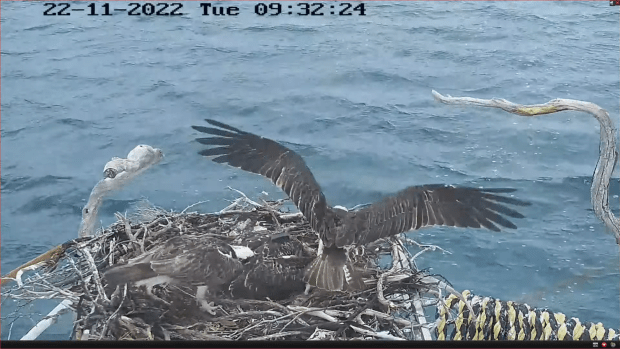
It was nice to see Zoe with a great big fish delivery from Dad. At 0701:14, Zoe sees Dad arriving.

At 0701:20, Dad lands on the nest. Mum begins to fly over from the ropes to the nest.

It was a big fish, not a teaser. Mum seemed to hope there would be some left but, Zoe does love her fish! And has a history of being unable to share.

By 0735, Zoe has finished the entire fish!

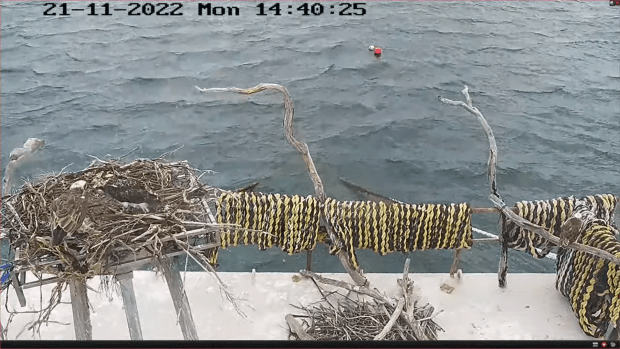
At 0801, Zoe sits with Dad over on the ropes. He doesn’t seem to have budged a centimetre from the earlier image above.

At the scrape box of Xavier and Diamond on the campus of Charles Sturt University, Diamond was having a nice siesta in the afternoon sun. She is so beautiful. Her and Xavier must be very happy with Indigo’s progress.
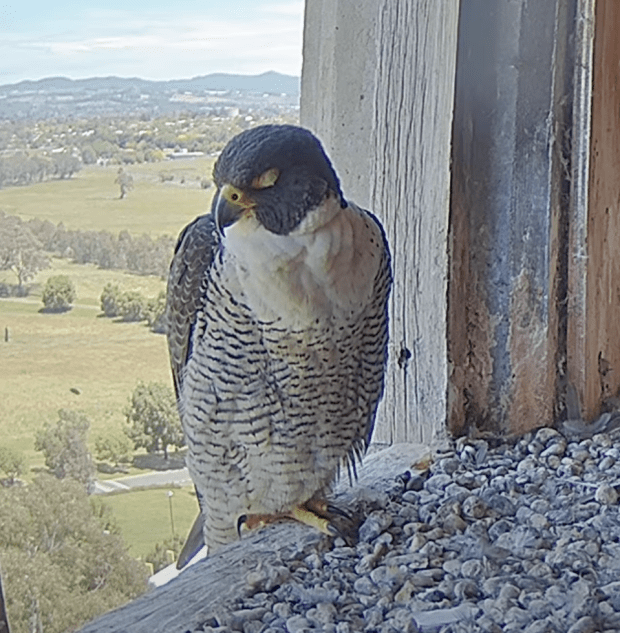
Indigo arrives and thinks the ledge is a good place for an afternoon nap, too.

Elain has another great highlights of the Day for our Orange Falcon family.

The biggest news in Bird World continues to be the competition for Gabby’s heart and nest.

In order to try and keep the identification of the suitors separate and apart from one another and Samson, the AEF have gone to identifying the birds using their tail feathers.

Tail Comparison: Top Row L to R: Samson, V1. Bottom Row L to R: V2, V3

I have not seen V2 at the nest today. There is now the third male, V3, who has been working on the nest and Gabby has not chased him away. Gabby even got into the nest with V3 for a bit.

V3 has slept on the nest and is very alert.

There is very little known about Gabby including her age. She became Samson’s mate at this nest in 2018. She was an adult so she is at least 9 years old now. She has a nest in a good location and there are many suitors. To date, I do not believe we have noticed a brood patch on Gabby. A brood patch is the spot where the feathers do not exist – they fall out when it is time to incubate eggs. The skin of the adult touches the eggs and helps to keep them warm. If the feathers would there, the warmth of the parental body would not exist – so this brood patch has developed over eons to assist the eagles with incubation.

Wonder who Gabby will choose? There seems to be plenty of time so as the AEF suggests, get some popcorn and sit back and watch. It truly is a soap opera. Meanwhile, Harriet is only letting M15 have a little incubation time while Anna down at the KNF nest in Louisiana loves to give Louis plenty of time with their eggs.

M15 brought Harriet a tasty treat today, right off the Road Kill menu – rabbit. Harriet wanted it plain, not in a cassoulet.

Meanwhile at the Kistachie National Forest nest, Louis is getting another chance to incubate the eggs overnight. Wow! These young eagle mums are really sharing the whole experience with their mates. It looks there is some rain and a little lighting near the nest in Alexandria, Louisiana.

Congratulations to Superbeaks – the Central Florida Bald Eagle nest – on their second hatch as announced by Paul Kolnik on Bald Eagles 101.

‘A’ reminded me that Wisdom is not only the oldest Laysan Albatross in the world but she is also the oldest banded bird in the world. Incredible. There is a new announcement from the Midway Atoll. It seems that Wisdom has returned and was seen on the 24th of November but, her mate has sadly not. Will she get another mate? We wait to see. What an amazing seabird Wisdom is…incredible.

Remember that Ferris Akel has his live tour on Saturdays starting at noon Eastern on YouTube. Today, he didn’t catch big Red on the Cornell Campus, our queen of the Red-tail Hawks. Ferris did find her mate, Arthur – and it is always good to see either of them and extremely special when it is both.

Some thoughts from David Suzuki.

Thank you so much for joining me this morning. Take care everyone. See you soon! One last one to put a smile on your face – the ever loving Jackie and Shadow kissing in the nest yesterday while they did renovations.

Thank you to the following for their posts, videos, and streaming cams that make up my screen captures: David Suzuki Foundation, Bald Eagles 101, Ferris Akel Tours, US Fish and Wildlife Services and ‘A’, Tonya Irwin and KNF Bald Eagles FB, Lady Hawk, SWFL Eagles and D Pritchett, NEFL-AEF, the AEF FB, Elain and Charles Sturt Falcon Cam, Charles Sturt Falcon Cam and Cilla Kinross, Port Lincoln Ospreys, Cornell Bird Lab, and FOBBV.

Early Saturday in Bird World

10 December 2022

Good Morning Everyone from a snowy, icy landscape – the Canadian Prairies. As many of you suggested, it was a huge culture shock going from bright sun and warm seas to frozen. It is always good to be away but, it is equally nice to get ‘home’. Thank you for all your wonderful letters and best wishes. I had an epic time!

The big news is still coming out of Samson and Gabby’s nest in The Hamlet near Jacksonville. Will there be a nest take over? will Gabby get a new mate? where is V2 this morning as I write this? did Samson appear? Wow. Everything else pales in comparison.

This is a short catch up on some news that we are following this morning.

I want to start with a disgusting arrogant display that has gone viral. It was posted by Geemeff, one of our readers.

What a disgusting individual.

Was it Samson visiting the NE Florida nest? We would have to see his toe – one is flattened. But, gosh, it sure looks like him.

Maybe the word is out and all of them know that Gabby is now single (sadly) and they are lining up for her to choose? They should try bringing her fish!

There was a musical nest. V2 was there and gone, then Gabby left and V2 returned, and then he saw Gabby and escorted her back to the nest.

Postings of a third visitor.

But where was V2 last night. It looks like Gabby spent the night alone – again!

Gosh, I love these daily videos that Elain posts of the highlights at the Orange scrape in Australia of Diamond and Xavier. That little Indigo reminds me so much of Izzi – chasing the parents out of the scrape in the morning, pair bonding, and snacking.

Why do I like them? Elain edits the entire day into a short video and includes the main highlights.

Now for a few smiles.

Falcons in the Middle East fly in their own 747s. Challenger the famous US Eagle in the care of the American Eagle Association likes to fly SW Airlines.

Have you been following the World Cup of Birds? Let’s see who is left standing! Pick your favourite bird out of those left and follow what happens. Morocco stunned everyone when they beat Brazil putting the Rufous Bellied Thrush out of action. So will Moussier’s Redstart take home the cup? England is playing France today – the Robin vs the Gallic Rooster! Stay tuned.

For all Osprey fans, there is an Osprey still in Londonderry today – at the Bann Estuary. Does this bird know something we do not know? I mean seriously shouldn’t he be sunning himself in Spain right now or Africa? or does he need to get out of town quick?

Zoe is flying over shallow water and getting those wings to work. Dad brought Zoe 3 fish yesterday and Mum brought her 1. They are taking good care of their daughter! Here is her most recent tracking release.

We haven’t done a check on Karl II’s family recently so let’s have a look and see where Waba and Bonus are today.

Waba is still loving Sudan and fishing at the Nile River.

Bonus started flying over the Eastern Desert. There has been no transmission since the 4th of December. We wait. Please send Bonus your best wishes.

Thank you for being with me for this quick look at what is the main story in Bird World – Gabby and her nest. Send out your warmest wishes to Rita who is healing nicely in Miami and to dear Alden and Samson – we wish you would still appear! Take care everyone. See you soon.

Thank you to the following for their streaming cams, videos, and posts which make up my blog this morning: NEFL-AEF, Bald Eagles Live Nest Cams and News, Charles Sturt Falcon Cam Project and Cilla Kinross and Elain, American Eagle Live Nest Cams, Southwest Airlines, Raptors of the World, Port Lincoln Ospreys FB, Looduskalender, and Geemeff.

Fish feast for Zoe…and other news in Bird World

25 November 2022

Good Morning Everyone,

I hope those of you that celebrated Thanksgiving had a lovely celebration. It was another warm day in the garden. Today it will be 6 degrees C. The sky is a beautiful blue and the sun is bright. There should be a lot of activity in the garden. I am quite enjoying watching the Starlings and the Sparrows flit about their lives enjoying the Butter Bark and the soft suet. It is hard to imagine that they are both vulnerable and in decline and on The Red List in the UK but, as I am told by many, their lives are so precarious and the Avian Flu last year could rear its ugly face again this year.

I just think that the Starling below is quite stunning. The so called ‘white’ spots on their bodies during the non-breeding season actually look silver in the sunlight. That coupled with those magnificent rust and rust tipped ebony wing feathers make them stand out and yet, if you don’t know they are there, they blend in quite nicely with the bark on the branches of the Lilacs.

Dyson has been coming for peanuts for several days but, instead of running about storing them, she has stopped and taken the time to eat several before scurrying about. She is really adorable. I notice that her colouring is also changing. Some of the youngsters have great tufts coming out of their ears now. I will see if they will sit still long enough for me to get a photo for you soon.

Junior was about today along with a least one of the three fledglings but Mr Crow and his family were not about. I wonder where they found food. It always scares me if I see road kill as I know they will chance it to get some food. I wish everyone would stop and if they see road kill get out and move it to the side of the road, way off the shoulder, if it is safe for them to do so.

The Australian Nests:

I cannot possibly tell you how quiet it has gone in Bird World now that all of the Australian birds have fledged. You might already guess that Xavier and Diamond are taking good care of Rubus and Indigo and that Zoe is screaming her head off for a fish. Dad went out and came back with nesting material. What in the world is up with the fishing in Port Lincoln?

Cilla posted a prey transfer for Indigo that took place yesterday in Orange.

Dad brought in a fish for Zoe at 09:56. She ate the entire thing. The fish tail went down at 10:21:08. Dad ‘appeared’ to have a crop. Mum was sitting on the ropes as she is above. Will Mum get anything to eat?

With Dad appearing to have a crop and Zoe getting a fish, what is there for Mum? Has Dad decided now that the chick has fledged, his duty is only to feed it and him and Mum can fend for herself? It is certainly common at other nests.

Mum did not sit around. She has proven herself today. She brought in a nice fish for her and Zoe at 13:30:31 and another one at 14:39:40. Indeed, Mum was on the nest with Zoe and flew off quickly as if the fish had skimmed the water near the barge. Isn’t this just excellent! Everyone will have had a good feed today.

Indeed, Mum was just finished feeding Zoe the 1330 fish when she spotted the next one. We will have to start calling her ‘Eagle-eyed Mum’.

Off she goes!

Zoe and Mum are having feasts today while Dad sits on the perch. Good for Mum. She is going to make sure that her and her daughter are well fed.

In his book, After They’re Gone. Extinctions, Past, Present, and Future, author Peter Marren says of the Ospreys, “To survive the Sixth Extinction, it may help to be useful- useful to humankind, that is” (164). Marren continues on the following page, “In Britain, nesting ospreys and sea eagles attract tourists and hence income to places that need it” (165). Every place that has wildlife should heed Marren’s words. They should consider the environment and rush to bring it back to life because those beautiful animals and birds and the landscape that is cared for and respected will help with the economy in the future. Indeed, my granddaughter is looking for a place for a holiday to see birds and animals. It would be truly sad if I had to tell her to go to a zoo!

Making News:

a little change from plants- hen harrier looking for dinner.” by island deborah- New Book ‘Song of the Sparrow’ vig is licensed under CC BY-SA 2.0.

Well, to tackle this entire issue of the vulnerability and extinction of the Hen Harrier, Hen Harriers will be bred in captivity and released in England on the Salisbury Plain. Twelve birds, six males and six females, have been brought from France and Span to establish the breeding pairs. This is a project between Natural England and the International Centre for Birds of Prey. Their goal is to release 100 birds over the next 5 or 6 years.

Fantastic. You can read more about this intervention to increase biodiversity here:

https://www.theguardian.com/environment/2022/nov/23/hen-harriers-to-be-bred-in-captivity-and-released-on-to-salisbury-plain?CMP=share_btn_link

I have become increasingly aware of these magnificent birds over the past year and have devoured as many new books on them that I could. There are a couple that I have quite enjoyed and will mention if you or someone you know is interested in the life and the plight of these magnificent birds of prey. They are Bowland Beth. The Life of an English Hen Harrier by David Cobham, The Hen Harrier’s Year by Ian Carter & Dan Powell

Hen Harrier male (Circus cyaneus) illustrated by the von Wright brothers. Digitally enhanced from our own 1929 folio version of Svenska Fåglar Efter Naturen Och Pa Sten Ritade.” by Free Public Domain Illustrations by rawpixel is licensed under CC BY 2.0.

The problem is the illegal killing and the destruction of the land that supports these beautiful birds. So when will the courts begin to crack down on those who persecute the raptors?

A nauseating story is coming out of County Down, Northern Ireland of a lovely Buzzard found with a plastic bag around its neck hanging on a tree. Unbelievable. Just look at that face and that gorgeous plumage.

Inquisitive Buzzard” by John C Williams is licensed under CC BY-ND 2.0.

Here is that Story.

Dead buzzard found hanging from a tree in County Down – Raptor Persecution UK

Each year the Raptor Persecution UK puts out a report on the killing of raptors and, sadly, this year – 2022 – has been the second highest record in history. What a tragedy and why is this happening?

RSPB’s 2021 Birdcrime report reveals second-highest figure on record – Raptor Persecution UK

Fieldfare on a cherry tree” by hedera.baltica is licensed under CC BY-SA 2.0.

No 15. The Red List. The Fieldfare

FF 031 ~ Fieldfare~” by Mike Hazzledine — British Biodiversity is licensed under CC BY-NC-ND 2.0.

Fieldfares are a large member of the thrush family. The name Fieldfare comes from the Anglo-Saxon meaning ‘traveller of fields’. Look at the image above. They have the most beautiful light steel-blue-gray heads and wings. Their back, which you can see in the image below, is the colour of a beautiful Horse Chestnut. Their tails are black. Their ivory breast is spotted with a deep espresso tinged with chestnut. A peach wash makes a gorgeous collar. Their back end is a grey and they have black legs with touches of black around the eye. The female looks very similar to the male but has slightly more chestnut than the blue-grey and some consider the colouring more ‘dull’ on the female. There is an image of a female feeding her nestlings below. Make up your own mind if she is dull!

The decline of the Fieldfare from a handful of breeding pairs to now only one or two brings much sadness to many British birders. The author of the entry in Red Sixty Seven, Nick Acheson, writes about Joe Harkness another author whose book, Bird Therapy, speaks to the joy that birds bring to all of us. In writing about the Fieldfare, Harkness says that he is elated when two Fieldfares visit his garden during the winter’s snow and ice. Acheson says that Harness’s joy comes “not from the beauty of the birds, though beautiful they certainly are, not from their rarity, for per se they are not rare at all (globally). His joy comes from their shining witness, perceived – this once – in a place of domesticity.” Indeed, Fieldfares are not found in fields despite their name and do not frequent gardens but are mostly seen on the wet hawthorn hedgehops, Buckthorn bushes in the sand dunes along the sea.

Fieldfare” by Linton Snapper is licensed under CC BY 2.0.

The Fieldfare is not a thrush but it can be found spending time with flocks of thrushes during its migration from Northern Europe to spend time in Britain in winter. In the Scandinavian countries, they are known as Birch Thrushes or Bjorktrast. There they feed on berries until they arrive in Britain in mid-September where they roam the country side, the fields, the hedgerows and the gardens looking for food. In particular, they will search for berries from the Rowan, Hawthorn, and Holly. In farmlands, they feed on invertebrates and earthworms.

Fieldfare on a cherry tree” by hedera.baltica is licensed under CC BY-SA 2.0.

The decline of the Fieldfare is due directly to the steep decline in insects. Studies in Europe have shown that the biomass of insects in Germany has declined by 75%. The decline is serious in other countries and this is due directly to the use of pesticides. Climate change is also playing havoc with these lovely little birds. Milder temperatures in the northern countries and then quick freezes have cost the lives of nestlings. Many Fieldfare have also chosen not to migrate which is one reason there is the decline in numbers in the UK. Of course, the Northern European countries are not the only ones that are using pesticides. In the UK, there are similar issues and declines in birds that depend on insects for their food source.

Oh, thank you so much for being with me today. Take care all. See you soon!

Thank you to the following for their posts and streaming cams where I took my screen captures: Charles Sturt Falcon Cam and Cilla Kinross, Port Lincoln Ospreys, Openverse, The Guardian, RSPB, and Raptor Persecution UK.

Falcons and Football…and more in Bird World for Tuesday

22 November 2022

Good Morning to Everyone!

It has warmed up on the Canadian Prairies – and because of that the heating is not on as much and it is damp and cold. Believe me, we always grumble about the weather. It is to be 0 degrees C today! It will cause things to melt a bit and get all slushy – there is nothing worse than chills to the bone. It will be a good day to go to the pond and see if there are any of those Wood Ducks still hanging about. Images (sadly I do not have permission to share them – yet) have been coming in that are showing 50 or 60 Bald Eagles just south of our City in the trees alongside the Snowy Owls. It is quite incredible.

In the Mail:

There are times when we just need something to put a smile on our face. When I lived in Norman Oklahoma and went to the University of Oklahoma, it was impossible not to be an OU Sooners Football Fan. I can still smell the damp leaves in the fall covering the sidewalks on the way to the stadium. When ‘B’ found out about this, he sent me the most fabulous image. As we all remember – too well – there was a time in 2020 and 2021 when large gatherings of people were forbidden due to Covid. One of those was, of course, the popular football games in the US. So, the University of California at Berkeley, put up cardboard cut outs of viewers. Guess who got the prime seat? Look!

That is fabulous. Our own Grinnell. Alden is wonderful but there was just something about Grinnell that made him ever so special. It is hard to lose them.

Thank you ‘B’.

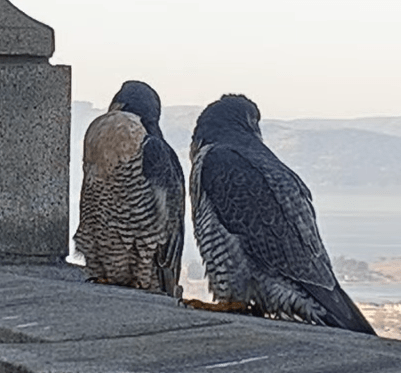
The other day Annie and Alden attended all the celebrations for the latest football game at Berkeley when the Cal Golden Bears beat the Stanford Cardinals 27-20. Our adorable Peregrine Falcon couple went up to the ledge, spent some time there recuperating (was it 3 hours?). ‘H’ sent me a link to the video of them sitting and leaving together that she made for us to enjoy. Thank you ‘H’.

Making News:

There is news coming in about the streaming cams and nests on Captiva Island -the Bald Eagle nest of Connie and Clive and the Osprey nest of Andy and Lena.

The Dfyi Osprey Project in Wales is reporting that there are two beautiful Red Kites on the Dyfi Osprey nest of Idris and Telyn. Aren’t they ever so beautiful? Just look at that plumage. I don’t know about you but I am simply mystified at how beautiful these raptors are – the falcons, the kites, the kestrels, the Merlins, and the Harriers. You can take the same colours and shake them up and each one is slightly different than the other. I have to admit that the Red Kites are quite stunning with those icy blue heads and amber eyes, bright chrome-yellow cere and short hooked beaks with its black tip. The terracotta or rusty sort of Corten Steel colour of the tails (reminiscent of the Red-tail Hawk) set against the dark chocolate trimmed with white is outstanding.

You can check on all the birds that use this nest by going to dyfiospreyproject.com

There is no rest for Dr Peter Sharpe of the Institute for Wildlife Studies. Those who watched the Channel Island’s Bald Eagle nests will remember Dr Sharpe climbing up to rescue Lancer at Two Harbours, getting a chick of the cliff at the West End, and going in and taking Victor to the Ojai Raptor Centre last season. He is now busy working on the cameras. Here is the announcement from the IWS.

Everyone is getting ready for the Bald Eagle breeding season. Speaking of that, Samson and Gabby were caught mating on the nest today just like Harriet and M15 were a week or so ago. Eggs should be coming shortly. Will there be holiday eaglets?

Philippe Josse reports that progress is certainly being made on the Notre Dame Eagles nest – the natal nest of dearest Little Bit ND17. Please join the FB group Notre Dame Eagles for up to date information on this family.

Terry Carman is keeping track of the Bald Eagle eggs on the streaming cam. Here is the latest report — and all bets are on Harriet and M15 having their first egg today at SWFlorida! If you are looking to track Bald Eagle laying, please head over to this great FB group. There you will always have the latest information.

Checking on the Australian Nests:

Zoe is 66 days old today. She could fledge at any time. She is doing some good hovering and has nailed stealing the fish when Dad brings it to the nest! And you know what? She is gorgeous. When the wind whips her crest up it accents those focused piercing eyes and that very sharp hooked black beak. The dark black eye line just makes her that more gorgeous.

The winds are at 26 kph right now. Gusty for our girl. I hope she does not get swept up when she is practising her hovering. Zoe is getting better each day at that hover but, still. We saw what wind gusts can do with Rufus. I prefer that they take off on their own!

In Orange, Xavier and Diamond seem to be having prey drops with Indigo. She is really doing well!

Look carefully over at the trees!

Yesterday Shines found Rubus on the ground next to the road and put the little fella back up in the Waddle Tree.

I have to admit that I am a wee bit worried about Rubus and that is only because there have been no reports of any feedings. That is not to say they have no occurred. Diamond and Xavier are cracker parents and I think they are decidedly trying to lure Rubus back up to the scrape. It is possible that he does not feel confident to fly. Has anyone seen Rubus flying since he fledged/fledged?

Some more photos of Rubus higher in the Wattle Tree.

Every once in awhile one of the parents goes up to the scrape. I think they are really trying to lure Rubus back into the box.

Xavier is keeping an eye over everything happening with his two fledglings from the ledge of the box.

At 1540 Indigo comes up to the scrape box prey calling, very loudly, and Xavier immediately takes off. Indigo stays in the scrape looking for prey amongst the feathers. Will Xavier return with something from the storage vault?

Indigo spent the night in the scrape box last evening.

I urge you to check out the wonderful website that has gone up at Orange. Cilla Kinross and her great team have put together cracker content and you can get up to date information on our falcon family there with their photographs.

That link is: falcon cam.csu.edu.au

No 12 The Red List: The Merlin

Merlin Falcon” by minds-eye is licensed under CC BY-NC-ND 2.0.

Oh, it is hard to imagine that this lovely little raptor is on the vulnerable list in the UK. But, if it is happening there, it is possible that there are declining population numbers elsewhere. Ruth Tingay, writing in Red Sixty Seven, describes the birds as feisty and dashing with their “rapid fire kek, kek, kek, kek, kek” that demands everyone’s attention. Tingay first saw Merlins in the wilds of the Hebrides, those remote islands off the west coast of Scotland. She then saw them again in an urban setting in Idaho and said she was shocked because she always associated them with great open spaces.

Look at the colour of the plumage! They are smaller than a Peregrine Falcon measuring at most 30 cm or 12 inches in length or the Red Kits who grow to approximately twice their size. The male Merlin has dark steel blue grey upper wings, tail and top of the head. The underwing – the primaries and the secondaries are the same dark grey barred with a lighter grey. There is a fine white eye line, magnificent rusty-orange with dark chocolate barring on the underneath, on the legs and the upper part of the wing. The deepest dark 70% cocoa eyes, a white beard and throat. The beak has a black tip fading into that grey blue and a yellow cere. The legs are chrome-yellow with deep black talons.

Merlins are described as “our smallest falcon, male smaller than the female, not much bigger than a Blackbird.” They live on the moors and open fields where they breed but travel to the south and the coasts of the UK for their wintering grounds. Here is their map.

Seriously adorable but, in the sky and hunting, they are formidable for the smaller birds.

Falcon” by Terry Kearney is marked with CC0 1.0.

The Merlin was a popular hawk of Mary Queen of Scots and became known as the Queen’s Falcon or Lady’s Hawks. Royalty and women of the aristocracy would use them to hunt Sky Larks. They are a fierce hunter capturing their prey from the air, high up meaning that they have to have a very calculated effort. They normally hunt small to medium sized birds bit have been known to take pigeons, ducks, and even plover.

Sadly, they are quickly losing their habitat, pesticides and secondary poisoning, and of course the shooting by the keepers of the estates where Red Grouse hunting takes place. Other causes of death are collision and cat predation. There are many other threats. Corvids, such as Crows and Jays, will eat the eggs and the nestlings if they find them and, indeed, Merlins do not build their own nest but reuse the nests of others including Crows. Larger Raptors such as Peregrine Falcons, Great Horned Owls, and even Goshawks are a threat but all others tend to steer clear of this small falcon because of its aggressiveness.

Climate change will impact this small spirited hawk. Audubon has set up a programme to try and predict the changes to its breeding habitat. As you can see they will be pushed further north to where it is cooler. With the polar ice melting and the seas warming, I wonder how long it will be cooler in the north?

Some new books have arrived and I will be anxious to tell you about them as I work my way through. For now I am trying to scout out all the birding sites on the island of Grenada in the West Indies so that I can – hopefully – send you some images of birds that are either old friends or new ones. My son will probably never invite me again! He gets another location or two each day – . I was told tonight to bring my gum boots and lots of mosquito repellent. So for dear ‘L’ who was worried that the newsletter might stop while I am away, ‘no’ it will not. You are all going on my birding adventure with me!

Thank you so much for being here today. It is so nice to have you with us. Please take care of yourself – and I will see you soon!

Thank you to the following for their letters, their posts, their videos, and their streaming cams where I took my screen captures: ‘B’ so grateful for that image of Grinnell, ‘H’ for her great videos, Captiva Island Eagles and Ospreys FB, Dyfi Osprey Project FB, IWS, Notre Dame Eagles, Bald Eagles Live Nest Cams and News, Port Lincoln Ospreys, Charles Sturt Falcon Cam and Cilla Kinross, the Falcon Cam Blog, Open Verse, and Audubon.org.

Annie and Alden, a whopper for Zoe and some serious hovering…early Monday in Bird World

21 November 2022

Oh, the best of the morning to all of you! I hope this newsletter finds you well and happy and taking some time to de-stress out of doors if you need it — or watching our marvellous birds from inside your home or on the streaming cams. It is so nice to have you hear with us.

The weather continues to be wintery with no break now until spring, late spring normally here in Canada. The garden animals have been all flooded up keeping warm. Me, too! It is, however, very hard to imagine that in 40 days it will be a brand new year.

Dyson never disappoints in her ability to find and get food efficiently. She has a perfect spot on a branch where she sits and can eat right out of the bird feeder!

The Starlings really are lovely. This one flew down to check out what the Blue Jay was interested in on the deck but, normally they always stay in the lilacs or the back trees.

The Starlings and Sparrows share the Butter Bark.

In the Mailbox:

‘J’ sent a link to a blog that some of you might find interesting. It goes to the heart of our earlier discussions about birds and emotions. Thank you ‘J’!

Website of Gaby Schulemann-Maier: https://nam12.safelinks.protection.outlook.com/?url=https%3A%2F%2Fwww.birds-online.de%2Fwp%2Fen%2Fbirds-online-english%2F&data=05%7C01%7C%7C49ef41f33eef4818ef3508dacb2dc009%7C84df9e7fe9f640afb435aaaaaaaaaaaa%7C1%7C0%7C638045694605754558%7CUnknown%7CTWFpbGZsb3d8eyJWIjoiMC4wLjAwMDAiLCJQIjoiV2luMzIiLCJBTiI6Ik1haWwiLCJXVCI6Mn0%3D%7C3000%7C%7C%7C&sdata=v%2Fr%2BhO5flt0reUFvtxw5W3DyZoKqhMrl8uH5CodWB7E%3D&reserved=0

‘BG’ and I both agree that we neither fans of soccer or Twitter but, a World Cup of Birds – yes! Each team in the World Cup has been assigned a bird. Let’s follow and see who wins. Thanks ‘BG’ for sending me this!

Jer Thorp: “We’ve got 4 days until the World Cup. 4 days to decide the MOST important question: Which country in the tournament has the best national bird? 16 birds have already flown home. 16 are ready for glory. Welcome to the knockout stages of the #WorldCupOfBirds!!!”

Making News:

‘B’ sent me a note. Annie and Alden were on camera at The Campanile on the grounds of UC-Berkeley on Sunday. I admit to shedding a couple of little tears – tears of joy – to see them together and with such a nice crop. Looking forward to screaming eyases. Can’t wait. Thank you ‘B’. I know that everyone has been wondering about this lovely couple – Alden another one of those amazing males that stepped in and saved the season.

Emyr Evans of the Dyfi Osprey Project in Wales has permission to post all the information about Paith. Faith was the youngest of the three osplets (2 females, 1 male) of Idris and Telly at the Dyfi nest. The information that Evans has comes from early September – so awhile ago but he just received it. Faith was in Brittany, one of the northern most areas off France and due south as straight as a crow could fly from her nest in Wales. Is she on her way to Africa? or will she overwinter in France?

To get the full story and see the maps, and migration ages of the osplets from Dyfi, please go to dfyispreyproject.com

Tiger Mozone has also posted some information that indicates there are Ospreys that do over winter in this area of France. I think this is really interesting because it is always presumed that the birds go all the way to Africa. It appears not and we do know that many are now over wintering in Portugal and Spain. It may help with the decline in populations due to migration incidents and it might also speak to the changing landscape in Africa in terms of fish availability.

Congratulations goes out to Dave Anderson who has won the prestigious prize – the RSPB Species Award. Anderson is well known in the UK raptor world for his work with White-tailed Eagles and, in particular, promoting research on them by using satellite tracking. I cannot think of a more deserving person. You can read all about him and his extensive work with raptors – a life dedicated to bettering theirs – by clicking on the link in the announcement below.

Australian Nests:

Early Monday morning in Australia, Xavier went to the scrape box with a nice prey item for breakfast. Was he trying to lure Rubus and Indigo to the box?

Indigo will arrive in the box and will be seen on the top of the tower but, Rubus did not fly up to join Indigo. They have been seen in the trees and it would appear that all is well. Xavier was there with them for some time and Diamond was photographed flying around the trees keeping guards on her precious fledglings.

News has come in regarding Rubus today: “Rubus fledged yesterday at 0818 h and has been found alive and well in a pine shelterbelt a few hundred metres from the tower. He was in a tree (so can fly at least a bit). He was still in the same area this morning, but a bit closer to the tower, He was found on the ground and placed in a tree in the woodland.”

Shines found Rubus and wrapped him in a blanket and placed him on the tree branch. Thank you, Shines!

Xavier and Diamond have both been in and out of the scrape. It is entirely possible that they are trying to lure Rubus back into the box so that he can rest and they can feed him there.

In Port Lincoln, Dad flew in with a whopper for Zoe at 1015. Port Lincoln has a severe wind alert for gusts up to 34 kph. Mum and Dad are very smart. This is one way to keep Zoe on the nest – a big fish!

Mum flies in while Zoe mantles the fish.

Just look. Dad had a good feed and Mum is looking down knowing there should be some left for her, too. I wonder if Zoe will want all of this fish to herself?

Zoe is trying. She has her talons in the fish holding it down and is doing a pretty good job eating away.

That is a big fish!

Mum would really like to have some of that nice fish but Zoe isn’t quite ready to give up.

At 11:56 Mum takes control of the fish. Zoe looks like she wants Mum to feed her. She has not made much progress on it herself.

Mum had different ideas. She wants some fish, too and it looks like Zoe ate enough to have a nice crop. Mum flies away with that fish so she can enjoy it all to herself. I wonder if she will bring any of it back to Zoe?

Zoe was not happy!

Of course, the answer is ‘yes’. Mum ate her fill and returned to the next some time later to feed Zoe.

That fish was sooooooooo large that the entire family had a nice big meal. How grand. Thanks Dad!

Zoe did some serious helicoptering. She is ready to fly! It will be soon.

No 11 The Red List: Montagu’s Harrier

Montagu’s Harrier (Circus pygargus” by Ian N. White is licensed under CC BY-NC-SA 2.0.

Montagu’s Harrier is the most rare of any of the birds of prey in the UK. This incredible raptor was not in any nest records in the UK in 2020 nor in 2021. Their numbers began to decline in 2015. That year there were only 5 nests in the UK. It is feared that they might already be extinct, not just vulnerable.

These are magnificent raptors that fly low, like the Hen Harrier, in search of rabbits, small birds, lizards, insects, and shrews. They also soar high above the fields in the thermals and their flying and hunting has been described as ‘spectacular’.

Just look at that stunning plumage. Again, it is anything but a drab grey. How about a light blue steel grey on the wings with a light cream around the eye, a very slight dark blue grey eye line and band around the cream. How else would you describe this magnificent species?

Montagu’s Harrier – Circus pygargus (male)” by Tarique Saniis licensed under CC BY-NC-SA 2.0.

They are a medium sized raptor, 43-47 cm long, that is slim with very long pointed wings like a Hen Harrier. They have a long tail. The upper body of the male is grey. The primaries are black and the secondaries have a black stripe or band across them. They are white underneath. The female is a gorgeous dark brown. The bills are hooked and black with a bright chrome-yellow cere. Their legs and feet are also chrome-yellow. Notice the striking yellow eyes.

The demise of the Montagu’s Harrier is due to the over and expanding use of pesticides, the expansion of fields into modern agriculture, the destruction of their nests which are on the ground in the fields during harvesting. In addition, their food sources have declined dramatically due to the use of pesticides! These raptors need protected areas for nesting and an end to the use of contemporary pesticides that kill the birds by secondary poisoning or by killing their food source. The Montagu’s Harrier migrates to Africa and so, in both of their respective homes, they are subject to ever expanding agricultural practices and the use of deadly poisons. Those poisons should be banned internationally. They are also quite dangerous to humans. Ask anyone who has lived around a farm in Canada who has developed asthma and breathing issues early in their life.

This is an immature. Notice that gorgeous rust brown above the yellow legs, the barred tail with the grey and espresso brown, the light grey around those chrome-yellow eyes…what a beauty.

Montagu’s Harrier immature” by Rainbirder is licensed under CC BY-NC-SA 2.0.

I couldn’t leave without posting an image of a mature female Montagu’s Harrier. These females are stunning in their own right. Look closely. Their plumage is anything but a drab brown. Starting with the head and around the eyes, that bright chrome-yellow cere stands out amongst that deep chocolate brown. The white around the eyes with the espresso eyeliner and eye liner inside of the dark espresso band on a camel coloured head and breast are brilliant. It took a lot of the crayons out of the box to come up with this outstanding colour palette. That camel mixes with the deep chelate again on the back, and the wings while holding its own on the breast, chest and underparts. She is gorgeous.

File:Montagu’s Harrier, juvenile, Bangalore, India (edit).jpg” by Cks3976 is licensed under CC BY-SA 3.0.

Oh, thank you so much for being with me today. It is always my pleasure to carry on and on and on about the beautiful feathered friends that bring us so much joy – and most often, tranquility. Take dare of yourselves. See you soon!

Thank you to the following for their posts and streaming cams where I took my screen captures: ‘BG’ for the World Cup of Birds, ‘B’ for letting me know about Annie and Alden, ‘J’ for her great link in the mail re birds and emotions, Cal Faldons, Dyfi Osprey Project, Gregarious J Toonen for Ospreys Pandion Haliaetus FB and Tiger Mozone, Port Lincoln Ospreys, Charles Sturt Falcon Cam and Cilla Kinross, and Open Verse.

Sunday News in Bird World

20 November 22

Greetings from a wintery wonderland on the Canadian Prairies. We have snow – thankfully not like what has been landing in the Great Lakes area of the US. Just lovely snowy drifting down giving everything a crisp clean Hallmark card ‘look’.

Before I go any further, Rubus and his fludged-fledge has been located in a tree near to Indigo by Shines. Later Indigo flies up to the scrape but has difficulty due to the very strong winds getting the landing perfect. It was like Rubus who had little control with those winds as he exited the scrape but greater control near the ground. Both are safe and sound. We can all breathe a little lighter! Zoe remains on the nest as I write this. So everything is, so far, alright at both of the Australian nests we have been watching. Only one fledge to go, Zoe, the Port Lincoln osplet.

If you missed it, here is Rubus’s start to his great adventure:

Thanks to ‘B’, who sent me this link, we can see Rubus and Indigo perched in trees! Thank you so much ‘B’.

This is the feeding recap for Zoe at the Port Lincoln Osprey barge up until 1500. ​06:14 Dad with partial fish. 06:14:12 Zoe steals fish from Mum.8:24:50 Partial by Dad. Zoe self feeds. 9:10:50 Zoe finishes the tail.

Making News:

Paith, the third hatch at the Dyfi nest of Idris and Telyn of 2022, has been spotted in another country. Emyr Evans needs permissions for all the details, etc. but this is fantastic news. Oh, tears. Need these third hatches to do well!!!!!!

The Melbourne Four make the news again and they are right. Who needs Netflix when we can have Nestflix?

https://www.theage.com.au/lifestyle/life-and-relationships/bird-s-eye-view-who-needs-netflix-when-you-can-tune-into-nestflix-20221116-p5bywe.html?fbclid=IwAR2MHVlDtBYcr46mtwCPkpd9gkSg7bJDEqoFy_7MiTjJu6XQcAoFQbneNiE

There was also just an amazing season tribute to the Melbourne Four that included ‘Old Dad’ (M17). Thank you for this! It came on a day when we needed some really positive news with Rubus fledging/fludging.

The Black-naped Pheasant-Pigeon was thought to be extinct. It was last seen in 1887. It has been found in New Guinea.

The very first egg of the season at the Kistanchie National Forest nest has been laid on Nest E-3. Congratulations!

Big Red was spotted on the Cornell campus along with one of the juveniles. It is always great to see Big Red, the international star of all Red-tailed Hawks! She is all flooded up to keep warm. Big Red had been spotted earlier out hunting – and it was successful. There is great comfort in knowing that she is alright. It seems that L4 is also still around the campus. That is also wonderful news.

No 10 The Red List: The Tree Pipit

Tree Pipit (Anthus trivialis)” by gilgit2 is licensed under CC BY-SA 2.0.

I have never heard of a Tree Pipit. As far as I know, we do not have them in Manitoba. Ed Douglas describes them this way, “Pipits are often regarded as dreary-looking birds, the avocado bathroom of the avian world. That only makes me love them more, but telling these flecked brown birds apart visually is a task of tooth-grinding attention to detail.” The Tree Pipit is a bit bigger than the other Pipets and its beak is thicker. “The Tree Pipit has a touch of swagger, strutting across the ground, tail pumping rhythmically, like a wagtail, as it hunts for insects.” The birds also breed on the ground laying a clutch of approximately six eggs in the grasses beneath the trees. Indeed, the birds like the woodlands and the fringes at the edges for raising their families. They flutter through the air in a way not dissimilar to a Black Capped Chickadee.

Tree Pipit (Anthus trivialis)” by gilgit2 is licensed under CC BY-SA 2.0.

Personally, I do not think they are Avocado Bathroom at all. The colouring is marvellous. Stop for a second and examine the range from a soft silvery white to the creams, the darker ash blonde, moving into the very dark blond and on to that deep 70% chocolate. They are stunning! Notice the white eye ring and the very subtle eye line.Move on to the wing and the teardrop pattern with the dark espresso lined by the white. Incredible. Striations only on the upper breast. This melody of brown and its hues is all topped off by velvety light rose legs and beak. I expect this little one to be wearing a matching light rose velvet hat with feathers carrying a matching handbag!

There are parts of the world where the Tree Pipit is of least concern but in the UK, its song and it are in dramatic decline. They migrate annually to Africa and when in the UK, their diet consists of insects gleaned from the woodland floor and old rotting trees. Declines can also be attributed to the use of insecticides and herbicides both in the UK and in Africa – to kill the insects which are then eaten by these small birds causing them to die. Secondary poisoning.

https://www.theguardian.com/environment/2021/jul/13/country-diary-the-song-of-the-tree-pipit-is-a-rare-pleasure?CMP=share_btn_link

Migration News:

Little Waba is still in the Sudan fishing at the Nile River near Nori. She is obviously doing very well. The temperature in the area today was 26 degrees C.

Bonus is also in the same area in Turkey in Konya Province. It is considerably cooler there at 13 degrees C. Bonus also landed on a transmission tower today and everyone was very, very concerned because of the deaths from electrocution. He left, thankfully!

Oh, the time just flies by. It is hard to believe that we have our first Bald Eagle eggs in Florida and in Louisiana now and that we have only one more raptor to fledge in Australia, Zoe. It is a good time of year to take a deep breath, to remember those lovely feathered friends we have lost, and to be ever so grateful for those that survived.

Thank you for being with me today. Please take care of yourselves. Looking forward to having you with me again soon.

Thank you to the following for their posts, their videos, and their streaming cams where I took my screen captures: ‘B’, Charles Sturt Falcon Cam and Cilla Kinross, 367 Collins Street by Mirvac, Looduskalender Forum, OpenVerse, Suzanne Arnold Horning, Cornell Bird Labs, US Forestry Service KNF Bald Eagle Nests, CTV News, 367 Collins Street by Mirvac, The Age, Ospreys. Ringed Birds and Sightings (UK), and 367 Collins Falcon Watchers.

Rubus Fledges!

19 November 2022

Thanks to ‘BA’ I was alerted to Rubus fledging. I have caught it on video for you.

It will not go off as the smoothest of flights out of the box. Rubus has landed in the trees below that we can see. Dr Cilla Kinross is on her way to find him.

If you look out at the skies they are dark and the wind is really blowing. While it might have given our darling boy a lot of lift, I sure wish he would have stayed home today.

Send all your positive wishes to Rubus. Congratulations to Diamond and Xavier on two fledges this year – two really strong beautiful Peregrine Falcon Fledglings, Indigo and Rubus.

Thank you to Charles Sturt Falcon Cam and Cilla Kinross where I took my video clip and screen capture.

Hovering, Nest building…Saturday in Bird World

19 November 2022

Good Morning Everyone!

I hope that you are well. So nice to have you with us this morning. It is a blue sky cold day, -14 C, on the Canadian Prairies. The kittens are up carrying toys and watching the Crows come for their morning feeding. The Grackles have already been to the suet feeder and the little Sparrows are all puffed up keeping warm in the lilac bushes.

It is a type of soft suet that the Starlings like. They can stand back and poke at it with their long sharp beaks.

The Blue Jays that fledged from the nest across the lane are still here. One was eating peanuts while these two were in the lilacs sunning themselves.

Nest News:

Yesterday Zoe got some really good height in her hovers. Thankfully she remained on the nest and did not fledge into those strong winds as that storm did roll in.

If you missed it, here are those beautiful early morning hovers.

Later, Mum is down in the nest with Zoe taking care of her only ‘baby’. Dad was not out fishing. If you remember, Zoe ate really well on Friday so did Mum. On Saturday morning, Mum took Dad’s fish and returned with the tail portion for Zoe. That has been the only meal so far and if the weather stays, it could be it for the day. Zoe will be fine. She is not going to starve.

Indigo continues to fly out of the scrape and return. This is excellent. Most of you watch the Bald Eagle nests as well as the Ospreys and it is ‘normal’ for fledglings to return to the nest for food, to fly and strengthen their wings being fed by the parents for a period of 4-6 weeks.

Rubus continues to do his wingers and the pair enthusiastically eat all that is brought into the scrape. There are still a few dandelions on Rubus but not many.

The brothers 9 days ago.

Just look at them all covered in down with Indigo revealing some lovely back and tail feathers.

Oh, little Rubus had to get to the front and jump in the beginning to get some prey. Hard to imagine now when both of them are screaming and running all over the scrape. Diamond and Xavier have raised two healthy feisty chicks.

‘A’ reports that it was raining so hard in Melbourne yesterday that the wipers had to be on full speed. Of course, all we can think of are the fledglings from 367 Collins Street. Positive wishes out to them to be safe and fed.

As the season in Australia winds down, everyone is on egg watch at the nest of Harriet and M15 in Fort Myers, Florida. The pair have been working diligently to rebuild their nest after Hurricane Ian. Sadly, that GHOW continues to plague our beloved eagle couple. Oh, I wish their nests were further apart!!!!

Harriet and M15 continue to work on their nest together. They are amazing.

Samson and Gabby have been at their nest, too, working away. They have had a three year old Eagle visiting the nest and I began to wonder if it could be Jules or Romey.

Mum and Dad have been rebuilding the nest in St Patrick’s Park in South Bend, Indiana. You will remember that this is the home nest of Little Bit ND17. They are making good progress and now, some snow has arrived. I sure wonder where Little Bit is! Gosh, we long for them to fledge and then we grieve to see them again hoping they survived that almost insurmountable first year.

Humane Wildlife Indiana sent out a clever fundraiser. They are asking for donations for the strays in their care to have a full fledged Christmas dinner. You can purchase one for one animal or more. I wonder why more animal sanctuaries do not do this? You might mention this to your local care group. It is a marvelous idea.

Making News:

Sadly, for the wrong reasons the adorable Melbourne Four make the news.

https://www.theage.com.au/national/victoria/collins-street-falcon-chick-dies-days-after-taking-wing-20221115-p5byi1.html?fbclid=IwAR22J_pnOqqPaRA8JqL7WcplN8ddPreG3bIpfCVw8kNgpVudjgCKWoSHXgI

Oh, our beloved Canada Geese are making news in the UK.

https://www.theguardian.com/environment/2022/nov/18/country-diary-canada-geese-are-on-the-move-with-a-melancholic-honk-but-why?CMP=share_btn_link

No 9 The Red List: The Nightingale

It is the song of the Nightingale that has attracted writers for thousands of years. Pliny the Elder described its song more than 2000 years ago when animals were denied artistic abilities. He wrote: “the sound is given out with modulations, and now is drawn out into a long note with one continuous breath, now made staccato . . .” Ellen Finkelpearl continues in her short article on Pliny and the Nightingale that he did believe, strongly, that the natural world including our feathered friends can be artistic!

https://classicalstudies.org/plinys-cultured-nightingale

If you are a lover of Shakespeare, you will know that the Nightingale shows up in more of the plays, not just when Juliet educates Romeo on the wonderful song of the Nightingale.

Wilt thou be gone? It is not yet near day.
It was the nightingale, and not the lark,
That pierced the fearful hollow of thine ear.
Nightly she sings on yon pomegranate tree.
Believe me, love, it was the nightingale.

Here is a fantastic blog that captures the portrayal of the Nightingale in all of Shakespeare’s works.

https://blogs.bl.uk/sound-and-vision/2016/04/shakespeare-and-the-nightingale.html#:~:text=The%20morning%20after%20their%20secret,is%20not%20yet%20near%20day.

In his entry in Red Sixty Seven, writer Luke Massey says, “…We should be ashamed that in our quest to clean our landscape, in our acrimonious divorce from nature, we have forgotten this songster and let it suffer. Despite its song we have ignored it ; we have let it fall silent in our copses, our scrub and our hedgerows. We have failed it and with that we have failed nature. Will we really let this be the last song of the Nightingale?”

Its very last space in the UK is under threat.

https://www.nationalgeographic.co.uk/animals/2018/04/last-stronghold-of-nightingale-under-threat

There are problems with the Nightingale’s wings getting shorter due to climate change. That is mentioned in this great report for The Guardian.

https://www.theguardian.com/environment/2020/apr/01/nightingales-at-risk-due-to-shorter-wings-caused-by-climate-crisis

Changes in farming practices, the destruction of hedgerow and copses for more modern farming are all adding to end the life of this most beloved bird who nests are on the ground. There are fewer and fewer sites for this beloved bird to raise their young safely.

As I read more and more of what we have done to halt the lives of so many birds, it is readily apparent that the world needs to return to some of the ‘old ways’ and continue policies or re-wilding if we are to save our precious wildlife.

In the Mailbox:

‘EJ’ was wondering how these transmitters work – like the one put on Zoe at Port Lincoln. She found a great article and you might be wondering how these transmitters work, too. Thank you, ‘EJ’. Here is the link. You should be able just to click on it.

Technology (ospreytrax.com)

Thank you so much for being with me today. Take care everyone. As I look at the weather report there is a severe weather alert for wind in both Orange and Port Lincoln. Maybe Zoe and Rubus – as well as Indigo – will take care today. Send best wishes to them!

Thank you to the following for their posts and their streaming cams that make up my screen captures: RSPB, The Guardian, Osprey Research, Port Lincoln Ospreys, Charles Sturt Falcon Cam and Cilla Kinross, The Age, Lady Hawk and SWFlorida Eagles and D Pritchett, NEFL-AEF, and Notre Dame Eagle Cam.

Hovering with Zoe!

18 November 2022

The eyes are all on Port Lincoln where it is the morning of the 19th of November. Zoe is all wound up just like Indigo was before she fledged. Oh, she wants to fly and she is getting some really good wind under those wings. We are so close to that first flight – the fledge!

I took a video clip for you to enjoy.

The problem is the weather. I am seeing overcast skies, chopping water, wind, and 100% chance of rain starting in less than six hours. Not a good day for a fledge unless Zoe is going to fly and return to the nest. We have come this far. I would hate for anything to happen to this super osplet.

Take care everyone. See you tomorrow!

Thanks Port Lincoln for your streaming cam where I took my video clip.

Indigo flies out and in…plus more news in Bird World for Thursday Nov 17

17 November 2022

Oh, good morning to all of you. Thank you so very much for being with me today. I am so very, very happy to be with you! Thank you for all of the wonderful stories that you have sent. I will be working my way through them slowly. Much appreciated. We woke up to more snow. Everything is beautiful and white!

The kidlets, Missy and Lewis, had their first vet visit. I am a glowing proud parent. They were soooooo well behaved. They are not litter mates and the adoption person told us that they might not get along with one another. I have not had more than one kitten since I was a child and did not know what to expect.

I remember one stray that someone left at our gate. when I was a child. Oh, I loved that cat. To me the drab brown tabby was the most beautiful cat in the world. My grandmother was very diplomatic and said, ‘He sure is sweet’. I begged to keep this one particular cat. My dad agreed since it was a ‘boy’. Well, he apparently didn’t check very good…a few weeks later we had a pack of kittens. That tabby lived for more than 10 years. She was incredibly sweet. It is very different, having kittens outside with their mother and kittens in the house – in a conservatory, with very large plant pots and tall vines with flowers, or trees…yes, trees.

But, back to the topic at hand. Lewis and Missy are the best of mates. They do everything together including eating out of the same dish at the same time, drinking out of the same dish at the same time, having to have their paws touch when they are sleeping or sleeping in the same tent. Always together. So off they went in the same pet carrier, not separate, together. Not a single peep. At the vet they were so content. Proud Mum here!

I got a tip from the technician at the vet. One of the biggest culprits for cats will be their teeth. I hope if you have cats and dogs are brushing their teeth or giving them things to facilitate good gum health and clean teeth. If you have tried brushing their teeth and it didn’t work, get a nice flavoured tooth paste. Lewis and Missy like the chicken. Take clean nylon stockings or panty hose. Cut a square. Wrap it around your finger, put a dab of the toothpaste on it and away you go. Be sure to do the back ones and those sharp canines in the front. You can get them used to what you are going to do by rubbing on the outside of their cheek for a couple of days. Small toothbrushes or those prickly things you put on your finger did not – at least not for these two. Panty hose do! And I swore I would never wear the darn things again after I retired. So glad there is some use for them!

Missy is the ‘alpha’ You might recall she had Lewis well aware that she is the boss immediately. The vet saw it too! Indeed, the vet smiled and said, “Always the female!” Anyone watching a raptor on a streaming cam knows this. I said nothing. The odd thing is Lewis is so solid and looks ‘so tough’ and Missey appears to be ‘so fragile’. So funny. Missy is half Maine Coon – but both, at the end of the day, are literally ‘alley cats’. Found new borns taken to the shelter from different parts of my city. We are so lucky to have in our lives.

Missey likes to get inside plant pots – with or without soil. This is the tiny artificial tree that has been put up. The soft felted birds have had to be removed. LOL.

Looking so innocent! “We didn’t do it!”

Today’s action was still at the scrape box of Diamond and Xavier. Those parents are really making sure that both Rubus and Indigo are well fed. What a fantastic couple they are. The moderator put some history in the chat today and for those of you that do not know – we now have at least three male peregrine falcons that we know of that have started out as step-fathers.

The last sighting of Diamond’s mate, Bull, was on 30 September 2016. Their erases hatched on the 4th and 5th of October. The first sighting of Xavier in the scrape box at Orange was on the 7th of October. He brought prey to Diamond and the babies on the 8th of October. The rest is history as it is with Alden at UC-Berkeley and M2022 at 367 Collins Street.

Aren’t they adorable? Every day Rubus looses more and more dandelions.

Everyone has been wanting to know when Indigo would fly again. He certainly has been eating well and enjoying being back home. Today, right before 14:38 Indigo got a little frantic, running around the scrape just like he did the day before he fledged. At 143802, Indigo flew out of the scrape box. He returned 35 seconds later! I caught it on video for you.

​RECAP of feedings at Orange: 05:29:41 X/quail; 05 32 39 X/St.Quail Indigo Grabs; 06:05 38 X/juv star; 8 39 04 D/prey 8 47 58 D takes leftover quail; 15 41 31 D/pigeon; 18 32 52 X/red-browed Finch; 19 06 55 D/Live Star

‘H’ sent this link to me. It is a split screen video that Cilla Kinross made of a feeding. Disregard the word ‘kestrels’. It is definitely Rubus and Indigo. Thanks, ‘H’. Delightful.

Indigo and Rubus both in the scrape as the IR lights are turning off.

The wind was really blowing and there were lots of white caps at Port Lincoln. It made everyone wonder whether or not there would be any fish today but – alas, it turned out good.

At Port Lincoln, Zoe can surely scream for the fish! I have jokingly said that I hope she lives a long and healthy life with many osplets screaming their heads off to her…their poor Dad. Just imagine.

There have been at least 2 fish deliveries today. Mum was on the ropes eating a fish around 1400. Zoe took absolutely no notice. She was not hungry. Isn’t that grand? No one on this nest hungry. The fish are ever so unstable. But – we will take it. Today is a good day. Mum ate her bit and flew to the nest at 141408 and fed her large daughter.

Zoe doesn’t even seem to know or care if Mum is over on the ropes eating a fish. Normally she would be screaming her head off. Not today. It is a good fish day.

When the feeding was over, Zoe had an enormous crop.

All of the family together. Mum has a very nice crop from the earlier feedings.

Lots of food at Port Lincoln. These are the late time stamps from Gtr Kitarr:  19:16 headless fish by Dad, Mum off w the fish, back at 19:29 to feed Zoe. 20:24 Zoe wing flapping & 20:24:14 standing on one leg. 21:10 headless fish by Dad, Mum feeds Zoe in the dark.

Making News:

The investigation of the theft of four precious Albatross eggs continues.

https://www.stuff.co.nz/national/crime/130488815/was-a-boat-used-to-steal-four-rare-albatross-eggs-in-daring-heist

How many of us love Iris? The oldest Osprey in the world whose nest is on the lot of Riverside Health Care Center in Missoula, Montana. A request has come in from lovers of Iris. Here it is:

Here is a very short report on the current status of Sea Eaglets 29 and 30. I also want to mention that my contact tells me that the sea eaglets are at different clinics. The specific names are not being mentioned as is the case with other popular birds to keep the phone lines open for injured wildlife.

The Red List 8. The Yellow Wagtail

Yellow wagtail” by hedera.baltica is licensed under CC BY-SA 2.0.

There are many birds that I do not know. This bird is one of the first to be spotted when it returns from its winter migration in Africa to the fields in the UK. In Africa, they feed on the insects that the elephants kick up from under their feet so if you ever get to go to Africa on a safari and see a herd of elephants look for these dramatic sulphur yellow birds with their grey heads. In the UK, they follow the farm tractors kicking up the soil to reveal their next meal. They need a good supply of insects and spiders to survive. Besides fields, manure heaps and wet lands are good places for them to forage.

Yellow Wagtails raise two clutches a year if there is suitable nesting spaces and food. Their nests are low on the ground adjacent to wet lands, salt marshes, hay meadows, and some fields of vegetable crops.

Yellow wagtail” by hedera.baltica is licensed under CC BY-SA 2.0.

Changes to agriculture and crops grown put the Yellow Wagtail under threat. The RSPB has made some recommendations to farmers in the UK which would help stabilise and grow the numbers of these beautiful birds. This includes returning to having some manure heaps for them to forage through. They are beautiful songbirds. Let us hope that those who can do something to encourage their population growth will keep this in mind when they are planning their crops and how they do their farming in the upcoming years before it is too late.

We are waiting for both Zoe and Rubus to fledge. Rubus is not quite ready but is getting more and more interested as Zoe spends time in the scrape and now, that she has flown in and out again. Zoe is doing a lot of wingers. I am a bit old fashioned. The longer they stay on the nest or at the scrape and the stronger they are when they fledge, the more chance they will have of success. Weak tired birds do not do well in the field.

Thank you so very much for being with me today. Send your best wishes to our beautiful sea eaglets as they recover. Take care of yourselves, too. Looking forward to seeing you soon.

Thank you to the following for their posts, their videos, and their streaming cams which make up my screen captures: OpenVerse, Port Lincoln Ospreys, Sea Eagles FB, Montana Ospreys at Hellgate, Charles Sturt Falcon Cam and Cilla Kinross, Royal Albatross FB.