It is a super cloudy day on the Canadian Prairies and the bird feeders and baths are relatively quiet this morning. The visitors have been mostly the Crows who, for some strange reason, have decided they only want to eat the dried corn off the cob this morning – nothing else. No cheesy sandwiches. Nothing but dry corn. It is 11 degrees C as I write.
The big news in Bird World – and there is lots going on – is the arrival of Harriet and M15 back at their nest tree. Thank you bogs for getting images and posting them! With all the damage that the hurricane left behind, there should be no shortage of building materials even just on the Pritchett property. I know that all of you will be so relieved that they survived and this gives us great hope for Lena and the eagles over at Captiva.
Thank you Linda Russo for sharing your image and providing such relief and hope to everyone that the nest will be rebuilt!
Samson and Gabby are fine and they have been seen at their nest near Jacksonville, Florida.
Ron and Rita are back to their nest in the Miami Zoo. It is nice to see that they are also safe and sound. We wait to hear about Captiva – all the wildlife there – and Pink Shell Resort.
There were two and then there were three eyases at the 367 Collins Street scrape yesterday. Mum has done a great job feeding them – and herself – from a single pigeon carcass which appears to be depleted now. Everyone is wondering if her thwarting of male2 is because he is arriving empty taloned? Let us all keep a close eye today to see if she has new prey items. Let us all hope that the young male brings in a nice fat pigeon first thing.
Of course, there were tears and cheers when Xavier and Diamond’s had their first hatch of the 2022 season. What a fantastic falcon family!
For those of you just learning about falcons and hawks, I want you to look at the yellow eye ring, the cere (the part of the beak between the black razor sharp tip and the forehead) and the legs. Notice that deep rich orange-yellow colour. This is an indication of a super healthy bird. To me, Xavier and Diamond seem to be in much better physical shape this year than last.
This is Xavier who is delighted to get time with his newly hatched eyas.
Will there be another hatch at Orange today? We wait.
The Sydney Sea Eagles are still home! They are so big. Dad and Lady continue to fly from the branch showing the sea eagles a good spot to fledge from. Fingers crossed that the Currawongs leave our beautiful SE29 and SE30 alone! I know – it is wishful thinking but, gosh I wish they were otherwise occupied elsewhere when these two fledge.
That was some dust up between Big and Middle Bob at Port Lincoln yesterday. Poor Little Bob got caught, literally, in the middle of this spat for dominance on that nest.
Dad brought a nice sized fish to the nest at 1700 and Mum filled the trio to the brim. The cam operator gave us some incredibly beautiful close ups.
Little Bob was right up there and look at that nice crop before bed. Fantastic. None of the osplets seem to be the worst for the big battle, lasting more than six minutes, that occurred a few hours earlier.
Everything was fine at all four of the Australian nests when lights when out for the night. ‘A’ sent me a note to remind me – and all of us – that Daylight Savings time starts in Australia just about now! I also want to remind everyone that Big Bob is 14 days old today.
In other news, Scottish landowners who have grouse hunting estates continue to deny killing raptors even in the face of the evidence of the 9 found in bags at the Millden Estate. The movement to make Red Grouse hunting illegal continues by those that are concerned about the killing of raptors that are being re-introduced into the UK after being wiped out by shooting, egg collecting, habitat loss, and climate change.
Thank you so much for being with me this morning. It is so nice to have you here with us. I will do a round up of the days happenings later today. For now, everyone should be sleeping in Australia! Take care. See you soon.
Thank you to the following for the images and streaming cams which make up my screen captures: Linda Russo, NEFL-AEF, WRDC, Port Lincoln Ospreys, Charles Sturt Falcon Cam, 367 Collins Street by Mirvac, and Sea Eagles@Birdlife Australia Discovery Centre Sydney Olympic Park.
It was a beautiful autumn evening, just perfect for watching some of the geese arrive at the nature centre at dusk. There were not nearly as many as expected – normally the pond surface is covered and the honking is so loud but, not so tonight. So I am heading back in a week to see if the numbers of migrants has increased.
Cormorants were sitting on some of the logs in the water – far away in the distance.
The geese begin to arrive about 15 minutes prior to dusk.
They fly in from all directions.
The silhouettes against the sky are so beautiful. They remind me of cutting paper and making silhouettes as a child and sticking them to the windows.
The geese were flying about 70 metres above my head.
The pond should be filling up with geese as the sun set but, there were only about 5,000 scattered about the two large ponds. Perhaps next week!
In the Mailbox:
There have been several repeated questions. The first one is: “Has the Old Dad been seen at Melbourne since the eyases hatched?” Sadly, the Old Dad will not see his last chicks. He has not been seen at the ledge for 4 weeks. Male 2 is about and has been seen on the ledge. Let us hope that he is providing food for the Mum. When Xavier took over Bula’s place at the Orange scrape on the grounds of Charles Sturt University, he provided food but did not interact with the chicks that were Bula’s. The situation was slightly different with Alden as one of the eggs was believed to be his. Let us all hope that this new Mum at Melbourne and the new male provide for and raise these healthy babies. She is going to be exhausted having to do almost everything – let us hope she doesn’t have to hunt, too!
Question 2: “Has Harriet and M15 been seen?’ The Pritchett family released a statement that all of the cameras had been found. One tree that a camera was on was down and it is going to take some time to get things repaired. There has been no sightings of Harriet or M15 yet. Eagles can fly great distances and they are great weather predictors. Let us all hope that they are at some distance from the nest enjoying prey.
Making News:
Mum and Dad made the news!
The AEF has reported that Samson and Gabby’s nest in Northeast Florida near Jacksonville is intact.
The practice of Red Grouse hunting continues to impact the lives of raptors in the UK. Nine dead raptors were found, thrown into bags, outside a games keeper’s lodge. The book that I am reading, Bowland Beth. The Life of an English Hen Harrier by David Cobham speaks to the barbaric nature of this sport that threatens the lives of the raptors that seek out prey in order to live and find themselves on the hunting estates. There is a huge campaign to stop grouse hunting in the UK but, it might not have any legs in the current political situation.
On the 29th, the chicks at the Port Lincoln Osprey barge ate really, really well. The 30th turned out to be the opposite. Those three are hungry and they are moving about. Mum even took off and had a bath. I wonder if she tried to catch a fish. Today the chicks are 13, 12, and 9 days old. I am hoping that some fish come in later and these three have a really good feed. It is not the time for deliveries to be variable – they need to be steady.
A large fish came in at around 1500. All of the chicks were fed until their crop was popping. Oh, they waited such a long time and were so good to one another in the meantime. Let us all hope that the fishing for Dad is much better today.
Mum has been in and out and the two eyases at the 367 Collins Street scrape. She tried to feed the eyases earlier and they were not hungry. We all held our breath when she dropped the prepared pigeon. And each of us has worried how this would all work out.
At 12:11 the pair had their first feeding and they held those little beaks open and Mum fed them really well. I was surprised at how well she did putting the morsels of pigeon into their beaks. She looked like she had done this before! So, for now, male 2 is coming around and Mum is talking to him. The two hatchlings are eating well and – well, we could not ask for anything more. For all the worrying, I wonder how many of us shed a couple of tears of joy?
At Orange, we are on pip watch with Xavier and Diamond.
Beautiful SE29 and SE30 are still with us. Lady fed them their late meal yesterday. She must know that her time with them is limited. They simply could fly off the edge at any time but, hopefully, they will stay on the nest and get really strong.
Migration News:
Following the family of Karl II, Black Storks from the Karula National Forest in Estonia, there is all good news. Karl II is feeding on the Danube Delta betweek Ukraine and Romania.
Kaia, Karl II’s mate, was in Bulgaria and is quickly flying south. It is wondered if she will stop in Turkey.
Waba is in Moldova.
Bonus is also in Moldova.
So as of yesterday, all are safe and sound. What a relief.
It may be some time before we hear about the arrival of the eagles back in Florida. Captiva has simply been decimated, according to the news and with no land bridge to connect the barrier islands to the mainland, this will be a slow process of clean up and rebuilding. Our thoughts continue to be with every animal and bird that was impacted by this horrific hurricane – and, of course, all of the humans impacted, as well.
In the world of Australian raptors, we are looking forward to more feeds at Melbourne and a pip at Orange. Of course, our little scamper Little Bob is going to be right up front, like dear Ervie, when the morning fish comes in!
Thank you so much for being with me this morning. Please take care of yourselves. See you soon.
Thank you to the following for their streaming cams and posts that made up my screen captures: AEF, Port Lincoln Ospreys, 367 Collins Street by Mirvac, Charles Sturt Falcon Cam, Looduskalender, and Sea Eagles@Birdlife Australia Discovery Centre Sydney Olympic Park.
A brief check on what is happening at a few of the Osprey and Eagle nests that are on the edge of Hurricane Ian as it moves towards Florida and a peek at the Australian nests as the 28th of September begins there. At the moment, it appears that Port Lincoln Osprey barge is offline. Maybe that cam will start working again before I finish. The Sea Eagles appears to be offline as well.
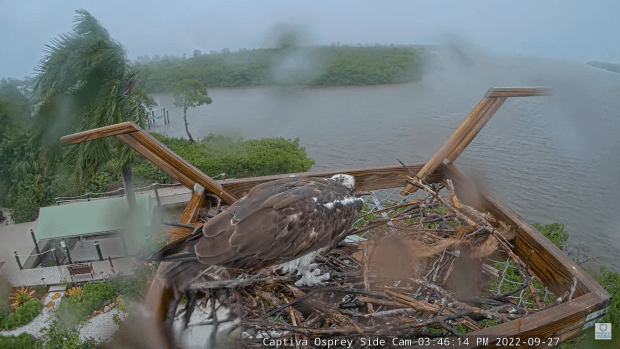
I know that our thoughts are always with the people and birds when these treacherous storms arrive. Osprey Lena is hanging on tight to her new nest at Captiva as I write this. On top of having to hunker down and ride out what could be a category 3 or 4 hurricane by tomorrow, Lena also has not seen her mate, Andy, back at the nest. I just feel for her right now. The wind is blowing at 25 mph and the rain is intensifying at both the Osprey and Eagle nests at Captiva.
Lena continues to hunker down in the same spot.
An hour later she is holding on in the same spot. You can see on the live streaming cam the gulls and pelicans flying low to the water’s surface. Rain and wind are picking up.
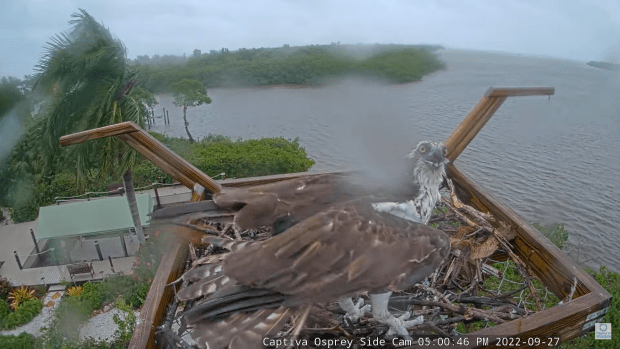
At around 1700, Romeo, the young male tried to land on Lena and Andy’s nest so Lena not only has to contend with a hurricane coming but also is alarming and trying to protect her nest. She is not impressed.
Lena is blown off the nest.
There she goes.
You can watch the Captiva nest and Lena here:
You can catch the Captiva Eagle nest of Connie here:
The Achieva Osprey nest is starting to sway in St Petersburg and the wind seems to be picking up a bit at the nest of Harriet and M15 in Fort Myers. The nest of Ron and Rita in the Miami Zoo would make you seasick if you were so inclined!
The little sea eaglets – who are not all that little anymore if you look at that wing spread – are acting more and more like adults. Someone took a video clip of them sleeping. Have a look at how grown up they are standing with their heads tucked.
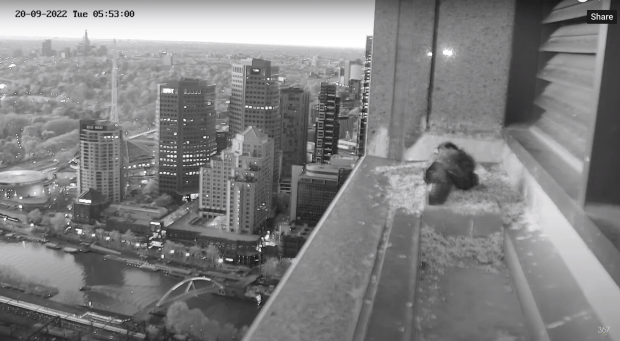
The Mum at Melbourne was doing some ker-chuffing at 0606. She did not take a break for several minutes later -at 06:10:43 -and she was gone long enough to have a nice meal and stretch her legs. While she was away the new male came to the end of the ledge. He did not incubate the eggs. He stayed for a few minutes and then flew off before Mum returned.
There she goes.
Mum appears to be a lot more careful when approaching the eggs and her body appears to be fluffed quite a bit. Can she hear her babies? From the pip to hatch can take anywhere from 24-72 hours. Oh, I wish we could get a real close up on those eggs!
Fluffed out and looking around.
This year Xavier appears to be spending much more time in the scrape box with Diamond.
Port Lincoln still appears to be offline. Send all your best wishes to the people and our beautiful birds in the line of Hurricane Ian. Captiva is S of Tampa and Tampa is expecting strong winds to hit tomorrow afternoon.
Thank you so much for being with me on this quick check as to what is happening. Take care everyone. See you soon.
Thank you to the following for their streaming cams where I took my screen captures: Captiva Ospreys and Window to Wildlife, Captiva Bald Eagles and Window to Wildlife, WRDC, Sea Eagles@Birdlife Australia Discovery Centre Sydney Olympic Park, 367 Collins Street by Mirvac, and Charles Sturt Falcon Cam.
It has been a gorgeous 17 degree C afternoon in Manitoba. The dreary morning left around noonish, and it was lovely to be outside without a jacket. I cleared up some plants and have not gone to work on the images of Little Red eating up the suet cylinder, but I will try to get to that sooner than later. He has just about finished it today! The Crows have had lots of their sandwiches and dry corn, the squirrels are still about but, there have been fewer and fewer songbirds.
I thought we would just check in on the Australian nests as their day is beginning.
The breakfast feeding at Port Lincoln was terrific. Mum rose around 06:29:19 and found an old piece of fish on the nest sufficient to fill up the three youngsters and she could get a couple of bites herself. Hopefully another nice fresh fish will land on the nest shortly.
Little Bob was sleepy. It took him a few seconds to figure out what was happening and get himself turned around the right way.
Ervie learned really quickly that you need to be up front if you are the short one. Let’s see how long it takes Little Bob to figure that out.
It wasn’t a huge piece of fish that Mum found and Big and Middle sure put down a lot of huge pieces. I thought they would eat it all.
Little Bob got 4 bites while Big Bob had about 17. Then…Little Bob got a couple more.
Then for a second, Big Bob had a food coma. Middle Bob is still standing and it sure put down the fish early too – and some big pieces. But Little Bob is right up in the sweet spot. Let’s hope he remembers where it is.
Mum filled Little Bob up and ate some of the skin herself. All of the kids were full and out in food comas. Now she can brood them until Dad comes in with the fresh fish. He has been having some trouble getting there early. I wonder if it is windy seas or gulls??
What a gorgeous morning in Melbourne. Mum is waking up.
This is the old dad. He has come to tell her where her breakfast is stashed.
He looks over the eggs for a bit – from a distance – and then flies off. I am noting that the second male has not made an attempt to rid the nest of the eggs and this is a good thing.
Mum is back safely on the eggs. We are two days from hatch watch! The 27th. OK. Technically that is less than 2 days. Oh, goodness.
It was a misty morning in the Sydney Olympic Forest. SE29 and SE30 spent a lot of time looking over the rim of the nest. At the point in the first image below, it looked like the pair were having a great conversation. Perhaps they are wondering if Mum will bring in a fish and eat it all herself again?? Or almost eat it all.
Look at that adorable face.
Some wing flapping going on. The wings of the eaglets are almost as wide as the nest. Amazing.
As the sun comes up in Orange, Australia, Xavier is on the ledge of the scrape box hoping that Diamond will give him some time with those eggies. Did I say that hatch watch is now only 5 days away!
Thank you for joining me at this quick peek of what is going on in Australia. Take care everyone. See you soon!
Thank you to the following for their streaming cams where I took my screen captures: Port Lincoln Ospreys, 367 Collins Street by Mirvac, Sea Eagles@Birdlife Australia Discovery Centre Sydney Olympic Park, and Charles Sturt Falcon Cam at Orange.
Everyone is starting to wake up in Australia and there is some action at the Captiva Osprey nest, also. So…I thought I would send you a few pictures as their day begins and ours in a growing colder Canadian begins to wind down.
Gosh, those Sydney Sea Eagles are simply stunningly beautiful. There are not showing any signs of flapping their way up to the branches yet. They are walking all over the nest and it is incredible, if you look carefully, how well they are camouflaged (best when the camera is pulled out).
The sun is just casting that beautiful golden glow on the 367 Collins Street nest. Mum looks good. Someone is providing food – I wonder if we will get a glimpse of old dad today?
Mum is just waking up at Port Lincoln and it is going to be a busy day with those three! Gracious, goodness, those beaks are always open.
Right now, Big Bob is about twice as big as Little Bob. I was holding my breath when Middle and Big were beak to beak and eye to eye. Avoiding eye contact between siblings seems to help.
Beautiful Mum waits for the first fish delivery of the day.
Xavier has been and gone with a breakfast order from Diamond. I can almost hear her telling him, ‘Xavier, darling. An Eastern Rosella topped by a Galah would be perfect for breakie.’
Diamond took a quick break and we got a chance to see those gorgeous falcon eggs.
Meanwhile, in Florida, is trouble brewing? Lena has been at the new nest and so has this younger male. It is not Andy but he has a full crop and he is checking out the new camera and look at those nice perches. Remember. If it is an artificial nest the Osprey need perches!
Thank you so much for stopping in. I hope you enjoyed these images as the day begins with our four raptor families in Australia. Captiva will become interesting in a couple of months but, for now, we wait to see if Andy shows up. Take care. See you tomorrow.
Thank you to the following for their streaming cams where I took my screen captures: Port Lincoln Ospreys, Sea Eagles@Birdlife Australia Discovery Centre Sydney Olympic Park, Charles Sturt Falcon Cam, 367 Collins Street by Mirvac, and Captiva Ospreys and Window for Wildlife.
Oh, goodness. The sky is the most beautiful blue this morning without a single cloud. The tree tops have been kissed and they are all turning slightly golden but, we have not yet had a frost. Decades ago, there was always a frost in August and people lost their tomatoes still growing in the gardens. This year the mint has eclipsed its pot and the tomatoes are still growing and turning red. Thankfully, my three-year old neighbour loves those little grape tomatoes – there were 1000s this year!
Dyson has already arrived along with the Blue Jays who let me know that there are absolutely no peanuts to be had. It was the first time that I really examined those nuts. No wonder the Jays are picky eaters. Some of those nuts are not good – dry or with only one peanut. I don’t blame them for giving them a shake to find the fullest heaviest one.
Scraggles loves peanuts and always tries to take two! Notice her tail. It is growing back after she used part of it for her nest this summer.
Dyson looks great. Her tail has grown in and it is so nice to see her in the garden every day. Dyson stayed and ate quite a few nuts before leaving with a couple. It is so good to see her looking so well. It is hoped that by providing good food and water the animals might live better and longer.
In the Mailbox:
A number of you have asked: “What happened to the old Mum at 367 Collins Street?”
That is a question on probably hundreds of mines watching that scrape. The old Mum had a really formidable face but she was a great female and raised many eyases. Mum and Dad had been there since 2016 so, like Dad, she was at least 8 or 9 years old with the average life expectancy of six years according to Victor Hurley. So let us rewind for a minute. Last year the camera went off right when the 4th chick died of trichomonosis.
Trichomoniasis is a disease that is transmitted between birds through direct contact and therefore can spread relatively easily. One characteristic of this disease is the lesions that will present on your bird’s crop and esophagus. Trichomoniasis is a disease caused by the protozoa trichomonas gallinae. This condition is highly contagious among birds. There is a loss of appetite and general inability to eat, they have difficulty standing and keeping their balance, etc. This year we saw the female at the Janakkulum Osprey nest in Finland contract what was believed to be trichomonosis and probably died. Luckily her two chicks did not contract the disease. I mention this disease because it is possible that the Mum did get trichomonosis.
The other possibilities include dying naturally from old age, severe injury or death caused by the urban environment, severe injury or death caused by the new female or another female.
Sadly, the camera was off and we have no clues. Indeed, what happened to the female might have taken place on the other side of Melbourne. We miss her and Dad together and the stability on the ledge. The life of an urban falcon is difficult at best and even more so when we have grown to love them as individuals.
“What is going to happen to the egg shells at Port Lincoln. Why doesn’t Mum get rid of them?” This certainly is a question on a lot of people’s minds as we sit and wait for the third hatch. It is a very good question, too!
The females make the egg shells using calcium from their bodies. As a result, their calcium levels are lower. Some females eat the egg shells to help replenish their stocks while others will kick the shells out of the nest or just allow them to break up and become part of the nest. At 0:40:40 Mum at Port Lincoln is seen eating some of the small pieces of egg under the chick.
In the News:
‘N’ sent me a lovely article and it is so appropriate – the challenges that urban raptors face appeared in The New York Times. It is a good read and continues to remind us of the importance of the wildlife rehabbers that care for the raptors we love after they leave the nest. I wonder what the gender % is at wildlife clinics? The ones where I live are more than 90% women, like those in this story. Thank you ‘N’ for sharing with us.
A Scottish Osprey, Glen, misjudged GPS for migration and wound up on two ships!
The second osplet hatched at 19:11:32 at Port Lincoln. The third is working on making its appearance. Here are a myriad of shots from yesterday. It is amazing just how strong the first hatch is. I have not counted how many feedings that chick has had. Mum is hungry and Dad is getting the fish to the nest. Adorable Dad. He has gotten to see the babies and Mum looks tired. Perhaps it was only because she went without any fish for so long while Big Bob was hatching.
Dad was drying off after being out fishing. Thanks, Dad, for all the fish!
What a beautiful picture with the sun shining down. It is lovely to see Dad and Mum on the nest with the new hatch. I guess Dad has news for Ervie now!
Oh, this first hatch always wants to eat. I sure hope it is nice to its siblings and shares.
Snug as bugs in a rub those two osplets are!
Rumour has it that Little Bob is making good progress. Oh, I hope so. Big Bob has eaten so much s/he will be twice as big by the time little one gets out of that shell.
‘A’ writes that SE30 has managed to get the good prey items but has, in turn, shared with 29. Fantastic. What a wonderful civil nest this has turned out to be – very similar to the last two years. I do have a warm spot for those Sea Eagles. Lady and Dad have done a fantastic job with these two!
While the little sea eaglets were having their breakfast, Xavier was trying his best to get Diamond to get up off the eggs so he could have some time and she could have her breakfast. Diamond was buying it! Poor Xavier went off to the ledge dejected.
I really hope that all is well at Melbourne. This morning, if you listen, you can hear one of the males calling from the ledge out of view of the camera and I saw a feather fly into the air. Breakfast for Mum is being provided by someone — and I hope it is old Dad. It would be good for him to raise his eggs!
I wish I could capture the feathers flying.
A male flies in to relieve Mum. I have not been able to get a good look to see which it is.
He will give us no clues. I hope that someone grabs a quick look when he leaves. But let us all send warm wishes to this nest for a successful outcome. We are a week from hatch.
On the Bookshelf:
This book is from Deborah Lee Rose and Jane Veltkemp who brought us the book, Beauty and the Beak. The pair combine the stories of raptor rescues into moving tales. If you are a science teacher or have children aged 7-11 both of the books are for you. They are filled with information and amazing images – really good ones – along with stimulating ideas for students at the end. This one is about a nest that was blown down and the fostering of two little osplets from Idaho where Veltkemp has her practice. Thinking of holiday book gifts already? This is a good one!
Thank you so very much for joining me today. Everything appears to be going splendidly at the nests. Port Lincoln is going to be busy today. Remember the feedings occur almost every hour so you will be in luck during the daylight hours whenever you sign on. Take care all.
Thank you to the following for their streaming cams where I took my screen captures: The New York Times, Port Lincoln Ospreys, 367 Collins Street by Mirvac, Charles Sturt Falcon Cam, and Sea Eagles@Birdlife Australia Discovery Centre Sydney Olympic Park.
What happened to August? It seems as if we blinked and it flew by. Despite the heat there is a look about the leaves on the trees and the wilting of the tomato plants despite their being well watered that is alerting us to the end of summer, not just the calendar. There is another 9 or 10 days before the teachers and students are back to their classrooms in Manitoba. It is a reminder that it is time to get a small delivery of firewood. There is something so cosy about a wood fire on a crisp autumn morning and if August is any indication, autumn will be here in two blinks.
The colour of the light and the water of the pond seemed to be taking on the hues of autumn.
The rain started in the early morning hours of Monday and everything has turned green in the garden again…it is raining so hard! And for once, I am so glad to see it! Monday will be a good day for reading the small pile of books accumulating on my desk.
In the Mailbox:
‘N’ writes: “Do all falcons incubate the eggs the same no matter where they live? Do all ospreys?” Oh, what an interesting question! I am not a specialist on incubation, the term used for the behaviour whereby adult birds keep the eggs warm until they hatch. My experience watching the nests of different species is that birds are very individualistic and even within a single species, the attention that they give to their incubation duties varies. I found a paper that actually discusses the different approaches to this important task. It is not a recent one but it is quite interesting. The author covers some birds that are unknown to me but, I believe the findings and the data can enlighten us as to the full answer to your question, ‘N’.
RSPB created an extremely short video about Avian Flu killing the White-tail Eagle chicks on the island of Mull. What is so intriguing is the landscape of the island and the beautiful chicks so alive in the nest. It is clearly not the be all- end all informative presentation but it was nice to see where these eagles live.
Just a couple of months before Avian Flu began killing the White-tailed Eagles on Mull, this beautiful 7 minute video was made showing them on their island setting. Have a watch:
The attempt to rid Gough Island of its House Mouse problem has hit a wall. The eradication of the mice that were biting and killing Tristan Albatross chicks and adults is now being viewed as a failure. Everyone had such high hopes that the island would be rid of these invasive mice but an unknown problem presented itself – the slug. Have a read:
In his newsletter, David Hancock of Hancock Wildlife just posted the following information about the Delta 2 nest in British Columbia, Canada: “Firstly, both Ma and DM have gone on their migration. Ma was last seen at the Delta 2 nest/territory on July 25th. DM (taking his new role as Ma’s mate very seriously) hung around for another week keeping an eye on things. He was last seen there on August 1st. Thanks to all who donated to the GoFundMe campaign, as well we received a a few private donations which are greatly appreciated. These donations are going to cover the costs associated with the installation of a sturdy new nest pole and two (2) new cameras at Delta 2.”
Nest News:
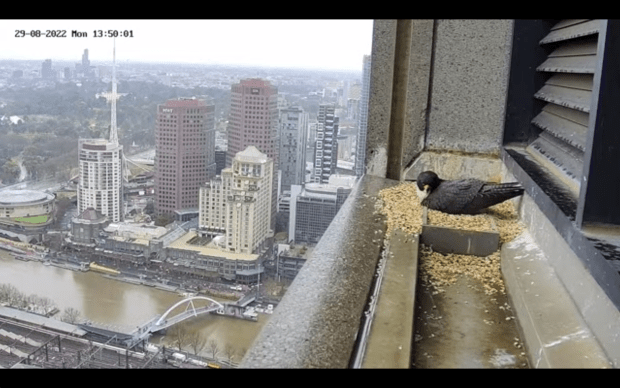
It is egg 4 for the Melbourne Peregrine Falcon couple on the ledge of 367 Collins Street! Oh, my goodness. Dad you are going to so hope that the pigeon population of the city is very plentiful!
Here is a video of that last egg being laid:
It was a prey drop and a chance for Dad to get himself acquainted with how you have to wiggle around to get 4 big falcon eggs under so they can stay warm.
It is a lot easier for Mum to get those four eggs tucked in tight. Do you think there will be a 5th?
We have a ways to go before hatch for Melbourne and Diamond might not be finished laying eggs. Incubation is a time for the females to rest. It is going to be very hectic if all the hatch at Melbourne! And exciting.
The Sydney Sea Eagles are developing right to schedule. Their plumage continues to come in and they are picking up sticks in the nest and preening. SE29 is standing and walking better each step. They really are gorgeous. The Monday morning feeding saw both 29 and 30 with nice crops full of fish. I have seen no concerning aggressive behaviour on the part of 29 to 30 that would cause me to worry.
We are about 3 weeks away from hatch watch at Port Lincoln. Mum and Dad continue to take turns incubating. That said, Mum will always have night duty and Dad will provide Mum with her meals.
You would think that Mum would be very stiff incubating the eggs all night. Dad has arrived and is nudging her off so he can have a turn. Mum goes away for her breakfast and a break, returning in about half an hour.
You are doin’ good, Dad.
There has been an unknown male visit Annie in the tower.
There is a notable change in the behaviour of the female Ospreys in the UK this year. Normally they would depart the nest about 10-14 days prior to the fledglings leaving on their migration. This year it appears the majority are choosing to remain on the nest while some or all of the fledglings depart. While we will not know the specific reason, I wonder if it is, in part, due to the raising of these large female chicks and the Mums needing more time to get in top shape. Or could it be that prey is plentiful, the weather is nice in the UK, and they just want to be home for a little longer?
Idris, Telyn, Padarn and Paith are still at the Dyfi Osprey nest in Wales as of Sunday the 28th. Idris has stayed on the perch all night. Pedran was last seen on the 11th of August at 0905.
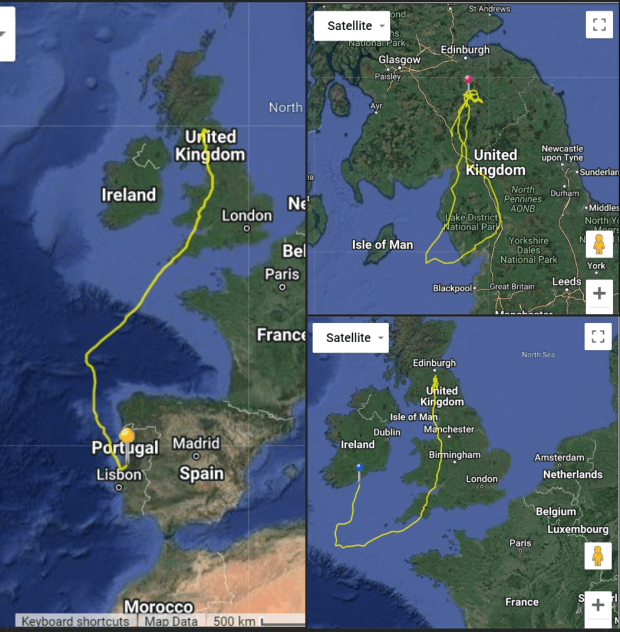
If you follow Tweed Valley, the three fledglings are going in very diverse directions including Glen who remains on the nest. Kirk is in Ireland having flown south and turning back to the land. Tweed is nearing land in Portugal.
Ruthland is updating us on their second hatch at Manton Bay, 1H2:
Tiger Mozone says that the fledglings need good DNA and luck. 1H2 certainly has great DNA. Let us all hope she has some awfully good luck, too.
1H2’s parents, Blue 33 and Maya, along with older sibling 1H1 were all still at the Manton Bay Nest at Rutland on the 27th and there is no news of either 1H1 or Maya departing since.
Seren was on the Llyn Clywedog nest early this morning and Dylan even popped in for a few minutes to join her later.
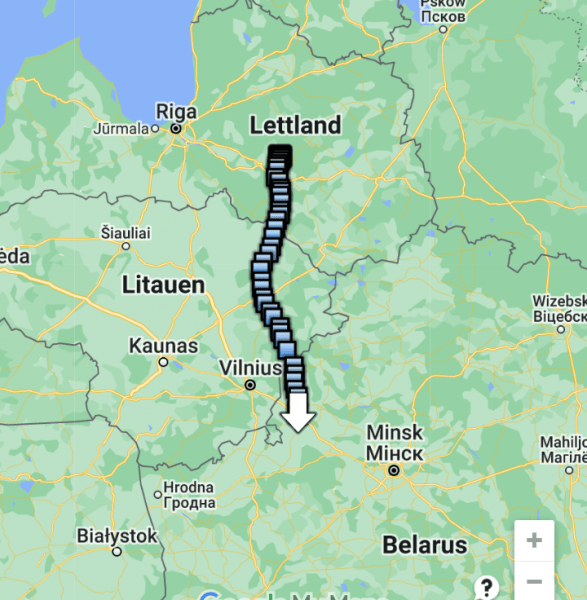
It is just incredible. Bonus continues to prove that he is a very special Black Stork! He flew from the nest in Estonia and spent the night in Latvia on the 27th. He has now flown through Lithuania and is in Belarus near Minsk. That was a total of 279 km.
Kaia, Bonus’s foster mother, remains in Belarus in the Prypjat Wetlands near Shestovicy.
So what intrigues me is this. If Kaia remains where she has been for the last several days since she flew north out of the Ukraine, is it possible that Bonus might also wind up in the same wetlands? Or will Bonus fly into the Ukraine? and remain there? or turn back north like Kaia? We should have our answer in a day or two.
Here is the distance shown by Google Maps:
Waba has begun the journey also and the tracker shows that he crossed into Latvia from Estonia on 28 August. He then flew a short distance.
I have received word that Karl II has left the nesting area in the Karula National Forest and has begun his migration. More on that to come tomorrow.
Victor has done so well since Dr Sharpe travelled to the Two Harbours nest on the Channel Islands to take him to be treated for zinc toxicity at the Ojai Raptor Centre. He has now been moved out to the big flight area! It just doesn’t get too much better than this until he is released. Wow. Victor. Way to go!
Looking forward to Lena and Andy at Captiva next year? or Connie and her mate? Window to Wildlife posted a 7 minute video about updates changes to the cameras, etc with some lovely pictures of Lena feeding the wee nestlings last year.
Thank you so much for joining me today. Please take care of yourselves. See you soon.
Thank you so much to the following for their streaming cams, their videos, and their posts that make up my screen captures: RSPB, 367 Collins Street Falcons and Mirvac, Charles Sturt Orange Falcon Cam, Sea Eagles@Birdlife Discovery Centre Sydney Olympic Park, Port Lincoln Ospreys, Cal Falcons, Dyfi Osprey Project, Tweed Valley Ospreys, Rutland Osprey Project, LWRT, CarnyxWild, Looduskalender, CIEL, and Window on Wildlife.
Good Morning Everyone! It’s Saturday and the sun is shining down golden this morning in Winnipeg. There is no forecast for rain. Everyone living here wishes we could have shared some of the moisture with those places that need it. It is going to be 26 degrees. Friends have seen trees full of Turtle Doves south of me. That is a hint that fall is coming. They are on their way home for the winter. The plan will be to go out and check on the ducklings later today when they are all out paddling. The garden animals have been quiet – or I should say the Crows and the Blue Jays. Are they still mad at me for going away for two days? or have the Blue Jays already left? and the crows, too?
I grew up in Oklahoma and although I have not visited since 2014, at that time, you could drive 100 mph on the turnpikes. The State of Oklahoma is proposing more turnpikes – and there is growing opposition because of the harm it will bring to wildlife. Here is the story:
Kenneth Kujawski posted a video of our Little Bit ND17 perched at the St Joseph River. You really have to look closely to see him – but all images much appreciated. Below the top video is a second. I believe you can hear Little Bit 17 wheeing….because he doesn’t like 16 sitting beside him. This time 17 flies off the perch.
In mid to late August each year the ospreys migrate from the UK to their wintering grounds in west Africa. It has taken just 14 short weeks for the osprey chicks to hatch, fledge and grow to a point where they are ready live independently. The chicks leave one at a time without their parents and make their own way south to the rivers of Gambia, Senegal and Guinea Bissau.
It is unusual to be seeing so many birds visiting their nests at this time but, it is always special to see them as we have no idea when they will leave their territory and head to their winter homes. Today the camera operator at the Dyfi Osprey Platform in Wales, home to Idris, and Telyn, zoomed in to give us some magnificent images of Idris. Idris continues to bring fish for Paith, the third hatch, and Padarn, the second hatch. Telyn is the daughter of Maya at Rutland. Telyn hatched in 2013. Idris’s history is unknown. He has been breeding with Telyn at Dyfi since 2020. There is some thought that Idris was usurped at the ON4 nest in Wales by Monty’s son Z1, Tegid (2016).
Each is just slightly different. Idris is a grand fisher and he is often called ‘Daddy Long Legs’ for his extremely long legs that help him with his catch. What a magnificent male you are, Idris.
Telyn was last seen a week ago. His oldest daughter, Pedran, was last seen on the 11th of August. It is ‘assumed’ that they have both left the territory to go south. Idris will remain at the Dyfi Nest until all of his daughters have left for migration. He will absolutely not leave until then.
This is 7B1, Padarn. Just look at that amazing crest!
Padarn has decided to rest while she waits for Idris to bring her lunch.
That is Paith, 7B2, on the right with that great big mullet that Dad delivered. No fear, there will be something left for Padarn.
How cute.
A friend sent me an image from the Patuxent #1 nest today. The male is certainly keeping this osplet well fed! Goodness. I am not certain that isn’t the largest crop I have ever seen on a juvenile. And just look! Dad has another fish. I sure hope he gets to enjoy it! But no. He will leave it on the nest for later.
Many chicks were waiting and calling for food today – they would have loved to have had that fresh fish from the Patuxent nest.
The two at Loch of the Lowes called and called but Laddie LM12 did not appear with a fish. The one on the nest does not look to be starving!!!!!!
This young lady, the eldest of the three girls, 1H1, was hoping that her dad, Blue 33, might get a fish to her right away if she sat and called and called. Blue 33 will not leave his gal hungry. Never. Maya was still at Rutland as of the 18th. I did not see her today.
The procedure that seems set in 60 million years of development with Ospreys who migrate is always this: the female leaves a few weeks ahead of the fledglings. Then the fledglings who are now fit fledge. Then Dad. So then, this brings me to a number of very serious questions regarding the Loch Garten nest. AX6 Axel has not been seen 15 August at 0635. The female, Asha, unringed, was last seen on 14 August at 1018. The male chick, 1C2 is still coming to the nest to be fed. Why would the male leave before the chick? Has he been usurped by an intruder? There has been a constant intruder who is now arranging the twigs on the nest. It is KL5, a two year old, hatched at Loch Ness. Is the chick being fed off the nest by an injured dad? is it possible 1C2 is catching its own fish in the loch?
While the Uk, European, and North American Ospreys are preparing to take their winter break, the nests in Australia are getting busy. Everyone is watching Xavier and Diamond very closely – hoping for eggs! Diamond was in the scrape box on the water tower at Charles Sturt University in Orange today putting the final touches on the indentation in the stones.
For those of you that do not know Xavier and Diamond, they are quite the pair. Neither is young but I do not believe anyone is sure of how old they actually are – or how young! Xavier is tiny and cute and tries so hard to please Diamond. There is one thing that Diamond does not like to eat and that is a European Starling. She will if she is starving but, normally, she will refuse the prey offering from Xavier if it is a Starling. She much prefers the parrots and a nice fat pigeon if Xavier can find one in the country. They are plentiful in a city like Melbourne but rarer in Orange. Parrots on the other hand are somewhat plentiful.
Xavier has brought Diamond a Starling and stashed it in the corner for her.
Xavier comes in and removes the Starling – hopefully it will enjoy the nice meal! I never thought of birds as ever being picky eaters but Diamond doesn’t like Starlings and Victor doesn’t like trout. I wonder which others have quirks?
You can watch Xavier and Diamond on this streaming cam. There is also a cam looking directly out front and one on the water tower.
Mum and Dad are incubating three eggs at Port Lincoln. In the image below, Mum has returned from her break and is urging Dad to get up!
Port Lincoln posted two images of Ervie showing that his talon is growing – ever so slowly. Little stub on left foot of our dear Ervie. Thankfully he watched Dad and got the hang of fishing in the right spots and that talon no longer means he can only catch puffers!
Isn’t this the most magnificent image of Ervie?
The Sea Eagle nest is the only one with little ones. Port Lincoln is incubating and the falcons are ‘thinking’ about eggs both at Orange and in Melbourne, I presume. This is the latest from Melbourne CBD-367 Collins St Falcons and this is early!!!!!!!!! So excited.
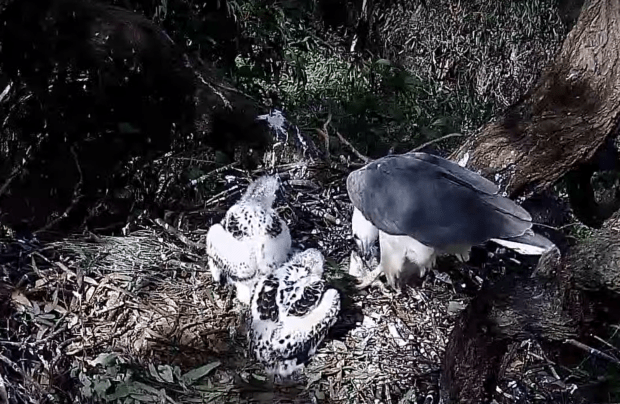
The Sea Eaglets are getting around all over the nest now.
Lady makes sure that 30 gets fed.
Look at SE30 stand on its feet. I am not supposed to comment on the fat little bottoms and legs of the chicks! I did this last year with an image of the Melbourne falcons and caused quite the stir. Apparently the largest supplier of chicken legs and other parts is a company called Steggles. One of the FB comments said she couldn’t stop laughing and almost choked. — But seriously. Look at that tail and little bottom of 30…precious.
Thank you so much for joining me this morning. Have a wonderful Saturday. Stay safe! Take care of yourself. We will see you soon.
Thank you to the following for their streaming cams and/or posts that make up my screen captures: State Impact Oklahoma, Notre Dame Eagles, Dyfi Osprey Project, Patuxent River Park, Friends of Loch of the Lowes and Scottish Wildlife Trust,, LRWT, Charles Sturt Orange Falcon Cam, Port Lincoln Ospreys, and Sea Eagles@BirdLife Australia Discovery Centre Sydney Olympic Park.
Holly Parsons, the administrator for the Orange Peregrine Falcon FB group, has posted the following from Cilla Kinross regarding Yurruga:
I took some images of beautiful Diamond throughout the day.
We would expect the parents to visibly be supplying prey to Yurruga. Many of you will have seen the adults at 367 Collins Street bringing in prey. You might recall how the Dad tried so hard to feed the little male when he was too sick and could not eat or swallow anything. Just pause and remember the healthy chicks at that nest and the noise they made even prior to fledging when food was around. Then remember Yurruga and how he behaved when prey came to the scrape. The falcons are loud in their food begging just like the four lads at Port Lincoln. The little ones simply cannot go without eating and while they are learning to fly they are also being taught how to hunt. It is unclear how instinctive hunting is. For example, the adult Ospreys do not teach their fledglings how to fish. They simply are hardwired to do it. Peregrine Falcon parents spend much time passing prey around, dropping it for the wee one to catch, etc. Certainly Yurruga had at least a days training because he was seen flying around with the parents prior to the big storm. There would be several prey drops during a day. No one has anything confirmed after last Thursday in Australia, 9 days ago now. I know that each of us wants this outcome to be different and I would like nothing better than for someone a mile away to phone Cilla and tell her that Yurruga is on their roof or in their garden. The long sessions in the scrape together may be Xavier and Diamond bonding in grief. There is also the additional issue of the absence of the eggs. Diamond has spent an inordinate amount of time scraping where the eggs were. My heart really goes out to her.
Sad news is also coming out of California. The California Condor chick #1075 died at the Los Angeles Zoo on 12 November. He had sustained injuries from adult male condor #247 during a territorial dispute. I know that many of you watched that streaming cam. Their lives are so very very fragile and to have a death of a promising chick due to fights is extremely difficult to process. There seems to be a lot of territorial disputes. You might remember that California Condor #1031 Iniko who survived the Dolan Fire was actually injured when an adult male came to the nest tree. —— Which reminds me! Iniko will be released back into the community of condors where he hatched on Saturday along with two others. This is great news coming on the heels of grief.
We really need some good news in Bird World. Iniko’s release is, of course, one of those. I really hope it is OK to cut and paste this amazing story from that Valerie Webber posted on the Loch Garten and Other Ospreys FB page. It is a marvellous tale of German Osprey Black 1FO seen in Portugal in Dec 2005/Jan 2006 and again in September 2021. So the question that is being asked is where has this bird been? It is more than 16 years old and this is truly remarkable – 3 sightings only in all those years. He really is a very handsome bird.
More good news come in the form of a Pacific Black Duck named Daisy who has now laid her first egg in the Sydney White-bellied Sea Eagle nest. An earlier blog today gave more images and some details. So nice to have her back! I am so excited about Daisy’s return that I can’t sleep! You can catch her on the Sydney Sea Eagle Cam. She laid her first egg today. She must have rushed to get to the nest OR she had made a nest elsewhere and predators came. We might not know. She will begin lining the nest with the down from her breast. That down will not only make it soft for her and the eggs but also will help cover the eggs when she has to go forage. She will also mix the down with leaves on the nest and cover the nest with those leaves. I hope there are lots of them!
Every one of the lads on the Port Lincoln Osprey Nest has had a fish today. Port Lincoln also says that the three have been seen at the shore going for a bit of a swim or a bath. Fantastic.
The three are over on the perches and ropes near Mum. What a beautiful image. I wish that Dad was there, too. The fledglings are gradually spending more time on the perches and ropes and flying around. They are growing up and shortly might be off on their own. I need to check and find out when Solly permanently left the barge. That might give us some clue.
I know that many of you are familiar with the Welsh Ospreys, Aran and Mrs G at the Glaslyn Nest. You might also know that one of Monty and Glesni’s sons, Aeron Z2, and his mate Blue 14 have their nest close by at Pont Croesor. Glaslyn has announced that the new hide is finished and visitors will be able to observe the nest of Z2 and Blue 14. That is great news.
That is it for me. I am sufficiently exhausted from the excitement of Daisy that I might be able to sleep. This is my Friday newsletter. I will bring updates later tomorrow (Friday the 3rd) evening.
Take care everyone. Thanks for joining me.
Thank you to the following for their streaming cams or FB pages where I took my screen captures: Loch Garten and Other Ospreys FB, Orange Peregrine Falcon FB, Port Lincoln Osprey Project, Sydney Sea Eagles @Birdlife Australia Discovery Centre, and Charles Sturt University and Cilla Kinross.
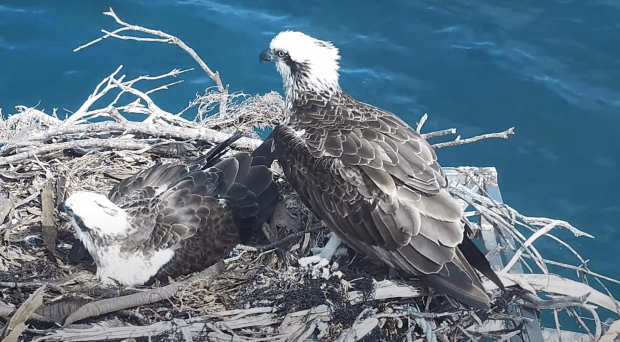
The fish arrived on the nest at Port Lincoln at 6:35:01 and immediately Ervie was mantling it.
Needless to say, Ervie really is the boss of this nest and for good reason. He has fabulous survival instincts.
As you know, my interest is in third hatches and how well they do on nest and off. It will be very informative on how well Ervie does when he leaves the area of the nest seeking out his own fishing spots.
Bazza and Falky might wish that Ervie would fly off and not return.
I only commented once but watchers were calling Falky ‘Mellow Yellow’. It is time that Falky was not so laid back. Yesterday, Bazza took the second fish while Falky had the fish tail from Ervie’s earlier breakfast. If I missed Falky getting a fish, I apologize. It would be good if each had one fish per day. They are all well-feathered and Bazza and Falky will fledge when they are good and ready. e
Oh, wouldn’t it be wonderful to watch Ervie learn how to fish?
At 7:43, Ervie is still eating but his two siblings are hanging close hoping to get some leftovers.
Ah, and Falky got it. Well done, Falky.
If you missed Ervie’s fledge, here it is again. It is quite beautiful on the take off and fly by but the landing was not impressive! Still, I applaud our third hatch lad. Ervie, you are amazing. You are definitely the leader of the pack, so to speak.
If you missed Victor Hurley’s Q & A discussion, it was really really super. I posted that link in my blog, Ervie Flies! early this morning. Very informative and you can start and stop it as you like. If you are interested in falcons or Australian birds of prey – it really is a talk not to miss.
Since the shut down of the 367 Collins Street camera, I hope that many of you are filling that gap with Yurruga in the water tower scrape of Charles Sturt University at Orange. As a former academic, we do not like to comment on others’ research. There were a couple of questions to Victor Hurley about the scrape at Orange and he answered in general terms. Someone asked about the low hatch rate and the eggs. VH said that if the eggs are too large (and he does not know that is the case at Orange) it is hard for the chick to kick them to create a crack all around the egg. He also noted that sometimes eggs get turned when a beak is protruding and the chick cannot right itself if the egg is turned around. Of course, VH said that those are general statements and not specific to Orange. He did comment that Yurruga gets all the food while the four at Collins Street had less bites per chick. He also noted that the Collins Street Four developed quite fast this year and that Yurruga appears to be developing normally. So, she is 8 days younger and the amount of floof she has is normal for this stage.
One of the things that I took away from VH’s discussion was how adaptable Peregrine Falcons are. If there is a drop in numbers of a prey item, they will move to something else. For example, some Alaskan Peregrines have been known to eat trout. The image below was shown as an example.
This year I noted a drop in the amount of pigeon delivered to the scrape at Collins Street. This could, according to VH, be a result of the several lockdowns they have had due to the pandemic. Less people eating their lunch and feeding the pigeons. He did note that the male did bring in Quail and Rail. The falcons normally have a 5 km hunting range but are known to go farther. The are for Collins Street is prey rich. The red dot indicates the site of the nest box.
The falcons do not spend a lot of time on the ledge after the eyases fledge. There is a good reason for this – parasites.
As we learned with Grinnell, the male at the University of California – Berkeley Campanile scrape, birds can become loaded with parasites and they might not be able to protect themselves as well as if they were healthy. Grinnell was taking anti-parasite medication to overcome this. We know he is improving and will be released shortly.
One of the most interesting things to come out of this talk had to do with how the females are attracted to a mate. VH said that there are ‘stunning’ Peregrine males. You and I have seen them. They have an almost orange cere and legs. Dark black, really black, hoods with cream chests and very fine pinstripe chests. Those are the extremely healthy males and the females want healthy. Pale yellow indicates unhealthy. So now when you look at a falcon you can tell healthier vs not so much.
Also falcons divorce. If the female hooks up with a male and he does not share incubation duties or bring in prey, she will move on the next year. The male stays with the nest but it could be in a prey deficit area. At any rate, it was a real good discussion! It is nice to listen to the expert in the area – even talk about rodenticide.
Little Yurruga is doing well. She was working on her breakfast the last I checked.
My daughter went to the Assiniboine River for a walk and discovered about thirty-five ducks still on the river. She sent some photos for us. She noted that there was at least one other group this size down the river.
There are a lot of signs on our park ponds not to feed the ducks and geese or they will not migrate. My daughter ran into a neighbour that says the ducks stay at that part of the river year round and people feed them. They added that parts of the river in that location have been open – not frozen over. I sure hope that is the case this year! There is also an American Bittern hanging around one of the creeks. Maybe they know that this big snow is just to scare us into thinking it is going to be a horrible winter and it will be mild. We wait to see.
The garden birds have found the seed left on the deck and Dyson has, of course, been helping himself. I missed getting him hanging upside down on a suet cylinder. The migrating birds are all gone from this area. Thankfully.
Dyson always knows when the food comes out!!!!!!!!!!!!!!!
The feeders – and there are many different kinds – are all full. It was interesting to me that the sparrows did not mind standing on the snow. According to my daughter, the ducks really like being in the water and not having their paddles on the cold ice.
It is a good day to be inside!
Thank you for joining me today. There could be another fledge at Port Lincoln and we know there will be lots of prey for Yurruga. Take care everyone. See you soon.
Thank you to the following for their streaming cams where I took my screen shots: Port Lincoln Osprey Project and Charles Sturt Falcon Cam and Cilla Kinross. I also want to thank the 367 Collins Street FB group for posting the link for Victor Hurley’s talk and my daughter for those great duck images.