Wednesday in Ospreyland and elsewhere

The water on the lake is very smooth today. Strangely there were no gulls, only one Cormorant fishing, and a lone duck. The bison were not in their enclosure but the sky was the most beautiful blue and the Aspen trees are nothing short of gorgeous. It was a good day. I also learned a lot by plunking myself down and talking to the chap that runs the Nature Centre. So first with the terrible photos. The blame is on my ‘finger’. The setting on the camera was definitely not where it should have been.

This cormorant was rather amazing. He dove into the water and came up about 15 metres from where he went under – but not for several minutes. Incredible. I hope he found a fish for his efforts.

Feel free to help me identify this duck. I have three bird books in front of me and none of the descriptions fit this one. Ideas? I was told that there is a duck that should not be here but should be in British Columbia. I wonder if this is it?

The fawn was not going to cooperate! And why should it? But I do wish it would have turned and smiled.

Driving through the hills and gravel roads is such a change from the urban asphalt. These colours were stunning and changed from area to area in the park.

The national parks in Western Canada from 1915-1946 were built in part by some ten thousand foreigners, the unemployed, the homeless, conscientious objectors, and people deemed to be enemies of the state. I understand that they were not criminals but were perceived, at the time – during the Depression and the wars – to be persons who might cause civil unrest.

Four hundred and forty German POWs worked at Riding Mountain National Park. They were originally in detainment camps in Alberta that were crowded. They volunteered to come to Manitoba and work in the forests cutting wood. Each man’s quota was 3/4 of a cord of wood a day. Their camp was at Clearwater Lake. There were no fences and no barricades. In conversations with staff at the park, it was known that the men would often sneak out of camp and go to dances in some of the small towns. No one seemed to mind. They would be back in the POW camp in the morning for the roll call.

The men worked eight hour days. There was not a lot to keep them busy. They began wood carving. Many made dug out canoes from the large spruce trees in the forest. They raised pigs and grew vegetables in their gardens. They also caught a bear and tamed it and it became the camp mascot.

A number of the men returned to visit Riding Mountain on the 50th anniversary of the end of WWII. It is totally fascinating – a part of the history of my province that I did not know.

Times have certainly changed. Look at the old canvas tent and the chairs. I love the moose calves. Not sure the rangers would like to see this happen today! I can’t wait to learn more about this beautiful area where I live.

This is a short video about the POWs and their role at the park.

Now to turn our minds back to the birds for a moment. The sun is just rising over the water at Port Lincoln, Australia. It is kissing the back of our Osprey mum with its golden rays.

Six or seven hours after the third Osplet hatched, it was holding its head high wanting some fish.

I am not quite sure where it is during this feeding! It will be a scramble but hatching out of that egg took a lot of energy and many do not even eat the first 24 hours. I have a feeling that this little one is strong. Let us all hope so and send good wishes down to them and their parents. I want to see this nest fledge three this year!

What a beautiful place for an Osprey nest. I hope there are a lot of fish for Dad to bring to the nest. Fingers crossed.

Looks like everything is going well at Port Lincoln. Here is another image of its first feed, less than six hours after hatch. Fantastic.

The researchers and administrators at the Port Lincoln Osprey Project have posted a number of videos on the Port Lincoln FB page. You do not have to be a member of their group to watch them. Check it out!

Thank you for stopping by. I hope to do a full check on all the nests – including returning Bald Eagles – tomorrow night. Take care everyone. Stay safe!

Thank you to the PLO for their streaming cam where I took my screen shots.

Double Cute – the two Little Bobs

Ospreys quite similar to the ones we know today were well established in much of their current breeding range at about the same time our earliest ape-like ancestors left forests and began to walk upright across the plains of Africa.

Alan Poole quoted in D. Gessner, Return of the Osprey, 158.

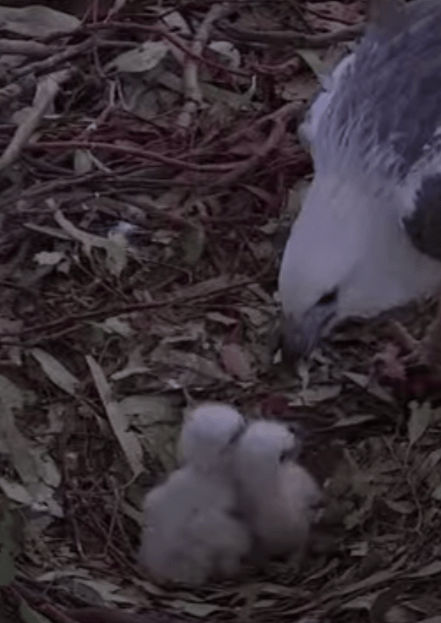
I could not wait to wake up this morning to check and see how the little Osplets are doing at the Port Lincoln Barge. Yesterday I wondered how you say cute in Osplet – but how do you say double cute? These kids are healthy and strong and by 18:00 necks were held high. No teaching these two what to do when mom gets up and dad delivers a fish, 50 million years of genetics have seen to that!

These images are in reverse order. They go from what I believe is the last feeding in the evening to when the little one was figuring out how to turn around to get some fish. Sorry about that. My mind must be operating in reverse!!! As you go back in time you will notice that the chicks have, in six hours, figured out how to line up for mom so they get some fish. It is nice they are almost the same size. Mom is so patient with these two.

I have left the time stamps on the the top ones, the most recent. Enjoy.

Mom trying to get some rest.

That is a nice fish that dad has brought in.

There were two close feedings together towards the end of the day.

Born with their mouths open like little tiny song birds.

Waiting for Dad.

A much needed rest. Mom will have to sleep as much as she can when those little Bobs are quiet.

This is the 11:54 feeding.

The ‘little’ one got himself straightened up and got some fish but, initially, his head went the opposite direction.

Oh, little one, you need to turn around!

More cuteness. I had so forgotten how incredibly quick these Bobs learn. In a week we will not recognize them from the size and the way they look today with their seemingly black face goggles.

It is now 01:04 in Australia and Mom is having a sleep. Can’t wait to check in on how the two are doing in about six hours. Thank you for joining me. Stay safe everyone.

Thank you to the PLO Project for their streaming cam where I took my screen shots.

Oh, our lovely fish eating birds

I love Ospreys – bet you can tell! Still, the anxiety rises when there are three eggs on a nest that, historically, simply cannot support that many mouths to feed. Right now the Mum at the Port Lincoln Osprey barge in Australia is incubating three eggs. In 2020, a drop in fish deliveries around day 16 of the youngest life meant that food insecurities hit the two older and much bigger siblings. Tapps was a victim of siblicide. Will 2021 be different?

So far the two adults are working like a super machine. Today Dad came in with a fish delivery for mom. She left and he incubated the eggs for a half hour. Have a look at that smooth exchange:

The 2019 female fledgling of the PLO nest has been seen and photographed at Tulka yesterday. Solly, the 2020 fledgling with the satellite tracker still seems to prefer Eba Anchorage but she has spent some crazy time at Streaky Bay again. Solly is 339 days old on 26 August Australian time.

If it has been awhile since you watched an Osprey catch a fish, have a look at this slow-motion video shot in the Scottish Highlands. Incredible. When you are watching this remember that Ospreys and Owls are the only birds whose outer toe is reversible to help them hold on to their prey. It allows them to grasp with two toes in the front. Great design.

The Ospreys that live in Australia along the coasts and the rivers are Eastern Ospreys, Pandion cristatus. Eastern Ospreys do not migrate. Their status ranges from secure to vulnerable and rare in various states of Australia.

Ospreys have a system of communication between one another that individuals, such as yourself, will recognize if you have been watching Osprey nests. There are 11 physical and visual displays that show they are resting, alarming, soliciting for food, in a defensive posture, nest protecting, under attack, or sky dancing to impress their mate. In addition to the body language Ospreys use they also have 8 sounds that they make alongside the physical signs. Those include alarming, food solicitation ranging from a very low sound to an extremely high pitched sound, a sound for guarding, being excited, screaming, and the sound during copulation. These findings were published in 1993 by Vincent Bretagnoll and Jean-Claude Thibault. The article is “Communicative Behavior in Breeding Ospreys (Pandion haliaetus): Description and Relationship of Signals to Life History.” It was published in The Auk, Volume 110, Issue 4, 1 October 1993, Pages 736–751.

The British Library and the Cornell Bird Lab have an extensive library of bird sounds that you can access. Also, just watch the birds intently on their nests in different situations. You will soon be able to recognize their different visual postures. For those working in situations that deal with Ospreys, it is essential that they learn the communication and behavioural signals of these birds. These skills would definitely have helped those reviewing Malin’s flight off the nest and, in the future, could save a bird’s life.

Blue 33 (11) has delivered Maya a nice fish for breakfast. So Maya is still here. It doesn’t mean she won’t eat and fly! We just need to wait and see.

Either White YW left Tiny Little an early fish or the silvery white object is a leftover piece of fish from last night’s late feed. Is Tiny home to eat it? and will she be in Cumbria all day?

Ooops. Looks like Tiny Little is too late!!!!!!!! Mr Crow has found a nice breakfast. Does this mean Tiny Little has started her first migration?

UPDATE: Tiny Little is still here. I didn’t get the photograph but someone else did. Yippee. Will try and chase her down today.

It is another misty morning. Aran is on his perch almost in the exact same position as he was yesterday morning.

And here is Aran with Mrs G. She remains in the UK still.

At the Dyfi nest, Telyn was last seen on 21 August at 12pm while Ystwyth was last seen on 24 August at 09:26. Dysynni and Idris were both at the nest on 25 August. Idris brought Dysynni a whopper.

Yesterday, Laddie, LM12, delivered a fish to LR2 on the nest. LR2 was 97 days old.

After a pesky crow flew around the nest, LM2 decided it was safer to take that whopper over to his favourite Birch tree to eat it. Wow, Laddie, great fish!

LR1 left for her migration on 15 August. This was only the second time in the history of this nest that a fledgling has left before the female.

Oh, it is lovely to see some of them still home. Thank you, Tiny Little! News in other news is there are now three eggs for the Collins Street Falcons! That last egg arrived at 23:53 last night. Congratulations. And last, if you follow the Loch of the Lowes Nest a wonderful surprise. A 2015 fledgling, FR2, flew over Guardbridge in Fife yesterday. They got a photo. Fantastic. A survivor! There is sad news today. The Black Stork fledglings received their names yesterday. 7181 (no 1) was named Julge meaning Brave. 7181 (no 2) was named Malbe meaning Sedate. 7183 (no 3) was named Tasane meaning Peaceful. You might have recalled some animal sounds being heard at the base of the nest tree. It is now confirmed, so sadly, that Malbe has been killed by an animal. Urmas has taken the body of Malbe to be examined. Word has also come that Tuul, Karl’s fledgling, has also perished. The Black Storks are so rare – it is so sad to hear of these deaths. Our hearts go out to all who loved these beautiful families and to those who so diligently worked to make sure Jan’s nestlings were fed and healthy to fledge. There has been some problems with the tracking and posting of Karl II and his fledglings locations. I will bring this to you as I locate it. Did you follow Milda? You will know that this brave White Tailed Eagle from Durbe lost her mate and sat on her eggs for eight days without food and then a potential mate came. But last year turned to be a sad year for Milda. She is now working on the nest with her new mate, Mr K. So happy for her. There is word that WBSE 28 did, finally, get some food. Send your warm and positive wishes off to all of the birds.

Correction to earlier news letter. Karl II has only had a transmitter for two years. I said ‘many’. Thank you!

Have a wonderful day everyone. Take care. See you soon.

Thank you to the following for their streaming cams where I took my screen shots: The Cumbrian Wildlife Trust and The Foulshaw Moss Osprey Nest, Bywyd Gwyllt Glaslyn, Dyfi Osprey Project, The Scottish Woodland Trust and the Friends of the Loch of the Lowes, LWRT and the Manton Bay Osprey Nest, the Port Lincoln Osprey Project and FB Page.

Checking in on Australia

It is raining in parts of Australia. Orange got 50 mm and there are floods about while there was 37 mm out at the Campus where the scrape box of Peregrine Falcon couple, Xavier and Diamond, have their scrape box.

Diamond has spent time on the ledge and going back to the scrape box looking like she is concentrating on that first egg. What do you think? Maybe today?

Sadly, the poor weather might be impacting Dad’s ability to bring in prey to the two babies in the Ironbark Tree. Until now, there has been little to no demonstrations of dominance but yesterday the prey diminished and WBSE 27 started telling the little one who is boss. It is unclear if WBSE 28 had any of the morning fish. WBSE 27 is 26 days old today and WBSE 28 is 24 days old. Oh, I hope this stops. There is enough for everyone! Most people say that the parents will not step in. And, as you know, if I hear survival of the fittest one more time I might scream loud enough for someone to hear me in Australia! All you have to do is to think about Tiny Tot on the Achieva Nest or Tiny Little — those tortured little ones turned out to be a force to be reckoned with. I wish Tiny Tot had a tag and a satellite transmitter. I sure would like to see what she is doing in a couple of years. If there are two Ospreys that will survive it is those two. And they started out like WBSE 28. Of course, only worse for Tiny Tot.

Mom was looking particularly beautiful over in the Port Lincoln Osprey Nest. The colour of the water contrasted with the nest lining — well, it is gorgeous.

The female at Collins Street in Melbourne certainly looks like she is going to lay her second egg today. She is getting full in the bottom just like Diamond. She is certainly plunked down in that scrape box with that stern look she can give. It must be quite uncomfortable laying eggs!

I don’t do a lot of reporting on the Albatross despite the fact that not only am I fond of them but I really want our oceans to be cleaned up and the fish stocks renewed so that all of the sea birds are promised some kind of a decent life. Sharon Dunne does a great job running the FB group as well as keeping us abreast of everything ‘Tiaki’, the Royal cam chick of the 2021 year.

Ms Pippa Atawhai was just the cutest little albatross chick and her parents were incredible. She was the 2020 Royal Cam Chick. Her nest was close to the visitor’s centre. Tiaki’s nest is down close to other nests. Some are less than 3 metres away. This has led to a lot of ‘drama’ between the chicks! Seriously. I thought it was only the juveniles that caused mischief. Oh, no. These gals can seriously get with the squabbling.

The Cornell Bird Lab caught that on camera today. Have a look:

It reminds me of my garden. Before I seriously started watching birds and their behaviour, it seemed they all got along and lived in some kind of sing song happy land. Oh, geez. There is even a hierarchy in our garden! Incredible. Have you noticed this behaviour at your feeders? Is this why we say ‘Pecking Order’?

This was a quick check in. I am restless – not knowing for sure if Malin is alive or dead or nothing can be determined. But I want to leave you with an uplifting story and a lesson. Yesterday I reported on the Osprey that had been hanging upside down in a tree for two days because of being entangled in fishing line. The beautiful bird had pulled all of its muscles from being upside down. The bird, at 45 feet, was ten feet more than the climber could reach so he used an extension net and a pole saw to cut the line and catch the bird in one swoop. On the ground the bird was detangled from the line. A stainless steel treble hook – for catching 3 fish at once – had gone through the talons of this baby. Today, this young one is healing. The lesson is ——- clean up after you go fishing. Join in groups to clear the shores of rivers and lakes of fishing debris that gets caught in them. Help our water birds!

I took these screen shots from A Place Called Hope’s FB page. They have a wonderful video on their site of this rescue and I urge you to search FB, find their home page, and watch it. It is very moving. What wonderful people these people are – there is not a situation too challenging and if a bird can be saved, A Place Called Hope will give it that chance.

Thank you for joining me today. I am certain that Collins Street will have another egg tomorrow and well, Diamond might have one as well. Take care everyone. Stay safe.

Thank you to the following for their streaming cams: Sea Eagle Cam, Birdlife Australia and the Discovery Centre, 367 Collins Street by Mirvac, Cornell Bird Lab, The Falcon Project with Cilla Kinross and Charles Sturt University, the Port Lincoln Osprey Project, and A Place Called Hope FB page.

Hawks definitely do not like children

By 18:30, the smoke and the temperatures were cooperating and it seemed like a good time to go and check on the Cooper’s Hawk family in Assiniboine Park. When I arrived at the Park, there were several cricket games going on, families were meeting and sharing a pot luck outside – many for the first time since spring 2020, there were birthday parties and children running around.

When I found the spot and knew where the hawks had their nest and were hunting for bugs and chipmunks the other day, there were children running around. I could see the hawks in the sky circling. They never went to the nest tree or came to the ground. It is the life of a birder. It would be wonderful to see them a few more times before migration. The Canada Geese do not usually begin leaving until the middle of September through to the end of October. I have seen some miss the group and wind up walking about on an early snow. Weather is such a significant factor in the challenges our birds face.

For those who are not sure what migration actually is. Our feathered friends Move from one area for breeding during the spring and summer to another area for winter. They have adapted to the pattern of coming and going in order to survive. It is based on food supplies.

Different species travel different routes to their winter homes. These are long journeys. For example, the Ospreys in the United Kingdom will travel some 8,000 kilometres or 5,000 miles to places in Africa. The birds will fly over land, sea, and desert to reach their destinations. People wonder why the birds just don’t live in Africa all the time. The answer is rather simplistic: there would not be enough nesting sites or food for all of them plus their chicks. There are also a lot of very hungry predators ready to take those lovely fluffy little ones. So they disperse from Africa to sites in the United Kingdom and Europe.

The birds decide when it is time for them to migrate. The hormones in their body begin to change. Unlike spring when this hormone change leads to breeding, the autumn sees the birds restless until they know that it is time to depart. These hormones trigger a lot of eating. Fat begins to gather under their skin. They gain weight. It is that fat that will see them through their migration. Still, they stop and feed along the way. Normally they hunt for food in the early mornings and late afternoons. High pressure systems are good for flying but low pressure systems bring winds and rain. When the birds get into a low pressure system, they will normally stop flying, if they can, and wait til another high pressure system comes through. Migration times vary because of the winds and the weather. Birds that soar and ride the thermals can travel as much as 465 km or 300 miles in a stretch. Some gather in flocks like the storks in Latvia and Estonia. Sometimes birds pair up to migrate. For the Ospreys, the female leaves and the male stays behind until there are no fledglings crying for food.

Not all birds migrate. Even I have a sedentary Sharp-shinned Hawk that defies all logic to stay on the Canadian prairies for the winter. The Osprey in Australia do not migrate. The birds in the Amazon Rainforest do not migrate. There is plenty of food and nesting sites for them year round. This past spring and early summer there was much discussion over the migration of birds from Florida. In Jacksonville, Samson, the father of Legacy, stays in the area of the nest year round. Gabrielle, on the other hand, migrates north – yes north – to cooler summer climates. This year she might have discovered it is hotter up north! Even some of the Ospreys in Florida do not migrate; they stay year round. There are plenty of fish for them as well as nests.

Birds take different routes. The White Storks from Latvia either taken a western route or an eastern route. Dr Erick Greene and his team in Montana study the migratory movements of the Ospreys from the Clark Fork River area with satellite transmitters. In the United States, some fly over Hawk Mountain where there is an annual count. In fact, you can go to this site to see the number of birds traveling over this marvellous area with its thermals. Here is the link for you for their autumn migration count that will being in about a week!

https://www.hawkmountain.org/conservation-science/hawk-count

Migration is extremely challenging and we hope that all of the adults will return to their nests the following spring and that we will see the juveniles who take their first flight to Africa in a couple of years.

And now for some birding and nest news

Poole Harbour: Blue 022 and CJ7 who were so visible until a few weeks ago sky dancing, mating, and working on the nest with the streaming cam are now working on another nest in the area. There is no camera. They are still doing everything together and everyone is looking forward to the first hatches in Poole Harbour for 200 years.

Dahlgren: A large part of the nest in King George, Virginia, collapsed today. It will be fixed in the fall well after Jack and Harriet’s migration.

Kielder Forest: All 16 of the 2021 juveniles have fledged successfully. Everyone is elated. This is 6 more fledglings than their previous best year. Congratulations everyone!

Mlade Buky: Bucachek and his new love spent the night on the nest in Mlade Buky, Czechoslovakia. Oh, how sweet! Just as the dawn is beginning to appear, they are both preening.

Balloons, something that impacts all birds: Virginia, Maine, Maryland, and Delaware have or are going to pass shortly the release of balloons. Hawaii has already passed a law on helium balloons.

Port Lincoln Ospreys, Australia: Dad and Mom have been taking turns incubating the eggs. Here is dad on the nest. A little earlier he had been pestering Mom. He kept pulling on that turquoise rope wanting his turn. It was too funny. The Port Lincoln Ospreys are an example of sedentary birds. They do not migrate. There is no need.

Loch Arkaig: The two juveniles of Louis and Dorcha have now fledged. I have not heard anything about the chosen names yet.

Collins Marsh: Malin was a little wet off and on during Saturday. S/he is sleeping on the nest alone tonight. There is no perch – let us hope that the parent or both parents are in a nearby tree in case there are any owls about. It seems like a pattern. Does mom always spend Saturday night off the nest?

WBSE, Sydney Olympic Forest: 27 and 28 continue to eat until their crops almost burst and sleep. Meanwhile there has been an intruder today and Lady and Dad were honking in alert.

And last but very special, A Place Called Hope. Along with other wildlife centres, they are receiving quite a number of starving Great Blue Herons and other herons. Why would they be starving? It has been raining in the Connecticut area and all the herbicides and pesticides that people put on their lawns and gardens makes its way into the environment, into the water table, into the ponds. It is poison. If your gardening centre or lawn care person tells you that the chemicals they use are ‘Green’ – well, think again. Whatever they are using kills. So sad. It is OK if your lawn doesn’t look emerald green.

Thank you so much for joining me today. Have a lovely Sunday. Take care of yourselves. I look forward to seeing you soon.

Thank you to the following for their streaming cams and their FB pages where I grab my screen shots: A Place Called Hope, Mlade Buky White Stork Cam, Collins Marsh Osprey Nest, Port Lincoln Osprey Project, and Sea Eagles, Birdlife Australia and the Discovery Centre.

The featured image is Dad at the Port Lincoln Osprey Barge taking his turn incubating his two eggs.

Four rare Hen Harrier chicks fledge in Derbyshire

One of the big announcements came today when four extremely rare Hen Harrier Chicks fledged in Derbyshire, England. They were predated by hunters and owners of estates where grouse hunting was popular as well as ‘land management practices’. They are now protected under the 1981 Wildlife and Countryside Act.* In North America, the Hen Harrier is called the Northern Harrier while in France it is the Buzzard of St Martin.

Hen Harriers are a bird of prey like most of the birds that I write about. They are related to kites, hawks, and eagles. Have you ever heard of them? or seen one?

The males are pale grey as in the image below. The primaries are a dark espresso colour. Here the male is flying low over the countryside looking for prey.

“Hen Harrier” by ressaure is licensed under CC BY-NC-SA 2.0

Here is an image of the underside of the male Hen Harrier.

“Hen harrier male, Circus cyaneus” by peter.v.b is marked with CC0 1.0

The females are brown as are the juveniles with a white rump and long barred tail. The females are often called ‘Ringtails’ because of the bars or bands on the tail. Like the Honey Buzzard their heads are rather small in comparison to other raptors. They will measure no more than 42 cm with a wing span of 120 cm. They weight less than a pound at 300-400 grams. Hen Harriers eat small birds and mammals. Besides flying low and finding prey, they also use the cover of bushes in the woodlands to surprise and take their prey on the ground (normally).

“Hen Harrier (Circus cyaneus)” by gilgit2 is licensed under CC BY-SA 2.0

When hen harriers are courting, they do a fabulous sky dance or rolling and tumbling. The Hen Harriers normally lay 4 to 5 eggs in a nest on the ground or in cattails or long dense grass. The male and female both take care of the chicks but the males provide the food. They hunt it and when successful pass the prey to the female by tossing it at them mid-air. They would make great softball players!

Look carefully at the image below. Notice that the facial features of the Hen Harrier look like an owl. Like owls, they have a parabolic facial disk which allows them to hunt by sound (like owls) as well as their incredible ‘hawk’ eyes.

“Hen Harrier (Circus cyaneus – Albanella reale)” by Lorenzo L M. is licensed under CC BY-NC-ND 2.0

*There continues to be the debate between the grouse hunting societies and those that protect birds and want grouse hunting banned. Any number of associations who do not support the killing of animals are active in supporting the reintroduction of the Hen Harrier. You can do a simple search on Goggle for ‘Hen Harrier Myths’. There is even a Hen Harrier Day celebrated in the Highlands of Scotland.

Other Bird World News:

Foulshaw Moss Osprey Cam, Cumbria: After waiting and moving about sticks, Tiny Little (Blue 463) was prey calling and in flew big sibling chasing after Dad or White YW. 464 took the fish and then flew off with it. Poor Tiny Little.

Nasty older sibling!

WBSE in Sydney Olympic Park, Australia: Well, they just can’t stop getting cute!

Collins Marsh Nature Centre, Wisconsin: Malin is looking really good to me. I focused on her wings whenever I checked in. She has been fed and the feathers look grand. I can also see four bands or bars on the tail now so Malin is continuing to grow and develop.

Besides this lovely tail growing and those gorgeous scalloped back feathers – I adore Osprey, can you tell? Malin is no longer dragging one of her wing feathers. It just seems it took almost 7 weeks to get these things sorted. Joy. Real joy. What a beautiful Osprey chick?!!!!!!

Patricia Fisher, the local wildlife rehabber just wrote and agreed that Malin’s feathers are looking much better. They still have to cross but fingers crossed on that one. More Joy. Thanks, Patricia for keeping an eye on this little one with all you have to do.

Port Lincoln Osprey Barge, Australia: Mum is busy rolling two eggs and I believe there remain two, awaiting third. Dad and her have been taking turns incubating.

Dad has returned to see if Mom would like a break. He is annoyed by the blue rope material and Mom seems to be annoyed by him pulling it out from under her! What a pair.

Fortis Red Deer: It is embarassing. I have not mentioned our Canadian Ospreys in Alberta for awhile. When I last checked you could only see Legacy’s little head hardly extended above the sticks. Look at this beauty now. Wow. These chicks have grown. This is what I want to say about Malin’s growth at Collins Marsh in a week!

Fortis Exshaw, Canmore, Alberta: It looks like the ospreys were practicing with their ‘ps’ or there was rain and enough blowing wind to throw mud balls up on that lens!

The good thing is that you can hardly tell which are the two chicks and who is the adult. Incredible.

It has been hot but more than that the smoke pollution has made it difficult to breathe at times on the Canadian Prairies. I am keeping an eye on the White Rock fire in British Columbia. You might all know Dr Christian Sasse and his love of Bald Eagles and Osprey. He often streams live generously showing us these beautiful birds. Well, his cottage where he streams them is in the path of the fire. Send warm wishes his way as well as all the wildlife in the region. The White Rock fire is misbehaving badly, not doing normal things so the firefighters are really having a time of it.

Thank you for joining me today. I had hoped to bring you some local hawk pictures. I am heading out hopefully later. Take care everyone.

Thanks to the following for their streaming cams: the Collins Marsh Nature Centre, the Sea Eagle Birdlife Australia, and Discovery Centre, Cumbrian Wildlife and Foulshaw Moss Osprey Nest, Port Lincoln Osprey Project, Fortis Alberta Red Deer, and Fortis Alberta Exshaw. A Special thanks to Patricia Fisher from Wisconsin who cares about Malin and takes time to answer all our questions. I am so grateful.

Late Thursday and early Friday nest news

It was a rare treat to check on the Black Storks and find that Karl II was at the nest feeding the three fledglings. It was around 18:00I had been missing this. The ritual of the feeding and the eating is entrancing. This nest is in the Karula National Park in Estonia. As in Latvia, the Black Stork is very rare and much loved. Karl II and Kaia raised three healthy hatchlings this season. Congratulations!

In my last newsletter, everyone was waiting for the second egg at the Port Lincoln Osprey nest to arrive. If you missed it, it was around 3:27 am nest time on 6 August.

Last year’s PLO fledgling, Solly, is 320 days today. Wow. It is about time to get out the party hats and celebrate her one year hatch day. This just gives you hope. Today, Solly is going in and out and in and out at Eba Anchorage. She apparently has a favourite dead tree in the area that she likes to roost in.

Oh, it seems nestlings are just like human children. Let mom or dad get out of sight and they start picking on one another. This was the case with 27 and 28 at the White-Bellied Sea Eagle nest in Sydney, Australia. If this is all these two get up to – let them have a little fun. They are so close in size that neither has an advantage. Have a peek.

Dad and Mom are continuing to bring in fish about 5 fish a day to the Collins Marsh Nest. This is a big improvement over a few weeks ago. Malin’s tail now reveals three rows of dark bands and the beautiful scalloped juvenile feathers.

Oh, Malin is becoming such a gorgeous bird. The stepped up deliveries and the drop in heat seem to be suiting this Osprey family in Wisconsin, USA.

Such a little sweetie. Malin really loves this part of the nest. You can catch her sleeping there during the day (like in the image above) or at night. All tucked in with Mom watching over her. If we could only slip a little pillow under that wee head.

Suzanne Arnold Horning was on the Cornell Campus this evening and found K3. Oh, this is such a cute Red-Tail Hawk fledgling! She did not find the other three and commented that K3 must have missed the memo on where to meet tonight. He was apparently flying around food calling!

I didn’t think another Red-tail Hawk fledgling could ever win my heart like J3 did but look at that sweet face on K3. I am melting.

K3 is over on one of the light towers. What a gorgeous image of this third hatch against that clear blue sky. He has really grown into an amazing fledgling. These two, K1 and K3, are simply great fliers and K1 has turned into a fantastic hunter just like her parents, Big Red and Arthur.

Other Nest News:

Congratulations to Rutland Water. It is their 25th anniversary and today, the 200th chick, Blue 360, fledged! Wow. What a fantastic record for the translocation project. The announcement and photo of that lucky chick is on their FB page: https://www.facebook.com/324266140960825/posts/4294404503946949/

Louis and Dorcha at Loch Arkaig (nest not on camera) have their first fledge this morning. Voting has ended to name their chicks. Hopefully we will know tomorrow! What fun. That Loch Arkaig nest was so empty this year without Aila. Hopefully another couple will claim it for the 2022 season or maybe Louis and Dorcha will move from the nest off camera to the one where we can watch their every move.

Between now and the beginning of the third week in August, the females of the UK nests will begin their migration to as far away as Spain/Portugal or West Africa. The males will remain as long as there are chicks calling for food. This is normally 2-3 weeks.

This is what fish calling sounds like thanks to one of the fledglings up at the Loch of the Lowes. This chick could be heard all the way to Glasgow! They are so loud. You can easily imagine that the male will know if there is a chick on the nest who is hungry.

Things seem to be going really well on the nests today. That is always worth a big smile!

Thank you so much for joining me. I will be back late Friday evening with a nest update. Take care everyone. Stay safe.

Thank you to the following for their streaming cams where I took my video clips and screen shots: Eagle Club of Estonia, Collins Marsh Osprey Cam, Scottish Wildlife Trust and Friends of the Loch of the Lowes, Port Lincoln Osprey Project and the Port Lincoln Osprey Project FB Page, and Suzanne Arnold Horning for letting me share the beautiful images of K3.

The featured image is K3 on the light stand taken by Suzanne Arnold Horning.

Whew! It’s a good day!

The severe weather that was heading to the Collins Marsh Osprey nest in Wisconsin swerved and headed SE away from the nest. There was rain but the winds never got to the speed in the severe areas. The lightning kept the chick hunkered down in its comfy spot on the nest.

The little one woke up and was self feeding on a fish delivery.

Then mom arrived and fed the chick. They had no more than finished than dad delivered another fish! These two parents must be proud of their wee one making it through that storm all alone.

It is so wonderful to wake up this morning and see this chick in the nest. Indeed, it was quite a relief in the week hours of the morning nest time when the lightning cam less frequently and the storm cells were out of the area. Relief.

WBSE hatched at 4:57 pm nest time. Here is that video:

Here is the link to the live stream of the Sydney Sea Eagle Cam:

It would have been a perfect 3 for 3 if Tiny Little had been on the nest feeding off a big fish but it is only 16:15 and isn’t quite tea time for the fledglings.

This is a really quick update so that you know the little chick on Collins Marsh was really, really lucky. Everyone is so glad this baby is safe and well. Thank you for joining me. I am hoping to have some local bird images for you tomorrow. Take care!

Thank you to the following for their streaming cams where I took my screen shots: Collins Marsh Osprey Nest and Cumbrian Wildlife Trust and the Foulshaw Moss Osprey Nest.

Tiny Little makes second flight!

This will be a concise posting. Today my hair will be getting a makeover for the first time since November – or was it August of 2020?

There is great news. Tiny Little (aka Little Bob) on the Foulshaw Moss took her second flight at 13:34 on 21 August. Polly Turner caught the action:

Earlier, around 8:20, Tiny Little’s crop was concave, as it is in the picture above. White YW landed on the nest with a stick. Stayed a couple of seconds and flew to land on the top of the parent tree in the background. Tiny Little got antsy. You could just feel that she wanted to fly, too.

Congratulations, Tiny Little! Let’s get those wings to working hard before you have to start your migration.

Ferris Akel has posted the highlights for his 17 July tour. Here is that link:

In other Osprey news, Osprey House in Brisbane, Australia had their first hatch on 14:58 on 20 July and their second hatch at 7:05:54. That is only forty hours apart. Well done. There is no streaming cam, but they do have a FB page if you are interested.

Thank you for popping in and joining me. Have a wonderful day. I will be back with a full report of the nests early this evening.

Thank you to the Cumbrian Wildlife Trust and Foulshaw Moss Osprey Nest for their streaming cam, where I grabbed my screenshots.