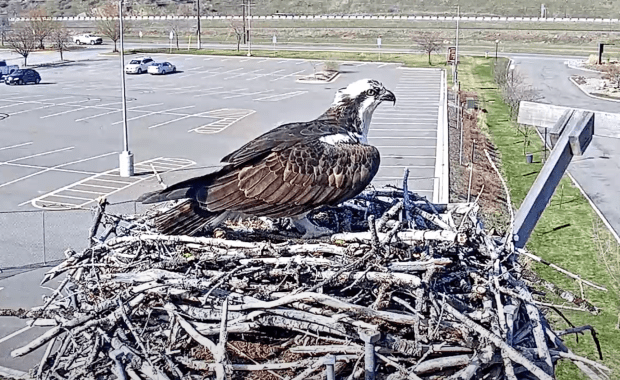
There is so much news in Bird World. I simply cannot keep up. At the same time, most of it is all wonderful! That is a good thing. My report will be short. Many things to do after listening to the wonder session with Cal Falcons.
Jackie and Shadow are amazing. While we have rain warnings here on the Canadian Prairies, our beautiful Eagle family in the Big Bear Valley had a horrific snow/ice storm.
Here is a video clip of Jackie and Spirit. What a great Mum Jackie is!!!!!!
This image was taken at 13:45 and things are much improved.
Cal Falcons. Mark May 5-6 as hatch days. Gosh, the Q & A with Sean Peterson and Lynn Schofield was really and truly informative. I learned so much! And I am posting it for you so you can listen if you wish. There were a couple of takeaways from this session that I found quite interesting. The first was that Alden was known to both Annie and Grinnell and was accepted by Annie and Grinnell. He had been seen for 1 or 2 months. Neither of them ever tried to chase Alden off the Campanile. On at least one occasion, Alden brought a prey delivery to Annie while Grinnell was alive. Again, no action by Grinnell. There is speculation that Alden was going to be a ‘nest helper’ for Annie and Grinnell and that is why neither of them were antagonistic or aggressive to him. The second was that a falcon has super eye sight for about a mile. They can spot a prey item. Grinnell was killed within a mile of The Campanile. Annie might have seen Grinnell being killed and that would contribute to her bonding with Alden so quickly.
Here is the link to this session.
Another fish came to the UFlorida-Gainesville at 16:11:37. The feeding finished at 16:47:55. Little Bit got nothing. The problem is that the two big siblings are now requiring more and more food and both are intimidating the wee babe. If another extremely large fish comes on board before night, finger’s crossed. I am not hopeful, however.
In part, one of the biggest issues is how the female stands to feed the chicks. If she would point her head at the rim so that Little Bit could get between her legs or on the opposite side, he might have a chance of some food.
Lena has been calling for a fish delivery. I wonder if she is hoping she can get Little (MiniO) who fledged this morning back up to the nest for some food.
There is absolutely nothing more beautiful than Big Red looking down at her new baby and it looking up to its wonderful Mum.
Iris has been spending time today at the nest just like she seems to do every afternoon.
The winds are roaring around the Channel Islands Bald Eagle nests. Everyone at the West End nest of Thunder and Akecheta are holding on!
It is not nearly as breezy but the wind is blowing and it is wet and dreary at the MN-DNR nest of Nancy and Harry and their two eaglets.
Big and Middle shared a fish at 09:38. These two are looking really good and there is absolutely no rivalry. It is truly wonderful – even when there are not a lot of prey items.
It is Earth Day and this is a very good reminder from Rosie and Richmond!
Wishing Everyone a Very Happy Earth Day. Take care. See you soon.
Thank you to the following for their streaming cams or FB pages where I grabbed my screen captures: SF Ospreys and Golden Gate Audubon, DHEC, Friends of Big Bear Valley, UFlorida-Gainesville Ospreys, MN-DNR, Cornell Bird Lab and Montana Ospreys, Cornell Bird Lab RTH, Captiva Ospreys and Window for Wldlife, Explore.org, and Cal Falcons.
The snow that was forecast did not materialize in southern Manitoba and Winnipeg. That is wonderful! We needed a break from the last storm to melt the snow and to be outside. The birds needed a break in the weather, too. Sadly, there is another special weather advisory for the southern part of Manitoba starting tomorrow morning through Sunday. Perhaps we will only get the wintery rain. Oh, the poor Wood Ducks. They have just arrived.
IMPORTANT INFORMATION: The Q & A session on Cal Falcons is at noon in Berkeley! When you go to the YouTube site and set the alarm reminder, it will confirm your local time – hence the confusion. Thanks ‘B’ and ‘S’.
You can tell by Big Red’s demeanour that ‘something’ is happening. She does a little wiggle and then you catch her with this focused look as if she can see the eyas advancing in its pecking. Of course, she can hear it cheeping and, apparently, so can the other three. Some believe that this encourages them to hatch faster so they can join their sibling. That would be grand.
Arthur revealed the progress of the hatch when there was a shift change.
Hatching!
The White-tailed eagle nest of Tula and Borek in the Tuchola Forest had three eggs. The eaglets hatched on 8, 12, and 14th of April. There are only two surviving eaglets today. Siblicide is not as widespread in White-tail Eagle populations as it is in Golden Eagles. That said, when the third eaglet hatched the eldest at this nest began immediately to beak it. There was 6 days difference in their age and size. I believe the two surviving are hatches 1 and 2. I will refer to them as Big Bob and Middle Bob to try and keep things straight.
Today, Middle was clever and crawled up leaning half in and half way out of the nest cup so it could get some food. This is a very determined youngster. The eldest had eaten and so the youngest was not tormented. I hope that these two survive just like the two oldest hatches at the Dale Hollow Nest.
The nest is 25 metres above ground on a 140-year-old pine tree. The White-tailed eagles have been using the nest for four years. At another place in the forest, eagles had been nesting since the late 1990s on a 160-year-old pine near to one of the fish lakes. So for 25 years eagles, at some location in Tuchola Forest, WTE have been breeding. There is a year round protection area around the nests extending 200 metres in any direction.
The nest is located in this large, 46 sq kilometres, nature reserve in northern Poland. The two main types of trees are the Pine and the Oak Bartek. It is the oldest oak tree in Poland believed to be 686 years in age.
The park is full of rabbits, deer, and 80 species of birds. There are also nearby rivers for fish. It is anticipated that there should be plenty of food for the adults and both of the chicks.
There are about 1200-1500 pairs of White-tailed Eagles in Poland. Their conservation status is ‘very scarce breeding bird’. Most of the eagles live in the northern areas of Poland.
Here is a link to this White-tailed Eagle nest in Poland:
Both eaglets were being fed well Thursday morning:
Idris and Telyn were watching the train go past the Dyfi Nest in Wales. Two eggs. We will be watching for the third tomorrow.
Little (or Mini) is still on the nest with Lena and has not fledged yet. Middle (Little) took off this morning about 10:05 for a flight and is perched on some greenery near the nest. He is probably going to watch for when Dad delivers a fish. This morning Lena has also had to chase away an intruder, another Osprey.
It looks like the MN-DNR nest is getting a bit of sun this morning. It will help dry out the nest of Harry and Nancy but will they get some of that snow and rain that is coming?
What is enfluffeling?
Jackie and Shadow’s 2022 eaglet, Spirit, sure loves it when the wind blows hard through the nest. She is working those wings today!
For all us worrying aunties and uncles, the cam operator did Zoom out and there are three eaglets on the West End nest. Relief. When the camera is in the normal position, you might only see two.
This is the view of the Glacier Gardens Nest this morning. Oh, it is beautiful. Liberty and Freedom should be returning soon.
It is a bright sunny day for Chase, Cholyn, and the little one at the Two Harbours nest.
The Redding Eagles are asking for you to vote for your favourite name for Liberty and Guardians 2022 hatches. Here is the announcement:
Friends of the Redding Eagles NAMING: Step 2: Vote for your favorite pair of names, just ONCE please. Click here to vote- https://docs.google.com/forms/d/e/1FA…
Jasper and Rocket from Samson and Gabby’s NEFlorida Bald Eagle nest have both fledged. They have also returned to the nest. Yahoo. Today they were perched on a branch of the nest tree looking out. I wonder if they might do some tandem flying?
Mum flew in with a hunk of fish at 09:22 at the UFlorida Osprey nest. Look where where that one osplet is positioned for the feed! I believe this to be either Big or Middle. It is not Little Bit.
That chick got a lots of nice big fish bites while the other two were fighting at the back of Mum. It is difficult to tell who is who and the dark shadow is not helping. I first thought it was Little Bit on the rim of the nest but I believe that Little Bit is getting hammered by Big while it is Middle eating. But that is not a 100% certain ID.
The chicks are really, really hungry. Clever of that one to get up there to be fed. It walked away and fell into food coma. Smiling. Ah, is he playing possum? He looked up to see the other two eating. Wonder if he will return for some more fish?
That osplet would certainly like some more fish.
Sadly it looks like Little Bit is lodged between Big and Middle. This is not good especially with less fish coming on the nest and the hot weather dehydrating the little guys.
Little Bit cannot seem to get around the bigger sibling. He will be getting tired and dehydrated.
At 10:00 the Big sibling was laying on top of Little Bit.
I do not believe Little Bit did get any fish. The feeding was over and Mum went to brood the chicks.
I will monitor the UFlorida nest on and off today. What looked good a few days ago has now turned. Let us all hope that another big chunk of fish gets on that nest quickly so Little Bit can have some food.
This is the latest on the hatch for Big Red and Arthur. The image was shot in a change over from Arthur to Big Red. I am really hoping that is blood from a prey item.
Thank you so much for joining me today. Take care everyone. I will be back with what I hope is good news on Little Bit later today along with hatch news from Cornell. See you soon!
Thank you to the following for their streaming cams where I took my screen captures: Cornell Bird Lab, UFlorida-Gainesville Ospreys, Friends of Big Bear Valley, Explore.org, Tuchoskie Forest Eagle Cam, NEFlorida and the AEF, Redding Eagles, MN-DNR, Captiva Ospreys and Window for Wildlife, Cal Falcons, Glacier Gardens, and Dyfi Osprey Project.
If you have been checking on the three osplets in the University of Florida-Gainesville nest today, you might have become quite distressed. The first fish did not arrive until 11:11:41 and Big made it known – after Little Bit – made a couple of beaks – that it would eat first. The beaking continued by Big and then Mum got them all lined up and fed peacefully by moving the fish.
There has been no more fish deliveries. It is 24 or 75.2 degrees with winds of 21 kph or 13 miles per hour. It is, of course, hotter up on that high nest with the light reflecting off the shiny metal of the lights.
Big is hot and cranky and very hungry as are the other two siblings and Mum. Hopefully this is not going to set a pattern for the future. If fish deliveries can get more normalized it would be very helpful.
Mum has left the nest. Has she gone fishing?
At 17:40:11, Mum landed on the nest with a fish with a head on it. I am going to presume that in the time she was away from the nest she caught this fish. My reasoning? This dad always brings in headless fish to the nest. I had hopes that the feeding would go smoothly but because it is slow going starting with the head, bedlam broke out with Big taking its frustration out on everyone. So sad that this is happening.
At 18:06 almost an hour after the fish landed on the nest, Little Bit moved up and is being fed. Relief.
There is enough fish left to fill Little Bit up! Mom is pulling the flesh off the skin for Little Middle. She has eaten some along the way and she will eat the skin and the tail for sure. It would be really nice if Dad brought in a second fish. Wonder where he is?
I can tell Little Bit is being fed by the way his body is moving. He sort of spreads his wings out sometimes too. Mum is also feeding Middle at the same time. They will all go to bed with some fish in their tummy.
Give Mum a great big round of applause. She was still feeding Middle and Little Bit at 18:18! I am impressed. Middle got full and moved and Mum was still finding flakes for Little Bit at 18:27. Bravo.
Further chaos evolved when Mum decided she wanted to brood all three of them! Good night little ones. Happy Fish Dreams.
In other Bird World news.
At 14:25 you could see the little beak of L1 chipping away at the egg wanting to hatch!
The Smithsonian Magazine has put out an article about the impact of Avian Flu on the Bald Eagles (US). In Manitoba, we have two confirmed cases of Avian Flu – a Bald Eagle that just migrated and a Snow Goose.
I would not want to get in the way of any of the Eagle parents. They caught the female at the Pittsburgh-Hayes nest protecting her three eaglets from an intruder.
Not only are the hawks and falcons laying four eggs but there is an Osprey nest in the Kielder Forest that now has four osprey eggs. Oh, geez. Can you tell already I don’t want that 4th egg to hatch?? It is at Kielder Nest 1A.
@ Forestry England
The Kielder Web site says, “It is the fifth time in total that there have been four eggs on their nest. 2016 was the first occasion and the pair raised them to fledging, but sadly the eldest was never seen after that. On the more recent occasions a chick has died young or hatches failed. Weather is a key factor, but disruption by intruders can also cause problems.”
No eggs yet at Poole Harbour but Blue 022 did bring CJ7 a nice fish today! Fantastic.
A reminder about the Cal Falcons Q & A. I just had one large laugh when I saw a comment by ‘B’ about the time. ‘B’s’ question is: Can I assume that this is noon Pacific time and not 2pm? Here is the posting! And that is a great question. Did the system automatically set the time for CDT not Berkeley time? I plan to ask and will get back to everyone as soon as hear. The nice thing is that Sean always posts the whole discussion after. The sad thing is that you miss submitting questions. This should be a very informative chat after all that has happened.
It has just been a lovely day and I am going to try and navigate the snowy sidewalks and go for a bit of a walk. There are apparently Wood Ducks back in the City and Canada Geese have been making nests on beaver dams because of the snow. It is rather crazy out there. The snow last night did not materialize. Thank goodness.
Take care everyone. Thank you so much for joining me today. See you soon.
Thank you to the following for their streaming cams and/or web pages where I took my screen captures: Kielder Forest, Cal Falcons, Cornell Bird Lab, UFlorida-Gainesville Ospreys, and Poole Harbour Ospreys.
Right now it is hard to believe that snow will be arriving again in about 4 or 5 hours. All of the garden animals are out and about running around on the hydro lines and poles and checking to see if there are any corn kernels hidden in the wood in the little sheds. Dyson knows it is there! He will find it for sure.
Sharpie seems to have some competition in the garden now with a Cooper’s Hawk (note the curved tail). This hawk is much larger than Sharpie. I wonder if it is a female. Certainly didn’t need to worry about birds at feeders!!!!!!!! They took off but a few went down under the deck and Cooper knows they are there.
Besides the garden chaos with Cooper, there has been a mini-kerfuffel going on in my City today. To feed the songbirds or not? to put out feeders or not? in times of Avian Flu. I decided to ask the Cornell Bird Lab and also sent a question to Dr Thijs Kuken at the University of Erasmus in Rotterdam who is a virologist and studies Avian Flu. I have not heard from him. But the Cornell Bird Lab did send the following information:
“Hello,
Thank you for reaching out to the Cornell Lab of Ornithology.
We are paying attention to the situation. Avian influenza viruses occur naturally among wild aquatic birds worldwide and can infect domestic poultry and other bird and animal species. Wild aquatic birds can be infected with avian influenza viruses in their intestines and respiratory tract, but usually do not get sick.
There are no suggestions to take bird feeders down unless you have backyard poultry or work with poultry or other domestic birds. Of course, this may change as birds begin their migrations north.
Sarah Wagner, PhD Public Information Specialist Cornell Lab of Ornithology
It is recommended that you clean your feeders with a very mild mixture of dish soap and either white vinegar or bleach (very, very mild). You should allow everything to fully dry before using them. There are also recommendations that you clean your feeders every 48 hours. But do note, if you have feeders near poultry – as in a back yard poultry area), those feeders should be removed!
Checking on the UK Ospreys, Mrs G and Aran have their first egg. It arrived at 19:37! Aran saw the egg and went to get Mrs G some more bedding. Sweet.
Telyn and Idris welcomed their second egg at the Dyfi Osprey nest at 18:01.
Sweet. A nice fish for Telyn. Oh, Idris. You are a darling.
A small piece of fish with the tail arrived at the Dale Hollow Eagle nest late in the day. Big and Little Middle were decidedly hungry! It was nice to see the adult feed them both.
I know that the parents slow down the delivery of fish as the eaglets get older providing them with plenty one day and nothing another so they learn about living on their own. However, it sure was nice to see a piece of fish show up for these two!
Martin and Rosa’s eaglet at the Dulles-Greenway Bald Eagle nest is doing great. They have had some bad weather and it is still really windy there.
Akecheta has been busy protecting his three eagles at the West End nest on the Channel Islands. It looks like he was concerned about some gulls that were overhead this afternoon.
I did not see it but ‘B’ sent me a video clip of an intruder getting right in the scrape box at Cal Falcons. I am glad I did not see that event live. Thank you, ‘B’.
Sadly, the successful breeding and relocation programmes often cause a lot of floaters looking for nests that can be quite disruptive to established pairs with eggs or chicks. Or, sadly, cause fatalities.
Little Bit has a nice crop. You can see it in the ‘cuddle puddle’ on the nest. That fuzzy light grey marble looking thing is its crop! The nest has done well today. Mum has tried to keep those osplets cool.
Jasper at the NE Florida Bald Eagle nest took its first flight and has since made several others. Rocket is ‘thinking’ about flying. Jasper, however, seemed to have everything happen the day he flew for the first time. He roosted during a storm on the nest tree and, as the AEF realized, he was also hit by an owl! Needless to say he was tired and starving when he got back in the nest. Here is the footage of the owl attack.
This has been a very short newsletter. I hope that everyone is doing well. Take care and I will see you again soon – with more eggs being laid tomorrow in the UK! Thank you for joining me.
Thank you to the following for their streaming cams where I took my screen captures: DHEC, Brywd Gwyllt Glaslyn, Explore.org, UFlorida-Gainesville Ospreys, Dulles-Greenway Eagles, Pix Cams, and Dyfi Osprey Project.
The first time I watched an Osprey nest I swore I would never watch another one. Here I am years later. My book shelves are full of information on Ospreys, I dream about Ospreys, I do research on third hatches. My mind is filled with ‘Osprey’. These birds can take you to the lowest depths and send you to the highest heights of joy. Together many of us cheered on Ervie – the third hatch at Port Lincoln, Australia in 2021 – who was clever and survived winning our hearts and the sat-pak over Bazza and Falky. Since then he has had at least one talon pulled out – it is growing ever so slowly. As a result, Ervie has stayed around Port Lincoln. Ervie has entertained us by returning to the nest barge over and over with his puffers. It is the best! We get to enjoy him longer.
The camera at the Achieva Osprey Cam in St Petersburg, Florida is now on line. It looks terrific. While the camera was out of order, Diane laid three more eggs – a second clutch. The first fell in a hole in the nest (or so it was believed). Normally, the eggs would be hatching at the end of February or beginning of March. The hot Florida weather may pose a problem. I found it very endearing when I discovered, this morning, that David Hancock is adding a shade canopy to all of the Bald Eagle nests he is building in British Columbia. That is something that may become very necessary at the Florida nests!
Jack and Diane fledged three last year. It was not an easy nest to watch as Tiny Tot Tumbles struggled. More than three times we thought TTT would die but she was clever and persistent. She learned to eat old dried fish and she lived to become the most dominant – and beautiful. In the end, Diane went and caught cat fish to supplement what Jack brought to the nest. This is what turned the corner for Tiny Tot.
After fledging, Tiny Tot remained at the nest for some time. She even defended it against adult intruders on her own and with Jack. Oh, how I wish she was banded!
But, I will warn you. With the late hatch and the heat, there is no telling what will happen at this nest.
I have no idea how the three will be doing in a week at the U of Florida Gainesville nest. It is hot! The chicks are enjoying the shade under Mum.
These are also three of the most active little ones I have ever seen!!!!!!
At least two are up out of the egg cup. If Little Bit isn’t yet, he will be out of there soon clamouring around on the Spanish Moss.
Lena and Andy were one month ahead of the normal egg laying time in Florida. Their two osplets are just about ready to fledge. They are beginning to get a little air under their wings and it won’t be long til they are hovering about. Andy and Lena did a great job this year.
By laying the eggs a month early at Captiva, Andy and Lena might have saved their chicks from the Crows and other predators that predated their nest for two years.
The two are yelling at Andy to get the breakfast fish on the nest pronto! Lena can sit back and let them take care of it – if she chooses. They can be pretty loud.
You can still watch this nest and enjoy seeing these two beautiful birds fledge! Here is the link:
Idris has brought a large Mullet onto the Dfyi nest in Wales today but Telyn wants more fish and she is really telling him!
I am not sure what is happening in Loch Arkaig. Louis and Dorcha seem to be playing musical nests. Yesterday it felt certain that Louis and his new mate of last year would go back to the old nest but, today, Dorcha has been on the one that they used as a couple last year. It doesn’t matter for watchers – cam 1 or in this case, cam 2 – we can see them at either one!
Mrs G and Aran on the Glaslyn nest – now that everything is sorted and the females are where they should be – everyone can settle. Aran brought in five fish so far today – 3 yellow-bellied trout, 1 sea trout, and 1 flounder. He is an incredible fisher.
Mrs G, the oldest UK Osprey.
Aran! And he is very handsome.
While we wait for Mrs G to lay her first egg, Blue NC0 at the Loch of the Lowes nest laid her first a day ago and we will be watching for egg 2 shortly.
Seren and Dylan have their first egg yesterday at the Llyn Clywedog Nest in Cumbria.
One of my favourite nests is the Foulshaw Moss nest of White YW and Blue 35 in Cumbria. This nest fledged three last year. It was the home of a third osplet that no one thought would survive – the others were monstrous when the third hatched. It was to the keen parenting and the tenaciousness of Tiny Little Bob. She fledged as Blue 463 and she was queen of this nest! It was incredible to watch her figure out how to get around the big ones.
They are not on YouTube and there is no rewind on the two cameras. You can access them here:
That is a very quick run through some of the nests. I wanted you to know about Achieva in case it was a nest that you watch. Take care everyone. Thank you for joining me today!
Thank you to the following for their streaming cams where I took my screen captures: UFlorida Ospreys at Gainesville, Captiva Osprey and Window on Wildlife, Achieva Credit Union, Woodland Trust and Friends of Loch Arkaig, Dyfi Ospreys, Brywd Gwyllt Glaslyn, Cumbrian Wildlife Trust, and CarnyxWild.
We continue to shovel the walkways so that we can put down seed. Then it snows lots more and we do it again!
It is nearing 23:00 on the 12th of April. The RCMP (Royal Canadian Mounted Police) are closing all of the major highways in the province where I live. This is unprecedented and will actually be quite helpful in keeping people safe. For at least two days we have known about the historic storm that is due to arrive in a few hours and have been told to stock up on medicines, batteries, candles, food, etc. All of the schools are closed. As for me I am sitting back and waiting and watching the MN-DNR Bald Eagle nest south of me in Minnesota to see how this system plays out with those eagles.
The nest is in a severe thunderstorm watch area. The winds were gusting earlier. I caught a few minutes of the nest as it creaked and swayed.
It is currently raining and the nest is still blowing about but not nearly as bad.
This is the nest Wednesday morning. They have gotten rain but not the snow that we are experiencing that is confusing many of the smaller birds such as the Juncos.
There have been two recent visits of Ervie’s to the Port Lincoln Osprey nest. One was 17:42 on the evening of the 12th (last night). The other was this morning, the 13th in Australia. Ervie arrived and then left and returned with a puffer.
In the image above, you can see the missing talon. Ospreys only have four talons. The image below has caused a lot of confusion. Does the nail on the right top belong to a different foot? or the one with the missing talon?
Is Ervie missing one or two talons? or is one curled under? Everyone is looking very closely at Ervie’s feet.
I wanted to do a quick check of many nests this morning so we can see how they are doing.
The rain from yesterday seems to have stopped. Both Big and Middle Little at the Dale Hollow nest are dry and there are large pieces of fish on the nest. Little Middle had a nice feed earlier, too. So all is well with those two!
This nest has settled down.
This is the Llyn Clywedog Nest of Dylan and Seren. It is gorgeous. Dylan is notorious for bringing back trout to the nest! Sadly, yesterday, a goshawk came and sat on this nest. Goshawks tend to like to lure the Ospreys into the forest where they attack. Fingers crossed that it will not return!
Aran and Mrs G together on the perch first thing on the morning of 13 April. Aran at the back and Mrs G with her really dark face at the front.
Handsome Aran with his fish on the perch at Glaslyn later in the day. Did he bring it for Mrs G? where is she?
Idris and Telyn on the perches at the Dyfi Nest. All is well.
Blue NC0 laid her first egg on April 12 at 18:35. What a beautiful nest at the Loch of the Lowes – so soft and comfy – and personally, one of the most gorgeous sites in all of the Osprey breeding areas.
Laddie LM15 comes to take his turn helping his mate Blue NC0.
CJ7 has been bringing nesting materials into the alternate nest at Poole Harbour. Blue 022 has been seen sky dancing all over the place. I hope he stays at Poole Harbour!
All is well at Rutland Water. Maya is incubating three eggs. Fantastic.
If you are following the UK arrivals, here is a good chart for you.
Thank you to Friends of Loch Arkaig FB Page for posting his chart.
Moving back to North America, the three osplets at the U of Florida at Gainesville continue to do well. Little Bob is still with us! And that is a good day.
Strong winds took out the camera at the West End nest of Thunder and Akecheta on the 12th.
Calmer winds are forecast for the Channel Islands today. That is fantastic. Looks like the view is pretty good from Two Harbours already. That wee one of Chase and Cholyn’s looks so tiny in that huge nest!
Andy has delivered fish. Little (or Mini) is calling for fish in the image below while Big flaps its wings.
Gosh, those chicks of Andy and Lena’s are sure beautiful. They will surely pop the corks when these two fledge! It has been a good year for Captiva Ospreys.
Mr President and Lotus’s chick has a nice big crop this morning. That little fuzzy teddy bear of a shape has sure changed over the past week! No signs of bad weather at the National Arboretum Nest in DC.
It is a little wet and windy in Iowa at the Decorah North nest. I wonder if they are going to get any of the system that is impacting us?
This is an image of Majestic, the Ambassador Bald Eagle for Wildlife Haven, our local rehabber. She has been part of a fund raising campaign because of the Avian Flu. She has been moved indoors where she will be safe. Everyone loves Majestic!
The Manitoba Wildlife Federation is sponsoring a virtual talk/discussion on what is being done about Avian Flu in our province on 19 April at 7pm. Here is the link to sign up. It is free. Since it is virtual and if you are wanting to learn more about Avian Flu, why not sign up?!
Hancock Wildlife in British Columbia is having a GoFundMe drive for nests for Bald Eagles. David Hancock is ‘the eagle man’ in Canada. Most of you probably know him. He reminded me today that when he was sixteen years old and living at Blaine Harbour, you would see white buckets on the fishing boats with eagle legs. Yes, the legs cut off. They would be shipped to Alaska for $2 a pair. That was 1954. Sadly, David says that the same attitude of neglect towards the Bald Eagles continues.
Thank you for joining me today. We are busy trying to take care of the birds that come to our garden as best we can. The squirrels are tucked up warm and no where in sight. Take care everyone!
Thank you to the following for their streaming cams where I took my screen captures: Port Lincoln Osprey Project, MN-DNR, DHEC, CarnyxWild, Brywd Gwyllt Glaslyn, Dyfi, Scottish Wildlife, Poole Harbour, Rutland Water, UFL Ospreys, Explore.org, Captiva Ospreys and Window on Wildlife, NADC-AEF, and Wildlife Haven.
Iris is the Queen of American Ospreys. Believed to be the oldest Osprey in the world, Iris began breeding in Missoula, Montana on a hydro pole with her mate Stanley. The Montana Raptor Project built her a nest on what was the parking lot of the Riverside Clinic in Missoula near Hellgate Canyon. She is thought to be 28 or 29 years old.
Each year everyone waits holding their breath. April 7 is a special day because it is the day that Iris seems to pick to arrive more often than not! I will have a full report on this grand dame but for now, just celebrate! Iris made it through the winter and is back in Hellgate for the spring and summer!
Welcome home Queen Iris.
Thank you to ‘L’ for alerting me and to the Montana Osprey Project for their streaming cam where I took these images.
Someone once told me that if you can get people involved in the lives of the birds, get them to see them as the individuals that they are, get them to understand the hardships that they face because of ‘us humans’, then there is hope that the world will be a better place for our feathered friends.
One of my readers, ‘B’ mentioned to me that California loves its birds. He sends me wonderful links to the news stories of Grinnell and Annie or Jackie and Shadow. It was mind blowing to see the sheer mass of press coverage – everything from breakfast news, to the headline news at 6pm, to the printed pages – stories of the lives of the birds from eagles to falcons. What a fantastic way to get the public involved. No wonder the streaming bird cams in California have over 5000 viewers at times.
Today there is another wonderful article surveying the life of Annie and Grinnell, the death of Grinnell, and the rise of the ‘new guy’. Have a read, it is a good one:
I miss Grinnell. There was something about that little falcon that tugged at my heart every time I saw him. For transparency sake, I should say that I feel thee same heart tugs when I see Xavier bringing prey to Diamond or the male at the CBD 367 Collins Street scrape in Melbourne plucking a pigeon for his female triplets. They are tiny up beside the females. If someone could design a pajama onsie like the plumage of an adult male falcon, they would surely make a lot of money. Seriously, these little males are cute. We cannot forget – at the same time – that they are the best aerial predators in the world flying at speeds up to 350 kph, breaking the necks of their prey in the sky. Still…put that altogether with the ritual bonding of the couples and you have a most interesting raptor. I disagree with some who say watching falcons is the ‘gateway’ into watching larger raptors. For me, the falcons and the hawks are just as interesting, if not more, than the eagles. Eagles frustrate me. Falcons can feed three eyases without a problem and have them all fledge. Enough said.
For Annie’s sake and for the two eggs of Grinnell’s in the scrape along with the one of the ‘new guy’, I am glad the NG came along. I like the fact that he brings prey to Annie late at night. If she isn’t hungry she can stash it away and have it in the middle of the night or eat it for breakfast. There is no waiting for food. I like the tenderness that he uses in trying to roll the eggs and get them under his tiny body along with the fact that if Annie calls him – he comes. New Guy isn’t going to win a lot of awards for his jammies – they are a little rough at the edges, something that goes along with his lameness – but he will most certainly win hearts and minds, just like Xavier did at Orange, for rescuing this 2022 breeding season for Annie — and for our dear Grinnell. We must not forget that. He isn’t the male that comes storming in and shattering the eggs of his predecessor. Nope. He is tender and caring. It is a miracle of sorts that he came along, just at the right time, slipped into place. In a month, we will play guess whose nestling belongs to whom – and we won’t know and the new guy and Annie won’t know. They will just take care of all three of them.
I do wish that the falcons wore identity tags. It appears that the ‘new guy’ flew up to the ledge. No prey in talons but obviously working on something. Is it stashed somewhere? The ledge clock says it is 17:16 when he arrives.
Simultaneous with the new guy’s arrival, Annie gets up and leaves the eggs to take a break.
It was only the limp that gave away it was the ‘new guy’ trying to fit the eggs and roll them under him without causing any damage.
Annie returns with some nice YSL red lipstick at 18:08. She obviously had a nice supper. Did I say I was getting to like the new guy? How many times?
Cal Falcons put together this video of the exchange of incubation duties. Enjoy!
Good night Annie and ‘the new guy’. Good night to all of you. Take care. See you soon!
Thank you to Cal Falcons for their streaming cam where I took my screen captures.
One of my favourite White-tailed eagle females is Milda. I have mentioned her before in my blog. Her nest is in Durbe County in Estonia. It has been a rough year for Milda since her long-term mate was missing and presumed dead in late March of 2021. Milda heroically tried to incubate the eggs without food for 8 straight days to the point of starvation. Several males offered hope and then didn’t. As if with a miracle the two chicks hatched and we all celebrated only for them to perish because of one of the males taking the food off the nest and then not covering them. But, that was last year, and there was hope for this one but again, disappointment when the eggs laid were broken by an interloper.
The females on the nests need a good strong partner who is working with them cooperatively!
The White-tail Eagle is so rare in Eastern Europe. Latvia, Estonia, and Poland are doing what they can to encourage breeding sites.
The White tail eagles are Haliaeetus Albicilla. They are the largest raptors in Europe and are located from Greenland to Asia. The Eagle Directory describes the plumage like this, “White-Tailed Eagles are almost entirely brown. They have a yellow-gray head, neck, breast, and lesser wing coverts, and the belly, thighs, and rump are dark brown. The flight feathers are close to black and their wedge-shaped tail, as their name would indicate, is white. The tibia are feathered, though the tarsi are not, and the legs and feet are yellow. The eyes, beak, and cere are yellow.”
As you can seen from the images of the White-tailed Eagles below, the plumage can vary and of course, we have to take into account the lighting and settings on these streaming cams. These eagles grow to be from 74-92 cm long with a wingspan of 193-244 cm. The females are larger than the males as in most raptor species and weight between 3.7 and 6.9 kg. The males come in at 3.1 to 5.4 kilos. Their life expectancy can be up to 36 years. They eat mainly fish but also hunt mammals such as rabbits and birds. I have seen them also be opportunistic and bring some carrion to the nest. Indeed, it was a crane brought to the White-tailed eagle nest last year that killed two wee chicks because that crane brought with it the highly pathogenic Avian Flu, H5N1. While the birds are listed as not being under threat in some areas, they are very rare in Eastern Europe and the UK is trying to reintroduce them. While they may lay 1-3 eggs, it is most typically 2 eggs that will be incubated by both parents (as you see below) and hatch within 34-46 days. Fledging typically takes place between 77-90 days after which the fledglings are depending on the parents for 4-6 weeks while they learn to fly and hunt.
In older White-tailed eagles, the head and neck can be almost white.
The adults in the images are in a nest in the Woziwoda Forest District. It is a special project of the Eagle Conservation Committee, the Woziwoda Forest District and Polish Radio promotion both old forests and the White-tailed Eagles. The nest is highly protected. There can be no activity within a radius of 200 m. Setting up the camera were problematic and the workers who installed it had to do this cautiously when the eagles were away.
The nest you are looking at is on a 140 year old pine tree at a height of 25 metres. This nest has been occupied for four years. It is known that there was one fledge in 2021.
For transparency, I do not know any of the history of this nest so I do not know whether to give you caution or not. I am attempting to find out. The setting is simply beautiful and if some of you have been watching this nest in the past, please let me know. The chat is in Polish and I understand eggs are being incubated but it is not clear how many or when they were laid by the information provided.
Here is the link:
Just an update on 2 other nests: The adults at Dale Hollow have brought in a teaser 2 bite fish and a small sucker early in the morning. Big ate both of them. No other food has been provided to the eaglets up to 18:30 this evening. I sure wish they would bring a whopper on the nest tonight for both. That said, Little Middle ate well yesterday and is OK. Sadly, Little Middle continues to pull that monofilament line. Thank you to ‘CA’ from Belgium who sent me this 15 second video clip. I could not see him dragging the nesting material, my mistake.
Annie and the new male continue to bond in the scrape box. I have caught him incubating a few times today. I sure hope he is a good guy to our Annie! I don’t think any male will ever fill Grinnell’s shoes – he was a huge character in every aspect of a raptor’s life but any bird who will care for Annie, Grinnell’s eggs and now on of his own is gold in my books!
Karl II has spent his 4th night in the Ukraine not far from Kyiv. Anne7 posted this image of where he was hunting for food this afternoon. I am so grateful for the Looduskalender Forum and their English pages and to the tirelessness of Anne7 to inform all of us of Karl’s whereabouts. I wish him to replenish his energy and get to Estonia! Fast.
You may find yourselves spending too much time looking at the Dale Hollow nest hoping for a miracle. I had to begin to pull back today. It is mentally exhausting. We cannot make the adults bring in more food and legions of you have contacted enough people to get help. ‘L’ has had a promising conversation with Al Cerere who asked the important questions. If help can come, he is the guy to make it happen. We simply have to wait and hope. My heart breaks for both of these eaglets but, of course, most especially Little Middle.
Our weather is set to soar to a high of 8 degrees Celsius. We will all be outside in our summer clothes! Well, not quite but it will feel like that. It was a damp day, cold to the bones British type weather today. Birds are arriving and I really hope to get out to see some of them in the morning tomorrow. My post will likely arrive late in the afternoon.
Thank you so much for joining me this evening. Please take care. See you soon!
Thank you to the following for their streaming cam where I took my screen captures: Cal Falcons and Bieluki On line Bory Tucholskie.
So many of us love/d Grinnell. I do not know anyone who is not still shocked by his death.
How do you write about a Peregrine Falcon that brought so many so much love, joy, and laughter? Grinnell was a very sweet lad. I have found it difficult to write about him because for many years it was always ‘Grinnell and Annie’ ‘Annie and Grinnell’. In my mind, I was not able to separate the two. They were a constant which, over the past few years, has been very reassuring. And then they weren’t.
Grinnell was last seen at The Campanile at 10:37 on the 31st of March. He was later found dead in the downtown area of San Francisco. It is believed he was chasing a female intruder and went low and got hit by a car.
Grinnell hatched along with another male in a nest near Martinez, California. He was banded in 2013. This makes him 9 years old this year.
Annie and Grinnell were bonded mates for six years. Indeed, it was probably only Grinnell’s injuries on the 29th of October that caused them to be separated for the longest time in their relationship. They appeared at The Campanile in December 2016 making their first nest on a sandbag!!!!!!! Cal Falcons decided that it was better if they fixed them a proper nest in 2017 which evolved into the scrape box that you see on camera in 2018.
Annie and Grinnell raised two to fledge in 2017- Fiat and Lux. Fiat flew out of Mum and Dad’s territory to set up his own while, sadly, Luxe hit a window and died. In 2018, they fledged 3 – Berkelium, Lawrencium, and Californium. All successfully left. Lawrencium, the female has a nest on Alcatraz and has made Grinnell and Annie grandparents. In 2019, there were two fledges – Carson and Cade. In 2020, there were three – Poppy, Sequoia, and Redwood. Poppy was spotted recently in San Jose, California and Sequoia is known to be in Santa Clara, California. Unless a miracle happens, 2021 will be the couple’s final breeding season. It was hugely successful with three males fledging – Fauci, Kaknu, and Wek-Wek. In total, they fledged 13 juvenile peregrine falcons in 5 seasons. It is not clear how many grandchildren the couple have.
We ached for Annie and the two eggs in the scrape.
It has been a bit like a roller coaster with the plot thickening every day since Grinnell’s death. A male appeared, began courting Annie, and briefly incubating the eggs almost as soon as Cal Falcons announced the death of Grinnell. The news of this tragic drama has spread. It even made it to the Toronto news.
The new male likes to sit on the ledge above the nest box watching over Annie and the eggs. Has she accepted prey from him? I am not certain.
This afternoon, Annie initiated the bonding and the male immediately came to join her at 16:30.
He has a limp. Cal Falcons confirms that this should not impact his hunting. And, in fact, he tried to give Annie some nicely prepared prey last night but she was either full, according to Cal Falcons, or not ready to commit. Has anything changed today?
After the bonding ritual, the young male situates himself on the eggs to incubate them.
He is rather cute and I am quickly warming up to him.
These are gentle gestures of loving kindness — the world could use so much more kindness like this – right now.
There are so many news stories out about Annie and the new male. Here is one with comments by Lynn from Cal Falcons:
I will always treasure the years that I was privileged to watch Annie and Grinnell raise their chicks. No one will replace Grinnell in the hearts of thousands but, for now, I am grateful to this young male who has been hanging around for about a month, that he is stepping up and will help raise the last two chicks ever of Grinnell’s. That makes him a winner in my books.
Thank you for joining me tonight. If you are looking for a blog on Sunday, it will be coming late in the afternoon. I am counting Canada Geese tomorrow at several locations! Continue to send your warm wishes to all of the birds especially those migrating over war zones and those entangled with monofilament line. Please take care. See you soon!
Thank you to Cal Falcons for their streaming cam where I took my screen captures.