The automation of YouTube has once again caused havoc and I am sending my apologies.
The Question and Answer session with Sean and Lynne is set for 3pm Pacific Time. My YouTube automatically set mine for 5pm even showing that on the poster!!!!!! Crazy.
You can type questions into the active chat, too. Or just sit back and listen to two very excited individuals who love Annie, Grinnell, Alden and the chicks.
Here is the link:
If you go to Cal Falcons, you might be able to see the second chick hatching. It is working on that shell!!!!!!
The five peregrine falcon eyases at the Manchester, New Hampshire scrape have been fed four times before 0930. Meal times were 0531, 0627, 0712, 0917. Mum doesn’t get finished quick. She will wait til there are no beaks open wanting food. Just look at the youngest right up there!
There are five eyases in the scrape at the Walburga Tower in Oudenaarde, Belgium, too.
Here is the link to the camera in Belgium:
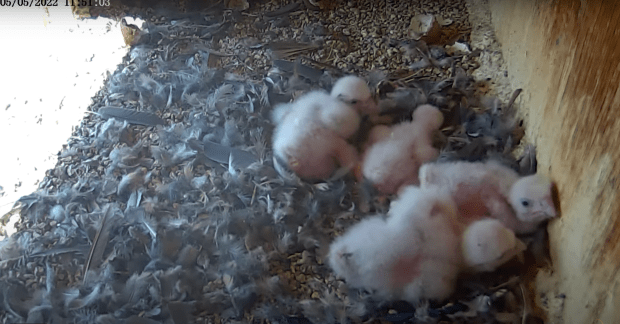
There is still one eyas at the scrape box on The Campanile on the grounds of UCalifornia-Berkeley. The wee one hatched on 5 May. There are two more eggs. One appeared to have some cracking of the egg but that could have been light or debris.
Bingo!
A really nice fish arrived for the two soggy eaglets at the Dale Hollow Nest at 0813.
It is not clear to me which of the eaglets claimed the fish. Note: the cam is flickering (or was) in and out of IR mode).
There was some headway made on the self-feeding and later both decided to sit it out on the rim of the nest.
Lessons are still being taught at the WRDC Bald Eagle nest in the Miami Zoo. Rita arrived with a nice fish at 0926.
She waited eating morsels. It was not until 1024 that a fledgling arrived on the nest.
Mum left them empty taloned. Wonder what lesson she was giving out today????
Both R1 and R2 seem to be hanging around the nest. Hi there.
The three eyases at the Weissenburg scrape in Bayern are really growing. Look at the change in their plumage. The soft dow gives way to a rather matty looking cotton that reveals feathers!!!!!! Pink beaks begin to change colour.
Louis is an amazing partner. I adored him with Alia and so sorry she did not return last year. He has settled in with Dorcha and despite the pelting rain in Scotland landed a nice fish for her. Well done, Louis.
Dorcha is so dark. She reminds me of Mrs G at the Glaslyn nest.
We might be checking in on the Osprey nests scattered about the UK but all eyes are on one nest – that nest belongs to Blue 33 (11) and Maya at Manton Bay. They should be having a pip and a hatch today or tomorrow.
Maya is not giving anything away! Gosh she is beautiful.
If you are looking for a solid Osprey nest to watch, one that fledges all their hatches then this is the nest to watch. Here is the link to the streaming cam.
It is raining a lot of places in the US and much of that rain is really welcome especially up in the Pacific Northwest. You will notice that I do not list any of the Osprey nests in that region. The ones I know have suffered from the extreme heat.
It is also raining on Long Island at the PSEG Oyster Bay Osprey platform. Did you know that there are over 2000 Osprey nests on Long Island? Most are located on the eastern end. PSEG has two platforms. The one at Oyster Bay in Nassau County and the other at Patchogue. The Ospreys return each year with the arrival of the Menhaden. It is a species of fish in the herring family. They travel south in the fall and winter and north in the spring in slow moving tight schools. Sadly they have been over fished.
We are waiting for hatch at the new scrape box mounted on the top of the Spartan Stadium at the University of Michigan. It is raining there today, too.
Dad has come to relieve Mum but she isn’t budging. Will we have a hatch today? Maybe. Here is the link to this new streaming cam and scrape.
These falcons made the news!
Some images from this morning at the nest of Big Red and Arthur on the grounds of Cornell University in Ithaca.
Nancy has fed E1 and a cherry picker has gone up to the nest. It is banding day!
E1 properly defended the nest he shares with Mum. Sadly, Dad Harry has not returned to the nest. He disappeared on the evening of 26 April. Once Nancy realized what was happening, she started bringing food to the nest. As we know, it was too late for E2.
Despite early worries by some watchers when there were four eggs, Big Red has shown that this is not a problem. Indeed while it might be one extra to her norm, you can see by some of the peregrine falcon nests that it is possible for five to do well. Life is so different on the hawk and falcon nests than it is for the eagles and the ospreys.
It is going to be a gorgeous 21 degree C day in Manitoba. It is a good day to get outside – before the next rains come – and go and see some of the new arrivals in the City while I wait for the second hatch at Cal Falcons and for their Q & A at 5pm Pacific Time.
The Dark-eyed Juncos that arrived in mass during the horrible storm a few weeks ago seem to have departed. The numbers of birds at the feeders are returning to the norm. Even Mr Blue Jay dropped by this morning.
Take care everyone. Thank you for joining me. See you soon.
Thank you to the following for their streaming cam where I took my screen captures: Cal Falcons, WRDC, Woodland Trust and People’s Post Code Lottery, LRWT, Cornell Bird Lab RTH, Spartan Stadium Falcon Cam, I & M Falcon Cam, PSEG Oyster Bay, Weissenburg Falcons, DHEC, Oudenaarde Falcons, MN-DNR, and Peregrine Falcon Networks.
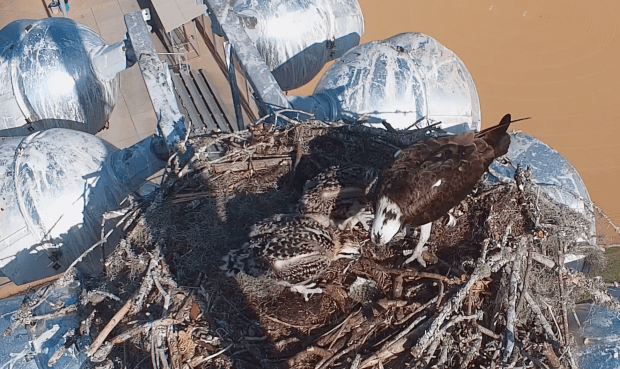
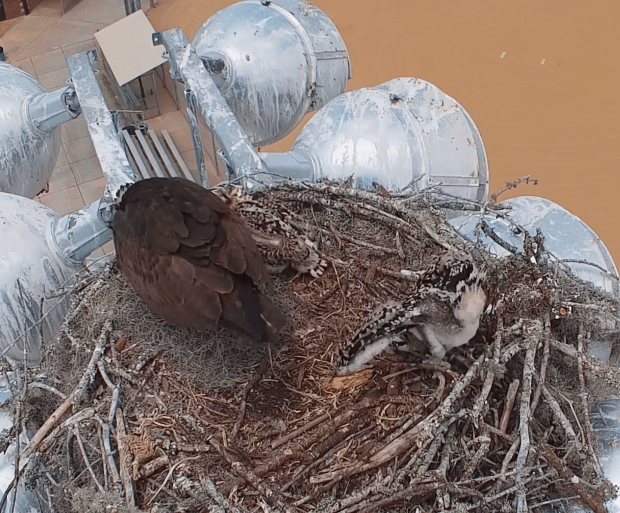
It is hard to believe the change in a few days. The intruders made it virtually impossible for the parents to get food to the two osplets on the UFlorida-Gainesville nest. That caused a lot of tension on the nest with the youngest chick, Middle, often getting left out. This morning there has been three – yes 3 – fish deliveries before 0900. Unbelievable. The chicks are certainly not fighting.
The first fish came in at 0642. Both were up. At the onset it appeared that Big had the advantage. Middle moved back and forth to the middle of the nest always returning to Mum’s beak. At 0746 Middle had a nice crop.
Big is to the left of Mum with the darker plumage and Middle is to the right.
Middle has a really nice crop! Lovely.
The second fish – to the astonishment of everyone – arrived at 0810. Middle was right there but Mum moved the fish to the other side of the nest. By 0812 Big was settled in eating. Mum continued to feed Middle then alternated with Big. Middle cleaned his beak at 0827.
Once again Big is on the left and Middle is on the right. What a nice fish!
Big gets full and leave and Mum continues to feed Middle. Big will move back up again but both had nice crops and, in the end, of the two fish were fed pretty equally.
I don’t think anyone believed it but Dad flew in with another small piece of fish at 0847. Middle took advantage of the placement. Everyone ate, including Mum and all are full.
All will be nicely hydrated and full for the long hot day ahead.
It has been a really good morning for Mum and the two osplets.
The weather in Gainesville is currently 23 C reaching a cooking high of 32 C or 89.6 F. It is going to be really hot up on that nest. Dad was smart to go out early and fish while it is cool before the fish go deeper in the water. Winds are 11 kph with a humidity of 88%. Hot and humid.
Excellent news on a nest that had one incident of siblicide and a second chick suffering due to a lack of food. Today is a good day. We will celebrate that!
Thanks for joining me this morning. I am off to check on the falcons, hawks, and eagles. Take care all. See you soon!
Thank you to the UFlorida-Gainesville Osprey streaming cam where I took my screen captures.
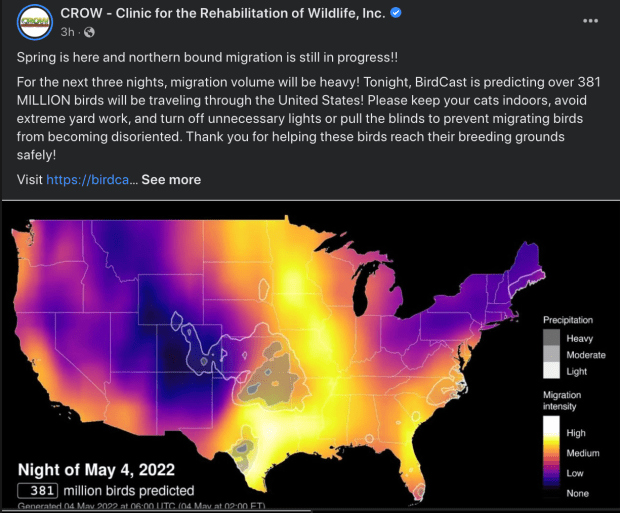
Tonight, the Audubon Society believes that 380 million birds will be on the move from the south where they wintered to the north to their breeding grounds. Manitoba is set for a huge number of birds flying in especially to the very north near Churchill and to the wetlands in the middle of the province. I draw your attention to the Wapusk area because I want you to see Churchill. Churchill is now as the ‘accessible Arctic’. Here beginning in June you can see many species including Ross’s Gull, the Northern Hawk Owl, Smith’s Longspur, Spruce Grouse. the Three-Toed Woodpecker, and Harris’s Sparrow. Of course, the list is endless for the ducks and geese that make Hudson’s Bay and the area around Churchill their summer home. Raptors include the Northern Harrier, Gyrafalcons, Merlins, Bald Eagles, and Golden Eagles. Lots of other wildlife abound in the area including Polar Bears.
North of Riding Mountain National Park, also in Green to the south and west of Wapusk is Winnipegosis. This is the place to see Osprey. Directly east and north of Gimli near Hecla Island is a large concentration of Bald Eagles. Canada Geese have arrived and the Trumpeter Swans are arriving now along with the American Pelicans and Red-winged Blackbirds. The shores of the two very large lakes, Lake Manitoba and Lake Winnipeg, are home to a huge variety of shorebirds that are beginning to arrive.
It felt like I watched Annie and the wee hatchling all day under a microscope. Alden got to see the chick and brood it and incubate the other two eggs. There is a dent in one of the two remaining eggs.
Alden checked earlier to see if Annie wanted a break and she wasn’t ready yet.
The baby was wanting food so Annie gave Alden a shift. I noticed how extremely careful he was with his lame leg not to stop on the chick. Well, done, Alden.
Annie arrives with a bird for the little one’s first meal. I could not possibly tell you what species this is. It is not familiar to me in Manitoba.
First hatch had a nice meal.
Annie catching some sleep. She is going to need all she can as the next eyas appears to be working on its shell. So happy for Annie. Things feel like they are going to turn out just fine.
Afterwards I went to check on the osplets at the UFlorida-Gainesville Osprey nest. I had been watching earlier in the day but not early enough to catch a morning feed. It was apparent that the chicks and Mum had eaten as all three had crops heading into the evening.
It is good to see the Mum on the nest and the osplets – and her – nicely fed. Middle is the one closest to Mum.
Middle is growing. A few days of good meals makes all the difference in the world.
Big Red has a nest full!!!!!!! She must be in her glory. Oh, I hope the weather holds.
L4, the smallest one, hatched a week after the first, likes to be at the front of the line. Gosh, sounds like another Ervie!
At 19:32, two Crows arrived at the Achieva Osprey nest in St Petersburg, Florida. This is the nest of Jack and Diane. Last year Jack and Diane fledged three – this is the home of Tiny Tot -. Those chicks hatched the beginning of March. Jack and Diane had a previous clutch of eggs that went down a hole in the nest. Diane laid three more eggs but the dates were unknown because the cam was offline. I know that the Achieva nest is a favourite of many but, perhaps this is a blessing in disguise. It is really late to have osprey chicks in Florida due to the extreme heat.
It is doubtful that any of the eggs made it. Crows watch and wait just like they did with Daisy Duck’s clutch. Eggs left alone even for a few minutes will be eaten if there are Covids around.
Bird flu continues to be in the news as 37 million factory farm birds are killed.
We are one week away from pip watch for Richmond and Rosie at the SF Osprey nest on the Whirley Crane in SF Bay.
One of my favourite Osprey nests in the UK belongs to Idris and Telyn at the Dyfi in Wales. Idris is know as Daddy Long legs but he is also one of the best fishers amongst all the UK osprey. Look at this one he hauled in today!
Beautiful Maya at the Rutland Manton Bay nest she shares with her mate Blue 33 (11). We are on pip watch for this couple!
Another fantastic Osprey Mum, Blue NC0 at the Loch of the Lowes nest in Scotland that she shares with Laddie. We will be watching for her eggs to hatch after Maya’s. What a beautiful setting for a nest!
The oldest Osprey in the UK is Mrs G. She is believed to be 22 years old. She is incubating the three eggs of her and Aran’s. They will be hatching late as Aran was late returning from migration. Today Aran was busy keeping intruders away from the nest.
Of the nests I have checked, all seem to be doing just fine.
Thank you for joining me. Take care everyone. See you soon.
Thank you to the following for their streaming cams where I took my screen captures: Brywd Gwyllt Glaslyn, Dfyi Osprey Project, LRWT, Friends of Loch of the Lowes and Scottish Wildlife Trust, UFlorida-Gainesville Ospreys, Cal Falcons, Cornell Bird Lab RTH, SF Ospreys and Golden Gate Audubon, and Achieva Osprey.
The scrape boxes across the world have been welcoming eyases for about a week. Besides tulips and the crocus pushing their way up, the hatching in the scrapes is a sure sign that spring is truly here. Cute little fluffy white bundles with pink accessories. So sweet.
Manchester, New Hampshire has a scrape full! For once, every egg hatched. Remarkable.
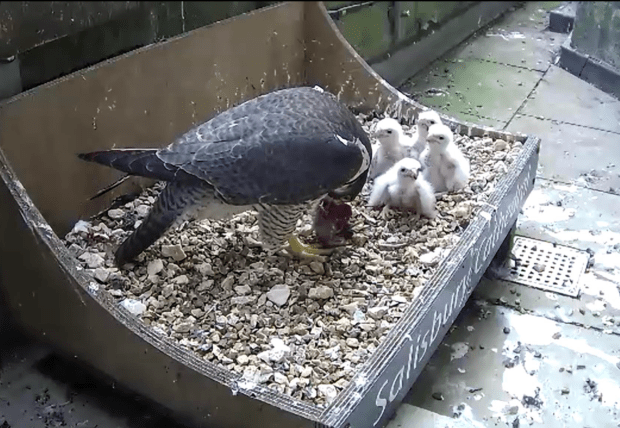
Salisbury Cathedral! Four.
Cromer is hatching.
Chichester Cathedral has new hatchlings.
San Jose City Hall started hatching this morning! Thanks ‘B’ for letting me know.
Ares and Astrid have been incubating their four eggs in Utica, New York for 31 days today. We are on pip watch!
Want more information on the Utica Falcons, head to this link where you will find historical information, updates, and all the camera views.
Of course, the hatch that warms my heart and brought tears of such joy I was overcome happened in the scrape box at The Campanile on the grounds of UCal-Berkeley. Three eggs. Two presumed to be Grinnell’s, the last one Alden’s. First hatch this morning with what is appearing to be a crack in at least one other egg. The one thing we can say about the falcons is that they don’t waste any time getting out into the world!
Our first good look at Grinnell’s baby, wet and pink skinned.
You can see the crack in the second egg in the image below.
Our beautiful Mum, Annie.
CalFalcons made a short video clip of the first hatch.
At 11:01 Alden comes to check on things and wants to take over incubation.
Everything is going just fine. That cute little one and its precious wing is dried off. Maybe there will be one more this evening!
Thank you for joining me today for a round up on the Falcons! It has been a fantastic day! Take care everyone.
Thank you to the following streaming cams where I took my screen captures: Cal Falcons, San Jose City Hall, Utica Falcons, Salisbury Cathedral Falcons, Chichester Cathedral Falcons, Cromer Peregrines, and Manchester NH Peregrine Network.
It is 8 degrees C and will be 18 Celsius today in Winnipeg. Our City is a bit of an island with areas north and south flooded and communities being evacuated. It is also the height of bird migration. So we truly did go from winter to summer. Crazy.
News of the morning. We have a pip at Cal Falcons for Annie, Alden, and Grinnell!!!!!!!!!!! Oh, fantastic.
Baby Steps! USS4 took its first baby steps. How sweet. Just look at those strong legs!
If you missed it, Spirit branched! Jackie and Shadow have done a fantastic job raising this super ‘spirited’ eaglet. What a joy it has been to watch her grow from that first pip to now.
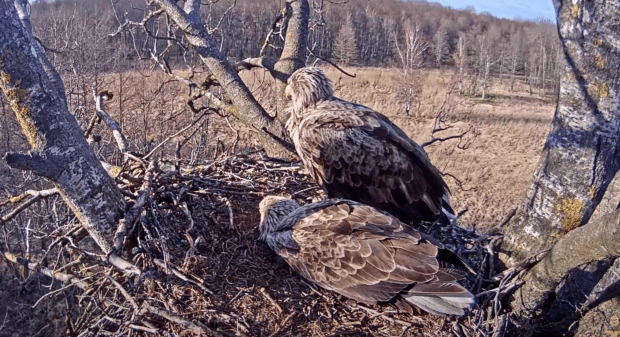
Many of you watched the satellite/GPS tracking of Karl II as he returned from his winter home in the Chad and Sudan areas of African. Karl II arrived at his nest n the Karula National Forest in Estonia on 8 April 8. His mate, Kaia, arrived on April 12th. This couple – who fledged three last year – have four eggs this year. They were laid on 24, 26, and 29 April and on 1 May.
The image below is of Kaia aerating around the eggs. You can distinguish Kaia from Karl II not only because Karl is bigger but also he is banded and also has his satellite tracker on his leg.
Nancy was in the nest with E1 last evening. She is doing a great job at being an only parent.
We all love Shadow and Jackie. Here is an interesting story from yesterday but more interesting is the image of a young Shadow on the bottom right!
It was a foggy morning at the nest of Big Red and Arthur. Gosh I love that dark morph of Big Red’s plumage. She is so gorgeous.
L4 continues to delight. Here he is climbing over the gang from the back to get some breakfast. L4 was also seen having two crop drops by Cornell staff this morning. Way to go little buddie. No worries ever about Big Red and Arthur being able to handle four!!!!!!!!
It is not entirely clear what has gone on at the UFlorida-Gainesville Osprey nest this morning. Mom was on the nest and there was a fish delivery. Was it Dad returning? or was it the intruder and the Middle wanted to be fed?
The chicks are standing and walking better. They are also growing with all the good fish that has come in. Just look at the size of that wing!
It is really a beautiful morning with the sun rising over the nest. This is Mum with the chicks.
There is what appears to be a remnant of prey but that is not Mum and that bird is not feeding the little ones. Note the design on the back of its head.
Is this Dad? I admit to not having looked at his plumage as carefully as I should have. The kids would like some fish. It is going to get hot on that nest this morning.
There you can see that design better. I wonder who this is? And where is Mum? Has she gone fishing? I will check back later to see how these two are.
I wanted to let everyone know about the pip at Cal Falcons. This is so exciting. Annie and Alden can hear the cheep-cheep of Grinnell’s chick and the egg tooth pecking away. Tears.
Bird World needs some good news and it is happening. Here is the link to their camera:
Thank you for joining me this morning. I will be back tonight with check ins on your favourite nests! Until then, I will be watching this pip while I ready the garden for summer today. Take care everyone. See you soon.
Thank you to the following for their streaming cams and/or FB pages where I took my screen captures: Cal Falcons, Cornell Bird Lab RTH, UFlorida-Gainesville Ospreys, Big Bear Bald Eagles, Pix Cams, MN-DNR, USSteel Eagles, and The Estonian Eagle Club.
First up, Louis brought Iris a fish. He did not stay to incubate their egg at the Hellgate Canyon Nest in Missoula but, hey – he brought a fish. I am grateful. I am not going to get mad and stomp my feet. This is, I believe, the third fish this season. Grateful.
Iris, you are so gorgeous! The oldest osprey in the world and you look better every year.
It was also a good day, so far, at the UFlorida-Gainesville Osprey nest. Mum brought in a fish at 11:59:52 and low and behold Dad flew in with another nice fish at 13:04. Both of the eaglets ate. When one chick is dominant and eating the most, it really helps when the bigger fills up and another lands on the nest right after. That way Mum gets food and hydration, too. Happy.
Big wandered about a bit and even did a ps before he thought about more food. All the while Middle was gobbling up the fish as fast as Mum could get it to the beak.
Big had eaten and was not in an aggressive mood. Nice.
Both chicks get to eat. The fish is finished at 13:27.
It has been raining in Ithaca, New York. Not a torrent, thankfully. Big Red is trying to keep those wiggly nestlings dry! Are they cooperating? Not always.
That’s L4 with its head raised up.
CalFalcons posted a short video of Alden incubating the eggs. Gosh, it is possible there will be pips tomorrow but, more likely, on the 6th! Oh, I hope that all three hatch. That would be wonderful. Despite the injury to Alden’s left ankle, he really seems to have adapted and is doing well. He certainly has been a terrific mate to Annie since Grinnell was killed.
Nancy has stepped up and is delivering prey items to the MN-DNR in order that her and E1 survive without Harry. Nancy is perfectly capable of fishing and hunting and E1 has its juvenile feathers so that it can regulate its temperature. We are fortunate that the eaglets were older when Harry disappeared eight days ago. (For those who do not know this nest, Harry disappeared. Chicks were extremely hungry. E1 was very aggressive to E2 and had been for a long time. E1 pushed E2 off the nest and E2 had to be euthanized.)
Unless something dramatic happens, we should expect E1 to fledge and for Nancy to have a new mate next year – unless Harry miraculously, at this stage, returns.
Despite the fact that a UFO, a catfish, and a sucker were brought on to the Notre-Dame Bald Eagle nest, ND17 still struggles to get food. Today there were three feedings and a bit of one before noon. At the last feeding, the small eaglet got food to create a crop. Another Relief but another struggling nest trying to get enough food for everyone. Did I ever say I wish these nests would not have more than 2 hatches?
During the first UFO feeding, ND17 stayed in submission. It did not even try to get up to have something to eat.
He did go up after and try to find a place to nibble on the prey item.
ND17 also stayed away from the second feeding.
The little one managed to get some fish at the last feeding. There was even fish left on the nest. Thankful.
Fish delivery at Dale Hollow. Looks like Middle gets it first and then later Big comes down to have some. Nice sharing. That is Big up on the edge of the nest behind the parent.
The leaves are lush and green at the National Arboretum nest of Mr President and Lotus. The day started off soggy and now the sun is shining on DCD9 and he has dried out.
Martin made two deliveries this afternoon to the Dulles-Greenway eaglet. The first was a duckling at 14:28 and this was followed by something else that I could not identify at 15:19.
One of my all time favourite wildlife rehabbers is reminding us to help the migrating birds. CROW posted this today on their FB page. Check your region and help! Thank you.
As predicted, we went from winter to summer on the Canadian Prairies. Everyone is outside – and most around me are having their first official barbecue of the season. The birds have not been happy with my clearing up their old seed and I suspect that Mr and Mrs Grackle once again have their nest in the wood shed which is why Mr Raven and Mr Crow have been around so often. My neighbour tells me that he saw about 20 Pelicans in a tree – sounds like the tree with the Great Egrets in Grenada to me. Summer is here. No spring. Just summer.
I hope this blog finds all of you well. Some of the nests are still struggling but life is good and it is pip watch for the Cal Falcons tomorrow!!!!!!!! Yes. I cannot wait to celebrate the three eyases.
Take care. Thank you so much for being here with us. See you soon.
Thank you to the following for their streaming cams and/or FB pages where I took my screen captures: UFlorida-Gainesville Ospreys, Montana Osprey Project, Dulles-Greenway Bald Eagles, ND-LEEF, Cornell Bird Cam RTH, CROW, NADC-AEF, MN DNR, and DHEC.
Gosh, it was sure nice to end the day on Tuesday seeing the Mum and the two osplets at the UFlorida-Gainesville nest with huge crops.
Food coma for the kids and some fish leftover for Mum! Nice. I really hope that today turns out as good as yesterday for these two.
It really is unclear again what is going on this morning. A headless piece of fish was brought to the nest by the male around 09:00. He did not feed the youngsters. Middle was right up there hungry chewing on the edge of the fish. Once again he is looking around. Is it another day of intruders causing havoc with fish deliveries and feedings? Is Mum off chasing the interloper away?
The chicks ate well and went to bed full. Ideally they are fed more often and early morning would be ideal to keep them hydrated. This is also a nice size fish so everyone gets some.
We wait to see how this sorts itself.
Intruders or interlopers are causing mischief at the nest of Richmond and Rosie, still. Indeed, there were five! They have not let Rosie or Richmond alone this breeding season and soon there will be three osplets to feed.
Miss a day or two and there are more falcons hatching! There are four at the Salisbury Cathedral in the UK. Oh, so well-behaved and cute.
There are now five eyases at the Peregrine Falcon scrape in Manchester, NH. The three oldest all hatched on the 28th of April with the wee ones on 1 May and 2 May. Often all the eggs will not hatch, – but, they did this year.
They will all be fine.
It is 11:16 nest time and there have already been three feedings!
Here is a link to this camera at Manchester.
Nancy has been on and off her perch this morning at the MN-DNR Bald Eagle nest. I have not seen a feeding. There appears to be a little food left on the nest for her and E1.
Lady Hawk did a tribute for Harry and E2 at the MN-DNR nest. He has now been away nearly a full 8 days. Another interloper/intruder is assumed. And another siblicide.
Iris, the oldest Osprey in the world, has an egg. Right now she is just as happy as she can be! Sometimes go off in this fantasy that maybe Louis will actually help her this year and not just feed Star and her chicks at the baseball park.
I wonder what the status of the Clark Fork River is this year? You might recall that last year it was almost dry in places with lots of beautiful trout dying because of the hot water. I would love to give them some of our water if it would help! If only it were that easy.
The two Red-tail Hawks at the Presidio in San Francisco are fine this morning. They are a little itchy and both of them are waiting for breakfast.
Everyone is soaked at the Dulles-Greenway Bald Eagle nest in Virginia. Our tiny eaglet of Martin and Rosa grew and is now self-feeding. Blink.
Prey delivery for the eaglet came at 09:07.
The Pittsburgh-Hayes triplets are drying out after being soggy yesterday like the Dulles-Greenway eaglet.
Spirit is getting almost as big as Mama Jackie! What a gorgeous nest they have at Big Bear Valley.
Do you remember sitting and holding your breath wishing that the egg would hatch successfully after Jackie and Shadow not having any chicks for two years? Now look at her. Spirit did hatch and it was 3 March. She is 62 days old today! Wow. Not ready to fledge but getting there. In California, the average age for fledging is 12 weeks. This also depends on the amount of prey, the sex of the eaglet, and the timing of the hatching.
There is an excellent report on the different times of hatching and fledging for Bald Eagles by latitude. Go to avianreport.com/baby-bald-eagles
One of the eaglets is self-feeding at the West End and doing a pretty good job of it. Looks like Kana’kini to me as she is larger than Sky or Ahota.
River brought a fish in and fed the two eaglets on the Dale Hollow nest. Big is really beginning to flap its wings while sitting on the railing. 66 Days old.
Most of us can’t be in San Francisco on 6 May for hatch day for Annie, Alden, and Grinnell. No worries. Sean and Lynn of CalFalcons will be holding another one of their great Q & As. Here is the information:
We are actually one day away from the first anticipated hatch day at Rutland Water’s Manton Bay nest of Blue 33 (11) and Maya. The window on the three eggs hatching is: Egg 1: 5th to 12th May; Egg 2: 8th to 15th May; and Egg 3: 11th to 18th May.
For those of you that do not know this couple, they are considered super Osprey parents! They consistently fledge all of their chicks. They have been together since 2015 and in six years they fledged 20 chicks – that doesn’t count this year!
It has been drizzly in Ithaca at the Red-tail hawk nest of Big Red and Arthur. Big Red has the four wee ones comfortably under here so they will not get wet. They cannot regulate their temperature yet and this is so important! Warm and Dry.
Fingers crossed for the osplets at the UFlorida-Gainesville nest today. Let us hope that Mum returns to feed the babes soon. (Gosh, I wish these dads would also feed the chicks…it would be so helpful).
Thank you so much for joining me today. Take care everyone. See you soon.
Thank you to the following for their streaming cams where I took my screen captures today: Cornell Bird Lab RTH, Pix Cams, Montana Osprey Project, UFlorida-Gainesville Ospreys, MN-DNR, Cal Falcons, Rutland Water LRWT, DHEC, Explore.org and The Institute for Wildlife Studies, Friends of Big Bear Valley, Peregrine Networks Live, Salisbury Cathedral Falcons, Presidio Trust, and Dulles-Greenway.
News has come that the male at Denton Homes, Majestic Dad, has died. Avian Flu has been confirmed. The Denton Homes nest lost three eaglets and an adult male. The female, Majestic Mum, looks good on cam and is being monitored.
For those looking for information, here are two publications that have good solid information as well as some of the latest news on the spread.
This is one of the last images of E2, that sweet little eaglet off the MN-DNR nest that became a victim of siblicide at the age of 5 weeks. E2 hatched on 23 May and was shoved off the nest by E1 and subsequently euthanized on 30 April.
Dr Sharpe has been very busy. Another chick was to be banded on Santa Rosa Island and Dr Sharpe arrived just in time as the nest had collapsed and dropped. Here is that announcement
There are now five baby Peregrine Falcons in the Manchester, New Hampshire nest
Here is the link to that streaming camera (there are 2 of them).
There is an unease this morning on the UFlorida-Gainesville Osprey nest. I have observed fish being brought in but a bewildered adult and no feeding of the eaglets. An adult brought a fish on at 10:19 (or thereabouts). Both of the chicks began to scream for food. It was interesting watching what is happening. The adult eventually gave up and dropped the fish on the nest. Middle began to self-feed. You might have noticed him chewing on other bits of old fish and bones on the nest.
In the image below, the adult has brought in the fish. Middle is trying to get under here to be fed. (Big has the darker back plumage).
Middle anticipated that the adult would be feeding them and is trying to get to a point away from Big so that it gets some food.
The female places the fish in the middle of the nest leaving it. She did not feed the chicks when she brought in the piece of fish.
The chicks look on as the adult flies away. They do not understand what is going on – the same as me!
Middle begins to self-feed.
The chicks give up on the self-feeding. This picture was taken at 10:31.
At 10:47 an adult lands on the nest.
The adult, at first, appears to be a small piece of fish tail that they have brought in. Then the adult pulls part of a catfish – the head and part of the body – out of the nest. Both chicks are prey crying very loud. The adult appears confused as Middle tries to self feed. Is this Dad? and was it Dad earlier?
The adult looks completely bewildered.
Middle is attempting to self-feed. What is going on at this nest?
Middle had very little food yesterday and, if that were the case the day before, is not starving but getting there. It is clear that Big has no crop and is also hungry but not like Middle.
Middle may have gotten a little flesh off the open end.
While the dropping of the fish on the nest is a good strategy for both if there are two pieces and both chicks are self-feeding, it is clear that these two are not ready to feed themselves. Where is the female?
At 12 noon the adult returns, chicks crying desperately for food. The adult looks around. Is this Dad again? (From the behaviour I am assuming Dad). Where is Mum? If you observe the Mum feeding the chicks (or the dad) please send me a note. I cannot watch the nest all day today, unfortunately. I am quite concerned.
This has been posted on the UFlorida-Gainesville Osprey Nest page if you would like to help name the chicks, the adults, and the nest:
All I have to do is flip over to the Red-tail Hawk nest at Cornell and there is an instant smile. The four Ls do not have to worry about getting fed. Arthur is constantly bringing in food and Big Red feeds each beak until there is not one asking for food.
Larger clutch, direct feeding, lots of food on the nest, no history of siblicide – that is the difference at the Red-tail Hawk nest as compared with the UFlorida-Gainesville Osprey nest.
The West End nest of Thunder and Akecheta is an example of two parents working hard to make sure that each of their offspring survive —- and thrive! Both parents were active bringing in food. Several times they had tandem feedings. And look – Sky, Ahota, and Kanakini. They should all fledge and we hope return and raise their own families in the Channel Islands.
The Mum and Dad at Pittsburgh-Hayes consistently raise triplets to fledge. They hatched on 21, 22, and 25th of March making them 43, 42, and 39 days old.
These are Bald Eagle nests. Examples of siblicide that I listed yesterday include both Bald Eagles and Ospreys. It will be enlightening, at the end of the season, to compare data on species in terms of survival rates. It is also complicated and might not reveal a true picture in terms of prey availability, parenting, genetic predisposition to siblicide, etc. unfortunately. Another interesting comparison will be the rate of success of 3 clutch Ospreys in the UK with those in North America.
At the Hellgate Canyon nest of Iris in Missoula, Montana, the oldest osprey in the world laid her first egg of the 2022 season at 08:13.
Louis arrived a little later – fishless – to see the egg and do what Louis does.
I want to repost Dr Erick Greene’s letter about Iris’s relationship with Louis and why I should not be – nor you – upset with the fact that he has two nests. There is a huge change in the Osprey population that use the Clark Fork River for their food supply. Much of what Dr Greene says can also be applied to other species who are under pressure.
The Anacapa Falcons are doing well.
Things seem to have settled for now so that Bukachek and Betty can take care of their five eggs in the Mlade Buky White Stork nest in The Czech Republic. They have had disturbances – as recent as two days ago- from intruders like so many other nests this year.
It is a soaking morning on the Bald Eagle nest at Notre Dame University. There has been some strife at the nest with regard to the third hatch getting feed. It seems that there are good days and not so good. The weather might well impact feeding and behaviour today.
This is the history of this nest back to 2015: One chick, ND1 in 2015; ND2 in 2016; ND 3 and 4 in 2017; ND 5 and 6 in 2018, ND 7, 8, and 9 in 2019; ND 10, 11, and chick 12 who died on May 14 in 2020); ND 13 and 14 with a non-viable egg also in 2021. The hatches this year (2022) are ND 15, 16, and 17. Hopefully all three will make it.
Notice the turtle shells. James Broley commented that the Bald Eagles love turtle and he always found turtle shells in their nests when he went to band the chicks.
Beautiful female with her two eggs in the Barlinka Forest nest in Poland.
Wow! I just came across this Osprey nest at the US Steelworks Plant in Washington State.
It really helps to have metal workers when you need an upgrade. The original nest was on top of a light pole. Look carefully. In 2012, when a lighting upgrade was required, it was felt that a new nest platform should be constructed. The workers incorporated the old nest with the new metal one in hopes of attracting the birds to use it.
I do not know anything about the history of this Osprey nest. It is in Kalamana, Washington State and the Pacific Northwest had tremendous problems with the extreme summer heat causing many nests to fail. Chicks were leaping to their death to get away from the heat. So this is a warning if you start to watch this nest – there could be issues related to weather at this nest.
Eyases have hatched at the Cromer Peregrine Falcon scrape in the UK. The adults are Poppy and Henry.
The nest is on top of the Cromer Church Tower. In 2020, the resident pair fledged three chicks. In 2021, no viable eggs were laid. Now look at the little ones this year. Fantastic.
Here is a short video of their feeding. Notice how the female holds the prey.
Here is a link to the Cromer Peregrine Falcon page that has a link to the camera as well as lots of images and information.
And here is a link to the YouTube streaming cam for Cromer.
I am very interested in the White-tail Eagle nest at the Matsalu National Park in Estonia. Last year the couple hatched two chicks that perished from Avian Flu. It was the first recognized instance of H5N1 during spring breeding and marked a shift from the Avian Flu being prevalent in the fall and winter when it did not impact the breeding season. The two eagles have returned to the nest where WTE have been raised since the 1870s.
Will they lay eggs this season? If so, they are very, very late. In a normal season the eggs would be laid around the third week in March with hatching in late April. We are now 3 March.
This is the link to this nest in Estonia.
If you are watching the UFlorida-Gainesville Osprey nest today and see a feeding, if you do not mind sending me your observations I would be very grateful and would, of course, credit you for those! I am very worried about this nest. The female has to eat and it is possible that she is as ‘starving’ as Middle. Two fish on a nest is not enough to support the female plus two growing and demanding chicks. Thank you so much!
So many nests and so much happening – lots of good and much sadness recently. Thank you for joining me today. It is so nice having you here. Please take good care.
Thank you to the following for their streaming cams and/or FB pages where I took my screen captures: The Eagle Club of Estonia, Cromer Peregrine Falcons, U-Florida-Gainesville Ospreys, Cornell RTH, Montana Osprey Project, Steelscape Osprey Cam, Peregrine Falcon Networks, Institute for Wildlife Studies, Explore.org, Pix Cams, ND-LEEF, Barlinka Ospreys, Mlade Buky Storks, and Anacapa Falcons.
I have not spent the time I should have observing the UFlorida-Gainesville Osprey nest since the third hatch starved to death because of siblicide. The nest appeared to have ‘calmed’ down after that. I am, thus, very grateful to ‘R’ who took the time to write to me telling me about the change to aggression.
While my research focuses on that third hatch, it appears from the instances of aggression that we have seen this season – that ‘something’ is happening out there in the nests. Before we chat about these sorrowful avian behaviours, I want to go back to the book I am reading, The Eagle Man. It is about Charles Broley, a Canadian, who spent his time between here and Florida observing Bald Eagles and banding thousands. Broley’s observations are from direct observation or information provided to him by others. He did not have the benefit of the streaming cams and data collections that we have today. Still, some of his observations continue to hold true such as the ‘Northern’ Bald Eagles are larger than the ‘Southern’. In another instance, he notes that the ‘Southern’ eagles are more aggressive than their ‘northern’ counterparts. In terms of nest aggression, Broley said: “The more demanding of the babies gets the greatest amount, however, for the weaker, smaller one is always neglected for the more aggressive one. As a consequence on that is a little smaller, a trifle weak, perhaps, tends to grow weaker through lack of food, abuse from the older bird, and general neglect, while the stronger one, because it gets all the food, increases in size and strength rapidly (52).
In their article, “Why do some siblings attack each other? Comparative analysis of aggression in avian broods” by Alejandro Gonzalez-Voyer, Tamas Szekely, and Hugh Drummond (Evolution, 2007), the authors list eight traits that they are testing to determine if any, some, or none drive aggression on nests. Those traits are:
feeding method (monopolization of food). Direct feeding when food passes directly from the adult beak to the chick’s beak. This allows the dominant bird to violently exclude any competition. The authors believe that when food is placed on the nest floor in indirect feeding it is more difficult to monopolize. The feeding method theory predicts that “a greater use of aggression in species in which direct feeding predominates throughout the nestling period).
effective weaponry (pointed or sharp beaks)
limited escape possibilities (nest site typography)
differences in age and size of broodmates (hatching asynchrony)
large food parcel size
small brood size. As brood size increases the authors observe that it is more difficult to intimidate and attack.
aggressive potential (maturity and body size)
slow food transfer
The researchers studied and compared several species including the Accipitridae (eagles, hawks, and buzzards) along with Boobies, Anhingas, Ibises and Spoonbills, Egrets and Herons, Pelicans and Kingfishers. I was, of course, disappointed that they did not include Ospreys. Following lengthy observational study, the authors concluded that indirect feeding, small broods, and long nesting periods are significantly correlated with broodmate aggressive competition. They also agreed that more studies needed to be conducted because exchanging or removing even one factor might alter the results of the research. I did find it interesting that out of 58 Eagle nests studied compared to 52 falcon nests, the eagles were 81% more inclined to nest aggression. They thought that factors such as larger clutches, a shorter nesting period, and one other factor — that the broodmate aggression being eliminated through evolution- could be at the heart of why falcon nests have little siblicide. It is rare to find siblicide in falcons and hawks while, as we have seen recently, it is much more common in eagles and ospreys.
Within this season, we have seen siblicide, the deliberate killing of a sibling, at several nests. These include the third hatch, DH16, at the Dale Hollow nest on the border of Tennessee and Kentucky; the third hatch at the UFlorida-Gainesville Osprey nest; the second hatch at the MN-DNR nest who was physically abused (with holes in its head) in the nest and, ultimately, successfully shoved off the nest on the third attempt; and the biological chick killed by the foster chick at the Pink Shell Osprey nest in Florida. In addition, it is difficult to know what the outcome would have been at the Captiva Osprey nest if the oldest sibling had lived. Big did prevent the female and the two younger siblings from eating for a period of 72 hours before it literally dropped dead. Would the death of the youngest sibling at the Duke Farms Eagle nest be classified as siblicide?
The situation at the UFlorida-Gainesville Osprey nest has not stabilized. The information I received this afternoon from observations on the nest indicate that the eldest sibling is relentless in stopping the middle sibling from eating. Observations of the behaviour include – the mother feeding the dominant sibling, the dominant sibling abusing the younger even if its crop is full to overflowing, the younger one having to expend energy and become aggressive to even get a few bites of fish. I do not know the number of deliveries in a day or the size of the fish. The camera re-wind is such that it is not conducive to discovering this information. Tomorrow I plan to write to Gainesville and see if I can get the data which someone must be keeping – and also to find out precisely how old these osplets are. While there is no truly ‘safe period’ against broodmate aggression, it is normally expected to stabilize around the age of one month. That said, the dominant aggressive osplet in the Port Lincoln nest did throw its sibling over the nest to its death when the chick was 65 days old. This is why we cannot predict what will happen.
In the top image, the eldest chick, Big, has learned to get between the mother’s legs preventing Middle from getting food and from the advantage of having the adult in between the two birds. Thank you ‘R’ for drawing this to my attention.
Middle had to expend a lot of energy flapping its wings and trying to mantle to get a few bites. The ratio was more than 10 bites to 1 with Big having the advantage. I do not know when the Middle sibling last had a good meal with a crop.
We must remember that the more food Big gets the bigger and stronger that bird gets to the detriment of the younger. It is hot on top of that light stand in Florida and the fish is the only hydration the chicks get.
Middle is once again rushing at the Mum to try and get some food.
Another small fish comes on the nest later. In the image below, Big has been eating and has a huge hard crop. Middle has no crop. Big has been eating but Middle moved slightly and caught Big’s attention who went on the attack.
Big goes back to eating.
Eventually Middle gets a few bites of fish once Big passes out in a food coma. In essence, Big ate almost two entire fish with the Mum and the Middle sibling getting very little.
One thing that is missing in this discussion is the fact that the Mum also needs to eat. It was 25 degrees C today or 77 F on the ground and later in the day (9pm). It is very hot on top of that light stand. I cannot predict what will happen on this nest or on Middle’s survival. Normally I would say not to worry but Big has tried to push Middle off the edge – when I see this behaviour my antennae really begin to alert. It is going to depend on many factors some of which we just do not know – will there be an increase in size and number of fish being delivered? is there a genetic disposition towards aggressive behaviour at this nest?
I am sorry to bring you this sad news. I had so hoped that the aggressive behaviour would have ended with both chicks thriving. I will be keeping a closer watch on this nest and I am very grateful for the letter alerting me to the change. If you know of other nests where siblicide has occurred since 1 July 2021 to the present, please do let me know. It would be much appreciated.
Thank you for joining me. Take care everyone. See you soon.
Thank you to the UFlorida-Gainesville for their streaming cam where I took my screen captures.