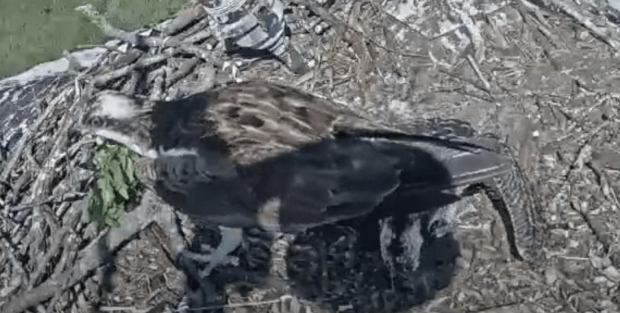
The First Egg for the Collins Street Falcons

Oh, my goodness. The male at the Collins Street Peregrine Falcon nest is nothing short of adorable. I spent all last year wanting to scoop up this stealth fighter in my arms and cuddle with him. Or dreaming of a Peregrine Falcon onsie. Wouldn’t that be cute on a toddler?

The first egg of the 2021 season has been laid on 21 August. Wow. It is eggciting.

You might be asking why the female is not incubating that egg. The female will not start incubating the eggs until the last one is laid. This is because the adults want the nestlings to be about the same size for the first fortnight so that there is no rivalry over food. Last year, the three big girls all hatched within a 24 hour period. There was never any sibling rivalry – that is what I love about falcons and kestrels. Once the last egg is hatched, they will be incubated for 32-40 days.

Mom looks so proud of herself!

These are some images from last year:

Mom brooding the triplets.

Dad feeding the girls when they are a little older – before they lose all that fluffy white down.

This year Mirvac, the property owners, are in charge of the streaming cams of the Victorian Falcon Project. You can watch these falcons from the very beginning.

Telyn at the Dyfi Nest, Wales. 20 August 2021

Some more great news. The Season of the Osprey will premier on PBS October 27 at 8pm! Please check your local stations for the exact time in your area. This is what they are saying about this documentary:

“Birds of prey exist in myriad shapes and sizes. Scores of eagles, hundreds of hawks and countless kites and falcons have all adapted form and behavior to fit diverse habitats. But in all the world, there is only one osprey. Following a single evolutionary path, it has conquered every continent save Antarctica. One bird, one design, unchanged. It is the only truly aquatic raptor, the sole member of its own taxonomic family. This one-hour, blue-chip special brings viewers into the life to this incredible raptor with a depth and intimacy never before attempted. Shot in and around Great Island Marsh, where the Connecticut River meets the Long Island Sound, cameraman Jacob Steinberg has achieved unlimited access to an osprey nest and captured the struggles, failures and triumphs of a single osprey family.”

Oh, I can’t wait!

I am afraid that I am having Malin withdrawal. A week or more ago I took a few video clips of Malin being fed by Marsha. I would like to share one of those with you now.

And another one of Malin exercising his wings.

It is so much easier when you know that the little one fledged, returned to the nest for food for 36 days or so, and then flew off to find their life. There is a level of anxiety when it doesn’t happen that way. I sure miss that little one. I have not, as yet, received any images of the two Osprey chicks found or any other news. I am hoping for tomorrow or Monday. It is a busy time of year for the wildlife rehabbers.

Two of the storklings have fledged at the nest of Grafs and Grafiene near Siguldas – the youngest was first and then the oldest yesterday. Only the middle remains. All have returned to the nest safely. The one that had its wing up against the far branch seems to be alright as well. That is good news. I have heard of no feedings since Grafs came in with some very small fish for the trio on 19 August. That means that if the storklings did not find the feeder – the two that fledged – they have had little food but nothing for two days. This is critical. There is concern that Grafs has left for his migration — it was the very initial concern. I want to remain hopeful.

Jan has fed his storklings but the meal was only tiny fish or worms. Urmas has not brought any more fish to the nest. Since he has fed them once and they accepted the fish, I hope that Urmas will do this again (he also left fish when he banded them and put on the trackers). It is not clear whether the anxiety of starvation is worse than having a human bring food to the nest.

These are very difficult times for everyone but they are especially difficult circumstances for these six starving Black Storks – rare Black Storks!

At the Black Stork Nest in the Karula Forest in Estonia, Karl II was still in the nest area. His transmitter told us. The two early fledges, Tuul and Udu, headed the wrong direction due to weather concerns and then turned south. Pikne travelled south from the beginning. New tracker information should be coming in soon. Safe travels all of you!

Oh, this youngster can really scream for food on the Loch of the Lowes nest. What a beauty. This is another good example of a ‘normal’ fledge. The chicks return to the nest to be fed and fattened up for migration.

I really want to put a plug in for the administration of the lochs in Scotland. No one is allowed on those lakes from April to the end of September so that humans do not disturb the birds. It means that motor boats with their leaking fuel are not chasing the Ospreys and making the water toxic. Gosh, I hope that only human powered boats are allowed. What a great idea – leave the lakes to the birds during breeding season. Three cheers for Scotland! This could well be the case throughout England and Wales also. I will try and find out.

And look what is on the Foulshaw Moss Nest. It is a flounder for the lucky chick that makes it to the nest first. Tiny Little!!!!!!!!! Where are you Tiny Little?

It’s a few minutes later and I missed that lucky fledgling that snagged that flounder! It’s gone. That leads me to believe that it was probably Blue 464, the male, the first to fledge. He likes to take the fish and eat it on the branch of the parent tree.

Thank you so much for joining me. I hope that you are looking forward to those falcons hatching as much as I am. Take care. See you soon.

Thank you to the following for their streaming cams where I took my screen shots and video clips: Scottish Wildlife Trust and Friends of Loch of the Lowes, Mirvac Corporation and the Collins Street Falcon Cam, The Cumbrian Wildlife Trust and the Foulshaw Moss Osprey Nest, The Eagle Club of Estonia, The Latvian Club for Nature, Collins Marsh Nature Centre, and The Dyfi Osprey Project.

What is better than a Peregrine Falcon Kiss?

Lots of people keep track of hurricanes and tropical storms. Most watch because they or their loved ones, or both, live in the line of the storm. Bird watchers also track weather systems. There are currently two systems that might impact our beloved Big Red and family as well as the birds that are migrating over Hawk Mountain, PA.

Henri is going to give some heavy rain and wind. Ithaca is west of the darkest green band but could get some rain.

Tropical Disturbance Fred will also give some heavy rain in the same area. There were flash flood warnings for Ithaca last night. It is 1:03 am Thursday morning in Ithaca and there are rain drops dripping off the metal supports of the light stand that Big Red and Arthur’s nest is on. The rain does not look heavy at the moment. There is also a peculiar corn plant growing out of the centre of the nest!

Heavy rain will impact the hawks ability to hunt. They would have felt the pressure system coming and hopefully caught more food yesterday.

This isn’t the beginning of the season. Hurricane season runs until 30 November.

Baby Kindness (I wonder if she would mind if I call her that?) is not worried about hurricanes. Today, she is 83 days old. Kindness branched yesterday and all she has on her mind is ___________________. If you said flying you are 100% correct. She has really been putting on a show for the people watching the live stream today.

Oh, she really gets some nice air under those wings going back and forth from the branch to the nest.

Wow. Look at those wings. Magnificent.

Kindness has spent a lot of time considering what is below that branch she is sitting on. Sometimes she gets the branch to bouncing a bit and that seems to unnerve her slightly and she flies back to the nest.

For several days, I have been talking about the migration of Ospreys in Wisconsin, like Malin, or those living in the United Kingdom or in Northeastern Europe. The Bald Eagles in Alaska do not migrate south of Alaska unless there is no food. In 1972, the State Legislature established a long stretch of the In Chilkat River as critical bald eagle habitat. The goal was to protect the birds, some 4000 of them, that move from the interior to the Chilikat River Valley where they feed on the Chum Salmon run during the late fall and winter. The juveniles normally eat spawned and dead salmon or the carcasses left behind by bears.

The Glacier Gardens Rainforest Adventure is located in the Tongass National Forest just fifteen minutes away from Juneau. This is where Liberty and Freedom have their nest and where Kindness will fledge. There are meadows, forests, and glaciers. What a spectacular place to be a Bald Eagle!

“Tongass National Forest” by markcbrennan is licensed under CC BY-SA 2.0

One of the features of the park is the Mendenhall Glacier.

“Mendenhall Glacier – Tongass National Forest” by jcsullivan24 is licensed under CC BY-NC 2.0

Liberty, Freedom, and Kindness are not far from the Chilikat River Valley and the Alaska Chilikat Bald Eagle Reserve.

In the spring, many of the Bald Eagles will head to areas rich with Herring and Eulachon. These include the Stikine River, Copper River Delta, Silka Sound and Kenai Bend. You can see some of those on the map below. The Copper River flows from Prince William Sound while Silka Sound is closer to Juneau on the far right bottom.

Kindness is fortunate to live in such a beautiful state with what we all hope are abundant resources for her and all the wildlife forever.

There are so many worries in the world. The birds bring so much joy to each of us filled with nail-biting anxiety and that bittersweet moment when our friends fledge to begin their lives off the nest.

Malin is beginning to feel the wind beneath his wings. For so long I did not believe that Malin’s feathers would develop and he would fly – but here he is preparing just for that. Joy.

Like other birds, Malin is doing much more wing strengthening flapping as fledge approaches. The energy from the fish he is eating gives rise to lots of exercising after a feed.

For tonight though, Malin is sleeping like a duckling dreaming of fish.

While Kindness and Malin are dreaming of fish and flying, Xavier and Diamond are constantly pair bonding while preparing for their 2021 eggs and hatches. After doing their courtship dance in the scrape box today, they sealed the deal with a kiss – peregrine falcon style.

Can you think of a better way to end this newsletter? I can’t!

Want to catch the adventures of Xavier and Diamond, here is the link:

Well, what could be better than a Peregrine Falcon kiss? Three Black storklings eating the fish that Urmas brought them. That is actually cause for a big celebration!

When the storklings woke up at dawn and found the fish gift from Urmas, they began to eat.

The feeding of the storklings is a success! Congratulations.

Thank you for joining me this morning. Have a wonderful Thursday. Take care all.

Thank you to the following for their streaming cams where I took my screen shots: Cilla Kinross and the Falconcam Project Charles Sturt University, Collins Marsh Nature Centre, Glacier Gardens Rainforest Adventure, Google Maps, Cornell Bird Labs Red Tail Hawk Streaming Cam, and the National Hurricane Centre.

Fish delivered to the Estonian storklings!

There are some very interesting developments going on in Estonia with the Black Storklings of Jan and Janika. On the 18th of June, Jan fed the storklings one time. He has not found the feeding pond, dug especially for him, with the decoy of Janika but, a Blue Heron has!

@Forum of the Jergova Black Stork Nest in Estonia

After dark, Urmas and a helper delivered a pail of fresh fish for the three storklings. You can see the pail that he is holding and all of the fish that have been poured onto the nest. Urmas was hoping to clean up the old fish with a branch but he did not because it could harm the storklings or the storklings might bite him. Everyone is doing an amazing job to make sure that these three rare Black Storklings will live and fledge! I cannot imagine another thing that Urmas and his team could possibly do for these beautiful young birds. Thank you Urmas!

@ Eagle Club of Estonia and the Form of the Black Stork Nest at Jergova

After Urmas has left, the storklings went back to sleeping. They will wake up to a fine meal.

@ Eagle Club of Estonia and Black Stork Nest Forum at Jergova

Grafs has delivered two feedings to his storklings at the Siguldas Latvian nest. They were so hungry and so glad to see him for the second feeding. We can only continue to hope that a miracle happens and Grafs finds the feeder with all of the little fish. This nest is not stable like the one in Estonia so no one can climb with a pail of fish and deliver them.

In stark contrast, Malin, the Osprey in the Collins Marsh Osprey Nest has a crop that is so big that it looks like it could pop. I have seriously lost track of all the feedings today, the size of the fish, and what might have been left from last night.

This Osprey chick has not seen so much food in its entire life! His system has adjusted to eating more fish. Originally, Malin would eat and then stop before he had a crop. Now he eats and eats as much as he can.

Marsha has flown in and is feeding an already full Malin that fish that was on the nest.

A few minutes ago, around 4:20 nest time, Malin still has his crop and Mom is looking pretty good, too. I wish there was someway to measure Malin. He looks like he is twice as big as he was at the beginning of the month with much more feather development.

By the size of the feet most people would say Malin is a little male. I know when the banders ringed Tiny Little on the Foulshaw Moss nest they could not tell if Blue 463 was a male or female. That was because of the lack of food. And that is precisely the problem with Malin – a lack of food might trick us. Malin could be a female but my ten cents worth is on a small very handsome male.

Don’t you just love how those wing feathers are crossing over the tail? This chick has been such a worry but it feels like that anxiety is all gone. Let us hope that the good feedings keep up for all three of the birds – Marsha, Collins, and little Malin. We want them healthy for their migration.

Ha, ha. My friend, S, in Hawaii just sent this picture to me – the one below. She is calling it the ‘Battle of the Bulges’. ‘My crop is bigger than your crop!’ Too funny. It is so nice to be able to relax and laugh. For so long we thought Malin was doomed but wow. I wish this kind of happiness for the Black Stork nests.

There is something troubling brewing. EC from France has posted images on FB of the fire, now four days old, burning the Massif des Maures in France. It is a huge mountain range. This is the worst fire in that area in 20 years he reports.

@ Eric Calvete
@ Eric Calvete

The fire is in the area with the red teardrop marker.

Google Maps

Here is the map showing the two main routes of the European birds. You will see on the top left that the birds from the UK normally fly over France, through Spain and across the Straits of Gibraltar and then the Sahara and Atlas Mountains. This is an extremely challenging journey. If they stay west in France, they will miss the fires currently burning at Massif des Maures. The good news is they should. The Eastern routing through Turkey and Greece still has major fires burning and is causing much difficulty. You can see how the arrows in the dark green – from The Netherlands to Latvia and Estonia converge and go through both Greece and Turkey to reach Africa.

We are told that the heat we are experiencing will now not go away. I hope that if that is the case our birds make adjustments to their schedules.

@ Open University

Some quick news from other nests:

NC0 is still feeding her fledglings at the Loch of the Lowes. LR2 snagged a really nice fish delivery from mom. So this is one female who has not started her migration.

Idris has been feeding Dyssni and Yestwyth at the Dyfi Nest in Wales today. Telyn has been seen so she has not left on her migration despite earlier reports that she might have.

All three chicks were on the Foulshaw Moss Nest. It looked like 464 had snagged the fish delivery with the other two waiting to see what happened. I have not seen Blue 35 and I do not know if she has departed or is just allowing White YW to do the feeding duties while she fattens up for migration.

Maya was caught on camera at the Rutland Manton Bay nest yesterday. Will continue to monitor her whereabouts. Both chicks, 095 and 096, are at Rutland.

There is our beautiful albeit somewhat grumpy looking Tiny Little on the right. It was nearing 7pm at the nest. Her crop looks good. Gosh she is a big bird! That look reminds me of Mrs G. So stern. That also makes me think she is a female!

It is always nice to see Tiny Little with a crop! And that is a good place to close for today. I hope everyone is keeping well. Sending off prayers and warm wishes to the nests and people in Latvia and Estonia and to the birds trying to make their way to their winter homes.

Thank you to the following for their streaming cams where I took my screen shots: The Cumbrian Wildlife Trust and the Foulshaw Moss Osprey Nest, The Scottish Wildlife Trust and the Loch of the Lowes, Collins Marsh Osprey Nest, The Eagle Club of Estonia, The Latvian Fund for Wildlife.

Happenings in Bird Land. 17 August 2021

Our sky is very overcast this morning and, for one of the first days, our temperature will not go over 29 C which is the same as it is in the Caribbean. It is not surprising that the summer flowers, such as Jasmine and Hibiscus, are thriving while the others meant for bees and butterflies are having a difficult time with it even with watering. So far I have gathered 5 one-gallon pails of blossoms off this Hibiscus and dried them for tea. It has been a bumper crop.

Sweet little Malin slept on his fish. Smart little one. Perhaps that is how to keep leftovers if you are afraid that someone will steal your food! Malin ate it for breakfast and then, at 10:17ish, Dad made a delivery.

Sometimes Malin bites Dad’s toes. It is a good idea to drop that fish and get away fast!

Malin protecting his little fish while Dad flies away.

We are keeping a close eye on what is happening with the Black Storks in Latvia and Estonia and I am very grateful to ‘S’ for helping with this. In Latvia, Grafs made a fish delivery at 12:04:43.

The storklings had one feeding yesterday but four feedings on the 15th. It is hoped that more fish will come to the nest today.

One of the birdwatchers in the area and a good friend to this nest, BK, purchased a white decoy and has spent their time painting it to be Grafiene 2. This decoy was installed on the morning of the 17th to try and lure Grafs to the fish table.

Anyone who lives in duck hunting country will know that the use of decoys to attract birds can be very successful. We hope that Grafs smells the fish donations and sees Grafiene 2.

Some of you might be wondering why they do not climb the Black Stork nest near Sigulda. The simple answer is – it is not safe to do so. The nest is mostly made of peat and the birds could from their movements and jumping cause that to break off. Human disturbance would cause the same issues. It is also a very old tree and not strong. Everyone is doing everything that they can. After the feeding at noon heavy rains came to the area.

One development is that the eldest storkling is now branching. You can see that in the image below.

This Black Stork nest is very special to the people of Latvia as are these miracle storklings. ‘S’ tells me that there was no successful nesting here in both 2019 and 2020. This year no one thought that Grafs would attract a mate to the nest – especially so late in the season. No one would dare to think that there might be storklings for fear that something would happen. But there were eggs and they did hatch and look at these beautiful trio. Sadly, around the nest the area of the forest and adjacent areas have changed so much in the past couple of years that finding food for a family here can be difficult. Everyone continues with hope that Grafs will find the fish table. As I have said so very often, human encroachment and human impact on the climate are causing wildlife irreparable harm. Providing food for the birds now and in the future is the least we can do.

In Estonia, Jan has brought in three big fish for the trio at 11:01:17. He made a second trip to the nest at 15:09:18. In between, the storklings have been picking at the old fish on the pile. They were so full that they did not eat one of the big fish that came to the nest. Sadly, that fish fell off.

In other Osprey news, Telyn is still at the Dyfi Nest and has not left for her migration. She delivered a nice size fish and Dysnni was the taker! Some had thought he might have left the area but he hasn’t. Maybe Idris will get something for Ystwyth who looks on – no doubt she had hoped to nab that fish.

And here is Ystwyth, Blue 491, with her fish:

Beautiful Telyn or Blue 3J is a great provider for her two fledglings just like Idris.

Dysynni, Blue 490, flew up to the branch to eat his fish. Everyone always talks about how messy Idris is when he eats well, his son is just like him!

Dysynni has managed to eat the flesh of the fish and leave the tough skin. Bravo – but still messy! BTW. Dysynni is 89 hatch days old today, the average age of the males fledging off the Dyfi Nest in Wales.

You could hear LR2 on the other side of the Loch of the Lowes she was food crying so loud. There is no getting away from the fact that a fish is wanted! NC0 came in with a nice one. So, if anyone is wondering, NC0 has not left for her migration either. Historically, the 18th was the latest that she has left but, perhaps, the birds, hopefully, understand the weather along the migratory route and they will stay in place. As long as there is food, why leave? wait a couple of weeks. LOL. As if I can read an Ospreys mind!! I do hope they can wait.

Lucky! That is a nice fish and this chick doesn’t look like it is starving. That is a pretty nice crop.

These birds have turned out to be strong and healthy. Laddie and NC0 did well.

To close the day off, it was wonderful to click on the Foulshaw Moss Osprey nest and see Tiny Little, Blue 463, eating a really nice size fish! It was 18:40. It could be the last one for the day.

But, the icing on the cake was the receipt of my ‘Iris pen’ just a few moments ago in the post! It is Choke Cherry and is absolutely gorgeous. You can refill with any Cross Cartridge. What a fantastic fundraiser. Thank you Montana Osprey Project! My picture does not do this beautiful pen justice.

Thank you so much for joining me today. Please continue to send your warm wishes and prayers to the very precious Black Stork nestlings in Latvia and Estonia. The people there are doing everything they can to take care of these precious birds. I am continuing to monitor the fires in Greece. There are two new ones. Those fires impact the migration of the birds already on their way. There is a very sophisticated system using magnetic fields and Quantum Mechanics that our birds use to get from one place to another. If you want to read about it, one of the best books is A World on the Wing. The Global Odyssey of Migratory Birds by Scott Weidensaul. I just want them to stay put if they can! Take care everyone. Order you Iris pen if you didn’t! See you soon.

Thank you to the following for their streaming cams where I took my screen shots: Collins Marsh Nature Centre, The Eagle Club of Estonia, The Latvian Club for Nature, The Dyfi Osprey Project, The Cumbrian Wildlife Trust and the Foulshaw Moss Osprey Nest, and The Scottish Wildlife Trust and Friends of Loch of the Lowes.

Monday in Bird World

There is some sad news coming in from the Kakapo Recovery. During routine checks, Tutu was found dead. He hatched in 2019 and the team says he was quite ‘the character’. This brings the total population of Kakapo in the entire world to 201.

Photo of Tutu @ Petrus Hedman Kakapo Recovery FB

The news coming in is not all bad but, it could be a lot better. I reported that Grafs had provided two feedings for the Black Storklings on the nest near Sigulda. As it turns out, after I posted my newsletter, Grafs returned two ore times making a total of four feedings on 15 August. The team are hoping that Grafs will find the feeding table. If Grafs does and accepts the food, this nest could turn around quickly! At the present time the storklings are in a critical condition.

This is the news from Janis Kuze:

“I can report that fish were let into the feeder last night, the place is a few hundred meters from the nest and is easy to see from the air, but the bird still has to find it.
Thanks to everyone who provided support!”
Jānis Ķuze

Grafs arrived with some larger fish for the storklings at 14:47. He has yet to find the feeding table. Some are thinking that it might not be in his territory. There is a discussion about putting a decoy black stork to attract Grafs.

A feeding table has also been set up for the Estonian Black storklings of Jan and Janika. I understand a decoy – a White Stork decoy painted black – is at that table to try and lure the male to the fish for the storklings.

Yesterday I said that the storklings had eaten all of the fish. That was incorrect. They have been stomped into a pile but the Estonian storklings are still eating from them today and they have had a feeding from Jan. You can see the remaining fish today on the back left of the nest. Thankfully the nestlings are eating from them. If you look at their bills they are still a dull colour which is good. They are also not getting stress lines in their feathers like the storklings of Grafs. Stress lines are translucent feathers caused by all manner of stresses not just lack of food. Regular growth in feathers is not translucent.

Here is the link to the streaming cam of the Black Storklings in Latvia:

Here is the link to the streaming cam of the Black Storks in Estonia:

If you want to keep up to the minute with what is happening at either or both of these nests, please look under the information of each streaming cam. You will find the link to the English forums.

Please be mindful that these are extremely difficult times for the moderators and helpers on the chats and the forums. These two nests showed great promise – the best – and as I have said many times — the fate of our birds hangs on a fragile piece of thin thread. It can change any moment. The biologists and vets are doing everything possible. We need for the male storks to find the fish tables. Send your warm thoughts to all. The little ones need a miracle.

UPDATE: It appears that Jan has found the fish table. He has flown in and brought 2 very large fish to the nest in Estonia. There are also fish left there from the bander! Great news. Let us hope this continues and now we just need Grafs to find the fish.

And now on to some rather silly news. Blue 462 at the Foulshaw Moss Osprey Nest in Cumbria, got the breakfast fish. And, of course….Tiny Little was right there making sure her big sibling could not eat in peace. Tiny Little is giving them back what they gave to her as a youngster in the nest!

Tiny Little loves moving around the sticks. It is really disturbing to the one who is trying to eat.

One of the cameras got knocked but what it did was give us a nice close up of all those sticks Tiny Littles moves and returns, moves and returns.

There were others wanting some of that fish – those pesky crows who seem to be around, too.

Tiny Little kept running at the crows to get them to go away but finally, it was 462 that flew away leaving Tiny Little that great big fish all to herself. Do you think Tiny has enlisted the crows to help her? with the promise she will leave some food? Normally, Tiny Little is like a vacuum cleaner removing every piece of fish!!

In the image below, 462 has just flown off the nest. Tiny Little is moving towards that big fish she is going to have for breakfast.

Tiny Little spends some time making sure the siblings and the crows are not going to bother her. At one time or another the crows were climbing and flying around that part of the nest. But never mind. Tiny Little started 16 August off with a nice big crop. Well done Tiny Little.

It’s now 17:30ish on the Foulshaw Moss nest and Tiny Little is there calling White YW for food along with another sibling. It looks like 464 to me but I cannot catch the band number. Tiny Little is the fledgling at the back.

Tiny Little is such a character. She is one of the good news stories of the year for sure! I really hope that when she returns to raise her family it is on one of the nests with a streaming cam.

Do you recognize this view?

That is the scrape box for the Collins Street Falcons in Melbourne! and the YouTube channel is up and running. This is fantastic news to all of us that have waited to see this couple and their eyases again. Dad is just the cutest.

Both parents are working on the scrape box. That is mom in the image below.

Here is the link so you can be in on the action from the very beginning:

It doesn’t get any cuter nor any happier than the little sea eaglets in the nest on the old Ironbark Tree in Sydney’s Olympic Park.

Both of them are thriving! That is 27 facing us with its big crop and 28 is still eating.

Yesterday, Malin went to sleep with his head on a fish and another whole Bullhead on the left side of the nest. He woke up this morning and finished off the “pillow fish” and Marsha flew in and fed him and ate a lot of the Bullhead herself.

Malin has a nice big crop! Mom is getting some fish and that catch did not go to waste. And that is a good thing.

Thank you so much for joining me today. This newsletter comes about six hours earlier than I expected. It is nearly 100 degrees F on the Canadian Prairies and the birds are in hiding. No photography until later. I will continue to monitor the two Black Stork nests and bring updates. Send your prayers and your warm wishes to those two Black Stork nests. They need a miracle to get the males to accept the fish! Bukacek did so we need Grafs and Jan to do the same!

Thank you to the following for their streaming cams or their FB pages where I took my screen shots: The Kakapo Recovery FB, Collins Marsh Nature Centre Osprey Cam, Sydney Sea Eagles, Birdlife Australia, and The Discovery Centre, Cumbrian Wildlife Trust and the Foulshaw Moss Osprey Nest, 367 Collins Falcons, The Eagle Club of Estonia and The Latvian Fund for Nature.

Late Thursday and early Friday nest news

It was a rare treat to check on the Black Storks and find that Karl II was at the nest feeding the three fledglings. It was around 18:00I had been missing this. The ritual of the feeding and the eating is entrancing. This nest is in the Karula National Park in Estonia. As in Latvia, the Black Stork is very rare and much loved. Karl II and Kaia raised three healthy hatchlings this season. Congratulations!

In my last newsletter, everyone was waiting for the second egg at the Port Lincoln Osprey nest to arrive. If you missed it, it was around 3:27 am nest time on 6 August.

Last year’s PLO fledgling, Solly, is 320 days today. Wow. It is about time to get out the party hats and celebrate her one year hatch day. This just gives you hope. Today, Solly is going in and out and in and out at Eba Anchorage. She apparently has a favourite dead tree in the area that she likes to roost in.

Oh, it seems nestlings are just like human children. Let mom or dad get out of sight and they start picking on one another. This was the case with 27 and 28 at the White-Bellied Sea Eagle nest in Sydney, Australia. If this is all these two get up to – let them have a little fun. They are so close in size that neither has an advantage. Have a peek.

Dad and Mom are continuing to bring in fish about 5 fish a day to the Collins Marsh Nest. This is a big improvement over a few weeks ago. Malin’s tail now reveals three rows of dark bands and the beautiful scalloped juvenile feathers.

Oh, Malin is becoming such a gorgeous bird. The stepped up deliveries and the drop in heat seem to be suiting this Osprey family in Wisconsin, USA.

Such a little sweetie. Malin really loves this part of the nest. You can catch her sleeping there during the day (like in the image above) or at night. All tucked in with Mom watching over her. If we could only slip a little pillow under that wee head.

Suzanne Arnold Horning was on the Cornell Campus this evening and found K3. Oh, this is such a cute Red-Tail Hawk fledgling! She did not find the other three and commented that K3 must have missed the memo on where to meet tonight. He was apparently flying around food calling!

I didn’t think another Red-tail Hawk fledgling could ever win my heart like J3 did but look at that sweet face on K3. I am melting.

K3 is over on one of the light towers. What a gorgeous image of this third hatch against that clear blue sky. He has really grown into an amazing fledgling. These two, K1 and K3, are simply great fliers and K1 has turned into a fantastic hunter just like her parents, Big Red and Arthur.

Other Nest News:

Congratulations to Rutland Water. It is their 25th anniversary and today, the 200th chick, Blue 360, fledged! Wow. What a fantastic record for the translocation project. The announcement and photo of that lucky chick is on their FB page: https://www.facebook.com/324266140960825/posts/4294404503946949/

Louis and Dorcha at Loch Arkaig (nest not on camera) have their first fledge this morning. Voting has ended to name their chicks. Hopefully we will know tomorrow! What fun. That Loch Arkaig nest was so empty this year without Aila. Hopefully another couple will claim it for the 2022 season or maybe Louis and Dorcha will move from the nest off camera to the one where we can watch their every move.

Between now and the beginning of the third week in August, the females of the UK nests will begin their migration to as far away as Spain/Portugal or West Africa. The males will remain as long as there are chicks calling for food. This is normally 2-3 weeks.

This is what fish calling sounds like thanks to one of the fledglings up at the Loch of the Lowes. This chick could be heard all the way to Glasgow! They are so loud. You can easily imagine that the male will know if there is a chick on the nest who is hungry.

Things seem to be going really well on the nests today. That is always worth a big smile!

Thank you so much for joining me. I will be back late Friday evening with a nest update. Take care everyone. Stay safe.

Thank you to the following for their streaming cams where I took my video clips and screen shots: Eagle Club of Estonia, Collins Marsh Osprey Cam, Scottish Wildlife Trust and Friends of the Loch of the Lowes, Port Lincoln Osprey Project and the Port Lincoln Osprey Project FB Page, and Suzanne Arnold Horning for letting me share the beautiful images of K3.

The featured image is K3 on the light stand taken by Suzanne Arnold Horning.

Estonian Black Storks fledge…and other news from Bird World

All you have to do is watch a songbird catching insects for her wee nestlings, coming and going all day, to clearly see the great effort this is on behalf of the adult. As the nestlings grow ever larger, those same parents have tremendous pressure to increase the amount of food and the number of deliveries. Just finding food has been a serious challenge for all the birds this year whether they are in Montana, Florida, or Latvia. The tremendous heat waves, droughts, and urban development have impacted hunting areas as well as the quantity of fish or prey available.

I recorded an evening food delivery to Grafs and Grafiene’s storklings in Latvia. This is about a minute long. I could have recorded them for much longer but I can only upload so many MBs. It is absolutely fascinating. The parent arrives, regurgitates the fish, and quickly gets out of the way! Those three are so excited– and hungry!

There have been some concerns over the availability of food. Latvia has experienced, like other countries, excessive summer heat. ‘S’ tells me that they have also been experiencing land amelioration that has caused drainage issues in the surrounding area. If you have ever watched Ferris Akel’s Live Tours of birding areas in upstate New York, you will be aware of how the drainage of land impacts the birds. One day the water and food are there and two or three days later – gone! Poof. The summer heat has exacerbated these issues. Still, this trio of Black Stork nestlings seem to be developing quite well.

If you missed it, Karl II and Kaia’s nestlings were ringed on 9 July at the nest in the Karula National Park in southern Estonia. They also had Kotkaklubi transmitters put on their legs so the researchers can follow them as they migrate. They are Pikne 716P, Tuul 716 T and Udu is 716U. Tuul is the youngest and is seen here in this short video clip flapping and jumping. That nest seems so small!

All that flapping was leading up to something — Udu 716U fledged at 6:19 and then another fledged 716T, Tuul. This leaves Pikne, 716 P to fly. The fledgling Udu has flown and returned to the nest and flown again. It is so wonderful to see them in the early morning enjoying the little bit of wind under their wings. Always exciting and bittersweet.

I promised you an update on Big Red, Arthur, and the Ks. Everyone is doing well. K1 and K3 are very strong fliers and have really extended their range within the territory of their parents on the Cornell University campus. K1 is a very successful hunter. It is unclear to me whether or not K3 has caught his own food yet but, if he hasn’t, he will soon. Big Red and Arthur seem to take turns watching the fledglings progress from a distance.

Here is K3 on top of Roberts Hall.

K1 has been hunting. Wonder what she has in those talons?

A small bird.

K1 finished her snack and is ready to find some more prey!

I love this image. You can clearly see the ‘eyebrows’ that keep the glare out of the hawk’s eyes. Then there is that amazing red streaked belly band – enough to rival that of her mother, Big Red. K1 is such a gorgeous hawk. In this image she is completely focused on the task at hand – finding another prey item.

There is proud papa, Arthur, watching his kids closely but not interffering with their learning.

K1 seemed to be all over the campus hunting. I am not so familiar with the buildings but doesn’t she look gorgeous on this one with the red clay roof tiles? Just a beauty.

The Ks are doing well. We are moving into August. They should be hunting in the fields by highway 366 shortly, if they are not already. The days will pass quickly. The pair will begin soaring and then it won’t be long til Big Red and Arthur will be empty nesters.

Thank you so much for joining me. I hope to get some images of our local water fowl to share with you tomorrow. Take care everyone. See you soon.

Thank you to the following for their streaming cams where I take my screen shots and video clips: The Latvian Fund for Nature and the Eagle Club of Estonia. Thanks go to Suzanne Arnold Horning again for sharing her great images of the Red tail haws with us.

Sunday news in Bird World

The sun is bright but not too hot, the Hibiscus continues to bloom, and Tiny Little is on the Foulshaw Moss nest eating a large fish. That is a great beginning to the day.

This is actually ‘the tea time’ fish for our favourite little fledgling on the Foulshaw Moss nest. It is about 16:00 in Cumbria.

Tiny Little is so smart. She doesn’t waste her time and energy fighting with the mouth and eyes of the fish, she rips a part of the belly open and begins to eat the side and the bottom of the fish. She is ever mindful that there are also two hungry siblings lurking about.

Tiny Little ate off that fish for more than an hour. She got a lot of really nice fish Great work, Tiny Little!

After what appears to be an hour and a half, big sibling 464 arrives. I missed the hand off. Was Tiny Little finished or did 464 come in and take the fish? We will never know. 464 has been fighting with the front of that fish for over an hour now. Sibling 462 is waiting their turn! Tiny Little has flown off.

In the White-Bellied Sea Eagle Nest in the Sydney Olympic Park, Lady has been busy feeding 27 and 28. Oh, they are so cute! I love this stage. Lady is so gentle feeding them with her big beak. They look like two little snow people with arms.

The Only Bob or Bobette in the Collins Marsh Osprey Nest in Wisconsin has had a couple of feedings this morning and perhaps more by now; it is now 13:33 on that nest. The fish that are being brought to the nest by both parents are quite small. I wonder if all the fish are that small? or are the bigger fish lurking around in deeper water?

The chick is being watched for feather development. It is hoped that the ‘blood’ feathers will grow fully and, at the time of fledging, the chick will have a full set of juvenile plumage.

In the image below, you might want to look at what some people call the quills on the left wing. As the feathers grow, those quills break open and eventually fall off. This is what we are watching.

Yesterday I reported that Bonifac, one of the male storklings cared for by the people of Mlade Buky had been electrocuted just like its mother. The other male, Servac had not been to the nest but was seen flying with other storks. Pantrac has been to the nest to be fed. There were no storks on the nest so far today. This is not unusual! The storks are beginning to gather for their migration to Africa. Yesterday might well have been the last day for them in Mlade Buky.

Before the age of Immarsat M and GPS, the only way to study the migration of the storks was if they were ringed. In 1933, a short entry in Nature Magazine (30 September, p 509) says that ‘Storks nesting east of the River Elbe have been found to use the Asia Minor route when migrating, and those nesting west of the Elbe are stated to take the route through Spain.’ Today those similar routes are simply called the Easter and the Western. The western is through Spain and the Straits of Gibraltar while the eastern has the birds flying through Egypt following the Nile. With Satellite tracking, the birds are now known to winter in Ethiopia, the Central African Republic, Senegal, Nigeria and the Niger River Basin.

The observations of the success of the migration and the concerns in 1933 are similar to those in 2021. It is a two month journey for the Danish storks – anything can happen between the time the storks leave and arrive. Even with laws protecting migrating birds, these lovely creatures have been known to have been shot down in France, Malta, and in parts of Egypt. There are many other things that impact this hazardous journey – changing climates, lack of food and water can all contribute to the loss of the birds.

Because we are talking about European laws, it is essential that the countries that make up the European Union – and many who do not- work together to ensure that the killing of migrating birds in European states is halted. There also need to be uniform protections in the territories where the birds migrate. As the world changes, following the SARS Covid-19 pandemic, countries in African that have been devastated by wars, famine, droughts, and epidemics need to understand that ‘birding’ can be an economic success story. People will begin to travel. Bird Tourism can bring vital monies into these struggling economies.

There is, however, another very troubling trend. As the climates change some of the storks are not migrating. Traditionally, they travelled to Africa where food supplies were plentiful during the winter when they were not in Europe. One troubling occurrence is that many of the European storks who take the western route are now stopping and living in garbage dumps in Spain and Portugal during the winter. There are groups that are not happy with the storks being there year round. One of them is called ‘Stop Storks’. A discussion of the issues is in an article, “European Storks become Couch Potatoes and Junk Food Junkies” in Environment.

https://www.dw.com/en/european-storks-become-couch-potatoes-and-junk-food-junkies/a-19172154

Speaking of storks, one of the nests that I have, embarrassingly not mentioned for some time, is that of the Black Storks in the Karula National Park in Estonia. The camera was broken during a severe storm on 25 June and was not operational again until 15 July. Oh, those wee babies sure have grown. Their parents are Karl II and Kaia.

The trio was ringed on 9 July. You can see the bands. Those bands contain Kotkaklibi transmitters. To my knowledge this is the first instance this type of satellite tracker has been used on the Black Storks. The band numbers are as follows 716U for the oldest chick, 716P for the middle, and 716T for the youngest. Names are pending.

In the image below you can see both the banding ring and the transmitters on the legs a little better. Hopefully reports will come back on a regular basis so that we can follow these three as they undertake their first migration.

Here is the link to the streaming cam of the Black Storks in the Karula National Park in Estonia:

Thank you so much for joining me today. Please go and see those lovely Black Storks. We are now at 1 August and they will not be with us for much longer. I hope everyone is well. Take care. Enjoy.

Thank you to the following for their streaming cams where I took my screen shots: Cumbrian Wildlife Trust and the Foulshaw Moss Osprey Cam, the Sea Eagle Cam, Birdlife Australia, and the Discovery Centre, the Collins Marsh Nature Centre and Osprey Cam, the Mlade Buky White Stork Cam, and the the Eagle Club of Estonia.

Please Note. I have very strong opinions and will always advocate hard for ways in which to protect birds. My son sent me an article with some videos on a troubling conspiracy theory in the United States. It is the ‘Birds are Not Real’ group. They believe that birds are equipped with transmitters and are actually drones that are for surveillance. Those beliefs would cause the killing of innocents. If you know of someone who believes this, please have a gentle conversation with them. If you want to check out their beliefs and what is happening, please Google: Birds are Not Real.