Happenings in Bird Land. 17 August 2021

Our sky is very overcast this morning and, for one of the first days, our temperature will not go over 29 C which is the same as it is in the Caribbean. It is not surprising that the summer flowers, such as Jasmine and Hibiscus, are thriving while the others meant for bees and butterflies are having a difficult time with it even with watering. So far I have gathered 5 one-gallon pails of blossoms off this Hibiscus and dried them for tea. It has been a bumper crop.

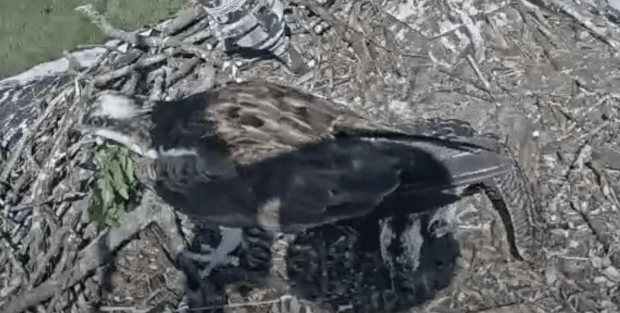
Sweet little Malin slept on his fish. Smart little one. Perhaps that is how to keep leftovers if you are afraid that someone will steal your food! Malin ate it for breakfast and then, at 10:17ish, Dad made a delivery.

Sometimes Malin bites Dad’s toes. It is a good idea to drop that fish and get away fast!

Malin protecting his little fish while Dad flies away.

We are keeping a close eye on what is happening with the Black Storks in Latvia and Estonia and I am very grateful to ‘S’ for helping with this. In Latvia, Grafs made a fish delivery at 12:04:43.

The storklings had one feeding yesterday but four feedings on the 15th. It is hoped that more fish will come to the nest today.

One of the birdwatchers in the area and a good friend to this nest, BK, purchased a white decoy and has spent their time painting it to be Grafiene 2. This decoy was installed on the morning of the 17th to try and lure Grafs to the fish table.

Anyone who lives in duck hunting country will know that the use of decoys to attract birds can be very successful. We hope that Grafs smells the fish donations and sees Grafiene 2.

Some of you might be wondering why they do not climb the Black Stork nest near Sigulda. The simple answer is – it is not safe to do so. The nest is mostly made of peat and the birds could from their movements and jumping cause that to break off. Human disturbance would cause the same issues. It is also a very old tree and not strong. Everyone is doing everything that they can. After the feeding at noon heavy rains came to the area.

One development is that the eldest storkling is now branching. You can see that in the image below.

This Black Stork nest is very special to the people of Latvia as are these miracle storklings. ‘S’ tells me that there was no successful nesting here in both 2019 and 2020. This year no one thought that Grafs would attract a mate to the nest – especially so late in the season. No one would dare to think that there might be storklings for fear that something would happen. But there were eggs and they did hatch and look at these beautiful trio. Sadly, around the nest the area of the forest and adjacent areas have changed so much in the past couple of years that finding food for a family here can be difficult. Everyone continues with hope that Grafs will find the fish table. As I have said so very often, human encroachment and human impact on the climate are causing wildlife irreparable harm. Providing food for the birds now and in the future is the least we can do.

In Estonia, Jan has brought in three big fish for the trio at 11:01:17. He made a second trip to the nest at 15:09:18. In between, the storklings have been picking at the old fish on the pile. They were so full that they did not eat one of the big fish that came to the nest. Sadly, that fish fell off.

In other Osprey news, Telyn is still at the Dyfi Nest and has not left for her migration. She delivered a nice size fish and Dysnni was the taker! Some had thought he might have left the area but he hasn’t. Maybe Idris will get something for Ystwyth who looks on – no doubt she had hoped to nab that fish.

And here is Ystwyth, Blue 491, with her fish:

Beautiful Telyn or Blue 3J is a great provider for her two fledglings just like Idris.

Dysynni, Blue 490, flew up to the branch to eat his fish. Everyone always talks about how messy Idris is when he eats well, his son is just like him!

Dysynni has managed to eat the flesh of the fish and leave the tough skin. Bravo – but still messy! BTW. Dysynni is 89 hatch days old today, the average age of the males fledging off the Dyfi Nest in Wales.

You could hear LR2 on the other side of the Loch of the Lowes she was food crying so loud. There is no getting away from the fact that a fish is wanted! NC0 came in with a nice one. So, if anyone is wondering, NC0 has not left for her migration either. Historically, the 18th was the latest that she has left but, perhaps, the birds, hopefully, understand the weather along the migratory route and they will stay in place. As long as there is food, why leave? wait a couple of weeks. LOL. As if I can read an Ospreys mind!! I do hope they can wait.

Lucky! That is a nice fish and this chick doesn’t look like it is starving. That is a pretty nice crop.

These birds have turned out to be strong and healthy. Laddie and NC0 did well.

To close the day off, it was wonderful to click on the Foulshaw Moss Osprey nest and see Tiny Little, Blue 463, eating a really nice size fish! It was 18:40. It could be the last one for the day.

But, the icing on the cake was the receipt of my ‘Iris pen’ just a few moments ago in the post! It is Choke Cherry and is absolutely gorgeous. You can refill with any Cross Cartridge. What a fantastic fundraiser. Thank you Montana Osprey Project! My picture does not do this beautiful pen justice.

Thank you so much for joining me today. Please continue to send your warm wishes and prayers to the very precious Black Stork nestlings in Latvia and Estonia. The people there are doing everything they can to take care of these precious birds. I am continuing to monitor the fires in Greece. There are two new ones. Those fires impact the migration of the birds already on their way. There is a very sophisticated system using magnetic fields and Quantum Mechanics that our birds use to get from one place to another. If you want to read about it, one of the best books is A World on the Wing. The Global Odyssey of Migratory Birds by Scott Weidensaul. I just want them to stay put if they can! Take care everyone. Order you Iris pen if you didn’t! See you soon.

Thank you to the following for their streaming cams where I took my screen shots: Collins Marsh Nature Centre, The Eagle Club of Estonia, The Latvian Club for Nature, The Dyfi Osprey Project, The Cumbrian Wildlife Trust and the Foulshaw Moss Osprey Nest, and The Scottish Wildlife Trust and Friends of Loch of the Lowes.

A Cracker of a Day for Malin

Oh, it’s a cracker of a day! We know that the Sharp-shinned Hawk that comes to our garden is here often but since the extreme head we had not seen him. He flipped around on the lines bringing the Internet into the house and then in a blink was in the lilac bushes. He stayed there for about ten minutes and out he flew between the houses heading north. No chance for a photo but I tried! We feed approximately 300 urban birds a day – yes, you read that right. I never grieve over the single sparrow that Sharpie is sometimes able to catch. He has to eat, too.

Sharpie is an aberration according to Cornell Bird Labs. He should not be living on the Canadian Prairies in the winter but he does! He is a year round resident. It was his mate – in January 2017 – that changed my life. It is so good to see him.

Malin is such a sweetheart. He has the sweetest face. It has been a good day for Malin, too.

Last night, Malin slept on a piece of fish about the size of the one in front and to the right of him. There was also a small Bullhead on the nest last night. Malin woke up and ate the fish he was sleeping on. Mom arrived and shared the Bullhead with him. On top of those two, Malin had four other deliveries today. A total of 6 fish! His crop is about to pop. We have never seen this Osprey chick this full. I wonder if he will use this fish as a pillow? save it for breakfast? or finish it off a little later? He is one lucky little Osprey today.

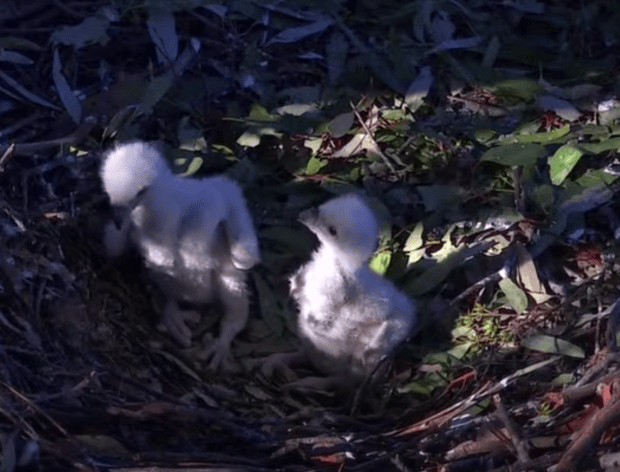
Those pesky little sea eagles will have several good feeds today, too!

WBSE 27 is the one on the left and cutie pie WBSE 28 is on the right.

There is still a tiny bit of egg tooth left but it is disappearing quickly. If you look closely under that soft down are there little pin feathers growing?

WBSE 27 hatched on 29 July and WBSE 28 hatched on 31 July. Today, they are 17 and 15 days old. This is the end of week 2 going into week 3.

  • Week 2: The wee ones are covered all in white down. Their beak is starting to grow longer but the egg tooth (the white dot) is still visible.
  • Week 3: We should be seeing the bill and the eyes enlarged but still the white down. The chicks are now doubled in size from when they hatched. They are looking around and noticing things.
  • Week 4: Those pin feathers I wondered about are starting to show on the wings. You will see them begin to preen their feathers and they should be moving around the nest picking up sticks and leaves. They will also be resting on their tarsus assisted by their wings for balance. The tarsus is the part of the leg from the top of the foot to the knee.

Ah, so sweet when they are asleep and growing!

The day is yet to begin in Latvia and Estonia. We wish that those beautiful Black Storklings get lots of fish today.

Thank you so much for joining me for this quick update on Malin. We are so pleased that Malin has had lots of fish today. He is getting so big and no doubt the more he eats the stronger the little one will get for fledge. The featured image is our little cute Malin. Take care. See you soon.

Thanks to the following for their streaming cams where I took my screen shots: Collins Marsh Nature Centre and Sea Eagles, Birdlife Australia, and The Discovery Centre.

Fishy Dreams and Fish Tails

Today, the Collins Marsh Osprey chick, Malin, had six fish deliveries. SIX! Feel free to correct me but I don’t ever remember this much fish on this Osprey nest. Ever.

In fact, there was so much fish with deliveries coming in on top of one another that Malin simply could not eat all the fish. There is a bullhead left – it is on the left below the light. Malin is sleeping on half of a bigger fish. What a grand pillow for an Osprey. He can have fishy dreams all night! And, Malin can wake up in the morning and not have to wait for a fish delivery.

Fish. It makes all the difference in the health and well-being of our Ospreys and Storks.

In the image below, the setting sun puts a soft glow over our little one. Please note that the big feathers are now beginning to cross. Malin is also standing and walking more and is flapping his wings much more often to get them strong for flying.

A month ago there was concern that Malin would not develop his plumage and would be unable to fly successfully off the nest. Now just look! Food – the right kind of food and the amount of it – makes all the difference in the world in Malin’s development.

Malin is miracle #3 for 2021.

Here on the Foulshaw Moss nest, Blue 463 or Tiny Little Bob, is eating the fish her dad delivered. White YW would have heard her several miles away screaming for fish. Blue 462 had gotten the earlier fish and Tiny Little wasn’t liking it. Dad came to the rescue! Indeed, White YW and Blue 35 should get a round of applause. They pulled off a nest of three fledglings this year. They did not lose a hatch.

The crows are hoping that Tiny Little will leave some bites for them! I don’t know. She is a bit like a nest vacuum when it comes to food falling between the twigs!

Tiny Little is miracle #2 and, of course, miracle #1 is Tiny Tot from the Achieva Osprey nest in St Petersburg, Florida. I am certain that there are others that will come to mind when I publish this newsletter. For now, however, these three were enough to cause lots of anxiety.

I did a Sunday hop-skip-and-jump through some of the UK Osprey Nests to see if anyone was home. This is the Dyfi nest in Wales of Idris and Telyn. On the nest is Ystwyth, their daughter. Telyn is on the nest perch and Idris is on the far perch.

Idris and Telyn together. How beautiful.

Does he need an introduction? The chick on the Llyn Clywedog Osprey Nest, Only Bob? Only Bob was so big when he was ringed that everyone believed him to be a large female. Nope. It is just all that fish that Dylen and Seren fed him. My goodness did Blue 496 grow.

He has spotted Dylan flying in with a fish. We are so lucky to see this. Indeed, to see so many of the UK fledglings on the nests today is fantastic.

That is a gorgeous fish for dinner. Only Bob looks pretty excited.

Watch out for your toes Dylan.

Only Bob learned well despite the fact that he was the only chick on the nest. He is excellent at mantling. But, stop, and take a look at that tail and the size of those wings. I would be ever so grateful if Malin’s was half that size when he fledges.

Oh, let’s just move this beauty over here so I can eat it!

At least one of the chicks on the Loch of the Lowes has a huge crop. It is so big, it looks like it could pop. The other is hoping for a fish delivery. Of course, neither is showing us their pretty blue bands.

NC0 and Laddie have done an amazing job raising these two. NC0 has really moved up to be one of the females that I want to watch. She is becoming super mom. She can fly and haul fish to the nest just like Iris – and she isn’t afraid to do it!

Grafs was able to find enough fish for two deliveries today. The first was a bunch of small fish at 15:29 and the second came at 19:41 with some bigger fish. The storklings are starving. They are already beginning to show the signs of malnutrition.

Grafs makes sure he moves around so that each one gets a little something.

It was mentioned that not only the sunken bodies but also the fact that the bills are turning a bright colour indicates starvation.

Once the people watching these nests realized what was happening, they became very vocal in their demands that the birds be fed. Everyone knows about the fish table that the two engineers set up for the White Storks in the village of Mlade Buky, Czechoslovakia. The people demanded that their storks be fed and the wildlife staff heard them. After seeing only one feeding by 15:00, Janis Kuze wrote the following on 15 August 2021: “It may be necessary to support the operation of the feeder – to bring live fish there regularly (once a day or two). I will write about it in the coming days.”

Liz01, the moderator of the looduskalender.ee/forum (English forum for the Latvian Fund for Nature and this Black Stork Nest) posted this notice:

“Due to the fact that the female has not been seen in the stork nest for several days, she has probably started migrating, opportunities are being sought to artificially feed this nest. Currently, the only feeder is the male, whose capacity is too small for the young birds to be successfully.
One way of trying to help the inhabitants of this nest is to set up an artificial feeder. There is one ditch near the nest where it can actually be done. Ornithologist Jānis Ķuze is ready to take over the management of this event, but he needs the help of the society. Therefore, we are looking for:
1) people on the Sigulda side who would help to set up a feeder,
2) human or fish feeders on the Sigulda side, which would be willing to donate and / or catch small fish (they must be still alive), with the possibility, to put these fish into the feeder, thus regularly
replenishing fish stocks in the feeder a third person or another link in the chain).
If anyone has the opportunity to help with this event, please send a message to Jānis Ķuze by e-mail: janis.kuze@ldf.lv.
This is currently the only real way you can still try to help the young birds in this nest survive and fly successfully! It is not known whether it will work, but we think it would be better to try not to do anything and just watch.”

Immediately, there were too many offers to help the Black Storklings and Grafs. Tears. People are so generous. All we have to do is ask.

If you wish to follow the discussion about what is happening at this particular nest in English, please go here:

When I have news of what is happening at the Estonian Black Stork nest, I will let you know.

You can watch the Black Stork Nest in the forest near Sigulda, Latvia here:

We all send our prayers and warm wishes to these beautiful birds and the people helping them. We need a miracle like that at Mlade Buky.

Thank you so much for joining me. It is wonderful to bring you such good news. Please send all your positive energy to Latvia and Estonia so that the efforts to save the Black Storklings from starving to death will be successful. It is heart warming to see so many people answer calls for help.

Thank you to the following for their streaming cams: The Latvian Fund for Nature, the Collins Marsh Nature Centre, Dyfi Osprey Project, Cumbrian Trust and the Foulshaw Moss Osprey Nest, Scottish Wildlife Trust and Friends of Loch of the Lowes, Llyn Clywedog Osprey Nest and CarnyX Wild, and Bywyd Gwyllt Glaslyn.

Just a note. My newsletter will be posted late on Monday 16 August. Thank you!

Worries…and Hope for the Black Storklings of Latvia and Estonia

Sometimes the good news in our Bird World gets suppressed by horrific news or concerns – and in that moment, we begin to lose hope that anything is being done to protect our feathered friends. Today, we are going to start off with the worrying news and end with some really positive happenings.

The real worry centres around one word: migration. Normal migration brings enough troubles to the birds – winds, lack of prey, predators but this year underneath that big umbrella of migration are two other concerns: the wildfires that are impacting birds already in the midst of their migration and those who will be starting their journeys to Africa from Europe and the UK and the late hatches. For those of you that do not know, the fires around the Mediterranean are causing birds to fall dead from the sky or to go into care for smoke inhalation. It is heating up in France and Spain with record temperatures. High atmospheric pressure is fanning the heat. It is extremely dangerous for the birds to fly through the fires to reach their winter homes. The second worry are the birds that were born late – some three to four weeks after the others. Will their parents stay and feed them? or will they die on the nest? will the father who remains while the mother has already left be able to find enough food for these large birds nearly ready to be on their own?

The latter issue is pressing down on stork nests in both Latvia and Estonia. We have had the pleasure of watching Grafs and Grafiene feed their three Black storklings on the nest in the forest near Sigulda.

Grafiene last came to the nest to feed her babies on 13 August. The Storklets were normally getting 10 feedings a day. On the 13th of August they had four feedings but, on the 14th, the next day, there were only two. It is, as we all know, extremely difficult for one parent to maintain the level of feeding when they are also preparing for migration. There is fear in the Latvian community for these beautiful birds.

My friend ‘S’ in Latvia advises me that through the efforts of the community – the calls for help for these birds – the ornithologists in charge of the area have set up a food table for the father near to the nest. This is very similar to the help given to Bukacek in Mlade Buky when the female was electrocuted. Let us hope that Grafs will accept the food and feed his nestlings. They will not be ready for fledging for at least another two weeks. Please send your warm wishes for these beautiful birds that they survive.

You can follow what is happening at the nest of Grafs and Grafiene here:

At the Black Stork Nest in Jegova county in Estonia, the storklings were fitted with satellite transmitters late on 13 August. This is the nest of Jans and Janika. The banders left a pile of frozen fish on the nest that they hoped would last a few days. Janika was last seen feeding the storklings on 6 August. The father has managed to bring some big fish to the nest but ‘S’ tells me that these fish have been difficult for the nestlings to eat because of their size.

Two things you will notice in the image below taken on the 15th. You can see the transmitters on the legs of the three storklings but you will not see a pile of frozen fish – the storklings ate all of the fish provided! This is wonderful news and gives one hope that the efforts of everyone in both Estonia and Latvia will prevail and the six rare Black storklings will fledge and survive to return to their home countries.

Here is the link to this nest:

The pandemic which began in 2019 and continues to take lives around the world also contributed to some projects that have brought much hope in regard to the natural world and our bird friends. James Aldred, an award-winning documentary filmmaker was given an assignment to document a family of goshawks living in the New Forest. The New Forest is in Hampshire in southern England. It is the largest area of forest and pastures in England consisting of 71,474 acres.

The natural landscape of the New Forest consists of areas of open fields and heavily treed forest areas.

“New Forest Landscape” by davidgsteadman is marked with CC PDM 1.0
“New Forest – River At Mill lane Brockenhurst 2” by Chalkie_CC is licensed under CC BY-NC 2.0

Aldred was there to study the Goshaws who are medium large raptors that live in the forest. They are larger than the Sharp-shinned hawk that comes to my garden and the Cooper’s hawks that I see at the park but they are significantly smaller than eagles. They are known to be fiercer in temperament than the Sharpies or the Coopers. Because they live in the forest very secretively – not liking to be around humans – they are often hard to find. Stealth hunters they are known for their excellent flying skills seeking out both bird and mammal.

The females are, like other raptors, larger than the males. The couple build a very large nest in trees using twigs where the female will lay between 2-4 eggs that are incubated for a period of 28-38 days. Fledging normally takes place after 35 days.

So what was our documentary filmmaker doing with the goshawk family in the New Forest? Aldred spent 15 hours a day in a tent recording the comings and goings of the goshawk family. He created lots of notebooks about the intricacies of their lives often unseen by humans. Aldred said it was like going back in time a thousand years. There was silence in the New Forest which is normally underneath the flight paths of thousands of airplanes every day. He said what gives him hope is that “Very soon after humans deserted the forest last spring, wild animals started reclaiming it.” In addition to the goshawk family, deer, badgers, and fox cubs came out to play.

“Stag at Bolderwood, New Forest National Park” by Chalkie_CC is licensed under CC BY-NC 2.0

“The sheer emptiness of the place…It felt weird, being out there in that paradise on my own.” What he saw and experienced is now in the book, Goshawk Summer: A New Forest Season Unlike Any Other.

The brilliant take away from all of this is that once pandemic restrictions were eased people flooded the area with what Aldred calls their ‘pandemic puppies’ killing and scaring away the birds whose nests were on the ground. The arrival of so many humans scared all of the animals back into hiding and leading their lives in a very different way than during the period when no persons were allowed into the forest. The Forestry Commission listened to Aldred about managing visitor numbers and the woodland paths so that the animals would not be harmed by humans who visit the area.

Each of these stories brings us hope and encouragement. I am delighted to hear that the ornithologists -after hearing from so many people – are providing food to the storklings. It is hoped that those in Estonia will return and place more fish on the nest or nearby for Jans. That nest is wide enough. The Latvian nest is problematic because it is too narrow and might collapse if someone tried to place fish directly on it. Let us hope that the feeding continues and that it is successful.

We also have a late hatch – little Malin at the Collins Marsh nest in Wisconsin. So far, Malin has had only one fish and that was delivered by Collins around 8am. I really hope that he is going to get enough food today. This is another nest that needs someone to supply fish for the family because of the drought and heat that has happened.

Malin is getting some air beneath his wings in the image below and those feathers look good. Oh, he is so tiny!

Over in Cumbria, big sibling 462 got the fish and there is Tiny Little hollering for White YW to bring her one! And, of course, she is giving her big sibling ‘that look’.

It is another hot day on the Canadian prairies. My resident Blue Jay has learned where to sit to tell me that more water is needed in the bowls or that the ‘buggy’ suet is all gone. Him and his mate plus another Jay have been coming to the garden for several years. They live in a tree just across the back lane. It is always lovely to see them playing in the bird bath!

Thank you so much for joining me. Send all of your best wishes to the birds who are in the process of migrating. It could be catastrophic if all of them perish in the fires trying to get to Africa. At the same time, take a cue from what has happened in Latvia and Estonia – support those that want food tables set up to help the birds survive. Donate fish if you have them to give. One other thing is to thank those who helped and are continuing to help. Take care everyone.

Thank you to the following for their streaming cams where I took my screen shots: Collins Marsh Nature Centre, Cumbrian Wildlife Trust and the Foulshaw Moss Osprey Cam, the Latvian Fund for Nature and the Eagle Club of Estonia. Thank you to the banders in Estonia and the persons supplying fish to Grafs in Latvia. We appreciate your stepping in to show how much you care at this critical time for the birds. Thank you ‘S’ for sending me all of the news. It is much appreciated.

It’s official – the Collins Marsh osprey chick is Malin!

I want to thank ‘S’ and ‘L’ for really wanting the little osprey chick on the Collins Marsh nest to have a name. Long before the Nature Centre announced its contest to name the chick, we were calling that little one, Malin. It means mightly little warrior and he was ‘mighty little’ then. Since then the heat in that area of Wisconsin has dissipated and Malin has been getting a few more feedings. It is a marsh and the fish are smaller than what you see coming out of the lochs in Scotland. Today, Collins, the male, landed a nice one and it took Malin over half an hour to finish eating. There was even some left. Malin went to sleep with a full tummy and that is a wonderful thing.

Malin loves to sit with his face into the sun getting warm but also doing what appear to be his yoga exercises!

Recently Malin has really been exercising his wings. This will help them get strong. Indeed, the extra fish has given this one some added energy.

Malin’s parents are Collins and Marsha. This is their third or fourth year raising chicks on this nest on top of a wild fire tower that was brought to the centre so visitors can see the beautiful marshlands. The nest is on top of the observation area, 120 feet off the ground.

Malin was beginning to grow in the middle of July – slowly. Wisconsin was hit with a drought and then the rains came but also more hot. The last few days have been cooler.

Everyone worried if there would be feather issues and Malin might not be able to fly but all of the aunties and uncles have watched closely along with the local rehabber and we are delighted to report that those feathers are looking good.

Malin is a mighty little warrior. He is the only surviving chick on the nest at Collins Marsh. His two siblings died during the extreme heat wave. Malin is now exercising his wings and we hope that he will have plenty of time to hone his skills and get some fat on his body before migration begins.

Thank you to everyone who submitted a name for the contest and thank you to everyone who voted – no matter what name it was. It is wonderful to see so many people interested in this lovely little Osprey. Let us hope that we find ways for his life to be a good one. As you can see I continue to call Malin a ‘he’. I believe he is a small male and if that is the case then he will return to this area to set up his own nest and find a mate in a couple of years. By then I hope we have figured out how to make that successful on a planet that is getting warmer.

Thanks to Collins Marsh for their streaming cam where I took my screen shots and for posting the official name contest for Malin. Thank you for joining me. It is always a pleasure to be among fellow bird lovers!

What’s happening in Bird World?

I don’t know a person watching a nest on a streaming cam that doesn’t get anxious if food is not brought to the nestlings and fledglings on a regular basis. Most of us start doing a bit of nail biting. Today, for example, Malin had 4 feedings. It isn’t as good as five but it is better than nothing! And last Sunday Malin had nothing. We are all hopeful for tomorrow. The weather is cooling off – Malin we are wishing for six fish tomorrow!

Malin 13 August 2021
Malin 13 August 2021 after a feeding

Jake Koebernik of the Wisconsin DNR did a great job answering a lot of questions that some of us have had about Malin’s nest. One was ‘why are the fish that are delivered are so small?’ and the other was ‘why do fish deliveries drop at the weekend?’ This is his answer, “As for the nest at the Collins Marsh NC, the streams and marshes around that territory probably only offer smaller species such as bullhead, bluegills, small bass and northern pike. There aren’t large lakes or real productive rivers in that part of the state, so they are going after what is abundant and available.” Jake’s answers cleared up a lot of the mysteries. —— And tomorrow, when Malin wakes up, Malin will have its official name! Fingers and toes crossed for it to be Malin!!!!!!!

My friend ‘S’ sent a screen shot of a delivery that Telyn made to the Dyfi nest this afternoon. We both agreed that Malin’s eyes would pop out if he saw a fish this big land on the nest at Collins Marsh. That fish is bigger than Blue 491! Wow.

And if you did not hear, Idris had been missing since Wednesday and he was on the nest today, albeit with a completely sunken crop. He brought a nice fish to one of the chicks. Hoping he gets his own fill of fish. Where in the world could he have been? It is worrisome.

Telyn delivered a whopper for 491, Ystwyth who is 82 days old on 14 August

Oh, if only places that have ponds could stock them for the birds. The Pritchett Family in Fort Myers has a stocked pond for Bald Eagles Harriet and M15 and their kids and the water also allows them to cool off and clean their feathers.

We are told by the IPCC that we can expect the droughts and extreme heat to be with us. Since these changes to our climate are known to be directly caused by human activity, maybe it is time to figure out ways to help the wildlife. Providing water and food is a start.

These two little sea eaglets are just adorable and a little spunky, too. They are growing like the sunflowers in my garden that the birds planted.

Both had nice crops after this feeding.

Judy Harrington, the researcher observing the WBSE Nest in the Sydney Olympic Park forest, just released her report on what these two have been eating during the last fortnight (14 days). In fact, it is the first two weeks of their life. Harrington also records the amount of time spent feeding by both the male and the female has been recorded. Lady took on 109 feedings for a total of 21 hours and 20 minutes. Dad did 8 feedings for a total of 42 minutes. Dad has been providing most of the food – he brought in 25 items and Lady brought in 5. These consisted of the following in total: 16 Bream, 4 catfish, 2 fish, 1 Mullet, 2 Whiting, 1 Yellowtail, 1 Ibis chick, 1 nestling, 1 pigeon, and 1 bird. They have now morphed into sea eagles, the second largest bird in Australia.

Sadly, it appears that Lady was hit during the night by Boo, the BooBook Owl that lives nearby in the forest. Despite its very small size the BooBook Owl has caused injuries to the large sea eagles in the past.

It is thought that Boo, as the little owl is so fondly called, has a nest near to the Sea Eagles. To my knowledge, the WBSE have never bothered their nest but, – hey. Every parent is afraid of a larger predator and wants them to leave the area.

“Boobook owl” by jeans_Photos is licensed under CC BY 2.0

Legacy on the Fortis Red Deer Nest has fledged. She has been on and off the nest a few times today. One was to get some fish! Here she is with Mum. After all the nestling deaths during the heat wave, this is just one of the happiest moments from that nest. Look how big Legacy is next to mom. Congratulations.

It is almost impossible to see what is happening on the Fortis Alberta Exshaw nest up at Canmore. Both chicks appear to be on the nest and calling for food. It is unclear to me if one or both have fledged.

The love story of the two Canada Geese has gone viral. It warms our hearts to see these two devoted birds – Amelia finding and waiting for Arnold during his surgery and recovery and now their reuniting. My friend, ‘R’ found two more stories on them and I want to share with you what she sent to me. You could read about these two all day – and you will always walk away with a smile.


https://boston.cbslocal.com/2021/07/15/goose-surgery-visit-mate-new-england-wildlife-center-cape-cod-branch/
Female reporter admits to being teary eyed! 

https://whdh.com/news/goose-who-underwent-emergency-surgery-released-back-into-the-wild-to-be-with-his-devoted-mate-on-cape-cod/Shirts for sale: “Honk If you Love Arnold!”

The story of Arnold and Amelia has taught us all something. If you find an injured Canada Goose and are taking it into care, please take the time to find its mate! The outcome might be much more positive. If you live in an area where there are Canada Geese – let your local wildlife rehabber know about the story of Arnold and Amelia. They will understand why it is important to keep bonded mates together (and their goslings if necessary).

And news about Kona. It is nearing 100 F or 38 C on the nest in Montana. The foster mother, Scout, has been shading Kona. Everything is going well with this foster. How grand.

@ Montana Osprey Porject

Leaving you with a gorgeous image of Loch of the Lowes. It just looks so still and peaceful in the early morning hours of 14 August.

And a last peaceful image of Diamond on the ledge of her scrape box on the water tower at Charles Sturt University in Orange, Australia. We will be looking for eggs before the end of the month. Izzi was last in the scrape box of Xavier and Diamond 6 August. He was photographed on 10 August and someone thought they heard him this morning.

Thanks for joining me today. I am off to try and find some hawks tomorrow so this is coming out early. I will bring you some late Saturday news in the evening. Take care. Stay safe! If you hear of interesting bird stories – and in particular, raptors – let me know.

Thank you to the following for their streaming cams where I took my screen shots: Collins Marsh Nature Centre, Sea Eagle Cam, Birdlife Australia and the Sydney Discovery Centre, Dyfi Osprey Project, Scottish Wildlife Trust and Friends of Loch of the Lowes, Falcon Cam Project at C Sturt University, Fortis Alberta Exshaw and Fortis Alberta Red Deer. Thank you to ‘R’ for sending me the links on the coverage of Arnold and Amelia and to ‘S’ for the information on Telyn and her whopper of a fish delivery. It is much appreciated! Thank you to the Montana Osprey Project FB page for the image of Scout and Kona.

Uplifting stories in Bird World

A lady in Manitoba is trying to figure out if anyone has ever seen what is happening at her house. Keely calls it a ‘strange domestic situation’. The nest has 3 robin chicks. The couple taking are of them are a Robin and a Sparrow. Both of the birds sit on the nest, feed the chicks, clean up the nestlings pop sacs, as well as standing guard. The couple often sit next to one another on the telephone line. Keely finds it fascinating. Have you ever seen such an adoption?

The little sparrow’s head almost fits into the mouth of the Robin nestling when he comes to feed it.

The proud couple!

In Montana, there has been a second life given to an Osprey chick. Ospreys are known to be very good foster parents. The researchers at the Montana Osprey Project have been busy. They are trying something very complicated called cross-fostering.

Yesterday they found a second chick that was found tangled in baling twine at the Steinbrenner’s House. It was an only chick. If they removed it to care the parents might leave for their migration. At the same time, the original chick that was taken to care for baling twine entanglement was ready to go back to its nest. That chick’s name was Kona. But its older sibling had fledged and the parents weren’t at the nest much.

So Kona was put in the nest at the Steinbrenner’s house. The plan is to keep the parent’s busy taking care of Kona until their chick is out of rehab in a week or so. Then they will have two chicks to look after.

So how did it work? Kona was placed in the Steinbrenner nest and she begin flapping and wingersizing. At the same time, the person with the Montana Osprey Project put two trout in the nest with her.

Kona with her two gift trout in the Steinbrenner House nest. @ Montana Osprey FB Page

The female landed on the nest and there was no aggression spotted. The female took one of the trout and flew to eat it. Kona began eating the other trout. Meanwhile, the male arrived with a fish which, when seeing everyone eating, he took off to eat himself. The female went back to the nest and both her and Kona are eating on the fish. Another great intervention to help the birds. Smile. It is fantastic! The latest news is that all is well.

Those stories just make you feel really good!

Other Nest News. If you are needing to see some Bald Eagles, Harriet and M15 are back hanging out at the SWFlorida Bald Eagle Nest on the Pritchett Property in Fort Myers. Samson was seen on the NE Florida Bald Eagle nest and that streaming cam is up and running after its annual maintenance. The Collins Marsh Osprey is looking good.


The Achieva Osprey nest has had an adult visitor today. Rumours have it that it could be Jack, the female, just checking on his territory. Blue 463 otherwise known as Tiny Little Tot on the Foulshaw Moss Nest has become the dominant bird on the nest – wow. A mighty third hatch. She was there today waiting for a fish delivery and looking good.

Zenit continues to grow and stay close to the nest for prey deliveries. This Golden Eagle juvenile has really grown! The Asociata Wild Bucovina that sponsors this nest have received enough donations to have two cameras operating next season. Congratulations to them.

It has been a really uplifting day in Bird World. Thank you so much for joining me. Take care.

Thank you to the following for their streaming cams where I took my screen shots: Asociata Wild Bucovina, Cumbria Wildlife Trust and Foulshaw Moss Osprey Cam, and the Collins Marsh Osprey Nest Cam. Thanks also to Keely on the Manitoba Birding & Photography FB Group for allowing us to share her story and to the Montana Osprey Project FB Page.

Oriental Storks survive fire

The number of wildfires burning during the summer of 2021 has boosted concern for the birds and wildlife being impacted. For the past three days there has been constant reporting in Europe on the state of migrating storks passing over Greece. They are dying or, if not dead, being taken into care for smoke inhalation. It is tragic. In Canada and the Pacific Northwest, nestlings died during the heat wave at the end of May that triggered a number of fires. Some Coopers hawks in that region began jumping out of their nests when temperatures reached almost 50 degrees C.

When an area begins to burn, most of the birds will fly away from the fire to a nearby safe spot. Not all birds can fly – nestlings will be killed. Smoke inhalation may cause long term damage to the lungs of the birds and, as we have seen in 2020 in the SW United States and now in Greece, fires impact birds that are migrating. The fires and smoke can kill them. Indeed, there have been so many fires in recent years that it is difficult not to remember specific birds that have been impacted. Anyone watching Iniko as the forest around his Redwood nest burned during the Dolan Fire will understand the problem as well as those who saw the koalas caught in the fires in Australia. Birds and animals get displaced during fires and while the forests will grow and again provide shelter and food, it is the immediate impact – loss of nests and nestlings, the heat, death or smoke damaging lungs that is so horrific. No one appears to know the long term impact of smoke inhalation on birds.

On the 13th of May 2019 a male Far Eastern Stork saved his five storklings in Siberia. It made news around the world. Humans started the fire. The lesson the video teachs us is that artificial bird nests should be made out of materials that will survive wildfires. I wonder how high they should be to afford the benefit that the nest below does to Father Stork and his five babies.

Each of you has seen the storks in Europe who love to be around humans. They roost and make their nest on the homes of humans and sometimes, even are cared for by humans. The Far Eastern or Oriental Stork, Ciconia boyciana) does not like to be around humans. It will make its nest as far away from us as it can. Sometimes on the outskirts of forest areas, near lakes and marshes so it can feed its young.

The Oriental Stork is larger than the European White stork. Normally weighing 2.8 to 5.9 kg (or 6.2 to 13 lbs). It has a wingspan of 2.2 metres (7.3 ft). You can immediately tell the difference between a European White Stork and an Oriental stork by the red skin around the eye of the Oriental Stork, the whitish iris and its black bill.

“Oriental Stork” by ltshears is licensed under CC BY-SA 2.0

The Far Eastern or Oriental stork is is extremely rare. It used to live in Russia, areas of China, and in Japan and Korea. Today, it is found only in the eastern areas of Russia where 95% breeds in the Amur-Heilong river area. It winters on Yangtze River in China. The other small percentage of birds breed in the Northeast of China. There is good reason for the stork not to trust humans. It was poached, it was shot, and it was killed by herbicide use.

“東方白鸛 (Ciconia boyciana#Oriental Stork)” by Lin Sun-Fong is licensed under CC BY-SA 2.0

Here is a time lapse image of our hero’s nest from wee storklings to fledge. It is very short. Have a look at those babies fly off! They are gorgeous.

This morning was a great one. It looks like the little Osprey on the Collins Marsh nest in Wisconsin had a nice crop! Malin woke up and found an old fish tail and ate it – oh, this chick reminds me so much of Tiny Tot at the Achieva Nest. Then Dad flew in with either a small fish or ? . It appeared Malin ate it all and then Mom flew in and fed Malin some more fish. An hour of so later, Dad flew in with another fish for Malin to self-feed. Gosh. Malin with a crop! It is rare like the Far Eastern or Oriental Stork. So happy!

And then Dad flew in with another fish. Fantastic. What a great beginning of the day. It is not even noon yet on the nest. Dad looks like he has a good crop, too.

My friend ‘S’ from Hawaii gave me a gift last night. She didn’t realize how special it was. She sent me the link to a documentary on YouTube. It is the story of a young man who decades later returns in his 60s to document the Philippine Eagles. The scenery in the forests of the Philippines is gorgeous as are the other animals that live there. So instead of a Netflix moment next time, why not check this out? The Cornell Bird Lab helped with the production. Here is the link to the trailer:

To watch the full movie, go to “Birds of Prey Philippine Eagle full movie” on YouTube. They will not allow me to embed the link to the full length movie on this blog.

There is another 25 minute documentary on the Philippine Eagle here:

Check out those amazing birds!

All of the birds seem to be doing what they always do! Tiny Little is on the Foulshaw Moss Nest wanting prey. She is now the most dominant bird on that nest. Another great third hatch. So far our worries are only with the Storks leaving for their migration who are passing over Greece. Voting continues at the Collins Marsh nest for the chick that a group of us have been calling Malin meaning ‘little warrior’. There is still time to vote. Head over to the Neustadter Nature Centre FB page and the second posting. You will see the names. Add your choice of a name in the comments. Don’t like, write the name in. So far, Malin is leading the pack of votes but, not by much. The sea eagles are fine and Dad’s injuries are looking good.

Thank you for joining me this morning. Take care. See you soon.

Thank you to the Collins Marsh Osprey Cam where I took my screen shots and to ‘S’ who sent me the link to Birds of Prey.

Featured image is the Philippine Eagle. Here is the credit to the person who took this beautiful image: “Philippine Eagle” by billydl is licensed under CC BY-NC-ND 2.0

3 Cheers for Tiny Little Bob!

White YW delivered the tea time fish – a nice large one – to the Foulshaw Moss Osprey nest in Cumbria. Blue 462 nabbed it first and then guess who pinches it off big sibling! Tiny Little!

Big Sibling 464 on the left and 462 on the right – all waiting for Tiny Little to make a wrong move with that nice fish. Go away both of you!!!!!

Then 462 got it back!

The first round both 462 and 463 struggled with the mouth and eye area. Wonder who is going to get that fish when it is nicely opened.

Ah, White YW cannot stand to hear one of his fledglings call for food. He promptly went out and got another one. Blue 464 got that one. It was such a nice fish that 464 was eating on it an hour later. Tiny Little flew off the nest probably chasing Dad. No one should be worried thought. Tiny Little had a nice crop prior to snagging that fish off 462. None of these chicks are hungry!

Blue 464 is enjoying his nice big fish – alone! No one is around sniffing for some pieces.

Good Night Foulshaw Moss Ospreys!

In Wisconsin, Malin is busy self-feeding on a piece of a fish that Dad delivered. What captivates me today are the wing feathers. They are looking so good. There is a condensation mark but if you look to the right that one dangling feather from earlier in the month is now ‘crossing over’ the way that it should. The other wing feather scallops are lined up perfectly. Oh, Malin, you are growing up!

The nests are so big and every streaming cam distorts the images (or so it seems). It is difficult to try and determine how big Malin actually is.

There is no time code on the Collins Marsh camera. I believe that there was another delivery by Collins to Malin – this time another piece of a fish. That is really helpful for Malin to work on its self-feeding and not get caught up with the bony mouths and eyes. Eventually Malin will need to do that. Right now one of the wonderful things is Malin’s anticipation of the food drop and his excitement and mantling on its arrival.

In the imager below, Malin sees Collins flying into the nest. Look at his eyes. He has also dropped his wings in anticipation of mantling that fish.

Malin pivots. Wings stretched down and out for mantling with beak forward to grab the fish from Collins’s talons.

Get out of the way Collins! Malin has secured the food.

Ah. Over. I notice also that Collins’s crop is nicely full. He has eaten the head and perhaps part of the fish before the delivery.

These two food drops for Malin to self-feed come after the aggressive manner that Malin approached the fish yesterday with Marsha. We are moving on to the next phase: no more feedings by mom? Let’s watch and see.

Is this the tail of a little Bullhead?

It is a beautiful day on the Canadian Prairies. For the first time in ever so long we can see blue sky, not sky filled with smoke. It is 21 degrees C. That is 69.8 F. Just lovely for a trip to the one of our local parks.

It was a delight to walk up to the duck pond and discover that our Parks Department has put up signs to educate people on why they should not feed the ducks bread. Last year the local birding group had a big campaign to get this practice stopped. Today, the signs are up. They are large and prominently placed at strategic entrances and exits. No one was feeding the ducks, they were just enjoying them! Well done Parks Department!!!!!!

Thanks to the recent rains many of the geese were out on the fields where people play soccer or cricket eating green grass.

A male juvenile Mallard enjoying the water fountain at the rocks.

There was real discussion on the identification of the duck above and the one below. The discussion ended when the little duck below showed us her feeding behaviour. She is a dabbler so she is a female Mallard – not a female Blue Winged-teal.

Mallards come to Manitoba to breed. They arrive in the spring and leave in the fall. Here the little female is mottled brown with a whitish tail, and orange feet.

When feeding, she tips up and dabbles in the shallow waters of the duck pond for pondweeds and aquatic invertebrates. They also feed on larval amphibians and fish eggs.

The female Wood Duck and her ducklings. You can tell the Wood Duck by its white tear-eyed eye patch. Her breast is a mottled brown and white.

Wood Ducks are migratory birds in Manitoba. They arrive in the spring, normally April, and will head south in October. They are cavity nesters. They will lay their eggs in a tree cavity or specially built enclosed wood boxes. The ducklings are ready to bounce from the nest when they are 24 hours old. Precocial animals and birds hatch/born with all their feathers, skin, etc. and are able to see, hear, and move about.

The little Wood Duck and her ducklings mingled with the Canada Geese. Only once did I see a goose get aggressive towards one of the little ones.

Malin’s initial feather issues have caused me to spend more time looking at the back and wings of birds than I ever would have thought possible. Each individual feather is simply beautiful – taken together they are like a wonderful musical symphony – each performing their own task to help this Canada goose swim, walk, and fly.

The tail and wing feathers of a non-breeding male Mallard.

As we were leaving, a Juvenile Bald Eagle was soaring above us.

Then the Northern Goshawk beats its large wings. The Northern Goshawk lives in Manitoba all year round except for the southern part where they can be seen only in the summer or in the winter if food supplies in the North fall.

It was a good day! The skies are turning grey and the wind is picking up a little and maybe, just maybe, we will have some more rain. Wishing and hoping.

Thank you for joining me today. Take care everyone. See you soon.

Thanks to the following for their streaming cams where I grab my screen shots: the Cumbrian Wildlife Trust and the Foulshaw Moss Osprey Nest and the Collins Marsh Osprey Nest.

Oh, Malin!

The Collins Marsh Osprey chick is due to get an official name. Suggested names have been turned in and voting should begin tomorrow for the name. Please go to the Neustadter Nature Center FB page and cast your vote. Here is the link to that FB page. Be patient if the names are not up on Tuesday. However, check back often because the voting will be open for only a short time.

https://www.facebook.com/Neustadter-Nature-Center-at-Collins-Marsh-140052786074932

Since ‘S’ came up with the name Malin meaning “little warrior”, everyone from the Achieva Osprey chat group has called this little one ‘Malin.’ It is difficult to let a name go once it imprints itself in one’s mind. My children could not say ‘Granny’ when they were talking about my grandmother, they said ‘Candy.’ And so, in her 80s, that is what she was called for the rest of her life – not only by my children but, by everyone. And so, it might well be the same for Malin.

Malin’s parents are Collins and Marsha – named after Collins Marsh. Malin hatched on approximately 16 June making him 55 days old today.* That means Malin is one day shy of his 8-week hatch birthday.

Sometimes fish deliveries are good and some times they are abysmal. Malin had no food from early evening Saturday until Monday morning. There were two deliveries Monday morning. It was the third delivery that roused my interest. I have taped several short segments of that feeding. It is better if you watch the one-minute clips than my trying to describe them. Pay close attention to Malin’s behaviour. The fish arrived around 6:43 pm (there is no time on the streaming cam).

Act 1: Fish Delivery

Act 2. Malin is ravenous.

Act 3. Malin wants every morsel of fish!

Act 4: Malin and Mom finish off the fish.

After Malin finishes eating, s/he is so energized. She begins flapping her wings. Watch out Mom!

According to Alan Poole, the female Osprey loses between 10-15% of their body weight during the nestling period. Only when a piece of food is too large or when the chick/s stop food calling will she take bites for herself. He says, “It seems likely that the female parents are hungry much of the time they are raising young, especially as the young get older and take more food.” Certainly that is what we are seeing on the Collins Marsh nest today.

In terms of growth, Osprey chicks triple their body weight during their first 8 days after hatching. They will double this, on average, in the next four days. From 15 to 30 days after hatch, the Osprey nestlings “gain an average of forty grams or .09 lbs, about 2-3% of their body weight, every day,” says Poole. At the end of the 30 days, Osprey chicks will be 70-80% of their adult weight. On average, the Osprey nestling will take its first flight between 50 and 60 days. There are two exceptions to that timing: if the bird hatched on a non-migratory nest or if the chick had less food.

Malin is definitely in a migratory nest but, Malin is behind in development because of a lack of food. Precisely how far behind is unclear. Still, growth is clearly evident. Today there were four distinct dark bands on the tail with a 5th peeking through. The feathers are coming in nicely but they are not fully formed. Roy Dennis says that the full set of juvenile feathers should have grown in at 6 weeks. Malin, at 8 weeks, is still working on his.

Malin is clearly not ready to take his first flight. He is beginning to exercise his wings. Fledglings normally remain on the nest for at least a month after their first flight. This time helps them hone their flying skills. During this period, the male parent provides the fish. Fledglings do not normally catch their first fish until they begin migration – that said there are always exceptions to the rule. Migration for the Wisconsin Ospreys normally begins around the end of August or the beginning of September. Let us all wish that Malin is fed and afforded the time to perfect his flying before he has to leave the nest for his journey south.

There is really positive news coming out of Hawaii that I want to share with you. The Kauai Island Utility Cooperative is installing glow-in-the-dark diverters on electricity lines to try and stop seabirds that fly at night from crashing into the lines. By the end of 2021, the utility company expects to have installed 773 power line spans to help protect the Hawaiian Petrel, Newell’s Shearwater, and the Band-rumped Storm Petrel. Already Hawaii has banned the release of helium balloons.

“Hawaiian petrel chick in its burrow. Photo credit: Andre Raine/Kaua’i Endangered Seabird Recovery Project” by USFWS Pacific is licensed under CC BY-NC 2.0

It has been a good day. Thunder woke me up early on Monday and we had some nice downpours. Then the heavy rain changed to showers. Now the thunder and the pouring rain have started again. Every blade of grass has turned emerald green, the bushes and trees have all perked up, and the birds sang as loud as they could at dusk. It is simply wonderful!

Thank you so much for joining me. Everyone take care. See you soon.

Thanks go out to the Collins Marsh Nature Centre for their Osprey streaming cam where I took my video clips. A big thank you to ‘S’ who alerted me to the actions of the utility company on Kauai to divert night flying sea birds away from their power lines.