UPDATE. This blog has been updated to correct the name of the eaglet that hatched from Sky to Ahote.
If you didn’t know about the fledge at the West End Bald Eagle nest of Thunder and Akecheta in the Channel Islands but, you knew the nest and the chicks – which chick would you have voted to fledge first? Most people would say Kana’kini because she has been doing so much hovering.
However, this evening at 17:07:49 the third hatch, Ahote, fledged! It was brilliant. He hovered and out he went!!!!!!!! Surprised everyone.
It was just stunningly beautiful for a first flight.
t Wes
Congratulations to Thunder and Akecheta and to Ahote – your life as a fledgling and a juvenile just began.
Thank you to Explore.org and the Institute for Wildlife Studies for their streaming cam where I took my screen captures.
I am so impressed with the way that the raptors get great coverage by the radio, television, and daily newspapers. Spirit and her fledge have once again made the news! Why do I like this? Because the more people are aware and the more they appreciate the raptors the less likely they will be to harm them or their habitat. As each of us learns about their journeys and hardships we might change the way we do things to benefit their environment. We might make a donation to a wildlife rehabilitation clinic that has helped them. The possibilities are endless to do good things for the birds just like the joy they bring to our lives.
I admit to loving this image of the three – from left to right, Shadow, Little Spirit, and Jackie. What a beautiful family. Just so very happy for all of them – Spirit could not have had better parents and let us hope that she hangs around for a month honing those flying skills so we still get to see her!
Here is another that appeared on the FOBBV FB page:
‘R’ has been collecting images of Big at the UFlorida-Gainesville Osprey nest and they are amazing captures of the height that Big is achieving in her hovering. Thank you, R! I missed these and saw the hovering last evening. Big is so ready to fledge.
It is OK to go ‘Wow’.
These are from today. It continues to look as if Big is the one that is doing all the hovering. There is a bit more chocolate on her head. All that is needed is just the right wind!
Can you tell who is who? I never ever thought I would be in a position at this nest to wonder that!
What is wonderful is that there has been so much fish lately at the UFlorida-Gainesville nest that there are leftovers and tonight Mum even got to eat some by herself after feeding Middle.
Big is looking around and you can just feel her wanting to fly! Is Dad doing flying demonstrations above to try and get her interested? Maybe.
At 16:15 Little Bit 17 stole the fish tail form his big sibling 16 – the one that pulls out his feathers. Wow. Little Bit 17 is hungry and that was a nice piece of fish and the tail but the hunger has made Little Bit 17 brave today. He needs to eat. He spent much of his energy trying to get some food out of that road kill yesterday. Perhaps he expended more energy than what he got in terms of food. But, yes! Go Little Bit!
Little Bit moves in close to the right of 16 and grabs the fish tail. Remember he is the King of the Grab and Snatch.
Little Bit moves over to the side of the nest in a mantling position. He eats the fish by holding it down really tight and pulling up. Little Bit is getting faster! He knows that those big siblings could grab his precious food, too.
Protecting himself and eating fast.
Done. He goes around the nest after to see if there is any other food remnants. So far there has been a Blue Gill, a Small Mouth Bass, a Rye Bird and what looked to be a really bad piece of road kill. Perhaps a possum.
The nest needs much more food. But grateful for what comes. And it came in the form of Mum feeding – sit down – 16 and Little Bit 17 at the same time!!!!!! Seriously. She was mostly on the porch side of the nest but at 17:24:15 Little Bit has a nice crop and passes out in a food coma. It doesn’t get much better than that. Tears.
Sweet Eagle Dreams Little Bit 17. No one can say you are not brave – you are!
Dylan and Seren have plenty of fish up at Lyn Clywedog. Any early worries about the third osplet are all over. Each of the three chicks is doing extremely well.
Dylan is on the perch eating the head of the fish that he is going to take down to Seren and the kids.
One of the chicks is playing peek-a-boo.
They are all getting to be Reptiles!
It is evening at Poole Harbour. Fireworks are going off for the Queen’s Platinum Jubilee celebrations. (Don’t get me started on why fireworks are entirely unnecessary and harm wildlife and domestic pets). CJ7 doesn’t seem to be bothered but she does seem to be listening. Are we ready for the second hatch at Poole Harbour?
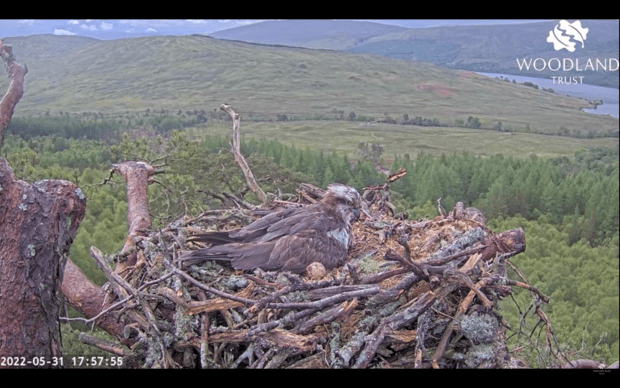
It is a bit drizzly up in Scotland at the Loch of the Lowes. Everyone is eating. The three are really growing. We can still tell Little Bob because he is a lovely light grey but he is growing and Blue NC0 has been super to make sure all are fed.
Big Red brought a big grey squirrel to the Ls for their dinner! Looks like a Thursday night feast.
Life looks pretty good on the nests. I will be watching the UFlorida-Gainesville Osprey nest intently. Both birds are ready to go – but, I suspect it is Big with all the flapping and a nice gust will carry her off!!!!! Little Bit 17 is full and that is good.
Take care everyone. Thank you so much for being with me. See you soon.
Thanks to the following for their streaming cams and/or FB pages where I took my screen captures: UFlorida-Gainesville Ospreys, ND-LEEF, Cornell RTH, Poole Harbour Ospreys, Friends of Loch of the Lowes and the Woodland Trust, CarnyXWild, and FOBBV.
Wednesday was a positively beautiful day. Chilly enough for a jacket but the sun and blue sky were perfect. The water is so very, very high in the Red River (it is everywhere). Last year there were literally hundreds of American White Pelicans at the dam at Lockport, Manitoba getting fish. They were sleeping along the shore for the most part today.
These pelicans were in the water like a synchronized swimming team fishing.
And all back up again!
There were Canada Geese but not a gosling in sight.
What is it about watching a mother raptor feed her little ones? Blue NC0 is doing a much better job with the Three Bobs. Little Bob has also figured out ‘the way of the world’ and will let Big Bob eat, get full and pass out and move up front.
Look at Little Bob trying to stretch that long neck of his up so Mum will see him. Big Bob is already getting full.
Both Big and Middle bobs are full and it is Little’s turn. He has wiggled right up there in front so Blue NC0 won’t start feeding herself and forget about him.
Little Bob is quite the cheeky little one! He is also full.
Idris brought in another one of his monster Flounders at the Dyfi Nest. Telyn makes sure that all the Bobs are also full and feed. Gosh, can you imagine brooding three wiggly Bobs?
I would really like to ship that nice big Flounder to Little Bit 17. He has been eating off and on all day – a small fish and some road kill. When I went back to check on him he was still working on the raccoon – trying to hork the last wooly piece of it.
You can sort of see a fuzzy bit of fur in his beak in the image below.
Then Little Bit was really courageous! No one should ever think that Little Bit could not survive in the world. He is as fast as lightning when he does his Snatch and Grab! He knows to stay away from 16 and he also knows that 15 will not hurt him. Street Smart Kid. An adult brought a fish on the nest at 20:46:01.
One of the big siblings got it. But a couple of minutes later, the adult took the fish away from the big sibling. In the process a piece broke off and Little Bit, the ‘King of the Snatch and Grab’ went for it – straight to the adult beak and had a tug-o-war. Little Bit won his piece of fish!!!!!!! Brilliant.
It wasn’t an enormous piece of fish but Little Bit got it and ate it. The adult fed the two big siblings. Little Bit got up to the feeding spot to get 1 maybe 2 bites. Little Bit also looked over the floor of the nest for any other pieces and found some.
As the sun is setting, Little Bit had a small fish, some more bites of fish, and it looks like he might have finished off that Raccoon pelt along with some squirrel. Would we have liked him to have more? No doubt. It is still better to have had this food and to go to bed – not with a big crop – but at least not starving. Let’s think positive. Hoping the cool weather keeps up and that there are no storms to murk up the river. Let’s wish for fish for Thursday!
And the fish came. Little Bit pulled a fish out from under nesting material at 10:34:11. It had been brought in at 10:31 by an adult. It is very hard to say how much fish, if any, Little Bit got. He moved around the nest from place to place very uneasy. He had possession of the fish until 10:40. The nest is very restless today. Little Bit is hungry.
The West End nest of Thunder and Akecheta in the Channel Islands has the most beautiful sunsets! The profiles of Kana’kini, Ahota, and Sky just seem perfect up on that cliff.
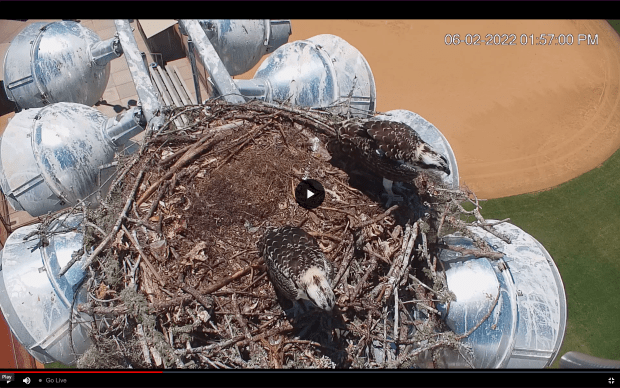
The Osplets on the UFlorida-Gainesville nest at the practice field are getting ready to fledge. I wish I could tell you which one did all the hovering but I can’t. I believe, from a rough count of the dark bars on the tail, that it is Big Bob – . Big Bob hatched on 5 April followed by Middle Bob on the 6th. They are 57 and 56 days old. Western Ospreys fledge from 7-8 weeks or 49-56 days. They are ready to fly!!!!!!!!!
A shout out to ‘B’ who alerted me to the fact that Spirit and both of her parents, Jackie and Shadow, were on the nest tonight. This is just amazing. Jackie and Shadow are really going to prepare Spirit for a successful life in the wild. Another thing that will help Spirit is that the habitat is closed by the USFS so that Spirit will not be disturbed while she learns to fly.
A fish was delivered and Spirit that gorgeous daughter started going wheeee, wheeee for the fish! She had to figure out how to get down from the tree and to the fish. (Someone said it was Jackie that delivered the fish but this sure looks like Shadow to me in his tight jeans!)
Spirit was carefully fed just like she had been the night before. How sweet.
Spirit gets left to clean up the rest of the fish.
And then all of the family are on the nest. What a beautiful sight to see!!!!!
The sun is setting on another perfect day at the Big Bear Valley Eagle nest. Spirit flew off in the morning and returned, spent time with her parents, had a nice fish meal partially fed by Dad. She is going to sleep on the perch again and hopefully repeat this same day tomorrow until she can fly and find prey and live without parental support.
Spirit is a sweetie. In some ways she reminds me of Legacy at the NEFlorida nest of Samson and Gabby. I am not sure how but she does.
Oh, speaking of cutie pies. SF Ospreys and Golden Gate Audubon made a compilation of Week 2 with the two osplets of Richmond and Rosie. They are so cute….Have a look!
Both of the chicks at the Cal Falcons scrape are now out and running about! No worries. They love their food and they will definitely come when either Annie or Alden has prey!!!!!!!! They will come screaming. Oh, just think. Friday we will get to call you by your names. Vote Everyone! Get your friends to vote – get these two cutie pies super names.
The three osplets at the Glaslyn nest continue to do well. You could not tell for an instant that Aran had an injury a year ago. He is really back in prime condition supplying Mrs G and the triplets with huge fish! Wonder if I could get them to adopt Little Bit?
Congratulations to Louis and Dorcha on their second hatch. Both chicks could be seen at 06:09 this morning.
It is clearly evident how much a headstart Maya and Blue 33 (11) have with their chicks. Just look at the difference!
Big Red and Arthur’s first hatch of the 2022 season at their Cornell Campus nest, L1, is checking out the fledge ledge! Fledge watch for L1 begins tomorrow!!!!!
And, last – there are now two little nestlings at the Glacier Gardens Bald Eagle nest in Alaska of Liberty and Freedom. They are three days apart. How cute!
When Charles Broley (The Eagle Man) studied and banded Bald Eagles, he was one of the first to note that the northern eagles are much larger than their southern counterparts. Alaskan eagles do not migrate. They stay and eat the salmon chum (dead salmon after laying eggs). It has been very plentiful.
It is cold and grey today. One beautiful warm day, one not so nice! I am just reading an article that is not making me very happy. It seems it has been going on for several years – the killing of Double-crested Cormorants in Newfoundland and Labrador with Parks Canada providing the justification. Are they serious? We take over their habitat and now we complain about their guano or that they are eating the fish!!!!! Are not Cormorants protected under Migrating Bird Laws? You would think but, not always. Apparently our provincial governments can also alter the laws about migrating birds. Who actually protects our wildlife?
Continue to wish for fish for Little Bit 17. I don’t think he got much of that fish this morning – I sure hope so but he is so nervous. 16 is a very, very nasty bird. The water level at the river where the adults fish at ND-LEEF is about a foot and a half or 45 cm higher than normal making it difficult for the adults to fish. It is going down but slowly. From seeing the high water around me and the opaque mucky colour, it is understandable that it is hard for the parents to fish. I imagine that they are also hungry.
Thank you so much for joining me this morning. Take care! See you soon.
Thank you to the following for their streaming cams where I took my screen captures and video clip: UFlorida-Gainesville Ospreys, ND-LEEF, Dyfi Osprey Project, Explore.org, FOBBV, Friends of Loch Arkaig and People’s Postcode Lottery, the Woodland Trust, Cal Falcons, LRWT, SF Ospreys and Golden Gate Audubon, Glacier Gardens, and Brywd Gwyllt Glaslyn.
I should go out and check on pelicans and ducks more often. Little Bit worked on a number of prey items getting some food. The times were 08:09:09-08:18:49, 11:33:51-11:36:11 Little Bit is working on the squirrel that was in the nest yesterday. From 12:27:47-12:40:47 he is eating away at something. Three other times are 12:51-12:54:27, 13:39:45-13:50:58 (Dad had brought in a prey item and 17 ate from 16:12:44-16:27. In the image below, Little Bit flaps his wings and goes to the porch to be fed.
Leftovers it seems mostly. Mum had him on the porch a couple of times and you could tell that he was eating.
Then a small fish was delivered to the ND-LEEP nest and a road kill Raccoon.
The small fish arrived at 16:04:17. It is hard to believe but Little Bit 17 got to eat the entire thing. Could it have been bigger? Sure. But let’s just be glad he got the entire thing instead of the skin at the end. Just lovely.
Little Bit 17 leaves the fish and moves back to working on the old raccoon. No one is paying any attention. Just like the squirrel yesterday it is too much trouble for some food for the older siblings. So Little Bit is pulling and eating away and slowly moving it over to the porch! This is a really smart kid! He has somewhere over there that he stashes food.
That is Little Bit 17 to the right of the tree trunk. You can see a bit of the raccoon just to his right.
At 17:27 Little Bit 17 is still working on that Racoon! It has been a good day.
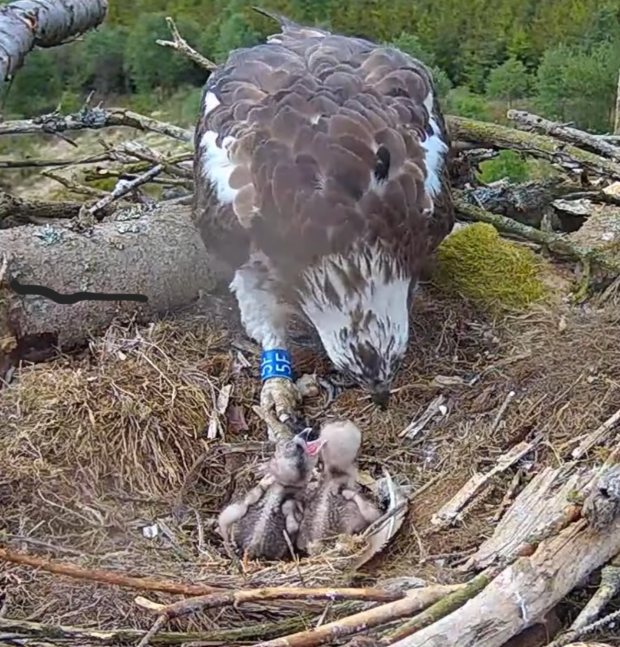
CJ7 waited for a mate and waited for a mate at her Poole Harbour Osprey nest and no one came until last year when a 2 year old Blue 022 returned from his migration and stopped. The couple hit it off – they seriously mated on camera during a BBC interview and apparently all over town. It was too late for eggs but they joined up together on their return in 2022. Today, CJ7 is feeding her first ever chick. It is also the first osprey chick to hatch in Poole Harbour in over 200 years. Congratulations!
Spirit came home from food and was fed by Shadow yesterday at the Big Bear Valley nest he shares with Jackie. She flew off at first light – 05:30:33. Let us hope she returns for an evening meal and roosting at the nest tree!
And guess who’s home? Spirit flies like she has been doing it for days, not just a day! She arrived at the nest tree through the back door and the camera caught her for us!
This is a very quick check. But to end on a very positive note at 17:21 both chicks on the UFlorida-Gainesville Osprey nest are eating fish!!!!!!!!!
That is it for today. If you haven’t voted for the names of the two chicks at the Cal Falcons scrape, do so before Friday morning the 3rd. You can only vote once. Here is the address:
Take care everyone. It has been a great day for the nests I checked on this afternoon. Good to see Little Bit working on road kill but also having that whole fish to himself. Let us see what happens tomorrow. Thanks so much for joining me. See you soon.
Thank you to the following for their streaming cams where I took my screen captures: ND-LEEF, Poole Harbour Ospreys, Friends of Big Bear Valley, and UFlorida-Gainesville Ospreys.
It has rained again so hard in our area that many farmers will simply not be able to plant anything this year. The flood that was here is still present in several locations and has now also flooded other areas. This is the wettest it has been in the history of our province! Several months ago I was longing for the sound of rain. It can stop now, please!
Right now there is a break. It is gusty but the animals have been coming to the garden. Mr Crow has been here for breakfast, Dyson has come to help eat the food put out for Hedwig (Dyson seems to want to eat everyone’s food but his own!) and Hedwig is here somewhere. There is lots of grass. We have been doing ‘No Mow May’ to help the insects get established so Hedwig can hide in the grass in certain areas! The rain has really made everything grow. I also noticed that the baby Chipping Sparrows have come for their White Millet. They want to eat in the sort of house feeder on the top deck on the red carpet. Go figure. Perhaps they don’t like to be lower with the adults???
After seeing ND-17 with a huge crop and knowing he ate well yesterday evening, I slept well. I checked and no food deliveries yet at the nest so I am hoping that lots of food will come in the afternoon and evening.
Little Bit sitting like a Buddha on the left. Conserving energy. Waiting for food. The winds are blowing 15-25 mph so not sure what the condition of the water at the river is like.
Congratulations go out to Jackie and Shadow and to Spirit for that beautiful fledge early this morning! No worries. Jackie and Shadow will keep close tabs on their fledgling teaching her everything she needs to know to survive in a world she has just entered.
There she goes! It was 05:40 ish.
More congratulations go out to Louis and Dorcha for their first hatch of the 2022 breeding season at Loch Arkaig! Louis sees his baby for the first time and immediately gets to brood! What a great dad he is! So happy. Two more eggs to go!!!!!!!!
He was called ‘Lonesome Louis’ til Aila came along and what beautiful families they raised. Now this is his second year with Dorcha. Speaking of Aila, everyone who watched her raise her chicks with Louis loved her. A tribute has been put together (get the tissues) for the three years she was at Loch Arkaig.
If you didn’t catch it in my blog yesterday, the only eaglet at the National Arboretum nest, the last chick or Mr President and Lotus has been given the name Takoda which means “Friend to All”. Wonder when DC9 will fledge?
Takoda is a beautiful eaglet. It is sad that his mother, Lotus, is not here to see her chick leave the nest. Mr President has really taken over all the jobs and has made sure this eaglet is thriving despite not having two parents.
Gorgeous Bobs at the Dfyi Osprey nest of Idris and Telyn – so much fish on the nest that sometimes they don’t wake up to eat! Seriously.
CJ7 is higher in the nest today and she is busy moving nesting material around her in the front. We might just have a hatch coming at Poole Harbour! It will be Cj7’s first – she waited a long time for a mate, just like Louis at Loch Arkaig.
Blue 022 has arrived at the nest but CJ7 isn’t getting up yet. Both will be first time parents. Blue 022 is just three years old! He arrived too late as a 2 year old first returnee at the Poole Harbour nest to have a clutch last year. So thrilled the two joined together again this year. A historical first when that egg hatches!
Dylan has been bringing trout to Seren and the three Bobs at the Llyn Clywedog nest. Everything seems to be going fine there.
I watched Blue NC0 at the Loch of the Lowes and Little Bob definitely got fed lots of bites. So everything is going alright at that nest. Thank goodness. She is going around to every beak with fish checking. Big Bob is full and little got food before mom horked the tail. Little Bob would have liked a few more bites but he waits til the Big ones eat, often.
The one to watch. Kana’kini at the West End Bald Eagle nest of Thunder and Akecheta will be one of the juvenile bald eagles to fledge this week amongst many.
Hatches and fledges. Names. There will be more of all three all week! I am off to try and beat the next bout of rain and get my walk in at the nature centre. Take care everyone. Thank you so much for joining me this morning!
Thank you to the following for their streaming cams where I took my screen captures: ND-LEEF, Friends of Loch Arkaig, Woodland Trust and the People’s Post Code Lottery, Poole Harbour Ospreys, Dfyi Osprey Project, Explore.org, FOBBV, CarnyX Wild, NADC-AEF, Friends of Loch of the Lowes and the Scottish Wildlife Trust.
The real focus on this blog is this fantastic Little Eaglet. I cannot say enough good things about him. There are a couple of other news items at the end.
If any third hatch deserves to live – and thrive in the wild – it is Little Bit 17 at the ND-LEEF Bald Eagle nest. Oh, he reminds me of Tiny Tot Tumbles from the Achieva Osprey Nest in St Petersburg in 2021. That third hatch was starved and appeared stunted. Tiny Tot Tumbles lived on old pieces of fish she could find buried in the nest until one day in April (she hatched 5 March 2021) her Mum, Diane, brought in a catfish. At some point Diane realized that this third hatch just might be remarkable. So besides being creative and doing the snatch and grab, Tiny Tot persisted and Mum fed her. For all those that doubt Little Bit 17 can grow big and strong – I have lots of examples that say you will be wrong if Little Bit survives.
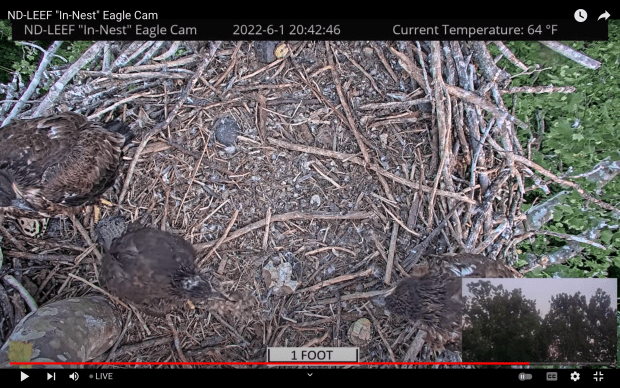
This afternoon Little Bit 17 really showed the stuff he is made of – he is brave and he is hard working. He is willing to eat the prey that no one else wants to survive. He has gotten smart except that he is hungry and he will be the ‘Snatch and Grab King’ when he can.
A prey item cam on the nest at 13:21:47. I could not make out if it was the squirrel or the raccoon – both road kill so mangled and mucked up.
Little Bit 17 was up next to 15 at the top rim of the nest. A perfect place to be.
Mum comes in with something and 15 moves back to peck at it. Little Bit stays up at the rim.
Mum checks and moves her head up to the rim to feed. Little Bit moves over. He is very afraid of Middle Bob – ND16 – who pecks at him all the time.
Mom feeds for about 4 minutes and then turns around where it is not so advantageous to Little Bit.
Despite 16 reaching over to peck a bit, Little Bit did the ‘Snatch and Grab’ for awhile and got a little more food. Right now he is pretty brave as he has opened himself up to get attacked by the big siblings.
One of them takes exception to Little Bit grabbing the prey and starts to mantle and flap. Little Bit gets over.
Then Mum turns sideways and Little Bit rushes to get to the side opposite the big siblings. You can just see his tail. He got some bites this way, too. Not many but some.
I wish that Mum would just stay in one place. It would be so much easier for Little Bit to eat with the big siblings on one side and it on the other. She seems antsy.
Little Bit is now doing the ‘snatch and grab’ again.
Mum is gone. She has left a part of the squirrel on the nest. Little Bit knows it is there.
Little Bit gets it. ND15 looks down and does nothing.
Little Bit gets hold of the prey item and pulls it and pulls it. It gets stuck but he keeps on eating and pulling. The big siblings are paying no mind. They are not going to work that hard for food so they can stay alive. Little bit 17 will though.
He pulls and tugs and tugs and pulls and just keeps on eating. He is eating skin and fur and every part of the raccoon. That is going to keep him alive. At the same time he is moving back away towards the porch where he might have a little stash of food or where he can continue eating away from the two siblings.
There he is pulling and pulling.
Where in the world did Little Bit find the squirrel? Goodness! He is pulling it back into his pantry too.
By 14:40 all evidence of the two prey items are gone and Little Bit is either saving them or eating in the back area of the nest known as the porch.
At the beginning of this Little Bit’s stomach would have had a little bit of food in it from Mum. Would he have a crop? Possibly if he ate the squirrel, too. He is quite hungry but the squirrel and the piece of raccoon will help. Did I say that Little Bit is brave, tenacious, creative, hard working, and willing to eat the crap food to survive? Well, he is. Send every positive wish his way – they are all working! Tears that he had something to eat.
In other news, the contest to name DC9 at the National Arboretum nest is over. DC9’s name is Takoda which means “Friend to All”.
For followers of the Dale Hollow nest, a parent flew to the nest yesterday with food and a juvenile chased them to the nest to get it. I do not know which one. The Dale Hollow camera only caught a small portion of the action which was posted on their FB page.
@DHEC
If you are a Glacier Gardens fan, a video of the first day of the eaglet’s life has been compiled. How nice!
It is hard to believe but we will be on fledge watch for L1 at the Red-tail Hawk nest starting on Friday! The following is a list of date ranges for the chicks to fledge based on historical data compiled by Cornell:
L1: 2-20 June
L2: 5-13 June
L3: 6-14 June
L4: 9-19 June
Big Red fed them all and also greenery is starting to come to the nest. While it is good to keep away insects, it is believed that Big Red and Arthur bring the oak leaves to get the kids to picture in their mind the tree where they should fly to on their fledge or first flight.
Big Red also sits on the fledge ledge to show them the best spot in which to take their first flight.
L2 and L3 watching a parent fly around the nest.
Cutie Pie L4 with a nice big crop. Hi Little One – and those silly humans thought that you wouldn’t survive. Just look at you.
L4 would like to figure out how to unzip that Chippie but he might need some help.
The bird that is standing to the right of L4 is L2. It has a white terminal band with a dark band and then the other bands are all muddy – no clear stripes on each.
Cutie Pie is trying.
L2 is really a gorgeous bird.
L2 and L3 looking at something on the ground.
After fledging the parents will provide prey while the fledglings learn how to hunt. In the past they have moved them farther and farther away from the nest at intervals teaching them to hunt in different ways at different places.
Just relieved that Little Bit 17 had something to eat. He worked hard for every morsel. Courageous and tough. Keep him in your most positive thoughts. Cal Falcons will be posting the short list of names for a quick vote. Go to their FB page after 6pm to see the choices.
Thank you for joining me today. Take care everyone. See you soon!
Thank you to the following for their streaming cams and/or FB pages where I took my screen captures: DHEC, Cornell Bird Lab RTH, NADC-AEF, and ND-LEEF.
This has been the wettest year in Manitoba history. Today we are in another special weather situation with the expectation of 30-55 more mm of rain in a province and City where there is hardly room for water to go. There will certainly not be any wild fires we hope this year!
At 20:01:24 the adult at the ND-LEEF leaves the two larger siblings and moves over to where Little Bit 17 has been feeding. Both big sibs were left behind.
They do not take any prey with them. In my last post, I was certain that Little Bit was self-feeding on something while Mum fed the other two elsewhere. When Mum gets over to Little Bit she starts feeding. On occasion she gives the larger sibling a bite. So Little Bit 17 did feed itself some fish and then Mum came to help it keeping the other two back.
At 20:04:34 a big sibling reaches in and grabs the tail. It is possible then that Little Bit 17 for 6 or 7 minutes. Going from nothing to that – we will keep it and hope that there is more food tomorrow. It is very much apparent that the female is aware of what is going on – . I do love how she shut the two bigs ones out. They have eaten today.
I also got a chance to get some images of Little Bit’s had. 16 has definitely been pecking and pulling. More feathers are gone and there is also one beak hole. This is what E1 did to E2 at the MN-DNR nest. ND17 Little Bit can fly without its head feathers but we don’t want an infection.
A half day at a time. Deep breaths.
On Monday morning, Little Bit pulled a chipmunk over to eat it at 09:08:50. I thought – bonus – he can do this! But only a minute later he was attacked by 16. Today the eaglets on this nest are 60, 59, and Little Bit is 55 days old.
Later Little bit 17 played tug-o-war with 15 for the chipmunk. I know it is 15 because 17 and 15 get along well. 16 is the odd one out – the most viscous which leads me to believe that 16 is a female.
Continue to send your warm and positive wishes to this little one. At 55 days old and having gone through a period of 10 days of good eating, the issue is clearly the amount of prey delivered to this nest. It is quite insufficient. I know it is a holiday and it might not be quiet on the river and the trails around this nest. We live in hope that something good will happen. That good would be the Dad bringing in something for the older ones and the Mum arriving and getting Little Bit at the other end feeding it. This is a brave little eaglet and there is no reason for it to be in this condition other than lack of food deliveries.
Someone posted that there had been a ‘dust up’ (my wording) between a couple of the siblings at the Manton Bay nest of Blue 33 and Maya. This seemed interesting to me and I went to check. The time indicated was 17:33. Blue 33 had delivered a fish and it was alive. The fish flapped and hit Big Bob. She straightened up thinking that it was Middle Bob on the other side that had hit her!
That is a pretty big fish!
Notice that huge crop on the big sibling to the left of the fish and Maya.
Big Bob is startled by the flapping fish and pulls back.
He looks over to Middle Bob and tells him what for for hitting him. And then a tiny dust up??
No reason for any of the Bobs to fight on this nest. They are always full. I do imagine the itchy feathers add to them being slightly touchy especially if they think another sibling has hit them on purpose.
Maya has them all full and tucked. Angels. Little angels.
Richmond and Rosie would like you to help name their two chicks for this 2022 season! Here is the announcement and you must post on the SF Ospreys FB page thread.
Aran and Mrs G welcomed Little Bob today!
While Big and Middle were ready for their afternoon tea, Little Bob would rather sleep. Hatching takes a lot of energy and we all know that they have enough to eat from the egg for about 24 hours.
We are now waiting for Louis and Dorcha at Loch Arkaig and for CJ7 and Blue 022 at Poole Harbour!!!!!
It was raining earlier at the Dyfi nest of Idris and Telyn. Looks like Flounder has been on the menu most of the day.
A Mullet just came in for the Bobs afternoon tea. No surprise. Big Bob is up at the table first!
All up at the table now.
At the Loch of the Lowes, everyone is up having their tea. You can see the difference in ages between Laddie and Blue NC0s little ones and Idris and Telyn’s. The oldest at the Loch of the Lowes is now changing plumage to go into the Reptile stage. Middle and Little Bobs are doing well.
Seren and Dylan continue to keep up with the fish and the three Bobs at Llyn Clywedog are up there for their tea. So cute!
CJ7 looking over the edge at Poole Harbour. Her and Blue 022 have been caught staring down at the nest. Can they hear the chicks now? Bets are being taken on when the first egg will hatch – many say today or at the latest tomorrow.
The other nest that is being watched closely is Loch Arkaig, the home of Louis and Dorcha. It could be a race between them and Poole Harbour on who has the first hatch of the two nests.
It is 37 days today for the first Poole Harbour egg. I am thinking tomorrow!
The Ls are restless. They want to flap and run and it is pretty crowded on the light stand nest of Big Red and Arthur at Cornell. Their lovely juvenile plumage is looking fabulous.
Big Red and Arthur are welcoming Monday morning by sitting on the light stand together while the chicks use up some of their energy flapping and running.
Just look at those cute Ls. So who is who? Bottom Row: L1 (left), L4 (right). You can still tell L4 because of the white head easily. Top Row: L2 (left) and L3 (right). These babies have the most beautiful peachy bibs and look at the rust coloured belly bands. Lovely.
Iris slept on her perch last night. She has really been bringing in some whoppers. What a great fisher she is. I am so thrilled that despite the eggs being gone Iris returns to the nest so we can see her. It is extremely reassuring.
‘S’ took some great screen captures of Iris on 25 May. I meant to share them with everyone that day and well – somehow they got a little down in the pile. Forever grateful for these great close up images to share. Thank you ‘S’.
Want to give a shout out to the Manitoba Peregrine Recovery Project for their great work. You can follow Pip and Ella and their three chicks on Twitter @mbperegrines
Ella is feeding three little chicks – imagine posted by Peregrine Chick on Twitter if you want to follow the action. Chick 1 and 2 are 24 hours apart and chick 3 is 36 hours apart. Nice and close!
This is Dad, Pip, in the scrape on top of one of our local hotels.
At the UFlorida-Gainesville Osprey nest and Mum has been in and fed the kids. They are so gorgeous, so alert, and so civil. Oh, how I wish this for ND-LEEF.
Ironically she pulls that fish up and it seems as if by magic fish come out of the side of the nest.
Mum continues to feed until all of the fish is gone at 08:51 – both chicks are happy. She was with her two big babies feeding them for about an hour. Terrific.
The Peregrine Falcon chicks are being fed. What a noise inside the scrape at Manchester NH. You cannot see anything in there anymore the chicks are so big.
Eyases have been fed at the San Jose City Hall scrape and one of them is looking like a big Hulk.
Wow! Just look at the size of the Presidio Trust’s Red-tail Hawks in San Francisco. At one time we were concerned about the second hatch – no more. Great image of these two. you can see the tail very clearly (there are several smudges on this camera – ugh). Four clear dark bands. We have a bit to go til fledge.
We are on fledge watch for the Dulles-Greenaway chick of Martin and Rosa today.
We are also on fledge watch for Spirit at Big Bear. Spirit is picking and food crying at Jackie.
Shadow brings in breakfast and both parents and stay with their beautiful daughter while she eats. These moments must be bittersweet.
It will not be long til we are waiting for the Three Amigos at the West End nest of Thunder and Akecheta to fledge.
Mr President has been in to feed DC9 at the National Arboretum nest in Washington, DC. Dad has done a great job being a single parent.
Lots to come, lots happening. Thank you for joining me this morning. Take care. Continue to send all your positive wishes to the ND-LEEF nest. Hopefully fish will come and Mum will feed Little Bit 17. See you soon!
Thank you to the following for their streaming cams and/or FB or Twitter posts where I took my screen captures: Cornell Bird Lab RTH, LRWT, SF Ospreys, Brywd Gwyllt Glaslyn, Dyfi Osprey Project, Loch of the Lowes and Woodland Trust, Poole Harbour Ospreys, Lock Arkaig and People’s Post Code Lottery, Montana Osprey Project, MB Peregrine Network, UFlorida-Gainesville Ospreys, Dulles-Greenaway Eagles, FOBBV, San Jose City Hall Falcons, Presidio Trust, Explore.org, and NADC-AEF.
There is so much news that it is difficult to know where to start sometimes. But today it is going to be in Port Lincoln, Australia on the Osprey barge. Mum and Dad were sitting next to one another on the ropes. Mum then went to the nest and was looking around. She was not happy. One of the long time watchers of the barge of this Osprey family, ‘M’ suggested on the chat that Ervie had been trying to land to eat a puffer, like he has done now for nearly 5 months. The camera did not pull back so that we could have a clear view. Something was definitely making Mum quite upset and ‘A’ writes this morning and confirms that at 0952 Ervie was trying to land.
This is, indeed a sad day for all of us that loved Ervie and wished beyond anything that the parents might let him come to the barge. Maybe he will go to the old barge with his puffers – the alternative for Mum and Dad. (Is it still there?)
Mum was still preening at 11:10 on the nest.
The feeding of five little storks! They have grown so much in a week!
While those White Storks have been growing, Betty and Bukachek at the Mlade Buky nest in The Czech Republic are welcoming their newly hatched storklets. Congratulations!
At the black stork nest of Jan and Jannika in Estonia, frogs and fish were brought in to feed all of the storklets. If you have never seen storklets fed, this is a great way to start watching. The parents regurgitate the fish for the little ones.
There is a very confusing situation at the Latvian Black stork nest of Grafs and Grafiene. The ‘real’ Grafiene returned late and now there are three on the nest with mating and fighting.
The second eaglet on the Fort St Vrain Bald Eagle nest in Colorado, US is sleeping quietly. The eaglet is 6 weeks old and I am so hoping that there is a parent near by. Last night a raccoon climbed and pulled an eaglet off the nest to feed it and possibly its babies. I hope this eaglet stays safe!
Before night, Little Bit 17 was flapping its wings on the ND-LEEF nest. They are getting bigger and he is getting stronger with every bite of fish that he eats.
A fish arrived on the ND-LEEF nest at 0820. Little Bit 17 began moving up to eat and was at Mum’s beat at 08:21:37 where he got fed. Yes! That is a very good way to start a Wednesday morning.
It got a bit wet on the nest this morning and Mum is there with the eaglets.
Lady and Dad are busy working on the nest first thing in the morning. Dad has been bringing fish to the nest every day for Lady. Lovely.
‘S’ was kind enough to forward a statement from the Scottish Wildlife Trust on the issue relating to Laddie, LM12’s eye. They said, “
Our breeding pair, LM12 and NC0 have made an incredible effort to provide for their growing offspring since the first chick hatched on 19 May.
If you’ve been watching the webcam you might well have noticed that resident male LM12 has an injury on his right eye – this may have been caused by an abrasion sustained when his protective, translucent, third eyelid, also known as a nictitating membrane, was open.
Fortunately this injury seems to minor and it doesn’t seem to have affected his ability to fish. LM12 brought two perch to his hungry family at 20:05 and 21:20 this evening.”
Laddie’s eye appears to be perfect. He has brought in a big fish for Blue NC0 to feed the babies!
The two osplets of Dylan and Seren at Llyn Clywedog are almost the same size. They are terribly cute. It is pitching down rain there today and the third Bob has hatched. Congratulations Dylan and Seren.
Both eggs have hatched at the nest of White YW and Blue 35 at Foulshaw Moss in Cumbria. Congratulations!
Congratulations to Idris and Telyn on the hatch of their first chick of the 2022 season at 1628 on the 25th of May! It is Tiffin Cake all around in Wales today I am told.
Both of the osprey chicks on the UFlorida-Gainesville nest were fed by Mum this morning. They were both full with Mum betting a chance to eat the tail at 1105. Later images show them with a nice crop each.
Look at the size of Middle’s beautiful wings!
The only surviving osplet on the Dahlgren Nest in Virginia US used to be the size of the Bobs at the Loch of the Lowes and Llyn Clywedog. Just look at how big that chick is today!
It was heart warming to learn that the Friends of Big Bear had so many letters of support to stop the development in Big Bear Valley. Jackie and Shadow are much loved. In terms of social media stars, they have the highest number of visitors to their streaming cam than any other Bald Eagle nest. This is fantastic news.
The day that Spirit flies off the nest is coming. It could even be today. She has been on the branch flapping her big beautiful wings and standing on one leg this morning.
Was Spirit getting some advice for the future?
DC9 has been sitting on the rim of the nest looking out at the world from the National Arboretum nest in Washington DC. Mr President is doing a great job taking care of his only eaglet this year. Mum Lotus has not been seen for several days now.
The triplets at Pittsburgh-Hayes are starting to get out on the branches!
The oldest US Steel Eaglet is 50 days old today while the youngest is 47 days.
Liberty and Guardian have been making regular prey deliveries to Star and Sentry throughout the day. Some viewers have worried. There is a chat associated with the nest and the moderator will list the times of prey deliveries and visits from parents. The two eaglets are so large they take up the entire nest!
The eyases at the Manchester New Hampshire scrape continue to loose more of their fluffy down revealing their beautiful feathers.
The San Jose City Hall falcons are so cute. They are starting to lose their fluff revealing some nice feathers, too. Such cuties sitting there like little Buddhas. They are 20 days old today.
Here is a short video of Pedro meeting those chicks. Look at how much they have grown.
Talk about losing baby down! The two Red-tail Hawks at the Presidio Trust nest in San Francisco sure look a lot different this morning. I have not checked on them for awhile and they are big hawks!!!!!
It is a crazy time in Bird World. So many nests and everything happening from mating to fledging – with lots of intruders! Let us hope that all of our feathered friends have uneventful days. One of our readers asked about the Berry College eaglet. B15 fledged – if my memory holds true – on the 28th of April. She was still visiting the nest to everyone’s delight at 110 days old. Good solid eaglet. Pa and Missy continued to provide food for her.
Gorgeous picture that someone sent me of Pa Berry and Missy. (Do not know who to credit). They are a beautiful couple and did a fantastic job this year with B15.
This has been a long blog today. Please pardon any crazy typos or wording – I tried to cover too many nests! I will do a short check in on some of the nests with recent hatches later today. Take care everyone. Thank you for joining me.
Thank you to the following for their streaming cams where I took my screen captures: Berry College Eagles, Presidio Trust, San Jose City Hall, Peregrine Networks, Redding Eagles, Pix Cams, NADC-AEF, FOBBV, Dahlgren Ospreys, UFlorida-Gainesville Ospreys, Dyfi Ospreys, Cumbrian Wildlife Trust, CarynXWild, Loch of the Lowes and Scottish Wildlife Trust, Sea Eagles@Birdlife Australia Discovery Centre, ND-LEEF, XCel Energy, Mlade Buky Storks, and Port Lincoln Osprey Project.
I can’t speak for all Canadians but, in Winnipeg when the sky is blue and no rain is falling and the temperature makes it feel like summer, we go outside. We will find anything to do to keep us outside. Today, amidst the roar of songbird vocalizations I planted the Vermillionaires that are going to make the summer hummingbirds very happy. Neighbours were on their bikes, walking up and down the alley in their summer attire being friendly. I did not check a lot of nests as a result.
I am, however, going to start with the bad news first. The highly pathogenic strain of Avian Flu is not in Sitka, Alaska. This is not good news. There is a huge population of Bald Eagles in Alaska that live off the salmon. Our dear Kindness that fledged off the Glacier Gardens nest last year is one of those. For more information go to the link that Terry Carman has posted on the Bald Eagles Live Nest Cams and News today.
How many of you fell in love with Louis and Aila at the Loch Arkaig Osprey nest? was it in 2020? when they fledged Vera, Doddie, and Captain? Captain, a third hatch, was my big celebration that year. Loving parents Louis and Aila made sure that that wee one was fed. Indeed, Louis often fished at night and tandem fed the chicks with Aila. We were devastated when she did not return from migration in 2021.
Doddie has been spotted, photographed and the band number has been confirmed – JJ6. He was diving for a fish on the Shetland Islands. This is absolutely fabulous news! We wait for news about Vera and JJ7 Captain.
That is quite the distance. The males tend to cause some bother around their natal nests. I must check on this. The distance is quite interesting.
The Manton Bay Three continue to thrive. Blue 33 stands guard while Maya feeds the chicks. This is a brilliant strategy on Blue’s part. He is prepared – either to help feed the chicks or to fight off any intruders that might want to take advantage of the situation of three chicks and a single adult on a nest.
I love fat little ospreys. Well, I love fat little chicks on a nest – period. This means they are well taken care of. These three are growing so fast it is hard to believe.
Yeap. No one is going to mess with Blue 33 (11)s family. He even has a better ‘snake eye’ than Iris sometimes!
A nice big fish came on the UFlorida-Gainesville nest around 1:39. Mum fed both of them and by the time she was finished, each had huge crops! I thought it was going to be another day where it was 10 bites for Big and 1 for Middle but, in the end, it seems to have worked out relatively even. These two are seriously gorgeous birds.
The four eyases of Big Red and Arthur are growing and growing. It was a nice day and then it rained and rained on the Cornell Campus. The only ones that seemed to fit under Mum were L3 and L4. Sometimes being the first hatch isn’t all that nice! That said L1 and L2 have some nice feathers coming in.
River and Obey continued to come to the Dale Hollow nest to try and lure their two fledglings, DH14 and DH15 back to the nest. So far it does not seem to have worked. A partial fish was left and one of the adults returned at 1609 to eat it and aerate the nest cup.
This was earlier. The adults have moved the large twig over to the side also.
It was hot in San Francisco today and Alden was working hard to keep the chicks shaded.
Alden helped Annie recover from Grinnell’s horrible death. These two very healthy chicks are a great testament to the hard work that both Alden and Annie have put in to make sure they not only hatched but that they thrived.
We were used to Annie and Alden feeding the chicks 10 or 12 times a day – little tiny meals. Now that they are older they will have fewer meals but will eat more and will have enormous crops. Just look below at the crops and how big their feet are!!!! Perhaps it is the angle but the Little one (nearest us) seems to have longer ‘toes’ talons than the oldest.
For those of you who love that ‘high spirited’ Spirit at the Big Bear Valley nest of Jackie and Shadow, you best be watching her closely! She is branching and flapping and looking out to the world away from the nest. She was their miracle chick this year and Jackie looks on knowing that Spirit will not be throwing her little fits for much longer – we will surely miss them as much as her parents.
I want to close with another wonderful day for ND17. A very large fish landed on the ND-LEEF nest at 1942. Little Bit 17 was in the right place at the right time – indeed, the parent actually oriented themselves so that 17 was on one side and, I believe, it was 15 on the other. Little Bit ate and ate and ate. Another huge crop at bedtime! Get the tissues. This is nothing short of fantastic. Perhaps this female has decided that she should feed her littlest one!!!!!!!
17 is on the nest under the left wing of the adult.
You can see where 17 is clearly now and see the size of that fish. Incredible. That will feed everyone.
17 got right up to the beak. Notice how well he is protected when Mum actually turns to the little ones benefit. The two older siblings are not going to plow through her to get to Little Bit 17. Perfect location.
Little Bit 17 knows how to put the food down. Look at that beach ball crop. Three days in a row. I hope I don’t jinx it. This little one will grow and grow over night. It isn’t going to catch up with the other two – it is six days younger – but it will help with the feather and muscle development – all this fine fish. Such a relief.
Thank you so very much for joining me. Little Bit 17 with a full crop is simply a perfect way to end this blog this evening. Take care everyone. Tomorrow we should have some more UK Osprey hatches!
Thank you to the following for their streaming cams and/or FB pages where I took my screen captures: ND-LEEF, UFlorida-Gainesville Ospreys, Cornell RTH Bird Cam, LRWT, DHEC, Bald Eagles Live Nest Cams and News, Friends of Big Bear Valley, and Cal Falcons.
Dr Sharpe will be going up to Two Harbours nest of Chase and Cholyn to band TH1 either late morning or early afternoon Pacific time. I have just found out about this. Both cameras were playing highlights. Let us hope they are back and running or that pictures will be posted!
They are saying that it is not a solar-battery problem but an Internet one. Fingers crossed that it is fixed in time.
This is the link to the camera but remember if there is not one chick on the nest, you are watching highlights.
The Dale Hollow Bald Eagle nest of River and Obey (named after the Obey River that flows nearby) is empty.
One of Middle’s favourite fans calls him Warrior because he had to fight back so hard when Big was taking all the food. It is a good name for him. Warrior was on the nest and at 11:09 he flapped his wings and went up the branch. Is he at the top of the tree? has he officially fledged? I am not sure.
Warrior spent some time pulling the big stick over the centre of the nest. Is he closing the door? Marking it occupied for River and Obey? It is interesting. Red-tail Hawks lay pine boughs across their nest to signal it is occupied but the occupants are not there at present. I do wonder. It was such a significant act pulling that across.
Warrior turned and looked at the camera as if to say goodbye – and say “Hey, are you watching this?”
Look at those magnificent wings.
Beautiful flight feathers.
Tears of joy for Warrior.
This was a challenging nest to watch this season with the loss of DH16, Little Bit. At times we wondered if Warrior would make it – but he was clever and determined. It makes today’s celebration of his first flight that much more heartfelt – that much more joyful. Warrior triumphed. May there always be good winds and lots of fish —- and, if we are lucky, maybe we will see him again on the nest fish calling to River and Obey.
It will be wonderful to see Dr Sharpe band TH1. He has been very busy. Yesterday he was banding the Anacapa Peregrine Falcons at their cliff scrape on the Channel Islands. I really appreciate the care he takes not to stress the chicks. He is quiet, gentle, and keeps them at their nest.
Do continue to check on the Dale Hollow nest. Both Big and Warrior should return for fish there for several weeks just like Kincaid, Jasper and Rocket, and E19 and E20!
Thank you for joining me. Take care. See you soon.
Thank you to the following for their streaming cams where I took my screen captures: Dale Hollow Eagle Cam.