Sadness and Joy

Everyone has been very saddened by the fact that there will not be four fledges from the 367 Collins Street Peregrine Falcon scrape in Melbourne. Everyone was both shocked and happy when Mum laid that fourth egg. It would have been a historic moment if all four had fledged. It is hard to lose a little one that we have come so close to – watching all of its antics.
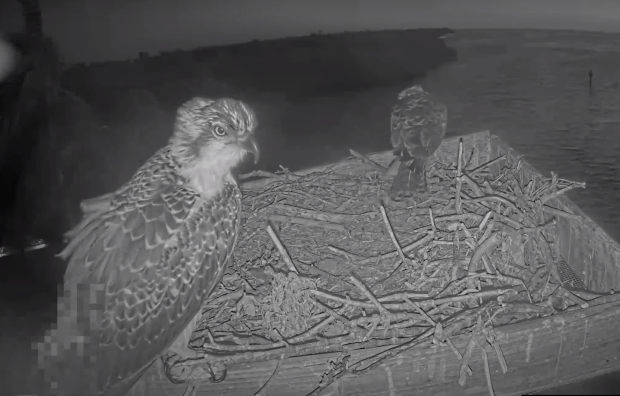
Trichomonosis is caused by a parasite. In urban raptors, it is normally by the eating of an infected prey item. The neck and throat can swell and sores or cankers can appear. The birds cannot swallow and it is difficult to eat and breath. That is certainly not something we would wish on any bird. No one will ever know which of the prey deliveries carried this deadly parasite.

As one person said today – putting this loss in perspective – “we are lucky that we did not lose all of the birds.” They are absolutely correct. We have seen how prey items are shared and we now must hope and send warm wishes that none of the other family members succumb to this parasite. You can see in the image below how swollen the neck is of the little male in this image taken last evening. He is the one with the floof on his wings and back still. It is so sad.

Two of the siblings stayed with their little brother in the scrape box last night. The parents had been in earlier. I will disagree with anyone that says the parents and the siblings do not know what is happening with their family member. They do. They are just not afforded the luxury of having several days to mourn. They have to get on with their lives so that they survive.

In her book, The Genius of Birds, Jennifer Ackerman addresses (briefly) issues related to death and mourning in Corvids. The Peregrine Lady (Kate St John) who writes about the falcons in Pittsburg in her blog Outside My Window, has often commented that whenever one of the fledglings would die, the Mum falcon would go to her “mourning corner”. While she could not stay there for long because she had survivors to look after, it was a noticeable change in her behaviour when one of her own died and it was the only time she goes to that particular place. Kate St John’s blog is excellent and can be accessed at: birdsoutsidemywindow.org

Here is another article on mourning.

As Jennifer Ackerman states, “The jury is still out on whether birds grieve their own. But more and more scientists seem willing to admit the possibility.”

There is not a lot happening on the other Australian nests today, thankfully. The water is still a little choppy at Port Lincoln. Certainly not like it was yesterday when one of the nearby boats sunk. The three will no doubt be working on their hovering after getting some energy once that breakfast fish has arrived. And, yes, they could fledge anytime but I am counting on another week with these guys.

Yurruga is also waiting for her breakfast. She will be ready to fledge in a week but will she fly then? That is hard to imagine with all the floof still on her body! At that time the parents will continue to provide her with food and train her so that she can live a successful life as a falcon. Once she reaches that stage, they will invite her to leave their territory and find her own space.

Yurruga is adorable. Her name means ‘Sunny’ in Maori and she does certainly brighten up everyone’s day. Notice that she is standing on the rocks in the corner. She slept next to her Mum, Diamond, on Diamond’s rocks last night. Those rocks were put there on purpose so that Diamond would not be able to lay her eggs where they could not be seen by the camera. Yurruga only knows that Mum stands there and we get the benefit of seeing her beautiful face up close. What a darling.

Please do watch this beautiful family. Diamond and Xavier are fabulous parents! Yurruga is very vocal and right at this moment she is screaming for the parents to bring breakfast! I promise that Yurruga will delight you just as her brother Izzi did last year. Here is the link:

It is a very snowy day on the Canadian Prairies. A wonderful day to hunker down and read and drink lots of tea. If you have good weather and are heading out for a walk, enjoy it for me, too. This snow is like walking in a 15 cm or 6 inch Slurpee it is so heavy and wet. The birds are hiding in the wood boxes today, some of them.

Take care everyone. I so wish I had been able to have brought you good news about the little fellow. See you soon.

Thank you to the following for their streaming cams where I took my screen shots: The Port Lincoln Osprey Project, and 367 Collins Street Falcons by Mirvac.

Should we stay or should we go?

As 8 November was beginning to reveal itself in Melbourne, all four of the 367 Collins Street Peregrine Falcon chicks were at the end of the ledge, near the scrape box where they had slept during the night.

At 06:34, Victor Hurley confirmed the first fledge of the 2021 season.

It was absolutely perfect. The sibling on the ledge did not even notice!

and off.

Interestingly, at 08:41:00 when the camera was turned to the other side in anticipation of catching more fledges, there were three falcons at that end and one at the other.

So, did the bird that fledged return? or did it quickly run down to the other end when the camera was turning?

With the camera now pointing to this gorgeous penthouse view of the falcons, we may never know.

These three entertained themselves, bobbing their heads, eating, and watching Mum and Dad do some aerial manoeuvres.

They ate and found scraps of food.

They love walking along the ledge.

In the image below, notice the difference in size. Yes, there is the camera angle and one in front and another behind. Victor Hurley suggests that there are two males and two females this year.

The one in front is likely the much larger female. The smaller male at the back. I think I will go so far as to add that it was probably a male that fledged first also. That tends to be the norm.

They are, of course, perfectly capable of flying. That one flew from the ledge overlooking the street to the window ledge. No problem.

So will these three stay or will they go?

It is nearing 11:10 in Melbourne and all three are on the ledge of 367 Collins overlooking the river.

It is hard to believe that they were ever small fluff balls like they were on 22 October, 17 days ago.

Oh, they still have their pink bills and legs. It is 8 October. The image below was precisely four weeks ago.

This was 1 October. We were all worried that the little one wouldn’t get enough food. That was a bit silly. 39 days ago.

It has been another fabulous year for the Mum and Dad and their chicks at 367 Collins Street in Melbourne. Victor Hurley has given us wonderful information on the FB page of the group, sharing all of his knowledge of Peregrine Falcons in the state of Victoria. The camera has been shifted at least twice. Thank you for that! No one wants to miss anything. It has been a great experience. When these three do decide to take the leap of faith and become birds – indeed, the fasting flying bird in the world – we will, indeed, miss them. But oh what a joy they have brought to each of us. We will always be grateful.

And a lesson learned. Falcons need pigeons, so feed them! Don’t put rodenticide up on your roof trying to kill the pigeons. It could be a beautiful falcon that eats that pigeon and dies. Tell your friends and family, too. Let’s make the world safe for these gorgeous birds.

Thank you so much for joining me today. I am still a bit zonked from staying up for the banding of the Port Lincoln Ospreys last night. Those chicks were also very healthy with beautiful feathering – just like the Collins Four.

Thank you to the 367 Collins Street Falcon Cam by Mirvac for their streaming cam where I took my screen shots and to Victor Hurley for being so patient with all of us and for his ongoing research on the peregrine falcons.

Port Lincoln Osplets have names

Oh, there was such excitement yesterday. The Port Lincoln chicks were banded and, in addition, there were rumours that 3 or 4 of the Melbourne eyases had fledged. Let’s put that rumour to bed. Mum is sleeping on the weather protector above the four. So everyone is still home. That is fantastic. Maybe they will all fledge from this end so we can see!!! Ironically, Victor Hurley said they would turn the camera around to face the other direction after his Q & A session so there was a better chance to see them fledge. With two ends and one camera, it is very difficult to predict which end will prove to be ‘the one’.

Port Lincoln wanted to band a male chick because they wanted to compare his dispersal to that of the female, Solly, who fledged last year from the PL nest and has a tracker. Solly has taught osprey researchers much including the distances that female osprey will disperse. In Solly’s case, she traveled 311 km to Eba Anchorage. There were rumours that osplet 2, Middle Bob, was to get the tracker because it was thought he was the only male. In the end, Port Lincoln had three males to choose from and they went with the one who weighed the most – Little Bob – who turns out to be the ‘biggest’ Bob.

Here are the names and weights:

  • Big Bob, first hatch, has a red band, weighed the least at 1280 grams and is named Bazza. The name celebrates Take 2 Photography’s husband, Barry Hockaday, who did so much to bring the Osprey Barge to a reality.
  • Middle Bob, second hatch, has a yellow band, weighed 1330 grams and is named Falky after Ian Falkenberg, the bander.
  • Little Bob, third hatch, has a dark green almost black band, weighed 1380 grams and is named Ervie. It is the name of the Scottish town where Australia’s current Minister of the Environment grew up. This choice focused on the fact that the growth in the Eastern Osprey population and this project would not be possible without the Minister’s support.

And that is how ‘never miss a meal Little Bob’ became the biggest Bob! And got the sat-pak! Well done, Ervie.

The chicks behaved as expected. When the boat came close they pancaked so much you could not see them above the nest. Each was removed and put in a small sack. There was no stress at all. A gift of fish was put in the nest. The parents returned within minutes of the chicks being put back in the nest. It was a beautiful process and so much will be learned through the monitoring of Ervie’s travels including dispersal and threats. I will not deny that I am a huge supporter of banding and tracking. It is the only way to learn where the birds go, where they breed, what dangers there are in the environment, what happens to them, etc.

I admit to being very tired this morning. I could not stay awake long enough to find out the names last night or, should I say I stopped waiting at 2 am in Canada. It was so nice to run to the computer and see all the information this morning.

Many wondered how they could donate to keep the cam running at Port Lincoln. It is complicated and it is my understanding that they cannot accept donations. That said, if you or someone you know is going to the area why not take one of Calypso Star’s nature tours? Go out to see the sea lions or get in a cage and watch sharks. That would be a great way to thank them.

Update on WBSE 27 on 5 November (in case you missed it): “SE27 is doing well, gaining in strength and is feeding by itself. It has moved to a larger raptor cage to allow it to exercise and recover. The treating vets have advised that SE27 will be in care for a few weeks while it recovers and will be released back into the wild as soon as it’s well enough. Healing takes time so please be patient. Updates will follow when possible.”

It is another gorgeous day on the Canadian prairies. 13 degrees C. The sun is bright and I can see the squirrels already hoping that their breakfast will be taken out to the deck. They are a little early.

Take care everyone. Thank you so much for joining me today. See you soon.

Thank you to the following for their streaming cams where I took my screen captures: the Port Lincoln Osprey Project and the 367 Collins Street Falcons by Mirvac.

Soap Opera at the Campanile and other nest news

The soap opera playing out with the Peregrine Falcons at tThe Campanile on the grounds of UC-Berkeley made the Los Angeles Times this morning:

Annie only knows Grinnell is not there and it appears she might be taking up with the interloper that caused Grinnell’s injuries. My goodness!

The birds are stirring at Port Lincoln this morning. Before 6am there was calling from the nest. There were only 3 birds but it was Mum calling Dad with the breakfast order. No. It was the chicks calling Dad wanting their fish! They are so big. Ready to begin flying.

Just look at those three birds. I sure hope they stay in the nest and pancake when they are to be ringed today but I am worried the sound of the motor boat is going to make them bolt off the nest early. I so want to be proven wrong, for the sake of the birds, and foolish for even thinking such a thing.

Janet Forster says they will come in a boat and dingy when the boat gets back from the Sea Lion Tour. Fingers crossed. We will not be able to see this live but I am hoping either pictures or a video will be shared later. The trio were fed six times yesterday. It should have been seven but dad lost a fish and he found it and decided he would eat the entire thing!

Is this to be the day that at least one of the 367 Collins Street Four fledges? They slept on the ledge last night. Will they fly off together?

Yurruga had a lot of prey items yesterday. She sported a nice crop and is doing really well with her self-feeding. What a lovely independent eyas. In one instance, Xavier came in with a Rosella. Even with a crop Yurruga seemed to want to have some of it – they must be very tasty. Someone told me they are the equivalent to the pigeons in the city – parrots everywhere – but I have no idea if that is true. In the end, watch and see what happens. Oh, and before I forget. Diamond’s limp is still there but it is improving every day.

There is an updating on WBSE 27 by Judy Harrington. This is what she posted: “SE27 is doing well, gaining strength and is feeding by itself. It has moved to a larger raptor cage to allow it to exercise and recover.
The treating vets have advised that SE27 will be in care for a few weeks while it recovers and will be released back into the wild as soon as it’s well enough. Healing takes time so please be patient. Updates will follow when possible. BTW, we hear fish and mice have been on the menu!
It is unlikely any photos will be issued while in captivity.
There are no reported sightings of SE28.” That is good news for this beautiful sea eaglet, WBSE 27.

It is really windy down in Ft Myers, Florida. M15 has been bringing his mate, Harriet, some nice treats in the last few days. The other day it was a Cattle Egret. She was delighted. The pair continue to work on their nest. Wonder when the first egg will appear?

Harriet being blown a bit by the wind. 6 November 2021

It is stormy over in Jacksonville, Florida. Still Samson and Gabby were both on the nest in the wind and rain preparing it for this season. Oh, goodness, this couple just warms my heart! (Yes, we all have our favourites. I admit it).

The weather out in Colorado is perfect and the Bald Eagle couple on the Fort St. Vrain Bald Eagle Nest are busy working, too. Last year they raised one chick. Wonder if they will make it two this year?

There is one eagle, at this very moment, working on the nest in the Kisatchie National Forest. I do not know if it is Anna or Louis. This is their second season together. So glad to see the couple returned. Last year was the first since 2013 that an eaglet had hatched and fledged in this nest. Nice to see the young family here. That is a great image on the two cameras and the sound is excellent this year. Cody and Steve have really been working on the set up. (Thank you!)

I am afraid that I could go on checking Bald Eagle nests and we would see the same image – one or both adults working on the nest. The eagles have really come back from nearly being wiped out. I hope there are enough big trees for them for nests!

It is going to be awhile til the PLO chicks are ringed and, believe it or not, it is 14 degrees C on the Canadian Prairies. Summer weather. Well, this is what our summers used to be like: 14-17 degrees C. Now you can double that. The sun is shining, the sky is blue, and so far, Dyson is leaving Mr Blue Jay’s corn cob alone. It is a great day for a walk. See you later. Take care everyone.

Thank you to the following for their streaming cams where I took my screen shots: X-Cel Energy, Port Lincoln Osprey Project, 367 Collins Street Falcons by Mirvac, SWFlorida Eagle Cam and the Pritchett Family, NEFlorida Eagle Cam and the AEF, the KNF Bald Eagle Nest, and Charles Sturt University Falcon Cam and Cilla Kinross.

Excitement in Bird World

It has been quite the day in Bird World. It started out with gorgeous weather on the Canadian Prairies and my hunt for Wood Ducks. Were they still here? Yes, they were! There was only a pair at Kildonan Park but what cuties they were. I almost didn’t see them at first. They were both standing on a log back in a hollow with an overhang. I have so fallen in love with Wood Ducks the last six months.

The last time I visited the duck area of Kildonan Park, there had to be three dozen in the stream near the Witch’s Hut but, not today. I walked up and down the shore, down close to the water, and well, they had to be hidden really well if they were there.

This time it was also easy to count the Mallards. 25 in total. Each of the Mallards were busy either preening or dabbling for food. I thought I would give you a view different perspectives for a couple of the males. Their plumage is simply gorgeous.

In the image below, I love the soft feathers on the chest in contrast with the two white borders of that deep navy. Look at the curls on the tail and the horizontals on the chest. Stunning.

This is a great example of how waterproof their feathers actually are.

There were about 350 Canada Geese at various locations. Some were feeding on the grass, others were in the water. None of them liked the people walking their dogs.

Today was a problem because I wanted to get back and hear the updates and discussion about Grinnell, the injured falcon from UC-Berkeley. Sadly, I did not have as much patience with a little Red Squirrel that seemed to not like my taking photos of the ducks. It chattered away the whole time. Perhaps it wanted its picture taken? I decided that it didn’t because it would not give me one of those cute squirrel poses everyone else seems to capture. This little one was determined to hide behind that branch!

Oh, it screeched at me til I got out of sight! My phone told me that I had a little over an hour. Would it be possible to check on the duck pond closer to where I live? Were there any Wood Ducks there?

I scoured Duck Island at St Vital Park, walked the entire perimeter of the pond, and could only find three Wood Ducks – 2 females and a male in Eclipse plumage (the one in the middle). All of the others were gone.

There were not nearly the number of Mallards or Canada Geese despite the wide open soccer and cricket areas where they can feed.

It seems that the cooler weather a few days ago really did get many to head South. It will be nice when April comes and we can hear them honking overhead. I can’t wait.

I have reported on the update on Grinnell earlier today. You can read about it here and there is a link to the live event in my blog:

https://wordpress.com/post/maryannsteggles.com/27983

At this point it felt like the day was almost over and I had yet to check on the ‘regulars’ – the PLO osplets set to be banded on 8 November, the 367 Collins Street Four, and Yurruga, the Peregrine Falcon nestling at Orange.

The first was little Yurruga. I think I will stop using the adjective ‘little’. Yurruga is growing and changing. She is really beginning to loose that fluffy down revealing her juvenile feathers. Despite the fact that Yurruga has had short bouts of self-feeding, today was a bit of a surprise. I captured it for you in a short video.

Several hours later, Diamond came into the scrape and fed Yurruga the remaining portion of the Starling.

What wonderful training. Yurruga worked and worked on that prey item until she was tired. She did well. Mum knew to give her time and then come in and feed her little one. These are incredible parents. I also want to add that Diamond is walking much better! Her injury is healing.

Wow. Could it get any better? Well, I don’t know if it is better or not but I can say that the three osplets at Port Lincoln are even civil when wing flapping. They take turns! That said, I just about fell out of my chair watching them. Little Bob is flapping first. The trio are to be ringed on Monday, measured, given names, and at least one will have a sat-pak attached to its back. I just hope they are still on the nest! Can you imagine planning for that and they have literally flown the nest? It could happen!

Little Bob really wants to fly.

I am not certain which of the other siblings is featured in this clip testing out its wings. Mum is feeding – it sure doesn’t take long now to consume an entire fish! What a change from six weeks ago. Little Bob is on the right and unknown sibling on the left eating.

They take turns.

All three are getting some air. Oh, my. I was almost afraid to check on the 367 Collins Street Four for fear they had all fledged while I was away or doing other things. Relief. All four were on the ledge a few hours ago.

These are bittersweet moments. Fledge can happen at any time. At least one of them is more than ready. In an interview today, Victor Hurley, the lead researcher of Peregrine Falcons in Victoria, says he believes that there are 2 females and 2 males this year. How lovely!

It has been an exciting day with more to come in the next week. There will be fledges in Melbourne and Port Lincoln for sure.

Thank you for joining me today. Take care everyone.

Thank you to the following for their streaming cams where I took my screen shots and video clips: the Port Lincoln Osprey Project, 367 Collins Street Falcons by Mirvac, Charles Sturt University Falcon Cam and Cilla Kinross.

Whew!

I know that some of you have watched birds fall out of nests including Silo Chick at Patuxent River Park last summer. Remember that feeling when you saw that little osplet fall into the water, heard the splash, and saw the others looking down? Felt helpless? Of course. Thankfully that story ended well. I have no idea how many called but the osprey was located and literally tossed back into the nest. It was an enormous relief. Others are not so lucky.

I posted a new owl box streaming cam in Joburg, South Africa just the other day. An orphaned Spotted Eagle owl was put in the box with two other owlets. The mother accepted it! Fantastic. The adopted owl is 5 days older than the other two and it got curious about the outside world today and fell out of the nest box!

What no one knew, at the time, was that the owl landed on a huge platform under the box. If it doesn’t get back into the box on its own, it will be placed back inside the box. Relief.

Yarruga was starving this morning. There were two prey deliveries at the scrape box and there was not a scrap left of either meal.

Yarruga was so excited when the second meal appeared that she could not stand still to eat. She literally ran around the scrape box as in the images below.

Xavier was certainly glad when that feeding was over! There is not a drop left for either of the adults. Yarruga was soooooo hungry after having only 2 feedings yesterday. She does love her food! And she is certainly growing. Look how big she is next to Xavier!

In fact, Yarruga should have had a nice tasty little duckling yesterday but Diamond saw it and quickly took it from Zavier and flew out of the scrape! One has to imagine that this is quite the delicacy (as opposed to the dreaded Starling!). After her injury, I am actually glad that she got it.

Port Lincoln did a nice close up of the juvenile feathering of the three osplets this morning. Just look at the variations in the depth of the white juvenile feather banding. Little bob is in the middle.

As the dominant bird, Little Bob often gets the first bite. She is full and letting the other two have their turns as she looks out to the water in the image below. Of course, I am saying ‘she’ because of her thick legs. Wait til Monday when the banders declare she is a he. How funny! Whatever gender, that bird is gorgeous and I will continue to celebrate the times that she put Big Bob in his place.

There she is below.

Victor Hurley, the main researcher for the Peregrine Falcons in Victoria has been posting information on the 367 Collins Street FB Page. The last posting was on ‘Dispersal’ because, as we know, the falcons will be fledging shortly. I imagine that there are many things in this column that would be of interest to many of you. This is what he wrote:

First Flight Normally, this is not such a serious undertaking as that from an inner city high rise ledge. Normally pre-fledgling Peregrine Falcons will scramble around across their natal cliff for quite some time before taking their first flight. Mostly this is successful and they land high on another ledge or small perch. In a city location they will land on the roof top of another building nearby. If the winds are tricky then things can go south pretty quickly. Once they have mastered their first flight then they will spend increasing time “on the wing” and following and learning from the parents how to hunt. As soon as each youngster achieves their first kill the adults (parents) will stop providing any more food and that youngster is on their own to find food. Once all young are successfully hunting then depending upon the experience and ruthlessness of the adults they will all be chased with serious determination out of the territory altogether. In some cases this may occur in December or even early the nest year. Either way the young tend not to return again to the nest ledge that we have been observing. Maybe occasionally, but then only briefly.

Plumage differencesLeading up to this first flight the adults restrict the level of food resources they bring to the nest. This explains the weight loss of the nestlings. The wings of the nestlings are still growing but they are also losing weight. This makes them lighter with larger wings which provides for a “lower wing loading” which makes their first flight easier. Neat, huh! The other point I thought I would raise here is that of the plumage differences. Peregrine Falcons as with most raptors and many other bird species have a juvenile plumage phase and an adult plumage phase. The juveniles are in essence a brownish colour with vertical splotchy stripes over a “dark milk tea” fawn base colour on the front and dark brown wing, back and head. Whereas the adults have a near black hood for the head, slatey grey wings and back with a soft cream bib and base colour overlayed with fine dark grey-black horizontal stripes. The tail and main wing flight feathers are also longer in the juveniles and they moult shorter feathers with each year as they get older.

Natal dispersal This is the ultimate question. Where and how far do Peregrines disperse to find a place of their own in which to breed. Natal dispersal is the distance (and direction for those interested) in how far fledgling Peregrine Falcons ultimately move to find and establish (read take over for the most part) their own breeding site. Amongst Peregrine Falcons in Victoria, as with most bird species the world over, the females disperse further from their fledging site to breeding site then do males. Based on observing 127 breeding adults with leg bands (placed on them as nestlings) the females dispersed on average 64km (range 6-280km) and males average 25km (rang 1.6-90km). This differing dispersal distance minimises the likelihood of siblings interbreeding. The average age at first breeding is as follows: females 2.6 years (average) and for males 3.3 years (average). Another way of presenting this same data includes presenting the direction as well as the distance males and females disperse. No bias in dispersal direction was recorded.Victoria is a relatively flat area of the planet, its highest point above sea level is Mt Bogong (1,979m) and~80% of Victoria is <200m ASL. So for a predatory species like the Peregrine Falcon that doesn’t migrate annually due to milder winters and having the highest wing loading of any Peregrine sub-species globally, in a state (Victoria) with limited high altitude cliff faces with an abundance of low lying wetlands and associated birdlife and a very diverse range of parrot species what is a cliff nesting raptor to do? A look at all (256) of the Peregrine Falcon nests ever described in Victoria provides the answer to this question. The Peregrine Falcon in Victoria has overcome these obstacles by adopting a range of novel nesting situations (by nesting in stick nests of other birds, tree hollows and of course buildings (a growing trend globally). So this leads to another interesting question. Do those birds raised in one type of nest only adopt others of the same “nest type”? or will they readily disperse to a different type? That is to say, do they become behaviourally “imprinted” on the nest type they are raised on? Again thanks to the long term banding of nestlings and resighting of adults (with telescopes) by volunteers with the Victorian Peregrine Project the natal dispersal patterns of 127 Peregrine Falcons have been identified so far showing that 30.2% have adopted a different (novel) nest type from the one they were hatched and raised in. Between the sexes dispersal patterns are similar with 26% of females and 23% of males adopting different or “novel” nests in which to breed. Combined 30.2% of Peregrines undertake novel natal dispersals to find a place to breed. So the myth of nest type imprinting has been pretty thoroughly exploded with these bird banding results.Further to this, slightly counter-intuitively, novel dispersal events (dispersing from one nest ‘type’ to another) were less dispersive with no sex bias. That is those individuals who adopted a ‘novel’ nest type did so by dispersing a shorter distance on average than those undertaking a typical natal dispersal. Presumably they are doing this in order to exploit a familiar (geographically closer) food/prey resource by adopting a novel nest type in order to remain close by to that prey resource.So back in 1991 when Peregrine Falcons were first identified breeding at 367 Collins Street, Melbourne it was one of only two or three nest sites on built structures that were known. Since then over 20 new sites have been discovered and the number continues to grow. Nest site selection is driven by its proximity to food resources as well as the security (from predators and human disturbance) and how protected the nest is from rainfall and water runoff.Surviving the first two years…The third question (although not chronologically) is what is the survivorship of young Peregrine Falcons in their first two years prior to breeding. Generally, it is accepted that there is a ~a 66% die-off of Peregrine Falcons within their first year. Given the youngest breeding is at two years post hatching I have trawled the VPP database again to investigate causes of mortality of ~240 banded Peregrine Falcons in their first two years post banding. Most banding occurred at or around 24 days post hatching. When considering the various incidents there was no sex bias. That is neither sex is more prone to any cause of death compared to the other. Rock falls, cliff collapses or storms bringing down trees or stick nests have been a surprisingly regular threat to young of this species. The constant and ever present shooting of Peregrine Falcons continues to this day. The first ever band recovery of a Peregrine Falcon in Australia was in 1958 in Victoria. Disease of course is Trichomoniasis and predators varies from Red Foxes, Brown Falcons and even Peregrine Falcons in limited circumstances. Secondary poisoning has generally been a result of pigeon control campaigns.”

This information would, in general, apply to all falcon populations. And if you read all that – it is a ‘Double Whew’ for today. I have been reminded that Victoria Hurley is doing a Q & A tomorrow. I cannot find the link to it. If I do I will send it out later.

Thank you for joining me. Everyone has been fed at least once if not twice already. Diamond is looking much better. No news on WBSE 27 yet and nothing on Grinnell. Take care!

Thank you to the following for their streaming cams where I took my screen captures: Port Lincoln Osprey Project and Charles Sturt University Falcon Cam and Cilla Kinross.

White-Bellied Sea Eagles have an Empty Nest

It was not the way the morning should have started. When we think of fledging, most of the time we recall juveniles reaching a certain age and flying out from the nest on their own. Sometimes it does not go to plan. Many are actually forced out by intruders. We will never know, for example, what larger bird of prey forced Malin (the Osplet at Collins Marsh) to fledge causing its death. Other times the birds fludge like Izzi last year when he went to sleep on the ledge and fell out of the scrape box. Izzi was lucky. He had a guardian angel to get him back to safety. Malin did not.

Today, WBSE 27 and 28 got up and 28 seems to have snagged the morning breakfast delivery. I don’t know what it is with eating and early morning air but young raptors seem to become energized. That is precisely what happened to 28, the youngest. It started flapping its wings and jumping around the nest. Meanwhile, 27 was minding its own business on one of the parent branches. 28 decided to fly up to where 27 was. It was at that moment that I remembered Big and Little at Duke Farms last season. Both were on the branch and one of the birds wanted on the other side and they both fludged. Theirs was a happy ending but that wasn’t know for a few days. Both made their way back to the nest to be fed by the parents for some time. That is the way it is supposed to happen. Well, it is unclear about WBSE 28. He fell off the nest.

Here is a sequence of still images showing the build up to the fludge. In the first one, 27 is on the branch and 28 is still eating.

28 begins to flap and jump.

Look at those beautiful wings.

27 flies up to the branch.

At 07:22:02 WBSE 28 almost took both of the birds off the nest. He fell to the left. You can see his wings. WBSE 28 composes itself on the branch.

Meanwhile the cam operator searches the ground for WBSE 28.

Almost immediately the Pied Currawong begin their relentless attack on WBSE 27.

There were three Pied Currawong taking turns at WBSE 27. You see it is in their best interests to keep these sea eaglets out of the forest despite the fact that I have never seen a WBSE eat a Pied Currawong. They certainly might want to start doing that. This is not the first time these birds have rushed a sea eaglet to fledgling and flying out of the forest never to return. They did the same thing last year.

27 does well honking and spreading its wings in a defensive manner. It had to be frightened.

At one point 27 flew at the Currawong.

WBSE 27 off the nest at 8:33:56.

One of the Sydney Sea Eagle chatters caught WBSE 27’s fledge and made a video clip of it. 27 flew to the branch by the camera tree. You can see it in the clip. It was a beautiful first flight. You can also see 27 flying out of the forest to the left.

There are many types of fledges and the anxiousness of WBSE 27 being harassed by the Pied Currawongs – well, you can decide if he flew off the nest because he was frightened or not.

Many believe that when the nestlings fledge, it is a successful season and life goes on. I always wonder what happens to these fledglings. It pulls at my heart and mind to have the Currawong run them out of the forest.

When raptors fledge, many take short flights from the nest returning for up to a month to be fed by their parents until they are just strong enough to fly off on their own. One of the best examples of success in this way were E17 and E18, the two Bald Eaglets of Harriet and M15’s at the Southwest Florida Bald Eagle nest in Fort Myers this year. There on the Pritchett Property the little eaglets were watched – they played in the pond, flew out and returned. They did this for about a month and then, one morning they were gone. By doing short flights from the nest at their leisure, the eagle fledglings imprinted the map back to the nest in their mind. That is not what has happened at the Sea Eagle nest in the Sydney Olympic Forest. Will the eaglets return to the nest to be fed by Lady and Dad? Will Lady and Dad find them and feed them elsewhere? Is 28 tangled up in a tree in the forest? Will anyone rescue it? Where are the foxes? These are my questions. I hope that there is someone – many someones – actively looking for 28. If I hear anything, I will let you know.

The sea eaglets were right within the fledge range. I expected them to fledge any moment. It is unfortunate that 28 fell out of the tree. I do hope it recovered. No reason to think it would not. We will probably never know what happens to WBSE 27 and 28. Sadly, there is no programme for monitoring and tracking. I wish there were like with the Ospreys at Port Lincoln. It would be very interesting to see if they make it away from the nest and find a beach with carrion and other juveniles and survive and thrive.

UPDATE: Ranger Judy Harrington says that no one will be looking for 28 in the forest. It was heard on camera and they believe the Currawong will let them know where it is.

Thank you for joining me this evening. Take care all.

Thank you to the Sea Eagle Cam @Birdlife Australia Discovery Centre.

7:46, June 12. J2 fledges.

It is the day that everyone has been waiting for – the first fledge off the Fernow light tower at the Cornell Campus in Ithaca, New York. The winner of the honour was J2.

J is the designation for the year, 2020. The camera began recording the activities at the nest in 2012. Knowing that Big Red had, at least, two earlier years raising successful chicks prior to the cameras, they began with the letter C in 2012. The ‘2’ is because this hawklet was the second to hatch but was, ironically, the first egg to be laid. Which if you are good at math and understand the counting indicates that this chick is actually the oldest.

J2 has beautiful blue eyes which will eventually turn darker and a wide white terminal band. Notice how the breast (or crop area) is covered with the typical peach colour for these hawks. At fledge it also had a line of ‘dandelions’ remaining on the top of its head, like a mohawk hair-cut.

J2 sitting in a pine tree across the street from the nest but within view of his mum, Big Red. Notice the little dandelions on his head. How cute! Their talons have tendons that enable them to sleep or sit standing up without fear of falling over.

J2 set a first in the recording of fledges from the Fernow Tower nest. He fledged off the back of a light box. It was, actually, more of a fludge. He/she spent some wonderful time sitting on top of the light box balancing nicely and then slipped but recovered beautifully flying under the tower, across the street, landing by its talons on Bradfield to steady itself in a nearby Ginko tree.

For nearly twelve hours, until the camera stopped rolling, J2 kept us on the edge of our chairs. I tell you it was better than a good thriller on Netflix!

He/she flew keeping the legs tucked tight like a pro. J2 spent some time on top of the Rice Building, flew back near Bradfield and played around on the steps and railings to the entrance, flew off again to another building, and finally wound up near to where it started, back in the tree. Throughout Big Red was watching from the southeast corner at the top of Bradfield while Arthur soared whenever J2 got out of sight so that the chick could be located. Nothing gets by these two parents. Parenting is a well orchestrated sharing of duties.

Big Red on the left (17 years old) and Arthur on the right (4 years old)

When I first began watching the hawks on the ledge at NY University, I naively asked the chat group what kind of dangers hawks experienced. The Washington Square group were very patient with me describing the use of rodentcides that cause blood not to coagulate as a prime poison for the hawks in the parks of NYC. This is because their primary prey are the rats of the city. And then there are cars, buses, trucks, windows, air vents between buildings -. The list was extensive.

This morning J2 flew over a street with little traffic but still the cars and buses were moving at a clip and well, who knew that he could steer itself to the safety of a tree away from the road? He/she could have also, just as easily, flown into a window. There is a box of worry beads in the chat room and I suspect most of us were helping ourselves today. The sad truth is that 1 in 3 red-tail fledglings do not live to see their first year. I hope, for these in rural New York, that is not the case.

So tomorrow will be another nail biter as we wait to see what J1 and J3 will do. Will they both fledge at the same time? on the same day but at different times? will either of them try to go over the light box like J2 or will they find some new entry way to this next stage in their life?

Stay tuned! I am now officially a hawkaholic.

Teaching nestlings the value of food

By the time the three Red-tail hawks have fledged off the light stand at Cornell University, many of you might well be tired of listening to my natterings about the good parenting of these amazing raptors. Every day there are new lessons or repeated ones for the eyasses so that they can live a full and healthy life without relying on their parents. Isn’t that what all of us really want for our children? To sit back and smile knowing that they can take care of themselves if we are not there?

Today’s lesson involved a pigeon.

Just before the nestlings bedtime (around sunset), Arthur, the tercel (male/father) delivered a pigeon right in the middle of the nest and fledge area.

Arthur delivering the plucked pigeon.

Food to the nest has been dispersed sparingly as the nestlings approach the time they will fly off the natal nest. From morning til about 6pm, each had something to eat. And now it is right before bedtime. This is an easy snack! Their dad even plucked it for them. But the nestlings go about playing and picking up sticks and dreaming of flying and ignore the prey.

One of the nestlings near the prey but it shows no indication of being hungry or ready to eat.

Big Red (the mother/formel) comes to check on the state of the pigeon about ten minutes after it has been delivered. Ten minutes after this she comes with a branch and does some nest reconstruction. The youngest chick starts chirping wanting to be fed and the other two approach her as if she will fed them. Big Red has other ideas.

In the real world of hawks off the nest, prey can be scarce and young fledglings have to learn to eat when food is available, not ignore it. That was the lesson for today. Big Red looked around for a bit, picked up the pigeon with her talon and with nestlings chirping, she left with it. She does not bring it back even if they beg. It is gone. Too late. Too bad. Adios.