Late Saturday and early Sunday 17-18 July in Bird World

If you have watched Kindness, the Bald Eagle nestling at Glacier Gardens, then you might have caught her nipping at her mum’s beak. It looks like she is trying to kiss mum. A couple of days ago a video was made showing Kindness interacting with her mum. My goodness, Kindness, you are lucky your mum is so patient! Have a look.

At the Port Lincoln Osprey barge, it looks like the final touches have gone on the nest renovations. The egg cup is now lined with very soft pieces of bark. Mom decides to try it out!

Dad flies in with something else on his mind! No eggs yet but mating is taking place. Season will begin soon!

As we approach fledging at all of the Northern Hemisphere Osprey nests and migration in a month to six weeks, if you fear Osprey withdrawal, here is the link to this nest. Just a warning. This nest has had instances of siblicide in the past.

The Port Lincoln’s eldest chick from the 2020 season, a female named Solly, was fitted with a satellite tracker. Solly is 301 days old and she is still hanging out at Eba Anchorage and Kiffin Island. It sure seems that Solly has found her forever home at Eba Anchorage. For those of you unfamiliar, the movements of Solly changed what everyone understood about Ospreys in Australia. It was believed that ospreys stayed near to where their natal nest was located. Solly travelled over 200 km to Eba Anchorage and Perlubie giving the researchers fresh insights to the behaviour of these ospreys.

To my knowledge there has been no sighting of DEW, her younger brother. He did not receive a tracker but he did get a metal ring and a Darvic colour band.

Suzanne Arnold Horning was on the Cornell Campus again this evening. How lucky she was to get some great images of Big Red with a squirrel down on the ground – and it wasn’t raining. (Send the rain to the Canadian Prairies when you get tired of it, Suzanne!).

It was wonderful to see Big Red with prey that she was going to eat herself. She needs to build up her strength after laying eggs, incubating those eggs, and feeding and caring for the three Ks until fledge. Even now she is doing some prey drops and is busy training the Ks to hunt.

Big Red with Squirrel. @ Suzanne Arnold Horning

The Robins were giving Big Red a lot of grief. Could it be because Arthur has been up at their nest eating their babies? Or the fact that K1 caught a bird today and it was rumoured to be a young Robin?

Robins being rather assertive around Big Red. @ Suzanne Arnold Horning

Big Red and her squirrel also attracted another visitor – a Turkey Vulture!

Would you mind sharing asks the Turkey Vulture. @ Suzanne Arnold Horning

The pair also attracted a human who was said to have tried to interfere with the situation. Both of the birds were fine. Big Red was eating and the Turkey Vulture appeared to be waiting to see if she left anything.

One of the things that I have learned is that hunting is difficult and prey is not abundant always. Raptors can wait for hours, half a day, or even a day to catch prey to eat. It is estimated that only 1 out of 3 juveniles live to the age of two years – mostly due to starvation. Humans should not interfere when a raptor is eating. As a result of the human intrusion, Big Red chose to fly away from the human who was interfering. This also caused her to leave part of her meal. The vulture did eat the rest – so in the end everyone ate- but it was a situation that should never have happened. Remember if you see a hawk hunting or eating, please leave them alone. Finding their meal is not that easy.

Turkey Vulture at Cornell. @Suzanne Arnold Horning

The scientific name for the Turkey Vulture – Carthartes Aura – means ‘cleansing breeze’. They are scavengers, eating mainly carrion. They have dark espresso coloured feathers, red legs and head, with a white beak. Like the condor, there are no feathers on their head. This is a great evolutionary trait so that pieces of the dead do not stick to them causing disease or parasites. The Turkey Vulture’s sense of smell is so great that they can find a fresh killed animal a mile away! The only raptors larger than the Turkey Vultures are the Eagles and the Condors. What I find interesting is that they are the only raptor that cannot kill their own prey. They simply do not have the right talons to do this – their feet are more like that of a chicken. That said they can tear through really tough hides with their beak. In other words, the Turkey Vulture was never a threat to Big Red.

As I prepare to settle in for the night, Tiny Little is waking up. The early morning fog over the marsh is just starting to clear. You can see the parents, or siblings, or both back on the parent tree. Tiny Little is still sleeping like a duckling on the nest. Good Morning Tiny Little! Let’s get that gear box into forward today.

Tiny Little is also checking the nest for any little tidbits of leftover fish. And just like Tiny Tot he has found some lurking under those sticks.

Tiny Little was doing some prey calling and looking up in the sky. The morning fog doesn’t seem to be clearing. What a beautiful colour it is – that sort of golden pink gradually fading into the grey-blue-green. Lovely.

Update: Tiny Little had a huge breakfast. It is now mid-afternoon and Blue 462 is working on a fish that arrived. 464 is standing next to that fish and Tiny Little, 463, is ignoring it right now. She is probably still full enough from the morning not to bother. Unclear if Tiny Little has taken a second flight today. I stayed up waiting! But had to give in to being tired.

This is the image of the afternoon line up for a fish! 462 is eating, 464 is pretending to be Tiny Little and bugging his big sibling. Tiny Little is over at the side duckling style. Tiny Little is full from breakfast and knows that Mum will come to the rescue later if she gets hungry.

There is a beautiful peachy almost coral sky as the morning begins at the Poole Harbour Osprey nest. CJ7 and Blue 022 are roosting elsewhere.

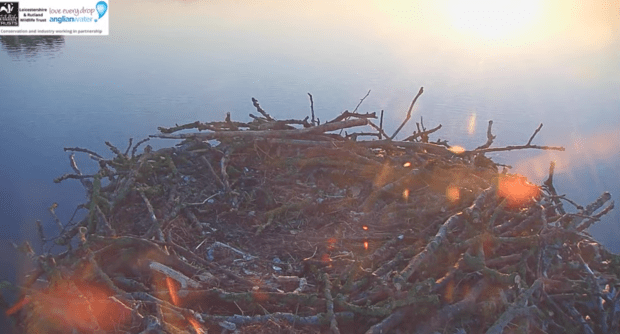
Golden diamonds are falling on the nest of Blue 33 and Maya at Rutland Manton Bay. No one is home. They are all perched elsewhere. Blue 33 does make food drops at the nest for the two Bobs.
A little later, Blue 095 flies into the nest and settles down and then flies out again.

Blue 095

Oh, wow. Just look at that sun coming up over the Dyfi nest of Idris and Telyn in Wales. It is so bright you cannot see the perch!

A very short video of Ystwyth fledging at 7:59 am on 17 July is here:

It is serene up at The Loch of the Lowes. No one is home but it sounds like there is a fledgling on the camera perch.

What you don’t see here is that later, NC0 is on the nest, spots a fish, goes out and gets it, and gives it to LM2.

Early Morning at Loch of the Lowes. 18 July 2021

The only thing you can hear at Glaslyn are either bees or wasps on the microphone! Oh, it is so beautiful and green. It has been hot at this nest, 26-29 degrees C – and the birds are staying cool in the shade of the trees. Even with the heat the landscape looks so lush. What a gorgeous way to begin the day.

Early morning at Glaslyn. 18 July 2021

Thank you so much for joining me today. I so enjoy hearing from all of you. Stay safe! See you soon.

Thank you to the following for their streaming cams where I took my screen shots: Byrwd Gwyllt Glaslyn, Dyfi Osprey Project, Scottish Wildlife Trust and Friends of the Loch of the Lowes, Cumbrian Wildlife Trust and the Foulshaw Moss Osprey Nest, Poole Harbour Osprey Project, LRWT and the Manton Bay Ospreys. I would also like to thank the Port Lincoln Osprey Research Project and the PLO FB page where I took a screen shot of Solly’s recent tracking. And last but never least, I would like to say a huge thank you to Suzanne Arnold Horning for allowing me to use her images on my blog. She holds the copyright on them so please do not use elsewhere. Thank you.

Ystwyth Fledges and a shout out to those who helped the Patuxent Osprey chick

Yesterday was quite an anxious day with people all over the world staying up to see if the little osprey chick was saved at the Patuxent River Nest 2. In the flurry of the moment, a few people were not thanked who need to be. The first is Burky4 from the Achieva Osprey chat group. Indeed, Burky4 was the first person to mention that there were only two chicks in the nest in the nest in the Patuxent chat room. So this is a huge shout out to Burky4. Thank you! I will not know the names of everyone and I apologize – but another shout out to S Shen who then in her own words, “found the number of Tom O’Connell, director of the USGS Eastern Ecological Science Center (EESC). His business number went to voice mail which INCLUDED his cell!! Yay. I was able to text him and he gave the phone numbers for the 24 hour a day Natural Resources Emergency or Assistance.” S Shen says that another individual to be credited is Barnegat Light. I also want to thank Linda Kontol who got busy phoning numbers as well to try and get anyone’s attention after hours. I also want to thank the young man on the Wildlife Emergency Services Line again who got in touch with the Fish & Game people. It was a grand team effort and this chick might not be alive this morning were it not for the efforts of these wonderful citizen birders and government officials who worked to save this little one. And to everyone that was inadvertently missed, thank you! Tom O’Connell will be posting information on the actual individuals who went to the site this coming week.

The ‘silo’ chick is the one that went into the water, the last foster chick to be put in this nest. It is the one in duckling mode. The chick has moved but has not moved a lot. It has had a lot of excitement. Let us hope that there is no damage from either of its falls.

Every day people watching nest cams move into action when they see an animal in distress.

S Shen reminds me again how important it is to have emergency numbers readily available. She said that several years ago she noticed a chick in a Lake Barkley, Kentucky nest entangled in fishing line. There was no chat room so she went to the nest’s FB page and remembered the name of one of the chatters who said they lived close to the nest. She tracked down their phone number and called them. That person, ER, managed to get someone up to the nest and the chick was saved.

I remember that my mother had a list of emergency phone numbers for everyone helping her just in case it was needed. It was on her fridge. Here are three suggestions and I am certain everyone reading this will have more. The first is if there is a chat room associated with a nest that it have a moderator 24/7 (these are volunteers) who have emergency numbers to call the instant something happens. The second is for anyone administering a streaming cam that the local emergency wildlife numbers appear right under the name of the nest so people can locate them quickly. And the third is for everyone who watches a nest to begin to gather their own emergency numbers to call for each nest and make their emergency list for their fridge, phone, etc.

In other Osprey news, if you missed it Tiny Little of the Foulshaw Moss fledged yesterday at 20:19:57. He slept alone on the nest duckling style last night and was up early looking around. It is just a beautiful morning in Cumbria as the sun slowly rises the mist gives way to a pink hue over the landscape.

Tiny Little was doing a lot of flapping and looking. I wonder if he realizes that he actually flew yesterday?

Monty and Glesni have a grandchick. Oh, they would be so proud. Four of their chicks are now breeding. Yesterday on the Pont Croesor Nest in the Glaslyn Valley, the Only Bob of Monty and Glesni’s son, Z2 Aeron, and Blue 014 was ringed!

Blue 494 is also the first chick to hatch in this nest so there are a lot of congratulations and happiness going around. The PC nest was controversial when it was positioned where it is. Many thought it too close to the Glaslyn Nest of Aran and Mrs G. Only time will tell how this works out. For 2021, Blue 494 is also the only chick to hatch at Glaslyn with the three little ones of Aran and Mrs G dying due to the circumstances surround the storm at the end of May and Aran’s injury.

And congratulations to Idris and Telyn on Ystwyth’s fledge today! Both of their 2021 chicks have now fledged. Well done.

Doesn’t that empty nest look nice? Ystwyth is 54 days old.

She is investigating the area around the cameras.

I have some great pictures of the Ks to share with you. I will get them organized this evening. For now there is a lot of happiness to go around. Once again thank you to all of those individuals who helped save the ‘silo chick’ at Patuxent.

Thank you for joining me this morning. It is another scorcher on the Canadian prairies. There is rumour of some showers but like everywhere else in Canada we could use some rain and the birds in my garden are probably wanting their bowls and baths to be filled.

Thank you to the following streaming cams where I took my screen shots: Bywyd Gwyllt Glaslyn Wildlife video on the ringing on their FB page, Dyfi Osprey Cam, Cumbrian Wildlife Trust and the Foulshaw Moss Osprey Cam, and the Patuxent River Park Osprey Cam Nest 2.

Friday Morning in Bird World

Have you ever started looking for something and found something else, equally as interesting? As it happens, yesterday I was looking for a short film about a Japanese man living in Hokkaido with his falcon. What was found was a new film released on 1 June 2021.

The documentary is the story of the only African American falconer, Rodney Stotts. Stotts says falconering for him is all about second chances – for people and for the birds. Have a look at the trailer for The Falconer:

Yesterday there seemed to be no news in Bird World and then there was. Do you follow the Welsh Osprey Nests? If you do, you will recognize the name Aran immediately because he is currently Mrs G’s mate. Aran injured his wing (primary flight feathers) at the end of May or beginning of June. He had been battling crows around the nest and then the storm came. No one knows how he got his injury. No one saw. But he was unable to provide fish for the nest while Mrs G was hatching the chicks. The volunteers and people of Glaslyn set up a fish table for Aran and Mrs G. They lost their chicks and both have been rebuilding their strength.

Yesterday, Aran was in a ferocious battle with a blue ringed bird a distance enough from the nest that it caught the attention of Elfyn Lewis of the Glaslyn FB group who posted the following image that made the rounds of several groups so I am reposting it here. Aran is the bird on the bottom. The white is the injury he sustained earlier. Are there birds attempting to usurp Aran from the Glaslyn nest? Always it would seem.

@ Elfyn Lewis

Other news comes out of Hawaii. The State of Hawaii bans the release of ‘Albatross Killing helium balloons’. It seems they are not banning the balloons but the intentional release of them. Here is that announcement through the AP:

https://apnews.com/article/hawaii-environment-and-nature-government-and-politics-fb9c1cd959ffaad608f08610be548428

What child does not love a balloon? and how many young women did I see lined up at a shop with balloons in hand for a party the other day? The question is how to dispose of them properly — and it isn’t sending them off in the air with wishes attached! Release the air, put them safely in a scrapbook, etc. Or eliminate balloons from festivities altogether. It is not only the helium balloons that injure the birds, it is also the normal ones that blow away in the wind. It is a good way to educate your children about the many challenges the birds face and that balloons and strings can kill them.

Speaking of Albatross, the Royal Cam chick, Taiki, is now 165 days old (nest time). On 5 July she weighed 8.3 kg or 18.3 lbs. She will be stabilizing her weight so that she can fledge in mid-September. Her dad, Lime-Green-Black (LGK) has now travelled over 42,000 km or 26,000 miles in total since he received his satellite tracker in February to feed his precious chick. (The mother is alive but her tracker stopped working).

It is still two months until Taiki fledges in mid-September. She is just getting her beautiful black wings, she is building play nests, and the parents are flying in to feed her. It is all very interesting and it is such a calm nest to watch. The Rangers weigh all of the chicks on Tuesday morning and that is fascinating to watch also. Humiliating for such a beautiful girl to be stuffed in a laundry basket but – it is necessary. Supplementary feedings are given should any of the chicks require it. NZ really takes good care of their birds! As North American streaming cams wind down for the breeding season, why not have a look at some of the amazing birds in the Southern hemisphere?

Taiki stretches her wings and flaps them to help them get strong.

Here is the link to the Royal Cam chick on Taiaroa Head New Zealand:

Lady and Dad will be on hatch watch in about two weeks time. This is the only White Bellied Sea Eagle Cam in the world. These beautiful birds are the second largest group of eagles in Australia. The nest is in an old Ironbark Tree in Sydney’s Olympic Park. It is not always an easy nest to watch because their can be sibling rivalry but the sea eagle chicks are so cute and the juvenile plumage is simply gorgeous.

If you are a lover of Ospreys, there is still plenty of action in the UK nests where the nestlings have fledged or are getting ready to fledge. They will be around for another five weeks or so until they leave for their migration to Africa.

In Australia, the Osprey couple on the barge in Port Lincoln have just finished lining their nest with soft materials and the streaming cam is now live. These are the parents of Solly and DEW. Solly is the female Osprey with the satellite tracker. This is also not an easy nest to watch because of siblicide.

There are two falcon cams in Australia. One is on year round and the other, the CBD Peregrine Falcons in Melbourne, will start once the falcons are back in the scrape box. Here is the link to Xavier and Diamond’s scrape box on top of the water tower on the campus of Charles Stuart University. No one knows what will happen this year. The couples’ 9 month old son, Izzi, still continues to come to the scrape box and might even believe it is his own home. In the UK, chicks from an earlier hatch have helped the parents raise their new brood. In Australia, we watch and wait!

In Eastern Europe, there has been some concern over the amount of prey being brought in to the little Golden Eaglet in Buconovia, Romania. Lady Hawk was able to capture the delivery of a hare by the father and a really good feeding yesterday. That is excellent news! When the camera was first installed he was afraid of it and he is becoming more comfortable day by day.

That’s it for Friday. The Achieva Osprey Nest has not return visit from Tiny Tot and Electra is at the nest less and less. The Canadian chicks in Alberta seem to be doing fine as is Kindness up in the Glacier Gardens Bald Eagle Nest. Fingers crossed for continuing good health to all the birds.

Thank you for joining me today in Bird World. Have a wonderful Friday. Take care, stay safe.

Thank you to the following for their streaming cams where I take my screen shots: Port Lincoln Osprey Project and the Cornell Bird Lab and NZ DOC Albatross Cam.

Nest Hopping News for 1 July

Juvenile Osprey Blue 096 has fledged from the Rutland Manton Bay Nest of Maya and Blue 33 (11). It happened at 12:12:27 pm.

He looks up.

Wings begin flapping. Blue 095 goes, “oh, not this again! This nest is getting too small for flapping. I wish you would just go away!”

He’s on tippy toes and grabs the wind and…

Blue 096, male chick of Maya and Blue 33 (11) fledges on 1 July 2021.

Jack delivers a breakfish to Tiny Tot this morning. Oh, thank goodness! It is 28 degrees C and the weather service says there is a 40% of a thunderstorm around 5pm in St Petersburg, Florida. Thanks, Jack!

By 9:29 Tiny Tot will have that fish out of dad’s talons and she will be saying ‘Yum’.

There were, to my knowledge no fish deliveries to Tiny last evening. She was really waiting and watching for dad. Turns out it is a small headless fish, a bit of a teaser for our gal who chowed down on that whopper the other day, this morning.

Look at those magnificent wings. Tiny, you are such a gorgeous bird!

Well, one of those nests that I suggested you watch when others get stressful just turned up the noise. Lady Hawk posted a video of the Royal Cam chick going to visit her neighbor SSTrig and the neighbour gets into a big territorial dispute. Taiki is very social and meant no harm but we now know there won’t be any afternoon tea parties with these two. Here is that video:

There is great news coming out of New Zealand. Remember I love this country for the way in which it takes care of its wildlife. Well, today, New Zealand announced that it is putting surveillance cameras on all of its fishing boats to make sure that they comply with safe fishing so that no seabirds are caught as bycatch. Way to go New Zealand!

The landscape at the Glaslyn Nest of Mrs G and Aran in Wales is stunningly beautiful. I admit to dreaming of trees and places where you can look out and see birds and not the concrete of the city. Of sitting and smelling the wet grass and hay and not the petrol fumes of cars. Of disappearing into the wilderness.

Aran and Mrs G are spending more and more time together. Aran is able to fish after his injury in early June but he is still healing. There will be no more chicks this year but the couple was seen bonding. That is fantastic!

Aran brought in a big fish earlier that he was eating. I wonder if he shared it with Mrs G who now has a nice chunk and the tail in her talons. He has provided at least one fish to her that was caught on camera which is a great indication of Aran’s continuing progress in healing.

The two Bobs at the Dyfi Osprey Nest in Wales are enjoying a lovely fish that Idris delivered. Telyn is a fantastic mom but that nest is getting a little crowded. She may have to stand on the rails to feed her babies soon. These two are growing like crazy! You might remember that Dysynni, the male, is the largest male Osprey born on this nest ever. Idris has really brought in some of the large fish. It has been determined that many of those fish actually weigh more than Idris – breaking another myth that Ospreys can only carry a % of their actual weight.

It also demonstrates how much food and the quantity of it matter to the health and well being of the chicks. This is the nest of a super dad – as are many of those in Wales and other parts of the UK.

Meanwhile, over in Scotland, the two Bobs on the Loch of the Lowes nest are waiting for NC0 or Laddie to bring them in a tea time fish. Gosh these Bobs are beautiful. The time has flown by and they will soon be hovering and fledging but, in those very first days, I really wondered if Bob 2 would survive the bonking from Bob 1.

And goodness, I woke up this morning and had to look twice to figure out which of the chicks on the Foulshaw Moss Nest of White YW and Blue 35 was Tiny Little Bob! Which one do you think is Tiny Little?

If you said the one closest to the right looking out, you would be right. She or he is watching for one of the parents to arrive with a fish! As noted from the people who ringed the chicks, they could not determine the gender of Tiny Little from the measurements because of its small size at the time. Rumours had gone around that Tiny Little is, in fact, a female.

Today, the Cumbrian Wildlife Trust put out their announcement about the ringing of these three Ospreys. Part of the celebration is that Tiny Little was the 100th osprey chick to be banded in Cumbria since 2001. That is amazing. Here is part of the text that was posted:

“I’m incredibly pleased that we have ringed another three osprey chicks at Foulshaw Moss Nature Reserve this year. For a time we we’re unsure if the smallest chick was going to make it. It was rapidly being outgrown by its bigger siblings but it carried on fighting for its share of the food from mum and dad. Now there’s not much difference in weight – and it was the smallest one that was the 100th osprey chick to be ringed in Cumbria since 2001! Osprey chicks are weighed by the licenced bird ringer and each chick is given a coloured leg ring. This year we have Blue 462, a female weighing 1.6kg, Blue 463 weighing 1.5kg – gender unknown, and Blue 464, a male weighing 1.6kg”.

Paul Waterhouse, Cumbria Wildlife Trust

I wanted to check in on the little Golden Eaglet in Bucovina, Romania. He has changed so much in just a few days. Most of the white feathers are gone and are now replaced with the beautiful dark black kind of espresso coloured ones for the juveniles.

The female has come to the nest to feed the eaglet. There were lots of bones and scraps of meat left on them. It is unclear to me whether or not the mother has brought in new prey or is using what is in the pantry.

You can look and see the remote mountain area where this nest is located. I continue to hope that the parents are able to find enough prey for this little one to thrive and fledge.

Thank you so much for joining me today. I regret I have no images of the Ks for you – maybe later today. They are off exploring the trees and some of the buildings with Big Red and Arthur. Everyone is fine; they are just not around the nest!

Thank you to the following for their streaming cams where I obtained my screen shots: Bywyd Gwyllt Glaslyn, Cumbria Wildlife Trust and Foulshaw Moss Osprey Nest, Scottish Wildlife Trust and Friends of Loch of the Lowes, Achieva Credit Union, Asociatia Wild Bucovina, LRWT and Manton Bay Osprey Nest, Cornell Bird Cam Royal Albatross and NZ DOC, and Dyfi Osprey Projec. I would also like to thank Lady Hawk for her video clip of the territorial dispute between Taiki and SSTrig.