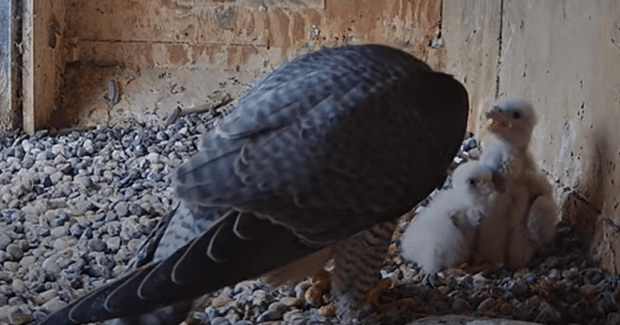
First, Brock has returned. He showed up on the front video camera at 11:35 this morning. He had been to my neighbour, Jane’s, earlier to eat, but she did not see him. Now we had proof of life! Happy tears.
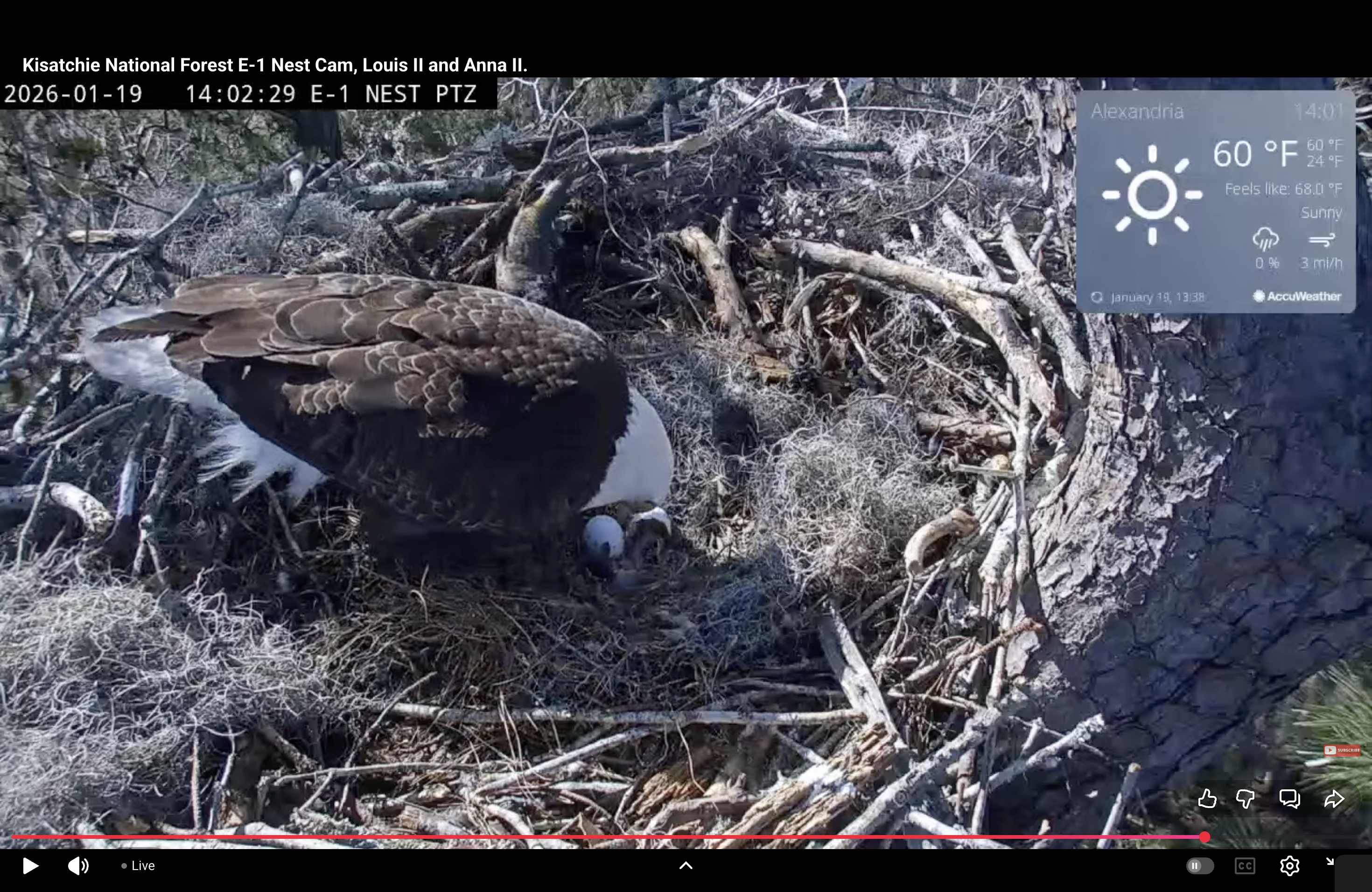
We have a hatch at the Kistachie National Forest nest of Louis II and Anna II at the E1 nest. Time 14:01.
The Royal Cam chick continues to make hatch progress in New Zealand.
A second eaglet at the Texas nest has died. The cause is highly suspected to be HPAI.
Another Hen Harrier in the UK has been illegally killed and dumped. Why do some humans believe they have a right to take the life of another living being?
There are many books on Hen Harriers. Bowland Beth: The Life of an English Hen Harrier moved me the most. Bowland Beth’s story became a focal point in the debate over hen harrier conservation, a totemic species facing decline due to human persecution, often linked to grouse shooting interests.
Bowland Beth was a real female Hen Harrier tagged in the Bowland Forest in Lancashire. She was shot before she was able to breed. Because of her sat tag, the story chronicles her movements in great detail. David Cobham chronicles the bird’s tragic life and illegal shooting, highlighting persecution issues in UK conservation. Beth’s story symbolises the species’ struggle for survival against human threats, particularly in the Bowland Forest.
SK Hideaways didn’t think that dementia and a clean house were oxymorons. Well, the other day it was the carpets and hardwood floors that were cleaned. You should see my utility room today! Have someone you are caring for who has dementia? Seriously, try getting them involved in cleaning. It could change your life.
Thank you for being with us today. Please take care. We look forward to having you with us later this week!
Thank you to the owners of the streaming cams that allow us to see the miracles and the sadness in the lives of our raptor friends. I am very grateful to those who create videos, post information and images on FB, and to Raptor Persecution UK, who alerts us to the atrocities our feathered friends face at the hands of humans.
It is Halloween. It is also Diwali, the Festival of Lights. Will you be celebrating either of these holidays? In years past, we used to get at least 75 children at the door wanting treats, and that all changed. I am thrilled that some of the streets in our neighbourhood are being blocked off so that the children can run from house to house and cross the street without worry of being hit by a car. On Saturday, there was the walk at Bird’s Hill, and CPAWS put on all the games and treats. There have been events at many of the community centres. Everyone is trying to make it safe for the little ones to be outside. The biggest Diwali party took place at our convention centre a couple of weeks ago.
I remember several years spent celebrating this holiday on the Indian Subcontinent eons ago. The food was delicious! It was the same later in Singapore. We have put up extra lights in the garden this year and will be thinking of our friends in India and Singapore as they celebrate good over evil and light over darkness.
National Geographic Kids gives this information on Divali: “Diwali, or Dipawali, is India‘s biggest and most important holiday of the year. The festival gets its name from the row (avali) of clay lamps (deepa) that Indians light outside their homes to symbolize the inner light that protects from spiritual darkness. This festival is as important to Hindus as the Christmas holiday is to Christians.
Over the centuries, Diwali has become a national festival that’s also enjoyed by non-Hindu communities. For instance, in Jainism, Diwali marks the nirvana, or spiritual awakening, of Lord Mahavira on October 15, 527 B.C.; in Sikhism, it honors the day that Guru Hargobind Ji, the Sixth Sikh Guru, was freed from imprisonment. Buddhists in India celebrate Diwali as well.”
Now, ‘The Girls’ are wondering how much you know about Halloween. They consulted Good Housekeeping and it says, “If you think Halloween is a uniquely American tradition, grab a mini Snickers and settle in, because you’ve got some learning to do. Dressing up in a creative costume, traipsing around in the gathering dusk to collect the best candy or throwing a monster bash with friends are all time-honored holiday traditions. But Halloween didn’t start stateside at all.
In fact, the origins of Halloween go back thousands of years to the Celtic celebration of Samhain (pronounced “sow-win”), a festival that marked the end of the harvest season and ushered in a new year. During Samhain, the veil between the worlds of the living and the dead was thought to be especially thin, so people could communicate with loved ones who had passed on.
Whether or not you buy into the supernatural, it’s still fun to learn a little something about the meaning behind your favorite Halloween traditions before you head out trick-or-treating. Turns out, the holiday has a much more interesting (and sometimes even spookier!) backstory than many people realize. Travel back in time with us to learn what some of the very first celebrations of Halloween looked like, including throwback ghoulies and ghosties, what people used to carve in place of pumpkins and even the elements that Valentine’s Day and Halloween have in common. We can guarantee there wasn’t a glitter pumpkin or superhero costume in sight.”
Calico urges you to keep your kitties inside during Halloween. (She thinks they should be inside all the time and Calico should know – she lived on the street!)
The best news in the world is that Lady and Dad are feeding SE33 and SE34 over away from the river from the moment and while they might be getting harranged by Currawongs and other small birds, they appear to be flying strong and eating well as of the time I am writing. Seeing the eaglets and their parents together just made me shed tears of joy. I hope you did, too!
I will continue to post all of the news that I can find. Some might overlap with earlier reports.
It is really, really hot on that ledge in Melbourne. The temperature ready for lower down is 16 C. I wonder what it is on that ledge. Just look at Mum.
News from New Jersey says that Ospreys are staying later this year. In Manitoba, there are still lots and lots of geese and ducks. Perhaps this is the reason for the low migration numbers of raptors below. I sure hope so. The Red-tail Hawk count makes me cry. Let’s hope this is just a late season or these raptors are in trouble.
It seems that we take one step forward and one or two backwards when it comes to protecting wildlife and habitat. More news from Geemeff:
This is a damning report on the state of the environment and rewilding just after we read about huge swaths of land being put into trust and not into grouse shooting.
Osprey accepted the platform that had to be removed and rebuilt in South Australia. Wonderful news. Now if we can get Ervie a mate and a platform with a camera all of our dreams will come true. Little Envies!!!!!!! Think about it.
Breakfast at Port Lincoln. Gosh, Dad is doing a good job this season. Would love to give him a pat on his feathered back. Keep up the good work!
Beau and Gabby continue to work in their amazing nest. As we enter November, we can hope that fertilized eggs will appear by the end of the month with a hatch on Samson’s hatch day (24 December).
‘H’ sent me some sad news this morning regarding the cameras at NE Florida: “We’ll be lucky if we get to see any of Gabby and Beau and their family this season. As you know, cam 2 is down all season due to a broken cable. Well, now the cam 1 issues have been diagnosed: a partially broken cable. Not all the strands within the cable at the nest are being used to transmit to the server… meaning that some of the cam 1 cable fibers are broken. Cam 4 is still okay so far.”
I cannot imagine know knowing if Gabby and Beau have babies this year. Was it the hurricane that damaged the cables (Milton)? Do the cameras get an annual check up here? I wonder.
It was raining at the West End, too. Thunder was looking out over the territory.
This is a very good use of funds. They will get to the bottom of all the questions about Menhaden and quotas and surely to goodness will help save the Osprey in the same way that the warnings from Rachel Carson issued about DDT did in the 1970s. There are many species at risk because of the commercial fishing of Menhaden being allowed by the State of Virginia. It needs to stop before they are wiped out entirely and there are no more ospreys, not even starving ones.
Scotland is one of the most nature depleted countries in the world. It is home to so many raptors. So why not rewild 33% of Scotland. This film asks that question. Our narrator is a 26 year old who has eco- anxiety. Take some time to watch. It isn’t just Scotland. There are some gorgeous images and thought provoking questions. Even a good comparison between Scotland and Norway, the Oder Delta between Germany and Poland, and other sites that have rewilded. Happy ecosysystems and biodiversity link to the nature and climate crisis. https://youtu.be/FFypWj1bjPk?
Missing story time with Calico and the other three girls is not a good thing. I apologized this evening profusely and we settled down with treats and a good book. It got Calico’s Ten Golden Paw Award and she thinks you might want to put it on your holiday list for those special children in your life. It is not about raptors, but about seals and comes to us from Wales. The main characters are the seals that come to the island to have their pups and to rest. The other central character is Tina, a little girl who lives on the island where her Mum is the local vet. It is summer holiday season and Tina is determined to make the holiday goers that come to the island understand how to respect the seals. The book is: Rescue at Seal Bay by Gill Lewis. The only colour illustrations are on the front and back covers. All others are black and white drawings, just in case you wanted to know. The story is really good and Calico didn’t mind not seeing images in colour! It is listed at $14.99 CDN at the online retailers.
Calico found a lot of books written by Gill Lewis. We just ordered another one for her birthday – Sky Hawk. It is about Hen Harriers! I can’t wait to read it.
Thank you so much for being with us today. Please take care. We hope to see you soon.
Thank you to the following for their notes, posts, comments, images, videos, articles, and streaming cams that helped me to write my post today: ‘A, Geemeff, H, J’, OpenVerse, National Geographic for Children, Eagle Cam, Judy Harrington, Rohan Geddes, 367 Collins Street by Mirvac, SK Hideaways, Hawk Mountain Migration Chart, pressreader.com, Fran Solly Coffin Bay Community Notice Board, Port Lincoln Ospreys, Charles Sturt Falcon Cam and Cilla Kinross, Nesting Bird Life and More, Elain, NEFL-AEF, Androcat, Raptor Research Project/Explore.org, PIX Cams, FOBBV, IWS/Explore.org, Joanie Millward, Menhaden – Little Fish, Big Deal, The Scottish Rewilding Alliance, Gill Lewis, Harley Thomas White.
I hope that all of you had a good start to the week. It is cooler on the Canadian Prairies today with really cloudy skies and reports of possible showers starting at noon. The animals have really been busy in the garden gathering nuts and eating. I wonder if we will have another cold snap? The European Starlings have come to the tree in the back lane but, for some reason they have not come to the garden. Is it because I have no Butter Bark or Meal Worms out for them? I plan to go and get some later today. We will see if that is what they are looking for.
Of the four nests in Australia, the real concern is at Port Lincoln and I will be monitoring that nest closely.
The gold star for the week goes to the male at Melbourne who really kept the nest together when Mum was away for over 3 hours and the hot sun was beating down on the youngsters.
To tell the difference between Dad (below) and Mum, look at the breast area. Dad has hardly any lateral barring – with a full crop, his chest area looks like fluffy Victorian handmade lace. Isn’t he adorable? I have come to love this tiercel so much. He has really saved the lives of these four eyases, now known affectionately in my house as The Melbourne Four.
Making News:
The causeway to Captiva and Sanibel Islands is now restored and vehicles are going in to restore communication systems, power, etc. This is incredible news. Who would have imagined this would be completed in October! (Not sure what was done or if private vehicles can travel but the causeway is functioning). Connie and Clive have been seen and photographed and Lena has been heard. Everyone is just waiting to get the cameras back up and running.
There are lots of boots on the ground checking for SE30. She was found on the ground being harassed by Currawongs and Magpies yesterday. She flew and seemed to be fine and was seen near the River Roost with a parent. That should put a smile on all our faces!
The text and images come from the Eagle Cam FB page.
I have seen no further reports on SE29 who was found in a residential area and taken by WIRES to a vet where it was receiving fluids and pain killers.
Sharon Dunne (aka Lady Hawk) has completed her tribute video to Lillibet, the Royal Cam Albatross chick, daughter of OGK and YRK, for 2022. As always, get the tissues out. OGK was last seen the middle of May on camera. It has saddened everyone to think that this fabulous mate and father has perished. We will wait to see if he returns for breeding season in October 2023. He was injured in 2020 and was away from the nest for 40 days. What a joy it was when he returned. Miss Pippa Atawhai was so happy. They had a very close bond.
Sadly, the Albatross continue to be killed at an alarming rate by the long-line fishing trawlers. As anyone knows reading my blog, there are quite a number of easy fixes to stop these endangered seabirds from being slaughtered. They include setting the lines at night – how easy is that?
Nest News:
The Melbourne Four continue to be well fed. At least three persons noted that there were 9 separate feedings yesterday. They were a mixture of stashed prey (as at breakfast) followed by fresh kills when there was not enough meat on the pantry item. Raptors eat everything unlike us humans who are said to waste 40% of all food we purchase. All of those pigeons are turning into beautiful falcons! Mum had her lunch time break (from 11:19:45-13:01:37). Thanks ‘H’.
Nine feedings. If they can keep the intruders away from their penthouse scrape and maintain their territory in the non-breeding season, we will have years of watching this incredible couple raise their families. The male has really stepped up and has actively engaged with the eyases and from his protective mode the other day has a strong bond with the little ones.
Port Lincoln Ospreys keeps a running timestamp of happenings on the barge. Its listing yesterday pretty much sums up what is happening. The nest has gone off the rails. Little Bob had a few bites of prey yesterday. It is so hungry that it is trying to take food off Middle’s beak. Big Bob is unrelenting in her (it has to be a female) rampage. The osplets are 25, 24, and 21 days today. In general, nests like this ‘settle’ at 28 days just like they start on day ‘8’. We have a week to go. Even then, nothing is guaranteed. The oldest sibling on this nest has pushed its younger off the nest at 65 days and killed it. It is going to be a long week.
Mum was up having a snack and she tried to reach down and give Little Bob a bite of fish while Big was asleep. The time is 01:27:54. Little Bob is awake but Big Bob moves. Oh, if Little Bob would just slide up and open its beak, he would get a good feeding.
Middle Bob did eat some fish along with Mum. Sadly, Little Bob never woke up. Both Middle and Little will be hungry but Little really needs to have a good feed.
You can see Middle Bob’s crop. I just wanted to shake Little and get it awake so it could it. That feeding would have made all the difference. Mum has fish leftover for morning but will there be enough for Little to eat or only Big?
At the scrape box of Xavier and Diamond in Orange, Australia there were six feedings starting at 07:46:35 and ending at 18:48:40. Rubus is getting some bigger bites. Both of the eyases, Indigo and Rubus, are adorable.
Little Rubus had a nice big crop before bed!
From the Bookshelf:
Do you love Hen Harriers as much as I do? Those beautiful owl-faced low flying raptors that can be seen over the heather? There is a new book out by Ian Carter that looks very promising, The Hen Harrier’s Year. Here is the review:
So many factors play into a successful nest – lots of prey, healthy parents, no intruders…the list can be fairly long including Avian Flu. Despite all that has happened at Melbourne, that Peregrine Falcon nest is doing really well right now. That lovely tiercel is delivering fresh prey to Mum, the chicks are growing, and Dad has been able to help shield them from the sun during Mum’s noon day absences. Rubus is doing better at Orange. That wee one had a nice crop before bed last night. SE29 is in care and SE30 is being closely monitored. Thank you to all the boots on the ground near the Discovery Centre. The problem nest is Port Lincoln and this will not dissipate soon. We can only hope that Little gets one decent meal today.
Thank you for being with me. Take care everyone. I will be sending out breakfast news at the nests in the early evening. See you then!
Thank you to the following for their posts, their video tributes, and their streaming cams that make up my screen captures: Sharon Dunne (aka Lady Hawk), Port Lincoln Ospreys, Sea Eagles@Birdlife Australia Discovery Centre Sydney Olympic Park, Sea Eagles FB, Raptor Persecution UK, 367 Collins Street by Mirvac, and Charles Sturt Falcon Cam and Cilla Kinross.
Good Afternoon Everyone. I hope that this finds each of you well whether you are starting or ending your day. It remained a glorious day on the Canadian Prairies – a crisp fall one. There are so many songbirds in the garden now all wanting to eat and have baths. It is impossible to differentiate between the hundreds of sparrows and what looks like a few Grosbeaks but, they all seem happy and the two bird baths this year are really making a difference. They are so thirsty. The usual group comes around 1800 so these are the early birds.
Mr Blue Jay is here. There is a cob of corn for him as well as some individual kernels. Let us see if he gets it or if Dyson does! Dyson should be here in about an hour. It is amazing how they have their own timetables and really stick to them. Oh, two of the three Blue Jays have arrived. This will be interesting. One is eating from the cob of corn and the other is taking the corn kernels that I broke off a second cob.
This is Junior. He is the Dad of the three fledgling Jays that remain in the garden and at their nest tree across the lane. Junior still needs to grow in his crest. He is easy to spot.
He knows I am watching and he also knows that I am the one that puts out the corn. No, Junior. It is not just to take your photograph! Junior is 5 years old this year.
A little female squirrel has arrived.
One of the Crows just flew in to check out the evening’s buffet.
Our wildlife rehabilitation centre has its annual open house this week. If you live in Southern Manitoba or Winnipeg and want to go out and see the amazing facilities including a brand new surgery and our super flight training buildings, go to line to Wildlife Haven and order your tickets. Remember, too, if you go out – check for clean old towels and sheets. They can never get enough of them. And if you have some spare savings or are in need of a tax donation, every wildlife rehabilitation clinic will thank you and give you a receipt for your donation. It is the only way they survive.
Australian Nest News:
Oh, what a glorious day it was to wake up to a brand new osplet – and, so, as all of you probably know, the clutch at Port Lincoln is complete. Congratulations to everyone! Dad came in with a really nice fish for the brood. It is unclear if Little Bob got much or any – he has to be tired from working so long on that egg but, you can bet the other two got their fish!
Let us hope that the fish keep coming. We are off to a good start with that big fish. The key will be for Big and Middle to get full and then Little Bob to eat but let us see if it works out that way! Our dear Ervie had to be right up there preferring to thwart any attention Bazza wanted to pay on someone to Falky.
Just look at that nice fish. It is incredible to me that birds of all makes and models are hardwired to hold their heads up high and their beaks wide open for food from the git go.
You can watch all the action at Port Lincoln here:
It looks like a super day starting in Melbourne. I hope it is as it is the 23rd of September and gosh, golly, we are looking for a hatch on the 27th. Four days. Fingers crossed that the second male – who Mum is not interested in – is thwarted. I know. It is wishful thinking but, let’s all send good wishes out to our wonderful old dad. This could be his last clutch and he is remarkable. One of the great Peregrine males out there and so ever funny in his pjs.
Mum left for a break. Food is being brought in and stored elsewhere but not near the nest and this probably won’t happen til the chicks arrive. The falcons like, for some reason, to keep that scrape box really clean while there are eggs. Then when they begin feeding their eyases it can be mayhem with blood, bones, and feathers flying everywhere. The old dad used to love to pluck and feed the fresh pigeons right in the scrape. I don’t think the former Mum appreciated that at all.
Xavier has arrived early at the scrape box hoping that Diamond might want a break. He is such a devoted Dad. We are looking at the first week in October for hatch. For the past two years only one of the three eggs has hatched. I am wishing for one strong eyas! Two would delight Xavier to no end. Three might be overwhelming but these two very seasoned parents would manage.
Some of you might be wondering what is going on at the Sydney Sea Eagles. Yesterday, Mum flew in with a fish and stood on the nest eating it while 29 played with its tail. Lady wanted to see if the eaglets would fight for that fish and take it from her. That is what they will need to do in the wild. They did not. Eventually she offered and 30 got some nice bites. It was a very interesting educational moment. And so, here we are today.
The sea eaglets are up looking around in their beautiful plumage. Those feathers are almost all completely in.
One of the parents is in the tree watching every move the eaglets are making with that fish on the nest.
Both parents are now on the branch watching the eaglets. Do not ever think for a second that these parents do not know what they are doing. They do. They are letting go – and they are trying to provide their two kids, SE29 and 30 – with the skills so that they can survive in the wild. They need the eaglets to be hungry, to need to get that fish and eat and they need them to know how to hold it down and pull off the flesh. At some point in time Dad might bring them a live fish to see how they respond.
Making News:
The new Kestrel Ambassador for the Ojai Raptor Centre has a name. It is Topa and the word comes from a mountain range near to the wildlife centre called the Topa Topa. What a lovely bird to help teach youngsters and us about the challenges raptors face daily.
The new Osprey cam is now installed and working at Captiva in Florida. Just look – we have an adult. Last year Andy and Lena managed to end their years of not having chicks due to predation by Crows. How did they do it? They laid their eggs one month early. Very smart Ospreys. We had three magnificent chicks – and we ended with two, Middle and Little Bob, who turned out to be a male and a female. Big Bob died of an indeterminate cause but he did have enlarged organs similar to some other ospreys lost this year. That was determined to be salmonella in one case. Big Bob had also been ruthless in his eating claiming all the fish for nearly 72 hours before he died. The other two thrived and were very civil fledging with the male staying around Captiva and the nest for us to enjoy for some time.
In the Mailbox:
EJ sent us a great video of a juvenile sea eagle fishing. It is short and quite amazing. Thanks, EJ!
From the Book Shelf:
In a few of my blogs I have been writing about the campaign by Chris Packham, Mark Avery, and the Raptor Persecution Group in the UK to get rid of sport hunting and killing. In this instance I am referring to Grouse Hunting and Killing on large estates for sport. The problem is that the game keepers of the properties kill the raptors. Raptors such as the Hen Harrier who covered the wet lands and moors and heath was a common sight in England during the Mesolithic Age, ten thousand years ago. It has really gone into decline with the advent of the Enclosures Act in the eighteenth and nineteenth centuries. Now, sadly, heath burning, the escalation in killings and diseases brought in by the imported birds has caused a swift and rapid decline in the number of breeding pairs of Hen Harriers in the UK. In 2012, there was only one breeding pair left.
David Cobham has set out and written an incredible little book on the history and decline of this amazing low flying raptor. It is based on the promising life of Bowland Beth and the title is, Bowland Beth. The Life of an English Hen Harrier. You are drawn into Bowland Beth from the minute her father returns to his natal nest in the Bowland Forest to find a mate. You will discover this amazing and most promising bird and her daily activities (she is tagged with a sat pack). And you will come to understand so fully why the grouse hunting and the killing of all the raptors that find their prey on the wrong piece of land need to be kept safe. It is essential that the law be changed. I rarely head deep into politics but this is an archaic practice that needs to end for the sake of the wildlife. They need to thrive without fear of catching a vole and being shot.
$18.40 CDN for the hardback at your local on-line book seller.
Thank you so much for joining me this afternoon. I hope that you are well and that you will enjoy watching the sea eaglets and those cutie pie osplets. Take care. See you soon!
Thank you to the following for their streaming cams, videos, and postings that made up my screen captures: Sydney Sea Eagles@Birdlife Australia Discovery Centre Sydney Olympic Park, Charles Sturt Falcon Cam, 367 Collins Street Falcons by Mirvac, Ojai Raptor Center, Robert Full and ‘EJ’, David Cobham, Captiva Ospreys and Windows for Wildlife.
Friday turned out to be one of the best birding days I have had in my City because of the birds and the three people that I met — and, of course, an Osprey story. No, I didn’t add lots to my life list but, I will add a few when I can get some help doing the IDs. It was hot in the afternoon for the walk at the nature centre. The little Mallard mother that had 11 ducklings still has the 9 she had the other day. She has moved them to a different pond where the water and plants appear to be a little healthier.
In some areas the algae is just stifling the life out of the pond. The geese were all resting in the shade and only the song birds were exerting themselves. In particular, 5 or 6 Black-Capped Chickadees were around the ‘winter’ feeding area. I had the most glorious chat with a woman about the fate of insects and she mentioned a book, The Insect Crisis.
This lovely woman spent a few minutes explaining the concept behind the book – the collapse of the insect population and the shocking collapse of everything from birds to crops. I suspect that almost everyone who reads my blog is aware of the domino-effect that is or will take place as the insects die. The rest of the population has surely heard about what is happening even if they don’t understand it — or worse, choose to ignore it. Why then do people still hire companies to come and ‘kill’ the weeds on their lawn so that it is pristine all the while what they believe the company is using a green chemical is actually toxic! or the spraying of roses and other flowers? the use of pesticides used in farming? It is time to put a stop to these practices and embrace companion planting or the use of certain birds and animals that will weed but not kill the crops or flowers.
All the while we were talking, the lovely lady, perhaps in her 90s, was pulling out sunflower seeds for the Chickadees.
An hour before dusk I went to another site where a Bald Eagle had been spotted. OK. I am not the luckiest birder on the planet – far from it. All I could find were some Mallards resting….
and then, I didn’t hear it but something caused me to look up. There was an osprey flying overhead. My heart stopped for a second. An Osprey – sorry Bald Eagle people but this was fantastic. I have been trying to find the Osprey living in this area of my City and have always failed…and there it was.
It has been a good year to be surprised by Ospreys flying overhead. I only know where one nest is but that is fine…seeing them flying at dusk is very special.
The sun was nearly setting but, just on the chance that the Egrets were landing near the pond on the other side of the City, I took off…
As the sun set, 7 Great Egrets descended on the pond and their night time tree.
They continued to arrive as the sun set lower and lower in the sky. It was just a calm, beautiful summer evening spent looking at a ‘sedge’ of Egrets – a most unusual sight for a Canadian Prairie city.
I am not a wildlife photographer. Let’s be clear about that. There are people who are and two of them spent time with me taking photos of the Egrets, talking about where the birds might be spending their days and the anticipation of the arrival of ‘THE’ Green Heron this year (he was really lost last year when he landed south of our city in a small little river). Quite the celebrity that heron was! Of course, everyone is looking and comparing the ‘kit’ each of us had….I take photos because I love the garden animals and the birds – to show you! So they are taken with love not great technical expertise although there are many times I wish I had that level of talent.
In the Mailbox:
The Ojai Raptor Centre updated Victor’s progress in an e-mail posting today: Just look at this magnificent eaglet. This is a very special day. His zinc levels are normal!!!!!!!!
Here is the announcement from ORC:
Bald Eagle patient 22-635, who was rescued from Santa Cruz Island with zinc toxicosis on July 11, continues to make progress. The most recent test for zinc showed the patient within normal levels. This means the eaglet no longer needs to go through chelation therapy to remove the toxic metal from the bloodstream. The eaglet’s ataxia (lack of balance) seems to have resolved as well!
‘L’ sent me a lovely screen capture she had in her archives of Ma Berry. The year is 2018. Do you know who she is?
Berry College is located in Mount Berry, Georgia. Ma Berry was the mate of Pa Berry until 2020 when she was last seen the 17th of November. Ma Berry had a injury to her left talon – she was easily recognized. She had no difficulties fishing or catching prey with her injured foot. She was dearly loved despite there being a heavy loss to the chicks on the nest. In 2017-18, two eggs hatched with one chick fledging and the other sadly died from falling off the nest. The following year, 2018-19 both eggs hatched again but the chicks died within a week. The following year one egg cracked and the second was not viable. Ma Berry has a huge fan club and as one article at the time said, “There’s been a scandal brewing behind the Cage Center at Berry College.” A new female and Ma Berry had a bit of a stand off. For awhile many worried that Ma Berry had been injured or killed but on the 21st of January 2021, Ma Berry was seen at a lake (again easily recognizable by her injured and twisted foot). She is enjoying her retirement. The new female named Missy had two eggs in 2021. One was not viable and the other baby died – both of starvation and hypothermia. Missy just didn’t know what to do as a Mum. However, this year Missy and Pa Berry fledged B15 – a fine strong eagle. Pa Berry must have been very pleased.
Three questions came in from ‘G’: What would have happened to the female at the 367 Collins Street Falcon nest? Did she find a new mate? Second question: What is a scrape? The third question: Why do falcons use gravel for nests and not twigs like eagles? OK. Let’s start at the beginning. I have included some images of the male at 367 Collins Street and his mate from previous years below with their four eyases from 2021. You will often hear that Raptors mate for life. From reading the information about Ma Berry above, you will then know that this is not always the case. Some females get usurped from the nest as do some males. Some are injured and die. Some leave and are discovered elsewhere. Some Ospreys have had two mates. A good example is Seren, Blue 5F in the UK. From 2015-2020, she was Aran’s ‘other woman’ at Glaslyn while Mrs G was his primary mate. In 2020 she decided not producing chicks and have a faithful mate was reason enough to pack her bags and leave. She did. She flew to Llyn Clywedog and became the mate of Dylan! So the saying mate for life is not always the case but it is more the standard than anything else. It is presumed, however, that the female at 367 Collins street has died and a new female has taken her place. If this is her first year as a Mum, let us wish both a very good year.
Scrape is the name of the ‘nest’ that Peregrine falcons use to lay their eggs and raise their eyases. Eyas is the proper term for the chick.
Peregrine Falcons traditionally made their nests on cliffs. There the sand and gravel would be gathered and a small indentation made for the eggs so they would not slide out of the nest cup. It is believed that by using this kind of nest insects and diseases that often form in twig nests – especially if it is cold and wet – would, thus, not impact the falcon chicks. That said, there are some stick nests being used by falcons in Poland that have been very successful.
An early morning question from ‘T’: Why aren’t the falcons in Australia sitting on their egg and eggs all the time? Great question! You can see them leaving the eggs in the images below today. Some raptors practice delayed incubation. They will keep the eggs warm for a few hours a day but will not begin 24/7 incubation known as ‘hard incubation’ until all of the eggs are laid. This ensures that there is not such a discrepancy in their dates of hatch. This lessens the chance of siblicide. In addition, many times the eyases hatch within 24 hours of one another like those at Collins Street the last few years.
In the News:
Hen Harriers remain in the UK news. As their populations begin to recover at 100 birds the illegal killing of the raptors remains a huge problem for the reintroduction programme.
In Australia, there is dismay as to the protection of the forest industry and the lack of concerns from some of the wildlife going extinct. In 2022, people are starting to get upset and angry. Will the government respond?
Holly Parsons has posted the links to the four Falcon cameras at Orange along with a link to FAQs. Thanks, Holly! Here it is:
Diamond has been the female at the Charles Sturt Falcon scrape at orange since 2015. Xavier has been her mate since 2016. This means that they are at least 9 years old for Diamond and 8 years old for Xavier. Peregrine Falcons have been known to live for nearly 20 years in the wild.
Diamond is looking out the window of the scrape at Orange. Galahs, a pink and grey parrot, are flying by the tower. Do they not know they would be a remarkable mid-morning snack for Diamond? If Xavier sees them, she will have one!
Later Pied Currawong were observed doing flybys while checking out the scrape box. They eat eggs! Diamond and Xavier are going to have to be vigilant.
There is no hard incubation yet at 367 Collins Street in Melbourne. Does this mean that Mum and Dad Peregrine Falcon are thinking of a 4th?
For those of you who have watched the Melbourne nest in previous years and, perhaps, did not notice or know. This is a new female this year with Dad. My first thought was is it possible that Mum died from trichomonosis like the 4th eyas last year? We might never know – unless Victoria Hurley does, the researcher at this nest.
Dad has the biggest eyes. Oh, such a cutie with one of his prepared pigeons for the kiddos.
It would be very difficult to forget these four. They were incredible. The year before Mum and Dad had 3 girls…they towered over little Dad.
Mum and Dad with the four eyases for the 2021 season. Mum was amazing. She often appeared to be gruff but if you are having to chase after four eyases with independent minds, she seemed to have to be to keep them from falling off the edge of that ledge. Thankfully birds are afraid of heights (or so I am told). Soar high, Mum. You took such great care of your little ones.
The new female shows Dad the third egg early on a misty Melbourne morning. It arrived at 22:18 on the 26th of August.
Oh, I adore the little male falcon at Collins Street. Sometimes he looks like a toy in his cute little pajamas.
A few more images today of Dad and the new Mum taking turns incubating the eggs. You will get to know Dad rather quickly with the thick yellow around his eyes and if he is next to New Mum, he will be quite a bit smaller
Neither Diamond or the Melbourne Mum will begin ‘hard’ incubation until all of their eggs are laid. This is one of the reasons that there is less competition between all the eyases as they are close in size and birth date. Some Ospreys and eagles begin hard incubation immediately and this means that the third catch could be several days difference in size and development than the first.
Just look at SE 29 and 30. 29 is standing so tall with its big crop while 30 is enjoying a private feeding from Lady. Look very carefully at 30 since we can see the top of the head, the chest, the wings and back and – of course those pink legs standing so tall. Weeks 5 and 6 show the biggest change from the fluffy chicks with their down to the stage of an eaglet. There is now down left on the head (maybe a dandelion or two on 30). Dark feathers are starting to show everywhere – they are the most gorgeous espresso brown. The chicks are spending a lot of time preening now as feather growth is said to be itchy (how does a human know that?). They are now able to stand like 29 is doing without the aid of the wing tips. They will begin flapping and might make some attempts at self feeding.
Notice that beautiful light rust that is appearing on both of the eaglets. If you have never seen a juvenile Sea Eagle you are going to be so surprised at how stunning their plumage is. Notice also how those beaks continue to grow long and strong.
Dad was nudging Mum at the Port Lincoln Osprey nest to get up and give him a turn. It was 23:42!
Andor visited the Two Frasers Bald Eagle nest in the Channel Islands. It looks like he now has some time to regain his strength after helping Mama Cruz raise Lilibet and Victor. He certainly must have had a nice lunch!
The streaming cam at the Minnesota DNR Bald Eagle nest is now offline until the 17th of November. Mark it on your calendars. I wonder if Nancy will have a new mate for the next breeding season????
Both eaglets at the Glacier Gardens Bald Eagle nest have now fledged. Congratulations to Liberty and Freedom for another successful year. Believe it or not, the Bald Eagle season will be getting underway in Florida in the next 4 weeks or thereabouts. Goodness.
Kielder Forerst posted that one of the 2022 fledglings, Frankham, is now in Spain enjoying himself on the llobregat River in Catalonia. His ring number is Blue 439 and he was the first to leave Kielder this season. Frankham was from nest 1A where Mrs YA raised the chicks after Mr YA did not return after they had hatched. Congratulations Kielder Forest!
Did you know that there are 10 Estonian Black Storks with trackers on them this year? Kaia and Karl II along with Waba and Bonus from the Karula Nest are amongst the ten. It is going to get busy once they start moving. Kaia remains near Liaskavicy in Belarus in the wetlands of the Priyjpat River.
A new book, Birds. A Complete Guide to their Biology and Behavior by Jonathan Elphick has arrived on the desk. Review to come.
Have a lovely Saturday everyone. Take care of yourselves. I look forward to seeing you soon….and remember, if you have a question, send it in. There could be 50 or 100 people wondering about the same thing!
Thank you to the following for their streaming cams, posts, and videos that form my screen captures: Ojai Raptor Centre, Berry College and ‘L’, Charles Sturt Falcon Cam, The Guardian, Orange, Australia FB, 367 Collins Street by Mirvac, Sea Eagles@Birdlife Australia Discovery Centre Sydney Olympic Park, Port Lincoln Osprey, Explore.org and the IWS, and Looduskalender.
Today turned out to be a very special day (22 August). OK. It is always special when I can go out to the nature centre and do my long walk. It is also a good way to check every nook and cranny for the geese and ducklings. A few had moved from where they were yesterday but many stayed in or close to their normal pond area. I continue to be fascinated that there simply are no Wood Ducks at the nature centre. It is like the two species – Mallards and Wood Ducks – sat down and signed a truce and decided who would go where! There were a lot of birds at the ‘winter’ feeding stations — they must fill the feeders year round. There were several Downy Woodpeckers, two American Goldfinches, a number of Black-capped Chickadees and then a bird sitting in the squirrel feeder that I did not recognize. After going through the birding book, it appears that the little lovely below is an immature female Rose-breasted Grosbeak. I certainly welcome any help with this ID.
The most excitement came this evening, however. It is hard to imagine sitting next to a pond which is about 6 metres away from, perhaps, the busiest highway in our City and seeing a Great Egret fly to a tree to join two others. They are part of the heron family but they are very large. In North America they have black legs and a yellow bill. They gather in groups near ponds and wetlands if there is plenty of food. Otherwise, if food is relatively scarce, you will see them alone.
What a magnificent creature.
In the mailbox. Following up with the question about Titi and Boris and the reason for the Janakkalan nest cam in Finland to go offline. We have answers. Thank you ‘S’ for getting back so quickly to us. Boris was seen on the nest two days after Titi’s fledge. It was the morning of 12 August. Titi did not return to the nest while the camera was still operating.
There is a video of Boris’s nest visit.
There were difficulties with the camera and it completely broke down. It will be fixed and will be up and running again next year. ‘N’ did receive a response from the Finnish Osprey Foundation stating that there were a number of Osprey fledglings in the Muonio in Northern Finland. Thank you ‘N’.
Can you help? There is a new book on Peregrine Falcons being written by Richard Sale in the UK. Susan Sale writes with the following information and a question. “My husband is self-publishing a book on the Peregrine Falcon and I am trying to source the following Peregrinus Casini, Japonensis and Pealei. Do you have any photographs of them or perhaps give me some contacts who may and if you or they would be willing to allow use in the book.” If you have any images of any of the three sub-species of Peregrines or you know someone who might be able to help, please contact Richard and Susan at this e-mail address: Richard@snowfinch.co.uk
Several have been wondering about Big Red and Arthur’s L3 and L4 that are currently in care. They ask “Will they, if ever released, be placed near their family so BR and Arthur can find them? If not, Who and How will they learn to hunt after all these WEEKS in the clinic???” L3 and L4 are in very good hands. Just like they would if they were patients in my local wildlife rehabilitation centre, they will learn to fly and they will also be taught how to hunt and catch their own prey. I do not know where they will be released.
‘B’ sent a note and wondered if I had seen Thunder and Akecheta on the West End nest together. I had not and went quickly to rewind and there they were. Thanks ‘B’. We are always happy to see the parents on the nest as well as the fledglings!
‘L’ wrote: “When I grew up in the north of England, along the Pennines…near the Lake District….I never saw an Osprey, Kite, Goshawk, Golden Eagle that were native to our islands as we had eradicated them… I thought all was lost .it wasn’t and these efforts wipe away the despair that can overwhelm you when you ask how can we make a difference. WE make a difference.”
‘L’ you will then be thrilled to learn that the National Trust, RSPB, and the Peak District RaptorGroup just announced two successful Hen Harrier nests this year! And, as you know, the Ospreys are thriving and so are the Goshawks. Isabelle Tree’s re-wilding at Knepp is taking off…there will be more raptors.
Nest News. It is hard to imagine sitting in the heat of summer in the Northern hemisphere but, the forecast is for snow in Orange, Australia. Holly Parsons who heads up the FB group was posting an image of Xavier and Kelli HissiFit Walker, one of the new mods on the streaming cam chat, dressed Xavier for the occasion. I chuckled so loud – I hope you enjoy it. If I were Diamond I would not want to lay eggs in that cold!
Thanks Holly and Kelli for letting me share!
Like Titi at the Janakkalan Osprey nest, LC at the Osoyoos nest doesn’t seem that much interested in fledging — yet. LC is 66 days old today.
As of the 22nd, Telyn was still at the Dyfi Osprey nest. She has not begun her migration yet. There is no rush and the females need to be in top form before they depart. Taking care of three big female chicks really has to be draining because they require much more food.
I went to check on the Sydney Sea Eagles and Lady was feeding SE29 and 30. It was very civil. SE30 did a few quick grabs and kinda looked to make sure 29 wasn’t going to do anything. Lady had it all in hand – a bite for you and then one for you. Back and forth. How lovely.
Sometimes 29 did seem to get more bites than 30.
and then 30 would get a few more…
There is plenty of fish. Both will be full. Just look at the ‘blood feathers growing in on SE29’s back and wings. Oh, they are changing so quickly — and the are simply adorable.
It rained later in the day and Lady spread her big wings and covered those babes who do not, as you can see above have their feather covering.
Dad was in the nest and on alert to any intruders that might be around,
Migrating tracking. Kaia flew in a big loop today staying in the same area that she flew to after she flew north out of the Ukraine.
There is considerable worry for Kaia’s mate, Karl II, and migration has not begun. He normally spends much time at a nature reserve on the Black Sea near Odessa. The area is currently a war zone.
A lovely image of Little Bit 17 was posted by S Basly on the Notre-Dame FB page. It was taken on the 28th of July.
What a wonderful way to end today’s blog with a look at Little Bit 17. He is, of course, a prime example of what an intervention and wildlife rehabilitation can do to give a raptor a second chance at life. Little Bit deserved it and he is living it. Such a beautiful juvenile.
Thank you so much for joining me today. Please take care. See you soon!
Thank you to the following for their streaming cams and/or posts that made up my screen captures: Notre-Dame Eagles, Looduskalender, The Eagle Club of Estonia, Sea Eagles@Birdlife Australia Discovery Centre Sydney Olympic Park, Osoyoos Ospreys, Dyfi Osprey Project, Raptor Persecution UK, Explore.org and the IWS, Finnish Osprey Foundation, and the Orange Australia Falcon Cam FB.
Featured image is Thunder and Akecheta on the West End Bald Eagle nest in the Channel Islands. 22 June 2022