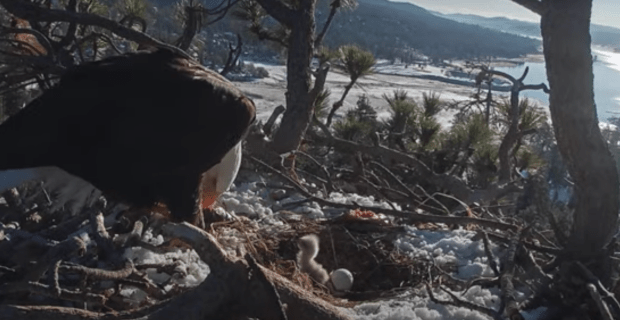
Saturday morning in Bird World

16 April 2022

The sun is shining bright and there is a possibility that some of the snow will melt. The garden remains full of Juncos! They are all over our City trying to find food at feeders. People have been posting images of Robins eating suet. Poor things. Their migration should have been a good one without the snow storm! This morning, however, there have been about 30 Crows on my street. It is believed that the Great Horned Owl could be in the neighbourhood. They will escort it out!

At the NE Florida Bald Eagle nest of Samson and Gabby, Jasper fledged this morning at 11:12:49!

Rocket watches as Jasper opens up her wings.

And she’s off! Congratulations.

The UFlorida Osprey nest reminds me of Port Lincoln when you had Bazza, Falky, and Ervie lined up eating.

Dad arrives with a nice fish for breakfast.

Mum cheeps at him to leave moving the fish to the other side. Little Bit is right up front and is getting some of the first bites.

Little Bit just gets itself up to the front. Oh, he reminds me of Ervie!

I took a short video clip of one feeding. This nest – so far – really makes me happy.

Dr Sharpe is going up to fix the West End camera today so that we can continue to observe Thunder and Akecheta’s triplets. One of the eaglets has slipped off the left side. Thunder knows where it is and it is hoped that Dr Sharpe can put the baby back in the nest. Send best wishes their way!

Telyn laid the first egg of the season for her and Idris at the Dyfi nest about an hour ago!

There it is!

Little Middle has been over nibbling on one of the pieces of fish on the nest.

For those of you worried about the absence of the female eagle at the Duke Farms nest, she was in the nest this morning feeding the only eaglet. All is good!

Teo visited the only Osprey nest in Latvia!

Teo has been bringing fish to the nest. Two females have been seen at the nest and there was a mating attempt with one of them but there is no confirmation that either were Teo’s mate, Vita. We wait for her to return from her migration.

Here is the link to the Latvian Osprey cam near Kurzeme:

Wow. They are sure beautiful. Is it possible that we are looking at the difference in size now between the male and female juvenile Ospreys? Little Mini in the back with his long legs and Middle the larger female at the front?

Little Mini took off at 07:40:38 for a trip around the nest. He will take his 2, 3rd, and 4th flights today after fledging yesterday. So far Little Mini flies at 07:40;39, 08:06:57, and 08:07:59. you can go back and rewind to see this magnificent bird get the air under its wings.

Middle is watching Little Mini. Look above the palm tree on the right. You can see him.

It is going to be a perfect landing!

There is a theory about males flying first. Since the females are bigger 1/3, it takes longer for all their feathers to grow in compared to the males. Therefore, the males tend to fledge earlier.

Little Mini wants to fly again and again. Both chicks would like a big fish delivery, too!

Here is the link to their camera:

Karl II and Kaia are happy to be reunited in their nest in the Karula Forest in Estonia. They are so beautiful. Last year Karl II and Kaia raised three storklets to fledge from the three eggs that hatched.

Here is the link to their nest:

Suitable trees for nesting are becoming a real issue for all manner of bird species including Eagles, Ospreys, and Black Storks. Here is an article about this issue in Estonia. This is one of the reasons that many, including David Hancock at Hancock Wildlife and Ron Magill, Miami Zoo, are looking at alternative artificial nests.

Do you watch the Osprey nest of Alma and Ossi in Finland? Nesting materials are arriving.

Alma and Ossi have raised eight osplets to fledge since 2017. Here is a link to their streaming cam:

There is absolutely so much happening that it is impossible to keep up with all of the changes. While I am watching one fledge, another could be fledging on a different nest! It is a crazy time – but a good one.

Thank you for joining me this morning. All of the nests look good. Take care. See you soon.

Thank you to the following for their streaming cams where I took my screen captures and video clips: UFlorida at Gainesville Ospreys, NEFlorida and the AEF, DHEC, Captiva Ospreys and Window on Wildlife, Eagle Club of Estonia, Duke Farms, Dyfi, Latvian Fund for Nature, and Saaksilive.

Big continues her attack at Dale Hollow and other stories in Bird World on Sunday

27 March 2022

Jack brings in yet more toys for the kids as Harriet lays the third and, hopefully, final egg today at the Dahlgren Osprey Nest on the King George V River.

Not to be out done by the Cornell Red tail hawks with their four eggs, the female at the Syracuse Red tail Hawk nest has now laid four eggs! Goodness. While we might want to think that this is a prey rich summer, I had a conversation about Avian Flu with someone who is involved in that research. They said that Avian Flu H5N1, the highly pathogenic strain, is spreading like wild fire. Could the extra egg be part of a natural reaction to this? The general consensus is that 1 out of 3 fledglings survive. Are the hawks laying 4 eggs with the hope now that 1 in 4 survives this year with the spread of the flu? It reminded me of a quote on the Looduskalender Forum byIrene Ripperberg: “Clearly animals know more than we think and think more than we know.”

I had hoped that the afternoon would be a good one for Middle Little. While Little Middle did eat, those feedings did not come without enduring the wrath of Big. At 12:06:54 a parents flies in with a piece of fish. Big immediately goes after Little Middle who will get nothing of that prey drop. At 14:19:13 there is a large fish and a small piece left from earlier on the nest. Little Middle moves and Big goes on the attack. LM watches as Big is fed. By 14:26:47, Little Middle is at the rim of the nest moving cautiously. Little Middle gets a bite at 14:29:00 and a few more bites. Big gets up and Little Middle goes into submission. Big ate the rest of the fish and the tail. Little Middle did have a crop, part of which was left from the morning. Obey flew in with another fish at 15:28:58. Middle was where he landed. He gave Little Middle some bites which LM snatched and grabbed til Obey flew off at 15:32:39. At 17:52:47 River moves the large fish Obey brought in earlier and begins to feed Big. Little Middle moves over by Dad who has arrived at 17:54:24 hoping he has some more food. He doesn’t. Little Middle moves over to the rim and cautiously up to River who gives him some bites.

Big appears to be sleeping. At 18:15:27 – only three minutes later- Big goes into an attack. Oh, how I wish that Big would have just slept. There is hardly any food left – it ate an entire fish!

She tries to get Little Middle’s head to inflict the most damage which despite a large crop she does. Little Middle appears to be quite frightened. Big moves up to eat again. Middle Little must move – Big goes on the attack again at 18:16:11 in spite of having a big crop. Big positions herself so that she can grab Little Middle’s head and she twists it.

I had hoped that the beaking was going to slow down. It certainly does not appear to have anything to do with whether Big is full of not. One of our readers ‘BG’ observed that Big has a much more difficult time attacking Little Middle if she has a big crop which she does in the image below. It is hard for her to go over the top of the back anymore. That said, she was surely determined today and shifted to the side so that she could grab Middle’s head and neck which she shook.

While Little Middle is getting bigger and Big is often so full she can’t do anything, Little Middle must be cautious. And we have to hope that much more food comes on this nest. As it happens what is being brought in is enough for Big but barely enough for Little to have lots which it needs now. Both eaglets are 27 days old today – 28 if you count hatch day.

In the image below, Big is trying to go down to the head on the side at a slightly different angle than the image above. She has strong legs and, in fact, could, if she got wild enough, push Little Middle out of the nest. Despite being full, she simply could not sand that River would feed Middle Little a few bites of scrap fish.

Big is huge compared to Little middle. Look at her legs!

River feeds Big as he pushes Little Middle from the back. Little Middle raises its head and Bit goes at it again at 18:16:25.

Little Middle tries to get away by moving up close to River. River feeds Big. Nothing for Little Middle.

I am putting the image below in as a comparison of the size of the two. There remain many ways that Big can harm Little Middle but let us look at the positive. Despite not getting lots of food and cheeping wanting more, Little Middle did eat and did have a crop. He also had a really good PS this afternoon.

I am continually checking on Karl II and his movements curious as to if he can ‘smell’ or ‘sense’ war and not go to his normal watering hole in the Ukraine.

One of the British that travel to The Gambia to monitor Ospreys, Chris Wood, notes that many of the Ospreys arrive and go right to the same tree that they have done in many years previous. Will this also be the case for Karl II that he will, nonetheless, go to his normal spots despite the war?

Karl II is through Bulgaria, almost. Will he continue through Poland up to Latvia? We wait for the transmissions.

The people of Mlady Buky, The Czech Republic, are awaiting the arrival of their two White Storks. This community is the one who saved the father and the three storklets (originally four but Dad selected) by providing food for them last year.

Are you fond of Goshawks? The Goshawk nest at Riga, Latvia has its first egg today.

For any of the Latvian nests, I urge you to subscribe to The Latvian Fund for Nature’s streaming cams. There is no charge. You can do a search on YouTube and then select the nests you wish to watch. You will get a notice if something happens! There you will also find all of the videos of Milda the White-tailed Eagle at Durbe, her trials and joys.

There is a lovely little video of the adults at the Pittsburgh-Hayes Bald Eagle nest doing a tandem feeding. Oh, I just love this when the parents work together to make sure their chicks survive – if at all possible.

I love Red tail hawks and A Place Called Hope posted this today. I wanted to share it with you. If I were a raptor and needed rehab, I would really like to find myself at APCH.

The second egg for Mr President and Lotus at the National Arboretum Nest in DC is 35 days old. I so hope that this one hatches and the chick survives to fledge. It would be wonderful for this new pair. This is 18:13 this evening. Lotus is being very careful when she rolls that egg!

The following was posted a few hours ago. It looks like there is an internal pip happening. Please send your warmest wishes to Mr President and Lotus for a successful hatch for DC9.

R2 was returned to the nest by Ron Magill at the Miami Zoo. The remaining monofilament was removed successfully from its foot. These images were posted on Ron Magill’s FB page:

How wonderful! So happy for R2. He is sleeping on the rim of the nest tonight.

Everything is fine on the Captiva Osprey Nest of Andy and Lena in Florida. The beautiful juvenile plumage is coming in on both Middle and Little. They are growing so fast! Still no news on what killed Big.

Today, Grinnell protected the egg at the Peregrine Falcon scrape in The Campanile while Annie chased off the intruder. Here is a short video clip of that action.

Cal Falcons just posted another. The couple have been busy with intruders.

And before I close, a quick look at the West End Bald eagle nest of Thunder and Akecheta where the trio of eaglets continues to thrive and grow without a second of discord. Remarkable parenting at this nest!

Look at how big they are. This just brings tears to my eyes. Two parents working together got this fantastic result for Thunder and Akecheta.

It looks like Ervie went out to the water. I hope he caught a nice fish! His tracker continues to work and he remains around Port Lincoln. Joy. Now if we only had news of Falky and Bazza.

Life is good at the nests!

Thank you so much for joining me. My blog may not be out til late on Monday. Hopefully the news will be good at Dale Hollow. Take care all. See you soon!

Thank you to the following for their streaming cams and/or FB or Forum: Looduskalender, Latvian Fund for Nature, Mlady Buky Stork cam, Captiva Osprey Cam, Ron Magill, West End Bald Eagles and the Institute for Wildlife Studies, Cal Falcons, Dahlgren Osprey Nest, Pix Cams, Port Lincoln Ospreys, A Place Called Hope, and WRDC Bald Eagles.

Friday Morning in Bird World

18 March 2022

I am a night owl and not generally up before 07:00. This morning I wanted to check on the status of the Dale Hollow nest. In all the sadness there, it is good to pause and to continue to thank all those amazing ‘bird’ mothers and dads out there. Over the years I have seen them separate chicks, get their mate to help with tandem feedings, and go fishing or hunting themselves to ensure that there was ample food for all on the nest. I am desperately trying to understand the ‘root cause’ of the issues at Dale Hollow that have taken us to this morning. River has come into the nest alerting and Big is still attacking. Rain started at 10:17.

It was a beautiful morning on the Gulf of Mexico at the Captiva Osprey nest in Florida. Lena was up waiting and trusting that Andy was going to get a fish on the nest for Middle and Little (Little and Mini). Andy did not disappoint!

The chicks are full and Lena is going to go for her bath to get off all the fish. Middle and Little look great!

At the NEFlorida Bald Eagle nest of Samson and Gabby, breakfast has arrived. Jasper is being fed and Rocket is self-feeding. If you are new to this nest, the eldest, Jasper once demanded to be fed first and tried to keep Rocket from eating. Rocket became an expert at the ‘snatch and grab’. Rocket even took fish from the parents and was a pro at self-feeding early. Rocket learned great survival skills.

These two have not branched yet but that stage of their development is coming soon.

DG1 has had a few feedings already this morning at the Dulles Greenaway Bald Eagle nest in Virginia. Martin even took a turn at feeding the chick while Rosa had a break.

This little one is alert and ready for some more fish!

There is a second egg but time for pip is passing. Maybe this little one DG1 will be an only child.

There are three eggs being incubated at the Pittsburg Hayes Bald Eagle nest and this week we are on pip watch.

Are you a teacher looking for resources to teach about Bald Eagles? The Pittsburgh Hays Bald Eagle nest has posted a link to the Audubon Resources. Not a teacher? Have a peek. We are never too old to learn!

http://www.aswp.org/pages/educator-resources

The US Steel Bald Eagle nest was built in 2019. Eaglets have fledged from that nest in 2020 (1 fledge) and in 2021 (2 fledges). There are two eggs being incubated on this nest and Dad is on duty this morning.

At the White-tailed Eagle nest in Matsalu National Park in Western Estonia, the breeding couple are on the nest. Last year, two eggs were laid. The first on 20 March and the 2nd egg on the 24th of March. Both chicks died. Cause of death was confirmed to be H5N1, the highly pathogenic Avian Flu.

The White-tailed eagles are extremely rare in the Balkans and it is hoped that this nest is successful in fledging little eaglets this year. Here is a link to the camera:

Milda is at her nest in Durbe Municipality near the city of Liepaja in Western Latvia.

Milda has a new partner this year after losing her long time mate, Raimis, last year after she had laid her eggs. Her new mate, Mr L, and Milda bonded last year. I hope that he is of good help to her and that this nest also has successful fledges this year. There are many interlopers and both eagles have been on alert today.

Everything is great at the West End Eagle nest of Thunder and Akecheta. The three sleepy heads looked around when it was time for breakfast! Like what, is it that time already!?

The to be named chick at the Big Bear Valley nest of Jackie and Shadow is 15 days old today. It is doing really, really well. It is good to keep in perspective the size of this chick compared to DH16, Little Bit, on the Dale Hollow nest. There are stressors on the little ones that cause a lack of feather development or lines in the feathers. This wee one is getting 8 or 10 feedings a day and is extremely healthy.

Big Red is patiently incubating her two eggs in the shade on the grounds of Cornell University campus in Ithaca.

That is it for me this morning. Every nest that we are following is doing well except for Dale Hollow. I really hate to see the Little Bit suffer. Nature is not kind. I hope to have some new Osprey arrivals for you late this evening. There is still no word on the cause of Big’s death at Captiva. We wait for the results.

Take care everyone. Thank you for being with me today.

Thank you to the following for their streaming cams where I took my screen captures: Looduskalendar, Captiva Ospreys and Window on Wildlife, Cornell Bird Lab RTH, Pix Cams, Friends of Big Bear Valley, West End Bald Eagles and the Institute of Wildlife Studies, Latvian Fund for Nature, The Eagle Club of Estonia, Dulles-Greenaway Bald Eagles, and NEFlorida Bald Eagles and the AEF.

Milda lays first egg of 2022!

17 March 2022

This year it seems that couples who have had difficulties in the last year or two are having success. I hope that this is the case with Milda and her new mate at the White-tailed Eagle nest near Kurzume in Durbe Municipality, Latvia.

On the map below you can see Kurzeme in the western region of Latvia.

Last year Milda lost her long time mate, Raimis, right after she had laid her eggs. Milda and Raimis had successfully bred on the nest in 2018, 2019, and 2020. 2021 would have been their 4th breeding season. It is believed that Raimis was killed or injured in a territorial dispute and did not return to the nest.

Milda tried to incubate those eggs in the cold weather without eating. She did so for eight full days. What an incredibly devoted mother. She had to eat and left the two eggs for approximately 5-6 hours in the cold weather of April. To everyone’s surprise, the two eggs hatched. But Milda was starving and there was little food and an on again off again male who watched the two chicks freeze to death while Milda foraged. It was a horribly sad ending for the breeding year but, much was learned about eggs and outside temperature. We also know that these big nests hold a lot of heat.

So this is a new year and Milda has laid her first egg at 18:09 on Thursday the 17th of March. Congratulations to Milda and her mate who I hope is as devoted to her as she is to her eggs and chicks.

The nest is in a forest area high up on Spruce Tree. The region is so beautiful. It will change from winter into spring before your eyes.

You can join in with all the other fans of Milda by going to the streaming cam below. There are some great chat moderators there to help you, too!

White-tailed Eagles are extremely rare in the Balkan Region. This nest has been used since 2014 and it is hoped that this year it will be successful for this fabulous Mum.

This is exciting. I am so happy for Milda. Thank you for joining me!

Thank you to the Latvian Fund for Nature for their streaming cam where I took my screen captures.

Monday in Bird World

07 March 2022

There was a lovely soft glow from the sun rising over Big Bear Lake when hick at 05:53.

Shadow does a fabulous job feeding his baby. You would think that he would have fed dozens of chicks by the ease that he takes care of this little one. So delicate.

Everyone was anxious to get a glimpse of the egg as Dad fed the 3+ day old chick. That egg is 40 days old today and that is late for a second egg to hatch. It might not happen and, in the long run, one really healthy chick, able to get under Mum and Dad during bad weather is fine with me! There has been some speculation that the chick you see in the images is actually the chick from egg 2, hatched at 37 days making the remaining egg 44 days old. No one will ever know for sure. What matters most is that Jackie and Shadow have one gorgeous healthy baby!

Jackie had a nice break and returned to feed the chick its second breakfast at 07:16.

Turn around little one!

That wee one had its third feeding around 08:27. The bites are getting a little bigger and the feedings are now a little longer. The baby is growing. It will be four days old this afternoon.

Big Bear has posted a short video of Shadow feeding the baby yesterday:

While the weather looks promising in Big Bear Valley, it is soaking wet on the border of Kentucky and Tennessee at the Dale Hollow Nest. River is having to be a huge umbrella trying to keep those very active chicks dry and warm.

It is also wet but, not soaking, in Ithaca at the nest of Big Red and Arthur. Yesterday Big Red and Arthur worked on the nest. Arthur even brought in a prey item for Big Red which she happily accepted at the nest quickly flying off to enjoy it.

We have not seen Ervie at the Port Lincoln barge. His tracker is due an update but for now we have the one for the 4th of March which shows him still staying along the North shore.

The White-tailed Eagles up in Latvia and Estonia are mating and defending their nests. These eagles do not migrate. I am particularly excited about Milda who lost her long time mate, Raimis. She has had several potential suitors. I hope that this year she raises a successful clutch. Her and what appears to be her new mate, Mr S, were mating early this morning at the nest near Durbe, Latvia. Indeed, these two have been mating on or near the nest for at least a week now.

This is the link to the streaming cam of Milda’s nest near Durbe:

It isn’t noon yet on the nest of Ospreys Andy and Lena at Captiva and already the three osplets have had three feedings this morning. Big Bob has been at Little Bob once in awhile but all three have eaten well. Little Bob isn’t going to let Big Bob dampen its day!

The fish that Andy has been bringing in this morning are Mullets, a common fish for the Ospreys in the UK, too.

Look at how big these three are getting! Wow.

Lena is doing the best she can to keep her growing Bobs in the shade away from the hot sun on the Florida coast this morning.

There is so much going on now with the birds and their nests. Eggs are being incubated by Bald Eagles throughout the US. The eagles in Europe that do not migrate are working on nests and mating. The European Ospreys who winter in the Iberian Peninsula and Africa are beginning to migrate home. Who will land first in the UK is the common question on everyone’s mind. Of the streaming cams, my vote is on Maya and Blue 33 at Rutland Manton Bay. Richmond and Rosie continue to try to build their nest amidst the ever growing thievery of twigs by the Corvids. It is a very busy time. Annie and Grinnell are bonding. I am not happy with Big Bob’s recent hostility to Little Bob at Captiva and the same is happening at Duke Farms albeit the chick is younger and fighting to get some fish. Little Bob will be fine. Send positive wishes to Duke Farms!

Thank you for joining me this morning. Take care everyone. See you soon.

Thank you to the following for their streaming cams where I took my screen captures: the Latvian Fund for Nature, the Cornell Bird Lab and RTH, Captiva Ospreys and Window on Wildlife, Friends of Big Bear Valley, Duke Hollow Lake Eagles, and Port Lincoln Osprey Project FB Page.

Monday in Bird World

It is -10 C on the Canadian Prairies on a day that can only be described as white. There is no colour in the sky and while I had anticipated including images of a different landscape due to melting, well, that hasn’t happened. The snow appears to be melting from the inside of the snow banks and tunnels slowly – which is a good thing! Today and for several days this week, we will continue having yet more of the white fluffy flakes. It has – weather wise – been a winter we will not forget for a long time.

I have been reading Mark Avery’s blog. Avery spent his life working with the RSPB in the UK and is an outspoken defender of ‘nature’. He was their Conservation Director for 13 of the 25 years he worked for them. I will include the link to his blog at the end. The current topic is ‘Alternatives to grouse shooting’.

Avery also includes a short list of books he has read and their reviews at the bottom. One of those was The Consolation of Nature. Spring in the Time of the Coronavirus. Three nature writers – Michael McCarthy, Jeremy Mynott, and Peter Marren – keep a ‘nature’ diary running parallel with happenings with the pandemic for the period of spring 2020. They begin with the astronomical beginning of spring on the 21 March running through 31 May when summer begins. (Meteorological beginning of spring is 1 March). My interest in this book is the emphasis on the healing aspects of nature and how, during the beginning of this horrific virus, people turned to nature for solace. All of us watch bird cams. Did you know that in the UK from the period 23 March to 31 May 2019, there were 20,407 page views of bird cams. During the early period of the pandemic this increased to 433,632 views! It was a similar situation at Loch Arkaig where 400,000 people watched Louis and Aila raise their three osplets. Indeed, it was an amazing year for nature as we isolated ourselves. Few if any planes, few if any cars. When we stopped, nature thrived. “Fish returned to the canals of Venice, no longer churned up by tourist boats. In parts of northern India, the Himalayas became visible for the first time in thirty years as air pollution fell. Baby sea turtles made it safely to the water on Brazilian beaches empty of sunbathers, joggers, and dogs. Wild boar and deer came back into car-free European cities.” As the authors demonstrate, some of those events were significant including “a colossal fall in the carbon dioxide emissions” driving climate change. While the coronavirus spring brought many human losses and great stress, nature gave each of us hope and comfort.

It is a remarkable little book. I highly recommend it but, even more so, I recommend that you begin keeping your own diary of how much joy our beloved birds bring to your life – or it could be the animals or the plants in your garden or a green area you visit. In years to come, it will be a treasure, I promise.

https://markavery.info/blog/

Many of us have never looked back after first watching our bird families on the streaming cams. By watching the daily lives of these families struggling to survive sometimes, we have learned much and it is hoped become more empathetic and prone to fight for a better environment for all of us.

Our first family up this morning are the Captiva Osprey family of Andy and Lena and the three Bobs. Lena was up at day break calling Andy to bring in a fish. She is incredibly loud and Andy could have heard her if he had been in Fort Myers!

I picked the image below not for its compositional beauty but because this morning for the first time, we can clearly see the difference in development between Big Bob and Little Bob. Look at the top of their heads. Little Bob, on the left, still has his soft light grey down. Big Bob has lost his. Soon his head will look like it has been dipped in a pot of black oil with a few copper flecks at the bottom. Big Bob is entering the ‘Reptilian Phase’.

While Lena wanted that fish before 07:00, it was, in fact, delivered at 08:14:39. It was a live Sheepshead.

Lena had a bit of a time with that fish – getting it opened and not flipping about on the kids. Big and Middle Bobs are right up there when she begins feeding. You will see that Middle Bob also has a greasy black Reptilian head like Big Bob. Little Bob is just waking up. Get up there Little Bob!

Little Bob is definitely our ‘Captiva Ervie’. It didn’t take him long to get the sleep out of his eyes and get up under Lena’s beak. Look at him stare at the fish. At least for today, we can easily tell Little from the other two if the trio are in a clump.

Lena was really hungry. She fed the kids for more than an hour and then finished off the fish and ate the tail at 09:49. All of the chicks were passed out in a food coma.

Andy returned hoping there would be some fish left just as Lena swallowed the fish tail! The chicks woke up and were thinking about a second feed. Too late! Big Bob did root around in the nest for scraps eating them as he found them. Wow. That is fantastic.

Lena is currently busy keeping the osplets cool by shading them. She is also hoping that Andy will ring another fish in!

Cornell Bird Lab put together a 15 minute video of Big Red and Arthur frantically working on their nest on the Cornell Campus this morning. It is much better than any still captures I could show you!

Squeezing some of the somber in with the joy, HH3, one of the Hilton Head Island Trust eaglets has died. HH4 is fighting for its life and hanging on by a thread. The test results to determine the cause are not ready yet. The adults are being monitored closely and the Birds of Prey Centre has brought in the Clemson University Vet School to help with the determinations as to cause.

There was a lovely kerfuffle at the NEFlorida Nest of Samson and Gabby this morning. It was fantastic, actually. Jasper (NE26) was eating all of the food. This has been the typical pattern for these two. This morning it was the same- NE27 is on the left with its head down and Jasper is at the beak getting all the food.

NE27 moves closer and does the old snatch and grab and horks all of the remaining prey! He was hungry and was tired of waiting. Way to go 27!

Jasper has been doing a lot of standing and wingersizing. She is definitely getting much more stable on those legs.

Gabby and Samson sure make beautiful babies. I just love the pantaloons on Jasper.

The more I watch the Dale Hollow nest the more I am loving this family. Obey comes in to check on River and feeds her. That reminds me of Blue 33 feeding Maya at the Rutland Osprey nest. Then River and Obey feed the chicks in tandem. The life experience of these two eagles, well into their 20s in age, really shows when dealing with the health and welfare of their chicks. Just wonderful. The third egg is 36 days old today and it is almost hatched!

Another tandem feeding this morning.

Continual aeration of the nest cup to keep it soft and bring oxygen in.

River feeding the twins.

Oh, just look at them. They are so cute, fluffy, and a little chubby. Perfect!

There are currently more than 3,044 persons watching and waiting for a pip at the nest of Jackie and Shadow in Big Bear Lake, California. The eggs were laid on January 22 and 25. That makes them 34 and 37 days old. The average time for pip is between 34 and 40 days so we are still right in the sweet spot for hatching. Good luck Jackie and Shadow! Your fans are cheering.

It is difficult to avoid the news. My heart goes out to any person caught in a conflict zone. It is difficult to avoid the war zones in Africa where our birds migrate to for the winter and now, as they begin to return to their homes in Latvia and Estonia, many have historically spent time eating and resting in the Ukraine. This is the map of Karl II’s family migration this past summer. Many of the other birds that migrate to Africa follow a similar route. Wildlife suffers irreparable harm, like ordinary citizens, in times of war.

Here is a detailed study of wildlife in conflict zones and the need for conservation. It is a good first read to understand the challenges that nature and wildlife undergo when there is war. I hope that you are able to open it.

https://esajournals.onlinelibrary.wiley.com/doi/am-pdf/10.1002/fee.1433

I will close as we wait for a pip at Big Bear and the final hatching at Dale Hollow with a closeup of Dad at the Port Lincoln Osprey barge. Dad spent considerable time on the ropes yesterday. I cannot help but imagine that he was hoping to catch up with Ervie and see how he is doing. You can certainly tell where Ervie gets his good looks from!

It has warmed up to a balmy -8 C. Serious spring weather and I am off to get more bird seed and go for a much needed walk. Please take care everyone. Thank you so much for joining me today.

Thank you to the following for their streaming cams or FB pages where I took my screen captures: Port Lincoln Osprey Project, Dale Hollow Bald Eagles, Captiva Ospreys and Window on Wildlife, NEFlorida Bald Eagles and the AEF, Cornell Bird Lab, Friends of Big Bear Valley, Bald Eagles 101 FB, and the Latvian Fund for Nature Forum.

Late Wednesday and Early Thursday in Bird World

1.23-24.2022

I have to admit that I can’t stay away from the Captiva Osprey nest for long. After dinner, I decided to stop in and see what I had missed. It was two things! There was a fifth feeding. The last two ran together and the fish were lovely Mangrove Snappers. The other one happens around 12:33 nest time. Little Bob is in the back. Big and Middle Bob are not that interested in food. Lena begins to cut through the two older chicks and she feeds Little Bob full to the brim. The other two paid absolutely no mind.

All the thoughts that keep going through my head keep asking: Is this a clutch of three males like Port Lincoln?

You can see that Little Bob’s crop has filled up in the image below.

That was an excellent feeding for Little Bob. The fifth feeding so close to the fourth insured that Mum also had some fish before she went to bed. Marvellous family working so well together!

After all my praise for Andy having a fish right at the dawn, today Lena called and no answer. Andy flew in with a fish at 09:07:36. Lena checked a couple of times, each returning to brood the kids. In the image below she knows that Andy is coming with a fish.

It is now 11:30 nest time. Lori, the owner of the property, has posted on chat that Andy is below the nest in the mangrove eating the head of a huge fish. Looks like the kids will have a big lunch! Despite the late breakfast, the trio were well behaved. Just like Port Lincoln.

Here is that big fish being delivered at 11:37:08. No doubt Lena is going to fill herself and the nestlings up to the brim! Nice one, Andy.

It took a few seconds for Little Bob to wake up and get himself around to the side where Lena is feeding. Ah. Now they are all lined up. It looks like it will be another great day at Captiva!

Oh, Little Bob got himself right up to the front so he can get lots of fish! Just like Ervie. Gosh, I miss Ervie. That Port Lincoln Osprey nest is so lonely.

Big Red and Arthur continued work on their nest today – almost at a frantic pace.

You can really see the nest cup much clearer at night.

Big Red and Arthur are on the edge of a system that could bring up to 30 cm or 12 inches of snow to the Northeastern parts of the US. It looks like it could just miss them. Fingers crossed.

It looks like Big Red and Arthur might have escaped the storm.

The Dahlgren Osprey nest of Jack and Harriet now has its streaming cam live. You might recall that Jack brings in a lot of toys to the nest. Sometimes there is so much stuff that the eggs get lost in the jumble. This year there is a brand new platform for the Ospreys to fill up! You can see it in the image below in the link to the streaming cam.

It is 08:52 in Big Bear Lake, California. The sun is filtering through the snow covered nest of Jackie and Shadow. That nest is 44 metres or 145 feet up at the top of a Jeffrey pine tree. You can see the eggs as they are being gently rolled. It will be hatch watch for Jackie and Shadow this weekend. Thousands are holding their breath for this couple in their quest to raise eaglets.

Egg 1 was laid on 22 January with egg 2 laid on the 25th.

Here is the link to Jackie and Shadow’s camera if you do not have it on your list.

There has been a fight between two White-tail eagles on the nest of Milda near Durbe in Latvia. It was posted as a short video on YouTube. It was a younger eagle, perhaps 4 or 5 years old, fighting with Mr S. Thankfully Milda was not involved.

It is snowing on Bonnie at the Great Horned Owl nest in Newton, Kansas. The one egg of Bonnie and Clyde was laid on the 16th of February this year. Last year, the couple fledged two fantastic owlets, Lily and Tiger. They have taken over the nest of a young Bald Eagle couple.

The human made nest at the WRDC is looking a little bare to the wire this morning. R1 and R2 – Rita and Ron’s kids – are looking good. It is lovely to see them doing so well. I know that many of you worried, like I did, about R2 in the early days. He is a big strong creative eaglet. His early attempts at self-feeding really helped.

Kincaid had a Red-eared Sunfish for breakfast this morning at 10:15:18. Like R1 and R2 his juvenile feathers are really coming in now although not as advanced as the Miami duo. He is doing a good job at self-feeding but loves when Anna stays and does the honours.

They are all doing so well. Put a smile on your face! It is so nice that the egg laying is staggered from region to region so that we have the time to enjoy these wee ones growing up into beautiful juveniles!

For the first time in I can’t remember when, all three Grey Squirrels – No Name (the great big one), Dyson, and Scraggles were all in the same area at the same time. I had eyes on all three. Then Little Red ran along the telephone lines. So everyone was around the garden. Dyson was eating on the solid seed suet and in the snow and Scraggles was eating seeds on the snow. I took lots of photographs – none of them great quality but, I wanted to find out if any of them had been injured by the cat yesterday. (Of course, that was only an assumption based on the two locations of blood). No Name is fine. Tail in tact, no scars. Both Dyson and Scraggles have tail issues. There are no marks anywhere on Dyson other than his beautiful tail seemingly thin to the skin in one area. I know it is Dyson because of the tufts and his sweet little face. You can see what would be a nice solid busy tail. It doesn’t quite look like it does when Dyson is moulting.

Little Scraggles seems to look the same as it did the other day. So I think that it was Dyson caught by the cat.

Dyson is fine! He is vacuuming up every seed he can find! It is such a relief.

And we are now heading out to fill up all the feeders so there will be more for him. It remains terribly cold here. It is now only -23 C but temperatures are dropping throughout the day to -31.

Take care everyone. Thank you for your warm wishes for the injured squirrel. Tails will grow back!!!!!!! No real damage done, thank goodness. See you soon.

Thank you to the following for their streaming cams where I took my screen captures: Window on Wildlife and Captiva Ospreys, KNF Bald Eagles, WRDC Miami Eagles, Dahlgren Ospreys, Cornell Bird Lab, Friends of Big Bear, Farmer Derek, and CNN Weather Tracker.

Friday in Bird World

The Lost Words is a book by Robert MacFarlane, Fellow at Emmanuel College, Cambridge. Its focus is on the words that the editors of the Oxford Children’s Dictionary removed. Its 128 pages, 27.9 x 37.6 cm in size, are gorgeously illustrated with the watercolours of Jackie Morris, writer and illustrator, who lives in Pembrokeshire, Wales. The missing words that concerned MacFarlane are the following: acorn, Adder, Bluebell, Bramble, Conker, dandelion, fern, heather, heron, Ivy, Kingfisher, Lark, Magpie, Newt, Otter, Raven, Starling, Weasel, Willow, and Wren. At a time when our focus as adults should be to strive to install the wonder of the natural world and our responsibility to it in the children, why, then, would anyone choose to remove words that are directly connected with our environment.

I mentioned this book awhile ago. I have returned to it many times always admiring the illustrations, such as the images of the Ravens on the forest floor amongst the fallen conkers. Conkers are the fruit of the Horse Chestnut Tree, Aesculus hippocastanum. Horse Chestnut trees can grow quite large. Ironically, the conkers are poisonous to horses and I believe, all other animals. The type of poison is called esculin.

That illustration conjured up a beautiful memory of the time my family spent in England. Up on the gorse was a Conker Tree. We had never seen conkers – it was something wonderful and new. The children played a game with them. First you had to drill a hole and run a cord through the conker and secure it with a nice big knot at the bottom. The children would then ‘conk’ their conkers trying to see whose would break first! It was free entertainment and kept them busy for hours.

“Conkers on a string” by MrsEds is licensed under CC BY-NC-SA 2.0

Creative Commons had this historical picture of two young lads trying to break the others’ conker.

“Its conker time” by theirhistory 

The rolling hills with their public paths were marvellous places for the children and the adults to take walks and breathe in the air. We were fortunate to have a ‘gorse’ within 50 or 60 feet from where we lived. It was full of butterflies and birds and the most delicious blackberries. It was a time when children played outside with their mates. No one set in front of the telly or spent hours looking at screens. Bikes were ridden and trees were climbed. In the three years we lived in Lincolnshire, it snowed once. There was about 4 cm on the ground – just enough. Still, everything stopped. Children stayed home from school and anything and everything that could be used as a sled was used to slide down the hills of the gorse. I wonder what all those children would think about the snow in my garden today?

The nice thing about snow is that it can cause people to slow down. To enjoy a cup of hot tea and a book. To stop running around worrying about things that are not always that important, to pause long enough to take in the moments.

It seems like it is rather quiet in Bird World but, is it really? Eaglets are growing bigger by the day all the while their plumage is changing. Thankfully, none are ready to fledge. E19 and E20 spend time flapping their wings as does the Osceola eaglet. Other eagles are incubating eggs. It is not time for Osprey season unless they are in Florida. Diane is incubating 3 eggs at Achieva in St Petersburg while Lena, laying hers a month early at Captiva, will be on hatch watch this weekend. Annie and Grinnell are only dreaming of eyases. Today Grinnell had to tell a 2 year old juvenile female to get off the ledge of The Campanile. Cal Falcons posted a video of that encounter.

Ervie continues to fish call off the barge at Port Lincoln. We can hear him but we cannot see him.

Kincaid is 29 days old today. He is starting to walk. It is so cute to see those first ‘baby steps’. Louis brought in what looks like an egret (or a part of an egret). When it looked like Louis might want to eat some of it, Anna promptly arrived at the nest. To Anna, prey brought to the nest belongs to her and Kincaid, not Louis who brought it! Anna is pretty strict in that regard. Not all female Bald Eagles behave that way. Anna proceeded to try and remove one long leg while Kincaid, with an already large crop, waited patiently.

Kincaid is mimicking what Anna is doing as he grabs the other leg and pulls on it. So cute. Kincaid also keeps himself busy moving around nesting material. These little eaglets learn from watching the adults.

Kincaid is already making attempts at self-feeding.

Kincaid is, of course, not the only one trying out eating by itself. I posted an image of R2 at the WRDC nest a week ago eating a fish. The eaglets of Harriet and M15 are also attempting eating on their own. E20 has become a bit of a pro. It seems like all of the eaglets grew up faster than they have ever done previously. Does it seem that way to you?

At the White-tailed Eagle nest of Milda and her new mate near Durbe, Latvia, the snow has melted. Milda will be laying her eggs about the same time as Big Red in Ithaca, New York – the third week of March – if all goes to plan.

There is more snow forecast for Big Red’s territory. The temperature in Ithaca is 1 C.

What I like about the image below is that you can see the nest cup area that Big Red and Arthur have been working on. In Milda’s nest sprigs of pine with their cones line the area of the egg cup. It is so fascinating watching the couples prepare for the upcoming breeding season. It is so intriguing. I would love to ‘speak hawk’ and sit by Big Red and Arthur when they discuss what needs to be done!

At least five eagles poisoned, one dead, four in serious condition in Manchester Maryland. Was this lead poisoning? or was this something else more sinister to impact all of the birds at the same time? There is an investigation underway.

Here is a short informative video of why eagles eat carrion in the winter.

https://fb.watch/b6jnYJByKa/

There is good news coming out of Australia about WBSE 27. You might remember that twice, after fledging, 27 was taken into care. 27 was not taught by the parents to take care of itself. Once 27 fledged, it was taunted and chased by the Pied Currawong. Both times 27 was extremely dehydrated. The last time the Currawong had gathered and had pecked 27s head. When 27 was taken into care the last time, I hoped that rehabilitation would include flight training as well as training for getting prey. This takes longer than a two week stay in a clinic. Some wildlife rehabbers keep birds for 2 years to make certain they are capable of caring for themselves with confidence. It looks like 27 is getting that great training. The news is excellent!

Isn’t she lovely? And – yes – 27 is a she!

I wish that all of the sea eagles that fledge from the WBSE nest in the Sydney Olympic Park would not be harangued by the Pied Currawong. They chase them out of the forest. They never learn to fly or to catch prey. How many of them survive, if any, unless they wind up in care?

The camera is now working again at Port Lincoln. Ervie was on the nest and, at various times, in the shed with Dad. Sometimes he was in the shed alone. I cannot tell you if he had a fish but there was definitely a lot of fish calling.

Checking in on Jack and Diane at the Achieva Credit Union Osprey nest and Jack is busy delivering fish and helping incubate the eggs.

If you are into garden animals and song birds, with a few surprises, you might want to check out Wildlife Kate. She has several wildlife cams and is featured on Springwatch in the UK. Have a look. You might find something really interesting like Yew Pond, or the Kestrel Box, or the Woodland Pond.

This is Woodland Pond. The cameras are live with no rewind. Enjoy.

https://www.wildlifekate.co.uk/

I haven’t posted anything about the eaglet at Berry College for a few days. Thermal down is coming in nicely. Pa Berry did a great job feeding the little one this morning. B15 is still walking around on its tarsus (not yet with its feet) and doing a lot of preening. B15 is doing great. Missy and Pa Berry are doing a great job raising this baby.

B15 is a sweet little eaglet. You can see how its plumage is beginning to change.

I will leave you with a gorgeous image of Jackie incubating her eggs at Big Bear Bald Eagle nest in California. Fingers crossed for a great season for her and Shadow!

Thank you so much for joining me today. Take care. See you soon!

Thank you to the following for their streaming cams where I took my screen captures: Friends of Big Bear, Achieva Credit Union, Wildlife Kate, Cornell Bird Lab and RTH, Berry College, Port Lincoln Osprey Project, KNF, Latvian Fund for Nature, and Sea Eagle Cam FB Page.

Late Monday in Bird World

The ‘Alberta Clipper’ is just starting to impact Winnipeg with some light snow flakes. We are in an extreme blizzard warning area until tomorrow morning when the winds and snow – getting up to 90 kph (or 55 mph) – dissipate. The garden birds were a little strange today. They ate and left. Normally they come and stay all day but a couple of waves of different groups came and went. I suspect they were going to try and find a place to hunker down for the duration. This storm system is also going to impact a huge part of the US including my childhood state of Oklahoma.

It is snowing on the Storks near Freiburg, too.

There is wind and blowing snow in Durbe, Latvia, the home of Milda, the White-tailed Eagle. The sound from the camera’s microphone makes you shiver – the wind is just howling through the forest.

The female Bald Eagle at Duke Farms is also under some snow and it looks like she might get more as this weather system moves through the eastern US.

There is good news in Bird World. Both of the USS Bald Eagles were seen at the nest today. The worry last night over whether or not there was an injury melted away. Nice.

The thermal down is coming in on the eaglet at the KNF in Central Louisiana. The light natal down is giving way to dandelions. Notice how much longer the beak is and how large the cere has become. The cere is the soft fleshy part above the black beak, seen below. The cere varies in shape, size, and colour amongst raptors. The beak will turn that beautiful yellow when this eaglet is approximately 4-5 years old and be pure yellow by the time it is 6 years old. At that time, it will also finish getting its adult plumage including that full beautiful white head.

The meals are more spread apart but the eaglet is eating longer and its crop is getting much fuller. Just look below. The crop is a pouch along the espophagus. It stores food before it gets to the stomach. It also processes prey items that cannot be processed in the stomach. The raptor will regurgitate a compressed pellet of those items that do not go to the stomach.

The Wildlife Biologist has just confirmed that this crop is at least 3-4 inches (10 cm) long! Wow.

Poor Baby. It took some maneuvering with the weight and flopping of that crop for it to get in a position to PS. Obviously the crop weighs more than the chick’s bottom does.

This baby has really grown in the last 4 or 5 days and is changing more and more with every blink it seems.

Despite being full to the brim and hardly able to move, Anna is making certain that the little one is topped up before bedtime.

NE26 and 27 are awash in Spanish Moss. The nest seems to be covered with it and fish. Lots of fish.

There are those sweet little fluffy dumplings in the nest bole.

Sleeping quietly under Mum.

At the WRDC Nest in Miami, R1 and R2 have popping crops, too. The pin or blood feathers can be seen coming in through the thermal down.

R1 is closest to you. R2 without the fluffy hair is in the back and also has a large crop. Both eaglets are doing well and there is plenty of food on the nest.

The 2022 Albatross Count on Midway Atoll is completed. Here is the information as it was posted by Friends of Midway Atoll National Wildlife Refuge today:

YRK flew in and switched places with OGK yesterday at the Royal Albatross Quarry Track Nest in New Zealand.

Lady Hawk caught that sweet reunion.

The camera is still offline in Port Lincoln. Would love to have had a good look at our Ervie.

Tuesday February 1 is Lunar New Year for many of our friends. For all of you celebrating the Spring Festival, we wish you a healthy, happy, prosperous Year of the Tiger.

Thank you for joining me today. So happy to have you with me. Stay safe, stay warm!

Thank you to the following for their streaming cams where I took my screen captures: Cornell Bird Lab and the NZ DOC, Friends of Midway Atoll Wildlife Refuge FB Page, KNF Bald Eagle Nest, NEFlorida Bald Eagles and the AEF, WRDC Eagle Cam, Duke Farms, Latvian Fund for Nature, and the Stork’s Nest Livestream.

Sunday in Bird World

What a Saturday afternoon and night. It was such a huge relief to find Anna on the Bald Eagle nest in the Kistachie National Forest and that there had been either a misidentification or that Anna and Louis switched places at dawn. Whatever happened- Anna is alright. Both birds were stressed on Saturday. It is unclear what was the cause or was it a multitude of things together – humans, gun shots, other intruding birds or animals.

I just love the image below. Everyone is so happy and relaxed this morning.

If you are watching the KNF nest, listen for the ‘laughing’ frogs. They are actually called Southern Leopold frogs but because of the sound they make, they are nicknamed laughing frogs. I hope to goodness that is the only sound that the nest has to hear besides eagles today!

The eaglet is enjoying some of the duck that was delivered earlier.

Eaglet is in food coma. Hopefully by this time next week, this baby will have a name!

The Wildlife Biologist says this afternoon that Anna and Louis would not have made their nest in a place if they were bothered by humans being around. Yesterday was, however, different from any other time that I have watched this nest – last year and this.

I know that many of you are stork lovers. Did you know that there is a live streaming cam with storks at Dreisamtal, about 10 kilometres east of Freiburg, Germany? A pair of storks make their nest on the roof of the Church of St. Gallus. Normally the couple arrive in February but this year, they returned on New Year’s Eve 2021.

The couple come and go for foraging. They sleep on the nest at night. Here is the link to this camera to calm all of your longing-for-storks-to-return!

What gorgeous plumage these Storks have. Incredibly beautiful!

Ervie had a full crop and was being blessed by diamonds all around. Oh, our glorious boy! He has quite the crop in that image. While there are few fish deliveries captured on the streaming cam, it is now believed that Ervie is catching almost all of his fish himself.

Dad does still continue to deliver a fish on occasion when Ervie is crying on the nest. Ervie loves being an ‘only child’.

The other day a word showed up in respect to Ervie – extreme philopatry. Yes, it is possible that Ervie is tied as tight as he can, more than others, to this very nest and that he will not wander too far afield like Falky has done. Indeed, one day we might see Ervie as the adult male on the barge with his own family.

Look a Ervie’s crop! Our young man is doing well. It is a relief to imagine that Ervie is an excellent fisher now.

At the Achieva Osprey nest in St Petersburg, Florida, everyone is waiting for the first egg to be laid this breeding season.

Of course, we are also waiting for Big Red and Arthur to begin working on their nest. It is, actually, awhile still. Last year Big Red laid her eggs on 26 and 29 March and 1 April! So we have about 7 weeks and a few days til our beloved Red-tail Hawk is incubating.

About the time Big Red is laying eggs, Iris will be returning from her winter migration. It is a snowy cold day in Missoula. I hope Iris is enjoying the warmth of her winter home.

At this very same time – as Big Red lays her eggs and we are on watch for Iris to land on her nest, Milda will be laying eggs on the White-tailed eagle nest in Durbe.

When I looked at my calendar and saw those three events – Big Red, Iris, and Milda – there was a big exclamation mark. Of course, all of the Ospreys and Storks will be returning from their winter homes to breed in the UK and Europe! It is going to get really, really busy.

For now, I will turn my attention back to the Bald Eagles. I don’t think NE26 is being an angel but it appears that s/he is not a ruthless brute either to NE27 – that is all good. Samson continues to have the pantry full and the fuzz balls nothing short of adorable.

In the image below, NE 26, the tallest, was trying to peck at 27. 27 did a pretty good job of standing up to its big sib. Bravo!

NE27 still has quite a dominant egg tooth. Sweet little babe with the golden glow of the morning sun shining on it.

A banana leaf was brought on to the WRDC nest. R1 thinks it makes quite a comfortable bed! So cute. It kinda’ fits with having a Papadam Chair for a nest.

R1 and R2 with their charcoal thermal down are growing and growing. Both are eating well and Ron has just brought a nice big fish on to the nest. It will not be long til these two eaglets are walking with ease around the nest. Just look at how big R1 is – looks like Hulk.

The eaglet at Berry College is wanting to have an afternoon snack and is looking intently at what the adult is plucking on the nest. This little one is a real little sweetie. Look at that lovely soft down head. You can see the thermal down coming in on the body of the eaglet. In a couple of days that soft light grey down will be nothing but dandelions!

And, last for today, if you are a Thunder and Akecheta fan, Thunder laid her first egg at the Channel Islands Bald Eagle Nest at 16:54 on 29 January! This is Cheta’s third breeding season and he no longer minds incubating the eggs. Last year the Ravens (or Crows?) got the eggs so this year, hopefully, neither adult will leave them alone!

Here is the link to the Channel Islands streaming cam:

Whew. All is well at the nests. Thankfully. It is supposed to warm up and start snowing on the Canadian Prairies in a short time. It is a good day for a walk out in the fresh air!

Thank you so much for joining me. Take care everyone and just breathe a sigh of relief. Anna is fine.

Thanks to the following for their streaming cams where I took my screen captures: KNF Bald Eagle Nest, Berry College, Port Lincoln Osprey Project, NEFlorida and the AEF, WRDC, Explore.org, Latvian Fund for Nature, Montana Osprey Project, Cornell Bird Lab, Achieva Credit Union, and Storks Nest Live Stream.