Sadness on the WRDC Nest and other Bird World News

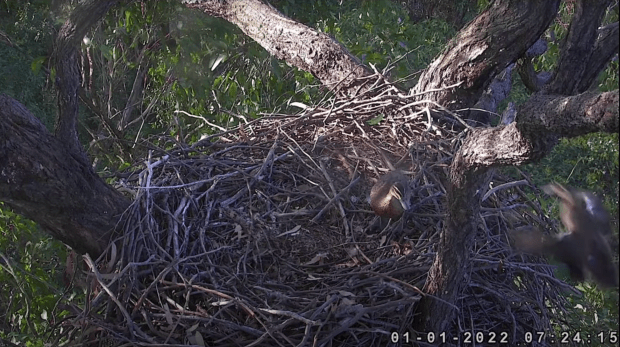
Yesterday we celebrated the arrival of R3 on the WRDC in Miami-Dade County. The third hatch of Ron and Rita did not make it and died. It would be seriously impossible to tell what caused the death. The nest cup is so deep and narrow that it might have just been suffocated. We will not know for sure. Rita removed its body from the nest cup at 11:18 this morning and placed it along the rim of the nest at 06:00. It will probably become part of the nest unless Rita or Ron remove the body completely from the nest.

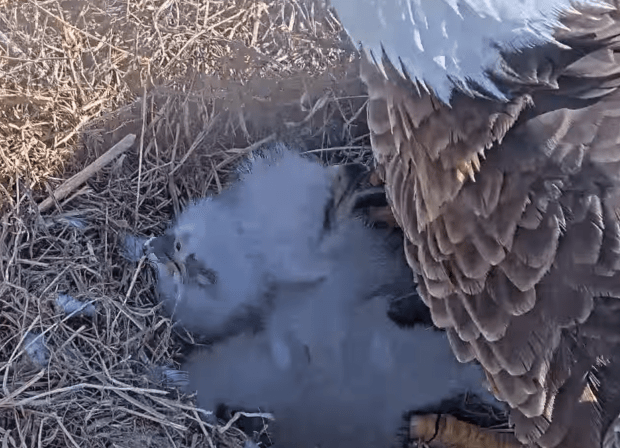
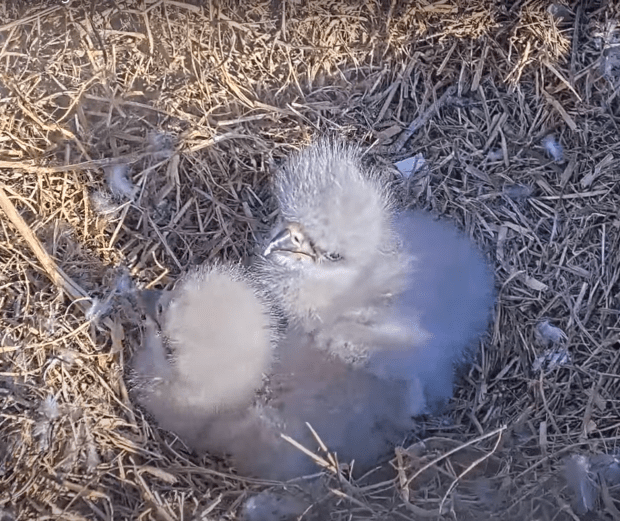
R1 and R2 are healthy and growing. Let us celebrate that! As you know I had hoped that R3 would not even hatch. It is always better to have strong healthy eaglets, fewer of them, than more not so healthy.

It is also wonderful that the adults continue to work on this nest. Spanish Moss is coming in to fill up the nest cup and make everything soft while branches are going up on the side. I was a little worried about these curious Rs climbing on what appears to be chicken wire like construction. Yes, just another worried auntie!!!!

Rita looking lovingly at her two surviving chicks, R1 and R2 after R3 passed.

At the time, I actually thought that R2 might have been dying but it was only in a deep food coma. Seriously, I almost panicked. Thankfully, both chicks are fine as you can see from the time stamp above. They have been eating a green parrot and fish.

As the day progresses, the heat comes on the nest. Rita is busy helping R1 and R2 stay cool. As we know from the heat wave going through the Pacific Northwest in May and June of 2021, heat can cause bird deaths. In Canada, many jumped from their nests to avoid being ‘cooked to death’ during that heat wave. It is currently 27 degrees C in Miami with a chance or rain. These two little ones are unable to regulate their own temperatures so the parents must help them.

Here is the link to the WRDC nest:

Anna and Louis are approaching pip watch and official hatch watch (is there a difference?) tomorrow. The KNF Wildlife staff posted this notice on their FB page this morning. Steve and Cody, the Rangers who maintain the cam, appear to be super excited. So am I!

Here is the link to the KNF nest. There is one egg for Anna and Louis as the second egg was broken by accident when Anna landed one day. They fledged their first chick last year, Kisatchie. Kistachie was the first eaglet to hatch at this nest since 2013. Incredible. It is a beautiful nest close to Kincaid Lake in central Louisiana and belonged to an elderly Bald Eagle couple that quit using it in 2013. Louis and Anna arrived and then last breeding season returned to take over the nest and raise their family. Louis is an excellent fisher! No shortage of fish. Indeed, last year this pair could have started a fish exporting business to other eagle nests as they had way too much food!

Here is the link to their camera:

Well, gosh. There are going to be a lot of little eaglets hatching in the next week. I could not even begin to count them but we have Captiva and, of course, my faves, Samson and Gabby up at NEFlorida.

It is windy and there are showers near the Jacksonville nest of Samson and Gabby today. It is currently 15 degrees C – wow. That is a whole lot cooler than Miami or Fort Myers who are both reporting high 20s today.

Here is the link to Gabby and Samson up at the NEFlorida Bald Eagle nest near Jacksonville. They are a great couple to watch. I put them and Harriet and M15 right up at the top of the ‘do not worry’ list. For those of you that do not know, this was the adult male, Samson’s, natal nest. He has great DNA. His parents were Romeo and Juliet. Samson hatched 23 December 2013. He returned with his mate Gabby after the 2018-19 sadness with his parents. The American Eagle Federation gives this account, “However, the 2018-2019 season was very different, as several large mature eagles disturbed the peace and tranquility of this nest. The expectations of the season ended in heartache as Juliet returned to the nest with an injury and was subsequently driven from the nest by a rival just days before the eggs were to hatch, leaving Romeo to do the work of two. When an egg hatched on Christmas Day 2018, a female eagle following Romeo to the nest swooped down and took the hatchling. This was not A2.” The A2 they are referring to is Gabby who later partnered with Samson. Romeo and Juliet raised 19 eaglets to fledge in 10 seasons.

Gabby and Samson raised two their first season, Jules and Romey. They fledged Legacy – one spectacular juvenile – last breeding season. I am really looking forward to this year. Can you tell?

It is hot on the SWFlorida nest of Harriet and M15 today. All I can say about E19 and E20 is that they are absolutely precious. Harriet is keeping them cool.

You can see that Harriet is shading them but the two eaglets have moved into shady patches on the nest, too. They are older than Ron and Rita’s chicks and are moving quickly around this large nest.

Down in Port Lincoln, Australia, there are wee showers. It looks like Falky did have the nest reservation. He spent the afternoon, all evening on the nest, and he will be there, hopefully, to get the morning breakfast fish in about 3 or 4 hours.

Falky and Ervie had quite the dust up yesterday. Falky might have thought Ervie was not going to honour his reservation departure time!

Falky decided to lay down duckling style late in the day.

It is hard to see him but he is on the nest, nearly in the same spot. For some reason they all stand or sleep there. Must be something magical about that space.

Just look at this beautiful fledgling. Se McGregor posted a recent image taken of WBSE 27 by the National Parks and Wildlife Services of NSW. Gorgeous. She is doing well. Let us all send warm wishes for continual improvement. Many rehabbers believe it takes two years to fully train an eagle that has not been trained by its parents. I wonder how long they will keep 27? I hope a long time til this bird is confident and strong.

Annie and Grinnell continue to bond and have total control of their territory. Cal Falcons posted an image of Grinnell with a large crop on the ledge on National Bird Day.

Other than the death of R3, things in Bird World are looking pretty good at noon on a Friday. It is -27 C on the Canadian Prairies dropping to -32 later today. That is exactly 54 degrees C different than the temperatures Harriet and M15 and Ron and Rita are experiencing in southern Florida today. That is a 129.5 degrees F difference! Whew. Temperature extremes.

Thank you for joining me this morning. I will continue to monitor the reservation rota at Port Lincoln! Take care everyone. See you soon.

Thank you to the following for their streaming cams where I took my screen captures: WRDC Eagle Nest, SWFlorida Eagle Cam and D Pritchett, NEFlorida Eagle Cam and the AEF, KNF Eagle Cam, Port Lincoln Osprey Project, Sea Eagles@Birdlife Australia Discovery Center FB Page, and Cal Falcons Twitter Page.

Late Monday and early Tuesday in Bird World

Oh, goodness. Bazza spent the night on the nest in the same spot as Ervie did. Bazza has been there all day waiting for a fish delivery. No one thinks this is unusual – it is Bazza! But, when Ervie did the same thing, we worried. It was out of character for him.

It is windy and the water is choppy today, too. Falky and Ervie are no where in sight. It is Mum and Bazza on the barge. Maybe Ervie and Falky are out trying their luck fishing with Dad.

Ervie will eat that fish tail that he left last night when he wakes up.

Bazza is certainly a handsome Osprey.

Sometimes Bazza hunkers down duckling style on the nest when it is windy or he is tired of standing up. You can just see Mum on the ropes at the right near the bottom of the image.

No fish deliveries so far despite Bazza’s fish calling.

In the video clip below, Xavier calls Diamond up to their scrape box on the water tower at Charles Sturt University at Orange today. Their bonding ritual with its bowing and eh-chupping is fascinating. It took place a few minutes ago. What a beautiful couple they are!

Right now OGK, the male Royal Cam Albatross parent, is incubating his egg for a straight 13 days, 14 tomorrow. His mate YRK has not returned. There are two possibilities: she has had to travel so far to find enough food to eat to sustain her on incubation duties or she has been caught and killed by the long lines on the fishing trawlers. As we are aware, the oceans are warming. At the same time there are countries who have huge trawlers scooping up the fish 24/7. Each are causing havoc for our sea birds and it will get worse. Let us all hope that YRK is alright. The NZ DOC rangers have already removed the fertile egg from under OGK and put it in the incubator. OGK is incubating a dummy egg in case he has to leave to save his life before YRK returns, if she does. The rangers are also prepared to give OGK supplementary feedings. In terms of their birds, NZ is enlightened. They recognize what climate change and humans have done to destroy the environment for the animals and the birds and they are doing something positive for them. I hope that YRK shows up while I am writing this. It would be the best thing!

I have been trying to find live bird cams in Japan for one of my readers, ‘A’. I found this one that has three different cameras for three different wildlife or bird boxes. The boxes are located at the base of Mount Lizuna which is northwest of Tokyo. One is for Mandarin Ducks, another is for Ural Owls, and another is a wild bird feeding station. Please enjoy and if you know of other streaming cams in Japan, please let me know so I can spread the news!

It is the beginning of a new year for all of us and what could be a better time than now to reflect on the beauty, the inspiration, and the sheer joy that our feathered friends brought to us over the past year. They taught us so much. How many times would we be able to see a Peregrine falcon couple bonding? or a Bald Eagle tenderly feeding its chick? or a third hatch be clever and courageous? We are so blessed. I am starting to make a short list of resolutions for this year and they include writing to everyone I know to try and end the harm that longline fishing is doing. I also want to work towards a ban on the manufacture of rodenticide, which causes secondary poisoning to birds, and lead in hunting and fishing equipment. All of those require persistent e-mail mails. Protective covers for power poles need to be put in place and there needs to be awareness of the dangers of monofilament line and a clean up of the shores of lakes and rivers. That is a start! I am certain that you can think of many more ways to make the lives of our birds better. Maybe you have made some resolutions, too. I would love to hear about them!

Thank you so much for joining me. It is always a pleasure to have you with me. Take care everyone!

Thank you to the following for their streaming cams where I took my screen captures and video clips: Port Lincoln Osprey Project, the Charles Sturt University Falcon Cam and Cilla Kinross, and Cornell Bird Lab and the NZ DOC.

Sunday in Bird World

Hi Everyone!

It is another cold day on the Canadian Prairies. The European Starlings were sitting on the tips of the Lilac branches on a bright sunny morning. It is -30. Notice how blue the sky is on a cold, cold day.

The Starlings puff up all their feathers. They seem more interested in sunning themselves than eating today.

Little Red was leaping from the fence to the feeders and back again, collecting nuts as quick as he could. It looks like Dyson & Co have decided to hibernate during this week or two of extreme weather. I do not blame them!

M15 found a possum that had been killed on the road and brought it to the nest in Fort Myers. That is one of the ways that Eagles get killed – removing carrion from the roads and taking it to the nest OR sitting on the road and eating the prey item. Our wildlife rehabbers suggest carrying a shovel in your car and stopping and removing dead animals from the road and placing them way back in the ditch. It will certainly help all the raptors.

In a late Sunday afternoon feeding, E20 got smart for a bit and stood behind E19 when Harriet got up to feed them.

If you are wondering which one is which, it is easy to identify them. Currently, E19 has a bit of PS and food on its back and it is slightly bigger. E19 is in front. E20 is a fluffy clean white ball. A sweetie.

So far their eyes are looking great. No sign of any infection.

The other day when E20 climbed out of the nest cup for a feeding, it was too close to Harriet’s beak making it difficult for her to feed it. By standing behind E19, E20 is at the right place for food and away from E19’s beak. So the first bites go to E20.

The next bite goes to E19. Harriet is such a good mother. There should never been any feelings of food insecurity on this nest.

Adorable.

I was a bit shocked to see an individual on the FB group of the SWFlorida Eaglets write expecting E19 to kill E20. Siblicide in Bald Eagles is very rare. I include below some information from a study. You will see that storms cause more deaths. There has never been a death due to siblicide on this nest in SWFlorida. Everyone can rest easy.

From the researcher in Maine:

“I studied 62 webcam Bald Eagle nests with direct observations of the nest bowl recorded over a period of up to 8 years. The total number of nest seasons was 240. Of that number, there were 91 with just one hatch or none, 105 nestings with 2 hatches, 42 with 3 hatches and 2 with 4 hatches. (These are all direct observations of egg-laying, hatch, eaglet development and fledge.)

Of the 105 nestings with 2 hatches, both eaglets successfully fledged 77 times (73%), 1 eaglet fledged and 1 died 22 times (21%), and both died 6 times (6%). Of the 34 who died, the cause of death was parent neglect (6), killed by intruder (4), storm (4), failed in the first day or two (3), accident (5), illness (1), unknown (7), possible siblicide (1), and known siblicide (3). Based on these figures (including the possible siblicide), the incidence of siblicide on a nest with 2 eaglets is 3.8%.

Of the 42 nestings with 3 hatches, all 3 eaglets fledged 35 times (83%), 2 fledged and 1 died 3 times (7%), 1 fledged and 2 died 2 times (5%), and all three died 2 times (5%). Of the 13 who died, the cause of death was storm (eight), poison (2), accident (1), unknown (1), and siblicide (1). Based on these figures, the incidence of siblicide on a nest with 3 siblings is 2%.

Of the 2 nestings with 4 hatches, all 4 eaglets successfully fledged on one, and 2 on the other. The cause of death of the 2 who died was storm (1), died in the first day or so (1).

The known incidence of siblicide on these 62 random nests of 396 hatched eaglets was 4 eaglets, 3 of whom were from the same nest in Maine, and all were attributed to lack of food and/or parent neglect. That’s 1%. It would be less than 0.3% if I discounted that one nest in Maine.”

That should put everyone’s mind to rest when they are watching the Bald Eagle nests.

And as I close, E20 is eating again and E19 is looking at something else. It was a good feeding!

Lady and Dad, the White-Bellied Australian Sea Eagles, did not return to their nest in the Sydney Olympic Park after having been harassed by both the Currawong and the BooBook Owls the previous night.

It has been confirmed that there are boxes for ducks at the Duck Pond but our Daisy seems to prefer nests to them. Let us all hope she changes her mind.

Samson is giving Gabby a break at the Northeast Florida Bald Eagle Cam near Jacksonville. He is incubating NE26 and 27. (Legacy was NE24 and the unviable egg was considered NE25). We will be on hatch watch in about 12 days. How wonderful.

It is an interesting morning at the Port Lincoln Osprey Nest. Ervie is the one who has been on the nest and who is prey calling – very loudly.

Falky has landed on the nearby ropes and is hoping for a chance at the breakfast fish this morning, too. I wonder how much fishing Ervie is actually doing??? He has been sitting on that nest a long time prey crying instead of fishing….

The other Bald Eagle nest that currently has two little eaglets is Hilton Head. The eaglets are doing fine. I will include the link to the camera since they are not on YouTube. They are adorable and I urge you to stop in and have a look. There is no rewind function, however!

The link to the camera is here:

https://hdontap.com/index.php/video/stream/hilton-head-land-trust-eagles

Someone asked me what nest I am looking forward to the most in 2022. That is a real hard one! In the United States, it would have to be Big Red and Arthur, the Red-tail Hawks at Cornell University. Here are K1 and K2 from last spring’s nest. K3 will hatch the day after. They are just super parents. Big Red will be laying her eggs in March.

Unlike Bald Eagles who hatch with grey soft natal down, Red-tail Hawks have the most beautiful soft white down and white spikey hair on the top of their heads! They melt my heart instantly.

5 May 2021. K1 and K2.

I love Peregrine Falcons so Annie and Grinnell will be at the top of my list and as for Osprey Nests in the US, you can’t get better than Richmond and Rosie out in California. I try to keep track of several Osprey nests in the UK, the Black Stork nests in Latvia and Estonia, and for this year, the Osprey nests in Finland. Then there is the Black Kite Nest in a Taipei Cemetery. That should keep me out of trouble!

Thank you so much for joining me today. It is wonderful to have you here. Take care. See you soon.

Thank you to the following for their streaming cams where I took my screen captures: SWFlorida Bald Eagle Cam and D Pritchett, NWFlorida Bald Eagle Cam and the AEF, Port Lincoln Ospreys, Hilton Head Eagle Cam, Cornell Bird Lab, and Sea Eagles@Birdlife Australia Discovery Centre Sydney Olympic Park.

New Year’s Day in Bird World, late edition

New Year’s Day started off wonderfully with the uniting of Annie and Grinnell. Cal Falcons posted a note that the interloper that had injured Grinnell and sent him into rehabilitation on 29 October has not been seen in the past two weeks. It appears that our little Grinnell watched, got stronger, and got rid of him! That is a good thing. Grinnell is far too experienced a mate and knows how to take good care of the eyases – that is invaluable to Annie. I only wish Daisy had a mate half so invested in the eggs and nestlings!

10,600 people have watched Annie and Grinnell ring in the New Year together! Look closely at the image. Notice just how much bigger Annie is than Grinnell. That is reverse sex-size dimorphism – in raptors, the female is normally 30% larger than the male.

These little falcons like to live on the highest buildings so they can have a great view if anyone larger than them should want to arrive at their scrape box. Thousands of years ago they lived on the highest cliffs (some still do in certain geographical regions) but, like other birds they have adapted as humans take over their space. They have adapted to our skyscrapers like this perfect building on the University of California at Berkeley, The Campanile.

Oh, what a beautiful sight first thing in the morning. So happy. This is just such a relief.

The White-Bellied Sea Eagles were up on the branch together to sing the morning duet. They had a rough night of it. They were chased and harassed by the Pied Currawong first. The Curra are the birds that injured WBSE 27 – gathering in a group to fly and hit its head. The Curra are also the birds that chase the eagle fledglings out of the forest before they have learned from Lady and Dad how to fish and survive. I really do not like them and their numbers have grown in the forest over the past few years. They are more than a nuisance. They can be deadly.

As soon as the Curra were in bed, it was not long until BooBook Owl and its mate started their silent attacks. They spent five full hours harassing the WBSE. They are also dangerous. One injured Lady’s eye last year and she could have been blinded.

Here is a video of the attacks with the eagles falling off the branch.

To my knowledge, the WBSE do not eat the hatchlings of either the Curra or the Owls. These little birds just want the big Apex raptors out of the forest and they will do everything they can to accomplish this.

The pair sang The Duet and promptly left the forest. I wonder if there is another nest location for them? The old nest of Dad’s collapsed but there could be other suitable sites.

I made this video clip a few months ago in mid-September. I love the beauty of Lady and Dad singing their song to wake up the forest. Scroll your mouse or tracker over the left hand corner and then click on the arrow to play.

I have never liked this nest because of the Currawongs and now Boo and his family are older and bolder. It is not good for the eaglets who hatch or for Daisy. My eyes in that area tell me that the Ravens have also been coming to the nest to check for eggs every couple of days. So sad. If Daisy does return, I have no hope for her eggs hatching. I just do not want her to get injured if a large number of Ravens would come at the same time.

This morning on the Port Lincoln Osprey Barge Bazza was on the nest when the fish arrived at 08:09. Falky flew over from his perch hoping to get it but Bazza was the clear winner and kicked Falky off the nest! You will remember that yesterday Bazza flew in and took the fish right when Dad brought it in. Bazza is going to be called Bold Bazza for sure. He is getting street smart for sure – all good survival skills.

Here comes Dad with the fish. Bazza can see him and he is prey calling louder and louder.

Bazza is starting to mantle the fish (on the left side of the nest). Mantling is when a raptor spreads their wings over the food item so that others cannot get to it. It is almost like hiding it. Falky is on the right edge of the nest. Ervie is up on the perch and Mum is on the ropes.

What interested me was not Bazza getting the fish or Falky trying to take it but, Ervie’s behaviour. Ervie did not move off the perch. He did not care. He was not hungry. This tells me that Ervie had already been out fishing for his morning breakfast. He will continue to get more and more independent.

E19 was being a bit of a stinker today. His attacks on E20 were frequent and sometimes brutal.

So what do Harriet and M15 do when this happens? Well, often, they will ‘sit’ on the chicks but, at other times, they will do a tandem feeding. That is precisely what happened today. M15 stepped in to help Harriet with the cantankerous two.

Just lovely. Both eating at once. They will learn, over time, that everyone gets fed. No one goes hungry in Harriet and M15’s house.

Ferris Akel held his tour today. Viewers were treated to the sightings of five Snowy Owls at the Finger Lakes Airport.

Snowy Owls are moving south from their home in the Arctic to find food. They mostly eat rabbits, grouse, mice, weasels and small waterfowl and marine birds. Open fields, golf courses, or small airports like this one are perfect for them to find food.

Not far away were what seemed like a thousand Sandhill Cranes. Some were feeding in the fields, some were in the marsh, and some were flying from the fields to the marsh. There seemed to be Sandhill Cranes everywhere!

The adults have grey bodies with a distinctive crimson red cap. Their long legs and necks immediately tell us that these are ‘wading’ birds. They stand 90-122 cm tall or 36-48 inches. They have long pointed beaks for finding food in the muddy waters of wetlands. They also have a ‘bustle’ or tufted tail. You can see those tufts on the cranes in the image below.

The Sandhill Cranes migrate during the winter leaving their summer feeding grounds in the Arctic and Northern Canada in large groups. They will gather in the thousands in staging areas.

With their long beaks they probe in the waters feeding on plant tubers, roots, seeds, and small invertebrates. In the image below you can see how their long legs and neck really assist them in finding food.

Oh, these cranes are so gorgeous. Sandhill cranes have been the subject of Japanese art for centuries. They are a traditional symbol of immortality because it is believed that the cranes live for a thousand years.

The panel below is called Cranes in a Winter Landscape. This is clearly a good wish for longevity.

The screen below is part of a series of two six-panelled screens done in the 1700s. Typically the backgrounds would have been painted gold. Both the old twisted pine and the crane signal immortality or wishes for a long life. These would have typically folded and divided rooms.

Thank you so much for joining me. Stay warm, stay safe. See you soon.

Thank you to the following for their streaming cams where I took my screen captures and video clips: SWFlorida Bald Eagle cam and D Pritchett, Port Lincoln Osprey Project, UC-Berkeley Falcon Cam, and Ferris Akel.

Grinnell and Annie Unite – and other Bird World News

In North America it is the first day of the New Year. We remain under an Extreme Cold Warning. It is -30. Yesterday, it was reported that there are nearly 200 ducks still in the open waters of our Assiniboine River. When it is warmer I will go and check for all of us! And get a photo.

It is incredible that the waterfowl can tolerate such extreme temperatures. The ducks apparently swim very close to one another. That mass creates a large area of heat which keeps the water melted so they are able to eat. They just have to keep moving. They will swim in one direction in unison and then turn and swim the other direction keeping the water flowing so that it does not freeze. Their down – remember all that down that Daisy removed from her breast for the nest? – keep them warm along with their waterproof feathers. This is impressive in terms of adaptation.

I am so excited. Annie and Grinnell bonded on the ledge of the scrape box together first thing New Year’s Morning. Tears. Grinnell is back. Annie has picked him over the interloper that injured him! Oh, I could hardly believe it. Grinnell arrived calling Annie last night. What wonderful news for everyone. Congratulations UC-Cal Falcons.

Wow. Remember I said that E20 was a pistol? Meaning that this little one is full or surprises. Well, guess you wanted the first bite and climbed out of the nest bowl to get it? E20!!!!!!!

Here is a very short video showing E20 climbing up the nest bowl. At first, 20 did not get any food because the angle was wrong. It is an advantage to not be right under Mum or Dad’s beak. Notice that the adults have to turn their head in order to feed the chicks. That is so the eagle can see the beak of the eaglet. It is often why first time Bald Eagle mothers have difficulties feeding – they do not tilt their head. In the image above you can see the tilt of Harriet’s head in order to feed the babies. And, yes, E20 does get fed. This little eaglet has lots of spunk.

Harriet will make sure that they are both fed. Sometimes she fills up the one that is causing all the mischief so it will go to sleep and then she will feed the other one. Harriet is very experienced. She had this nest with her mate Ozzie before M15. There has never ever been a chick lost on this nest to siblicide or hunger. Ever. It is a really good nest for everyone to watch.

The other streaming Bald Eagle cam with two eaglets is Hilton Head. Deb Steyck put together a video of the Dad, Mitch, feeding the pair. They will, eventually, both get fed. Now sure how much experience Mitch has feeding his babies!! They are such darlings.

Dear Ervie was on the nest at the Port Lincoln Osprey as the sun was setting on New Year’s Day in Australia. Happy New Year PLO!

Yesterday, Mr and Mrs Daisy visited the nest of the White-bellied Sea Eagles. What Daisy doesn’t know is that the crows have been visiting the nest almost daily looking for eggs. If they see her sitting on eggs they will go after them. Then, like clockwork, Lady and Dad returned to the nest to spend the night on thee first night of the New Year. As much as we all love Daisy, I hope that when she comes back the Sea Eagles are there and she will choose a different place for her nest!

First, it was the Currawongs bothering the Sea Eagles.

Then BooBook Owl came calling in the middle of the night.

Maybe this time we should collectively blow Daisy off the nest?! I feel so sorry for her. I wish she had a safe place to raise her ducklings. This nest is not that safe place! And, it is possible the Sea Eagles will have trouble with the Ravens now. I hope not.

I want to wish you and all the birds every happiness and success for the New Year. It is so nice to have you here with us. Take care of yourself. See you soon.

Thank you to the following for their streaming cams where I took my screen shots: Port Lincoln Osprey Project, Sea Eagles@Birdlife Australia Discovery Centre Sydney Olympic Park, UC-Cal Falcons, SWFlorida Eagle Cam and D Pritchett.

Everyone’s favourite Duck and Falcon are back!

The last time we saw Daisy the Pacific Black Duck was when she returned to the White-Bellied Sea Eagle nest on the 23rd of December. She brought Mr Daisy with her to show him that her eggs were missing or destroyed. Daisy pushed all her down into the egg cup after walking all around the nest quacking. She arrived at 20:22:52 and left at 20:34:56. My heart broke for Daisy that day. After dealing with the possum in the early morning and the rain, Daisy was forced to leave for her morning break late. It just happened that three Ravens decided to venture out early that day. Daisy returned to her fertilized eggs missing or broken. She was frightened and confused.

This was the second time that Daisy had attempted hatching ducklings on this nest. The previous time had been in January of 2021.

Now, on 1 January 2022, Daisy and her mate have returned. When the eggs are broken, the intermission between then and the ducks mating again can be as little as ten days. It has been 9 days.

If Daisy decides to use the WBSE nest again, and it appears that she will, January will be complicated because Lady and Dad, the Sea Eagles, will be spending more time at the River Roost and more time checking on their nest.

The Sea Eagles will not be a direct problem. They might pull all the down off the eggs and might break one but they had no interest in destroying the eggs before. No, the predators are the Ravens.

If only Mr Daisy would step up and help!

Daisy arrives.

Mr Daisy arrives.

Our beautiful Daisy.

I had so hoped that she might try her luck down on the ground.

And so, we all realize the worst but hope for the best for this precious little duck that just wants to be a Mum.

There will be a lot of sleepless nites and tears. Get the tissues ready! Here are 2 video clips of Daisy and Mr Daisy arriving and inspecting the nest.

Another big surprise and a most welcome one is the return of Grinnell to The Campanile today. Here is the video clip of that moment:

Wow. Two huge surprises. I have to say that I am more than delighted to see Grinnell up on the ledge of the area that him and Annie use to raise their chicks at The Campanile on the grounds of UC-Berkeley. This is just fantastic. On the other hand, I do wish that Daisy had a safe place to lay her eggs so that she could experience the hatching and the leading of her little ones to the water. I cannot think of anything that would make all of us happier.

Thank you so much for joining me. I am thrilled to bring you this news. Take care. See you soon! Wonder what else is in store for us?

Thank you to the following for their streaming cams where I took my screen captures and video clips: Sea Eagles@Birdlife Australia Discovery Centre Sydney Olympic Park and UC-Cal Falcons. I also want to thank ‘P’ for alerting me to Daisy’s return. I would have missed it otherwise.

New Year’s Eve in Bird World

The Audubon Society has posted a list of five rules when photographing Bald Eagles. I think that they apply to every bird. Be respectful. Prey is often scarce and if you see a raptor hunting food don’t disturb it, please. Their life could depend on it!

https://www.audubon.org/magazine/winter-2017/five-rules-photographing-bald-eagle-nests?fbclid=IwAR0rgIDuOUG1oXKaHil_H4B_mFz6TF6JzcL-1fuIpMJG8Hgw4Smxbh_02BE

The other day I called E19 and E20 little stinkers. What a pair! One of them was even beaking an adult this morning! E20 holds its own – it just makes everyone a little anxious. They are strong and healthy. The images are a little fuzzy as I tried to crop them so you could see the little ones better.

Here they are going at it first thing while Mum tries to get over to feed them breakfast. Both had huge crops and at the second feeding weren’t interested in eating just dusting it up.

This cheeky eaglet facing Mum was beaking at her feathers!

Even with all the action, they are both adorable with their spiky tops.

Harriet has just finished feeding the pair some nice fresh fish.

Harriet is so experienced. It is often one bite for you and then a bite for your sibling.

Here is a video showing Dad, M15 giving E19 and E20 the last meal of the day yesterday!

It was a gorgeous morning at the NEFlorida Bald Eagle nest of Gabby and Samson.

Gabby is having a break looking over their territory in the morning mist.

Samson always enjoys getting some time with the eggs. Oh, so handsome.

Anna and Louis seem to have perfected transitioning incubation duties while protecting that one precious egg of theirs.

It is a beautiful nest full of pinecones for this little eaglet to use to learn how to grip with its talons.

It is already New Year’s Day in Australia and the Port Lincoln Lads were up early trying to get the first fish from Dad. It was 06:23 and Falky was on the nest!

Dad didn’t even eat the head!

Well done, Falky.

Diamond does not seem to have spent the night in the scrape box on the water tower at Charles Sturt University but she did arrive early. There was a lot of eee-chupping. It sounded like she was calling Xavier to come and join her. Xavier might have been off hunting for breakfast. It was a beautiful morning.

You are so beautiful, Diamond.

Everyone in Bird World seems to be doing just fine today. Big Red and Arthur have been spotted hunting together over by the power plant. It is comforting that all are doing well. We hope that all of the 2021 fledges fly safe, stay healthy, and have lots of prey items.

Thank you so much for joining me. Wishing you all a healthy and happy start to 2022. See you soon.

Thank you to the following for their streaming cams where I took my screen shots: SWFlorida Bald Eagle Nest and D Pritchett Family, KNF Bald Eagle Nest, Port Lincoln Osprey Project, Charles Sturt University Falcon Cam and Cilla Kinross, and NE Florida Bald Eagle Nest and the AEF.

Late Thursday in Bird World – horrific storm hits Bald Eagle nest at Berry College

It could be early Friday, Old Eve Night, if you are in Australia.

Our beloved birds never cease to amaze me. For so long I have worried about Bazza, the oldest juvenile on the Port Lincoln barge. Bazza just never seemed to have that drive that he needs to take and protect his fish in the wild that he needs to survive. Well, this morning Bazza surprised everyone. And I do mean everyone – including Dad, Falky, and Ervie. I wonder if Mum was watching?

Ervie and Falky are waiting for the first fish delivery of the day on the nest. As Dad flies in with it, Bazza appears out of no where flying in behind and stealing the fish. His older brothers surely wondered what happened! It took less than 30 seconds. Have a look:

As much of a kerfuffle as that was, we don’t need to worry about Bazza anymore. What is that old folktale about the tortoise and the hare? That surely is what is happening here on this nest.

Last night there was a horrific storm at the Bald Eagle nest at Berry College. It was all caught on camera. There is no editing (so you see the entire 30 minutes) but I guarantee that you have probably never seen an eagle nest twisted around live like this one. Missey is incubating 2 eggs when the rain begins. The rain changes to hail and the worst of the wind and hail begins around 10:27. Cameras have gone out. I did see Missey’s wing raised once. All cameras are off today and with it being a holiday we might not find out the fate of Missey and her eggs for awhile. If you hear anything, please let me know. Send this nest your most positive energy.

There is no news coming out of Cal Falcons about the love triangle with Grinnell, Annie, and the interloper. Looks like we will have to wait a little while longer for that to sort itself out. There is, however, fantastic news of one of Annie and Grinnell’s fledglings, Sequoia. Every sighting of a fledgling is a reason to celebrate. They survived!!!!!!!!! They are not part of the 60%. Well done, Sequoia.

There are the two little stinkers melting everyone’s hearts! Looks like we are waiting for a prey delivery at SWFlorida.

E19 and 20 are definitely the cutest with those little wings and fat pink legs and talons. They will keep Harriet and M15 very busy! And thank goodness. They are healthy and strong.

Adorable.

That is just a short catch up on some of the nests. There is some really good news and – well, what can I say? That tree at Berry College is strong and seeing that wing flap from Missey gives me hope that all is well. Fingers crossed.

Take care everyone. Thank you so much for joining me. See you soon.

Thank you to the following for their streaming cams where I took my screen shots and video clips: Port Lincoln Osprey Project and SW Florida Bald Eagle Nest and the D Pritchett Family. Thanks also to Cal Falcons for the information and images of Sequoia on their FB Page.

E20 is a pistol

Social media is filled with pictures of Harriet and M15’s two little eaglets. Those eaglets are adorable.

The meaning of the word ‘pistol’ describing someone is a compliment. It means that they are full of surprises. And, so it was today, that E20 showed him or herself to be a ‘pistol’ when it provoked the first round of beaking on the nest at the 07:04 feeding, its first! It happened again at 09:04 and Lady Hawk caught it in a video for us.

Those eaglets are sure cute even when they have fish juice running all over them.

No problem opening wide. The eaglets are eating some nice fresh fish flakes today and loving it.

Look at the size of that bite. I think that is E19 up at Harriet’s beak.

Harriet always makes sure that each of the babies are fed. She is a very experienced and excellent Bald Eagle Mum. She also knows when to put her foot down on the nonsense – she just casually goes over and gets on top of both of them. Sometimes they will miss a meal if she decides they need too. Often M15 will step in and they will tandem feed the youngsters. That is the best!

Wonderful dad, M15 on guard.

Another example of fishing line! This hawk was really lucky. Around a river or lake and you see fishing line – help clean it up! We owe it to them. — In order to help we need to be ready. It helps to have a very sharp pair of scissors, a box, some garbage bags, and gloves in the trunk. Of course, you can add to that. A fishing net is great along with old towels to help the birds not get so stressed.

I am so proud of the three juveniles at the Port Lincoln Osprey Barge. I just went to check on them and Falky tries fishing. I recorded it for you. He will dive from the right ropes into the water and he will do several flybys before landing pack on the ropes. Oh, they are sure trying.

I want to close with a beautiful video of Xavier and Diamond bonding in the scrape box. Nothing more precious than seeing a pair of raptors confirming their togetherness. It was a hard season for them with the loss of Yurruga and the other two eggs not being viable. We wish them the best for next year.

It seems like today is a day of videos instead of images. I hope that you enjoyed them.

Take care everyone. Thank you so much for joining me today. Enjoy little E19 and 20. We will be at the clown feet stage before we know it.

Thank you to the following for their streaming cams where I took my screen and video captures: SWFlorida Eagle Cam and D Pritchett and the Port Lincoln Osprey Project.

Late Monday in Bird World

It has been a wonderful day in Bird World. It is a good time to reflect on how much joy the birds bring into our lives, how much they teach us as we observe them and, as always, what else we can do to enrich their lives like they have ours. I cannot even begin to imagine what my life would have been like. First was the feeding of the songbirds in our garden and then there was the arrival of Sharpie’s mate. All of that was followed by watching Red-tailed Hawks in New York City and in Ithaca on the streaming cams. Years later the pandemic hits. Two years ago we had barely returned from a trip to Quebec City to celebrate my retirement and the first discussions of a deadly virus were swirling about. It was not long until we learned about the cases in PRC and, of course, all of that is now history. The first hawks that I watched in New York City are no longer with us (secondary rodenticide poisoning) but Big Red is still going strong up in Ithaca. She gave so many a reason to get up in the morning and, at the same time, reasons for us staying up all night as well – worrying. The birds taught – and continue to teach – me many things including empathy and patience.

Today, the Hilton Head Eagles, Harriet and Mitch, had their second hatch. The nest was discovered in October and the Hilton Head Trust held a contest for names for the couple while also setting up a streaming cam. Harriet is named after Harriet Tubman, nurse and spy for the Union army, and Mitch is for Civil War General, Ormsby Mitchel. Tubman actually led 700 slaves to their freedom, 100 of them to Mitchelville, a community established by the General for formerly enslaved persons. Thus, the names have a connection to one another and also to the community where the nest is located.

They are just adorable – littl eaglets with their soft grey natal down and spiky hair. Look how strong they are in the image below. It is so reassuring when they hatch and are strong and ready to go! Have a look:

I have been watching M15 and Harriet and the hatch of E19 most of the day. If you missed it, I updated my earlier blog identifying M15 as the adult on the nest when E19 hatched. That hatch was at 12:43:04. Harriet saw her baby for the first time at 14:46. The couple have each had turns feeding their first hatch of the 2021-22 season.

Look how wide E19 is opening its mouth. Harriet is pleased.

M15 stands guard over his nest with mate Harriet, E19, and yet-to-hatch eaglet, E20.

All of these eaglets will spend 75-85 days in the nest, depending on where they hatched. Here are the three standard divisions of the eaglet’s development. The first stage, 35-40 days, is called ‘structural growth.’ This is when the eaglets rapidly gain weight. They seem to be eating all the time. They are building bones and muscles as well as their tissue, toes, claws, etc. The second stage is related to the eaglet’s future ability to fly. The eaglets are born with natal down. Next is thermal down, then their juvenile feathers come in, and over the course from fledge to the time they are five years old, they will go through stages of feather development resulting, finally, in an adult with a beautiful white head, gorgeous brown body and yellow legs and feet. The thermal down will begin coming in around day 10. Juvenile flight feathers begin growing between 24-27 days. You will notice the eaglets doing wingercizes which help them develop the muscles in their wings. Right now these eaglets do not have much control over their heads and beaks. They will, as their neurological coordination increases, begin to stand on their feet instead of scooting around on their tarsi. They will learn to tear food, holding the prey down with their feet and pulling with their beak. Instead of being clumsy unfocused bobble-heads, they will turn into beautifully focused chocolate feathered raptors.

Within the last hour, another GHOW strike has happened at the SWFlorida Eagle Nest. These attacks are occurring much more frequently. Several nests including one Osprey one at Hog Island employed lights and clothed dolls to thwart the GHOW attacks. Thank you for that information, ‘L’. Maybe it is time to consider lights for Harriet and M15.

The Kakapo Recovery posted the cartoon of their infamous bachelors about two weeks ago.

Well, the staff no longer have to wait for breeding season to begin on Whenua Hou Island. The Kakapo kicked it up into high gear starting on 24 December. Oh, let there be many baby Kakapo!

Over at Port Lincoln everyone is eating well. Bazza found a fish before day break on the floor of the barge, then Bazza received another fish. Did I say I think Bazza will never leave home? Ervie has been over on the ropes eating a fish that it appears he caught and when he couldn’t eat another bite, Falky took over. Wow. Sibling sharing. How nice!

Ervie is at the top and Falky is eating the rest of the fish Ervie caught on the ropes near the bottom of the image.

Diamond slept on the Cilla Rocks last night. It is comforting to see her sitting on the ledge of the scrape at first light.

As I approach the end of the day, the sun is waking up on the deserts of Africa. The little birds are flitting about the bore hole in Namibia getting drinks. What a beautiful view. So peaceful. So warm compared to the cold snowy weather of Manitoba!

Good Night everyone. Thank you so much for joining me this evening. Stay well, stay safe. See you soon.

Thank you to the following streaming cams where I took my screen captures: Hilton Head Eagle Cam, SWFlorida and D Pritchett Eagle Cam, Port Lincoln Osprey, Charles Sturt University Falcon Cam and Cilla Kinross, Nambia Cam, and Kakapo Recovery FB Page.