Saturday 17 July in Bird World

I promised some updates on Big Red, Arthur, and the Ks. Right up front I want to thank Suzanne Arnold Horning for allowing me to share her images of Cornell’s birds with all of you. She lives in Ithaca and once or twice a day she heads out with her family looking for the Ks. Thank you Suzanne!

This first series is from 16 July. Both of the Ks are on the corner of this unidentified building. K1 is on the left and K3 is on the right at the corner of the building.

Isn’ she gorgeous? This is K1, the mini-Big Red.

On the 15th, the Ks were hanging out on Weill.

K1 is doing the hawk walk! So cute.

She stops and looks for her brother, K3, who has just flown away.

K3 flew over to the middle of the hockey rink roof and landed! Good gracious.

Later, K3 rejoins his sister on Weill.

Meanwhile, where are Big Red and Arthur?

Big Red is on top of the Cornell Clock Tower.

Here’s a much closer look at Big Red.

And here is an image showing the position of Arthur and the Ks. The green arrow is where Arthur is on the light stands and the purple arrows points to the corner of the Weill Building where the two Ks are located.

Thanks Suzanne for the arrows and the images. It is reassuring to know that everyone is safe and sound.

There is some other news today. K1 caught her own prey. I know it happened but I do not have an image I can show you. Of course, no one knows if this is the first time or not but this is incredible. She is certainly related to Arthur who is like the stealth bomber of hunting! And Big Red is really good herself.

The Ks will be leaving their parents territory in August. They need to be able to fly well and hunt. As you can see Big Red and Arthur have now moved them around Weill and other areas farther from the nest. Soon they will have them hunting in the fields out by the Holey Cow Barns. Why holey and not holy you ask? The cows have clear tubes inserted in their sides so that the students in the Vet School can see what is happening inside the cow’s body. I have to admit the first time I heard this I was quite happy not to be there seeing it. But then wow – how would these students learn otherwise?

Suzanne Arnold Horning also went out to the Cornell Osprey nests and took some images. She believes that the nestlings are about to fledge!

There is only one Osprey nest on the Cornell Campus. It is located on the university athletic fields on a light tower at the soccer field. The adults there fish in Cayuga Lake, Beebee Lake, and Six Mile Creek. Those are within a few miles of the nest. The adults are Olin and Olive.

Off the Cornell Campus there were 38 Osprey nests around the Cayuga Lake Basin. While it isn’t a steadfast rule, most male Ospreys do return to the area of their natal nest. I am assuming then that when Olin showed up as a bachelor and began building a nest that he had hatched from one of the nests around Cayuga Lake several years earlier.

Olin would fly around the soccer field and people began to wonder if he was going to build a nest on one of the light towers. He made several attempts with sticks at the Game Farm Road soccer field. Olin did attract a female – Olive.

The nest you see in Suzanne Arnold Hornings’s images is the new nest that was built for Olive and Olin.

There are three little ospreys ready to fly in that nest this year.

Don’t you just hold your breath when they are hovering? I do! Wings everywhere. Looks like Olive needs to duck.

The Hornings and the Sedlaceks wrote a lovely article about the first year with Olin and Olive. There are some good images. I will attach it below this. Olin and Olive originally had a nest on a light and it was precarious. This is a wonderful nest that was constructed for this Osprey couple. Just look at it. They figured out the height, the measurements the nest should be and made sure that it was storm proof. Amazing.

Here is the link to the article. Please read it, it is lovely.

https://sites.google.com/site/cornellssurpriseospreys/

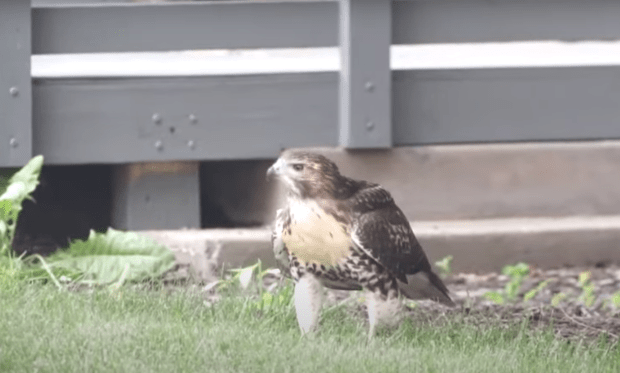
On the earlier part of the Ferris Akel Live Tour, there was a lovely juvenile Cooper’s Hawk. I think I have a couple of reasonable good screen shots to show you. What a lovely bird. We have Cooper’s Hawks that come to breed on the Canadian Prairies in the summer. They are protected under the Manitoba Wildlife Act of 1994.

Indeed, when I first encountered the hawk that comes to my garden, it was not clear if it was an adult Cooper’s or a Sharp-shinned. Turned out to be a Sharpie Adult, Northern. Like the Sharp-shinned, the Coopers are a medium sized Accipiter. These are the green-blue-grey (or celadon if you want to describe them like a pottery glaze) of a juvenile. The eyes of the adult male are red and they have a white breast/belly with ochre streaking, blue-grey hood and wings. You can see those red eyes in the image directly below.

“Cooper’s Hawk” by airboy123 is licensed under CC BY-NC-SA 2.0

This juvenile might look like a Red-tail Hawk if you only saw its back. Like my Sharpie and the Red-tails, the length of the wings attributes to the silent stealth manner in which they hunt. They live in forests and even in urban back gardens and they need to be able to turn quickly which they can also do with their wings and their medium size. You can see those celadon eyes of this juvenile in the image below.

Look at the image below. Do not peek at their blue Darvic rings! Which one of those birds is Tiny Little?

It might be a surprise to you. Tiny Little is the bigger chick at the back!

I watched Tiny Little for several hours. He is absolutely hilarious. For awhile I wondered if he had forgotten how to fly. He hovered, he flapped his wings and he really wanted to go but he couldn’t get it in forward gear. But never mind. White YW brought a fish on to the nest and thoughts of flying went right out the window. Tiny Little was up to his old tricks. What you are seeing in the image below is the second sibling that Tiny Little has tormented over the evening fish. BTW. Tiny Little had a huge breakfast! His MOD is to stare at the fish, then do some flapping, go back and stare and make the sibling nervous til they walk away and leave the fish. And guess what? He is really good at it.

Blue 464 gave up the fish! Because of his behaviour you will know which one is Tiny Little below but please look at the size and look at the other bird. This is the female, that big female that tormented Tiny Little, Blue 464. Unfortunately I took about 300 images of this nest today (maybe more). I have one of Tiny Little standing next to Blue 462, the male. 462 has the thinner longer legs of White YW. Tiny Little’s legs are stout like a female and she is a big bird.

Just like she wanted. Tiny Little gets a nice feeding by Blue 35. Indeed, I think the two of them shared almost half a fish after 464 and then 462 tried to self-feed.

Here is an earlier image of the Foulshaw Moss family minus Blue 464. White YW is on the front left. Then Blue 35 is next at the rim of the nest. Then don’t peek, which one is Tiny Little? If you said the one on the far right, you are correct. Now necklaces in themselves do not indicate a female but with those stout legs and her size. Well..

‘Silo’ chick on the Patuxent River Osprey Nest 2, the one who fell out of the nest into the water last evening, was up and moving about in the afternoon so everything seems alright there. Fabulous.

Thank you everyone for stopping in today to find out about the birds. It is great to have you with us.

Thank you to the following for their streaming cams where I took my screen shots or who gave me permission to use their images: Suzanne Arnold Horning for the images of Cornell’s Red tail Hawk family and the Osprey Nest of Olin and Olive, Ferris Akel Live Tour, Cumbrian Wildlife Trust and Foulshaw Moss Osprey Cam, and Patuxent River Osprey Cam 2.

A surprise visit to see the Ks

I was not expecting to see a notification that Ferris Akel was on the Cornell University Campus in Ithaca this evening. What a wonderful surprise! The reason that everyone wants to see Big Red and her family is not to see spectacular things but, really, it is just to know that each and every one of them is safe and well. After the worry of Hurricane Elsa and the nests along the southwest coast of Florida, this was simply a joyful treat.

Ferris found K1 on a window ledge. How she got there is anyone’s guess. My goodness she is so cute. Whoever said that she is a mini-Big Red is so right. Her plumage is such a deep brick red and she has a full red-feathered belly band, too, with lots of peach on her chest.

Look at the image below. Notice the feathered area that extends above K1’s eyelid. It starts at the beak and goes to the back of the head. It is called the supercilium. The supercilium helps keep the glare out of K1’s eyes! It is often simply called a bird’s eyebrow.

Hawks can turn their heads 270 degrees. Sometimes it looks like they can do the complete 360 but they can’t.

You can see in the image below, despite it being blurry (rain at started), the peach on the chest and the low very dark feathers of the belly band.

The cere is the area around the nostrils above the beak. You can easily see it in the image of K1 above and below. It is light yellow. Notice that the eyes are a green-gray. When K1 is an adult they will be brown getting a deeper brown the older she gets.

Last year, Big Red and Arthur’s fledgling, J3, was born with deep brown eyes.

Ferris did some close ups of K1’s back so that we could see the scapular ‘V’. When both wings are held tight to the body it is the ‘V’ on the upper back. Examine K1’s scapular V. It has its own pattern. Some people use this along with the tail and the belly band to try and identify hawks that are not banded.

You can think of the scapular V as being the way the hawk’s back looks when the wings are closed.

K1 has a white terminal band on her tail feathers. In fact, it is rather wide. Notice the dark bands. When hawks fledge, we want them to have five, preferably six dark bands, so that they get lift and control and will be successful. K1 now has at least eight dark bands. We know that she is also an excellent flier.

The tail feathers help the hawk to do controlled manoeuvres. This is why it is so much better if they are longer at the time of fledge. The wing feathers – you can see the tips of them in the image below- are the most useful for flying. Did you know that the wing and tail feathers of the fledglings are actually longer than those of the adults? This is to assist them when they are learning to fly. After their first moult, they will grow in the standard length of an adult hawk (return to a normal length). Another interesting fact is that at the time of fledging, the feathers actually weigh more than the bird itself!

At the beginning of their second year, when they moult, the fledglings will get their red tails. When Big Red and Arthur bonded, Arthur did not yet have his red tail! Lots of people questioned Big Red’s intentions. She had many suitors but I think we can all agree that Big Red knew best. She has a wonderful mate in Arthur.

Ferris found K3 in one of the pine trees near to Rice Hall’s parking lot. What gave K3 away? Robins vocalizing!

K3 is looking at something intently.

K3 was doing a lot of preening. The preen or the oil glands are at the base of the tail. These oils reinforce or condition the surface of the feathers. Just like the oil you put in your car, the preen oil changes composition during the year. This oil, once it is exposed to sunlight, has been found to contain vitamin D.

Big Red was over on the ledge at Bradfield. I almost did not recognize her. In the summer when Big Red begins to moult, she starts becoming Big Blond. It looks to me like this process is starting.

But why do hawks moult? Feathers are made out of keratin, just like human fingernails. But unlike our fingernails, feathers do not continually grow. Once they are fully formed, they stop growing. Over time the feathers get damaged. This damage comes from normal wear and tear, the sunlight, parasites, and from injuries. These feathers have to be renewed. Hawks do not moult or change their feathers all at once. They would be unable to fly or function and would die. Moult is a gradual process. Big Red does not begin her moult during breeding season. It is too hard on her. The birds deplete their calcium producing eggs and Red tail hawks can lose approximately 20-30% of their body weight by the time the chicks fledge. Big Red will spend the summer and fall getting back into condition and replacing her feathers.

Feathers help the birds fly, they offer camouflage, and they also keep the birds dry.

Arthur was on ‘the throne’ on Bradfield. Neither Big Red nor Arthur moved from their locations during Ferris’s visit. Both Ks appeared to have a crop and neither were food begging. The crop is the first stage of digestion. It is like a pouch under the beak and the mouth. The crop expands with the food. The undigestables are rolled around in the crop to form a casting which the hawk throws up or ‘casts’. The rest of the food that can be digested enters the digestive system proper. The only raptor that does not have a crop is the owl. Owls have gizzards. If you watch Ospreys you will have looked to see if the chicks have crops. That way you can tell if they have had food recently.

It was an absolutely wonderful surprise. There is nothing nicer than spending the end of the day with Big Red and her family. I hope you enjoyed seeing them, too.

This is a great shout out to Ferris Akel. Thank you Ferris for taking your time to go and check on ‘the family’. It is wonderful to know that they are all fine and well.

Friday Night fun with Ferris and the Ks

I did not expect Ferris Akel to be over on the Cornell Campus tonight finding Big Red and Arthur and showing us what the Ks were doing but, he was there and I am terribly grateful. I want to share some of the images from this evening so you have an idea what our favourite Red Tail Hawk family was doing today 2 July 2021.

The event began a little earlier with Arthur dropping off a chipmunk on the nest at 17:47:08.

Here comes Arthur with that tasty little snack.

Arthur is looking around to see if any of the Ks saw him with the chippie and will follow him to the nest tower.

Time to get out of the way because here comes K1! And she is obviously hungry.

This gives you a really good view to K1’s gorgeous tail. Doesn’t it look like white scallops on each feather? I can count nine dark stripes. No wonder she is such a good flier.

At some point K3 comes over to the nest tower and finishes up the chippie that K1 had left. And then they are both off on their adventures.

One of the things I love to watch are the hawklets playing soccer with the pinecones. It is really good training for gripping their talons and holding on to prey. K1 found something that she was gripping and tossing – turns out it was a piece of asphalt. Yuck!

K1 had such a fun time playing. She is certainly good at entertaining herself.

When she finished playing, she flew and landed in one of her favourite trees.

Ferris had been able to locate everyone except K3. Ferris decided to check behind the Rice Building and then he heard Robins alarming. There sitting quietly in the pine was K3.

K3 remains in the pine trees provoking the Robins and K1 flies to the nest tower. Here is she is below. Maybe K1 will stay there as it is actually getting quite late.

Big Red, on the right, and Arthur, on the left, are clearly ready to call it a day. Good Night everyone!

Thank you for joining me. It is always wonderful to watch what Big Red, Arthur, and the Ks are doing. It is magic how fast they learn and grow!

Thank you to Ferris Akel for his love of the birds, his knowledge, and generously sharing his time with us. If you would like to follow the Ks or go on other Ferris Akel tours, everything is free. Just go to YouTube, do a search for Ferris Akel Tours and subscribe. Hit the bell for announcements. You will get an alert to when Ferris is livestreaming. Ferris will be on the Cornell Campus tomorrow. His tour normally starts at noon on Saturday, Eastern Time.

I have had several letters asking me about why certain nests get help from the wildlife rehabbers and others do not. I hope to have a complete answer formulated for my Sunday blog. It is a very complicated question that deserves a very considered answer.

Protecting birds by simple changes in our lives can make a huge difference.

For the past week I have been posting information on how we can all join in and make our environment friendlier to birds. The tips and the ongoing discussion with my chatters on the Cornell RTH FB page have been enriching. Those posts were a way of remembering J1, the eldest chick of Big Red and Arthur, who died a week ago today after what is believed to be a window strike at Weill Hall. J1 was a super large very maternal bird who could be hawk-fierce when required or a gentle goof pulling the tail feathers of her brothers if they sat on a bar above her. She loved playing soccer with pinecones and taking baths in the puddles after a hot day in Ithaca. Her birth brought joy to all and as she grew most recognized that she would be a gentle but firm mother like Big Red. Because of COVID-19 and the escalating deaths and subsequent civil unrest, her death sparked a deep sense of loss not only within her hawk family but also with the BOGs in Ithaca and those who love this family around the world. Big Red and Arthur led the two remaining chicks away from Tower Road and the business of the campus near Bradfield and Weill out to Holey Cow. Just looking it appears that the distance is around a mile but I could be all wrong. The area is rural farmyard territory as opposed to urban with its buildings, streets, and cars. And the parents have kept them near the barns with the cows and sheep and the fields where Big Red’s mate, Ezra, used to hunt. One evening all four took part in a team hunting event. Big Red from one side of the pine tree and Arthur on the other would fly into the tree chasing a squirrel down for the two juveniles to hunt it. The move has caused the chicks to slow way down and stop random flying stunts between buildings. You say, “Did Big Red and Arthur know that J1 had died?” My answer to you is “Of course, they knew.” Would they have wished that Cornell University would have earlier installed window reflective glass on their buildings? Absolutely. And so, that is why I am writing to you tonight. To introduce you to ways that you can help birds in your own neighborhood.

Most of you will know some of these points but you might have forgotten or maybe you didn’t know. I certainly didn’t know all of them and tonight I find that I am still learning. So here goes:

  1. Make all of your windows bird friendly by installing strips on the outside so there is no bird strike. Check your local wildlife or nature centre. They often have this available in their shop.
  2. Speaking of windows. Governments in Australia have announced that all buildings will now be required to use reflective glass. It is estimated that 1 million birds die from window strikes annually. Supporters of the new reflective glass windows believe that they can save 90% of the birds with this new measure. Write to anyone in your community who will listen!
  3. Bird-friendly coffee. Almost everyone reading this blog will drink some kind of coffee a day. But, as I have learned recently, not all coffee is the same. There are now many organic beans and blends as well as fair trade coffees but if you want to be the most environmentally friendly with your cup of java, then you must find bird friendly coffee. And this is not easy! The Smithsonian must certify the coffee to be grown under shade so that the forests are not cleared to qualify beyond being organic and fair trade. So look for the labelling and ask your local roaster to get beans brought in for you or you can order on line.
  4. Water. The summers are getting warmer. The heat impacts all of us. One simple way to help the birds is to put out bowls of water so that they have a fresh drink and a place to have a bath and cool off. You don’t need to go down and buy a fancy bird bath. Readers of my postings have suggested checking your local thrift store for bowls or even bird baths. Many use the dishes that go under pots. One even suggested the plastic liners for paint trays (new, of course). Since I work with clay, we have an array of shallow bowls outside and every day around 4pm the little song birds line up for a drink and a splash. One day the largest of our local Grackle community decided to have a bath. It was sweet.
  5. Cats. Cats are one of the most prominent dangers to birds. Where I live it is illegal to let your cats outside. But in many parts of the world this is not the case.
  6. Herbicides and pesticides. One major birdseed company in the US (who also supplied herbicides and pesticides for gardens and lawns) was discovered to have poison seed in their product several years ago. Make sure you know where your birdseed comes from BUT also let your garden be natural. All of the treatments for lawns are very dangerous to animals.
  7. Mouse and rat poison. Rodenticide. Do not use poisons to trap mice and rats. They mice and rats eat the poison, get sluggish, and are easy for the raptors to catch. Then they die. It has been clearly proven that raptors are much better at keeping down the rat population than poisons. Tell anyone you know not to use these products that stop the blood from coagulating. In fact, cats can also die if they eat a poisoned mouse or rat.
  8. Plant a tree. During this very chaotic spring, people have been seeking calm. Trees and gardens offer places for peaceful contemplation. They also help the biosphere. So instead of paving your patio, consider creating a rustic treed space that is bird friendly instead.
  9. Slow down. When you drive slow down. It will cause less deaths from window strike.
  10. You might want to keep gear in your vehicle to help with injured birds. This can include but is not limited to gloves, a secure cage, and soft blanket. Know the contact numbers for your local wildlife rehabilitation centre.

These are not the only ways but they are a beginning. You might want to think about ordering the book that was recommended to me today. It is Nature’s Best Hope: A New Approach to Conservation that Starts in Your Yard.

Feathers and Preening

You have probably never thought much about feathers unless you raise chickens and wind up plucking them yourself. Or your duvet is full of down and feathers and you find them all over the place if there is a small hole. But, maybe, like many of us, you wish you had wings and could fly – like Icarus – but not with the same consequences. I wish I had feathers and wings because then I would soar into the sky as high as I could go!

Before I begin, this posting is not the definitive answer to everything about feathers or preening. But I hope to give you a glimpse into the importance of both to Red-tail hawks. Sort of a nutshell version. If you are really interested in feathers and believe me, there is a lot to learn, I have included the name of a good book later in this blog.

Red-tail hawk chicks begin to jump and flap in the nest, according to my observations, approximately 2-3 weeks after they hatch. They are building the muscles in their wings when they flap and flap. Flight feathers not only help birds fly and soar but they are contoured and offer protection from the weather. In the first photo below, there is a snow and ice storm in Ithaca on May 8. Big Red’s feathers are keeping her dry and also protecting the chicks. Look carefully at the one under her beautiful red tail feathers.

Feathers keep birds warm and dry – in ice, rain, and snow. The chicks have not yet developed feathers to do this so Big Red covers them.

Several times this spring, the rain has just been torrential in Ithaca. Again, the feathers kept Big Red, no matter how drenched she looked, dry and in turn, she spreads her wings to keep the chicks dry and warm.

For us newbies, we were worried about Big Red in all the rainy weather. Here she is covering the chicks. They get so warm that they often stick their heads out just to get cool. And just a note. Both Big Red and Arthur have brood patches where their feathers have worn down from incubating the eggs and then protecting the chicks.

When it is really hot and humid as it is in both Ithaca and Syracuse the last few days, rain can be very welcome to hot hawks. Below is an image from the Syracuse University Hawk cam showing two of their newly fledged red-tails dancing in the rain to cool off. It reminds me of being in India in the late 1980s and 1990s. You would beg for the rains to come to cool off and would run out into the rain ever so thankful!

So remember. Flight feathers are not just for flying but they are also for protection from the weather. The water resistance from the feathers comes from hydrostatic pressure. Hydrostatic pressure is the tension between the structure of the feather versus the pressure of the water. Water droplets bead on the feathers.

Arthur leaving to get prey for the chicks with Big Red giving him directions. Notice his legs tucked up and the slight curve of his wings at the end and, of course, that beautiful red tail.

Wing feathers are the longest and the most useful for flying. Below is a closeup of one of the chicks with their wing feathers starting to grow. Also notice the tail feathers that are beginning on the chick and the recognizable “red tail” of the Red Tail Hawk on Big Red. The chicks will not get their beautiful red tails until they are in their second year. Tail feathers are like the rudder on a boat. They help the birds manoeuvre. About a month after they have fledged, the chicks should be able to soar into the sky.

Approximately 18% of the weight of a Red-tail Hawk comes from feathers. By the time the chicks are 29-31 days old, their dorsal wings should be 90% feathered. Their legs will begin to feather and they will get the characteristic “pantaloons”. The ear openings should be covered and the upper tail coverts should be well developed. By the time they are 35 days old (about a week from a possible fledging or first flight off the nest), the head will be at least 50% feathered, the dorsal body will be 95% feathered, and the breast should be 90% feathered. Their tail feathers should be five to six bands long, preferably. The more bands the more successful the first flight will be.

This chick is J3, the youngest. He is 31 days old. Note the distinctive “peach” on the breast, the lovely dark feathers marking the “apron” below the crop. The downy head is beginning to gets its feathers and the feathers covering the legs are there.

At the time these chicks fledge, their wing and tail feathers will be longer than their parents. With their first molt, they will return to normal. Molting is the falling out and gradual replacement of the feathers.

There is a really good book on feathers. It is Feathers: the evolution of a modern miracle by Thor Hansen. There is so much to learn including every part and its function! Apparently humans have the DNA to grow feathers but we don’t have the “switch” to turn it on and off. Feathers are much more efficient than their hair. Hawks also use their feathers like a sharpening tool to keep their beaks in perfect condition.

The simple definition of preening is that it is cleaning and maintaining the feathers. Preening reinforces and conditions the surface of the feathers with gland oils. These gland oils contain vitamin D. When the feathers are exposed to sunlight after preening, the oil works as a protective conditioner. The oil in the glands change composition during the year just like you will, if you live in a cold climate in the winter, change the weight of your oil in your car. Red-tail hawks spend approximately 77% of their time preening.

This is an example of a warble. This is when the head of the bird is folded all the way back and down and they are preening their wings
The chicks learn quickly how to balance themselves on branches or metal railings and preen at the same time!

One of the things that I found most interesting about the feathers is that because they are hollow, some researchers understand that birds can feel the changes in barometric pressure and will know what weather conditions are approaching. They are more likely to know the precise weather approaching than the local weather station. They have to. They live outside in the trees, roost on the ledges of buildings, and depend on millions of years of evolution to give them clues to nature’s mysteries so they can survive.

Why are female Red-tail Hawks almost always 30% larger than the males?

It is called Reverse Sex-size diamorphism. There are several theories as to why this happens with Red-Tail Hawks.

The first is that the females had to be larger to protect themselves from the feisty males.

The second is that the females selected smaller males to be their mates because the size difference allows each of them to hunt different prey and reduce any competition for food between the pair. Raptors that hunt birds are generally smaller and faster with the female specializing on larger prey. At the beginning of the nesting season, the female becomes an active hunter and again when the nestlings are larger. Generally the adults tend to partition the prey resources in their territory.

Another theory is that the females need to be larger because they must accumulate reserves in order to produce eggs. When they are incubating eggs and brooding young, they rely on the male to feed the family. Red-tail hawks are usually born in April when the prey are sluggish and just coming out of hibernation. Small males can make quick turns. In the case of the Red-tails on the Cornell Campus, Arthur W, the male, is known as the ‘stealth bullet.’ He is quick, fast, focused, and quiet when he hunts. Big Red’s former mate, Ezra, was like Arthur W a great hunter but he was also about 30% smaller than Big Red as is Arthur.

Ezra has his wings spread and his legs tucked tight. If you look closely you will see that he is delivering two items to Big Red. The first is a snake and the second is a flower!
It is very difficult to get Big Red and Arthur to stand up straight at the same time. They certainly do not listen to requests from humans!This is the closest I have come to finding an image that might be able to show you the difference in their size. Big Red is on the left and has her head leaning back preening and she is a little more slumped than Arthur who is on the right.

In terms of the nestlings, the only way to positively known the gender of the bird is through either a DNA sample or you see them laying an egg when they are older. Everyone likes to guess the sex of the chicks growing in the nest cup. Using reverse sex-size diamorphism, we speculation whois a female by their overall size as they grow in the nest and the size of their feet. But again, no one can be absolutely sure. In the past one of the small nestlings was always believed to be a male. This particular bird injured its wing and, as a result, had to be taken to a vet. The bird’s DNA was tested and, to the surprise of many, it was determined to be a female. So not every small Red-tail Hawk is a male!

In terms of the relative size of each J, J1 is the largest of the three. Early in its development, everyone noticed the large size of its feet. Now as a juvenile, J1 remains the largest of the three siblings. But there is something else about J1 that I personally find fascinating. J1 is very much interested in nest maintenance. She can be seen, even today, mimicking Big Red in attempts to vent the nest bowl. She rearranges the nest twigs and on the second day after she fledged, she brought a branch to the top of the Rice patio. There seems to be 100% agreement that J1 is going to be a good mama like her mother, Big Red.

J3 in the front and J1 behind watching J2 fledge. Look at the difference in the size of their legs as a starting point.

J2 on the other hand is also a large bird, not as large as J1 but larger than J3. J2 was actually the first egg to be laid but the second to hatch and is, therefore, actually the oldest. His fledge was more like a fludge when he climbed up on the light box and then slipped but his flight was still remarkable. J2 has continued to be a very, very strong flyer already interested in hunting. The shape of “his” head – you will notice that I continue to use the term “his” – is also different than that of J1. He has an intense focus and besides bugs and insects he has already been interested in small birds in the territory. To my knowledge he has not caught one. He is also very aggressive. A few of us believe he is truly a male and will be a great hunter like his dad, Arthur W.

J3 eating his first prey drop after fledging.

J3 is the problem child that everyone loves. . J3 was born four days after the other two and it was also the last egg to be laid. Taken together, J3 is actually a week younger than its siblings. That is a lot in the life of a Red-Tail Hawk chick. It may also account for the fact that Arthur W brings food to the nest tower in an apparent effort to feed J3 away from the two larger siblings. Let me try to explain what has been happening. Normally the juveniles are spread out being individuals. This trio is quite different according to the people who have monitored all of the broods on camera (since 2012). It is because they tend to congregate together. To hang out. If one is on the Rice patio, all three might be there.

All three on what is called the Rice patio. Arthur W often makes food drops here but it is also a safe and flat site where they can sleep in the sun or practice their skills.

They might all be on one of the towers including the nest tower. Still, on occasion, they go their separate ways.

J1 in one of the oak trees near the Fernow Building looking at a squirrel.

A prey drop is just that – one of the parents dropping lunch. The juveniles will, unless they have recently eaten, fight for the food with the most aggressive mantling the prey. Unless the prey item is too large for the chick to eat all at once, sharing doesn’t seem to happen. So, because of J3s size and a seemingly lack of aggressiveness in comparison to J2, J3 is somewhat at a disadvantage. This is the reason that I believe Arthur W still supplies food on the nest to the little guy.

Arthur has been dropping lunch off to J3 for several days now. This was around 3pm. He seems to be looking for J3 who arrives almost immediately.
J3 mantling the prey that Arthur W dropped on the nest. Remember mantling is a way of protecting the food item so that no one else can steal it.
J3 finishing up his afternoon snack.

For now, the gender of the three juveniles is sheer speculation. There are no banding practices and no GPS monitors on the Js. In other words, no identification. It is only when one of the juveniles might find its way to the vet and be both recognized and tested that the sex would be determined.

Tomorrow we are going to talk about the importance of preening.

Everything is fine in the world of the Js

Little J3 spent the night of June 14 on Rice, apparently alone. He flew back to the nest hoping to have breakfast at 7:46 am on June 15. Arthur quickly awarded him with a squirrel which he mantled with both feet. The little guy was really hungry and no one was there to steal his food! Great hawk reflexes though. A couple of hours later Arthur returned with a chippie. Full to the brim J3 spent the day lounging on the grating or the natal nest, sometimes sleeping on his favourite leaves. At sunset, he flew back to the Rice building where he spent the night. He was just waking up this morning, stretching, and sleepy.

J3 on the nest tower thinking about flying over to the Rice building to spend the night.
J3 getting into the line backer position to take off. He is really getting his flying skills down.
J3 getting in position to fly off of Rice to head back to the nest where he will spend his day eating the food drops from Arthur. He will fly out and over to Rice to spend his second night there.
J3 is figuring out how to tuck up his landing gear!
Arthur delivering breakfast to J3 over on the nest tower. A nice reward for all the effort of his fledging the previous day.
This is an excellent example of mantling prey – protecting it so no one else can get it.
The rear view of J3, now relaxing with no sibs about, eating his lunch chippie.

J1 also spent a bit of time on the nest rearranging the oak leaves that Big Red had brought in but most of her day was spent on top of Rice where her and J2 received prey drops from Big Red.

Around 5pm she made her way to the trees in front of the Fernow Building. At one point it looked like she wanted to get to the nest and she began breaking branches to aid her flight. Very intelligent. She then changed her mind. When I left her last night at 7pm she was in the Oak tree preening and this morning she was with a squirrel in one of the Oak trees in front of Fernow.

J2 is harder to keep up with as he is our “stealth bullet baby”. J2 has amazing flying abilities. It is like he skipped the learning stage and went to advanced intermediate. Yesterday he was aggravating a bunch of robins near the old coop buildings on the Cornell campus.

It is now the morning of June 16 and all is well with the J family. They are fed by the extraordinary hunting skills of their father, Arthur, aged 4. Their mother, Big Red, aged 17, keeps a close eye on the chicks. I wish I was on the ground chasing them about in Ithaca but, sadly, not. Postings about their development and happenings will appear daily albeit they could be short.

In the meantime preparations are ongoing, around the world, for the very first World Albatross Day on June 19. Stay tuned for information on that event as well as the challenges that both the Red Tail Hawks and Albatross face living with humans and machines.

June 14. Double Fledge. J3 goes first at 8:46, 46 days old. J1 goes two hours later, 50 days old.

Wow. What a busy morning. The oak leaf and thorn plus withholding food certainly motivated the last two chicks out of the nest. J2 came over for a visit expecting to get some food but Big Red and Arthur must have had a confab last evening and decided it was thorns and oak leaves, no food. It is incredible how food can be used to motivate behaviour.

At 8:46 nest time, the hungry and light Little J3 decided it was time to go. After bouncing around on the nest, he slipped over to the front railing where everyone has expected him to fledge. In fact, Little J3 has spent most of the past several weeks looking out to the world from that very spot. He could often be seeing jumping around on the nest cup like it was his own personal trampoline but always stopping to look out to the world through the railing.

J3 after running across the nest and flapping stops to watch J1 flapping.

Over the course of the last few months, from the time of incubation, hatching, and changing, preparing to fledge, J3 won the hearts of many. For one thing, he is so tiny compared to J1 and J2. Speculation has always been that “he” is a “he” because of his size. Only a couple of us think that “he” is actually a very small female hawk. That is because “it” has very large feet in proportion to its size. Additionally, J2 always picked on J3 including sleeping on prey to keep it from him. As the chicks matured, Little J3 or Little Bit as he was often called was protected and cared for by his/her big sister, J1. Even this morning before J1 fledged, she was taking care of the nest bowl completely oblivious to the rest of the world. But because of her attachment to J3, it is believed she finally took the step and just joined her sibs (see later in post).

J2 was sitting on the railing and J1 was pleasantly resting in the nest cup as J3 made his way over to his favourite spot.

Look carefully above the road. J3 is winging it across the street. BOGs on the ground said it sounded like a little helicopter motor as opposed to when J2 (sitting on rail) fledged yesterday which was like a stealth rocket, totally silent.
J3 has his white pantaloon legs down from the previous shot and you can see that if this were video, he would be flapping his wings. When he gets more experienced he will tuck those legs up tight so there is no drag when he flies. Imagine if you will the problems that airplanes have if their landing gear gets stuck in the down position. It is the same for hawks.

The BOGs (Birders on the Ground) thought that J3 had landed a great distance from the nest because he was so light and going at such a clip. There was even speculation that he had flown all the way to a nearby lake. Even Big Red was circling around to find her chick.

In the end, J3 landed in one of the trees in front of the Fernow Building close to where J1 had fledged yesterday. After looking for some time, the BOGs found him. His descent was not as smooth as his take off. What a little guy! His great long life journey, we hope, begins.

J3 landing, rather awkwardly, on a tree near the Fernow Building. As he gains confidence and experience, these awkward moments will stop. J3 is, I am told by those who have trained and watched hawks for years, a typical fledgling, struggling to figure it out. But because of J2’s stellar performance the day before, us first timers thought his fledge would be like J2s.

While J3 was settling in the tree away from the eyes of the BOGs hunting him, J2 is on top of the Brueckner Building. J1 is on the nest cup rearranging the oak leaves that Big Red brought in the night before. At 10:36, after much back and forth, J3 gives up and reluctantly fledges between the rails at the front of the nest facing her siblings (J2 is on Bruckner and J3 is in the tree in front of her across the street).

J1 hems and haws for several minutes before taking flight. J1 will be a fantastic mom one day – she had a great teacher, Big Red.
And J1 is off!
J1 has spread her wings and she has cleared the light box. A well intended, albeit reluctant, fledge. Not a fludge.
Last night Big Red brought in oak leaves and thorn branches to the nest. Laura Culley, a falconer and owner of Mariah, a red tail hawk aged 28, speculates that the chicks will use the visual clues to find the oak trees across the road when they fledge.

J1 had a slow flight across the street but remembering those oak leaves, she landed beautifully in the oak trees just as Big Red suggested! Isn’t she gorgeous? Like J2, she has beautiful blue eyes which will get darker in time. Ironically, her little brother (sister?), J3, already has dark eyes. It was a good way to tell them apart even if he was smaller because sometimes it got confusing.

Big Red tries to lure the trio with food at noon. She stands on top of a wooden pole with a chipmunk and is tempting them but no takers so far.

Arthur brought a chipmunk to the patio and it was picked up by Big Red. She took it to a tall post where the chicks could see her. She waited to see if any of them would come to the post for their food. None did.

When none of the chicks came to the post to retrieve their lunch, Big Red eats some of the chipmunk taking the rest to J2 on top of the Bruckner Building. It was the first prey drop of the season to the chicks. J2 was delighted. He even carried the chippie around for awhile and mantled it when Big Red arrived with an oak branch. Some think that is a clue for him to spend the night on top of the Bruckner Building where it is safe.

J2 suns himself on top of the Bruckner Building after he eats his lunch. Big Red often can be seen on the Bradfield Ledge in this same position.

As J2 suns himself after his lunch, J1 flies to the top of the Rice Building, a site that would have been very familiar from the nest. Meanwhile, J3 has decided to come down from the tree and get itself in some mischief around the road. Thanks to the BOGs on the groud and especially Karel and BOGette, he did not get run over by a truck and eventually made his way to the roof of one of the buildings. From here he can work his way to a point where he should be able to see and fly to his sister, J1. He first has to manage his way up onto a slate roof and then over to the metal corners before flying over to the Rice Building. It is definitely not easy walking on slate with talons!

J3 discovers it is difficult to hawk walk up roofing slates. He eventually gets to the metal corner and makes his way to the ridge where he sees his beloved sister, J1, and flies over to join her hoping to get some supper from Arthur or Big Red.
J3 joins J1 on the top of the Rice buildings air conditioning unit.
J1 is waiting alone for his prey drop from Big Red or Arthur.

Wow. What a day. And it easily came with tears at the end of it. We leave J3 on top of the air conditioning unit waiting for food from mom or dad. It is the first day for all three of the chicks to be out of the nest.

But for Big Red and Arthur it is a day to be proud. Big Red has successfully fledged all of her babies since the time the cameras were installed in 2012. They know that she also had at least two broods pre-camera and probably more before. In all she has fledged 24 chicks on camera and at least another six off camera, 30 in all.

In the coming weeks Big Red and Arthur will help the chicks to hone their flying skills and will teach them how to hunt for their future survival. I will bring all of you updates as they become available.