Monday morning in Bird World

22 August 2022

Good Morning Everyone! The sun is out and it promises to be another hot day, 28 C. No rain forecast until tomorrow — and they might well change that. I am delighted to report that Dyson was seen in the garden this morning. One of the juvenile Blue Jays was screeching so loud – at Dyson – who was helping herself to ‘his peanuts’. The three juvenile Crows were in the garden on Saturday and again this morning. The little female was cooling her feet off in the bird bath.

I have also been out checking on the ducklings. Some are really growing!

Last week, there were 11 with this female. I am now counting 9.

This little sweetheart watched me quietly walk towards and around her. She never moved. How delightful.

If you are a duck and it is hot and humid, what do you do? Try to find some shade and/or a breeze. Duck Siesta time.

Then I found these two ducklings. They do not have their tails and are still sporting their downy fluff. Oh, I am going to worry about them and, hopefully, I can find them today or tomorrow when I am out checking again.

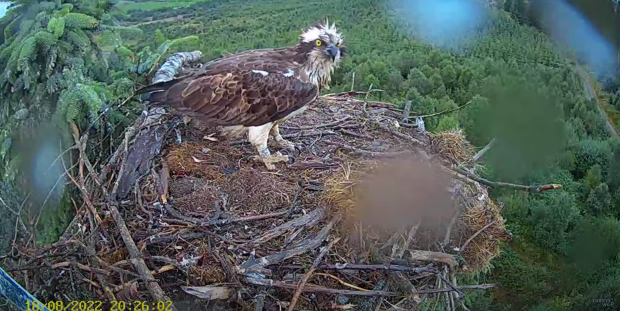
Update. There was some concern about the situation with AX6, Axel, at the Loch Garten nest. Yesterday, I posted that AX6 had not been seen on the nest and was feared to be ousted by the intruder, KL5, injured, or worse since 15 August at 0635.  Good news arrived from ‘DV’ who wrote to tell me “AX6, Axel, was seen on the Loch Garten nest this morning (Sunday), according to watchers.” Oh, fantastic. I checked on the Loch Garten FB page and they confirmed the time as 0835. Axel remained on the nest for 5 minutes. There is YouTube video confirmation. Thank you so much DV! Now has he been feeding the sole surviving chick from the nest 1C2 off camera? That is the question. He looks good!

The nest was empty later.

From the mailbox. There are several nests that many of you might have been wondering about. First up, Titi and Boris at the Janakkalan Nest in Finland. I have heard nothing since the camera shut down quickly and abruptly. I do not know why a decision was made to go offline at that time.

The streaming cams operate for many reasons but research and education/entertainment seem to be the main categories. The owners of the streaming cams often do not take into account the impact that watching a family of raptors has on viewers. Each of us has our favourite nests. Some may be the same for all of us but there are always nest surprises. We have our favourite nestling and we cheer them on and yell at the screen, fret when the weather is bad often staying up with them. We worry when there is not enough food. We clap and jump when they fledge and then we worry about where they are and if they are alright Sometimes (and it was a lot this year), we cry when one or another or all die.

For me the streaming cams have always been a way for us to connect with nature. They became particularly important during the pandemic as shown by Loch Arkaig having over 400,000 viewers watch Louis and Aila raise JJ5, JJ6, and JJ7 in 2020. Many have written to tell me that they are in hospital dying and it is the birds that are keeping their spirits up. One of my readers who became a good friend had cancer. Anyone on the Sydney Sea Eagle chat will remember Phyllis. The sea eagles and the chatters kept Phyllis going much, much longer than the doctors could ever imagine. The birds enrich our lives. I have had people say why not go outdoors and watch the birds, why on screen. I always tell them that it is like going to a sporting event or a Formula 1 race – you actually get a better view on the telly. Of course we go outside and see the birds if we are able! But where could you see up close an Osprey, an Eagle, a Peregrine Falcon raising their chicks? I surely couldn’t! They have brought us joy and touched our hearts so when that camera is suddenly turned off without an explanation or warning, we wonder why. It is shocking.

And so it was with Titi and Boris. They had lost their mother and their sibling. Dad continued to bring food and the goshawk was around. We worried about Titi who waited so long to fledge and then boom…nothing. We never got the opportunity to see if Titi would return to the nest. Some of you have written to ask the Finnish Osprey Foundation why did they turned the camera off so early. You have not received an answer. I have written to one of my Finnish contacts and readers to see if they know anything. I will certainly post any news here for everyone if I should hear.

My inbox has been full of letters about Malalam the little Red-tail Hawk adopted by the Bald Eagle family on Gabriola Island, British Columbia. When her nest mate turned sibling, Junior, was electrocuted on a pole owned by BC Hydro, GROWLS posted all manner of information so that a campaign could be directed towards BC Hydro. Many groups joined in. I carried their request to you. Malala is not ringed. The Red-tail Hawks and hawks in general are beginning their migration. Will we ever know what happened to Malala? is anyone watching the nest to see if she returns? She could be heard on the cam on the 30th of July. That same day, GROWLS FB said that the season was closed and the camera was immediately turned off. No information has been posted since. It felt abrupt especially after so many wrote to BC Hydro on their behalf after the call to do so on July 22, ‘Justice for Junior’.

I am fortunate to have a friend and former student in the area. They have confirmed for me that there are a number of red-tail hawks and without any method for identification no one will know unless they happen to see Malala at the nest or eating fish. If I do hear anything – or if you do – please let us know.

Many of you fell in love with this family and the story. That is the missing link in the streaming cams that I am trying to emphasize. If we are to try to make any positive impact in the lives of wildlife, then it would be good if the administrators of the streaming cams would agree to post any updates and warn individuals when and why cameras are being turned off. Annual maintenance is one of the biggest reasons and well established cameras with high traffic always warn their viewers. I am thinking of SWFlorida Bald eagles. In this instance so many of you wrote to BC Hydro and it would be reassuring if we heard that the pole that killed Junior had been made safe for any future fledglings. I would love to see a FB post about that and if GROWLS had their new camera. I think you would, too.


Just when we should be expecting the nests to be so empty, there continue to be surprises. Lancer visited the old Two Harbours nest and the cam operators were simply fantastic, getting great captures.

The Channel Islands just look like a perfect place for Bald Eagles to live. What a magnificent view of the water.

A video was put together of Lancer’s visit to the original Two Harbours nest. No one is sure why Chase & Cholyn decided to move their nest. Here you go:

Thunder visited the West End nest with a fish today, too. She must be lonely without any one of the three fledglings not rushing her to grab that fish out of those talons!

I decided that perhaps there might be some luck checking on the other nests. There was no one to be seen at the Fraser Point nest of Andor and Mama Cruz. I have had quite a number of letters asking about Trey and what happened to her after Mama Cruz winged her. I have heard nothing and there seems to be no mention on any of the normal sites associated with the Institute for Wildlife Studies. This time it would seem that no news is good news – she has gone on her way. If I should see or hear anything otherwise, I will definitely let you know. I will also add that this is not the first time that Trey -who hatched and fledged from the Fraser Point nest – has returned home. She fledged on 6 June 2019. Her first return to the nest tree was 15 July 2021. She returned again on 25 July 2021 and then again this year on the 16 August 2022.

There was no one about the other nests in California that I could see. I then went over to Florida to the nest of Samson and Gabby at Jacksonville and got a pleasant surprise – it was a Red-shouldered Hawk having a rest.

Migration has begun, of course, and there will be many raptors (and other birds) stopping to rest along the way. What a beautiful, beautiful hawk this one is! And what a delight to get to admire the gorgeous plumage for a bit.

Karl II is still feeding the four Black Stork fledglings at the nest in the Karula National Forest. Bonus was there so all four are still around and have not left.

Meanwhile Kaia remains in Belarus near the fields and marshes near Lake Veluta.

If you are a fan of the Kielder Forest Ospreys, here is a full up-to-date report on each nest! It was joyful reading that Mum had managed to fledge her two chicks after losing her mate, YA. They flew on 9 and 13th of August. She remained another 11 days fattening up for her big trip.

Dorcha has not been seen at the Loch Arkaig nest for several days. I am presuming that she has begun her migration, too. Louis is keeping Willow and Sarafina satisfied with fish — as he always does. What a fantastic mate he is. Louis delivered a fish to both this morning.

At the Foulshaw Moss nest in Cumbria, Blue 35 and fledgling Blue 480 have not been seen for a number of days and, like Dorcha, are believed to be in the midst of their migration. White YW is supplying fledglings Blue 481 and 497 with fish at the nest.

Dylan is delivering nice trout to the Llyn Clywedog nest…and the fledglings are not always holding on tight enough and oops…off it goes. As long as the fledglings are around, Dylan, like all the males, will continue to bring fish to them. Then they will feed and go on their way to their winter home. Seren Blue 5F was still seen fishing on the 21 August.

Mrs G is still at the Glaslyn Valley nest she shares with her mate, Aran.

It is a little soggy at the Dyfi nest of Idris and Telyn. The information below the camera states that Telyn was last seen on the 20th. As it happens, however, Telyn was seen on camera at 16:08 today and there were great views of the second hatch, Padarn.

Here is a lovely video of Telyn bringing a Mullet to the nest with Padarn and Paith doing some loud fish calling!

It is raining with some wind at the Mlade Buky White Stork nest in The Czech Republic. I have seen only one stork on the second nest that Bukacek built. Awaiting confirmation that Betyhka has started migration along with the four fledglings.

In the UK Raptor Persecution news, the Moy Estate in the Scottish Highlands has lost its license (in an appeal) for the poisoning of a Red Kite on its estate.

There will be more and more prosecutions of estates where grouse hunting takes place and when the wildlife estate managers kill the raptors that the UK is working so hard to reintroduce. Indeed, there is a growing movement to end the practice of grouse hunting.

Dad brought Lady and SE 29 and 30 a nice big chunk of fish yesterday. All ate and then, surprisingly, Lady decided to brood the chicks. This nest appears to be doing very, very well this season.

Waiting for eggs at the scrape of Xavier and Diamond. The rejected Starling in the corner appears to be ‘past its sell-by-date’. If the amount of mating that these two have been doing is any indication of the number of eggs, this scrape should be full from top to bottom and side to side. I am hopeful that we might have the first egg in a few days!

367 Collins Street in the CBD (Central Business District) of Melbourne has not gone live so no eggs there yet either.

It is pouring down rain in Port Lincoln this morning. Mum is really tucked in so those precious eggs do not get wet.

It’s a wrap! Thank you so much for joining me today. I hope that the start to the week is a wonderful one for each of you. Please take care. See you soon.

Thank you to the following for their streaming cams, posts, and videos that form my screen captures: Loch Garten RSPB, GROWLS, Explore.org and IWS, NEFlorida-AEF, Eagle Club of Estonia, Looduskalender, Kielder Ospreys, Friends of Loch Arkaig and the Woodland Trust, CarnyxWild, Bywyd Gwyllt Glaslyn, Dfyi Ospreys, Mlade Buky, Sea Eagles@Birdlife Australia Discovery Centre Sydney Olympic Park, UK Raptor Persecution, Charles Sturt Falcon Cam, and Port Lincoln Ospreys.

Featured Image: Thunder at the West End Bald Eagle nest, 21 August 2022.

Little Bit ND17 and more…Friday morning in Bird World

19 August 2022

Good morning everyone! It is the end of the week. We blink and time whizzes by us. There is not a lot of news in Bird World. Sometimes that is nothing short of a welcome relief – a time to breathe.

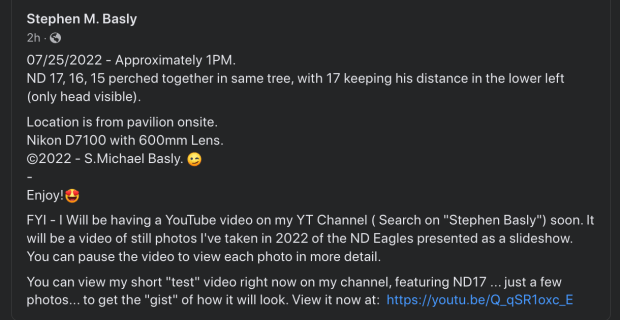
What a way to start a Friday morning! Getting up and seeing Little Bit ND17 perched on his river roost in the evening. Oh, what a magnificent bird he is. Stephen Basly posted three images on the Notre-Dame FB page. This is the full zoomed in version. Oh, Little Bit looks so confident. A few little springs of baby down working their way out of the juvenile feathers. What a joy to see him!!!!!! So I want to move ahead a year and wonder if Little Bit will come to this same perch next year? Basly added that he had not seen 16 since Little Bit kicked him off the perch a few days ago! Way to go Little Bit. 16 was a nasty big sister!!!!!!

You will remember the two eaglets that were on the Pitkin Trail nest. The Mum flew off and pulled them out of the nest in the third week of June – one perished. The other was saved by passersby who got in touch with help immediately. I wrote to Pitkin County Open Space and Trails to find out if there are any updates on the little one. This was their quick response to my query: “The last update we received, on Aug. 8, was brief: “This Osprey is doing well so far. He is still being monitored at our ICU. Normally, this chick would have fledged in late July and would be making fewer and fewer appearances at the nest by now.” This ultimately means that the osplet will most likely not be in fit shape to take on the fall migration.

It is so nice when humans stop and do everything that they can to help our wildlife in need. It is often that immediate attention that is crucial to whether they will survive or not. Here is another amazing story of a passerby reaching out to help an electrocuted eagle. This one certainly got a chance at a second life thanks to an individual who saw the injured bird and called for help. Please cut and paste this link. I hope it still works! https://youtu.be/SCoigRwwA-Q

As you are aware, I am extremely concerned about the birds migrating from Scandinavia, Estonia, and Lativa who would normally be flying through the Ukraine. The other day Kaia, the mate of Karl II from the Karula National Forest Black Stork nest landed in the Ukraine and immediately headed back to Belarus. She has flown a bit east from her previous position but has not left Belarus. I understand from my colleagues that there are other migrating birds in the area where Kaia is resting and feeding.

August 19. Looduskalender gives the following information for where Kaia is this morning. “The Pripyatsky National Park is a protected area of swamp & oak forest, noted for wading birds, rare lynx and a herd of European bison.Pripyatsky National Park or Pripyat National Park in a natural reserve in Gomel Region, Belarus. It was founded in 1996 for preservation of natural landscapes around the Pripyat River from which it takes its name. Much of the park’s area is occupied by turf swamps.”

Hesgyn (KA3, 2019) was the last chick that Monty, the famous Welsh osprey, fathered, with Telyn. He returned as two year old in 2019 and sadly, at the blossoming age of 3 years, he was found dead. The wildlife centre that will do the post-mortem returned Hesgyn’s silver band and his coloured Darvic ring to the Dyfi Osprey Centre in Wales so that it could be placed on the family tree board. The results of the post-morten will be published when they are available.

I have been praising the Dyfi Osprey Project and Emyr Evans for their data driven website. It is wonderful to be able to go and find clear and accurate information. I also loved their family tree. Llyn Clywedog has now published their own family tree for their ospreys. Here it is:

Seren was still at the Llyn Clywedog nest in the Hafren Forest of Wales at 2055 on 18 August. She appeared on the nest wet and with muddy feet covering most of her Darvic band. Poor thing. How do I know this is not an Osprey chick? What would you say?

If you said the adult plumage you would be absolutely correct! If the plumage had been juvenile feathering then, it could have been the third hatch, Blue 555 (male).

Just look at all those males that will be returning to find mates and start their own families. My goodness, Dylan and Seren have had only one female. The largest male chick every to hatch and fledge was Blue 496 last year. He was a whopper! If every Osprey nest would design one of these family trees and have it on their website, it would be a great educational tool especially for studying the returnees, the dates of their return, and their gender and hatch ranking.

Oh, those little sea eagles are developing nicely. Breakfish arrived at 0614 with another meal following in about 4 hours. The eaglets eat more and are not fed as regularly. They are left longer in the nest alone but there is always a parent close at hand. We will see much more feather development and more balancing with the wing tips and standing up in the coming weeks. Grasping twigs and moving them about will be seen much more often, too.

Oh, this probably feels like a baby book for the sea eagles. I just got a note from ‘J’ that SE29 was playing with 30’s toes and so I went to look immediately. Thanks for the time stamp, J. Much appreciated. The cam operator gave us some great close ups. Also look, 29 is standing on its feet. Still shaky but fantastic.

‘J’ is right – it is a really cute bonding moment!

The two chicks on the Loch of the Lowes nest, LP8 and LR0, of Laddie LM12 and Blue NC0 were really fish calling when they saw an adult fly towards the nest. How said they must have felt when it was an intruder. There are many intruders landing on nests now as the birds being shifting away from their natal nests, exploring around them, and moving south for migration.

Blue NC0s chicks are really loud — just like their Mum. I often wondered if we should donate a pair of noise cancelling headphones to Laddie.

Laddie has been busy delivering fish to the pair on the nest and it is fantastic – like it is at all the nests – to see the birds on the streaming cams. So often they are simply not around. This year appears to be a bit of an exception no matter where the nest is located.

Fish delivery from Dad. Is Blue NC0 around or has she left for migration? Last week she took off for spa time for about 3 days and then returned with a big fish for the kids. She is quite the Mum.

Gosh these two are healthy! They are ‘fattening up’ nicely for their long adventure. Laddie is doing a great job keeping the fish on the nest.

Lancer is still getting room service from Chase & Cholyn at the Two Harbours nest. Lancer is certainly a really beautiful eaglet.

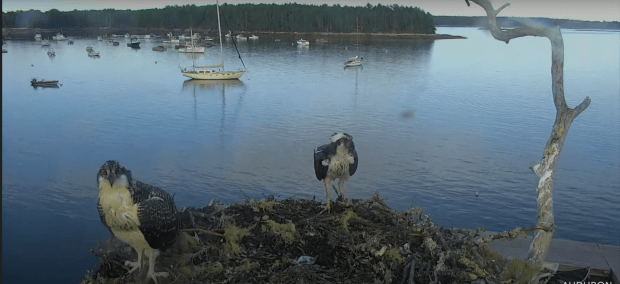
‘H’ sent a lovely close up of Sloop, the third hatch of Dory and Skiff at the Boathouse Osprey platform in Maine. What a cutie pie. She adds that Sloop is now loving the perch that he was afraid to move from before fledging. Grand news, indeed.

Sloop is quite handsome. So many of us worried when he was wee making sure Dory got some fish flakes in his little beak. Dory was an amazing first time Mum and Skiff kept the fish coming in.

Sadly, the Osprey rescued hanging from the tree with fishing line had to be euthanized and its sibling was found in the nest, image below, tangled in human debris. This is the announcement. Please read it and look at the tangled mess that killed these poor chicks. It seems that our rivers, lakes and oceans are nothing more than dumping grounds for human garbage carried back by the birds to their nests – innocently or tangled.

‘T’ sent me this very concerning story this morning. Another migration hazard – human meanness. Thank you ‘T’. A migrating White Stork has been shot through the neck with an arrow. The photograph of it on top of a house is below. It is not clear where the bird was shot. You do not need to hear what I am saying!!!!!! We have culprits like this in our City who think it is fun to do the same to the geese.

https://www.milliyet.com.tr/gundem/leylegin-okla-goc-yolculugu-turkiyede-vurulma-ihtimali-yuksek-6809314?fbclid=IwAR2IK2rnRzR1YU01Rr6LyAyD1s4AeC5MCREmLznuO-gzOGTSNzR9YnhXQ7U

The RSPB in the UK has released the initial findings on the post-mortem of ICI, the Loch Garten chick that passed away after being lethargic in the nest. Please have a read. I find it interesting that they mention an enlarged organ. The inconclusive findings of Big at the Captiva Nest when he died stated, ‘enlarged organs’. They did not state that this could have been due to an infection. I would like to hear more about this – and I wonder if it is the same for Molate who also was lethargic for several days and died.

https://community.rspb.org.uk/placestovisit/lochgartenospreys/b/lochgartenospreys/posts/osprey-update-post-mortem-results?fbclid=IwAR36xBdBt84rAMULZAgotA8uRz2CnQFsNCEkI4CDKkoB5DzacVMQDbsa4Mg

Thank you to everyone for being with me today. I hope that each of us is enjoying a lovely end of the week. Please take care. See you soon.

Thank you to the following for their streaming cams and/or posts where I took my screen captures: Notre-Dame Eagles FB, Looduskalender, Dyfi Osprey Project, CarnyxWild, Sea Eagles @Birdlife Australia Discovery Centre Sydney Olympic Park, Friends of Loch of the Lowes and the Scottish Wildlife Trust, Explore.org and the IWS, Audubon Explore and ‘H’, and The Raptor Centre.

Victor is a picky eater, Little Bit Soars, and Ervie tests out spikes – early Thursday in Bird World

18 August 2022

I have started writing this with the news of Wednesday the 17th that some of you might not have seen. It has been raining and raining with tornado warnings for a couple of days now and it is expected to continue. As a result I am scooting out to the nature centre and local ponds to continue the duckling and gosling counts whenever I can. Good thing. The skies opened up in the middle of the night – many friends had pets who were frightened by the fierceness of it all.

It always puts a smile on my face when I go out and all the waterfowl families are where they normally are. It is true that they develop an area to their liking and it is equally true that some wander from one place to another. I hope that some images might brighten your day, too. I did not do any colour adjustments. The water looks like pea soup – the surface is made up of tiny little leaf like bits.

This Mallard family lives in a particular spot. I have been following them since June.

I always know which pond to find them. Today, I saw them coming around a bend. Ducks paddle fast. The female kept a watchful eye but seemed not to be bothered by my presence. She has seen me so many times that it seems she just goes on about her business as if I am not there.

You can see the leafy bits easier in the image of the Mallard below. It is clearly a different surface from the much-needed-to-be-cleaned-full-of- human-debris pond at one of our other parks.

I found this bunch lounging under one of the benches in the shade trying to stay cool.

What has been most interesting to me is that the Mallards are thriving – what ones that survived – at the Nature Centre with their ever growing ducklings while the Wood Ducks have taken over a park and there are only 5 or 6 Mallards. I do know that they do not like one another!

The Ojai Raptor Centre has given us an ‘excellent progress’ update on our dear Victor.

Look how tall and handsome Victor is – remember when he could not stand and he required physiotherapy by being held by a towel with holes for his legs? What an amazing transformation! (At this point, it is perfectly permissible to shed a tear or two).

I wonder if Victor is yelling for fish?

Now, it turns out that Victor is a very picky eater!!!!!! He only likes Whitefish so the Ojai Raptor Centre has sent out a call for the fishermen to bring in fresh Whitefish. It is costly. If you have been thinking about donating or making a shop purchase in aid of Victor, maybe now is a good time to do this. He has really made fabulous progress with their great care.

There is very sad news coming out of the Arboretum in Minneapolis. The only osplet on the nest was near fledge. It had leapt off of the nest – and survived a couple of times – due to human activity below the platform. Two days ago the little one jumped off again in fright. Searchers have not found the youngster and it is assumed that it was predated. #85 on the list of feathered friends departed. I will happily delete that entry if the osplet turns up!

This was the announcement:

Of course, I have an opinion! (And I am certain you do, too) It won’t help this osplet but protocols need to be developed and put into best practices everywhere there is a raptor nest. Areas near Osprey platforms need some separation from human activity. This chick was known to leap out of the nest due to its fear of humans below. It was nearing fledge. Two options: Once a near fledgling has leapt out of a nest due to the fear of human activity, Kept the chick in care til it could fly OR stop the human activity around the platform until such time as the chick fledges. It really is that simple. When do non-emergency human activities take precedent over the safety and concern for wildlife?

Little Bit ND17 has been caught perched on ‘his’ branch and soaring over the St Joseph River near to the natal nest in St Patrick’s park. Oh, he is doing so well. Just brilliant. What a role model Little Bit is for all of us. He ate anything he could find on the nest to stay alive. I will never forget him scurrying back to the part we couldn’t see to eat something – normally the pelt of a squirrel or a raccoon so 16 could not come after him. It didn’t matter to him – it was food and it kept him alive. He kept his wits about him even when he did not have food for a couple of days…and he never gave up! Little Bit wanted to live and to soar like a big eagle — and he is doing just that. Look at him go!

Suzanne Arnold Horning found L2, the first of Big Red and Arthur’s 2022 clutch to fledge and the second to catch its own prey (L4 was first), today after there had been a brief storm. L2 is incredibly beautiful. He is out by the fields and it looks like he is sitting on a pole like a good hawk watching for voles and chipmunks. Red-tail hawks are gorgeous. Like the hawks that visit my garden on occasion during the fall and winter, they are capable of sitting like a statue for extreme periods of time waiting for prey.

Sadly we are entering a period where the raptors will be going into care because of lead poisoning or from being hit by cars. Those that eat carrion are especially at risk as many people will not stop and remove a dead animal from the road and place it safely away from the cars. — If you do see a dead animal, you need to think quickly on your toes because you do not want to be a casualty either. Not everyone carries a shovel and a collapsible pet carrier or cardboard box in their car but it really helps if you have a shovel or piece of wood to remove the carrion to the side of the road. Put your flashers on. Watch so you do not open the door when there is oncoming traffic. Then be bold. Wave your arms to stop cars. Most will but be darn quick to get out of the way if they don’t. Then scoop up the animal and put it away from the road in the ditch — we do not want it close to any cars. Thank you! Tonight, however, the culprit is monofilament line. None of the children at our nature centre, when questioned, realized that ‘fishing line’ was dangerous to wildlife. Education is key.

This little Osprey fledgling was lucky that people were willing to work after hours to give it a second chance when it was found tangled in fishing line.

Oh, what a sweet little thing. It looks like it is feeling better already.

Even the fish get caught up in line – many break the line leaving the hook inside of them. A kind person living in my city found this fish near the shore wrapped in monofilament line. They stopped, cut it off, and worked with the fish for 5 minutes to get the life back in it. That fish got a second chance, too.

Every living thing deserves our kindness.

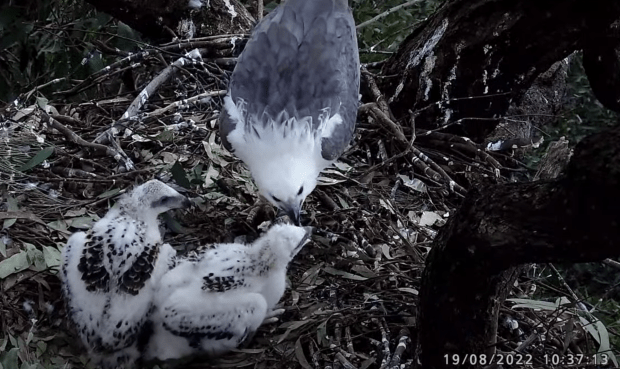
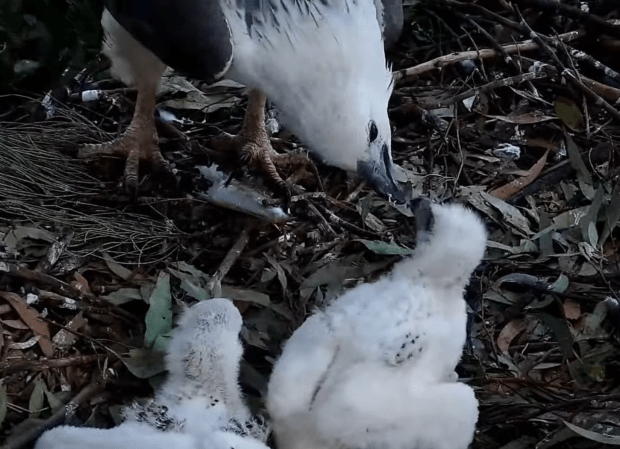
The Sea Eaglets 29 and 20 continue to thrive. Lady fed them both a nice breakfast – not a crop buster but, a good start to the day.

30 is really starting to have a growth spurt. We can still tell them apart because 29 is just that little bit ahead. you can see the down gone from its entire head to the nape. There are more back and wing feathers.

The feathers are really developing. In a wink these two are going to look so different…and look, hardly any down bits left on those heads.

Cooper’s Hawk

Most of us know Dr Eric Greene from his work with the Montana Ospreys and, in particular, his love of dear Iris, the oldest Osprey in the world. Yesterday he posted a video on the University of Montana website about a very special raptor family on the grounds of the campus.

Our City is home to numerous Cooper Hawk families and I am hoping to get out to see one of them at a park called Bunn’s Creek this weekend with a group. You might recall that a large female Cooper’s Hawk took up residence on my deck early this spring. It appears that they have ousted the little Sharp-shinned Hawk from the territory.

‘H’ sent some great images of Sloop. He doesn’t have his landings perfected — or does he mean to buzz those siblings???? Congratulations to Dory and Skiff – they fledged three beautiful ospreys this year who have ample time to get in form for migration.

The take off – wings up, Sloop!

The buzz. Thanks ‘H’. Great screen captures. Too funny.

The Black Stork, Kaia, continues to stay in Belarus travelling only a few kilometres to find food. Her battery is operating at 99%. Here is her current position.

Mama Cruz has visited the Fraser Point nest this morning. She is showing concern – there is a ‘stranger’ in her territory. It is Trey, her 2019 daughter with Spirit. Trey is under the natal nest in the bushes.

How do I know this is not Andor? There is no wing tag. Mama Cruz shed that tag in April 2021 and she has only one band, a federal silver band on her right leg because when she was ringed Dr Sharpe believed she was a male.

Has something happened to Trey? It is not clear why she is in the bush under the nest and not flying.

Migration is under way and you can go to this link to find an interactive map.

Emyr Evans has posted an image of Pedran, Idris and Telyn’s daughter, who is today 84 days old. She has not been seen at the nest for the last 7 days. Did she undertake the earliest migration in Welsh Osprey history? or will she return to the nest from some adventure? or, sadly, is she lost? No one can answer that question yet.

News coming out of Port Lincoln Osprey is really good. Dear Ervie has demonstrated that certain approaches to keeping birds off poles simply do not work!

And there is a great article about Mum and Dad’s three eggs this season. Osprey are so rare in South Australia.

https://www.abc.net.au/news/2022-08-18/osprey-breeding-eggs-conservationists-thrilled-port-lincoln/101343128?fbclid=IwAR1rd-z0ZeS_zBQQtmLIlTzoPIcoxvN1SWX8X8V-TdZH6claZLhTEBgwV2g

Thank you so very much for joining me today. Please take care of yourselves! We are expecting more and more rain but I hope to get out into nature somewhere — you sleep better. Your mind is refreshed. I hope that you will make an effort, no matter how small, to take in nature’s beauty today.

Thank you to the following for their streaming cams and/or FB posts where I took my screen captures: Port Lincoln Osprey Project, Dyfi Osprey Project, BirdCast, Explore and IWS, Looduskalender, University of Montana, Sea Eagles@Birdlife Australia Discovery Centre Sydney Olympic Park, Bobby Horvath, Suzanne Arnold Horning, Notre-Dame Eagles FB, Twin Cities Metro Osprey Watch, and the Ojai Raptor Centre.

3 year old eagle returns to natal nest while Sloop decides to fly…or not

16 August 2022

Sometimes events are so heart warming that they need to be spread throughout the community. Sitting on a perch as I write is a 2019 hatch of the Two Harbours nest and Mama Cruz. Trey is the female eagle’s name because she was the third to hatch. She survived her migrations to return to the Channel Islands as a three year old! Just splendid.

My goodness even moulting she is gorgeous. A survivor. When you look at this three year old eagle be amazed. As we know most simply do not make it to their first birthday.

The Channel Islands eagles have graced us with their beauty in the past few days – Lancer at Two Harbours, and Thunder and Akecheta at the West End. Andor and Mama Cruz and now Trey.

Remember that the research tells us that it is the males that return to their natal nests. Well, this is a female! I hope that Victor’s natal nest GPS coordinates are hard wired into his system so that no matter where he is released, we will see him on this same perch in 3 years time.

In Canada we are familiar with Spunky, the Red-tail hawklet raised by the Bald Eagles in Sydney, British Columbia. This year it was Malala’s turn – another Red-tail Hawk – to be raised by Bald Eagles along with their chick,, Junior, on Gabriola Island, British Columbia. Well there was, at the same time, on the other side of the US, another Red-tail Hawk being raised by a Bald Eagle family in New Jersey.

Here is the story:

A New Jersey First: Hawk Raised by Eagles

It would seem that the raising of a hawklet on an eagle nest might not be as rare as we think.

A note from ‘H’ came flying across my computer screen. It is about Sloop, the third hatch at the Boathouse who has not fledged. He made his way up to the high perch and it would appear that he is afraid to come down. ‘H’ says Dory has been trying to lure him down with a fish. He has now not eaten since 1230 — and we know that Sloop loves his fish.

Sloop has now been joined by a sibling.

I have a great fear of heights and have so much empathy with our dear Sloop who has been up on that perch for almost 7 hours! Poor thing. The water looks calm and he can fly —– he just does not know it.

‘B’ gave me an idea. I am going to send Stephen Basly and Doreen Taylor snail mail thank you cards to St Patrick’s Park. I am certain they know them well – from all of us. It has been such a treat to be able to see Little Bit 17. So grateful for their efforts.

Thank you so much for joining me. Send good energy and a gentle wind to our dear Sloop in the morning. After his huge meal yesterday he will not starve. Remember in the wild eagles can go for days without eating and he had some crop. Yesterday he was too full to fly.

Speaking of crops…one last image. SE30 is the one on the right. No words needed. Take care everyone.

Thank you to the following for their streaming cams and/or posts where I took my screen captures: Sea Eagles@Birdlife Australia Discovery Centre Sydney Olympic Park, Audubon Explore, Bald Eagles 101, Explore and the IWS.

Bird World News – Early Tuesday

16 August 2022

Good Morning Everyone!

Everyone has survived the torrential rain from last night but all the plants were pelted down by the heavy rain and I wonder if that is the same for the crops in the farmer’s fields?

I am reasonably sure that everyone reading my blog this year is aware of the ‘rain’. We had a 4-5 year drought and then the skies opened in the spring and never closed for any extended period of time. The dehumidifier cannot keep up and tonight the skies opened again! It is raining so hard you cannot see and the sky is charcoal-gray.

This is an image shot on the highway and sent to me about 30 minutes before the system hit Winnipeg last evening.

This image has an empty alt attribute; its file name is screen-shot-2022-08-15-at-7.59.16-pm.png

There it is on radar.

This image has an empty alt attribute; its file name is screen-shot-2022-08-15-at-7.58.11-pm.png

What does this have to do with raptors? or wildlife? Well, in Manitoba it has a lot to do with them. It means that the rangers at Hecla Island/Grindstone Provincial Park will not be able to check the shore line where the eagles used to make their nests. It means that the lake will rise even higher. It will be good for some of the shorebirds! For others they might have difficulty finding food.

Thankfully the new baby Hedwig came to eat under the bird feeders at his usual time and beat the storm. I try to not let him see or hear me which means the images are always compromised. He is really growing. Sometime between the 20th and 30th the new fence will be going up. Then the bird and pollinator friendly area will be planted. The fence builder already knows that the fence has to be raised so that the rabbits can come in. Sadly it also lets the feline domestics in the garden, too. (Just like the reintroduction of Goshawks in the UK means that there will always be predators for the Ospreys now). The floor of the sunroom will be tiled on Wednesday, cure until Friday night and finally on Saturday if all is well, I can move back in. I need to figure out how to remove one of the screens as it really stops me from being able to take photos of the garden friends without disturbing them. It also means that the juvenile Crows will see me and stand on the roof screaming and pecking when their cheesy dogs need replenishing. It is interesting – no one can ‘see’ into the sunroom but if the birds get close enough they can – and, of course, their hearing is top notch. Still, I try to be invisible.

I am very fortunate and honoured to be able to take care of them, this little enclave of nature in the middle of a big and growing city. While I cannot turn back the heating of our planet, I can make the lives of the animals that bring me such joy easier. It is the least I can do. They used to burrow and fly in this area – free. As my City grows out instead of building up in the interior, their habitat gets more and more compromised by large housing developments with no trees and the houses so close together. It is easy for humans to become estranged from nature and that is the opposite of what we want.

This image has an empty alt attribute; its file name is 1steke7grlesuxe0myt3vw_thumb_117cc.jpg
Little Hedwig III

My goal this summer was to not only take care of the animals and birds but to coddle the old roses that were on this property in 1902. They are climbers and had been neglected when I arrived and well…I am guilty of also neglecting them. This year the area was cleared and supports were put in place. With all of the rain they have flourished. This is just one tiny cluster. They have been blooming since June and there are new buds every day as long as I pick off the old ones — which I need to do on this bunch. I wish I could put the scent on this page for each of you. If it could be bottled you could pull it out and smell the roses of summer at any time. They bring such joy.

This image has an empty alt attribute; its file name is dftj3rmkr1c369ziarqfog_thumb_117ca.jpg

I am shocked every time I go to the park because there are new ducklings. It is August – the middle of August! There should not be ducklings!

My camera is ‘smarter’ than I am and reacts badly if I happen to not check all the bells and whistles. I did not set it for ‘Movement’. This little duckling was moving. It was so tiny and still fuzzy. I have really cropped and blown up the image. What will happen to this little one? Will it grow fast enough to migrate in October? Why are so many ducklings hatching during the last week? They are all, by the way, Wood Ducks save for a couple of Mallards. The numbers have shifted this year. The Wood Ducks arrived late and are bountiful. At one time in early June I could not find a single Wood Duck!

These images are not great. Thankfully I am not trying out for wildlife photographer of the year — they would send me out of the room quickly!!!!!!!

This image has an empty alt attribute; its file name is unadjustednonraw_thumb_116a7.jpg

If you haven’t guessed by now, I love Wood Ducks!!!!!!! I think they are my favourite duck ever.

This image has an empty alt attribute; its file name is uswta97vqtoocjb5vvk4lq_thumb_11664.jpg
This image has an empty alt attribute; its file name is 10wq2wfatosfkdkvldydeq_thumb_1176c.jpg
This image has an empty alt attribute; its file name is tnxutqlkrpspmgy9zbozw_thumb_1179c.jpg

There were a few older Mallards. I could see no Mallard ducklings at this particular pond.

This image has an empty alt attribute; its file name is unadjustednonraw_thumb_116bd.jpg

I was, however, shocked/annoyed/angry that there was a party at a duck pond with balloons. On the drive out of the park there were more balloons attacked to trees! Signs can be used instead of balloons. They need to be banned from the park and the public needs to be educated as to what the reasons are.

This one had broken lose and had blown over to the edge of the island in the pond where the ducks and geese rest and lay their eggs. Will it pop and will one of them consume it?

I seem to be venting but clearly notices against balloons must go up at the parks just like the feeding signs.

This image has an empty alt attribute; its file name is unadjustednonraw_thumb_116ba.jpg

There they were – piles and piles of them. Celebrations should be fun and safe ——–for everyone and everything – including our dear ducks.

This image has an empty alt attribute; its file name is unadjustednonraw_thumb_116d4.jpg

Our City banned the use of glue strips as of 1 July 2022. So why are our big box DIY stores still selling them???????!!!!!!!!!!!! (Screaming at the computer!)

This image has an empty alt attribute; its file name is screen-shot-2022-08-15-at-7.32.43-pm.png
This image has an empty alt attribute; its file name is screen-shot-2022-08-15-at-8.18.02-pm.png

This will be a long term stay at the centre – feathers must moult and regrow. The wee one will need to learn everything in order to live in the wild. Wildlife rehab clinics, their vets, their student vets, their volunteers are the angels behind in the scenes in helping give our raptors a second chance at life from the harm that we do to them. Remember that you can help, too. That help comes in as many different forms as each of us is different – clean old towels and sheets, a bottle or two of Dawn dishwashing liquid, bleach, items for enrichment, volunteering time, holding a garage sale and giving some or all of the proceeds to the rehabber of your choice – the list is endless.

BirdCast has an active map showing migration in the US. Here is how to access it:

https://birdcast.info/migration-tools/live-migration-maps/embed/#?secret=jEQFPNj636

Kaia, the mate of Karl II, who is now migrating towards Africa turned back from the Ukraine yesterday and flew back into Belarus. Kaia has remained in Belarus today in a forested area. Some reported that she is in the Ukraine – this is not correct.

Many articles on how the war in the Ukraine is impacting wildlife, both residents and migrants, will be part of Wednesday morning’s blog on migration challenges.

This image has an empty alt attribute; its file name is screen-shot-2022-08-15-at-11.35.52-pm.png
This image has an empty alt attribute; its file name is screen-shot-2022-08-15-at-11.35.36-pm.png

At the White Stork nests of Bukacek and Betty in The Czech Republic, the adults are enjoying some quiet time together – bonding and working on the two nests. The fledglings seem now to have left the area to join other groups of other fledglings as they begin their mass migration together.

Stephen Basly who posts photos and videos of the Notre Dame fledgling eagles watched Little Bit 17 successfully defend his perch against 16. Isn’t that wonderful news?! The kid has confidence and we know he is tenacious and resourceful. Sounds like a great beginning to independent living for this survivor. If the images come out, SB will be posting them on the Notre Dame Eagles FB page.

This image has an empty alt attribute; its file name is screen-shot-2022-08-15-at-11.28.22-pm.png

In Senegal News, Jean Marie duPart reports that there are 31 young Ospreys in good form and finding large fish counted in Langue de Barbarie Park. Jean-Marie and his team keep us updated on Osprey counts from the beginning of migration period (yesterday) to their departure in the spring.

Young raptors can get trapped in trees. They still cannot land very well and often the twigs and the thicker of the thin branches stick through their wings and they are trapped….waiting to die. If you should see a raptor in precisely the same place, they probably need help. Check with your local wildlife rehab rescue. This Red-tail hawk is very happy that someone stopped to care for it!

https://fox8.com/news/see-red-tailed-hawk-trapped-in-dead-medina-tree/?fbclid=IwAR0QXV7cLEeMR0cBXpCbfGe3bTs0Sf1KXy-YUKc8w6EFNp-nBM-uTX4AoNk

The osplet on the nest at the National Arboretum platform in Minnesota has been scared off the nest at least three times this season by human activity. It is time that the institution put a fence around the area during breeding season like Montana Osprey Project does for Iris in Missoula. Sadly the chick is missing this time.

Are you missing Thunder and Akecheta? I sure am! Thunder was calling to Akecheta from the nest last evening as he flew around. He listened and joined her. So nice to see the two of you.

This image has an empty alt attribute; its file name is screen-shot-2022-08-16-at-8.58.25-am.png

Missy and Pa Berry were working on their nest yesterday also…and remember, Samson is waiting for Gabby to return. We have not even seen the fledglings off and the adults are starting to think about ‘spring’! With the changes in temperature, it will be interesting to see how many nests maintain their traditional egg laying schedule or who, like the Ospreys at Captiva, begin a month early.

This image has an empty alt attribute; its file name is screen-shot-2022-08-16-at-8.59.55-am.png

CJ7 and Blue 022 are making sure that their sole surviving fledgling, 5H1, is truly ready for migration. Look at the good condition this bird is in! 5H1 is a very important Osprey in the history of the reintroduction programme in the UK. He is the first osprey to hatch in more than 200 years and he has survived! (Let us hope that the goshawk that caught 5H2 off guard does not come around).

5H1 is really telling Blue 022 that it is time for the afternoon tea to be delivered!!!!!!!

This image has an empty alt attribute; its file name is screen-shot-2022-08-16-at-9.04.25-am.png
This image has an empty alt attribute; its file name is screen-shot-2022-08-16-at-9.07.46-am.png
This image has an empty alt attribute; its file name is screen-shot-2022-08-16-at-9.08.01-am.png

The youngest of the three osplets at the Boathouse platform in Maine is Sloop. ‘H’ tracked this bird all day yesterday and the days prior. Sloop is yet to fledge. The other two are 58 and 59 days old. Thanks ‘H’. So it is fledge watch for this third hatch of Dory and Skiff.

This image has an empty alt attribute; its file name is screen-shot-2022-08-16-at-9.09.47-am.png

There is still one osplet to fledge at the Osoyoos Osprey platform in British Columbia.

This image has an empty alt attribute; its file name is screen-shot-2022-08-16-at-9.17.22-am.png

Fledgling BC still comes to the nest for fish. So happy for Soo and Olsen. Despite losing one chick who fell off the nest, they managed to raise two in remarkably difficult conditions.

This image has an empty alt attribute; its file name is screen-shot-2022-08-16-at-9.17.44-am.png

Everything looks OK with Dad for yesterday at the Port Lincoln Osprey barge. He is really wanting to do some incubating so there are lots of changing shifts. He even came in the late evening, 2202, but Mum sent him packing.

This image has an empty alt attribute; its file name is screen-shot-2022-08-16-at-9.21.43-am.png

Everyone is sound asleep in the Sydney Olympic Forest. SE29 and 30 are too big to tuck under Lady so they have made a little cuddle puddle.

This image has an empty alt attribute; its file name is screen-shot-2022-08-16-at-9.23.35-am.png

That is it for early Tuesday in Bird World. Thank you so much for joining me today. Please take care. See you soon!

Thank you to the following for their posts and/or streaming cams where I took my screen captures: Sea Eagles@Birdlife Australia Discovery Centre Sydney Olympic Park, Port Lincoln Ospreys, Osoyoos Ospreys, Audubon Explore, Poole Harbour, Berry College, Explore and the IWS, Arboretum Ospreys, Notre Dame Eagles FB, Capi Mlade Buky, Looduskalender, Bird Cast, and Bald Eagles 101.

Little Bit 17 and Sea Eagle update

15 August 2022

I cannot thank the boots on the ground near the St Joseph River for keeping us informed about Little Bit 17. Without his tale tale tonsure, we might never know that it is him. I know that many of you are not members of FB so I took a couple of screen captures but, if you are members go over to Notre Dame Eagles and see the latest posting by Doreen Taylor. There are some great videos of 17 soaring as well as one of the parents.

The St Joseph River where Little Bit is perching and soaring.
One of the adults flying over the nest tree. Note the white head.
A capture from the video of Little Bit 17 perched preening.

Just seeing him out in the wild living his life – thank you Humane Wildlife Indiana. Tears.

There has been some discussion about whether or not a chick – not sure which one – had fledged or not. Our ‘osprey eyed reader ‘H’ kept questioning this. Today after watching one osplet on that nest move around all day and not fly, it has been confirmed that only 2 of the osplets from Boat House have fledged! Thank you ‘H’.

And there the osplet is…stuffed with fish, flying no where soon. With the camera off for 2-3 weeks it was really difficult to even identify which osplet was which – not sure it has been done yet!

Keep your most positive thoughts for Dad at the Port Lincoln Osprey barge. Mum and Dad are into hard incubation of the three eggs. Let us hope that he does not have another ‘spell’.

Beautiful Mum.
Dad comes to give Mum a break.

Last. SE30 is doing great. He is flapping his wings and crawling out of the egg cup. Don’t tell 29 but 30 is figuring out how to get up to Lady and get the first of the fish!!!!!!!!

Sea eagles have wide and long wings. The pin feathers coming in so nicely on the part of the wing closest to the body in image 1 are the secondaries. They have 15 secondary feathers and 10 primaries – the ten closest to the wing tip. You can get a glimpse of those coming in.

As you can see SE29 is moving around the nest keeping balance using those wings! You can feathers appearing slightly on the shoulders (as black dots) and back of 29 in subsequent images. They will start to flap those wings more.

We are getting ready for the biggest plumage and development changes during the next two weeks. They will go from mostly being a fluffy chick to looking more and more like an eaglet. They will stand on their two feet and begin to make efforts to self-feed. So lots of exciting things to come!

‘B’ sent me a note after the images of Lancer appeared in yesterday’s blog. He reminded me that Dr Sharpe had saved so many eaglets this past season including Lancer who clung to the side of the cliff. Yes, Lancer also had a second chance at life! Thanks Dr Sharpe.

Thank you for being with me. I knew you would want to hear about Little Bit. Take care everyone. See you soon!

Thank you to the following for their FB posts and streaming cams where I took my screen captures: Doreen Taylor and the Notre Dame Eagles FB, Audubon Explore and ‘H’, Port Lincoln Osprey, and Sea Eagles @Birdlife Australia Discovery Centre Sydney Olympic Park.

Early Monday in Bird World

15 August 2022

Good Morning Everyone,

The hoped for blog on migration will be written tonight and appear Wednesday morning. Lots of good information has come in! Thanks to all. If you are still thinking about migration challenges – even in your own area – send them to me before 1800 CDT Tuesday the 16th.


When will Diamond lay her first egg of the season with Xavier at Charles Sturt University in Orange, Australia? That seems to be the question on everyone’s mind. Xavier continues to bring in lovely prey items – some not so welcome like the Starlings but, it would seem that Diamond is in really good shape for this breeding season. Many of you might have noticed that Diamond appeared to be in less that stellar form last year and there was some concern that little Yurruga did not have good feather development. We are wishing Xavier and Diamond a successful season – meaning lots of prey items for the hatchlings, good weather for fledge, and success.

Here is the data on previous years:

Surviving Poole Harbour fledgling, 5H1, immediately flies away when it hears a predator approaching. Everyone learned fast after 5H2’s death by Goshawk. Today it was a Buzzard – a friendly. The little one is taking no chances though. Well done. You even took your fish dinner with you!

There was a question: Do goshawks eat fish? Goshawks are carnivores. They eat mammals and large sized birds found near the edge of the forest. They also eat amphibians, insects – and, yes, fish!

I had a comment in more the form of a question from my good friend, ‘T’. She noted that for years people have loved looking at the Osprey nests in the UK. The only things that were of concern were the weather and enough fish. They brought a lot of solace. Now Goshawks? ‘T’ wonders when the UK is so active in reintroducing the Ospreys to their country that there are now goshawks – long time enemy in the forests.

‘T’ here is your answer. A reintroduction project began in 2018 with Goshawks taken from Norway and Sweden to the UK.

Watching our raptors lay their eggs can emit all kinds of empathy especially if the eggs are big and more hard than soft when laid. At the Port Lincoln Osprey nest, Mum laid her third egg of the 2022 breeding season right on time. She looks tired. Watching birds incubate eggs is like watching water boil when the heat on the stove is ‘off’. But, Mum will get a rest and then in about 38-43 days she is going to be really busy. Should I wish for a clutch of all males or all females so life is civil again this year?

Sadly, it appears that Dad might have had another issue like he did a number of days ago. ‘H’ caught it! Is Dad having some kind of a seizure? or is the wind whipping him and his beak gets caught in nest material? It really is not clear but please send warm wishes to this amazing male – Ervie’s best buddy. Here is the video:

What a treat it is to check on a steaming cam and have a fledgling sitting right there as the sun sets. That is what happened when I went to see if Lancer had visited Two Harbours today. She is probably hoping for food! Chase & Cholyn haven’t delivered anything on camera for a few days. Not to worry. Lancer is not going to starve to death. They are seasoned parents. Cholyn is 24 years ‘young’.

Remember we talked about the things that wildlife rehabilitation centres need – besides cash donations. We talked about old clean towels – well, add old clean sheets and egg cartons to your list. Collect them from neighbours, friends, and family. Create a box. Everything helps! Most centres offer enrichment to the animals in their care. This comes in many forms from using toys to crumbled up paper to egg cartons!

The very latest on our Little Bit ND17. What a fantastic image. We can all be assured that Little Bit has been eating and that his flying is getting stronger. He has been back in St Patrick’s Park for many weeks now! So grateful to those on the ground who continue to track Little Bit and send us images. Thank you Stephen Basly!

The Sydney Sea Eaglets are fine. They ate and ate yesterday. Both had enormous crops – and yes, they do still get a little scrappy but I will venture to say that there is nothing to worry about unless there is an absolute food shortage. SE29 is the dominant bird. 30 knows it but sometimes doesn’t like it!

I continue to track Kaia, Karl II’s mate as she migrates towards Africa. She did a round turn and left the Ukraine and went back to Belarus! Dates on second image below.

What caused Kaia to flee the area and return to a safe spot she knew? Will she be resting and trying to figure out a different route? will she feed up so that she does not have to stop in the Ukraine? This is an extremely worrisome situation for both Kaia and Karl II but also for the four Black Stork fledglings – they represent the only storklets to survive this year.

War is a very terrible thing no matter where it is happening. We read about the costs to people and infrastructure but never to the wildlife that are suffering. Most of the birds from Estonia will be flying through the Ukraine – or have traditionally. Send them your most positive wishes.

While Kaia tries to work her way around a war zone, Karl II is keeping the four fledglings full — they will need to fatten up and so will Karl II for their long journeys.

There is a rumour that all of the chicks on the Boathouse Osprey platform have now fledged.

Chicks are doing fine on the Osoyoos Osprey Platform. BC was self-feeding and LC was enjoying being fed by Soo. Hats off to them. They have survived the two heat domes and it continues to look good for this nest in Canada!

That’s it for today in Bird World. Thank you so much for joining me. I will be keeping my eyes on Kaia’s movements and, at the same time, I will be trying to find out what is happening in the area of The Ukraine where she had landed that sent her back to Belarus.

Thank you to the following for their streaming cams and/or postings where I took my screen captures: Osoyoos Ospreys, Audubon Explore, Eagle Club of Estonia, Looduskalender, Sea Eagles@Birdlife Australia Discovery Centre Sydney Olympic Park, Notre Dame Eagles FB, Explore and the IWS, Port Lincoln Ospreys, Poole Harbour ospreys, Charles Sturt University Falcon Cam.

Fledges and returns…brief Bird World News

9 August 2022

I hope this finds each of you well. We are just enjoying especially beautiful days lately with clear skies and ‘green’. It is the thing we miss most during the winter – the colour ‘green’. The juvenile Crows and Blue Jays are still coming for peanuts and water and for some nice swims in the bird bath. Of course they have to beat Dyson to those peanuts. The men have not closed up the bottom of the sunroom and I believe, if they went under, they might find about 30 peanuts Dyson has been putting there! I am waiting to see if these Crows and Blue Jays migrate. They do not always. Soon the migrating birds from up north will begin to make their way south. The Dark-eyed Juncos will be here demanding millet – on the red carpet!

There is not a lot of news in Bird World but what there is is fantastic.

The Fortis Exshaw Osprey Nest (put up by the power company of the same name) is celebrating today and so is ‘H’ who spent the day staring at the screen. She had a feeling that all three would fly today and — well, she was almost snookered when Dad came in with a fish but – yes, all three osplets at the Canmore Alberta site are now fledglings. This is fantastic. Thanks ‘H’ for your tenacity and belief. Mom had been on the distant pole urging them on. You can see her cheering her three babies.

This is the footage of the first fledge. (There is some buffering).

Fledge 2. The fledgling flew about for 2 or 3 minutes before returning to the nest.

Fledge 3.

Guess who is home? He doesn’t migrate but his mate does. The couple fledged two eaglets at their nest near Jacksonville. The nest this male Bald Eagle is using is the actual nest where he hatched on 23 December 2013. His father’s name was Romeo. His mother’s name was Juliette. Any ideas?

Gosh he looks good! If you said Samson you are correct. He has fledged 5 eaglets from this nest: Jules and Romey (2019), Legacy (2020), Jasper and Rocket (2021). Welcome home, Samson!

Gosh, things are just steaming up in Australia and Samson is home. Goodness.

More images of the Notre Dame eagles have been taken and posted. The three of them together a few hours ago. Lovely to see them. It is curious that our Little Bit 17 seems to always stay away from where 16 is…long memories.

The two sea eaglets at the nest in the Sydney Olympic forest are getting two big for that egg cup. They should be stretching those legs and skooting around the nest on their wrists. They are adorable. Pin feathers and all.

For all the California Condor lovers, the chick at Tom’s Canyon is really growing beautifully. Very hopeful.

Thank you so much for being with me. Cheer the Fortis Exshaw osplets. It was quite the day for their parents – all three fledging at once. So happy. They are going to have good time to create those flight muscles. Take care everyone. I will be back on Friday.

Thank you to the following for their streaming cams, videos and or posts that became my screen captures: ‘H’ for the Fortis Exshaw videos, Fortis Exshaw, American Eagle Foundation- NEF Bald Eagles, Sydney Sea Eagles@Birdlife Australia Discovery Centre, Sydney Olympic Park, Notre Dame Eagles FB, and Ventana Wildlife.

Ervie, fledges and more – early Tuesday in Bird World

9 August 2022

First a correction! Shame on me for saying we know where Telyn winters. It is not Telyn but, the beautiful Seren from Llyn Clywedog that spends her winters in The Gambia. I knew that and wrote Telyn. Thanks, ‘C’ for alerting me. Much appreciated!

One other clarification that ‘CE’ caught that needs explaining. Osprey fledglings are the raptors that do not require their parents to teach them to hunt or fish. Others do. You will have seen the eagles and hawks showing their fledglings how to hunt prey! I bet Ervie did chase Dad around in his efforts to find some good fishing spots, though!

Ervie, dear Ervie. Port Lincoln posted images after I had sent out my blog last evening so our dear Ervie is up first. Thanks to ‘B’ for alerting me to these.

As so many of you are aware, Port Lincoln Ospreys is working hard to introduce our fish eagles to Southern Australia. They are getting attention from government agencies and, of course, the population is growing to love these birds – many because of our dear Ervie. Here are the latest postings from Port Lincoln and the beautiful pictures of Ervie out fishing with Dad by Fran Solly. There are more on the Port Lincoln Osprey FB page. Head over and have a look. This is the place to continue checking on Ervie and his antics with Dad — or alone.

It is always good to see you, Ervie.

Is there room for you, Ervie??????!!!!!!

Remember when we worried that Ervie would only be able to catch puffers? Well, he has certainly adjusted to fishing without that other talon (I have not seen it fully grown in on the pictures but I would love to be corrected!). That is a beautiful fish. Well done, Ervie.

At the Black Stork nest in the Karula National Forest of Karl II and Kaia, Bonus, the adopted storklet of Jan and Janika, Bonus, fledged first today. He was followed by Volks who hears Bonus in the forest and flies off to the left.

Both returned to the nest. Ilks is looking at his reflection in the camera. Will you fly next? So funny when they find themselves. After fledging the Black Storks will stay at least a week around the nest being fed. If the food is plentiful they may stay longer before venturing out to find food for themselves and beginning migration.

As ‘B’ says, it is hard to beat the WBSE for cuteness. SE30 is a bit of a corker. When it was 2 days old, 30 beaked at 29. Not a good thing to do. We have all worried about 30 but unless there is an unexpected ‘something’, they should both be fine. SE30 gives as good as it gets and they both fool around with one another and then seem to stop before it gets too rough.

Chubby little bottoms. Their soft down on the head is giving way to pin feathers and the feathers are coming in nicely along the wings. They will begin to do a lot more preening as things get itchy. You can see their black talons and those big clown feet getting started. So cute.

Of the streaming cams in Australia, we now have the WBSE eaglets and the first egg at the Port Lincoln Osprey barge for Mum and Dad as of yesterday. We are awaiting the beginning of the season for Peregrine falcons Xavier and Diamond and the Melbourne CBD – 367 Collins Street. Xavier and Diamond are amping up the bonding in the scrape! Eggs before the end of the month?

The only chick on the Landscape Arboretum platform at the University of Minnesota fell off yesterday. It has not fledged. Here is the video of that incident. This could have turned out badly – and would have if not for the quick actions at finding the chick and getting it back on the nest. Thanks to all involved!

Boris and Titi (yet to fly) on the Janakkalan nest in Finland. 9 August 2022. Handsome!

All of the White Storklings of Betty and Bukacek have fledged. They seem to spend their time finding the parents and following them back to the nest for good feedings.

Look carefully. Bukacek is flying into the nest from the left (right above the grassy area at 930 on the nest).

All of the storklings came to the nest quickly so as not to miss a meal.

All of the UK chicks have fledged. This year the three at Foulshaw Moss did not get the best attention from me – in terms of publicizing the nest activities here on the blog. Last year I followed every move because of the third hatch – Blue 463 who survived and did extremely well. Waiting for her return next year! The Cumbrian Wildlife Trust have put out a very nice blog with an overview of the nest activities including some links to videos.

https://www.cumbriawildlifetrust.org.uk/blog/alasdair-mckee/there-were-three-nest-and-littlest-fledged?fbclid=IwAR3EmfM6q7y1XNIqdvENXGlh8x4VhZve9AwmrsA4vAFcs_XRrvXubF76BhM

There appears to have been a fledge this morning at the Fortis Exshaw Osprey platform near Canmore Alberta. Thanks ‘H’ for the tip off! They seem to all be relatively equal – perhaps the others will fly today. You can see Mum looking on over the nest at her three beautiful chicks from the perch.

The fledge was a quick take off, fly around the nest and return landing on the right side.

I am counting a fledge as a flight off the nest and a return. In my mind, the chicks jumping up or getting to the many perches is equivalent to branching for Eagles, not a full blown official fledge. The real question is how far away is the perch? It is too difficult to tell. Mum certainly looks small and if it is a distance, then it might be counted as a fledge. If that is the case, then there were two fledges at Canmore this morning so far.

Big Red, Arthur, and L2 have all been accounted for by Suzanne Arnold Horning this week. Excellent news. Still no recent updates on L3 or L4.

L2 in the top picture screaming for a prey item and Big Red and Arthur calmly relaxing in the second.

Everyone remains curious as to how Victor got so much zinc in his system that he almost died. The Institute for Wildlife Studies has indicated that there are fishing lures coated with zinc. Thanks ‘B’. Here is the posting on the chat at the IWS. The question still remains: how much zinc does a fledgling eagle have to ingest to almost kill it? I do not know the answer to that question but I hope to find out.

The posting of the images of Little Bit 17 prompted a lot of mail. Everyone is thrilled and so very reassured that it is our little tenacious eagle. So grateful to the boots on the ground for chasing after this family and sharing their photos and videos with us on the Notre Dame Eagles FB.

‘CE’ had a very interesting analogy that seems quite fitting given the sponsors of the camera and the university that they are associated with – Notre-Dame. CE noted that the image of Little Bit looks like a Franciscan Friar with his friar’s crown. He said, “In the 5th century, the tonsure was introduced as a distinctive sign. In the East, the Pauli tonsure was used (all hair was cut), in the West, the Petri tonsure (only the top of the head was shaved). This was also called Corona Christi (Crown of Christ). Since the 16th century, the tonsure of regular clerics has been reduced to a small circle.” Friar Little Bit. It sounds nice.

Thank you so much for joining me today. It is lovely to have you with us and the birds. I will continue to monitor the nests during the day. Tomorrow I am heading north for two days to count and enter the GPS for the Bald Eagle nests in and around Hecla Island. That information will be sent to David Hancock whose foundation monitors bald eagle nests in Canada. I hope to get some good images of the adults and juveniles before they leave for their winter homes. There will not be a newsletter tomorrow morning but I will try my best to get some images out to you tomorrow evening. Please take dare. I look forward to seeing you again soon.

I want to thank everyone who wrote in and sent me news. I still have some of your images to post! Much appreciated. I want to also thank the following for their streaming cams and/or posts or their photographs that I used for my screen captures: Fran Solly and the Port Lincoln Ospreys, Suzanne Arnold Horning, the Notre-Dame Eagles FB, the Eagle Club of Estonia and Looduskalender, Mlade Buky White Storks, Fortis Exshaw, the Finnish Osprey Foundation, the IWS, Charles Sturt University Falcon Cam, Landscape Arboretum Ospreys, and Sea Eagles@Birdlife Australia Discovery Centre, Sydney Olympic Park.

Migration woes and daily threats to our feathered friends

5 August 2022

Good Morning Everyone! It is a hazy day on the Canadian Prairies. The birds have been up early feeding as temperatures are set to rise to 29 degrees C today. The plants in the garden are looking a little droopy despite watering – we have been lucky to have all that rain. Some areas are really struggling. It is now a little after noon and the Crows and Blue Jays are reminding me that they need more peanuts and want their water changed! They are so smart. Wonder if I could teach them how to use the water hose?

I hope that you enjoyed seeing those beautiful pictures of Brooks back on the nest with Mum and Dad, Rosie and Richmond, at the WWII Whirley Crane. HE is well and beautiful. In case you missed it, Brooks (Blue XA) arrived back to the nest yesterday in the late afternoon and DNA testing has confirmed that Brooks is a male. Molate was also confirmed to be a male. This is a photo of him. He is very handsome.

Richmond does not migrate but Rosie does. Wonder which Brooks will choose? It is much safer to stay put!

Rosie has brought Brooks a lovely fish. Welcome home, Brooks.

Fish hooks and monofilament line are dangerous for all birds that eat fish like Ospreys and eagles. This is a reminder that things on nests can happen quickly — and for us to clean up our environment! Join a riverbank of lake clean up. It will make you proud that you have helped.

As we get ready to begin the great autumn migration, it is perhaps best if we take a deep breath. Migration is extremely dangerous especially for first year fledglings but it is becoming increasingly difficult for ‘seasoned’ birds as well.

I was surprised when I brought home a book from our nature centre, Atlas of bird Migration. Tracking the Great Journeys of the World’s Birds. It has good solid information on species with maps, information on the difference of gender in certain species as to migration —– and, hold on, out of 176 pages, four are devoted to “Threats and Conservation.” Out of those four, two pages had large photographs. The book lists: water (they show an oil spill), field and forest (they show fires), hunting and caging. Can you think of good current examples of these that will impact the birds we love heading to their winter quarters? what are they missing? Send your ideas to me and they will be included in a special blog on migration next Friday, 12 August.

Do you live anywhere near Hawk Mountain in Pennsylvania? You can visit but, you can also take part in the annual count. Here are the dates that the birds fly over. Even if you didn’t help with the count what a special time to see the birds flying with the thermals, soaring over the mountains on their way to South America.

Hawk Mountain has kept track of spring and autumn migrations since 1934. You can go to their link and see population shifts. It is an eye-opener in some cases.

https://www.hawkmountain.org/conservation-science/resources/migration-data

Each of the nests below has faced or is facing challenges like many others. If you looked at the picture of the nest could you come up with issues they have faced? Try it before reading my text!

The two osplets at the Osoyoos Osprey nest have not fledged yet. They are working on some wingersizing. Caught them enjoying an early fish from Olsen this morning. Today will be good but by Sunday the temperatures at the nest will be 36 rising to 38 on Monday and 40 on Tuesday. Extreme heat has been an issue at this nest for several years with the temperatures continuing to rise and rise.

Thanks to the lovely people who live around the Notre-Dame Eagle nest we have more pictures of ND 15, 16, and Little Bit 17. It is always so funny…Little Bit seems to love to hide behind the small branches with leaves. So grateful to all those keeping track of the trio!

Hi Sweetheart.

The Parramatta River and Sydney Harbour have some significant toxins in the water that impacts the fish eaten by the sea birds.

The toxins leaked into the river from a shipping container company as reported in The Sydney Morning Herald on 16 May 2009. The article said, “The Patrick’s site on the Camellia peninsula, near Rosehill Racecourse, has been found to be leaking the chemical Chromium VI, posing a risk to people and marine life.”

In 2017, 2ser 107.3 reported that the Parramatta River was a “toxic time bomb.” They said, “Fifty years of toxic chemical residue is sitting on the bottom of Sydney Harbour and the Parramatta River. It’s a toxic time-bomb and disturbing this sediment could worsen already dire pollution levels. And now sweeping developments along the shore of the River could be bringing more pollution to the already sullied waters.” While many might have hoped to swim in the river before they were too elderly to do so, contaminated storm water was pumped into the river in December 2020 causing more problems.

It is unclear what impact this is having on the White-bellied Sea Eagles who are at the top of the food chain along the river. Despite research being carried out, the direct implication to these WBSE is not normally discussed. If you know of a study with results, please let me know.

Lady with WBSE 29 and 30. They are filling up the nest cup!

Karl and Kaia missed each other by a flap of a wing. The fish basket has been replenished! Karl II rains down fish on the storklets. You can see the fish on the nest in the image below and then in the video. So grateful for Urmas and his fish baskets that have kept this family in good health. Areas where the Black Storks used to fish is becoming too developed and it is becoming more difficult to find fish – so grateful for the intervention. I continue to question whether or not it would work -in nests impacted by human action such as Osoyoos – to place a fish basket for the Ospreys? Would they use it? We are constantly told that the temperatures we are experiencing now are not going to alter but will get hotter. We need to work on plans for the birds.

Kaia has also been collecting fish for the four.

The four were stuffed after the feedings from both Karl II and Kaia. They will not fledge in rainy weather nor will they fledge when they are so full.

Urmas posted this note on Looduskalender yesterday. It has some information about what will happen once the storklets fledge.

The storklets now have names. Bonus will keep his name. The other three are Voog, Wada, and Iks.

The three storklets of Karl II and Kaia are Voog. This is Voog standing up

Waba is on the perch.

Iks is preening Waba. So there are the three!

Last year Kaia left for her migration on 11 August. These storklets should have fledged last week but they have not. Recent heavy rains have halted this or large feedings. The longer they stay on the nest and eat the stronger they will be.

The storks will travel to the centre of Africa for their migration. Have a look at a map and remember that that they often stop west of Odessa at a nature reserve. What particular issues will they face during migration?

The migration threats to the White Storks of Mlade Buky in the Czech Republic are similar to the ones that Klepetan faced when he migrated back and forth from Croatia to South Africa. He would visit his mate, Malena in Croatia for the breeding period. The person who cared for Malena was particularly concerned with the White Storks passing over Lebanon? S Vokic even wrote to the Prime Minister and President of Lebanon. Do you remember what his concerns were?*

Dad continues to provide fish on the Janakkalan Osprey nest in Finland. I have not seen Titi fly.

He can fly. He just does not know it and he has no mother like Nuppu to encourage him. As such he continues to be a target for predators. It is good to remember that Ospreys talons are for holding fish – getting them out of the water and transporting them – not for fighting. They are too curved inward.

Despite concerns over migration or intruders, the birds on the nests are doing fine. Their health appears good and food is coming in on a regular basis – even at Osoyoos where Olsen brings fish in early on the hottest of days and late in the day. Once the birds fledge they can also cool off in the water. Keep sending them your warmest wishes. Life is getting ready to get difficult as they fly, perfect their flying, and set off on their own course in life.

There is some great news coming out of Yorkshire! More firsts for the UK Osprey population. Fantastic.

Sharon Dunne posted an update on when the Royal Cam chick will be banded. They ran out of time yesterday. Here is the announcement:

The Albatross face particular threats that some of the other migrating birds do not face. QT chick will fledge in September. When she flies off Taiaroa Head she will head out to sea where she will spend 4-6 years before ever returning to land. Then she will return as a juvenile with wobbly legs for a bit partying it up with the others hoping to find a mate for future years. What could happen to these lovely birds on the high seas for all those years?

In the Northern Hemisphere, the lovely sea birds around the UK continue to die from Avian Flu. They thought it was over and it has come back with a fury. Dutch scientist, Thijs Kuken says the solution for future outbreaks is to stop the factory farming of poultry. So far the Ospreys in the UK seem to have not fallen victim to the latest outbreak.

https://theecologist.org/2022/aug/01/avian-flu-outbreak-killing-wild-birds?fbclid=IwAR1erpdLzQUUobsxWqc5oQM5e9hURsLjGxXpP0vVS1Eu7HzmlSDPbLXIc1E

Thank you for joining me today. Remember do your research on threats to our feathered friends due to migration. Think about it. Send me your findings by Thursday of next week. That would be 11 August on the Canadian Prairies. Take care everyone. See you soon!

  • If you said shooting for sport you would be correct.

Thank you to the following for their posts and/or streaming cams where I took my screen captures: SF Ospreys and Golden Gate Audubon, Notre Dame Eagles FB, Sea Eagles@Birdlife Australia Discovery Centre Sydney Olympic Park, Finnish Osprey Foundation, Eagle Club of Estonia and Looduskalender, Mlade Buky White Storks, and the Osoyoos Osprey nest.