Hawks definitely do not like children

By 18:30, the smoke and the temperatures were cooperating and it seemed like a good time to go and check on the Cooper’s Hawk family in Assiniboine Park. When I arrived at the Park, there were several cricket games going on, families were meeting and sharing a pot luck outside – many for the first time since spring 2020, there were birthday parties and children running around.

When I found the spot and knew where the hawks had their nest and were hunting for bugs and chipmunks the other day, there were children running around. I could see the hawks in the sky circling. They never went to the nest tree or came to the ground. It is the life of a birder. It would be wonderful to see them a few more times before migration. The Canada Geese do not usually begin leaving until the middle of September through to the end of October. I have seen some miss the group and wind up walking about on an early snow. Weather is such a significant factor in the challenges our birds face.

For those who are not sure what migration actually is. Our feathered friends Move from one area for breeding during the spring and summer to another area for winter. They have adapted to the pattern of coming and going in order to survive. It is based on food supplies.

Different species travel different routes to their winter homes. These are long journeys. For example, the Ospreys in the United Kingdom will travel some 8,000 kilometres or 5,000 miles to places in Africa. The birds will fly over land, sea, and desert to reach their destinations. People wonder why the birds just don’t live in Africa all the time. The answer is rather simplistic: there would not be enough nesting sites or food for all of them plus their chicks. There are also a lot of very hungry predators ready to take those lovely fluffy little ones. So they disperse from Africa to sites in the United Kingdom and Europe.

The birds decide when it is time for them to migrate. The hormones in their body begin to change. Unlike spring when this hormone change leads to breeding, the autumn sees the birds restless until they know that it is time to depart. These hormones trigger a lot of eating. Fat begins to gather under their skin. They gain weight. It is that fat that will see them through their migration. Still, they stop and feed along the way. Normally they hunt for food in the early mornings and late afternoons. High pressure systems are good for flying but low pressure systems bring winds and rain. When the birds get into a low pressure system, they will normally stop flying, if they can, and wait til another high pressure system comes through. Migration times vary because of the winds and the weather. Birds that soar and ride the thermals can travel as much as 465 km or 300 miles in a stretch. Some gather in flocks like the storks in Latvia and Estonia. Sometimes birds pair up to migrate. For the Ospreys, the female leaves and the male stays behind until there are no fledglings crying for food.

Not all birds migrate. Even I have a sedentary Sharp-shinned Hawk that defies all logic to stay on the Canadian prairies for the winter. The Osprey in Australia do not migrate. The birds in the Amazon Rainforest do not migrate. There is plenty of food and nesting sites for them year round. This past spring and early summer there was much discussion over the migration of birds from Florida. In Jacksonville, Samson, the father of Legacy, stays in the area of the nest year round. Gabrielle, on the other hand, migrates north – yes north – to cooler summer climates. This year she might have discovered it is hotter up north! Even some of the Ospreys in Florida do not migrate; they stay year round. There are plenty of fish for them as well as nests.

Birds take different routes. The White Storks from Latvia either taken a western route or an eastern route. Dr Erick Greene and his team in Montana study the migratory movements of the Ospreys from the Clark Fork River area with satellite transmitters. In the United States, some fly over Hawk Mountain where there is an annual count. In fact, you can go to this site to see the number of birds traveling over this marvellous area with its thermals. Here is the link for you for their autumn migration count that will being in about a week!

https://www.hawkmountain.org/conservation-science/hawk-count

Migration is extremely challenging and we hope that all of the adults will return to their nests the following spring and that we will see the juveniles who take their first flight to Africa in a couple of years.

And now for some birding and nest news

Poole Harbour: Blue 022 and CJ7 who were so visible until a few weeks ago sky dancing, mating, and working on the nest with the streaming cam are now working on another nest in the area. There is no camera. They are still doing everything together and everyone is looking forward to the first hatches in Poole Harbour for 200 years.

Dahlgren: A large part of the nest in King George, Virginia, collapsed today. It will be fixed in the fall well after Jack and Harriet’s migration.

Kielder Forest: All 16 of the 2021 juveniles have fledged successfully. Everyone is elated. This is 6 more fledglings than their previous best year. Congratulations everyone!

Mlade Buky: Bucachek and his new love spent the night on the nest in Mlade Buky, Czechoslovakia. Oh, how sweet! Just as the dawn is beginning to appear, they are both preening.

Balloons, something that impacts all birds: Virginia, Maine, Maryland, and Delaware have or are going to pass shortly the release of balloons. Hawaii has already passed a law on helium balloons.

Port Lincoln Ospreys, Australia: Dad and Mom have been taking turns incubating the eggs. Here is dad on the nest. A little earlier he had been pestering Mom. He kept pulling on that turquoise rope wanting his turn. It was too funny. The Port Lincoln Ospreys are an example of sedentary birds. They do not migrate. There is no need.

Loch Arkaig: The two juveniles of Louis and Dorcha have now fledged. I have not heard anything about the chosen names yet.

Collins Marsh: Malin was a little wet off and on during Saturday. S/he is sleeping on the nest alone tonight. There is no perch – let us hope that the parent or both parents are in a nearby tree in case there are any owls about. It seems like a pattern. Does mom always spend Saturday night off the nest?

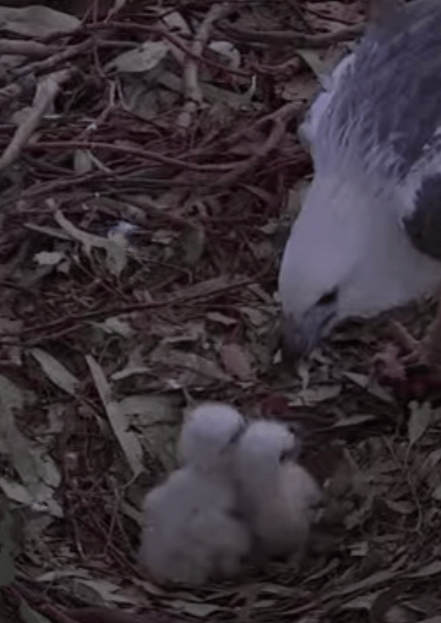
WBSE, Sydney Olympic Forest: 27 and 28 continue to eat until their crops almost burst and sleep. Meanwhile there has been an intruder today and Lady and Dad were honking in alert.
And last but very special, A Place Called Hope. Along with other wildlife centres, they are receiving quite a number of starving Great Blue Herons and other herons. Why would they be starving? It has been raining in the Connecticut area and all the herbicides and pesticides that people put on their lawns and gardens makes its way into the environment, into the water table, into the ponds. It is poison. If your gardening centre or lawn care person tells you that the chemicals they use are ‘Green’ – well, think again. Whatever they are using kills. So sad. It is OK if your lawn doesn’t look emerald green.

Thank you so much for joining me today. Have a lovely Sunday. Take care of yourselves. I look forward to seeing you soon.

Thank you to the following for their streaming cams and their FB pages where I grab my screen shots: A Place Called Hope, Mlade Buky White Stork Cam, Collins Marsh Osprey Nest, Port Lincoln Osprey Project, and Sea Eagles, Birdlife Australia and the Discovery Centre.

The featured image is Dad at the Port Lincoln Osprey Barge taking his turn incubating his two eggs.

Tiny Little, it is good to see you!

Friday morning started off fantastic with Tiny Little on the nest alone food calling. She was later joined by older sibling, 462.

What you need to know is that Tiny Little had an entire fish to herself a little earlier for breakfast! Just look at her enjoying that fish!

7:45 nest time. Nice fish delivered by White YW to his girl.

Tiny Little returned later and was joined by 462. Yes, I said that already! They waited and waited. All that waiting and food calling paid off! Both Tiny Little (or Bobbie to some) and older sibling got a fish – older sib gets the flounder, Tiny Little has something else (?). Dad, you are fantastic. This is the way to keep the kids happy and quiet.

Tiny Little is the fledgling on the right. She is a ‘big’ girl! I am just so delighted to be able to see her. She is growing and growing. Tiny simply doesn’t fit anymore!!!!!!

This is the link to the Osprey Nest at Foulshaw Moss managed by Cumbrian Wildlife Trust:

https://www.cumbriawildlifetrust.org.uk/wildlife/cams/osprey-cam

But there was more happiness. To top it off, the little Osprey nestling at Collins Marsh Nature Centre had two feedings before 9:30 this morning. If this pace keeps up Malin is really going to have a big growth spurt this week. Already the tail and back feathers are remarkably changed from last week.

And another feeding here. So happy to see these parents stepping up the food. Malin is really starting to present as a juvenile Osprey now. I keep looking at those little feet – wonder if we have a little boy here? Male or female it doesn’t matter. Malin is really a gorgeous/handsome.

The link to the Osprey nest at Collins Marsh is here:

https://www.cumbriawildlifetrust.org.uk/wildlife/cams/osprey-cam

One of my readers was asking about the nest for the Black Storks in Latvia. I was able to find some information and a couple of images so that you can see the beautiful forests in the area.

The nest is in a forest in the Sigulda region of Latvia. It is 53 km southeast of the capital, Riga. It is the orange area on the map below.

The area is home to Sigulda New Castle and the remains of a medieval castle built in 1207.

The image below is the New Castle.

“Siguldas jaunā pils (Sigulda Castle)” by twiga_swala is licensed under CC BY-SA 2.0

Through the forest you can see the New Castle.

These are the remains of the medieval castle. It is a major tourist site and because of this, Latvia has stabilized some of the walls so it can be fully appreciated.

The nest in the forest is on a pine branch that extends about 1.8 metres from the trunk of the tree. So, in plain English, the nest is on a branch that is sticking out —- just a big branch! I know. Take a deep breath. It could make you nervous. The nest is 18 metres from the ground. Imagine these storks on such a branch! I kept thinking they could slide off the edge.

The youngest storkling is 53 days old today. It is flapping its wings and gets really excited. The eldest is 56 days old and the middle one is 54 days.

The adults, Grafs and Grafiene, have to be very careful when they come to feed their little ones now so they do not slide off the nest. It is getting a little crowded as the nestlings grow!

One of the moderators for the nest forum created a video of Grafiene coming to feed the storklings about one month ago. It is very short but shows us just how much these nestlings have grown in that time. Just look how tiny they were.

All of the storks meet to begin their migration. ‘S’ tells me that they land on the tops of all the houses, the hydro poles, and the trees. And then they begin clacking and this is the beginning of their long journey as far as South Africa. Everyone is a little sad when they leave.

The link to the Latvian Black Storks is here:

Don’t all babies look sweet when they are sleeping? The little sea eaglets are no exception. You would never know that they are so tired from all the mischief they cause when their parents aren’t watching.

They look like little angels.

Dad is making sure that there is lots of food on the nest.

Here is the link to the White-Bellied Sea Eagle nest in Sydney’s Olympic Park. It is the only WBSE nest in the world that is streaming live. One of the really neat things is just listening to the forest sounds when the streaming cam is on. You will hear many Australian birds. There are lots of YouTube videos of the birds and the sounds they make. Just do a search of ‘Australian Bird Sounds’.

There has been a lot of chatter about when the female ospreys in the UK will be leaving the nests and heading off on their migration. Blue NC0 is still up at the Loch of the Lowes working hard, along with Laddie, to feed LM 1 and LM 2. She is known to catch big fish and this morning she brought in a whopper. The sad part was NC0 worked so hard to get this fish out of the water and on to the nest and one of the kids let it fly off the nest. It happens but we all must appreciate the real effort these parents put into feeding these juveniles especially when they must be eating themselves, fattening up, to make their journeys.

NC0 has turned into one wonderful mom over the season. It has been such a joy to watch her develop from when the little ones hatched and we had no idea if she was going to figure out how to feed them!

The fledglings still associate the nest with food so you might still get in some good action. This has to be one of the most beautiful nest locations in the world. When I went to check, I could see the Ospreys flying around and food calling on the branches at the top left of the image below. So turn up your sound and look there when you check on this nest.

Here is the link to their camera:

I checked to see if the names had been announced for Louis and Dorcha’s chicks on the ‘other’ Lock Arkaig nest. There seems to be no mention or I have missed it. So hold on. Will let you know as soon as I hear anything! I am also waiting for the Collins Street Peregrine Falcon cam to come on live. You are going to be in for a real treat with that falcon nest! I promise.

Thank you for joining me today. I hope everyone is well. Tomorrow I am heading out to find the local hawk. Expect news to come in the late afternoon for all the nests. Enjoy your weekend. Stay safe.

Thank you to the following for their streaming cameras where I took my screen shots: The Latvian Fund for Nature and the Sigulda Black Stork Nest, the Collins Marsh Nature Centre and Osprey Cam, the Sea Eagles, Birdlife Australia, and Discovery Centre, the Scottish Wildlife Trust and the Friends of the Loch of the Lowes.

Late Thursday and early Friday nest news

It was a rare treat to check on the Black Storks and find that Karl II was at the nest feeding the three fledglings. It was around 18:00I had been missing this. The ritual of the feeding and the eating is entrancing. This nest is in the Karula National Park in Estonia. As in Latvia, the Black Stork is very rare and much loved. Karl II and Kaia raised three healthy hatchlings this season. Congratulations!

In my last newsletter, everyone was waiting for the second egg at the Port Lincoln Osprey nest to arrive. If you missed it, it was around 3:27 am nest time on 6 August.

Last year’s PLO fledgling, Solly, is 320 days today. Wow. It is about time to get out the party hats and celebrate her one year hatch day. This just gives you hope. Today, Solly is going in and out and in and out at Eba Anchorage. She apparently has a favourite dead tree in the area that she likes to roost in.

Oh, it seems nestlings are just like human children. Let mom or dad get out of sight and they start picking on one another. This was the case with 27 and 28 at the White-Bellied Sea Eagle nest in Sydney, Australia. If this is all these two get up to – let them have a little fun. They are so close in size that neither has an advantage. Have a peek.

Dad and Mom are continuing to bring in fish about 5 fish a day to the Collins Marsh Nest. This is a big improvement over a few weeks ago. Malin’s tail now reveals three rows of dark bands and the beautiful scalloped juvenile feathers.

Oh, Malin is becoming such a gorgeous bird. The stepped up deliveries and the drop in heat seem to be suiting this Osprey family in Wisconsin, USA.

Such a little sweetie. Malin really loves this part of the nest. You can catch her sleeping there during the day (like in the image above) or at night. All tucked in with Mom watching over her. If we could only slip a little pillow under that wee head.

Suzanne Arnold Horning was on the Cornell Campus this evening and found K3. Oh, this is such a cute Red-Tail Hawk fledgling! She did not find the other three and commented that K3 must have missed the memo on where to meet tonight. He was apparently flying around food calling!

I didn’t think another Red-tail Hawk fledgling could ever win my heart like J3 did but look at that sweet face on K3. I am melting.

K3 is over on one of the light towers. What a gorgeous image of this third hatch against that clear blue sky. He has really grown into an amazing fledgling. These two, K1 and K3, are simply great fliers and K1 has turned into a fantastic hunter just like her parents, Big Red and Arthur.

Other Nest News:

Congratulations to Rutland Water. It is their 25th anniversary and today, the 200th chick, Blue 360, fledged! Wow. What a fantastic record for the translocation project. The announcement and photo of that lucky chick is on their FB page: https://www.facebook.com/324266140960825/posts/4294404503946949/

Louis and Dorcha at Loch Arkaig (nest not on camera) have their first fledge this morning. Voting has ended to name their chicks. Hopefully we will know tomorrow! What fun. That Loch Arkaig nest was so empty this year without Aila. Hopefully another couple will claim it for the 2022 season or maybe Louis and Dorcha will move from the nest off camera to the one where we can watch their every move.

Between now and the beginning of the third week in August, the females of the UK nests will begin their migration to as far away as Spain/Portugal or West Africa. The males will remain as long as there are chicks calling for food. This is normally 2-3 weeks.

This is what fish calling sounds like thanks to one of the fledglings up at the Loch of the Lowes. This chick could be heard all the way to Glasgow! They are so loud. You can easily imagine that the male will know if there is a chick on the nest who is hungry.

Things seem to be going really well on the nests today. That is always worth a big smile!

Thank you so much for joining me. I will be back late Friday evening with a nest update. Take care everyone. Stay safe.

Thank you to the following for their streaming cams where I took my video clips and screen shots: Eagle Club of Estonia, Collins Marsh Osprey Cam, Scottish Wildlife Trust and Friends of the Loch of the Lowes, Port Lincoln Osprey Project and the Port Lincoln Osprey Project FB Page, and Suzanne Arnold Horning for letting me share the beautiful images of K3.

The featured image is K3 on the light stand taken by Suzanne Arnold Horning.

Happenings in Bird World 2 August 2021

It is a gorgeous day on the Canadian Prairies. The extreme heat of the past has dissipated and the sun is shining. There is no wind, every leaf is still. The only thing moving in the garden are the little songbirds waiting for the feeders to be filled. No wind means there is no smoke from the wildfires farther north. It is a nice change. We are all hoping for big downpours and, if the weather report is correct, that will come at the weekend.

A serious lump came in my throat this morning when I went to check on Tiny Little at the Foulshaw Moss Osprey Nest. No one was there this morning (nest time) and now the crows are picking at the nest. Normally, at this time of day, Tiny Little would be on the nest waiting for a fish drop. There appear to be no birds in the parent tree in the background. The Crows are a reminder that the days of seeing our Ospreys are precious ones.

I returned to the Foulshaw Moss nest several times. The last visit revealed Blue 464 – the first of White YW and Blue 35’s chicks to fledge – on the nest food calling. You could see the shadow of another bird on the camera at times.

There are some ‘late’ nests and some just starting in case you are having empty nest syndrome.

One of those nests is at the Collins Marsh Nature Centre in Wisconsin. So as not to confuse everyone, the constant watchers got together. Each felt the chick needed a name, even if it was just for us. ‘S’ from Hawaii suggested Malin which means ‘strong little warrior.’ It fit perfectly for this small chick. Voted for unanimously amongst our small but caring group! So from now on I will refer to him or her as Malin, just so you know.

The female was not on the Collins Marsh nest when I checked. She is absent for long periods of time. I want to think she is fishing and will be back to feed Malin or she is just resting. The male has made a fish delivery. This time it is headless. Malin is confused because Dad will not ever do any feeding. Malin is standing and walking much better than last week but he still wants to be fed by the adult.

Malin continues to try and get the male to feed him the fish but it is not happening!

Once Malin realized that he was being left to fiend for himself, he started self-feeding on the fish. Because this one is headless, Malin is making much better progress. This little one is trying very hard.

There is a concern about the feather growth of Malin. Unfortunately, the camera is not clear. Yesterday, ‘S’ took some screen shots that indicated some wing feathers near the tips could be missing. If you look carefully at the image below, you can see the green grass through both wings clearly. This could be a serious concern for this young bird.

Thinking about Malin’s development, a search through the FB pages of the nature centre indicates that three chicks hatched on this nest on 16, 18, and 20 of June. Historically, the smallest – the third – has died on this nest with the exception of one year. This year Malin is the only one to survive leaving us to believe that he was either the first or second hatch. That would mean that he is either 46 or 44 days old. From Osprey development charts, it appears that Malin is about two weeks behind the average in growth. This is most likely due to the low food deliveries.

Maris Strazds, from the Institute of Biology at the University of Latvia states that the availability of food determines the dates of fledging and also that the survival rate of chicks is better if they spend more time on the nest after fledging. Strazds is speaking specifically about storks but this is also known to be true in hawks and falcons and I would like to think that it also extends to Ospreys and Bald Eagles.

While the feather growth is being monitored by the Wisconsin DNR Biologist and a concerned Wildlife Rehabber of the area, access to the nest is a problem. The nest is situated on top of a wildlife tower that was moved to this site so that people could climb the stairs and view the countryside. Here is a close up view. It appears that a metal roof with a peak was fabricated to fit on top of the flat roofed water tower.

In this image the nest looks quite deep. This image was taken several years ago and it seems that the nest has been reduced in size – perhaps by strong winds. Photographic comparison of the nest cup now with the chick and a couple of years ago also indicates a loss of nesting material, perhaps substantial amounts, missing.

It is difficult to determine if there is a wooden support under the twigs. If you look at the images of the nest with Malik (above) it appears that there is something ‘square’ underneath a couple of layers of twigs.

My concern is that if the feather development on Malin is problematic, there is no emergency access to the nest from the observation box. In other newsletters I have indicated that there should be a means to access the nest without compromising the safety of the individuals trying to help the birds.

There is only one operational White-Bellied Sea Eagle cam in the world. It is at the WBSE nest in the Sydney Olympic Park and the excitement there is just beginning. These two little ones, 27 and 28, appear to be getting along without food competition. Of course that can change but there has been plenty of Catfish Eels (or is it Eel Catfish?) on the nest.

Right now the sea eagles are sleeping. One little babe can be seen sleeping on Lady’s leg.

You can access this streaming cam here:

Tomorrow I will give you some information on other nests in Australia including two Peregrine Falcon streaming cams.

If it is Bald Eagles you love then the Glacier Gardens Bald Eagle Nest in Juneau, Alaska is not to be missed. Kindness is such a little sweetheart. Liberty and Freedom are helping her by trying to get her self-feeding skills honed. The eagles fledge later in Alaska because they are bigger in size than the ones hatching in the Southern US who are already off the nest. At Glacier Gardens, the average fledge is 89 days after hatch while the rest of Alaska is 80 days on average.

‘L’ also sent me the link to an Osprey nest that she has just discovered. The chick hatched on 23 June. It is a real little sweetheart ——- and the camera definition is excellent!

It is the Minnesota Landscape Arboretum Osprey Nest. There is only one surviving chick. The other perished on 26 June; the cause is not clear. This chick looks extremely healthy. The nest is on top of a platform at the University of Minnesota. Enjoy!

Because so many of you love storks, I want to mention two that my friend, ‘S’ in Latvia says are very special. One nest is in Latvia and the other is in Estonia.

The Black Stork nest in Latvia is very special. The birds are listed as critically endangered and it is rare to see them in Latvia even though the White Stork population is healthy. The male is Grafs. ‘S’ explains to me that the nest is late because Grafs was a bachelor and waited a very long time for his mate, Grafiene, to arrive. The three storklings hatched on 12, 14, and 15 of June. There are many challenges for this couple and their trio. The first is the late hatching date and the worry about whether or not the parents will remain with the storklings until they are developed and strong enough for migration. The storklings will be ready for fledging in 20 or more days. That puts it at the third week of August. As we know, storks are already gathering for their migration so watchers can only wait and hope and take the beauty of this nest a day at a time – as we always do with other nests. The second concern has been the dangerous heat that has hit nests all around the world causing a drop in prey delivery. The third is the nest itself. It appears to be unsafe despite the fact that other stork couples have fledged chicks in previous years.

I want to add that the chicks are very healthy – they are doing so well so I want all of us to be optimistic. This year I have seen miracles happen on nests – I only have to look at Tiny Tot on the Achieva Osprey Nest and Tiny Little on Foulshaw Moss to know that positive things can happen if we all send warm wishes. Even the turning of the deadly storm cells away from the nest at Collins Marsh was another of those miracles or the safe return of the male at the Barnegat Light Osprey Nest in NJ after being missing for a day due to that same weather system. So, we wait, watch, and hope.

You can watch this beautiful nest here:

It is raining today on the nest. Oh, how I wish the beautiful storklings could send some of that moisture to Canada!

There is also a forum in English for this nest where you can go back and see the long history and discuss the nest. You can access it at

The second Black Stork nest is actually in Estonia. As in Latvia, Black Storks are loved in Estonia and are rare.

It is also raining at this nest today, too.

The parents are Jan and Janika. The nest is very stable so there are no worries with the structure. But because of the horrific heat that has impacted all nests, food deliveries have sometimes been problematic. Janika, like the mother on the Collins Marsh Osprey nest also disappears for long periods. These storklings will also have a challenge to be flight ready for when the migration begins. Again, we can watch with wonder at these extraordinary birds but we must be aware of some of the challenges that birds encounter. Life is not easy.

There is also a forum for this nest. It is here:

I really want to thank ‘S’ for bringing these two Black Stork nests to my attention plus sending me all of the information about them. They are such beautiful and rare birds and it is a real privilege to see them hatch, grow and learn, and then begin their journeys. In addition, I want to thank ‘L’ for sending the information on the Minnesota Landscape Arboretum Ospreys and ‘S’ for finding all the images of the tower at Collins Marsh and the Nest and the great name for the Collins Marsh chick – Malin.

And I want to thank you for joining me today. It is always a pleasure to have you here with all the other bird lovers around the world. Stay safe everyone. See you soon.

Thank you to the following for their streaming cams where I took my screen shots: Eagle Club of Estonia, Latvian Fund for Nature, Collins Marsh Nature Center, Cumbrian Wildlife Trust and the Foulshaw Moss Osprey Nest, Sea Eagle Cam, Birdlife Australia, and the Discovery Centre, Glacier Gardens Bald Eagle Nest, and the Minnesota Landscape Arboretum Osprey Cam.

Late Thursday and early Friday in Bird World 22-23 July 2021

The Royal Albatross ‘Cam Princess’ for 2021, Taiki, was banded on Taiaroa Head, New Zealand on 22 July. Taiki is Maori and means ‘protector of the land and sea’. She now has a permanent metal band with a unique number to her and a white plastic band with the number 60 on it on the other leg. The white designates the chicks that were born this year. All 34 of them will get a white band. When they return to land, after being at sea from 4-6 years, they will receive the adult colour bands. For example, Taiki’s mother is Lime-Green-Lime (LGL). Can you imagine being at sea and only returning to walk on the ground after being away for all that time?

Here is an image of Ranger Sharyn putting on the bands.

And here is the video that the Cornell Labs did of the entire banding session.

It is unclear how many fish came up to the Collins Marsh Osprey Nest today. ‘S’ noted one medium fish. I did check in on the nest and caught the chick standing. That is very good. It is getting its juvenile feathers and it is beginning to get strength in its legs to walk and stand up. Excellent.

One of the most beautiful times of day at the White-Bellied Sea Eagle nest in the Old Ironbark Tree in Sydney is early morning. The forest is waking up. You can hear all the birds singing including the Sulphur-Crested Cockatoo, the Noisy Miners, and the Currawongs. We are just getting a trade off on incubation duty (I believe) when I checked the nest. We should be on hatch alert in a couple of days!

It is so calm and peaceful in the forest. No one is allowed inside this restricted area other than the Rangers and specific staff of the Discovery Centre.

Here is another hand off around 13:30 this afternoon.

The adult plumage is this beautiful slate blue grey with a white head and underbelly. The juveniles are the most gorgeous rusty-espresso.

I want to give you the link to the Sea Eagle camera so that you can start watching. It is very exciting. The little ones are fuzzy white when they hatch. So cute.

It is 4:59 and Tiny Little has already flown off the Foulshaw Moss Osprey Nest.

Just looking at that nest reminds me how grateful everyone was when Tiny Tot stayed around the Achieva Osprey nest for so long. In fact, for four months we got to enjoy seeing that wee one grow up. We saw her change from the beaten, pecked, and starved little one to a ferocious independent fledgling. What a gift we were given! We never know how long we are given with these ‘special survivors’ so we have to savour every minute. Tiny Little will, no doubt, return to the nest when there is a fish drop unless the parents begin to feed the fledglings off nest.

Ah, and before I stopped writing it seemed like a good time just to check on that Foulshaw Moss Nest again and guess what? Tiny Little is there with another sibling waiting for the breakfish drop!

Tiny Little, 463 on the left and 462 on the right.

And they both got their wish!

Some good news was posted today. Seventy eggs of the Black Foot Albatross from Midway Island were transported to Guadalope Island, Mexico. I mentioned this in an earlier blog last week. It has now been confirmed that all 70 of the eggs hatched and all 70 of the chicks have fledged. You can’t get any better than 100%.

One of my friends and readers lives on the Hawaiian Islands. She mentioned the colony of Albatross Hawaii they have. That reminded me to introduce you to a very special person who founded the Kauai Albatross Network.

Her name is Hob Osterlun. In this short clip, she is doing a one person play on her life as a nurse for nurses and doctors and she talks about how the albatross changed her life.

That short video, Kapuna Life, mentions Hob’s book, Holi Moli. I recall the first time I read it. I devoured the pages reading from late in the evening to the wee hours of the morning.

So many of you reading my blog have been moved by ‘the birds’. Whether it was during the pandemic or before, a two legged creature with feathers – that fly or not (we can’t forget about the Kakapo) – touched you in a way that is probably hard to describe. For Hob Osterlund, having that Laysan Albatross touch her foot was extremely powerful.

Here is a beautiful video about Hawaii and the Albatross. It is an hour long. Watch pieces of it or the whole thing when you have time. These are such beautiful birds. Hob never gets tired of talking about them!

It is a scorcher in southern Manitoba and Winnipeg today. Yesterday my daughter and her sons got to see an Osprey dive for its fish at Lake Winnipeg. She saw the nest using binoculars with its two chicks, too. We have a number of Osprey platforms placed by Manitoba Hydro around Victoria Beach, Grand Beach, Grand Marais and on the way to our Iceland city, Gimli. How lucky they were!

Thank you for joining me. Stay safe everyone! Stay cool. Remember to leave water out for the birds.

Thank you to the following whose streaming cams I use to get my screen shots: Cumbrian Wildlife Trust and the Foulshaw Moss Osprey Nest, Collins Marsh Reservoir Osprey Cam, Cornell Bird Lab and NZ DOC, Sydney Sea Eagles, Australian Bird Life, and the Discovery Centre.