Happenings in Ospreyland?

Oh, it is a gorgeous day on the Canadian prairies. The sky is blue – oh, such a beautiful blue without a cloud. Those, hopefully, will come this week and bring us some more needed rain.

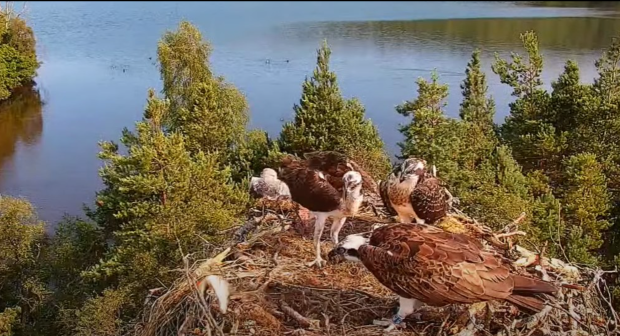
White YW on the Foulshaw Moss nest certainly knows when Blue 463, Tiny Little, wants a fish. My goodness she can cry really loud. You might imagine everyone in the area of the nest could hear her. There is nothing shy about 463 anymore. If she wants something, everyone knows it. And that is the way Dad likes it. Otherwise, he will think she isn’t hungry.

Tiny Little is not subtle that she would like that fish sibling 464 nabbed. She is up to her old tricks – moving sticks, crying, flapping, and staring. Tiny Little is not starving! Yesterday, she had at least 3 of the fish Dad delivered to the nest. She is smart. Bulk up before migration.

When 464 finishes, Tiny Little also does what she is good at – cleaning up all the fish that the siblings leave behind.

The Crow would like it if Tiny Little would leave some fish for it, too.

Blue 463 is gorgeous. No doubt about it – she has grown into a stunning female! This looks like a good image to keep – to compare when she returns to us again in two years time. I am so optimistic about this one and Tiny Tot from Achieva. They are strong survivors.

A really beautiful – and short – video has been posted showing the ringing of two Osprey chicks at a nest in Finland. Have a look. The scenery is stunning!

As many of you are aware, Idris, the male on the Dyfi Osprey Nest in Wales, is super reliable. When he went missing on Wednesday and did not return until the late afternoon on Friday with a sunken crop, everyone became worried about what had happened to him. It was thrilling to see that he was alright. Indeed, he brought in 3 large fish for Telyn, Ystwyth, and Dysnni. While he was away, Telyn delivered fish to the two chicks on the nest without fail. Well done, Telyn!

Ystwyth on the Dyfi Nest eating a really nice fish. There are rumours that Dysnni has migrated but it is unclear if that is true. He has not been seen on the nest for a short period but he could also be getting fish somewhere else. Many birds, once they have fledged, eat off nest. Others like those at Loch of the Lowes always return to the nest. 463 at Foulshaw Moss certainly likes eating there.

Ystwyth eating a fish late Saturday, 14 August 2021. Unknown bird on perch – most likely Telyn.

Aran and Mrs G were seen on their nest in the Glaslyn Valley today together. They are keeping a close eye on that prime real estate!

The gorgeous and formidable Mrs G looking over her territory.

Idyllic.

The Osprey chick at Collins Marsh will get its official name this evening. Fingers and toes crossed. The last time I checked – thanks to so many of you – ‘Malin’ was leading the polling.

‘S’ caught a great shot of Malin getting its third feeding around 1pm today. Three fish before 1pm. We might get to that magical 5 or 6. Fantastic. But look – ‘S’ seems to have solved the mystery of why Collins is shy about delivering fish! Ouch.

Great screen grab, S!

NC0 is still at the Loch of the Lowes Osprey nest in Scotland. She delivered a really nice salmon to the nest Saturday evening. And isn’t that simply a gorgeous view as the golden rays of the sun kiss everything making it look like autumn?

Both of the chicks remain at Rutland Water’s Manton Bay Osprey Nest. Blue 33 is kept busy feeding these two.

Blue 096 with hers.

Often Blue 096 chases 095 off the nest but here he is below enjoying his fish! Nice one.

Nothing posted on the name but Malin has another fish drop and is doing some wingersizing! Thanks Dad, number four.

Thank you to all of you for joining me today. This was just a hop and a skip to make sure everyone on the Osprey nests were doing OK and they are. Doesn’t get any nicer than that. Take care everyone. Enjoy your weekend.

Thank you to the following for their streaming cams where I get my screen shots: Collins Marsh Nature Centre, Cumbrian Wildlife Trust and the Foulshaw Moss Osprey Nest, Bywyd Gwyllt Glaslyn, Dyfi Osprey Project, LRWT, Scottish Wildlife Trust and Friends of Loch of the Lowes.

Tiny Little lands 3 fish for the day!

At one time there was fear that Tiny Little Bob, the itsy bitsy third hatch on the Foulshaw Moss Osprey nest would perish.

The top image is from 12 June. You can see how large 462 and 464 are at the time. There is our Tiny Little Bob sitting up looking over them.

This image is from 30 June. Tiny Little Bob has grow but is still shy and waits to eat. At this time, the banders cannot tell if 463 is a male or a female because of the lack of food and growth.

Today is 13 August. It might be hard for some to believe but Tiny Little now controls the nest. She is a big bird – the dominant bird – on the Foulshaw Moss Osprey Nest. Tiny Little has take three fish today. The first one at 6:08 am, the first fish to land on the nest today. Then she gets the fish at 16:16. And then, she snags the fish and is eating at 19:48. This is quite a change in status for a bird that people thought would die because the others were so large and cruel.

Long time readers know of my interest in the third hatch (or a tiny second that battled with a large first when there was no third). This year alone we have seen Tiny Tot (Tumbles) rise from the near dead several times on the Achieva Osprey Nest to grow into an aggressive survivor. Other researchers have sent me stories about other third hatches who came back strong. If you know of any, please do not write to me.

This is the best news of the day. Thanks for joining me for this very short newsletter. The voting closes at Collins Marsh today for the name of their Osprey. A very kind Wisconsin DNR Biologist has sent me their 2020 report on Bald Eagles and Ospreys. I will report on that tomorrow. And there is one other piece of good news. Idris had been missing on the Dyfi Nest since Wednesday the 11th at 13:16. This morning he showed up with a big fish for one of his fledglings. He had an extremely empty crop. Wonder what happened? This is great news as Telyn would have to delay her migration if he did not show up. A few Osprey adults have gone missing for a couple of days. Are they getting caught in something line line or netting?

Take care everyone!

Thanks to the Cumbrian Wildlife Trust and the Foulshaw Moss Osprey Nest and the Dyfi Osprey Project for their streaming cam where I took my screen shots.

3 Cheers for Tiny Little Bob!

White YW delivered the tea time fish – a nice large one – to the Foulshaw Moss Osprey nest in Cumbria. Blue 462 nabbed it first and then guess who pinches it off big sibling! Tiny Little!

Big Sibling 464 on the left and 462 on the right – all waiting for Tiny Little to make a wrong move with that nice fish. Go away both of you!!!!!

Then 462 got it back!

The first round both 462 and 463 struggled with the mouth and eye area. Wonder who is going to get that fish when it is nicely opened.

Ah, White YW cannot stand to hear one of his fledglings call for food. He promptly went out and got another one. Blue 464 got that one. It was such a nice fish that 464 was eating on it an hour later. Tiny Little flew off the nest probably chasing Dad. No one should be worried thought. Tiny Little had a nice crop prior to snagging that fish off 462. None of these chicks are hungry!

Blue 464 is enjoying his nice big fish – alone! No one is around sniffing for some pieces.

Good Night Foulshaw Moss Ospreys!

In Wisconsin, Malin is busy self-feeding on a piece of a fish that Dad delivered. What captivates me today are the wing feathers. They are looking so good. There is a condensation mark but if you look to the right that one dangling feather from earlier in the month is now ‘crossing over’ the way that it should. The other wing feather scallops are lined up perfectly. Oh, Malin, you are growing up!

The nests are so big and every streaming cam distorts the images (or so it seems). It is difficult to try and determine how big Malin actually is.

There is no time code on the Collins Marsh camera. I believe that there was another delivery by Collins to Malin – this time another piece of a fish. That is really helpful for Malin to work on its self-feeding and not get caught up with the bony mouths and eyes. Eventually Malin will need to do that. Right now one of the wonderful things is Malin’s anticipation of the food drop and his excitement and mantling on its arrival.

In the imager below, Malin sees Collins flying into the nest. Look at his eyes. He has also dropped his wings in anticipation of mantling that fish.

Malin pivots. Wings stretched down and out for mantling with beak forward to grab the fish from Collins’s talons.

Get out of the way Collins! Malin has secured the food.

Ah. Over. I notice also that Collins’s crop is nicely full. He has eaten the head and perhaps part of the fish before the delivery.

These two food drops for Malin to self-feed come after the aggressive manner that Malin approached the fish yesterday with Marsha. We are moving on to the next phase: no more feedings by mom? Let’s watch and see.

Is this the tail of a little Bullhead?

It is a beautiful day on the Canadian Prairies. For the first time in ever so long we can see blue sky, not sky filled with smoke. It is 21 degrees C. That is 69.8 F. Just lovely for a trip to the one of our local parks.

It was a delight to walk up to the duck pond and discover that our Parks Department has put up signs to educate people on why they should not feed the ducks bread. Last year the local birding group had a big campaign to get this practice stopped. Today, the signs are up. They are large and prominently placed at strategic entrances and exits. No one was feeding the ducks, they were just enjoying them! Well done Parks Department!!!!!!

Thanks to the recent rains many of the geese were out on the fields where people play soccer or cricket eating green grass.

A male juvenile Mallard enjoying the water fountain at the rocks.

There was real discussion on the identification of the duck above and the one below. The discussion ended when the little duck below showed us her feeding behaviour. She is a dabbler so she is a female Mallard – not a female Blue Winged-teal.

Mallards come to Manitoba to breed. They arrive in the spring and leave in the fall. Here the little female is mottled brown with a whitish tail, and orange feet.

When feeding, she tips up and dabbles in the shallow waters of the duck pond for pondweeds and aquatic invertebrates. They also feed on larval amphibians and fish eggs.

The female Wood Duck and her ducklings. You can tell the Wood Duck by its white tear-eyed eye patch. Her breast is a mottled brown and white.

Wood Ducks are migratory birds in Manitoba. They arrive in the spring, normally April, and will head south in October. They are cavity nesters. They will lay their eggs in a tree cavity or specially built enclosed wood boxes. The ducklings are ready to bounce from the nest when they are 24 hours old. Precocial animals and birds hatch/born with all their feathers, skin, etc. and are able to see, hear, and move about.

The little Wood Duck and her ducklings mingled with the Canada Geese. Only once did I see a goose get aggressive towards one of the little ones.

Malin’s initial feather issues have caused me to spend more time looking at the back and wings of birds than I ever would have thought possible. Each individual feather is simply beautiful – taken together they are like a wonderful musical symphony – each performing their own task to help this Canada goose swim, walk, and fly.

The tail and wing feathers of a non-breeding male Mallard.

As we were leaving, a Juvenile Bald Eagle was soaring above us.

Then the Northern Goshawk beats its large wings. The Northern Goshawk lives in Manitoba all year round except for the southern part where they can be seen only in the summer or in the winter if food supplies in the North fall.

It was a good day! The skies are turning grey and the wind is picking up a little and maybe, just maybe, we will have some more rain. Wishing and hoping.

Thank you for joining me today. Take care everyone. See you soon.

Thanks to the following for their streaming cams where I grab my screen shots: the Cumbrian Wildlife Trust and the Foulshaw Moss Osprey Nest and the Collins Marsh Osprey Nest.

A Hop, Skip, and a Jump through Ospreyland

Several people have written and asked about the third or last chick placed on the Patuxent River Park Osprey Nest 2. Many call that little one the ‘Silo Chick’ since it fell out of a silo and was fostered on this nest at the River til fledging. This little one seemed to have a short run, hopefully, of bad luck as it also fell out of the Patuxent nest as well and was rescued by Katherine Dami and her boyfriend. That little Osprey was so lucky! The flurry of activity around that rescue made me realize that every streaming cam needs to have an active 24/7 emergency number to the local wildlife rehabber or the person who would instigate emergency rescue at the nest. Ah, but back to the topic at hand. Silo chick fledged and has not been seen at the nest. Katherine, when asked, wrote to ‘S’ and said that they had not observed Silo Chick at the nest. Katherine did say that a large number of fledglings have gathered together and were honing their flying skills on another spot in the Patuxent River. So let us all hope that Silo Chick is there! If I hear anything more I will let you know. That nest looks very empty right now. Some fledglings like to be fed on the nest. A good example of that is LM1 and LM2 up at the Loch of the Lowes but maybe these three are being fed off camera.

So far there are only two eggs on the Port Lincoln Osprey Nest in Australia. I am quietly cheering that it remains only two. There are nests, such as that of Blue 33 and Maya at Manton Bay Rutland, that can feed and manage four chicks but, Mom and Dad at PLO will do better if there are only two. It could stop the rate of siblicide on this nest.

Tiny Little our ‘Big Girl’ at the Foulshaw Moss nest snagged herself a nice fish this morning from dad, White YW. After losing one to a bigger sibling last evening it is grand to see her eating away. Indeed, it is always nice to see Tiny Little!

Aran and Mrs G have been staying around the nest at Glaslyn. There was even sky dancing observed. The Ospreys want to seal their bond before migration. I am so happy to see the two of them around the nest. There was a time when Aran was injured and not flying much or fishing that I was concerned that Z2, Aeron, from the Pont Croesor Nest nearby or his siblings including Z1, Tegid, who has a nest in Snowdonia, might be eyeing the Glaslyn nest.

Mrs. G on the nest:

Aran up on his perch.

There has been a lot of discussion about when NC0 will leave the Loch of the Lowes Osprey nest in Scotland for her migration. She is still here and she is fishing – hauling in some nice ones for her two babies who prefer to eat on the nest. This was Sunday late afternoon.

The anticipation and seeing mom arriving with a fish:

NC0 lands it.

LM2 got the fish and ate really fast with older sibling hanging around.

Maya is also still at Rutland Manton Bay – there had also been questions about whether she was still around. Seen on nest with chick around 18:00 Sunday. Blue 33 had just brought in a fish for Blue 095.

The Friends of Loch Arkaig have just announced that the names of Louis and Dorcha’s two male chicks for 2021 on the alternative Loch Arkaig nest will be Aspen and Alder. The names are derived from the two popular trees in the area. They took 45.5% of the votes. Well done!

People have been wondering where Iris is. The cam operator spotted her early this morning, around 9am, on her favourite perching spot on Mt Sentinel. Iris is fine and is enjoying her summer. Worries, of course, continue for the Montana Ospreys as the Clark Fork River water levels are at all time lows. The trout are dying. The New York Times carried an article on this urgent matter. If you don’t have a subscription you might not be able to open the article and I apologize but do try. Just look at the level of the water in the image and the dead trout. So terrifying.

Speaking of Iris, I promised the Montana Osprey Project that I would mention their fundraiser – The Iris Pens – this weekend as a reminder to everyone. Dr Erick Greene has collected a few more twigs and sent them off to the workshop of Richard and Sharon Leigh Miles in South Carolina. The pens are $45 US and that includes postage.

This is Dr Greene with the box of Iris twigs.

This is Richard and Sharon Leigh Miles opening up the box of twigs they received from Dr Greene.

Richard begins by cutting the sticks in their workshop.

Pens get their beautiful shape on the lathe.

This is what the finished ‘Iris Pens’ look like – the colour and patterns will depend on the wood that the pen is made from. Iris spreads her love to various trees and shrubs!

The pens have been made and sold out for the past few years. This year as in other years we wish for Iris’s safe return to us from her migration next spring. If you want an Iris Pen, do so quickly. The original 35 are gone and, as mentioned, Dr Greene has sent some more twigs the birds knocked out of the nest to Richard and Sharon. Follow these directions supplied by the Montana Osprey Project.

1) Send an email to montanaospreyproject@gmail.com2) If your mailing address is in the US, on the subject line of your email, type your full name followed by Pen OrderFor example To: montanaospreyproject@gmail.comSubject: Your Name – Pen Order3) If your mailing address is outside the US, on the subject line of your email, type your full name followed by International Pen OrderFor example To: montanaospreyproject@gmail.comSubject: Your Name – International Pen OrderIf yours is an international order we will get back to you with a few additional instructions.4) The email’s body should include the following information:a) Your name b) Your email c) Number of pens you would like to order.d) Total amount ($45.00 per pen). Shipping is included in this price.e) Your mailing address just as it should be on the envelope. f) Send the email to MontanaOspreyProject@gmail.com5) For those of you who live in the United States, make out a check out to: Montana Osprey Project – Erick Greene(We are not set up to take credit card or Pay Pal orders. Sorry – has to be a personal check or money order)6) Mail your check to:Dr. Erick Greene – Montana Osprey ProjectDivision of Biological Sciences 32 Campus Drive University of MontanaMissoula, Montana USA 598127) For those of you who live outside of the US, send us the email with all of your information, but hold off on sending a check. We will get back to you with a few more instructions.

I can’t wait for mine to arrive.

Thank you so much for joining me today. I am off in search of hawks and ducks this afternoon. It is sunny and warm but we are going to venture out in the heat anyway! Take care all. See you soon.

Thank you to the following for their streaming cams where I grab my screen shots: Collins Marsh Nature Centre, Manton Bay Osprey Nest and Rutland Water, LRWT, Scottish Wildlife Trust and Friends of Loch of the Lowes, Port Lincoln Osprey Project, Patuxent River Park Osprey Cam 2, Cumbrian Wildlife Trust and the Foulshaw Moss Osprey Cam, Brywd Gwyllt Glaslyn, and the Port Lincoln Osprey Project. I would also like to thank Richard and Sharon Leigh Miles for allowing me to use the information and the images for the Iris Pens and for their dedication to the Montana Osprey Project. A big shout out to Dr Greene for his devotion to the Montana Ospreys. Thank you!

Featured Image are the two 2021 chicks of Laddie, LM12, and Blue NC0 waiting for NC0 to get the fish to the nest. Their numbers are LR1 and LR2.

Four rare Hen Harrier chicks fledge in Derbyshire

One of the big announcements came today when four extremely rare Hen Harrier Chicks fledged in Derbyshire, England. They were predated by hunters and owners of estates where grouse hunting was popular as well as ‘land management practices’. They are now protected under the 1981 Wildlife and Countryside Act.* In North America, the Hen Harrier is called the Northern Harrier while in France it is the Buzzard of St Martin.

Hen Harriers are a bird of prey like most of the birds that I write about. They are related to kites, hawks, and eagles. Have you ever heard of them? or seen one?

The males are pale grey as in the image below. The primaries are a dark espresso colour. Here the male is flying low over the countryside looking for prey.

“Hen Harrier” by ressaure is licensed under CC BY-NC-SA 2.0

Here is an image of the underside of the male Hen Harrier.

“Hen harrier male, Circus cyaneus” by peter.v.b is marked with CC0 1.0

The females are brown as are the juveniles with a white rump and long barred tail. The females are often called ‘Ringtails’ because of the bars or bands on the tail. Like the Honey Buzzard their heads are rather small in comparison to other raptors. They will measure no more than 42 cm with a wing span of 120 cm. They weight less than a pound at 300-400 grams. Hen Harriers eat small birds and mammals. Besides flying low and finding prey, they also use the cover of bushes in the woodlands to surprise and take their prey on the ground (normally).

“Hen Harrier (Circus cyaneus)” by gilgit2 is licensed under CC BY-SA 2.0

When hen harriers are courting, they do a fabulous sky dance or rolling and tumbling. The Hen Harriers normally lay 4 to 5 eggs in a nest on the ground or in cattails or long dense grass. The male and female both take care of the chicks but the males provide the food. They hunt it and when successful pass the prey to the female by tossing it at them mid-air. They would make great softball players!

Look carefully at the image below. Notice that the facial features of the Hen Harrier look like an owl. Like owls, they have a parabolic facial disk which allows them to hunt by sound (like owls) as well as their incredible ‘hawk’ eyes.

“Hen Harrier (Circus cyaneus – Albanella reale)” by Lorenzo L M. is licensed under CC BY-NC-ND 2.0

*There continues to be the debate between the grouse hunting societies and those that protect birds and want grouse hunting banned. Any number of associations who do not support the killing of animals are active in supporting the reintroduction of the Hen Harrier. You can do a simple search on Goggle for ‘Hen Harrier Myths’. There is even a Hen Harrier Day celebrated in the Highlands of Scotland.

Other Bird World News:

Foulshaw Moss Osprey Cam, Cumbria: After waiting and moving about sticks, Tiny Little (Blue 463) was prey calling and in flew big sibling chasing after Dad or White YW. 464 took the fish and then flew off with it. Poor Tiny Little.

Nasty older sibling!

WBSE in Sydney Olympic Park, Australia: Well, they just can’t stop getting cute!

Collins Marsh Nature Centre, Wisconsin: Malin is looking really good to me. I focused on her wings whenever I checked in. She has been fed and the feathers look grand. I can also see four bands or bars on the tail now so Malin is continuing to grow and develop.

Besides this lovely tail growing and those gorgeous scalloped back feathers – I adore Osprey, can you tell? Malin is no longer dragging one of her wing feathers. It just seems it took almost 7 weeks to get these things sorted. Joy. Real joy. What a beautiful Osprey chick?!!!!!!

Patricia Fisher, the local wildlife rehabber just wrote and agreed that Malin’s feathers are looking much better. They still have to cross but fingers crossed on that one. More Joy. Thanks, Patricia for keeping an eye on this little one with all you have to do.

Port Lincoln Osprey Barge, Australia: Mum is busy rolling two eggs and I believe there remain two, awaiting third. Dad and her have been taking turns incubating.

Dad has returned to see if Mom would like a break. He is annoyed by the blue rope material and Mom seems to be annoyed by him pulling it out from under her! What a pair.

Fortis Red Deer: It is embarassing. I have not mentioned our Canadian Ospreys in Alberta for awhile. When I last checked you could only see Legacy’s little head hardly extended above the sticks. Look at this beauty now. Wow. These chicks have grown. This is what I want to say about Malin’s growth at Collins Marsh in a week!

Fortis Exshaw, Canmore, Alberta: It looks like the ospreys were practicing with their ‘ps’ or there was rain and enough blowing wind to throw mud balls up on that lens!

The good thing is that you can hardly tell which are the two chicks and who is the adult. Incredible.

It has been hot but more than that the smoke pollution has made it difficult to breathe at times on the Canadian Prairies. I am keeping an eye on the White Rock fire in British Columbia. You might all know Dr Christian Sasse and his love of Bald Eagles and Osprey. He often streams live generously showing us these beautiful birds. Well, his cottage where he streams them is in the path of the fire. Send warm wishes his way as well as all the wildlife in the region. The White Rock fire is misbehaving badly, not doing normal things so the firefighters are really having a time of it.

Thank you for joining me today. I had hoped to bring you some local hawk pictures. I am heading out hopefully later. Take care everyone.

Thanks to the following for their streaming cams: the Collins Marsh Nature Centre, the Sea Eagle Birdlife Australia, and Discovery Centre, Cumbrian Wildlife and Foulshaw Moss Osprey Nest, Port Lincoln Osprey Project, Fortis Alberta Red Deer, and Fortis Alberta Exshaw. A Special thanks to Patricia Fisher from Wisconsin who cares about Malin and takes time to answer all our questions. I am so grateful.

Oh, Tiny Little!

Oh, what a relief to go to the Foulshaw Moss Osprey Nest and see all three of White YW and Blue 35’s fledglings on the nest. Big Sibling 462 had the fish.

Of course, Tiny Little had her back of tricks open to try and get that fish and sibling 462 knows that Tiny Little is getting much better at stealing fish.

So, 462 decides that the best approach is to take off with the fish in talon! Meanwhile, 464 is at the back of the nest, only partly paying attention.

Tiny Little reminds me so much of Tiny Tot from the Achieva Osprey Nest. No matter what, Tiny Tot would dig around in the nest and find food. That is precisely what Tiny Little is doing right now. The first thing she eyes is a nice fishtail.

She eats all of the fish and horks down that tail like the pro at self-feeding she now is.

Then after digging around a little more, look what she finds. Wow. A great big piece of fish. Way to go, Tiny Little.

When she finished those treasures, Tiny Little began to move sticks around. Was this to pass the time? Or was it in search of more hidden treasure?

Both Tiny Little and 464 ‘think’ that a fish drop is imminent. They have seen an adult, and they are both food calling.

Each has tried to find the perfect position to get in close and take the fish from dad, White YW.

And now both have flown off the nest! That fish drop must have been made somewhere else, off-camera. It was so good to see all of them but, particularly, Tiny Little. She is looking really well.

News has come in from the Roy Dennis Wildlife Foundation that this year’s chicks, eight of them taken from nests in Scotland, were successfully translocated to Poole Harbour. They were placed in cardboard boxes filled with moss and closed – kept in a temperature-controlled van. The party stopped in Staffordshire for the night. The chicks were fed then and fed again in the morning. They have all been at Poole Harbour for about a fortnight and will be released the first week in August. Let us hope that the birds that have been translocated return and help build up the population of Ospreys at Poole Harbour in the future.

Roy Dennis’s website is full of information. You should check it out when you have time. Roy Dennis is one of the main individuals responsible for bringing back the Ospreys and other large raptors to the UK. Here is the link:

There should be another hatch – WBSE 28 – today. Indeed, maybe Lady isn’t given up secrets, and we already have two soft little chicks. Meanwhile, WBSE 27 could not get any cuter. It is hard to imagine that this little soft ball of down will be a big sea eagle by October!

I did check on the Collins Marsh chick before things got hectic. By 13:13, the wee babe had at least three feedings. Oh, that was really wonderful to see. This is not a popular Osprey nest. When I look down and see ‘3 people watching’, I know precisely who those three are! This is an image of the last fish delivery around 13:00.

Despite two earlier feedings, our wee babe is happy to tuck in. So three feedings in one morning. That is sometimes better than what happens in an eight hour period on this nest. Yeah, dad! Keep it up. This wee one needs to really grow and begin to put on some fat, too.

Ferris Akel has been out finding that beautiful Roseate Spoonbill, and he has made another video of it fishing. In past images or videos, this gorgeous bird has been in the trees. Here that is for your pleasure:

The White Storks at Mlade Buky are doing fantastic. They come to the nest for food, but it also appears that they are now spending time off the nest doing their own fishing. Here are some images from the late afternoon.

There were always only two storks on the nest. The other one must be catching enough fish to try and be on the nest when Father Stork returns to feed.

They did a lot of preening.

They also did a lot of looking for Father Stork, but he did not show up.

One flies off to the left. That bird will fly over the rooftops and fly beyond the highway on the other side of the tree line about 3/4 from the bottom of the image.

Then the other one departs. What beautiful wings.

Tomorrow I will bring you some more news from the Gough Island Recovery Project to eradicate the mice and rats killing the Sooty and Tristan albatross chicks and adults.

The only news in my garden included the ‘usual gang’ was a Golden-Crowned Sparrow this morning. Not very exotic for sure, but since the heatwave came through, there are fewer ‘visitors’ to the garden despite plenty of water and food.

“Golden-crowned sparrow” by jimculp@live.com is licensed under CC BY-NC-ND 2.0

Thank you so much for joining me today. We will hope that Tiny Little landed another fish before the fishing stops for the day. Regardless she looks really great – and that necklace of hers is more prominent along with her stout legs. I hope you are all doing well. I will look forward to bringing you updates and news about the Gough Island Recovery tomorrow. Take care! Stay well.

Thank you to the following for their streaming cams where I took my screenshots: Cumbrian Wildlife Trust and the Foulshaw Moss Osprey Nest, Sea Eagle Cam, Birdlife Australia, and the Sydney Discovery Centre, Collins Marsh Nature Centre Osprey Nest, and the Mlade Buky White Stork Cam.

Tiny Little – you had a great day!

It doesn’t really matter what you call him or her, the third hatch on the Foulshaw Moss Osprey Nest in Cumbria has had a really great 24 hours. Everyone was waiting for Tiny Little (aka Little Bob) to do some more flying, to get a little aggressive towards nabbing a fish drop, and for her to sleep like an adult. Well, all of that has now taken place.

Last night, for the first time, Tiny Little slept on the perch, head tucked in sometimes – and sometimes standing on one leg. Grown up style.

Between 6:00 and 18:00 (a long period of time) I did not see what Tiny Little accomplished.

At 18:25:41 Dad, White YW, delivered a fish. 464 grabbed that one. By 18:34 Tiny Little had moved up and was trying to get that fish. Tiny Little is so funny. He was trying to take bites out of 464’s mouth and was doing his usual ‘stare down’. 462 had arrived on the nest but he was hanging back from the action around the fish. At 18:53 sibling 462 moves in for the steal and takes the fish from 464. Tiny Little then focuses its sight on that fish.

In 37 minutes, at 19:02 White YW flies in with another fish! This time Tiny Little fights Dad for control of the delivery.

White YW must be looking down at Tiny Little feeling very proud. These are the lessons these parents want their children to learn and do. It will be a hard world out there for Tiny Little and White YW and Blue 35 need their youngest to be able to survive.

Tiny Little uses her beak to try and tear that fish off Dad’s talon. Dad just wants to get out of the nest!

Tiny Little has moved around and opened her wings to keep sibling 462 from the fish.

Tiny Little did not win the battle but she did not get injured either. Sibling 462 won this one but, it is the very first time that Tiny Little has shown any aggression during a fish drop. Bravo, Tiny Little!

At 19:04, Tiny Little moves over and finishes eating the last of the first delivery. There is still a bit of fish and the tail for her.

Once she finishes that little tidbit, Tiny Little is still hungry. Sibling 462 is chomping away at that big fish dad brought in. So what does Tiny Little do? You guessed it right – she starts doing her antics. She stares, she picks up sticks, she moves around the fish getting right close to the face of her sibling.

Wouldn’t you just like to share a little, 462?

Then Tiny Little tries pulling pieces of fish out of 462’s beak when she is pulling the pieces from the fish to their beak. That must be very annoying. And, of course, that is precisely what Tiny Little wants to do — annoy their sibling to give up the fish without having to have a fight and get injured.

Tiny Little begins to focus more on the location of the fish and the balance of 462. Look at how Tiny Little is staring between the legs of its sibling.

Tiny Little is beginning to remind me of Tiny Tot on the Achieva Osprey Nest. She is getting smart. She is moving in to get that fish. She has spotted that 462 does not have complete control of the fish.

Feeling very confident, Tiny Little steals the fish from sibling 462 at 19:20:49. Wow. Tiny Little, your fan club is cheering you!

Tiny Little gets the fish and pulls it over to the other side of the nest so that 462 will not try and take it back.

Yum!

Tiny Little is focused on eating. She knows that at any moment the other sibling could arrive on the nest and want some fish. Tiny Little is learning to eat fast and not be distracted.

Despite sibling Blue 464 arriving on the perch at 19:32, Tiny Little pays no mind and continues to eat.

Ah, nothing like eating almost an entire fish to warm a little one’s tummy.

It looks like Tiny Little is going into a food coma for the night. Nite nite Tiny Little. Happy fish dreams!

It has been a great day for Tiny Little. That is about as much excitement as one can take in a day! Thanks so much for joining me. Please take care. See you soon.

Thank you to the Cumbrian Wildlife Trust and the Foulshaw Moss Osprey Nest for their streaming cam where I took my screenshots.

You can watch the antics of Tiny Little and her Osprey family here:

https://www.cumbriawildlifetrust.org.uk/wildlife/cams/osprey-cam

Thursday Morning in Bird World

Living on the Canadian prairies, we know that spring is coming when the Canada Geese return from their winter migration. Indeed, Canada Geese are usually one of the first birds to arrive. You can hear them honking flying overhead in their large ‘V’ shape formations. They arrive in late March and stay with us until late October or November.

Like other bird species, Canada geese bond for life. They also return to the same nesting site year after year. That is the sad part. Our City is growing so fast that to see these beautiful creatures laying their eggs on dirt in the midst of broken up pieces of concrete on a building site is a tragedy.

It is spring and these geese have arrived at one of our nature centres, Fort Whyte.

You can easily tell a Canada Goose from other geese with its long black neck, its white chinny chin chin, its black legs, and light grey-brown underparts and wings.

I had gone to the park near me to put up signs not to feed the birds bread. A group of the geese came over to see what was on offer and, when they saw corn and peas, they grumped at me. These geese are so used to eating bread that they will shun the food that is good for them! That is sad. The bread makes its way into the water and decomposes creating horrible algae.

This guy was particularly offended by an offer of peas! Geese will hiss and if you get close to their nests or goslings they can bite really hard. Be forewarned!

In the fall, there are several places where you can go – including the Fort Whyte Nature Centre – to see them fly in and land on the pond. There are thousands of them. The sky fills up with the silhouettes against the orange and pink at dusk. It is beautiful.

Our nature centre had – until the pandemic – an annual Goose Flight Dinner. It was a charity event with a great meal and an opportunity to see the geese up close flying in. I had my phone. There are geese in the apricot background but they are too difficult to see. So close your eyes and imagine a black blur honking.

Have you been following the love geese? Their names are Arnold and Amelia.

On 13 July the staff at the Cape Wildlife Centre in Barnstable, Massachusetts noticed that one of the geese that lives on a pond behind their centre had a limp. The staff knew the wild bird and wanted to help. The goose was caught and it was determined that he had two open fractures in his leg. The staff explained that an open fracture means that the tissue and skin are pulled away from the bone. You can see this in the top right photo. Their best guess was that a snapping turtle had harmed Arnold. Arnold had surgery and while he was recovering, there was a tap tap at the door. It was Arnold’s mate, Amelia. Amelia waited for the surgery to be complete watching Arnold from the glass window.

@ Cape Wildlife Centre

The couple became instant celebrities. Who doesn’t need a warm fuzzy story these days?

Arnold is healing nicely. His bandages get changed and he is getting stronger. Amelia comes to visit him every day, looking in the glass door of the porch. The staff were so moved by the devotion of the geese to each other that they fixed up a pen so that Arnold and Amelia can share a meal. The good news is that Arnold will be moved to an outdoor pen once he has finished his medications. He will be returned to Amelia and the wild once his foot has completely healed.

Wow. That puts a smile on your face! Everyone loves a love story – especially if it is two birds – ‘love birds’ or is it ‘love geese?’

@ Cape Wildlife Centre

Some quick Osprey news. At the Foulshaw Moss Osprey Nest, Tiny Little slept like an adult on the perch. White YW (dad) brought in three fish so that everyone could have a nice meal during the day. That is fantastic.

After calls for emergency numbers, I received an e-mail from Katherine at the Patuxent Osprey Nest 2. They have now included the park e-mail at the top of the streaming cam. This is fantastic. There is no phone at the park that is operable 24/7.

I still recommend that everyone who watches particular nests make their own list of emergency numbers so that if you see something happening you can act quickly.

Here is a better look at that Patuxent Osprey nest as it sits in the water. Thanks ‘S’ for sending me the time stamp! Gosh, that is a really nice place for a nest.

When I checked the Foulshaw Moss nest last, no one was home! Tiny Little is out working those wings. That is fantastic.

Thank you for stopping in today to check on the birds. Everything appears to be fine on a Thursday morning in Bird World. The Osprey fledges are working their wings and getting stronger in the UK. There are still chicks to fledge there and in the US. No doubt there will be a flurry in the next couple of weeks. Take care everyone. Stay safe. I will be checking on Tiny Little throughout the day!

Thank you to the following for their streaming cams where I grabbed my screen shots: Cumbrian Wildlife Trust and the Foulshaw Moss Osprey Nest and the Patuxent Park Osprey Nest 2. Thank you to the Cape Wildlife Centre where I grabbed the images of Arnold and Amelia from their FB Page.

Late Monday 19 July in Bird World

When every fledgling is hungry and Mum brings in a fish:

This is currently the state at the Foulshaw Moss Osprey nest where the three fledglings are waiting on the nest for a fish drop and each one of them is food begging. Tiny Little has lost out today so let us hope that Blue 35 shows up and feeds him. The birds do not need to eat every day – a lesson that they will have to learn.

I have watched and watched but was away for a couple of hours. It is unclear if Tiny Little had any fish today. At 22:00 one of the big siblings was on the nest eating. At first Tiny Little food called to Mum but then he laid down like his cute duckling self and didn’t continue. The big sibling ate the entire fish, flew off, and then Blue 35 left also.

Nite Nite Tiny Little. Have some sweet fishy dreams – and if you are hungry tomorrow, let everyone know it.

The film, Brave New Wilderness, is only showing in New Zealand on Vimeo right now. It is about the recovery efforts going on for the Kakapo and the Takahe. Watch for when it will be released worldwide on Vimeo. Here is that trailer:

There are now only 202 Kakapo in the world. Kakapo parrots that cannot fly. They are loners. They rarely interact with one another. The only time that they come out of their ‘own space’ is during the summer and fall breeding season or you might find 2 to 4 gathered at a food dispenser on the island. Kakapo will only breed if there is lots of food and that food must be Rimu fruit. It is sometimes called Bush Tucker and is a group of Indigenous foods that grow wild.

“Ripe rimu fruit” by Department of Conservation is licensed under CC BY 2.0

This is Sinbad and he has been fitted with a very special transmitter by the Kakapo Recovery. This transmitter will not only will give Sinbad’s GPS but will also tell the researchers and staff of the recovery if Sinbad has mated.

Because of their solitary nature the Kakapo have to be fitted with transmitters so that they can get their health checks. It has made a huge difference in the population as any ill birds can be sent out for wildlife veterinary assistance.

Some people thought it was funny but right now it is such an effort to feed four people that Laddie, LM 12, losing a fish over the side of the nest on a delivery at 17:05 feels rather tragic. I know that Tiny Little would have liked to have been under that nest to catch that fish!

The storkling that fledged is back up on the nest with her other siblings. So everything is fine in Mlade Buky with the White Storks. Good news. So happy when the fledglings don’t get themselves into a spot of mischief.

It’s 5:54 at the Patuxent Osprey Nest 2 and Mom has a fish and there are three hungry chicks. The chick that fell into the water is doing fine. What a relief to have that little one back on the nest! One of the rescuers told my reader ‘L’ that they were fortunate because it was still low tide when they went to find the baby. Everyone is still so grateful!

I have to admit to almost having a mini-meltdown. One of the chicks was so well hidden behind mum that it looked like this nest had lost another one overboard. Thank goodness it was just the angle of the camera!

That is a short round up today. All of the UK Osprey nests are doing great. The fledglings are all flying and getting stronger save for our little one, Tiny Little. Her confidence is growing and no doubt by this time next week we will be wishing she was back being a duckling on the nest.

Thank you so much for joining me. So happy that you enjoy the birds! It is lovely to have you with us.

Thank you to the following for their streaming cams where I get my screen shots: Mlade Buky White Stork Cam, Scottish Wildlife Trust and Friends of Loch of the Lowes, Cumbria Wildlife Trust and Foulshaw Moss Osprey Nest, and the Patuxent Park Osprey Nest 2 as well as the Kakapo Recovery FB Page and SF Bay Ospreys and Golden Gate Audubon for their video.

Tiny Little fledges at Foulshaw Moss!

Oh, my. No one was expecting it. 496 people were watching the streaming cam at Dyfi expecting Ystwyth to fledge and it was Tiny Little who beat her!

It had all been over a fish. Imagine a big fish on a nest and three juveniles. The fish came in around 19:00. 464 ate some of the fish at the beginning. Then 462 flew in and decided it was their turn. In the middle of all of this was Tiny Little trying to eat the tail, dig at the middle, twist the fish and gently unbalance his siblings.

For awhile they all give up. The fish just sits in the middle of the nest.

464 pulled it over to the edge of the nest and began self-feeding. 464 is a pro at this!

At 20:22 Tiny Little is watching 464. He moves over to the rim and food calls to mum.

At 8:19:57 Tiny Little lifts his wings and flies to the parent tree. I think he was tired of calling for mom to come and feed him! And then he proceeded to safely return to the nest at 20:22:07. Tiny Little flew like a pro. Tears of joy today.

Tiny Little returned to the nest and got curious about the fish and tried pulling it out. Hopefully mum will reward him…gosh, that was a smooth flight.

What a glorious day. Everything pales in comparison.

Thanks for stopping by and thank you to the wonderful folks at the Cumbria Wildlife Trust and Foulshaw Moss Osprey cam where I took these screen shots.