The Daisy Chronicles, Day 6

It is 13:32 at Daisy’s nest in the Sydney Olympic Forest on Day 5. The Ravens came and Daisy thwarted them for an entire 13 minutes. At least one Raven returned a couple of hours later and Daisy sent him packing. I also found out that WBSE Dad had come to the nest and stomped around on the egg cup the evening of Day 4 for Daisy. The eggs were not damaged.

Daisy has been rolling the eggs many times. I wonder if this is it – if these are the last 5 eggs and she was frightened from her first nest and rushed here to try and at least save some. It is curious. Sometimes waiting to find out is not easy.

As I am writing this, I do not know if Daisy’s eggs will survive to reach Day 6. Sunset on Day 5 is at 19:56.

Will she stay til it is dark and then go and take a break and forage? Neither the WBSE or the Ravens should come at night and from last year, we know that Daisy can come and go in the dark.

The weather forecast for the Sydney area is not good. There is a thunderstorm for today. You can see below.

The winds were already starting. Daisy became ever so alert. She was plucking at her breast, adding leaves – any she could find – and rolling the eggs for the entire afternoon of Day 5.

Daisy covered her eggs flying off the nest at 15:59. You can hear the rain falling on the leaves.
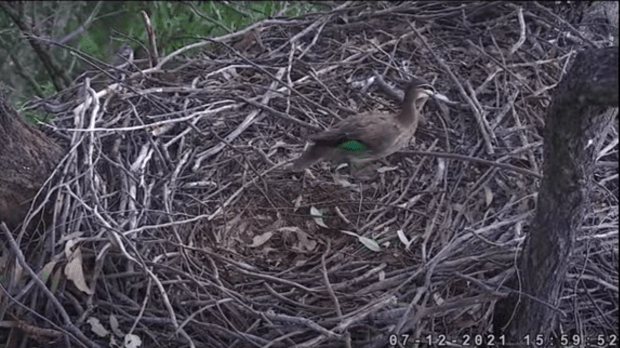
I hope that our little duck gets lots of food while she is foraging and that the ongoing thunderstorm keeps the predators away.

Besides the predators Daisy has that other problem of a lack of material to cover the eggs. Maybe the winds will blow some leaves off the tree and cover those eggs. We can wish!

DAY 6: It is 03:49:00 and Daisy will be arriving back at the egg cup for Day 6. No one disturbed the eggs during the night, so far.

Daisy laid egg number 6 at 06:42:50.

She stood very still after the sixth egg.

The duck eggs are so big. Daisy seems to be having a bit of a time trying to stand up so the sixth one will harden.

Daisy has settled down comfortably.

I wonder what she will do. Will she stay for the normal two hours, cover the eggs and leave? or will she remain at the nest til around 16:00 and depart? We wait.

There have been two very brave birds on this nest. Today we are looking at one of them – Daisy. She should give us all hope that we might not be big but we can be brave and protect that which is dear to us. She is an inspiration. Of course, the other one was WBSE 26 whose leg was broken early in the nest and who endured pain and suffering to meet all of the milestones so that she could fly. What an amazing bird. They both bring tears to my eyes. They were inspirational to so many who have/had challenges. I will personally never forget Daisy or WBSE 26 – ever. I am certain that many of you feel the same.

WBSE 25 holds and comforts its little sister, 26, after its leg is fractured. WBSE 25 will go on to encourage 26 to meet all the milestones and will help her to reach them.

If I had three wishes –

  • The first would be for the WBSE nest to be near to the shore of the river so that the sea eaglets had a better chance of survival. They would be near to their parents after fledge to be taught how to hunt, to be fed while in training and building their flying skills. Not run out of town by the Pied Currawong and left to their own devices.
  • WBSE 26 to have had a very special veterinary surgeon give it a chance.
  • For someone to have built duck boxes for Daisy and the few other female ducks in the river so that their eggs might survive to have ducklings jumping out. They could do a large Pacific Black Duck display and put in permanent binoculars for interested parties to watch – and capture the video of the ducklings jumping and swimming in the river. It would really add to the study of the nature in the area. (Perhaps they already have this????).

I clearly believe in intervention. Humans have destroyed habitat and have built buildings where duck nests used to be and maybe WBSE nests as well. They have also poisoned the Parramatta River and the waters around Sydney. We owe the wildlife a chance. Just this morning I had this vision in my head of the forest caretaker taking a long pole and dumping a basket of leaves on that nest. Now wouldn’t that be grand? Obviously when she was not on the eggs…yes, I do daydream about the birds like you!

I will continue to monitor Daisy throughout the day. So far she is fine. I have not heard any ‘cawing’ from the Ravens so far. There will be an update later this evening.

Thank you so much for your interest and love for this brave little duck! Keep sending positive energy and warm wishes. We can hope. Take care everyone.

Thank you to the SeaEagles@Birdlife Australia Discovery Centre for their streaming cam where I took my screen captures.

The Daisy Chronicles, day 4 – ‘The Raven Arrives’

Our beautiful little Pacific Black Duck, Daisy, laid her 4th egg in the old Ironbark Tree in Sydney’s Olympic Forest at 06:19:36. She was more nervous today than usual. Something had caused her to be overly cautious today. Still, the little duck worked with as many leaves as she could find to cover her eggs and stayed for almost the entire 2 hours that she has done on previous days. She flew off at 08:15:17.

Daisy covered the nest really well— as best she could bringing in leaves from behind her this morning. There is no indication that she has used any of her down and that is a good thing. The predators would smell it and find the eggs!

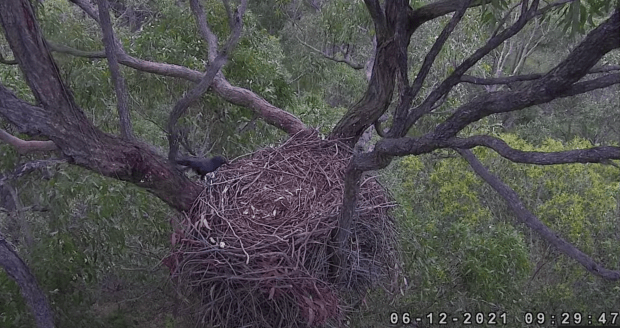
Did the Raven see Daisy on the nest? or did he just happen by and was curious?

The Raven lands on the nest at 09:29:30. He actually looks like one of the Crows we have that come to our garden as opposed to a Raven in North America. I know that it is difficult to identify between the Australian Raven and Crow. It is not a Pied Currawong – there is no white.

Whatever – a very dangerous bird has landed on Daisy’s nest of the variety that consumed her eggs last year.

The Raven looks right at the nest cup but cannot see anything. Daisy did do a good job covering those four eggs.

The Raven almost steps on the nest cup! But he doesn’t, thankfully.

He jumps over to the rim of the old Sea Eagle nest.

All the while the Raven is on the nest it is making very strange calls.

I wonder if it was calling the other members of its family. Last year several arrived but not today.

He stares but obviously cannot smell those eggs and he certainly cannot see them. Oh, Daisy, you little Duck. You did do a great job covering them.

It simply felt like he was going to tear that nest up but he moves over to the parent branch of the tree where the juvenile sea eagles often branch.

And then he is gone. I think my heart sunk to my toes. It is too early for the predators to be sniffing around Daisy’s nest. —— Any day is too early until the ducklings hatch and jump!

At 09:31 ‘something’ chased ‘something’ out of the forest from the top centre to the lower left side. It happened very fast and I could not decipher what it was. I wonder if our little Duck chased that Raven? Has Daisy been watching?

I hope that Daisy only lays one more egg. If there are fewer she will be able to cover them adequately or maybe a big wind would come and rain down leaves on that nest. Wouldn’t that be wonderful?

Everyone send all your good wishes to our little Pacific Black Duck, Daisy. She needs all the positive energy she can get as she continues to try and keep her eggs safe.

Other Bird World News: There is no further news on Yurruga. Ervie picked off the first fish of the day at 06:33. If you watch Jackie and Shadow, the Bald Eagles at Big Bend, they have been working on the nest. Yesterday Connie at Captiva laid her first egg at 05:55:37.

There have been two welcome visitors to our garden. Hedwig, the short tailed Cottontail Rabbit, has been photographed.

Shortly after lunch, Sharpie, the Sharp-shinned Hawk dropped by.

The European Starlings, the Black capped Chickadee, and numerous varieties of Sparrows, mostly House Sparrows, filled up the feeders. I think that each of them knew that there was a weather advisory out and that they would be hunkered down by snow and blowing snow with little visibility in the late afternoon.

Oh, I hope that Raven forgets about Daisy and her eggs!

Take care everyone. Thank you for stopping by to check on the birds. It is nice having you with us.

Thank you to the Sea Eagles @ BirdLife Australia Discover Centre for their streaming cam where I took my screen shots.

Wednesday in Bird World

Let’s start off with what is on everyone’s mind: Has there been a confirmed sighting of Yurruga? Yesterday, Dr Cilla Kinross was inspired by a very quick prey drop at the scrape. Diamond flew into the trees. Cilla was in the trees looking half an hour later – she only saw Diamond. Diamond returned to the scrape with quite a large crop also. Some believed they had heard Yurruga calling but, Cilla is unable to confirm that. So the answer is – we simply do not know. Yurruga has not been seen since last Thursday when he was on a building during a storm. We can only wait.

My goodness that little one was such a cutie.

October 20. Yurruga and Diamond

Diamond was really beautiful this morning as the soft glow of the sun worked its way through the fog.

Both parents, Xavier and Diamond, have been inside the scrape – scraping. They also had some bonding moments this morning at sunrise.

My heart aches for them.

The second question of the day is what is going on with Grinnell, the male Peregrine Falcon of the Campanile, mate to Annie, that was injured by a male intruder that is trying to cosy up with Annie? Here is the latest news.

The New Zealand Department of Conservation rangers on Taiaroa Head are shutting down the streaming cam so that they can move it to the site of the Royal Albatross family for 2021-22. There are lots of guesses as to who the couple might be. The announcement is due tomorrow.

One of my favourite Bald Eagle couples, Samson and Gabby, at the NE Florida Bald Eagle nest near Jacksonville have been putting the finishing touches on their nest. They are perfecting the Spanish moss lining the nest cup. Now all we need are some eggs!

Gabby doing some final inspections this morning.

The three lads at the Port Lincoln all had fish yesterday. Falky had more than Ervie or Bazza. Falky has become a master at slipping the fish out of Dad or Mum’s talons. A magician.

There is a lovely shot of the PLO Mum. She has done an extraordinary job raising these three boys to fledge this year (with Dad’s good help). Yesterday she even spent some time feeding Bazza. He is definitely a Mum’s boy!

Bazza can be a bit naughty. I know that the banders were certain that there were three males. Someone looking at Bazza’s legs and that beautiful necklace in the image below might mistake him for a lovely female.

Bazza and Falky sleep with their heads tucked under their wings – adult style – standing on the nest. Ervie is sleeping over on the perch or the ropes. They are all doing well. I continue to pinch myself. This Osprey nest really turned itself around this year to fledge all three hatchlings.

There are many articles coming out in international newspapers and academic journals on the effect of warming oceans on the seabirds including the beloved Osprey. I picked one of those for you as some are frustrating. They allow me to embed the article but then want you to subscribe to read it! That is a major irritant to me – like Subarus are to Ferris Akel!

https://www.downtoearth.org.in/news/climate-change/climate-change-threatens-survival-of-albatross-60906

It is a grey damp day, 3 degrees C. The snow is melting. There are lots of birds at the feeders. A large European Starling is sharing the peanut and bark butter feeder with some cute little House Sparrows.

The tiny suet balls called Bark Butter by our supplier are a really big hit since winter has set in. Junior has been around to get the corn while Dyson was busy elsewhere. Nice to see all of them.

One of my former students posted this today on FB. It is a perfect little giggle for all of us!

Thank you so much for joining me today. Take care everyone. Stay safe.

Thank you to the Port Lincoln Osprey Project, Charles Sturt University Falcon Cam and Cilla Kinross, and NE Florida Eagle and the AEF for their streaming cams where I took my screen captures.

Little Yurruga

As many of you are aware, Yurruga has not been seen since last Thursday. Cilla Kinross saw him on the top of a building in the pitching down rain and later, university workers also saw Yurruga on the same building. Cilla sent me a short note this morning because I had written to her earlier about Yurruga’s 2nd right tail feather still being contained by the quill. The local vet did not think this was a problem but, like Cilla Kinross, was concerned about a lack of feather development on the little falcon. What impact this might have had will never be known. Cilla has looked and looked in all the places Yurruga might be and others but she is concerned and has posted a note that has been placed on the FB Page for the Orange Peregrine Falcons. I was very touched because she referred to Yurruga as a ‘poor little lamb.’ Every day is a test for our birds. Even the strongest have challenges. It is difficult enough for fledglings but compounded with unkind weather for numerous days, well. Yurruga should be flying around screaming at his parents for food and the conclusion is that he is no longer with us.

The parents, Xavier and Diamond, had an extremely long – fifteen minute or more – bonding session in the scrape yesterday morning at 05:15. This is simply not something that would normally happen with a fledgling needing prey and training. Considering the work of Marc Bekoff (Emotional Lives of Animals), Jane Goodall, the observations of Hob Osterlund with the Laysan Albatross, the bonding behaviour of Xavier and Diamond should be considered alongside grief. While we have only a limited view of the falcon’s behaviour, it might be assumed that the couple have now grieved for their wee one and are, with the weight of that loss, reconfirming their love and commitment to one another. We cannot do a brain scan on Diamond’s hippocampus (area of brain in human animals for emotion) to see if it lights up, Barbara J King in her book, How Animals Grieve, would tell you that the investment in the mating, the making of the egg, the care and incubation, the care and feeding after and training, she says that ‘grief comes from love loss.’ There have been roadside funerals of Crows, Ospreys who have mourned the loss of their chicks by predators. Other bird species and drowned themselves after the death of their mate. And, of course, all of you reading my blog, will know about Arnold and Amelia, the two Canada geese. Arnold and Amelia lived at the pond on the grounds of the clinic (fortunate for them!).* Arnold had one of its digits severed by a snapping turtle and required surgery. Amelia went to look for Arnold and watched through the glass, finally sharing a meal and a pen til Arnold was released.

So, today, we grieve with Xavier and Diamond over the loss of little Yurruga.

It was a beautiful morning when little Yurruga flew for the first time.
Diamond and Yurruga bathed in the golden glow of the sun the morning Yurruga flew.
Xavier feeding his baby.
Xavier brings prey for Yurruga.
Diamond and her baby.
Xavier feeding Yurruga. Xavier loved getting a chance early on to feed his little one.

What an adorable little eyas. Fly high little one. Fly high.

I am so sorry to bring this terrible news to you. We join Xavier and Diamond, Cilla Kinross and the team at Orange in their mourning.

Thank you to Charles Sturt University and Cilla Kinross for the streaming cam where we get to share the joys and the sorrows – and where I took my screen shots of this lovely Peregrine Falcon family.

  • I say this because many do not consider the mate when one is taken into care. Arnold and Amelia were extremely lucky.

From Port Lincoln to Kauai to Juneau

Oh, gosh. We really are going to miss these three boys when they finally leave the Port Lincoln barge. Ervie was wet this morning. He has been focusing very hard on finding a fish and catching it. We might never know, sadly, when that moment occurs – unless he brings it up to the ropes like Dad. Wouldn’t that be wonderful?!

Bazza seems to have landed the first fish this morning on the nest. Falky doesn’t seem bothered and Ervie had flown off earlier.

Port Lincoln gave us a nice image of Bazza over on the ropes. These three males are quite handsome.

When Ervie flew back to the barge he was really keen on preening those feathers.

You can really see that sharply hooked beak that helps to tear the fish so they are easier to eat. Unlike Peregrine falcons, Ospreys do not have a tomial tooth. In my images it is a bit difficult to see that valve which seals the Osprey’s nostrils when they dive for their fish but, it is there.

Looking at that beautiful image of Ervie below you will notice that the Ospreys lack that very heavy eyebrow of some of the other raptors. Instead, they have that incredible black line which passes from the eye down to the neck. That black line helps them with the glare.

Ervie missed the the 8:14:14 fish that Dad brought in. Falky claimed in.

Port Lincoln has reported that Ervie has been flying farther. They also note that he has been checking out the coast. Here is the latest map of Ervie’s movements from the barge.

Ervie and his siblings will get their adult plumage at their first moult which is fully completed by the time they are a year old. That change in plumage does not indicate Ervie’s sexual maturity. Osprey do not normally breed until they are three years of age. The 2019 fledgling from Port Lincoln, Calypso, has been spotted sitting on a branch with a male. Might there be chicks next year? That would be marvellous!

When Penny Olsen’s book on the raptors of Australia was published in 1995, the map of Australia indicated that the Eastern Ospreys were located only around the coast. Ironically, that map did not indicate any ospreys in the Eyre Peninsula. This is one of the things that has changed since its publication. We have to look no further than the Port Lincoln Opsrey Barge and Thistle Island. We also know from Solly being the first tracked Osprey that the birds do go inland. Not all that far but further inland than anyone had understood previously. We are fortunate that Solly was able to provide so much information to us in the 14 months that she was alive. Port Lincoln can now compare the dispersal of a female to that of a male with the tracking of Ervie.

There are many threats to Osprey. I imagine that everyone reading my blog can name at least four. I want to add warming seas and the decline in fish numbers as yet another.

As you know, I highly recommend Dr Marc Bekoff’s book, The Emotional Lives of Animals. He also wrote The Ten Truths with Jane Goodall. A very moving story is coming from the island of Kauai, Hawaii. Some of you might recognize the name of Hob Osterlund. She posted a very moving story that can be added to the cornucopia of evidence that Bekoff and Goodall have that support animals having emotions which they express. Once you have read those two reasonably priced books, you will never ever apologize again for anthropomorphizing animals again.

Here is that posting:

Tears.

One of my readers ‘B’ asked me if I had seen the snow at Glacier Gardens. I had not! So I went to check. Oh, my goodness, it is so beautiful. If you close your eyes you can see that beautiful Kindness using that nest and those branches like a trampoline. What a magnificent juvie Kindness was. She is off eating Salmon along the river.

On Taiaroa Head, 122 birds have been seen so far and there are 36 eggs laid. No mention yet on who the Royal cam stars for 2021-22 will be! Soon. And there has been no update on Grinnell. No further updates on WBSE 27 either.

Thank you so much for joining me today. Take care. See you soon.

Thank you to the following for their streaming cams where I took my screen shots: Glacier Gardens Bald Eagle Cam, Port Lincoln Osprey Project, and to Hob Osterlund and her FB page for that moving story. Much appreciated.

Black-Shouldered Kite

I want to thank ‘L’ for asking if I would share parts of that amazing book Australian Birds of Prey by Penny Olsen. I am so happy to do this! We can all learn together.

There are 24 species of raptors at the time the book was written in Australia, 1995. I know that many of you are familiar with the Eastern Osprey and the Peregrine Falcon so I want to start with some gorgeous raptors that you might not know. My plan is to introduce 1 or, at the most, 2 species a week. Our first is the Black-shouldered Kite. The scientific name is Elanus axillaris. Just look at that lovely bird. She is simply gorgeous.

“Black-shouldered Kite (Elanus axillaris)” by patrickkavanagh is licensed under CC BY 2.0

The Black-Shouldered Kite is easily identified by the black patch on their wing. There is also a small black underwing patch. This is a small to medium bird with a gorgeous white head, body, and tail. The shoulders are black as is the beak. The back and upper wings are mostly a very pale grey. The eyes are a captivating red! The cere is a brilliant yellow as are the legs and talon.

The female is 36 cm and the male 35 cm in length. The female weighs approximately 300 grams with the male weighing 260 grams when fully grown. As you can see, the female is slightly larger than the male which is known as Reverse Sex Dimorphism.

“Black Shouldered Kite” by jeans_Photos is licensed under CC BY 2.0

The Black-shouldered Kite has two front toes and two in the back (as opposed to three forward and one back). The wingspan is 80-100 cm.

In terms of its habitat, the Black Shouldered Kite prefers open grasslands, woodlands, and croplands in lower altitude areas that are within the tropical or temperate climate zones. At the time the book was written the population numbers were climbing.

The birds prefer rodents as their first choice of prey while their second is insects. The Black Shouldered Kite tends to breed when prey numbers are higher. They raise one clutch per year normally between May-November. Clutch sizes vary between 2 and 5 with the majority being 3 or 4 eggs. In a poor year with little or no food, it is expected that Black Shoulder Kites would have a much smaller clutch or lay no eggs at all. Eggs are on average 4.2 cm. This can be compared to an Osprey whose eggs are, on average 6.1 cm long. Eggs are incubated for 31 days with chicks fledging at 5 weeks. The chicks will have their adult plumage in one year, after their first moult.

The image below is a juvenile. Notice the rusty brown wash on its head and shoulder. What a beauty. Even though this chick is waiting for food, at 5 weeks it is fully capable and does hunt mice.

“Black-shouldered Kite: Waiting for lunch” by birdsaspoetry is licensed under CC BY-NC-SA 2.0

As we know, raptors adapt and below the kite is eating a lizard.

“Predator with prey! (Black-shouldered kite)” by Tarique Sani is licensed under CC BY-NC-SA 2.0

Oh, what a beautiful bird! I hope that you have enjoyed learning about one of the raptors that live in Australia (and other parts of Asia). Like every species of bird, the protection of their habitat (and keeping it from fragmenting into small patches) is important to the continuing health of the Black Shoulder Kite. Other threats are egg collectors (yes, they still exist), pesticides, rodenticides, and electrocution on power lines.

Thank you so much for joining me today. Take care. See you soon!

Credit for Featured Image: “Black-shouldered Kite (Elanus caeruleus)” by Lip Kee is licensed under CC BY-SA 2.0

Saturday in Bird World

Are you having Peregrine Falcon withdrawal since the Collins Street kids and Yurruga fledged? Did you know that there are a pair of falcons living in Baltimore, Maryland that do not migrate? Their names are Barb and Boh. Barb will lay her eggs in March (normally) but for now the camera is live every day! The history of the scrape is located on the web cam page.

Urban hawks are very fascinating as are the amount of wildlife that exist in the very large urban parks such as Central Park in NYC. I always recommend this site. There are some good videos on Cedar Waxwings and the Peregrine Falcons as well as the RTH’s. The blog is run by Bruce Yolton who is extremely knowledgable. Check it out if you are interested in how wildlife survives in some major cities like New York.

https://www.urbanhawks.com/

There is also an Osprey streaming cam in Maryland that you should have on your radar. It is the home of Tom and Audrey 2 on the property of The Harrison Family.

This Osprey family, Tom and the original Audrey, were the subject of a book full of wonderful images, Inside An Osprey’s Nest. A Photographic Journey through Nesting Season. The images and text are for year 2015 when Tom and Audrey became adoptive parents – twice! The story is as good as the images showing the arrival of the two chicks to the nest and then, a little later, another chick lands on the nest and wants to be part of the family.

The eggs of Tom and Audrey are determined to be non-viable. The eldest two nestlings are removed from a nest with four chicks. Imagine Audrey’s surprise when she returns to her nest from a break to find not three eggs but two chicks and an egg. It is a very heart-warming story!

One of our readers asked if I would share some information from that big book on Australian birds of prey – and the answer is definitely yes! It is too difficult to find that volume and too expensive to purchase but, oh so wonderful to share! We will work our way through Australian birds of prey!

The latest news on two peregrine falcons that we are watching – Grinnell, the mate of Annie at UC-Berkeley’s Campanile – and Yurruga, the recent fledge at Orange is no news. The last posting from UC Falcons is that the interloper male appeared briefly on the ledge and was greeted by Annie. It was raining in Orange. Diamond and Xavier were about but Yurruga was not seen. He could be in the trees staying quiet out of the weather. Perhaps he will be spotted today.

The boys at the Port Lincoln Osprey Barge are doing fine. Bazza decided to be a little aggressive when he received one of the morning fish deliveries from dad. Afraid that Ervie might steal his late breakfast, Bazza decided to mantle and then thrust himself at Ervie just to make sure Ervie understood.

Bazza was very quick to protect its fish and mantle Ervie. The mantling is not the problem it is that beak. They can do a lot of damage to one another if they decide that is what is necessary.

Bazza finally settles and goes back to eating his fish.

Later. All is forgotten. Simply beautiful fledglings. Falky is on the right, Bazza with his great crest is on the left and Ervie is behind with his sat-pak.

Someone said that Falky had a wing or feather injury but I can see nothing to indicate that in these images. Falky is definitely one beautiful elegant bird. He has really come into himself in terms of flying. I also hear rumours that Ervie is trying his hand at fishing. Wonderful!

Just beautiful. Sometimes I just stare at these three boys. What joy they gave to us this year. I wish each had a sat-pak because we get so attached to them and then – poof. Nothing. What happened? Rather than think things are well, I like to know. If something happens, then we need to deal with it. Like Solly’s electrocution. Put the protectors on the poles. It is simple.

As we prepare for Bald Eagle season, I want to stop and say that there are so many many nests. You have your favourites and I have mentioned mine in the last few days. Some of the first eggs that will hatch belong to M15 and Harriet at the SWFlorida Eagle nest in Fort Myers on the property of the D Pritchett family. Those eggs are set to hatch from the 25-28 of December. They are an experienced family with little trauma – the GHOW being the exception. If you are after an eagle family to watch, SW Florida should be your first go to this season. There are three cameras. You can find the others on YouTube.

Ithaca, New York is the same temperature as the Canadian prairies today, 0. Yes, it warmed up and the sun is out! Ferris Akel’s tour is live at the moment. He is on Wildlife Drive and it is snowing but he did find some beautiful swans.

If you are reading this at the right time you can still join the tour. On Thursday Ferris found Big Red and Arthur on the Cornell Campus. Maybe he will do the same today!

I am also happy to report that so far, knock on wood, Dyson has not found the new feeder for Little Woodpecker! Yippee.

Take care everyone. Thank you for joining me today. I hope you have a marvellous Saturday. See you soon.

Thank you to the following for their streaming cams where I took my screen shots: Port Lincoln Osprey Project and Ferris Akel.

Friday and Australian Raptors

The FB of the Orange Australian Peregrine Falcons posted an interesting article with the vocalizations of Peregrine Falcons. Want to understand what those falcons are doing or saying?

When Victor Hurley did his Q & A session about the Melbourne Collins Street Falcons, he mentioned a book. That volume, Australian Birds of Prey by Penny Olsen is one of the most informative and beautiful books. Published in 1995 most of the information remains relevant today. The statistics on how many birds exist will change but the information on all of the falcons, size, ID, brooding, etc remain the same. One of the things I love about it are the drawings of the raptors.

Note: Do not be fooled by books of a similar name. Check and make sure it is Penny Olsen 1995.

Images from old print collections. In this instance it is the Wedge-tailed Eagle, the largest raptor in Australia, in a hand coloured drawing from the early 19th century.

The stories of how these early drawings came to be made just wrenches your heart especially when foreigners to Australia would injure the birds and hope to take them back to England. This bird managed with a wound to claw its way through a rope and escape, thankfully. Our ideas of the rights of animals are changing but we still have much much more to do!

The image below is of a Hobby. Olsen comments that young raptors spend much more time lying down than they do standing. The photographer has caught this small falcon resting. What a lovely capture!

The Hobby is also known as ‘The Little Falcon’ or the ‘Little Duck Hawk.’ It is a member of the Falconidae family of diurnal, day time hunting, raptors.

One of the things that I like about the book are the tables that compare the various raptors in Australia to one another and the topics that cover everything from ecology (habitat, dispersion, , mortality), predators, reproduction, health, raptors and humans as well as conservation.

This is an impressive book and if you can get your hands on a copy – there are no reprints – it is, as Victor Hurley says, ‘essential for a library’.

Continuing on with the raptors from Australia, Cilla Kinross posted a video of a bonding session between Xavier and Diamond. Listen for the vocalizations (after you read and listen to the first article today).

There is no current update on Yurruga. He was seen day before yesterday on a roof. It rained hard and steady yesterday and Orange and I imagine our wee fledgling was hunkered down somewhere wanting to stay dry. Not good to try and hone your flying skills in a down pour!

I have not seen any updates or sightings of the 367 Collins Street fledglings. If something comes up I will let you know! It is still bittersweet looking at the four of them and the wee male not making it. But, on the brighter side, we could have lost all of the eyases this year. “Be thankful for what we have and don’t wish for what we don’t” was a common mantra of my grandmother.

The season in Australia is winding down as our lads on the Port Lincoln Osprey barge continue to get stronger and stronger and will become more independent and learn how to fish soon. It is wonderful that we will be able to follow Ervie on his adventures with his sat-pak. Let’s see if PLO has posted anything today!

This is the last posting when Ervie flew over land on 23 November. To the surprise of many, Solly also flew over land and into the interior a bit which will go a long ways to informing the power companies where they need to put those protectors on the hydro poles.

All three are sleeping adult style, standing up with their head tucked under a wing.

As to the situation with Annie and Grinnell and the interloper, the interloper male flew in to the Campanile and was greeted by Annie. UC Falcons have not seen Grinnell and Annie together as yet. Challenges and conflict over territory could happen. Fingers crossed.

As things go quiet in Australia, I will begin to list some of the Bald Eagle and Osprey nests in North America that you can watch. If you have a favourite, let me know and tell me why you like it so I can pass that along to others. Thank you!

Thank you for joining me today. Stay safe. See you soon!

Thank you to the following for their streaming cams or FB pages where I took my screen captures: Orange, Australian Peregrine Falcons, Charles Sturt Falcon Cam and Cilla Kinross, 367 Collins Street Falcons by Mirvac, and Port Lincoln Osprey Project.

Thanksgiving Thursday in Bird World

Our wildlife rehabilitation clinic has seen a 21% increase in patients in the last week. If you live in Manitoba and have the finances, send them a donation, however small or large. They receive no government funding. Everything is done on a donation basis – as is the case with most wildlife rehabilitation clinics. They have a long list of items they need on their website and all monetary donations are tax deductible.

I know that many of my readers live elsewhere but if this is happening here then perhaps it is happening all over.

There was a very sobering article on that cute little Korora (Tiny Blue Penguin) that is doing well in NZ. Its sibling died because the parents have to go so far to feed. For those that love those New Zealand birds such as the Royal Albatross at Taiaroa Head and wildlife that depend on the oceans to survive, what they are seeing is warming waters which mean the fish move or even die (like the trout did in Montana when the Clark Fork River got too water). It is time we demand that governments get serious and take radical steps to try and stop the situation from getting worse.

I want to remind everyone of Ferris Akel’s tours. You can go to YouTube, search for Ferris Akel, and hit the subscribe button to the live stream. He has lots of archived video tours as well. They normally take place on Saturdays at noon, Ithaca NY time. Ferris is out at Sapsucker Woods today for Thanksgiving and he has just found a beautiful juvenile Red-tail hawk that is hunting.

Notice the ‘eyebrow’ that helps to keep the glare away from its eyes when hunting. Oh, isn’t this a beautiful raptor?

Ferris just caught a Belted Kingfisher close to the RTH. There have been other birds this morning included Canada Geese and maybe another Kingfisher.

In the summer and fall, Ferris finds lots of shore birds and in the winter there will be owls! You can leave Ferris on like a radio if you are busy or you can watch as little or as much as you like. There is also a chat function with great people who can answer questions.

I am so thankful for Ferris Akel and his tours and his generosity in allowing us to share his images. I have learned so much from him over the years just wish I had a better ear to know which birds are out there by their beautiful voices.

Little Yurruga, the Peregrine Falcon fledgling at Orange, has been seen on top of a building so it is flying alright. Xavier and Diamond have been seen taking food in and out so she/he ? is being provided for. Isn’t this wonderful?!!!!!!

Below is the image that Dr Cilla Kinross took the day Yurruga fledged. She placed it in a tree. What a lovely little falcon you are, Yurruga.

This appeared on the FB Page of the Orange Peregrine Falcons today.

Have you ever wondered about the colour morphing of birds? The Audubon Society has a nice ‘Ask Ken’ article on that very topic! Thanks BM for letting me know!

The NZ DOC rangers at Taiaroa Head are deciding which Royal Albatross couple will be the Royal Cam family this year. There are 36 eggs and they believe that is all for this year. The favourite couple, WYL and BOK, who have made us so happy with their cuddles have not laid an egg – maybe next year! Will keep you posted!

It is a quiet day in Bird World and that is something to be very thankful for – no drama, nothing horrible happening.

Take care everyone. Have a marvellous day. To those having Thanksgiving, enjoy. See you soon.

Thank you to the following for their streaming cams where I took my screen captures or their FB pages: Cornell Bird Lab and NZ DOC, Ferris Akel Tours, Orange Peregrine Falcons FB page and the Cornell RTH FB Page.

WBSE Release

Here is an image of WBSE 27 being released last week. It was determined by the scale lines in her toes that the bird was in fact, 27 not 28. So happy that ID was solved! The day the bird was released was the first day that the parents were not at their River Roost. I hope the three connect! There is a video of the release and it shows 27 as a really strong bird. I hope she thrives in the wild for eons. What a gorgeous bird.

The following was posted on the FB page of the Sea Eagles:

Here is a news report:

https://www.9news.com.au/videos/national/incredible-moment-sea-eagle-returns-to-wild/ckwd1mylj000n0go2tpq6dkcs?fbclid=IwAR1LEfr-N1vKUIgUAawVmy477RlTUb7sTU0yFDQwedhjs2gAW9t_FQQJva0

The Kakapo Recovery are doing their annual fundraiser. As many of you know, we started out the pandemic with 208 Kakapo in existence. There are now 202. Dedicated individuals do wellness check ups which mean they have to find these elusive non-flying parrots. The only way to do that is with a transmitter. The transmitters and batteries require check ups and replacements (batteries) on a regular basis. Medical treatment, etc. If urgent and life threatening, the bird is flown to Dunedin, NZ for veterinary care.

Many are considering doing one special gift on behalf of their family to help wildlife and the planet (as opposed to fast fashion that winds up stacked in the deserts of Africa). The Kakapo Recovery is hoping you might choose them.

Last year we adopted Rangi! He happily lives in the living room plants when he is not cuddling up with Pippa the Albatross or Big Red the Red-tailed Hawk!

It is something everyone needs to think about even if it is $5 to a streaming cam that you love. It can make all the difference. You can also adopt other types of birds. Last year there was a huge rush to help Aran and Mrs G at the Glaslyn Bywyd Gwyllt. You might recall that two horrific events came together in the perfect storm at Glaslyn. A heavy rain storm with cold temperatures hit the area when the chicks hatched and Aran got in a territorial fight and injured his wing and he could not fish. The community came together and provided a fish table for the family. Sadly the chicks did not survive but Mrs G and Aran did and Aran got his strength and migrated on time. To help that cause many went to the website and adopted Aran and his family.

You will have your own list as well. Other ways that you can help is to check with your local wildlife rehabilitation clinic. They often post a list of items that they need. You would be surprised but clean old towels are usually at the top of the list! So next time you are looking at a pile of towels and old sheets, think of your local clinic for wildlife! It doesn’t cost anything but getting the items there and often the clinics have volunteers that pick up for them.

Books for children and teens on how to help wildlife thrive are, of course, invaluable in building the next generation to care for our beloved birds.

Holly Parsons posted an update on Yurruga on the FB page for the Orange Australian Peregrine Falcon:

“Post from Cilla approx. 5pm 24 November:I haven’t seen Yurruga since I placed him in the tree, but I’m pretty sure he is still there as the parents have been coming and going with prey and giving me warning calls if I approach too close. I only check once a day and the foliage is really thick so hard to find him if he’s quiet.”

That is great news coming out of Orange! That is the kind of news I wish were coming out of Sydney with WBSE 27 – that the parents have been feeding it. Fingers crossed.

This is a short update. It is extremely quiet in Bird World now that the falcons and ospreys and WBSE in Australia have fledged. Eggs are happening in the Bald Eagles nests in the US and there will be lots of action around the holidays in December.

Take care everyone. Thank you for joining me.

Thank you to the following for their streaming cams or FB pages where I took my information: Orange Australian Peregrines FB, Kakapo Recovery FB, and Sydney Sea Eagle Cam.