Late Friday and early Saturday in Bird World

6-7 May 2022

The Cal Falcons hatch day was a complete success. One eyas arrived on Thursday and the second hatched during the festivities. You could tell at the beginning of the Cal Falcons Q & A today that both Sean and Lynn were overjoyed. Here are some images from today and at the bottom of them I will put the link to the archived session from today if you missed it.

One of the most remarkable moments for me today was when Annie and Alden were ritually bonding in the scrape with chick 1 chiming in. Adorable.

Feeding and eating take some practice.

Alden checks on the newly hatched chick while Annie goes to get some food and has a break.

They know to hold that pink beak up high and to open wide from the minute they hatch.

Sean and Lynn believe – based on the coloration of the eggs – that the oldest chick was egg 1 and that chick 2 was actually the third egg. They noted that the third egg was darker than the other two. Historically, Annie has never had all of the eggs hatch. If the egg that remains is to hatch it will be by tomorrow afternoon. It is not clear if the second chick is Grinnell’s or Alden’s. They hope to test the feathers to determine paternity and they are looking for someone within the University of California system who would be interested in helping.

Newly hatched falcons can live on the nutrients from the yolk of the egg for approximately 24 hours. This means that they do not need to be fed until then. However, they can eat as soon as 4 hours after hatching according to Sean.

Saturday morning 0611.

It is hard to imagine but these wee babes will have adult size legs when they are 24-26 days old. That is when they will be banded. Falcons fledge from 38-42 days old. This is very quick and is one way that they are very different from the eagles and the ospreys. Their time in the scrape is short. They will spend approximately a month with the parents after fledging learning to fly better and to hunt.

Names? After the banding name suggestions will be taken with a final vote. One of the leading names is Grinnell. I totally agree.

Here is the link to the Q & A session from today.

The banding at the MN-DNR nest is completed. There were no surprises. E1 is a very big robust female weighing in around 9 lbs. Incredible. Sadly, those big females appear to be the ones that cause siblicide more than the males if food appears to be getting short on the nest. Solly at the Port Lincoln Osprey nest in 2021 and E1 this year on the MN-DNR nest. (Confirmed females by testing and/or measurements). Nancy circled around the nest and returned fairly quickly to E1. E1 will be a formidable female just like her Mum.

Iris laid her second egg of the 2022 at 15:14:36 Friday afternoon at her Hellgate Canyon nest. Iris appeared to go into labour a few minutes earlier with the feathers on her back rising and falling.

Maya at the Rutland Water Manton Bay nest in the UK is not giving away any hints – not a single one. Here are the eggs at 20:12. She is very restless during the wee hours of Saturday morning. Do we have a pip on any of those eggs?

Saturday and no obvious pip that I can see on Maya’s eggs, yet.

A beautiful image of Chase and Cholyn’s only hatch for 2022. Just gorgeous. One month old.

Quite a change from the beautiful blue waters of the Channel Islands and the bright sun to the dreary rain of the Dulles-Greenway nest of Martin and Rosa and DG1. They were soggy yesterday, too.

Gosh, Middle Little at the Captiva Osprey nest has such strong long legs. He watches and waits for Andy to come in with a fish for him. Stunning fledgling. Just stunning.

Lori Covert, the owner of the property with the Captiva Osprey and Bald Eagle nests on them went out in her kayak and posted an image of the tree where Little MiniO likes to perch.

It is wonderful to have the two around getting stronger with their flying, figuring out the world, and perfecting their fishing skills.

The two eaglets at the Dale Hollow Lake will make you very nervous as they stand on the rim of the nest and flap their beautiful big wings. They are 69 days old! The date of fledging depends on many factors but 11-13 weeks is good. These two are approaching that early window.

Are you a fan of the eaglet at Duke Farms? Look at the air under those wings Saturday morning early! It will not be long.

Family photo of Arthur brooding, Big Red on the railing and those gorgeous Ls at the Cornell Campus RTH nest. Big Red, like all other raptor females, is very cautious and keeps the chicks close to her after hatch. Now Arthur is getting some great ‘Daddy’ time as the Ls get older. Cute. I don’t know who is cuter – Arthur or the chicks

The engineers who took care of the White Stork Bukacka and his storklings last year have put together a short video clip about the life of Bukacka and his mate, Betynky. It is sweet.

The livestream at the UFlorida-Gainesville Osprey nest is offline Saturday morning. I will be checking in with them, more of the European nests and, of course, with the CalFalcons later today. In the meantime, enjoy your Saturday. Ferris Akel will be having his tour around noon Ithaca time. Google Ferris Akel Tour on YouTube if you are interested.

Take care everyone. Thank you so much for joining me as we wait…pip watch is going to happen at several nests this week including Rosie and Richmond. See you soon!

Thank you to the following for their streaming cams and/or FB pages where I took my screen captures: Cal Falcons, MN-DNR, Montana Osprey Project, LRWT, Explore.Org, Dulles-Greenway Eagles, Captiva Osprey Nest and Lori Covert, DHEC, Duke Farms, and Cornell Bird Lab and RTH.

Friday Morning in Bird World

6 May 2022

The five peregrine falcon eyases at the Manchester, New Hampshire scrape have been fed four times before 0930. Meal times were 0531, 0627, 0712, 0917. Mum doesn’t get finished quick. She will wait til there are no beaks open wanting food. Just look at the youngest right up there!
There are five eyases in the scrape at the Walburga Tower in Oudenaarde, Belgium, too.

Here is the link to the camera in Belgium:

There is still one eyas at the scrape box on The Campanile on the grounds of UCalifornia-Berkeley. The wee one hatched on 5 May. There are two more eggs. One appeared to have some cracking of the egg but that could have been light or debris.

Bingo!

A really nice fish arrived for the two soggy eaglets at the Dale Hollow Nest at 0813.

It is not clear to me which of the eaglets claimed the fish. Note: the cam is flickering (or was) in and out of IR mode).

There was some headway made on the self-feeding and later both decided to sit it out on the rim of the nest.

Lessons are still being taught at the WRDC Bald Eagle nest in the Miami Zoo. Rita arrived with a nice fish at 0926.

She waited eating morsels. It was not until 1024 that a fledgling arrived on the nest.

Mum left them empty taloned. Wonder what lesson she was giving out today????

Both R1 and R2 seem to be hanging around the nest. Hi there.

The three eyases at the Weissenburg scrape in Bayern are really growing. Look at the change in their plumage. The soft dow gives way to a rather matty looking cotton that reveals feathers!!!!!! Pink beaks begin to change colour.

Louis is an amazing partner. I adored him with Alia and so sorry she did not return last year. He has settled in with Dorcha and despite the pelting rain in Scotland landed a nice fish for her. Well done, Louis.

Dorcha is so dark. She reminds me of Mrs G at the Glaslyn nest.

We might be checking in on the Osprey nests scattered about the UK but all eyes are on one nest – that nest belongs to Blue 33 (11) and Maya at Manton Bay. They should be having a pip and a hatch today or tomorrow.

Maya is not giving anything away! Gosh she is beautiful.

If you are looking for a solid Osprey nest to watch, one that fledges all their hatches then this is the nest to watch. Here is the link to the streaming cam.

It is raining a lot of places in the US and much of that rain is really welcome especially up in the Pacific Northwest. You will notice that I do not list any of the Osprey nests in that region. The ones I know have suffered from the extreme heat.

It is also raining on Long Island at the PSEG Oyster Bay Osprey platform. Did you know that there are over 2000 Osprey nests on Long Island? Most are located on the eastern end. PSEG has two platforms. The one at Oyster Bay in Nassau County and the other at Patchogue. The Ospreys return each year with the arrival of the Menhaden. It is a species of fish in the herring family. They travel south in the fall and winter and north in the spring in slow moving tight schools. Sadly they have been over fished.

Brevoortia patronus Goode, 1878 – Gulf Menhaden” by Crabby Taxonomist is marked with CC BY-NC-SA 2.0.

There are two falcons and two eggs at the Indiana and Michigan Power Company scrape. You can help them name the chicks. Information below.

Here is the link to this camera.

The Boys & Girls Club of Fort Wayne, Indiana provided a list of ten names for a Survey Monkey. You can vote here once before May 16.

https://www.surveymonkey.com/r/LN776TF

We are waiting for hatch at the new scrape box mounted on the top of the Spartan Stadium at the University of Michigan. It is raining there today, too.

Dad has come to relieve Mum but she isn’t budging. Will we have a hatch today? Maybe. Here is the link to this new streaming cam and scrape.

These falcons made the news!

Some images from this morning at the nest of Big Red and Arthur on the grounds of Cornell University in Ithaca.

Nancy has fed E1 and a cherry picker has gone up to the nest. It is banding day!

E1 properly defended the nest he shares with Mum. Sadly, Dad Harry has not returned to the nest. He disappeared on the evening of 26 April. Once Nancy realized what was happening, she started bringing food to the nest. As we know, it was too late for E2.

Despite early worries by some watchers when there were four eggs, Big Red has shown that this is not a problem. Indeed while it might be one extra to her norm, you can see by some of the peregrine falcon nests that it is possible for five to do well. Life is so different on the hawk and falcon nests than it is for the eagles and the ospreys.

It is going to be a gorgeous 21 degree C day in Manitoba. It is a good day to get outside – before the next rains come – and go and see some of the new arrivals in the City while I wait for the second hatch at Cal Falcons and for their Q & A at 5pm Pacific Time.

The Dark-eyed Juncos that arrived in mass during the horrible storm a few weeks ago seem to have departed. The numbers of birds at the feeders are returning to the norm. Even Mr Blue Jay dropped by this morning.

Take care everyone. Thank you for joining me. See you soon.

Thank you to the following for their streaming cam where I took my screen captures: Cal Falcons, WRDC, Woodland Trust and People’s Post Code Lottery, LRWT, Cornell Bird Lab RTH, Spartan Stadium Falcon Cam, I & M Falcon Cam, PSEG Oyster Bay, Weissenburg Falcons, DHEC, Oudenaarde Falcons, MN-DNR, and Peregrine Falcon Networks.

Monday in Bird World

2 May 2022

Oh, I cannot tell you the level of elation when – just stopping in to check on a fledging that it is there on the nest, yelling at the parent it sees in the distance bringing in a headless fish. Oh, Kincaid, it was so very nice to see you. Thank you Louis for that great meal! The time on the Kistachie National Forest streaming cam was 15:48:36.

There is Kincaid on the branch. Oh, how lovely. I have not checked in on you enough but, it so reassuring that you are still at the nest with your parents, getting food and getting stronger at flying. That is how you will survive! Maybe you won’t ever leave. There is plenty of lake, lots of fish, and an empty eagle’s nest.

Kincaid saw Louis flying towards the nest way in the distance and she rushes down to get her dinner.

Kincaid was sure ‘wheeing’ very loud as the adult approached the tree and landed. Kincaid mantled the nice headless fish perfectly.

Kincaid did a great job feeding. She was still on the nest eating an hour later.

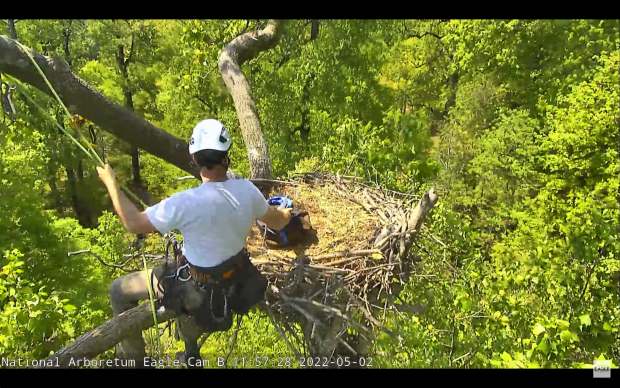
This morning DC9 at the National Arboretum Nest was banded. The eaglet was taken in a pouch down from the tree and returned. It was a very hot day in Washington, DC. 27 degrees C or 80.6. It is hotter on the top of the nest. DC9 was panting. The immediate reaction of the bander was that DC9 was a male. If I hear differently, I will let you know. Here are some images of that event.

DC 9 valiantly defended its nest. It is 10:52. DC9 is 35 years old. The perfect age for banding.

The bander sat very quiet talking gently to the little eaglet and slowly, ever so slowly got him to where he could place him in the sack.

In you go.

Down they go.

Done and dusted. The bander stayed to see that DC9 was alright. Watched his breathing etc.

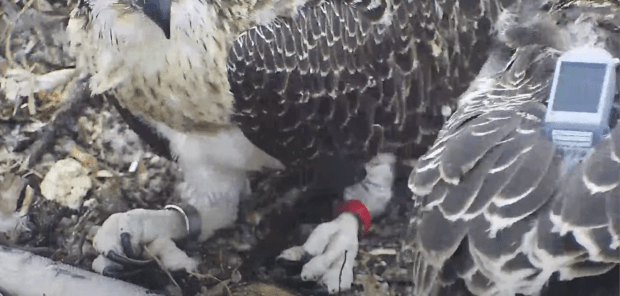
DC9 is panting due to the heat and probably some of the stress. He is not going to show us his bling either.

Mr President was on a branch of the nest tree called the ‘balcony’ at 15:43. He flew down to the nest and fed DC9 at 16:22. I wonder if DC9 told Dad what a day he had had!

The cuteness factor at the nest of Big Red and Arthur is way up there. L4 is quite the ‘corker’ as my Mum would have said. Yesterday evening he was trying to eat the same piece of rabbit as its older sibling, L1. The wee one isn’t afraid of anything – even attempting to eat a bird leg this morning. It was quite hilarious. At least once Big Red had to rescue the poor darling from choking. Did I say she was a great Mum?

L4 is on the far right with that big piece of meat. Right now it is the only eyas that does not have the grey down coming in. The others are preening and itchy! Soon enough, little one. Don’t grow too quickly.

Everyone is getting a nice crop.

Then it started raining. Poor Big Red. She is getting soaked.

Then the rain stopped. All of the babies are completely dry and kept nicely warm.

It often seems like Big Red never stops feeding them! Adding one extra sure changes things on a nest!

Iris came to visit her nest today at Hellgate Canyon in Missoula. No eggs yet.

Someone commented that they thought raptors bonded for life (meaning if the mate disappears they do not take another mate) today in a short discussion about Nancy and Harry at the MN-DNR nest. Harry has been missing since Tuesday evening. He is Nancy’s second mate. Should Harry not return to the nest, Nancy will have her choice of suitors. She is an experienced female with a beautiful nest and according to the statistics there are too many single male eagles. II really hope that Harry is off healing and will return. Nancy is taking good care of E1. (E2 was shoved off the nest by E1 and subsequently euthanized due to its injuries both from the fall and from the beaking from E1 on the nest).

The oldest eaglet on the Dale Hollow nest branched today. A parent was in with a chunk of fish for Big and was feeding some fish to Middle.

The eaglets are big! Just look at the size of them.

Wow. That big beautiful wing. The eaglets are (counting hatch day) 64 days old today. They hatched on the 28th of February.

Louis and Dorcha at the Loch Arkaig Osprey nest in Scotland now have three eggs. Congratulations.

Male Ospreys are quite funny. Some bring toys and bright objects to the nest. Others land on their mates and use them as a pillow hoping to get some incubation time. At the Dyfi Nest in Wales, Idris pulls Telyn’s feathers when he wants a turn! Telyn is incubating three eggs!

Idris is also known for being ‘Daddy Longlegs’ and for his fantastic fishing abilities!

This is a reminder that Annie and Alden, the Peregrine Falcons at the Campanile on the grounds of the University of California at Berkeley are incubating three eggs which are set to hatch in four days – 6 of May (possibly the 5th). Two eggs are believed to belong to Annie’s former long term mate, Grinnell, and one is thought to belong to Alden. Everyone is very excited. When the chicks are banded, snips of feathers will be taken and a DNA test will happen. We will know the genders and hopefully which chick belongs to which Dad.

Don’t know what to expect from a Peregrine Falcon nest? or need a refresher? or just want 15 minutes of cute? Have a look at a season compilation from Glasgow.

I have not had a chance to check all of the nests! Adding the falcons and ospreys in with the eagles has been running – which is a good thing! Those nests I have checked appear to be just fine.

It is sunny and dry in Manitoba! American White Pelicans are on the river near to where I live. The floodway seems to be regulating the water inside the city the way it was designed. Thankful.

Thank you for joining me this afternoon. Take care. See you soon.

Thank you to the following for their streaming cams where I took my screen captures: Dfyi Osprey Project, Cal Falcons, Cornell Bird Lab RTH, DHEC, Scottish Woodland Trust, NADC-AEF, MN-DNR, KNF, and the Montana Osprey Project.

Thunder and Akecheta’s Chicks are ringed!

Dr Sharpe and a banding helper ascended, once again, to the top of the cliff where Thunder and Akecheta have their nest. The trio were banded today.

The banding took place at 13:10. You can still catch it on rewind. There are two bands. A metal federal band and an orange band. If the orange band is on the right leg it is a male. If the orange band is on the left leg it is a female. We will have to wait for the eaglets to show us their bling to know!

Can you see Akecheta on the top of the cliff at the back left? He is keeping guard.

Akecheta is making good and sure the humans are gone before he returns all the while keeping watch on the eaglets and the fishing boat going by.

There is one female and two males. The female is at the centre back with the males on either side.

Today, as we celebrate the survival of these three eagles, there is a back story to how Bald Eagles were restored to the Channel Islands.

This 13 minute video discusses DDT, DDE, and how – through lots of hard work – Bald Eagles like Thunder and Akecheta now breed on the Channel Islands. It is an awesome story.

Here is a map of the current eagle nests on the Channel Islands. I bet you watch many of the ones that have streaming cams!

Thank you to Explore.org for their streaming cam where I took my screen captures.

Port Lincoln Osplets have names

Oh, there was such excitement yesterday. The Port Lincoln chicks were banded and, in addition, there were rumours that 3 or 4 of the Melbourne eyases had fledged. Let’s put that rumour to bed. Mum is sleeping on the weather protector above the four. So everyone is still home. That is fantastic. Maybe they will all fledge from this end so we can see!!! Ironically, Victor Hurley said they would turn the camera around to face the other direction after his Q & A session so there was a better chance to see them fledge. With two ends and one camera, it is very difficult to predict which end will prove to be ‘the one’.

Port Lincoln wanted to band a male chick because they wanted to compare his dispersal to that of the female, Solly, who fledged last year from the PL nest and has a tracker. Solly has taught osprey researchers much including the distances that female osprey will disperse. In Solly’s case, she traveled 311 km to Eba Anchorage. There were rumours that osplet 2, Middle Bob, was to get the tracker because it was thought he was the only male. In the end, Port Lincoln had three males to choose from and they went with the one who weighed the most – Little Bob – who turns out to be the ‘biggest’ Bob.

Here are the names and weights:

  • Big Bob, first hatch, has a red band, weighed the least at 1280 grams and is named Bazza. The name celebrates Take 2 Photography’s husband, Barry Hockaday, who did so much to bring the Osprey Barge to a reality.
  • Middle Bob, second hatch, has a yellow band, weighed 1330 grams and is named Falky after Ian Falkenberg, the bander.
  • Little Bob, third hatch, has a dark green almost black band, weighed 1380 grams and is named Ervie. It is the name of the Scottish town where Australia’s current Minister of the Environment grew up. This choice focused on the fact that the growth in the Eastern Osprey population and this project would not be possible without the Minister’s support.

And that is how ‘never miss a meal Little Bob’ became the biggest Bob! And got the sat-pak! Well done, Ervie.

The chicks behaved as expected. When the boat came close they pancaked so much you could not see them above the nest. Each was removed and put in a small sack. There was no stress at all. A gift of fish was put in the nest. The parents returned within minutes of the chicks being put back in the nest. It was a beautiful process and so much will be learned through the monitoring of Ervie’s travels including dispersal and threats. I will not deny that I am a huge supporter of banding and tracking. It is the only way to learn where the birds go, where they breed, what dangers there are in the environment, what happens to them, etc.

I admit to being very tired this morning. I could not stay awake long enough to find out the names last night or, should I say I stopped waiting at 2 am in Canada. It was so nice to run to the computer and see all the information this morning.

Many wondered how they could donate to keep the cam running at Port Lincoln. It is complicated and it is my understanding that they cannot accept donations. That said, if you or someone you know is going to the area why not take one of Calypso Star’s nature tours? Go out to see the sea lions or get in a cage and watch sharks. That would be a great way to thank them.

Update on WBSE 27 on 5 November (in case you missed it): “SE27 is doing well, gaining in strength and is feeding by itself. It has moved to a larger raptor cage to allow it to exercise and recover. The treating vets have advised that SE27 will be in care for a few weeks while it recovers and will be released back into the wild as soon as it’s well enough. Healing takes time so please be patient. Updates will follow when possible.”

It is another gorgeous day on the Canadian prairies. 13 degrees C. The sun is bright and I can see the squirrels already hoping that their breakfast will be taken out to the deck. They are a little early.

Take care everyone. Thank you so much for joining me today. See you soon.

Thank you to the following for their streaming cams where I took my screen captures: the Port Lincoln Osprey Project and the 367 Collins Street Falcons by Mirvac.

Everyone is a ‘Bob’

Oh, what a day!

The banding and measuring of the Port Lincoln osplets began well after lunch once the boat – the Calypso Star (above) – that took tourists out to see the sea lions returned. The entire process took approximately two hours. Mum positioned herself on the boat anchored next to the barge with the nest on it. At various times she expressed her growing dissatisfaction. She wanted her chicks back on the nest. There she is in the image below on top of the mast.

When Mum got tired of waiting, she flew up to the barge pole and began yelling at the banders to hurry up!

There they are in the nest before the banding took place. All nice and calm.

First off, I was wrong! Little Bob is Little Bob. Big Bob is also Big Bob. Middle Bob is also Middle Bob. All three are judged to be male.

It was only after Janet Forster said they were all males on the chat that things began to fall into place. There is only 51 hours separating the oldest from the youngest. That is incredible in itself. I cannot comment on prey deliveries in former years but the fish were consistent this season leading to food stability. To me, this was possibly the calmest, most civil osprey nest with three chicks I have ever seen. Does gender play into that? Is a nest with three males much less prone to aggressive rivalry? than if there is a female on the nest? or two females?

It is almost 4pm in Port Lincoln. We are still awaiting the names and to see who got the tracker. PLO wanted the tracker to go on a male. This was because the tracker was put on Solly, the first hatch and a female, last year. Now they have a choice of three! Oh, I am hoping for Little Bob.

Chicks returned to the nest at 15:41:33 with some fish treats.

The chick on the right has a yellow band and has found a fish and is really doing well at the self-feeding. Some of the images are a little blurry. Everyone loves that Middle Bob got the yellow band – ‘Mellow Yellow’ they are calling him.

One chick is looking out to sea and not quite ready to have fish. And then there is the one right up front, right under Mum’s beak wanting fish. That chick has a black band and there is a sat-pak on its back. Can you guess who loves to be fed by Mum? and who is decidedly the ‘Big Cheese’ on the nest now – for certain? and who is always at the table first? I know you know who that is!

Little Bob got the satellite tracker! Tears are flowing down my cheeks.

The nest started off with seven fish. There are only three left now. Ah, now two. Dad came and took one and joined in the celebration.

Here are a series of close up images. You can clearly see the red band and look, there is also a metal band. It is the Australian Bird and Bat Banding Scheme. Each bird (or bat) has a distinct number. If found, the number is called in to identify it for tracking purposes. There is a similar scheme in North America.

The sat-pak, if it is like the one that Solly has, should last for up to four years. It is going to be fantastic to see how far a male fledgling goes from the natal nest. You might remember that Solly broke all expectations when she moved more than 300 kilometres away from Port Lincoln to Eba Anchorage. No one realized the females would disperse that far. It brought a new understanding to the movements of the Eastern Ospreys.

So typical. Little Bob decided to come back for seconds.

The chicks have had a stressful day. They are doing fine and so are the parents. All that nice fish left by PLO surely helps.

Little Bob is looking through the nest for any leftovers! Typical. He stole a lot of hearts from the time he karate kicked his way out of his shell to putting a big sibling in its place a couple of times when they thought they might push him around a bit. It did not work. If he was hungry, he was always up at the table and ready to eat. No one would stop him. He is a great choice for this tracker.

We are just waiting for the names to come in. It is now in the wee hours of the morning in Canada. Someone just commented that while they will have official names, they think #3 will always be Little Bob. Could be. Someone else suggested Big Bobbie. I hope he lives long – I hope all of them do – and father many healthy chicks to help bring the population numbers of Eastern Osprey up.

This is a momentous occasion. So very happy for the Port Lincoln Osprey Project, all the people behind the scenes, and this amazing osprey family.

Thank you so much for joining me. Next stop at this nest: fledge. Perhaps in 7-9 days. That will come too fast. Names have not been released yet. I will post those tomorrow. It is nearly 2 am and I am zonked. Want to bet they will post the names the minute I publish this blog? Most likely. Take care everyone.

Thank you to the Port Lincoln Osprey Project for supplying the streaming cam where I took my screen captures.

Port Lincoln Osprey, update

It is currently late afternoon in Port Lincoln, Australia. The osplets have been flapping their wings steady all day. At one point, I felt that one or more of them might take flight.

The original timing of the ringing, measuring, naming, and attaching at least one sat-pak to one of the trio was to be Monday 8 November. That timing has been brought forward. It will now take place in the morning Sunday 7 November Port Lincoln time.

It is unclear to me if you will be able to see the process or not. Please check your local time with that of Australia if you wish to check to see what is happening live. The link to the streaming cam is here:

On Monday, the Thistle Island chicks will be banded and one will get a sat-pak.

Oh, I can’t wait! Time to set the alarm.

Take care all. Thanks to Port Lincoln Osprey Project for their streaming cam where I took my screen shot.

Why are female Red-tail Hawks almost always 30% larger than the males?

It is called Reverse Sex-size diamorphism. There are several theories as to why this happens with Red-Tail Hawks.

The first is that the females had to be larger to protect themselves from the feisty males.

The second is that the females selected smaller males to be their mates because the size difference allows each of them to hunt different prey and reduce any competition for food between the pair. Raptors that hunt birds are generally smaller and faster with the female specializing on larger prey. At the beginning of the nesting season, the female becomes an active hunter and again when the nestlings are larger. Generally the adults tend to partition the prey resources in their territory.

Another theory is that the females need to be larger because they must accumulate reserves in order to produce eggs. When they are incubating eggs and brooding young, they rely on the male to feed the family. Red-tail hawks are usually born in April when the prey are sluggish and just coming out of hibernation. Small males can make quick turns. In the case of the Red-tails on the Cornell Campus, Arthur W, the male, is known as the ‘stealth bullet.’ He is quick, fast, focused, and quiet when he hunts. Big Red’s former mate, Ezra, was like Arthur W a great hunter but he was also about 30% smaller than Big Red as is Arthur.

Ezra has his wings spread and his legs tucked tight. If you look closely you will see that he is delivering two items to Big Red. The first is a snake and the second is a flower!
It is very difficult to get Big Red and Arthur to stand up straight at the same time. They certainly do not listen to requests from humans!This is the closest I have come to finding an image that might be able to show you the difference in their size. Big Red is on the left and has her head leaning back preening and she is a little more slumped than Arthur who is on the right.

In terms of the nestlings, the only way to positively known the gender of the bird is through either a DNA sample or you see them laying an egg when they are older. Everyone likes to guess the sex of the chicks growing in the nest cup. Using reverse sex-size diamorphism, we speculation whois a female by their overall size as they grow in the nest and the size of their feet. But again, no one can be absolutely sure. In the past one of the small nestlings was always believed to be a male. This particular bird injured its wing and, as a result, had to be taken to a vet. The bird’s DNA was tested and, to the surprise of many, it was determined to be a female. So not every small Red-tail Hawk is a male!

In terms of the relative size of each J, J1 is the largest of the three. Early in its development, everyone noticed the large size of its feet. Now as a juvenile, J1 remains the largest of the three siblings. But there is something else about J1 that I personally find fascinating. J1 is very much interested in nest maintenance. She can be seen, even today, mimicking Big Red in attempts to vent the nest bowl. She rearranges the nest twigs and on the second day after she fledged, she brought a branch to the top of the Rice patio. There seems to be 100% agreement that J1 is going to be a good mama like her mother, Big Red.

J3 in the front and J1 behind watching J2 fledge. Look at the difference in the size of their legs as a starting point.

J2 on the other hand is also a large bird, not as large as J1 but larger than J3. J2 was actually the first egg to be laid but the second to hatch and is, therefore, actually the oldest. His fledge was more like a fludge when he climbed up on the light box and then slipped but his flight was still remarkable. J2 has continued to be a very, very strong flyer already interested in hunting. The shape of “his” head – you will notice that I continue to use the term “his” – is also different than that of J1. He has an intense focus and besides bugs and insects he has already been interested in small birds in the territory. To my knowledge he has not caught one. He is also very aggressive. A few of us believe he is truly a male and will be a great hunter like his dad, Arthur W.

J3 eating his first prey drop after fledging.

J3 is the problem child that everyone loves. . J3 was born four days after the other two and it was also the last egg to be laid. Taken together, J3 is actually a week younger than its siblings. That is a lot in the life of a Red-Tail Hawk chick. It may also account for the fact that Arthur W brings food to the nest tower in an apparent effort to feed J3 away from the two larger siblings. Let me try to explain what has been happening. Normally the juveniles are spread out being individuals. This trio is quite different according to the people who have monitored all of the broods on camera (since 2012). It is because they tend to congregate together. To hang out. If one is on the Rice patio, all three might be there.

All three on what is called the Rice patio. Arthur W often makes food drops here but it is also a safe and flat site where they can sleep in the sun or practice their skills.

They might all be on one of the towers including the nest tower. Still, on occasion, they go their separate ways.

J1 in one of the oak trees near the Fernow Building looking at a squirrel.

A prey drop is just that – one of the parents dropping lunch. The juveniles will, unless they have recently eaten, fight for the food with the most aggressive mantling the prey. Unless the prey item is too large for the chick to eat all at once, sharing doesn’t seem to happen. So, because of J3s size and a seemingly lack of aggressiveness in comparison to J2, J3 is somewhat at a disadvantage. This is the reason that I believe Arthur W still supplies food on the nest to the little guy.

Arthur has been dropping lunch off to J3 for several days now. This was around 3pm. He seems to be looking for J3 who arrives almost immediately.
J3 mantling the prey that Arthur W dropped on the nest. Remember mantling is a way of protecting the food item so that no one else can steal it.
J3 finishing up his afternoon snack.

For now, the gender of the three juveniles is sheer speculation. There are no banding practices and no GPS monitors on the Js. In other words, no identification. It is only when one of the juveniles might find its way to the vet and be both recognized and tested that the sex would be determined.

Tomorrow we are going to talk about the importance of preening.