It might be the shortest day, but it also harks back to the days when they were not longer. It is a welcome day in our house because it has been getting dark by 1630.
So what is Winter Solstice? This is what Google said: “Winter solstice rituals focus on welcoming the return of light after the longest night, often involving candle lighting, feasting, creating altars with natural elements (evergreens, stones, candles in white/gold/green), and intention setting like writing and burning wishes or fears to release them, reflecting ancient traditions of Yule, Saturnalia, and Dongzhi that celebrate rebirth, renewal, and hope.”
There are so many ways to celebrate the solstice. The Nordic countries do a fantastic job of lighting up their community spaces and their homes, creating a warm glow using candles. I would love to do that with real beeswax candles, but the last time I tried, Missey almost caught her beautiful, fluffy tail on fire. So I decided to do some research, and here are some other ways to celebrate. I particularly like number 6: “6. Connect with nature:
Spend some time outside, even if it’s just for a few minutes. Take in the beauty of the winter landscape and appreciate the natural world around you. In these darkest days, seeking sunlight on your face becomes even more important. A brief moment in the sun can lift your mood, boost your energy, and remind you of the light slowly returning with each passing day. If you’re near water and feel called to it, cold water swimming can be an invigorating way to connect with nature and your body. Immersing yourself in cold water sharpens your senses, grounds you in the present moment, and leaves you feeling refreshed and alive. Whether it’s standing under the sun, walking through frosty fields, or dipping into icy waters, connecting with nature during the Winter Solstice invites us to align with the Earth’s rhythms and find peace in its beauty.” Oh, I don’t think I am brave enough to take a plunge in our icy rivers but a nice walk with Toby in the park will be perfect.
Toby’s friend, Nellie, is already to make some holiday memories with him and The Girls.
This is just the best news about Girri. We knew she was a strong girl! And thankfully the weather has been brilliant after her fledge. Please read and smile. (There is older news below).
Jak and Audacity have been together for eleven years. We have witnessed their triumphs and their struggles. Cried and leapt for joy. SK Hideaways gives us their history. Enjoy. https://youtu.be/jCVVKQNIbfw?
News on Girri on the Falcon Cam chat: “21 DEC BOX 04.38.50 distant call heard; 04.41.52 D out; Gimbir in box 05.51.33, 06.12.22, 06.22.01, 06.31.00, 10.03 44; Girri update: seen by Cilla in roost trees this morning!”
Gimbir is in the scrape. What an amazing first-time dad he was!
There could be a pip in the second egg at the SW Florida nest of M15 and F23. I sure hope this second hatch is strong and feisty.
E26 is doing great!
Protecting Mum and the nest. M15 is one of those great Bald Eagle dads!
NestFlix Memories gives us some insight into little R9 and Mummy Rose moving the fish to give it some room! https://youtu.be/dyxhLia-f6c?
There is a pip. R10 is wanting to hatch!
Feeding at Dade this morning:
Missing Big Red and Arthur and those cute little Red-tailed hawklets? Well, here is a video of the season’s highlights for you to enjoy. https://youtu.be/0PY02IzVD48?
Have a glorious day everyone! We will see you tomorrow after all the drama of Nellie’s arrival has settled. It is -28 C. Whew. So cold you don’t feel it. Bye.
Thank you so much to Cilla Kinross for her report on Girri and those lovely photos, the owners of the streaming cams, Gracie Shepherd for her FB posts, and SK Hideaways, always, for their videos!
I hope that the beginning of the week was a good one for all of you. As the holiday season draws closer, even if you do not celebrate anything at all, you will feel the rush and the stress without knowing it. There is more traffic, the crowds are bigger, and people are not always polite. Everyone has forgotten to slow down, breathe, and have fun. Cranky might be an apt word for many others, but I hope it doesn’t describe you.
Look for the good and the beautiful, and do not let the bad and the ugly get you down; do not let them ruin your life. And don’t let the drive to have the cleanest house, the most perfect meal, and the most ideal table decorations, along with stacks of presents, ruin the moment. None of that really matters. Time with friends and family sharing laughter – and maybe a sandwich instead of a meal that took hours and hours to prepare and made you dead tired on your feet – is really what the holidays should be about.
It continues to be warmer on the Canadian prairies with temperatures on Tuesday around -9 C. Snow continues to fall and the young man who shovels for us will, no doubt, be coming again tonight as he did last evening. It is quite beautiful, but the roads are ‘greasy’ and someone even wrote to say it was raining on one side of our city. It is near the middle of December. This season is strange.
I took a very short video in the small front garden where the conifers are planted. The small tree is in memory of Melvin, one of our cats (a tuxedo like Brock). Melvin was a sweetheart. We put solar lights on his tree this year. There is a Scotch pine planted in memory of Don’s mother, a large Blue Spruce we planted in 1998 in memory of our youngest son, William, and an apple tree that was relatively small when we purchased the property. A family of chickadees lives in the Blue Spruce. Missey often sits atop a small dresser, watching them. Gosh, it makes me so happy to have a garden in the middle of a city where wildlife feel safe.
I tried to capture the snow falling, but the iPhone camera didn’t quite do it justice. Squint. You can see a bit of snow falling. LOL. If you have suggestions on the settings that will help me improve, by all means, please tell me! Please.
Ann took the boys out for a long walk in the snow. We will go out again tonight. -9 °C is simply the perfect temperature. Toby loves to romp. As I always try to mention, ‘The Girls’ do not have any desire to go outside. They easily find the closest vent with the heat pouring out – or their heated beds that ‘EJ’ recommended a couple of years ago. They still love them, especially when the floor is cold.
Everyone in the garden has been accounted for, except for one Blue Jay, missing for over a week. That leaves a sad hole in my heart. I wonder what happened. I hope that one is just off visiting the kids and will return. Stay tuned. You will be the first to know. The Crows are here, but they are not coming as often; as a result, only about half of the peanuts are eaten. The small birds have increased in number so that we will increase the amount of wild bird seed and Black Oil seed for them. They are fluffed up to stay warm.
This year, I have not ordered many books, simply because few interested me. One did entice me, though, and that was Amy Tan’s The Backyard Bird Journal.
You will never know which birds are visiting your garden or their seasonal patterns unless you keep a journal. This book is an excellent gift for you or for inspiring someone to look more closely at the natural world around them. You need to be sure to add the date and the year and I also recommend adding the temperature and wind conditions. Later, you can go back and do an annual comparison.
The Backyard Bird Journal is more than a journal if you let it be. Tan discusses how nature ‘saved her’ and how being outside in the natural world can reduce stress. Her ‘Introduction’ is very personal – read it. Think about how wildlife, being in nature and actually ‘seeing it’, can change your life. Her other book, Backyard Bird Chronicles, is beautiful and tells her journey to find happiness after the stress she felt when she began. I highly recommend both – especially now when you might be feeling there is no hope for nature.
The second eaglet has hatched at the Central Florida nest of Pepe and Muhlady and its name is Froto.
I mentioned issues with disclaimers at Superbeaks. I am so grateful that Heidi spoke up with what happened to her. This is the reason that I am very weary of covering this nest.
This is in the comments section of my blog, but, because many people do not read the comments, I want to include it here.
Heidi wrote:
“About 18 months ago I made 3 videos to show the fledges of the eaglets (Mason and Dixie) and their return to the nest. The videos were complex with transitions, overlays, and graphics, and took a lot of time to make. I gave credit to Superbeaks, and their logo was on the videos. My YT channel is not, and has never been monetized. SB/CF took my videos, cropped off my watermark, and posted them on their own channel. When I protested, they replied that the videos I made were their property. I filed copyright strikes with YT, I won, and YT removed the videos from the SB/CF site. Then, SB/CF filed a counter-strike with YT and threatened to sue me. YT washed their hands of it at that point, and told me that I had 15 days to show proof that I was suing SB/CF. Of course, I was not going to spend the money and go that far. It was after their issue with my videos that SB/CF posted their current legal language below their live feed. Their copyright statement is not new, it has been posted for about 18 months. There was no such language posted before I made the fledge videos. By the way… I was not, nor have ever been a ‘professional scraper’. Beware.”
For those of you who are capturing images and making videos, like Heidi, I recommend being careful.
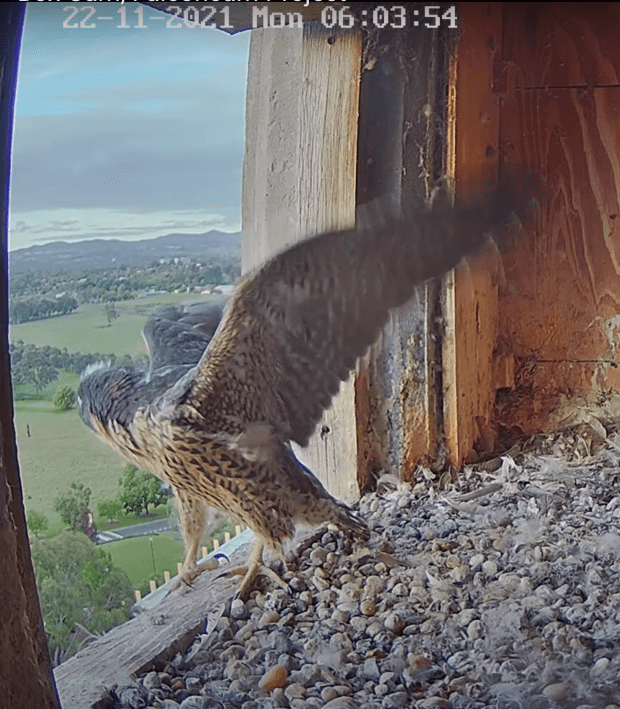
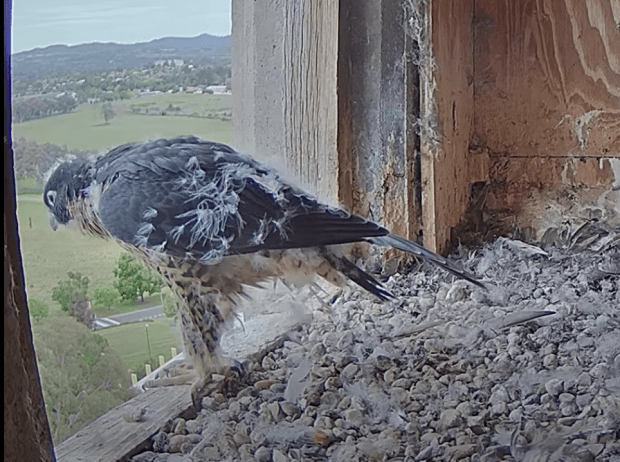
One nest I do love is the Charles Sturt Falcon cam. Girri is getting so big. She is waiting for breakfast to arrive and in it comes!
Dad was on the nest of the barge at Port Lincoln in South Australia. Hello, Dad! So nice to see you again.
Hawk Mountain has posted their migration chart for the week of December 9:
Look over those numbers. Some birds have really increased in numbers – like the Bald Eagle. Others have had a sharp decline (so far). We still have eagles in Manitoba. I continue to say that they know more about the changes in weather patterns than we do. It is going to be a very interesting winter.
A close encounter with a Buzzard. The following commentary, “Six feet away, the buzzard crouched, as though preparing to leave if I came any closer, and I wondered what kept her there. Was she weak with hunger? Or sick? Or reluctant to waste energy against the cold wind? What remains with me now is the intensity of her eye, glossy black in the light, how the buzzard’s gaze drilled into mine, as if the world were simply endless calculation.” reminds me of my encounter with a very large female Sharp-shinned/Cooper’s Hawk years ago in my garden. Looking deep into her eyes changed my life. I have not experienced anything so powerful since that cold winter’s morning in the garden. This is one of those lovely little Country diary articles of 350 words or fewer. Enjoy.
The RSPB describes Buzzards: “Now the most common and widespread UK bird of prey, the Buzzard is quite large with broad, rounded wings, and a short neck and tail. When gliding and soaring, it will often hold its wings in a shallow ‘V’ and the tail is fanned. Buzzards vary in colour from all dark brown to much paler variations, but all have dark wingtips and a finely-striped tail. Their mournful mewing call could be mistaken for a cat.”
“Key features to look out for:
Not to be confused with the Honey Buzzard, which is a rare summer visitor to the UK. They glide with their wings held flat, tilting their tail like a kite. Their wings are not held raised in a ‘V’. They are neatly barred underneath, with a prominent small head.
Usually brown, with white undersides to the wings, but their plumage is quite variable
Adults have an obvious dark tail band and dark trailing edges to their wings
Long, broad wings with prominent ‘fingers’
Buzzards tend to hold their wings in a raised ‘V’ when soaring, whereas Red Kites hold their wings flat, or slightly downcurved
Short tail, often fanned in flight, which lacks the distinctive fork of a Red Kite’s
Yellow beak, with a black tip
Yellow legs
Often sits with a hunched posture”.
In the UK, Buzzards are on the UK Green List meaning they are doing well and have no conservation concerns. I love them. They remind me of Red-tail Hawks despite the difference in their plumage.
Calico sends everyone some love.
Thank you so much for being with us today. Take care. We look forward to seeing you tomorrow.
Thank you to Heidi for carefully explaining what happened to her when she posted a few of her videos. At the time, I was so taken aback by the way she was treated that I stopped covering this nest, and despite how much I admire Pepe and Muhlady as parents, other nests will get my attention and donations. Thank you to Hawk Mountain for providing their detailed charts and to Amy Tan for her new book. Thanks, Gracie Shepherd, for the FB post about the second hatch at Superbeaks. Thanks to everyone connected with the Charles Sturt Falcon scrape – Cilla Kinross and to Holly Parsons for being such a great FB group moderator. Once again, I want to thank The Guardian for its articles on wildlife and the environment and OpenVerse for images that can be used on various social media platforms if citations are included.
It says Monday, but it is actually late Sunday night.
I hope each of you had a lovely weekend. We had snow and ice, and it wasn’t all that wonderful, but it warmed up today to 1°C, so some of that treacherous ice has melted. Thank goodness! The garden animals have been very busy, and on Saturday, there were so many European Starlings that it was completely impossible to count them. Oh, they are lovely birds. Our friend Geemeff was here to see them, and they noticed that our Blue Jays are much brighter in colour than those in the UK.
Heidi has sent me the most informative presentation on the issue of the ospreys in the Chesapeake. It is worth sharing with everyone who cares about the destiny of our fish hawks in that region.
Heidi writes: “This was a very informative presentation about the decline of ospreys around the Chesapeake Bay region. It includes some general osprey educational information, then at around the 49 minute mark, they start to talk more about the decline of ospreys, and specifically as it relates to industrial fishing of menhaden. It is a long video (2 hours), but I watched it in 15-20 minute increments over a couple of days.”
SK Hideaways Videos for the Week of 2 November 2025
All my videos stem from my love of raptors. My mission is to inform, educate, and entertain viewers. I have never and will never monetize my videos. They are purely a labor of love that give me great joy to share with anyone kind enough to view them. Much gratitude to Mary Ann Steggles for bringing my videos to you.
367 Collins St. Falcons, Mum F24, Dad M24, and 3 chicks
Morning Shenanigans More Vigorous & Daring. NEW ~ Louvre Perching (2025 Nov 7)
As fledge nears, the chicks are more active and even a little twitchy, especially first thing in the morning. Their wing exercises are more vigorous, their gutter stomping louder and bouncier, and all of this happening more often on the ledge. Today, one sister made it to the louvre ~ another milestone.
Chicks Take Self-Feeding Seriously ~ Give Mum the Boot (or Beak) (2025 Nov 7)
The chicks were all over mum F24 when she delivered breakfast a little later than they would have liked. They needed no help devouring every last morsel and then gave mum the heave-ho when she stopped by for leftovers.
SE36 FLEDGES✈️ Follows SE35 to Dad’s Perch🌲 and Back Again🎉 (2025 Nov 7)
SE36 had a beautiful fledge, flying to Dad’s perch tree to meet SE35, who flew moments before. The eaglets were frisky and lively all afternoon ~ seemed like they were planning SE36’s fledge along. After an exhausting day, the siblings pancaked in the nest overnight.
SE35 Leaves Nest for 2-Hour Exploration ~ SE36 Remains on Sentry Duty (2025 Nov 6)
SE35 took to the forest for a 2-hour exploration of the habitat. SE36 was content to keep an eye on things and simply look stunning. When SE35 returned, all was well between the eaglets and they simply got on with their day.
Gimbir Watches Diamond Feed Chick #1 from Cilla Stones 🥰 (2025 Nov 7)
Gimbir continued his on-the-job training after delivering one of many meals. While he typically flees after deliveries, this time he perched himself on the Cilla stones and watched Diamond feed his first born. It was one of the most heartwarming displays I’ve ever seen.
Gimbir Brings 3 Starlings in 9 Minutes ~ Chicks Gets First Meal (2025 Nov 6, 6:01-6:29)
Gimbir showed his paternal chops, delivering a significant bounty to the nest for the 17-hour-old chick and Diamond. His 9-minute hunt reaped 3 starlings. Wonder if Diamond was impressed as we were.
Gimbir Meets His Very First Chick ~ Moments of Puzzlement Ensues (2025 Nov 5)
Gimbir seemed somewhat perplexed to see a fluff ball where there used to be an egg. While he hasn’t yet learned the subtleties of fatherhood – or even the not-so-subtleties, he will do so in time. Here we look at his first two visits with his very first chick.
FIRST HATCH for Diamond & Gimbir ~ From Pip to Hatch in 7 HOURS (2025 Nov 5)
Diamond increased moving and shaking of the eggs as she likely detected a pip and heard at least one chick. Chick #1 was motivated to see the world! The video shows progress from pip to hatch over 7 hours
Shadow then Jackie Make Pre-Season Nest Visits🪹Rendezvous on Roost Tree🌲 (2025 Nov 3)
Adult visits to the Lookout Snag and Basement were gifts enough. But then, Shadow and then Jackie each visited the nest. Shadow brought 2 sticks with Jackie following a bit later to inspect the still messy nest. It’s pre-season time, so every visit is an extra special gift. The cherry on top was Jackie and Shadow’s rendezvous on the Roost Tree.
Cholyn & Chase Do Major Nestorations with Massive Sticks (2025 Nov 3)
Cholyn and Chase continue shoring up the rails of the original nest, bringing in massive branch after massive branch plus soft material from the fluff factory. Typical disagreements about what furniture should go where are quickly resolved. They depart the nest at the end of the video, flying away to their secret hideaway. Listen for the beautiful chortles.
It continues to be possible that the falcons Gimbir and Diamond at the Charles Sturt Falcon scrape in Orange will only have one eyas to care for and what a lucky little fluffy white ball this one is if that is the case!
This little one is seriously adorable.
Cilla Kinross wants to name this little cutie pie. Here is the information – please vote noting that you can select up to three names but no more or your vote will be discarded!
While the little one at Orange has not even had its beak change colour, the trio at Melbourne’s CBD falcon scrape at 367 Collins Street are preparing to fly. Almost all of the dandelions have disappeared and they are enjoying watching their parents fly through the CBD luring them into a life away from the scrape. Soon! Too soon, of course.
Every year we wring our hands with worry around the fledging of the sea eaglets at Sydney. It is the Currawongs. Despite those pesky birds attacking our fledglings, Lady and Dad are persisting in feeding the eaglets on the nest and today on the branches of nest tree – Ranger Judy Harrington says this is a great milestone. In all the years I have watched this nest, the adults only fed at the nest or down by the River Roost. No doubt these feedings will keep the fledglings strong, strong enough to beat those pesky birds so that they can learn to hunt from Lady and Dad and live a marvellous independent life – both of them. No more starving sea eaglets on the pavement by the Discovery Centre taken into care — let’s hope! So happy.
‘A’ sends us their commentary from Melbourne: “Dear Mary Ann,
I presume you have seen this footage, but in case you hadn’t, I thought I’d send it to you:
It’s almost as if the two eaglets following each other and appearing to play together is giving the younger sibling confidence. It certainly looks like that (okay, I’m anthropomorphising but you have to admit, it does appear that way.)
Let’s hope this year will be different. Certainly, the pre- and post-fledge behaviours have been somewhat different this year, and the confidence of both eaglets may be greater when it comes to insisting on their right to exist in that forest. I have a lot of confidence that this is going to be the year that the eaglets manage to thrive despite the currawongs. If they work to some extent as a team, they will surely have a better chance. Let’s hope my completely irrational belief is based on something real.
The three at Collins Street are such a noisy and energetic rabble that the parents just dump food and flee. Meanwhile at Orange, Gimbir continues to observe and learn. He still has not done a feeding but I’m sure he will try soon. Meanwhile, I believe I was right about the egg that hatched being the last one laid. Certainly, it was the one with the least colour. But whether or not I am right about that, I don’t think either of the two remaining eggs is going to hatch. At this stage, I have enough confidence in Gimbir’s hunting to have stop fearing a second or third hatch, but I don’t think we’re going to have one.”
M15 is undoubtedly a handsome eagle, and he is working hard with F23 to prepare their SW Florida nest for eggs. Mulhady and Pepe already have three at Central Florida – they always seem to be the first!
I have a soft spot for the NE Florida Bald Eagle nest of Gabby. Like so many of you, I adored Samson, but it appears that Beau is rising to the occasion, and let us hope that they have another fledgling this year! They are sure working on that nest.
Eagles at the US Steel nest.
They are working on the Decorah North nest in Iowa!
And at many other nests including Fraser Point on the Channel Islands.
There are ospreys visiting the Captiva Osprey nest on Sanibel Island! They came and went before I checked on the nest. The chat is very informative and Window to Wildlife has a daily log – the link to it is in the chat. This is a new osprey couple it appears.
Jack and Jill have been at the Achieva Credit Union nest in St Petersburg, Florida. Concerns persist regarding the structure, with worry that eggs and/or chicksmay fall through.
The environment remains on all of our minds. As much as we try to avoid plastic, it is almost impossible to do so. What a mess we have made of things! The Guardian brings us up to date on just one of the major disasters brought on by plastic.
Our local wildlie rehabilitation centre, Wildlife Haven is really busy. Lumi the rare lynx cub is now doing much better after refusing to eat. Now they have a Bald Eagle in their care.
Anyone reading my blog is aware of the dangers posed by lead to our beloved raptors. We must continue our fight to halt the production of lead ammunition, as well as lead in all types of fishing gear. Please raise your voice to ban this deadly substance any time you can.
How much do you know about Great Grey Owls? There are some lovely close ups of nestlings in this documentary by Our World.https://youtu.be/OVE3UzyvEIc?
From everyone in my family to yours, we hope you have a truly wonderful week. We look forward to you being with us again next Monday. Here are some recent photos of Toby and his sisters and a few of the garden animals that add so much joy to my life. Indeed, I cannot imagine a day without them despite all the work they create.
Toby is modelling his new turtleneck sweater. Toby is going to need a miniature closet soon.
Hugo Yugo looking beautiful in the golden light of sunset.
Baby Hope – the sweetest and most shy of the bunch.
The mysterious Missey.
Lovable Calico.
Mr Crow waiting his turn in line to get a peanut.
Brock trying to hurry and eat his roast chicken and ham before Toby finds out he is outside! As everyone knows, Brock is a true survivor. He has lived for five years outside on his own. He won’t come in the house and is very weary of being ‘trapped’ in fancy heated houses for winter. So, we simply love him, respect what life has thrown at him and what he is used to, and make sure he gets at least three large tins of food and fresh water every day.
One of five grey squirrels.
Do you know what the national bird of Canada is? Have a good read and celebrate the American Bird Conservancy’s Bird of the Week!!
Thank you to A, Heidi and SK Hideaways, to all the owners of the streaming cams that give us a glimpse – a great privilege – into the lives of our favourite raptors, to the authors of Facebook posts that keep us up to date on the nest happenings, and to papers such as The Guardian that continue to carry the environmental story. My blog would never be the same without their contributions. I am very grateful!
First, let’s head down to Port Lincoln in Australia. Falky’s reservation for the nest on the Port Lincoln Osprey barge included yesterday afternoon, evening, a bed for the night and the breakfast fish which arrived around 06:15. Ervie tried to steal it from Falky but failed so he got on the perch and was a little pouty! Poor Bazza doesn’t have a chance with these two.
Honestly, these birds are more entertaining than most things on the telly including the streaming movies!
Just look at Ervie all puffed up. He won’t even look at Falky. Too funny. We know that Ervie doesn’t remember the agreement, right? Spend the night on the nest and you get a free breakfish.
Ervie is very good at stealing fish. Falky gets a little nervous he is going to lose out so he moves over to the corner and eats his fish on the ropes. Ervie takes the nest.
Ervie is still on the nest. Falky is gone and Mum is on the ropes. All of the boys must be fishing themselves, too. It is, however, much easier to have Daddy Door dash!
I wonder who has the next reservation? Ervie looks like he thinks it is him.
Dr Cilla Kinross and Charles Sturt University in Orange just installed a cam that shows a view of the water tower where Xavier and Diamond hang out and where their scrape box is located. There have been a few storms and one yesterday. Cilla posted an image of lightning around the tower stating she was thrilled it has a lightning rod. Wow!
The storm is over and Diamond spent the night in the scrape box. Here she is in the morning. All is well.
There has been some chatter about the WRDC nest of Ron and Rita. Terry Carmen posted the announcement by the WRDC. Here it is.
While we mourn the little one, there is nothing at fault. The nest cup was narrow and deep – a great way to protect young eaglets from GHOW attacks. The other two, R1 and R2 are doing very well.
I had a question sent to me. Yes, Rita removed the chick from the bottom of the nest cup and placed it at 06:00 on the nest rim. Yes, she did feed R1 a bite and took a bite herself. The remainder of R3s body will become part of the nest if it is not moved or consumed completely. This practice is quite normal within the eagle species. I simply chose not to show what happened in graphic detail.
Both Ron and Rita have been undertaking some nestorations. Meanwhile, R1 and R2 are in food coma, sound asleep. They are doing great.
Now say awwwwww. Isn’t he handsome? Sharon Pollock posted this screen capture. I would say that Grinnell has fully recovered. He has a nice crop and his beak has grown back. But what really interests me is that yellow orange cere and legs. This is one healthy peregrine falcon! We love healthy. Glad to see you back in great shape, Grinnell.
I have not seen Daisy the Duck return to the Sea Eagles nest in the Sydney Olympic Forest since her visit a week ago with her mate. This is a good think! She is adorable and has brought a new interest in ducks to my life. I wish her and Mr Daisy well and I just hope that after I post this, they do not show up!
Thank you for joining me. Everything else is clicking along at all of the nests. Get ready for pips and hatches over the weekend! Take care.
Thank you to the following for their streaming cams or FB pages where I took my screen captures: Port Lincoln Osprey, WRDC Bald Eagle Cam, Sea Eagles@Birdlife Australia Discovery Centre Sydney Olympic Park, Cilla Kinross and Charles Sturt University Falcon Cam, Orange, Australia Peregrine Falcons FB, and Bald Eagles Live Nest Cams and News FB.
As many of you are aware, Yurruga has not been seen since last Thursday. Cilla Kinross saw him on the top of a building in the pitching down rain and later, university workers also saw Yurruga on the same building. Cilla sent me a short note this morning because I had written to her earlier about Yurruga’s 2nd right tail feather still being contained by the quill. The local vet did not think this was a problem but, like Cilla Kinross, was concerned about a lack of feather development on the little falcon. What impact this might have had will never be known. Cilla has looked and looked in all the places Yurruga might be and others but she is concerned and has posted a note that has been placed on the FB Page for the Orange Peregrine Falcons. I was very touched because she referred to Yurruga as a ‘poor little lamb.’ Every day is a test for our birds. Even the strongest have challenges. It is difficult enough for fledglings but compounded with unkind weather for numerous days, well. Yurruga should be flying around screaming at his parents for food and the conclusion is that he is no longer with us.
The parents, Xavier and Diamond, had an extremely long – fifteen minute or more – bonding session in the scrape yesterday morning at 05:15. This is simply not something that would normally happen with a fledgling needing prey and training. Considering the work of Marc Bekoff (Emotional Lives of Animals), Jane Goodall, the observations of Hob Osterlund with the Laysan Albatross, the bonding behaviour of Xavier and Diamond should be considered alongside grief. While we have only a limited view of the falcon’s behaviour, it might be assumed that the couple have now grieved for their wee one and are, with the weight of that loss, reconfirming their love and commitment to one another. We cannot do a brain scan on Diamond’s hippocampus (area of brain in human animals for emotion) to see if it lights up, Barbara J King in her book, How Animals Grieve, would tell you that the investment in the mating, the making of the egg, the care and incubation, the care and feeding after and training, she says that ‘grief comes from love loss.’ There have been roadside funerals of Crows, Ospreys who have mourned the loss of their chicks by predators. Other bird species and drowned themselves after the death of their mate. And, of course, all of you reading my blog, will know about Arnold and Amelia, the two Canada geese. Arnold and Amelia lived at the pond on the grounds of the clinic (fortunate for them!).* Arnold had one of its digits severed by a snapping turtle and required surgery. Amelia went to look for Arnold and watched through the glass, finally sharing a meal and a pen til Arnold was released.
So, today, we grieve with Xavier and Diamond over the loss of little Yurruga.
It was a beautiful morning when little Yurruga flew for the first time.Diamond and Yurruga bathed in the golden glow of the sun the morning Yurruga flew.Xavier feeding his baby.Xavier brings prey for Yurruga.Diamond and her baby.Xavier feeding Yurruga. Xavier loved getting a chance early on to feed his little one.
What an adorable little eyas. Fly high little one. Fly high.
I am so sorry to bring this terrible news to you. We join Xavier and Diamond, Cilla Kinross and the team at Orange in their mourning.
Thank you to Charles Sturt University and Cilla Kinross for the streaming cam where we get to share the joys and the sorrows – and where I took my screen shots of this lovely Peregrine Falcon family.
I say this because many do not consider the mate when one is taken into care. Arnold and Amelia were extremely lucky.
Our wildlife rehabilitation clinic has seen a 21% increase in patients in the last week. If you live in Manitoba and have the finances, send them a donation, however small or large. They receive no government funding. Everything is done on a donation basis – as is the case with most wildlife rehabilitation clinics. They have a long list of items they need on their website and all monetary donations are tax deductible.
I know that many of my readers live elsewhere but if this is happening here then perhaps it is happening all over.
There was a very sobering article on that cute little Korora (Tiny Blue Penguin) that is doing well in NZ. Its sibling died because the parents have to go so far to feed. For those that love those New Zealand birds such as the Royal Albatross at Taiaroa Head and wildlife that depend on the oceans to survive, what they are seeing is warming waters which mean the fish move or even die (like the trout did in Montana when the Clark Fork River got too water). It is time we demand that governments get serious and take radical steps to try and stop the situation from getting worse.
I want to remind everyone of Ferris Akel’s tours. You can go to YouTube, search for Ferris Akel, and hit the subscribe button to the live stream. He has lots of archived video tours as well. They normally take place on Saturdays at noon, Ithaca NY time. Ferris is out at Sapsucker Woods today for Thanksgiving and he has just found a beautiful juvenile Red-tail hawk that is hunting.
Notice the ‘eyebrow’ that helps to keep the glare away from its eyes when hunting. Oh, isn’t this a beautiful raptor?
Ferris just caught a Belted Kingfisher close to the RTH. There have been other birds this morning included Canada Geese and maybe another Kingfisher.
In the summer and fall, Ferris finds lots of shore birds and in the winter there will be owls! You can leave Ferris on like a radio if you are busy or you can watch as little or as much as you like. There is also a chat function with great people who can answer questions.
I am so thankful for Ferris Akel and his tours and his generosity in allowing us to share his images. I have learned so much from him over the years just wish I had a better ear to know which birds are out there by their beautiful voices.
Little Yurruga, the Peregrine Falcon fledgling at Orange, has been seen on top of a building so it is flying alright. Xavier and Diamond have been seen taking food in and out so she/he ? is being provided for. Isn’t this wonderful?!!!!!!
Below is the image that Dr Cilla Kinross took the day Yurruga fledged. She placed it in a tree. What a lovely little falcon you are, Yurruga.
This appeared on the FB Page of the Orange Peregrine Falcons today.
Have you ever wondered about the colour morphing of birds? The Audubon Society has a nice ‘Ask Ken’ article on that very topic! Thanks BM for letting me know!
The NZ DOC rangers at Taiaroa Head are deciding which Royal Albatross couple will be the Royal Cam family this year. There are 36 eggs and they believe that is all for this year. The favourite couple, WYL and BOK, who have made us so happy with their cuddles have not laid an egg – maybe next year! Will keep you posted!
It is a quiet day in Bird World and that is something to be very thankful for – no drama, nothing horrible happening.
Take care everyone. Have a marvellous day. To those having Thanksgiving, enjoy. See you soon.
Thank you to the following for their streaming cams where I took my screen captures or their FB pages: Cornell Bird Lab and NZ DOC, Ferris Akel Tours, Orange Peregrine Falcons FB page and the Cornell RTH FB Page.
Here is an image of WBSE 27 being released last week. It was determined by the scale lines in her toes that the bird was in fact, 27 not 28. So happy that ID was solved! The day the bird was released was the first day that the parents were not at their River Roost. I hope the three connect! There is a video of the release and it shows 27 as a really strong bird. I hope she thrives in the wild for eons. What a gorgeous bird.
The following was posted on the FB page of the Sea Eagles:
The Kakapo Recovery are doing their annual fundraiser. As many of you know, we started out the pandemic with 208 Kakapo in existence. There are now 202. Dedicated individuals do wellness check ups which mean they have to find these elusive non-flying parrots. The only way to do that is with a transmitter. The transmitters and batteries require check ups and replacements (batteries) on a regular basis. Medical treatment, etc. If urgent and life threatening, the bird is flown to Dunedin, NZ for veterinary care.
Many are considering doing one special gift on behalf of their family to help wildlife and the planet (as opposed to fast fashion that winds up stacked in the deserts of Africa). The Kakapo Recovery is hoping you might choose them.
Last year we adopted Rangi! He happily lives in the living room plants when he is not cuddling up with Pippa the Albatross or Big Red the Red-tailed Hawk!
It is something everyone needs to think about even if it is $5 to a streaming cam that you love. It can make all the difference. You can also adopt other types of birds. Last year there was a huge rush to help Aran and Mrs G at the Glaslyn Bywyd Gwyllt. You might recall that two horrific events came together in the perfect storm at Glaslyn. A heavy rain storm with cold temperatures hit the area when the chicks hatched and Aran got in a territorial fight and injured his wing and he could not fish. The community came together and provided a fish table for the family. Sadly the chicks did not survive but Mrs G and Aran did and Aran got his strength and migrated on time. To help that cause many went to the website and adopted Aran and his family.
You will have your own list as well. Other ways that you can help is to check with your local wildlife rehabilitation clinic. They often post a list of items that they need. You would be surprised but clean old towels are usually at the top of the list! So next time you are looking at a pile of towels and old sheets, think of your local clinic for wildlife! It doesn’t cost anything but getting the items there and often the clinics have volunteers that pick up for them.
Books for children and teens on how to help wildlife thrive are, of course, invaluable in building the next generation to care for our beloved birds.
Holly Parsons posted an update on Yurruga on the FB page for the Orange Australian Peregrine Falcon:
“Post from Cilla approx. 5pm 24 November:I haven’t seen Yurruga since I placed him in the tree, but I’m pretty sure he is still there as the parents have been coming and going with prey and giving me warning calls if I approach too close. I only check once a day and the foliage is really thick so hard to find him if he’s quiet.”
That is great news coming out of Orange! That is the kind of news I wish were coming out of Sydney with WBSE 27 – that the parents have been feeding it. Fingers crossed.
This is a short update. It is extremely quiet in Bird World now that the falcons and ospreys and WBSE in Australia have fledged. Eggs are happening in the Bald Eagles nests in the US and there will be lots of action around the holidays in December.
Take care everyone. Thank you for joining me.
Thank you to the following for their streaming cams or FB pages where I took my information: Orange Australian Peregrines FB, Kakapo Recovery FB, and Sydney Sea Eagle Cam.
It was a beautiful flight. Xavier was outside taunting Yurruga. Diamond was at her side. Then Diamond flew. Yurruga was watching everything. She took off like a pro with perfect form. It was a beautiful Monday morning in Orange, Australia. 06:03:55.
Diamond and Yurruga are watching Xavier. That beautiful golden glow of the morning sun touches the scrape.
Diamond is off!
Yurruga joins her parents flying around the water tower. It was brilliant. No fludge for this young man or lady.
She has perfect flying form.
Yurruga leans down and out she goes. Magnificent.
This is the view of Yurruga leaping out to chase her destiny from the ledge cam. Look at Yurruga go! Beautiful and strong legs.
Fly safe, Yurruga!
Diamond returns to the scrape box ledge. Her job is mostly over.
Diamond watches from the ledge cam. Xavier and Yurruga are flying by. Xavier will teach Yurruga to fly and hunt along with team teaching with Diamond.
Congratulations to Dr Cilla Kinross, the lead researcher on the Peregrine Falcon Project, to Diamond and Xavier bravo! You did an amazing job. May Yurruga bless you with children, grandchildren, and great-grandchildren!
Thank you to Charles Sturt University and Cilla Kinross for their streaming cam where I took my screen shots.
Yurruga is a Peregrine Falcon whose parents, Xavier and Diamond, have their scrape on the water tower at Charles Sturt University in Orange, Australia. Soon this beautiful fully feathered falcon will take its first flight out to that world that it is becoming increasingly interested in.
There are, according to Helen MacDonald in her book, Falcon, “60-odd species of the falcon family Falconidae…Those species are subdivided into four groups: the largely insectivorous hobbies, the tiny, bird-killing merlins, the kestrels and…the large falcons which are divided into two groups, the peregrines and the desert falcons.” The Falco Pereginus or the peregrines are fast flying hunters in the open air whose physical traits have developed over millions of years.
In the world of falconry, the female peregrine is called a falcon while the male is called a tiercel. In French, tiercel means a third indicating that the male is roughly 1/3 the size of the female.* This is called sexual dimorphism. Many also believe that the third hatch is always a male, a tiercel.
Yurruga has incredible vision. In The Peregrine by JA Baker, he says, “The eyes of a falcon peregrine weigh approximately one ounce each; they are larger and heavier than human eyes. If our eyes were in the same proportion to our bodies as the peregrine’s are to his, a twelve stone man would have eyes three inches across weighing four pounds.” * White goes on to say that the whole retina of a hawk’s eye records objects “twice as acute as that of the human retina…with a resolution eight times as great as ours.” Helen MacDonald states that while humans have one fovea and falcons have two enabling them to have two images of the same object fused in their brain.*** Humans have three receptors – red, green, and blue but falcons have four. We have three-dimensional colour vision, falcons can see four. In other words, these magnificent slate grey birds with their streaked chests, yellow cere and legs are far superior in their vision than we could ever wish to equal.
Southern falcons, such as Yurruga, are said to have significantly larger beaks than northern birds. Historically it was believed that these evolved for killing parrots. Researchers today are not quite sure of the discrepancy in size between the two geographical locations.
Peregrines also have a tomial tooth. This is a razor sharp point shaped like a triangle on the outer edges of the upper mandible that fits into a slot in the lower mandible. They use this tooth to bite into the neck of their prey to cut the vertebrae killing the bird instantly.
Sometimes Yurruga sits on the ledge of the scrape box with her mother, Diamond, looking out on the family’s territory.
Once Yurruga fledges, her parents, Diamond and Xavier, will teach her to hunt and will supply her with prey until she makes her very first kill. Yurruga will normally leave the parent’s territory after 4-6 weeks of training.
In the image below, you can clearly see Yarruga’s tomial tooth and her large eyes. She looks so much like a falcon today as opposed to a nestling. She is a gorgeous bird. Some viewers and chatters have gotten upset when Yurruga is aggressive with either Diamond or Xavier. Cilla Kinross said, “Shrinking violets won’t last long in the real world.” So true. Sadly, the survival rate of falcons in their first year is low. We know that Yurruga’s brother, Izzi, was thriving and we hope that she will, too.
One last observation. Diamond has been broody lately. She has incubated or fiddled with the eggs on numerous occasions. This could just be hormones or the physical eggs being there triggering Diamond. But, I wonder if she understands that ‘her baby’ will only be in the scrape a little while longer and she wants to ‘mother’?
In the middle of the night, Diamond was looking at her beautiful daughter.
As winter sets in, we are all looking for some good reads. There are many field guides that feature falcons but it is difficult cuddly up with a field guide. Looking at my bookshelf, I can see any number of them. If, however, you are looking for a really good read to understand the cultural history of falcons and their mythology, I highly recommend (and have done so many times) Helen MacDonald’s Falcon. MacDonald is an excellent and knowledgable writer that easily draws you into her respect and love for these birds. If you have exhausted the guides and have all three of MacDonald’s books, then there is another one. It is a small book illustrated by Welsh artist, Jackie Morris. She is incredibly talented. It is called Queen of the Sky and tells about the rescue, rehabilitation, and release of a peregrine falcon in Wales. An enjoyable read. Morris has a great website full of her wonderful animal stories and bird images.
There has been a real leap forward against animal cruelty. You may recall that several months ago, the home of Chris Packham in the New Forest had its gate burnt and a car set on fire. Packham has been leading the call for a banning of ‘the hunt’ on the grounds of animal cruelty. Today, trail hunting has been banned on all the land owned by Natural Resources in Wales. The amount of land is 362,456 acres or 146,681 hectares.
Trail hunting is supposed to involve dogs and hounds following scent without actually harming, chasing, injuring, or killing a fox. It has been proven that this is not always the case and Wales said that they did not have the resources to police the land for those who do not follow the law so they are not outlawing the practice altogether. Recently, Packham demonstrated that one of the riders was unusually cruel to her horse – an incident filmed that went viral. In October, the National Trust in England outlawed trail hunting on its properties as well. This is a great move forward in outlawing any cruelty to animals.
Speaking of cruelty to animals, Animal Nation, has called for people to stop using doves and pigeons at memorial ceremonies. The birds are released and die or if they are lucky wind up in a wonderful centre to receive care. They are not bred to live in the wild. Please tell your friends. No wonder it was so easy for Dad to catch that dove and take it to try and feed his #4 chick at 367 Collins Street in Melbourne.
The text was too long so that I had to take two captures. If you know of anyone considering memorial doves or pigeons, please talk to them, respectfully, about the implications to the birds. This is tragic. Thank you.
Whenever it looks a little dark, there is always someone or a group of people doing a really good thing for the birds and animals. A Place Called Hope posted images of the new osprey platform going up in Branford, Connecticut. A pair of Osprey nicknamed the Pretzel Pair had a poor location for a nest and annual failures. The community hopes that this brand new platform on a telephone pole will attract the couple and that there will be fledglings next summer. How thoughtful!
Photos @ Deanna Broderick on A Place for Hope FB Page
Wow. A lot can be done when a few dedicated people get together to help our birds. The platform on the pole will be lifted into place tomorrow. Fingers crossed the osprey couple find this to their liking!
It is raining in Port Lincoln. The three lads are wet. This might calm their adrenalin. Falkey is eating the latest fish delivered after Mum retrieved an earlier fish that Bazza got from Dad and that Ervie managed to take later. (They both ate). It felt like a lesson that Mum was teaching them when she swooped in and grabbed that fish. Sadly, it is time to toughen them up for the real world – which I hope is not so full of ospreys that they do not thrive.
Little Yurruga is very interested in what is going on outside and below the scrape. She has given viewers today more than a little scare. It was only a year yesterday that her big brother, Izzi, fell out of the scrape!
For some time now, Cilla Kinross, the main researcher at this scrape box, believed Yurruga to be a female. Now with the fluffy down falling away, Kinross now believes Yurruga is a male. She showed images of Yurruga next to Diamond and said she would expect Yurruga to be much bigger at 41 days and she isn’t.
Do we really care? I think everyone wants a lively, beautiful, and successful falcon – male or female!
I have seen no news on Grinnell or on the release of the WBSE fledgling in Sydney.
Take care everyone. Enjoy the end of the week. Thank you for stopping by.
Thank you to the Port Lincoln Osprey Project and the Charles Sturt University Falcon Cam and Cilla Kinross for their streaming cams. That is where I took my screen shots. I would also like to thank A Place Called Hope for the posting and images of the new osprey platform at Branford. That is where I took my information and images.