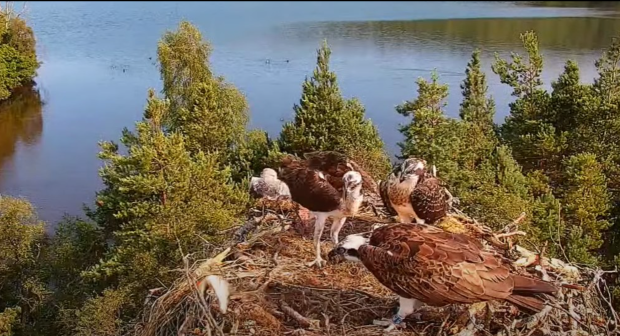
This will be a concise posting. Today my hair will be getting a makeover for the first time since November – or was it August of 2020?
There is great news. Tiny Little (aka Little Bob) on the Foulshaw Moss took her second flight at 13:34 on 21 August. Polly Turner caught the action:
Earlier, around 8:20, Tiny Little’s crop was concave, as it is in the picture above. White YW landed on the nest with a stick. Stayed a couple of seconds and flew to land on the top of the parent tree in the background. Tiny Little got antsy. You could just feel that she wanted to fly, too.
Congratulations, Tiny Little! Let’s get those wings to working hard before you have to start your migration.
Ferris Akel has posted the highlights for his 17 July tour. Here is that link:
In other Osprey news, Osprey House in Brisbane, Australia had their first hatch on 14:58 on 20 July and their second hatch at 7:05:54. That is only forty hours apart. Well done. There is no streaming cam, but they do have a FB page if you are interested.
Thank you for popping in and joining me. Have a wonderful day. I will be back with a full report of the nests early this evening.
Thank you to the Cumbrian Wildlife Trust and Foulshaw Moss Osprey Nest for their streaming cam, where I grabbed my screenshots.
When every fledgling is hungry and Mum brings in a fish:
This is currently the state at the Foulshaw Moss Osprey nest where the three fledglings are waiting on the nest for a fish drop and each one of them is food begging. Tiny Little has lost out today so let us hope that Blue 35 shows up and feeds him. The birds do not need to eat every day – a lesson that they will have to learn.
I have watched and watched but was away for a couple of hours. It is unclear if Tiny Little had any fish today. At 22:00 one of the big siblings was on the nest eating. At first Tiny Little food called to Mum but then he laid down like his cute duckling self and didn’t continue. The big sibling ate the entire fish, flew off, and then Blue 35 left also.
Nite Nite Tiny Little. Have some sweet fishy dreams – and if you are hungry tomorrow, let everyone know it.
The film, Brave New Wilderness, is only showing in New Zealand on Vimeo right now. It is about the recovery efforts going on for the Kakapo and the Takahe. Watch for when it will be released worldwide on Vimeo. Here is that trailer:
There are now only 202 Kakapo in the world. Kakapo parrots that cannot fly. They are loners. They rarely interact with one another. The only time that they come out of their ‘own space’ is during the summer and fall breeding season or you might find 2 to 4 gathered at a food dispenser on the island. Kakapo will only breed if there is lots of food and that food must be Rimu fruit. It is sometimes called Bush Tucker and is a group of Indigenous foods that grow wild.
This is Sinbad and he has been fitted with a very special transmitter by the Kakapo Recovery. This transmitter will not only will give Sinbad’s GPS but will also tell the researchers and staff of the recovery if Sinbad has mated.
Because of their solitary nature the Kakapo have to be fitted with transmitters so that they can get their health checks. It has made a huge difference in the population as any ill birds can be sent out for wildlife veterinary assistance.
Some people thought it was funny but right now it is such an effort to feed four people that Laddie, LM 12, losing a fish over the side of the nest on a delivery at 17:05 feels rather tragic. I know that Tiny Little would have liked to have been under that nest to catch that fish!
The storkling that fledged is back up on the nest with her other siblings. So everything is fine in Mlade Buky with the White Storks. Good news. So happy when the fledglings don’t get themselves into a spot of mischief.
It’s 5:54 at the Patuxent Osprey Nest 2 and Mom has a fish and there are three hungry chicks. The chick that fell into the water is doing fine. What a relief to have that little one back on the nest! One of the rescuers told my reader ‘L’ that they were fortunate because it was still low tide when they went to find the baby. Everyone is still so grateful!
I have to admit to almost having a mini-meltdown. One of the chicks was so well hidden behind mum that it looked like this nest had lost another one overboard. Thank goodness it was just the angle of the camera!
That is a short round up today. All of the UK Osprey nests are doing great. The fledglings are all flying and getting stronger save for our little one, Tiny Little. Her confidence is growing and no doubt by this time next week we will be wishing she was back being a duckling on the nest.
Thank you so much for joining me. So happy that you enjoy the birds! It is lovely to have you with us.
Thank you to the following for their streaming cams where I get my screen shots: Mlade Buky White Stork Cam, Scottish Wildlife Trust and Friends of Loch of the Lowes, Cumbria Wildlife Trust and Foulshaw Moss Osprey Nest, and the Patuxent Park Osprey Nest 2as well as the Kakapo Recovery FB Page and SF Bay Ospreys and Golden Gate Audubon for their video.
There are a number of Ospreys named Louis but the one that I am writing about today is the Louis of the Loch Arkaig Osprey Nest. His mate, Aila, did not return from migration this year and there is a new Mrs Louis. Her name is Dorcha. Louis chose not to make their nest on the one that he had shared with Aila. As a result, news of Louis and Dorcha comes from those who have access to see the nest. Today’s news is from the person who ringed the chicks. They report there are two healthy 4-5 week old nestlings. How grand. Louis is a fabulous dad – he even went fishing at night for Aila and the three chicks last year.
I am doing a bit of nest hopping. For whatever reason I am unable to access the Foulshaw Moss Osprey Nest. Others are having difficulties too but some seem to have some success. It is, of course, slightly frustrating because this is the nest of Tiny Little!
The eaglet on the Bucovina, Romanian Golden Eagle nest is hungry. Yesterday he only had a small bird and a bone. There seem to be days of bounty and then not much of anything on this nest. Is there enough prey? how far to the parents have to travel? are both parents still delivering food for the baby? For many this is the haunting memory of Spilve and Klints last year. The young Golden Eaglet cannot live on a little bird. Zenit is a beautiful bird and it will not be long til fledge. Let us all hope that Zenit gets a large prey drop today.
Zenit saw his reflection in the camera for the first time yesterday. It is so cute when they do this – the reactions to seeing another bird like them! Lady Hawk caught this precious interaction.
Wishes come true! I checked on Zenit just a minute ago and Zenit has an enormous crop! Looks like he swallowed a softball.
Scrolling back, Zenit’s mother came in to feed him. This was at 14:12. It also appears that a bird delivery was made around 17:00. It is not clear what the mother brought but as you can see above, Zenit has a very large crop and this is a good thing. It remains unclear to me how much prey there is in the area. Let us all hope it is good!
When the Royal Albatross chick was weighed on Tuesday (NZ time), she had dropped from 8.2 kg to 8.0. The rangers were monitoring Taiki’s weight and were considering whether or not she needed a supplementary feeding. Perhaps that won’t be necessary after today because her mother Lime-Green-Lime flew in for two feedings and her dad, Lime-Green-Black was there for one. Three feedings in a single day at 9:58 (LGL), 13:57 (LGK), and LGL arrives twenty minutes after LGK departed at 14:17. These were quick in and outs but it looked like Taiki got a lot of food.
LGL is so happy to see her daughter. Taiki would like her mum to dispense with all the formalities – the sky calls, the welcome – but LGL will insist. Her daughter needs to learn all of these and imprint them in her mind. Taiki will fledge in mid-September. She will not return to land for 4-6 years. At that time she will do a skycall just like Mum is doing now. Can you imagine being at sea and never stepping foot on land for that long?
Taiki is so excited to have a parent come in for breakfast.
LGK saunters in after Taiki has had her breakfast and is ready to feed her lunch at 13:57. It always looks like the adults have difficulty walking – and maybe they do if the chicks are digging holes and building play nests everywhere. Here comes dad!
It is so interesting that these little Albies stay put on their nest without moving about so much (at least at this stage). LGK does several sky calls but Taiki just wants food!
Taiki settles down to work on her play nest after LGK leaves and gets dirt all over her beak. It sure doesn’t matter. Look at how beautiful she is.
This is LGL’s second visit to feed her daughter. Taiki is so excited to see her again. I wonder if she told mum that she just missed dad? LGL does several skycalls when she greets her daughter.
The baby down is falling off and revealing a beautiful pattern on the back of Taiki.
LGL always looks like she is smiling.
Taiki must be about to pop after three big feedings! LGL must be fishing near to Taiaroa Head as she is returning so often. Taiki is lucky.
It was a golden morning on the Loch of the Lowes. No one was on the nest- they were all out flying and learning to fish. There are some trees around the nest that are apparently good perches for the birds. What a beautiful place. It looks so tranquil —- and safe for Ospreys.
It was just as beautiful at Mlady Buky in Czechoslovakia this morning. There is a mist, low lying clouds, or a fog hugging the mountains. The three storklings are on the nest. Everything is so quiet – you can almost hear the stillness.
Father Stork arrives at 6:19 with breakfast for the three almost fledging storklings.
The three continue to find small morsels on the nest after the frenzy when dad arrives.
The feeding gives them energy. The sun is up and they are warm and two are flapping madly on the nest.
The female is really covering the nest and moving her wings. She was getting some lift this morning as well. Father Stork and the people of Mlady Buky have done well. After the loss of the female, it has been simply a miracle to watch these three thrive. In a way, the people of the community stepped in and took over when supplementary feeding was necessary – just like the New Zealand Department of Conservation rangers.
Sadly, there is no one stepping in for Zenit if it is needed. I wonder if the people who operate the camera would consider setting up a food table if it were needed?
My goodness. Blue 022, the two year old who returned from his migration and stopped off at the Poole Harbour nest of CJ7, is so enthusiastic. He has been helping fix up the nest and has even provided fish for CJ7. He has also been seen ‘sky dancing’ on several occasions. This morning was no exception!
They make such a lovely couple. Oh, goodness. Everyone is already crossing their fingers and toes that these two return from their migration safely. The months will not pass quickly enough. Imagine – no chicks born in this area of England in 200 years! Incredible. There will be lots of celebrating!
Dylan and Seren are both on the nest at 7am watching and waiting for Only Bob to come and have some breakfast. He loves to go and fly often landing on the camera stand. It is so different when they fledge – at first babies always on the nest and hungry and then parents having to wait with food as they fly about.
Kindness is getting her legs stronger every day. She is standing straight and walking some on the nest. She is certainly growing fast – an advantage to being the only chick on the nest.
Kindness loves to do kissey-kissey with Mom. It is so funny watching these two.
At the Osprey nest on the Port Lincoln barge, Mom is on the nest and Dad was over on the ropes. Eggs arriving soon.
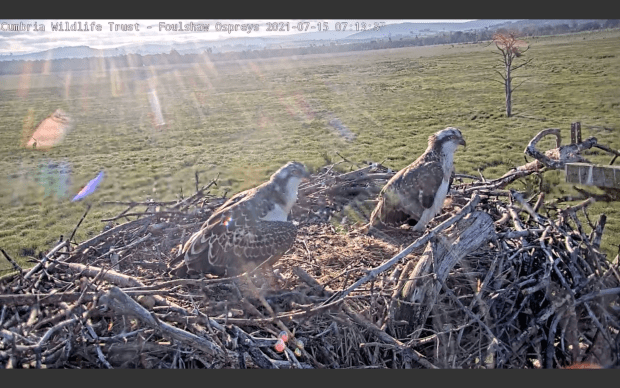
Oh, it is a bit like a bad joke. The camera at the Foulshaw Moss Osprey nest just started working. Both 462 and Tiny Little are on the nest. It is around 7am and they are watching for a parent to arrive with breakfast. Look at that nice necklace that Tiny Little has. Interesting. (TL is on the right) They are being kissed by diamond rain from the sun.
And when he wasn’t watching for a delivery, Tiny Little was flapping his wings dreaming of flying.
The more flapping he does the more the last tidbits of baby down disappear. It won’t be long Tiny but you were four days younger than everyone and you were behind in growth. You will get there just like Tiny Tot!
Hopefully that fish arrives! These two are both hungry. And it did. Tiny Little went over and ate some of the remaining fish and Blue 35 comes in and removes what is left (piece at the front) and will fly off with it.
The camera was still on the blink. I just checked and Tiny is fine. It is tea time and both Tiny and big sib are waiting for a delivery. It is so interesting that the big siblings know when to show up for food.
And last but never least, a lovely picture of Aran and Mrs G on the Glaslyn Nest together. This is a beautiful sight. There has been some bonding over the last few days. I was concerned that Aran was not in top form and Z2, Aeron, of the PC nest might want to take over this one. They are being kissed by golden raindrops, too! Mrs G doesn’t look like she is 21 years old, the oldest osprey in the United Kingdom. She is in really good shape. So sad that they lost their three chicks this year. That can cause issues but they seem to be a solid couple.
Thanks for joining me everyone. It is lovely to see the Golden Eaglet doing well today. That nest is a constant worry. And speaking of worry. The comments section on my blog seems to not be working all the time. It is like Tiny Little’s camera. Please feel free to send me an e-mail: maryannsteggles@icloud.com. I know that some of you had concerns and I regret that technology has caused you any worry. For the next while, til things step up in Australia, there may be only one blog per day. I hope to get more local Osprey news for you this coming week.
Thank you to the following for their streaming cams. This is where I grabbed my screen shots: Bucovina Golden Eagle Nest Cam, Cumbria Wildlife Trust and the Foulshaw Moss Osprey Nest, Cornell Bird Lab and NZ DOC, Mlady Buky, Port Lincoln Osprey Cam, Glacier Gardens Eagle Cam, Dyfi Osprey Project, Clywedog Opsrey Cam and Carnyx Wild, Byrwd Gwyllt Glaslyn, Poole Harbour Ospreys, and Scottish Wildlife Trust and Friends of Loch of the Lowes.
Whenever there are sad moments in Ospreyland, I find it is always comforting to head down and spend some time with Taiki, the Royal Cam Albatross in New Zealand. Taiki was 170 days old today and she weighed 8 kg. She was at 8.2 kg. Around this stage in their lives the weight of the chicks stabilizes – meaning they will not gain vast amounts of weight as they will be focusing on getting their wings strong for flight. If, however, the chick’s weight drops too much, the rangers will provide supplementary feedings. Taiki is right at that point where they are watching her.
Lady Hawk posted a video of Lime-Green-Lime, the mom, coming in to give Taiki a feeding. If you haven’t seen the adults feed their chicks, please have a look. Taiki will be making food callings and her bill will be clacking at the parent’s. That is to stimulate the feeding. Taiki was taught this when she was just a day old. How precious. LGL does beautiful sky calls.
Tiny Little spent his first night alone in that big Osprey nest at Foulshaw Moss in Cumbria. When asked if Tiny Little would be lonesome for his older siblings now that they have fledged, one person on FB said, ‘Not the way they treated him’. Yes, Tiny Little might not have survived but he did! And we are all so happy. Tiny Little was flapping his wings hard wanting to fly but it will be a few days more. Hopefully he won’t get too restless.
Both White YW and Blue 35 have been alarming and flying on and off the nest. This happened around 6:10 am.
Tiny Little did what he had been taught. Stay as still as you can and don’t move – keep your head down!
By 6: 19 the disturbance seemed to be over and Tiny was looking around hoping for a fish delivery.
There are advantages of being on the nest alone. Tiny Tot at Achieva was a pro at finding fish scraps. Look what Tiny Little finds around lunch time! You got it – an entire fish hidden in the nest!!!!
He looks around to check and see if anyone else is around and then he tucks in. He is still eating when Blue 462 lands in the nest two hours later.
Tiny Little is not showing 462 what he is mantling. Meanwhile 462 is pecking around the nest to see if there are any fish scraps left. Smart one Tiny Little!
What an absolutely tranquil scene at the Dyfi Osprey Nest in Wales. The cows are out in the fields and Dysynni was in the nest with his sister, Ystwyth, waiting for a breakfast delivery from dad, Idris.
It is a beautiful day up in Scotland at Loch of the Lowes and both fledglings, LR1 and LR2 are in the nest waiting for breakfast, too.
Those two are just beautiful. Well done Laddie LM12 and Blue NC0. Looks like they decided to pose and look at the camera instead of turning away. Thank you! You are both gorgeous fledglings!
The Rutland Manton Bay nest is growing grass after the Two Bobs fledged. Little birds have been around but seldom do we see any of the Ospreys —–until there is a fish drop and then everyone seems to show up.
Blue 33 shows up with a nice Bream and both 095 and 096 land simultaneously. 095 gets the fish in its talons.
You can see Blue 33 flying off leaving the two kids to sort the fish.
Blue 33 returns less than a minute later. Is he looking for Maya to feed the chicks? He leaves as quickly as he arrives.
Blue 095 is starting to eat the fish. No worries there will be plenty for 096.
Have a look back in time. Here are 095 ad 096 exactly two months ago tucking into a Bream. Just imagine. They are so tiny and now they are preparing themselves to migrate in about six weeks. Gosh they were cute!
It is now around noon in the UK. Only Bob, Blue 496 decided to take a flying spin around the Llyn Clywedog Nest straight to the trees where Dylan goes around 11:47. Yesterday, Only Bob flew to the camera post but today they are counting this as his official fledge! It was a great one, too. Mom, Seren 5F was on the nest with him watching her baby take those next steps.
Seren leaves and Only Bob moves over to the rim of the nest looking at his target. Those trees that he sees dad come out of.
And he’s off. If you look at the right side of the image you will see his two legs flying and heading for the trees! Gosh that must feel fantastic.
A couple of hours later, Seren has a nice fish on that nest trying to lure Only Bob over to have some lunch. It was really interesting watching Seren look at or for Only Bob. At times it sounded like she was talking to him – has slipped trying to land on the rim and is on a lower branch of the tree. Only Bob is 50 days old today.
What a great day in UK Ospreyland. Things are going really well. Aran was seen flying high over at Glaslyn today which is a good sign of an improvement. Hopefully he is not having to contend with intruders. Z2 actually landed on the Glaslyn nest the other day – his nest and chick are at the Pont Cresor nest which many consider to be close to Glaslyn. Sadly, one of the chicks on the Charlo Montana Osprey nest died because of bailing twine. If you don’t know, it is what farmers use to tie up large hay bails. So sad. Montana seems to be having a rather bad year with this twine winding up in the nests.
That is it for me today. Thank you for joining me to check in on all the babes. Take care. Enjoy your Tuesday wherever you are.
Thank you to the following for their streaming cams where I grabbed my screen shots and to Lady Hawk for her videos: Cumbria Wildlife Trust and the Foulshaw Moss Osprey Nest, Dyfi Osprey Project, Scottish Wildlife Trust and the Friends of the Loch of the Lowes, LRWT and the Rutland Manton Bay Osprey Nest, and Carnyx Wild and the Clywedog Osprey Nest.
Let’s start off with the fledges. Wow. They almost happened simultaneously.
Only Bob, Blue 496 at Clywedog, the son of Dylan and Seren fledged at 12:34:54 on 12 July.
And he’s off. He first flight was short but it was a fledge – he went to the camera pole. Congratulations Only Bob!
Dysynni, Blue 490, fledged from the Dyfi nest, the son of Idris and Telyn, at 12:26.
Gorgeous take off! Congratulations.
And now to the serious stuff for the day. It is wonderful to see the birds fledge but we need to take care of them afterwards.
If someone stopped you on the street and asked you to list all of the threats to the well being of our beloved Fish Hawks, what would you say? Think about this and jot down as many issues as you can. You can even use some historic examples because in parts of the world some of those could still be threats.
Methamphetamines. The Smithsonian Magazine picked up a story running in several newspapers about a week ago. That article focused on the minute amounts of meth amphetamine that were in the water and that the fish had gotten addicted. The diet of Ospreys is fish. How might this impact the adults and their chicks?
Fishing Equipment. Every year adults and chicks alike get tangled in monofilament fishing line. Without doing any research to find the latest examples, there was the incident of the dead Osprey near London, Ontario about a month ago and just a week ago Fortis Alberta was called to the Red Deer Osprey Nest to remove monofilament line around the only surviving chick on that nest. I am going to guess that anyone reading this will have several examples. Then there are the hooks. And hooks attached to monofilament line.
Non degradable Baling Twine. The banders who went to Warm Springs, Montana, found four chicks entangled in bailing twine. One had died. It took 20 minutes to remove the twine from another chick. The twine was so tightly wound that it had cut through the skin and had halted the chick’s circulation. As a result the chick was in pain and the leg was very swollen.
Copyright Montana Osprey Project
The impacts of climate change can include a long list of side effects. One of those is heavy winds that can tear down trees and nests.
The impacts of climate change can include a warming planet. Everyone witnessed the high temperatures that hit the Pacific Northwest (the US and Canada) recently (June 28). Heat kills Osprey chicks that cannot regulate their own temperature to survive. The heat also causes the fish to go to the bottom of the river or lake so that they are difficult to catch. This causes the birds to become dehydrated and die if there are not sufficient deliveries. You can probably name several nests where you witnessed chicks die due to the heat. Ospreys want open nests or platforms where they can see the environment around them. Because of this the nests are not shaded and the temperature on the nests can be higher than that reported. The sun bears down on the little ones and they die quickly. A good example is the Cowlitz chick. Electra went to get fish despite the fact that the chick had a crop. Temperatures were in excess of 40 degrees C. The mother was only gone from the nest for a few minutes when the chick began calling for her and died of heat stroke. Osprey chicks in British Columbia and in Alberta also suffered death from the high temperatures.
Decline in fish stock numbers due to pollution, high temperatures, and drought. The diet of Ospreys is 99% fish and if the fish numbers are low, the Osprey have nothing to eat.
Snowpack. Warming temperatures mean that there is less of a snowpack at the top of the mountains. The snowpack will melt faster causing flooding making it difficult for the Osprey males to catch fish when the chicks are hatching.
Mine waste and heavy metals. Eric Greene studies the toxic heavy metals in Montana from the old mining sites. He tests for these when Osprey chicks are banded. He has found 30% more arsenic in 2018 than he did when he began his study in 2006. Greene has also found very high mercury levels that result in egg mortality. The rate is up to 50%. Greene also found that the level of mercury in Osprey chicks blood is 100 times higher in the chicks than what is considered a problem for humans. Imagine. In other areas of the Clark Forks River, there is so much dioxins, furans, and PCBs that humans have been told not to eat the fish. The Osprey continue to eat the fish and feed it to their chicks. I do not know if you can open it but here is a report from Montana on the clean up and issues related to heavy metals in the Osprey:
Soil Remediation to remove the contaminants from the rivers causes a temporary decline in fish stock.
Egg collecting. In the late nineteenth century and early twentieth, the collection of Osprey eggs was very much ‘in vogue’. This caused the numbers of Osprey to decline significantly. There remain some egg thieves today. The eggs of Osprey were considered the most beautiful and were highly prized. A man in the United Kingdom, Mark Gonshaw, was convicted of illegally acquiring eggs of endangered species including eight Osprey eggs in 2011. He had more than 700 eggs in his possession and on 22 December 2011 he was sentenced to prison. You can read about this here: https://focusingonwildlife.com/news/british-egg-collector-sentenced-to-prison-term/
Vandalism. A good example is the instance when one or more persons came to the Lyn Brenig Osprey Platform where there was egg/s and cut down the platform with a chainsaw.
Shooting. This year it is known that at least two Ospreys were shot over Malta on their return flight from Africa to their breeding grounds in the United Kingdom and Europe.
Other Birds of Prey or Animals. Other birds and animals often predate the eggs or take the chicks out of the nest such as the attack on the nest by a Northern Goshawk in Latvia recently. Great Horned Owls are also problematic as are Ravens who love Osprey eggs.
Urban Development and loss of forest habitat.
Power Lines. Many power companies are now creating artificial platforms so that the birds are not electrocuted on the lines.
Pesticides. Ospreys were the first of the large raptors to warm about DDT. Today DDT still exists in the soil of some areas and causes reproductive and thinning of the egg shells.
Poor Water Quality. You might recall that there was an enormous spill of toxic material into the water near the Sarasota Osprey nests. Those toxins will spread with the flow of the water.
Hypothermia. Hypothermia is believed to be the cause of the deaths of the surviving two osprey chicks at the Urdaibai Biosphere in Spain.
Human disturbance. Ospreys are much more tolerant of humans than many of the other large birds of prey. Still humans can come near the nests and frighten the birds causing them to abandon their nests with eggs or chicks.
Avian Flu. The impact from this is not clear. I continue to research.
Competition within their own species for nests and territories.
You have probably thought of many more ways that these beloved birds are threatened. I would love to hear from you!
I will leave you with a couple of images of Tiny Little taken around 6:15 am Monday 12 July 2021 nest time. Tiny you are not looking so Tiny! No one needs to worry about you and that is fantastic.
Tiny Little seems to really be enjoying himself up on that perch instead of being on the soggy nest this morning. Look at those wings. Tiny Little has grown like a very bad weed in my flowerbed. Unbelievable! Maybe that bander is right and he will be the second to fledge! We wait. This afternoon, Little Bob was getting some bites in between Fledgling Bob, 464 being fed.
Thank you so much for joining me. Stay safe and take care. See you soon.
Thank you to the following for their streaming cam where I took my screen shots: The Cumbria Wildlife Trust and the Foulshaw Moss Osprey Nest, the Dyfi Osprey Project, and CarnyX Wildlife and the Clywedog Osprey Cam. I am grateful to the Montana Osprey Project FB site for the link to the recent report on threats to the Ospreys in their state and for the photo of the entangled Osprey chick which I took from their FB Page.
Today it not just about Ospreys. There have been some nests that have been overlooked lately so I am going to try and catch up on some of those for all of us.
I love how the wildlife rehabbers go to great lengths to make certain that the babies they rescue do not imprint on humans. Have a look at an eaglet that came into care and how it is being fed:
The female White Storkling at the nest in Mlady Buky, Czechoslovakia is ready to fledge! Look how beautiful she is with her wings spread. She looks like a dancer bowing to her audience. She was making all the right moves this morning. She began flapping her wings as the sun was rising and got very enthusiastic around 6am. She is restless and continues flapping and looking out to the world beyond the nest.
Father Stork comes in to feed the three youngsters. This generous community continues to provide supplementary food for Father Stork so that he and his three babies can survive. You can see, in the background, Father Stork eating from the fish table that is provided to him and his family. Sadly, their mother was killed on one of the electrical lines and these three are alive today because of this community. It is heart warming to see that the storklings are ready to fledge. Everyone can be so proud of their efforts!
The Bucovina Golden Eaglet, Zenit, grabbed the prey delivery from Mom and completely self-fed today for the first time. Zenit mantled and flapped all the while telling Mum to go away he could do this himself. Wow. Another milestone to independence. Lady Hawk caught this magical moment in a video:
There has been a lot of discussion about goshawks lately because they have raided and killed many Osprey both in Latvia and an eagle in Spain. There is a Crested Goshawk nest in a park in Taipei. The adults failed at their first breeding attempt and had one hatch on their second. The eaglet is three weeks old. So cute.
Crested goshawks live in Asia. Their territory is from the Indian subcontinent to Taiwan. In terms of its range and numbers it is of ‘least concern’. It is, however, a protected species in Hong Kong because of the encroachment on its forest environment. The hawks are now adapting to urban living. The Crested Goshawk is 30-46 cm in length or 12-16 inches. Like other raptors, there is reverse sex size diamorphism – the female is larger than the male. They feed on insects, birds, and mammals. The nest is normally made of sticks in a tree and most often the female will lay between two and three eggs.
The image below shows a Crested Goshawk Female. Look at that gorgeous plumage.
In size comparison, the Northern Goshawk that has caused issues related to the death of the Osprey chicks in Latvia and Spain is approximately twice the size of the Crested Goshawk. Each species has a long tail and shorter broad wings to help them speed around the forest area where they hunt. They are more adapt at living in the forest and often lure their prey into that environment.
Here is the mom in her nest with her eaglet.
The eaglet has been ringed with two official bands.
The eaglet will fledge in 2-3 weeks. You can watch this little one grow up here:
Now let’s check on some of those Ospreys!
Foulshaw Moss. Tiny Little is still moving in to get fed. I have seen some people worrying about him but, honestly, this little one is going to be grand. At tea time on Sunday, 464 was self-feeding. Self-feeding is hard work and the chicks spend a lot of time and energy fighting with the bones in the head. They get tired. So when 464 finished eating, Blue 35 took over and fed Tiny Little and Middle Bob.
In the image below, 464 is self-feeding. Mom, Blue 35, is waiting and it is Tiny Little stretching his wing. As we will all be saying, Tiny Little isn’t so Tiny anymore. And that is a good thing!
Blue 35 has taken over the feeding and, of course, Tiny Little is right there for the bites! Tiny Little and Middle Bob have always done well together. It is really good that 464, the big female, fledged first. It is hard to imagine but a couple of days ago Tiny Little looked like an extremely young chick. Now, unless the bands are visible and you follow the chicks it is hard to tell them apart. Now that is magnificent and it shows precisely what getting a good feeding means to these chicks.
Dyfi. Right now it is pitching down rain. Earlier it looked like Dysynni was hovering so high that he was going to fledge – but, he didn’t. Ystwyth is in awe! Dysynni is 52 days old today and Ystwyth is 48 days.
I imagine that Sir Richard Branson whose Virgin Galactic’s Unity Spaceplane took off from Spaceport America this morning successfully returning to Earth from space would really like to fly like a bird. Laura Culley, falconer and great mind, told me once that humans have the DNA for feathers and flight we just haven’t turned them on. Any geneticists out there to confirm that?
And then the rains came and Idris delivered a really nice fish that Telyn is feeding the nestlings. No more thoughts of fledging today!
Poole Harbour. Both CJ7 and Blue 022 were at the nest at Poole Harbour today. They continue bonding. There is at least a month or six weeks til they head off on their migration. Let us all hope that this lovely new couple return in late March or early April – both of them – and entertain us with their antics while raising chicks.
Clywedog. Oh, it is wet and miserable at this nest in Wales today. Only Bob looks pretty miserable.
Never fear. Dylan went out and got a nice perch for Only Bob’s (Blue 496) tea time treat. Seren is happily feeding her little one. Soon Only Bob is going to be thinking about fledging too.
Look at Dylan’s strong thin legs. The other day he flew 13 km to get a trout for his family’s dinner. Thanks John Williams for confirming that distance!
Loch of the Lowes. It is raining in Scotland, too. NC0 is on the nest feeding her nestling and her fledgling their tea time meal. NC0 has been flying with Fledgling Bob over the loch. It will be wonderful to see her spend time flying with both her babies once Second Bob has fledged. NC0 has become a very good mother. She struggled at the beginning with the feeding and many thought that Second Bob would not survive and perish like little third Bob. But, look at these two now. Fantastic. NC0 really came into her own. Laddie has done his part, too!
Are you interested in France’s plan for their Osprey and White Tailed Eagles? If so, Stephanie Scofield posted the French government’s document on the Ospreys (Pandion haliaetus) FB page. If you cannot read French, have a look anyway. The graphics are very helpful. Here is that report:
Thank you so much to the person who forwarded me an image of Z1, Tegid. I do not know who to credit for the image so thank you to that individual. I hope you do not mind my posting it today!
I am so grateful to my friend ‘T’ for telling me about this brave little osprey. As many of you know, I am setting about on a ten year plan to follow the osprey hatches that were beaten and battered and deprived of food but, who made it despite all the odds against them to fledge! I want to see how their lives unfold. Sadly, many like Tiny Tot on the Achieva Osprey nest are not ringed and most are not seen on camera. So my list is short. It includes Z1 Tegid, JJ7 Captain, Tiny Little Bob Blue 463, and Tiny Tot. If you know of others please alert me. You can leave me a comment or send the information through e-mail (maryannsteggles@icloud.com). It is much appreciated.
Here is Tegid. He has a nest with chicks for the second year in Snowdonia in Wales! Look at those strong little legs, too.
It is a soaring hot day on the Canadian prairies. The birds are really enjoying the water dishes and baths – they are keeping us busy filling them. I am taking a break from cleaning my tiny home office. It got stuffed with all manner of everything during the pandemic and now it is time to get that sorted. It is so nice, like now, to stop and check in on our friends with feathers!
Thank you so much for joining me and thank you for all the letters, comments, and pictures. I love hearing from you.
Thank you to the following for their streaming cams where I take my screen shots: Scottish Wildlife Trust and Friends of Loch of the Lowes, CarnyX Wildlife and Clywedog Ospreys, Dyfi Osprey Project, Poole Harbour Osprey Project, Cumbria Wildlife Trust and the Foulshaw Moss Osprey Nest, Crested Goshawk Nest Cam in Taipei, and the Mlady Buky White Stork Nest Cam.
It is raining this morning. The three juvenile Ospreys at the Foulshaw Moss Nest are drenched this morning. Blue 35 left a piece of fish on the nest. Wonder if she is watching for self-feeding action? And will she make certain that Little Tiny Bob is fed?
This amazing and uplifting story of how an entire village intervened when Mama Stork was electrocuted. They fed the chicks and Father Stork three times a day until Father Stork could look after the storklings on his own. Now just look at them! Just puts a smile on your face – it always does when help is allowed! At the Mlade Buky White Stork nest, fledging will occur in 1-2 weeks.
There is also good news coming out of the Fortis Alberta Red Deer Osprey Nest. It was originally feared that all three chicks would perish during the recent extreme heatwave hitting the area, along with a series of thunderstorms and torrential rain. But there is one surviving chick! It just feels like a miracle.
As we know, it can be tricky at this point in a chick’s life. Wet weather can also cause hypothermia. That is what was seen at the Urdaibai Biosphere Park Osprey’s nest that took the lives of the two seemingly healthy chicks. Keep sending warm wishes toward Red Deer for this sweet little one.
And poor Tiny Tot. She returned to the nest after dark, probably from all the loud fireworks! Wonder when the celebrations will shift to fireworks that do not make noise? Seriously, all of the animals suffer, not just the birds. Family pets are susceptible to loud booms. Tiny isn’t on the nest as I write this, been and gone. Tiny, I hope you are eating some fish where we can’t see you.
We continue to watch Elsa. Already the local weather reports for St Petersburg, Florida, are calling for rain most of the beginning of the week. I knew that Tiny Tot had one feeding, but one of my readers, ‘S,’ notes that he actually had two fish fairly close together late in the evening. That is fantastic! Thanks, Jack! Keep it up. The news this morning is that Elsa wants to make landfall in the Tampa Bay Area. A state of emergency has been declared in South Florida, and they are saying that it is the heavy rain that is the problem. Tiny Tot, Harriet, and M15 in Fort Myers, the Captiva Nest are all within the area that this storm seems intent on landing. Send warm, positive energy their way.
Thanks for joining me this morning. This is a concise report. I will be checking on the storm throughout the day and any other news in Bird World. Take care all.
Thank you to the following for their streaming cams where I took my screenshots: Achieva Osprey, Fortis Alberta, Mlady Burky, and Cumbria Wildlife.
The heat wave that hit the Pacific Northwest on the 28th of June continues to claim the lives of Ospreys. It is impossible to know the full extent of the impact because the vast majority of nests are not monitored. We now know for sure that two chicks at Clark PUD in Washington, 1 chick at Cowlitz PUD, 3 chicks at Osyoos, Exshaw lost 1 of 3 chicks, and all three at the Red Deer Nest in Alberta are unwell as I write and are not expected to survive. They are not eating. The little ones survived the heat to be hit with a torrential storm. Sadly I am not holding out much hope. The only raptor rescue in the interior of British Columbia has saved 26 raptors from perishing in a 24 hour period.
In a recent article, “The record-setting day when global heating surpassed COVID-19 as the existential crisis” in The Narwhal, Arno Kopecky came to the conclusion that the record breaking heat was not ready to take a downward curve because there are serious repercussions. The biggest one of those is wildfires. The town of Lytton hit a Canadian record for 47.5 degrees C. Then we watched that town burn to the ground.
There will be more wildfires – fires that rage and kill humans and animals and burn the trees that help cool the planet. Creeks and wells will continue to dry up. No water, no fish.
Kopecky mourns the lack of seriousness and understanding and says that it took this “extreme heat wave to galvanize public concern over climate change”. He believes that it is NOW – not in three months – but NOW when the heat is still killing that we, the people, must talk to our leaders and friends “about what a heat wave like this means, and what we’re willing to do about it.”
It is understood that the heating of the oceans will cause more hurricanes and storms. Right now sitting off the coast of Cuba is Elsa. That storm has its heart set on battering the west coast of Florida where there are many sea birds including our beloved, Tiny Tot.
This is the latest map showing the path that they believe Elsa will take. What happens around Cuba could change this trajectory.
For those of us worrying about Tiny Tot, the good news comes out of Wales at the beginning of June. How many of you watch the UK Osprey Nests? If you don’t, you should!
Wales was hit by a Force 11 wind storm that brought heavy rain. The wind was blowing at 75-78 mph. Mrs G, the oldest Osprey in the United States, was on the nest with her and Aran’s 2021 brood. Chicks were hatching as this storm raged. The chicks died but not because of the storm. Mrs G was soaked but she stayed on that nest! In an earlier storm that hit Wales, Monty, one of the most beloved Osprey males in Welsh history, went fishing during Storm Hector for his family.
So what I am saying is that many birds and nests will weather such a storm just fine. We are fortunate that there are no chicks on the Achieva Nest. Chicks have perished in such storms as evidenced by several weather systems that hit Martha’s Vineyard and region years ago. Imagine if this were the 10th of March?! The nest tower that the Achieva Credit Union built should have been designed to withstand a hurricane. Tiny Tot and Jack will hunker down. They may eat a lot more before the storm arrives to sustain themselves.
And now for some brief news from other nests. Electra has been on and off the nest at Cowlitz PUD. This morning around 6:30 ish, her and Wattsworth were both on the nest.
Mom and Dad both slept on the ropes last night at the Port Lincoln Osprey Nest in Australia. This is giving hope that the 2021 season is about to begin for these rare birds in Australia.
I was also very happy to see the official report on the ringing of the three ospreys on the Foulshaw Moss nest in Cumbria. There is some information to be corrected. The first hatch is a female and she is now Blue 462. Middle Bob is the one that they could not determine the sex. That bird is Blue 463. Tiny Little Bob – oh, bless you – is a male and is Blue 464. He weighed 1.6. I always believed that Tiny Little was a tiny little boy and that Big Bad Bob was a female. Thankfully it turned out that way! Someone had written, incorrectly and I picked up on it, that because Tiny Little was growing so fast it had been decided he was a female. Oh, dear.
Tiny Little is definitely growing! He still prefers not to lean on Big Bad Sister – and she is a big girl. There they are looking at something coming – White YW with a fish perhaps.
The two Rutland chicks, 095 and 096, of Maya and Blue 33 continue to practice their flying skills. They are doing great.
Flying certainly makes the little ones tired. It takes a lot of energy especially when they are learning. Both have had some good power naps.
Blue 33 makes sure that they are all fed. 095 and 096 take turns eating. Neither is out witting the other with the fish and the self-feeding. That is truly refreshing. Maya and Blue 33 rank up there as one of the power couples of UK Ospreys in terms of rearing chicks. There is never a shortage of food and Maya keeps good organization on the nest.
It is raining around the UK Osprey Nests right now. Earlier the two Bobs on the Loch of the Lowes Nest were enjoying a lovely dinner right in the middle of the drops. It is a bit too soggy to think about fledging right now but that day is coming. We will all need our worry beads!
Did you follow Louis and Aila on the Loch Arkaig Osprey Nest? If you did, I know that you are amongst tens of thousands sad because Aila did not return from her migration this year. Louis finally took another mate. They now have chicks on another nest, off camera. One devoted Osprey fan visited the area of the nest and was able to take photographs. I am sorry I cannot share them with you but what I can say is that Louis and Mrs Louis (that is what someone is calling her) have at least two healthy chicks on that nest! They are soooooo cute. There could be three. Mrs Louis would not move from her perch on the railing of the nest for the visitor to see further into the nest. I am so happy for this very devoted Osprey Dad.
Thank you for joining me and thank you to all that send me a note or make a comment. Let us all wish that Elsa gets slowed down before she gets to Florida. Take care everyone.
Thank you to the following for their streaming cams where I grab my screen shots: Achieva Credit Union, Scottish Wildlife Trust and Friends of Loch of the Lowes, Cumbria Wildlife Trust and Foulshaw Moss Osprey Nest, LRWT and Rutland Water Manton Bay Ospreys, and Port Lincoln Osprey.
I want to give a shout out to Fortis BC for helping the South Okanagan’s only birds of prey rescue centre, SORCO, retrieve two baby Ospreys from a nest in Penticton. People saw the babies hanging over the sides of the nest panting and looking very dehydrated. The parents were unable to feed them because of the extreme heat driving the fish to the bottom of the rivers and lakes.
The Osprey platforms are out in the open – in the direct sun – and the chicks took a real hit by the heat when temperatures in the area rose into the high 40s on Wednesday.
@ CastaNet News Kelowna@CastaNet News Kelowna
The babies are being fed and rehydrated. SORCO says they are doing well. They will be kept in care for approximately six weeks. SORCO says they have rescued 23 raptors during the extreme heat wave.
Elsa is now a hurricane and is expected to impact Florida and the region of the Osprey nests in St Petersburg early next week. The National Hurricane Centre is advising everyone to keep an eye on the hurricane as it now develops and what happens after it passes over the Antilles. You can follow the news here:
All of our eyes will be on that system now that it has strengthened from a Tropical Storm to a hurricane because of our beloved Tiny Tot at the Achieva Osprey Nest in St Petersburg. The hurricane is currently located over Barbados (the white circle in the purple area).
Electra did not spend the night perched on the Cowlitz PUD Osprey nest but she has returned sometime this morning before 7am nest time.
The female chick, Blue 095, at Rutland Manton Bay has fledged today, 2 July, one day after her brother, Blue 096. Here is that flight:
It is definitely getting harder, at first glance, to tell who is who on the Foulshaw Moss Nest in Cumbria where Tiny Little Tot lives on the nest of White YW and Blue 35. Indeed, Blue 35 is testing the kids self-feeding skills today!
The male claimed the fish that arrived and didn’t do a bad job with the self-feeding. Tiny Little was right there hoping he would share! or feed him!! I do hope Blue 35 feeds Tiny Little today and doesn’t just let the bigger ones grab all of the fish.
The last time I saw Tiny Tot on the Achieva Credit Union nest she was waiting for a fish delivery. K1 and K3 had been fed and were over together on the Rice Building. So all is well in Ithaca.
Take care everyone. That is our early morning nest round up for Friday, 2 July.
Thank you to the following for their streaming cams where I get my screen shots: Cumbrian Wildlife Trust and the Foulshaw Moss Osprey Cam and the Cowlitz PUD.
Featured image is FortisBC and SORCO going up to rescue osprey chicks in Penticton.
It’s late on 1 July, Canada Day and by the time I finish writing this it will be 2 July. The week has been wrought with extreme heat and now a wildfire in British Columbia has left the citizens of Lytton with only 15 minutes to evacuate. My friends in the Kootenays tell me that this is just the beginning of a long, hot hard summer. Our thoughts go out to everything – non-humans and humans alike.
I had a question from a reader and I want to answer it here because everyone might be wondering, too. The question: Do female Ospreys always rely on the male Osprey to bring them fish even when they are not taking care of chicks or incubating? The answer is that it varies by female. Some female Ospreys do not fish at all and rely on their partner completely for their food and the food for the chicks. Those female Ospreys never fish. Some go fishing once their chicks are older. This past week we have seen NC0 on the Loch of the Lowes Nest go fishing. Indeed, in a short part of one day, she went out four times. She brought fish to the nest and ate them herself and fed some to the Bobs. Mrs G is known to be a formidable fisher. She is known for catching whoppers! Maybe she is in competition with Idris from the Dyfi Nest. Mrs G relies on Aran when she is incubating the eggs and brooding the chicks to supply the fish. Otherwise she likes fishing herself. Right now the couple are bonding after Aran’s injury and the traumatic death of their chicks, so she is enjoying Aran delivering some fish to her and likewise, he is happy that Mrs G is accepting his gift. That said, she caught a big one this afternoon and sure didn’t share it with Aran!
Mary Kerr did a short video clip of the historic moment when Aran delivered Mrs G the first fish after his injury:
As I write there is a severe thunderstorm warning for Missoula, Montana where Iris, the oldest Osprey in the world has her nest. They are expecting torrential rainfall, heavy winds in excess of 45 mph which is higher than what is forecast when Tropical Storm Elsa hits Florida. The system in Montana is moving NW at 10 mph.
I just checked and the skies are getting dark in Missoula and there is a little wind. Iris is not on her nest but she was there this morning. This is the scene at 21:33 at the nest:
This is Iris this morning. How many times can you say gorgeous?
Send positive thoughts out to everyone in the area of this system as well as our beloved Iris. There are many other Osprey nests in the area, too.
It is now 23:30 at the site of Iris’s nest and all is well. Let us hope it stays that way during the night.
Several days ago I announced the ringing of the three chicks on the Foulshaw Moss Osprey Nest of White YW and Blue 35. This is the nest of Tiny Little, Middle Bob, and Great Big Bob. Many did not believe that Tiny Little would survive but being clever and determined like Tiny Tot on the Achieva Credit Union nest in St Petersburg, Florida, Tiny Little did well. Of course, he won all of our hearts. As it happens, Tiny Little is now a very special chick in the history of Cumbrian Ospreys. Tiny Little got the honour of being the 100th chick ringed since 2001. Well done, Tiny Little!
There is their official portrait posted on the Cumbrian Wildlife Trust FB. Just look at the difference in size between Tiny Little and Great Big Bob. I would be afraid of that monstrous sister if I were Tiny Little. But, being clever, Tiny Little figured out how to manage rather well.
Blue 462 weighed 1.6 kg and is a female, Blue 463 weighed 1.5 kg, and the gender is unknown, and Tiny Little is Blue 464, the 100th chick ringed, andis a male weighing 1.6 kg.
@Cumbrian Wildlife Trust
The oldest chick, the male, on Rutland Water’s Manton Bay Nest fledged at 12:12pm today. Someone on site, later in the day, sent word out that 096 was sitting on the camera perch while Maya and the female, 095 were on the nest. Blue 33 had just brought in a nice fish.
By the time I went to check on them, 096 was on the nest and 095, the female, was flapping and hopping. Looks like she will fledge shortly!
I also checked in to see if Electra was on the Cowlitz PUD Osprey Nest and she wasn’t. The wind is picking up a bit and it is only 18 degrees C. So much cooler than the heat that killed her last chick.
Tiny Tot is sleeping up on the perch. There is a 40% chance of a thunderstorm in the St Petersburg, Florida area. However, other models showing the rain moving NE did not indicate any systems coming near Tiny’s nest. I never know whether to trust the weather maps or not. With all the technology they should be spot on but, sometimes they aren’t!
I took some images of Tiny Tot during the day thinking that it might be the last time to see her. I sincerely hope that is not the case. Indeed, I hope that she stays around like Izzi, the juvenile Peregrine Falcon son of Xavier and Diamond, in Australia. She could give Jack and Diane a hand. It wouldn’t be the first time a juvenile stayed home and helped.
Tiny is incredibly beautiful, even when she is mantling because of an intruder. There is an intenseness about her.
Tiny’s plumage is beginning to change slightly on her body. Look at the necklace that is getting darker. Remember the white ‘V’ on the head. She will always have that and the white making a heart along with the very symmetrical espresso lines from her gorgeous eyes going to the back of her head.
She is even lovely when she is squawking at intruders! Go Tiny! Let them have it.
Tiny will be really anxious for Jack to deliver a fish in the morning as she went to sleep without her regular evening dinner. She won’t starve. The raptors often go for a day or more without prey. Still, for all the efforts today – even with Jack coming to help with the intruder – Tiny needs her fish payment for doing security duty! Don’t you think?
Little Kindness is truly a sweetheart. Here she is sitting with Mom on the nest in Glacier Gardens late in the afternoon on 1 July. Just precious!
Kindness with her Mom, Liberty. 1 July 2021
There are several things that people look for when they try to determine the gender of a Bald Eaglet. One is the size of the feet and the second is how far the back of the mouth goes in relation to the back of the eye. The farther back that yellow line extends and the bigger the feet indicate a female. Kindness has very large feet. Just look at them! And that yellow line of her mouth goes far back. By this method, that would indicate that she is a girl. Of course, nothing but a DNA test or seeing an eagle lay an egg is 100%. I wonder if they plan to ring Kindness? Must ask! And I did ask and got an answer quickly. It appears there are no plans to ring little Kindness. I could give them ten good reasons to ring this eaglet. I wonder why ringing and keeping data on the birds is not as ingrained in North America like it is in the United Kingdom and Europe?
The three white storklets remain on their nest in Mlady Buky, Czechoslovakia. They are growing and growing and now are as large as Father Stork.
It is time to say goodnight to all of the birds and to you. But before I do, I want to leave you with a video that Lady Hawk posted today. It is the Golden Eaglet in the Bucovina, Romania Nest. The mother brought in the 6th roe deer today and the baby ate it all! That eaglet looks like it will explode. Enjoy!
Thank you to the following for their streaming cams where I get my screen shots: Achieva Credit Union, Cowlitz PUD, Glacier Gardens Bald Eagle Nest, LRWT and Monton Bay Ospreys, Rutland Water, Cornell Bird Lab and Montana Osprey Project, and the Cumbrian Wildlife Trust.Thank you Lady Hawk for doing your videos!