Eggs, Electrocutions, Migrations and more…Tuesday in Bird World

30 August 2022

Good Morning Everyone,

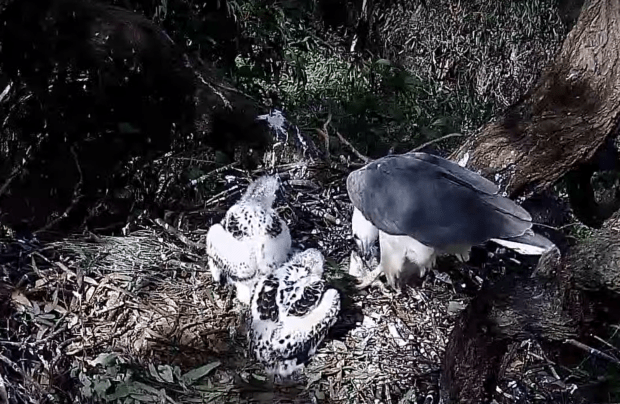
We are nearing the end of August. I keep saying the month has disappeared and it surely has! It is simply hard to believe. We had a magnificent rain that brought the garden back to life. There is nothing like a good soaking – watering from the tap doesn’t seem to do it. The garden also had a visitor this morning. I know the hawk has been around but, with all of the foliage it is hard to spot him. The new fence has, however, attracted a lot of attention and today it got approved to be the new plucking post! The image is not good. I got so excited that I hit the silly video button on the phone and not the photo. It is also from a distance through a screen -I was hiding in the shadows hoping that she would not see me inside the house taking her photo – hawks have to eat, too.

By now you will have noticed that I have added some sub-titles to my blog. There will not always be questions in the post to answer – that is up to you! But if you are wondering something, ask. I will absolutely not always know the answers but I have friends and colleagues to ask that do and they are happy to share what they know with all of us. There is generally some news and there are always things happening at the nests despite it being quite slow the end of August. I hope also to incorporate a book review section once in awhile —- when there is time to read a new book. I am currently working on two: Birds. A Complete Guide to their Biology and Behaviour. It is excellent so far – a great reference that includes topics such as Anatomy and Physiology, Flight, Food and Feeding, Breeding… The second is After They’re Gone. Extinctions Past, Present and Future by Peter Marren who tackles some of the very uncomfortable truths that we have to face. It is time, after all, to get our heads out of the sand and listen to what individuals like Marren have to tell us. Full review to follow in a few weeks when I have had time to digest and reflect the latter.

In the Mailbox:

‘B’ writes: “I have been watching Osprey nests for years. Why do the siblings attack one another after fledging when they have been nice on the nest?” Oh, this is such a timely question as the nests begin to empty themselves of parents and fledglings in the Northern Hemisphere.

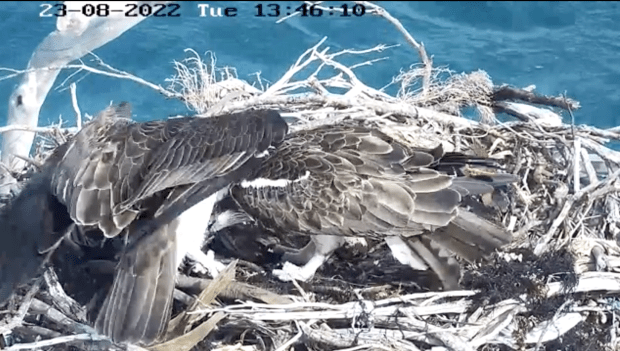
Some of you will remember that the three osplets on the Port Lincoln Osprey barge in 2021 – Bazza, Falky, and Ervie – were sweet to one another as nestlings. Bazza tried a couple of times, early on, to boss Ervie but, even as little as he was, Ervie wasn’t having any of it. So the nest was very peaceful. Then they grew up. They fledged and even became interested in fishing. When Dad would bring a fish, they would descend on the nest and fight – or, rather, let’s use the Australian term, “a dust up” would occur. If you are watching the Dyfi nest of Idris and Telyn, two of the three girls remain in Wales. Whenever a fish comes on the nest, they practically knock each other about to get to that food. This is perfectly normal behaviour. They no longer see one another as siblings but as rivals who might take the only food supply. Soon, they will go their separate ways and no would have been hurt-normally -although Bazza and Ervie did get pretty rough. Please note that the PLO nest had 3 males and the Dyfi had 3 females – same gender on the nest. Same sex nests tend to be very civil after a brief set to at the beginning.

‘S’ sent me some news and included in it is a video/PowerPoint on what to expect at the Royal Albatross Taiaroa Head Colony in September. I know that many of you are fans of the albatross and watch Quarry Track chick, this year’s Royal cam chick, faithfully. I do not cover her but I look in on her. Sharon Dunne does an excellent job of providing all the information needed! This is a great information packet – have a peek. Thanks, ‘S’.

Making the News:

Drought and hydro poles killing off Europe’s White Storks. Only 10% of the hydro poles in Hungary are insulated and yet 150,000 beautiful White Storks are electrocuted each year. This well done video shows the birds, where they live, the deaths, and the fix that is required. It is now time for humans to step up to the plate and take care of the wildlife instead of doing what we have always done — put ourselves first.

And, of course, Hungary is not the only country that has this issue. We saw it in Canada when Junior was killed near the nest on Gabriola Island, in The Czech Republic, and elsewhere.

https://www.bbc.com/news/av/world-europe-62690344

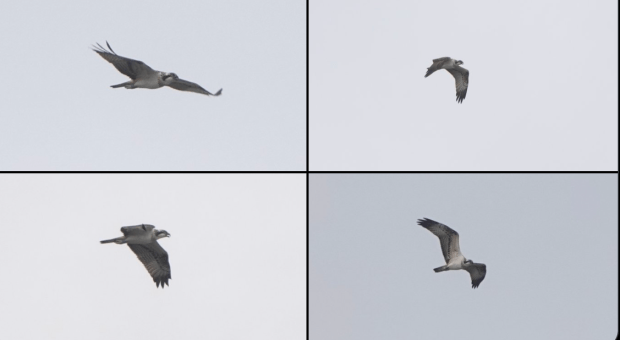
A Polish Photographer has been stirring up real interest on the Internet with his image of an Osprey fishing. His name is Krzysztof Stasiaczek and the image was taken in August 2022 in Eastern Masuri, Poland.

Hancock Wildlife Foundation in British Columbia used their GoFund Me and some other private donations to build a new sun-shaded nest for Ma and Dad at Delta 2. Why? Rising temperatures in the area of the nest due to the increased heating of our planet. They released the images today. That is David Hancock with the light blue long sleeve shirt working tirelessly to continually improve the lives of the Bald Eagles…he has been doing this for at least 65 years!

Somehow we all knew that the numbers of Bald Eagles on the Channel Islands is growing – thanks in large part to Dr Sharpe ensuring the eaglets do not tumble into the sea or die under a nest from zinc toxicity.

News is coming out of the Channel Islands Eagle Lovers group that there is the possibility of a new Bald Eagle pair spotted on Santa Cruz! Sauces 2016 hatch A-63, a male named Whisk, has been seen at the old Fraser Point nest with a subadult female of approximately 3 years. Fingers crossed.

A blog by Rosie Shields who monitors the Borders nests in the UK found its way into my inbox today. You might not be interested in these Ospreys but, it is the behaviour of the female that is important. She left a nest with three chicks she was feeding to begin her migration, landed on a nest she had visited before, and sat herself down now for 9 days being fed by the resident male who is willingly catching fish for her. It is always good to learn more and more about the behaviours of Ospreys – they never cease to surprise and amaze me.

Nest News:

Annie and Alden decided it was a good idea to renew their bond in the UC-Berkeley scrape on The Campanile after the sudden visit of a mysterious male falcon. Alden initiated the bonding session. “Annie, do not look at another male falcon. Alden is a keeper!”

Alden was caught loafing in the setting sun last evening. How adorable.

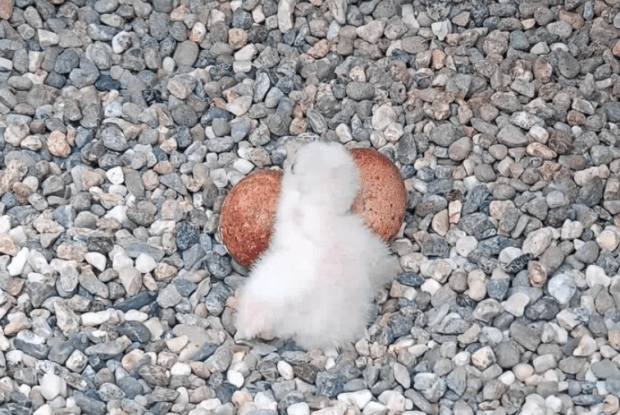
Everyone is sitting waiting really impatiently to see if Diamond will lay a third egg at the Charles Sturt Orange Falcon cam in Australia. Diamond’s average between eggs is 56 hours. The second egg was 57 hours this year. Will there be a third? and will it be on time?

Xavier loves his ‘eggie’ time and Diamond was obliging this morning to let him take a turn.

Xavier left and returned around 0700 with a Horsfield’s Bronze-Cuckoo (IDed by Holly Parsons). Xavier always brings something special on egg laying day. What a sweetheart.

Xavier waits for one and a half hours to incubate those precious eggs…it is caught on video.

Diamond looks pretty contented. Let’s see what is happening in a couple of hours.

There are still only 2 eggs at Orange. It is the middle of the night. If Diamond is to lay a third egg I would surely think that it will come before 0800 on the 31st.

In Melbourne, the little Dad is getting his turn, too and those four eggs look awfully big as he wiggles and squiggles to get them under him. Yesterday he looked down and noticed one was outside!

You can almost hear him saying he hopes the new mate doesn’t lay 5! She could. Keep hoping the population of pigeons is bursting at the seams in Melbourne!

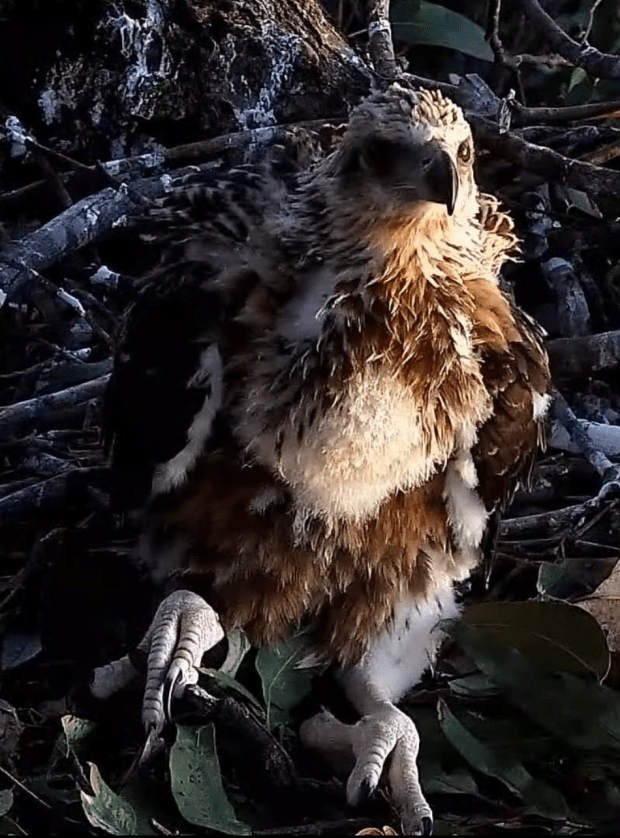
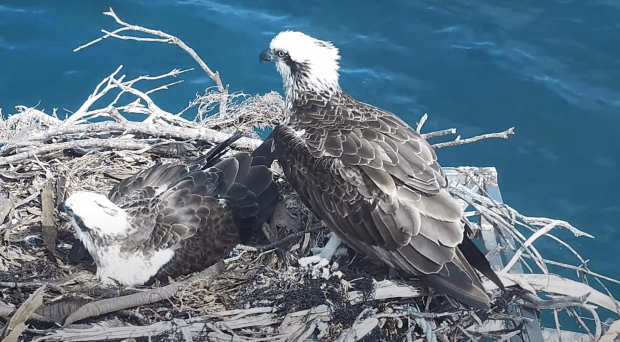
Everything seems to be going well with the Sea Eagles. They are six weeks old and standing sturdier by the day and changing their appearance with those gorgeous feathers coming in.

At Port Lincoln, Dad took over incubation and Mum is enjoying a really nice dinner time fish before tucking it in for the night.

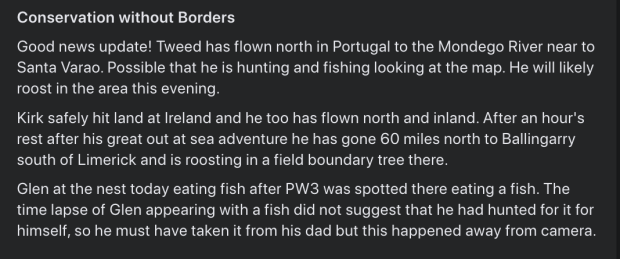
Updates on Tweed’s three fledglings from yesterday’s post.

A Tweet from County Cork with a great photograph of an osprey believed to be Kirk. Fantastic. He has had quite the adventure. Glad Kirk is safely on land. Now to get his GPS coordinates polished.

In the UK, Louis and Sarafina are still at Loch Arkaig. Dorcha was last seen on 18 August and it appears that Willow, LW5, began her journey on the 28th of August.

Louis delivered a lovely Mackerel to the nest for Sarafina today. She has been seen down at the loch attempting to catch a fish, too. Isn’t that splendid?

Louis brought a lovely fish to Sarafina at 16:16:33 on the 30th. She is still with us as of today.

The last sighting of Willow was on the 28th.

Maya is still at the Rutland Manton Bay Osprey platform. She flew in with a fantastic fish this morning at 0619. While many of the females have now departed, Maya raised three very large and strong female chicks with Blue 33. She is taking good care of herself so she is in good shape for migration. Normally we can expect to see her and her mate, Blue 33, back in the UK at the end of March. The first eggs and the first hatches!

Seren, Blue 5F, was with Dylan this morning at the Llyn Clywedog nest looking around their beautiful territory.

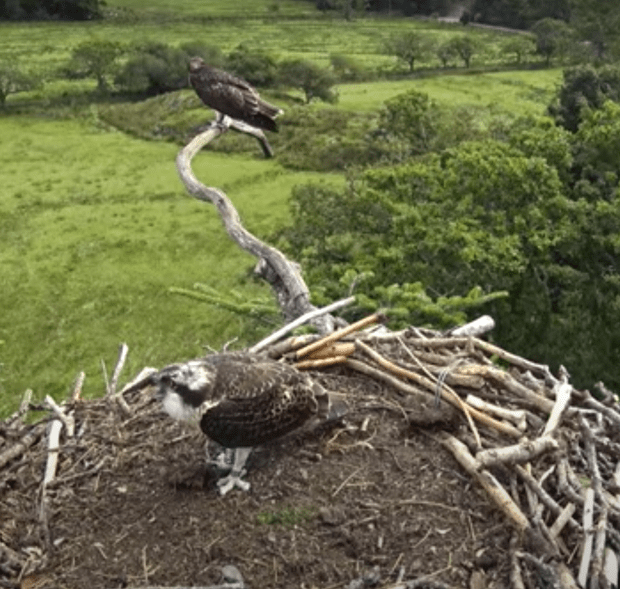
It appears that Mrs G from the Glaslyn Valley nest is now on her way south. Aran was on the nest earlier and one of the fledglings was shouting out for a fish.

At the Dyfi Nest, Telyn was last seen on the 25th of August. Pedran left before Mum, and Padarn was still at the nest today. Paith has not been seen on the 30th that I am aware of so it could just be the second hatch, Padarn, and Aran left at Dyfi.

Stephen Basly posted another great image on the Notre Dame Eagles FB Group of our Little Bit 17! It was the 25th of July and is such a great image. I think Stephen worked to get it cleaned up well for all of us. Thanks Stephen!

I have not been able to access Looduskalender today for updates on the Black Storks, Karl II and his family, as they migrate.

Thank you so much for joining me today. It is a gorgeous day here – I hope it is for you, too and that you have been able to enjoy being out in nature, if possible. Take care of yourself. See you soon!

Thank you to the following for their tweets, videos, streaming cams, and blogs that make up my screen captures: NZ DOC, BBC News, Krzysztof Stasiazek, Hancock Wildlife Foundation, CIEL Rosie Shields, Cal Falcons, Charles Sturt Falcon Cam, 367 Collins Street by Mirvac, Sea Eagles@Birdlife Australia Discovery Centre Sydney Olympic Park, Port Lincoln Ospreys, Conservation without Borders, Dave McGrath, Friends of Loch Arkaig and the Woodland Trust, LRWT, CarnyXWild, Bywyd Gwylld Glaslyn, Dyfi Ospreys, and Notre Dame Eagles.

Ervie goes fishing, Egg 2 for Diamond and Xavier and more…Sunday morning in Bird World

28 August 2022

Good Morning Everyone. I hope that each of you had a lovely Saturday. Thank you so much for joining me today!

From the Mailbox:

‘A’ asks: What is the average time difference or gap for Peregrine Falcons to lay their eggs? Diamond looks like she is ready today. Thank you, ‘A’. That is a very timely question as we sit staring at Diamond’s bottom for her tail feathers to begin to go up and down when she is in labour. In the nest notes that Cilla Kinross, the researcher at the Orange Falcon cam compiled, it says that the average time difference is 56 hours. As I write this, the time in Orange is 13:21 on Saturday. That egg is due anytime.

‘L’ asks: What is the purpose of molting? The feathers of our bird friends get damaged just like our clothes from normal living. They break and get tears. Moulting is the annual replacement of the feathers. In fact, think about it. Feathers are so important to birds – they keep them warm and dry and, of course, are needed for flying. They should be in tip top shape which is why birds spend so much time preening. Some birds begin to moult in the spring. Others wait until nesting has finished. Moulting is really hard on the birds and it is normally done when there is an unusually high level of prey so they can keep their energy up.

‘C’ writes: “I’m glad I helped with that information about galvanized steel that contains zinc. But in stainless steel, the component is chromium. Is it also bad for the health of birds? I searched very quickly, and in a very superficial search, I didn’t find anything that chromium is also bad for.” The information you provided was very useful. As one of our other readers ‘L’ writes there are some uses for zinc that are also helpful such as in ‘Zinc Ointment’ for baby rashes. I do not know a lot about chromium. It is also used in ceramics to make certain shades of green glazes and is highly toxic in its powdered form. It is not toxic after the pottery has been fired to a specific degree, however. — We assume that the things that we use for cooking are all ‘safe’. Sometimes it is only later we discover that there could be connections to specific ailments. However, if I had a beloved bird that lived in a cage – the cage wires would be stainless. We have a metal shop in our city that made all the SS backings for my kitchen and my island top. I am certain there are similar facilities in other cities where they could make the wires. I am still finding this whole zinc toxicity that impacted Victor very curious. I wish I knew more!

In the News:

The UK is still celebrating the arrival of more than 100 Hen Harriers.

The New York Times published the following article about how climate change will impact the birds we love and which are more likely to go extinct first. The cover shows the Kakapo and my readers know that the Kakapo Recovery Group is working hard to make sure that the flightless parrots survive. Today there are 205 of them on a couple of mall islands of New Zealand.

Nest News:

Chase showed up with a nice big fish and waited and waited on the Two Harbours nest for Lancer on Saturday morning around 10:38. Lancer never showed up. What a change it must be for the parents from nearly getting their talons torn off to sitting quietly to see if anyone will arrive. If you have left the territory, Lancer – soar high, be safe and always have a full crop!

Such dedicated eagle parents. Did you know that Chase & Cholyn have been together for 19 years?

Ferris Akel had a terrific tour on Saturday afternoon around Ithaca, New York. I was listening and doing other things until he got to the Cornell Campus where he caught Big Red, Arthur, and L2 on camera. Oh, it is lovely to continue seeing L2. According to Suzanne Arnold Horning, the latest a juvenile has been seen at the Cornell Campus is 28 August. L2 looks pretty comfortable. I wonder if she will shatter that record?

Arthur was hunting.

L2 could see Big Red in the distance when she was on the pole and was prey crying really, really loud. Since L2 was the second juvenile to catch her own prey in June I am imaging that Big Red’s answer to that is: “Get your own!”

Big Red looks a little ‘rough’. She is moulting. Like other Red-tail Hawks, Big Red undergoes a complete moult once a year. Normally, hawks begin their moult in spring and every feather has been replaced by September or October. Big Red, however, appears to begin her moult after the eyases fledge.

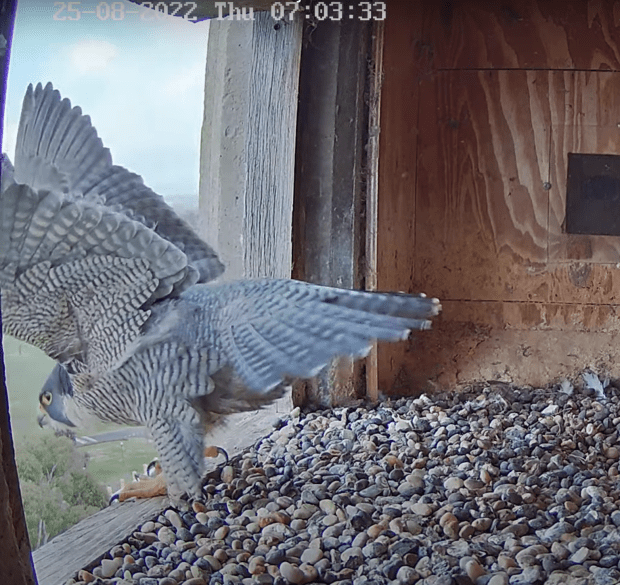
Xavier has been bringing Diamond some extra special treats during Sunday to help Diamond keep her energy up for the egg laying. One was an Eastern Rosella which is a very colourful parrot and the other was a nicely prepared pigeon. Diamond was excited for both!

The arrival of the Rosella meant that cute little Xavier could have some time with ‘eggie’.

Diamond had a very large crop when the pigeon arrived but she certainly wasn’t going to turn her nose up at that special food gift.

It is 13:57 in Orange and Diamond is sitting on the ledge of the scrape box while we wait and watch for an indication that the second egg might be arriving.

Diamond is back on the egg at 1400.

Diamond is very focused and she looks ‘heavy in the rear’. Egg 2 could be coming shortly. Diamond normally lays 3 eggs. For the past two years, only one egg has been viable each year.

Diamond laid egg #2 at 17:27. Yippppppeeee. Why am I so excited? Well, falcon eggs do not always hatch and for the last two years Xavier and Diamond have had only 1 out of 3 eggs hatch so it makes the chances better of having a successful hatch.

Xavier arrives at 17:33 to see the second egg and to bring Diamond her dinner. Notice that Diamond is being very careful. Falcons lay their eggs standing up. She is protecting the egg while the shell hardens in the air. The gap between eggs is 57 hours.

Diamond did not want to eat. She had already had two big meals. She remained in the scrape box. During the night she would sometimes incubate or, alternatively, stand above the eggs protecting them. Remember the Currawong know there are eggs in that scrape and they will eat them if the opportunity arises!

The Melbourne couple seem to be finished with three eggs and each takes turns incubating. Dad was very anxious to demonstrate that he was well seasoned in incubation. The Melbourne crew even made a video of the persuasion.

It is a very short and cute clip. Oh, do you ever wish you could speak falconese?

Friends of Osprey have posted some photographs of Ervie near the Marina where he had dived and caught the lovely fish he is eating. They were taken by Alex Ditton. Oh, goodness. It is always such a joyous occasion when someone shows us that Ervie is doing very well indeed! Check out the Friends of Osprey for more images of Ervie.

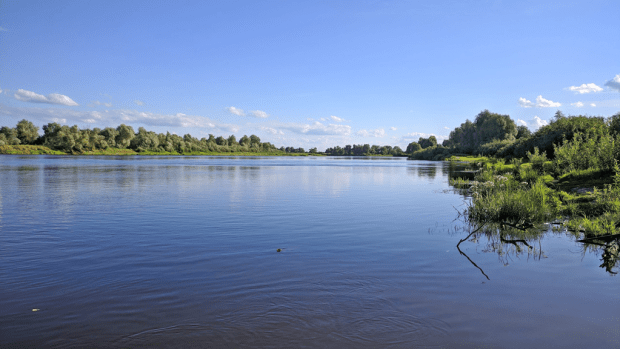
Kaia remains in Belarus around the Priypat River. This is what the area looks like where she is resting and fishing.

Bonus, the only surviving storklet of Jan and Janika that was fostered with Kaia and Karl II has begun his migration. His tracker tells us that he traveled 109 km and is now in Latvia near the village of Vietalva.

Travel safe dear Bonus, fly high, stay out of the war zones, always have a stream full of frogs and fish — prosper.

There should be more news but it appears that all might have left for their winter homes from the Karula Forest nest of Kaia and Karl II. I will confirm this tomorrow.

Bonus was always a very special Black Storklet. He would not have survived without the intervention of Urmas and Dr Madis and his team. They would have died on the nest. Urmas’s foresight to provide fish baskets meant that everyone had lots of fish. A special thank you to all who donated towards the food for the nest.

The Dahlgren Osprey nest in the US has announced that the male, Jack, has not been seen for a few days so that now Harriet, the female, and the sole surviving fledgling from the nest in King George County are on their journey south.

No one has been seen at the Loch of the Lowes since yesterday. Laddie LM 12, Blue NC0 and both of the fledglings appear to also be heading south.

It was another successful year for Ospreys in Wales and John Williams gives us the run down in his last blow of the season for Llyn Clywedog. The numbers of Ospreys in Wales are growing. There are now 7 ‘known’ pairs who produced 17 chicks this year. John catches up with all the nest news.

John also produced a chart for all the chicks hatched at Llyn Clywedog – noting that there is simply too much grey. Were those chicks ever seen or not? Sometimes they do get missed.

Handsome Aran on the perch at the Glaslyn nest this morning. He remains bringing fish to the nest for the fledglings. Mrs G was still home as well today.

Handsome, Aran.

Emyr Evans has provided us with the data of the fledges at the Dyfi nest asking the question: what happened to Pedran? Emyr is great with statistics and this is a good read about migration and young fledglings.

https://www.dyfiospreyproject.com/blog/emyr-mwt/pedran-what-has-happened-her?fbclid=IwAR2nZUelKdPCJFEW-3PIjKlcohXunU9JSBevJA8wFl4XpT1ICR9H8O8bepA

Rosie was still on the perch at the SF Bay Osprey nest this morning! Brooks has not been seen at the nest for some time now – this is not alarming. She is out exploring!

Congratulations to Glacier Gardens. Both Love and Peace have fledged. Here is a video of that moment on 25 August when Peace took to the air. Congratulations for another successful year Liberty and Freedom!

Thank you so very much for joining me this beautiful Sunday morning. I hope that you are doing well and I will look forward to having you with us again in Bird World.

Thank you to the following for their streaming cams, their posts, and their videos that form my screen captures: The New York Times, Explore.org and IWS, Ferris Akel Tours, Charles Sturt Orange Falcon Cam, 367 Collins Street by Mirvac, Friends of Ospreys, Looduskalender, Dahlgren Ospreys, Friends of Loch of the Lowes and the Scottish Wildlife Trust, John Williams and The Clywedog Ospreys, Bywyd Gwyllt Glaslyn, Dyfi Ospreys, SF Ospreys and Golden Gate Audubon.

Remembering Lindsay…and more. It’s Friday in Bird World

26 August 2022

Amidst the joy of Peregrine Falcon eggs in Australia at both Orange and Melbourne, the loss of dear Lindsay, the eldest of the two siblings hatched at The Campanile on the grounds of the University of California-Berkeley, remains heavy – a real heartbreaker. From the news it is apparent that Lindsay died several weeks ago; her body just being found today. She was last seen on the Campanile on 5 August precisely three months after she hatched on 5 May. A life cut way too short.

Lindsay was one of a two-part miracle. Lindsay’s Mum, Annie lost her mate Grinnell when he was killed after chasing an intruder away from The Campanile. There was worry that there would be no chicks this season. Alden arrived in 5 or 6 hours hours (already a friend of Annie and Grinnell’s) and offered to help Annie incubate the eggs and take care of the chicks. We rejoiced at the love the two siblings had for one another, when they played, and when they chased moths. They grew strong and they flew. It is with such deep sadness that we say goodbye to Lindsay today. Fly high, Sweet Girl. Soar to new heights you never imagined.

Here is the full announcement from Cal Falcons. It appears that Lindsay’s death, from the evidence found from her body, was killed by another raptor.

It is heartbreaking. Lindsay had such potential and, of course, it is very possible that she was the last chick our beloved Grinnell fathered. She brought us such joy! I would like to share a few images of this remarkable falcon moving back in time from the last sighting of her on The Campanile on 5 August to the day she hatched.

Lindsay and Grinnell, Jr adopted many of the quirks of Alden including loafing. Annie has perfected it!

Annie and Grinnell, Jr playing together at The Campanile. The two siblings seemed to really enjoy playing with one another, something that I have not seen for a long, long time. It was refreshing.

Lindsay on the roof of the library on 18 June after fledging. Just look at this exceptionally beautiful juvenile. Stunning.

Do you remember banding day 27 May (on the right)? Lindsay was frightened but quiet. Alden would not stop being loud! Lindsay was still sit ting with a not so scared look on her face in early June.

Lindsay was also sitting in that same pose on 22 May.

Hatch day for Lindsay, 5 May. Grinnell wants to come and help. Annie is not sharing – yet – but she will and each of us will rejoice watching this wonderful family.

‘H’ just sent this press release on Lindsay. Thank you, ‘H’. Just made it before I hit send! Grateful.


From the Mailbox:

‘M’ writes: What do you think about this from Dyfi project? I am not sure I would pass off some of that behaviour as just “playing”, at least not based on how the smaller chick reacts. Wondered about your view, based on your study of third hatches.”

For transparency, I posted the information from Dyfi in one of my blogs. Emyr Evans has a long history with the Dyfi Nest in Wales. I have great respect for him but, in this instance, I choose to disagree.

In the UK Osplet deaths are generally attributed to either very poor weather in the early days after hatching or lack of prey, starvation not siblicide. There is little history of siblicide; there are so few breeding pairs and chicks compared to North America. This year, however, we did see it at the Loch of the Lowes Nest. It was rather horrific treatment of the third hatch that was killed by the eldest during a period of low prey delivery.

As you are aware, my research is on siblicide and, in particular, the success of any third hatch osplets vs the other two siblings. Because I track the juveniles long term this is limited to those that are ‘ringed’ and/or ringed with SAT tracking. My findings also rely on the good fortune of someone seeing the juveniles in the future and providing that information to various data bases! In my experience, the aggression shown by older siblings ranges from mild displays of dominance to more serious concerns that seem to taper off around the age of 26-28 days. Serious aggression often ends in the death of the smaller weaker sibling. There is much research to support the fact that it is not always about food. Sometimes it is just dominance.

‘M’ this, in my opinion, is not play. It is establishing the dominant bird on the nest. The dominant bird will eat first and if there is little food it will be the only chick that eats. Had food been scarce the treatment might have escalated but, thankfully, it didn’t. Gender may play significant roles also with the females requiring more food to grow 1/3 larger and feather a larger body. Thus, the females, especially if they are the first hatch, tend to be more aggressive.

Multiple times this year we have seen the third hatch killed by the eldest sibling and sometimes in conjunction with the middle one. As mentioned, this happened at the Loch of the Lowes this year when food was scarce. It also happened at the UFlorida-Gainesville Osprey nest amongst others. It also happens on eagle nests and other species. However, there appears to be a higher rate of siblicide among North American Ospreys than those in the UK. It is likely that these numbers reflect the higher population of Ospreys in North America. In addition, the lochs are full of fish and there are restrictions on many of them to prevent human intrusion during the breeding season.

Loch of the Lowes

In the News:

We are going to start with some fantastic news. When I lived in the UK, I studied in Leicester but lived in Lincolnshire and Belvoir (pronounced Beaver) Castle was a regular haunt for me – so close to where I resided. For the first time in 200 years, we have Ospreys breeding on top of Belvoir Castle! Oh, my goodness. I am delighted. Here is the BBC News report.

https://www.bbc.com/news/uk-england-leicestershire-62675910?fbclid=IwAR2oh_nwcQ04Sgqp9W2VubAHNIWEVdklHCduT0KiCfsp1lu7y_-92-kc-hI

There is more news coming in about the sad state of the White-tail Eagles on Mull Island — known internationally for the birds and their nests.

https://www.rspb.org.uk/about-the-rspb/about-us/media-centre/press-releases/mull-white-tailed-eagle-chick-dead-from-bird-flu/?fbclid=IwAR1dQ2AI_bU07KxyTS0T6CeKgHBU0FFA5bnjUFrTF1LOCudnRC2vPFJhjhU

Bird Flu is also killing Black Vultures. Deaths from migration, Avian Flu, human disturbance and killings, fires, habitat loss, lack of food…how many of our raptor friends will be left?

https://www.theguardian.com/world/2022/aug/24/bird-flu-has-killed-700-wild-black-vultures-says-georgia-sanctuary

There is a lovely documentary on YouTube on the return of the Black Storks to Germany in the 1980s. The cinematography is excellent as is the narration. So much to learn – 53 minutes. Find a nice quiet time to watch!

Nest News:

The 367 Collins Street Falcon Cam in Melbourne is up and running. So far there are 2 eggs!

Here is the link to the camera:

As you will be aware, the first egg of the season for Xavier and Diamond at their scrape in Orange was laid at 0713:48.

Diamond resting in the scrape after her labour and the delivery of the first precious egg for these two.

Diamond incubating the egg. How beautiful.

Xavier comes to the scrape to relieve Diamond. A short bonding ritual takes place before Diamond flies off.

Xavier scraping and trying to turn the egg as he settles down.

Xavier carefully rolls the egg.

Everything is alright with the world. Oh, what a joy to finally see the first egg for Diamond and Xavier. Let us all hope that their year is as successful as it was in 2020 with the hatch of the ever adorable Izzi.

Here is the link to one of three cameras for Xavier and Diamond:

I am so used to the Ospreys in the UK and the Dads bringing in a fish right before or when the sun is rising in the morning. That first fish delivery for SE29 and 30 at the WBSE nest in the Sydney Olympic Forest did not come until 12:31 today. Thankfully the chicks were civil and it was not huge but was a good size.

Images from early morning to feeding.

Early morning preening of those itchy feathers.

Beautiful Lady listening and waiting for Dad to bring food to the nest.

SE29 and 30 watching Mum aerate the nest. Just look at how carefully they are looking at her every move. This will imprint in their mind’s and they will know to aerate their own nests.

Finally, a fish has arrived!

Things appear to be going good at the Port Lincoln barge except for Mum making cries for fish. On occasion Dad has flown in eaten more than his fair share while Mum is fish calling. He then delivers the remainder to her. Come on Dad! Dad is taking his turns incubating.

Oh, it seems so long until 19th of September – may the time pass quickly! There is nothing cuter than nestlings a couple of days old.

Checking on Kaia’s transmission. She remains in Belarus. On the 25th of August she flew 123 km. She is now near the village of Liaskavicy. It is in an area that is part of the wetlands of the Pripjat River. There is a national park and the area is considered to be quite safe for Kaia.

Karl II is looking a little tired. Thanks to Urmas the supply of fish continues so that he can feed the four Black Stork fledglings. Soon they will fly and hopefully Karl II will have some days to recover and gain some weight before he leaves. Of course, when they do depart we shall all be worried for them. I wonder if by some means Karl II and the children will meet with Kaia and decide another route to their winter home???

It appears that all of the White Storks from the nest in Mlade Buky, The Czech Republic have left for their migration. It is raining heavily and both of the nests of Bukacek and Betty appear so lonely. Safe travels dear family.

Suzanne Arnold Horning has caught L2 on the Cornell Campus! So happy she is here with us. In the history of the nest, it seems that the 28th of August is the last day to see fledglings in the past. Enjoy these moments then with our first fledge of the year. Gosh, she is beautiful. We know that she is catching her own food – she was the second of the fledglings to do so more than a month ago. So all is well with L2.

It is Friday. A friend sent this to me to cheer me up because of Lindsay. I did giggle…love those sour worms. Thank you ‘S’.

Thank you so much for joining me today. If you have any questions, you can send them through the comments page or through e-mail. My address is maryannsteggles@icloud.com Have a fabulous Friday! Take care of yourselves. See you soon.

Thank you to the following for their streaming cams, videos, and posts that form my screen captures: Cal Falcons, Berkeley News, Dyfi Osprey Project, Friends of Loch of the Lowes and the Scottish Wildlife Trust, RSPB, The Guardian, BBC, 367 Collins Street Falcons and Mirvac, Charles Sturt Falcon Cam, Sea Eagles@Birdlife Australia Discovery Centre Sydeny Olympic Park, Looduskalender, Eagle Club of Estonia, Mlade Buky, and Suzanne Arnold Horning.

Early Thursday in Bird World

24 August 2022

Good Morning Everyone! Do you feel like autumn is coming? It is chilly in the house this evening (Wednesday), The evening temperatures are dropping on the Canadian Prairies but, it will be 28 C this week during the day. I watched the squirrels in the garden fetching peanut after peanut – storing them away in their nests and around the garden for the winter. They do not remember that there are plenty of peanuts and solid seed cylinders during the winter for them. In a week and a half many of us will be traveling to birding hotspots outside Winnipeg to see the beginnings of the arrival of large numbers of birds from the North. Already there are postings about long lines of Canada Geese flying South. Thursday turns out to be a crisp morning – sweater weather now but that will be shed shortly.

A young Least Chipmunk comes to visit. Least Chipmunks are the smallest of all chipmunks. They have five dark and four light stripes along their sides and three dark and two light stripes on the face. Their fur is orange-brown, and their underside is greyish-white. Their habitat in our neighbourhood was destroyed with the building of large condos and they are finding new places to live.

In the Mailbox:

From ‘P’. “We are always told that Ospreys do not respond well to being in care. Is this true?” The first example that I think of when I hear this question is Smedley, the Osprey with the droopy wing who lived in care for 28 years at the Audubon Centre. One of the care givers at the Audubon Centre, ‘L’ answered the question this way for us: “Many times, people assume Ospreys do not do well in care. They do overcome the nervousness that is characteristic of osprey. They’re known to be the lovers and not fighters of the raptor world but they show the same adaptation, feisty spirit and will to survive as all species do. We have had so many here at Audubon with injuries from the short term to severe long term….adults to juveniles to fledgling. I walked into the clinic a couple of weeks ago and saw half a dozen with hoods on so they stay calm just stood around waiting to be hand fed. You definitely can’t do that with hawks, eagles and owls.”

Many have written to ask what happened to the Osplet on the Finnish nest that was always attacking its mother? As a reminder that was the chick on nest #3. The parents are Ahti (male) and Nuppu (female). FYI: Nuppu had on a couple of occasions taken the fish arrival and not fed the chick which might have just prompted that aggressive behaviour.

Here is that famous video:

That very healthy chick fledged and here is a video of Tuulos returning to the nest to get a fish meal two days ago. Lovely juvenile Osprey. Oh, I hope this one is a survivor – he sure has the drive.

A Sparrow Hawk visited nest #3. As it happens everyone in the Northern Hemisphere is getting empty nest syndrome right now.

In the News:

Worrying news coming out of the UK this morning. A white-tail Eagle on the Isle of Mull has tested positive for Avian Flu. A number of eaglets have died on the nest or right at fledge. This is terrible news for the WTE population. Here is the article on the impact from the RSPB:

https://www.rspb.org.uk/about-the-rspb/about-us/media-centre/press-releases/mull-white-tailed-eagle-chick-dead-from-bird-flu/?fbclid=IwAR0ae5Qd6FSGEI9MFj5zxbPL4bIDracUna3nkCqj-dH7ktFu8CxO6V6cu1g

Port Lincoln Ospreys has made its mark in Australia for its efforts to save the Ospreys. They need no introduction on my blog for their tireless efforts to get platforms up and nests off the shores so that predators do not get the eggs, chicks, or the adults.

They shot the hen harrier. In order that its killing would go undetected, its wings were cut off with the tag and tracker attached to a Crow. It is not know if the wings were ripped off the raptor when she was alive or dead. Her name was Asta. “She vanished from a known raptor persecution hotspot, in an area managed for driven grouse shooting – an industry with an acknowledged filthy history of persecuting birds of prey, and particularly hen harriers, as demonstrated by decades of prosecutions, convictions and endless scientific evidence.” I have never suggested that violence was in any way the right choice in any conflict but I often do wonder what if the individuals who tear the wings off a helpless bird, or shoot an arrow through the head of an innocent goose or other bird or animal were to have the same treatment done to them – would it help stop this inhumanity! I am happy to attach the short blog that explains this story in full. We are at a time when we are celebrating the successful fledge of two hen harriers in the reintroduction programme in the UK. Will they also be shot over a grouse hunting estate ——or can we begin to hope that that archaic sport is pasts its sell-by date?

There are growing calls to ban the killing of wildlife in the United States. Can you hear me saying, ‘thank goodness’! What happens in the US often has a reciprocal impact on us in Canada. Indeed, one of the wetland areas that I visit just sent an invite for a Zoom talk on this years numbers and how this will impact hunting!!!!!! No thank you.

https://www.nationalgeographic.com/animals/article/how-killing-wildlife-became-a-game?fbclid=IwAR2kwKSzHZXKlUpFN7RqWymrwbqz4WmXO0-40zkmdK3xNNy1YmV6FUik-9I

The BBC is asking people in the UK what it will be like where they live as our planet continues to heat up. I would love to see this for the rest of the world. My concern is – of course – the raptors. Will they arrive earlier? Will the intensification of rain along the coasts cause issues with osplet health and survivability in Wales? The whole story is here:

https://www.bbc.co.uk/news/resources/idt-d6338d9f-8789-4bc2-b6d7-3691c0e7d138

Alongside this news I am always asking how can we help our raptors and other wildlife mitigate or adapt? One of my dear friends lives in Singapore and before the pandemic, I visited this area often. Her father was the second President of Singapore from 1971-81, Dr Benjamin Sheare’s. Sheares’s predecessor, Lee Kwan Yew launched Singapore as a garden city in 1967. The idea was carried further in 1992 with the sustainable blueprint, Singapore Green Plan (SGP). This was updated in 2021. Today, half of Singapore is gardens and this is set to increase. Every family will live within 10 minute walk of a green space, cycling areas are being extended while car licenses will only go to clean green aka electric cars. The ash from the garbage collection will be used as an alternative for sand in concrete. Water, green spaces, and even more trees will provide a richer environment for the birds that live in this island City. Further clean ups of the environment will also benefit all of the large raptors that live by the docks and the marina such as the White-bellied Sea Eagles.

https://www.greenplan.gov.sg/

I have been increasingly concerned about heavy metal toxicity in our raptors since Victor tested positive for zinc. As many of you know our world seems to be full of galvanized materials. Yesterday my galvanized chain link fence put here by the previous owner in 1991 was removed. For those of you that have bird cages, last week I posted an article that ‘C’ had sent about the bars being zinc and Cockatiels showing a high level of zinc when tested. ‘C’ has sent me another article on the impact of lead. Thank you ‘C’.

https://rsdjournal.org/index.php/rsd/article/view/12701

Nest News:

In Winnipeg, there are some really late hatches. You have already been subjected to my concerns over the late-hatch ducklings at the nature centre where I walk and at a few other manmade ponds in the City. Last year I was taking photographs of the Cooper’s Hawk fledglings in late June at our Zoo. This year they had to wait for the owls to fledge their owlets (they used the hawk nest) to lay their eggs. The hawklets are so little. There are 5 of them. The crystal ball foresees some sleepless nites come October!

At Glacier Gardens, Peace has yet to fledge. Sibling Love as been flying around, on and off the nest early showing how it is done.

I have a new osprey nest for you with what appears to be a good camera. Put it on your list for next year as it seems the female has already left on migration from Maryland (30 July). The information page includes the history of the nest for the past 2 years.

It is the Blackwater National Wildlife Refuge Nest and they raised two chicks this year. Here is all the information:

https://www.friendsofblackwater.org/river-osprey-cam.html?fbclid=IwAR1oRNIiMjuYO8SgfVnAJV-jB-CaEBqLq_cJZ7qzIfgU53igmdIct-0xeuE

You might remember that Harry, the male at the Minnesota DNR nest was injured or died. Nancy had to raise the two eagles alone. The youngest was pushed over the nest by its elder sibling when food was in short supply and had to be euthanized. The eldest fledged. Now there is a new male suitor for Nancy. Lady Hawk caught him in a video with Nancy on the nest.

Rosie was on her perch this morning in San Francisco. Any day she will depart for her migration leaving Richmond behind who will be waiting for her return on Valentine’s Day.

The Birds of Poole Harbour posted a fantastic tweet. The one surviving historic fledgling from the Poole Harbour nest in 2022 was seen in the harbour fishing!!!!!!!!!!

Anyone that has ever watched the Loch Arkaig Osprey nest knows that Louis is quite amazing. Today he delivered two big fish – 9 minutes apart – so that both Sarafina and Willow would have their own. Incredible. Is this a record? Willow on the left and Sarafina on the right — two great fledglings for 2022.

Dorcha, Louis’s mate has left on her migration but Mrs G is still at Glaslyn. She was spotted eating a fish in the trees today. Aran continues to keep the fledglings fed. Today Blue 499 has had at least two very large fish!

Idris is not only keeping Padarn and Paith in fish but also himself as well as chasing off intruders today.

Blue 022 continues to deliver fish to H51 at the Poole Harbour nest. Happiness still abounds at the presence of their own ospreys despite losing one to the goshawk attack. CJ7 and Blue 022 did an amazing job as first time parents…a dream come true for CJ7 who waited several years to find a mate.

It is impossible to see the band but at least one of the female fledglings is still on the nest at Rutland waiting for Blue 33 to bring in the tea time fish.

No worries about SE30 getting enough to eat. Goodness. That crop is so full it isn’t even making a nice soft pillow! You don’t look very comfortable 30!

Lots of Kissy-Kissy going on early in the morning between SE 29 and 30.

When the pair turned around you can see some dramatic changes. Look at the plumage on the heads, the chest, and then notice…some of that incredible rusty brown is showing on SE29 under the wings and moving over the chest. Gorgeous.

Bets continue to be made on when Diamond will lay her first egg. If the number of mating attempts is anything, that nest should be full to the brim this year! Moderators are saying in less than 5 days. That would be 29 August. I will say 28 August. What do you think?

Bonding in the scrape…then mating on the tower and then Xavier returns with a nice juicy pigeon. Doin’ good today Xavier!

Diamond got out quick before Xavier could change his mind and want it for his breakfast.

You did really well Xavier – a nicely plucked and prepared fat pigeon for Diamond.

A video of a prey transfer between Diamond and Xavier.

Suzanne Arnold Horning caught Big Red and Arthur on the Cornell Campus Wednesday evening — and she also spotted L2. So L2 is still living with Mum and Dad in their territory.

Big red is moulting. 23 August 2022
L2. 23 August 2022
Sweet Arthur. 23 August 2022

So many things going on in Bird World but for the Northern Hemisphere, the birds are on the move…while many of us turn our attention to Australia. Thank you so much for joining me today. Please take care. See you soon!

Thank you to the following for their videos, streaming cams and posts that made up my screen captures: Finnish Osprey Foundation, Port Lincoln Ospreys, CBC, BBC, Glacier Gardens, Blackwater Ospreys, MN-DNR, SF Ospreys and Golden Gate Audubon, Friends of Loch Arkaig and the Woodland Trust, Bywyd Gwyllt Glaslyn, Dyfi Ospreys, LRWT, Poole Harbour Ospreys, Sea Eagles @Birdlife Australia Discovery Centre Sydney Olympic Park, Charles Sturt Falcon Cam, and Suzanne Arnold Horning.

2 Fledges in Bird World and more…Wednesday morning

24 August 2022

It is hard to believe that the summer is almost over. The teachers and students do not go back to class until after Labour Day here but they continue to have classes throughout June. There is a different look to the top of the trees and I noticed today that my tomato plants are looking a little rough. In his book Mistletoe Winter, Roy Dennis describes Autumn as ‘the altruism time of diligent creatures’. He is referring to the Blue Jays which “only reached the North of Scotland in the last 40 years” and who are busy storing away acorns for the winter. Dennis notes that some of their stash will be forgotten or overlooked. The acorns will germinate inside the bramble bush protected from the deer and will, in effect, grow nuts for future generations as well as the old Oak trees. Likewise, the Red Squirrels will be working away at the hazel nut trees. The animals in the garden are becoming increasingly interested in stashing food for the winter here in Winnipeg despite the fact that the day time temperatures are still in the high 20s C.

In the Mailbox:

‘P’ wrote: “Last year you and I connected when the chick was forced off the nest and died….Was there any nesting this season? I cannot find any thing on the site at all.” It turns out that the nest in question is Collins Marsh. To refresh everyone’s memory, one chick hatched last year at Collins Marsh in Wisconsin. The fish delivered to the nest were small and not always plentiful. One or another parent seemed to be absent at times. The little osplet was adorable. One of my readers ‘S’ suggested the name, Malin meaning ‘Little Warrior’ and it won. Malin would need to be a warrior to survive on that nest. Then one day an intruder came, Mum flew off and Malin, scared to death flew off the nest, too. Malin was not ready to fledge. ‘S’ and I spent hours on the phone trying to get immediate help. It did not come. (That is a long complicated story and I am still unhappy about the response of the naturalist at the time). The platform was on top of a moved fire tower. It had no perch and it was deathly hot. As a result, the ospreys did not make a nest there this year, 2022. Were they old? did they no survive migration? Or did they also realize it was not a safe place to raise their family? I was told by DNR personnel doing nest surveys that there was an unused nest about a mile away. They might have gone there. But with the intruder and a poor food source they might have moved out of that area altogether.

‘B’ wrote and wondered, awhile ago, if there was anything else that we can do to gather things up for the rehab clinics and what might they be? So who else better to answer that question that ‘L’ who works at the Audubon Centre in Florida. ‘L’ says “I often reach out to our neighbourhood communities because as you rightly say, money is so tight for so many but its amazing what we have in our homes that would just be thrown out. I ask for any donations that are paper related. Paper towel and toilet roll cardboard inserts, newspaper for lining crates and are used for enrichment will continue to become more and more scarce since the news is on the Internet plus old or ignored dog toys like kongs and ropes. Believe it or not, one of the most popular enrichment items are paper flowers and streamer type decorations (I swear I will make raptor friendly piñatas lol). They all LOVE paper in various degrees of thickness.” What an amazing list! I will continue to add clean loved but well used towels and sheets plus all manner of cleaning supplies. Sometimes the rehab clinics have their own lists on line. You can check for local needs. I wonder about having a sort of neighbourhood drive to gather up items. And I never thought of gently used dog toys!

‘W’ writes: ‘There is a nest of baby robins in my tree. I am disturbed by persistent distress calls from from one bird and then another. I don’t know why, and I feel helplessly alarmed. I’m sitting watching the nest, hoping to see one of the robins go to the nest, during this whole time of callings neither parent has appeared. What can it be? As it happens I have asked our local wildlife veterinary student this same question only with regard to another species. The parents will move away from the nest alarming to scare the intruder away but, at the same time, they do not go to the nest to show the predator where it is. —- I have noticed also when I am on walks in the nature centre that the Canada Geese are quite protective of their little ones. One will act as a security guard while some of the others will be decoys trying to get my attention elsewhere and away from where the goslings are located. That could definitely be what is happening with the Robin family. Have any of you had similar experiences?

‘S’ asks, “YRK has been coming in to feed QT very frequently. Do you think she is looking for OGK?” I think YRK is absolutely looking for OGK. They often came in or landed close to one another when they were raising Miss Pippa Atawhai. It was really delightful to see the two of them rejoice in being close to one another. I know that YRK has even gone up the hill to Pippa’s nest – she has to be wondering what has happened to OGK and why she has not seen him. The NZ DOC will not declare OGK officially deceased until he doesn’t return in October of 2023. He was injured once and was away for 40 days but he has not been seen since the middle of May. We wait with hope but, I am a bit of a realist and I believe he is no longer with us.

‘P’ asked: Do any of the raptors fish at night? What a timely question! Last night Dad at the Sydney Sea Eagle nest brought in a fish late at night. Alden at the Cal Falcons nest seems to always hunt at night. It is thought it could be his injured leg and he hunts then to avoid the other big raptors at night. Of course the song birds are about and with the light of SF he seems to do quite well. There have been others who have brought in fish at night. We certainly know that Ospreys do fish at night but the nests escape me this morning. — Then there are the Great Horned Owls and other owls who silently hunt at night. This is their time!

From the News – Digital and Broadsheet:

It may not seem like much but this is a major victory for the anti-grouse hunting movement in the UK. What is at issue is that pheasants and grouse are imported so they can be shot by visitors to the big estates where shooting continues to be a sport. The problem is that the game’s keepers often kill raptors that come on to the estate lands to hunt. Today, the Ritz in London announced that grouse is off the menu. Expect others to follow! Yes.

https://www.theguardian.com/food/2022/aug/20/game-over-the-ritz-takes-grouse-off-the-menu-in-victory-for-environment-campaigners

Canadians are watching the geese and raptors and this morning lines of Canada Geese were seen flying south from 2 hours north of Winnipeg. This is early. Since 2019 the associations studying the climate crisis and its impact on birds have given us warnings that things are changing quickly. The insects that many depend on to feed their young are hatching earlier. If the birds arrive at the same time as what has been normal, there will be less food and thus, less offspring. The floods this spring and summer have left many moving to other areas and we have fewer and fewer ducklings and goslings in the City of Winnipeg this year. As I have noted in earlier blogs my concern is now with the few little fuzzy ducklings that are in some of the ponds. Will they survive to fledge? A heating planet means that we may well see many of the raptors breeding a month early.

In 2020, the UN had an autumn lecture on how the changing climate will impact raptors. Two years ago…things change quickly. I will be looking for an update for us for this fall but this is a good beginning to understand what changes we may see in our favourite raptor families as the planet heats.

Nest News:

Today, we have two fantastic fledges to celebrate. We have been waiting and waiting for LC to fledge from the Osoyoos nest of Soo, Olsen, and BC. This afternoon, after spending the morning jumping from the nest to a cable, LC flew!!!!!!!! The time was 14:29:24 the 23rd of August 2022. “H’ sent a video (thank you ‘H’ for this and confirmation of the time). Don’t blink. It is only seconds long.

‘A-M’ lives a bit of a distance from the Osoyoos nest. You might remember that she travelled to Osoyoos to search for the chick that fell off the edge of the nest. ‘A-M’ found the wee one dead but she placed it in a quiet spot in a very dignified way. Today, excited like everyone waiting for this moment at Osoyoos, ‘A-M’ drove in to see if she could see the family. This is her report: “I went to the nest around 4:15pm LC was on the camera pole and BC joined, they sat there for a good half hour chatting to each other. Mum flew on to pole around 16:37 and BC flew to nest. I watched Soo sit with LC on the pole and BC fly to the tree where Olsen hangs out. So beautiful to see BC fly around the area and to see LC out the nest, they both are stunning. I will check on them in a few days to see if I can capture a video clip of LC in flight.”

The other fledge was at Glacier Gardens. Love fledged. Now we will wait for Peace. Here is the video of her first flight:

There have been no sightings of the Notre-Dame Eagle family. ND15, Little Bit’s caring sibling, left the territory earlier. Little Bit has been easy to spot on his perch on the St Joseph River but the birders on the ground report that not even a squee has been heard anywhere. It is that time of year. If they have left for their migration may we all wish them strong wings, lots of prey, and a good long productive life.

There is a lot of curiosity about Trey, Mama Cruz’s 2019 fledgling with her mate, Pride. Someone has put together a video of the ‘dust up’ between Mama Cruz and Trey at the nest:

We are waiting for the first egg to arrive at the Charles Sturt falcon scrape in Orange, Australia. Today, Xavier brought in what appeared to be some road kill and Diamond was quite happy to eat it. The moderator added that the falcons are quite happy to eat road kill when other prey is scarce. All I could think of was — we don’t want a year where the prey is scarce!

The sea eaglets continue to do well. If you look at the other camera, rather than the one looking down on the nest, you will always get a good look at Lady’s fluffy white bottom! It is also nice to see the chicks in profile. Gives you a whole different understanding of their size.

They had nice crops around 1220.

And there was another feeding a few hours later.

In Port Lincoln, it has been rainy and a bit miserable. Mum thinks Dad is just taking far too long with the fish for her liking. She does do some screaming at him and is quick to get off the eggs when he arrives. Estimated hatch day is 19 September.

According to the Port Lincoln FB page, Ervie has been showing off his skills o visitors staying in the Port Lincoln Hotel! I wonder how many of us would love to be on the roof watching him????????

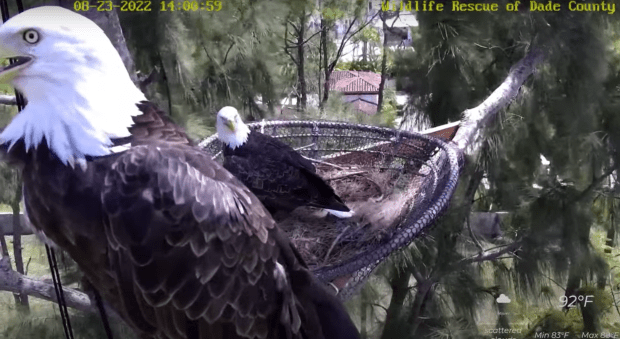
And just when I thought that all attention would soon be turning to the birds in Australia, look who shows up at their nest inside the Miami Zoo! Rita and Ron.

Look at that crop…it appears to be bursting the feathers at the seams.

The Papadam nest seems to have worked great for R1 and R2. If you are fans of Ron and Rita they might start working on getting it into shape for the next breeding season.

Cal Falcons caught Alden in the scrape calling Annie.

What a beautiful place to raise osplets – the Dyfi nest in Wales, home to Idris and Telyn.

It is a damp grey morning but, oh, so green and lovely. Quiet.

Earlier there was a Magpie on the nest and one of the fledglings eating a fish. I wonder if the Magpie was waiting for leftovers?

There has been an intruder on the nest today, possibly a Scottish juvenile on the move. The whole of the UK Osprey population (and all other migrating birds) are beginning to move to the south so there will be lots of visitors just stopping in at nests. I hope to have a good list of all the departures on Friday. Mrs G is still at Glaslyn. She stole a fish off one of the juveniles that Aran delivered not long ago.

Checking on Kaia, the Black Stork mate of Karl II who turned back from the Ukraine to feed in Belarus. I am watching Kaia’s movements closely as this could give us some insights into the other storks and raptors migrating from the north through the area of The Ukraine.

Kaia began her day near the Veluta Lake in Belarus where she has been for about a week. She then flew a distance of 143 km and is in the wetlands near the Pripyat River, a little northeast of Veresnitsa, and southeast of Povchin in the Gomel Oblast in Belarus. The small village has 1070 citizens. Looduskalender notes that Kaia is feeding within a few metres of another Black Stork with a tracker, Timmu. So she is feeding and remains safe. Relief. It is hoped that the storks and other raptors can find a way around the Ukraine. War has many sides and none of them are good for birds.

Take care everyone. Thank you so much for being with me today. Congratulations to Osoyoos and Glacier Gardens on their fledges. See you soon!

Thank you to the following for the streaming cams and/or posts where I took my screen captures: Osoyoos Ospreys, ‘H’ and ‘A-M’, Glacier Gardens, Explore.org and the IWS, Charles Sturt Falcon Cam, Sea Eagles@Birdlife Discovery Centre Sydney Olympic Park, Port Lincoln Ospreys, WRDC, Cal Falcons, Dyfi Ospreys, Bywyd Gwyllt Glaslyn, and Looduskalender and the Estonia Eagle Club.

Early Tuesday in Bird World

23 August 2022

Today turned out to be a very special day (22 August). OK. It is always special when I can go out to the nature centre and do my long walk. It is also a good way to check every nook and cranny for the geese and ducklings. A few had moved from where they were yesterday but many stayed in or close to their normal pond area. I continue to be fascinated that there simply are no Wood Ducks at the nature centre. It is like the two species – Mallards and Wood Ducks – sat down and signed a truce and decided who would go where! There were a lot of birds at the ‘winter’ feeding stations — they must fill the feeders year round. There were several Downy Woodpeckers, two American Goldfinches, a number of Black-capped Chickadees and then a bird sitting in the squirrel feeder that I did not recognize. After going through the birding book, it appears that the little lovely below is an immature female Rose-breasted Grosbeak. I certainly welcome any help with this ID.

The most excitement came this evening, however. It is hard to imagine sitting next to a pond which is about 6 metres away from, perhaps, the busiest highway in our City and seeing a Great Egret fly to a tree to join two others. They are part of the heron family but they are very large. In North America they have black legs and a yellow bill. They gather in groups near ponds and wetlands if there is plenty of food. Otherwise, if food is relatively scarce, you will see them alone.

What a magnificent creature.

In the mailbox. Following up with the question about Titi and Boris and the reason for the Janakkalan nest cam in Finland to go offline. We have answers. Thank you ‘S’ for getting back so quickly to us. Boris was seen on the nest two days after Titi’s fledge. It was the morning of 12 August. Titi did not return to the nest while the camera was still operating.

There is a video of Boris’s nest visit.

There were difficulties with the camera and it completely broke down. It will be fixed and will be up and running again next year. ‘N’ did receive a response from the Finnish Osprey Foundation stating that there were a number of Osprey fledglings in the Muonio in Northern Finland. Thank you ‘N’.

Can you help? There is a new book on Peregrine Falcons being written by Richard Sale in the UK. Susan Sale writes with the following information and a question. “My husband is self-publishing a book on the Peregrine Falcon and I am trying to source the following Peregrinus Casini, Japonensis and Pealei. Do you have any photographs of them or perhaps give me some contacts who may and if you or they would be willing to allow use in the book.” If you have any images of any of the three sub-species of Peregrines or you know someone who might be able to help, please contact Richard and Susan at this e-mail address: Richard@snowfinch.co.uk

Several have been wondering about Big Red and Arthur’s L3 and L4 that are currently in care. They ask “Will they, if ever released, be placed near their family so BR and Arthur can find them? If not, Who and How will they learn to hunt after all these WEEKS in the clinic???” L3 and L4 are in very good hands. Just like they would if they were patients in my local wildlife rehabilitation centre, they will learn to fly and they will also be taught how to hunt and catch their own prey. I do not know where they will be released.

‘B’ sent a note and wondered if I had seen Thunder and Akecheta on the West End nest together. I had not and went quickly to rewind and there they were. Thanks ‘B’. We are always happy to see the parents on the nest as well as the fledglings!

‘L’ wrote: “When I grew up in the north of England, along the Pennines…near the Lake District….I never saw an Osprey, Kite, Goshawk, Golden Eagle that were native to our islands as we had eradicated them… I thought all was lost .it wasn’t and these efforts wipe away the despair that can overwhelm you when you ask how can we make a difference. WE make a difference.”

‘L’ you will then be thrilled to learn that the National Trust, RSPB, and the Peak District RaptorGroup just announced two successful Hen Harrier nests this year! And, as you know, the Ospreys are thriving and so are the Goshawks. Isabelle Tree’s re-wilding at Knepp is taking off…there will be more raptors.


Nest News. It is hard to imagine sitting in the heat of summer in the Northern hemisphere but, the forecast is for snow in Orange, Australia. Holly Parsons who heads up the FB group was posting an image of Xavier and Kelli HissiFit Walker, one of the new mods on the streaming cam chat, dressed Xavier for the occasion. I chuckled so loud – I hope you enjoy it. If I were Diamond I would not want to lay eggs in that cold!

Thanks Holly and Kelli for letting me share!

Like Titi at the Janakkalan Osprey nest, LC at the Osoyoos nest doesn’t seem that much interested in fledging — yet. LC is 66 days old today.

As of the 22nd, Telyn was still at the Dyfi Osprey nest. She has not begun her migration yet. There is no rush and the females need to be in top form before they depart. Taking care of three big female chicks really has to be draining because they require much more food.

I went to check on the Sydney Sea Eagles and Lady was feeding SE29 and 30. It was very civil. SE30 did a few quick grabs and kinda looked to make sure 29 wasn’t going to do anything. Lady had it all in hand – a bite for you and then one for you. Back and forth. How lovely.

Sometimes 29 did seem to get more bites than 30.

and then 30 would get a few more…

There is plenty of fish. Both will be full. Just look at the ‘blood feathers growing in on SE29’s back and wings. Oh, they are changing so quickly — and the are simply adorable.

It rained later in the day and Lady spread her big wings and covered those babes who do not, as you can see above have their feather covering.

Dad was in the nest and on alert to any intruders that might be around,

Migrating tracking. Kaia flew in a big loop today staying in the same area that she flew to after she flew north out of the Ukraine.

There is considerable worry for Kaia’s mate, Karl II, and migration has not begun. He normally spends much time at a nature reserve on the Black Sea near Odessa. The area is currently a war zone.

A lovely image of Little Bit 17 was posted by S Basly on the Notre-Dame FB page. It was taken on the 28th of July.

What a wonderful way to end today’s blog with a look at Little Bit 17. He is, of course, a prime example of what an intervention and wildlife rehabilitation can do to give a raptor a second chance at life. Little Bit deserved it and he is living it. Such a beautiful juvenile.

Thank you so much for joining me today. Please take care. See you soon!

Thank you to the following for their streaming cams and/or posts that made up my screen captures: Notre-Dame Eagles, Looduskalender, The Eagle Club of Estonia, Sea Eagles@Birdlife Australia Discovery Centre Sydney Olympic Park, Osoyoos Ospreys, Dyfi Osprey Project, Raptor Persecution UK, Explore.org and the IWS, Finnish Osprey Foundation, and the Orange Australia Falcon Cam FB.

Featured image is Thunder and Akecheta on the West End Bald Eagle nest in the Channel Islands. 22 June 2022

Monday morning in Bird World

22 August 2022

Good Morning Everyone! The sun is out and it promises to be another hot day, 28 C. No rain forecast until tomorrow — and they might well change that. I am delighted to report that Dyson was seen in the garden this morning. One of the juvenile Blue Jays was screeching so loud – at Dyson – who was helping herself to ‘his peanuts’. The three juvenile Crows were in the garden on Saturday and again this morning. The little female was cooling her feet off in the bird bath.

I have also been out checking on the ducklings. Some are really growing!

Last week, there were 11 with this female. I am now counting 9.

This little sweetheart watched me quietly walk towards and around her. She never moved. How delightful.

If you are a duck and it is hot and humid, what do you do? Try to find some shade and/or a breeze. Duck Siesta time.

Then I found these two ducklings. They do not have their tails and are still sporting their downy fluff. Oh, I am going to worry about them and, hopefully, I can find them today or tomorrow when I am out checking again.

Update. There was some concern about the situation with AX6, Axel, at the Loch Garten nest. Yesterday, I posted that AX6 had not been seen on the nest and was feared to be ousted by the intruder, KL5, injured, or worse since 15 August at 0635.  Good news arrived from ‘DV’ who wrote to tell me “AX6, Axel, was seen on the Loch Garten nest this morning (Sunday), according to watchers.” Oh, fantastic. I checked on the Loch Garten FB page and they confirmed the time as 0835. Axel remained on the nest for 5 minutes. There is YouTube video confirmation. Thank you so much DV! Now has he been feeding the sole surviving chick from the nest 1C2 off camera? That is the question. He looks good!

The nest was empty later.

From the mailbox. There are several nests that many of you might have been wondering about. First up, Titi and Boris at the Janakkalan Nest in Finland. I have heard nothing since the camera shut down quickly and abruptly. I do not know why a decision was made to go offline at that time.

The streaming cams operate for many reasons but research and education/entertainment seem to be the main categories. The owners of the streaming cams often do not take into account the impact that watching a family of raptors has on viewers. Each of us has our favourite nests. Some may be the same for all of us but there are always nest surprises. We have our favourite nestling and we cheer them on and yell at the screen, fret when the weather is bad often staying up with them. We worry when there is not enough food. We clap and jump when they fledge and then we worry about where they are and if they are alright Sometimes (and it was a lot this year), we cry when one or another or all die.

For me the streaming cams have always been a way for us to connect with nature. They became particularly important during the pandemic as shown by Loch Arkaig having over 400,000 viewers watch Louis and Aila raise JJ5, JJ6, and JJ7 in 2020. Many have written to tell me that they are in hospital dying and it is the birds that are keeping their spirits up. One of my readers who became a good friend had cancer. Anyone on the Sydney Sea Eagle chat will remember Phyllis. The sea eagles and the chatters kept Phyllis going much, much longer than the doctors could ever imagine. The birds enrich our lives. I have had people say why not go outdoors and watch the birds, why on screen. I always tell them that it is like going to a sporting event or a Formula 1 race – you actually get a better view on the telly. Of course we go outside and see the birds if we are able! But where could you see up close an Osprey, an Eagle, a Peregrine Falcon raising their chicks? I surely couldn’t! They have brought us joy and touched our hearts so when that camera is suddenly turned off without an explanation or warning, we wonder why. It is shocking.

And so it was with Titi and Boris. They had lost their mother and their sibling. Dad continued to bring food and the goshawk was around. We worried about Titi who waited so long to fledge and then boom…nothing. We never got the opportunity to see if Titi would return to the nest. Some of you have written to ask the Finnish Osprey Foundation why did they turned the camera off so early. You have not received an answer. I have written to one of my Finnish contacts and readers to see if they know anything. I will certainly post any news here for everyone if I should hear.

My inbox has been full of letters about Malalam the little Red-tail Hawk adopted by the Bald Eagle family on Gabriola Island, British Columbia. When her nest mate turned sibling, Junior, was electrocuted on a pole owned by BC Hydro, GROWLS posted all manner of information so that a campaign could be directed towards BC Hydro. Many groups joined in. I carried their request to you. Malala is not ringed. The Red-tail Hawks and hawks in general are beginning their migration. Will we ever know what happened to Malala? is anyone watching the nest to see if she returns? She could be heard on the cam on the 30th of July. That same day, GROWLS FB said that the season was closed and the camera was immediately turned off. No information has been posted since. It felt abrupt especially after so many wrote to BC Hydro on their behalf after the call to do so on July 22, ‘Justice for Junior’.

I am fortunate to have a friend and former student in the area. They have confirmed for me that there are a number of red-tail hawks and without any method for identification no one will know unless they happen to see Malala at the nest or eating fish. If I do hear anything – or if you do – please let us know.

Many of you fell in love with this family and the story. That is the missing link in the streaming cams that I am trying to emphasize. If we are to try to make any positive impact in the lives of wildlife, then it would be good if the administrators of the streaming cams would agree to post any updates and warn individuals when and why cameras are being turned off. Annual maintenance is one of the biggest reasons and well established cameras with high traffic always warn their viewers. I am thinking of SWFlorida Bald eagles. In this instance so many of you wrote to BC Hydro and it would be reassuring if we heard that the pole that killed Junior had been made safe for any future fledglings. I would love to see a FB post about that and if GROWLS had their new camera. I think you would, too.


Just when we should be expecting the nests to be so empty, there continue to be surprises. Lancer visited the old Two Harbours nest and the cam operators were simply fantastic, getting great captures.

The Channel Islands just look like a perfect place for Bald Eagles to live. What a magnificent view of the water.

A video was put together of Lancer’s visit to the original Two Harbours nest. No one is sure why Chase & Cholyn decided to move their nest. Here you go:

Thunder visited the West End nest with a fish today, too. She must be lonely without any one of the three fledglings not rushing her to grab that fish out of those talons!

I decided that perhaps there might be some luck checking on the other nests. There was no one to be seen at the Fraser Point nest of Andor and Mama Cruz. I have had quite a number of letters asking about Trey and what happened to her after Mama Cruz winged her. I have heard nothing and there seems to be no mention on any of the normal sites associated with the Institute for Wildlife Studies. This time it would seem that no news is good news – she has gone on her way. If I should see or hear anything otherwise, I will definitely let you know. I will also add that this is not the first time that Trey -who hatched and fledged from the Fraser Point nest – has returned home. She fledged on 6 June 2019. Her first return to the nest tree was 15 July 2021. She returned again on 25 July 2021 and then again this year on the 16 August 2022.

There was no one about the other nests in California that I could see. I then went over to Florida to the nest of Samson and Gabby at Jacksonville and got a pleasant surprise – it was a Red-shouldered Hawk having a rest.

Migration has begun, of course, and there will be many raptors (and other birds) stopping to rest along the way. What a beautiful, beautiful hawk this one is! And what a delight to get to admire the gorgeous plumage for a bit.

Karl II is still feeding the four Black Stork fledglings at the nest in the Karula National Forest. Bonus was there so all four are still around and have not left.

Meanwhile Kaia remains in Belarus near the fields and marshes near Lake Veluta.

If you are a fan of the Kielder Forest Ospreys, here is a full up-to-date report on each nest! It was joyful reading that Mum had managed to fledge her two chicks after losing her mate, YA. They flew on 9 and 13th of August. She remained another 11 days fattening up for her big trip.

Dorcha has not been seen at the Loch Arkaig nest for several days. I am presuming that she has begun her migration, too. Louis is keeping Willow and Sarafina satisfied with fish — as he always does. What a fantastic mate he is. Louis delivered a fish to both this morning.

At the Foulshaw Moss nest in Cumbria, Blue 35 and fledgling Blue 480 have not been seen for a number of days and, like Dorcha, are believed to be in the midst of their migration. White YW is supplying fledglings Blue 481 and 497 with fish at the nest.

Dylan is delivering nice trout to the Llyn Clywedog nest…and the fledglings are not always holding on tight enough and oops…off it goes. As long as the fledglings are around, Dylan, like all the males, will continue to bring fish to them. Then they will feed and go on their way to their winter home. Seren Blue 5F was still seen fishing on the 21 August.

Mrs G is still at the Glaslyn Valley nest she shares with her mate, Aran.

It is a little soggy at the Dyfi nest of Idris and Telyn. The information below the camera states that Telyn was last seen on the 20th. As it happens, however, Telyn was seen on camera at 16:08 today and there were great views of the second hatch, Padarn.

Here is a lovely video of Telyn bringing a Mullet to the nest with Padarn and Paith doing some loud fish calling!

It is raining with some wind at the Mlade Buky White Stork nest in The Czech Republic. I have seen only one stork on the second nest that Bukacek built. Awaiting confirmation that Betyhka has started migration along with the four fledglings.

In the UK Raptor Persecution news, the Moy Estate in the Scottish Highlands has lost its license (in an appeal) for the poisoning of a Red Kite on its estate.

There will be more and more prosecutions of estates where grouse hunting takes place and when the wildlife estate managers kill the raptors that the UK is working so hard to reintroduce. Indeed, there is a growing movement to end the practice of grouse hunting.

Dad brought Lady and SE 29 and 30 a nice big chunk of fish yesterday. All ate and then, surprisingly, Lady decided to brood the chicks. This nest appears to be doing very, very well this season.

Waiting for eggs at the scrape of Xavier and Diamond. The rejected Starling in the corner appears to be ‘past its sell-by-date’. If the amount of mating that these two have been doing is any indication of the number of eggs, this scrape should be full from top to bottom and side to side. I am hopeful that we might have the first egg in a few days!

367 Collins Street in the CBD (Central Business District) of Melbourne has not gone live so no eggs there yet either.

It is pouring down rain in Port Lincoln this morning. Mum is really tucked in so those precious eggs do not get wet.

It’s a wrap! Thank you so much for joining me today. I hope that the start to the week is a wonderful one for each of you. Please take care. See you soon.

Thank you to the following for their streaming cams, posts, and videos that form my screen captures: Loch Garten RSPB, GROWLS, Explore.org and IWS, NEFlorida-AEF, Eagle Club of Estonia, Looduskalender, Kielder Ospreys, Friends of Loch Arkaig and the Woodland Trust, CarnyxWild, Bywyd Gwyllt Glaslyn, Dfyi Ospreys, Mlade Buky, Sea Eagles@Birdlife Australia Discovery Centre Sydney Olympic Park, UK Raptor Persecution, Charles Sturt Falcon Cam, and Port Lincoln Ospreys.

Featured Image: Thunder at the West End Bald Eagle nest, 21 August 2022.

Early Sunday in Bird World

21 August 2022

Good Morning Everyone. It is a gorgeous sunny day – a good day to go out checking on ducks! It did get a little excited and a little tragic. There was a scratch scratch behind one of those switch covers. For awhile I worried that a squirrel had gotten into the wall but listening carefully you could hear the flutter of wings. All light had to be shut out, all doors closed and two layers of plates and plugs had to be undone…and we still could not get to a cavity where the bird could fly free out the open door. If the birds make their way down the chimney in the wood stove, we have a fool proof way to deal with this but…not where this little bird got itself. I have to admit that at first all I could imagine was as squirrel leaping out. The key now is to find out how that bird got where it did so that no others get themselves in this predicament. Sadly we cannot save it.

As many of us wait with much ‘impatience’ for eggs to appear at either the Charles Sturt scrape in Orange or the ledge scrape on the 367 Collins Street skyscraper in Melbourne, I will try and find as many short video presentations or articles so that we can learn more and more about the Peregrine Falcon, the fastest raptor on Earth. In this less than four minute video, David Attenborough shows us how the Peregrine sets about to catch its prey in Rome.

Cal Falcons caught Annie and Alden doing some bonding in the scrape….and then Alden saw a moth!!!!!!!! It is so amazing how a parent’s behaviour influences eyases (or human parents on their children). I had never seen any of the chicks at the UC-Berkley scrape box in The Campanile ever chase moths until his year! ‘B’ commented that it is a great strategy for teaching eye-talon coordination – essential to being a falcon.

Stephen Basly worked for a very long time cleaning up the images that he took of Little Bit ND17 on his perch at the St Joseph River so we could really see this fine juvenile. There are two other images on the Notre-Dame Eagle FB page.

It is so wonderful to still be able to see this amazing fledgling. So grateful.

Someone else is still coming to her nest, too, and that is Iris! Every visit to her nest and every time we see her is so very, very precious. Iris is possibly 29 or 30 years old this year and she lives in the wild. She migrates. No one knows where but it is often thought it could be the south of Texas. Other Ospreys from this particular Montana area have transmitters and either go to Central America or parts of Mexico.

Many of the females on the Osprey streaming cams are still at home. Maya, the mate of Blue 33 at Rutland, is still home as of Saturday morning, the 19th. It appears that 1H2 and 1H3 have begun their migration leaving the eldest daughter, 1H1, at the nest with Mum and Dad.

At the nest of Rosie and Richmond, Rosie is the only one of the couple that migrates. Richmond remains in the San Francisco Bay area. Here is Rosie in the golden glow of a fine August morning.

During the week of 11 August at the Dyfi Nest in Wales, it was 30 degrees C – the exact same temperature that the Ospreys will have in Africa. Emyr Evans says that he never remembers this happening before ever. Telyn, the mate of Idris and the daughter of Rutland’s Maya, was still at the Dyfi nest as of Friday the 19th. Yesterday she flew to the nest with a mullet which Padern and Paith were very much interested in…

Meanwhile, the first hatch of Idris and Telyn for the 2022 season, Pedran, has not been seen at the nest since the 11th of August. She was 77 days old and it is believed she started her migration earlier than all.

Mrs G is also still with us, too. Here she is with all three of her 2022 fledges on the Glaslyn Valley nest she shares with her mate, Aran.

Mrs G is the oldest UK Osprey – at 23 (?).

In the world of Bald Eagles, Chase & Cholyn were caught perched together. They have been raising chicks at the Two Harbours nest together for at least 19 years. They are the parents of Thunder who is breeding at the West End nest with Akecheta.

Their fledgling this year was Lancer — and thanks to Dr Sharpe, Lancer got a second chance at life when he fell off the nest and was clinging to the side of the cliff for 24 hours. Thank you Dr Sharpe for always taking such good care of the Channel Island eagles.

The camera at Two Harbours – the one for the old Overlook Nest that they used to use – has Lancer on it. The camera cuts in and out of ‘Highlights’ but Lancer can be seen around 0702, 0710, and 0721. Here are some of those lovely images this morning of Lancer looking out to the sea.

What a lovely wild place to hatch — and return to, Lancer.

Andor is spending the night on the Fraser Point nest that he shares with his mate, Mama Cruz. They are the parents of Victor who is in care at the Ojai Raptor Centre and Lilibet.

I have seen no other mention of the three year old, Trey, who returned to her natal nest (parents Mama Cruz and Spirit). Mama Cruz had taken exception to her being at the nest while Andor had ignored the visit. At one time Trey was under the nest like Victor. Many of you wrote and asked me if Dr Sharpe would rescue her. I have written to find out the status of Trey. I will let you know if I hear anything. If, however, you are aware of Trey’s status, please let us know.

Speaking of Victor in rehab because of heavy zinc toxicity. ‘C’ writes me today to tell me that one of the serious issues with bird cages. He asks, “Did you know that cockatiels raised at home have a problem with zinc in the body? There is an interesting research done by veterinarians in Brazil. It is common to find a lot of zinc in cockatiels when they go to the vets. They found in the research that the source of zinc was in the cages. There is a lot of zinc in the cage bars. And when the cockatiels are biting the bars, they consume zinc.” This is very, very interesting. Victor would have been larger than a cockatiel so how much lead would he need to consume to be so sick? And wouldn’t all caged birds including Budgies be threatened by the zinc in the bars?

Mark Avery was with the RSPB for nearly 30 years. He writes a blog about many things including governmental policies, the end of grouse hunting calls, etc. in the UK. Yesterday, however, he published a blog by Les Wallace. The focus was the promotion of a documentary film looking at what wildlife would have been in the UK if humans had never existed. It is all about rewilding and Wallace draws some very interesting connections on which species should be introduced first. It is a good read.

Kaia is still in Belarus. I can only imagine how wonderful it would be for the Black Storks of Estonia if there were no humans living in any area on their migration route. What will happen? where will she go? The Ukraine is dangerous for the wildlife and many of the natural areas that the storks visited to eat and eat and get their strength to fly to the centre of Africa have been destroyed.

Big Red and Arthur were spotted by Suzanne Arnold Horning. Big Red is in her stage of moulting where I often call her ‘Big Blond’. L2 has not been seen since Thursday and it is now fully possible that s/he has left to find their own territory. Big Red and Arthur do not migrate. It is entirely possible that the other hawks in the region do not migrate either. Must find out!

Big Red. August 20 2022
Arthur. August 20 2022

Karl II has brought fish in for Iks, Waba, and Voog. Bonus was not at the feeding. You will remember that Bonus is the only surviving chick of Jan and Janika. He was fitted with a transmitter. If he has begun his migration the information should be showing up on one of the migration charts. Will check and report later today or tomorrow.

Hatch is not expected to happen at the Port Lincoln Osprey barge until the 18th or 19th of September.

This is the latest satellite tracking of Ervie. There is some speculation as to why he might have headed to the same area as Calypso.

Port Lincoln has also posted some information about their new Friends of Osprey FB and Website. As many of you are aware, Port Lincoln could not take donations as much as everyone asked to help pay for the streaming cam. They formed this group as a response and it has morphed into a good site for information. There is a $20 AUD charge.

We are expecting eggs at the CBD 367 Collins Street scrape any day now. If you want to check out the status there is a 367 Collins Falcon Watchers FB group. Victor Hurley has said they will turn on the camera the minute eggs are laid. Yahooo.

The Sydney Sea eaglets are doing great. SE30 does not always trust 29 and for good reason. Yesterday it found some ingenious ways to eat including between Lady’s legs – something seen on numerous Bald Eagle nests.

The only eaglets on a North America streaming cam left to fledge are those at the Glacier Gardens nest in Alaska. The larger eagles take longer to fledge than those in the south. Love hatched on May 29 with Peace hatching on June 1. Historical records indicate that GG1 fledged on day 86, GG2 on day 83, GG3 on day 85, GG4 on day 97, GG5 on day 98 and Kindness, GG6 last year, fledged at 86 days.

Unfortunately there is a branch that always seems to make it impossible to see the entire nest. So GG7 Love is 84 days old if we count hatch day and Peace is 82 days old. It is entirely conceivable that both will fledge within the next week.

I want to thank you so much for joining me today. Please take care of yourselves. See you soon.

Thank you to the following for their streaming cams and/or their FB posts and websites where I took my screen captures: Cal Falcons, Notre Dame Eagles, Montana Osprey Project, LRWT, Golden Gate Audubon and SF Ospreys, Dyfi Osprey Project, Bwywd Gwyllt Glaslyn, Explore.org and IWS, Mark Avery, Looduskalender, Suzanne Arnold Horning, Eagle Club of Estonia, Port Lincoln Ospreys, Friends of Ospreys, and Glacier Gardens.

Idris..Little Bit..Ervie..eggs in Melbourne?? Early Saturday news in Bird World

20 August 2022

Good Morning Everyone! It’s Saturday and the sun is shining down golden this morning in Winnipeg. There is no forecast for rain. Everyone living here wishes we could have shared some of the moisture with those places that need it. It is going to be 26 degrees. Friends have seen trees full of Turtle Doves south of me. That is a hint that fall is coming. They are on their way home for the winter. The plan will be to go out and check on the ducklings later today when they are all out paddling. The garden animals have been quiet – or I should say the Crows and the Blue Jays. Are they still mad at me for going away for two days? or have the Blue Jays already left? and the crows, too?

I grew up in Oklahoma and although I have not visited since 2014, at that time, you could drive 100 mph on the turnpikes. The State of Oklahoma is proposing more turnpikes – and there is growing opposition because of the harm it will bring to wildlife. Here is the story:

Kenneth Kujawski posted a video of our Little Bit ND17 perched at the St Joseph River. You really have to look closely to see him – but all images much appreciated. Below the top video is a second. I believe you can hear Little Bit 17 wheeing….because he doesn’t like 16 sitting beside him. This time 17 flies off the perch.

In mid to late August each year the ospreys migrate from the UK to their wintering grounds in west Africa. It has taken just 14 short weeks for the osprey chicks to hatch, fledge and grow to a point where they are ready live independently. The chicks leave one at a time without their parents and make their own way south to the rivers of Gambia, Senegal and Guinea Bissau.

It is unusual to be seeing so many birds visiting their nests at this time but, it is always special to see them as we have no idea when they will leave their territory and head to their winter homes. Today the camera operator at the Dyfi Osprey Platform in Wales, home to Idris, and Telyn, zoomed in to give us some magnificent images of Idris. Idris continues to bring fish for Paith, the third hatch, and Padarn, the second hatch. Telyn is the daughter of Maya at Rutland. Telyn hatched in 2013. Idris’s history is unknown. He has been breeding with Telyn at Dyfi since 2020. There is some thought that Idris was usurped at the ON4 nest in Wales by Monty’s son Z1, Tegid (2016).

Each is just slightly different. Idris is a grand fisher and he is often called ‘Daddy Long Legs’ for his extremely long legs that help him with his catch. What a magnificent male you are, Idris.

Telyn was last seen a week ago. His oldest daughter, Pedran, was last seen on the 11th of August. It is ‘assumed’ that they have both left the territory to go south. Idris will remain at the Dyfi Nest until all of his daughters have left for migration. He will absolutely not leave until then.

This is 7B1, Padarn. Just look at that amazing crest!

Padarn has decided to rest while she waits for Idris to bring her lunch.

That is Paith, 7B2, on the right with that great big mullet that Dad delivered. No fear, there will be something left for Padarn.

How cute.

A friend sent me an image from the Patuxent #1 nest today. The male is certainly keeping this osplet well fed! Goodness. I am not certain that isn’t the largest crop I have ever seen on a juvenile. And just look! Dad has another fish. I sure hope he gets to enjoy it! But no. He will leave it on the nest for later.

Many chicks were waiting and calling for food today – they would have loved to have had that fresh fish from the Patuxent nest.

The two at Loch of the Lowes called and called but Laddie LM12 did not appear with a fish. The one on the nest does not look to be starving!!!!!!

This young lady, the eldest of the three girls, 1H1, was hoping that her dad, Blue 33, might get a fish to her right away if she sat and called and called. Blue 33 will not leave his gal hungry. Never. Maya was still at Rutland as of the 18th. I did not see her today.

The procedure that seems set in 60 million years of development with Ospreys who migrate is always this: the female leaves a few weeks ahead of the fledglings. Then the fledglings who are now fit fledge. Then Dad. So then, this brings me to a number of very serious questions regarding the Loch Garten nest. AX6 Axel has not been seen 15 August at 0635. The female, Asha, unringed, was last seen on 14 August at 1018. The male chick, 1C2 is still coming to the nest to be fed. Why would the male leave before the chick? Has he been usurped by an intruder? There has been a constant intruder who is now arranging the twigs on the nest. It is KL5, a two year old, hatched at Loch Ness. Is the chick being fed off the nest by an injured dad? is it possible 1C2 is catching its own fish in the loch?

While the Uk, European, and North American Ospreys are preparing to take their winter break, the nests in Australia are getting busy. Everyone is watching Xavier and Diamond very closely – hoping for eggs! Diamond was in the scrape box on the water tower at Charles Sturt University in Orange today putting the final touches on the indentation in the stones.

For those of you that do not know Xavier and Diamond, they are quite the pair. Neither is young but I do not believe anyone is sure of how old they actually are – or how young! Xavier is tiny and cute and tries so hard to please Diamond. There is one thing that Diamond does not like to eat and that is a European Starling. She will if she is starving but, normally, she will refuse the prey offering from Xavier if it is a Starling. She much prefers the parrots and a nice fat pigeon if Xavier can find one in the country. They are plentiful in a city like Melbourne but rarer in Orange. Parrots on the other hand are somewhat plentiful.

Xavier has brought Diamond a Starling and stashed it in the corner for her.

Xavier comes in and removes the Starling – hopefully it will enjoy the nice meal! I never thought of birds as ever being picky eaters but Diamond doesn’t like Starlings and Victor doesn’t like trout. I wonder which others have quirks?

You can watch Xavier and Diamond on this streaming cam. There is also a cam looking directly out front and one on the water tower.

Mum and Dad are incubating three eggs at Port Lincoln. In the image below, Mum has returned from her break and is urging Dad to get up!

Port Lincoln posted two images of Ervie showing that his talon is growing – ever so slowly. Little stub on left foot of our dear Ervie. Thankfully he watched Dad and got the hang of fishing in the right spots and that talon no longer means he can only catch puffers!

Isn’t this the most magnificent image of Ervie?

The Sea Eagle nest is the only one with little ones. Port Lincoln is incubating and the falcons are ‘thinking’ about eggs both at Orange and in Melbourne, I presume. This is the latest from Melbourne CBD-367 Collins St Falcons and this is early!!!!!!!!! So excited.

The Sea Eaglets are getting around all over the nest now.

Lady makes sure that 30 gets fed.

Look at SE30 stand on its feet. I am not supposed to comment on the fat little bottoms and legs of the chicks! I did this last year with an image of the Melbourne falcons and caused quite the stir. Apparently the largest supplier of chicken legs and other parts is a company called Steggles. One of the FB comments said she couldn’t stop laughing and almost choked. — But seriously. Look at that tail and little bottom of 30…precious.

Thank you so much for joining me this morning. Have a wonderful Saturday. Stay safe! Take care of yourself. We will see you soon.

Thank you to the following for their streaming cams and/or posts that make up my screen captures: State Impact Oklahoma, Notre Dame Eagles, Dyfi Osprey Project, Patuxent River Park, Friends of Loch of the Lowes and Scottish Wildlife Trust,, LRWT, Charles Sturt Orange Falcon Cam, Port Lincoln Ospreys, and Sea Eagles@BirdLife Australia Discovery Centre Sydney Olympic Park.

Little Bit ND17 and more…Friday morning in Bird World

19 August 2022

Good morning everyone! It is the end of the week. We blink and time whizzes by us. There is not a lot of news in Bird World. Sometimes that is nothing short of a welcome relief – a time to breathe.

What a way to start a Friday morning! Getting up and seeing Little Bit ND17 perched on his river roost in the evening. Oh, what a magnificent bird he is. Stephen Basly posted three images on the Notre-Dame FB page. This is the full zoomed in version. Oh, Little Bit looks so confident. A few little springs of baby down working their way out of the juvenile feathers. What a joy to see him!!!!!! So I want to move ahead a year and wonder if Little Bit will come to this same perch next year? Basly added that he had not seen 16 since Little Bit kicked him off the perch a few days ago! Way to go Little Bit. 16 was a nasty big sister!!!!!!

You will remember the two eaglets that were on the Pitkin Trail nest. The Mum flew off and pulled them out of the nest in the third week of June – one perished. The other was saved by passersby who got in touch with help immediately. I wrote to Pitkin County Open Space and Trails to find out if there are any updates on the little one. This was their quick response to my query: “The last update we received, on Aug. 8, was brief: “This Osprey is doing well so far. He is still being monitored at our ICU. Normally, this chick would have fledged in late July and would be making fewer and fewer appearances at the nest by now.” This ultimately means that the osplet will most likely not be in fit shape to take on the fall migration.

It is so nice when humans stop and do everything that they can to help our wildlife in need. It is often that immediate attention that is crucial to whether they will survive or not. Here is another amazing story of a passerby reaching out to help an electrocuted eagle. This one certainly got a chance at a second life thanks to an individual who saw the injured bird and called for help. Please cut and paste this link. I hope it still works! https://youtu.be/SCoigRwwA-Q

As you are aware, I am extremely concerned about the birds migrating from Scandinavia, Estonia, and Lativa who would normally be flying through the Ukraine. The other day Kaia, the mate of Karl II from the Karula National Forest Black Stork nest landed in the Ukraine and immediately headed back to Belarus. She has flown a bit east from her previous position but has not left Belarus. I understand from my colleagues that there are other migrating birds in the area where Kaia is resting and feeding.

August 19. Looduskalender gives the following information for where Kaia is this morning. “The Pripyatsky National Park is a protected area of swamp & oak forest, noted for wading birds, rare lynx and a herd of European bison.Pripyatsky National Park or Pripyat National Park in a natural reserve in Gomel Region, Belarus. It was founded in 1996 for preservation of natural landscapes around the Pripyat River from which it takes its name. Much of the park’s area is occupied by turf swamps.”

Hesgyn (KA3, 2019) was the last chick that Monty, the famous Welsh osprey, fathered, with Telyn. He returned as two year old in 2019 and sadly, at the blossoming age of 3 years, he was found dead. The wildlife centre that will do the post-mortem returned Hesgyn’s silver band and his coloured Darvic ring to the Dyfi Osprey Centre in Wales so that it could be placed on the family tree board. The results of the post-morten will be published when they are available.

I have been praising the Dyfi Osprey Project and Emyr Evans for their data driven website. It is wonderful to be able to go and find clear and accurate information. I also loved their family tree. Llyn Clywedog has now published their own family tree for their ospreys. Here it is:

Seren was still at the Llyn Clywedog nest in the Hafren Forest of Wales at 2055 on 18 August. She appeared on the nest wet and with muddy feet covering most of her Darvic band. Poor thing. How do I know this is not an Osprey chick? What would you say?

If you said the adult plumage you would be absolutely correct! If the plumage had been juvenile feathering then, it could have been the third hatch, Blue 555 (male).

Just look at all those males that will be returning to find mates and start their own families. My goodness, Dylan and Seren have had only one female. The largest male chick every to hatch and fledge was Blue 496 last year. He was a whopper! If every Osprey nest would design one of these family trees and have it on their website, it would be a great educational tool especially for studying the returnees, the dates of their return, and their gender and hatch ranking.

Oh, those little sea eagles are developing nicely. Breakfish arrived at 0614 with another meal following in about 4 hours. The eaglets eat more and are not fed as regularly. They are left longer in the nest alone but there is always a parent close at hand. We will see much more feather development and more balancing with the wing tips and standing up in the coming weeks. Grasping twigs and moving them about will be seen much more often, too.

Oh, this probably feels like a baby book for the sea eagles. I just got a note from ‘J’ that SE29 was playing with 30’s toes and so I went to look immediately. Thanks for the time stamp, J. Much appreciated. The cam operator gave us some great close ups. Also look, 29 is standing on its feet. Still shaky but fantastic.

‘J’ is right – it is a really cute bonding moment!

The two chicks on the Loch of the Lowes nest, LP8 and LR0, of Laddie LM12 and Blue NC0 were really fish calling when they saw an adult fly towards the nest. How said they must have felt when it was an intruder. There are many intruders landing on nests now as the birds being shifting away from their natal nests, exploring around them, and moving south for migration.

Blue NC0s chicks are really loud — just like their Mum. I often wondered if we should donate a pair of noise cancelling headphones to Laddie.

Laddie has been busy delivering fish to the pair on the nest and it is fantastic – like it is at all the nests – to see the birds on the streaming cams. So often they are simply not around. This year appears to be a bit of an exception no matter where the nest is located.

Fish delivery from Dad. Is Blue NC0 around or has she left for migration? Last week she took off for spa time for about 3 days and then returned with a big fish for the kids. She is quite the Mum.

Gosh these two are healthy! They are ‘fattening up’ nicely for their long adventure. Laddie is doing a great job keeping the fish on the nest.

Lancer is still getting room service from Chase & Cholyn at the Two Harbours nest. Lancer is certainly a really beautiful eaglet.

‘H’ sent a lovely close up of Sloop, the third hatch of Dory and Skiff at the Boathouse Osprey platform in Maine. What a cutie pie. She adds that Sloop is now loving the perch that he was afraid to move from before fledging. Grand news, indeed.

Sloop is quite handsome. So many of us worried when he was wee making sure Dory got some fish flakes in his little beak. Dory was an amazing first time Mum and Skiff kept the fish coming in.

Sadly, the Osprey rescued hanging from the tree with fishing line had to be euthanized and its sibling was found in the nest, image below, tangled in human debris. This is the announcement. Please read it and look at the tangled mess that killed these poor chicks. It seems that our rivers, lakes and oceans are nothing more than dumping grounds for human garbage carried back by the birds to their nests – innocently or tangled.

‘T’ sent me this very concerning story this morning. Another migration hazard – human meanness. Thank you ‘T’. A migrating White Stork has been shot through the neck with an arrow. The photograph of it on top of a house is below. It is not clear where the bird was shot. You do not need to hear what I am saying!!!!!! We have culprits like this in our City who think it is fun to do the same to the geese.

https://www.milliyet.com.tr/gundem/leylegin-okla-goc-yolculugu-turkiyede-vurulma-ihtimali-yuksek-6809314?fbclid=IwAR2IK2rnRzR1YU01Rr6LyAyD1s4AeC5MCREmLznuO-gzOGTSNzR9YnhXQ7U

The RSPB in the UK has released the initial findings on the post-mortem of ICI, the Loch Garten chick that passed away after being lethargic in the nest. Please have a read. I find it interesting that they mention an enlarged organ. The inconclusive findings of Big at the Captiva Nest when he died stated, ‘enlarged organs’. They did not state that this could have been due to an infection. I would like to hear more about this – and I wonder if it is the same for Molate who also was lethargic for several days and died.

https://community.rspb.org.uk/placestovisit/lochgartenospreys/b/lochgartenospreys/posts/osprey-update-post-mortem-results?fbclid=IwAR36xBdBt84rAMULZAgotA8uRz2CnQFsNCEkI4CDKkoB5DzacVMQDbsa4Mg

Thank you to everyone for being with me today. I hope that each of us is enjoying a lovely end of the week. Please take care. See you soon.

Thank you to the following for their streaming cams and/or posts where I took my screen captures: Notre-Dame Eagles FB, Looduskalender, Dyfi Osprey Project, CarnyxWild, Sea Eagles @Birdlife Australia Discovery Centre Sydney Olympic Park, Friends of Loch of the Lowes and the Scottish Wildlife Trust, Explore.org and the IWS, Audubon Explore and ‘H’, and The Raptor Centre.