Checking in on the PLO

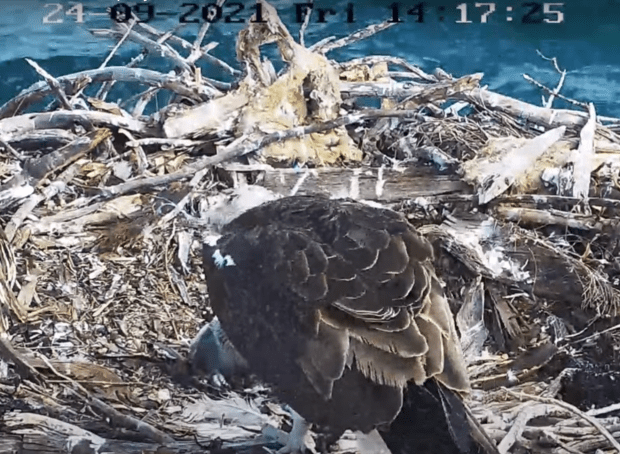
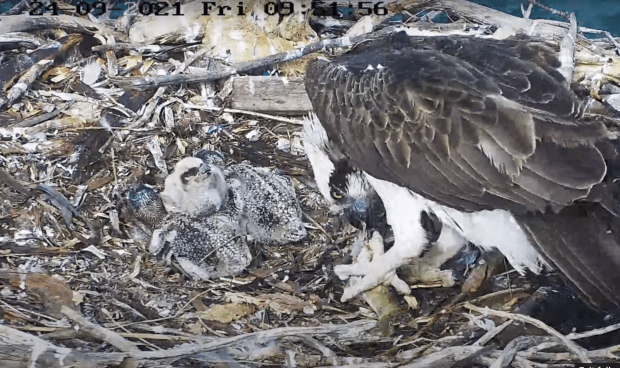
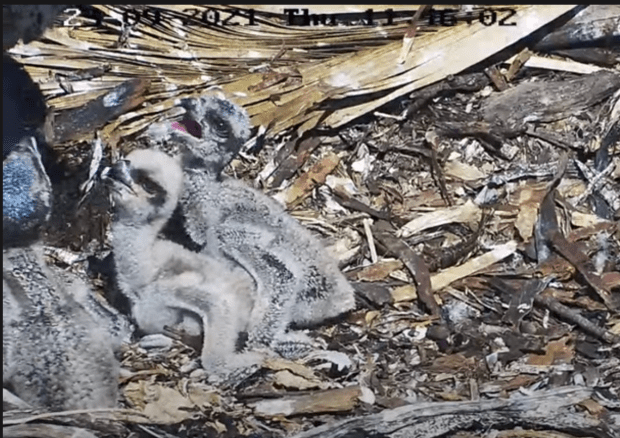
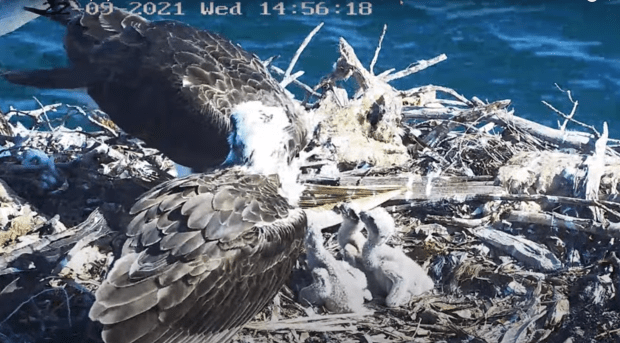
Sometimes it is good to remember and compare. The little Osplets at Port Lincoln have grown so quickly that is seemingly unfathomable that they were like this only a week ago!

There is Little Bob in front the same way that he has been all along. Yesterday Big and Middle Bob waited patiently for their turns while he ate.

Yesterday a very large fish came on the nest at 12:44:16. mom was still feeding and eating at 13:38:39.

This is the beginning of the feeding. You can see the fish. Notice the two older Bobs – Big and Middle – waiting for Little to eat. Then they can have their turns. Little ate a lot and went to sleep. Food coma!

Mom continues to feed Little Bob.

Look at how close in size Big and Middle Bob are to one another!

Little Bob is out for the count and now Mom is feeding one of the older siblings. They waited nicely. No pecking. Just patience. Wow.

You can see how much is left of that big fish – the tail and a bit. Little Bob has woken up and Mum is feeding him again! They will eat the entire fish.

That will give you an idea as to how much has changed regarding their consumption. A week ago that fish would have lasted all day. Now it is only one meal. The osplets are able to eat lots more at a sitting.

Awww. Mum is checking with Little Bob to see if he wants some more bites before she eats. And, yes, of course he does. Why am I surprised? This little one is an endless pit.

They have all passed out and now Mom can eat the last of the fish and the tail. She needs food, too!

At 16:02 they are still asleep or just waking and continue to have large crops.

The cam operator pulls the image out and you can see that the Mom must have had a small piece of that earlier fish hidden. She is topping off the little ones. Remember. They will double their size in four days!!!!!!! Wow.

The golden glow of the sun setting is kissing the Port Lincoln Nest. Everyone is full and happy. It has been a civilized day. All of the chicks are now into their extreme growth period with their reptilian plumage (or lack of).

Did you know that a group of Ospreys is called a ‘duet’? I didn’t. Hawks Aloft published that fact today. They said it is because Ospreys are solitary. They only pair up for breeding season. They also said that it was because the pitch of the male and female is different so when they are calling, it sounds like a duet. Interesting.

I do think that David Gessner and others Osprey watchers in Cuba would disagree with the statement that they only pair up for breeding seasons. The reason I say that is when I first read it, I went ‘wait’. Large flocks of Ospreys have gathered together to fly over the Sierra Maestra Mountains in Cuba. Gessner wrote about this in his book, Soaring with Fidel. So do Ospreys gather together when it helps the group? only in pairs for breeding? and are solitary when it comes to fishing? They certainly don’t seem to help one another like the American White Pelicans who, together, get the fish to swim to a certain shallow spot so they can all feed. It is all curious.

Yesterday Tiger Mozone and I questioned why certain Ospreys are violent. The comment was related to the Port Lincoln Ospreys. Is it in the DNA? is it a result of toxins in the water that have concentrated in the fish and then in the Ospreys? Dr Greene at the University of Montana has studied heavy metals. Is anyone studying the toxins in Australian waters? I have not had time to look into this but will as well as the suggestion of the DNA connection.

It is now 04:49 in Port Lincoln. Mom is trying to sleep. Let us all wish them a great fish day. I will bring updates later tonight.

Thanks for stopping by. These little ones are growing fast and behaving themselves. Thank goodness. Take care everyone.

Thank you to the Port Lincoln Osprey Project for their streaming cam where I took these screen shots.

Godwits…and more

I have heard the name but have never seen the bird – or, at least, I do not think I have. With my lousy shorebird IDs, I might have even confused this beautiful long-legged shorebird with a Greater Yellowlegs. Of course, everyone would have laughed.

Godwits are ‘very’ long legged shorebirds but their legs are not yellow! Their beak is ‘very, very’ long and is bi-coloured – light rose and espresso -and ever so slightly upturned at the end. They are called waders because they live in the mudflats and the estuaries. See how their legs go deep into the mud, too. They feed by sticking that very long beak into the mud, rooting around for worms and small shellfish.

“Bar-tailed Godwit” by naturalengland is licensed under CC BY-NC-ND 2.0

The breeding adults have a chest that ranges from a deep terracotta for the males to a brighter orange for the females. The wing and back feathers are more brown and white overall with a touch of the breast colour, sometimes. They have gorgeous dark eyes.

“Bar-tailed Godwit” by 0ystercatcher is licensed under CC BY-NC-SA 2.0

The juveniles have a cream coloured breast with overall brown and white feathering.

“Bar-tailed Godwit” by 0ystercatcher is licensed under CC BY-NC-SA 2.0

What is so miraculous about these shorebirds is their migration. They breed in Alaska and fly in September to New Zealand! They make only one stop, normally. And they do the trip in record time. It is an 11,265 kilometre journey or 7000 miles. They accomplish this in eight days! Yes, you read that correctly, eight days.

“Bar-tailed Godwits” by naturalengland is licensed under CC BY-NC-ND 2.0

Neils Warnock, the Executive Director of Alaska Audubon in 2017, remarked,These godwits are epic migrants. We had a bird, E-7, that we had tagged, and she left New Zealand in the spring. She flies non-stop seven days, ten thousand kilometres, to the Yellow Sea. All of the Bar-tailed Godwits of Alaska, they stop at the Yellow Sea.”

The Yellow Sea is located between mainland People’s Republic of China and the Korean Peninsula.

Historically the mudflats of the Yellow-Sea have been rich with food for the Bar-tail Godwits so they can fatten up and make the rest of the journey to their winter homes in New Zealand without having to stop. Today, the mudflats of the Yellow Sea are under threat – they are disappearing with coastal development. This could prove to be a major challenge for these beautiful shorebirds. There have been many studies and the researchers have seen a drop in the number of shorebirds by 30% in the last few years because the mudflat areas have been reduced by 65%.

https://www.science.org/news/2017/04/migrating-shorebirds-danger-due-disappearing-mudflats

The reports of the shrinkage of the mudflats has been coming in since 2013 with alarms sounding.

Today the Pukorokoro Miranda Shorebird Centre in New Zealand reported that Bar-tailed Godwit 4BYWW made his flight in 8 days and 12 hours arriving home at 03:00 on 26 September. He flew 12,200 km. His average speed was 59kph. 4BYWW may have set a new distance record for the Bar-tail Godwits. We will know when the others return home. Isn’t that amazing?

What I found most interesting was her route. She does not appear to have gone via the Yellow Sea. Is this because of the decline of the mud flats? Have the birds adapted their migratory route? I definitely want to look at this more closely.

This was the satellite tracking image posted by the Pukorokoro Miranda Shorebird Centre FB page:

The Centre was tracking another four adults and 3 juveniles on their journeys home. One of those, 4BWWB, has been reported as flying non-stop for 163 hours and over 10,000 km. Seriously, my head can’t comprehend what that must be like. I am also truly amazed at what these sat-paks can tell us about the birds and their amazing resilience. Just incredible.

Tiaki officially fledged on the 25th of September. The Royal Albatross cam chick of 2021 is foraging off the coast of New Zealand at the present time. She will eventually make her way to the waters off of South America near Chile. We wait for her return in four to six years to Taiaroa Head where we will hear that beautiful Sky call, again.

While millions and millions of birds are moving from their summer breeding grounds to their winter homes, others are waiting for eggs to hatch. Holly Parsons posted a table of Diamond’s incubation history.

Xavier and Diamond’s first egg was laid in the scrape box on top of the water tower at Charles Sturt University in Orange, Australia on 31 August this year. Cilla Kinross, the main researcher, is expecting a hatch from 6-9 October with the most promising day being the 7th. Can’t wait!

Diamond was catching some sleep this morning. If all of the eggs hatch, her and Xavier are going to be very busy!

If the hatch is expected around the 7th of October at Orange, then what about those Melbourne Peregrine Falcons? The first egg was laid on the 21st of August – yes, that is right. Ten days before the Orange falcons. So, I am going to be looking for a hatch at Melbourne starting in two days!!!!!! This means that all of the Melbourne eggs, if viable, will hatch before those in Orange. It will be nice to get to enjoy them without trying to watch both at the same time!

For those of you wondering about those beautiful White-bellied Sea Eagles, 27 and 28, here they are. Talk about gorgeous.

Things will really be starting to ramp up shortly. Bald Eagle breeding season in the United States begins in a few days. Looking forward to checking on some nests to see if the birds have returned – such as Anna and Louis who had the first hatch on a nest in the Kisatchie Forest last year since 2013. His name was Kistachie – very appropriate.

Then there is always the trio at Port Lincoln. They had two feedings this morning and a third at 11:31:27 when Dad brought in a very small fish. All of the chicks were well behaved – quite civil to one another. And, of course, Little Bob is right there in front! Look carefully you can see him.

Life is good. Everything seems to be going really well for all the nests.

Thank you so much for joining me today. I hope you enjoyed learning about the Godwits as much as I did. Incredible birds. Take care everyone!

Thank you to the following for their streaming cams where I took my screen shots or for postings on their FB pages that I have shared with you: Port Lincoln Osprey Project, 367 Collins Street Falcons by Mirvac, Falcon Cam Project at Charles Sturt University and Cilla Kinross, Pukorokoro Miranda Shorebird Centre, Sea Eagle Cam @Birdlife Australia Discovery Centre, and Cornell Bird Lab and NZ DOC.

Feature image credit: “Bar-tailed Godwit” by 0ystercatcher is licensed under CC BY-NC-SA 2.0

Sea change for Little Bob

People were thinking that Little Bob was days behind Big and Middle Bob. It was only 51 hours hatch difference between Big and Little. Today, it is hard to tell them apart. They are a pile of black reptilian creatures. Precious still.

Yesterday there were six feedings on the Port Lincoln Osprey Nest: 06:10, 08:39, 12:25, 16:20 17:03, and 18:25. Everyone had crops.

All are doing fine. Yes, Big Bob does want to try to throw her weight around on occasion but, so far Mum has sat on them before it could get bad. I just hope Little Bob learns to protect its neck!

Today, the first feeding is just finishing. The golden rays of the sun fall on Mum and Dad as he delivers the fish at 6:37:35. Thanks, Dad! This is the best way to start off the day!!!

It is 11 degrees C and the wind is blowing at 19 kph. That is up 8 from yesterday. I do wonder if Dad fishes better in choppy weather???? It doesn’t make sense but, hey…he brought in lots of fish when there were white caps and the winds hit 34 kph and less when the wind is below 11 kph. I wonder what is up with all of that??

You can, for the moment, still recognize him a bit. Little Bob is lighter and he is turned around ready to jump over Big Bob to get to be first in line.

Now notice Little Bob’s crop. It is very big this morning but he is going to drop it. The food that he was holding in store will now be processed making room for his breakfast.

With all of the talk and the reactions of Big Bob wanting to dominate, Little Bob got to eat first.

And Little bob is still eating! This little osplet is not shy when it comes to fish.

It is such a relief to see a fish land on the nest so early in the morning. Hopefully this will set the tone for the entire day. All of the chicks are entering the rapid growth period. They will double their size – and by tomorrow, Little Bob will be black. You will really have to look hard to tell which one he is. I don’t know about you but Little Bob looks almost as big as the chick on the right. Maybe it is the camera playing tricks on us. What do you think?

Thanks for stopping in today. Everything seems to be on hold. The Bald Eagles in Florida are working on their nests, 367 Collins Street falcons are still incubating eggs as are Diamond and Xavier. The WBSE 27 and 28 are growing and growing and seem to be getting along fine. Tiaki has fledged. Birds are migrating all over the world. It was a really beautiful day on the prairies.

Take care. See you soon.

Thanks to the Port Lincoln Osprey Project for their streaming cam where I took my screen shots.

Late Friday in Bird World

It is 10:16 in Australia as I begin this short newsletter.

The osplets on the Port Lincoln barge had a small fish between them around 06:15. They have had nothing since and Big Bob is getting a bit restless. Sadly, he has been pecking Little Bob’s neck and Little Bob is going to have to learn to use his backside to protect himself when this happens. So far the beaking has not been too bad but, as all of you know – this Osprey nest makes me nervous. I will not be able to relax until Little Bob is a little older. It seems that Big Bob is trying to establish nest domination. Tiger Mozone wondered on the chat about DNA causing excessive aggressiveness in the chicks. Certainly this nest has a history of that type of behaviour. I also wonder about toxins in the water that enter the fish and stay in the tissue of the Ospreys.

Mom was hopeful around 09:45 and the chicks were in line to eat. Their crops have dropped from the small fish three and a half hours earlier.

The chicks are being fed more fish and for a longer period. What was six minutes a week ago has stretched into 45 minutes at the table. And these chicks will be fine today if a big fish does not come on the nest for a few more hours. The issue is Big Bob who seems to want to press his authority by fighting with the other two. Middle Bob is the clever one (so far) and seems to be able to stay out of the way but Little Bob still needs to learn how to protect itself.

The two older chicks are moving straight into the rapid growth period where they need lots of fish. Little Bob is following as quickly as he can. You can see that he is moving into the reptile phase himself. The dark feathers are coming in and he is losing the down on his head. Big Bob is awfully dark and a bit scary looking! He is the one holding his head the highest and looking towards you.

It is nearing noon, nest time. Dad has come to the nest without a fish. Is there a predator in the area? I actually thought that this nest was relatively free from predators unlike those in Europe and the US that have to deal with Goshawks, Great Horned Owls, etc. Or has Dad arrived to get the meal order from mom?

I couldn’t help myself. I had to check. Dad must have been taking the fish order at 11:25 because he delivered a fish to the nest around 12:25. Thank goodness. Big Bob behaved himself and everyone is getting to eat.

Look at who has his little mouth open wide!

Little Bob ate first. You can see from the crops. Middle and Big will eat next and by the time they finish, Little Bob will be hungry again. I hope that fish is big enough!

The big news over in New Zealand is that Tiaki has fledged on 25 September. She was 244 days old. Both her and Plateau Chick left the headland but, it has not been completely determined when that was. By the sat-pak it seems that Tiaki might have fledged at night but sometimes that sat-pak GPS requires adjustment. We all wish her a wonderful safe life, full of fish, and a return to us in five years time.

You can follow her satellite GPS. I will put the link below the fledging video.

Cornell Bird Lab caught the moment:

Here is the link so that you can check on Tiaki. Her satellite tracker should continue working for a year until her first moult. You can follow her dad, LGK also. His tracker should be good til he moults – another couple of months. There are only six chicks remaining to fledge.

https://my.wildlifecomputers.com/data/map/?id=6008d9ba31af59139976bcfe

The migration continues in Manitoba with everyone is excited. There are dawn breakfasts and evening dinners celebrating the arrival and departure of the Canada Geese – and, of course, the swans and all the other ducks and birds. Today marked the return of the Dark Eyed Junco to Winnipeg. Oh, people are so happy to see these adorable little birds. There are several sub-species of Junco and the one that visits Manitoba in the summer to breed is called the Slate-coloured Junco.

The Juncos love my red outdoor carpet. Tomorrow or the next day there will be 50 or more hopping about on it and jumping in and out of the dill. They love it if we ‘intentionally’ spill some seeds on the carpet. They are better than a vacuum clearing them up if we do. They do not feed at the feeders but are also seen on the ground for invertebrates. Isn’t this a real cutie? It was definitely not shy. The image was shot through a triple pane of glass so as not to disturb the bird. It seemed to not notice me.

Today, Mr Blue Jay had two other Blue Jay male visitors that wanted to help him eat his cob of dried corn.

By the time dusk arrives, the Jays and the squirrels – both red and grey – had made a real mess of the seeds. I think one of the squirrels wanted some of that corn but the Blue Jays were not having it. They would eat 3 or 4 kernels and then take some away in their beak. It was fascinating watching them through the windows.

Little Red decided it was easier to get up in the lilac bushes and balance himself on the bird feeder and eat his dinner there. Contending with three male Blue Jays was not something he wanted to do. So he kept quiet and ate and ate. He also doesn’t get on with the Grey Squirrels. He has picked a good place to eat in peace and quiet.

Awwww. Look at those tiny little nails.

It was a good day. All of the garden wildlife save for the rabbit were accounted for. There were also several new species of sparrow in the lilac bushes eating seeds. There were Chipping sparrows as well as Clay Coloured Sparrows today.

Hatch watch is coming soon for the 367 Collins Street Peregrine Falcons. WBSE 27 and 28 are doing well. 28 actually managed to get a prey delivery today. Here is a short video showing 28 mantling the prey and then wanting to share it with his big sib. They have their beautiful juvenile plumage and are so adorable.

I also checked in on the Bald Eagles who are working on their nests. Will put in a report some time this weekend. I know that many of you are anxious for Samson and Gabby, Harriet and M15, as well as Jackie and Shadow to get those nests built and those eggs laid! And while the last of the Albatross are fledgling, it will not be that long til the other adults return to Taiaroa Head to make their nests and lay their eggs for the 2022 season. Sometimes time feels like it melts in front of our eyes.

Thank you for joining me. I have promised myself that I am not going to worry about the Port Lincoln Ospreys tonight. The crazy thing is that I wish the winds would pick up. Dad seems to be able to fish better when that is the case. Yes, I know. That is a crazy idea. Take care all of you. Stay safe. See you soon.

Thank you to the following for their streaming cams where I took my screen shots: Port Lincoln Osprey Project, Cornell Bird Lab and NZ DOC, and Wildlife Computers.

Bird World Happenings

There is a lot of news in Bird World this morning. Early sat-packed Ospreys are finding their way to Africa. A 2013 hatch from Rutland, the famous 4K, arrived on the coast of guinea on 23 September at 17:00. Chris White has also sent photos of other unringed Ospreys arriving. So nice to hear they are safe.

Sharon Leigh-Miles posted a long list on the Montana Osprey FB Page. Sharon reported the following (abbreviated):

First out of the gate for migration was Avery. Many of you know Avery. She is from the Class of 2016. She returned to her nest by the Yellowstone River about April 19, 2021. This year she fledged three healthy chicks again. Dr. Marco Restani of the Yellowstone Osprey Project banded her chicks. Avery must have needed a rest because she left for her home in Veracruz about September 1st. Avery’s sister or half-sister, Boots, Class of 2018, seemed to find a home in Idaho this year. She is now on the coast of Louisiana. It is decision time for Boots. Will she fly east to Cuba, her first winter home, or will she veer back westerly and return to the Chiapas, Mexico? We believe hurricanes and tropical storms may have blown Boots off course last year and she settled in Chiapas. We have three chicks that fledged on MPG Ranch in the Bitterroot Valley. Kove was banded and outfitted on July 21, 2021. He was the eager beaver and left on his first migration on September 11th. He is currently right outside Tampico. Lupine from the Class of 2020 found her winter home slightly northeast of Kove’s location. Sainfoin was banded and outfitted on August 10th. This chick left on migration on September 16th and just crossed the border into Mexico. Rio is our last chick this year. She was banded and outfitted on August 10th as well. Rio seems to think that having fish delivered and having a full crop is just the ticket, as she is still at her natal nest being supplied by her dad. Don’t worry. The urge to migrate will soon move her south. In addition to Lupine, three additional ospreys from the Class of 2020 remain at their winter homes. Zinnia and Dahlia have made Louisiana their winter home. Lucky settled down on the coast of Tabasco, MX.” Thanks, Sharon!

Satellite Packs and even simple banding give us a lot of information about the travels of our beloved birds. Audubon FL reported that a Banded juvenile Bald Eagle Green K/48 from Florida was located far from home in Virginia. Have a read:

https://fl.audubon.org/news/banded-eagle-spotted-hundreds-miles-nest-site?fbclid=IwAR3nNRp2wMD5NjudQ_vUwAoexk2NMJiWABT6FGFBWmL6XeDxMzXYnaJsnns

There are currently only 10 Albatross chicks left on Taiaroa Head, NZ. One of those is Tiaki. Tiaki is the Royal Cam chick of the year, daughter of LGL and LGK. She is a beauty. She has already mastered hovering and when Tiaki decides it is time to fledge, we will all be cheering for her. We can also watch her travels because she also has a sat-pack!

If you are a fan of Turkey Vultures, the San Diego Zoo announced that it has successfully hatched an Egyptian Turkey Vulture in captivity.

https://www.kpbs.org/news/2021/sep/23/first-egyptian-vulture-bred-captivity-san-diego/?fbclid=IwAR32UpOxdtf2MCrJx5-3jlE62cpSE7gEG5bvTdvvlsJGWLPMQeGXl3nAWBM

Last but never the least, the Port Lincoln Ospreys had several feedings after I turned out the lights on the Canadian prairies. Dad brought in a whale at 13:56:56. Mom was still feeding the chicks at 14:29. That is a total of 34 minutes. It is good to compare this with earlier feedings that were only 6 minutes long. It will give you some idea of the amount of food the chicks are now consuming. There was another feeding at 15:04:54 and again at 16:03. The kids – each and everyone of them – had nice crops! It was a good day in Port Lincoln.

At 12:51, the trio still have crops from their earlier feeding.

Look at that great fish Dad just delivered!

More than half of it was gone at the end of the feeding. Remember when this fish would have lasted all day?

Mom cleaning her beak at the end of the feeding.

Happy babies wanting more.

Their crops are full. one is passed out in a food coma. Little Bob and one of the older siblings are holding out for a bit more. Little Bob never leaves the table early. He seems to have an endless pit.

The Port Lincoln chicks are all doing well. Little Bob is beginning to lose the soft down on top of his head and you can see the dark feathers coming in. Little Bob is 51 hours younger than Big Bob. He will be catching up in plumage very soon. There are a lot of people that think that he will catch up in size but, the general rule – rules, of course, always broken – is that the third hatch is a male. If that is the case with Little Bob then he is going to be smaller than Big Bob who is probably a female. At least 30% smaller.

Everything is wonderful in Bird Land. Lots of good stories about migration coming out.

Thank you so much for joining me. It is another grand fall day with summer temperatures on the Canadian prairies. Take care everyone. See you soon!

Thank you to the Montana Osprey Project and Sharon Leigh-Miles for allowing me to use their information from their FB page. Thanks to the Port Lincoln Osprey Project and the Cornell Bird Lab and NZ DOC for their streaming cams where I took my screen shots.

Port Lincoln Osprey Nest, check in

Today was a day for me to go outside, walk, and enjoy a beautiful, warm, fall day in the country. I did check on the Port Lincoln Ospreys before I left and Dad had brought in a fish and they were eating. It is now noon in Port Lincoln, Australia and there have been two feedings. Everything is fine. I believe the following images will dispel any concerns. We had great days with 8 to 10 feedings and then they slowed down. The chicks are older and their crops can hold more so they get more food but there are less feedings. The older two are in the reptile phase. Some people love the rubbed oil effect and the bald heads, the dark plumage – I am usually glad when they get through this phase!

So here, with little narration are some images from the first 4 hours of the day. Check out the time stamps as you go through.

I love the golden rays of the morning sun falling on Mom and the nest. She is really beautiful.

First feeding. None of the chicks are fighting and this fish came in much earlier today than yesterday (past noon).

Mum makes sure that everyone is full. You can see, look carefully, that all three chicks have nice crops. She is still checking to see if Little Bob wants any more bites.

Right now it is really easy to tell Little Bob from Big and Middle Bob.

Mum is eating some fish. She deserves to eat just like dad and it is hard to get bites in with these three. But, look, does Little Bob want some more fish?

If anyone says this mum feeds herself before her osplets, they are wrong. She is breaking off a piece above and below she is offering it to Little Bob to make sure that he is full.

Look at the crops and the bald oily looking heads. Oh, dear! These kids are changing right before our eyes.

Oh, gosh. Little Bob just finished and now the other two are up at the table again. Mom is feeding both Big and Middle again.

“Last Call at the Fish Bar!”

Mom lets them fall into food comas and makes sure they are covered and warm. Maybe they will sleep for a few minutes.

Oh, no. They are starting to wiggle their way out. Just look at those pin feathers. These babies are going to be doing a lot of preening very soon.

An hour later and Mom is feeding them again. This is feeding 3 and they still have crops from the earlier feeding. No one is going to feel hungry today.

Little Bob stays up at the table. The other two are full.

Finally – food coma.

Happy, full Osplets sleeping in a pile!

There will be more fish meals today. These three are doing fine. We had one worrisome day. Let us all hope that is the last for this family. Right now – in this very moment – all is well.

Take care everyone. Thanks for stopping in. See you soon!!!

Thank you to the Port Lincoln Osprey Project for their streaming cam where I took my screen shots.

Fish delivery at PLO. Tears of joy.

It is 11:36 on the Port Lincoln Osprey Nest and Mom is still waiting for Dad to bring in a fish. I have peeked but, she is up and waiting and hopeful. The chicks are behaving themselves. That is a relief. I don’t know what will happen when the fish does arrive on the nest. Thinking positive!

What is very noticeable is the change in appearance of the two older osplets from yesterday. They have really lost that light down and are quickly transitioning to the reptile stage. That is part of the reason that they might have looked ‘skinny’ to some on those days when they were full with crops.

Hatch Information:

  • Big Bob. 13 September. 22:03
  • Middle Bob. 14 September. 02:30
  • Little Bob. 16 September. 00:51

Little Bob still has the light down. It is difficult to distinguish between big and Middle sometimes but I believe that the chick on the left is Big Bob and the one on the right, Middle Bob.

Oh, joy. 11:44:35. It looks like the chicks are anticipating a feeding.

And it looked like shadows of parents moving. Sadly, the camera angle is focused here and we cannot see for sure. I really hope that there has been a fish delivery. These three are behaving themselves but they are really, really hungry ——– and so is Mom!

Waiting.

Fish? No Fish? I think that I am full of anxiety as I watch these three. They are not fighting. They are waiting. Is there food for them?

It is 12:13 on the nest. If a fish was caught, it has not come to the nest nor have the chicks been fed. Mom is calling loudly.

They are still waiting for lunch. Look at the image above and notice where Little Bob is. Now look at where he has gone in anticipation of a fish delivery.

The view from the nest.

Mom is working hard to keep them focused on her so they will not fight.

The real fish finally came in. 12:46:07. Mom does not need to do the fake feeding anymore!

Little Bob is curled up. No doubt they are hungry and their energy is depleted. There is enough fish for everyone. He can wait and let the others get theirs first.

This is very unusual for Little Bob. He is normally up at the table immediately. Big Bob has come up to eat. Wake up Little!

Little Bob came around! You can see his crop getting fuller through the sequence of images. Look at that crop on Middle Bob who is on the left. Then Big Bob and then Little Bob.

It is a nice fish. Mom really needs to eat too. I hope she fills these three up until they pop.

Everyone is happy and behaving themselves. That is also a relief after the earlier skirmishes around dawn.

One last image as those crops get fuller and fuller.

I am just so excited to tell you the good news. These little ones will be full for a bit. They can eat more and I hope that mom continues to feed them – like I said, til they popped. Continue to send warm wishes and positive thoughts to this nest. It is at such a vulnerable stage today.

I am sending this off toggled to my phone as our Internet is out. So thank you again. Take care everyone.

Thanks to the Port Lincoln Osprey nest for their streaming cam where I took my screen shots.

Trouble at Port Lincoln?

Yesterday there were not as many fish deliveries as there had been on the days when the wind was blowing at 34 kph. It was a bit concerning but the chicks seemed to be fine.

The PLO camera was down for a long time – frozen. The temperatures are cool but the winds are only around 11 kph. It is now after 8:45 am and no fish delivery yet. The chicks are fighting and hungry.

Mom has called and has tried to sit on them. This is a tragic turn of events if a large fish doesn’t come on this nest soon. They need the food – constantly. This is day 9 and 10 for these chicks. I continue to remind myself when watching the events this past hour that Tapps left us on day 18.

Why is this happening? That is my big question. The Dad has been good. Things let up a bit yesterday in terms of the deliveries but — please send your good wishes to this nest. Things can change in a second and we want the civil state and full chicks back.

One of the key persons with the nest said, “​In this phase, you will notice feedings further apart, but they will stuff those crops which now can handle a bit more. A bit slower growth than some are use to, different continent.” I hope she is right!

Thank you to the PLO for their streaming cam where I took this image.

Wednesday in Bird World

Lady Hawk has posted some close ups of the Royal Albatross cam chick, Tiaki, doing some wing exercises. Tiaki is all grown up, a beautiful juvenile, the daughter of LGL and LGK. She will fledge soon beginning her five or six year journey at sea – never touching land – til she returns to the headland to begin finding a mate. Perhaps one day Tiaki’s chick will be the Royal cam chick. I do hope so. It will mean that the seas are safer places for our beautiful squid eating birds.

“Masked Bobwhite (female ) (subspecies of Northern Bobwhite) | BANWR | AZ | 2016-04-15at07-43-413” by Bettina Arrigoni is licensed under CC BY 2.0

The Audubon Society has posted some really good news. The Masked Bobwhites are once again seen in southern Arizona. They were believed to be on extinct or on the edge of extinction because of cattle grazing in the Arizona deserts. Today they are listed as ‘critically endangered’.

They are a small round quail. When I was a child, we would travel to visit relatives in Arizona every summer. Oh, was it hot! But there were always Bobwhites. It is nice to hear that they are now returning.

This photo was taken on the 10th of September. I wrote about it at the time because in migration news, this is great. The son of Aeron Z2 and Blue 014 at the Pont Cresor nest in the Glaslyn Valley – and the grandson of Monty and Glesni – had reached Brittany. That was 12 days ago. He would now be further on his migration, perhaps stopping in Spain. The photo of Blue 494 was taken by Colette Leclerq.

Photo by Colette Leclerq, Brittany France

Speaking of migration and waiting and wanting news of Blue 464, it is more than time to check on the Black Storks from Latvia and Estonia.

First up, Karl II, his daughter Pikne, and his son Udu. They are from the Black Stork nest in the Karula Forest in Estonia. This map is taken from the Karl II migration pages of the Forum.

Udu is now in Hungary near the fishponds at Banhalma. Karl II remains around Kherson Oblata in the Ukraine. Pikne has doubled back and remains in Moldova. What I think is interesting about this map is that Udu has turned and is heading towards the Asia Minor route. There was a question as to whether he might go the western route to Africa but it seems he will be flying over Greece.

This is the data from BirdMap. You can access the BirdMap here:

http://birdmap.5dvision.ee/EN

I was wanting to see about the Black stork Julge. He is Jan and Janika’s only surviving chick this year. He is now in france. You can see him still heading over the westerly routing.

The birds that are in the centre of Africa are two Ospreys!

So far everything looks in order and everyone is still safe.

I cannot bring you a late afternoon update on the Port Lincoln Ospreys. The camera was frozen for most of the day and has just returned to normal. Mom has the kids covered tight. It is only 8 degrees at 16:00 with winds blowing over the water at 11 kph.

I can show you a bit of what a beautiful day it was on the Canadian prairies. I really need to practice with my camera and my tripod. These are some images today taken at a distance of about 68 metres. I found the tripod tricky to use – I need a counterbalance for it – so these are all hand held. The set up was heavy. But there were a few passable images.

A female Mallard. This species is very common in Manitoba. They have, on occasion, fooled me so I have had to go to our local eBird expert. This is a real beauty.

The Canada Geese would like the entire pond to themselves. They swim after and honk as they pursue the ducks.

There is your dabbling duck. She knows that goose is there but is trying to ignore it.

The park was just beautiful. It was 25 degrees today. One of the fountains was not working and that end of the pond had men working. Still the geese on the other side were a bit curious.

All of the Wood Ducks were either up on the islands or down by the fountain that was working. This is a female and she is such a cutie. I sat and watched her swim in and out of the water droplets for quite awhile.

Thank you so much for joining me today. Tomorrow is a day away chasing shore birds. I hope to have a posting tomorrow evening (Thursday). Take care everyone. Stay safe. Stay Positive!

Thank you to the following for their streaming cams or FB pages where I took my screen shots: Port Lincoln Osprey Project, Friends of Ospreys, and to the Eagle Club of Estonia, BirdMap, and the Latvian Fund for Nature.

Everyone is Fine

One of the problems with the streaming cams is the ‘chat’ feature. There, I have said it. The same persons come on at different times of the day, every day or every other day and say the same negative things. There is one on the PLO chat that always says, ‘The mother never feeds the youngest’. ‘Mama feed in order never feeds youngest.’ Seriously! Either they can’t rewind, they don’t watch, or they just want to stir the pot of negativity. I think that it is all three. So I go back to an old cry out of mine, Streaming cams need 24/7 knowledgable moderators. They need them to stop the bots coming in and they need them to stop the negative chatter. Even more so, if something happens on the nest they need to have emergency numbers to call or place them on the streaming cam site at the top.

The Port Lincoln Osplets are doing fine! And it is something to celebrate. One of the most exciting things is to watch them grow and grow they are. these chicks are losing their light grey coat to get their second, darker grey down. You can see the little pin feathers starting. still, each retains a tiny bit of its egg tooth. The feet are getting bigger, wings are growing and the tiny tails are starting. If you didn’t know the different species at this age of 9-10 days, just look at that beautiful dark mask going from the cere to behind the eye. that is the distinctive bandit mask of the Osprey!

Dad comes in with another fish. the big one that arrived earlier is all gone.

The chicks are getting bigger and they don’t like sleeping under Mum like they did when they first hatched. Indeed, these little ones seem to be tumbling around underneath her much of the time.

Awwww. Such sweeties.

Because it is winter in Australia, the light changes early. Mum and dad are on the nest and the little ones are getting another feed. Notice how much they have grown. It is as if someone took them and stretched them in the last couple of days. They no longer appear like short fat little chicks but they are entering another phase where they will begin to look like thin reptiles with long necks.

Each is doing fine. There were not as many big fish yesterday as during the high winds but everyone was fed and no one was left out.

I literally checked into the White Bellied Sea Eagle nest to see how WBSE 27 and 28 are doing. Lady was feeding them.

That is WBSE 28 at the front of the nest with its big crop. 27 is practicing its self feeding with a small piece of prey.

This nest will have two fledges this year. I so hope the Pied Currawong do not chase them out of the forest so they can fly and return to the nest for more meals while they get their piloting in order.

Lady Hawk did a video of 27 learning to self-feed and 28 nibbling at her toes. Have a look:

The strongest earthquake in recorded history hit Melbourne, Australia yesterday.

https://www.heraldsun.com.au/news/victoria/earthquake-tremor-felt-across-melbourne-and-regional-victoria/news-story/f8dca1048e48a500e3308dabedfdb1c1

The first thing many thought of were the four eggs of the Peregrine Falcons at 367 Collins Street.

Dad was on the eggs at the time and stepped off wondering what was happening.

Everything appears to be fine. Some buildings were damaged but no one was killed. Thankfully! We are nearing hatch watch for this couple.

In Orange, the running joke has been Xavier wanting his time to incubate the eggs.

Xavier doesn’t want to give up his incubating time!

Do you know why the male Peregrine falcon is called Xavier? It is one of those heart wrenching stories that makes you love this little male bird even more.

Diamond’s eggs were ready to hatch. Her mate, Bula, disappeared and was presumed dead. As we all know, the chicks would have died. Instead, enter a new male who starts helping with the chicks and raises them as if they were his own. Because he was a ‘saviour’ of the family, he was named Xavier.

The researcher at Orange is Cilla Kinross. She did a cute video of the negotiations between Diamond and Xavier over the incubation duties.

Everything is changing at these four nests in Australia. The White-Bellied Sea Eagles are exercising their wings, jumping, and hopping about. They are getting more adept at self-feeding although 27 still is the one that gets to the prey first it seems. Lady does come in and feed them. Branching will be next but not for a bit, thankfully. We will be watching for the four at Collins street to hatch in about four or five days. Diamond and Xavier’s chicks will follow but not for a week or a little more. And, of course, the change in the Osplets at Port Lincoln will be significant. They will look like skinny reptiles all wound around one another. The key is that everything, at this moment in time, is just fine. There are no worries. So enjoy them!

It is another beautiful fall day in Manitoba. The Green Heron has departed and I always missed it. Perhaps another will come next year! The Blue Heron is also gone but I hear there are waves of Dark-Eyed Juncos headed towards the city. I cannot wait. They love to pick apart my red outdoor carpet. Such cuties. I am going out for a long walk and to check on the Wood Ducks. Perhaps they will cooperate and there will be some good photos for me to share with you.

Thank you for stopping by. Check out the streaming cams – the birds are doing great. And, if you feel up to it, shut down the negativity. There is already enough in the world. The birds bring us joy. Take care all. See you soon.

Thank you to the following for their streaming cams where I took my screen shots: Port Lincoln Osprey Project, 367 Collins Street by Mirvan, Falcon Project Cam at Orange, Sea Eagles @ Birdlife Australia Discovery Centre.