Our wildlife rehabilitation clinic has seen a 21% increase in patients in the last week. If you live in Manitoba and have the finances, send them a donation, however small or large. They receive no government funding. Everything is done on a donation basis – as is the case with most wildlife rehabilitation clinics. They have a long list of items they need on their website and all monetary donations are tax deductible.
I know that many of my readers live elsewhere but if this is happening here then perhaps it is happening all over.
There was a very sobering article on that cute little Korora (Tiny Blue Penguin) that is doing well in NZ. Its sibling died because the parents have to go so far to feed. For those that love those New Zealand birds such as the Royal Albatross at Taiaroa Head and wildlife that depend on the oceans to survive, what they are seeing is warming waters which mean the fish move or even die (like the trout did in Montana when the Clark Fork River got too water). It is time we demand that governments get serious and take radical steps to try and stop the situation from getting worse.
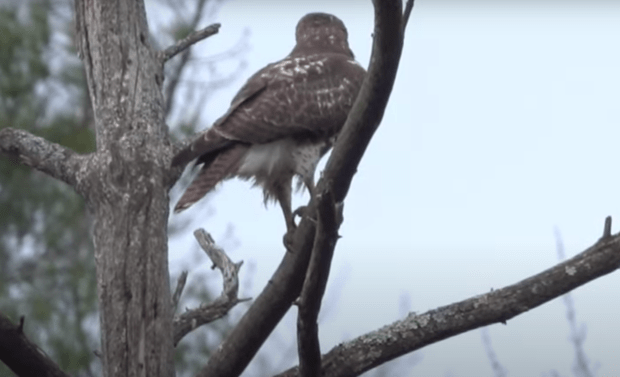
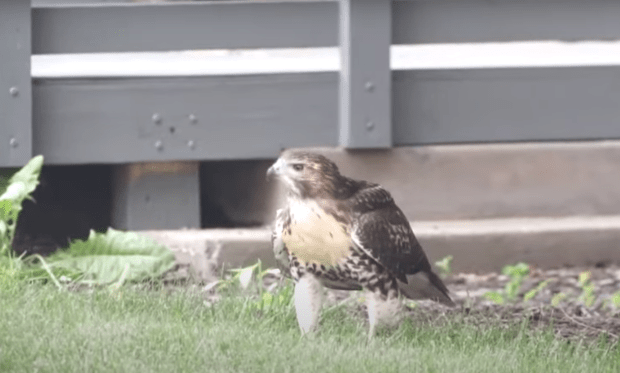
I want to remind everyone of Ferris Akel’s tours. You can go to YouTube, search for Ferris Akel, and hit the subscribe button to the live stream. He has lots of archived video tours as well. They normally take place on Saturdays at noon, Ithaca NY time. Ferris is out at Sapsucker Woods today for Thanksgiving and he has just found a beautiful juvenile Red-tail hawk that is hunting.
Notice the ‘eyebrow’ that helps to keep the glare away from its eyes when hunting. Oh, isn’t this a beautiful raptor?
Ferris just caught a Belted Kingfisher close to the RTH. There have been other birds this morning included Canada Geese and maybe another Kingfisher.
In the summer and fall, Ferris finds lots of shore birds and in the winter there will be owls! You can leave Ferris on like a radio if you are busy or you can watch as little or as much as you like. There is also a chat function with great people who can answer questions.
I am so thankful for Ferris Akel and his tours and his generosity in allowing us to share his images. I have learned so much from him over the years just wish I had a better ear to know which birds are out there by their beautiful voices.
Little Yurruga, the Peregrine Falcon fledgling at Orange, has been seen on top of a building so it is flying alright. Xavier and Diamond have been seen taking food in and out so she/he ? is being provided for. Isn’t this wonderful?!!!!!!
Below is the image that Dr Cilla Kinross took the day Yurruga fledged. She placed it in a tree. What a lovely little falcon you are, Yurruga.
This appeared on the FB Page of the Orange Peregrine Falcons today.
Have you ever wondered about the colour morphing of birds? The Audubon Society has a nice ‘Ask Ken’ article on that very topic! Thanks BM for letting me know!
The NZ DOC rangers at Taiaroa Head are deciding which Royal Albatross couple will be the Royal Cam family this year. There are 36 eggs and they believe that is all for this year. The favourite couple, WYL and BOK, who have made us so happy with their cuddles have not laid an egg – maybe next year! Will keep you posted!
It is a quiet day in Bird World and that is something to be very thankful for – no drama, nothing horrible happening.
Take care everyone. Have a marvellous day. To those having Thanksgiving, enjoy. See you soon.
Thank you to the following for their streaming cams where I took my screen captures or their FB pages: Cornell Bird Lab and NZ DOC, Ferris Akel Tours, Orange Peregrine Falcons FB page and the Cornell RTH FB Page.
There is super news regarding the fledglings. Pont Cresor Blue 494, son of Aeron Z2 and Blue 014 was spotted at Point Caillot in Brittany, France by Colette Leclerqu. Blue 494 was also a historic hatch – the first for the Pont Cresor Nest in the Glaslyn Valley.
Blue 494 has a great pedigree. He is the grandson of Monty and Glesni. Looking forward to his return in 2023!
If anyone hears of someone spotting Blue 463, Tiny Little, from the Foulshaw Moss Nest, please let me know!!!!!! Did you know that Foulshaw Moss was one of only a few Osprey nests in the world to successfully fledge three Osplets in 2021? Achieva Credit Union Osprey Nest with Tiny Tot was another.
I did a short report on the feedings at Port Lincoln in the middle of the night. There were at least two other meals for the three after I shut my computer down.
Mom knows with the cool winds coming off the water that the chicks need to be kept warm. They don’t! They are curious and wiggly and want to look around! Too funny. These three are going to be a handful.
Calypso, the 2019 hatch from this nest, a female, lives and is seen often around Port Lincoln. Solly, 2020 hatch, has a satellite transmitter and continues to stay around Kiffin Island and Eba Anchorage. Solly is 364 days old. Tomorrow is her first year hatching birthday!
The Montana Osprey Project has officially said goodbye to Iris for the 2021 season. She did not return to her nest to say goodbye this year and she was last seen about four days ago on the branch at Mt Sentinel eating a fish.
Here is one of the most iconic of Iris images. For those of you just learning about Ospreys, Iris is the oldest Osprey in the world. She is unringed. No one knows where she spends her winters. Her nest for the spring and summer is at Hellgate Canyon in Missoula, Montana. Iris, we wish you safe travels, great fishing, good weather, a wonderful winter break, and a speedy return to us.
It continues to be a good day in Osprey Land. Wishing for lots of fish for the PLO and great feedings today.
What a treat. An Osprey came into view while Ferris Akel was streaming at Wildlife Drive in Montezuma, New York.
I am off to check on the ducks today. Thank you so much for joining me. Emyr Evans if you are reading this, please open the on line store so we can all order our copies of Monty!
Thank you to the PLO Project, the Dyfi FB Page, Ferris Akel Livestream, and the Montana Osprey Project for their streaming cam where I took my screen shots.
Oh, what a relief to go to the Foulshaw Moss Osprey Nest and see all three of White YW and Blue 35’s fledglings on the nest. Big Sibling 462 had the fish.
Of course, Tiny Little had her back of tricks open to try and get that fish and sibling 462 knows that Tiny Little is getting much better at stealing fish.
So, 462 decides that the best approach is to take off with the fish in talon! Meanwhile, 464 is at the back of the nest, only partly paying attention.
Tiny Little reminds me so much of Tiny Tot from the Achieva Osprey Nest. No matter what, Tiny Tot would dig around in the nest and find food. That is precisely what Tiny Little is doing right now. The first thing she eyes is a nice fishtail.
She eats all of the fish and horks down that tail like the pro at self-feeding she now is.
Then after digging around a little more, look what she finds. Wow. A great big piece of fish. Way to go, Tiny Little.
When she finished those treasures, Tiny Little began to move sticks around. Was this to pass the time? Or was it in search of more hidden treasure?
Both Tiny Little and 464 ‘think’ that a fish drop is imminent. They have seen an adult, and they are both food calling.
Each has tried to find the perfect position to get in close and take the fish from dad, White YW.
And now both have flown off the nest! That fish drop must have been made somewhere else, off-camera. It was so good to see all of them but, particularly, Tiny Little. She is looking really well.
News has come in from the Roy Dennis Wildlife Foundation that this year’s chicks, eight of them taken from nests in Scotland, were successfully translocated to Poole Harbour. They were placed in cardboard boxes filled with moss and closed – kept in a temperature-controlled van. The party stopped in Staffordshire for the night. The chicks were fed then and fed again in the morning. They have all been at Poole Harbour for about a fortnight and will be released the first week in August. Let us hope that the birds that have been translocated return and help build up the population of Ospreys at Poole Harbour in the future.
Roy Dennis’s website is full of information. You should check it out when you have time. Roy Dennis is one of the main individuals responsible for bringing back the Ospreys and other large raptors to the UK. Here is the link:
There should be another hatch – WBSE 28 – today. Indeed, maybe Lady isn’t given up secrets, and we already have two soft little chicks. Meanwhile, WBSE 27 could not get any cuter. It is hard to imagine that this little soft ball of down will be a big sea eagle by October!
I did check on the Collins Marsh chick before things got hectic. By 13:13, the wee babe had at least three feedings. Oh, that was really wonderful to see. This is not a popular Osprey nest. When I look down and see ‘3 people watching’, I know precisely who those three are! This is an image of the last fish delivery around 13:00.
Despite two earlier feedings, our wee babe is happy to tuck in. So three feedings in one morning. That is sometimes better than what happens in an eight hour period on this nest. Yeah, dad! Keep it up. This wee one needs to really grow and begin to put on some fat, too.
Ferris Akel has been out finding that beautiful Roseate Spoonbill, and he has made another video of it fishing. In past images or videos, this gorgeous bird has been in the trees. Here that is for your pleasure:
The White Storks at Mlade Buky are doing fantastic. They come to the nest for food, but it also appears that they are now spending time off the nest doing their own fishing. Here are some images from the late afternoon.
There were always only two storks on the nest. The other one must be catching enough fish to try and be on the nest when Father Stork returns to feed.
They did a lot of preening.
They also did a lot of looking for Father Stork, but he did not show up.
One flies off to the left. That bird will fly over the rooftops and fly beyond the highway on the other side of the tree line about 3/4 from the bottom of the image.
Then the other one departs. What beautiful wings.
Tomorrow I will bring you some more news from the Gough Island Recovery Project to eradicate the mice and rats killing the Sooty and Tristan albatross chicks and adults.
The only news in my garden included the ‘usual gang’ was a Golden-Crowned Sparrow this morning. Not very exotic for sure, but since the heatwave came through, there are fewer ‘visitors’ to the garden despite plenty of water and food.
Thank you so much for joining me today. We will hope that Tiny Little landed another fish before the fishing stops for the day. Regardless she looks really great – and that necklace of hers is more prominent along with her stout legs. I hope you are all doing well. I will look forward to bringing you updates and news about the Gough Island Recovery tomorrow. Take care! Stay well.
Thank you to the following for their streaming cams where I took my screenshots: Cumbrian Wildlife Trust and the Foulshaw Moss Osprey Nest, Sea Eagle Cam, Birdlife Australia, and the Sydney Discovery Centre, Collins Marsh Nature Centre Osprey Nest, and the Mlade Buky White Stork Cam.
If you hear the name Ferris Akel, you might recognize the individual that gives a regular Saturday afternoon virtual birding tour of the area around Montezuma National Park, Wildlife Drive, Sapsucker Lake, and the Cornell Campus at Ithaca. Ferris also surprises us with ‘pop up’ tours of the Cornell Campus at other times so that he can see what is going on with Big Red and her family and share it with us. Tonight, we got a special tour and were able to see all four members of the Big Red family.
For those of you unaware, Big Red is a Red-tail Hawk. Red tail hawks are easily identified by their bright orange-red tail feathers once they are adults. The females are larger by approximately 30% than the males. This is called reverse sex size diamorphism. Red tail hawks have amazing eye sight. They will scan for food while they are soaring or are know to sit quietly on a perch for long periods of time watching for their prey. They will immediately fly to get it. Unlike the Peregrine Falcons who take their prey in the air, Red tail hawks normally fly down and get their prey on the ground. They do not normally eat carrion (dead animals) unless they are really starving. Their wing span is 1.2-1.5 metres for both males and females or 3.9 feet to 4.9 feet.
Big Red is a huge celebrity within the birding community. Big Red is now 18+ years old. She was banded near Ithaca, at Brooktondale, on 20 October 2003. Her current mate, Arthur, hatched in a territory next to the Cornell Campus in 2016. He has been Big Red’s mate since her mate, Ezra, died in March 2017. Arthur was first spotted visiting the nest in April of 2017. Big Red and Arthur were an ‘item’ by the fall. Their nest is on one of the light boxes across Tower Road from the Fernow Building. This year they hatched three chicks, the Ks. Two of the three fledged – this is the only time that Big Red did not have all of her chicks that hatched fledge. K2 sustained an injury to her right cheek and beak in the nest and had to be euthanized. She would never have been able to live in the wild nor would she have been able to have any quality of life in captivity. The two surviving chicks, K1 and K3, have already proven themselves to be excellent flyers and it looks like K1 has already had some successful hunts.
K3 on the nest. 21 June 2021. She was taken into care the following day.
Big Red was named after the territory she dominates, the Cornell Campus. She is also a large Red-tail Hawk with a lot of the beautiful rusty brown colour and bring orange-red tail feathers. In the image below she is beginning to become ‘Big Blond’ as she is moulting.
She is the matriarch. It is estimated that she has probably hatched chicks for fifteen years. Ezra was probably her first mate. If she hatched three chicks per year, that means that she has fledged 44. That is an incredible record! Sadly none of the chicks were banded so there is no knowledge of their whereabouts or status. A small number are known to have died after fledging. One was injured and is an ambassador bird for Cornell, E3.
Big Red is noted for her very dark plumage and that amazing red feathered apron.
Ferris first spotted one of the Ks on a light tower.
Big Red was spotted on the Water Cooling Plant.
You can see that her feathers look a little ruffled, untidy. This is the moulting.
Those piercing dark eyes just make you melt.
Can you spot the hawk? Seriously I believe that Ferris Akel has ‘hawk eyes’!
Oh, look it is Arthur! He is Big Red’s mate and is one of the most amazing hunters I have ever seen. He is also moulting!
This is K1 looking out. She is a really good flier and is also believed to have already made a couple of ‘prey kills’. Yesterday she had a little chipmunk and was doing a war cry when K3 came around hoping to get some of it. Normally if the bird is war crying they are the ones that caught the prey and will not share! Even if it is their cute little brother.
At first Ferris and the gang were not sure but once we saw the stripes on the tail, we knew it was K1. K3 has a muddy tail almost verging on red – a first for all of Big Red’s chicks.
K1 is gorgeous and very dark. These images are soft not because Ferris could not focus but because of the heat shimmer off the buildings.
And here is cutie pie, K3. All those little third hatches just soften my heart.
Oh, you wanted your sister to share her chippie and she told you to go and catch your own! Poor little thing.
And that was a wrap. Ferris persisted in finding all of the Ks and trying to get some good images of them despite the heat shimmer and the fact that it was getting dark.
Good night Big Red, good night Arthur, good night K1 and K3.
Big Red and Arthur are moving the Ks around the buildings on the Cornell Campus. They can now be found around the Water cooling buildings, Bartels, and across the ravine. It will not be long til they have them out by the buildings with the cows and the open fields. It is part of their training – enlarging their territory bit by bit. How do they do thus? Food is a great motivator and the adults will carry prey to different areas of the campus and the Ks will follow! It is that easy.
If you see the hawks coughing and shaking their heads and necks and something gets ‘thrown’ out of their mouth, this is called a ‘cast’. It is the bits and bobs of the prey that cannot be digested that is sort of compressed into a small pellet. The raptors cannot digest this and so they throw it up. This is properly called ‘casting a pellet’. This is with the exception of the owls that have a gizzard for digesting these parts of the prey.
It is now getting towards the last week of July. The Ks will be with us for a bit longer. I remember last year. Once J2 and J3 had been catching their own prey around the barns they began soaring. It was not long after that that J3 went poof and was gone with the winds to be followed by J2 the following day.
The last bit of news this morning is that Tiny Little and siblings were fed by White YW (dad) this morning. 462 was first followed by Tiny Little.
It is now around tea time, late afternoon, and Tiny Little has been like a ducking food crying in the nest for a bit.
Thanks so much for joining me. It was a great evening with Big Red and the Ks. They are progressing so well towards their own independence. Sadly, they do not get bands and we will not know where they go or what they do. Lucky for us Tiny Little is Blue 463! Take care all.
Thank you to the following for their streaming cams where I took my screen shots: Ferris Akel’s Livestream and Cumbrian Wildlife Trust and the Foulshaw Moss Osprey Nest.
I promised some updates on Big Red, Arthur, and the Ks. Right up front I want to thank Suzanne Arnold Horning for allowing me to share her images of Cornell’s birds with all of you. She lives in Ithaca and once or twice a day she heads out with her family looking for the Ks. Thank you Suzanne!
This first series is from 16 July. Both of the Ks are on the corner of this unidentified building. K1 is on the left and K3 is on the right at the corner of the building.
Isn’ she gorgeous? This is K1, the mini-Big Red.
On the 15th, the Ks were hanging out on Weill.
K1 is doing the hawk walk! So cute.
She stops and looks for her brother, K3, who has just flown away.
K3 flew over to the middle of the hockey rink roof and landed! Good gracious.
Later, K3 rejoins his sister on Weill.
Meanwhile, where are Big Red and Arthur?
Big Red is on top of the Cornell Clock Tower.
Here’s a much closer look at Big Red.
And here is an image showing the position of Arthur and the Ks. The green arrow is where Arthur is on the light stands and the purple arrows points to the corner of the Weill Building where the two Ks are located.
Thanks Suzanne for the arrows and the images. It is reassuring to know that everyone is safe and sound.
There is some other news today. K1 caught her own prey. I know it happened but I do not have an image I can show you. Of course, no one knows if this is the first time or not but this is incredible. She is certainly related to Arthur who is like the stealth bomber of hunting! And Big Red is really good herself.
The Ks will be leaving their parents territory in August. They need to be able to fly well and hunt. As you can see Big Red and Arthur have now moved them around Weill and other areas farther from the nest. Soon they will have them hunting in the fields out by the Holey Cow Barns. Why holey and not holy you ask? The cows have clear tubes inserted in their sides so that the students in the Vet School can see what is happening inside the cow’s body. I have to admit the first time I heard this I was quite happy not to be there seeing it. But then wow – how would these students learn otherwise?
Suzanne Arnold Horning also went out to the Cornell Osprey nests and took some images. She believes that the nestlings are about to fledge!
There is only one Osprey nest on the Cornell Campus. It is located on the university athletic fields on a light tower at the soccer field. The adults there fish in Cayuga Lake, Beebee Lake, and Six Mile Creek. Those are within a few miles of the nest. The adults are Olin and Olive.
Off the Cornell Campus there were 38 Osprey nests around the Cayuga Lake Basin. While it isn’t a steadfast rule, most male Ospreys do return to the area of their natal nest. I am assuming then that when Olin showed up as a bachelor and began building a nest that he had hatched from one of the nests around Cayuga Lake several years earlier.
Olin would fly around the soccer field and people began to wonder if he was going to build a nest on one of the light towers. He made several attempts with sticks at the Game Farm Road soccer field. Olin did attract a female – Olive.
The nest you see in Suzanne Arnold Hornings’s images is the new nest that was built for Olive and Olin.
There are three little ospreys ready to fly in that nest this year.
Don’t you just hold your breath when they are hovering? I do! Wings everywhere. Looks like Olive needs to duck.
The Hornings and the Sedlaceks wrote a lovely article about the first year with Olin and Olive. There are some good images. I will attach it below this. Olin and Olive originally had a nest on a light and it was precarious. This is a wonderful nest that was constructed for this Osprey couple. Just look at it. They figured out the height, the measurements the nest should be and made sure that it was storm proof. Amazing.
Here is the link to the article. Please read it, it is lovely.
On the earlier part of the Ferris Akel Live Tour, there was a lovely juvenile Cooper’s Hawk. I think I have a couple of reasonable good screen shots to show you. What a lovely bird. We have Cooper’s Hawks that come to breed on the Canadian Prairies in the summer. They are protected under the Manitoba Wildlife Act of 1994.
Indeed, when I first encountered the hawk that comes to my garden, it was not clear if it was an adult Cooper’s or a Sharp-shinned. Turned out to be a Sharpie Adult, Northern. Like the Sharp-shinned, the Coopers are a medium sized Accipiter. These are the green-blue-grey (or celadon if you want to describe them like a pottery glaze) of a juvenile. The eyes of the adult male are red and they have a white breast/belly with ochre streaking, blue-grey hood and wings. You can see those red eyes in the image directly below.
This juvenile might look like a Red-tail Hawk if you only saw its back. Like my Sharpie and the Red-tails, the length of the wings attributes to the silent stealth manner in which they hunt. They live in forests and even in urban back gardens and they need to be able to turn quickly which they can also do with their wings and their medium size. You can see those celadon eyes of this juvenile in the image below.
Look at the image below. Do not peek at their blue Darvic rings! Which one of those birds is Tiny Little?
It might be a surprise to you. Tiny Little is the bigger chick at the back!
I watched Tiny Little for several hours. He is absolutely hilarious. For awhile I wondered if he had forgotten how to fly. He hovered, he flapped his wings and he really wanted to go but he couldn’t get it in forward gear. But never mind. White YW brought a fish on to the nest and thoughts of flying went right out the window. Tiny Little was up to his old tricks. What you are seeing in the image below is the second sibling that Tiny Little has tormented over the evening fish. BTW. Tiny Little had a huge breakfast! His MOD is to stare at the fish, then do some flapping, go back and stare and make the sibling nervous til they walk away and leave the fish. And guess what? He is really good at it.
Blue 464 gave up the fish! Because of his behaviour you will know which one is Tiny Little below but please look at the size and look at the other bird. This is the female, that big female that tormented Tiny Little, Blue 464. Unfortunately I took about 300 images of this nest today (maybe more). I have one of Tiny Little standing next to Blue 462, the male. 462 has the thinner longer legs of White YW. Tiny Little’s legs are stout like a female and she is a big bird.
Just like she wanted. Tiny Little gets a nice feeding by Blue 35. Indeed, I think the two of them shared almost half a fish after 464 and then 462 tried to self-feed.
Here is an earlier image of the Foulshaw Moss family minus Blue 464. White YW is on the front left. Then Blue 35 is next at the rim of the nest. Then don’t peek, which one is Tiny Little? If you said the one on the far right, you are correct. Now necklaces in themselves do not indicate a female but with those stout legs and her size. Well..
‘Silo’ chick on the Patuxent River Osprey Nest 2, the one who fell out of the nest into the water last evening, was up and moving about in the afternoon so everything seems alright there. Fabulous.
Thank you everyone for stopping in today to find out about the birds. It is great to have you with us.
Thank you to the following for their streaming cams where I took my screen shots or who gave me permission to use their images: Suzanne Arnold Horning for the images of Cornell’s Red tail Hawk family and the Osprey Nest of Olin and Olive, Ferris Akel Live Tour, Cumbrian Wildlife Trust and Foulshaw Moss Osprey Cam, and Patuxent River Osprey Cam 2.
Imagine that you have one child. Everyone is happy – it is easy to provide for the one. Then imagine one day you blink and think you are seeing double. But you aren’t. There are two children. Now imagine that you are away from home and return to find three. Osprey families have the same difficulties in providing for multiple children just like humans. The adults at the Patuxent River Park in Upper Marlboro, Maryland, Osprey nest number 2 now have that challenge! The pair had only one chick of their own and are now fostering two chicks about the same age as theirs.
Cathy Cohen of the Jug Bay Natural Area posted the following image on the park’s FB page today of the mom and the three chicks. The first foster chick was placed on the nest on 30 June. Nest 2 was chosen because the foster chicks are about the same age as the one hatched on the nest. There they are. It is incredible. They look like a perfect match. How wonderful to give those two lucky ones another chance. Intervention can be a good thing.
The foster Mom was said to have welcomed the chick who had fallen from a barn silo with open wings yesterday! Here she is looking over the babies while they are sleeping (or supposed to be sleeping).
And here they are this morning. It is getting warm and the new babies are getting shade.
Most of the time if I say the name ‘Iris’ everyone knows who I am talking about. If you don’t, here is a mini-bio. Iris is an Osprey. She is 26-28 years old. This makes her the oldest Osprey in the world. Iris has her nest at Hellgate in Missoula, Montana. The platform was put up for her and her mate, Stanley, to save them from getting electrocuted on the hydro lines. When Stanley did not return from migration, Iris bonded with Louis. They have only had one chick survive. That was a female, Le Le, in 2018. The reason for this is that Louis has another mate and another nest at the ballpark. For years, people have watched Iris perfect the renovations on her nest, catch magnificent fish, mate with Louis, lay her eggs and then either have the ravens steal and eat the eggs or have the chicks die because the female cannot protect them and fish at the same time. Individuals are very vocal in their support of Iris. They want her to have another mate and to be able to raise chicks. I have always thought maybe she could retire with dignity and just take care of herself during her summers in Montana. At the same time you know just seeing her work on the nest and the fish she brings in that she would be an amazing parent. The issue is one of territory. Iris’s nest is in Louis’s territory – according to Louis. Louis has protected Iris on a couple of occasions this summer from intruders. Iris has also managed on her own to thwart them. She is strongly independent.
When someone posted an image of Iris sitting on a branch with another Osprey on Twitter 15 July 2021, people got excited.
The notion that Ospreys mate for life is not consistently true. When Blue 5F, Seren, got tired of laying a nest full of eggs only to be abandoned by Aran because he also had a nest with Mrs G at Glaslyn, she left Aran’s territory and found another mate, Dylan, at Clywedog. According to Google Maps, Seren moved a distance of 67.4 miles. Seren and Dylan are the proud parents, this season, of fledgling Blue 396 otherwise known as Only Bob.
It will be very curious to see how things develop over the end of the summer.
We all worry about Tiny Little. It is easy to forget looking at Blue 463 that at one time his older siblings kept him from eating and were quite aggressive. Because of that Tiny Little is hesitant to engage with the older siblings and, in particular, Blue 462. So there are worries that he will not get enough to eat. Today White YW brought in a fish and within about 15 minutes he brought in another fish. Blue 35 took that one and fed Tiny Little while the other two were eating fish pieces. What a beautiful image of Mum and her three chicks on the Foulshaw Moss nest having a nice meal of fish.
People have been asking if Tiny Little has been flapping. OH, yes, he flaps those wings all the time.
If you want to join in the fun watching Tiny Little prepare to fledge, this is the link to the Cumbrian Wildlife Osprey Cam:
Erick Green with the Montana Osprey Project posted some images of chicks who were entangled with baling twine. They saved three chicks a week ago but sadly one had died. Another chick had twine cutting into his right leg to the bone. Dr Green reported today that the chick is doing fabulous today. In his posting I learned something interesting. He says, “One thing that seems to work in their favor is that ospreys (and all birds) have very high body temperatures – about 105 degrees Fahrenheit. These high body temperatures help birds fight off many bacterial infections.”
Only Bob, Blue 396, has gotten really good at flying and zooms in when Dad Dylan does a food drop. Poor Seren might have to discuss Dylan bringing in an extra fish for her. Only Bob can finish them off pretty good! Look at how big this fledgling is. Wow. Dylan delivered the fish around 13:09.
At the Dyfi Nest, Idris and Telyn are waiting for Ystwyth to fledge! So is her brother Dysynni. He is sitting there urging her to come on and join in the fun while the parents are up on the camera perches watching. Ystwyth was getting some really good height to her hovering and she will go soon if not today. She is 53 days old.
Here is Ystwyth hovering. Isn’t she great?
Other nest news:
There is sad news coming out of Taiaroa Head, NZ. One of 33 Northern Albatross chicks died yesterday. The chick was not gaining weight and the NZ DOC rangers gave it a supplementary feeding. When the chick died following this it was discovered during the necroscopy that it had a piece of charcoal stuck in its trachea. As Sharon Dunne notes, charcoal floats on the surface of the ocean and it can easily be taken in by the parents when they are out fishing for food for their chick. I never imagined charcoal! Everyone is distraught. The rangers do such an excellent job taking care of these parents and chicks. Condolences go out to all of them including the albatross parents.
Our little Golden Eagle, Zenit, has had a prey delivery – a bird – and is beginning to stand really tall and strong on its legs – adult style. All good news! The Golden Eagles eat the bones – absolutely every part of their prey so Zenit will have something later. Still, having lots of meat is what this young eaglet needs right now. Excellent news.
Ferris Akel has posted a nicely edited version of his tour on Wildlife Drive on the 14th. The editing is well done and there are discreet bird names in case you do not recognize what you are looking at. There are some really nice shots of a Black Tern. Here is that short clip.
My friend, ‘T’ tells me that there is a stork with an injured food that is getting a prosthesis. Will try and find out all the news on this incredible intervention.
And speaking of storks, there are still three White Storklings on the Mlade Buky nest in Czechoslovakia:
That’s a short morning round up of happenings late Thursday night and early Friday morning at some nests. Remember that Ferris Akel does his tours on Saturday. He begins at noon NY time and ends up at the Cornell Campus. It is a great opportunity to see the Red tail fledglings in action. They have now moved from flying near to the nest to other buildings farther away. Big Red and Arthur do this with prey drops gradually to expand their territory. It will not be too long til they are down by the barns at Cornell. Always fun. You can search Ferris Akel Livestream on YT. Thank you so much for joining me. Take care everyone.
Thank you to the following for their streaming cams where I get my screen shots or add their videos: Ferris Akel Live Tour, Patuxent River Park Ospreys, Montana Osprey Project FB Page, Cumbrian Wildlife Trust and Foulshaw Moss Osprey Cam, Dyfi Osprey Project, CarnyX Wild and Llyn Clydewog Osprey Cam, Capi Hnizdo- Mlade Buky, and Asociatia Wild Bucinova.
I cannot tell you how delighted I am that Ferris Akel has been taking his tour to the campus of Cornell University. Ferris has a gift for finding the fledglings and an attitude of pure innocence and joy as he watches them with us. This evening K1 and K3 could not have been any cuter. There they were on the top of the Rice Building together. It was their interaction with one another that was so precious and extraordinary.
I am going to let you make up your own story as you look through the images. K1, the bigger female and the mini-me of Big Red, is on the left. K3, the little brother whose tail might be muddy but sure looks reddish, is on the right throughout the sequence. Enjoy!
Aren’t they adorable? Big Red was sitting calmly on the light stand and Arthur was on Riley Robb Hall making his way later to another light stand. For awhile, K3 was food calling. As well all know, Big Red’s kiddos never go hungry. K3 was just wishing for a bedtime snack! All is wonderful in the world of Cornell’s most famous family, Big Red and Arthur, the Red Tail Hawks, and their Ks.
Jack who will possibly forever be known as Daddy Door Dash to me brought Tiny Tot a fish at 6:47:12 on the Achieva Credit Union Osprey Nest. Again, I have a sequence of images. The facial expression of Tiny Tot is incredible. Feel free to make up your own story – but as you do, imagine Jack, at least a couple of times, as a ballet dancer with those legs of his.
Tiny Tot has gotten really good at holding its fish! Remember when he used to lose them to sibling #2? I don’t think that would happen anymore. Actually, I don’t think either of the siblings would mess Tiny about anymore either. If they tried, they might wish they hadn’t.
I hope you enjoyed these few images tonight. It is always reassuring when Big Red, Arthur, and the fledglings are located – as it is when Tiny Tot goes to bed with a nice fully tummy.
I have just received a new book, Queen of the Sky. It is the story of a rescued Peregrine Falcon by a fabulous woman in Wales, Ffion Rees. I can’t wait to read it and tell you about it! I will continue to monitor Tropical Storm Elsa as it passes over Cuba on its way to Florida.
Thank you so much for joining me. Take care. Stay well.
Thank you to the following for their streaming cams where I took my screen shots: Ferris Akel’s Livestream on YouTube and Achieva Credit Union.
I did not expect Ferris Akel to be over on the Cornell Campus tonight finding Big Red and Arthur and showing us what the Ks were doing but, he was there and I am terribly grateful. I want to share some of the images from this evening so you have an idea what our favourite Red Tail Hawk family was doing today 2 July 2021.
The event began a little earlier with Arthur dropping off a chipmunk on the nest at 17:47:08.
Here comes Arthur with that tasty little snack.
Arthur is looking around to see if any of the Ks saw him with the chippie and will follow him to the nest tower.
Time to get out of the way because here comes K1! And she is obviously hungry.
This gives you a really good view to K1’s gorgeous tail. Doesn’t it look like white scallops on each feather? I can count nine dark stripes. No wonder she is such a good flier.
At some point K3 comes over to the nest tower and finishes up the chippie that K1 had left. And then they are both off on their adventures.
One of the things I love to watch are the hawklets playing soccer with the pinecones. It is really good training for gripping their talons and holding on to prey. K1 found something that she was gripping and tossing – turns out it was a piece of asphalt. Yuck!
K1 had such a fun time playing. She is certainly good at entertaining herself.
When she finished playing, she flew and landed in one of her favourite trees.
Ferris had been able to locate everyone except K3. Ferris decided to check behind the Rice Building and then he heard Robins alarming. There sitting quietly in the pine was K3.
K3 remains in the pine trees provoking the Robins and K1 flies to the nest tower. Here is she is below. Maybe K1 will stay there as it is actually getting quite late.
Big Red, on the right, and Arthur, on the left, are clearly ready to call it a day. Good Night everyone!
Thank you for joining me. It is always wonderful to watch what Big Red, Arthur, and the Ks are doing. It is magic how fast they learn and grow!
Thank you to Ferris Akel for his love of the birds, his knowledge, and generously sharing his time with us. If you would like to follow the Ks or go on other Ferris Akel tours, everything is free. Just go to YouTube, do a search for Ferris Akel Tours and subscribe. Hit the bell for announcements. You will get an alert to when Ferris is livestreaming. Ferris will be on the Cornell Campus tomorrow. His tour normally starts at noon on Saturday, Eastern Time.
I have had several letters asking me about why certain nests get help from the wildlife rehabbers and others do not. I hope to have a complete answer formulated for my Sunday blog. It is a very complicated question that deserves a very considered answer.