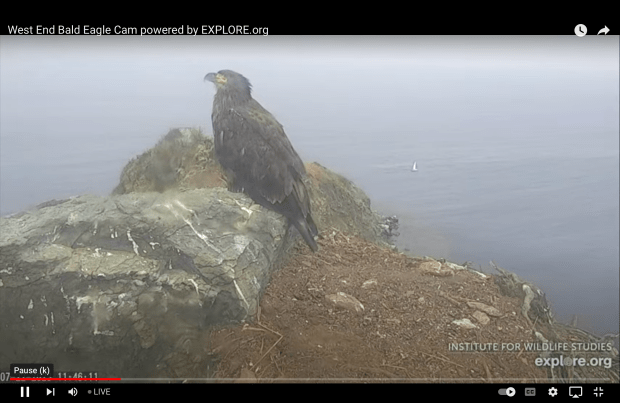
It’s late so it is ‘good night’. Some news has been crossing over my computer that I think you might want to know if you do not already.
First up, JBS 24 fledged today. No tree, no branches to practice, just take off and go! That is precisely what this surviving eaglet did. Congratulations to everyone!
At Achieva, Jill brought in another catfish. Little got to eat its fill and went to bed with a huge crop. I wonder if she will do this every day? If so, Little will survive. Catfish are tough old things to try and take apart to feed but, my goodness, she has found the source that Diane must have used so there will be food unless something strange changes.
There is growing concern for the plight of Lola in Charlo, Montana. Charlie did not return from migration. I have to add him to the Memorial Wall. Lola has been knocked off the nest by a GHO, hard. There have been searches for her. No sighting. Thanks, ‘PB’, for alerting me to this situation. GHO strikes, often very hard ones, can result in the osprey being hit hard enough to be sore and tired. Let us hope that Lola is off in a tree recuperating. She has been defending the nest prior to the attack.
At the Sandpoint nest of Keke and Keo, the geese finally gave up on raising goslings, and Keo and Keke returned to their original platform. Now Keo has been missing for two days. Ospreys do go MIA – I can think of several. The females do, too, especially before eggs. Elen at Glaslyn is the latest reminder of this. So let’s not give up on Keo yet, but it is breeding season, and it doesn’t feel right.
Geemeff’s Woodland Trust daily summary for Loch Arkaig Thursday 16th April 2026
Today saw the welcome return of JJ4, the young male from the western nest. He made his presence felt, first intruding on Dorcha with a very inept attempt at landing on her back, then returning in her absence and spending quite some time nestorising, including nest scraping and having a go at the troublesome stick. JJ4 also got rid of the tricky stick that Garry LV0 had brought this morning and dumped on Dorcha, and later on he got rid of Garry himself, defending the nest vigorously when Garry intruded. By contrast, things were quiet on Nest One – Aurora 536 received one fish taking Garry’s tally to fifteen, and had several mating encounters, at least two of which looked successful. Today’s videos:https://youtu.be/Sbm_OYe9MYU N2 Garry LV0 plays seesaw with Dorcha 09.38.22https://youtu.be/jgmmHJWLDD0 N2 JJ4 makes an undignified exit after intruding on Dorcha 10.04.35 https://youtu.be/-rKKuHCP9bQ N2 JJ4 returns to Nest Two in Dorcha’s absence and does some nest prep 10.56.18
Thanks so much for being with us again today. I am very tired – like Lola defending her nest. My house is now alarmed so that if Don wanders, I will know. The day was disruptive – for everyone, including The Girls and Toby. I am hoping for a much more gentle Friday.
I hope to have a wee bit of a break from posting but it seems the birds have other ideas!
Take care everyone.
Thank you to ‘PB’ for alerting me to the catfish delivery at Achieva. Thank you to everyone who posts info and images on FB and the owners of the streaming cams that allow us to worry all the time about our dear bird families.
Just a quick check in on some nests and the garden as spring arrives.
The first Dark-eyed Juncos of the season have arrived! Thank goodness the whole seed area is a mess and there is lots for them on the ground.
The big news (as far as I am concerned) is that Kai, Beau and Gabby’s baby, fledged about an hour and a half ago caught on video by Netflix Memories. https://youtu.be/VnmSSSODa6M?
Ospreys are arriving at the European nests including those in Germany.
Blue NCO calls for a mate from her nest at Loch of the Lowes.
She might be 23 years old but she is still gorgeous. Big Red.
Chichester’s Peregrine Falcon newsletter has arrived.
We have at least one osprey on the Pitkin County nest in Colorado.
On pip watch at Achieva. I hope that Jack steps up provisions. Many of you might wonder about the fish he brings in – this couple recycles fish just as Jack and Diane did. A fish comes in, part is eaten, it is taken away and. brought back. The ospreys have a place where, like the squirrels in my garden, that cache food. We saw this clearly at Captiva when there was a tree near to the platform that served this purpose.
So when you see a fish, don’t count them as individual fish – that is not the case. Jack will need to provide more. Diane supplemented the fish with her great catfish. Will this female have to pitch in for her babies to survive?
Thank you so much for being with us. Take care! See you soon.
Thank you to all the individuals who posted videos that I am sharing, information on FB, and to the owners of the streaming cams, we are all grateful to be able to watch our beautiful birds.
To those who celebrate the achievements of women – Happy International Women’s Day!
It has been quite the day. But first up, something good. The threesome at the Moorings Park Osprey platform of Harry and Sally. Seriously, well fed, healthy, happy little tikes.
I wish all good things came in threes!
We have had quite the weekend. It began with the car needing new brakes and a routine oil change, etc., and with two tyres repaired because they had picked up debris from a nearby house fire. Then Toby got sick. Last, my twenty-year old washing machine – which does not owe me a penny – decided it was time to call it a day. I am really hoping that it stops here!
I cannot tell you if Toby is better. Thank you to everyone for your notes and well wishes – they literally came from around the world. It warmed my heart. I hope to find out more about what is going on in the next couple of days. I can tell you that he has been very hungry and has eaten, is drinking water, and ran outside to chase a squirrel, barking his head off in the afternoon.
Toby is watching the Crufts 2026 Dog Show from Birmingham hoping that the Cavalier King Charles Spaniel that won the ‘toy’ group will win overall.
Toby would never make the ‘toy’ group. Just look at those paws. He clocks in at a mighty 25 lbs. just like the breeder said he would. So much for the 2XL little sweatshirt. It barely makes it to his waist!!!!!!!!
While I am dealing with one thing, my neighbour, who has two Cavaliers – a tri-colour like Toby and a Blenheim (rust and white), is having a very difficult time. The little Blenheim (both girls are tiny beside Toby) has a heart condition. My heart breaks when I see my friend walking her adorable girls in their cute outfits knowing she is frightened about what is happening.
All of this kept me from the bird cams today. I clean when I worry so the laundry room is properly ready for the arrival of the new machines. They should live longer than I will.
But, let’s check a few. Moorings Park is doing fantastic. Cholyn and Chase have a second egg and that is good news.
Most osprey cams are streaming, including those in Germany. Cranes and storks are arriving early. It saddens me to think that many who are migrating from Africa will have to pass through war zones to get to their nests in the north.
Besides flying through Lebanon, we also have those birds flying through Ukraine.
The wind was so strong at Big Bear on Saturday that Jackie was tossed about like she was a feather on the nest. Very scary.
Stella and Ira have three eggs at the US Steel nest! Wings of Whimsy recorded the event: https://youtu.be/xdcEOajcANI?
Nest preparations continue to go well for Red-tail Hawks Big Red and Arthur on the Cornell Campus.
SK Hideaways Videos Week of 1 March 2026
Channel Island California Eagles Livestreamed nests: ~ Fraser Point ~ Santa Cruz Island ~ Cruz & Andor ~ Sauces Canyon ~ Santa Cruz Island ~ Audacity & Jak ~ Two Harbors ~ Catalina Island ~ Cholyn & Chase ~ West End ~ Catalina Island ~Residents in flux
Cholyn & Chase Chortle About Nest Changes, Meet-ups & Alerts (2026 Mar 4) From dawn till dusk and even through the night, Cholyn and Chase chortle, snortle, and murmur to each other about whatever is happening in the moment. Their bond is remarkable to behold. Video: https://youtu.be/LoHana6raBc
Long Labor for Cholyn’s 3rd Egg ~ First Peek Shows Breakage (2026 Mar 2) In 23 nesting seasons, this is the first time that Cholyn has laid three eggs. Her labor was atypical and difficult, so it wasn’t completely surprising to see that the third egg was cracked when first revealed. The good news is that Cholyn and Chase are healthy, and that they have two strong eggs. Wishing them success and hoping to see these eggs turn into bundles of fluff. Video: https://youtu.be/i60SnPkL8io
Female & Lee All-Day Courtship ~ Sleepover, Beakies, Mating Attempt (2026 Mar 3) The female, F, and Lee, the 4-year-old sub-adult eagle from the Seal Rocks nest exhibited courtship behaviors throughout the day. We can only guess what they were up to while the cameras were down, but today looked promising. Video: https://youtu.be/zjFbfJxk3w8 Lee/D29 & Female Seem to Like Each Other ~ As the West End Turns (2026 Mar 2) When the West End cameras came on after being down for 2 weeks, we were met with a new male. Seems the female remains the same ~ this is the one that arrived after Haku and Akecheta left. The male is Lee/D29, a 2022 hatch from the Seal Rocks nest, also on Catalina Island. The couple soared and perched together for much of the morning. What will happen next? Only the eagles know for sure. Video: https://youtu.be/mlBQgJTi19E
Dad Brings *Very* Fresh Fish ~ JBS24 Gets Fed and Self Feeds (2026 Mar 5) JBS24 is 5-1/2 weeks old and is progressing right on schedule. Here’s what occurs in the fifth week, courtesy of Loudon Wildlife Conservancy: ~ Begins playing with sticks ~ Is capable of fully standing ~ Is aware of its surroundings, in and outside the nest ~ Begins tracking objects and birds outside the nest ~ The tarsi (the feet or lowest part of the legs) are full size, and the foot pad is nearly full size ~ Imprinting is nearly complete
JBS24 is doing a little self-feeding in addition to the above milestones. Mom and Dad spend quite a lot of time with their only eaglet. This family is a joy to observe. Video: https://youtu.be/zI5sDnFeuHo
Thank you, SK Hideaways!!!!!!!!! You bring the nests to life for us.
Ellie and Harvey at Farmer Derek’s Bald Eagle nest should have their second hatch by tomorrow.
I wonder what is going to happen at the Glaslyn nest this season. Will Aran return and prevail as the male? Will Teifi return and take over the nest? Will Elen return? We wait.
The female at Duke Farms continues, at times, to incubate the remaining unviable egg. The little one is a cutie.
Winter Park eaglets had some prey today. There has been some concern about the lack of prey coming to the nest as of late.
Oh, remember how we worried about ‘Tiny Tim’? – not so tiny anymore! Can you tell Wink from Atlas now?
At Dade County, R9, the oldest, still has to fledge. Females often take longer than males.
Eve and Kai perch along the rim of the NE Florida nest of their parents, Beau and Gabby. Eve is 68 days old today and Kai is 67. Fledge in a week?
Quinn (Captiva nest of Connie and Clive) is gorgeous and if you look carefully, all of these eaglets are so close in age. They spend their days looking out to the world they will soon conquer through flight.
There is at least one tiny osplet at the Pink Shell nest in Florida. Let’s hope that this nest is successful this year.
You will learn something you never thought you needed to know!
The funds to save the land near Jackie and Shadow’s nest were nearly 1 million dollars when I last checked. Others are seeking donations: the Severna Ospreys need batteries for their camera so they can stream.
Thank you so much for being with us today. We hope that your weekend was much better than ours. That said, we are looking forward to an ‘uneventful’ week. We have started doing nothing on Thursdays. Toby gets to go for his walk with Ellen, and I stay in my PJs. A writer of all things Parisian recommended some lovely Pima cotton pyjamas made in South Carolina, and I do love them. The phone is ignored for most of the day. No one is invited over or invited in if they show up. We watch movies, read books to Toby and The Girls and generally use Thursday as a day to recharge our so-called batteries. If you are feeling overwhelmed, however slight the feeling, I highly recommend a ‘day off’. And I do mean a day off!!!!!
We look forward to seeing you again soon – Friday, if not sooner.
Thank you to SK Hideaways for their wonderful videos that add much to my post. I would also like to thank the owners of the streaming cams where I took my screen captures and who allow us to watch the lives of our favourite birds.
It was a great night. Our visiting canine, Nellie, settled in and slept through the night – and so did the rest of us! We woke up refreshed. Toby and Nellie headed out with Ellen at 0930 while ‘The Girls’ had their breakfast in peace. When the dogs got home, Don and I looked at the four sad bananas on the counter and set about to make banana bread. It was a great start to the morning.
Hugo Yugo and Toby were holding hands last evening. I can’t get enough of this puppy and sweet kitty. They have to either be touching or near to one another.
Oh, these animals just lift my spirits.
There are two eggs at the John Bunker Sands Wetlands Bald Eagle nest in Texas! That one flew right by me I was so intent on finding out about Girri. Congratulations.
Let’s hope we see more of Girri’s strong flying. It gives me hope that this fledgling of Diamond’s will survive!!!!!!!! She is one heck of a flyer.
Our friend ‘A’ is checking on Angel, the Leucistic Hawk, and her mate Tom and found an update from Connor at Window to Wildlife: https://www.youtube.com/watch?v=PHDDXUkIKio
Connie and Clive have a hatch at the Captiva Eagle cam. CE14 looks strong and alert.
E26 appears to be lucky (in some ways). No indication of a pip in E27’s egg. This is day 38 for that egg. Yes, it is still within the time frame for hatching. Would I want it to? Well, I wouldn’t. Many will. E26 is strong, healthy, and eating well. A lack of a sibling means no bonking – that has already started at Dade County in force with the Rs.
Gabby and Beau continue incubation at NE Florida. I am getting excited for their first pip next week.
Jackie and Shadow are visiting the Big Bear Valley Bald Eagle nest! They were there Tuesday!
Ron and Rose have a nest full of food for C10 and C11. There are still a few bites of Coot and a whole lot of fish ready and waiting.
If you missed Ventana Wildlife’s December chat, here is the link to find out what is going on with the California condors: https://www.youtube.com/live/_FO6WuxmL08?
The post today is quick and sweet. We hope you are not caught up in the rat race of the build-up to the final days of the holidays. Take care. We will see you tomorrow.
Thank you to the owners of the streaming cams where I took my screen captures, to SK Hideaways for their video, to ‘A’ for alerting me to Connor’s Window to Wildlife update! This blog would not be the same without you and without all those amazing members of Bird World!
I cannot tell you what a strange day it is. It is now +4 degrees C. The snow and ice are melting. The sky is heavy with cloud, and the wind is beginning to pick up. The forecast calls for a change within four hours: cold, very windy conditions and snow. Ann has taken Don to the zoo. Toby and I have been out for a good, long walk, as the rest of the week’s weather is questionable. It feels dark and dreary, and that wet cold, when things are melting, is not so nice. Toby enjoyed all of the puddles but was glad to get home to a warm towel and be dried off!
At the feeders this morning.
Mrs Junior
One of the 31 Starlings was checking to make sure there was dog and/or cat kibble in the feeder—female house sparrow in the back.
Male House Sparrow
If you missed it, juvenile eagles visited the nest of Jackie and Shadow. Everyone wants them to be Sunny and Gizmo! We know where this nest tree is located and how difficult, if not impossible, to get there to band the eaglets but gosh, it sure would be a confirmation if they had Darvic rings.
Thanks, SK Hideaways.
“here’s the video from last nights visit by 2 juvies to J&S’s nest tree. Oh my, the eaglesphere is certainly all a flutter about it!
FOBBVCAM 🦅Two Juvie Eagles Visit Nest Tree🌲Jackie & Shadow Let Them Be ☮️ Could it be⁉️ 2025 Dec 15 https://youtu.be/F6R4BuHTTOc
Gracie Shepherd asked the question: Whose eggs will hatch first: M15 and F23 at SW Florida or Ron and Rose at Dade County. I’m for having them hatch at the same moment! But who cares if they are healthy, right?
I keep saying it. Look. This is Girri but you could be easily fooled into thinking it was Diamond. Fledge watch is on – and this gal could fly out that scrape window any second.
Nice Osprey counts coming in from West Africa. Thank you Mary Cheadle, Jean-marie Dupart and all who follow the birds!
Today’s Country Diary focuses on the Snipe – oh, how I love seeing this bird in our wetlands in the summer. Enjoy.
Many of Bird World readers are struggling. ‘T’ and ‘J’ have lost someone dear to them in the last few days, and I am aware that several have loved ones in the hospital in critical condition. Our warm thoughts are with all of you at this time.
Please take care. We will see you again tomorrow!
Thank you to SK Hideaways, Jean-marie Dupart for tackling what seems impossible, The Guardian, and the owners of the streaming cams and FB posters for their alerts!
It is a beautiful Saturday on the Canadian Prairies. On Friday, many towns in and around Winnipeg reached a high of 16.7 degrees C, the highest temperature recorded in Canada that day. It was truly uncharacteristically warm, and thus worrisome.
I am actually sending this post out Sunday evening instead of Monday morning. I hope this is not too confusing! Monday morning is going to be very hectic. Toby has an organized dog walk with Ellen and then we are going to fetch our friend Ruth who is coming for lunch with a pop in visit by our daughter. Enjoy!
Oh, how nice it is to have you with us today. I hope that everyone has been watching that cute little fluff ball of Gimbir and Diamond. He or she now has a name – Girri – and thankfully it is one of two syllables that is easy to pronounce!
Cilla Kinross broke down the votes – but look at the number of votes. That is a fantastic response!
I have the listing from SK Hideaways of her weekly videos but this one is particularly cute. Can we truly take our eyes off little Gimbir, first-time dad, and his little baby!?? https://youtu.be/SyatpPaTnJU?
Is it my imagination, or is Gimbir getting much more time with his chick than Diamond allowed Xavier? Gimbir even tries to brood the baby! Or is Diamond just away a little longer and doesn’t see the interactions?
There was lots of activity and SK Hideaways has caught it on video:
We love that little fluffball of Gimbir and Diamond. Can you imagine someone stealing it to sell for profit? Well, Raptor Persecution UK is following a court case for someone who does just that!
Some of the cute stills of Gimbir feeding the little one for the first time. This is precious.
Look how big Diamond is compared to Gimbir in the image right above.
Just imagine Gimbir and Diamond arriving at the scrape with that precious baby gone?
Raptor Persecution UK continues to follow the plight of the Hen Harriers especially those found dead in and around the large hunting estates. You might recall that I reported on five little Hen Harrier chicks stomped to death several years ago. Their mother has now been found dead, and once again we are made starkly aware of how dangerous the lives of these amazing birds are!
Snow on the nest of Jackie and Shadow at Big Bear Valley on Sunday.
Both eagles at US Steel.
Both eagles at Cardinal Land Conservancy. Will there be an egg soon?
On a sad note, Blaze has not been seen at the Eagle Country nest for eleven days now.
I am enchanted with what is happening at the Sydney Sea Eagle nest this year. Lady and Dad arrive at the nest in the early morning with prey and no sea eaglets. They begin to defeather, looking around, and then both eaglets fly to the nest! In all the years I have watched this nest, this has never happened (at least to my memory). Does anyone else remember a year where the fledglings could fly freely around the forest returning to be fed? Please let me know!
This just brings tears to my eyes and I hope yours, too. These two eaglets from the Olympic Forest in Sydney will surely survive. They will get strong, learn how to hunt and beat those darn Currawong!
Just over the moon – almost beyond giddy. How long have the supporters of this nest have waited for a season like this one?
‘A’ has sent in a lot of commentary, and I need to post it, as I have been sending out little blurbs when an event has happened without a comprehensive narrative. I know how many of you enjoy their ‘take’ on what is happening in and around Australia, so here we go – albeit some out of order. Enjoy.
“It is nearly 8pm in eastern Australia and starting to get darker (it won’t be dark for a while yet with daylight savings) and both our eaglets are settling for the night on the branches above the nest. Lady is also perched nearby, in the nest tree. As I said, this is a family unit, working together. It is wonderful to watch, and the eaglets are gaining in confidence by the day. I have not seen this before. I hardly dare to hope that this really is the season they will succeed but I have felt that all along, as you know, and it is beyond thrilling to see the eaglets flying with confidence, returning to the nest for food and rest, and refusing to be cowed by those damned currawongs. “
“The upshot is that all three chicks have fledged and that one of those three has successfully returned to the ledge. Mum brought a snack too, which is encouraging – I am hoping we see all three return to the ledge. As I said, I’m hoping no news will be good news in terms of their welfare and whereabouts.
I will keep an eye on the cameras to see if we get any returnees but you would be best keeping an eye on the Facebook group – I am not a member of Facebook and refuse to become one at this late stage, but it might be worth it at this stage of events for the Collins Street group. It is exciting news that all three have fledged successfully and each one of the three appeared to fledge strongly and confidently. It terrifies me to even think about how difficult it is for young falcons to learn the intensely dangerous skills involved in their hunting technique, but I suppose this is where the parents play yet another critical role. I have been tremendously impressed by these parents, and the moment the crash landing back into the gutter occurred, a parent (probably mum) was immediately in the frame, doing a fly down (probably following the chick) to check that the chick was okay, indicating that the parent in question had been very close by during that fledge and obviously supervising everything that was going on. I do hope that indicates that these parents are going to be good teachers of their chicks. So many times during this season, I have been astounded at the size of the prey items brought to the ledge. These parents are very good hunters – let’s hope they’re great teachers as well. I suspect they might be. How wonderful would that be? There must be room for at least one more pair of peregrines in the CBD area. I’m still wondering where there are suitable nesting areas near Melbourne Airport. I must ask my sister that question again.
It will be raining in Melbourne over the next couple of days – not good flying weather for new fledglings. I do hope they return to the ledge for shelter, rest and food. There is plenty of time to learn all the skills they will need to survive alone out there.”
“Superdad M15. My favourite bald eagle male of all time. He is amazing. We will never forget his efforts the season he reared two eaglets alone. I think Mrs T might be in front in the female version of that award. And I noted from your blog that Mr T is up to his old tricks yet again. Leave the woman alone, you cad! What’s the betting he leaves her incubating a fertile egg and then takes off for the girlfriend’s island nest? I have no trust in him, I’m afraid. Once a cheat, always a cheat.
Oh, the joy of watching WBSE post-fledge. I never thought I’d type that! What a happy mutually supportive family they are this year. That nest makes me so happy at the moment.
Meanwhile, at Collins Street, two fledglings are on the ledge. The little male who returned after fledging yesterday spent the night on the ledge and in the scrape, and one of his sisters joined him around lunchtime. https://www.youtube.com/watch?v=GYQ2f7XnC8I&list=TLPQMTMxMTIwMjUIejz-QtbpwA&index=6. Wonderful! The returnee’s first priority is a little self-feeding in the gutter. Excellent. Let’s imprint that return to the ledge for food behaviour. The control she showed flying onto the ledge was impressive, don’t you think? Strong and balanced.
All three of the Collins Street fledglings returned to the ledge yesterday – the little male was still there from his fledge and immediate return the day before, but both his sisters joined him there during the day (how cute were the beakie kisses when the first sister returned and they lay side by side on the ledge? Just too adorable. I hope they can help and support each other just as the sea eaglets are doing. I’m sure it helps. Meanwhile, at Orange, our darling dad in training is progressing with determination. “
The Friends of Osprey South Australia and Port Lincoln have announced that, due to the failure of the trackers that have been placed on the osplets, they will now only be banding the little raptors.
Our local wildlife rehabilitation clinic, Wildlife Haven, is helping a Red-tail Hawk!
It is that time of year when people start thinking about the upcoming holidays. No matter what religious persuasion you are (or maybe not any), gifts find their way into the celebrations. Why not do something to help wildlife? One year, our family adopted the hawks, the Crow, and some of the other raptors at Wildlife Haven instead of buying ‘stuff’. Indeed, I do not need anything, having spent the last year trying to rid myself of the many things accumulated over a lifetime. Instead, we now gift small, locally made consumables. We will also reach out to local clinics in various ways. We have two large, used once dog carriers that are way too big for Toby. They will be donated along with a pet crate and various items on the wish list. I hope our family approves! Over the holidays, we will have a four-legged visitor to join our gang – Nellie, a very large British White Retriever. She is Toby’s bestie. The plan is to invite another four-legged friend and provide treats for the cats and dogs, along with some delicious shortbread for the adults.
There continue to be an enormous number of Canada Geese in and around Winnipeg along with Bald Eagles at every turn. Many of the geese have turned into lunch or those eagles. Great image by Kevin Eisler.
We still have osprey in Manitoba, too – the water is still open and fish and prey are readily available for the raptors. Migration times are extended!
Hawk Mountain’s latest migration chart for the week of 12 November. Those osprey numbers are not good.
Please continue to spread the word: Good Wolf reminds us that balloons have no place in celebrations in 2025. We know that they harm wildlife – it isn’t speculation. There are many other ways to decorate that are safe for our raptors and other wildlife.
Thank you so much for being with us. Please take care of yourself. We look forward to having you back with us for our next Bird World post which should be on Monday 24 November. See you soon!
Thank you so much to SK Hideaways, Heidi, and ‘A’ for their videos, notices, and commentary and to the owners of the streaming cams and FB groups who keep us informed, and The Guardian -I am in your debt. I am grateful to everyone behind Raptor Persecution UK who are working hard to bring justice for our raptors and to all who work hard to protect our precious feathered friends.
Happy Monday! We hope that you had a great weekend.
The three Blue Jays living in the trees in my garden will wake you up! This is how they sound when I deliver a new pail of peanuts. They have lost all their trees but one, and I saw a new orange circle on it, which means it will be cut down, too. Thankfully, we have a home for them.
I want to start with some interesting news and a request for help. Two years ago, Michael St John from Barbados took some photos of an Osprey with a Blue Darvic Ring. That number was Blue KW0. It was unfamiliar. Where was it from? And how did it get to Barbados? Well, it was from the United Kingdom, and whether it was blown off course, got on a ship, one will never know, but it wound up in Barbados and was photographed by Michael. Now he has another quandrum that he is hoping we can help – especially if you are or know someone who is a specialist in Harriers.
There are several species of harriers, all belonging to the genus Circus. The most well-known include the Northern Harrier (Circus cyaneus), the Western Marsh Harrier (Circus aeruginosus), and the Montagu’s Harrier (Circus pygargus). Other species include the Eastern Marsh Harrier, African Marsh Harrier, Swamp Harrier, Malagasy Harrier, Réunion Harrier, Long-winged Harrier, Spotted Harrier, Black Harrier, Cinereous Harrier, and Pallid Harrier. Some species, like the Papuan Harrier and Eyles’ Harrier, are also recognised. Here’s a more detailed breakdown: Northern Harrier: Found in North America, Europe, Asia, and Africa, and they prefer open habitats like marshes and grasslands. Marsh Harrier: A group of harriers, including the Western Marsh Harrier, Eastern Marsh Harrier, and others, is often associated with marshland and reedbeds. Montagu’s Harrier: A migratory species, often confused with other harriers due to similar plumage. Other Species: The African Marsh Harrier, Swamp Harrier, Malagasy Harrier, Réunion Harrier, Long-winged Harrier, Spotted Harrier, Black Harrier, Cinereous Harrier, and Pallid Harrier each have unique geographic distributions and characteristics. Harriers – Raptor Identification – The complete raptors guide The classification of some harrier species, particularly within the marsh harrier group, is still being refined.
This is a young Reunion Harrier (Raptors are the Solution).
Michael St John has sought out the advice of many agencies and I was happy that one of them acknowledged that raptors (birds of all types) get off course.
Doing his own research, Michael has these findings:
“1/ Prominent white rump patch at base of tail
2/ Length of tail…its an obvious longer than normal tail
3/ Five fingers on the hand, makes it either a Northern or Hen, female. This Rules out Pallid and Montague, they have 4 fingers on the hand.
4/ Faint white ring around neck
5/ Wing Bars pattern
6/ Curve of the beak
7/ Yellowish legs
8/ Underbelly plumage: yellow/ ochre streaking
9/ I notice the curvature of the trailing edge of the secondaries in the Female Hen and not the Female Northern, the northern has straighter trailing edge secondaries. I haven’t seen this mentioned anywhere in the literature, I just see this feature popping out in the online photos.
After carefully reviewing Northern & Hen Pictures online I’ve ruled out Northern completely and the 5 photos below, in my opinion… are identical to Hen, female.
My call at this stage of research is Female Hen Harrier.”
These are the images. This is the type of detail you need if you are looking to properly identify a ‘vagrant’.
Still, Michael wants to be certain, and he is reaching out to anyone who is an expert to assist in this identification. Note that Barbados is far south and closer to South America. It is easy for birds from Central America and Africa to get off course and wind up in this region.
Thank you so much for any help. You can leave a comment or write to me at maryannsteggles@icloud.com
‘PS’ sends us the Seattle report for the weekend:
A good weekend for the nest! Numerous feeds (including one where Harry brought back the rear half of the largest fish I’ve seen on the nest this year!) seen on July 11, 12, and 13, and both chicks continue to do well and look good! They both continue to flex their wings a lot, with one jumping ever so slightly up on one leg yesterday. Also they are both trying to take bites out of food on their own, with the larger one actually feeding itself yesterday! Mom had brought back a Coho Salmon and was feeding one chick when the other started pecking at something – I couldn’t tell what. But when it turned sideways to me I could see it had another salmon in its beak! I guess there was a “spare” fish in the nest that it decided to try and eat. Mom and sibling took several funny looking glances at the youngster as it tried to rip pieces off the fish, but it did so many times so seemed to successfully (if inefficiently) feed itself. Several intercept missions by both mom and dad, and I spotted a group of 3 Osprey hanging out atop a nearby crane (that drew Sally off the nest). ~40 days old now, give or take – fingers remain crossed! Few pics here, many more up here (https://www.flickr.com/gp/193514804@N08/8459V5m6z6).
Check out Ping’s gorgeous images on his Flickr account. Link is in the information above!
Sharon Pollock sent the following video link to me remarking that I might cry my eyes out. I did. Get the tissues. It is the story of T3 from egg to fledge. Remarkably raised by a single Mum! https://youtu.be/xj8ZQw63Nzw?
Mrs T is a very remarkable eagle. I have seen others raise eaglets alone but never from the egg to fledge. Great video by Explore!
In the United States, several osprey nests have been attacked by individuals in boats. On Sunday, the three osplets at Smallwood were forced to fledge. They have not returned, and we do not know if they drowned or if they made it to a safe place. The individuals in the boat repeatedly returned to the nest.
So many other nests in the US struggling for food and with high heat or both.
Heidi’s Osprey Nest Reports for the US:
Chick 2’s passing at Cape Henlopen… I don’t intend to post a separate nest-news item regarding this.
We have sadness at the Osoyoos nest in British Columbia. The first hatch was stepped on and died. The second died. Ann-Marie Watson has created a flower garden in memory of all the osplets lost at this nest—poor little souls. I also want to add that she has returned to Osoyoos after working and heading home to retrieve the little bodies that fell off the nest to place them in a quiet, peaceful spot. Her actions always touched my heart – no one else in the town seemed to care! Many have passed away over the years, primarily due to heat domes affecting the region and the male Olsens’ struggles to provide for their family adequately.
Waiting for a food delivery while keeping her four osplets cool at Dunrovin Ranch in Colorado.
Swoop just flew in with a late Sunday evening fish. Thanks, ‘PB’.
Little 4 is full.
Charlo Montana – waiting for Charlie to finish with the fish!
It is hot in Idaho at Coeur de’Alene where the three osplets seem to be doing very well after the starvation of little four.
Birds of Poole Harbour: All four fledglings were back in the nest for night with fish arriving at the following times: 10:02, 16:14, 18:32, 19:29, 21:17. Big round of applause for CJ7 and Blue 022 – they raised four to fledge again.
Dyfi Osprey Project: All three back in the nest for an evening fish and a good sleep.
Everything to know about the fledging of Idris and Telyn’s trio:
Rutland Manton Bay: The three surviving osplets return on and off during the day for fish, which is continually provided!
Alyth SS: Sadly we lost Oakley to siblicide/starvation when they were fullty feathered. The two older osplets are doing well.
Llyn Clywedog 1: Seren and Dylan have had their first fledge since Friday.
Foulshaw Moss 1: White YW and Blue 35 have their first fledge.
At Finnish #3 nest, the Raven helps himself to the three osprey eggs.
At Wildnis-Goitzsche, Zeus delivers the last fish of the day as the sunset captures the reflections. The osplet has fledged. Thanks, Joan Castnyer. https://youtu.be/bdWWyZ_vFK4?
Other images form the live stream from Wildnis-Goitzsche:
Renee and Ricci doing very well at Eschenbach!
Up close and personal with Bety and Bukacek’s two storklets at Mlade Buky.
A nest full of storks in Trutnove in the Czech Republic.
Two Black Stork babies waiting for a food delivery in Bolewice, Poland.
Geemeff’s Woodland Trust daily summary for Loch Arkaig Sunday 13th July 2025 Today was all about helicopters – both chicks spent considerable amounts of time practising lift off, and even getting quite high, but not the only-feet- visible-on-nest-cam sort of height for a true helicopter. However, practice makes perfect, and provided Dorcha doesn’t push them over the edge, as nearly happened to Darach 7P0 this evening, both chicks are on course to fledge this week. Louis delivered four fish to the nest, the second of which was his three hundredth for the season, but at times the chicks seemed more interested in bunny hopping and wingercising than eating, although Breac 7P7 did grab a fish directly from Louis, hold it away from Dorcha, and start having a munch on it. Louis’ tally now stands at three hundred and two. There were a couple of intruder alarms, but no one seen on nest cam, although over on Nest One, a shadow was seen briefly as Aurora 536 flapped her wings and squeaked before flying off. Garry LV0 brought her two fish – well, one and a half really, the second was just a small piece – and his tally rises to one hundred and twenty five. He also brought several sticks, one of which he actually rode in on and perched upon for a comedy moment. It was hot again today, at 29.7
°C slightly hotter than the forecasted 29°C, and the overnight conditions call for partly cloudy and light winds with a low of 16°C but the temperature is expected to drop tomorrow to a high of only 20°C, with thundery showers and a gentle breeze to cool things down.Night cam switches on (day cam): Nest One 23.51.42 (02.48.36); Nest Two 23.41.08 (03.13.59)
https://youtu.be/Y0dlcEBocmg N2 Danger! Dorcha nearly causes Darach to have an early fledge 21.59.39 (slo-mo zoom)Bonus action: voting now open for Woodland Trust’s Tree of the Year:
Geemeff’s Woodland Trust daily summary for Loch ArkaigSaturday 12th July 2025
On a hot day where temperatures soared to more than 33°C, the chicks didn’t seem to want extra fish, in fact, they appeared uninterested when the second and third fish arrived, preferring to wingercise and do the odd bunny hop. As seems to be the pattern now, Breac 7P7 acts keen on fledging first, flapping energetically and attempting lift off more than his older brother Darach 7P0. Louis brought three fish to the nest, taking his tally to two hundred and ninety eight, and despite appearances the chicks did eat enough to get the fuel they need at this stage of development. Dorcha had her fill of fish too, and spent time perching on the high perch or out of sight behind the nest on the cam post, relaxed despite being dive bombed by an intruder Osprey who buzzed the nest twice before leaving the area. Was it Aurora 536? The timings would work, but the intruder wasn’t seen clearly enough to notice if there was the blue flash of a Darvic ring. Garry LV0 brought two fish to Nest One but took the first away as the nest was empty. Aurora turned up too late shortly afterwards but was present when Garry delivered the second fish, and did her usual grab and mantle before leaving with it. Garry’s tally now stands at one hundred and twenty-three. Tonight’s overnight forecast is clear sky and light winds and a low of 15°C, continuing very hot tomorrow with sunshine, light winds and a high of 29°C.
Night cam switches on (day cam): Nest One 00.17.27 (02.42.05); Nest Two no switchover as at 00.45 (03.07.08)
There is so much news. The UK osplets are taking to the skies. All four of Blue 33 and Maya’s chicks have fledged. Sadly, we lost one who found himself in the water near the shore. A post-mortem is being conducted. Ringing has finished as far as I know. I wonder how many osplets over the entire UK were fitted with their Darvic rings and their BTO identification. I will try and find out.
Some include:
I am happy to report that the three osplets at the Green Ledge Light Preservation Society nest survived the storm and are now busy flapping their wings, preparing for fledge. Aren’t they beauties? No shortage of fish here! Long Island and New York have strict laws regarding the catching of Menhaden.
‘EJ’ thought we could use a hopeful Osprey article! I agree.
A heartwarming story about a rescue that refused to give up on this eagle: the images tell the entire story. Smile. Thanks, ‘J’.
World Bird Sanctuary adds:
“Happy 1 year intake anniversary to Bald Eagle 24-390!
While it seems strange to celebrate a patient having to be in our care for a whole year, it originally seemed unlikely that 390 would even survive the week. 390’s injuries were severe. He had gunshot injuries to both his left wing and his beak. with a significant portion of the middle of his beak missing due to the injury. Today we celebrate how far he’s come and the fact that his is still with us and progressing towards release!
There were many times, especially early in 390’s care, when we questioned whether it was time to give 390 the final gift we could, an end to his suffering through humane euthanasia. We diligently monitored his pain and stress levels and made adjustments to our treatment in order to keep him as comfortable as possible. At each turn we considered if his chance at recovery was worth everything we had to put him through.
But each time we considered calling it, 390 would take a step forward and show us that he was still fighting. He started taking his hand feeding without needing to be handled, was keeping down food, and started gaining weight again. His beak injury seemed less painful by the day as it started to heal and we reached the right balance of pain medications. His attitude and energy improved as he became feistier for care. All the while the beak was healing and enabled him to start eating on his own again.
It took 7 surgeries and countless wound cleanings over a period of 4 months to get 390’s beak to aligned and healing free of necrotic tissue. It required 8 1/2 months of healing before the gap in the bone finally finished closing. Now we are in the stage of keratin regrowth. 390 will need to grow an entirely new layer of keratin over his upper beak before we can consider him for release. This will likely take a full additional year of care. His beak will always be abnormally shaped due to his injury, but only time will tell if will regrow in a way that enables release.
Thank you to everyone who supports WBS and makes it possible for patients like 390 to have a fighting chance. A special thank you to our Rescuer’s Giving Club, whose monthly contributions go directly to our hospital and enable us to proved care to over 750 injured raptors each year. If you’re interested in getting more involved in supporting our patient’s journeys, you can learn more on our website.”
Another rescue. Father was missing. Mum tried to feed storklets. The fourth one passed. Then Mum was hit by a car. They were rescued. Here is Mum with her Babies. Czech Republic. Thanks, ‘TU’.
So glad to hear there could be two to fledge! This is a miracle in a very dire situation. Omega Protein Ocean Harvesters takes 112 metric tons, or roughly 230 million lbs, and it is based on science that measures the population in the ocean, not in the Bay.
Please sign the petition. I am Canadian and I don’t care what country you belong to – this needs to be stopped and I am embarrassed it is a Canadian company. The donations go to change.org. You do not need to donate but please share widely. We need this to stop.
Want to know ‘why’ politicians aren’t doing anything? What is the cost of the collapse of an eco-system and the deaths of thousands of ospreys? Well look below.
“Political contributions muddy waters
Reedville-based Omega Protein, which makes fish oil products, is the main beneficiary of menhaden fishing in Virginia, and it’s no stranger to politics.
The company has given $955,783 to Virginia political campaigns since 1996, according to the Virginia Public Access Project, a nonprofit that tracks money in politics.
That total includes money given to politicians on both sides of the aisle. The company, for example, has donated $38,000 to the Virginia Senate Republican Caucus over the years, and $34,500 to the Virginia Senate Democratic Caucus, according to VPAP.
Locally, Omega Protein has given $32,843 over the years to state Sen. Richard Stuart, a Westmoreland County Republican whose 25th District includes Caroline and King George counties.
And this year alone, the business has given $500 to Del. Joshua Cole (D-Stafford).
Milde, however, said he will not accept contributions from Omega Protein.”
Even with such a catastrophic year, there is a glimmer in some parts of New Jersey after months of bad reports.
Thank you for being with us today. Please take care. We will see you again on Friday.
Thank you so much for being with us today. I want to thank our notable contributors, ‘EJ, Geemeff, Heidi, Michael St John, PB, PS, TU’, the owners of the streaming cams listed in bold, the individuals who take the time to create videos, including SK Hideaways, and the authors of posts and articles, including Jeff Kear at UK Osprey Information. I am very grateful. My blog would not be what it is without your input into the world of birding.
Oh, tears….The big event begins on Saturday when ‘M’ alerts me to Mini’s amazing hover and ends with all of us rejoicing. Mini flew!
On Saturday, Mini did a great hover…a great hover…has been on the nest and has observed her siblings. She is going to do so great!
The tail on the ascent.
Landing after about 5 seconds of good hovering.
And PB wrote, “Mini at Patchogue branched on the perch 7:23am and fledged 8:26am….sooo happy and crying at same time. She did the impossible from being the runt and getting bullied and made it to fledge. So wish she was banded so when she ever returns we know it’s mini!” –Those banding sentiments are with so many of us…We want to know how she does. One way to tell one osprey from another is their head markings and Mini’s are distinctive. Take screen shots of her head from all angles, keep them. It is the only part of her that will not change!
Mini got her fish at 0856. What a fantastic reward – although it is unclear that Dad knows his little girl flew! Congratulations Mini. Stay safe out there. I think we all must have cried. Bittersweet moment.
The news is sad but the eagle that is being honoured was one of the first to be banded during the re-introduction of Bald Eagles into the US after the terrible decimation of our raptors from DDT.
There has been a rare bird sighting – a Switchable Black Kite – in Norfolk.
Speaking of kites and all other raptors in the UK – the Hen Harriers, the eagles…one utility company has said that it will not renew the licenses for grouse hunting on its land. As a colleague and friend pointed out, what is not known is how long those licenses can be used. When is the deadline? I hope that it is soon and that other utilities will follow suit. If the legal system cannot stop the grouse hunters from killing off all the raptors then preventing them from using the land is a brilliant alternative. Of course, the 21st century thing to do would be to stop this medieval tradition in its entirety!
There is sad news coming from OWL in British Columbia about Tyr, the eaglet on the Hancock Wildlife nest. Early concerns showed a possible issue with its leg.
If you are fans of Thunder and Akecheta at the West End Channel Islands nest, the 2023 fledglings often show up at the old nest site along with one or more of the parents.
Anthony is often on the Two Harbours nest along with parents Chase and Cholyn.
Now for some nest news:
MN Landscape Arboretum: Gosh, that little chick is getting its feathers and Mum is attentive. A real change from a month ago!
Boulder County: What a loving family. The five of them just make my heart beat. It is so interesting this year that the Ospreys living on nests in places other than in Florida and in the NE US are doing so very well. It is good to have their population growing and sadly, as hard as it is to say, to have some of the pressure off of the over saturated areas (like Florida and Chesapeake Bay).
These three at Boulder are real beauties. Mum does everything she can for them including being a huge umbrella when it is hot even if they are as big as her!
Charlo Montana: ‘L’ alerted me to the streaming cam being back on at Charlo Montana. The two chicks hatched in mid-June. They are 5 weeks old and doing well. And then the cam went down again! It is extremely hot in Montana. Mum is doing a fantastic job keeping the two cool. Bless her heart.
Loch of the Lowes: The Woodland Trust is more positive than I am that Blue NC0 will return. Laddie has his hands full and the chicks are hungry like those at Forsythe. Blue NC0 has been MIA for a week and this is really more than a spa break. She is a devoted mother and it has been a difficult year with little fish ——–how about stocking that loch like they do at Clywedog in Wales? That would solve this issue! Come on Woodland Trust – not just trees, fish! Here is the most recent report.
At the same time, I would like to call for a few more platform nests to be built for the growing population of ospreys.
Steelscape, Inc.: This Washington in Kalama had fallen off my radar until ‘PB’ wrote to me this evening about a real problem with fish deliveries for the three osplets. It is entirely possible that the third hatchling could be lost. Let us hope not. They have the same problem as Cowlitz it would appear – Eagles taking the fish from the Osprey, the heat, etc. But unlike Cowlitz, which has only one osplet to feed, this nest has three. Thank goodness the fourth egg did not hatch. Oh, goodness. Send it your very best wishes….and look. It is baking hot there, and these babies are feathered. We don’t want to lose another one – so many are starving this year.
Cowlitz: We now know that the wire mesh grids that Cowlitz PUD constructed to protect the osprey nest from Eagle predation have not hindered the ospreys. The only osplet has flapped and jumped and today, that sweet baby fledged (?) or did it branch to the top of the mesh? I think it is on top of the mesh but, if it did not fly – this one soon will!
Seaside: The two osplets, Kawok, the first hatch, and Naika, the second, are beautiful juveniles who are starting to feel their independence. They remind me a bit of Ervie and his brothers once they had fledged. Everyone was civil until then and then it was everyone lad for itself. There is a bit of an aggression showing up just like it is at other nests towards the adults especially if they do not show up with fish! No one is hungry, as far as I can tell, on this nest!
Alyth: The fledglings return to the nest for fish and rest. Flying is hard work. They did not sleep on the nest last night.
Poole Harbour: Oh, it was wet in Pool Harbour on Saturday! Miserable. Windy. The trio were busy preening and trying to dry off Sunday morning.
Glaslyn: OH2 has walked to the perch to with OH1 and Mum, Elen. Will he fly today? He sure is flapping those wings and looks strong and ready.
Dyfi: A bit of a lonely nest at times. One of the fledglings showed up Sunday morning. It looks a bit dreary and damp. Idris and Telyn will be doing a great job feeding their fledglings. Cennen has been flying for a week!
Time for ‘H’s reports:
Fortis Exshaw – Louise had some minor intruder issues, and she flushed an intruder off the tall perch and out of the area twice. She also delivered five fish to feed her chicks. The two 35-day-old osplets are thriving. Mr. O was not seen on camera Saturday.
Forsythe – There were four fish delivered to the nest, including one by Opal. The fledglings each had two fish. Even though the food had increased slightly on Saturday, there was still significant aggression, and the siblings were literally at each other’s throats. After a few days of very little food, the youngest sibling, Ollie, was the primary aggressor. The battle at 1438 was quite serious. I’m hoping the fish deliveries continue to increase so that these two juvies can relax.
Osoyoos – Dad continues to be a great provider for his family. The 26 and 27-day-old chicks are progressing normally.
Severna Park – Olivia and Oscar continue to deliver fish to the nest for their two fledglings. I have not seen anyone sleeping at the nest for the last two nights.
Barnegat Light – Oh my goodness, at 53 days of age, ‘Dorsett’ looks so grown up! Dorsett has been wingercising and practicing self feeding.
Patuxent Nest 1 – Foster and Sib-B are still hanging out and eating fish at the nest, but are sleeping elsewhere.
Patuxent Nest 2 – The livestream was down for 28 days, and finally returned full time on 7/20. By that time, all three of the chicks had already fledged. On 7/22 two of the fledglings were seen in the nest at the same time.
Thank you so much, ‘H’.
The FB posts in Manitoba are full of individuals finding baby birds in their yards. This is happening everywhere, not just near me. So what do you do? Review the chart below and make certain that you have your nearest wildlife rehab clinics on speed dial on the contact list of your cell phone, please.
Thank you so much for being with me today. Continue to send all that positive energy of yours to the nests including those that are struggling with starvation and nest aggression this season. Take care of yourself. I hope to see you soon!
Thank you to the following for their notes, their comments, postings, tweets, websites, and streaming cams that helped me to write my blog this morning: ‘Geemeff, H, L, M, PB, PSEG, Audubon, Birdguides.com, Raptor Persecution UK, Deb Stecyk and Bald Eagles 101, IWS, MN Landscape Arboretum, Boulder County Fair Grounds Ospreys, Forsythe Ospreys, Charlo Montana and Owl Research Project, Scottish Wildlife Trust, Steelscape Inc, Cowlitz PUD, Seaside Ospreys, Alyth, Poole Harbour Ospreys, Bywyd Gwyllt Glaslyn, Dyfi Osprey Project, Fortis Exshaw, Forsythe, Osoyoos, Severna Park, Wildlife Conserve Foundation of NJ, Patuxent River Park, and Chirp Nature Centre.