Late Friday and Saturday in Bird World, 28 August

It is late Friday night on the Canadian Prairies. The much needed rain has paused and the weather news says it will start again soon. The rosemary and thyme growing in the garden boxes are thriving as are the Vermillionaires, planted specifically for the hummers. Perhaps they will find them as they return to their winter grounds.

This is the first year that there have not been hummers in early July around the flowers.

The tracking information for Pikne and Udu is in. These are the two fledglings of Karl and Kaia. Sadly, Tuul passed.

26 August tracking map shows Pikne flew only 11.5 km from her last stop. The Forum postings says, “S/he is still between the villages Mykhailivka, Khvoshchivka and Stavychany, Khmelnytskyi Oblast in Ukraine.” Do not let this short distance worry you. She has found a nice place to rest and feed for a day or two.

It looks like a beautiful area for Black Storks to pause in their long journey.

“File:Khmelnytskyi, Khmel’nyts’ka oblast, Ukraine – panoramio (59).jpg” by durik1980 is licensed under CC BY 3.0

The report for Udu on 26 August indicates that he is also taking a bit of a break. He flew only 6.19 km. He is eating and gaining strength from all the flying near a wildlife park in Niezgoda, Poland.

There is also a big water area for Udu similar to where Pikne is eating and resting.

This is the latest map for Udu:

The only surviving Black Storkling, Julge which means brave one), seen recently on Jan and Janika’s nest has begun his migration. This is remarkable – five days after fledging. He travelled 224 km and appears to be flying the same direction as Udu, Karl II’s male fledgling. Well done Julge. You have survived the horrors of the forest and the Raccoon Dogs that killed your siblings and you are flying. Stay safe!

One of the chatters for the Latvian Forum has been to the feeder to check on it and on Grafs and Grafiene’s storklets. The heron that we see often in the photographs remains at the feeder. Live carp could still be seen in the pond. While there, two black storklings came flying over him and into the forest. Sadly, in the excitement, he lost the card from his camera so there are no pictures. But the good news is that the feeder still has fish and that the two storklings of Grafs are together and alive. The third is believed to have followed Grafs off the nest and is feeding in a different area. This is all fantastic news.

There appears to be no activity on the Foulshaw Moss Nest in Cumbria. Polly Turner caught White YW looking for our Tiny Little but no Tiny Little. She is believed to have begun her first migration. White YW and Blue 35 raised three lively chicks. Dad stayed on until Tiny Little had the call of the winds to leave and made sure she was fed well. This is a great nest and we look forward to the return of White YW and Blue 35 next spring and to Tiny Little, Blue 463 (remember that number), when she returns in two years.

That nest looks so lonely and empty without Tiny Little there screaming her head off! The visual clue for an Osprey fledgling wanting food is that yelling that Tiny Little to White YW every time she saw him —- in case he forgot that she was hungry!

Diamond is still holding that egg! She had everyone excited yesterday but no, no egg yet.

Mrs G and Aran are still in Wales. The lovely couple sitting close to one another on the perch looking over the beautiful valley that is their territory and fighting off any intruders.

Mrs G, the oldest Osprey in the United Kingdom. Lovely. We hope they both return safe and well to raise a lovely clutch next year.

The camera operator gave a tour of the other side of the nest. Have a wee peek.

The nest has everything! A river with fish!

What a magnificent valley, so serene.

Maya is still at the Rutland Water Manton Bay nest with Blue 33. She was caught on camera for a couple of brief seconds today. So like Mrs G, Maya is still hanging back from starting her migration.

I have received word that WBSE 28 ate well and had a crop at one of the feedings yesterday. Here is a video that the Sea Eagle Cam posted to reassure everyone.

At Taiaroa Head, the Royal Cam Princess for 2021, Taiki, is getting really good at hovering. She is busy as a bee these days wandering around and visiting with her neighbours. If you want to see more of this little fluff ball, now is the time to watch her. It is near the beginning of September and fledge is usually the middle of the month. Perhaps she is precocious and will fly off earlier!

Can’t you just hear her saying wheeeeeeeeeeeeee!!!!!!!!!! She is destined to spend the next 5 or 6 years of her life flying over the seas of the Southern Ocean in search of food. Remember – every chance you get lobby to stop long-line fishing without bird protections. They are easy fixes and every fishing trawler can use these covered hooks and sparkly lines without much cost. They can bait the hooks and lower them at night at no cost with no harm to the sea birds.

About the time Tiaki flies off, Gabby will be arriving at the Bald Eagle nest to meet her handsome Samson near Jacksonville. Doesn’t time go by so quickly?

Every day I learn something new. In researching nature centres and the rights of animals I have come across some interesting information. I thought I would share it with you in the form of a very short little game. Meant for fun!

  1. Approximately how many birds were killed in 1886 to provide feathers for women’s hats in the US? a) 10 million; b) 15 million; c) 2 million; d) 7 million; or e) 5 million.
  2. Which of the following, mixed with Xylene and fuel oil, was sprayed in the Patuxent River in 1945? a) chlorine; b) Agent Orange; c) DDT; d) 2.4 D; or e) MPCA.
  3. Which of the following began in elite hunting circles? a) environmentalism; or b) conservation
  4. Which of the following was first concerned with air and water pollution? a) environmentalism; or b) conservation
  5. Who is the individual credited with lobbying to protect the Bald Eagle from hunters in the early 20th century?
  6. Can private citizens in the US sue over alleged violations of the US Endangered Species Act on behalf of a tree, an Osprey, spotted owls, red squirrels, etc? a) Yes or b) No
  7. Jackie and Shadow are Bald Eagles who have their nest at Big Bear, California. What chemical, not outlawed for nearly 50 years, continues to cause their egg shells to be thin?
  8. In 2021, deep sea explorers discovered something horrific off the coast of Catalina in California. It was a dumping ground for barrels of what pesticide?
  9. What is the biggest killer of songbirds in Canada?
  10. I am a nestling raptor. I am flapping both of my wings up and down in unison with my head held low. What am I doing?
  11. I am a nestling raptor. I am pancaked in the nest cup, keeping my head as low as I can. Am I happy that food is arriving on the nest? Afraid of a predator? or signalling that my mum is flying to the nest?
  12. How many deer hunting licenses were sold through the Department of Natural Resources in Wisconsin (or on line) in 2020? a) 226,718; b) 873,001; c) 174,569; d) 820,299; or e) 547,223

Thank you so much for joining me. It is cool and the day promises more rain on the Canadian prairies – and that is a good thing. After the heat of the summer, so many are telling me the crisp air of fall is their favourite time of year.

Several are working behind the scenes to get the information over what happened to Malin and what the outcome might have been — remember that video by Scotty Watson rescuing the juvenile Osprey on its initial flight — to the responsible authorities of Collins Marsh. This may take time but it is done so that Malin’s tragedy is not only remembered but also used to educate those who have Ospreys in their care.

Thank you to the following for their streaming cams where I took my screen shots: The Cumbrian Wildlife Trust and the Foulshaw Moss Osprey Nest, Bywyd Gwyllt Glaslyn, Cornell Bird Lab and NZ DOC, and The Falcon Cam at Charles Sturt University in Orange and Cilla Kinross. I would also like to thank the Forum with the tracking for Karl II and his family.

Here are the answers to the fun quiz. Maybe we should do another just about the birds we love one day!

  1. The answer is 5 million, E. Birds of every species was used in millinery not just in the United States but also in Europe. It was one of the reasons that our beloved Ospreys became extinct. Some women decorated their hats with not only feathers but the stuffed remains of entire birds with their beaks, feet, and glass eyes!
  2. The Patuxent River was sprayed with DDT mixed with Xylene and fuel oil, C. When individuals returned from World War II having used DDT in various ways, it was accepted that it was harmless. Almost immediately, when DDT began to be used as an insecticide, problems were noted but this was not before vast areas of rivers were sprayed with DDT to lessen the mosquito population. The result was dead fish floating to the surface within days.
  3. Conservation is linked to the elite hunting and fishing clubs, B. Conservationists believe/d sport hunting was a worthwhile pursuit and they sought to protect entire species so that they could be hunted!
  4. Environmentalism is focused on a global connection and a global vulnerability of all life on the planet. Their early work was on air and water pollution and how they relate to every species. They promoted the interconnectedness of every living thing. When one thrives, we all thrive.
  5. Rosalie Edge took on the Audubon Society and hunters and lobbied to get the Bald Eagle protected. She eventually purchases Hawk Mountain and puts an end to sport hunting there.
  6. The answer is ‘yes’. The Endangered Species Act was signed into law after an argument before the US Supreme Court on giving legal representation to natural objects. The argument was first presented in a law review article titled, “Should Trees Have Standing?’. Supreme Court Justice William O Douglas wrote the preface. The first case was The Sierra Club versus Disney Corporation. The Sierra Club lost but, various legal arguments have been held to uphold the rights of owls, Florida Key deer, etc.
  7. The residual DDT in the ground and Big Bear Lake continues to wreck havoc on the shells of many birds including Shadow and Jackie at Big Bear. See Pesticides Documentation Bulletin, Volume 2, Issues 21-24.
  8. Deep sea divers have discovered leaking barrels of DDT at 3000 feet below sea level off the coast of Los Angeles near Catalina as reported in the LA Times, 26 April 2021, by Rosanna Xia. https://www.latimes.com/environment/story/2021-04-26/ddt-waste-barrels-off-la-coast-shock-california-scientists
  9. Cats. Some areas are now requiring that domestic cats be licensed and kept strictly inside. https://www.cbc.ca/news/canada/british-columbia/cats-the-no-1-killer-of-birds-in-canada-1.3130437
  10. Mantling to protect my prey item.
  11. Keeping still so a predator near the nest will not see me.
  12. 820,299. The sales of hunting licenses during the first year of the pandemic were up 3.5% in Wisconsin. https://www.uppermichiganssource.com/2020/12/01/wisconsin-dnr-releases-deer-hunt-harvest-totals-license-sales-information/

Waiting for diamond to lay her first egg, 2021

Diamond laid her first egg of the 2020 season at 04:16:09 on 27 August! She looked uncomfortable during the day with her rear all puffed up. How grand! Here is the video of that magical moment last year. If you have never seen a bird lay an egg, have a good look. They go into labour just like human females. The egg inside is very soft. You have probably noticed that the female birds do not immediately begin incubating the egg once they have laid it. This is so the air can harden the shell. In fact, Diamond is not going to start serious hard incubation til all of the eggs are laid. This is so the eyases will be born closer together, be a similar size, and not have the issues that eagles and ospreys have with the tiny third hatch.

There are now two Peregrine Falcon nests in Australia on streaming cam. If you miss Annie and Grinnell then please check out either of these. This is the link to Diamond and Xavier’s camera. There is a chat and excellent moderators. There is also a FB page.

We continue to wait for the 2021 egg!

The other Peregrine Falcon nest is on Collins Street in Melbourne and that happy couple are already incubating three eggs. Last year they raised triplet girls. I just love this couple.

And before everyone gets nervous, don’t. There is more of a ledge in front of this scrape box than in Diamond and Xavier’s.

Falcons are amazing to watch raise their clutches. You do not get the sibling rivalry like you do in WBSE, Eagles, or Ospreys. That again is because the eggs are not hard incubated until all of them are laid. So sit back, relax and watch the fun!

Here is the link to their camera. There is no chat.

Tiny ‘Not so Little’ is still around! She was eating a nice fish after 20:00 last night. Some are beginning to wonder if she will be too heavy to fly for migration! LOL. She certainly will be well prepared. Tiny Not so Little is a very clever girl. Let those others go first. Let dad work and stay a little later, too.

Tiny Little, there are so many people who admire you and cannot wait for you to return in 2023. Meanwhile I keep thinking that you might be like the Sharp-shinned Hawk that frequents my garden in the winter. He is an anomaly. Are you?

Migration is really in full swing here in Manitoba. There will be a number of celebrations beginning in a week as the various species make their way south to get away from the harsh winters of northern Canada. I headed off to one of the biggest environmental projects in our City – Fort Whyte. More about that later. Surely there would be ducks and geese and other species. Well, not so many. A very cranky male Canada goose did not like me within 13 metres or about 40 feet of his two juveniles and the female. He kept a good close eye on what I was doing.

It was early afternoon and the geese were obviously very thirsty. Their goal before the male noticed me was to get to the pond and have a big drink.

Some of them did this sort of gargling motion!

This beautiful little female mallard didn’t seem to mind my presence across the boardwalk. She watched me for awhile and then began preening.

And if you ever wondered, mallards are dabbling ducks. Much of the time this afternoon they were busy searching for food.

Often nature centres have special events surrounding migration. Our first is on 2 September but the one that I really look forward to is later in September or early October. It is the Goose Flight dinners at this very nature reserve I visited today. Enjoy a great meal with local ‘everything’ and then enjoy the thousands of Canada geese that fly in at dusk. It is unforgettable.

We are now putting out extra suet cylinders and topping up the feeders during the day plus all the water bowls. Just like Tiny Little needs a nice layer of fat reserves, all of the migrating birds need to eat well to help them be successful.

Brush up on the difference between the terms environmentalism and conservation. We are going to play a game in my blog on Saturday!

Take care everyone. Thank you for joining me today. Stay safe.

Thank you to the following for their streaming cams where I took my screen shots: Cilla Kinross and The Falcon Cam at Charles Sturt University in Orange, 367 Collins Street by Mirvac, The Cumbrian Wildlife Trust and the Foulshaw Moss Osprey Cam.

The featured image is Xavier in the scrape box.

Oh, our lovely fish eating birds

I love Ospreys – bet you can tell! Still, the anxiety rises when there are three eggs on a nest that, historically, simply cannot support that many mouths to feed. Right now the Mum at the Port Lincoln Osprey barge in Australia is incubating three eggs. In 2020, a drop in fish deliveries around day 16 of the youngest life meant that food insecurities hit the two older and much bigger siblings. Tapps was a victim of siblicide. Will 2021 be different?

So far the two adults are working like a super machine. Today Dad came in with a fish delivery for mom. She left and he incubated the eggs for a half hour. Have a look at that smooth exchange:

The 2019 female fledgling of the PLO nest has been seen and photographed at Tulka yesterday. Solly, the 2020 fledgling with the satellite tracker still seems to prefer Eba Anchorage but she has spent some crazy time at Streaky Bay again. Solly is 339 days old on 26 August Australian time.

If it has been awhile since you watched an Osprey catch a fish, have a look at this slow-motion video shot in the Scottish Highlands. Incredible. When you are watching this remember that Ospreys and Owls are the only birds whose outer toe is reversible to help them hold on to their prey. It allows them to grasp with two toes in the front. Great design.

The Ospreys that live in Australia along the coasts and the rivers are Eastern Ospreys, Pandion cristatus. Eastern Ospreys do not migrate. Their status ranges from secure to vulnerable and rare in various states of Australia.

Ospreys have a system of communication between one another that individuals, such as yourself, will recognize if you have been watching Osprey nests. There are 11 physical and visual displays that show they are resting, alarming, soliciting for food, in a defensive posture, nest protecting, under attack, or sky dancing to impress their mate. In addition to the body language Ospreys use they also have 8 sounds that they make alongside the physical signs. Those include alarming, food solicitation ranging from a very low sound to an extremely high pitched sound, a sound for guarding, being excited, screaming, and the sound during copulation. These findings were published in 1993 by Vincent Bretagnoll and Jean-Claude Thibault. The article is “Communicative Behavior in Breeding Ospreys (Pandion haliaetus): Description and Relationship of Signals to Life History.” It was published in The Auk, Volume 110, Issue 4, 1 October 1993, Pages 736–751.

The British Library and the Cornell Bird Lab have an extensive library of bird sounds that you can access. Also, just watch the birds intently on their nests in different situations. You will soon be able to recognize their different visual postures. For those working in situations that deal with Ospreys, it is essential that they learn the communication and behavioural signals of these birds. These skills would definitely have helped those reviewing Malin’s flight off the nest and, in the future, could save a bird’s life.

Blue 33 (11) has delivered Maya a nice fish for breakfast. So Maya is still here. It doesn’t mean she won’t eat and fly! We just need to wait and see.

Either White YW left Tiny Little an early fish or the silvery white object is a leftover piece of fish from last night’s late feed. Is Tiny home to eat it? and will she be in Cumbria all day?

Ooops. Looks like Tiny Little is too late!!!!!!!! Mr Crow has found a nice breakfast. Does this mean Tiny Little has started her first migration?

UPDATE: Tiny Little is still here. I didn’t get the photograph but someone else did. Yippee. Will try and chase her down today.

It is another misty morning. Aran is on his perch almost in the exact same position as he was yesterday morning.

And here is Aran with Mrs G. She remains in the UK still.

At the Dyfi nest, Telyn was last seen on 21 August at 12pm while Ystwyth was last seen on 24 August at 09:26. Dysynni and Idris were both at the nest on 25 August. Idris brought Dysynni a whopper.

Yesterday, Laddie, LM12, delivered a fish to LR2 on the nest. LR2 was 97 days old.

After a pesky crow flew around the nest, LM2 decided it was safer to take that whopper over to his favourite Birch tree to eat it. Wow, Laddie, great fish!

LR1 left for her migration on 15 August. This was only the second time in the history of this nest that a fledgling has left before the female.

Oh, it is lovely to see some of them still home. Thank you, Tiny Little! News in other news is there are now three eggs for the Collins Street Falcons! That last egg arrived at 23:53 last night. Congratulations. And last, if you follow the Loch of the Lowes Nest a wonderful surprise. A 2015 fledgling, FR2, flew over Guardbridge in Fife yesterday. They got a photo. Fantastic. A survivor! There is sad news today. The Black Stork fledglings received their names yesterday. 7181 (no 1) was named Julge meaning Brave. 7181 (no 2) was named Malbe meaning Sedate. 7183 (no 3) was named Tasane meaning Peaceful. You might have recalled some animal sounds being heard at the base of the nest tree. It is now confirmed, so sadly, that Malbe has been killed by an animal. Urmas has taken the body of Malbe to be examined. Word has also come that Tuul, Karl’s fledgling, has also perished. The Black Storks are so rare – it is so sad to hear of these deaths. Our hearts go out to all who loved these beautiful families and to those who so diligently worked to make sure Jan’s nestlings were fed and healthy to fledge. There has been some problems with the tracking and posting of Karl II and his fledglings locations. I will bring this to you as I locate it. Did you follow Milda? You will know that this brave White Tailed Eagle from Durbe lost her mate and sat on her eggs for eight days without food and then a potential mate came. But last year turned to be a sad year for Milda. She is now working on the nest with her new mate, Mr K. So happy for her. There is word that WBSE 28 did, finally, get some food. Send your warm and positive wishes off to all of the birds.

Correction to earlier news letter. Karl II has only had a transmitter for two years. I said ‘many’. Thank you!

Have a wonderful day everyone. Take care. See you soon.

Thank you to the following for their streaming cams where I took my screen shots: The Cumbrian Wildlife Trust and The Foulshaw Moss Osprey Nest, Bywyd Gwyllt Glaslyn, Dyfi Osprey Project, The Scottish Woodland Trust and the Friends of the Loch of the Lowes, LWRT and the Manton Bay Osprey Nest, the Port Lincoln Osprey Project and FB Page.

The Sweet and the Bittersweet

Ah, the sweet and the bittersweet. All of my friends from the Achieva Osprey Club who loved Tiny Tot or Tumbles as so many called her, will remember that she was the last fledgling to leave the nest. She was there for precisely four months – worrying us, causing us to lose sleep, cry, hope, cry again, bite our finger nails to the quick and watch the hurricane warnings with great anxiety. And then, of course, the miracle of it all, Tiny Tot became the most fierce and dominant bird to hatch on that nest this year. She will survive anything. No doubt. Tiny Tot stole my heart because of her ferocious desire to live. She had been starved – not being allowed to eat for several 72 hour long sessions by her two older siblings – and she tried every way to get around and get the food. Of those four months, she had no food for 12 full days, scattered more in the first half than the last. In the end, Tiny Tot ‘didn’t take anything from anyone’. She could handle an intruder as well as an adult – and she did, many times protecting the nest alone. Here she is a few days before she left the nest for good. She was gorgeous and she was the first miracle of 2021.

The second miracle I often talk about, too, is Tiny Little on the Foulshaw Moss Nest of White YW and Blue 35. Like Tiny Tot, Tiny Little is the only fledgling left on the nest in Cumbria. Everyone else but dad, White YW, has migrated. She has benefited, like Tiny Tot, from getting well fed, getting her flight skills in order, and not being in a hurry. She was enjoying a nice fish tonight for dinner (nest time). Will it be the last on the nest? Or will we get the pleasure of seeing her tomorrow? There are still plenty of Ospreys hanging on.

Polly Turner caught Tiny Little with her fish in this very short video!

The view this morning from the Glaslyn nest is Aran overlooking the valley. It reminded me of the paintings of the German Romantic painter, Casper David Friedrich. Aran’s healing from his late May-early June injury is something to smile about as well.

Idris and Dysynni were still at home on the Dyfi Nest. Idris brought in quite the catch for his boy, Blue 490. Telyn has not been seen since around noon on Saturday, 21 August.

That fish is just amazing. Idris you are so strong and just a great provider!

And what a beauty Blue 490 turned out to be. A lovely male.

So proud of his fish!

You can’t see them – sadly the camera at the Llyn Clywedog nest of Seren and Dylan and Only Bob, Blue 496. John Williams reports seeing Seren fishing and Only Bob later in the afternoon today, UK time. So they are still with us.

Maya was still at Rutland yelling as loud as she could for Blue 33 to get that breakfast fish on the nest! Ah, so happy to see you Maya. You deserve the time to get in great shape after the kids have headed off on their adventure.

I mention all of these because I really hope that Tiny Little is in no hurry to get on with her life. Selfish me. I want to enjoy her for a few more days.

In Latvia, everyone is elated. One of the storklings of Grafs has found the feeder!!!!!!!!!!!!! It is a success.

No matter where you live, remember this, please. In the future when our birds are at risk with no food or water – an area can be designed for them with a decoy to lure them to the site.

So happy for our friends in Latvia. It has been a long worrisome year.

Discussed on the Latvian Forum today is also a theory that the male, Grafs, lured the storklings off the nest by flying close and then flying away. This was what was suggested by chatter Liz01, a long time watcher and forum poster, “After the first storklet leave the nest on August 23 and didn’t come back, someone landed on the left. He flew away and the Storklets followed his departure with their eyes .. they turned and looked towards the forest on the right. One of the two, the eldest, took courage and flew behind. I already saw it yesterday, but only the departure and wondered how it could be that he chose this route. Now I have the explanation. It could be it was flying with Grafs!”

That is a very interesting and astute theory. I have seen hawks take a small piece of prey to lure their fledglings from one hunting spot to another or Peregrine Falcons that tease the eyases with prey flying in front of them to get them to leave. It is certainly a very credible idea by Liz01. Here is the link to the page where you will find photographs and a short video of what she noticed.

The wind continues in Sydney, Australia. At this point I am not prepared to report on the White Bellied Sea Eagles nest. The amount of prey has dropped to the point that I fear that WBSE 28 will be killed by 27. I do hope that the situation turns around. I am still working on how best to deal with the situation that occurred with Malin in the hope that people will learn and help wildlife. In a few weeks, someone let me know how WBSE 28 fared. Thanks.

Last a very rare sighting of a White-tailed Eagle has occurred in King’s Lynn, UK. If you are an eagle fan, have a read. This is amazing news.

https://www.edp24.co.uk/news/rare-white-tailed-eagle-spotted-in-kings-lynn-8270552?fbclid=IwAR2wzMu2VsM9qykrr8KSXX86DC3MvUQZqzcCs00iNhJ7kTeIMFzxdBZMUfc

In Manitoba, we are celebrating the work of our great vets, the rehabbers, and the visiting vets at Wildlife Haven. We also have the Manitoba Peregrine Falcon Recovery Project. I will tell you more about that in a couple of days. For now, our grand dame, Princess is 19 years old. She hatched in Minneapolis in 2002 and was translocated to Winnipeg that same year. Two years later she meets up with her first mate. She has had 4! In 15 years, she laid 54 eggs, hatched 46 chicks with 37 fledges. More about her later this week and her rescue. Everyone is happy.

Take care everyone. I am hoping to let you know that Tiny Little is still with us and has not started her migration. Just a few more days, please, Tiny Little. And where are Karl II and family? Updated reports tomorrow. Stay safe. Be kind to one another. Protect our wildlife.

I am grateful to the following for their streaming cams where I took my screen shots: The Cumbrian Wildlife Trust and the Foulshaw Moss Osprey Nest, The Latvian Fund for Nature and the Latvian Fund for Nature Forum, the Dyfi Osprey Project, LRWT and the Manton Bay Osprey Nest, the Achieva Osprey Nest, and the Brywd Gwyllt Glaslyn.

Black Stork news – the good and the sad

All of the storklings from the Estonian nests of Karl II and Kaia and Jan and Janika’s have fledged. In Latvia, the three nestlings of Grafs and Grafiene’s nest in Latvia have also fledged! This is simply fabulous news. Some are finding their own food and others return to the nest at different times to be fed by dad. They could also be self-feeding off the camera – no one can see and be sure.

In Jan and Janika’s nest, there was one unfledged storkling on the nest yesterday. That chick had two meals from Jan – eating alone, how grand. Gosh, they must have been overwhelmed. One sibling fledged and was gone from the nest since 22 August at 17:35. The other fledged yesterday at 09:15. There was some concerns for a storkling yesterday before 11:00. There were growling sounds and stork bill clattering below the new. It is believed that there was an encounter between a storkling and an animal but it appears to have ended well. Today, 24 August, the yet-unfledged storkling had breakfast from Jans at 9.34 am. After spending the first part of the day in the nest, the last, 3rd hatchling fledged today at 13.57 pm. My source tells me that “It sounded like an awkward fledge, probably got entangled in some branches, but we did not see it, since it was out of the camera view. However, judging by the wing flapping afterwards and not seeing the storkling anywhere when the camera zoomed out and did a 360 degree view, he/she managed to fly off unharmed. Based on the transmitter data of the storkling who fledged yesterday, everything is well with him/her.” The adult male, Jan, returned to the nest in Jergova County at 15:56 with a full crop. “He waited an hour for any of the kids to show up, but none did. However, everyone enjoyed seeing Jan in the nest for such a long time, since he seemed to enjoy his rest preening himself and tidying the nest. Until now, for a long time his visits have been super-short and did not allow us to admire this majestic bird in the way that he deserves.
As I am writing this, Jan came to nest again at 6.09 pm, the second fledgling (fledged yesterday, 23/08) followed and in a short while got a meal from Jan. Now we know that the second fledgling is still alright. Great news! Two of Jan’s children have gotten fed today. No such luck for our storklings in Latvia which makes me a bit sad, of course.”

I am so grateful to ‘S’ in Latvia for her great descriptions of the latest events on the Black Stork nests in Latvia and Estonia.

Here are some images of the nest of Grafs and Grafiene both empty and with the one fledgling.

This is a reason for having satellite transmitters – to do checks on their migration progress and to provide attention if a problem is noticed. ‘S’ reports about the migration of Karl II and his three storklings since they also have transmitters along with Karl. She says, “Karl II and his storklings have started the migration. According to the today’s data, Karl II was in Belarus, the oldest storkling Udu (meaning “fog” in Estonian) was in Poland, but the middle storkling and last fledgling Pikne (meaning “god of lightning” in Estonian) – in Ukraine. Sadly, it seems that we have lost the youngest storkling Tuul (meaning “wind” in Estonian). Yesterday’s data showed him only 400 m away from the previous location of 17th August. No one is speculating about what may have happened, but it is clear that there are 3 options: 1) Tuul is alive, but for some reason stuck somewhere; 2) Tuul has perished; 3) something wrong with the transmitter. Urmas will probably go look for him soon and report as soon as he knows something.”

This is a map posted of the Karl, Udu, and Pikne locations this morning:

You can read about Karl family’s migration here: https://www.looduskalender.ee/forum/viewtopic.php?f=65&t=945&start=11420

Every bird that is lost leave us with a hole in our hearts. There are as many people attached to Tuul who loved Malin. We know the depth of that sadness. I hope that his transmitter is broken. As soon as something concrete is available, I will update you.

That is it for me on a Tuesday. My mind and body are exhausted over the events surrounding Malin’s death. That energy will return – no fear. I am determined that Malin’s death will not go unnoticed. There are things that must change and there are several, working behind the scenes, to ensure that can happen.

I can’t leave you without giving you a smile. Tiny Little was on the Foulshaw Moss Osprey Nest this morning screaming at White YW for a fish. Everyone thought she would die – just shows them who truly is the fittest.

Thank you for joining me. It is always a pleasure to hear from you and once again – thank you for the hundreds of outpourings for Malin. He was a very special bird who fought to live and was loved by many. Take care all.

Thank you to the following for their streaming cams where I took my screen images and video clips: The Estonian Eagle Club, The Cumbrian Wildlife Trust and the Foulshaw Moss Osprey Nest, and The Latvian Fund for Nature. I would also like to thank ‘S’ in Latvia who gave me the up-to-date information on the Black Storks that I shared with you. I could not have done it without her!

The Biggest Adventure of their Lives

Chris Wood from Rutland described what he believes is Maya and Blue 33 (11)’s 2021 fledglings leaving home and starting their own journey. It was so poignant that I thought I would include it in its entirety here today.

No one home. Manton Bay, Rutland Water, UK

For those of you who do not know, Blue 33 (11) and Maya are the resident couple on Rutland Water’s Manton Bay Osprey Nest. They are normally the first to arrive back from migration and often within a half hour of one another. Imagine – 4000 miles and landing that close. Do they spend the winter together? No one seems to know. They are a Super Osprey couple, hatching and fledging 19 chicks as of today. This year the couple had 2 fledglings but they have had nests of four and it has not been a problem for either of them.

A video from a month ago. Maya is not ringed. The two fledglings are. In the image for the video, Blue 33 (11) is on the front left. Maya is looking at the fish and one of the chicks, now a fledgling, is in the back. Blue 33 always made sure that there was a fish on the nest first thing in the morning – right at dawn! Which is why his behaviour Yesterday was so unusual.

Chris Wood says:

“Yesterday at Manton Bay an extra shift proved to be quite eventful very early on. 095 had been very active early on in the morning, we get there for 6am, ok I was late yesterday, 6.45. She was flying around the bay, diving from the camera perch and from the air, skimming across the water as if to wash her feet and as usual plenty of food begging. But 33 wasn’t present, in fact we didn’t see him until midday, had he planned this? Around 9.10am, ten minutes into the extra shift 095 suddenly took to the air and started to fly across the bay, she started circling, round and round, gaining height slowly and gradually she passed over Waderscrape hide continuing on over the trees to the rear of the hide until we could see her no more, was she gone? Only 3 minutes later, 096, who had been sat on the far left perch all the time suddenly took flight and headed very purposely across the bay. He too headed towards the hide circling to the right and headed on past over the trees, he was gone. Had he seen his sister in the distance circling higher and higher heading away, south from the bay. Was he following, had they both left or was it just coincidence. Had 33 stayed away yesterday morning to encourage the youngsters to leave? All in all it was a spectacular sight if they had left, one tinged with sadness another with how fantastic to see two young Ospreys make it to migration and start the biggest adventure of their short lives, another great success for the Manton bay pair of Maya and 33(11).” Another person watching this, added, “Just before 095 left she also flew across to 096 on his perch – chipping at him – and Maya took to the air for the first time that morning as they left and circled upwards as if watching events.”

095 as she begins migration.
096 as he begins his migration 3 minutes after his big sister.

Oh, I wish those two had satellite transmitters.

Blue 33 is already doing some bonding with Maya before she leaves now that the kids are gone.

There has been no one home on the Foulshaw Moss Osprey Nest of Tiny Little at the times when the kiddos would normally have been there screaming for food.

Does this mean that they caught that same wind that draws our juveniles to start their own independent lives?

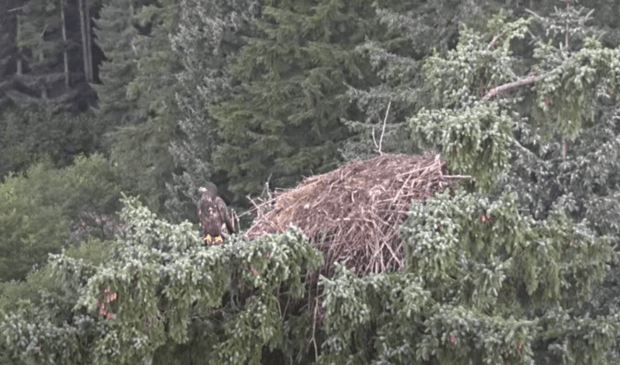
Someone who is home is Kindness, the fledgling Bald Eagle at the Glacier Bay Park in Juneau, Alaska. Kindness fledged on 21 August. Since then she has been enjoying short trips around her beautiful natal tree. So far she has slept on the nest but soon she will move to roosting on a branch.

Where Kindness is standing is called the ‘Bouncy Branch’. Oh, she looks so tiny next to those huge Pine Siskin Trees!

Kindness bounces and flies.

Liberty and Freedom always lure her back with a meal! And it works – Kindness has learned that if you leave food someone else will eat it. She is normally back on the nest within 3-5 minutes of a delivery.

This is precisely how fledging should go. Remember that and if you watched E17 and E18, Harriet and M15’s two fledglings from 2020 – that is a perfect example of a normal raptor fledge, the fledglings flying and playing with parents providing food.

When I last checked, the female peregrine falcon on the Collins Street nest was sure bulking up like she was going to lay that second egg today. Let me check!

Mom needed a break. Still only one egg at 4am 24 August. Sometime on the 24th for sure.

Another Australian bird, the Galah. Here is a very short video of an exchange between this fabulous pink and grey bird and some kangaroos. Try cutting and pasting. So cute! We need cute today. It is from the Kangaroo Sanctuary at Alice Springs.

https://fb.watch/7zJYVKBHM5/

Today there were some visitors to the garden in addition to the hundreds of various sparrows. The rain is coming down and it seems that they prefer the cylinder suet – fantastic. Even with domes the bird seed seems to still get wet. What a mess. Rain doesn’t stop the birds and squirrels from being hungry! The light was terrible and my laptop didn’t want to recognize the new card in the camera so I am attaching these even tho they are not the best images.

The image below is ‘Little Red” who has a life-lease for the garden shed penthouse.

Merlin identifies the bird image below as a Juvenile Male Ruby-throated hummingbird. If this is the case, the hummers are moving south on their way to winter vacations.

One of the resident Blue Jays who would love Little Red to get off the suet — or for me to go out and hang a new cylinder up in another place. He looks like he is doing a little moulting.

There is no word on Malin. Again, ‘no news is good news’. I am practicing patience or at least pretending that I am trying! We are all anxious for Malin and the youngsters of Grafs and Jan. Yesterday Grafs was in once and Jan twice. Better than nothing! And those storklings are starting to fledge. That feels like a miracle. I hope that they find the feeders.

I hope to have news soon on Malin. I am guessing that there are difficulties with the identification of the two birds – maybe neither is Malin. We wait.

Thank you for joining me today. Take care everyone, see you soon.

Thank you to the following for their streaming cams where I took my screen shots or found photographs: The Kangaroo Sanctuary in Alice Springs, Glacier Gardens Park in Juneau, Alaska, The Cumbrian Wildlife Trust and the Foulshaw Moss Osprey Nest, Chris Wood and the Rutland Osprey Project FB Page, and the Collins Street Falcon Cam by Mirvac.

Iris and Louis defend nest

In my last post, Tiny Little Bob or Blue 463 from the Foulshaw Moss Osprey Nest was screaming at White YW (aka dad) for a fish. He could have flown to Wales and he would have still heard her.

What is that about the squeaky wheel always gets the oil first? Perhaps screaming daughters do, too. It is the last fish of the evening probably and Tiny Little is eating it. Blue 462, the other female on the nest, would like Tiny Little to share. Somehow I don’t think so ——- it was, after all, Blue 462 who was such a meanie to Tiny Little when she hatched. Birds have good memories.

These are the areas adjacent to Iris’s nest in Hellgate, Missoula, Montana. It is very beautiful. We always see the nest in the parking lot but just on the other side are trees, grass, and water.

Iris is the oldest living Osprey in the world. Her nest is at Hellgate in Missoula, Montana. After her mate Stanley died, she bonded with Louis. They had one chick survive, Lele, in 2018. Louis has another nest at the baseball park with Starr. They fledged two chicks this summer. When Stanley died, Louis also took over the territory that includes the two nests. Every year Iris returns, goes through the rituals of breeding, lays her eggs, and everything falls apart. People get upset. They think very little of Louis. I am of a divided mind. Right now I prefer Iris taking care of herself, eating well, and bulking up for migration than running around with a nest full of juvenile fledglings. She has done her bit for the DNA of the species. But that is just my opinion. Everyone is entitled to theirs, for sure. But the one solid thing that binds all of us together is our love for this most amazing of Ospreys.

Iris tends to spend more time at her nest before she leaves on migration. Last year she departed on 8 September. Everyone gets a little teary eyed right about now because there is no promise that Iris will return but, we live in hope that this strongest of female Ospreys graces the screens next spring. Along with that hope is that the rains come and there is plenty of food for all.

There have been a number of intruders, both male and female, this summer. Do they want to usurp Louis? take Iris for a mate? Certainly when Dunrovin’s Congo came on the scene everyone was hopeful! or are they just curious and checking out what nests are available? Perhaps all of those things. Today, Louis flew to the nest alarming and Iris flew in and joined him – showing off her big crop!

Erick Greene and his team in Montana are considering many ways in which to commemorate Iris. Stay tuned or check out the Montana Osprey FB page. If you wanted to order an Iris pen and forgot, if you will send me a note I will send you the details. They are gorgeous and made from those sticks she brought to the nest.

In the image below, Rosie, the female adult on the San Francisco Bay Osprey cam at the Richmond Yards, is bringing Poppy, one of two female hatches, a beautiful trout. Poppy is 110 days old today.

The average age for Richmond and Rosie’s female chicks to stop feeding at the nest is 105 days. The longest a female stayed was in 2018 and that was Kiskasit who was 124 days old. Lupine was last seen on Monday. She was 103 days old. Sage, the only male, was last seen on 28 July at the age of 86 days. The average for the males to stop feeding on this nest is 93 days so Sage left a little early. There is no reason to believe that Sage and Lupine have begun any type of migration. Richmond stays in the SF Bay area year round. Mom Rosie will migrate and the female adults normally leave before the fledglings. And whose to say they will migrate! If there is plenty of food and the weather is fine – well, it certainly agrees with Richmond – may be they will stay!

And, of course, just thinking about fledglings returning to the nest to be fed until they are 90-100 days old just makes me think about Malin. Susan, the wildlife rehabber that is over the area where Collins Marsh is located, was to get in touch me later today. She wrote me a long note yesterday and she is also firm in her knowledge that Malin was a forced fledge. As we have learned, normal fledges do not require our attention. The chicks return to the nest, take short flights, and are fed by the parents. Malin was not ready despite his age. He had suffered a lack of food. His forced fledge meant that he was in jeopardy and boots on the ground were needed immediately. This did not happen. As noted earlier, she found two chicks – one dead, one alive. I am hoping that ‘no news is good news’.

Suzanne Arnold Horning was on the Cornell Campus and she found the two Ks. No sightings of Big Red and Arthur but, guess what? Getting to see K1 and K3 on the 22nd of August is a bonus. Here they are hunting. That is K1 on the top. She looks so much like Big Red and has turned out to be such a fantastic hunter. Suzanne said they were not food calling – just being quiet and hunting. These two seem so much more independent this year.

Ah, the little cutie, K3 looking down and hoping to find a chippie.

What a nice treat to get to see the Ks. And, of course, theirs could be a migration dilemma. Big Red and Arthur stay in the area year round. Perhaps with the changes in weather so will the Ks. If someone could put the average date that birds leave for migration this year against last and create a global directory (surely someone does this already), tracking of changes related to climate could be measured. We have seen Poppy stay longer as are many others and now perhaps the Ks.

Thank you for joining me today. I will let you know as soon as I hear about Malin – it is heartwarming to hear from so many around the world who came to love that little nestling. If you are in line with any of the storms hitting the coast of the US, going over Hawaii, or elsewhere, take care of yourselves. Stay safe.

UPDATE: Aug 23 at 17:35:35 No2 (7182) fledged at the Estonian nest of Jan and Janika. Slept as an adult off nest.

Thank you to the following for their streaming cam where I took my screen shots and video clips: Montana Osprey Project, Cumbrian Wildlife Trust and the Foulshaw Moss Osprey Nest, SF Bay Ospreys and Golden Gate Audubon. I would also like to thank Suzanne Arnold Horning who allows me to download her images to share with you.

Grafs feeds his storklings

It is so nice to wake up and have some positive news after the last week of Osprey sadness. Between the two Ospreys near to fledging being euthanized so a light bulb could be replaced and the issues surrounding Malin’s fledge, well, it has been a week of frustration. However, I was so delighted to see that there is some hope for the Black storklings!

At 10:43 on 22 August, after a period of 44-46 hours, Grafs, the male adult at the Sigulda Black Stork Nest returned to feed his storklings. All of the storklings have now fledged. When Grafs arrived only one was on the nest.

While White Storks will feed their fledglings off the nest, it is unclear whether this is the case with Black Storks. The one – starving storkling on the nest – hit the jackpot and got lots of fish. Then a second flew in and there were fish left. The last did not get food but two of the storklings had crops for the first time in ages!

Amanda caught this on video:

This takes away the fear that Grafs had left the storklings and begun his migration! That is wonderful news. It is possible that he had to travel some distance to find this amount of food. We will wait patiently for his next delivery and hope, at the same time, that both Grafs and the storklings might find the feeder. This surely has to bring some relief to my Latvian friends.

In Estonia, Karl II remains near to the nest. His mate left long ago for her migration as have his three children. The transmitter reading for each shows they are all traveling southward.

Jan has arrived at his nest in Jergova County in Estonia to feed his three storklings shortly after 9 am on 22 August.

The storklings of Jan and Janika are beginning to hover and jump. It feels like such a relief that the storklings were fed. Hopefully Jan will return later with more small fishes or some larger ones for the three.

Osprey stuck for 2 days on the top of the Cottonwood Tree entangled in fishing line. This is really getting to feel like a DVD stuck in the player.

A Place Called Hope did the rescue! If I ever come back in another life as a raptor and am injured or entangled, please let me be found and taken to either A Place Called Hope or the Cape Wildlife Centre. They give 200% and aren’t afraid of a challenge!

The Scottish Wildlife Trust has announced today that LR1, the oldest fledgling of Laddie and NC0, left for its migration on 15 August 2021 ahead of the adult female. They waited a week to be sure. This is NC0’s second breeding season and she has surprised many with her fishing skills and her independent attitude. No one has yet has established what her particular behaviour is surrounding migration. In the history of the Loch of the Lowes Osprey nest, a fledgling leaving before the female has only happened once. Normally, the females leave 2-4 weeks prior. The experts at Scottish Wildlife feel that LR1, the female, was very confident and “she just felt it was the right time to go.” A short video clip was made of the last time LR1 was seen.

This is one of the best short documentaries on Peregrine Falcons featuring Annie and Grinnell at the U of California, Berkeley. It goes through all the stages from beginning to fledge. Just fantastic. Guaranteed to put a smile on your face and to get you ready for both the Collins Street and Xavier and Diamond kids.

The wind is blowing in Cumbria but that doesn’t stop Tiny Little, Blue 463, from screaming at dad that she wants a fish ———- and she wants it NOW! Blue 463 is definitely a female.

She flew down to the nest from the perch in anticipation.

And off she went chasing White YW!

Tiny Little you make me smile every time I see you. Go girl, get that fish!

Thank you for joining me today. I have no news of Malin. When I do I will share it with you. Take care. Be safe.

Thanks to the following for their streaming cams where I took my screen shots: The Cumbria Wildlife Trust and the Foulshaw Moss Osprey Nest, The Eagle Club of Estonia, and The Latvian Fund for Nature. Thank you to A Place Called Hope for the image from their FB feed.

The First Egg for the Collins Street Falcons

Oh, my goodness. The male at the Collins Street Peregrine Falcon nest is nothing short of adorable. I spent all last year wanting to scoop up this stealth fighter in my arms and cuddle with him. Or dreaming of a Peregrine Falcon onsie. Wouldn’t that be cute on a toddler?

The first egg of the 2021 season has been laid on 21 August. Wow. It is eggciting.

You might be asking why the female is not incubating that egg. The female will not start incubating the eggs until the last one is laid. This is because the adults want the nestlings to be about the same size for the first fortnight so that there is no rivalry over food. Last year, the three big girls all hatched within a 24 hour period. There was never any sibling rivalry – that is what I love about falcons and kestrels. Once the last egg is hatched, they will be incubated for 32-40 days.

Mom looks so proud of herself!

These are some images from last year:

Mom brooding the triplets.

Dad feeding the girls when they are a little older – before they lose all that fluffy white down.

This year Mirvac, the property owners, are in charge of the streaming cams of the Victorian Falcon Project. You can watch these falcons from the very beginning.

Telyn at the Dyfi Nest, Wales. 20 August 2021

Some more great news. The Season of the Osprey will premier on PBS October 27 at 8pm! Please check your local stations for the exact time in your area. This is what they are saying about this documentary:

“Birds of prey exist in myriad shapes and sizes. Scores of eagles, hundreds of hawks and countless kites and falcons have all adapted form and behavior to fit diverse habitats. But in all the world, there is only one osprey. Following a single evolutionary path, it has conquered every continent save Antarctica. One bird, one design, unchanged. It is the only truly aquatic raptor, the sole member of its own taxonomic family. This one-hour, blue-chip special brings viewers into the life to this incredible raptor with a depth and intimacy never before attempted. Shot in and around Great Island Marsh, where the Connecticut River meets the Long Island Sound, cameraman Jacob Steinberg has achieved unlimited access to an osprey nest and captured the struggles, failures and triumphs of a single osprey family.”

Oh, I can’t wait!

I am afraid that I am having Malin withdrawal. A week or more ago I took a few video clips of Malin being fed by Marsha. I would like to share one of those with you now.

And another one of Malin exercising his wings.

It is so much easier when you know that the little one fledged, returned to the nest for food for 36 days or so, and then flew off to find their life. There is a level of anxiety when it doesn’t happen that way. I sure miss that little one. I have not, as yet, received any images of the two Osprey chicks found or any other news. I am hoping for tomorrow or Monday. It is a busy time of year for the wildlife rehabbers.

Two of the storklings have fledged at the nest of Grafs and Grafiene near Siguldas – the youngest was first and then the oldest yesterday. Only the middle remains. All have returned to the nest safely. The one that had its wing up against the far branch seems to be alright as well. That is good news. I have heard of no feedings since Grafs came in with some very small fish for the trio on 19 August. That means that if the storklings did not find the feeder – the two that fledged – they have had little food but nothing for two days. This is critical. There is concern that Grafs has left for his migration — it was the very initial concern. I want to remain hopeful.

Jan has fed his storklings but the meal was only tiny fish or worms. Urmas has not brought any more fish to the nest. Since he has fed them once and they accepted the fish, I hope that Urmas will do this again (he also left fish when he banded them and put on the trackers). It is not clear whether the anxiety of starvation is worse than having a human bring food to the nest.

These are very difficult times for everyone but they are especially difficult circumstances for these six starving Black Storks – rare Black Storks!

At the Black Stork Nest in the Karula Forest in Estonia, Karl II was still in the nest area. His transmitter told us. The two early fledges, Tuul and Udu, headed the wrong direction due to weather concerns and then turned south. Pikne travelled south from the beginning. New tracker information should be coming in soon. Safe travels all of you!

Oh, this youngster can really scream for food on the Loch of the Lowes nest. What a beauty. This is another good example of a ‘normal’ fledge. The chicks return to the nest to be fed and fattened up for migration.

I really want to put a plug in for the administration of the lochs in Scotland. No one is allowed on those lakes from April to the end of September so that humans do not disturb the birds. It means that motor boats with their leaking fuel are not chasing the Ospreys and making the water toxic. Gosh, I hope that only human powered boats are allowed. What a great idea – leave the lakes to the birds during breeding season. Three cheers for Scotland! This could well be the case throughout England and Wales also. I will try and find out.

And look what is on the Foulshaw Moss Nest. It is a flounder for the lucky chick that makes it to the nest first. Tiny Little!!!!!!!!! Where are you Tiny Little?

It’s a few minutes later and I missed that lucky fledgling that snagged that flounder! It’s gone. That leads me to believe that it was probably Blue 464, the male, the first to fledge. He likes to take the fish and eat it on the branch of the parent tree.

Thank you so much for joining me. I hope that you are looking forward to those falcons hatching as much as I am. Take care. See you soon.

Thank you to the following for their streaming cams where I took my screen shots and video clips: Scottish Wildlife Trust and Friends of Loch of the Lowes, Mirvac Corporation and the Collins Street Falcon Cam, The Cumbrian Wildlife Trust and the Foulshaw Moss Osprey Nest, The Eagle Club of Estonia, The Latvian Club for Nature, Collins Marsh Nature Centre, and The Dyfi Osprey Project.

Sadly, no word about Malin

I want to thank everyone that took the time to write to me and tell me how much Malin meant to them. My inbox was overflowing with letters expressing love and concern for Malin. Everyone wanted to know if there had been any word. Mom and Dad have both been on the nest with fish and today Marsha (mum) was there around 13:00. She did not have any fish that visit. During her morning visit she called out for Malin. So far there has been no sighting of Malin.

After going through the FB postings of the Nature Center, we were able to determine that Malin was the middle hatch. The youngest just disappeared from the nest and the eldest died in the middle of June leaving Malin, the chick that hatched on 18 June, alive. Malin was then the middle hatch of 18 June. Malin then was 63 days old at fledge. The average age for ospreys to fledge in Wisconsin appears to be 55 days. That would make Malin’s timing within range. Most ospreys spend at least 2 weeks flying and letting their parents feed them. Many stay much longer. Two examples that I give are Tiny Tot and Tiny Little because they were both hatches that suffered from lack of food. Tiny Tot stayed on the nest for a total of four months or 120 days. That is more than twice as long as Malin. Tiny Little remains on the nest in Cumbria. She will probably fledge before Tiny Tot’s 120 days – but she could be on the nest for 90 days.

There is disagreement over whether Malin simply flew or whether or not Malin was frightened off the nest by an intruder. Experts on both sides see that exit differently. It is unfortunate. The result is the same – Malin has not returned to the nest. The reactions to looking for Malin are different depending on which you believe. If Malin just flew because he wanted to then no one would go and really look for him. If one believed that Malin was frightened off the nest, they might worry that he was injured and look harder. Something that has to be kept in mind is that Osprey feed their fledglings on the nest – it is preferable. They do sometimes feed on a branch but I haven’t found an Osprey expert that has ever seen an Osprey parent feed their fledgling on the ground. In fact, if a fish falls off a nest they will not go and retrieve it. Have you ever seen an Osprey eat or feed its chick on the ground?

The research continues to stress that the more food and the longer fledglings stay on the nest the higher the success rate. That is the reality. This nest is really empty. Malin defied the odds – he survived and thrived. We hope that the name we gave him carries him on into his life and that he is somewhere safe eating a fish.

Collins is looking down like he might be seeing Malin.

One of the last times the entire family was together on the nest. It was a real privilege to watch little Malin survive and then – thrive. Let us all continue to send this family positive energy.

19 August 2021. Malin, Marsha, and Collins.

It is about 7am in Latvia and Estonia as I write this. The Black Storklings are waking up and like all birds are a little more energetic than they are at mid-day.

The two images below are from Grafs and Grafiene’s nest near Sigulda, Latvia. At least one of the storklets has fledged. Perhaps today they will all fledge and find the feeder area with the beautiful Grafiene decoy.

It is now just after 9am in Latvia and there is only one storkling on Graf’s nest near Sigulda. This means two have fledged just like my source had indicated. The second fledge is the oldest at 7:43 am. He is 70 days old today. The youngest fledged at day 66 after hatch.

This was not the smooth flight of the youngest. The oldest hit the branch on the other side of the tree. There is concern about the condition of that wing. I will update you as soon as there is any information. Send your strong and positive wishes. I hope it looks worse than it was. How terrifying for this young bird to have that happen.

Even so, I hope that both of the storklings are at the feeder filling themselves with fish – just like we hope Malin is doing the same.

There is now only the middle hatch. Perhaps it will go today. They are 68 days old.

When I checked on Jan and Janika’s storklings in Estonia’s Jogeva County, no more fish have been delivered to the nest. It looks to me like every scrap of the old fish has been eaten – I thought that yesterday. Perhaps one really packed down in the nest is there, the one the storkling on the left is pecking at. All of the birds need food.

Hopefully all of them will fledge and find the feeder set up for them, too.

They are so beautiful with the sunlight filtering through the trees. The storks are 67 and 68 days old today. The average for fledging is 68-72 days. I wonder if Urmas will deliver some more fish?????

Do you watch the peregrine falcons, Xavier and Diamond? If you do, then you will know that part of the pair bonding ritual is Xavier presenting a prey item to Diamond. Diamond is not that particular but, she does not like Starlings. She cannot stand them. She has turned Xavier away when he had a Starling for her. They must taste terrible!

Well, today, Xavier hit the jackpot. Diamond was completely excited about her lunch – although some of you might not be. Xavier had a Superb Parrot for his beautiful Diamond. Make sure your sound is turned up.

Superb Parrots are also known as Green Leek Parrots or the Barraband’s Parakeet. These little beauties are native to southeast Australia living in the dry woodlands of New South Wales and Victoria. They were once considered vulnerable in terms of conservation and have been listed as Least Concern since 2012. Loss of habitation due to timber logging might well see this bird back as being vulnerable.

They are medium sized, growing up to a little over 15 cm or 16 inches in length. The bird in the image below is a juvenile. How do I know that? It has brown eyes while the adults have yellow-orange eyes. The adult male has a bright yellow face and throat while the female looks like the plumage that the juvenile has below. They eat fruits, berries, insects, as well as grains and nuts.

Awww. What a sweet face.

WBSE 27 and 28 continue to charm the socks off of everyone. That beautiful fluffy white down is in transition. They look a little like old terry cloth towels sleeping in their nest this morning in Sydney.

Look closely along the edge of the wing of WBSE 28 on the left. You will see the little pin feathers coming.

The pantaloons are growing too.

Just look at that sweet baby, WBSE 28, looking up at its parent. How adorable.

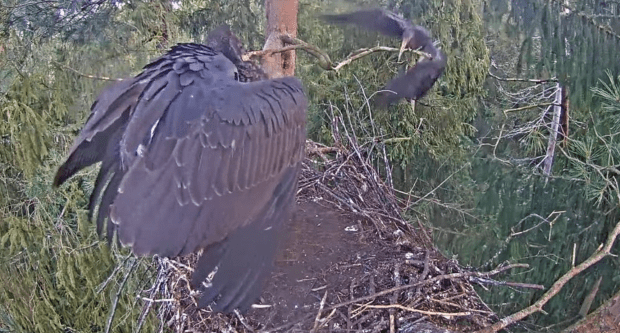
They are so young and yet, both of them know to pancake when there is an intruder near the nest. They hear their parents alarming and down they go. Look at the concern shown in the eye of WBSE 27 on the left. You can also see the black pin feathers coming in on both in this image better than the other one. But look – their cute little tails are growing!

You cam almost see them growing right before your very eyes.

Tiny Little still makes my heart skip a beat. Oh, what a wonderful bird you have turned out to be. You were so very tiny with that big older siblings but just look at you waiting for your breakfast to arrive.

Oh, you have that ferocious look like Mrs G. I have said that a couple of times but you do, Tiny Little. I hope you live as long as Mrs G and have lots of successful hatches. You really are quite amazing, Tiny Little.

Tomorrow is Saturday but there is no Ferris Akel tour this week. I was hoping to catch up with what is happening with Big Red and her family. It was raining yesterday but the Hornings were able to spot all four of them so we know that K1 and K3 are still with us – how grand, the 21st of August.

I am researching ‘Climate Driven Evolutionary Change’. If you know of bird arrivals or departures that are earlier than normal or later than what has been the norm, please let me know. It is much appreciated.

It is so nice to have you here with me. The rain is still falling – and that is a good thing. Please continue to send your positive wishes to Malin and all the bird families. Take care of yourselves. See you soon.

Thank you to the following for their streaming cams where I took my screen shots and video clip: The Falconcam Project at Charles Sturt University and Cilla Kinross. Collins Marsh Osprey Nest, Cumbrian Wildlife Trust and the Foulshaw Moss Osprey Cam, The Eagle Club of Estonia, The Latvian Fund for Nature, and the Sea Eagles Cam, Birdlife Australia, and The Discovery Centre.