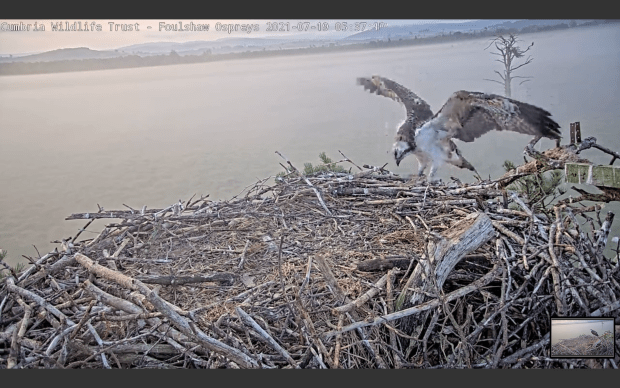
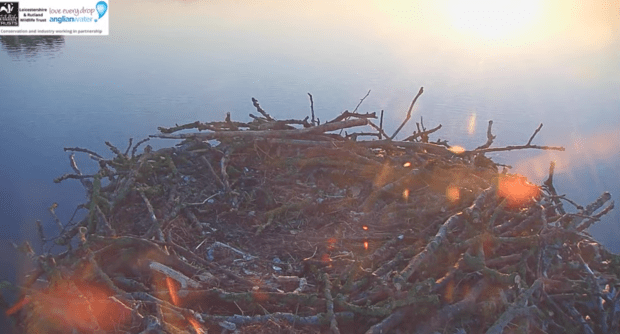
Late Thursday and early Friday nest news

It was a rare treat to check on the Black Storks and find that Karl II was at the nest feeding the three fledglings. It was around 18:00I had been missing this. The ritual of the feeding and the eating is entrancing. This nest is in the Karula National Park in Estonia. As in Latvia, the Black Stork is very rare and much loved. Karl II and Kaia raised three healthy hatchlings this season. Congratulations!

In my last newsletter, everyone was waiting for the second egg at the Port Lincoln Osprey nest to arrive. If you missed it, it was around 3:27 am nest time on 6 August.

Last year’s PLO fledgling, Solly, is 320 days today. Wow. It is about time to get out the party hats and celebrate her one year hatch day. This just gives you hope. Today, Solly is going in and out and in and out at Eba Anchorage. She apparently has a favourite dead tree in the area that she likes to roost in.

Oh, it seems nestlings are just like human children. Let mom or dad get out of sight and they start picking on one another. This was the case with 27 and 28 at the White-Bellied Sea Eagle nest in Sydney, Australia. If this is all these two get up to – let them have a little fun. They are so close in size that neither has an advantage. Have a peek.

Dad and Mom are continuing to bring in fish about 5 fish a day to the Collins Marsh Nest. This is a big improvement over a few weeks ago. Malin’s tail now reveals three rows of dark bands and the beautiful scalloped juvenile feathers.

Oh, Malin is becoming such a gorgeous bird. The stepped up deliveries and the drop in heat seem to be suiting this Osprey family in Wisconsin, USA.

Such a little sweetie. Malin really loves this part of the nest. You can catch her sleeping there during the day (like in the image above) or at night. All tucked in with Mom watching over her. If we could only slip a little pillow under that wee head.

Suzanne Arnold Horning was on the Cornell Campus this evening and found K3. Oh, this is such a cute Red-Tail Hawk fledgling! She did not find the other three and commented that K3 must have missed the memo on where to meet tonight. He was apparently flying around food calling!

I didn’t think another Red-tail Hawk fledgling could ever win my heart like J3 did but look at that sweet face on K3. I am melting.

K3 is over on one of the light towers. What a gorgeous image of this third hatch against that clear blue sky. He has really grown into an amazing fledgling. These two, K1 and K3, are simply great fliers and K1 has turned into a fantastic hunter just like her parents, Big Red and Arthur.

Other Nest News:

Congratulations to Rutland Water. It is their 25th anniversary and today, the 200th chick, Blue 360, fledged! Wow. What a fantastic record for the translocation project. The announcement and photo of that lucky chick is on their FB page: https://www.facebook.com/324266140960825/posts/4294404503946949/

Louis and Dorcha at Loch Arkaig (nest not on camera) have their first fledge this morning. Voting has ended to name their chicks. Hopefully we will know tomorrow! What fun. That Loch Arkaig nest was so empty this year without Aila. Hopefully another couple will claim it for the 2022 season or maybe Louis and Dorcha will move from the nest off camera to the one where we can watch their every move.

Between now and the beginning of the third week in August, the females of the UK nests will begin their migration to as far away as Spain/Portugal or West Africa. The males will remain as long as there are chicks calling for food. This is normally 2-3 weeks.

This is what fish calling sounds like thanks to one of the fledglings up at the Loch of the Lowes. This chick could be heard all the way to Glasgow! They are so loud. You can easily imagine that the male will know if there is a chick on the nest who is hungry.

Things seem to be going really well on the nests today. That is always worth a big smile!

Thank you so much for joining me. I will be back late Friday evening with a nest update. Take care everyone. Stay safe.

Thank you to the following for their streaming cams where I took my video clips and screen shots: Eagle Club of Estonia, Collins Marsh Osprey Cam, Scottish Wildlife Trust and Friends of the Loch of the Lowes, Port Lincoln Osprey Project and the Port Lincoln Osprey Project FB Page, and Suzanne Arnold Horning for letting me share the beautiful images of K3.

The featured image is K3 on the light stand taken by Suzanne Arnold Horning.

Early Monday in Bird World, 2 August 2021

Many who read my newsletter have a love for all birds and a particular fondness for one or two species and a number of nests. My personal journey began with an encounter in my own garden – literally, getting up close and personal with a female Sharp-shinned hawk in the dead of winter who, I believed at the time, was eating the garden rabbit, Hedwig. She wasn’t. Our eyes locked to one another’s, ‘something’ happened. I cannot describe it but those minutes changed my life. I know that many of you have had a similar experience as well as others who have gone on to write books about their journeys.

Philip Brown’s, The Scottish Ospreys from extinction to survival, written in 1979, is just such a book. My used copy arrived in the post a couple of days ago from the UK. The only time that I have had to read has been late at night. The book is so well written that I was often hesitant to stop reading. His enthusiasm and love for these fish-eating birds animates the drive in Scotland to reintroduce the Osprey after years of extinction. Brown gives a good solid history but it is his personal stories of spending time with others at the eyries of Loch Garten guarding the nests that draws the reader into sympathy with the birds. Brown worries about the trees that are partially dead but have nests, about the poachers that are killing the birds, and how to halt the illegal practice of egg collecting. Those are woven in with the growing understanding of osprey behaviour and the efforts to grow public interest in the birds. If Ospreys tug at your heart then this is a book that you should read. When I was looking for a copy I discovered that the book could be ordered from the UK with standard post for a very reasonable price. It is a hardback book and used copies are available for less than 5 GBP.

I want to re-mention another book, available only in paperback. Lady of the Loch. The Incredible Story of Britain’s Oldest Osprey is by Helen Armitage. There are a couple of ways it is different than the Brown volume. It is newer, written in 2011. The book covers the reintroduction of the Osprey to Scotland also but does it by focusing on a single bird, Lady, at the Loch of the Lowes. Lady raised 48 chicks migrating to Africa and back 20 times. That is simply astounding. Armitage’s book is different in another way. The lens is female, a welcome change when the majority of books on Osprey are written by men. She includes details not found in other volumes including one that I found particularly interesting. In trying to protect the Osprey, “In September 1899, Queen Victoria confirmed that certain regiments would stop wearing osprey plumes…” She also notes that it was women who continued the fight to stop the use of bird plumes including the Duchess of Portland who became the head of the Society for the Protection of Birds. It is time to think of fall reading and these are two really excellent books to curl up with.

In nest news, it appears that Bukacek or Father Stork is the only member of his family sleeping on the nest at Mlade Buky.

It is possible that both Pankrac, the female, and Servac, the male are with other fledglings preparing for their migration?

The normal practice with raptors is the female leaves for migration first. The male remains feeding the fledglings and bulking up himself. Once the fledglings depart, the male begin his long journey. Is this also the same ritual for storks?

I had a beautiful letter from a reader, ‘S’. She confirms the special status of storks in her country, Latvia. The people of Latvia have a special name for the White Storks, svētelis. She says the term speaks to the “embodiment of something holy and brings peace and protection from bad things.” This belief explains so much about the great love the people of Latvia have for their storks and that same understanding of storks being special must extend to surrounding countries where people go to great lengths to care for these amazing birds.

In regards to the migration of the storks, ‘S’ says that every year the storks gather on the trees, the roofs of all the houses and buildings, as well as on the electricity poles close to where she lives. When they are all ready to leave they begin clacking their bill together similar to what they do when the storklings are wanting food. Close your eyes and try to imagine how wonderful it would be to see this enormous gather of storks, each being called by the winds to begin their journey. The only equivalent we have in Manitoba are the Canada Geese. Every year they gather on the large ponds near to our nature centre, Fort Whyte. They arrive as the sun is setting calling one another. It is extremely moving. I can only imagine if it were storks!

There are several videos on YouTube about Klepetan and Malena, the famous Croatian white storks and the man, Sljepan Vokic, who has cared for Malena for more than 22 years. Sometimes, it is nice to see one of those videos just to remind ourselves that the world is full of kind caring people.

Skipping down to Australia, the two little sea eaglets, 27 and 28, are doing really well. It is mystifying watching Lady feed them the tiniest morsels of fish from her large beak.

Just look at the size of fish flake Lady is feeding to 28. She is so gentle.

There is plenty of fish in the nest and, so far, I have not seen any signs of food competition. Both of the little ones have nice tiny crops after their feedings. So far, so good. Fingers crossed it keeps up. Indeed, the only cheekiness I have seen is 28 trying to take a bite of 27’s head!

I love the look in Lady’s face as she stares at those two precious little fluffy bobbles. In many ways Lady reminds me of NC0 on the Loch of the Lowes nest in that she has grown into being an excellent – and loving – mother.

There is a gentleness about her movements with the two chicks this year that is striking. These moments of both of them tenderly tucked under mom will pass so quickly – they grow so fast!

A quick early Monday morning check on the UK Osprey nests reveals that Aran and Mrs G have been on the nest together since approximately 4 am.

Amidst the bleating of the sheep and the cows mooing, Aran brought in a fish for Mrs G and did a survey of their nest.

It is reported that Aran’s wing is much improved. He is flying more and fishing for himself as well as delivering fish to Mrs G. This is all good news since it was unknown at the time of his wing injury in late May whether or not he would be healed in time for migration.

One of Laddie and NC0’s chicks is on the Loch of the Lowes nest hoping for a food drop. Of course, that band is in hiding so it is anyone’s guess which chick is calling for fish!

The scene at the Dyfi Nest of Idris and Telyn and their two fledglings is simply pastoral. That said, no one is home!

The nest of Tiny Little is equally beautiful. I love the gentle yellows of the sun kissing the Dyfi Nest as it moves above the horizon and the gentle golden pink colouring the landscape of the Foulshaw Moss nest below.

A little later the Foulshaw Moss is magical. No Tiny Little though.

I cannot think of a better way to start a Monday morning than collapsing into the serenity of one of these landscapes. You can feel the stillness while, at the same time, soaking in the freshness of the smell of dew on grass.

Thank you for joining me. I will get the synopsis of what is happening with the Gough Island Recovery project this week. Once I started reading Brown’s book on Ospreys many other things went to the wayside. I hope that you have a great start to the week. Take care all.

Thank you to the following for their streaming cams where I took my screen shots: The Scottish Wildlife Trust and Friends of the Loch of the Lowes, Dyfi Osprey Project, Sea Eagle Cam, Birdlife Australia and the Discovery Centre, Mlade Buky White Stork Cam, Bywyd Gwyllt Glaslyn, and The Cumbrian Wildlife Trust and the Foulshaw Moss Osprey Nest.

Good Morning Ospreyland

I have a friend who lives in the Northeastern United States. She has a beautiful garden and loves her songbirds. She also adores Big Red, Arthur, and their chicks. Wicky and I often get really down in the dumps over the direction that environmental policies are going. Then we see something and begin to believe that there is hope that all this heat, drought, flooding, birds falling from the sky, etc will pass. We need one another – for on the day I am down, she is up and vice versa!

Today Wicky sent me a quote from Jane Goodall that I would like to share with you. I am including the interview in the New York Times that she sent as well. I hope you can open it.

“Traveling the world I’d see so many projects of restoration, people tackling what seemed impossible and not giving up.”

I am always impressed with how New Zealand develops positive policies for their wildlife. Another area that is doing that is Scotland. Here is a short early morning BBC programme on the restoring of the landscape at the Cairngorms National Park. I am including some images of the park for you so that you get a glimpse of the type of landscape being restored.

“Cairngorms” by wwarby is licensed under CC BY 2.0
“Cairngorms” by chuckrock123 is licensed under CC BY-ND 2.0

Of course, my interest is the Ospreys and this is the home to the Loch Garten Ospreys. It was the first place that the Ospreys returned to in the UK in the 1950s. It was the home of the Lady of the Loch, that female, often called the Norwegian by Tiger Mozone whose DNA, according to Tiger, is in every UK Osprey except for CJ7. Lady was the foundation stone.

The image below is of that historic Osprey nest that is still used.

Sadly this year there were no Ospreys breeding at the nest. I might be remembering this wrong but it seems to me that two birds arrived at the nest and people in a canoe or kayak got too close trying to take photographs and the birds left not to return. (I hope that I am not remembering another nest – I could be so feel free to correct me, please!). Fingers crossed for next year! Here are some images of the loch. It is freshwater and is full of trout. We know that Ospreys love their trout. Dylan flew 13 km to get trout for the Clywedog Nest with Seren and Only Bob a week or so ago.

What an incredible sunset.

“Sunset at Loch Garten” by chuckrock123 is licensed under CC BY-ND 2.0
“Loch Garten” by Cairngorms National Park is licensed under CC BY 2.0

This is that short programme with Ade Adepitan, MBE on the restoration of the natural environment in the Cairngorms:

It is now approaching 11pm on the Canadian Prairies. The Osprey nests in the United Kingdom are just waking up.

Good Morning Tiny Little! I wonder if you dreamed about flying?

Totally serene image of Loch of the Lowes. No one sleeping on the nest. On occasion NC0 or one of the fledglings will appear on the nest but for the most part the camera remains fantastic because sometimes you can see the Ospreys fishing in the loch.

Aila did not return from her migration. Louis waited and waited refurbishing their nest. When he could wait no longer he paired with a new female. They raised two chicks on another nest off camera. The new Mrs Louis is Dorcha. When the two chicks were ringed on 15 July it was believed that they were 4-5 weeks old and are both are believed to be male.

Beautiful Manton Bay Nest of Blue 33 and Maya. The camera will be shut off soon and we will have to wait til the Ospreys return in March. Normally Blue 33 and Maya arrive within an hour of one another. Just think – they travel 4000 miles and arrive in that close of time. It is unclear if they winter together in the same place.

The beautiful morning turned into a day of defending their nest for Blue 33 and Maya. Poor birds.

What a beautiful morning – just look at that pink sky and the green of the landscape – at the Dyfi Nest of Idris and Telyn. I can’t see a fledgling but it sounds like one of them is scratching on the microphone of the camera!

The cameras have not come on at the nest of Dylan and Seren but, wow. I found an 11 minute video shot by a photographer of Llyn Clywedog. We can get a really good look at the loch where their nest is located. It is like you are going for a walk around the water. Very restful.

It is now a sunny afternoon at Llyn Clywedog and no one is home! It is quite understandable why the owners of these streaming cams will be turning them off in the future!

Tiny Little made a short flight from one side of the nest to the other. She spends a lot of time looking down over the edge. Did someone tell me that birds are afraid of heights? Yes, they did. It was someone at the Cornell Bird Lab years ago. It is one of the reasons the little ones don’t often fall off the edge of the ledge nests.

Tiny has spent a lot of time sitting on the edge of the nest looking down.

It’s tea time at the Foulshaw Moss Nest. 463 has joined Tiny Little who is food begging. His crop is pretty flat. Good luck Tiny!

At 16:32 Dylan flew in with a live fish which 464 promptly mantled. Let’s hope mom is around to feed some of that fish to Tiny Little!

White YW is out of there as 462 flies in for the fish. This is going to get interesting. It is still alive! Good lessons.

Oh, we had a little rain and a thunderstorm during the night. It is still really cloudy and, despite the 27 degree heat, one can imagine it is cooler!

Thank you so much for joining me. It seems that everything is going along as it should with the UK Ospreys – save for our little darling Tiny Little who needs some confidence. It will come. They are all individuals. Have a wonderful start to your week. Take care. See you soon.

Thank you to the following for their streaming cams where I took my screen shots: Cumbrian Wildlife Trust and the Foulshaw Moss Osprey Nest, Scottish Wildlife Trust and Friends of Loch of the Lowes, Scottish Woodland Trust, LRWT, Rutland Water and the Manton Bay Osprey Nest, Carnyx Wild and Llyn Clywedog Osprey Nest, the Dyfi Osprey Project, and Bywyd Gwyllt Glaslyn. A big shout out to Wicky for sending me the Jane Goodall interview!

Late Saturday and early Sunday 17-18 July in Bird World

If you have watched Kindness, the Bald Eagle nestling at Glacier Gardens, then you might have caught her nipping at her mum’s beak. It looks like she is trying to kiss mum. A couple of days ago a video was made showing Kindness interacting with her mum. My goodness, Kindness, you are lucky your mum is so patient! Have a look.

At the Port Lincoln Osprey barge, it looks like the final touches have gone on the nest renovations. The egg cup is now lined with very soft pieces of bark. Mom decides to try it out!

Dad flies in with something else on his mind! No eggs yet but mating is taking place. Season will begin soon!

As we approach fledging at all of the Northern Hemisphere Osprey nests and migration in a month to six weeks, if you fear Osprey withdrawal, here is the link to this nest. Just a warning. This nest has had instances of siblicide in the past.

The Port Lincoln’s eldest chick from the 2020 season, a female named Solly, was fitted with a satellite tracker. Solly is 301 days old and she is still hanging out at Eba Anchorage and Kiffin Island. It sure seems that Solly has found her forever home at Eba Anchorage. For those of you unfamiliar, the movements of Solly changed what everyone understood about Ospreys in Australia. It was believed that ospreys stayed near to where their natal nest was located. Solly travelled over 200 km to Eba Anchorage and Perlubie giving the researchers fresh insights to the behaviour of these ospreys.

To my knowledge there has been no sighting of DEW, her younger brother. He did not receive a tracker but he did get a metal ring and a Darvic colour band.

Suzanne Arnold Horning was on the Cornell Campus again this evening. How lucky she was to get some great images of Big Red with a squirrel down on the ground – and it wasn’t raining. (Send the rain to the Canadian Prairies when you get tired of it, Suzanne!).

It was wonderful to see Big Red with prey that she was going to eat herself. She needs to build up her strength after laying eggs, incubating those eggs, and feeding and caring for the three Ks until fledge. Even now she is doing some prey drops and is busy training the Ks to hunt.

Big Red with Squirrel. @ Suzanne Arnold Horning

The Robins were giving Big Red a lot of grief. Could it be because Arthur has been up at their nest eating their babies? Or the fact that K1 caught a bird today and it was rumoured to be a young Robin?

Robins being rather assertive around Big Red. @ Suzanne Arnold Horning

Big Red and her squirrel also attracted another visitor – a Turkey Vulture!

Would you mind sharing asks the Turkey Vulture. @ Suzanne Arnold Horning

The pair also attracted a human who was said to have tried to interfere with the situation. Both of the birds were fine. Big Red was eating and the Turkey Vulture appeared to be waiting to see if she left anything.

One of the things that I have learned is that hunting is difficult and prey is not abundant always. Raptors can wait for hours, half a day, or even a day to catch prey to eat. It is estimated that only 1 out of 3 juveniles live to the age of two years – mostly due to starvation. Humans should not interfere when a raptor is eating. As a result of the human intrusion, Big Red chose to fly away from the human who was interfering. This also caused her to leave part of her meal. The vulture did eat the rest – so in the end everyone ate- but it was a situation that should never have happened. Remember if you see a hawk hunting or eating, please leave them alone. Finding their meal is not that easy.

Turkey Vulture at Cornell. @Suzanne Arnold Horning

The scientific name for the Turkey Vulture – Carthartes Aura – means ‘cleansing breeze’. They are scavengers, eating mainly carrion. They have dark espresso coloured feathers, red legs and head, with a white beak. Like the condor, there are no feathers on their head. This is a great evolutionary trait so that pieces of the dead do not stick to them causing disease or parasites. The Turkey Vulture’s sense of smell is so great that they can find a fresh killed animal a mile away! The only raptors larger than the Turkey Vultures are the Eagles and the Condors. What I find interesting is that they are the only raptor that cannot kill their own prey. They simply do not have the right talons to do this – their feet are more like that of a chicken. That said they can tear through really tough hides with their beak. In other words, the Turkey Vulture was never a threat to Big Red.

As I prepare to settle in for the night, Tiny Little is waking up. The early morning fog over the marsh is just starting to clear. You can see the parents, or siblings, or both back on the parent tree. Tiny Little is still sleeping like a duckling on the nest. Good Morning Tiny Little! Let’s get that gear box into forward today.

Tiny Little is also checking the nest for any little tidbits of leftover fish. And just like Tiny Tot he has found some lurking under those sticks.

Tiny Little was doing some prey calling and looking up in the sky. The morning fog doesn’t seem to be clearing. What a beautiful colour it is – that sort of golden pink gradually fading into the grey-blue-green. Lovely.

Update: Tiny Little had a huge breakfast. It is now mid-afternoon and Blue 462 is working on a fish that arrived. 464 is standing next to that fish and Tiny Little, 463, is ignoring it right now. She is probably still full enough from the morning not to bother. Unclear if Tiny Little has taken a second flight today. I stayed up waiting! But had to give in to being tired.

This is the image of the afternoon line up for a fish! 462 is eating, 464 is pretending to be Tiny Little and bugging his big sibling. Tiny Little is over at the side duckling style. Tiny Little is full from breakfast and knows that Mum will come to the rescue later if she gets hungry.

There is a beautiful peachy almost coral sky as the morning begins at the Poole Harbour Osprey nest. CJ7 and Blue 022 are roosting elsewhere.

Golden diamonds are falling on the nest of Blue 33 and Maya at Rutland Manton Bay. No one is home. They are all perched elsewhere. Blue 33 does make food drops at the nest for the two Bobs.

A little later, Blue 095 flies into the nest and settles down and then flies out again.

Blue 095

Oh, wow. Just look at that sun coming up over the Dyfi nest of Idris and Telyn in Wales. It is so bright you cannot see the perch!

A very short video of Ystwyth fledging at 7:59 am on 17 July is here:

It is serene up at The Loch of the Lowes. No one is home but it sounds like there is a fledgling on the camera perch.

What you don’t see here is that later, NC0 is on the nest, spots a fish, goes out and gets it, and gives it to LM2.

Early Morning at Loch of the Lowes. 18 July 2021

The only thing you can hear at Glaslyn are either bees or wasps on the microphone! Oh, it is so beautiful and green. It has been hot at this nest, 26-29 degrees C – and the birds are staying cool in the shade of the trees. Even with the heat the landscape looks so lush. What a gorgeous way to begin the day.

Early morning at Glaslyn. 18 July 2021

Thank you so much for joining me today. I so enjoy hearing from all of you. Stay safe! See you soon.

Thank you to the following for their streaming cams where I took my screen shots: Byrwd Gwyllt Glaslyn, Dyfi Osprey Project, Scottish Wildlife Trust and Friends of the Loch of the Lowes, Cumbrian Wildlife Trust and the Foulshaw Moss Osprey Nest, Poole Harbour Osprey Project, LRWT and the Manton Bay Ospreys. I would also like to thank the Port Lincoln Osprey Research Project and the PLO FB page where I took a screen shot of Solly’s recent tracking. And last but never least, I would like to say a huge thank you to Suzanne Arnold Horning for allowing me to use her images on my blog. She holds the copyright on them so please do not use elsewhere. Thank you.

Wednesday in Ospreyland

The camera at the Foulshaw Moss Osprey nest has been down or going on and off today so it has been hard to follow what has been happening on the nest. I was able to get some shots for you with two different fish. We know some of Tiny Little’s behaviour and this might help us predict what will happen. When Tiny Little is hungry he is going to be a pest until he gets some fish. In the afternoon on the nest, around 15:40, Tiny Little was on the nest with White YW and Blue 462.

Blue 462 has the fish in its beak. White YW is to the right of 462. Tiny Little is behind 462. You cannot see her.

Ah, there is 463 looking out off the nest maybe day dreaming of fledging? White YW is cleaning his beak and 462 is tucked into the fish. Tiny Little doesn’t seem interested.

Dad has left and Tiny Little continues to look off to the hills and mountains. Tiny Little is acting peculiar. At times he appears to be preening and at other times you might think he is hiding a small piece of fish. At any rate, whatever is going on, he does not seem hungry or interested at all in the fish that Blue 462 is eating.

Once he turned around and looked.

Then Tiny Little goes back to preening.

A fish was delivered for the late snack around 20:00. All three of the chicks are on the nest. It is so nice to see them together and to know they are all safe. 464 has the first go at the fish while 462 looks on anxiously.

Tiny Little is laying down duckling style just watching what is going on. Tiny Little learned a long time ago to let 464 finish before moving in. 462 is standing there, head down watching and waiting for their turn. Tiny Little has no problem getting up to try and eat or take the fish from 462 — but not 464!

462 could not have been that hungry. It ate and if you look carefully you will see that most of the fish is left on the nest to the left of the chick at the rear. 462 does a couple of beak swipes and flies off.

462 moves in to have some fish before Tiny Little can get there. Tiny is still playing duckling.

Tiny gets up and does the usual trying to distract the older sibling. He is now working on nest renovations and moving twigs about.

Then Tiny Little goes and stands by 462 next to the object of desire – that fish! They are both busy watching something. Maybe it is 462 flying about. I bet Tiny Little is hoping it is Blue 35 coming to take that fish and feed her like yesterday.

They both follow whoever is flying for a long time their heads and eyes moving in unison for the most part.

Tiny does a pretty fantastic ‘ps’ at 20:18.

And then he moves right back over by Blue 462 eyeing that fish.

Sadly, I cannot confirm what happened. But if yesterday was any indication, Tiny Little is eventually going to get some of that fish. Maybe Blue 35 will fly in and take over and feed Tiny Little or will Tiny Little get the fish herself? Fingers crossed the camera comes on again to solve the mystery.

At the Dyfi Osprey Nest, Idris was on his perch while Telyn was feeding Ystwyth on the nest.

Later both Dysynni and Ystwyth were on the nest together. Aren’t they adorable? Ystwyth should be fledging soon.

LM 2 was on the nest alone at Loch of the Lowes earlier. Is she watching her mother or Laddie or NC0? That is truly a gorgeous place to have an Osprey nest.

My Scottish friends can correct me but I am thinking that there is not a lot of fishing equipment debris to get into the Osprey nest making the nests in the UK safer than most in North America where the lakes and rivers have many power boats and weekend fishers.

Over at Clywedog, Only Bob loves to eat. Telyn and Only Bob are looking up to the skies at 17:13.

At 17:13:59 Dylan lands on the nest with dinner for the family.

Only Bob moves up so that he can watch how Dad eats the head of the fish.

Only Bob also knows that Dad loves to feed his chick! Dylan spends some time feeding Only Bob before turning it over to Seren who is waiting patiently in the wings. She would like some fish, too.

Only Bob waits for mom to have a few bites before she feeds the rest to him. You are really a very ‘big’ boy, Only Bob.

If you have been watching the nest of Iiris and Ivo in Estonia, their first hatch fledged. Here is that moment:

And with all the attention on Tiny Little, these three beauties of Richmond and Rosie, have all fledged. Aren’t they gorgeous. Richmond could probably handle a nest of four. Very few Osprey males can.

Many of you will have read that when the three chicks were banded, the measurements indicated that they were all boys. But…for the very first time in the history of the nest, the measurements were wrong. DNA testing shows that Poppy ZP and VZ Lupine are females and WR Sage is the only boy. Goodness they were wrong.

Rosie migrates but Richmond doesn’t. He stays around the San Francisco Bay area all year round. He will take very good care of these babies once Rosie leaves and he will be waiting for Rosie to return around Valentine’s Day!

Here is a really cute video of the two girls doing a tug of war with a fish. This was yesterday.

Ah, Legacy at the Fortis Red Deer Nest is snuggling up with mom to keep cool as she serves as a mombrella from the sun. That sky is so hazy from all of the fires. It travels all the way – the smoke – to Manitoba and can make breathing difficult. I wonder what impact the smoke has on these chicks?

It looks like the smoke from the wild fires is also making it hazy at the Fortis Exshaw Nest. Little ones are also trying to get in some of the shade provided by mom.

It is such a contrast to see the Osprey nests in Alberta, Montana, Florida, and California with those in the United Kingdom. It has given me a lot of pause to think about the trash that makes its way into the Osprey nests such as the baling twine that has been killing the chicks up in Montana.

I could not get back on the Cumbria Wildlife Osprey cam but Blue 35 will not let Tiny Little go to bed without some fish. He was so full in the middle of the afternoon that he wasn’t wanting any so maybe he really has had enough already. Either way he will be fine. Growing like a bad weed that one – and surely with those big sturdy legs he is a she.

Thank you for joining me. I am in the midst of planning a trip to Overflowing River in Manitoba to go and see the Ospreys that come to our province to breed during the summer. There will be lots of images for you I hope – but this is not happening for a couple of weeks. Take care everyone. See you soon.

Thank you to the following for their streaming cams where I took my screen shots: SF Bay Ospreys and Golden Gate Audubon, Scottish Wildlife Trust and Friends of Loch of the Lowes, Dyfi Osprey Project, CarnyX Wild and the Clywedog Osprey Nest, Cumbria Wildlife Trust and the Foulshaw Moss Osprey Nest, Fortis Alberta Red Deer Osprey Cam, and Fortis Alberta Exshaw Osprey Cam.

Tiny Little finds a whole fish, Only Bob does a proper fledge and other tales in Bird World

Whenever there are sad moments in Ospreyland, I find it is always comforting to head down and spend some time with Taiki, the Royal Cam Albatross in New Zealand. Taiki was 170 days old today and she weighed 8 kg. She was at 8.2 kg. Around this stage in their lives the weight of the chicks stabilizes – meaning they will not gain vast amounts of weight as they will be focusing on getting their wings strong for flight. If, however, the chick’s weight drops too much, the rangers will provide supplementary feedings. Taiki is right at that point where they are watching her.

Lady Hawk posted a video of Lime-Green-Lime, the mom, coming in to give Taiki a feeding. If you haven’t seen the adults feed their chicks, please have a look. Taiki will be making food callings and her bill will be clacking at the parent’s. That is to stimulate the feeding. Taiki was taught this when she was just a day old. How precious. LGL does beautiful sky calls.

Tiny Little spent his first night alone in that big Osprey nest at Foulshaw Moss in Cumbria. When asked if Tiny Little would be lonesome for his older siblings now that they have fledged, one person on FB said, ‘Not the way they treated him’. Yes, Tiny Little might not have survived but he did! And we are all so happy. Tiny Little was flapping his wings hard wanting to fly but it will be a few days more. Hopefully he won’t get too restless.

Both White YW and Blue 35 have been alarming and flying on and off the nest. This happened around 6:10 am.

Tiny Little did what he had been taught. Stay as still as you can and don’t move – keep your head down!

By 6: 19 the disturbance seemed to be over and Tiny was looking around hoping for a fish delivery.

There are advantages of being on the nest alone. Tiny Tot at Achieva was a pro at finding fish scraps. Look what Tiny Little finds around lunch time! You got it – an entire fish hidden in the nest!!!!

He looks around to check and see if anyone else is around and then he tucks in. He is still eating when Blue 462 lands in the nest two hours later.

Tiny Little is not showing 462 what he is mantling. Meanwhile 462 is pecking around the nest to see if there are any fish scraps left. Smart one Tiny Little!

What an absolutely tranquil scene at the Dyfi Osprey Nest in Wales. The cows are out in the fields and Dysynni was in the nest with his sister, Ystwyth, waiting for a breakfast delivery from dad, Idris.

It is a beautiful day up in Scotland at Loch of the Lowes and both fledglings, LR1 and LR2 are in the nest waiting for breakfast, too.

Those two are just beautiful. Well done Laddie LM12 and Blue NC0. Looks like they decided to pose and look at the camera instead of turning away. Thank you! You are both gorgeous fledglings!

The Rutland Manton Bay nest is growing grass after the Two Bobs fledged. Little birds have been around but seldom do we see any of the Ospreys —–until there is a fish drop and then everyone seems to show up.

Blue 33 shows up with a nice Bream and both 095 and 096 land simultaneously. 095 gets the fish in its talons.

You can see Blue 33 flying off leaving the two kids to sort the fish.

Blue 33 returns less than a minute later. Is he looking for Maya to feed the chicks? He leaves as quickly as he arrives.

Blue 095 is starting to eat the fish. No worries there will be plenty for 096.

Have a look back in time. Here are 095 ad 096 exactly two months ago tucking into a Bream. Just imagine. They are so tiny and now they are preparing themselves to migrate in about six weeks. Gosh they were cute!

It is now around noon in the UK. Only Bob, Blue 496 decided to take a flying spin around the Llyn Clywedog Nest straight to the trees where Dylan goes around 11:47. Yesterday, Only Bob flew to the camera post but today they are counting this as his official fledge! It was a great one, too. Mom, Seren 5F was on the nest with him watching her baby take those next steps.

Seren leaves and Only Bob moves over to the rim of the nest looking at his target. Those trees that he sees dad come out of.

And he’s off. If you look at the right side of the image you will see his two legs flying and heading for the trees! Gosh that must feel fantastic.

A couple of hours later, Seren has a nice fish on that nest trying to lure Only Bob over to have some lunch. It was really interesting watching Seren look at or for Only Bob. At times it sounded like she was talking to him – has slipped trying to land on the rim and is on a lower branch of the tree. Only Bob is 50 days old today.

What a great day in UK Ospreyland. Things are going really well. Aran was seen flying high over at Glaslyn today which is a good sign of an improvement. Hopefully he is not having to contend with intruders. Z2 actually landed on the Glaslyn nest the other day – his nest and chick are at the Pont Cresor nest which many consider to be close to Glaslyn. Sadly, one of the chicks on the Charlo Montana Osprey nest died because of bailing twine. If you don’t know, it is what farmers use to tie up large hay bails. So sad. Montana seems to be having a rather bad year with this twine winding up in the nests.

That is it for me today. Thank you for joining me to check in on all the babes. Take care. Enjoy your Tuesday wherever you are.

Thank you to the following for their streaming cams where I grabbed my screen shots and to Lady Hawk for her videos: Cumbria Wildlife Trust and the Foulshaw Moss Osprey Nest, Dyfi Osprey Project, Scottish Wildlife Trust and the Friends of the Loch of the Lowes, LRWT and the Rutland Manton Bay Osprey Nest, and Carnyx Wild and the Clywedog Osprey Nest.

Two more UK Fledges

Blue 462 fledged at the Foulshaw Moss Nest at 11:57 leaving only Little Bob on the nest.

Everyone is home for the tea time meal and Tiny Little Bob is being fed.

LR2 at the Loch of the Lowes fledged at 17:58! Congratulations to Laddie, LM 12 and NC0 for two fledges this year! Fantastic.

Both fledglings are home and waiting for their tea.

Thank you to the Cumbrian Wildlife Trust and the Scottish Wildlife Trust and the Friends of the Loch of the Lowes for their streaming cam where I took my screen shots.

Stay safe everyone! No doubt there will be more fledges coming.