YRK and OGK laid their egg at the Quarry Track nest, created by OGK, on 9 November 2021. Yellow-Red-Black (YRK) and Orange-Green-Black (OGK) are no stranger to the Royal Cam spotlight. They are the parents of the very popular Miss Pippa Atawhai, Royal Cam Chick at Top Flat in 2020. The moments viewing Atawhai with her dad, OGK, melted people’s hearts. Those who watched these very gentle birds will never forget the pair of them together.
YRK is 28 years old and OGK is 26 years old. They have been a bonded pair since 2006. This year is their 8th breeding attempt. They are also grandparents. This year their son RLK (Red-Lime-Black) successfully fledged SSTrig, the chick in the nest close to Royal Cam chick, Tiaki.
It took five days for the little one to hatch. The rangers say that the reason it takes the seabirds so long to get out of their shells is that they are such long lived birds. The Royal Cam chick is the 11th to hatch this season.
Ranger Sharyn returned the new hatchling to its mother, YRK, at 19:40 on 26 January. Before placing the chick under the mother, the area of the nest is sprayed with a bird-friendly insecticide in order that there is no fly strike on the youngster.
Ranger Sharyn carefully removes the chick from the insulated container.
She has already removed the dummy egg and sprayed the nest area before placing the chick under YRK.
Ranger Sharyn watches with delight as YRK accepts her little one.
YRK gives a shimmy and settles down to brood.
Once Ranger Sharyn is away, YRK raises up and looks down with the most gentle love to the new bundle.
It is extremely windy today. I wonder when OGK will fly in to relieve YRK and have his first look at the baby?????
Southern Royal Albatross are endemic to New Zealand. After the chick hatches, it will fledge in mid-September, spending 4-6 years at sea foraging for food in the waters off the coast of western Chile. Then the juvenile will return to Tairoa Head to find a mate. This choosing and bonding could take years. These seabirds are known for their socializing and elaborate dancing as well as the beautiful sky calls.
Once a couple have bonded, they will lay one egg every two years. Why not every year? It is too physically difficult to raise chicks that close together. The adults have to travel many hundreds if not thousands of miles to forage to feed their chick. They each take turns incubating. Once the chick has hatched they will take turns flying in and out of the headland to forage and feed their chick. They will do this until the chick fledges and begins its life on the sea. Imagine flying for the first time and not landing back on ground for another 4-6 years. I often cannot get my head around that!
The Albatross has the largest wingspan of any living bird at 3 metres or 9.8 feet. They stand 115-123 cm or 45-48 inches and weight 8.5 kg or 19 lbs. The males are larger than the females.
The population of the Southern Royal Albatross is vulnerable and stable at the moment. The challenges they face are longline and trawl fisheries, oil and plastic waste in the sea waters, natural disasters, and warming seas as part of climate change. The New Zealand Department of Conservation makes every effort to ensure that all of the Royal Albatross on Taiaroa Head are healthy. They provide supplemental feedings to both chicks and adults as well as elaborate sprinkler systems to cool the birds and medical care.
Here is the video of Ranger Sharyn returning the chick to YRK:
Here is a very short video by Liz of YRK revealing the chick three times.
You can watch the streaming cam for YRK and OGK here:
What wonderful news! I have peeked at all of the other nests and everyone is fine.
Ervie looked like a wet rat Wednesday afternoon late in Australia.
Ervie was alone on the barge last night while the rain is caught by the camera pelting down.
Thankfully the rain has stopped!
Gabby has been giving Samson time to brood the babies and feed them. Both 26 and 27 are doing very well! Gabby is much more relaxed this year with her third clutch.
Aren’t they so cute??
Thank you so much for joining me today. Take care everyone. See you soon.
Thank you to the following for their streaming cams where I took my screen captures: the Cornell Bird Lab and the NZ DOC, Port Lincoln Osprey Project, and the NEBald Eagle Nest and the AEF.
There is excitement on Taiaroa Head. The Royal Cam chick for 2022 pipped its egg today and the NZ DOC rangers promptly removed that egg from under YRK replacing it with a dummy. Why you ask? Fly strike is when flies lay their eggs, in the hot summer months, on various things including hatching Albatross chicks. Fly strike can be fatal as the fly eggs hatch into maggots that eat their host. So, for the safety of the very endangered Royal Albatross, the eggs are removed at pip to hatch in an incubator. The chick will be returned to the parents to feed and brood as soon as it is safe to do so. Last time OGK was on the nest. Wonder if he will fly in just time time for the return of the chick? Oh, it is so exciting.
The NZ DOC made a short video of the removal of the egg:
At the end of the day, the Kisatchie National Forest yet-to-be-named eaglet was fed 14 times between 06:52 and 17:41. That is 14 feedings in 10 hours and 45 minutes. Wow.
Anna wanted to feed the little eaglet at 17:08 but the baby had something over its beak. You can see it in the image below. Turns out it is some of Anna’s underbelly feathers. Anna tried to feed the chick but it could eat with that big wad over its beak.
Anna realizes the problem and begins to pull the fluff off the little one.
To the relief of everyone, Anna removed the fluff without a problem and the baby had its penultimate feeding of the day.
This is one of the most hilarious Bald Eagle couples I have ever seen. Louis fills the nest with food, so much it could not possibly be eaten. If he comes around to try and have a snack without having to go fishing, Anna perks up.
This is precisely what happened below. Anna was brooding the eaglet and she sees Louis arriving. She makes this very interesting vocalization and gets up and goes over to move a piece of fish. Louis is watching all of this. The little one says, ‘Sure, Mum, if you want me to, I will eat again!’
Louis decides he will be cool and he plays ‘hide the baby’ while Anna is trying to feed the eaglet (again). In the end, Louis winds up digging in the nest and finding a piece of old fish bone which he takes with his beak and flies off the nest. Meanwhile, the little eaglet is still being fed by Mum! That was the last feeding documented before the camera froze. Maybe you had to be watching. The interaction between these two parents is so funny. Louis did do something very useful today. He brought in some more branches to build up the walls of the nest. There are places with holes in them that will need to be covered.
Dad delivered Ervie’s breakfast fish to the nest at 08:30:59.
Here comes one dedicated Osprey dad with a fish!
Ervie was so happy when he saw Dad flying in with a fish.
Later, the cam operator gave everyone some really nice close ups of Ervie staring at the water looking for fish.
Ervie focused.Even when he was looking for fish, Ervie was prey calling to Dad.
I made a short video clip. It was wonderful to see Ervie interested in the water and the fish! Enjoy. There is a severe weather warning for Port Lincoln. The warning is for intense rainfall, severe warnings for heavy rain beginning at 16:00. Later in the evening possibilities of thunder and lighting. Stay safe Osprey family!
At the WRDC nest, it has been hot. Tomorrow they are looking for temperatures around 18 with a 40% chance of rain. I am happy to report that R2 ate and both eaglets seemed perky and happy. In the image below, R1 is full and looking out of the nest while R2 is eating.
R1 full and distracted so R2 can get a nice feeding.
Happy sleeping babies.
R1 and R2 in a food coma.
CROW has announced a virtual speaker series. Some of you might be interested. The guest is Ron Magill, ‘Mr Miami Zoo’ who is responsible for this human made nest for Ron and Rita. It sounds like a really interesting topic.
It will get down to 11 degrees C at the nest of Samson and Gabby in Jacksonville, Florida. That is 51.8 F. There is a chance of rain on Saturday.
Northeast Florida Bald Eagle Nest. 21 January 2022. Gabby rolling the eggs.
The American Eagle Foundation posted the following information today about hatching. Super informative as we wait for Gabby and Samson’s eggs to pip!
Hatching is hard work. Before starting to break out of the egg the chick has three things it must accomplish. It must first switch from being dependent on the oxygen diffusing through the pores in the eggshell into the network of blood vessels that line the inner surface of the shell and start to use its own lungs to breathe. The chick takes its first proper breath and fills its lungs the moment it punctures the air cell inside the top of the egg. (Internal Pip) This step is essential because by this stage of development there is not enough oxygen diffusing through the pores in the shell to support the chick’s respiratory requirements. Taking a breath from the air cell provides the oxygen and the energy necessary to break through the eggshell. Before it takes that first breath, the chick has to start shutting off the blood supply to the network of blood vessels that line the inner surface of the shell, and withdraw that blood into its body. The blood vessels are programmed to close off at the point where they emerge from the bird’s umbilicus, and just before the chick starts cutting round the shell. Third, the chick has to take what is left of the yolk and draw it into its abdomen. It does this by sucking up the remaining yolk through the stalk that connects the yolk to the chick’s small intestines. This “yolk sac” is a food reserve for the first few hours or days after hatching.
Hopefully we will have a pip tomorrow at NEFlorida. We are also watching the Achieva Osprey nest of Jack and Diane. There have been gifts of food and mating on the nest. Diane normally lays her eggs on the 22 or 23rd of January. Oh, so close! Stay tuned for news. So we are on pip watch, hatch watch, and egg watch! Crazy.
Take care everyone. Thank you so much for joining me today. See you soon.
Thank you to the following for their streaming cams where I took my screen shots and my video clips: Port Lincoln Osprey Project, KNF, NEFlorida Eagle Cam and the AEF, and the WRDC.
Our wildlife rehabilitation clinic has seen a 21% increase in patients in the last week. If you live in Manitoba and have the finances, send them a donation, however small or large. They receive no government funding. Everything is done on a donation basis – as is the case with most wildlife rehabilitation clinics. They have a long list of items they need on their website and all monetary donations are tax deductible.
I know that many of my readers live elsewhere but if this is happening here then perhaps it is happening all over.
There was a very sobering article on that cute little Korora (Tiny Blue Penguin) that is doing well in NZ. Its sibling died because the parents have to go so far to feed. For those that love those New Zealand birds such as the Royal Albatross at Taiaroa Head and wildlife that depend on the oceans to survive, what they are seeing is warming waters which mean the fish move or even die (like the trout did in Montana when the Clark Fork River got too water). It is time we demand that governments get serious and take radical steps to try and stop the situation from getting worse.
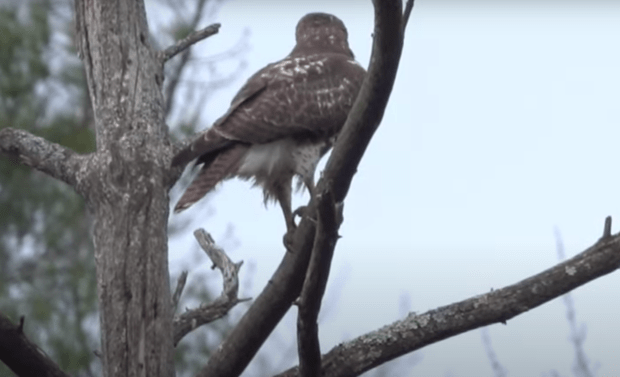
I want to remind everyone of Ferris Akel’s tours. You can go to YouTube, search for Ferris Akel, and hit the subscribe button to the live stream. He has lots of archived video tours as well. They normally take place on Saturdays at noon, Ithaca NY time. Ferris is out at Sapsucker Woods today for Thanksgiving and he has just found a beautiful juvenile Red-tail hawk that is hunting.
Notice the ‘eyebrow’ that helps to keep the glare away from its eyes when hunting. Oh, isn’t this a beautiful raptor?
Ferris just caught a Belted Kingfisher close to the RTH. There have been other birds this morning included Canada Geese and maybe another Kingfisher.
In the summer and fall, Ferris finds lots of shore birds and in the winter there will be owls! You can leave Ferris on like a radio if you are busy or you can watch as little or as much as you like. There is also a chat function with great people who can answer questions.
I am so thankful for Ferris Akel and his tours and his generosity in allowing us to share his images. I have learned so much from him over the years just wish I had a better ear to know which birds are out there by their beautiful voices.
Little Yurruga, the Peregrine Falcon fledgling at Orange, has been seen on top of a building so it is flying alright. Xavier and Diamond have been seen taking food in and out so she/he ? is being provided for. Isn’t this wonderful?!!!!!!
Below is the image that Dr Cilla Kinross took the day Yurruga fledged. She placed it in a tree. What a lovely little falcon you are, Yurruga.
This appeared on the FB Page of the Orange Peregrine Falcons today.
Have you ever wondered about the colour morphing of birds? The Audubon Society has a nice ‘Ask Ken’ article on that very topic! Thanks BM for letting me know!
The NZ DOC rangers at Taiaroa Head are deciding which Royal Albatross couple will be the Royal Cam family this year. There are 36 eggs and they believe that is all for this year. The favourite couple, WYL and BOK, who have made us so happy with their cuddles have not laid an egg – maybe next year! Will keep you posted!
It is a quiet day in Bird World and that is something to be very thankful for – no drama, nothing horrible happening.
Take care everyone. Have a marvellous day. To those having Thanksgiving, enjoy. See you soon.
Thank you to the following for their streaming cams where I took my screen captures or their FB pages: Cornell Bird Lab and NZ DOC, Ferris Akel Tours, Orange Peregrine Falcons FB page and the Cornell RTH FB Page.
On the Canadian Prairies, it is 8 November and it is 11 degrees C. There are some birds still around the southern part of our province including a large number of Great Horned Owls (GHOW) and Barred Owls (BADO). Several hours from where I live there are some hawks and Bald Eagles still making their way south. In celebration of such a gorgeous day with the promise of snow and plummeting temperatures on Wednesday, we decided to make one last check at Oak Hammock Marsh.
It was simply grand. You could see for miles.
The walk was great. It was sooooo quiet, a wonderful change from the noise of the city. If you were intent on counting tonnes of birds and seeing lots of species, then it was a bust! There were about 60 Canada Geese scattered about and a couple of Mallards, a male and a female.
They were all feeding on the tender marsh grasses below the surface.
Even the geese were quiet, no honking, nothing. Just working hard on those plants.
The two Mallards were quite interesting. They were sort of breaking down the grasses as they moved through forcing them under the water with their paddles and then eating them.
Beautiful little female Mallard.
The ducks were not bothered by the geese – everyone seemed intent on eating and enjoying the warm sunshine. The farmers in the area have finished harvesting their crops and the fields are bare. In several hours only six or seven Canada Geese flew into the wetlands.
It might have been quiet in rural Manitoba but there was a lot of things happening elsewhere. First up, for all of you that watch the Royal Albatross, OGK’s mate since 2006 has been YRK. OGK was first in on the peninsula excited to see her and build a nest but…she didn’t arrive. Time passed and she didn’t arrive. Today, 9 November YRK landed on Taiaroa Head. If people could have rung bells they would have. Instead many of us sat and shed tears. The fear is always there. OGK and YRK were the parents of very popular Royal Cam chick, Atawhai (aka Pippa) in 2020. This year will be their 8th breeding attempt.
In other Royal Albatross news, the new couple – Red and BOK (Blue-Orange-Black) have really been entertaining us. They are so sweet. Well, today, Red got some new bling. As one of a mated pair, he is now WYL (Whit-Yellow- Lime).
The image below shows the Ranger giving Red his new bling and identity. BOK is walking off the nest. She will return once everything is over.
Could this new couple with their first attempt at breeding turn out to be the Royal Family of the year? We wait.
The Port Lincoln Osprey Mum decided it was time to go to the spa. She flew off the barge and went over and had a lovely bath in the warm Australian waters of the cove yesterday. It is well deserved. Her and her mate have raised three healthy boys this year.
Isn’t Mum just beautiful?
It is hard to keep up with the 367 Melbourne Peregrine Falcons. I ‘believe’ that there are two (probably female) still on the ledge.
Yes, still there. There is a lot of noise and it could well be the parents trying to lure these two off with prey.
There are theories about gender and fledging times in falcons and hawks. Because the females are substantially larger, it takes longer for their bodies to feather. Therefore, they generally fledge after the males. I do not know how accurate it is but I hear this often.
In Orange, Diamond’s foot is doing much better. At 8:11 Xavier, the male Peregrine Falcon of the scrape on the water tower of Charles Stuart University, delivers a Starling to Yurruga. Xavier does not wait. He drops the breakfast prey and gets out. I don’t blame him. It could definitely save his talons.
Notice how big Yurruga is compared to Xavier. Think Yurruga is a female like her mum, Diamond?
Yurruga is a very good plucker!
Cilla Kinross just posted a video clip of Yurruga. It is really short. Have a peek. I do not think those eggs are going to last much longer.
Everything is as it is expected at Port Lincoln. Dad flew in with a really nice fish but instead of letting the chicks do a grab, Mum got over quickly, mantled the breakfast, and proceeded to take control of the feeding.
It should, by now, not surprise anyone to the identity of the chick right up at Mum’s beak. Now the chick can be identified quite quickly – it’s Ervie! aka Little Bob.
The rule of thumb is that the males return to make their own nests near their natal nest. I hope there are three or four more barges available.
One last nest. NEFlorida with Samson and Gabby. They are both very busy working on that nest. They have been bringing in a lot of big twigs. Here is Gabby moving some of those around.
Cute little Samson looks like he is standing very still in his tight black jeans waiting for orders. What a sweetie.
Samson is a very good listener and Gabby is giving precise instructions. Looks like they are already thinking they need high rails this year.
Thank you so much for joining me today as we check in on some of ‘my’ favourites. Take care everyone.
Thank you to the following for their streaming cam where I took my screen captures: Cornell Bird Lab and NZ DOC, Port Lincoln Osprey Project, NEFlorida Eagle Cam and the AEF, Charles Sturt University Falcon Cam and Cilla Kinross, and 367 Collins Street Falcons by Mirvac.
There are a number of Ospreys named Louis but the one that I am writing about today is the Louis of the Loch Arkaig Osprey Nest. His mate, Aila, did not return from migration this year and there is a new Mrs Louis. Her name is Dorcha. Louis chose not to make their nest on the one that he had shared with Aila. As a result, news of Louis and Dorcha comes from those who have access to see the nest. Today’s news is from the person who ringed the chicks. They report there are two healthy 4-5 week old nestlings. How grand. Louis is a fabulous dad – he even went fishing at night for Aila and the three chicks last year.
I am doing a bit of nest hopping. For whatever reason I am unable to access the Foulshaw Moss Osprey Nest. Others are having difficulties too but some seem to have some success. It is, of course, slightly frustrating because this is the nest of Tiny Little!
The eaglet on the Bucovina, Romanian Golden Eagle nest is hungry. Yesterday he only had a small bird and a bone. There seem to be days of bounty and then not much of anything on this nest. Is there enough prey? how far to the parents have to travel? are both parents still delivering food for the baby? For many this is the haunting memory of Spilve and Klints last year. The young Golden Eaglet cannot live on a little bird. Zenit is a beautiful bird and it will not be long til fledge. Let us all hope that Zenit gets a large prey drop today.
Zenit saw his reflection in the camera for the first time yesterday. It is so cute when they do this – the reactions to seeing another bird like them! Lady Hawk caught this precious interaction.
Wishes come true! I checked on Zenit just a minute ago and Zenit has an enormous crop! Looks like he swallowed a softball.
Scrolling back, Zenit’s mother came in to feed him. This was at 14:12. It also appears that a bird delivery was made around 17:00. It is not clear what the mother brought but as you can see above, Zenit has a very large crop and this is a good thing. It remains unclear to me how much prey there is in the area. Let us all hope it is good!
When the Royal Albatross chick was weighed on Tuesday (NZ time), she had dropped from 8.2 kg to 8.0. The rangers were monitoring Taiki’s weight and were considering whether or not she needed a supplementary feeding. Perhaps that won’t be necessary after today because her mother Lime-Green-Lime flew in for two feedings and her dad, Lime-Green-Black was there for one. Three feedings in a single day at 9:58 (LGL), 13:57 (LGK), and LGL arrives twenty minutes after LGK departed at 14:17. These were quick in and outs but it looked like Taiki got a lot of food.
LGL is so happy to see her daughter. Taiki would like her mum to dispense with all the formalities – the sky calls, the welcome – but LGL will insist. Her daughter needs to learn all of these and imprint them in her mind. Taiki will fledge in mid-September. She will not return to land for 4-6 years. At that time she will do a skycall just like Mum is doing now. Can you imagine being at sea and never stepping foot on land for that long?
Taiki is so excited to have a parent come in for breakfast.
LGK saunters in after Taiki has had her breakfast and is ready to feed her lunch at 13:57. It always looks like the adults have difficulty walking – and maybe they do if the chicks are digging holes and building play nests everywhere. Here comes dad!
It is so interesting that these little Albies stay put on their nest without moving about so much (at least at this stage). LGK does several sky calls but Taiki just wants food!
Taiki settles down to work on her play nest after LGK leaves and gets dirt all over her beak. It sure doesn’t matter. Look at how beautiful she is.
This is LGL’s second visit to feed her daughter. Taiki is so excited to see her again. I wonder if she told mum that she just missed dad? LGL does several skycalls when she greets her daughter.
The baby down is falling off and revealing a beautiful pattern on the back of Taiki.
LGL always looks like she is smiling.
Taiki must be about to pop after three big feedings! LGL must be fishing near to Taiaroa Head as she is returning so often. Taiki is lucky.
It was a golden morning on the Loch of the Lowes. No one was on the nest- they were all out flying and learning to fish. There are some trees around the nest that are apparently good perches for the birds. What a beautiful place. It looks so tranquil —- and safe for Ospreys.
It was just as beautiful at Mlady Buky in Czechoslovakia this morning. There is a mist, low lying clouds, or a fog hugging the mountains. The three storklings are on the nest. Everything is so quiet – you can almost hear the stillness.
Father Stork arrives at 6:19 with breakfast for the three almost fledging storklings.
The three continue to find small morsels on the nest after the frenzy when dad arrives.
The feeding gives them energy. The sun is up and they are warm and two are flapping madly on the nest.
The female is really covering the nest and moving her wings. She was getting some lift this morning as well. Father Stork and the people of Mlady Buky have done well. After the loss of the female, it has been simply a miracle to watch these three thrive. In a way, the people of the community stepped in and took over when supplementary feeding was necessary – just like the New Zealand Department of Conservation rangers.
Sadly, there is no one stepping in for Zenit if it is needed. I wonder if the people who operate the camera would consider setting up a food table if it were needed?
My goodness. Blue 022, the two year old who returned from his migration and stopped off at the Poole Harbour nest of CJ7, is so enthusiastic. He has been helping fix up the nest and has even provided fish for CJ7. He has also been seen ‘sky dancing’ on several occasions. This morning was no exception!
They make such a lovely couple. Oh, goodness. Everyone is already crossing their fingers and toes that these two return from their migration safely. The months will not pass quickly enough. Imagine – no chicks born in this area of England in 200 years! Incredible. There will be lots of celebrating!
Dylan and Seren are both on the nest at 7am watching and waiting for Only Bob to come and have some breakfast. He loves to go and fly often landing on the camera stand. It is so different when they fledge – at first babies always on the nest and hungry and then parents having to wait with food as they fly about.
Kindness is getting her legs stronger every day. She is standing straight and walking some on the nest. She is certainly growing fast – an advantage to being the only chick on the nest.
Kindness loves to do kissey-kissey with Mom. It is so funny watching these two.
At the Osprey nest on the Port Lincoln barge, Mom is on the nest and Dad was over on the ropes. Eggs arriving soon.
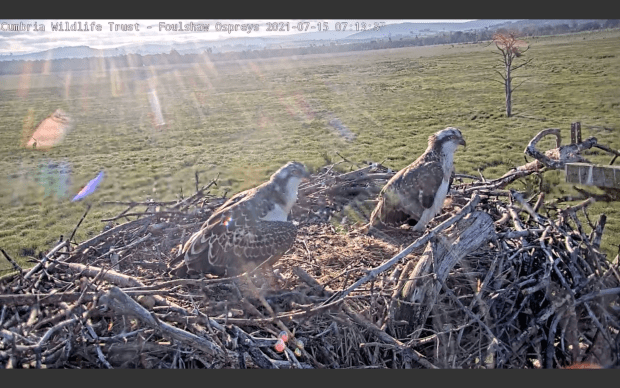
Oh, it is a bit like a bad joke. The camera at the Foulshaw Moss Osprey nest just started working. Both 462 and Tiny Little are on the nest. It is around 7am and they are watching for a parent to arrive with breakfast. Look at that nice necklace that Tiny Little has. Interesting. (TL is on the right) They are being kissed by diamond rain from the sun.
And when he wasn’t watching for a delivery, Tiny Little was flapping his wings dreaming of flying.
The more flapping he does the more the last tidbits of baby down disappear. It won’t be long Tiny but you were four days younger than everyone and you were behind in growth. You will get there just like Tiny Tot!
Hopefully that fish arrives! These two are both hungry. And it did. Tiny Little went over and ate some of the remaining fish and Blue 35 comes in and removes what is left (piece at the front) and will fly off with it.
The camera was still on the blink. I just checked and Tiny is fine. It is tea time and both Tiny and big sib are waiting for a delivery. It is so interesting that the big siblings know when to show up for food.
And last but never least, a lovely picture of Aran and Mrs G on the Glaslyn Nest together. This is a beautiful sight. There has been some bonding over the last few days. I was concerned that Aran was not in top form and Z2, Aeron, of the PC nest might want to take over this one. They are being kissed by golden raindrops, too! Mrs G doesn’t look like she is 21 years old, the oldest osprey in the United Kingdom. She is in really good shape. So sad that they lost their three chicks this year. That can cause issues but they seem to be a solid couple.
Thanks for joining me everyone. It is lovely to see the Golden Eaglet doing well today. That nest is a constant worry. And speaking of worry. The comments section on my blog seems to not be working all the time. It is like Tiny Little’s camera. Please feel free to send me an e-mail: maryannsteggles@icloud.com. I know that some of you had concerns and I regret that technology has caused you any worry. For the next while, til things step up in Australia, there may be only one blog per day. I hope to get more local Osprey news for you this coming week.
Thank you to the following for their streaming cams. This is where I grabbed my screen shots: Bucovina Golden Eagle Nest Cam, Cumbria Wildlife Trust and the Foulshaw Moss Osprey Nest, Cornell Bird Lab and NZ DOC, Mlady Buky, Port Lincoln Osprey Cam, Glacier Gardens Eagle Cam, Dyfi Osprey Project, Clywedog Opsrey Cam and Carnyx Wild, Byrwd Gwyllt Glaslyn, Poole Harbour Ospreys, and Scottish Wildlife Trust and Friends of Loch of the Lowes.