“You do not need a lot of money and often do not need to do a lot to help a life.” Often you just need to pickup the phone and find the closest wildlife rehabber who will help. Remember that phone app – Animal Help.
I just saw a posting from a wildlife rehabber who gives sage advice – if you see a bird that is unable to fly, notify the wildlife rehab clinic right away — sooner than later might save their life. The story of this fledgling eagle reminds me of Little Bit ND17.
WBSE 30 has hatched!
Lady got up from brooding to show Dad his new baby. How touching…I just love it when the males first come to see their new little ones.
It won’t be long until 39 is fuzzy wuzzy.
Let us all hope that these two are the sweetest of friends.
If you did not see my update, the Mum at the Finnish nest is, indeed, very ill. She is most often on the nest and this allowed an intruder female to come into the nest today to steal the osplets fish and she was beaking at them. It is a very challenging situation with no one there to protect the babies. Dad is doing his job getting them food. He might not know about the intruder. Let us hope she goes away so that these two who are now flapping their wings will fledge and thrive despite all the problems this season.
The chicks are asleep and the intruder bird arrives.
The chicks start alarming and mantling.
The one had some fish and he is really covering it. They are still alarming. The intruder flies off.
Please keep these two in your warm thoughts.
The wildlife in this heat wave are struggling. Send positive thoughts to all including the Osprey family in Osoyoos. Dad is doing the best he can in the circumstances. Large fish go down to the bottom. His best fishing is early in the morning before the temperatures have amped up. —BUT of course there is another problem — fish die in warm water. This is happening with the Clarke Fork River (or was last year) when the temperatures rose. The streams are drying up and the fish are dying…they do not like warm water! Sending hugs of hope to this family. Currently 34 degrees.
Lilibet has been enjoying a fish and hanging out on the perch of the Fraser Point nest in the Channel Islands. Andor and Mama Cruz have been around today, also. It was nice to see Andor!
It was excellent news to hear that Victor stood for the first time without assistance this morning. Such a relief. If you ever hear of an eagle getting physiotherapy, smile – because you know it can work!
One of the Ls – and I think it was L2 – landed on the railing of the Fernow Lighttower nest in Ithaca. L2 loved playing on those rails before she fledged. Scared the wits out of everyone. L2 and L4 continue to do very well!
The latest tracking on Ervie shows that he has been all over the place on the 19th in Port Lincoln. Just look at this map! Goodness gracious. Our boy is really moving along the coast. Meanwhile, Dad has been seen bringing fish to the nest but not sharing with Mum. She might get miffed soon if he doesn’t share.
This is just a check in – a quick one – at some of the nests including those that are concerning us: Osoyoos and Janakkdan – and all other nests that are having difficulties including Kielder 1A.
Thank you so much for being in with me this evening. Stay safe, stay cool and please take care. See you soon.
Thank you to the following for their streaming cams and/or posts where I took my screen captures: Hoo’s Woods Raptor Center, Sydney Sea Eagles@Birdlife Discovery Centre, Sydney, Explore and IWS, Osoyoos Ospreys, the Finnish Osprey Foundation, Port Lincoln Osprey FB, Cornell Bird Labs RTH.
Good Morning everyone. It is going to be a hot sunny day here on the Canadian Prairies with a temperature of 31 C – a good day to get outside early for that walk! There is a heat wave across the southern areas of western Canada right now and it is going to have an impact on our Osprey nests.
I had a lot of questions about the ducklings in my blog yesterday. Here are the ducklings again. They do not all belong to the same Mum. There were 35 in total but, the individual who took the image couldn’t fit them all in the frame. They are Mallards. The females rotate taking all the ducklings to the pond to swim and eat. The other mothers get a chance to relax and eat grass. What a great system! And what well-behaved ducklings. Incredible. ‘Duckling Daycare’.
The other day Suzanne Arnold Horning took an image of the three Ls (minus L3 who is in care) on the grounds of Cornell. Every year there are a few opportunities when the three get together on the top of a fence. This was the magic moment for 2022. What a treasure. Who would know that L1 would not be with us today as we woke up? Their lives are ever so fragile and we are so lucky to be able to observe them. So glad L1 flew, and hunted, and played with her siblings. And so sorry for Big Red and Arthur who, more than likely, saw that fateful moment that took their first hatch’s life.
L1 The Ls, 1, 2, and 4 on the fence by the track. Cornell University.
Ferris Akel was kind enough to go to the Cornell Campus last night and look for Big Red, Arthur, and the two remaining chicks in the wild. There is a lovely community that has bonded around Big Red and her family. It was getting dark when Ferris took these last images of Big Red hunting a squirrel and Arthur on top of the same building where they found L1 yesterday morning.
Arthur was on the other end of the building. Earlier they had been on a light pole overlooking the area where the two chicks were – observing from a distance and perhaps thinking of L1.
Both osplets at the Mispillion Harbour Osprey nest in Delaware have fledged! Congratulations to Mum and Dad and all those cheering them on. Thanks ‘H’ for letting me know! The pair are having fun taking short flights on and off the nest.
One on the perch and the other one flying.
Tuckered. Flying is hard work…turns fledglings into ducklings.
Audrey is busy incubating the remaining egg and brooding Big Bob. It is possible that Big might turn out to be the only Bob on the Chesapeake Bay nest of Tom and Audrey for the 2022. Big is the first hatch of the second clutch for these two. He needs to grow big and strong and fly good to meet migration deadlines.
Right now all Big Bob wants to do is sleep and eat. Cute.
The two chicks on the Janakkalan nest in Finland continue to work on their self-feeding. Dad continues to bring the fish to the nest. One is better at self-feeding but the second is getting there. Hunger is a great motivator and when one chick has opened up the fish it is easier for the smaller one to eat. Send positive wishes to this nest. They can both survive if they feed themselves.
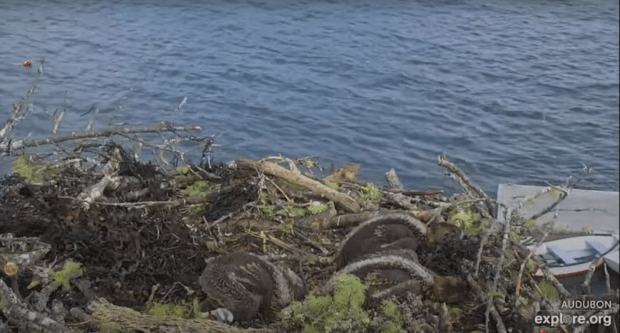
Everything appears to be good at the Boathouse Osprey platform on Hog Island. Morning stars glittering around Dory as she stands on the edge of the nest.
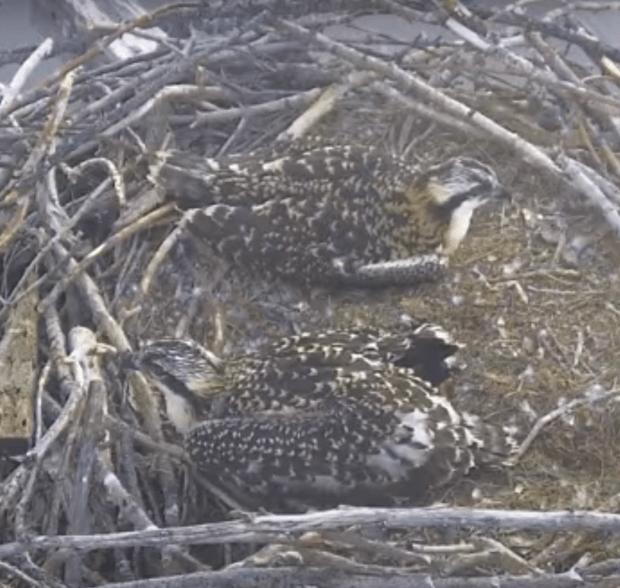
Another nest just needs fish. The heat in British Columbia is driving the bigger fish deeper into the water. The male at Osoyoos is only able to bring in little twiddlers. More fish is needed…It is going up to 34 C today. A cooker. The Ospreys need all the hydration they can get. Too bad Dad doesn’t have a fish basket on that lake.
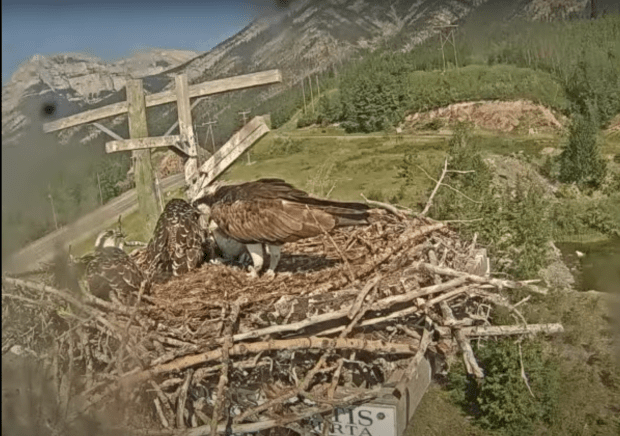
The temperature will rise from 9 C to 29 C with a heat warning at the Canmore Alberta Fortis Exshaw Osprey nest today. Wish for fish here, too.
Peace and Love, the eaglets at the Glacier Gardens nest, were ready for their morning breakfast. There is condensation (I think that is what it is) moving about on the camera lens so it is hard to see them. Their juvenile plumage is really coming in and both continue to be healthy. — Which reminds me. The news on H5N1, the highly pathogenic avian flu, is that it is waning. Thank goodness.
The latest Twitter posting of Cal Falcons show an incredible prey exchange caught by the photographer moon_rabbit_rising
Annie and Alden are making sure that these two are so capable of getting their own prey when they leave the home territory. Would love to see this in real time…
While we wait to hear what the Ojai clinic can determine is causing Victor, Andor and Mama Cruz’s eaglet fledgling, not to be able to stand, here is an uplifting story of a sub-adult Bald Eagle that was shot and got a second chance at life. Thank you ‘C’ for making sure I had a smile on my face the other day. So grateful to the vets and the rehabbers who take our feathered friends into their care and work miracles for them.
If you saw a raptor (or other bird or animal in need) who would you call? ‘B’ sent me the answer if you live in the United States. Here is a site – Animal Help Now – that will help you find all of the wildlife rehabbers in your area and their specialties. Note that some only take turtles and amphibians, etc. You enter your address or a city and you get a list. Please bookmark this site. You never know when you are going to find yourself in a park with an injured waterfowl or raptor or on the highway. This will save you a lot of time fumbling around and it could make a real difference to the life of the injured wildlife. USFWS does not help and neither does the DNR – so do not bother calling them. If you know of a similar website in other countries, please let me know. We are all here to help and getting to the right person is critical. Thanks ‘B’.
Fledge watch is on for most of the UK Osprey nests that have not already had fledges. Keep an eye on Brooks and Molate at the SF Osprey nest of Richmond and Rosie, too. Time is passing very quickly.
There was a fox cub seen on the Fraser Point nest last night. It is a good thing Victor was rescued when he was. Lilibet was not on the nest at the time the cub came poking about.
Pip watch at the WBSE nest of Lady and Dad in the Sydney Olympic Forest nest. Yesterday Lady let Dad incubate the eggs. Will she let him today? If not, watch that first egg closely.
Thank you so much for joining me this morning. There is so much happening with all the nests – I am just glad we don’t have eggs hatching at all the Australian nests right now. We would all need several computer monitors! Continue to send positive wishes to those feathered friends in care and to those nests that desperately need fish today – big fish – like Osoyoos. Take care everyone. See you soon.
Thank you to the following for their photographs, streaming cams, FB pages, and Twitter posts where I took my screen captures: Suzanne Arnold Horning, Cornell Chatters, Ferris Akel Tours, Mispillion Harbour Ospreys and the DDNR, Chesapeake Conservancy, Finnish Osprey Foundation, Audubon and Explore.org, Osoyoos Ospreys, Fortis Exshaw, Cal Falcons, Explore.org and IWS, Glacier Gardens, and Sydney Sea Eagles@Birdlife Australia Discovery Centre.
I hope that everyone had a lovely day today. It is relatively quiet in Bird World. That is a good thing!
It is so nice to get an update of WBSE 27. At her second stint in wildlife rehabilitation, WBSE 27 was kept and the staff did not release her until she was flying and hunting prey in a way that ensured she would survive in the wild. A real round of applause for Ranger Judy Harrington and Australian Raptor Care and Conservation. The most important thing is that the raptors are not released before they can manage completely on their own otherwise the stay in rehab has been futile.
The ‘problem’ with the WBSE nest in the Sydney Olympic Forest are the Pied Currawong. When the WBSE chicks fledge, the Currawong chase them out of the forest so they are not able to return to the nest to be fed. As a result they do not: 1) have the GPS coordinates imprinted in their mind for the nest; 2) do not have the time to allow their flight training to gradually progress; and 3) they do not get lessons on hunting from their parents; and 4) they generally starve as they cannot hunt. If located after flying off the nest, the birds are emaciated, like 27 was twice, and being beaked and attacked by all manner of smaller birds. It is a tragedy.
This is WBSE 27. Isn’t she gorgeous? She was ringed and fitted with a tracker the the rehabbers. What a good move. There is a very good report under the picture. What a blessing that the staff worked so diligently with her to ensure that we can be reading such a great progress report.
Lady and Dad have been busy incubating the eggs for WBSE 29 and 30. Here they are changing shifts. Pip watch should begin in about 4 or 5 days.
Here is the link to their camera:
The big news in US Osprey Land is that Tom and Audrey at the Chesapeake Conservatory Nest had a successful first hatch with their second clutch. Time was 0341. Oh, fingers crossed for all of them and that the chicks grow fast and healthy so that they are ready for that big migration south in the fall! Congratulations to everyone. Thanks ‘H’ for those two screen captures. Big Bob is adorable. So happy for Tom and Audrey.
Audrey looks down at her little upside down bundle.
Hi Dad, is that my fish?
What in the world is Bukacek doing? He started working on another nest the other day and now Betty is over there with him — and the kids are at the old nest!
Great timing. Just got there when Skiff brought Dory a fish for the three kids.
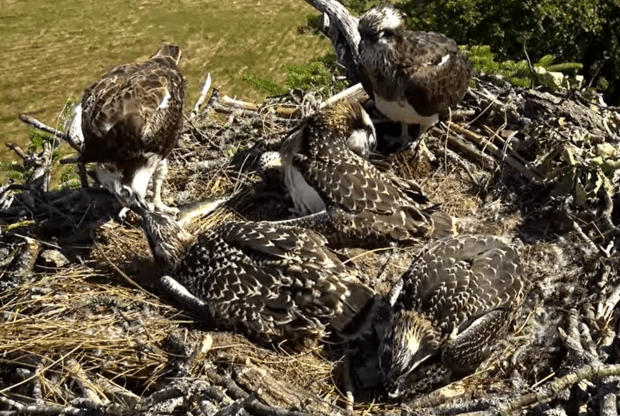
It looks like Little Sloop is in the middle. Which one is Schooner? and Slipjack? I have yet to be able to tell Big and Middle unless they are really looking at me.
Skiff has been on and off the nest all day. Is there an intruder about?
The kids have been pancaked on occasion. See how close big and Middle are…can you tell them apart? Any tips would be welcome.
For those watching the Osoyoos Osprey nest, Little Bob got himself on the other side of Mum today to get some fish. I wonder if that Big Bob is a female? She can be rather bossey.
We are definitely on fledge watch at the Mispillion Harbour Osprey nest. It is a good thing that the pair do not start wing flapping at the same time. Poor Mum. Either or both can take off anytime…they just don’t know yet that they can fly.
Idris has been filling the nest full of fish today. Pedran and Paith (Big and Little) both took turns feeding off of one fish. Telyn might be wondering when she can relax on the perch and they can feed themselves. It sure has been a busy season for her and Idris with these three whopping females.
Pedran is the one feeding herself. Paith is learning but she needs to figure out how to hold the squiggly fish down with her talons.
Louis has been busy today, too. I just feel for Dorcha. She has had so much bad weather this season in this nest. But today they are dried out. Big kids like those at Dyfi, almost ready to start thinking about learning to self-feed.
As the chicks get bigger they sure can eat a lot of fish. Laddie flew in with a really nice salmon for Blue NC0, Big, and Middle. The kids are also starting to think about what wings are for! I can’t help but think Blue NC0 is tired this year and she will need a time to get her strength up and her weight.
The wind was really blowing at Loch of the Lowes but it did not stop Laddie. Here he comes with that tea time whole fish!
What a scramble on the nest as he gets closer. Gosh, Laddie looks so tiny.
Blue NC0 got it. Best to let her take that fish and get off that nest. Talons could be in danger.
He’s off.
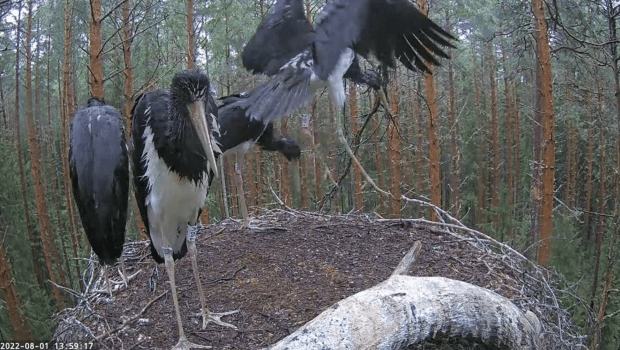
Karl II comes in with tonnes of fish for the four Black storklets. At the beginning, Bonus is in the back but he moves up the left side to come to the front. You can tell Bonus because his plumage is still whiter than the storklets of Karl II and Kaia. This intervention is doing great. So very happy.
Alden has been loafing. What a character. So happy to know that Annie has accepted him as a mate…we can prepare ourselves for more loafing and moth chasing next season.
As Suzanne Arnold Horning was leaving the Cornell campus, she spotted 2 Ls on top of the Riley Robb Building – a first ever she says. Big Red and Arthur are moving the chicks further around the campus as they get more hunting and flying skills.
I was able to pick up an ex-library copy of Alan Poole’s Ospreys. A Natural and Unnatural History. There are no big colour images like his other book, Ospreys. The Revival of a Global Raptor but this book is choked full of really interesting information on Ospreys. If you are an Osprey fan and want to learn more or are just beginning to appreciate these amazing books, see if you can find a used copy. Well worth it!
Thank you so much for joining me today. Take care of yourself. See you soon.
Thank you to the following for their streaming cams, videos, and/or FB pages where I took my screen captures: Australia Raptor Care and Conservation Ltd, Sea Eagles@Birdlife Australia Discovery Centre, Chesapeake Conservatory, Capi Mlade Buky, Audubon and Explore.org, Osoyoos Osprey Cam, Mispillion Harbour Ospreys and DDNR, Dyfi Osprey Project, Friends of Loch Arkaig and the Woodland Trust, Friends of Loch of the Lowes and the Wildlife Trust, Must-Tooneburg and Eagle Club of Estonia, Cal Falcons and Suzanne Arnold Horning.
Do you remember holding your breath whenever the Highly Pathogenic Avian Flu H5N1 was mentioned? I recall looking at the falcons on The Campanile and the eaglets in the Channel Islands and just hoping that it would not land on those islands and wipe them out. Very very sad news is is coming out of the UK. H5N1 is in the north of Scotland and Shetland but today Coquet Island said that every chick on each of the 1964 Sandwich Tern nests has been killed by Avian Flu. Tragically, they believe that it will also wipe out every Roseate Tern as well.
Coquet Island is off the east coast of the UK just a little north of Newcastle-upon-Tyne in Northumberland.
Suzanne Arnold Horning – thankfully – has her camera with her just when she needs it. She caught the 3 Ls on a fence at Cornell today.
Can you tell who is who?
Lancer has been playing with sticks on the nest…often the Red-tail hawks will play with pinecones to help with their eye-talon coordination. This is a very cute video of Lancer having some fun. It reminds me of the Finnish Osprey couple pulling on their fish!
As well as being asked if the females ever go fishing for the osplets, I am often asked if the males ever feed their chicks. Many do! This is Aran at the Glaslyn nest today feeding his triplets.
Awwww. They finally lined up.
The beautiful Glaslyn Valley – home to Aran and Mrs G.
It is that golden glow of evening on the Dyfi Nest. Idris has brought in a nice fish for the end of the day and Telyn is busy feeding those three growing bigger girls. The weather is nice just like it is at Glaslyn.
Oh, Dorcha is feeding her big girl and boy their last meal at Loch Arkaig. It looks like she had a nice weather day – well, deserved.
The cam operator caught two of Dylan and Seren’s chicks close up. Oh, they are gorgeous. There is a third – it hasn’t gone anywhere! Just sleeping between the two. We do not need any more excitement in Osprey Land this week. Seren has also been fishing – bringing in some nice fish from the reservoir when she thinks Dylan hasn’t provided enough. Go Seren!
At the Boathouse on Hog Island, Skiff brought in a fish. It looks like Little Bob – Peanut to some – is getting another private feeding. ‘H’ mentioned to me the nautical names given to the trio – schooner, Skipjack, and Sloop. So Little Bob or Peanut is really Sloop. Did they intend for him to be a small anti-submarine warship from WWII or a sailboat with a single mast?
Big ones are full enough and Sloop gets some nice fish all by himself. I continue to praise these first time parents. They are doing fantastic.
If you have been watching the Cornell Kestrels in Wisconsin, there was a fledging frenzy today. Here it is if you missed it. All four took flight.
A few days ago ‘L’ asked about Malena and Klepetan, the White Storks who had their nest on the roof of Stjepan Vokic’s house in Croatia. Malena had been shot by a poacher and left to die. Vokic rescued her and Malena lived with him for 28 years. For 19 of those years, her mate Klepetan flew from South Africa to Croatia. The couple raised 66 White Storks to fledge with the help of Vokic.
Surprise! I found a book, Malena and Klepetan. A Love Story on Wings by Jillian Marie Shea.
The author puts several quotes in the front. One says, “You must write for children the same way you write for adults, only better.” That is the nacre of this book!
The book is rightfully dedicated to Stjepan Vokic – who would win my vote for Gold-level Interventionist. “Never doubt that a small group of thoughtful, committed citizens can change the world. Indeed, it is the only thing that ever has.” A good reminder that we have the capacity to give our feathered friends a second chance– if we will only reach out and do it – because, like Malena, so many of their tragedies are due to us.
It’s a feel good book – for all of us!
Thank you so much for joining me today. Take care. See you soon.
Thank you to the following for their streaming cams where I took my screen captures: Cornell Bird Lab, Explore.org and Audubon, CarnyXWild, Friends of Loch of the Lowes and the Wildlife Trust, Friends of Loch Arkaig and the Woodland Trust, Dyfi Osprey Project, Bywyd Gwyllt Glaslyn, and Suzanne Arnold Horning.
Good Morning Everyone. I hope that your day is bright with sunshine. A decade or kore ago, the summer temperatures in Winnipeg averaged 17-19 degrees C. Then for 4 or 5 years – perhaps a little more – they crept up to the high 20s with some days being 38 degrees. Today it is 19 C. A fantastic day for a walk and a check on the goslings later.
Yesterday I reported on one of the fledglings at the West End nest being in a dust up with another. I could not see any bands but made the assumption that it was one of the other siblings – forgetting that the 2-3 year old juveniles are returning to the Channel Islands. Lady Hawk cleared that up with a video noting it was an intruder that attacked Sky. A shout out to ‘B’ for letting me know!
Here is Lady Hawk’s video of that event:
I wondered how long it would be before more names were added to ‘the list’. That news arrived late last evening when ‘A’ wrote to me about the sadness at the Finnish Osprey nest of Miina and Marko. The feathers were found under the nest and it is believed that the nest was attacked, as others have been, by a henhawk. So sad. This nest site with its close proximity to the forest seems to be an unlucky one. Thank you, ‘A’ for letting me know.
Here is the information from Looduskalender:
"The nest equipped with a webcam in the Võrumaa osprey (Kalakotkas 1), where female Miina and male Marko nested with two eaglets, was soon taken down due to damage caused by lightning.
Today the nest was empty, the nest tree was all broken, the osprey, the young bird, was killed. The burglary could have happened a few days ago."
Happily, the osplets on the nest in Finland are healthy and safe – so far no attacks that I am aware. This is a natural Osprey nest – not a human made platform – 160 miles south of the Arctic Circle. It is in the area known as Lapland and they have sunshine almost 24/7 this time of year.
Here is the link to this nest if you do not know it:
The osplets at nest #4 are simply gorgeous and it will not be long until they are ready to fledge. Oh, let us hope that the hawks do not come around!
If you would like to watch all of the Osprey nests in Finland at one time, here is that link: saaksilive.fi/live/kaikkikamerat
Dory is busy shading the three osplets at the Boathouse Osprey nest on Hog Island today. Gosh, isn’t she just a great first time Mum?!
We will never know if the hour long fireworks did any damage to the Bald Eagles hearing at the National Arboretum. Takoda, however, continues to be fed by Mr President on the nest – and this is a good thing because we get to see this gorgeous fledgling. Takoda was eating breakfast at 0628.
All around the world people continue to celebrate the little Red-tail Hawk, Malala, that survived from being the Bald Eagle’s dinner on Gabriola Island. It was always difficult to see Malala clearly on the streaming cam. Sharon Palmer-Hunt posted two photographs of Malala on the GROWLS FB page and, in case you didn’t see it, here she is:
Adorable. Like the fledgling Blue Jays, the Red-tail hawks have light blue or light blue-gray-green eyes. As they age, the eyes will turn a deep espresso brown.
Check out the tail below. How many dark bands does Malala have? Laura Culley suggests that they need at least 5 but better 6 to fledge. Malala has been flying for a little over a week (?) and she now has 8 or 9.
Our other favourite Red-tail hawk fledglings were caught hunting and playing around the Cornell Campus last evening by Suzanne Arnold Horning. Oh, they are adorable. She got all three! Thank you, ‘S’. All of us appreciate your efforts chasing these quick hawks around the campus so we can see them.
As the North American birds fledge, we will be moving our attention to Australia. One of the most adorable Peregrine Falcon couples is Xavier and Diamond at the scrape on the grounds of Charles Sturt University in Orange. They are not a young couple – considered middle age at 9 years old.
Xavier gets prey and stashes it in the corner of the scrape for Diamond. Diamond is very particular. She does not like European Starling!!!!!! It looks a nice pigeon for lunch today.
If you do not know this couple, here is the link to their camera. We will be expecting eggs in late August/early September.
Beautiful Diamond.
If you do not know this couple, here is the link to their streaming cam:
There is wonderful news coming from Estonia. We knew from the photograph that the trail camera took that Kaia had found the fish basket Urmas has provided this family so that it can feed the foster chick, Bonus. Now Urmas has posted a photograph showing Karl II finding the fish basket! The adults will require so much more food as the storklets grow bigger and bigger.
The wonderful experiment to save as many of Jan and Janika’s Black Stork fish appears to be working with the dedication of Urmas and his team. I want to find the donation button and post it again as the cost of the fish for the two – Karl II and Eedie families – is high. If you wanted to help and haven’t yet, there is still plenty of time.
I often have disagreements over intervention with some of my raptor associates. In the case of the Black Storks, they are extremely rare. It is possible that all of the fledglings from last year in Latvia and Estonia did not survive. (We await word on Udu). It is not, however, just the Black Storks. So many of the first year birds are lost in their first year. To put accurate data on the % is very difficult as the following academic article explains. Depending on the species it can be as much as 60% in the first year.
That is why the intervention that we are seeing when adults die or birds in the nest get injured or knocked off is so important.
I was particularly moved by a statement ‘A’ made: “Now when I see an adult bird of any species, I am amazed that it made it to adulthood safely.”
‘H’ reports that there are now two chicks fledged from the Osprey nest in Carthage, Tennessee. Congratulations!
Thank you so much for joining me this morning. Have a wonderful day – or evening – wherever you are. Take care of yourselves. See you soon!
Thank you to the following for their streaming cams, personal images, and/or FB pages where I took my screen captures: Explore.org and the Institute for Wildlife Studies, Finnish Osprey Foundation, NADC-AEF, GROWLS, Charles Sturt University Falcon Cam, Looduskalender, Suzanne Arnold Horning, and Explore.org and Audubon.
How many of you have tried to watch the streaming bird cams or Ferris Akel’s Tour (or both at the same time) and tried to cook dinner and bake a cake? Well, that is what I am trying to do without much success with any of them! OK. I shouldn’t say that. ‘The Cake’ is going to be delicious but it has to sit for 24 hours.
For those of you from Japan or living in Japan, it is a Yokohama Orange Cake. I am trying to replicate the one made by Hamasuzu in that city. They make some brandy cakes and cookies that are quite famous but their orange cake makes you remember it years later and well, your mouth starts to water. I will take a photo when I cut it and let you know if it is good – it took 20 oranges for the rind and the juice. Yum….I wish I could send everyone a piece.
Ferris Akel has the Ls on his streaming cam tour at the moment. He has found Big Red and Arthur and all three of the Ls. They are so cute.
The Ls continue to fly low across Tower Road. There are signs about the Osprey fledglings but I wish – as do many others I am sure – that Cornell would close tower road from fledging to the end of July.
L4 is a real cutie pie. He has a full crop and is going to sleep well tonight!
There is some very good information on Ospreys in this short article. I was looking for something else and found it.
It is fledge watch for the two Osplets at Mispillion Harbour Osprey platform next week. ‘H’ was able to locate a list of the hatch dates, sort of. The information by the Du Pont Centre is not detailed enough. There were originally five eggs. We are going to assume that the two chicks on the nest hatched on 19 May. That makes them 44 days old. Pandion Carolinis Ospreys fledge from 50-55 days normally.
Mom really loves anything that is a kind of yellow colour. The Vodka bottle flew out of the nest but the yellow mat is still there somewhere. Now there is another bag!
In his studies of the four different species of Osprey, Alan Poole notes that the North American Ospreys, the Carolinensis often like to bring items to the nest! As opposed to the other three species.
I sure hope this blows off the nest. There have been way too many accidents of chicks – even large ones close to fledging – being throw off the nests and dying when all this ‘junk’ ‘garbage’ is brought onto the nest.
According to Ervie’s tracking, he has been swinging by the barge but he has not been stopping by. It didn’t take long for Mum to get the message out? 2 or 3 times??
Oh, wouldn’t you just love to see Ervie??
Aran has really been piling the fish on the nest for Mrs G and the kids. She spent 2 entire hours feeding them a huge flounder. Just when she was done, Aran landed with a very large Sewin. Those kids are going to pop.
There is the flounder.
The Osprey nests in the UK have consistently seen large prey except up at the Loch of the Lowes when Laddie was bringing in some twiddlers.
I don’t know why but I am still a little concerned about the third hatch at the Boathouse on Hog Island. I hope I am just being a worrisome auntie. Fingers crossed for this young family.
There are still two on the Osoyoos Osprey Platform and they still make me nervous! Why do they all love to hang over the edge?!
Not an Osprey but the female at the Glacier Gardens Bald Eagle Nest, Liberty, really does like to bring plastic bags to the nest!
Look closely. Little feathers are starting to poke through on the wing tips.
There is lots of activity at the West End nest of Thunder and Akecheta. In the first image look carefully near the centre top. All three fledglings were chasing Akecheta for the fish.
Kana’kini might have it between her talons at 12:38 but…
KK sees one of her siblings coming.
She mantles.
Then she leaves the fish and goes behind the nest.
She goes back and really mantles the fish.
Here comes Sky entering from the left.
It was quite the dust up with Sky getting the prize fish at 12:41:11 – or so it appears. I cannot see the leg band to be sure and they were fighting around the end of the nest.
When the fledgling flies off the nest with the fish you still cannot see the leg band! Frustrating.
That is just a very quick look at the nests. I will continue to check on a few that could have problems although we seem to have had enough for a decade this season. I hope everyone had a really beautiful Saturday. Take care. See you soon.
Thank you to the following for their streaming cams or FB postings where I took my screen captures: Explore.org and The Institute for Wildlife Studies, Ferris Akel Tours, Bywyd Gwyllt Glaslyn, Mispillion Harbour Ospreys, Glacier Gardens, Osoyoos Ospreys, Explore.org and Audubon, and Port Lincoln Ospreys.
There was a lot of excitement in Bird World with the fledge (forced) of the Red-tail Hawklet at 06:17:44 from the Bald Eagle nest in British Columbia on 25 June. All day long the team at GROWLS, Christian Sasse, and David Hancock waited and watched. Twelve hours later, they were all extremely worried. Flying takes a lot of energy and every fledgling should return to the home nest before the sun sets. That way they can rest and be fed. We have had some worries in the past – Sentry at the Redding nest was gone for 4 days, I believe. Some fledglings never return like Kisatchie at the KNF nest near Alexandria, Louisiana. It isn’t always bad but…Eagles are taught how to hunt by their parents. They get their flying skills down by working on those wings and flying about returning to the nest for food. But 12 hours later, almost to the second, Malala returned to the Bald Eagles nest. It was nothing short of fantastic.
A forced fledge is when a nestling flies from the nest but did not intend to do so. Malala was frightened by the arrival of the adult with the prey and bolted. She/he is home and safe now.
At the ND-LEEF nest we are all holding our breath. Every day that the nest holds together is good for ND-17. He is old enough but it would be far better if his tail grew in a bit more and well 7 to 8 days longer on the nest would be beneficial. But, Little Bit 17 might have a forced fledge if that nest gives way. Then where does he return to rest? On a branch? to be fed? This is a very tricky situation.
Adult feeds Little Bit and then will eat the remaining squirrel pelt much to Little Bit’s surprise.
Little Bit 17 has a nice big crop. This is very good. If something should happen to this nest tomorrow, he had a really good feed that will hold him til everyone figures out how to handle the situation.
If it were my nest, I would be on the phone to Ron Magill at the Miami Zoo and the WRDC nest – and that other nest that fell with the eaglets in it – and find out how to get a large basket nest up there asap. Fill it with nest material and maybe, just maybe the adults would use it to feed Little Bit.
Little Bit on the crumbling nest alone. The rim is really falling off on the right, more and more causing the nest to appear to be tilting. Is it? I don’t know.
Keep this nest in your thoughts and send all the positive energy you can this way. We know the nest is going to completely collapse and the adults will rebuilt but, please just let it wait another week – or until 17 fledges on its own.
Each extra day we get is truly a blessing for Little Bit.
As of Sunday morning the nest is holding. At least one fish, a Blue Gill, has been delivered by Mum. Little Bit got the fish. 15 jumped down but the nest is so narrow that he cannot get passed 17 if he is mantling. This could get really dicey. There is not much room and they could both go tumbling over.
The two long-since-fledged Ospreys at the UFlorida-Gainesville Osprey nest are still having quite the dust ups over fish. Middle initially gets the fish but Big will take it at the rim of the nest. What a pair!
Ferris Akel usually ends his Saturday tour at the Cornell Campus. He will go through Montezuma, Wildlife Drive, and then to Sapsucker Woods (and sometimes other areas) before reaching Ithaca. Tonight he found a lovely Barred Owl and Great Blue Heron before reaching the hawks.
What a beauty. Great Blue Herons fascinate me by the way they quietly walk through the shallow water of wetlands or little streams and rivers and silently catch their fish. Beautiful birds that build their nests in the tops of trees. In the summer, many migrate to Manitoba and last year there was even a visit from a rare to us Green Heron.
I am used to looking at the feet and talons of raptors that I found it fascinating when Ferris focused on those of the Great Blue Heron.
Ferris was able to find both Big Red and Arthur and the three chicks. The fourth, L3 is in care for a fractured shoulder. She is expected to have a full recovery in 6-8 weeks and will be trained in flying and hunting skills before letting her into the wild.
At one time both Big Red and Arthur were on the light stands keeping their hawk eyes on the Ls.
L4 is quite the character. He is watching Arthur and when he sees him move he immediately takes off and flies to the nest. Ferris caught a glimpse of Arthur doing a prey drop but he thought it was on top of the Emerson Building not the nest.
L4 watching.
Positioning himself to take off.
Up and away. According to those on the ground, L4 is quite the little flier. That is always good news.
A strange Black Stork flew past the nest of Karl II and Kaia. The storklets watched it go past and were frightened. I wonder who it was?
The four storklets of Bukacek and Betty at Mlade Buky are growing and growing and growing. The nest also has to deal with intruders. In one instance, Betty and Bukacek are on the nest and the storklets are pancaked.
Everything is fine on the nest. Just look at the size of the eldest compared to Dad! These storklets are very healthy.
Betty and Dad are both on the nest making sure nothing happens to the storklets. When I see this I think of the Cowlitz PUD Osprey nest and wonder if both adults were on the nest protecting the chicks would the outcome have been different?
Eating some fish later.
Louis says “If Idris can do it, so can I!” And with that he landed a monstrous fish on the Loch Arkaig nest for Dorcha and the chicks. Just look at those legs – my goodness these Osprey leg muscles must be strong.
Louis removed the remainder of this fish – the last for the day and brought it in a little after 0400 for breakfast. How do you tell a fresh fish from one stored in the pantry? The fresh fish is flexible and bends; the stored one is stiff.
Today we got a good look at CJ7’s and Blue 022’s chicks. They are large enough that their heads are now higher than the nest!
Windy with some wet on the Loch of the Lowes nest of Laddie and Blue NC0. Chicks hunkered down.
It’s windy in Wales, too. The babies are tucked into the side of Telyn keeping their heads warm. I understand that the two days for ringing that are preferred are Tuesday or Thursday for the Dyfi chicks. The key in the UK is to try and get all of the chicks – every one of them – ringed. What a huge effort this is. Lovely.
It looks like Blue 33 and Maya are trying to see if any of their girls can break into that Mullet! Lessons in self-feeding.
All the rain in Wales makes it really beautiful – like here! Dylan and Seren have had to contend with intruders again today!
Mrs G and the trio are in utter misery with the cold and rain in the Glaslyn Valley today. It has been two days of damp for them – last year this type of weather happened when Aran was injured. The combination of the injury and weather and no food killed the three wee ones. So glad these three are older.
I want to share with you a wonderful story that happened precisely a decade ago when the highest waters and a huge storm hit Wales. It is from the Dyfi nest and the adults at the time were Monty and Nora. It is a tale of a rescue and a chick – of why interventions help and why ringing is important.
Please continue to send positive wishes for Little Bit 17 that the nest will continue to hold. We take it a day at a time. Thank you so much for being with me today. Take care all. See you soon.
Thank you to the following for their streaming cams, FB pages, and/or blogs where I took my screen captures or shared their stories: Dyfi Osprey Project, Bywyd Gwyllt Glaslyn, CarnyXWild, Friends of Loch of the Lowes and the Wildlife Trust, Friends of Loch Arkaig, People’s Post Code Lottery, and the Woodland Trust, UFlorida-Gainesville Ospreys, LRWT, Poole Harbour Ospreys, ND-LEEF, Mlade Buky White Storks, and the EMU.
We have been watching and waiting and Star fledged today at the Redding nest at 17:12. It was off camera. Congratulations to Liberty and Guardian, to Star, and to everyone who loves these beautiful eagles.
The camera found her. She will learn about which branches to land and take off. There were two prey deliveries after – Liberty and Guardian want Star and Sentry to come to the nest for food until they get their full flying credentials.
Another fledgling from today, L4, is trying to figure out how to land and take off! It looks very difficult.
Peregrine Falcons and Hawks eat pigeons. They love them! If you know of buildings that are putting out poison on their roofs because of the pigeons, speak to them. That rodenticide kills more than the pigeons. But there is now another threat to the falcons and the hawks – and that is pigeon nets. Stop with trying to get rid of the pigeons! Let the raptors do it!
This Peregrine Falcon at Leeds University was lucky!
At 15:19:47 Dad brought in a sucker to the ND-LEEF nest. 15 got it first. Little Bit watched and waited and at 15:45:53 did his now-famous ‘Snatch and Grab’ and stole the tail and a whole lot of fish on it! Way to go Little Bit 17. After working on that Raccoon earlier, that fish must have tasted really good!
Little Bit has moved in for the steal. You can see how much of that nice fish is left.
He goes for it!
Still eating. How could anyone not admire Little Bit 17? He has sure fought hard to live on this nest and now we are all anticipating a good fledge from this third hatch. Way to go Little Bit.
There is no good news coming out of the Loch of the Lowes. No fish deliveries. My own personal opinion is that something is wrong with Laddie – he is injured in some way and cannot fish ———–or there are otherwise no fish in that loch for him to catch! Blue NC0 has left the nest twice and returned wet but talons empty. If you hear anything about what is happening at this nest, please let me know.
There is a kestrel nest in Germany. The wee ones are so cute. They are also so hot. It is part of the heat wave that is hitting western Europe. 37 degrees C. The parents are Nanny and Ricky. It is unclear how the heat is going to impact this lovely family.
There were originally 9 eggs and there are five eyases. Here is a video of a feeding and below is the link to the camera.
You could hear him coming! Grinnell Jr returned to The Campanile after fledging. These visits will become less frequent and I know from hearing from many of you that you are having Lindsay and Grinnell Jr withdrawal. Cal Falcons will continue to post videos when the fledglings are in camera range. There is also the Instagram account of moon_rabbit_rising
Here is Junior’s visit today.
There are going to be two Peregrine Falcon nests to watch in Australia. One has a 24/7 feed from 3 cameras at Charles Sturt University at Orange. The other are the CBD (Central Business District) couple at 367 Collins Street in Melbourne. Both are worth watching at the same time. One is rural and one is as urban as you can get! Melbourne will come on line when there are eggs. Here is the link to Diamond and Xavier’s scrape in Orange. They are precious and you can often see prey deliveries from Xavier to Diamond in the scrape and ritual bonding there. There are two other cameras. Check them out on YouTube. One looks out to the exterior view from the back and the other is of the entire water tower where the scrape is located.
This is a very short posting. Was very very happy to see Little Bit had a good feed today – lots of raccoon and sucker. Just wonderful. The hot weather in Germany and in Europe might impact a lot of the nests in a very negative way – let us hope not but it could happen. And send every positive wish you can to the Loch of the Lowes nest. We have lost one chick to siblicide due to poor food deliveries. I just feel Laddie is injured. Will someone help Blue NC0 and the chicks? Ospreys are rarer than Golden Eagles in the UK. Let’s hope!
Thank you for joining me today. Take care everyone. See you soon.
Thank you to the following for their streaming cams where I took my screen captures: ND-LEEF, Friends of Redding Eagles, Cornell RTH, and Windsbach Kestrels.
The Cape Henlopen State Park Osprey nest kept me occupied for a large part of Monday . It is a very complicated situation. There are two intruder birds. They are distinctive in the very thick eye band. One has quite a good necklace and the other does not. Their eyes are close and often look like when we say ‘snake eyes’.
As the sun was setting both of the adult birds were on the nest. You can see their distinctive eye bands that are thick and go right to the shoulder. Except for their necklaces you might want to think they are twins.
One of the birds has some feather damage. It is the one who moved the chicks out of the nest. At first I thought the little chick had its wing caught in the talon but watching the bird try to remove and then in a second try achieve getting one of the bigger chicks off the nest – it was deliberate. She just didn’t have a good hold on that wee third hatch and it is probably – or was – at the base of the platform.
This bird has some interesting feather damage in at least two areas. I hope to get someone who knows about feather issues to examine the photo. It looks like a section around the scapula V on the right has been cut or torn or there are feathers missing. You can see the feather on the right hanging. The bird has flown on and off the nest carrying the chicks but returns quickly so she is just dumping them close by.
It appears that there is a third bird that is around the nest that these two are concerned about and it could be the Mum of the three dead chicks. Of course, this is simply speculation on my part. We have not seen that bird and none are ringed.
There are no adult ospreys on the Cape Helopen Osprey nest tonight, 13 June.
I have received word from ‘A’ and ‘EJ’ that the two intruders were at the Henlopen Osprey nest this morning and at one time a fish was brought and removed. The female intruder has also removed the third dead osplet from the nest. ‘A’ mentions the third osprey that has been bothering me. Is it Mum? is she injured? If it is her – our hearts go out to her. She has sadly lost her entire family.
I remember in an online discussion and chat with Sean and Lynn at Cal Falcons, they mentioned that the problem with the success of reintroducing these species is that there are too many birds. There are territorial fights, etc. Perhaps also it is the amount of habitat loss due to population growth and building, climate change and being able to get adequate food that is also a problem. For the Osprey there is then the issue of trees. Unlike Bald Eagles, Ospreys like to have their nests at the top of a dead tree. So many trees have been lost to deforestation and wildfires and in my community if someone sees a dead tree, it is cut down. Only in the marshes and mangroves do I see them. In South Australia they are busy building platforms in good places for the Ospreys if they have seen Ospreys nesting like Turnby Island. The new platform is up and the Ospreys are already on it along with most of their old nest. Do we need to get building more platforms? And if lakes and streams can be stocked for people to go fishing, what about the birds? It does appear – from many nests – that the success of both the Osprey and Eagle reintroduction programmes have caused issues for established nests – some outright tragedies. There must be some solutions.
Little Bob at the Loch of the Lowes was shut out from the evening feeding. Indeed, he had not eaten all day Monday that I am aware. Both Little and Middle stayed well out of the way of Big and just let him eat. Then Middle went up. By the time Little got up to the table the fish was gone. If this is a problem with Laddie not bringing in enough fish now – then Blue NC0 needs to step up the game and go fishing.
Big ate almost all that fish and has a big crop and so does Middle. Poor wee Bob. They can last for several days. We have seen this on many nests but it is time Little Bob had a good feed. Fingers crossed for Tuesday.
This is Blue NC0 defending the nest and chicks against the intruder.
The situation at the Loch of the Lowes has not improved. There is a ringed intruder and as such Laddie and Blue NC0 are both dealing with that. A fish finally came in at 16:00 but both Little and Middle Bob are getting pounded. Little Bob did not even raise its head and beg for food. There are any number of people worrying about this nest. I will be checking on it later. Some of the Osprey groups are already posting thoughts for Little Bob – he cannot go much longer if he is to live. I do not think he will make it either. So sad. Middle ate yesterday.
I started making a list of all the sadness at the nests this year and will post it later today. It has been a year of tragedy.
The West End fledglings – Ahote and Kana’kini – are really using their wings and learning how to land. Two of the chicks on the natal nest watch one of the siblings (I believe it is Kana’kini) fly off the nest and land on Transmitter Rock.
Perfect landing.
Kana’kini was still on Wray’s Rock Tuesday morning. She had flown there on Monday. Tuesday morning Ahote and Sky were on the natal nest when a fish delivery came in at 05:42. Waiting for Sky to fledge.
Kana’kini and Ahote have since flown off leaving Sky on the natal nest.
At the Two Harbours nest of Chase and Cholyn, Lancer will be 10 weeks old (70 days) tomorrow, the 15th. Cholyn is still flying in to feed their big girl!
There are big storms moving through the area of the ND-LEEF nest. The camera is out of sorts. This could seriously impact any prey deliveries for tomorrow. Little Bit 17 really needs a good meal tomorrow.
The system is going to impact a large area that have nests.
The camera is down because of the storm at the ND-LEEF nest. The eaglets are ND15 75 days old, ND16 74 days old and Little Bit ND17 is 70 days old. It sure would be a shame to lose this little fighter now. What a time to have a storm – backed up with days of little food. My goodness.
I haven’t checked on E1 and Nancy at the MN-DNR nest lately. Nancy made a prey delivery, E1 mantled quickly and was very aggressive to the adult. This is normal behaviour in eaglets getting ready to fledge.
There was a lot of strong winds and rain over night at the MN-DNR. The system is due to be about the same as the one in my city. It will calm down and may begin again. E1 survived it fine – thank goodness.
At the nest of Big Red and Arthur, it appears that the only eyas left to fledge is L4. Little cutie pie. And little cutie pie took advantage of having its big siblings off flying and getting prey elsewhere to eat up two prey items on the nest and get an enormous crop! Sometimes there are advantages to having your other siblings fledge. This might also work for Little Bit if everything came come together to get the parents able to find prey to deliver. I understand that this time of year at this particular nest prey deliveries suffer.
Big Red’s kids do not have that problem. Arthur is excellent at delivering food and Big Red is often hunting herself. They did a marvellous job this year. Amazing.
L4 could fledge. He has 5 going on 6 dark stripes and he is 47 days old. remember the average age of fledge is 46.5 days at this nest.
I love the stretching exercises after the meal. He stretched both sides like this.
The UFlorida-Gainesville Ospreys are not sleeping on the natal nest tonight.
The adults are dropping off fish on the nest and both of the fledglings, Big and Middle, make their way there when they see the parents flying in that direction. Big had the fish and then Middle got tired of waiting and took it. Both had a decent feed. These two are doing fantastic.
It is always good to remember that what you want to see are the chicks being fed by the parents on the nest after fledge. At other times, they will feed them off nest like they did with Little MiniO at Captiva. Often times the fledglings bolt and well, they need to get home. You might recall if you watched the NEFlorida Bald Eagle nest that Legacy (2021) was missing for about six days. She was so glad to find home she didn’t leave for another month!
It is early morning in The Czech Republic and Betty is feeding the four White storklets at the Mlade Buky nest. Oh, look. They are getting their pin feathers. Fantastic. Note: The smallest, the 5th storklet was eliminated on Sunday.
It is also lousy weather in Estonia but Karl II has been out fishing for these babies. Did you know he flies 10 km to get the little fish? It is monitored by his tracker.
Liz did a lovely – and short video (I always appreciate her short videos getting right to the heart of the matter) – of the three Black storklets of Jan and Janika’s in care late Tuesday having a meal. They are doing so very well. I think that you are witnessing an intervention that is going to go very, very well.
All three osplets on the nest of Aran and Mrs G in the Glaslyn Valley are doing quite fine. Just look at that face of Mrs G. I certainly would not want to mess with this Osprey Mum. In the second image all have crops after their afternoon tea time meal.
Idris taking the head off of the tea time fish for Telyn and the three Bobs. There is definitely not a problem at this nest!
Little Bob is in the middle and Telyn has been feeding him – and he will be fed til his crop is full! (or they run out of fish)
Llyn Brenig Ospreys have had their troubles. The third hatch died but the two surviving osplets appear to be doing very well. Let us hope that the horrible weather that has swept through the nests dissipates and gives these families a break!
The two surviving osplets at the Loch Arkaig nest have been enjoying all that nice fish that Louis brings in. The tea time one was a little too close to the lads or lasses but both got fed. Big Bob looks like he could be a problem. Let us hope that he isn’t! There is always fish on this nest of Dorcha and Louis.
They have had their problems up at Llyn Clywedog but it looks like those are behind them. Dylan brought in a huge Mullet for Seren and the three Bobs at 16:00:03. Just look at their crops after their tea.
That is a hop, skip, and jump through the nests with troubles and some of those that are doing so well. Seeing those three at Llyn Clywedog after the fear that Dylan was missing just warms the heart.
Last, Alden delivered what appears to be a pigeon. Annie gets it and this translates into a food fight between Lindsay and Grinnell, Jr. Neither have fledged yet but it is just morning in California! Fledge watch at Cal Falcons.
We may never know what ultimately happens at the Cape Henlopen State Park Osprey nest until we see who is on the nest for the next breeding season. If it is Mum who has been trying to get her nest back, let us hope that she either does so safely or she leaves the territory in good health to find another nest and mate.
I am working on two different pieces for you. One of Wildlife Rehabilitation Centres and their importance and another on the birds that we have lost since last 1 July. It is sadly a very long list. I had hoped to have the one on the rehabilitation centres finished this week but the events at some of the nests took over.
Thank you for joining me. Take care everyone. See you soon.
Thank you to the following for their streaming cams and/or FB pages or videos that I have captured and used for this blog: Liz M, Cape Henlopen State Park Ospreys, Cornell RTH Cam, ND-LEEF, Friends of the Loch of the Lowes and the Scottish Wildlife Trust, CarnyXWild, Bywyd Gwyllt Glaslyn, Dfyi Osprey Project, MN-DNR, Explore.org and the Institute for Wildlife Studies, Llyn Brenig Ospreys, Cal Falcons, Llyn Brenig Ospreys, Eagle Club of Estonia, Mlade Buky White Storks, UFlorida-Gainesville Ospreys, and NOAA.
UPDATE: The smallest, the 5th hatch storklet, at the Mlade Buky nest of Betty and Bukacek was eliminated on Sunday. I had missed this.
It looks like it could be another rainy day on the Canadian Prairies. We are certainly making up with moisture this spring for 4-5 years of drought. Everything is green and beautiful.
Well, the weather is taking its toll on other nests in Scotland and Wales on Sunday. Those long, cold rainy days with a dip in fish deliveries are making some of the Bobs cranky – and aggressive. Big Bob on the Loch of the Lowes almost pushed both Middle and Little Bobs off the nest. Little Bob has also missed out on some meals. I sure hope this weather changes and these chicks settle down.
At tea time on Monday, Telyn went out of her way – finally – to make sure that Little Bob had fish. I was terribly happy to see this as the biggest Bob is working hard to exclude Little.
Idris and Telyn at the Dyfi nest made sure that all three of the Bobs were fed well before bedtime on Sunday. It has been a stinker of weather over in Wales, too.
Monday’s tea at Dyfi was a Sea Bass followed by the delivery of a mullet by Idris to Telyn and the kids. The weather had considerably improved.
My goodness. Aran caught one of his whoppers! He cleaned off the head before delivering it to Mrs G and the kids.
Mrs G fed herself and the kids. Big Bob is in food coma and Little and Middle are up at the table.
There was lots of fish left over when Mrs G finished so Aran decided to have a really good meal before he got on the perch. All appears to be good.
The wind is still blowing a bit on the Glaslyn nest at tea time. All of the chicks are wide awake. Look at how good Little Bob is doing. He is standing at the back.
We have learned that a good nest can change in the blink of an eye – or weather, intruders, lack of prey. So far the osplets on the nest of Blue 33 (11) and Maya are doing fantastic. They are now all at least five weeks old and they will be ringed soon. Ringing normally takes place between 35-43 days in the UK. Any later and the osplets could bolt and any earlier and the leg would still be growing.
The weather has improved at Loch Arkaig – thankfully. Louis has brought fish in and has covered up Little Bob with some sticks brought in and from the nest. The surviving two Bobs appear to be fine this morning. They benefited from being under Dorcha during the cold rain and winds.
The rain appears to have stopped at the Llyn Clywedog nest of Dylan and Seren. Dylan is on the nest and in the early afternoon there was a male intruder with a blue Darvic ring that was flying around the nest. He was quickly sent off.
The three storklets continue to thrive in the care of the Veterinary School. Forest sounds have been added to their environment.
A very good article has been translated and placed on Looduskalender with the Forum for the Black Stork nest of Karl II and Kaia. The information could be applied universally to nests that depend on fish for their main food item. The specific nest that they are talking about is, however, that of Karl II and Kaia in the Karula National Forest.
“Black Stork – Ciconia nigra
The older chicks hatched on 28 May and turned two weeks old today. The third chick is considerably smaller but hatched three days later than the older two. Mother Kaia and father Karl are managing to feed their chicks well, despite the youngest being significantly smaller than the others. We know and have observed that Black Storks sometimes carry out infanticide, i.e. the parent birds remove the weakest chick from the nest. The main reason for this is a lack of food. Chicks must be very well fed because they will embark on a long and dangerous migration in August on their own, but this is how black storks do it. Less than a third of this year’s chicks will be alive in a year. What are we not seeing on the webcam? In Karula National Park, where this black storks nest is located, Kotkaklubi has been organising clean-up campaigns for many years to clear the banks of the brooks of the Koiva river basin of undergrowth so that the birds can access them. Small natural streams quickly become overgrown with vegetation, but black storks are happy to feed in such remote places. Adult birds will also look for food in ditches where fish can be found during the breeding season. Still, these ditches may dry up during both spring and summer droughts, threatening breeding success. Therefore the birds need to be able to visit different feeding areas. Adult BS also forage in meadows, catching frogs and occasionally rodents. We can see on the webcam that fish is their primary food. In addition, Urmas Sellis has installed a fish basket with live fish in a stream about ten kilometres away from the nest, and a trail camera has recorded the visits of black storks there.
Today, 13 June, the chicks are respectively 16, 16 and 13 days old.
The three storklets of Karl II and Kaia are waking up to a whole new day!
PLEASE NOTE THAT ON SUNDAY, BETTY ELIMINATED THE 5TH STORKLET. It looks like another rainy mucky day for Bukacek and Betty and their five little white storklets in Mlade Buky. I cannot look at the adult standing there without thinking about the plastic decoy with the storklets of Jan and Janika. Looks just like that decoy!
The storklets are getting their juvenile feathers.
A prey item has been brought to the ND-LEEF nest at 08:36:54. ND 15 stole it from ND16 and at 08:57:49 Little Bit 17 steals it, eats some, and then 16 gets it. They are all hungry but Little Bit is right in there!
Little Bit 17 is still ‘the king of the snatch and grab’. Fingers crossed for a lot more prey today!
It is extremely sad to see the Cape Henlopen nest with the three dead osplets of the long bonded pair on an empty nest. It remains unclear what happened to the 20 year old Dad and Mum from the nest after the intruders took over late Friday. An entire family lost because of intruders? So sad.
Will the intruders return? We wait.
Both fledglings were on the UFlorida-Gainesville Osprey nest this morning. Middle had control of the fish delivery. The parents have been excellent at bringing the two lots of fish during the day. They look to be in great health and their flying skills – and landing – are improving every day.
At 08:41 all four of Big Red and Arthur’s hawklets were on the nest. L2 fledged first followed by L1. L3 spent Sunday up on a higher level of the tower but it has yet to fledge along with the youngest L4.
L3 is 49 days old today and L4 is 46. The average of fledge at Big Red’s nest is 46.5 days. We could be looking at another two flying today or tomorrow.
Takoda is 69 days old today. On Sunday he had branched up to the height where Mr President normally perches. Early this morning he made it up to the cam which made for some lovely closeups just for us! Fledging is close at hand.
All eyes are on Star at the Redding Eagle nest. She is branching farther up and this early morning seems to have put out the sound on the streaming cam. As far as I know, there has been no sighting of Sentry since he fledged.
Could this be your day to fly Star?
Spirit is so beautiful. She is 3 months and 9 days old today. She hatched on 3 March and fledged on 31 May. She came down to visit the nest before taking off into the Big Bear Valley at 06:13. She might have been looking for breakfast!
There is one more fledge to go at the Pittsburgh-Hayes Bald Eagles nest and that is H18. Both H16 and H17 fledged on the 10th of June within an hour and a half of one another (06:20 and 07:50). That third fledge could happen any time.
Both eaglets at the US Steel nest are considering branching! What a gorgeous view.
Ahote and Kana’kini were on the move this morning. What a beautiful camera view of both of them. Sky is still on the natal nest. The time is o7:03.
An early morning view of the San Jose City Hall Peregrine falcons.
At 03:58 Annie was sleeping in the scrape with Lindsay and Grinnell Jr. Precious moments. Fledge will come before we know it. Goodness. Wasn’t it just yesterday that Alden came into our lives???? It sure seems like it. Annie and Alden have been super parents and I am thrilled that these two chicks got a chance to make their own way in the world. It could have been dramatically different without Alden.
Fledge watch begins for Lindsay and Grinnell Jr tomorrow – 14 June!!!!!!
It is early morning on the Canadian Prairies. We have had so much rain that the landscape could be the green of Ireland! It is impossible to see the birds and squirrels and even the small bunny in the jungle that has grown. Birds can be seen flying in and out and the feeders are empty by noon so they are in there – just covered by all the branches and leaves.
There may be several fledges today. There are eyes on many, many nests!
I hope that your Monday is a good start to the week. Thank you for joining me. Take care!
Thank you to the following for their streaming cams and/or websites where I took my screen captures: Friends of Loch of the Lowes and the Woodland Trust, Dyfi Osprey Project, Bywyd Gwyllt Glaslyn, LRWT, Friends of Loch Arkaig, People’s Post Code Lottery and Scottish Wildlife Trust, CarnyXWild, Eagle Club of Estonia, LizM, Mlade Buky, ND-LEEF, Cape Henlopen State Park Ospreys Cam, UFlorida-Gainesville Ospreys, Cornell Bird Lab RTH, NADE-AEF, Friends of Redding Eagles, Pix Cams, FOBBV, Explore.org and the Institute for Wildlife Studies, San Jose City Falcons, and Cal Falcons.