Early Tuesday in Bird World

23 August 2022

Today turned out to be a very special day (22 August). OK. It is always special when I can go out to the nature centre and do my long walk. It is also a good way to check every nook and cranny for the geese and ducklings. A few had moved from where they were yesterday but many stayed in or close to their normal pond area. I continue to be fascinated that there simply are no Wood Ducks at the nature centre. It is like the two species – Mallards and Wood Ducks – sat down and signed a truce and decided who would go where! There were a lot of birds at the ‘winter’ feeding stations — they must fill the feeders year round. There were several Downy Woodpeckers, two American Goldfinches, a number of Black-capped Chickadees and then a bird sitting in the squirrel feeder that I did not recognize. After going through the birding book, it appears that the little lovely below is an immature female Rose-breasted Grosbeak. I certainly welcome any help with this ID.

The most excitement came this evening, however. It is hard to imagine sitting next to a pond which is about 6 metres away from, perhaps, the busiest highway in our City and seeing a Great Egret fly to a tree to join two others. They are part of the heron family but they are very large. In North America they have black legs and a yellow bill. They gather in groups near ponds and wetlands if there is plenty of food. Otherwise, if food is relatively scarce, you will see them alone.

What a magnificent creature.

In the mailbox. Following up with the question about Titi and Boris and the reason for the Janakkalan nest cam in Finland to go offline. We have answers. Thank you ‘S’ for getting back so quickly to us. Boris was seen on the nest two days after Titi’s fledge. It was the morning of 12 August. Titi did not return to the nest while the camera was still operating.

There is a video of Boris’s nest visit.

There were difficulties with the camera and it completely broke down. It will be fixed and will be up and running again next year. ‘N’ did receive a response from the Finnish Osprey Foundation stating that there were a number of Osprey fledglings in the Muonio in Northern Finland. Thank you ‘N’.

Can you help? There is a new book on Peregrine Falcons being written by Richard Sale in the UK. Susan Sale writes with the following information and a question. “My husband is self-publishing a book on the Peregrine Falcon and I am trying to source the following Peregrinus Casini, Japonensis and Pealei. Do you have any photographs of them or perhaps give me some contacts who may and if you or they would be willing to allow use in the book.” If you have any images of any of the three sub-species of Peregrines or you know someone who might be able to help, please contact Richard and Susan at this e-mail address: Richard@snowfinch.co.uk

Several have been wondering about Big Red and Arthur’s L3 and L4 that are currently in care. They ask “Will they, if ever released, be placed near their family so BR and Arthur can find them? If not, Who and How will they learn to hunt after all these WEEKS in the clinic???” L3 and L4 are in very good hands. Just like they would if they were patients in my local wildlife rehabilitation centre, they will learn to fly and they will also be taught how to hunt and catch their own prey. I do not know where they will be released.

‘B’ sent a note and wondered if I had seen Thunder and Akecheta on the West End nest together. I had not and went quickly to rewind and there they were. Thanks ‘B’. We are always happy to see the parents on the nest as well as the fledglings!

‘L’ wrote: “When I grew up in the north of England, along the Pennines…near the Lake District….I never saw an Osprey, Kite, Goshawk, Golden Eagle that were native to our islands as we had eradicated them… I thought all was lost .it wasn’t and these efforts wipe away the despair that can overwhelm you when you ask how can we make a difference. WE make a difference.”

‘L’ you will then be thrilled to learn that the National Trust, RSPB, and the Peak District RaptorGroup just announced two successful Hen Harrier nests this year! And, as you know, the Ospreys are thriving and so are the Goshawks. Isabelle Tree’s re-wilding at Knepp is taking off…there will be more raptors.


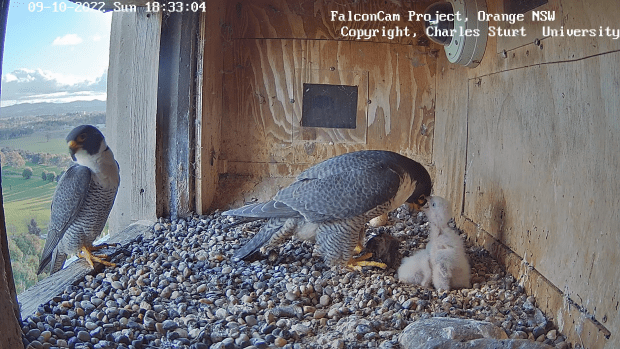
Nest News. It is hard to imagine sitting in the heat of summer in the Northern hemisphere but, the forecast is for snow in Orange, Australia. Holly Parsons who heads up the FB group was posting an image of Xavier and Kelli HissiFit Walker, one of the new mods on the streaming cam chat, dressed Xavier for the occasion. I chuckled so loud – I hope you enjoy it. If I were Diamond I would not want to lay eggs in that cold!

Thanks Holly and Kelli for letting me share!

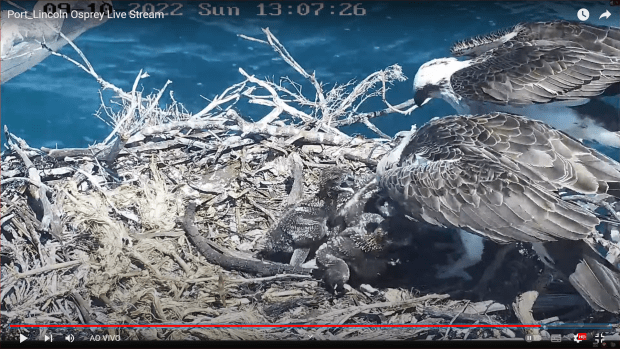
Like Titi at the Janakkalan Osprey nest, LC at the Osoyoos nest doesn’t seem that much interested in fledging — yet. LC is 66 days old today.

As of the 22nd, Telyn was still at the Dyfi Osprey nest. She has not begun her migration yet. There is no rush and the females need to be in top form before they depart. Taking care of three big female chicks really has to be draining because they require much more food.

I went to check on the Sydney Sea Eagles and Lady was feeding SE29 and 30. It was very civil. SE30 did a few quick grabs and kinda looked to make sure 29 wasn’t going to do anything. Lady had it all in hand – a bite for you and then one for you. Back and forth. How lovely.

Sometimes 29 did seem to get more bites than 30.

and then 30 would get a few more…

There is plenty of fish. Both will be full. Just look at the ‘blood feathers growing in on SE29’s back and wings. Oh, they are changing so quickly — and the are simply adorable.

It rained later in the day and Lady spread her big wings and covered those babes who do not, as you can see above have their feather covering.

Dad was in the nest and on alert to any intruders that might be around,

Migrating tracking. Kaia flew in a big loop today staying in the same area that she flew to after she flew north out of the Ukraine.

There is considerable worry for Kaia’s mate, Karl II, and migration has not begun. He normally spends much time at a nature reserve on the Black Sea near Odessa. The area is currently a war zone.

A lovely image of Little Bit 17 was posted by S Basly on the Notre-Dame FB page. It was taken on the 28th of July.

What a wonderful way to end today’s blog with a look at Little Bit 17. He is, of course, a prime example of what an intervention and wildlife rehabilitation can do to give a raptor a second chance at life. Little Bit deserved it and he is living it. Such a beautiful juvenile.

Thank you so much for joining me today. Please take care. See you soon!

Thank you to the following for their streaming cams and/or posts that made up my screen captures: Notre-Dame Eagles, Looduskalender, The Eagle Club of Estonia, Sea Eagles@Birdlife Australia Discovery Centre Sydney Olympic Park, Osoyoos Ospreys, Dyfi Osprey Project, Raptor Persecution UK, Explore.org and the IWS, Finnish Osprey Foundation, and the Orange Australia Falcon Cam FB.

Featured image is Thunder and Akecheta on the West End Bald Eagle nest in the Channel Islands. 22 June 2022

Breakfast at 367 Collins Street!

It is 5 degrees C or 41 F on a grey Saturday on the Canadian Prairies. The Slate-Grey Juncos have departed and only a few brave souls are in the lilacs around the feeders. Even the squirrels and Mr Blue Jay seem to still be hunkered down and it is already mid-afternoon.

It is, however, morning in Australia. I have to hand it to the parents of the Collins Street Four, they are really working this year to keep these energetic and healthy eyases fed. Here is a two minute video clip of the first feeding of the day. Watch it all. You will notice that the chick on the far left really gets the first bites and this might cause you to worry that it would eat all the food but as the two minutes progress everyone is getting bites and that is how it is – they will all be fed. Another pigeon will come in shortly to top this one off!

For those Rutland Water fans reading this, sad news has come this morning. Blue 2AA known as Duracell has been killed. Duracell has been wintering in Portugal for the past five years and today, he landed on an unprotected hydro pole and was killed instantly. The authorities responded swiftly to cover the lines but, it is just devastating that an Osprey who has lived for six years navigating migration and poles should come to such a sad end – one that could be entirely avoided if every country had laws that required bird protections on hydro poles. I know that many of you are concerned and steps are being taken but, it generally takes a death of a beloved bird to bring about action. How about prevention?!

Speaking of preventions. I promised that I would do a full scale review of Chris Packham’s and Megan McCubbin’s book, Back to Nature. How to love life-and save it. I will do that but for now, if you live in the UK, I highly recommend this book. It is paperback and very inexpensive. It will give you great insights into what is really happening in the United Kingdom and why some things do not change. For those fans of Roy Dennis, Packham doesn’t hold back any punches when it comes to to why the estates want to keep their grouse hunting and how the tax payer is their major subsidy. Why would taxpayers subsidize hunting I ask. Packham gets to the point and if you are a UK taxpayer, you need to understand the environmental issues at hand and the stakeholders.

If you visit or live in the UK, I invite you to look up Knepp Wildland Estate. It is 3500 acres south of Horsham, West Sussex. It is the vision of Charlie Burrell and Isabella Tree and is the only place you can hear turtle doves. Go to their website and read about what they have done to return the land back to the wild and if you haven’t read it, Isabella Tree’s book, Wilding will give you inspiration. Burrell and Tree have been influenced by the Dutch ecologist, Frans Vera.

https://knepp.co.uk/home

Here is the link to their page that talks about their vision. It is a good read.

https://knepp.co.uk/the-inspiration

I am a huge fan of their short videos showing the wildlife. Here is one of a White Stork but there is a host once you get to their website. I just know that you will enjoy them.

Here is another of the wild pigs and Robins.

And here is Isabella Tree talking about Rewilding – and how it can help save the environment, the wildlife, and us.

On my trip to Scotland next year to see the Ospreys I hope to find a way to get to Knepp as well as to Poole Harbour to see the Ospreys gather before migrating.

Everyone in the nests is fine today. It is just such a relief that all is going well. The individuals that run the cameras in Melbourne have said that they will not move the camera and have asked that this information be passed on. They have also asked that viewers not panic if they do not see all of the chicks. They would be out of sight but perfectly safe with Mum and Dad keeping watch over them. So I am passing it on. I know that we would really appreciate that other camera if the eyases decide to spend the majority of their time at that end. But, for now, let us be grateful to be able to watch this amazing family struggle with those four growing falcons!

Thank you for joining me today. Take care, be safe. Smile. See you soon.

Thank you to the Collins Street Falcon Cam by Mirvac for their streaming cam where I took my screen shots and video clip.

Feedings and fires…Storks fall from the sky over Athens

Today is a gorgeous day on the Canadian prairies. The rains helped to contain or put out many of the wild fires in our province and this morning, for a second day, we woke up to blue skies and white clouds! All of the plants are a vibrant green and the birds continue to sing. There was not enough to fill the dry creeks but the downpours we did get are a reminder of how much all life depends on water. The nestlings and fledglings would add ‘food’ to that list!

There is a constant worry that some of the late hatches are seeing dwindling food deliveries and that the parents might leave for their migration with young still on the nest. My friend, ‘S’ is concerned, as are many others, for the nestlings on two Black Stork nests – one in Latvia and the other in Estonia. Some others worry about the little osprey on the Collins Marsh Nature Centre nest that we have been calling ‘Malin’. (The official contest is underway for the official name).

Malin self-feeds from small Bullhead. 11 August 2021

Malin was receiving 5 feedings on occasion. Those were good days. The chick has not been fed well by the standards of other nests. This past Sunday, 8 August, Malin had no food. Yesterday, 10 August, he had two feedings. Today, there have already been 2 – one at 9:35 and the other around 11:42. Always these are small whole fish or pieces of fish. I have not seen a whopper on this nest.

Malin is hungry and several of us are trying to ascertain if the fish are ‘fished out’ or if the Dad has another nest – it really is unclear. A report by the Wisconsin DNR on the number of Bald Eagle and Osprey nests in the state indicate a drop of Ospreys in area 3, where the Collins Marsh nest is located, by -25.2%. While every other area saw an increase in Ospreys, Collins Marsh was only one of two that showed a decline. Does all of this reflect a growth in Bald Eagle Nests in the area? If you would like to read the report from 2019 (I have not found one for 2020), I am attaching a copy. A big shout out to ‘S’ who found this and sent it to me. Thank you.

The feedings for the nestlings of Grafs and Grafiene at the Sigulda Nest show a similar up and down pattern to that at Collins Marsh. However, there has not been a day without food to my knowledge at Sigulda.

‘S’ reports that on 9 August, the storklings had four feedings – which is considered low – but yesterday, they had only two. Today, there have been 2 deliveries by the female, Grafiene, and one by the male, Grafs. Grafiene is also like the female at the Collins Marsh nest, Marsha, who leaves for periods up to 24 hours at a time. The behaviour of these two females is very curious.

It is hoped that there is time for both the Black Storklings and the Osprey to fledge. ‘S’ advises that the minimum is ten days for the storklings. The Ospreys tend to migrate at the end of August or beginning of September in Wisconsin.

Malin is not ready to fledge. It is very worrisome for many reasons. I look at the development and growth of the Osprey fledglings in the UK and then compare this with Malin. Those in the UK have fully developed feathering and have really perfected their flying skills. They are self-feed with ease. Most have been fledged for a month. Will Malin have a month to further develop his body and skills? Will the storklings? The nest that is on the branch of the pine tree in the forest near Sigulda is so very narrow and has collapsed in the past. Will the hopping and flapping cause the little ones to fall?

The storklings are so excited when a parent arrives with fish that it does make you wonder if the could make the branch nest collapse. Grafiene covered the nest with little fish around 17:20. There was lots of food for each of the nestlings.

The storklings were eating and eating and had large crops. I wonder if a parent will bring another delivery before night?

I am including the link to the Black Stork Nest in Sigulda County, Latvia. If you wish to find the chat room or forum (with lots of information) please check the information under the streaming cam.

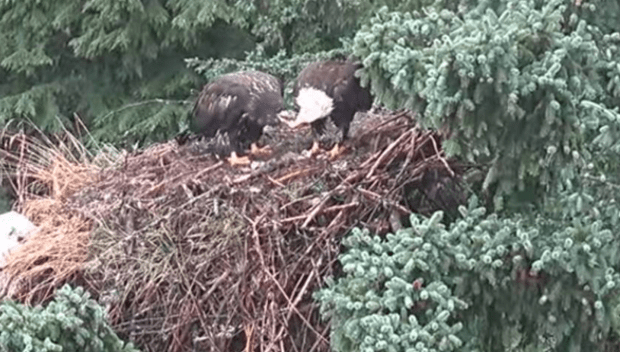
In Alaska, Kindness is not short of food. She has gone some days with few deliveries and other days, Dad not only leaves her food for self-feeding but today, he fed his baby girl. Dad just can’t help himself. He has an enormous soft spot for Kindness. The image below of Dad feeding Kindness is right after he had delivered prey 20 minutes earlier! Oh, Kindness, how lucky you are.

Did you know that Bald Eagles have a polarizing lens that helps them see fish in muddy waters? (Just like those who fish often wear Polarizing sunglasses.) That said Bald Eagles normally only feed in the top 15 cm or 6 inches. Their bare legs are designed to only go into the water 15 cm or 6 inches. Like the Ospreys and Sea Eagles, if they had feathered legs, they would get water logged.

You can watch Kindness here. The moderator on the camera chat is reminding everyone today that Kindness is 76 days old today. She is already flapping and jumping. The average act for fledge on this nest – not the whole of Alaska – is 89 days. (The whole of Alaska is 80 days). If she behaves like the other eaglets on this nest, you should be able to watch her until mid-September. Here is the link to that camera:

The White-Bellied Sea Eagle, Lady is feeding 27 and 28. Those little ones continue to look like white fluff balls but if you look carefully, their necks and wings are getting longer and there is a hint of ‘dark plumage’ underneath that natal down. The WBSE nest had a fright a few days ago. Dad showed up on the nest with a laceration on his leg and a cut near his throat that was bleeding. That seems to have subsided and Dad is busy catching fish for the family. (I am wondering about the small amount of salt water in the Parramatta River and its healing effects on Dad’s foot.)

27 and 28 do bonk but not much anymore. Some of the time it is instigated by the ‘little one’! They really are a good match for one another and unlike past years, viewers are remarking that they are really enjoying seeing the nest this year.

The egg tooth is disappearing as their beaks grow longer.

If you wish to watch then, here is the link to the cam:

There is some troubling news coming out in Bird World. ‘S’ informs me that the storks crossing over Greece where the wildfires are raging are being injured in large numbers as they migrate to Africa on the eastern routing. Various news agencies are reporting that people in Athens have been picking up dead storks off their lawns. This is more than sad. Here is a short news report by Reuters. I hope you can open it.

Here is a news article on the plight of these poor birds.

https://www.aljazeera.com/news/2021/8/9/disoriented-by-wildfires-migrating-storks-die-crossing-greece

A second is the number of raptors going into care. In the United States, there is an all out assault on plant life. Various levels of government are asking for and receiving permission to undertake ‘aquatic treatments’ using either Tribune or Harpoon. These are chemical herbicides and they poison birds!!!! At the moment, A Place Called Hope, has raptors in its care because of these treatments.

In Jacksonville, crews have been up doing maintenance on the NE Florida Bald Eagle cam. The presence of humans on ‘his’ nest brought Samson out from the trees and onto the nest yesterday. Wow. What a wonderful treat. Samson remains in the area and does not migrate while Gabby leaves early to travel north to cooler weather. Ironically – and sadly – this year it has been as hot in Ithaca, New York as it has been in Florida.

All three of the fledglings at the Foulshaw Moss Osprey nest were present yesterday. Poor White YW. Tiny Little Bob almost ripped his leg off trying to get at a fish delivery. Tiny Little! To steady himself, White YW had to put his talon on Tiny Little’s head. Gracious. It ended OK – no bird was injured.

For some reason all of the fledglings have been coming to the nest for fish. One will get the fish from dad, one will stalk that sibling, then they will get it and then White YW will arrive with another fish and confuse the entire situation. It is really quite hilarious. The fledglings are as big (or bigger) than Dad! You can watch them here:

https://www.cumbriawildlifetrust.org.uk/wildlife/cams/osprey-cam

Oh, wow. Tiny Little just snagged a fish from sibling 462. Fantastic.

Tiny Little is a ‘scrapper’ just like Tiny Tot. They both learned ‘street smarts’ to survive. Well done, Tiny Little! It was not that long ago that Tiny Little was shy. Her aggression will help keep her alive in the future.

News Flash. The female companion of Bucacek on the Mlade Buky White Stork nest in Czechoslovakia has been named Marketa.

Everyone reading my newsletter loves birds and animals or you wouldn’t be here. I was sent a delightful story – a view of rewilding through the eyes of a deer. Since we have so many deer in our city that have been displaced for ever more condominiums and roads, it really struck home to me. Perhaps you would enjoy reading it, too. Here is the link to ‘Rewilding is a Two Way Street. A letter from your neighborhood deer’.

https://www.hcn.org/articles/essay-wildlife-rewilding-is-a-two-way-street/print_view

Whew. That was a long newsletter. Sorry. Thank you so much for joining me. Send warm wishes to all the birds – for food and for the storks to survive as they travel from northern Europe to Africa. Take care everyone.

Thank you to the following for their streaming cams where I took my screen shots: Collins Marsh Nature Reserve, Glacier Gardens Park in Juneau, Latvian Fund for Nature, WBSE Sea Eagle Nest, Birdlife Australia, and the Discovery Centre, Cumbrian Wildlife Trust and the Foulshaw Moss Osprey Nest.