I had no intention of writing another update on today’s birds. However, sometimes something wonderful happens.
The weather cooled off at Notre-Dame and a really nice fish came on the nest. Early today, little 17 had only a bite of fish and not much yesterday. This sweet little third hatch was conserving what energy it had and we were all hoping that food would come. The wee one had a small ps – not good. It was really showing how dehydrated 17 was getting.
17 did what we have seen many who are dominated by older siblings do – he was hungry and he needed to eat. How could he get around the pecking siblings? He went around on the rim of the nest. How many times have we seen desperate eaglets or osplets do this?
17 is on the rim watching until that one big sibling moves away from the fish.
Once he gets up to eat the sibling on the far left will move its head threatening to peck. 17 keeps its head away and moves in to grab a bite of fish and throws its wings out in a mantle.
It had to be such an anxious feeding. A human being would be sick under that kind of pressure.
17 keeps snatch and grabbing until all that is left is an inch or so of fish and the tail.
17 mantles, then grabs and turns his head away. What determination. Go 17!
That fish is getting shorter and by the time 17 finishes eating – he is going to have a great big crop for his size.
Mum leaves the tail piece. 17 eats on it holding it down at times while the Big siblings ignore it all. Eventually one of them will try and self-feed, too but, 17 knows to hold it down and they don’t.
The ND-LEEF camera does not have good definition. But look straight down. See the fluffy grey on either side of 17’s head. That is how big his crop is! He can hardly walk he is so full. This is wonderful. He hasn’t ever had such a good meal that I can remember. We were also at the point to start worrying a bit – so that is all avoided. Yipee.
The second egg of Richmond and Rosie had a crack in it a few hours ago. About an hour ago that crack went completely around the egg and you could see the little osplet inside the shell! Oh, how grand. A hatch for the SF Ospreys. How wonderful. It is a good way to end the day. A full tummy for 17 and a hatch – finally – for Richmond and Rosie.
There it is! Oh, sweet wiggly one.
Back to brooding. Was sort of hoping that they would move that other part of the hatchling’s shell out of the nest.
But goodness, welcome wee one!
I simply cannot think of a better way to end the day than with a big smile. All is well in Bird World.
Thank you for joining me. Take care.
Thank you to ND-LEED and SFOspreys and Golden Gate Audubon for their streaming cams where I took my screen captures.
It is really sad when a ‘bird Mum’ seems to consistently favour one healthy chick over another especially when the eldest has already killed the third hatch. Today, at the UFlorida-Gainesville Osprey nest, this preference for the dominant one over a healthy chick crying for food was so evident despite Middle making every effort to get around to the beak to eat even after being intimidated. Yes, Middle held back for his own survival. But it is ever so sad. He is a big healthy osplet! A fish came in at 18:24. Big did the dominance stance and Middle pulled back. By the time Middle got around on the rim to Mum’s beak, she had already given Big part of the tail. Big ate the entire fish! At 18:37 Mum find a few little scraps on a bone and gives it to Middle. At 18:38 Middle takes the bone to self feed trying to find any meat no matter how dry to eat. Middle has not had much food today but he has had some. Yesterday he ate well so we are still good.
Middle will be a survivor if he does not fall off or get shoved from the nest – he reminds me so much of Tiny Tot Tumbles at Achieva last year. She dug around in the nest eating very old, very dry leather hard pieces of fish. They kept her alive. She was self-feeding proficiently before the two older siblings. TTT became the dominant bird on the nest and if any of those three chicks were to survive their first year, my money would be on her. In fact, this winter Tiny Tot Tumbles was photographed at least once on the Achieva nest so she is still alive. That is wonderful and it will be the same for Middle. I just wish these osplets were banded.
It is worth noting that Big already had a ‘big’ crop before the last feeding of the day ever took place! There she is in the middle of the nest standing proudly with all the commotion going on around her. Middle is trying to get to the fish.
Sadly, all Big has to do is raise her head and walk towards Middle and he cowers. This behaviour was noted to have changed over the weekend by ‘R’. Prior to Friday, Middle had been getting up to the fish faster and, therefore, getting more food. The assumption is that food was scarce over the weekend when there was a big storm and the camera kept cutting in and out. It is also believed that Big took this out on Middle.
Middle is watching Big and trying to move up to get some food. If Mum would just turn herself 45 degrees both chicks could eat. It is very frustrating.
Mum found a few bites for Middle. Just think. Big ate an entire fish and Middle got a few bites.
Middle is continuing to chew on the fish bone to try and find some food.
Is there enough food coming on the nest for Mum and the two chicks? There was yesterday and with Big having a crop before she ate this entire last fish today, I would say yes. Certainly 50% of the fish could have gone to Big with 25% each to Mum and Middle and everyone would have been fine. It is not a case of everyone starving. It is sad.
This female is not the only one that has favoured one chick over another. I am certain that you can think of several instances if you have been watching streaming bird cams for awhile. One thing I have noticed – at least in Bald Eagles – is that the Dad will often step in and feed the ‘left out’ sibling. I know it sounds crazy but some of those males that are now Dads would have had big sisters who demanded and took everything. Do the males remember?
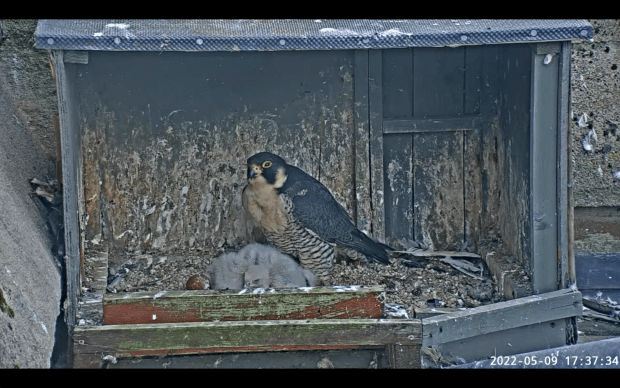
The two eyases at the CalFalcons scrape do not have the problems Middle has at UFlorida. Alden caught a pigeon today and I am absolutely certain Annie was delighted. Everyone can fill up and there will be leftovers in the pantry.
Precious.
Look at those two. Talk about a different atmosphere in a nest! I will take a falcon any day.
Bursting little crops. These two will cuddle up under Annie and sleep well.
Cal Falcons put this feeding into a short video clip.
So happy to see the promotion of the Peregrine Falcons and their chicks on The Campanile. Anything that will bring awareness to the raptors so that we can help make their lives a little better is welcome – and one way is to educate people.
It is so far, so good at the Manton Bay nest. Both chicks have eaten and it appears that the third chick is hatching. It will be a relief for Mum to be only brooding instead of brooding and incubating. I really hope that chick is doing just fine in the morning – the one that was exposed. It looks good so fingers crossed.
Ferris Akel has a pair of Red-tail Hawks near to where he lives and today he has discovered that Betty and Barney have three chicks!
Two Habours 1 is doing just fine. She looks out on that gorgeous cobalt coloured water that surrounds her nest in the Channel Islands.
The winds are really gusting at the West End nest of Thunder and Akecheta not far from Chase and Cholyn’s nest at Two Harbours. Let us all hope that the eaglets do not want to stand up and get near that ledge. Hunker down.
There are big storms about and it is very, very gusty at the MN-DNR nest of Nancy and E1 Harriet, too.
Harriet has brought in a really nice fish. You can see it in the image above. She is trying to stand in the violent wind gusts and feed Harriet. Sweet. These two are doing well under the circumstances.
We have another storm coming that is predicted to drop 40 mm of rain in a short period of time tomorrow. I wonder if this same system will hit the MN-DNR nest?
Those same winds are blowing at the Osprey platform at the Arboretum on the grounds of the University of Minnesota. The couple have one egg so far. Last year they fledged one chick.
Here is the link to their streaming cam:
The prey that is brought to the urban nests versus those in rural areas can be very different. In New York City, the Red-tail Hawks seem to live on pigeons and rats. Today a rat was delivered to the Presidio Red-tail Hawk nest in San Francisco. It makes me nervous. I am very much against the use of rodenticide and when the rodents are slow and easy catches they are often poisoned. The hawks thus die of secondary poisoning. It is tragic and unnecessary!
Fingers Crossed!
All White-bellied Sea Eagle fans should be checking in on the nest around the beginning to mid-June. Lady and Dad have been making nestorations and mating.
Of course, we will also be gearing up for the CBD Peregrine Falcons in Melbourne (late August or September for the cam to return), Xavier and Diamond at their scrape in Orange, and of course, the Ospreys at Port Lincoln. It is mid-May now. Time is passing.
Thank you for joining me this evening. Hopefully we will wake up to three healthy chicks at the Manton Bay platform tomorrow and several more fish for UFlorida-Gainesville! Tomorrow is pip watch for Richmond and Rosie. Take care everyone.
Thank you to the following for their streaming cams where I took my screen captures: Sea Eagles@BirdLife Australia Discovery Centre, Cal Falcons, Presidio RTH, Ferris Akel, Minnesota Landscape Arboretum Osprey Cam, Explore.org, UFlorida-Gainesville Ospreys, MN-DNR, and LRWT Manton Bay.
It is a gorgeous morning with the promise of 20 degrees C. There is a blue sky and that tinge of green on the trees. By afternoon many of those leaf buds will be leaves. It is also a good day to go and check on those cute little wood ducks!
I lucked out this morning at the UFlorida-Gainesville Osprey Nest. There was a fish delivery around 10:00. The nest was civil! So, I am going to make a assumption and see how far I can go back. There had to be at least one big fish, if not two, for Big to be nice and let Middle eat first.
Yes, there is a fish that is being fed to the two that comes prior to 06:35. I cannot tell you what happened when this fish arrived. Mum is feeding Middle nicely when I re-wind.
At 07:23:06, the pair are snuggled together in the centre of the big nest. It is hard to tell them apart. The hint is the plumage. Big remains darker than Middle. There is a little more juvenile plumage coming in. Big is bigger but when they are moving around on the nest, it is really difficult to determine who is who. Both are walking well now.
At 09:09, Big is self-feeding on a piece of fish left on the nest.
This is interesting. This is at least a second fish (perhaps there was an earlier one also to the first). Big has no interest in harassing Middle who is obviously hungry and up at Mum’s beak.
Big does come up for food and Middle begins to do his quick grab. There is no attempt to harm Middle, however.
It helps to have Big get caught up in eating a small piece of fish. Indeed, both of the chicks appear to have a piece of fish tail that they are trying to eat.
Mum was still feeding Middle at 10:25.
Now, I would like to rewind to what happened when I wasn’t able to access the camera so that we can appreciate what is happening this morning. I am very grateful for a very detailed report on the nest from ‘R’ who also knows the area well and was able to clarify where Dad goes fishing.
This is a broader map of the UFlorida-Gainesville campus showing several lakes. ‘R’ tells me there is no boating on most of them and limited boating on the larger lake. When I am looking at the reasons for there to be issues of food competition, the first thing I wonder about is the source for the fish. As some of you may realize, in Montana the Ospreys up near Missoula whose nests are on the Clark Fork River are having difficulties – or will – if the high temperatures and lack of snow pack and rain continue. The trout die. Here, this does not seem to be an issue. I did have to giggle. We know nothing about alligators in lakes in Canada that I am aware of – but apparently the lakes in Gainesville have gators and they do eat the odd dog when the walker gets it too close to the shore. Goodness, that would be a shock! As ‘R’ pointed out, the gators should not be a problem to the Osprey.
The nest is located on the Soccer Practice Field. That is the red indicator below. You can see that Dad has a large lake close by and further to the right another. Unless something is killing off the fish in those lakes, access is not an issue. Perhaps temperature is? It is 69 degrees F this morning in Gainesville. A respectable temperature for fishing. Does the temperature impact fish delivery if it gets up in the high 80s? Good question to find the answer.
‘R’ reports that Dad brought in little food on Friday. That evening, that big storm with the high winds that swept through the area and the nests – they were blowing on Captiva – took out the camera. There was on and off camera access Saturday but nothing steady with the camera until Sunday. It is unclear about food deliveries during this time but typically it is difficult for an Osprey to fish if it is a very bad storm. There is also an issue of barometric pressure. Easier to fish when the pressure is falling as opposed to rising. I am going to have to set up a graph and see if this is impacting Dad. ‘R’ was sadly able to report that a few years ago in another storm both of the chicks were knocked out of the nest. How tragic.
The report for Sunday and Monday were not good. As ‘R’ notes, this was probably due to a lack of fish deliveries. Bit was extremely aggressive attacking Middle constantly. Middle tried to position itself to get away from Big but this did not help. At this point Mum is favouring feeding Big over Middle.
The pattern continued to Monday morning – Big being clearly aggressive and Mum favouring Big in the feeding. It was estimated by ‘R’ that Big got ten bites to Middle’s one. Also noted was the fact that Middle went into submission easily whereas last week, Middle was showing some ability to deal with Big’s dominance.
The factors that are leading to food competition continue to be a lack of fish delivery by Dad, weather, and at least one instance of an intruder that was seen landing on a light near the nest.
I am extremely happy that something has happened this morning to turn this aggressive behaviour around this morning. If it is possible I want to go back and build up a graph checking on the barometric pressure in Gainesville and compare it to the days we know there were good fish deliveries and little. Is this the culprit? or is it intruders? the temperature?
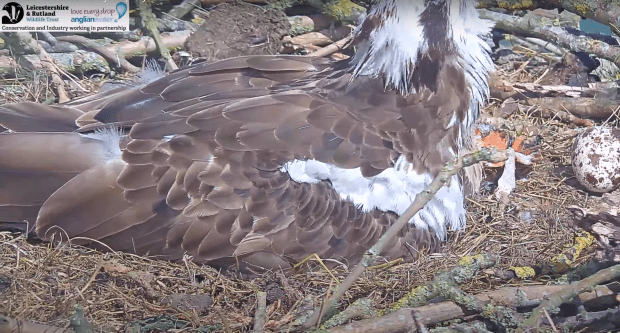
I want to take you to an Osprey nest where – for the past five or six years – there has been not a single problem. That is the Manton Bay nest of Blue 33 (11) and Maya. Three eggs this season. Two have now hatched. I will expect the next one to hatch tomorrow. The eldest hatched last evening and the second is still wet! You can barely see it in front of Big Bob. — A note. All of the Ospreys are Bobs in the UK. The Bob refers to the bobbing head. so it will be Big Bob, Middle Bob, etc.
That is that big fish I was talking about yesterday. The Manton Bay nest is right in the water at Rutland. There is nothing cuter than a day old Osprey chick. Nothing. OK. Maybe a Red-tail Hawk or a Peregrine Falcon.
Big Bob is already eating well.
Maya is a bit like Big Red, the Red-tail Hawk matriarch at Cornell. She wants her babies full to the brim and more. No need for a hungry wiggly baby while one is trying to dry off and get used to having hatched and the other is thinking about hatching.
Brooding and incubating. It will be much easier for Maya when the third hatches. Again, I am not expecting any issues at this nest over food competition. Blue 33 (11) always has the fish on the nest at dawn. If he doesn’t then we should start worrying about him! This is a terrific nest.
Here is the link to the streaming cam at Rutland Manton Bay:
I have not checked any other nests this morning but I will do later today. The sun is bright and it is getting warmer and it is time to do a hike around a lake to check on some ducks and geese.
Have a wonderful day everyone. Thank you so much for joining me. See you soon!
Thank you to the UFlorida-Gainesville Osprey Cam and the LRWT for their Manton Bay cam where I took my screen shots. A special thanks to ‘R’ who educated me in potential fishing sources for Dad at Gainesville and for bringing me up to speed with great detail over the weekend and Monday happenings at Gainesville.
Oh, it is pouring down rain and, as such, is a great day to drink hot tea and read. A friend sent me an article from the New York Times. [ Thank you ‘WW’ for that]. I do have a subscription but, as of late, I just haven’t had the time to forage through the paper or, for that matter, read it at all, sometimes. I like Margaret Renkl’s writing style. Her book Late Migrations looks down at me from the bookcase and like her, I have stacks of books all around, some read, some waiting. Today, she has written an opinion piece on the Ivory-billed Woodpecker. It is a good – it is a hopeful read. That is something we can all use on a cold wet dreary day.
So apparently I can gift the article to you to read. I don’t know about you but good news is uplifting and I will take all of it that I can find including the discovery of a bird living in quiet isolation that was believed to be extinct. I just hope that thousands of humans don’t converge on Louisiana with their long lenses and ruin it! Seriously, it is important not to give away the locations of some nests and these would be one of those instances to stay quiet!
Did you know about the Peregrine Falcon scrape in St Mary’s Church in Hampshire in the UK? I didn’t! This nest has been here for a number of years. Listen to the discussion at the end to find out how the nesting birds were discovered.
The chicks are just slightly older -but not much – than Big Red’s. They are getting their itchy blood feathers. The scrape looks successful. Why do I say that? Look at all the ps on the walls!!!!!!!!!!
This is a great 51 minute talk about Peregrine Falcons by Ornithologist Keith Betton who is also the Country Bird Recorder for Hampshire. It is interesting.
There was a bit of a prey tease the other day at the Cromer scrape. They made a short video of it. Cute.
It is dinner time at one of Poland’s Peregrine Falcon nests – and it wasn’t a tease. Also notice – it is a nest! Just like the other one in the Polish forest, Dolina Baryczy.
It is evening – 20:21 – at the LRWT Manton Bay nest of Blue 33 (11) and Maya. We are definitely on pip watch but, if there is one, our Mum is not revealing it. Maya has been extremely restless since late last evening. Is she hearing her chicks? I feel like a very restless expectant parent!
I am not familiar with the Osprey nests in Finland but, last year, a lovely young woman wrote to me to tell me that they have ten nests. That is fantastic. This is the link to one of those. Last year the couple laid three eggs. All three hatched. The youngest died at the age of 2 days for an unknown reason according to the streaming cam information. There was not a threat from the goshawks so I want to continue to check on this nest. The location is splendid. Just look at the water with all the fish for the babies and parents.
The female is Manta and the male is Manu.
The eldest eaglet at the Pittsburgh-Hayes nest is getting closer to branching. She was up on the top of the nest rim called ‘The Baby Gate’ today. The others are just too curious and they will be up there soon!!!!!!! Just don’t go crowding one another knocking someone off!!!!!!!!!
Anyone still worried about L4 at the Red-tail Hawk nest of Big Red and Arthur? I sure hope not. There is the tiny one right up front having lunch! If he isn’t on the edge, he will climb over the others to get up to Mum’s beak. Partially this is because he eats less food but needs to eat more frequently than the older siblings. But oh, what a little cutie pie.
Oh, those wings look like soft cashmere. Wee one is tucked in under them keeping warm. Every chick has a big crop!
The weather in Scotland around Loch Arkaig has not been good. The winds have been very very gusty with rain. One of those gusts almost completely blew dear Louis’s mate, Dorcha, off the Loch Arkaig nest around 16:00 today. Unbelievable. It always frightens me when this happens. Last year and the year before, Big Red was almost blown off once with a chick holding on to her.
Dorcha recovered but gosh, golly.
Nancy is on high alert at the MN-DNR nest after a juvenile eagle stayed on the perch tree and another flew overhead. Oh, I wish they would leave her alone. She cannot go and hunt for her and E1 with these interlopers about. It is pretty clear that the success of the reintroduction of the Bald Eagles (and Ospreys) in the US has caused a lack of good territories and nests causing much of the disruption and harm we have seen lately. I would also include the Peregrine Falcon population in the California area. What is the answer? More artificial nests? the stocking of ponds for fish for the birds?
Alden may be shy of the chicks but he is keeping the pantry full for Annie and the two wee babes. Don’t they just melt your heart?
Seriously sweet.
Some much bigger birds in the Dale Hollow Eagle nest were both enjoying a nice fish today for lunch. Both of them are perching up on the nest rim and each is doing very well. Looking forward to their successful fledge!
The UFlorida-Gainesville Osprey nest cam is back up and running. Excellent news.
I continue to hope that there will be a new wee babe on the Manton Bay nest by the time I wake up tomorrow. All of the nests I have checked are doing fine except for the continuing intrusion at the MN-DNR nest of Nancy and E1.
Thank you for joining me today. Take care everyone!
Thank you to the following for their streaming cams where I took my screen captures: UFlorida-Gainesville, Ospreys, DHEC, Andover Peregrines, LRWT, Cal Falcons, MN-DNR, Woodland Trust, Cornell RTH, and Pix Cams.
As citizens of Manitoba, we are really learning about what it means to live on the floor of what was once Lake Agassiz —- in other words, a flood plain. Two more Colorado Lows are set to dump more water on a province that is flooded south of Winnipeg and north of Winnipeg. One big lake save for those communities who spent funds on creating their own dams. The loss is enormous but looking at it from a wildlife perspective, one has to wonder where all the deer, the nests, and the animals have gone. I have seen one image of deer walking along a railroad track that runs from Winnipeg to the US border trying to find dry land and food. That border is now closed as are many highways and even some bridges in my City. Years ago one of our Premiers decided to build what was teasingly called ‘Duff’s Ditch’. Well, everyone should be grateful to Duff Roblin for having that kind of insight. The City is mostly dry and safe.
There are few birds in the garden as the raindrops begin to fall on a grey day.
I am as nervous as Blue 33 (11) is as he comes in and off the nest at Manton Bay checking on Maya and the eggs. There are three. At one point you could only see two, has there been a hatch? So, we wait for confirmation one way or the other! I cannot see any egg shells so I suspect that pesky egg is hiding!
It is certainly time to begin checking on the Black Stork nests in Estonia and Latvia. There is something curious that I noticed which I suspect my friends in Estonia have known all along. Jan and Jaanika laid their eggs a whole month earlier this year than last. In 2020, the eggs were laid on 12 May, 14 May, 16 May, and the 18th of May. Hatch from 14-17 June. This year the eggs were laid on 15, 17, 19, 21 April, 23 and the sixth and final egg on 25 April! This is excellent – the timing. Last year the couple was so very late that Janika started her migration before the chicks had fledged. It was a very difficult time and the food for the chicks was supplemented by fish being brought to the nest by the wildlife specialist, J Kuze.
The Black Stork in Estonia is so rare that every effort is made to help them that is possible.
I am not a stork expert. It would seem, however, that the parents cannot support six storklings very easily and they will probably select the three strongest. But, we wait to see.
Here is the link to Jan and Jaanika’s streaming cam in Jogeva County, Estonia:
I also checked on the nest of Karl II and Kaia in the Karula National Forest in the south of Estonia. The eggs for this year were laid on almost the identical dates as last year. Those days were 24, 26, 29 April and 1 May. Hatch began in 2021 on 28 May.
This is the link to Karl II and Kaia’s nest in the forest.
Sadly, it appears that Grafs and Grafiene did not return to their nest this year in the Sigulda Region of Latvia. Did they not survive migration? or did they decide to locate their nest elsewhere? I do know the answer to this but I will try to find out.
There is only one osprey nest in Latvia. This year only the male returned, Theo. He tried to attract many females to his beautiful nest. It is hoped that a young female, tagged UV and an Estonian female, will stay with them. Mating was attempted this morning but UV was not receptive. Sadly, this nest is a bit haunted. None of the former chicks have survived due to goshawk predation.
Here is the link to the Kurzeme camera of Theo:
In comparison, the Osprey nest of Ivo an Iiris in Tarta County, Estonia has done well. All of the couple’s chicks fledged last year!
Pip watch will begin on the 21st of May. That is only 12 days from now. Here is a link to Ivo and Iiris’s streaming camera:
Gosh, Big Red is gorgeous. It is so hard to believe she is 19 years old. She is in such good shape this year. What a beautiful golden glow on her and the four eyases as a new morning wakes up on the Cornell Campus.
This is a great nest to watch! There is plenty of time to watch these eyases develop, fledge, and then learn to be a ‘hawk’. Arthur will teach them flying and hunting with Big Red joining in. There is nothing better than seeing the parents teach the chicks how to hunt a squirrel in a tree!!!!!!
The two eyases at the Red-tail Hawk at the Presidio Trust Building in San Francisco are doing fine. These two are really growing. Look at the size of that wing. Wow.
Peregrine Falcon chicks are doing well this morning, too. The chicks at the scrape in the tower of Chichester Cathedral just had their afternoon tea.
All five eyases were fed and happy this morning at the Manchester, New Hampshire scrape.
Sleeping babies at Utica, New York scrape. Will the other eggs hatch? We will see.
Henry and Poppy do a great job taking care of their two chicks at the Cromer scrape. If you are interested in their day to day activities, there is a great blog with this nest that has images and comments of everything that happens on the nest. I will post it after the image of the chicks!
If you are wondering about the third egg at the U-Cal Berkeley scrape of Annie and Alden, don’t. It is non-viable. If it were going to hatch it would have happened on Saturday. What will they do with it? Incubate it, roll it around, or break it – or maybe Sean or Lynne will collect it for the museum when they clean the scrape.
Two healthy chicks are good. They are incredibly adorable.
All three eaglets are accounted for on the West End nest of Thunder and Akecheta.
TH1 at the nest of Chase and Cholyn is getting its blood feathers. There are a few lingering dandelions on the top of the head. It will not be long until this wee one looks like its cousins at the West End.
I checked on two nests in the East – PIttsburgh Hayes with its triplets and the National Arboretum nest. They are all awake and looking good this morning.
The three are beginning to fill up the nest!
Breakfast time for DC9. Looking good. There was a little concern earlier for DC9 because a bird had been brought on the nest as a prey item. Everything seems to be alright.
I want to leave you with a smile. A Canada Goose has chosen a planter on the deck of a Calgary, Alberta couple to lay its eggs three years in a row!
Lots happening today. Some exciting. Some sad. The youngest golden eaglet has been killed at the Estonian nest. It had been beaked by its eldest sibling earlier and prey became scarce and the oldest killed the youngest today. That was the Golden Eagle nest in the Soomaa National Park in Southwestern Estonia. As I mention often, the rate of siblicide is much higher in nests other than falcons and hawks.
Thank you for joining me on this rainy grey day in Manitoba. Take care everyone. See you soon – hopefully with a news of the first Osprey hatch in the UK!
Thank you to the following for their streaming cams where I took my screen captures: LRWT, Eagle Club of Estonia, Latvian Fund for Nature, Cornell Bird Lab RTH, Presidio Trust, Chichester Cathedral, Peregrine Networks, Utica Falcons, Cromer Peregrines, Explore.org, Pix Cams, and the NADC-AEF.
It is hard to believe the change in a few days. The intruders made it virtually impossible for the parents to get food to the two osplets on the UFlorida-Gainesville nest. That caused a lot of tension on the nest with the youngest chick, Middle, often getting left out. This morning there has been three – yes 3 – fish deliveries before 0900. Unbelievable. The chicks are certainly not fighting.
The first fish came in at 0642. Both were up. At the onset it appeared that Big had the advantage. Middle moved back and forth to the middle of the nest always returning to Mum’s beak. At 0746 Middle had a nice crop.
Big is to the left of Mum with the darker plumage and Middle is to the right.
Middle has a really nice crop! Lovely.
The second fish – to the astonishment of everyone – arrived at 0810. Middle was right there but Mum moved the fish to the other side of the nest. By 0812 Big was settled in eating. Mum continued to feed Middle then alternated with Big. Middle cleaned his beak at 0827.
Once again Big is on the left and Middle is on the right. What a nice fish!
Big gets full and leave and Mum continues to feed Middle. Big will move back up again but both had nice crops and, in the end, of the two fish were fed pretty equally.
I don’t think anyone believed it but Dad flew in with another small piece of fish at 0847. Middle took advantage of the placement. Everyone ate, including Mum and all are full.
All will be nicely hydrated and full for the long hot day ahead.
It has been a really good morning for Mum and the two osplets.
The weather in Gainesville is currently 23 C reaching a cooking high of 32 C or 89.6 F. It is going to be really hot up on that nest. Dad was smart to go out early and fish while it is cool before the fish go deeper in the water. Winds are 11 kph with a humidity of 88%. Hot and humid.
Excellent news on a nest that had one incident of siblicide and a second chick suffering due to a lack of food. Today is a good day. We will celebrate that!
Thanks for joining me this morning. I am off to check on the falcons, hawks, and eagles. Take care all. See you soon!
Thank you to the UFlorida-Gainesville Osprey streaming cam where I took my screen captures.
First up, Louis brought Iris a fish. He did not stay to incubate their egg at the Hellgate Canyon Nest in Missoula but, hey – he brought a fish. I am grateful. I am not going to get mad and stomp my feet. This is, I believe, the third fish this season. Grateful.
Iris, you are so gorgeous! The oldest osprey in the world and you look better every year.
It was also a good day, so far, at the UFlorida-Gainesville Osprey nest. Mum brought in a fish at 11:59:52 and low and behold Dad flew in with another nice fish at 13:04. Both of the eaglets ate. When one chick is dominant and eating the most, it really helps when the bigger fills up and another lands on the nest right after. That way Mum gets food and hydration, too. Happy.
Big wandered about a bit and even did a ps before he thought about more food. All the while Middle was gobbling up the fish as fast as Mum could get it to the beak.
Big had eaten and was not in an aggressive mood. Nice.
Both chicks get to eat. The fish is finished at 13:27.
It has been raining in Ithaca, New York. Not a torrent, thankfully. Big Red is trying to keep those wiggly nestlings dry! Are they cooperating? Not always.
That’s L4 with its head raised up.
CalFalcons posted a short video of Alden incubating the eggs. Gosh, it is possible there will be pips tomorrow but, more likely, on the 6th! Oh, I hope that all three hatch. That would be wonderful. Despite the injury to Alden’s left ankle, he really seems to have adapted and is doing well. He certainly has been a terrific mate to Annie since Grinnell was killed.
Nancy has stepped up and is delivering prey items to the MN-DNR in order that her and E1 survive without Harry. Nancy is perfectly capable of fishing and hunting and E1 has its juvenile feathers so that it can regulate its temperature. We are fortunate that the eaglets were older when Harry disappeared eight days ago. (For those who do not know this nest, Harry disappeared. Chicks were extremely hungry. E1 was very aggressive to E2 and had been for a long time. E1 pushed E2 off the nest and E2 had to be euthanized.)
Unless something dramatic happens, we should expect E1 to fledge and for Nancy to have a new mate next year – unless Harry miraculously, at this stage, returns.
Despite the fact that a UFO, a catfish, and a sucker were brought on to the Notre-Dame Bald Eagle nest, ND17 still struggles to get food. Today there were three feedings and a bit of one before noon. At the last feeding, the small eaglet got food to create a crop. Another Relief but another struggling nest trying to get enough food for everyone. Did I ever say I wish these nests would not have more than 2 hatches?
During the first UFO feeding, ND17 stayed in submission. It did not even try to get up to have something to eat.
He did go up after and try to find a place to nibble on the prey item.
ND17 also stayed away from the second feeding.
The little one managed to get some fish at the last feeding. There was even fish left on the nest. Thankful.
Fish delivery at Dale Hollow. Looks like Middle gets it first and then later Big comes down to have some. Nice sharing. That is Big up on the edge of the nest behind the parent.
The leaves are lush and green at the National Arboretum nest of Mr President and Lotus. The day started off soggy and now the sun is shining on DCD9 and he has dried out.
Martin made two deliveries this afternoon to the Dulles-Greenway eaglet. The first was a duckling at 14:28 and this was followed by something else that I could not identify at 15:19.
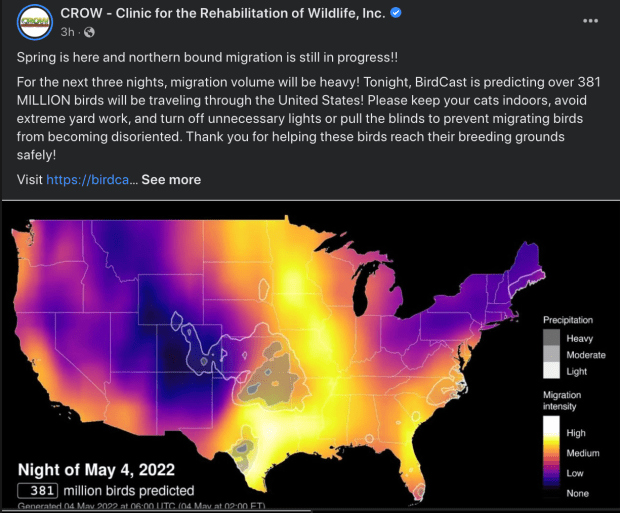
One of my all time favourite wildlife rehabbers is reminding us to help the migrating birds. CROW posted this today on their FB page. Check your region and help! Thank you.
As predicted, we went from winter to summer on the Canadian Prairies. Everyone is outside – and most around me are having their first official barbecue of the season. The birds have not been happy with my clearing up their old seed and I suspect that Mr and Mrs Grackle once again have their nest in the wood shed which is why Mr Raven and Mr Crow have been around so often. My neighbour tells me that he saw about 20 Pelicans in a tree – sounds like the tree with the Great Egrets in Grenada to me. Summer is here. No spring. Just summer.
I hope this blog finds all of you well. Some of the nests are still struggling but life is good and it is pip watch for the Cal Falcons tomorrow!!!!!!!! Yes. I cannot wait to celebrate the three eyases.
Take care. Thank you so much for being here with us. See you soon.
Thank you to the following for their streaming cams and/or FB pages where I took my screen captures: UFlorida-Gainesville Ospreys, Montana Osprey Project, Dulles-Greenway Bald Eagles, ND-LEEF, Cornell Bird Cam RTH, CROW, NADC-AEF, MN DNR, and DHEC.
The trouble with intruders into established nesting territories is that they can cause a lot of grief and, as we have seen, they can cause part of a bonded nesting couple to die. We saw this with Grinnell at UCalifornia-Berkeley Falcons. We saw it at the Bald Eagle nest of Bella and Smitty when Bella was injured and feared dead when a female intruder attacked her. Bella returned. A week ago Harry disappeared at the Minnesota DNR Bald Eagle Nest. There have been intruders since last year on and off the Achieva Osprey nest. The list goes on and on. The success of restoring the Eagles, the Ospreys, and the hawks and falcons after DDT (DDE) destroyed their populations (along with egg collecting, feathers for hats, shootings, habitat destruction) has resulted in a growing population where there are challenges for the best territories and mates. At the same time, what you have witnessed here and at other nests is troublesome.
Intruders without nests and mates are now wrecking havoc at the UFlorida-Gainesville Osprey nest. It is possible that this has been the issue for most of the nesting season when the male has not been able to bring adequate prey to the nest because of territorial surveillance and the removal of intruders. One chick lost and not enough food for three coming to the nest – Mum and two chicks.
The Mum left the nest at 15:25 on 2 May not returning until today. That same female intruder landed on the nest with the chicks this morning who, in their hunger, kept crying for her to feed them. She didn’t and she nipped at the Middle chick who was trying to get near to get a few bites. The chicks were confused. Dad flew in with a fish at 10:31, left, returned with a partial fish at 10:47, and was in a general state of anxiousness. Still the chicks cried for food.
In the image below Mum is on the nest. She returned with a full crop at 12:42. See the birds below the nest? That is Dad chasing away the female intruder.
Mum was attacked and now Dad is chasing off the intruder – this is a very good explanation for what has been happening on this nest. It is interesting to me, at least, that the causes of siblicide do not mention ‘intruders’.
I want to thank ‘A’ and ‘R’ who watched this nest while I was away.
‘A’ makes note of the intruder attacking the female at 12:57. ‘A’ also observed a fish, not a large one, being delivered at 14:43 where both of the chicks were fed.
From ‘R’s observations there appear to be issues with the intruder during this feeding. ‘R’ notes that “at 1501:10 you see two shadows very close together and Mum appears very nervous and stops feeding chicks and starts pulling the fish around the nest. At 1508:35 she becomes agitated and appears ready to fly off the nest but settles down and starts feeding the chicks again.” Clearly the intruder is making the nesting birds nervous causing them to react and not focus on the chicks. ‘R’ notes that following a couple of aggressive behaviours, Middle manages to get the remainder of the fish. Well done, Middle! Most of the time it is to Big’s advantage. Clearly another bird flying around as you can see the shadow pass the nest on multiple occasions.
Once Dad has dispensed with the female intruder, he returned with a large headless fish at 16:28. This is excellent and this is the way to get a nest back on track. Let us hope that the intruder has decided to go elsewhere.
There was a bit of a tussle between the two chicks once the fish had landed. I noted that each stood up to the other. Middle is hungry enough he might go on the attack.
I was surprised when Middle stood up big and bold that the two birds are not that much different in size. Clearly Big has the advantage of being energized by more food and is stronger.
Big exerts its dominance but this does not stop Middle from exerting its presence to get fed.
‘R’ noted that Mum moved the fish to the opposite side of the nest whiich was more advantageous to Middle. Once Mum got settled things began to get sorted with the feeding. In the end I would say that both chicks ate well.
It is 16:56 and both of the chicks are being fed in almost equal portions and there is still fish remaining. We can all sleep sound knowing that Middle had a really good feed late today!
Mum is still feeding at 17:01. How grand.
Each was offered a piece of fish tail at the end. Both osplets have crops. Nice.
I cannot think of a nicer way to end this blog. Despite all of the commotion and potential danger to this nest, in the end, Dad came through with a big enough fish for both of them to eat well. Sometimes we have to take the nests a day or an hour at a time. Today was a good day for Middle – and for Big.
Thank you so much, ‘A’ and ‘R’. You have each helped to fill in the gaps while I was away and to add substance to the angst that this intruder has caused. Much appreciated.
Thank you so much for joining me. Take care everyone.
Thank you to the UFlorida-Gainesvlle Osprey streaming cam where I took my screen captures.
News has come that the male at Denton Homes, Majestic Dad, has died. Avian Flu has been confirmed. The Denton Homes nest lost three eaglets and an adult male. The female, Majestic Mum, looks good on cam and is being monitored.
For those looking for information, here are two publications that have good solid information as well as some of the latest news on the spread.
This is one of the last images of E2, that sweet little eaglet off the MN-DNR nest that became a victim of siblicide at the age of 5 weeks. E2 hatched on 23 May and was shoved off the nest by E1 and subsequently euthanized on 30 April.
Dr Sharpe has been very busy. Another chick was to be banded on Santa Rosa Island and Dr Sharpe arrived just in time as the nest had collapsed and dropped. Here is that announcement
There are now five baby Peregrine Falcons in the Manchester, New Hampshire nest
Here is the link to that streaming camera (there are 2 of them).
There is an unease this morning on the UFlorida-Gainesville Osprey nest. I have observed fish being brought in but a bewildered adult and no feeding of the eaglets. An adult brought a fish on at 10:19 (or thereabouts). Both of the chicks began to scream for food. It was interesting watching what is happening. The adult eventually gave up and dropped the fish on the nest. Middle began to self-feed. You might have noticed him chewing on other bits of old fish and bones on the nest.
In the image below, the adult has brought in the fish. Middle is trying to get under here to be fed. (Big has the darker back plumage).
Middle anticipated that the adult would be feeding them and is trying to get to a point away from Big so that it gets some food.
The female places the fish in the middle of the nest leaving it. She did not feed the chicks when she brought in the piece of fish.
The chicks look on as the adult flies away. They do not understand what is going on – the same as me!
Middle begins to self-feed.
The chicks give up on the self-feeding. This picture was taken at 10:31.
At 10:47 an adult lands on the nest.
The adult, at first, appears to be a small piece of fish tail that they have brought in. Then the adult pulls part of a catfish – the head and part of the body – out of the nest. Both chicks are prey crying very loud. The adult appears confused as Middle tries to self feed. Is this Dad? and was it Dad earlier?
The adult looks completely bewildered.
Middle is attempting to self-feed. What is going on at this nest?
Middle had very little food yesterday and, if that were the case the day before, is not starving but getting there. It is clear that Big has no crop and is also hungry but not like Middle.
Middle may have gotten a little flesh off the open end.
While the dropping of the fish on the nest is a good strategy for both if there are two pieces and both chicks are self-feeding, it is clear that these two are not ready to feed themselves. Where is the female?
At 12 noon the adult returns, chicks crying desperately for food. The adult looks around. Is this Dad again? (From the behaviour I am assuming Dad). Where is Mum? If you observe the Mum feeding the chicks (or the dad) please send me a note. I cannot watch the nest all day today, unfortunately. I am quite concerned.
This has been posted on the UFlorida-Gainesville Osprey Nest page if you would like to help name the chicks, the adults, and the nest:
All I have to do is flip over to the Red-tail Hawk nest at Cornell and there is an instant smile. The four Ls do not have to worry about getting fed. Arthur is constantly bringing in food and Big Red feeds each beak until there is not one asking for food.
Larger clutch, direct feeding, lots of food on the nest, no history of siblicide – that is the difference at the Red-tail Hawk nest as compared with the UFlorida-Gainesville Osprey nest.
The West End nest of Thunder and Akecheta is an example of two parents working hard to make sure that each of their offspring survive —- and thrive! Both parents were active bringing in food. Several times they had tandem feedings. And look – Sky, Ahota, and Kanakini. They should all fledge and we hope return and raise their own families in the Channel Islands.
The Mum and Dad at Pittsburgh-Hayes consistently raise triplets to fledge. They hatched on 21, 22, and 25th of March making them 43, 42, and 39 days old.
These are Bald Eagle nests. Examples of siblicide that I listed yesterday include both Bald Eagles and Ospreys. It will be enlightening, at the end of the season, to compare data on species in terms of survival rates. It is also complicated and might not reveal a true picture in terms of prey availability, parenting, genetic predisposition to siblicide, etc. unfortunately. Another interesting comparison will be the rate of success of 3 clutch Ospreys in the UK with those in North America.
At the Hellgate Canyon nest of Iris in Missoula, Montana, the oldest osprey in the world laid her first egg of the 2022 season at 08:13.
Louis arrived a little later – fishless – to see the egg and do what Louis does.
I want to repost Dr Erick Greene’s letter about Iris’s relationship with Louis and why I should not be – nor you – upset with the fact that he has two nests. There is a huge change in the Osprey population that use the Clark Fork River for their food supply. Much of what Dr Greene says can also be applied to other species who are under pressure.
The Anacapa Falcons are doing well.
Things seem to have settled for now so that Bukachek and Betty can take care of their five eggs in the Mlade Buky White Stork nest in The Czech Republic. They have had disturbances – as recent as two days ago- from intruders like so many other nests this year.
It is a soaking morning on the Bald Eagle nest at Notre Dame University. There has been some strife at the nest with regard to the third hatch getting feed. It seems that there are good days and not so good. The weather might well impact feeding and behaviour today.
This is the history of this nest back to 2015: One chick, ND1 in 2015; ND2 in 2016; ND 3 and 4 in 2017; ND 5 and 6 in 2018, ND 7, 8, and 9 in 2019; ND 10, 11, and chick 12 who died on May 14 in 2020); ND 13 and 14 with a non-viable egg also in 2021. The hatches this year (2022) are ND 15, 16, and 17. Hopefully all three will make it.
Notice the turtle shells. James Broley commented that the Bald Eagles love turtle and he always found turtle shells in their nests when he went to band the chicks.
Beautiful female with her two eggs in the Barlinka Forest nest in Poland.
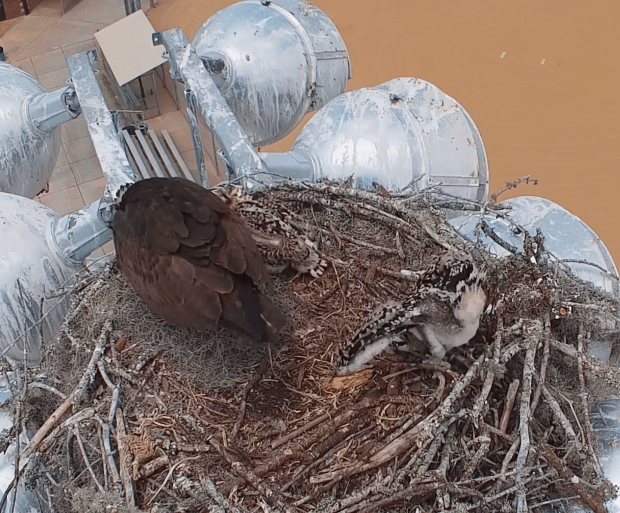
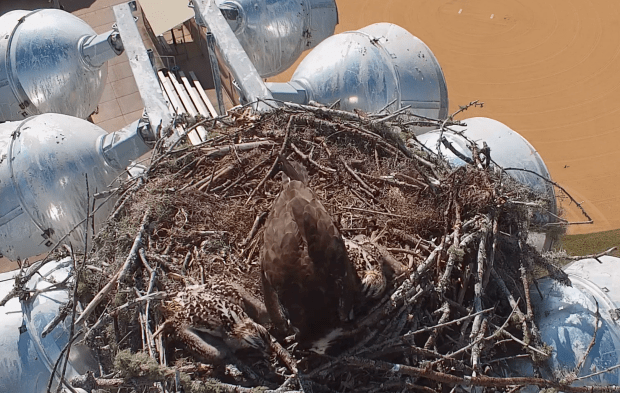
Wow! I just came across this Osprey nest at the US Steelworks Plant in Washington State.
It really helps to have metal workers when you need an upgrade. The original nest was on top of a light pole. Look carefully. In 2012, when a lighting upgrade was required, it was felt that a new nest platform should be constructed. The workers incorporated the old nest with the new metal one in hopes of attracting the birds to use it.
I do not know anything about the history of this Osprey nest. It is in Kalamana, Washington State and the Pacific Northwest had tremendous problems with the extreme summer heat causing many nests to fail. Chicks were leaping to their death to get away from the heat. So this is a warning if you start to watch this nest – there could be issues related to weather at this nest.
Eyases have hatched at the Cromer Peregrine Falcon scrape in the UK. The adults are Poppy and Henry.
The nest is on top of the Cromer Church Tower. In 2020, the resident pair fledged three chicks. In 2021, no viable eggs were laid. Now look at the little ones this year. Fantastic.
Here is a short video of their feeding. Notice how the female holds the prey.
Here is a link to the Cromer Peregrine Falcon page that has a link to the camera as well as lots of images and information.
And here is a link to the YouTube streaming cam for Cromer.
I am very interested in the White-tail Eagle nest at the Matsalu National Park in Estonia. Last year the couple hatched two chicks that perished from Avian Flu. It was the first recognized instance of H5N1 during spring breeding and marked a shift from the Avian Flu being prevalent in the fall and winter when it did not impact the breeding season. The two eagles have returned to the nest where WTE have been raised since the 1870s.
Will they lay eggs this season? If so, they are very, very late. In a normal season the eggs would be laid around the third week in March with hatching in late April. We are now 3 March.
This is the link to this nest in Estonia.
If you are watching the UFlorida-Gainesville Osprey nest today and see a feeding, if you do not mind sending me your observations I would be very grateful and would, of course, credit you for those! I am very worried about this nest. The female has to eat and it is possible that she is as ‘starving’ as Middle. Two fish on a nest is not enough to support the female plus two growing and demanding chicks. Thank you so much!
So many nests and so much happening – lots of good and much sadness recently. Thank you for joining me today. It is so nice having you here. Please take good care.
Thank you to the following for their streaming cams and/or FB pages where I took my screen captures: The Eagle Club of Estonia, Cromer Peregrine Falcons, U-Florida-Gainesville Ospreys, Cornell RTH, Montana Osprey Project, Steelscape Osprey Cam, Peregrine Falcon Networks, Institute for Wildlife Studies, Explore.org, Pix Cams, ND-LEEF, Barlinka Ospreys, Mlade Buky Storks, and Anacapa Falcons.
Oh, I cannot tell you the level of elation when – just stopping in to check on a fledging that it is there on the nest, yelling at the parent it sees in the distance bringing in a headless fish. Oh, Kincaid, it was so very nice to see you. Thank you Louis for that great meal! The time on the Kistachie National Forest streaming cam was 15:48:36.
There is Kincaid on the branch. Oh, how lovely. I have not checked in on you enough but, it so reassuring that you are still at the nest with your parents, getting food and getting stronger at flying. That is how you will survive! Maybe you won’t ever leave. There is plenty of lake, lots of fish, and an empty eagle’s nest.
Kincaid saw Louis flying towards the nest way in the distance and she rushes down to get her dinner.
Kincaid was sure ‘wheeing’ very loud as the adult approached the tree and landed. Kincaid mantled the nice headless fish perfectly.
Kincaid did a great job feeding. She was still on the nest eating an hour later.
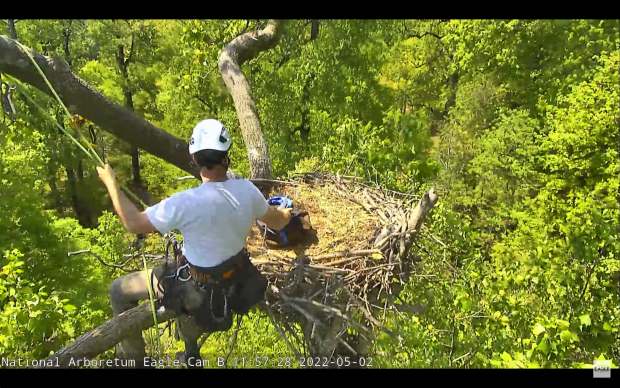
This morning DC9 at the National Arboretum Nest was banded. The eaglet was taken in a pouch down from the tree and returned. It was a very hot day in Washington, DC. 27 degrees C or 80.6. It is hotter on the top of the nest. DC9 was panting. The immediate reaction of the bander was that DC9 was a male. If I hear differently, I will let you know. Here are some images of that event.
DC 9 valiantly defended its nest. It is 10:52. DC9 is 35 years old. The perfect age for banding.
The bander sat very quiet talking gently to the little eaglet and slowly, ever so slowly got him to where he could place him in the sack.
In you go.
Down they go.
Done and dusted. The bander stayed to see that DC9 was alright. Watched his breathing etc.
DC9 is panting due to the heat and probably some of the stress. He is not going to show us his bling either.
Mr President was on a branch of the nest tree called the ‘balcony’ at 15:43. He flew down to the nest and fed DC9 at 16:22. I wonder if DC9 told Dad what a day he had had!
The cuteness factor at the nest of Big Red and Arthur is way up there. L4 is quite the ‘corker’ as my Mum would have said. Yesterday evening he was trying to eat the same piece of rabbit as its older sibling, L1. The wee one isn’t afraid of anything – even attempting to eat a bird leg this morning. It was quite hilarious. At least once Big Red had to rescue the poor darling from choking. Did I say she was a great Mum?
L4 is on the far right with that big piece of meat. Right now it is the only eyas that does not have the grey down coming in. The others are preening and itchy! Soon enough, little one. Don’t grow too quickly.
Everyone is getting a nice crop.
Then it started raining. Poor Big Red. She is getting soaked.
Then the rain stopped. All of the babies are completely dry and kept nicely warm.
It often seems like Big Red never stops feeding them! Adding one extra sure changes things on a nest!
Iris came to visit her nest today at Hellgate Canyon in Missoula. No eggs yet.
Someone commented that they thought raptors bonded for life (meaning if the mate disappears they do not take another mate) today in a short discussion about Nancy and Harry at the MN-DNR nest. Harry has been missing since Tuesday evening. He is Nancy’s second mate. Should Harry not return to the nest, Nancy will have her choice of suitors. She is an experienced female with a beautiful nest and according to the statistics there are too many single male eagles. II really hope that Harry is off healing and will return. Nancy is taking good care of E1. (E2 was shoved off the nest by E1 and subsequently euthanized due to its injuries both from the fall and from the beaking from E1 on the nest).
The oldest eaglet on the Dale Hollow nest branched today. A parent was in with a chunk of fish for Big and was feeding some fish to Middle.
The eaglets are big! Just look at the size of them.
Wow. That big beautiful wing. The eaglets are (counting hatch day) 64 days old today. They hatched on the 28th of February.
Louis and Dorcha at the Loch Arkaig Osprey nest in Scotland now have three eggs. Congratulations.
Male Ospreys are quite funny. Some bring toys and bright objects to the nest. Others land on their mates and use them as a pillow hoping to get some incubation time. At the Dyfi Nest in Wales, Idris pulls Telyn’s feathers when he wants a turn! Telyn is incubating three eggs!
Idris is also known for being ‘Daddy Longlegs’ and for his fantastic fishing abilities!
This is a reminder that Annie and Alden, the Peregrine Falcons at the Campanile on the grounds of the University of California at Berkeley are incubating three eggs which are set to hatch in four days – 6 of May (possibly the 5th). Two eggs are believed to belong to Annie’s former long term mate, Grinnell, and one is thought to belong to Alden. Everyone is very excited. When the chicks are banded, snips of feathers will be taken and a DNA test will happen. We will know the genders and hopefully which chick belongs to which Dad.
Don’t know what to expect from a Peregrine Falcon nest? or need a refresher? or just want 15 minutes of cute? Have a look at a season compilation from Glasgow.
I have not had a chance to check all of the nests! Adding the falcons and ospreys in with the eagles has been running – which is a good thing! Those nests I have checked appear to be just fine.
It is sunny and dry in Manitoba! American White Pelicans are on the river near to where I live. The floodway seems to be regulating the water inside the city the way it was designed. Thankful.
Thank you for joining me this afternoon. Take care. See you soon.
Thank you to the following for their streaming cams where I took my screen captures: Dfyi Osprey Project, Cal Falcons, Cornell Bird Lab RTH, DHEC, Scottish Woodland Trust, NADC-AEF, MN-DNR, KNF, and the Montana Osprey Project.