Early Sunday in Bird World

16 October 2022

Good morning, Everyone,

It was a very long night. I want to thank you for your outpourings of love and empathy for Little Bob at PLO. If love – human love – could have saved him, that nest would have been full of fish. Little Bob died of the effects of siblicide (starvation and a possible early morning injury) in the late afternoon of the 16th of October at the age of 24 days. Port Lincoln received permission to remove his body from the nest. Fran Solly (?) moved the camera away from the nest to the landscape while Little Bob was being taken off the nest.

Port Lincoln posted the following information on their observation board:

A sad day at port lincoln as #3 didn’t survive. It didn’t get fed properly these last few days and collapsed around 1 pm this afternoon and died at the end of the afternoon. PLO got permission to retrieve it for burial, but didn’t get permission to interfere before that. It is sad, but also the way of life in any nest. The other two siblings are thriving and have every chance to successfully fledge in a few weeks.

If you go to the obs board, you can also join in guessing the fledge time of the two surviving osplets. That obs board can be viewed here:

It is a shame that Port Lincoln did not get permission to intervene once they realized what was happening on the nest.

There are divided feelings on which osplet should be removed when food competition is present. Most researchers believe you remove the eldest if it can self-feed instead of the youngest – leave the youngest with the adult who will feed it. In other instances, smaller birds being beaked have been removed and fed and returned to the nests to live happily. Perhaps, in the future, should this occur again (and it almost seems inevitable at this nest if the first hatch is a big female), permission to intervene can be gained even before the eggs are laid. Just a thought.

Little Bob was loved by so many and we remain heart broken. I am glad that his suffering has ended, however. The parents have little time to grieve – they have two large osplets to care for and get to fledge.

Making News:

Warming seas, overfishing, hotter temperatures are all having a huge impact on birds. Will there be a time when Ospreys will only be able to find enough food for the parents and one chick to survive?

We have just witnessed at Port Lincoln the ospreys eating fish that were fresh and left on the nest or the one that magically appeared on the barge. Since climate change is human caused, it is time that we began to consider ways in which we can help our Osprey friends adapt – and that is through intervention. Providing fish when there is not enough. Fish tanks. There are figures of how many fish come to an Osprey nest with three chicks. The average, if I recall correctly, is somewhere around 450 fish.

Already scientists are seeing a 43% decline in Penguins. Here is the story:

https://www.theguardian.com/world/2022/oct/12/australian-scientists-observe-rapid-decline-in-adelie-penguin-numbers-off-antarctic-coast

The article might be about penguins today but, it is easy to see that the Royal Albatross chicks are requiring more supplementary feedings. What others will we be reading about?

Here is a story coming from Cyprus about the Griffon Vulture. When will countries realize that wildlife and bird watching tours add much income to an economy. So instead of trying to wipe them out with poisons why not embrace the beauty of all and celebrate it?

https://www.theguardian.com/environment/2022/oct/10/its-a-serious-problem-battle-to-save-griffon-vulture-heats-up-in-cyprus

Nest News:

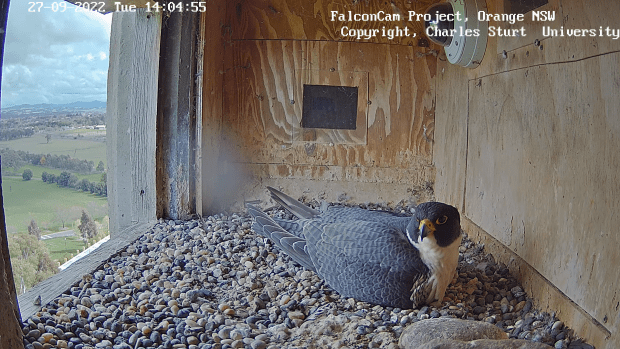
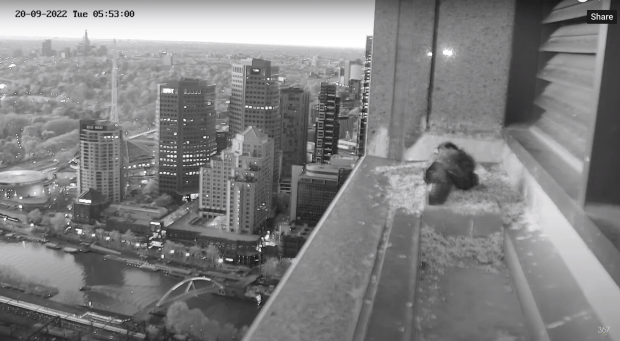
There remain three active nests in Australia with chicks to fledge: 367 Collins Street Peregrine Falcons in Melbourne, Charles Sturt Peregrine Falcon scrape in Orange (Xavier and Diamond), and the two Osplets at Port Lincoln. There are currently no concerns for the falcons at Orange. Both are eating well and food is arriving with no issue. There is concern about the amount of time the female is away from the scrape box at Melbourne. My understanding is that there will be two very hot days this week that will impact the eyases. They do not, as yet, have the ability to run up and down the gutter nor are they feathered to further help them regulate their temperatures. Big and Middle should thrive at Port Lincoln.

The Melbourne Four had several feedings yesterday. The last was at 1832. The four were absolutely bursting at the seams!

Indigo and Rubus ended their day with a duckling feed. Yesterday they had Starlings, a parrot and a Rosella. Xavier is bringing in quite a variety for his family. The Rosella feeding was at 16:29:58

At 1740 a duckling arrived on the ledge which Diamond happily took to feed Indigo and Rubus. Rubus did not have a crop from the earlier Rosella feeling an hour prior and so, this little one got to fill its tummy before bed with a favourite, duck.

At Port Lincoln, after the removal of Little Bob’s body, Mum fed the two surviving chicks one of the fish that was left by Port Lincoln. She also enjoyed some of it herself. It is worth remembering that both Mum and Dad have to retain their health or the entire nest suffers. Mum worked hard to find Little Bob fish when he was eating – at the expense of herself. The females lose weight and body mass as they produce eggs, incubate, brood and feed the chicks until such time as they fledge. Often, at about 30 days, Mum will, in fact, go fishing and supplement the fish Dad brings to the nest.

I do not personally believe there will be any more problems on the Port Lincoln nest. It is not always the case, however. At the UFlorida-Gainesville nest, after the third hatch died, the eldest began to take their angst out on the second hatch. The competition continued but as Middle got bigger, it was clear that Big could not kill it. At that nest, it was evident that the Mum often favoured the eldest. It was a very interesting nest to watch – it had two strong fledglings in the end.

Middle has grown a great deal in the last couple of days as she began to figure out how to get fish and be away from Big. Let us all hope that lots of fish continues to come in and that Mum will also get her share.

Breakfast has not yet arrived at all the nests. I hope to have a very late day report on the comings and goings early on a Monday morning at the nests in Australia. Thank you for being with me and thank you for all of your outpourings of sympathy for Port Lincoln over the death of sweet Little Bob. It will be very difficult to watch that nest for many. Port Lincoln is not a nest for the faint of heart. For those of you that love Ospreys, I want to now recommend three nests in the UK: Rutland’s Manton Bay with Blue 33 and Maya. That Osprey family has raised four osplets twice!!!!!!!!!!!!!! They are Super Stars in the Osprey world. The second is at Dyfi in Wales, the home of Idris and Telyn. It just so happens that Telyn is Maya’s daughter from Rutland! The other is the home of Louis and Dorcha at Loch Arkaig. Louis melted our hearts when he helped his former mate, Aila, feed their three chicks in 2020. He is an amazing provider just like Blue 33 and Idris.

Take care everyone. See you soon.

Thank you to the following for their stories, posts, and our streaming cams where I took my screen captures: The Guardian, Port Lincoln Ospreys, 367 Collins Street by Mirvac, and Charles Sturt Falcon Cam and Cilla Kinross.

Early Friday in Bird World

14 October 2022

Good Morning Everyone,

Some snow fell last night and it was still here – not melting – until half an hour ago. Everyone has been in the garden this morning and Canada Geese have been flying overhead. Everyone is visiting the garden. The number of Dark-eyed Juncos has increased, and the Starlings are here waiting for me to go and get Meal Worms and Butter Bark. I plan to do that shortly. They do cause chaos, but they are such beautiful birds and they also deserve a good feed on a cold day.

Making News:

Oh, I adored Rosa and Martin’s 2022 eaglet, Orion, at the Dulles-Greenway Bald Eagle nest. What a gorgeous chick. Orion hatched on the 13th of March. Well, guess what? Orion returned to the nest! But it gets better ———— Martin and Rosa were there!!!!!!!!!!!!!! Here is the video:

Harriet and M15, the famous Fort Myers Bald Eagle couple, have made The Washington Post with their rebuilding activities! The raptors can show us all the way. Don’t grumble about what life throws at you, just get on making it better!

https://www.washingtonpost.com/lifestyle/2022/10/14/bald-eagles-rebuild-nest-hurricane/?fbclid=IwAR2VxX84BEELvFGm6uHJXCm2lIm2qfvsDUHwDj4GLnnYCx9GTfPR0YsTYZU

Abby and Blazer from Eagle Country are on their nest tree. Just look at what Hurricane Ian did to their wonderful nest. I wonder if they will rebuild in the same place?

Do you adore the Kakapo, the charming green flightless parrots of New Zealand that are so threatened? Well, I do and am always thankful for the care they are given. They were New Zealand’s Bird of the Year for two straight years but, because of that, they have been struck from the ballot this year. Some are wondering if that is fair.

https://www.theguardian.com/environment/2022/oct/12/new-zealand-bird-of-the-year-contest-favourite-kakapo-blocked

New research comes from all the poo samples collected of the Kakapo. Here are the results that shows gut health is key to their survival.

https://www.newshub.co.nz/home/new-zealand/2022/10/kakapo-gut-bacteria-key-to-its-survival.html?fbclid=IwAR3ArV1bv8gLBVh4wIP0drEOQQICOkkxbimeWUZwoMlwQTou2g6UZz5S3Is

Nest News:

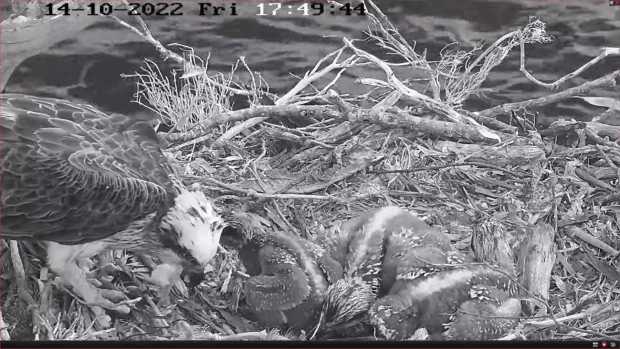
Today, at Port Lincoln, Big is 27 days old, Middle is 26, and Little Bob is 23 days. Those four days and, perhaps, a gender difference with Big Bob certainly being a female, sure set those two apart. According to Port Lincoln’s data chart, there were 4 fish delivered with 5 feeds. That does not tell us much about what happened on this nest. I was, however, delighted to see that Little Bob had a feeding around 0100 Friday morning. That is interesting as the night before, Middle had been the recipient of those precious bites. I could not rewind to see how much fish Little Bob got but, on Friday in Australia, Big ruled the roost in frenzied attacks on all the siblings. Little Bob had some fish around 10:45 before it was attacked by Big three minutes later. That feeding was highlighted in my last blog.

There was a feeding at 12:36. Little stayed rolled up tight and did not get any. The third feeding at 16:28 Middle got some but Little did not. It was the break through very large whole fish that helped Little Bob. It arrived at 17:17:45. Little Bob moved up to eat with Middle at 17:36 getting its first bite at 17:37:58. After that Mum worked that fish tail again giving Little huge bites at the end. Little Bob went to bed full of fish. That is a good thing.

There was not a late fish delivery like there had been the night before. It sure would have benefitted Mum and Little. Big is out for the count so full after gorging all day. I remember the second hatch at Achieve Ospreys in 2020. That osplet would eat and eat and eat so that Tiny Tot could not get any food. We wondered how it could even hold another bite.

Looking at Port Lincoln and the age of the Osplets, let us remember that the beaking started on day 8. The late and only fish delivery that day came after 1500. It was also the onset of the Reptilian phase. We are now moving out of the Reptilian Phase and this nest should settle —- if it is going to. It is why the ages of the osplets are now important as the development of their juvenile feathering. Oh how I wish we could measure their hormonal levels leading up to that Reptilian Phase and then coming out of it.

The chicks at Melbourne were once again left out in the hot sun yesterday. I am mystified at the female at this scrape. I have never seen a female consistently leave her chicks for an hour and a half or longer every day. They were so hot. Hopefully in another week – when, according to the Melbourne weather reports it is to get hotter – they will be able to run to the other end of the gutter for shade. I want to say ‘should Mum leave them alone in the hot sun again’ but, it seems that a pattern has formed and that is precisely what Mum will do, sadly.

Indigo and Rubus are being well fed and taken care of. Rubus now gets lots of food and you can see that it knows precisely where Mum’s beak is. The eyes are open and they are focusing. When Rubus is an adult it will be able to see a prey item a mile away. There were six feedings yesterday at Orange.

Rubus and Indigo are just cute little buttons of things. Indigo is so calm and Rubus seems to be a live-wire. I do love watching Indigo take food out of Rubus’s mouth – but, only if, Diamond replaces it for Rubus!

There is no news about SE29 or SE30. I will be back with updates on migration later today along with the breakfast news from the nests. For those watching the Finnish Ospreys, Salli left Finland on August the 25th and she arrived at her winter home in Rwanda on the 13th of October. She is now feeding at Lake Llaema. Fantastic. The adult Royal Albatross have been arriving on Taiaroa Head. Some have been around Lillibet’s nest. Check it out.

Thank you so much for being here with me. Take care. See you soon!

Thank you to the following for their news, their posts, and their screen cams where I took my screen captures: ‘A’ and ‘H’, Dulles-Greenaway, Osprey Friends, Eagle Country, Kakapo Recovery, 367 Collins Street by Mirvac, Charles Sturt Falcon Cam and Cilla Kinross, and Port Lincoln Ospreys.

Big Bob and the beaking…Port Lincoln gets its first fish of the day

13 October 2022

Good evening, Everyone.

I couldn’t end the day without checking on Little Bob. When I closed my earlier blog, the Port Lincoln trio and Mum were waiting for Dad to bring in the first fish of the day. The osplets were already antsy and had been beaking one another. Each started the morning with a crop left from the late feeding last night but, by 0900 they had all dropped that crop and were hungry.

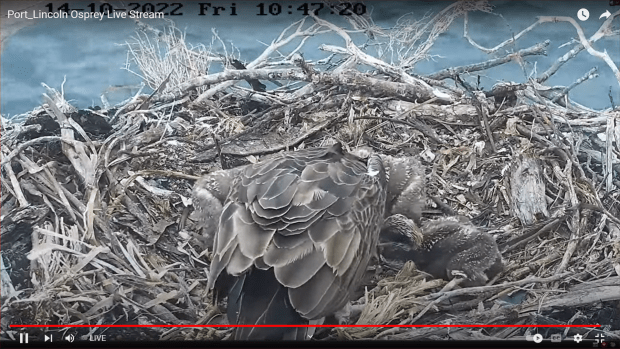
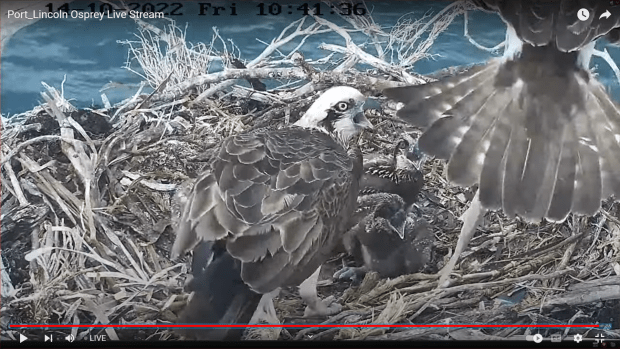
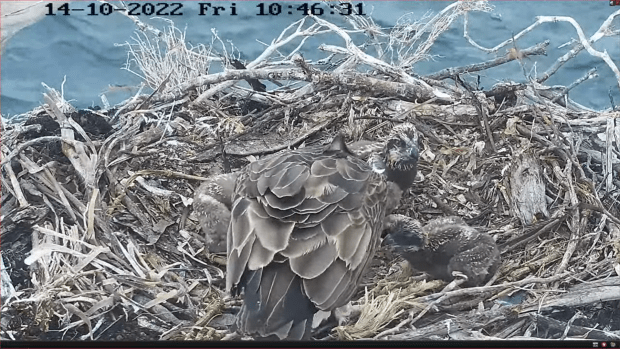
The first fish delivery arrived at 10:41:36. It was assumed, and rightly so, that Big Bob would eat the majority of any fish that arrived if not all of it. As it happened, Little Bob was getting some nice bites for several minutes even having a tug-o-war over a piece at 10:47:24. At that point, Little Bob had a small crop.

At 10:48:19, Big moves Middle out of the way so that he can brutally attack Little Bob. —The one saving grace this morning was that Little Bob did get up opposite Big and ate with his siblings. That is a big step from cowering yesterday and not even making a motion to eat. At 10:50:49, Big attacks Middle.

The long-awaited fish arrives. Even the osplets are fish crying to Dad.

Big is to the far left with Middle in the middle and Little Bob to the right.

At one-point Little Bob stands up to Middle and looks him in the eye. I just held my breath.

Little Bob has gotten some nice bites. Of course, not nearly as many as Big but, he is eating and he is up at the table and there is a small crop coming.

All is good and then it isn’t. Was the tug-o-war with Big and Big decided she had had enough of Little? I say ‘she’. Big is enormous. Not just from all the food she is consuming compared to the others but also because she has to be a female. It is also well known that the females are much more aggressive siblings especially if they are the first hatch. Their bodies will be at least 1/3 larger than the males and they have all those feathers to produce. They are often the last to fledge because of the time it takes them to fully develop compared to the smaller males.

Big is viscious. Just mean. She has had a lot of fish and yet, she is determined to terrorize the other two.

Then Big takes exception to Middle. Perhaps Big thought Middle had some food while it was dealing with Little. I want you to look at the size of Big’s wings and then look over at Little. Big is huge.

I have included this image. Big had a ps over the back of Little. I just want you to look again at the size. Little might have a peck at Big – which it shouldn’t – but Big is simply too big and could kill Little if she set her mind to it.

The fish is finished and both Middle and Little are fish calling at Mum. Let us all hope that much fish – great big fish – arrive on this nest today. Still, Little has eaten up at the table and that is a big step. Let’s watch and see what it does next time.

I wish I knew what it is that causes certain osprey nests to be more prone to siblicide and food competition. Is it toxins in the water? is it genetics? Is it just the psychological makeup of the osplets? is it gender? is it a mixture of all of these factors?

Thank you for joining me as I checked on Little Bob at Port Lincoln. Take care all. See you tomorrow.

Thank you Port Lincoln Ospreys for your streaming cam where I took my screen captures.

Tuesday morning in Bird World

27 September 2022

Good Morning Everyone!

It is clear blue skies on the Canadian Prairies this morning. The temperature when I began this blog was 2 degrees C. There was frost on the roof for the first time this year. The remaining flowers and herbs were not bothered so hopefully the second wave of hummingbirds that will be coming through will have some nectar. The Crows and Blue Jays along with the squirrels are busy collecting corn and peanuts this morning. Little Red has a new suet cylinder so all is well in the garden.

Making News:

Hurricane Ian is beginning to impact the Florida coast. This is the view of one of the Captiva Ospreys earlier this morning. For all of our raptor nests and everyone in this region – as I know so many of my readers are – we are all sending you our warmest thoughts. Stay safe. I will be checking on the Captiva situation throughout the day and evening.

It is currently calm in St Petersburg at the Achieva Osprey nest.

Some wind, which seems to be picking up in gusts, and rain at the nest of Bald Eagles Ron and Rita in the Miami Zoo.

You can hear the wind gusts at the Southwest Florida nest in Fort Myers of M15 and Harriet.

The winds at the Northeast Florida nest of Samson and Gabby appear and sound to be as strong as those at Southwest Florida.

Just checked. The wind speeds at Fort Myers (Harriet and M15) are at 17kph with Jacksonville, home to Samson and Gabby at 18 kph, and Ron and Rita’s nest in Miami at 19 kph. All have rain. We should expect these winds to pick up considerably later in the day.

This is the latest view from the Osprey nest at Captiva. There is one bird on a perch. You will have a front row seat to watch the storm according to the moderator on the cam. Hang on Lena!

Here is the link to the this camera:

Arctic Terns travel 44,000 miles during migration and now, once in the UK, they are met with Avian Flu. A good article that continues to discuss the demise of so many sea birds this year due to this wide spread disease.

https://www.theguardian.com/environment/2022/sep/27/country-diary-a-cruel-end-to-an-arctic-terns-epic-travels

Dr Sharpe has boundless energy and his love for raptors is highly infectious. He is now looking to place streaming cam on Alcatraz for one of Grinnell and Annie’s daughters who has been nesting there and raising chicks for a couple of years. The Institute for Wildlife Studies posted this image of Dr Sharpe this morning checking out the situation.

Nest News:

We can all give ‘three cheers’ for Little Bob at the Port Lincoln Osprey nest. At the mid-day feeding, Little Bob had himself right up there in the front row! This does remind me of our dear Ervie and it did take Ervie a couple of days to figure out the ‘sweet spots’ so he could get the most food. This is fantastic. Just look at that little bit of an osplet up there by Middle Bob. Gosh, he is a darling. Big Bob has such a long neck he can reach over both of them but what a tidy trio. It is also nice to see Dad on the nest. What a fantastic family this is.

Little Bob looks so proud of himself.

Dad came in at 1307 with a small headless fish and there was another feeding extremely close to the last one. By the time this feeding was over, all of the chicks were right ready for a good sleep!

The Mum at Melbourne seems to be ‘sitting’ on the eggs differently. Reports out of Melbourne seem to indicate that she is being fed and at one male did stand above the eggs, as if listening, yesterday. A soap opera in Falcon World. We wait but it should not be too long now. There could be pips as I am writing.

The two below appear to be the reigning adults at the Melbourne scrape. The female called simply a falcon (or Mum) has higher horizontal bars on her chest than the male. It is the only way I can tell them apart. Juveniles have vertical bars. The feathers of the female are darker than those of the male or the tiercel and, of course, she is bigger but it is often difficult to tell the size differential unless the pair are close together. I have watched the old male for quite a number of years and this tiercel does not look like him to me.

Mum was doing a lot of ‘looking down’ as if listening to the eggs beginning right after noon yesterday. She is quite beautiful but sure seems to give her ‘most fierce’ look at the camera sometimes.

Now she is being sweet and not so fierce.

It looked as if an eel were brought into the nest in the Sydney Olympic Forest with a wee bit of discord between SE29 and SE30 – but, in the scheme of things – that discord lasted 3 seconds with no pecking. Just a little feisty shuffle. Of course, the adults are watching everything that these two are doing.

Beautiful Diamond. At Orange, the eggs of Xavier and Diamond tend to hatch between 36 and 39 days. That means that the first pip should come on 1 October. As many of you know, the falcon eggs can hatch almost all at once. So 2-3 days. I do hope that these two have a very healthy chick or chicks. ‘A’ and I noticed that both Diamond and Xavier tend to be looking very healthy this year. Fingers crossed.

Thank you so very much for joining me this morning. We are really watching for pips and hatches at Melbourne and keeping our eyes and ears on what Hurricane Ian is doing to the nests within its range. Take care everyone. See you soon.

Thank you to the following for their posts and streaming cams which form my screen captures: Captiva Ospreys and Window for Wildlife, Achieva Osprey Nest, WRDC, SWFL Eagle Cam and Pritchett Family, NEFL-AEF, NOAA, IWS, Port Lincoln Ospreys, 367 Collins Street by Mirvac, Sea Eagles@Birdlife Australia Discovery Centre Sydney Olympic Park, and Charles Sturt Falcon Cam.

Early Sunday in Bird World

25 September 2022

Good Morning Everyone. Clear beautiful blue skies on the Canadian Prairies and a temperature of 13 degrees C. It is fantastic. The forecast calls for no rain this week which, is excellent. We are really into migration and it will be fantastic to bundle up a bit and watch the geese and ducks fly into the ponds this week without rain.

Last evening I went to a pond in an industrial area that I have started to frequent. The Canvasbacks had moved from the two smaller ponds to the big one and the Blue Heron was there as well along with a couple of Greater Yellow Legs, other ducks, a single Double-crested Cormorant, and some geese. The Blue Heron flew off to what I am now calling the secret pond to roost for the evening with the Great White Egret.

Canvasback
Great Blue Heron taking flight to the other pond.
Greater Yellowlegs swimming instead of punching at the mud.

Nest News:

It was a wet late feeding for the three osplets at Port Lincoln. Little Bob was absolutely soaked but, they all had full crops and did well even when the fish was flapping about. I always worry when chicks get soaked to the bone when they are just wee with only their soft natal down. They cannot regulate their own temperatures and, well, they can get a chill. Mum got right back on top of them and her body heat will keep them right toasty and they will dry off, thankfully.

Incubation continues at 367 Collins Street. According to the calendar, hatch watch starts on the 27th and that is tomorrow in Melbourne. It is also unclear which male is providing food. I did not see the ‘line’ that the second male has now being called M2. As a result, my identification went to M1 or the old male. I hope that there can be some good clear shots of that male once these chicks hatch so we know who is providing food and who is around or not. This female should get a golden award. She has had no help with incubating these eggs. I realize that this does not take a lot of energy but normally this part is shared with the male. She is hanging in there well for a bird believed to be a first time Mum.

Xavier and Diamond also continue their incubation. We have 5-6 days to go before we start to look for a pip in those eggs. Those cameras in that scrape at Orange will give you a ring side seat to see the hatch. At Collins Street, it will only be from a distance.

There are very interesting lessons being taught at the Sydney Sea Eagles – or at least, trying to be taught. These two are the most laid back sea eagles I have seen in years. Dad brought in a teaser of a piece of fish at 1715. Mum was on the nest and SE29 and SE30 stood there, looking at the fish, waiting for Mum to feed them with no move to steal it! Meanwhile, Lady is eating the fish…

That is a very good crop on one of the eaglets.

Notice how Mum waits before doing anything. Lady and Dad must be wondering what is up with these two…is it possible that we have two males this year? I wonder. They are so calm.

Making News:

Toxic chemical pollutants are killing our raptors – and if it happens in one country, you can be assured that the problematic toxins will be found elsewhere.

https://www.theguardian.com/environment/2022/sep/25/how-birds-of-prey-are-exposing-a-toxic-time-bomb

It is really incredible. Normally the fledglings of Big Red and Arthur are not seen after the end of August and here we are getting to the end of September and Suzanne Arnold Horning is still finding them for us on the Cornell Campus. This is just fantastic.

This is L4. What a magnificent hawk with her beautiful red feathered apron just like her Mum, Big Red.

The Bald Eagles continue to arrive at their nests in the US with sticks and a determination to rebuild the nest after last year’s clutch. You can almost check on any streaming cam and find that the couple have been there at some point working. Pa Berry and Missy have been busy for weeks now at Berry College! And Cody and his gang at the Kisatchie National Forest are getting some strange sounds made by eagles with their new ‘sound system’. We will jump out of our shoes when those eaglets start hatching- their cheeping will be so clear!

Listen to Louis pant when he lands on the nest:

It looks like it will be an interesting year. I urge you to add the KNF nest to your roster of eagles to watch — I know, you have too many already but, this is a great couple. Their third year together.

Thank you so much for joining me this morning as we wait for the hatches at the falcon nests in Australia. Right now everyone is sleeping! I hope that you have had a lovely weekend so far. Take care of yourself. See you soon.

Thank you to the following for their streaming cams or posts/videos where I took my screen captures: Port Lincoln Ospreys, Charles Sturt Falcon Cam, 367 Collins Street by Mirvac, Sea Eagles@Birdlife Australia Discovery Centre Sydney Olympic Park, Suzanne Arnold Horning, and Kistachie National Forest Eagle Cam.

Morning Fish at Port Lincoln

21 September 2022

It is actually the 22nd of September in Port Lincoln, Australia and the morning delivery started off a little ‘cock eyed’. Dad delivered a fish, Mum fed the kids a couple of bites, and then Dad came and took it. He had already eaten the head but it was noticeable that he was hungry. He ate another portion, looked around a bit, and then delivered the rest to Mum and Big and Middle Bob. Those kids were hungry, too – and so was Mum. Let us hope the deliveries get closer together to ensure the continued peace on the nest and there is peace. Mum gives one a bite and then a bite to the next. The bites are not little flakes but, surprisingly, large and the kids gobble them down! Osplet 3 is working on getting out and the cap of the pip was seen to move in the middle of the night. So things are happening.

I hope you enjoy these screen captures. I could not wait to show you. These two are little darlings.

Dad finished his fish and waited on the ropes before flying over to Mum. Why did he hesitate? There was at least one gull flying around hoping to grab the kid’s breakfast and Dad wasn’t going to let that happen!

The gull came and did a clean up after Dad flew off to the nest. With its bright orange legs and beak, I believe this is a Pacific Gull but, every Australian, please correct me if I am wrong!

The gas tanks in the osplets were empty but by the end of the feeding they both registered full.

Thank you so much for joining me on this quick update to what is happening at Port Lincoln with Big and Middle Bob – and Mum and Dad. Take care everyone. See you soon — maybe Little Bob will be here by tomorrow. That would be grand.

Thank you to Port Lincoln Ospreys for their streaming cam where I took my screen captures today.

Adorable osplets at Port Lincoln and more news in Bird World

19 September 2022

Good Morning Everyone,

Oh, goodness. The sky is the most beautiful blue this morning without a single cloud. The tree tops have been kissed and they are all turning slightly golden but, we have not yet had a frost. Decades ago, there was always a frost in August and people lost their tomatoes still growing in the gardens. This year the mint has eclipsed its pot and the tomatoes are still growing and turning red. Thankfully, my three-year old neighbour loves those little grape tomatoes – there were 1000s this year!

Dyson has already arrived along with the Blue Jays who let me know that there are absolutely no peanuts to be had. It was the first time that I really examined those nuts. No wonder the Jays are picky eaters. Some of those nuts are not good – dry or with only one peanut. I don’t blame them for giving them a shake to find the fullest heaviest one.

Scraggles loves peanuts and always tries to take two! Notice her tail. It is growing back after she used part of it for her nest this summer.

Dyson looks great. Her tail has grown in and it is so nice to see her in the garden every day. Dyson stayed and ate quite a few nuts before leaving with a couple. It is so good to see her looking so well. It is hoped that by providing good food and water the animals might live better and longer.

In the Mailbox:

A number of you have asked: “What happened to the old Mum at 367 Collins Street?”

That is a question on probably hundreds of mines watching that scrape. The old Mum had a really formidable face but she was a great female and raised many eyases. Mum and Dad had been there since 2016 so, like Dad, she was at least 8 or 9 years old with the average life expectancy of six years according to Victor Hurley. So let us rewind for a minute. Last year the camera went off right when the 4th chick died of trichomonosis.

Trichomoniasis is a disease that is transmitted between birds through direct contact and therefore can spread relatively easily. One characteristic of this disease is the lesions that will present on your bird’s crop and esophagus. Trichomoniasis is a disease caused by the protozoa trichomonas gallinae. This condition is highly contagious among birds. There is a loss of appetite and general inability to eat, they have difficulty standing and keeping their balance, etc. This year we saw the female at the Janakkulum Osprey nest in Finland contract what was believed to be trichomonosis and probably died. Luckily her two chicks did not contract the disease. I mention this disease because it is possible that the Mum did get trichomonosis.

The other possibilities include dying naturally from old age, severe injury or death caused by the urban environment, severe injury or death caused by the new female or another female.

Sadly, the camera was off and we have no clues. Indeed, what happened to the female might have taken place on the other side of Melbourne. We miss her and Dad together and the stability on the ledge. The life of an urban falcon is difficult at best and even more so when we have grown to love them as individuals.

“What is going to happen to the egg shells at Port Lincoln. Why doesn’t Mum get rid of them?” This certainly is a question on a lot of people’s minds as we sit and wait for the third hatch. It is a very good question, too!

The females make the egg shells using calcium from their bodies. As a result, their calcium levels are lower. Some females eat the egg shells to help replenish their stocks while others will kick the shells out of the nest or just allow them to break up and become part of the nest. At 0:40:40 Mum at Port Lincoln is seen eating some of the small pieces of egg under the chick.

In the News:

‘N’ sent me a lovely article and it is so appropriate – the challenges that urban raptors face appeared in The New York Times. It is a good read and continues to remind us of the importance of the wildlife rehabbers that care for the raptors we love after they leave the nest. I wonder what the gender % is at wildlife clinics? The ones where I live are more than 90% women, like those in this story. Thank you ‘N’ for sharing with us.

A Scottish Osprey, Glen, misjudged GPS for migration and wound up on two ships!

https://www.thenational.scot/news/21870390.scottish-osprey-found-hitched-lift-boats-migration/?fbclid=IwAR0nfVtGDTADEoI1zms4EiWN3MgwBmf2P9zrA5X0I-BQEtNqeetnBinPdsw

Nest News:

The second osplet hatched at 19:11:32 at Port Lincoln. The third is working on making its appearance. Here are a myriad of shots from yesterday. It is amazing just how strong the first hatch is. I have not counted how many feedings that chick has had. Mum is hungry and Dad is getting the fish to the nest. Adorable Dad. He has gotten to see the babies and Mum looks tired. Perhaps it was only because she went without any fish for so long while Big Bob was hatching.

Dad was drying off after being out fishing. Thanks, Dad, for all the fish!

What a beautiful picture with the sun shining down. It is lovely to see Dad and Mum on the nest with the new hatch. I guess Dad has news for Ervie now!

Oh, this first hatch always wants to eat. I sure hope it is nice to its siblings and shares.

Snug as bugs in a rub those two osplets are!

Rumour has it that Little Bob is making good progress. Oh, I hope so. Big Bob has eaten so much s/he will be twice as big by the time little one gets out of that shell.

‘A’ writes that SE30 has managed to get the good prey items but has, in turn, shared with 29. Fantastic. What a wonderful civil nest this has turned out to be – very similar to the last two years. I do have a warm spot for those Sea Eagles. Lady and Dad have done a fantastic job with these two!

While the little sea eaglets were having their breakfast, Xavier was trying his best to get Diamond to get up off the eggs so he could have some time and she could have her breakfast. Diamond was buying it! Poor Xavier went off to the ledge dejected.

I really hope that all is well at Melbourne. This morning, if you listen, you can hear one of the males calling from the ledge out of view of the camera and I saw a feather fly into the air. Breakfast for Mum is being provided by someone — and I hope it is old Dad. It would be good for him to raise his eggs!

I wish I could capture the feathers flying.

A male flies in to relieve Mum. I have not been able to get a good look to see which it is.

He will give us no clues. I hope that someone grabs a quick look when he leaves. But let us all send warm wishes to this nest for a successful outcome. We are a week from hatch.

On the Bookshelf:

This book is from Deborah Lee Rose and Jane Veltkemp who brought us the book, Beauty and the Beak. The pair combine the stories of raptor rescues into moving tales. If you are a science teacher or have children aged 7-11 both of the books are for you. They are filled with information and amazing images – really good ones – along with stimulating ideas for students at the end. This one is about a nest that was blown down and the fostering of two little osplets from Idaho where Veltkemp has her practice. Thinking of holiday book gifts already? This is a good one!

Thank you so very much for joining me today. Everything appears to be going splendidly at the nests. Port Lincoln is going to be busy today. Remember the feedings occur almost every hour so you will be in luck during the daylight hours whenever you sign on. Take care all.

Thank you to the following for their streaming cams where I took my screen captures: The New York Times, Port Lincoln Ospreys, 367 Collins Street by Mirvac, Charles Sturt Falcon Cam, and Sea Eagles@Birdlife Australia Discovery Centre Sydney Olympic Park.

Hatch and a Pip at Port Lincoln

18 September 2022

Well, it is Sunday morning and I did not make it to Toronto this trip. I have been slightly unwell – nothing concerning – just a bad reaction to a new medication which I have not stopped using. Still, it makes you feel like you just want to get under the duvet and sleep for a week. I want to spend superior time with that Harris Hawk so soon. Until I am back to normal, the blog will probably be a little shorter than usual.


So, like many of you, I spent Saturday anxiously awaiting the arrival of Ervie’s sibling. It seems that this pip did not emerge into a crack as soon as some of us might have hoped. Here are some images from today. It is now after noon in Port Lincoln. Perhaps there will be a little osplet by evening – and, perhaps, just perhaps, its cheeping will bring the second one along!

Mum will be very tired. Dad blew in and gave her a break at 12:16:17 until 12:26:41. Good for you Dad. Mum was hungry! Here is an image of the changeover! (Thanks Renie for that timestamp!)

The first egg pipped on the 17th of September at 20:53:37. Hatch was on the 18th at 21:27:30. The second egg pipped at 19:53:00.

Making News:

The male intruder at the Melbourne Peregrine Falcon nest has made the news along with the nest and the wonderings about how this might end.

It remains unclear what will happen at Melbourne, however. The arrival of the second male has clearly caused a disturbance in what should have been a routine incubation and hatch with the old male and the new female. The fact that the old male has not been able to rid his territory of this second male is very worrisome. The old male began breeding at this site in 2017 which makes him at least 8 years old now. The average life span, according to Victor Hurley, is 6 years. There is definitely competition for the nest site and the female which might prove to create a very difficult season for hatch and raising chicks. There has been a lot of ‘racket’ in the background. The competition will probably not end well as normally the males will fight to the death.

Meanwhile things are fine at the Sydney Sea Eagles cam. Lady Hawk posted a video of a great feeding with the eaglets flapping and getting stronger every day as we enter week 9. SE 30 continues to get some really good fish, too. Both sea eaglets doing well. Expect much more flapping..

Everything is rock solid at the scrape in Orange, thankfully. We do not need the drama that Melbourne is experiencing – just a strong healthy eyas or two in about 12 days.

Handsome Xavier.

Loch Arkaig has produced their season review. Have a look. Enjoy the bag pipes! Thanks Mary Kerr for all the great memories from arrival to departure.

Thank you for joining me for this short blog. Stay tuned to Port Lincoln as the second hatch will probably come quicker than the first. Then we wait for three and hope that they are grouped together closely. Let us all hope that Melbourne can settle and save this years clutch. Take care everyone. See you soon.

Thank you to the following for their streaming cams, videos, or posts that make up my blog today: Port Lincoln Ospreys, 367 Collins Street by Mirvac, Lady Hawk, Sea Eagles@Birdlife Australia Discovery Centre Sydney Olympic Park, Charles Sturt Falcon Cam, Mary Kerr and Friends of Loch Arkaig, the Woodland Trust and the People’s Post Code Lottery.

Ervie does a fly by to say ‘hi’ to Mum and other news in Bird World on Friday

16 September 2022

Oh, the best of the morning to all of you!

Thursday was a gloomy day on the Canadian Prairies with delightful periods of sunshine popping in and out – like the squirrels and the Blue Jays gathering peanuts to store for the winter.

One visitor, in particular, managed to let me get her photo – Dyson. It is difficult to tell if she is still nursing babies but, she is in good form. So grateful.

I do not know where her nest is precisely. It used to be in the century old Maple tree in the front of the house until the City cut it down this summer. Now she runs along the back lane to the West. Her tail is beginning to grow out.

Squirrels are like the Blue Jays. They can also let part of their tail break away if they are being attacked in order to survive.

One of the other garden surprises today was the visit by at least two different Blue Jay fledglings and Junior. Everyone is stashing peanuts. It is said that September is the month when the Jays do the most gathering. As a result, the pile is always large. Some Blue Jays over winter while others migrate. Will wait to see what happens.

It’s Junior. How can we tell? As the adult, he is the only one of the Jays moulting as the three youngsters only hatched in the spring. Notice that he is just getting a hint of his new crest and he does not have all of his tail feathers. The feathers that he has are nice and healthy, brightly coloured. Blue Jays can live to be 7 years old. Junior is now about 5. His parents are not longer with us as of this year. He has a mate and they were so lucky to have the 3 fledglings – they outsmarted the Crows and the Cooper’s Hawk!!!!!!! And even the GHOW. Their nest is across the line in a Maple tree. Like Samson, the Bald Eagle, Junior took over his parent’s nest.

The Sparrows find the 17 degree C a little chilly. There is a nip in the breeze and many perch on the ends of the lilac branches to get warm in the sun.

And here it is Friday mid-morning and it continues to rain. The trees and plants are loving it – the birds not so much! I see only two brave souls at the bird bath…oops, no…about 60 now!

Making News:

Ervie was flying close enough to the barge this morning to say ‘hi’ to Mum! Oh, cheeky Ervie. You just wanted Mum to remember that you are a year old now. Oh, and you were thinking she would invite you home for a fish dinner?? Oh, poor Ervie. You almost have brothers and sisters. Mum is busy. Hopefully you can have some fishing time with Dad.

The Ojai Raptor Centre reports that our beloved Victor continues to make progress and his zinc levels are normal. Oh, gosh. Isn’t that wonderful? Look how handsome this Two Harbours fledgling is!

A new subarctic seabird is breeding on the Diego Ramirez Islands. Have a read — oh, and they are using the Grey-headed Albatross’s nests!!!!!!! Thank you to Holly Parsons for posting this on the Albatross Lovers FB Group.

https://www.acap.aq/latest-news/4440-a-newly-described-landbird-the-subantarctic-rayadito-recorded-breeding-within-an-active-grey-headed-albatross-nest-on-islas-diego-ramirez?fbclid=IwAR1mfwMeFd1zXQ1cxLcegs3A6G3gR2BBVDap7uiD4VQ9p0eluDSTtFKdGDw

With Idris having departed the evening of the 13th and not seen since, the staff at Dyfi Osprey Centre will turn off the streaming cam in just a few hours. Here is that pastoral view.

The view at Glaslyn

At Loch Arkaig.

At Loch of the Lowes.

One of my friends in the UK said that it is best if we start knitting Osprey toy lookalikes until the end of March or beginning of April when the Ospreys return. That would actually be a great charity idea!

Travel safe and always with full crops our dear UK Ospreys. Full crops over the winter and safe and swift winds home in the spring.

New News:

Well, SE29 has been getting the fish deliveries on the Sydney Sea Eagles nest but, Lady, always keeping a watchful eye makes certain that SE30 gets some! Lady has blossomed over the past four years into a fantastic Mum.

The sea eaglets jumping and flapping at 0644 in anticipation of breakfast arriving.

Look at how clean the eaglets feet and talons are compared to those of Lady.

Attempts at self-feeding will continue until these two will remarkable appear that they have always been able to hold the fish down and pull with their bodies to get the flakes off. Early days of training.

SE30 waits very patiently. Remarkably civil these two. Both females? Both males?

Lady lets SE29 try and then feeds both of her babies so that each gets a good start to the day.

The second male at the 367 Collins Street Peregrine Falcon nest in Melbourne continues to make his presence felt by continuing to land on the ledge but, is he actively wanting to be involved in the raising of these eyases? or is his presence going to harm? It remains unclear as we are now 11 days from hatch watch.

His presence is clearly causing the older male whose scrape box this was to be reluctant to incubate the eggs. So what will happen when prey is needed for the eyases and Mum needs a break in feeding them? Who is actually protecting this Mum and the scrape box?

This is an image posted on 367 Collins Falcon Watchers of the two males. The original male – father of the clutch we believe – and the visitor on the right. Don’t worry! It is the camera angle that makes the one on the right appear larger.

Our cute little dad has very large yellow circles around the eye. The oneon the right does not and has a line on the right of black on white. Note: Most male Peregrine Falcons have a prominent yellow eye line like Dad 1 here and Xavier.

A close up of beautiful Mum has been posted accompanying a link to the tracking data for the nest if you are interested.

Let us all hope this works out well.

It is raining and about 11 degrees C in Port Lincoln. Rain is good but let us all hope it dries up before hatch watch on Monday!

Diamond was busy rolling the eggs before the IR camera came on Friday evening. Less than 2 weeks!

The Bald Eagles in Florida and the SE US are working on their nests – Pa Berry and Missy have been doing so for over a week now, Samson is happy Gabby is home – and those on the Channel Islands are busy, too. Oh, and I thought we would have a break after all the Ospreys migrated. BUT not all the Ospreys have migrated. ‘H’ caught Dory on the Hog Island nest in Maine! So Dory, Skiff, and at least Sloop are all still at home with no hint of starting their flight south!

‘H’ and I both think Sloop is a female from all her behaviour over the year. She can join the club of being kept home and fed well so that she is fully developed like Sarafina, Blue 497, and Padarn.

In the image below, Dory has flown onto the nest in the late afternoon on 15 August. Sloop has also been fishing – seen returning to the nest empty taloned but wet twice. Thanks ‘H’ for keeping us up to date on this nest. Much appreciated.

Migration News:

One of the Finnish Ospreys has spent a week in Ukraine and has safely departed. This is a good sign. Warm thoughts for Karl II and his family who continue to be feeding at various parts of the country.

Bonus remains in Belarus near the Pripyat River. He must really be getting a lot of nice fish and frogs there.

This is an image of the area that Bonus is fishing.

Kaia remains near the Desna River in Ukraine. No word from Karl II.

From the Archive:

I am ‘the most’ famous Red-tail Hawk in the world. Who am I? Where is my nest? Who is my current mate? and do you know how old I will be in 2023?

Thank you so very much for joining me today. I hope that each of you is well. Please take care. Looking forward to seeing you again soon.

Thank you to the following for their posts and streaming cams where I took my screen captures: Port Lincoln Ospreys, Ojai Raptor Centre, Dyfi Ospreys, Bywyd Gwyllt Glaslyn, Friends of Loch Arkaig and the Woodland Trust, People’s Postcode Lottery, Friends of Loch of the Lowes and the Wildlife Trust, Sea Eagles@Birdlife Australia Discovery Centre Sydney Olympic Park, 367 Collins Street Falcon Watchers, Charles Sturt Falcon Cam, Audubon and Explore.org, LAJI-FI, Looduskalender, and Cornell Bird Lab.


I am Big Red. My nest is on the campus of Cornell University in Ithaca, New York. My original mate was Ezra and my current mate is Arthur. I will be 20 years old in 2023. I was banded as a juvenile at Brooktondale, New York only 7.5 miles away form my nest now in the fall of 2003.

Thursday Morning in Bird World

15 September 2022

It was the perfect day to go out to the industrial area looking for ducks – and shorebirds. And then it wasn’t. Things to remember: empty the memory card in the camera after downloading all of the images to your computer or to an external hard drive and – take an extra battery, one that is fully charged! As a result of not following such advice, it became a great morning to just relax and watch the shorebirds!!!!!!!!

I am becoming quite attached to these Greater Yellow Legs (or are they Lesser?). Their movements are quick and they bob their heads up and down like falcons and hawks getting their prey into focus. So cute.

The geese have certainly been making a ruckus everywhere for a couple of days. Because there are so many of them, it is like they are taking over all the ponds and vacant fields.

Once the geese had left the area, the two Greater Yellow Legs rushed to the other end of the pond where there was a nice muddy shore. Don’t let anyone ever tell you ducks and shorebirds are ‘slow’ – they are decidedly not!

Once home, it was a real treat to see Junior. Last time we saw the Dad of the three Blue Jay fledglings, he was moulting and had lost his beautiful crest. Junior is not longer bald on the top of his head. The bright blue is coming in and it is easy to imagine what he will look like once that crest grows longer! Like the Greater Yellow Legs staying away from the geese, Junior seems not to like coming around when the Crows are about. Those three fledglings have really grown and they can be quite intimidating. Junior has also decided that he likes the Black oil seed and the White Millet that is on the ground. If you look you can see two brown legs. they are four legs to a little feeder with a roof but, this morning our dear friend Dyson & Co decided to make the feeder go sideways and everything dumped all over the place. It will not take them long to clean it up.

Look at Junior’s tail. He has kept enough to fly and has moulted the others which will grow in and replace any damaged feathers.

Have you ever heard of the term ‘fright moult’? A fright moult is when a bird’s tail feathers all fall out at once. This normally happens when a predator grabs the bird’s tail feathers. In order to save its life, the bird being attacked moults all of its tail feathers at once!

Another interesting and strange fact about Blue Jays. Their feathers are actually brown but appear to us as being the blue colour we identify with the birds because of light interference from the feather structure. If the feather is crushed, the blue colour disappears (https://www.thoughtco.com/blue-jay-birds-4692850.

I am so grateful being back in the sunroom where I can watch the birds go about their daily lives without causing them any stress. Hopefully our dear Dyson will slow down and let me get a picture of her soon. She is sooooo beautiful. Her fur is all back to normal and is bright and shiny. Did I tell you that Little Red is around, too? He loves the new fence because he can now run from his new home in the neighbour’s tree along the top of their fence to the new one here and then with a single jump he can land in the square hanging feeder and dump every seed everywhere!

In the Mailbox:

‘A’ has been watching the Sea Eagles carefully and believes that SE30 is a female. “SE30 has always been a feisty eaglet, except for a short period about three weeks ago where she seemed fearful of SE29 at feedings. Since then, she often seems to have been getting most of the food and nearly always grabs any fish tails, mantling if necessary to keep them! Size and temperament point to female. What do you think?”

Alison, I totally agree with you. SE30, at 8 weeks plus a few days, is showing every sign of being a dynamic female. She takes charge of the food and is really growing and no longer ‘takes grief’ from 29. It is unfortunate that the eaglets are not tested and ringed!

Making News:

Holly Parsons posted one of those great intervention stories of an Albatross who had had hook caught in its beak. Always happy to have a success story – and that hook just makes me ache. Poor baby.

Here is the announcement:

Thank you, Holly, for also making everyone in Australia aware of the petition for banning the release of helium balloons. This should be a world-wide effort but, it should be to ban all balloons other than those required for weather research. This is, however, a start!!!!!!!!!!

It is an ad for a camera but, for us, what is interesting are the beautiful images of the Peregrine Falcons!

Nest News:

The California Condor chick in Tom’s Canyon is 4 months old today!!!!!!!!!! Fantastic.

Ron and Rita continue to work on their artificial Bald Eagle nest in the Miami Zoo designed by Ron McGill. Gosh, the eagles seem to be busy making nestorations everywhere. Is it going to be an early season? We haven’t even said goodbye to the last UK ospreys yet!!!!!

The cameras will be coming on soon at the Southwest Florida Bald Eagle nest in Fort Myers. Harriet and M15 have been diligently working to get their nest into shape after E19 and 20! In the meantime, here is a video of M15 and Harriet working on the nest yesterday.

Shadow is at the Big Bear Valley nest starting to bring in those whoopers of sticks that only Shadow seems to find.

In Australia, the ‘little’ (not really sure that term is applicable anymore) Sea Eaglets 29 and 30 are continuing to practice their self-feeding. They are standing so much more and at least one of them is standing on the very rim of the nest. This always makes me nervous! Both Dad and Lady are also stepping in and feeding both of them. All is well in the Sydney Olympic Forest.

Diamond and Xavier continue to take turns incubating the eggs. There are a couple of weeks to go til we have hatch watch at Orange. Sadly, Diamond is also having to deal with an intruder female at Orange this year. Neither Diamond or Xavier are ‘young’ falcons but rather, slightly older.

I adore little Xavier and here he is bringing Diamond a yummy lunch.

Thank you, ‘H’ for letting me know about Victor Hurley’s posting on the 367 Collins Falcon Watchers FB Page. Hurley is the key researcher for the Victoria Peregrine Falcon Project that includes the Melbourne falcons. He has now stepped in to comment on what is happening at Melbourne. Please read carefully to the end…

The new female arriving to incubate the eggs after a meal.

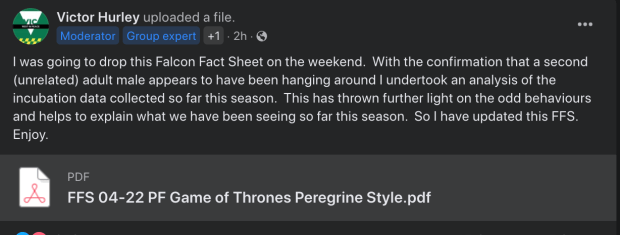
Victor Hurley has also included another fact sheet on the 367 Collins Falcon Watchers FB and has changed some of the data based on this new knowledge. (It is formatted so I cannot just post it here so you can read it, you must go there). A great article!

At Port Lincoln, the eggs are 38, 35, and 33 days old. On the 19th, egg 1 will be 41 days. Time is going to pass quickly. Hatch watch should begin on Monday.

Migration:

Things are just going quiet with the Ospreys in the UK. The last two lingering nests seem to be empty. No one appears to be home at the Glaslyn nest – Aran and Blue 497 both seem to have started their journey south. Padarn was last seen on the 12th of September at 19:20 with Idris last seen on the Dyfi Osprey nest 24 hours later on the 13th of September at 19:41. Safe travels, full crops. See you in the spring!

‘H’reports that there are still family members at the Boat House Osprey platform in Bremen, Maine. Sloop, the third hatch and reluctant fledge, is eating well having had at least 3 deliveries yesterday! She has sent a photo of Sloop excited for a delivery! She has not seen Schooner or Skipjack on the nest for 5-6 days but other osprey calls have been heard so it is unclear who remains as of today.

I am finding this very interesting. This nest is one of the most northern of all the US nests. It is migration season and we continue to have ospreys on the nest. Let’s watch and see when they depart.

Karl II and family:

All of the family members transmissions show them in the same areas that they were previously. There is no transmission for Karl II. He is believed to be at his favourite nature reserve in the Kherson Oblast region of Ukraine. I found several active reports on the current activity in the region yesterday.

Stay safe Karl II!

If you are following the new Osprey family at Belvoir Castle in Lincolnshire (my old haunt), Tim Mackrill has posted news!

From the Archives:

Do you remember: who are the storklets? what is their story?

Thank you so very much for joining me this morning. Please take care! See you soon.

Thank you to the following for their streaming cams, posts, tweets, etc that make up my screen captures: Holly Parsons and Albatross Lovers, Orange,Australia, Peregrine Falcons, Sony A1, WRDC, Condor Cam, SWFL Eagles, FOBBV, Sea Eagles@Birdlife Australia Discovery Centre Sydney Olympic Park, Charles Sturt Falcon Cam, Victory Hurly and the 367 Collins Street by Mirvac, Port Lincoln Ospreys, Tim Mackrill, ‘H’ and Audubon and Explore.org, Ukinform.net, and Dr Madis and the EMC plus the Eagle Club of Estonia.


The Black Storks of Estonia are rare and treasured. When Jan did not return and was deemed injured or dead, Janika had to try and feed her storklets. She could not manage even with the fish basket she found that Urmas, the Ornithologist for Estonia, provided. It was decided that the three surviving storklets would be taken into care at the Vet School in a stunning attempt to keep them alive by feeding with a decoy male and having a decoy female. In the image, Bonus is the largest of the three. The stotklets thrived. Two were placed with Eedie and Bonus was placed to be fostered with Karl II and Kaia. A goshawk attacked Eedie’s nest killing all the storklets. Bonus is now on migration and in Ukraine where he appears safe. Bonus is the only one of Jan and Janika’s six storklets of 2022 to survive.