It is a very early good morning to everyone- just past midnight. I am posting this newsletter early so that everyone will get to read the great news that is coming in – in case you do not already know. In the case of Victor and Little Bit, continued thanks to the wildlife rehabilitation staff that intervened and gave them a second chance on life.
My goodness, it is such a wonderful feeling as if you are floating on a cotton candy cloud when there is great news in Bird World. If you get emotional, I suggest you get the tissues out before reading further.
I want to thank ‘B’ and ‘L’ for alerting me to the special news about Victor in my inbox.
The Ojai Raptor Centre posted this announcement about Victor. When all of us were worrying he might not get well or he might not be able to feed himself ——– well, he is self-feeding and doing a grand job of it, too. He is in an outside enclosure not inside the clinic. Oh,, Victor, you have worked so hard to get well and all the staff at ORC have just being doing the best for you. Tears of joy, tears of joy.
Video of Victor self-feeding:
Video of Victor’s outdoor enclosure:
The other good news is, of course, Little Bit ND17. Images were taken and studied by several who go to the park on a daily basis to watch and photograph the Notre-Dame eagle family – Mum, Dad, ND15, ND16, and ND17 Little Bit. They have longed to get a good clear picture of 17 but wanted to be sure it was him. Here is the announcement in the Notre-Dame FB postings for today:
I was so skeptical when Little Bit was returned to the park without the ability to hunt his own prey. I am joyful to have been proven wrong! Notice the top right image. See how the hair kind of goes around in a partial donut shape. It reminds me of my late father-in-law who was bald but that circular band. It appears that some of the top is flat like strands of longer feathers covering up the places where feathers are missing. At the onset, I did not think he had a crop but, yes, that top right image appears to show that he has recently eaten. What a wonderful relief to see him looking and doing well. Thanks to everyone who worked hard to ensure Little Bit got a second chance on life and those birders on the ground who tried desperately to get images to reassure all of us. Thank you.
The Sea Eaglets are doing just fine, too. The crops of both of them are simply about to pop!!!!!!!
An hour later, Lady is urging them to have ‘just one more bite’! They are growing and will have a rapid growth spurt. Full crops will be the order of the day. Look at how the wings are forming and each has a cute little tail.
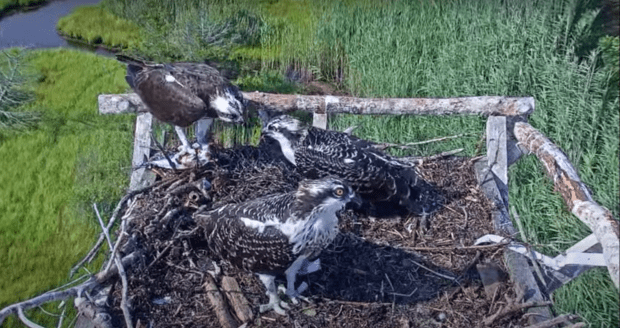
The two osplets on the Osoyoos Nest are looking good this evening. The forecast was correct and it has cooled down some – of course, it is still hot, just not as blistery. The chat for the streaming cams appears to be down. Not sure why unless it is all the spam.
Soo had a big crop at 10:46.
Another delivery.
Looks like one of the chicks got the last delivery and is self-feeding.
One crop fuller than the other chick who is fish crying.
I cannot give you a fish count but it appears that both chicks ate today and so did Soo. Fantastic.
Ervie is out flying about and finding nice fish for dinner. He must miss hanging out with Dad on the barge and going to the nest to eat his fish. I wonder if he will try to return to the barge after this breeding season?
It is good to know he is safe – GPS trackers certainly help with that.
In the case of each of these nests or particular fledglings, it is so good to know that they are either improving in care or are doing splendidly on their own. There has been no word on L3 or L4. We wait.
I want to mention a book called Beauty and the Beak. How Science, Technology, and a 3D-printed Beak rescued a Bald Eagle. It is by a pair of talented women – writer Deborah Rose and wildlife rehabilitator, Jane Veltkamp. I first heard of the efforts to save this particular Bald Eagle when I was looking for information about the McEuen Park eagles in Idaho. The intended audience would be children ages 8-12 (I think) but I also enjoyed the gorgeous photos and learning about how science and new technology saved Beauty’s life. It is another fantastic book about positive interventions. If you teach science or know someone who does, I would highly recommend this book. (Cost in Canada is $11.46 for the glossy paperback).
It is a beautiful story of compassion and the commitment of Jane Veltkamp to help Beauty the Bald Eagle.
My regular newsletter that normally appears around noon CDT during the month of August will appear in the early evening on 4 August.
Thank you so much for joining me with all these good news stories. Take care everyone. See you soon.
Thank you to the following for their postings and/or streaming cams where I took my screen captures: Notre Dame Eagles, Ojai Raptor Centre, Port Lincoln Ospreys and Sea Eagles@Birdlife Australia Discovery Centre Sydney Olympic Park.
I was out almost all day yesterday and returned to find some sad news. We will get this over and move on to all the good news!
The situation at the #4 Osprey nest in Finland turned darker. An intruder appeared and the chicks ‘fell or flew’ off the nest. The youngest who had not as yet flown was predated. This is also the chick that was so vigorously attacked by Mum the other day. So sad. Thank you ‘N’ for letting me know. This is 81 lost so far in the past 13 months on streaming cams.
The Mum and the surviving fledgling on the #4 nest. Keep them in your warmest thoughts.
Ervie. Bazza Hockaday was doing some photography for a client and found Ervie, too. Can you spot Ervie on top of the pine tree? This park is across from the barge – so Ervie is staying close. (Magnifying glass almost required!)
Meanwhile Mum and Dad are making sure that Mum is quite comfortable on those eggs – they are lining the nest with a Silver Gull, one of the favourite foods of the Sea Eagles.
Everyone wondered if anyone would be keeping an eye for Little Bit ND17. It seems that lots of people who loved the eagle that fought so hard to live continues to have a loyal fan club. This evening on the Notre-Dame FB page, the following was posted. It looks as if our Little Bit has been very resourceful and is doing fantastic. Tears, joyful tears!
SF Ospreys have not received the DNA results from Brooks and Molate. Brooks continues to enjoy herself at the other nest and the visitor seems right at home. He is certainly a lovely Osprey – and talented.
The ‘visitor’ at the nest of Richmond and Rosie has done something very special – it caught a Spiny Dogfish (Shark) that lives in the Bay. (Reminds me of those brought to the nest at Mispillion Harbour in Delaware – bet it is just a slight difference in name from one region to the other but the same fish). The juvenile very proudly brought it to the nest. SF Ospreys say this is highly unusual. They have only seen a juvenile do this once. Round of applause!
Here is the video clip:
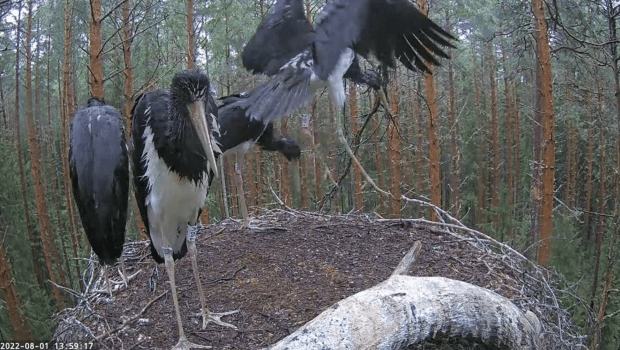
At the Black Stork nest of Karl II and Kaia, Karl was busy flying back and forth to the fish basket. He delivered 3 big meals to the storklets. Kaia delivered 1 on the 2nd of August. There was some concern that Karl II’s GPS was not working but it seems to be fine now. Thank goodness. I do worry about them all the time for some reason – storklets not yet fledged and requiring much food before migration.
Bonus has been standing on the curved perch with 1 leg. Great balance. Bonus is the oldest of the four. He is 72 days old on 2 August.
The four storklets of Betty and Bukacek are doing fantastic. The female- Fifinka- often spends time on the nest of the adults and then flies to the natal nest when food arrives. Sometimes she holds back from the bigger males but she wastes no time getting there if she is hungry. In the image below she is at the top flying in.
There is no reason for it other than sheer dominance at the Sydney Sea Eagles nest. Lady feeds SE29 and 30 at least every hour if not sooner. Things were going relatively well until 0911 when 29 decided to not be nice and attack 30.
Three minutes later 29 is going into a food coma and 30 is being fed (0917 below).
SE30 keeps its head down to protect it.
Notice how 30 is slinking around the back ready to move forward and eat when 29 calms herself. Very clever tactic.
SE 30 is still being fed four minutes later. All is right with the world.
Mom and Dad on the nest of the Port Lincoln Barge early on 3 August.
Did you fall in love with Louis and Anna at the Kisatchie National Park Bald Eagle cam? couldn’t believe your eyes the day 18 fish were on the nest? did you melt and worry when Kisatchie fledged? when Kincaid hatched this year? Well, Cody and Steve have more fun for everyone. You will be able to watch 2 Bald Eagle nests from the Louisiana! Here is the announcement:
Humans and wildlife rehabbers helping another juvenile eaglet so that it has a second chance at life. These stories are always welcome!
The fish have been arriving in various sizes to the Osoyoos nest. ‘H’ sent me a note this morning saying the tally was at least 13 yesterday. Olsen is keeping up the numbers and some of them had to be good a good size. Sometimes the chicks are full and sometimes they aren’t. The last fish for 2 August was delivered at 20:01. Dad brought it in and Big Chick (BC) grabbed the tasty little twiddler. Dad rooted around and found an old piece of fish and fed Little Chick (LC). The family is nourished and hydrated. They have a break in the weather for a few days. This is all good news.
Here comes Olsen! BC rushes over to get the little prize.
Fortunately for LC, Dad found a piece of fish and is feeding him while BC works on the twiddler. It is all good.
The fish started arriving at the Osoyoos nest around 0523. The first was a small one but it seems to have changed possession at least 6 or 7 times. BC has been grabbing and self-feeding. Soo got into the action so that her and LC had some breakfast too. It is starting off to be another great day at this nest with 7 fish before 00700. Thanks Olsen!
Beautiful Iris. She continues to work on her nest. Precious are these moments – every year we wait til she leaves and wonder if she will return in the spring after migration. 29 years?
There are no updates on L4. It is now presumed that it was another window strike on the Cornell Campus. That would mean that of the four eyases – three struck windows at Cornell whose Bird Lab is one of the world leaders. Of those three, two are in care and one died. It is time Cornell made its windows bird strike proof like all of us try to do. I have not see at this time 1052 CDT an image of the head of the juvenile believed to be ND17. Elsewhere things seem to be steady but that could change as I hit the word ‘publish’.
Thank you so much for joining me today. Take care everyone. See you soon.
Thank you to the following for their streaming cams, postings, videos, etc: Osoyoos Ospreys, Notre Dame Eagles FB, Sea Eagles@Birdlife Australia Discovery Centre Sydney Olympic Park, Mlade Buky, The Eagle Club of Estonia and Looduskalender, Center for Wildlife, US Forest Service at the Kistachie NF, Port Lincoln Ospreys, and SF Bay Ospreys. They have been turned into my screen captures.
Good Morning Everyone! It looks like rain here on the Canadian Prairies – and when finally believe it is coming, the sun pops out. I am heading up north to check on the Ospreys along Lake Winnipeg. Fingers crossed! I may only make it as far as the nature centre.
Just some housekeeping. The NCTC streaming cam on Bella and Smitty’s nest has been hit by lightning. It will be replaced in time but not when the eagles are about. Phillipe Josse posted on the Notre Dame Eagles FB that all of the eaglets were seen flying about on 1 August. Great news. Victor Hurley reminds everyone that the CBD (Central Business District) 367 Collins Street Falcons generally lay their eggs around the end of August. The camera at the Boathouse Osprey nest in Maine is on the blink. I just about had a heart attack when I did not see 3 chicks in the nest yesterday when I went to their stream. Thankfully I finally figured out it was ‘Highlights’. Check in the left bottom corner if you go so the same thing does not happen to you. The word ‘Highlights’ will appear. The situation at the #4 nest in Finland where the mother attacked the youngest on the nest and the fledgling when it returned has calmed. No clear understanding of the reason behind the attacks but the youngest seemed to get the blunt of the wrath. No updates on L4 taken into care. Good news. The one surviving osprey from the Pitkin County Trail Platform (they were pulled off the nest by female caught in nesting material) remains in care at a wildlife rehab centre. The chick is now eating on its own and its feathers are growing in. Great news! That incident happened on 22 June.
Olsen delivered a very large fish on the Osoyoos nest at 1137 on 1 August (Monday). It was the 13th fish of the morning. Large and with its head. Soo fed the chicks til they were so full they could not eat another bite and then she took the fish to the perch where she enjoyed it.
Soo and BC and LC know Olsen is arriving.
Look at that nice fish! Olsen must have found a super spot to fish today even with the heat.
Everyone ate and ate.
After taking the fish up to the perch to eat her portion, Soo returned a nice piece to the nest.
There were more than 13 fish arriving at the nest of Soo and Olsen Monday. Another one came in at 18:58.
The chicks have eaten well and have spent much of the day with one or the other hanging their heads over the rim of the nest scaring the wits out of viewers. All is well!
Soo and Olsen got a bit of a break in the weather. It dropped to 33 today but….sadly another heat dome is coming in a week. Olsen has already delivered fish small fish at these times: 0521:46, 0533:10, 0541:22, 0620:46, 0625:11. A larger fish with head came at 0656:53 with the 7th fish at 0715:06 which was smaller and headless. If you count that is 7 fish by 0715 Tuesday. Olsen, you are amazing.
The good news at The Campanile is that the bonding rituals between Annie and Alden are increasing…and often they are sans Lindsay and Grinnell Jr. How lovely. Stay safe Annie and Alden!
If you did not see my earlier announcement, L4 was taken into care. He was found on the ground unable to fly during the evening of 31 July. Thank you to those who rescued him and took him to the Swanson Wildlife Clinic at Cornell. No updates so far.
Suzanne Arnold Horning caught Big Red, Arthur, and L2 on the campus Monday evening.
Big Red is moulting.Arthur on the stacks.L2 yelling for food.
It is fledge watch at the Black Stork nest of Karl II and Kaia. Yesterday it was raining which halted any thoughts of flying but, this morning the storklets are jumping around and flapping. Bonus is the oldest at 72 days with the other three at 66, 66, and 63 days.
The camera was off for awhile and it is unknown if they had a feeding or not. Yesterday Kaia brought in 1 feeding, Karl II travelled to the fish basket but it was empty because he went further to try and find fish. His transmitter stopped at 10:01 on 1 August. It is not know what the problem is and everyone is waiting not so patiently to see if data is uploaded today or if he appears at the nest with food. Fingers crossed. These are the only four Black Storklets that I am aware of in Estonia this year to survive.
Bonus is 77 days old and is the only surviving storklet of Jan and Janika of the original six.
Andor delivered a fish and Lilibet sure enjoyed it. The top image is the 30th of July.
Lilibet on 30 July 2022.
Then he delivered a fish and no one showed up.
Everyone began to question if Lilibet had left the territory. Lilibet has gone no where! She is around the nest a few minutes ago being quite loud – with what appears to be a nice crop.
Lancer is still calling Two Harbours home and Chase & Cholyn are busy delivering fish. Lancer has earned the name ‘Miss Sassy Pants’ by the Bald Eagle community. She practically tore Chase’s leg off with the delivery. — I am sure Mum and Dad do not mind. She will really be able to stand up for herself when she leaves the safety of the nest area.
The Sydney Sea Eaglets are ‘darling’. Just cute little fluff balls eating and growing. Start watching for the slightest hint of little black dots which are feathers coming in.
It is August and we have another month, perhaps, with Iris at the Hellgate nest in Missoula, Montana. For those unfamiliar, Iris is the oldest unbanded Osprey in the world believed to be 29ish. It is remarkable. Mrs G in the UK is their oldest at 22 years.
Iris spent much time at the nest earlier working and bringing in sticks and she has, on occasion, lately graced us with her beauty. She was there this morning when an intruder arrived. Louis went swiftly over to remove the visitor.
Each of us needs a good rescue story! It gives us faith in ‘humans’.
Dad at the Port Lincoln Osprey Barge seems fine. Bonding taking place!
That is a hop, skip, and a jump around the nests this morning. So far everything seems calm. It is a strange time of year. The US Ospreys are eating and preparing for migration at the end of August or beginning of September. We have eaglets in Sydney and we await the arrival of the eggs for Mum and Dad at the barge and the peregrine falcons at CBD and Orange. I do not know about you but I really need a ‘fix’ of little ospreys. Simply cannot wait.
Thank you for joining me today. Please take care everyone. See you soon.
Thank you to the following for their streaming cam where I took my screen captures: Montana Osprey Project, Cornell Bird Lab, Osoyoos Ospreys, Sea Eagles@Birdlife Australia Discovery Centre Sydney Olympic Park, Audubon Explore.org, Port Lincoln Osprey Project, Eagle Club of Estonia and Looduskalender, and Suzanne Arnold Horning for her lovely pictures of Big Red and family.
Oh, one half of the sky is blue with cottonball-like clouds. The other side is a solid mass of heavy grey clouds. It is 22 C and more rain forecast for 1700. The Crows are already in the bird bath eating their ‘sandwiches’ and peanuts. Given a chance tens of sparrows gather in there after they have left. The squirrels are running about and the birds are flitting in and out. Dyson came to drink out of the bird bath yesterday and all the rabbits have been here. The weather is hot for here and having water out for the animals is, hopefully, helping them to cool down. It is so reassuring – just like when we check on the streaming cams and everyone is home!
The three young Crows are constantly with one another. Their flying is improving. The bird bath water is in constant change for one reason – everything is washed by the Covids. I wonder if it was to soften the shell of the peanut??
One of the fledgling Blue Jays waited its turn until the Crow departed.
This Blue Jay is yelling at Dyson! The squirrels do not wait in line – they just go and grab the peanuts. It is too funny. The juveniles are just getting their crests.
Poor Junior. He is moulting. If you see a Cardinal or Blue Jay looking scarce on top, they are not ill, just replacing their feathers.
Hello Dyson. Thank goodness the new bird bath is heavy enough that Dyson doesn’t go flying when he jumps up for a drink.
Adorable Hedwig. He spent about an hour eating the spilt seeds under the feeder. Hedwig was discovered under the Peony bush. He was such a wee rabbit. He never left the garden but ate the seeds as the birds flitted around him. He is never frightened by them. His burrow is somewhere else now but you can always count on his arrival around 1730 rain or shine, winter or summer. He’s an Eastern Cottontail.
Olsen really seems to have outdone himself on Sunday. As I begin to write this, there are two partial fish sitting on the nest. The chatters have been keeping close tabs and ‘H’ provided detailed time stamps. These are invaluable for viewers coming on line. Much appreciated. By 0900, Olsen had delivered 8 fish of varying sizes. Everyone was chock full of fish. It appears that there was some nibbling on the old fish (gosh they must be like dried fish now!) with another fish delivery at 18:33.
Soo has done a fabulous job keeping the chicks shaded. It is currently 37 C but rose to 40. Or 98.6 F to 104 F.
The nest still has horrific temperatures tomorrow. They seem to just keep adding on an additional day of heat. When did I ever believe I would say that 34 C was a welcome drop in temperature? The night will be welcome cooling off periods. The Osprey parents are doing the best they can and thank goodness those two chicks are feathered nicely this year.
Send positive thoughts, please. Soo and Olsen deserve success. In 2020 they lost a chick and one fell out of the nest and in 2021 the three died in the heat dome that stayed over the area. This year we have had one fall over the nest so let us keep fingers crossed. I think Soo and Olsen will succeed this year.
It is now Monday morning and Olsen has already brought at least five fish according to the chatters and here he is at 0656 feeding his babies fish number six!
I do not know if you have read the history of this nest but it is one of those great cooperative measures. FortisBC worked with the Town of Osoyoos put up a separate de-commissioned hydro pole for the Osprey and also donated the funds for the camera – the nest and streaming cam you are watching. They were proactive – indeed, it is in their best interests not to have the local power knocked out but, grateful, so grateful.
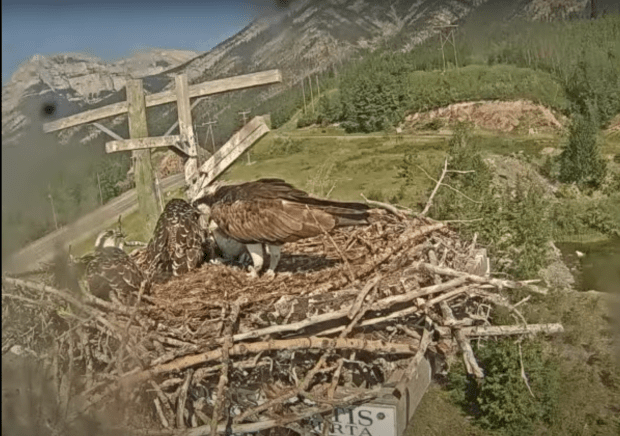
It is cooler at the Fortis Exshaw Nest in Canmore, Alberta. Mum and the trio are doing very well it seems.
Because it is in the same heat warning area, I have been checking on and off at the McEuen Park Osprey platform in Coeur d’ Alene, Idaho.
There were two of the fledglings on the nest when I popped in.
With all the heat warnings, it is nice to have something to laugh at and it is provided by Bukacek and the adult only nest. You might well remember that Bukacek had built a second nest for him and Betty. Having four large White storklets on the natal nest gets a little crowded. Now that the storklets are flying – they have taken over the new nest! Bukacek will have to build another!!!!!! Betty meanwhile lures them back to their own nest with food. Perfect. Ooops….they ate and left. Oh, goodness.
Beautiful Betty.
There has been some concern about a blood spot near the wing of SE30 on the Sydney Sea Eagles nest. What was the cause? Often the eaglets get fish blood or bird parts on their body but this does not seem to be that. It looks instead as if some feathers have clumped together either with fish juice or ps and they were, perhaps, pulling and it annoyed the eaglet who pulled them out and left a small bloody spot. The eaglet appears to be fine.
You can clearly see the spot on the right wing- and that enormous crop of SE29’s. 30 is eating well. No worries. Lady sometimes feeds it so much that 29 gets itself in a little knot. With the amount of prey coming on the nest there is no need for food competition – and even with feedings spreading a bit, everything should be fine. The eaglets are getting older. Getting ready to get some really itchy pin feathers soon. As long as food continues and Lady keeps up her remarkable feeding schedule..these two are going to grow and fledge.
There will not be any ringing or DNA tests unless one or both wind up in rehab after fledge. But I might be already inclined to guess that we have a really big sister in 29 and a little brother in 30.
We can always use good news in our lives. Here is another story of an eagle rescue that will warm your hearts! Thanks, ‘L’, much appreciated.
Our beautiful Victor. I love this photo of him standing on a low perch. You are progressing, Victor. Keep up the good work!
Since the rescue of Victor, some of us have been more than perplexed about where the zinc came from that poisoned his body. I have rattled my brain with several of you – flakes coming off of anything galvanized, warnings on garden hoses about zinc, the shale in the area contains zinc, etc. I really do not think our dear Victor sat and ate pennies knowingly. ‘C’ sent me the findings of a study by a Brazilian researcher. It has been translated by Google from the Portugese. If you are interested in how Victor might have gotten the zinc and how our contamination of the planet spreads to birds 10,000 miles away even…have a read.
Thank you, ‘C’. Much appreciated.
Title: “Not even the “end of the world” is free from human-caused pollution”
Animals that live in the waters of the Kerguelen archipelago, 3,000 km from the nearest inhabited region, are contaminated by metals such as cadmium and mercury.
Not even the “end of the world” is free from the pollution generated by humanity. Located in the south of the Indian Ocean, 3,300 km from Madagascar, the nearest inhabited region, the Kerguelen archipelago, formed by about 300 islands and islets, is contaminated by metals such as cadmium and mercury, copper and zinc. The observation is made by Brazilian researcher Caio Vinicius Cipro, a postdoctoral fellow at the Oceanographic Institute of the University of São Paulo (IO-USP), in two studies he carried out at the University of La Rochelle, in France, in partnership with scientists there.
Of volcanic origin, Kerguelen is 4 thousand kilometers south of India and 2 thousand kilometers north of Antarctica. The archipelago belongs to that country and is administratively part of the French Southern and Antarctic Lands (TAAF). There is currently a scientific station and structures associated with it. “There is also fishing activity due to France’s exclusive economic exploitation zone”, says Cipro. “Biologically, there are countless species of birds and marine mammals that have established colonies on the island and many others, in addition to significant amounts of fish and invertebrates thanks to the high primary productivity of local food. There are also several species introduced by humans, such as mice and reindeer, and some plants.”
He says that the idea for the study came during a period when he worked as a guest researcher at the University of La Rochelle. “My supervisor at the time, Professor Paco Bustamante, had told me about a dataset he had obtained years before, which he began working on during his own doctorate, and whose publication he never had time to pursue,” he says. “I volunteered to carry out the task and write the publication.”
Cipro then went on to study the occurrence of four chemical elements (cadmium, copper, mercury, zinc and selenium) in more than 30 species of invertebrates and fish, most of them at a lower trophic level (of the food chain). The objective was to understand how the concentrations of these inorganic pollutants behave at these lower levels that will influence organisms above them in the food chain.
Cipro’s first study was carried out in 2014, shortly after he arrived in France, on samples that had been collected by Bustamante’s team in the southern summers of 1997 and 1998. The Brazilian scientist analyzed metal contamination in a species of bird, the black shearwater petrel (Procellaria aequinoctialis). “We found contamination by cadmium, copper, mercury, selenium and zinc”, he says. “An article about the work was published in 2016 in the scientific journal Polar Biology.”
The second research was carried out in 2018 and yielded another article, published in the same journal. “In this case, we analyzed the levels of contamination of the same metals, with the exception of selenium – there were no conditions at the time to do this with this element in the laboratory at the University of La Rochelle – in 18 species of fish and 11 of invertebrates”, explains Cipro . The result of the work also pointed to the contamination of animals by metals.
According to Cipro, what can be concluded from the results of his research is that in this specific case of Kerguelen, cadmium values varied much more than mercury values (four orders of magnitude against one) and depended more on specificity in food ecology. and in the habitat than at the level of the food chain plain and simple.
In other words, the results of the studies showed that, contrary to what happens in most cases, the concentrations of pollutants found in animals depended little on their position in the food chain, but more on specific mechanisms of physiology and exposure, in such a way that predators from lower trophic levels could be more subject to some contaminants than others from higher positions.
This means, according to Cipro, that work with species of higher trophic level or sentinels needs more in-depth food ecology studies before reaching certain conclusions and that the food chain by itself does not mean much in this environment. “Furthermore, my research provides solid foundations on the exposure to which predators are subject, as in most cases this discussion remained on hypothetical terrain due to lack of field data,” he explains.
The work also showed a possible influence of a local secondary source of contaminants, probably the bird colonies themselves, a hypothesis confirmed in the Antarctic environment during his current research project. Going into more detail, Cipro explains that the analyzed metals have natural sources, but human activity certainly plays a bigger role than them in general. For mercury, for example, current emissions are estimated to be three to five times higher than before the industrial age. This element can reach the Kerguelen archipelago from dumps made by factories located 10,000 kilometers away.
Nevertheless, locally, in addition to bird colonies, some other natural sources may be significant, such as certain rocks and fossil fuels. “In the case of bird colonies, some studies that I proposed suggested and later confirmed their role as a local and relevant source of some elements and also of organic pollutants”, says Cipro. “In Kerguelen, we raised this hypothesis, comparing mussels from inside and outside the Gulf of Morbihan, and it seemed to be confirmed by the results obtained.”
The Dad at the Janakkalan Nest, Red CCL, continues to deliver the fish. The chatters have nicknamed the pair. Boris is the oldest and Titi is the youngest. The fish are so big that they take turns with no need to squabble. Titi is on the left. He has not figured out – yet – to hold the fish down with its talons.
Dad arrives with another fish at 1805. Titi is in the back with the huge crop from eating the fish in the image above. Boris is going to claim this one and Titi is absolutely too full to care! Lovely. Thanks, Dad.
The four Black Storklets on the nest of Karl II and Kaia are really wanting a food delivery. While they wait it is raining – they shake off their feathers, flap about, and jump on and off the perch. Kaia arrives with food at 16:58, the last image.
Just look at this beautiful juvenile Red-tail Hawk, L4. Stunning. L2 and L4 will probably be soaring in the thermals soon and leaving the Campus. Every moment with them is special as it is with Big Red and Arthur.
The latest update on L3 from the Cornell Lab:
L3 is gorgeous. Looking forward to her release when she is all healed.
Thank you so much for joining me today. It is wonderful to have such good news in Bird World. To my knowledge, all of the UK Ospreys have fledged. They will be eating and gaining weight as will their mothers for migration. Soon these flights will be charted. In the meantime continue to enjoy them. The same with the storks! Take care everyone. See you soon!
Thank you to the following for their streaming cams, websites, and postings where I took my screen captures: Osoyoos Ospreys, McEuen Park, Coeur d’Elene, Idaho, Sydney Sea Eagles@Birdlife Australia Discovery Centre, Sydney Olympic Park, Cornell Bird Lab, Finnish Osprey Foundation, Mlade Buky Storks, Eagle Club of Estonia and Looduskalender, Ojai Raptor Centre, and Fortis Exshaw.
I was not going to do another posting today but, in case you did not see the update on Victor or the posting of Ervie, I wanted to share them with you.
First, yesterday Dad had a terrible day. It is not clear what happened to him on the nest but he flipped over, his eyes looked terrified, and Mum thought it best to beak him to get him to come out of it. I was worried. Dad, we need you! Dad was later caught fishing with Ervie and he looks good.
Christine Georgiou took these great shots of the pair of them and posted them on the Port Lincoln FB. Ervie on top and Dad below sans transmitter. Look at that nice fish Ervie has! I do not know if anyone has realized what a treat it is to watch Ervie mature and how lucky ‘we’ were that he lost his talon and stayed home. He has had a good start on life…Dad certainly taught him where to fish and served as a great example.
If you look closely I believe you can see Ervie’s missing talon on ‘the right foot’. Ervie has learned to carry the fish with only three talons and the fish is backwards!
If you did not see the most up to date posting about Victor, here it is again. The good news he is getting better. Notice that he is standing quite well. Victor is such a young eaglet – where in the world would he have gotten so much zinc?
Several have written to ask about Little Bit NC17. The biggest question is: has anyone seen him eat? Little Bit was released at St Patrick’s Park near the nest and treed area by the nest on 20 July. That was ten days ago. This image was 25 July and it is the three fledglings from the Notre-Dame nest flying together over the nest and the trees. There are lots of people who love Little Bit and who are making a point to go and check on the eagle family. Little Bit has pulled that tenacious resourcefulness out and he has had to have eaten ——–he could not live for ten days without food! Little Bit ate everything that came to the nest. Fledglings normally exist on carrion – dead animals – their first year. We know he can eat fur pelts!!!!! The fledglings have been seen down by the river with the adults. I am extremely hopeful that he is doing well.
Send good wishes to Victor as he continues to go through all the therapies. Let us hope that just has he has been able to stand he will be able to eat by himself soon. Send good wishes for Little Bit to have a nice fish supper – and for Ervie and Dad to be safe.
Take care everyone. Enjoy your Saturday evening. Thank you for being with me this evening.
Thanks to the Ojai Raptor Centre, the Notre-Dame Eagles FB and Port Lincoln Osprey Project FB where I took my screen captures.
The presentation about Eagles Dying of Electrocution: What Can be Done? was quite informative. A number of topics were covered including why it is important for utility companies to not have wildlife incidents. Because they boost of having reliable electricity they cannot afford to have too many power outages due to wildlife electrocutions (squirrels, raptors, etc). So while wildlife is not their primary concern, if an eagle gets electrocuted it does impact their goal of ‘reliable’ transmission of power and it is actually in their best interests that their poles are safe. It is also good for their public image.
A PDF of a very large study done in 2006 was mentioned several times. It studied different birds in different countries with various configurations of hydro poles and how electrocution might be mitigated. Christian stated that the solutions are still solid examples. Here is a copy of that large study:
One interesting note in the mitigation is that you simply cannot install insulators or insulated cables. You must also deal with the transmitters.
A question or statement by one of the chatters for the presentation had to do with the lack of responsibility in this situation. If the first electrocution for an eaglet from the Gabriola Nest was accidental, isn’t the second one intentional? Many power companies will immediately move to fix the poles if they know there has been an incident. Florida has so many big raptors and it was mentioned that the power companies are pro-active in protecting the large birds.
An example from Belgium was shown. That is a perch for the eagle that is higher than the pole. The perch is not dangerous to the eagle. To mitigate further, the pointed triangle on the left has been installed making it impossible to create a connection also. Fantastic.
An example of good spacing and bad spacing in terms of wildlife.
Here is the presentation link in case you missed it or would like to listen again. It is about 50 minutes long.
Yvonne Roll Peterson posted the following image on the Notre Dame Eagles page. She carefully took the time to mark out who was where. You can’t see ND16, she is on the nest (of course). ND15 is on one branch and our Little Bit 17 is on another branch behind some leaves. Smile.
My eyes are on the Osoyoos Osprey nest where temperatures are climbing getting hotter and hotter. Olsen brought in a nice sized fish but it has been more than four hours ago. Hopefully they will get another. Soo is doing the best she can to try and keep her panting chicks shaded.
After the presentation on the Eagles and electrocution, I spent some time observing SE29 and SE30. SE30 did two ‘ps’ – one at 0634 and the other at 0713. Both were good. I did manage to capture one. Look carefully below.
Dad brought in what appeared to be a bird – possibly a Silver Gull chick? for the next feeding. Neither chick was that enthusiastic about eating at either feeding.
SE29 did hover but, there were no violent attacks at either the 0634 feeding or the later one right after 0715 ish. After SE30 did his ‘ps’ he did eat some bites.
Lady may have lots of prey items under the leaves. It is hard to tell but I did not see the piles of fish like I did when these two first hatched. So two good ‘ps’ to indicate that SE30 has been eating and its plumbing is working fine. Dad comes down to the nest and flies off – to go fishing from Lady and 29 & 30. Good luck!
At 0745 Dad returns with a large fish. SE29 did take exception when it appeared that 30 was going to get the first bites. In situations where the eldest sibling is trying to establish dominance, most of you will have seen them eating first and once they are full the second eats if there is prey left. It would appear that 29 is asserting that dominance.
It should be sorted out in a few days. Look for good ‘ps’ from 30. Lady continues to feed them almost every hour. All those little bites add up. In a week or a week and a bit, the feedings will show down because the eaglets will be eating more at each feeding.
Things remain really stable and good at the Boathouse Osprey nest in Maine. Dory is feeding the three chicks another good sized fish.
Every once in awhile you can catch one of the Ospreys at Mispillion Harbour on the perch today.
Duke has been bringing some really nice fish to the Barnegat Light Osprey nest in New Jersey. Daisy feeds the kids and winds up with a big crop herself. Oh, I would love to send that fish to Osoyoos! Wouldn’t you?
I have seen no news on the cause of Tom and Audrey’s chick suddenly dying at the Chesapeake Conservancy nest. Will continue to monitor. The adults have been on and off the nest.
Aran and Mrs G have been doing a lot of posing on the perches – sometimes with but today without the fledglings.
Notice the difference in size. Mrs G is at least one-third larger than Aran. Check out the difference in size in wings. — It is always good to remember, when watching a raptor nest, that the females require more food in order to grow to the larger size and to also grow all those additional feathers. Often the females are not the first to fledge either even if they hatched first.
The difference in size – where the females are larger than the males – is called reverse sex-size dimorphism.
I hope if you did not get to attend Christian Sasse’s presentation that you will take the chance to listen to it later. Some very good information with a lot of common sense when approaching utility companies. To all who wrote in, thank you.
Thank you for being with me this evening on this quick check. I am just watching two nests – Osoyoos and the Sea Eagles for stability. One for weather and the other for sibling rivalry. Fledge should be happening anytime at the Janakkalan Nest in Finland (or it has – have not checked today so if you know – send me a comment). Take care all. See you soon.
Thank you to the following for their videos, FB postings, and streaming cams where I took my screen captures: Christian Sasse, ND-LEEF, Osoyoos Ospreys, Sydney Sea Eagles@Birdlife Australia Discovery Centre, Sydney Olympic Park, Mispillion Harbour Ospreys and the DDNR, Barnegat Light Ospreys, Bywyd Gwyllt Glaslyn, and Audubon Explore.
It has been a beautiful day on the Canadian Prairies. The temperature is just right after our midnight thunderstorm. The forecast shows we could be in for another unsettled night. There are intruders everywhere in Bird World. Some are harmless – others not so much.
There is wonderful news coming out of Norway. Efforts to lure Ospreys to better locations after they have been impacted by extreme weather and deforestation are working. The number of Osprey chicks in 2022 is up 50%! In 2021 there were 54 chicks and this year there are 70. Fantastic.
Sadly, the news out of the SF Bay Osprey nest of Richmond and Rosie is not good but, worrisome. On 25 July Brooks was sent off the nest by an intruder. in a rather violent attack.
At present, 1118 PST, neither Brooks or Richmond have returned to the nest. Rosie is there somewhere with the intruder who has returned and is eating a big fish on the nest.
Since the intruder arrived, Richmond and Rosie have provided six fish. The intruder has not let Brooks return to the nest. The location of both Richmond and Brooks is unknown the last time I checked.
Thanks to ‘A-M and Burky 4’ for the time stamps at the Osoyoos Osprey nest. They are sooooo appreciated. We know from the weather report that it is going to be a scorcher. According to our avid hawk eyed chatters, there have been at least 6 fish deliveries, some of good size, to Soo and the chicks. The last one was at 11:03. The chicks were full from the previous deliveries at 0554, 0616, 0944, 1955, and 1103. There was some indication that the 0554 delivery was either the 2nd or 3rd of the morning. This is great. They need all the hydration they can get as the temperatures rise during the afternoon. Thank you, Olsen!
A lovely tribute article to Big Red and her two mates, Arthur and Ezra, and the chicks on the Cornell Campus.
Many of you have written letters and e-mails to BC Hydro. I still get the most welcome letters asking “What else can I do?” Tomorrow Christian Sasse will hold a discussion on that very topic. It is on YouTube and it is free. The time below – 3pm – is, as far as I know MY time which is CDT. The Pacific time would be 1pm or 1300. Go on line and check to be sure. YouTube should give the time locally at the event! Let’s try and have a good turn out. BC Hydro needs to know that we care!!!!!!!! And that we are not giving up. It will help everyone in other regions and countries when they go to demand their hydro poles protect our much loved raptors and storks.
Good to know.
At least three large fish have landed on the Jannakalan Osprey nest in Finland. Dad is taking very good care of his youngsters who are 51 days old today.
At 1904 both are working on fish.
Not quite 2 hours later, Dad arrives with another! I wish we could courier one of these to Osoyoos.
The little Sea eaglets could share some of the five fish on the nest in the Sydney Olympic Park. The cute little fluff balls finally got interested in breakfast. Sometimes there is just too much fish!
In fact, too much fish is what ‘H’ is report about the two fledglings at Mispillion Harbour. It appears that they are eating both on and off the nest. So much fish! That is another one of the Dog Fish Sharks landing on the nest in Delaware. Thanks, ‘H’.
Rescues of our beautiful raptors caught up in fishing line are always inspiring. Two surfers and a fisherman came to the rescue of an exhausted Osprey. Stories like these reach large audiences and help those who fish at least become aware of the problem and, hopefully, if they love wildlife they will become part of the solution. Thank you ‘B’ for calling my attention to the good news!
Oh, please keep Richmond, Rosie, and Brooks as well as Olsen, Soo, and the two kids at Osoyoos in your positive wishes. Those two chicks at Osoyoos are big and walking around. So far Olsen is doing good going out early. That might pull them through this week if he can keep it up———— . Thank you so much for being with me today. Take care of yourself. Remember Christian Sasse’s discussion tomorrow!
Thank you to the following for their streaming cam and/or FB postings where I took my screen captures: SF Bay Ospreys and Golden Gate Audubon, Finnish Osprey Foundation, Osoyoos Ospreys, GROWLS, and Cornell Bird Lab.
The big news of the day is that the physical therapy for Victor at the Ojai Raptor Centre must have really helped! The staff caught Victor standing for the first time on his own this morning. It feels like the time to bust out the champagne or a glass of herb lemonade. Tears of joy. Victor is 14 weeks old.
No images provided but so happy that physical therapy is working. We knew you could do it, Victor!
Oh, what a relief. The minute I hit ‘publish’ on the early news, a notice appeared in the inbox that Brooks had returned to Rosie and Richmond’s nest on the Whirley Crane in the Richmond Shipping Yards. Gone for 49 hours, 44 minutes and 36 seconds, Brooks was obviously hungry. He was screaming his head off for a fish! Like many of you, I was concerned that the presence of Molate’s body was upsetting Brooks. So glad you are home, Brooks!
The last chick on the Dyfi nest of Idris and Telyn, Padarn, fledged at 15:07 from the nest in Wales. Congratulations Idris and Telyn, Emyr and everyone at Dfyi! Padarn was 53.9 days old.
The Woodland Trust would like your help in naming Louis and Dorcha’s two osplets of the 2022 breeding season. The original submissions were reduced to a few pairs of names. Why not help name these two darlings? Here is the information:
There are two female chicks on the Pont Cresor nest of Aeron Z2 and Blue 014. They were ringed on the 18th of July. No other news is available as to their weight, etc.
UPDATE: THE REASON FOR MY CONFUSION ABOUT THE PHYSICAL STATE OF THE MUM IS THAT SHE WAS ON THE NEST VERY TIRED. THERE WAS ALSO A FEMALE INTRUDER WHO ‘R’ TOLD ME PECKED AT THE CHICKS AND TOOK THEIR FISH AWAY. SO – IT APPEARS THAT MUM IS ACTUALLY QUITE UNWELL AT THIS POINT. THE PROBLEM FOR THE CHICKS IS THIS INTRUDER OR OTHER PREDATORS.
It is really quite difficult to figure what is going on with the female at the Janakkalan Osprey nest in Finland. One moment she appears tired and weak and the next she flies in looking refreshed. Only time will reveal if she is getting worse or better. In the meantime, fish are arriving on the nest and the chicks are really taking to flapping their wings and trying to hover.
THIS IS THE INTRUDER BIRD THAT WAS MEAN TO THE CHICKS TAKING THEIR FOOD.
As the sun sets on the nest and the two osplets are alone, I wonder if Dad will bring another late night fish?
Mum is trying hard to keep the two chicks cool on the nest in Osoyoos. Olsen has been bringing in fish – they are small. The big ones are probably at the bottom of the lake keeping cool! I understand the heat wave in BC will last through Sunday. Send wishes for this nest for fish! It is the only thing that keeps them hydrated.
Everyone is well fed on the Fortis Exshaw Osprey nest near Canmore, Alberta. The wind is sure blowing the pole around but it will all be fine. I can hear Mum chirping away wanting more fish! or could it be an intruder flying over head? They just had a pretty nice fish lunch.
Will Alden be able to hide from Lindsay and Grinnell, Jr?
It is quiet in Bird World today…and there is good news to share. We should be seeing WBSE30 any time. Another cute fuzz ball in Sydney. Thank you for joining me. Send good wishes to all the wildlife caught in the heat. Remember to put our water and ….take care. See you soon.
Thank you to the following for the FB pages, their videos, or their streaming cams where I took my images: Ojai Raptor Centre, Finnish Osprey Foundation, SF Ospreys and GG Audubon, Dfyi Ospreys, Cal Falcons, Osoyoos Ospreys, Fortis Exshaw, and Friends of Loch Arkaig FB.
Good Morning Everyone. I hope the start of the week was a good one as we celebrate the rescue of Victor at the Fraser Point nest in the Channel Islands.
Here is the latest news on the Fraser Point eaglet of Andor and Mama Cruz:
As new birds go into wildlife rehab, it is easy to forget some that remain in care. At the Pitkin County Osprey nest, both chicks were pulled off the nest when the female’s talon was tangled in nest material that had fishing line. Here is an image of the chick in care and below it is the mass of fishing line and nest material that came off. One chick died. This one will be in rehab for some time and will not be returned to the nest area as the parents will have migrated when it is ready to be released.
How possible is it for every nest that is on a streaming cam to have the nest material examined and any fishing line, hooks, or other dangerous items removed when the camera gets its annual maintenance? That would help – it certainly won’t keep new items from coming on the nest but it would go a long ways to mitigating issues. Then, of course, there is the whole issue of educating the public about fishing line and hooks! And how dangerous they are to the water birds.
There has been no update on Little Bit ND17 this week. Will post as soon as I see one. No news is good news!
The Patuxent River Park Osprey nest 1 is empty. Was there a fledge?
Tonight there is a huge storm with thunder and lighting at the Patuxent River Park #1 nest. It could even scare me! You can see the nest because the lightning is making the entire sky glow.
Yes, it was a fledge at Patuxent River Park and the new flier has returned to the nest to the delight of Mum and Dad.
It has been 25 hours without her brother, Victor. Lillibet is on the nest panting and hot in the California sun.
The mother has returned to the Janakkdan nest in Finland to her two osplets. There has been lots of fish and she has been feeding them. Let us hope that what has been ailing the female is getting better. They are super beautiful and big osplets. It was just lovely to see her and the chicks are getting stronger and older and should be feeding more to themselves. That will certainly help. Mum does look better than the past couple of days. Fingers crossed. Send those good positive warm wishes to her. They help!
The first egg at the Sydney Sea Eagle nest is 35 days old today. Pip watch begins on day 40 which will be July 16/17. Lady and Dad are busy incubating and rolling the eggs. The cam operator gave us a good look. Thank you!
The White-bellied Sea Eagles are the second largest bird of prey in Australia.
Diamond looking out of the scrape at Charles Sturt University in Orange, Australia.
The scrape box on the water tower has been used by falcons for the past twelve years. Before that they made their nest on the water tower itself. The first couple were Swift (female) and Beau (male). In 2015, an entirely new couple were in the scrape. They were Diamond and Bula. In 2016 just when their three eggs were hatching, Bula disappeared and was presumed dead. Xavier means ‘savior’. He came along, just like Alden, right at the moment he was needed. He saved the breeding season. Xavier provided prey for Diamond and the chicks. He proved to be a very capable mate and Diamond accepted him with wonderful bonding displays in the scrape. Xavier is a darling. This will be Diamond and Xavier’s 6th breeding season. Diamond is at least eight years old and Xavier is at least seven years old.
The average life expectancy of a peregrine falcon in the wild is often considered to be quite low, 2-4 years. Our Princess in Winnipeg lived to be 19 years old. It is unclear to me how accurate that 2-4 years estimate is.
Diamond. 13 July 2022Xavier. 13 July 2022 with a prey offering for his mate.
The other peregrine falcon nest in Australia is in Melbourne. They will start streaming nearer to hatch once eggs have been laid. It is quite interesting to watch the rural nest of Xavier and Diamond with the urban one in Melbourne.
Do you like Great Horned Owls? Would you like to learn more about their lives on the prairies? Here is a free Zoom talk that you might wish to join.
Louis and Dorcha’s two osplets were ringed yesterday. They have two girls! LW6 was 1760g with a wing of 300mm and LW5 weight was 1910g with a wing of 350mm.
Chick LP8 fledged at Loch of the Lowes today. In celebration of this achievement, Louis brought in a fabulous fish! Congratulations LOTL.
The three girls at the Dyfi Nest of Idris and Telyn are really hovering. Who will be next to fly?
Thank you so much for joining me this morning. We send our good wishes to L3, Little Bit ND17, the Pitkin Osprey, and Victor as they continue to work hard to get better in care. Stay safe. See you soon.
Thank you to the following for their streaming cams and/or FB pages where I took my screen captures: the Ojai Raptor Centre, Patuxent River Park, the Finnish Osprey Foundation, Pitkin County FB Page, Charles Sturt University Falcon Cam, Sea Eagles@Birdlife Australia Discovery Centre, Explore.org and the Institute for Wildlife Studies, Prairie Conservation Action Plan, Friends of Loch Arkaig, People’s Postcode Lottery, and Woodland Trust and the Dyfi Osprey Project.
Just about the time I begin to think, and then say, that it looks like the parents at the Port Lincoln Osprey barge are slowing down with fish deliveries, they bring two nice sized fish to Ervie. There was a huge chunk at 07:34 and another nice fish arrived at 15:20. Ervie didn’t actually start eating it until 16:25. Ervie was the only lad about. Bazza was last seen on Sunday the 9th and Falky was last seen on the ropes with Mum and Dad at 19:40 on the 12th. Will Ervie stay or go?
Ervie is still full from the morning fish when the afternoon delivery arrives.
Ervie is still eating at 17:34! My goodness those were nice fish brought to the nest. Ervie finished off his fish and flew off the left side of the nest.
Will that be our last sighting of Ervie on the nest? No one slept on the barge last night. We wait.
Missy has been feeding the little one on the Berry College Eagle Nest. It appears to be doing fine. Everyone is watching for the second egg. Sadly that broken shell has really attached itself to that egg.
I believe this is Missy’s first eaglet to survive. She is figuring feedings out!
B15 is getting stronger. You can see the issue with the second egg clearly here. I cannot tell if the extra piece of shell is over the narrow or wide part of the egg. The eaglets pip on the wider end. Pip watch coming for that second egg.
The nest is empty this morning at Big Bear, California but everyone is on egg watch for Shadow and Jackie.
Anna let Louis brood the chick this morning! Last year she waited a long time and Lous is delighted to be involved with his chick. Both Anna and Louis have been on the KNF nest this morning and the eaglet is eating well. Lots of nice fish for everyone on that nest!
There seem to be two words used for Harriet and M15’s E19 and E20. They are ‘nice’ and ‘cute’. Look at the feathers coming on E19 and E20 and then look at Anna’s baby above. They change so quickly!
This is a great little film about the Kakapo. Since it is breeding season and we are looking at eggs, it seems like a good time to refresh what we know about this very endangered non-flying parrot and how they are cared for. The update on the numbers is that there are now 202 Kakapo down from 208 the beginning of last year.
Daisy the Duck has not returned to the White-Bellied Sea Eagle Nest to lay eggs since she visited with her mate on 1 January. That was two-weeks ago. Fingers crossed she has found another spot and is successful. One of the women who visits the centre was to send us images of Daisy paddling but nothing so far. Maybe Daisy is away from the area of water around the Discovery Centre and the Duck Pond.
Great Horned Owls have been mating on the Savannah Osprey Nest and the GHOWs have been mating on the nest that was stolen from a young Bald Eagle couple in Newton, Kansas last year. The couple who became known as Bonnie and Clyde raised two of the cutest little owlets on this nest. When the eggs are laid, I will definitely let you know.
For the most part the Owls and the Eagles live cooperatively but I really don’t like the owls when they try to knock the eagles off or hurt their eyes and heads as at the WBSE Nest by the small BooBook Owls and at SWFlorida when it is a GHOW hitting M15 and knocking him off the branch into the nest, sometimes.
One thing I did not know is that there are no Great Horned Owls near the WRDC Bald Eagle Nest in Miami-Dade County. The Coot delivered yesterday, the second one to arrive as prey on the nest, is gone! They seem to love the taste of that waterfowl. My eagle expert tells me that the WRDC are thinking about putting up more nests like this one for the eagles. Fantastic. It seems to be a really good design and they can work out any kinks watching this nest.
R1 ate well and now Dad is making sure that R2 is full to the brim. Ron, you are a great Dad! You can see R1 passed out in a food coma and Ron has even moved across the nest to feed the youngest sibling. Fantastic.
Today is Day 40 for the eggs at Captiva Bald Eagle Nest on Sanibel, Island. It is the home of Connie and her new mate, Clive. There is some chatter that the eggs might not be fertile. Let’s wait and see.
I haven’t seen any of Ervie’s tracking uploaded since 26 December. I will be checking on the PLO nest during the rest of the day to see if anyone returns to the barge at Port Lincoln. That wing of his could be our last sighting of the Erv until people along the coast send in images of him. There appears to be a huge interest ‘and caring’ for the Osprey in the region. That really helps!
Take care everyone. Have a great end to your week. Thank you for joining me. See you soon!
Thank you to the following for their streaming cams where I took my screen shots: Port Lincoln Osprey Project, SWFlorida Eagle Cam and D Pritchett, Berry College Eagle Cam, KNF Bald Eagles, Friends of Big Bear, Sea Eagles@Birdlife Australia Discovery Centre Sydney Olympic Forest, Captiva Bald Eagles, Farmer Derek Owl Cam, and the WRDC Bald Eagle Nest.