Good Morning Everyone. The first part of the week has flown by. I hope that you had a lovely long weekend (if you had a holiday) and that Tuesday was good.
The Crows continue to alarm every time “THE cat” comes into the garden and, in particular, when the rabbit is visiting and eating under he bird feeder. Today it happened twice. That bunny doesn’t know he has three guardian angels! How lucky.
Meanwhile Junior, the male Blue Jay, is moulting. Poor thing. He has lost his beautiful crest and he looks so out of proportion. He has finished up all of the peanuts and has decided to try some of the seed spilled when filling the feeders.
At sunset, hundreds if not a thousand gulls flew low to the ground looking for their evening resting area. The sky was simply full of them in every direction moving and looking like a swarm of mosquitoes. Several ‘V’s of Canada Geese could also be seen. The expectation is that the majority of duck and geese migration will take place starting the third week in September. If so, I hope to get some great images for you.
In the Mailbox:
‘G’ wonders how on earth an osplet could get salmonella poison and die? The necroscopy tests have revealed that the Loch Garten chick died of salmonella poisoning. The chick was lethargic several days before dying on the nest. A number of studies and several reports and articles such as “Incidence of Salmonella in fish and seafood” published in 2000 states, “Field laboratories of the U.S. Food and Drug Administration collected and tested 11,312 import and 768 domestic seafood samples over a 9-year period (1990 to 1998) for the presence of Salmonella. The overall incidence of Salmonella was 7.2% for import and 1.3% for domestic seafood. Nearly 10% of import and 2.8% of domestic raw seafood were positive for Salmonella”.
The study was, of course, related to the risk of food poisoning in humans but this would be the same way that osplets would get salmonella is by eating raw seafood that contains the bacteria.
The NZ DOC has done an 180 degree turn and has decided to hold a naming competition for the Royal Cam Quarry Track chick. QT, instead of leaving her with her code name. Here is the announcement:
Some additional images of Victor in the large flight area have been posted by the Ojai Raptor Centre. Oh. Victor is doing so well. I wonder if he is still rejecting the Trout and only wanting to eat Whiting??
Victor is getting stronger every day! Oh, how lucky this beautiful juvenile is to have such good care.
If you are intending to donate and/or purchase some items from the Ojai Raptor Centre’s shop, remember to include that it is for Victor! I might have mentioned that they have included a shopping option for Canada in addition to the US. If you live elsewhere, send them a note and they will set up the shipping. I received the two t-shirts and the tote bag today. They are super!
There is a wildfire in the Big Bear Valley. It is being called the Radford Fire. Many were concerned that it might bring harm to Jackie and Shadow and their nest but they are safe. The fire is on the SE part of the lake. We all love Jackie and Shadow and many of you might have heard about the fire and were worried. Here is that confirmation:
University of Louisiana grounds keepers saw the hawk tangled in fishing line and acted quickly in order to save its life. Remember and spread the word – be responsible. Clean up monofilament line both yours and that of others if you see it. Make the shores, lakes, and rivers safe for the birds and fish.
Nicola Sturgeon, the First Minister for Scotland has announced a draft bill on grouse moor licensing to be introduced in this year’s parliamentary legislation. Many like Mark Avery and Chris Packham have lobbied to end the senseless killing of the raptors on the driven grouse moors. This is a huge step forward and is coming none too soon.
The Guardian carried an article, “Dark matter and lithium water: 15 big issues poised to affect oceans and coastlines” today. You will already be aware of some of the concerning actions and issues including the dumping of toxic chemicals into the oceans. The example came from Senegal but it could easily have come from large westernized countries! My biggest disappointment was the glossing over – no, not just glossing over – not even acknowledging what will ultimately happen to the sea birds that depend on the oceans for food.
Mrs G and the three fledglings remain at the Glaslyn nest with the male, Aran. They are the only ‘full family nest’ still resident in the UK.
All three siblings lined up waiting for Aran and fish.
Mrs G is hiding!
News coming out of the Dyfi nest other than Idris continuing to feed Padarn is that Pedran, the first fledgling, did not fly straight south from the nest to begin migration but, rather hung around the UK and has been spotted! So remember this – the birds do not always fly directly south but can spend time flying and perfecting their fishing while getting strong! (Note- all three were deemed to be female. Disregard the use of the words he/him below).
Bella has arrived at the NCTC Bald Eagle nest waiting for her mate, Smitty.
An unknown female Peregrine Falcon interrupted Alden’s ‘loafing time’. Let us hope that this is not the female intruder that Grinnell had chased away from The Campanile scrape.
After an encounter with a female intruder at The Campanile, Annie and Alden renew their bond in the scrape.
All is well at the Australian nests. The only one with chicks is, of course, the Sydney Sea Eagles and SE29 and 30 are growing and changing and, like clockwork on the development chart, getting all of their juvenile feathers. It may be difficult to tell them apart soon!
It is incubation duties at the other three nests – the two Peregrine Falcon scrapes at Orange and Melbourne and the Port Lincoln Osprey barge.
Sunny in Melbourne.
Beautiful Diamond.
The sunshine gave way to rain later in the day at Port Lincoln.
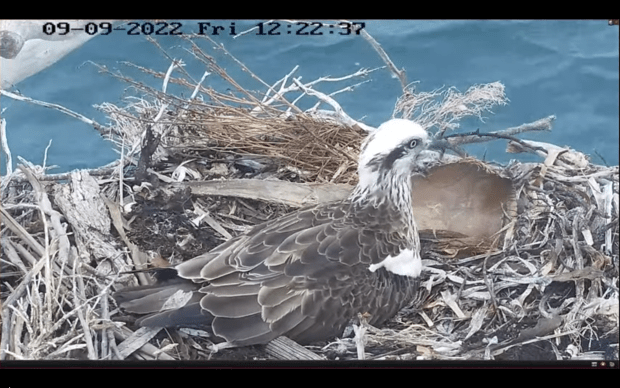
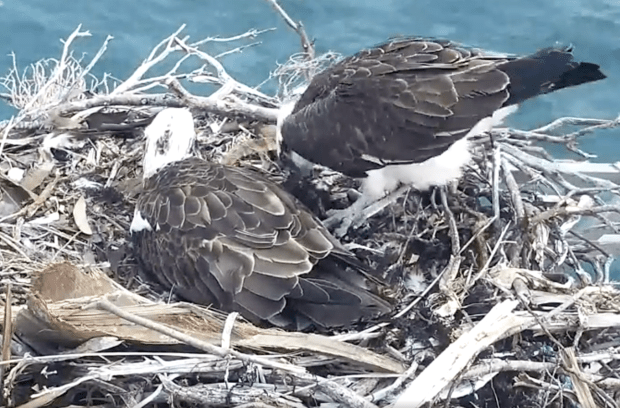
Dad eating his portion of fish before taking it to Mum. Thanks, Dad. We don’t want any more flapping fish on those precious eggs!!!!!!
Migration News:
No tracking news for Karl II or Kaia. Karl II is in the most dangerous area of Ukraine at the moment. Their transmitters could be jammed. The only news is of Waba and he is doing fine and has found a small area to fish. We wait.
Memory Lane:
Do you remember these two cutie pies? Who are they? what is their natal nest? and what are the names of their parents?
Thank you so much for joining me today. I will be pulling out photos from the archives for the next week or so to see if we can tell who is who! Take care everyone. See you soon!
Answer to Memory Lane: This is E17 and E18 from the SWFlorida Bald Eagle nest. They were removed to CROW for conjunctivitis and safely returned to Harriet and M15 after a successful treatment. Known for their early sparring the twins became best buddies.
Thank you to the following for their posts, their streaming cams and videos that make up my screen captures: Cornell Bird Lab and the NZ DOC,, Ojai Raptor Centre, Friends of Big Bear Valley, Bald Eagles 101, Bywyd Gwyllt Glaslyn, Dyfi Ospreys, NCTC, Cal Falcons, Sea Eagles@Birdlife Australia Discovery Centre Sydney Olympic Park, 367 Collins Street by Mirvac, Charles Sturt Falcon Cam, Port Lincoln Ospreys, and SWFlorida Bald Eagles and CROW.
Sunday afternoon really was a beautiful day. The temperature on the Canadian Prairies was in the low 20s with a light breeze and a bright blue sky. It was the perfect day to wind down summer. For many, Monday is a holiday and then everyone is back at school. The Ospreys are flying south from the Cape in the US and the geese are landing in the newly cut farm fields in Manitoba.
These geese just landed on one of the ponds at Oak Hammock Marsh.
Today I walked the perimeter helping to pull invasive weeds that are threatening the marsh and was more than miffed when my watch told me that I had walked precisely .7km. Looking at the map now, it was 18.7 km. The muscles in my legs know even if the watch doesn’t!
Hiding in some of the reeds in the middle of the afternoon were some Northern Pintail ducks. Aren’t they lovely? Please do not mistake them for a Mallard – look at the beautiful colour of that bill, a soft blue grey. This is a little female with her mottled plumage of tan and light brown. They are also dabbling ducks with their little bottoms stuck high in the air while they search for pondweeds.
It is so quiet and peaceful in the country.
The minute I parked my car at home, I could hear them – the Crows. But it was much more than Mr Crow and his family. There at the corner house where a lovely lady also feeds birds were more than 50 crows – in the trees, on the fence, on her roof, on the grass, on her garage roof. What in the world was up with them? Well, it was ‘THE cat’. Yesterday, this same cat tried to get little Hedwig and the three garden crows saw this. There they were – yelling and flapping at it in this lady’s garden. No doubt it was there to try and get a song bird. Don’t get me wrong. I love cats. From the time I could crawl until last July (2022), I always had cats. In my City cats are to be kept inside. It has substantially cut down on the feral cat population and it is safer for our pets. But one neighbour insists on letting their well fed cats out every evening at 5pm. Need I say more?
It was quite unbelievable. Then the cat ran out of the yard —–the Crows dispersed and everything was back to normal. Goodness.
In the Mailbox:
After posting about the Cape May Hawk Count, ‘H’ writes to ask me if I know about some other migration counting sites. I did not! So here from ‘H’ – thank you so much – is https://www.hawkcount.org/ You can find your local nests or others you are interested in. Counts are streaming across the bottom, too! What a glorious find. So, please check this useful tool. It is at the top of my list – and it is so easy to use.
Making News:
The staff of the DOC NZ at Taiaroa Head have decided that the newly fledged Royal Cam chick shall keep her code name as her name – QT.
Keeping with QT, Mum YRK returned to Taiaroa Head to feed her daughter on Monday (Australia time) and found the nest empty. She didn’t not stay very long and did not look about for the chick. She bowed her head a couple of times and flew off into the distance. YRK did a fantastic job taking care of her chick without OGK. My heart sank for her. Her and OGK often met at the nest of their chick and loved spending time together. So sad.
A clip from the Discovery Channel’s The Savage Edge – the Peregrine Falcon, a Living Missle.
Nest News:
Port Lincoln Osprey and all those in South Australia who have worked tirelessly for our beautiful fish hawks are celebrating. The first egg has been laid at the new platform on Turnby Island. Here is the announcement:
On Sunday, both Louis and Idris are still feeding chicks. Idris has been lucky and hasn’t gotten caught up with his daughter but Louis landed on Sarafina delivering her tea time fish and their wings got all tangled. It looked terrible but…all was well in the end. I think both of these dads will be looking for these girls to take off soon!
Xavier got to spend some quality time incubating the eggs today. Diamond seemed anxious to have a break when he arrived at 13:31. I love how Xavier always talks to the eggs when he rolls them and gets settled in!
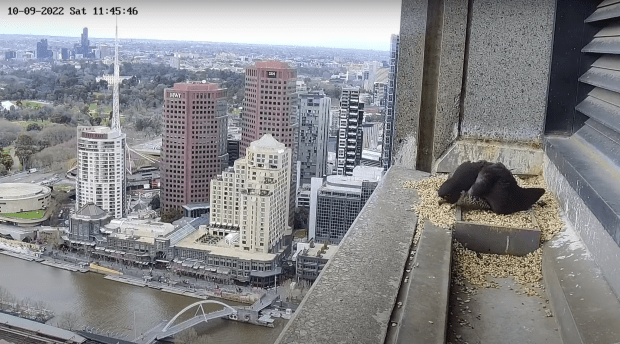
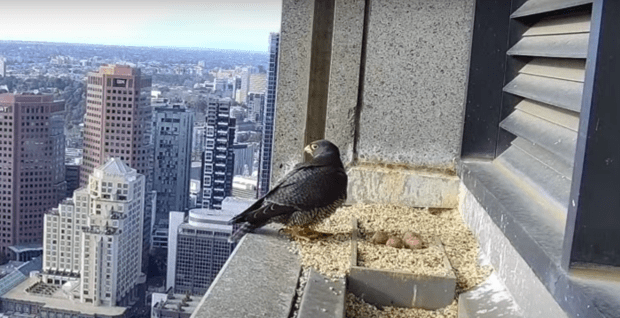
Dad arrives at the Melbourne scrap in the CBD for a turn incubating the eggs in that bright sunshine.
Cody has the new canopy cam installed at the Kisatchie National Forest Bald Eagle nest in Louisiana. It is a lovely clear view and there were eagles and chortles seen and heard this morning! I really like how Cody has the date and time at the top, white on black on the main screen.
Anna and Louis have now made three trips to the nest tree. I have a short video of one leaving and chortles from this morning.
Here is the link to the E1 camera for Anna and Louis:
Short video clip of one of the eagles at the E1 nest leaving this morning.
Here is the link to the E3 camera, the nest across the lake of the other eagle couple. It has a real crackling on the sound whereas the E1 cam is perfect.
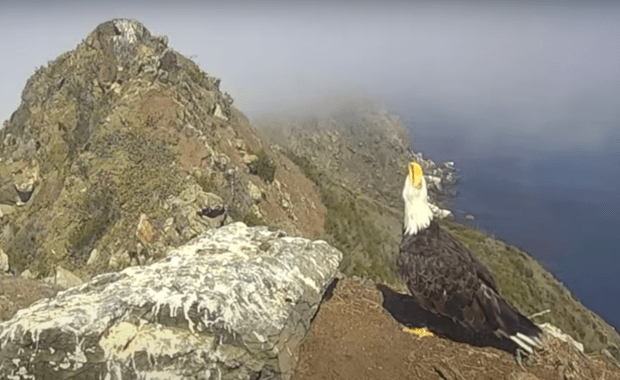
Jak and Audacity were at the Sauces nest on the Channel Islands yesterday.
Lady and Dad are trying to encourage some self-feeding at the Sydney Olympic Forest nest. The eagles have dark brown feathers almost over their entire body. They will be hopping and flapping their wings more. We should see them figuring out how to hold the prey down with their talons while tearing bits off. You will see mantling – the spreading of the wings over the prey item to claim it. They will also stand on their feet for longer periods of time. It is hard to believe but we are about 4-5 weeks away from fledging. You will begin to bet anxious if one eaglet seems to get more food than the other. It normally works out!
At the Port Lincoln Osprey barge, Dad got some incubation time from 2339-23:54 and then Mum sent him to his cave. Dad acted like he would have incubated all night. What a sweetie!
You may recall that a raccoon climbed up the tree and took one of the two eaglets at Fort St Vrain in Colorado last breeding season. A raccoon guard has now been installed at the bottom of the tree.
It is now Monday and both Idris and Louis are still fishing for their ever ravenous daughters, Padarn and Sarafina. Top image is Padarn fish calling at Idris and the bottom is Sarafina with her fish from Louis. These girls should be leaving at any time but I wonder if anyone told them!??? LOL.
I cannot believe how dark Sarafina is – just like her Mum, Dorcha!
Migration News:
Tracking the latest news on the migration of Karl II’s family of Black Storks. Waba is in Ukraine.
Bonus remains in Belarus along the Prypjat Wetlands where he has stayed for several days now.
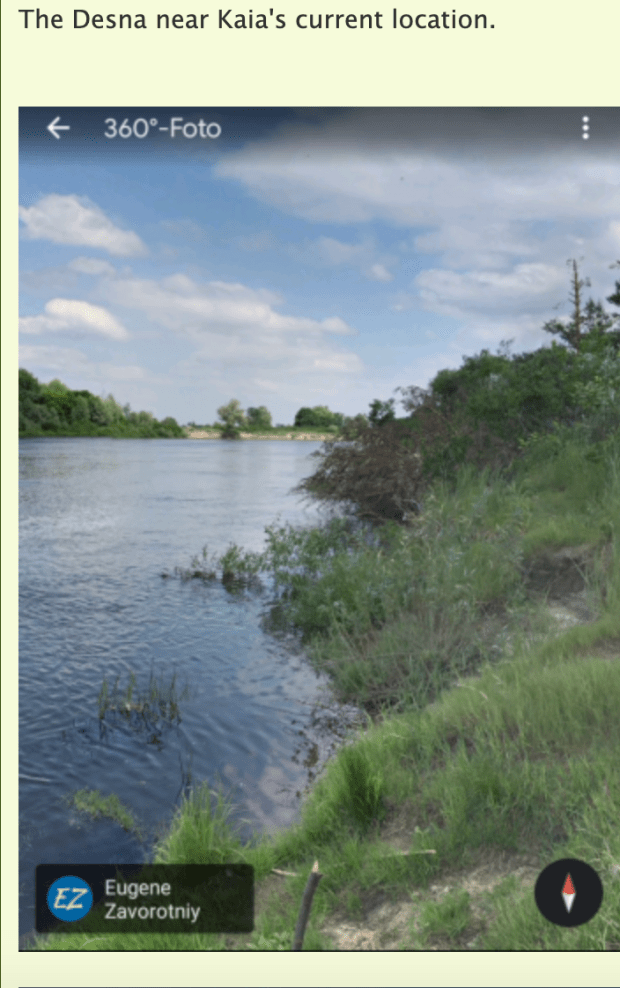
Kaia is in Ukraine near the River Desna which is close to Vovchok.
There is some concern for Kaia’s transmitter while she is in the war zone.
There has been no transmission from Karl II on Sunday.
But today on Monday the tracker indicates that Karl II flew over 600 km in a day and is now headed to Cherson in Ukraine which appears to be his second favourite stop enroute to Africa.
Karl II is such a strong flier and took such good care of his family. Now we need him to have some luck.
As our beautiful storks make their way to Africa, send them your best wishes for a safe trip and lots of food.
Thank you so much for joining me today. It is another gorgeous day on the Canadian Prairies. The sparrows and wrens are all over the millet seed in the garden and the Crow family has already had their “sandwiches”. Take care today wherever you are. Stay safe. See you soon!
Thank you to the following for their streaming cams, posts, videos, and articles which make up my screen captures: DOC NZ, Discovery Channel, Friends of Osprey, Friends of Loch Arkaig and the Woodland Trust, Charles Sturt Falcon Cam at Orange, 367 Collins Street by Mirvac, KNF, Explore.org and IWS, Sea Eagles@Birldlife Australia Discovery Centre Sydney Olympic Park, Port Lincoln Ospreys, Fort St Vrain Eagle Cam, Dyfi Osprey Project, and Looduskalender.
Oh, Good Morning Everyone. I hope this newsletter finds you well and happy.
It is a beautiful holiday Monday on the Canadian prairies. The sun is shining bright but the temperature is not going above 24 C today – a great day to go out and continue checking on the ducks and geese. Autumn is one of my most favourite times of year despite the fact that it leads us directly into winter and is often too short!
Yesterday the Cormorants and American White Pelicans were enjoying time in the shade near the dam at Lockport, Manitoba. The image below is one tiny section. There were more than 60 pelicans and 45 Double-crested Cormorants swimming and drying off in the sun.
If you live in or around Winnipeg, Fort Whyte will begin staying open Wed-Sunday beginning 21 September so that you can watch the Canada Geese arrive in the thousands at dusk. It is an amazing sight. There will be food trucks or you can bring your own picnic. The cafe might be holding its Goose Flight dinners but this is uncertain due to the same staffing shortages that are hitting the hospitality industry worldwide.
From the Mailbox:
‘H’ writes to ask me if I am familiar with moon_rabbit_rising on Instagram? Oh, yes, I am and if you love the Cal Falcons then you need to head over and see Bridgette Ahern’s incredible – and I do mean incredible – images of Annie and Grinnell and their family and now Annie and Alden and their family.
‘D’ wrote as did several others following my UK Osprey postings and information about the female departures: “Are the Dads usually the last to leave the nest?” Yes, the males are normally the last ones that leave the nest. The females usually depart about two weeks prior to the fledglings leaving and then the male stays, eats well getting his strength back, and then departs. There are always exceptions to the rule! I just had a couple of notes from ‘N’ who comments that the nests she normally watches generally have the males leaving first! It is a very poignant moment when the male arrives with a fish and waits – and waits some more – and no one comes to collect it. By now, Louis is wishing that Sarafina would fly in the same way that Idris would like to see Padarn off the nest.
Making News:
There are many times that I am proud to be a Canadian and today, it is so reassuring to see that the people in Callander, Ontario care about their Bald Eagle and its nest!
If you missed the video that Ojai Raptor Centre posted of Victor flying – here it is. It is also worth a second or third viewing. Victor is doing so well.
Another juvenile eagle – this time caught up in fishing line is saved!
The citizens living in the NE of England are demanding answers from the government on why hundreds of thousands of lobsters, crabs, and sea birds wound up on the shore dead.
Raptor Persecution UK is calling out Natural England as being compromised in the handling of the killing of Asta, the Hen Harrier. This is their description of the crime:
“The level of depraved brutality involved in this crime is quite shocking, even to those of us who have become hardened to the relentless illegal killing of birds of prey in the UK. It’s virtually impossible not to look at these images of Asta and imagine the horror she faced at the hands of her killer.
The calculated deviousness of whoever committed this crime deserves the full attention of the statutory regulator, Natural England, and widespread publicity about the lengths these criminals will go to hide their ongoing, appalling violence towards this species and other birds of prey.” After 18 months nothing has been done and birds of prey continue to be killed over the grouse moor hunting estates. It is not just the brutality of the killing of this single Hen Harrier but also the other 72 that have been killed and the lack of accountability that is worrisome.
Along this same theme, the Countryside Alliance is waging an all out campaign to get Chris Packham removed from the BBC because of his views about ending grouse hunting and thus, the illegal killing of raptors. If you live in the UK and have a view on this matter, please make it known.
The raptors are moving and Cape May, New Jersey likes to call itself the ‘raptor capital of North America’. See what is happening and why people are getting excited.
It is the 10th anniversary of the Bald Eagle nest at Berry College. Who didn’t love Ma Berry? and who of us did not lose their heart to B15 this season? The Bald Eagle experts take you on a trip down memory lane with the Berry Eagles but, you have to go to the Berry College FB page. They will – despite saying I can embed the link – well, it doesn’t happen! Regrets.
Suzanne Arnold Horning posted some great images of our lovely Red-tail Hawks on the Cornell Campus over this past season on the FB banner! I have not seen a new update on L3 or L4 and in this case, no news is good news.
This is one of the last shots Suzanne took of L2 before his/her migration. L2 has not been seen in a week and so she/he is off to find their own spot in the world. L2 was the first to fledge and the second to catch her own prey. Often noted as being a ‘mini’ Big Red. Beautiful hawk. Soar high and always have a full crop!
Following Karl II’s family on their migration:
Waba is in Ukraine where he has been exploring the banks of rivers for food.
Kaia remains in Ukraine in des Desna near Vovchok. She only flew 47 km – around the area feeding.
Bonus is still in Belarus in the Prypjat wetlands near Makarichi.
There is no current tracking news for Karl II.
Thunder visited the West End Bald Eagle nest in the Channel Islands at 10:38 Saturday morning. Listen to her calls. You will notice another bird flying around – you can just see the silhouette.
The Sydney Sea Eagles did not have to wait until afternoon for their breakfast today. I caught several feedings for these fast growing eaglets. Notice how well behaved they are!
It had rained and Lady is offering some comfortable out of the rain for SE29 and SE30’s heads. Poor things. They are too big to fit under her.
Dad brings in a nice fish. Lady jumps down from her parent branch to feed the wet youngsters.
Dad comes in with another prey item. It looked like a small bird but I am not entirely sure.
Ranger Sharyn posted the following information for viewers of the Royal Albatross streaming cam on Taiaroa Head, NZ after the fledgling of the Royal Cam chick QT yesterday.
It should be relative quiet while birds are incubating eggs but yesterday, there was an intruder at the scrape on the Charles Sturt campus in Orange. Cilla Kinross caught it in slow-motion:
Xavier has spent some time on the ledge protecting Diamond and their eggs.
At Port Lincoln, all is well. Mum is sleeping and incubating the eggs and Dad is down in his shed, a place he spent having some good old’ chats with Ervie. It is the 5th of September with hatch expected in a fortnight (2 weeks).
It is quiet in Melbourne at the 367 Collins Street scrape. Where is Dad you ask? He will be perched nearby – sometimes on the camera.
The amount of detail that people keep on the UK Osprey nests is truly impressive. If every nest in the world had a dedicated group keeping every single detail for each season what an impressive amount of information we would have on the breeding and behaviour of Ospreys. Llyn Clywedog just posted the number and type of fish and what this means in comparison to average deliveries elsewhere. Well done, Dylan!
Peace and Love, the two fledgling Bald Eagles of Liberty and Freedom at the Glacier Gardens nest, were on the natal nest this morning watching the traffic along the road. How lovely to see them.
Thank you so much for joining me today. Please take care. Looking forward to seeing you soon.
Thank you to the following for their streaming cams and their posts that made up my screen captures today: moon_rabbit_rising, CBC, Ojai Raptor Centre, Cape May Hawkwatch, Cornell Hawk Chatters and Suzanne Arnold Horning, Looduskalender, Explore.org and IWS, Sea Eagles@Birdlife Australia Discovery Centre Sydney Olympic Park, NZ DOC, Charles Sturt Falcon Cam, Cilla Kinross, 367 Collins Street by Mirvac, Port Lincoln Ospreys, Llyn Clywedog Ospreys, and Glacier Gardens.
Featured image is L2 taken by Suzanne Arnold Horning.
Friday is going to be a much nicer day in terms of weather. It has been sweltering on the Canadian prairies. The high will be 21 and not 32! It is hard to imagine it being 32 degrees at the beginning of September in Winnipeg. The sun is bright and the sky is blue without a cloud in sight. It will be a good day to go to the nature centre for that long walk and to see how those little ducklings have grown this week. The egrets were still in Winnipeg last night. They attracted a few of us to gasp at their beauty as they flew into their roosting tree at sunset.
No matter what is happening today in your life, take the time to marvel at the work of the wildlife rehabbers who are giving our darling raptors a second chance to live out their lives soaring in the skies. Smile. Victor is flying!!!!!!!!!!!!
Making News:
The Ojai Raptor Centre has done an amazing job getting Victor to flying in the large aviary from the patient that arrived with severe zinc toxicity. They posted a Victor of our dear Victor flying so well. So thankful for Dr Sharpe and everyone who gave Victor his second chance! What a wonderful sight to see ——-Victor flying and not having to do physio being supported by a human lifting a towel. Tears.
Whenever you think about intervention and someone says ‘nature will take care of it’ ——think of our dear Victor and tell them about him. Maybe you can gently change their mind. Or you could tell them about Little Bit ND17 – or both!!!!!!
You might remember that one of the two eaglets on the US Steel Bald eagle nest fludged and, in the process, tore many of its feathers. It was taken into care. Here is the most recent news on this lucky eaglet who is getting its second chance!
Rosie’s broken feather on the right.
The new feathers being inserted. They will fall out when Rosie has her first moult. Oh, what a very lucky eaglet! Just like Victor and Little Bit.
If you are living where Baltimore Orioles will or are passing through, heading to their winter homes, remember to put out the oranges and the jelly (they love other flavours than grape, too) for them to help build their energy.
The RSPB gives us all some ideas about how we can better ‘green’ our lives.
I was extremely interested in their article on how to create a garden that is beneficial for wildlife. It is always good to look for new and better ways to take care of those garden friends that come to us for food, shade, and shelter.
Who could have predicted that the Hellgate Canyon nest would have a visit from both dear Iris and Louis on Thursday? What a pleasure it is to see her. Like so many of you, I have growled at Louis but, in the end, Iris seems much happier when he is about so…I am going to stop moaning when I see Louis. I wonder if this is the pair together, Iris saying goodbye to all of us until next spring?
Beautiful Iris. If this is the last time we see you this year, travel safe, always have a full crop, enjoy your winter but return in the spring. You give us hope and inspiration.
And she is off, the oldest osprey in the world living in the wild.
Feeding time for the Sea Eagles. Notice how much progress they are making in terms of plumage but also, in standing.
There was another prey delivery at 1200 and SE30 did some impressive mantling on its arrival.
Xavier brought Diamond a nicely dressed pigeon for breakfast. She was thrilled and Dad got to spend some time incubating those three eggs in the scrape at Orange.
At the 367 Collins Street scrape in Melbourne, the little Dad loves taking care of the eggies just as much as Xavier does. Here is an early morning hand over.
The Collins Street Mum just found ‘us’!
Mum and Dad have such a good routine at the Port Lincoln Osprey barge. Mum knows that Dad is coming with a partial fish for her. She would have seen him eating his portion on the ropes before arriving at the nest and transferring the rest of the fish to her. Typically, the males eat the heads of the fish. Then Dad gets a chance to incubate the eggs, too. Great system. Gives Mum a nice quiet time to have her lunch. It sure won’t be quiet in a couple of weeks!!!!!!
Dad brings in some more decorations for the nest later.
The check on Karl II and his family as they migrate shows us that Karl II is following his normal flight path. Everyone hopes that he will be changing his trajectory as this normal path will have him flying directly into Kherson an area that is quite unsafe. Looduskalender posted the different colours for his flight this year and Karl II’s last two years.
Karl flew fast and quick to get into Belarus. Let us all hope that the winds carry him to his favourite tree -safely and quickly- in the very centre of Africa.
Bonus appears to be in Belarus near Makarychy in the Gomel Oblatst. He must be finding a good food source in the Pripyat River marshes.
Kaia’s tracker came on and showed she had traveled 28.8 km. She remains in Ukraine.*
Waba – no data since 30 August.
Thank you so much for joining me this morning. Wishing our Black Stork family from the Karula National Forest in Estonia safe, safe travels. It will be interesting to see what Karl II does as he approaches Ukraine. Take care everyone. See you soon!
Thank you to the following whose posts, videos, and streaming cams made up my news for the day: Ojai Raptor Centre, Hawk Mountain, Audubon, RSPB, Montana Ospreys, Tamarack Wildlife Centre, Sea Eagles@Birdlife Australia Discovery Centre Sydney Olympic Park, Charles Sturt Falcon Cam, 367 Collins Street by Mirvac, Port Lincoln Ospreys, and Looduskalender.
I have inadvertently been using the term ‘the Ukraine’. Having lived in the 2nd largest area of Ukrainians many decades prior to the country’s independence, it became a habit to say ‘the’. Now it is not appropriate. Ukraine is, of course, its own independent country. Apologies to anyone who might have been offended by my oversight.
The sun is once again shining bright on the Canadian prairies. There is not a cloud in the sky and it is getting hot. By tea time the temperature will have risen to 29 degrees C from the current 22. It is a day to make certain that there is plenty of water for the birds in the garden — and lots of food. The migrants are moving through.
Yesterday, I went for a ride to check the birds in the countryside. The gulls were enjoying the fields that the farmers had just plowed and a single Ring-billed gull thought that it could share my lunch.
There was a quiet stillness over the wetlands at Oak Hammock Marsh. A few geese, a handful of ducks and shore birds were around but nothing like what will begin to happen as September begins. Migratory birds will be landing at dusk and taking off in the early morning hours.
In the Mailbox:
This letter comes from a local friend but, it could be from anyone: “Every time I reach out to help the wildlife, I get told to leave nature alone (in the rudest way), nature will take care of itself. What is your advice?”
I wonder what you would say to this individual?
My advice is to ignore the negative comments. Lead by example. We have destroyed the habitats and, thus, the lives of the wildlife. We poison their water and have caused the oceans to warm. We throw our garbage into their ponds. We have destroyed their food supplies…we shoot them. It is time to embrace caring and understanding. Wildlife – the whole of it – are sentient beings, they have feelings and emotions. They deserve the best we can give them. We need to become selfless and put wildlife first, not ourselves. Putting humans first has caused us to be in the present state we find our planet in. Peter Merren says, ‘Care for Nature begins at home.’
Making News:
The plans to stop two pairs of Bald Eagles from being able to access their nests is causing a lot of outrage in British Columbia. You can sign the petition, too, by copying the link into your browser!
BirdGuides finds many human-induced changes to the environment that are killing the migratory birds. Of these infra-structure, hunting, and earth warming are the top three.
The birds are on the move and I found a super guide to Osprey migration. Everything you wanted to ask and were afraid to…It will give you some great insights as to what is happening at all the nests.
While Loch of the Lowes is empty, the Glaslyn nest of Aran and Mrs G still has three chicks yelling at Dad to bring in the fish!
Louis has delivered a nice fish to Sarafina at the Loch Arkaig nest this morning.
Idris brought a nice fish to Padern who appears to be the only fledgling at the Dyfi Nest. Paith was last seen at 1700 on the 29th.
I got a little emotional when I saw that Bonus and Kaia were just 25 km apart in Belarus. My heart beat a little faster wondering if it was possible that they would fish together along the shores of the Priyapat River. It was not meant to be…Kaia flew into the Ukraine again and then set a trajectory quickly east. Meanwhile Karl II remains in Estonia enjoying an empty nest (yes, parents do love their children but it is also nice to have some quiet and fish to one’s self). I want to give a real shout out to those that are posting the maps and images on the Looduskalender site for Karl II and his family’s migration. I have included their comments and image notes so you can see where Bonus and Kaia are in the image below.
Moving forward, on the 31st, here are the locations of the individual Black Storks.
The other big nest news is that Diamond has now laid her third egg. It happened at 0525 on 31 August 2022. Historically, Diamond has only laid 3 eggs and for the past two seasons, only one of those has hatched.
You could tell things were happening. Diamond was focused and standing.
Xavier comes into the scrape box and he is so excited!!!!!!!!! Diamond is happy to show him the three precious eggs. The bowing and the rituals fascinate me…oh, to be able to speak falcon!
In celebration, Xavier brought Diamond a very nice breakfast. Now we can get a good look at those three beautiful eggs.
Diamond took a break and Xavier comes into the scrape to incubate the eggies…he loves doing helping out. Diamond does not always oblige him but he can incubate those eggs with the best of them!
“Oh, she’s back….maybe she won’t see me here!”
The Sea Eagles are picking up sticks and 29 is standing stronger and doing some wingersizing. Both are fine.
The light on SE29 really shows off the variation in plumage colours. One year I was thinking that everyone should go to their stylist and ask for a 26…the little eaglet at the time but, this year, right now, it could be a 30. They just get more and more beautiful.
As many know, my first love was hawks. There is nothing cuter than a precious Red-tail juvenile. One of the moderators of the Sea Eagle cam who also was the admin on the Cornell Chatters kept poking me and telling me that I would change my mind the minute I saw a sea eagle juvie. ‘TCR’ you were positively right, of course.
This eaglet just makes me melt. So gorgeous. Talk about clown feet! Whoaaaaaa. Did I hear someone say they would like to cuddle with this cutie pie??? Now before you hold up your hand, just look at those very sharp talons and think about your answer carefully.
This image shows the difference in the back plumage. SE 30 is on the left and SE29 is on the right. Plumage progress is going well for these two.
But if SE30 sits differently, it is hard to tell them apart!
SE 29 flapping those wings! SE30 is watching carefully.
I should warn you…when they both start flapping on that nest -at the same time – you are going to need some worry beads!
Everything is fine on the ledge in the CBD of Melbourne. Dad is really enjoying getting some incubation in the warm Australian sun.
All is well at Port Lincoln. As the month changes from August to September, we are now only two and a half weeks away form hatch. It has just been too long since we have seen a little osplet with its back stripe in a nest.
Just like it was at the marsh, it is pretty quiet in Bird World today. Everyone is on the move, incubating eggs, or enjoying a time not raising chicks and getting strong again.
Thank you so much for joining me this morning. Take care of yourselves wherever you are. See you soon!
Thank you to the following for their streaming cams, posts, and videos which make up my screen captures: vancouverisawesome.com, LOTL Visitor Centre and Wildlife Reserve, Bywyd Gwyllt Glaslyn, Friends of Loch Arkaig and the Woodland Trust, Dyfi Osprey Project, Looduskalender, Charles Sturt Falcon Cam at Orange, Sea Eagles@Birdlife Australia Discovery Centre Sydney Olympic Park, 367 Collins Street by Mirvac, and Friends of Osprey.
We are nearing the end of August. I keep saying the month has disappeared and it surely has! It is simply hard to believe. We had a magnificent rain that brought the garden back to life. There is nothing like a good soaking – watering from the tap doesn’t seem to do it. The garden also had a visitor this morning. I know the hawk has been around but, with all of the foliage it is hard to spot him. The new fence has, however, attracted a lot of attention and today it got approved to be the new plucking post! The image is not good. I got so excited that I hit the silly video button on the phone and not the photo. It is also from a distance through a screen -I was hiding in the shadows hoping that she would not see me inside the house taking her photo – hawks have to eat, too.
By now you will have noticed that I have added some sub-titles to my blog. There will not always be questions in the post to answer – that is up to you! But if you are wondering something, ask. I will absolutely not always know the answers but I have friends and colleagues to ask that do and they are happy to share what they know with all of us. There is generally some news and there are always things happening at the nests despite it being quite slow the end of August. I hope also to incorporate a book review section once in awhile —- when there is time to read a new book. I am currently working on two: Birds. A Complete Guide to their Biology and Behaviour. It is excellent so far – a great reference that includes topics such as Anatomy and Physiology, Flight, Food and Feeding, Breeding… The second is After They’re Gone. Extinctions Past, Present and Future by Peter Marren who tackles some of the very uncomfortable truths that we have to face. It is time, after all, to get our heads out of the sand and listen to what individuals like Marren have to tell us. Full review to follow in a few weeks when I have had time to digest and reflect the latter.
In the Mailbox:
‘B’ writes: “I have been watching Osprey nests for years. Why do the siblings attack one another after fledging when they have been nice on the nest?” Oh, this is such a timely question as the nests begin to empty themselves of parents and fledglings in the Northern Hemisphere.
Some of you will remember that the three osplets on the Port Lincoln Osprey barge in 2021 – Bazza, Falky, and Ervie – were sweet to one another as nestlings. Bazza tried a couple of times, early on, to boss Ervie but, even as little as he was, Ervie wasn’t having any of it. So the nest was very peaceful. Then they grew up. They fledged and even became interested in fishing. When Dad would bring a fish, they would descend on the nest and fight – or, rather, let’s use the Australian term, “a dust up” would occur. If you are watching the Dyfi nest of Idris and Telyn, two of the three girls remain in Wales. Whenever a fish comes on the nest, they practically knock each other about to get to that food. This is perfectly normal behaviour. They no longer see one another as siblings but as rivals who might take the only food supply. Soon, they will go their separate ways and no would have been hurt-normally -although Bazza and Ervie did get pretty rough. Please note that the PLO nest had 3 males and the Dyfi had 3 females – same gender on the nest. Same sex nests tend to be very civil after a brief set to at the beginning.
‘S’ sent me some news and included in it is a video/PowerPoint on what to expect at the Royal Albatross Taiaroa Head Colony in September. I know that many of you are fans of the albatross and watch Quarry Track chick, this year’s Royal cam chick, faithfully. I do not cover her but I look in on her. Sharon Dunne does an excellent job of providing all the information needed! This is a great information packet – have a peek. Thanks, ‘S’.
Making the News:
Drought and hydro poles killing off Europe’s White Storks. Only 10% of the hydro poles in Hungary are insulated and yet 150,000 beautiful White Storks are electrocuted each year. This well done video shows the birds, where they live, the deaths, and the fix that is required. It is now time for humans to step up to the plate and take care of the wildlife instead of doing what we have always done — put ourselves first.
And, of course, Hungary is not the only country that has this issue. We saw it in Canada when Junior was killed near the nest on Gabriola Island, in The Czech Republic, and elsewhere.
A Polish Photographer has been stirring up real interest on the Internet with his image of an Osprey fishing. His name is Krzysztof Stasiaczek and the image was taken in August 2022 in Eastern Masuri, Poland.
Hancock Wildlife Foundation in British Columbia used their GoFund Me and some other private donations to build a new sun-shaded nest for Ma and Dad at Delta 2. Why? Rising temperatures in the area of the nest due to the increased heating of our planet. They released the images today. That is David Hancock with the light blue long sleeve shirt working tirelessly to continually improve the lives of the Bald Eagles…he has been doing this for at least 65 years!
Somehow we all knew that the numbers of Bald Eagles on the Channel Islands is growing – thanks in large part to Dr Sharpe ensuring the eaglets do not tumble into the sea or die under a nest from zinc toxicity.
News is coming out of the Channel Islands Eagle Lovers group that there is the possibility of a new Bald Eagle pair spotted on Santa Cruz! Sauces 2016 hatch A-63, a male named Whisk, has been seen at the old Fraser Point nest with a subadult female of approximately 3 years. Fingers crossed.
A blog by Rosie Shields who monitors the Borders nests in the UK found its way into my inbox today. You might not be interested in these Ospreys but, it is the behaviour of the female that is important. She left a nest with three chicks she was feeding to begin her migration, landed on a nest she had visited before, and sat herself down now for 9 days being fed by the resident male who is willingly catching fish for her. It is always good to learn more and more about the behaviours of Ospreys – they never cease to surprise and amaze me.
Annie and Alden decided it was a good idea to renew their bond in the UC-Berkeley scrape on The Campanile after the sudden visit of a mysterious male falcon. Alden initiated the bonding session. “Annie, do not look at another male falcon. Alden is a keeper!”
Alden was caught loafing in the setting sun last evening. How adorable.
Everyone is sitting waiting really impatiently to see if Diamond will lay a third egg at the Charles Sturt Orange Falcon cam in Australia. Diamond’s average between eggs is 56 hours. The second egg was 57 hours this year. Will there be a third? and will it be on time?
Xavier loves his ‘eggie’ time and Diamond was obliging this morning to let him take a turn.
Xavier left and returned around 0700 with a Horsfield’s Bronze-Cuckoo (IDed by Holly Parsons). Xavier always brings something special on egg laying day. What a sweetheart.
Xavier waits for one and a half hours to incubate those precious eggs…it is caught on video.
Diamond looks pretty contented. Let’s see what is happening in a couple of hours.
There are still only 2 eggs at Orange. It is the middle of the night. If Diamond is to lay a third egg I would surely think that it will come before 0800 on the 31st.
In Melbourne, the little Dad is getting his turn, too and those four eggs look awfully big as he wiggles and squiggles to get them under him. Yesterday he looked down and noticed one was outside!
You can almost hear him saying he hopes the new mate doesn’t lay 5! She could. Keep hoping the population of pigeons is bursting at the seams in Melbourne!
Everything seems to be going well with the Sea Eagles. They are six weeks old and standing sturdier by the day and changing their appearance with those gorgeous feathers coming in.
At Port Lincoln, Dad took over incubation and Mum is enjoying a really nice dinner time fish before tucking it in for the night.
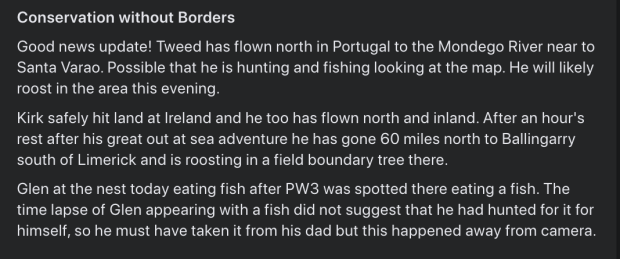
Updates on Tweed’s three fledglings from yesterday’s post.
A Tweet from County Cork with a great photograph of an osprey believed to be Kirk. Fantastic. He has had quite the adventure. Glad Kirk is safely on land. Now to get his GPS coordinates polished.
In the UK, Louis and Sarafina are still at Loch Arkaig. Dorcha was last seen on 18 August and it appears that Willow, LW5, began her journey on the 28th of August.
Louis delivered a lovely Mackerel to the nest for Sarafina today. She has been seen down at the loch attempting to catch a fish, too. Isn’t that splendid?
Louis brought a lovely fish to Sarafina at 16:16:33 on the 30th. She is still with us as of today.
The last sighting of Willow was on the 28th.
Maya is still at the Rutland Manton Bay Osprey platform. She flew in with a fantastic fish this morning at 0619. While many of the females have now departed, Maya raised three very large and strong female chicks with Blue 33. She is taking good care of herself so she is in good shape for migration. Normally we can expect to see her and her mate, Blue 33, back in the UK at the end of March. The first eggs and the first hatches!
Seren, Blue 5F, was with Dylan this morning at the Llyn Clywedog nest looking around their beautiful territory.
It appears that Mrs G from the Glaslyn Valley nest is now on her way south. Aran was on the nest earlier and one of the fledglings was shouting out for a fish.
At the Dyfi Nest, Telyn was last seen on the 25th of August. Pedran left before Mum, and Padarn was still at the nest today. Paith has not been seen on the 30th that I am aware of so it could just be the second hatch, Padarn, and Aran left at Dyfi.
Stephen Basly posted another great image on the Notre Dame Eagles FB Group of our Little Bit 17! It was the 25th of July and is such a great image. I think Stephen worked to get it cleaned up well for all of us. Thanks Stephen!
I have not been able to access Looduskalender today for updates on the Black Storks, Karl II and his family, as they migrate.
Thank you so much for joining me today. It is a gorgeous day here – I hope it is for you, too and that you have been able to enjoy being out in nature, if possible. Take care of yourself. See you soon!
Thank you to the following for their tweets, videos, streaming cams, and blogs that make up my screen captures: NZ DOC, BBC News, Krzysztof Stasiazek, Hancock Wildlife Foundation, CIEL Rosie Shields, Cal Falcons, Charles Sturt Falcon Cam, 367 Collins Street by Mirvac, Sea Eagles@Birdlife Australia Discovery Centre Sydney Olympic Park, Port Lincoln Ospreys, Conservation without Borders, Dave McGrath, Friends of Loch Arkaig and the Woodland Trust, LRWT, CarnyXWild, Bywyd Gwylld Glaslyn, Dyfi Ospreys, and Notre Dame Eagles.
Good Morning Everyone. I hope that each of you had a lovely Saturday. Thank you so much for joining me today!
From the Mailbox:
‘A’ asks: What is the average time difference or gap for Peregrine Falcons to lay their eggs? Diamond looks like she is ready today. Thank you, ‘A’. That is a very timely question as we sit staring at Diamond’s bottom for her tail feathers to begin to go up and down when she is in labour. In the nest notes that Cilla Kinross, the researcher at the Orange Falcon cam compiled, it says that the average time difference is 56 hours. As I write this, the time in Orange is 13:21 on Saturday. That egg is due anytime.
‘L’ asks: What is the purpose of molting? The feathers of our bird friends get damaged just like our clothes from normal living. They break and get tears. Moulting is the annual replacement of the feathers. In fact, think about it. Feathers are so important to birds – they keep them warm and dry and, of course, are needed for flying. They should be in tip top shape which is why birds spend so much time preening. Some birds begin to moult in the spring. Others wait until nesting has finished. Moulting is really hard on the birds and it is normally done when there is an unusually high level of prey so they can keep their energy up.
‘C’ writes: “I’m glad I helped with that information about galvanized steel that contains zinc. But in stainless steel, the component is chromium. Is it also bad for the health of birds? I searched very quickly, and in a very superficial search, I didn’t find anything that chromium is also bad for.” The information you provided was very useful. As one of our other readers ‘L’ writes there are some uses for zinc that are also helpful such as in ‘Zinc Ointment’ for baby rashes. I do not know a lot about chromium. It is also used in ceramics to make certain shades of green glazes and is highly toxic in its powdered form. It is not toxic after the pottery has been fired to a specific degree, however. — We assume that the things that we use for cooking are all ‘safe’. Sometimes it is only later we discover that there could be connections to specific ailments. However, if I had a beloved bird that lived in a cage – the cage wires would be stainless. We have a metal shop in our city that made all the SS backings for my kitchen and my island top. I am certain there are similar facilities in other cities where they could make the wires. I am still finding this whole zinc toxicity that impacted Victor very curious. I wish I knew more!
In the News:
The UK is still celebrating the arrival of more than 100 Hen Harriers.
The New York Times published the following article about how climate change will impact the birds we love and which are more likely to go extinct first. The cover shows the Kakapo and my readers know that the Kakapo Recovery Group is working hard to make sure that the flightless parrots survive. Today there are 205 of them on a couple of mall islands of New Zealand.
Nest News:
Chase showed up with a nice big fish and waited and waited on the Two Harbours nest for Lancer on Saturday morning around 10:38. Lancer never showed up. What a change it must be for the parents from nearly getting their talons torn off to sitting quietly to see if anyone will arrive. If you have left the territory, Lancer – soar high, be safe and always have a full crop!
Such dedicated eagle parents. Did you know that Chase & Cholyn have been together for 19 years?
Ferris Akel had a terrific tour on Saturday afternoon around Ithaca, New York. I was listening and doing other things until he got to the Cornell Campus where he caught Big Red, Arthur, and L2 on camera. Oh, it is lovely to continue seeing L2. According to Suzanne Arnold Horning, the latest a juvenile has been seen at the Cornell Campus is 28 August. L2 looks pretty comfortable. I wonder if she will shatter that record?
Arthur was hunting.
L2 could see Big Red in the distance when she was on the pole and was prey crying really, really loud. Since L2 was the second juvenile to catch her own prey in June I am imaging that Big Red’s answer to that is: “Get your own!”
Big Red looks a little ‘rough’. She is moulting. Like other Red-tail Hawks, Big Red undergoes a complete moult once a year. Normally, hawks begin their moult in spring and every feather has been replaced by September or October. Big Red, however, appears to begin her moult after the eyases fledge.
Xavier has been bringing Diamond some extra special treats during Sunday to help Diamond keep her energy up for the egg laying. One was an Eastern Rosella which is a very colourful parrot and the other was a nicely prepared pigeon. Diamond was excited for both!
The arrival of the Rosella meant that cute little Xavier could have some time with ‘eggie’.
Diamond had a very large crop when the pigeon arrived but she certainly wasn’t going to turn her nose up at that special food gift.
It is 13:57 in Orange and Diamond is sitting on the ledge of the scrape box while we wait and watch for an indication that the second egg might be arriving.
Diamond is back on the egg at 1400.
Diamond is very focused and she looks ‘heavy in the rear’. Egg 2 could be coming shortly. Diamond normally lays 3 eggs. For the past two years, only one egg has been viable each year.
Diamond laid egg #2 at 17:27. Yippppppeeee. Why am I so excited? Well, falcon eggs do not always hatch and for the last two years Xavier and Diamond have had only 1 out of 3 eggs hatch so it makes the chances better of having a successful hatch.
Xavier arrives at 17:33 to see the second egg and to bring Diamond her dinner. Notice that Diamond is being very careful. Falcons lay their eggs standing up. She is protecting the egg while the shell hardens in the air. The gap between eggs is 57 hours.
Diamond did not want to eat. She had already had two big meals. She remained in the scrape box. During the night she would sometimes incubate or, alternatively, stand above the eggs protecting them. Remember the Currawong know there are eggs in that scrape and they will eat them if the opportunity arises!
The Melbourne couple seem to be finished with three eggs and each takes turns incubating. Dad was very anxious to demonstrate that he was well seasoned in incubation. The Melbourne crew even made a video of the persuasion.
It is a very short and cute clip. Oh, do you ever wish you could speak falconese?
Friends of Osprey have posted some photographs of Ervie near the Marina where he had dived and caught the lovely fish he is eating. They were taken by Alex Ditton. Oh, goodness. It is always such a joyous occasion when someone shows us that Ervie is doing very well indeed! Check out the Friends of Osprey for more images of Ervie.
Kaia remains in Belarus around the Priypat River. This is what the area looks like where she is resting and fishing.
Bonus, the only surviving storklet of Jan and Janika that was fostered with Kaia and Karl II has begun his migration. His tracker tells us that he traveled 109 km and is now in Latvia near the village of Vietalva.
Travel safe dear Bonus, fly high, stay out of the war zones, always have a stream full of frogs and fish — prosper.
There should be more news but it appears that all might have left for their winter homes from the Karula Forest nest of Kaia and Karl II. I will confirm this tomorrow.
Bonus was always a very special Black Storklet. He would not have survived without the intervention of Urmas and Dr Madis and his team. They would have died on the nest. Urmas’s foresight to provide fish baskets meant that everyone had lots of fish. A special thank you to all who donated towards the food for the nest.
The Dahlgren Osprey nest in the US has announced that the male, Jack, has not been seen for a few days so that now Harriet, the female, and the sole surviving fledgling from the nest in King George County are on their journey south.
No one has been seen at the Loch of the Lowes since yesterday. Laddie LM 12, Blue NC0 and both of the fledglings appear to also be heading south.
It was another successful year for Ospreys in Wales and John Williams gives us the run down in his last blow of the season for Llyn Clywedog. The numbers of Ospreys in Wales are growing. There are now 7 ‘known’ pairs who produced 17 chicks this year. John catches up with all the nest news.
John also produced a chart for all the chicks hatched at Llyn Clywedog – noting that there is simply too much grey. Were those chicks ever seen or not? Sometimes they do get missed.
Handsome Aran on the perch at the Glaslyn nest this morning. He remains bringing fish to the nest for the fledglings. Mrs G was still home as well today.
Handsome, Aran.
Emyr Evans has provided us with the data of the fledges at the Dyfi nest asking the question: what happened to Pedran? Emyr is great with statistics and this is a good read about migration and young fledglings.
Rosie was still on the perch at the SF Bay Osprey nest this morning! Brooks has not been seen at the nest for some time now – this is not alarming. She is out exploring!
Congratulations to Glacier Gardens. Both Love and Peace have fledged. Here is a video of that moment on 25 August when Peace took to the air. Congratulations for another successful year Liberty and Freedom!
Thank you so very much for joining me this beautiful Sunday morning. I hope that you are doing well and I will look forward to having you with us again in Bird World.
Thank you to the following for their streaming cams, their posts, and their videos that form my screen captures: The New York Times, Explore.org and IWS, Ferris Akel Tours, Charles Sturt Orange Falcon Cam, 367 Collins Street by Mirvac, Friends of Ospreys, Looduskalender, Dahlgren Ospreys, Friends of Loch of the Lowes and the Scottish Wildlife Trust, John Williams and The Clywedog Ospreys, Bywyd Gwyllt Glaslyn, Dyfi Ospreys, SF Ospreys and Golden Gate Audubon.
Friday turned out to be one of the best birding days I have had in my City because of the birds and the three people that I met — and, of course, an Osprey story. No, I didn’t add lots to my life list but, I will add a few when I can get some help doing the IDs. It was hot in the afternoon for the walk at the nature centre. The little Mallard mother that had 11 ducklings still has the 9 she had the other day. She has moved them to a different pond where the water and plants appear to be a little healthier.
In some areas the algae is just stifling the life out of the pond. The geese were all resting in the shade and only the song birds were exerting themselves. In particular, 5 or 6 Black-Capped Chickadees were around the ‘winter’ feeding area. I had the most glorious chat with a woman about the fate of insects and she mentioned a book, The Insect Crisis.
This lovely woman spent a few minutes explaining the concept behind the book – the collapse of the insect population and the shocking collapse of everything from birds to crops. I suspect that almost everyone who reads my blog is aware of the domino-effect that is or will take place as the insects die. The rest of the population has surely heard about what is happening even if they don’t understand it — or worse, choose to ignore it. Why then do people still hire companies to come and ‘kill’ the weeds on their lawn so that it is pristine all the while what they believe the company is using a green chemical is actually toxic! or the spraying of roses and other flowers? the use of pesticides used in farming? It is time to put a stop to these practices and embrace companion planting or the use of certain birds and animals that will weed but not kill the crops or flowers.
All the while we were talking, the lovely lady, perhaps in her 90s, was pulling out sunflower seeds for the Chickadees.
An hour before dusk I went to another site where a Bald Eagle had been spotted. OK. I am not the luckiest birder on the planet – far from it. All I could find were some Mallards resting….
and then, I didn’t hear it but something caused me to look up. There was an osprey flying overhead. My heart stopped for a second. An Osprey – sorry Bald Eagle people but this was fantastic. I have been trying to find the Osprey living in this area of my City and have always failed…and there it was.
It has been a good year to be surprised by Ospreys flying overhead. I only know where one nest is but that is fine…seeing them flying at dusk is very special.
The sun was nearly setting but, just on the chance that the Egrets were landing near the pond on the other side of the City, I took off…
As the sun set, 7 Great Egrets descended on the pond and their night time tree.
They continued to arrive as the sun set lower and lower in the sky. It was just a calm, beautiful summer evening spent looking at a ‘sedge’ of Egrets – a most unusual sight for a Canadian Prairie city.
I am not a wildlife photographer. Let’s be clear about that. There are people who are and two of them spent time with me taking photos of the Egrets, talking about where the birds might be spending their days and the anticipation of the arrival of ‘THE’ Green Heron this year (he was really lost last year when he landed south of our city in a small little river). Quite the celebrity that heron was! Of course, everyone is looking and comparing the ‘kit’ each of us had….I take photos because I love the garden animals and the birds – to show you! So they are taken with love not great technical expertise although there are many times I wish I had that level of talent.
In the Mailbox:
The Ojai Raptor Centre updated Victor’s progress in an e-mail posting today: Just look at this magnificent eaglet. This is a very special day. His zinc levels are normal!!!!!!!!
Here is the announcement from ORC:
Bald Eagle patient 22-635, who was rescued from Santa Cruz Island with zinc toxicosis on July 11, continues to make progress. The most recent test for zinc showed the patient within normal levels. This means the eaglet no longer needs to go through chelation therapy to remove the toxic metal from the bloodstream. The eaglet’s ataxia (lack of balance) seems to have resolved as well!
‘L’ sent me a lovely screen capture she had in her archives of Ma Berry. The year is 2018. Do you know who she is?
Berry College is located in Mount Berry, Georgia. Ma Berry was the mate of Pa Berry until 2020 when she was last seen the 17th of November. Ma Berry had a injury to her left talon – she was easily recognized. She had no difficulties fishing or catching prey with her injured foot. She was dearly loved despite there being a heavy loss to the chicks on the nest. In 2017-18, two eggs hatched with one chick fledging and the other sadly died from falling off the nest. The following year, 2018-19 both eggs hatched again but the chicks died within a week. The following year one egg cracked and the second was not viable. Ma Berry has a huge fan club and as one article at the time said, “There’s been a scandal brewing behind the Cage Center at Berry College.” A new female and Ma Berry had a bit of a stand off. For awhile many worried that Ma Berry had been injured or killed but on the 21st of January 2021, Ma Berry was seen at a lake (again easily recognizable by her injured and twisted foot). She is enjoying her retirement. The new female named Missy had two eggs in 2021. One was not viable and the other baby died – both of starvation and hypothermia. Missy just didn’t know what to do as a Mum. However, this year Missy and Pa Berry fledged B15 – a fine strong eagle. Pa Berry must have been very pleased.
Three questions came in from ‘G’: What would have happened to the female at the 367 Collins Street Falcon nest? Did she find a new mate? Second question: What is a scrape? The third question: Why do falcons use gravel for nests and not twigs like eagles? OK. Let’s start at the beginning. I have included some images of the male at 367 Collins Street and his mate from previous years below with their four eyases from 2021. You will often hear that Raptors mate for life. From reading the information about Ma Berry above, you will then know that this is not always the case. Some females get usurped from the nest as do some males. Some are injured and die. Some leave and are discovered elsewhere. Some Ospreys have had two mates. A good example is Seren, Blue 5F in the UK. From 2015-2020, she was Aran’s ‘other woman’ at Glaslyn while Mrs G was his primary mate. In 2020 she decided not producing chicks and have a faithful mate was reason enough to pack her bags and leave. She did. She flew to Llyn Clywedog and became the mate of Dylan! So the saying mate for life is not always the case but it is more the standard than anything else. It is presumed, however, that the female at 367 Collins street has died and a new female has taken her place. If this is her first year as a Mum, let us wish both a very good year.
Scrape is the name of the ‘nest’ that Peregrine falcons use to lay their eggs and raise their eyases. Eyas is the proper term for the chick.
Peregrine Falcons traditionally made their nests on cliffs. There the sand and gravel would be gathered and a small indentation made for the eggs so they would not slide out of the nest cup. It is believed that by using this kind of nest insects and diseases that often form in twig nests – especially if it is cold and wet – would, thus, not impact the falcon chicks. That said, there are some stick nests being used by falcons in Poland that have been very successful.
An early morning question from ‘T’: Why aren’t the falcons in Australia sitting on their egg and eggs all the time? Great question! You can see them leaving the eggs in the images below today. Some raptors practice delayed incubation. They will keep the eggs warm for a few hours a day but will not begin 24/7 incubation known as ‘hard incubation’ until all of the eggs are laid. This ensures that there is not such a discrepancy in their dates of hatch. This lessens the chance of siblicide. In addition, many times the eyases hatch within 24 hours of one another like those at Collins Street the last few years.
In the News:
Hen Harriers remain in the UK news. As their populations begin to recover at 100 birds the illegal killing of the raptors remains a huge problem for the reintroduction programme.
In Australia, there is dismay as to the protection of the forest industry and the lack of concerns from some of the wildlife going extinct. In 2022, people are starting to get upset and angry. Will the government respond?
Holly Parsons has posted the links to the four Falcon cameras at Orange along with a link to FAQs. Thanks, Holly! Here it is:
Diamond has been the female at the Charles Sturt Falcon scrape at orange since 2015. Xavier has been her mate since 2016. This means that they are at least 9 years old for Diamond and 8 years old for Xavier. Peregrine Falcons have been known to live for nearly 20 years in the wild.
Diamond is looking out the window of the scrape at Orange. Galahs, a pink and grey parrot, are flying by the tower. Do they not know they would be a remarkable mid-morning snack for Diamond? If Xavier sees them, she will have one!
Later Pied Currawong were observed doing flybys while checking out the scrape box. They eat eggs! Diamond and Xavier are going to have to be vigilant.
There is no hard incubation yet at 367 Collins Street in Melbourne. Does this mean that Mum and Dad Peregrine Falcon are thinking of a 4th?
For those of you who have watched the Melbourne nest in previous years and, perhaps, did not notice or know. This is a new female this year with Dad. My first thought was is it possible that Mum died from trichomonosis like the 4th eyas last year? We might never know – unless Victoria Hurley does, the researcher at this nest.
Dad has the biggest eyes. Oh, such a cutie with one of his prepared pigeons for the kiddos.
It would be very difficult to forget these four. They were incredible. The year before Mum and Dad had 3 girls…they towered over little Dad.
Mum and Dad with the four eyases for the 2021 season. Mum was amazing. She often appeared to be gruff but if you are having to chase after four eyases with independent minds, she seemed to have to be to keep them from falling off the edge of that ledge. Thankfully birds are afraid of heights (or so I am told). Soar high, Mum. You took such great care of your little ones.
The new female shows Dad the third egg early on a misty Melbourne morning. It arrived at 22:18 on the 26th of August.
Oh, I adore the little male falcon at Collins Street. Sometimes he looks like a toy in his cute little pajamas.
A few more images today of Dad and the new Mum taking turns incubating the eggs. You will get to know Dad rather quickly with the thick yellow around his eyes and if he is next to New Mum, he will be quite a bit smaller
Neither Diamond or the Melbourne Mum will begin ‘hard’ incubation until all of their eggs are laid. This is one of the reasons that there is less competition between all the eyases as they are close in size and birth date. Some Ospreys and eagles begin hard incubation immediately and this means that the third catch could be several days difference in size and development than the first.
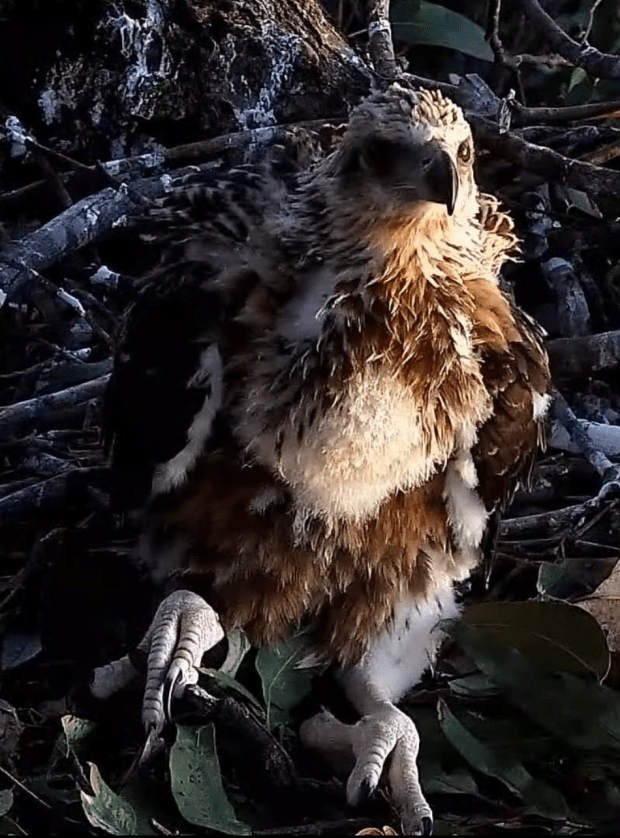
Just look at SE 29 and 30. 29 is standing so tall with its big crop while 30 is enjoying a private feeding from Lady. Look very carefully at 30 since we can see the top of the head, the chest, the wings and back and – of course those pink legs standing so tall. Weeks 5 and 6 show the biggest change from the fluffy chicks with their down to the stage of an eaglet. There is now down left on the head (maybe a dandelion or two on 30). Dark feathers are starting to show everywhere – they are the most gorgeous espresso brown. The chicks are spending a lot of time preening now as feather growth is said to be itchy (how does a human know that?). They are now able to stand like 29 is doing without the aid of the wing tips. They will begin flapping and might make some attempts at self feeding.
Notice that beautiful light rust that is appearing on both of the eaglets. If you have never seen a juvenile Sea Eagle you are going to be so surprised at how stunning their plumage is. Notice also how those beaks continue to grow long and strong.
Dad was nudging Mum at the Port Lincoln Osprey nest to get up and give him a turn. It was 23:42!
Andor visited the Two Frasers Bald Eagle nest in the Channel Islands. It looks like he now has some time to regain his strength after helping Mama Cruz raise Lilibet and Victor. He certainly must have had a nice lunch!
The streaming cam at the Minnesota DNR Bald Eagle nest is now offline until the 17th of November. Mark it on your calendars. I wonder if Nancy will have a new mate for the next breeding season????
Both eaglets at the Glacier Gardens Bald Eagle nest have now fledged. Congratulations to Liberty and Freedom for another successful year. Believe it or not, the Bald Eagle season will be getting underway in Florida in the next 4 weeks or thereabouts. Goodness.
Kielder Forerst posted that one of the 2022 fledglings, Frankham, is now in Spain enjoying himself on the llobregat River in Catalonia. His ring number is Blue 439 and he was the first to leave Kielder this season. Frankham was from nest 1A where Mrs YA raised the chicks after Mr YA did not return after they had hatched. Congratulations Kielder Forest!
Did you know that there are 10 Estonian Black Storks with trackers on them this year? Kaia and Karl II along with Waba and Bonus from the Karula Nest are amongst the ten. It is going to get busy once they start moving. Kaia remains near Liaskavicy in Belarus in the wetlands of the Priyjpat River.
A new book, Birds. A Complete Guide to their Biology and Behavior by Jonathan Elphick has arrived on the desk. Review to come.
Have a lovely Saturday everyone. Take care of yourselves. I look forward to seeing you soon….and remember, if you have a question, send it in. There could be 50 or 100 people wondering about the same thing!
Thank you to the following for their streaming cams, posts, and videos that form my screen captures: Ojai Raptor Centre, Berry College and ‘L’, Charles Sturt Falcon Cam, The Guardian, Orange, Australia FB, 367 Collins Street by Mirvac, Sea Eagles@Birdlife Australia Discovery Centre Sydney Olympic Park, Port Lincoln Osprey, Explore.org and the IWS, and Looduskalender.
Amidst the joy of Peregrine Falcon eggs in Australia at both Orange and Melbourne, the loss of dear Lindsay, the eldest of the two siblings hatched at The Campanile on the grounds of the University of California-Berkeley, remains heavy – a real heartbreaker. From the news it is apparent that Lindsay died several weeks ago; her body just being found today. She was last seen on the Campanile on 5 August precisely three months after she hatched on 5 May. A life cut way too short.
Lindsay was one of a two-part miracle. Lindsay’s Mum, Annie lost her mate Grinnell when he was killed after chasing an intruder away from The Campanile. There was worry that there would be no chicks this season. Alden arrived in 5 or 6 hours hours (already a friend of Annie and Grinnell’s) and offered to help Annie incubate the eggs and take care of the chicks. We rejoiced at the love the two siblings had for one another, when they played, and when they chased moths. They grew strong and they flew. It is with such deep sadness that we say goodbye to Lindsay today. Fly high, Sweet Girl. Soar to new heights you never imagined.
Here is the full announcement from Cal Falcons. It appears that Lindsay’s death, from the evidence found from her body, was killed by another raptor.
It is heartbreaking. Lindsay had such potential and, of course, it is very possible that she was the last chick our beloved Grinnell fathered. She brought us such joy! I would like to share a few images of this remarkable falcon moving back in time from the last sighting of her on The Campanile on 5 August to the day she hatched.
Lindsay and Grinnell, Jr adopted many of the quirks of Alden including loafing. Annie has perfected it!
Annie and Grinnell, Jr playing together at The Campanile. The two siblings seemed to really enjoy playing with one another, something that I have not seen for a long, long time. It was refreshing.
Lindsay on the roof of the library on 18 June after fledging. Just look at this exceptionally beautiful juvenile. Stunning.
Do you remember banding day 27 May (on the right)? Lindsay was frightened but quiet. Alden would not stop being loud! Lindsay was still sit ting with a not so scared look on her face in early June.
Lindsay was also sitting in that same pose on 22 May.
Hatch day for Lindsay, 5 May. Grinnell wants to come and help. Annie is not sharing – yet – but she will and each of us will rejoice watching this wonderful family.
‘H’ just sent this press release on Lindsay. Thank you, ‘H’. Just made it before I hit send! Grateful.
‘M’ writes: What do you think about this from Dyfi project? I am not sure I would pass off some of that behaviour as just “playing”, at least not based on how the smaller chick reacts. Wondered about your view, based on your study of third hatches.”
For transparency, I posted the information from Dyfi in one of my blogs. Emyr Evans has a long history with the Dyfi Nest in Wales. I have great respect for him but, in this instance, I choose to disagree.
In the UK Osplet deaths are generally attributed to either very poor weather in the early days after hatching or lack of prey, starvation not siblicide. There is little history of siblicide; there are so few breeding pairs and chicks compared to North America. This year, however, we did see it at the Loch of the Lowes Nest. It was rather horrific treatment of the third hatch that was killed by the eldest during a period of low prey delivery.
As you are aware, my research is on siblicide and, in particular, the success of any third hatch osplets vs the other two siblings. Because I track the juveniles long term this is limited to those that are ‘ringed’ and/or ringed with SAT tracking. My findings also rely on the good fortune of someone seeing the juveniles in the future and providing that information to various data bases! In my experience, the aggression shown by older siblings ranges from mild displays of dominance to more serious concerns that seem to taper off around the age of 26-28 days. Serious aggression often ends in the death of the smaller weaker sibling. There is much research to support the fact that it is not always about food. Sometimes it is just dominance.
‘M’ this, in my opinion, is not play. It is establishing the dominant bird on the nest. The dominant bird will eat first and if there is little food it will be the only chick that eats. Had food been scarce the treatment might have escalated but, thankfully, it didn’t. Gender may play significant roles also with the females requiring more food to grow 1/3 larger and feather a larger body. Thus, the females, especially if they are the first hatch, tend to be more aggressive.
Multiple times this year we have seen the third hatch killed by the eldest sibling and sometimes in conjunction with the middle one. As mentioned, this happened at the Loch of the Lowes this year when food was scarce. It also happened at the UFlorida-Gainesville Osprey nest amongst others. It also happens on eagle nests and other species. However, there appears to be a higher rate of siblicide among North American Ospreys than those in the UK. It is likely that these numbers reflect the higher population of Ospreys in North America. In addition, the lochs are full of fish and there are restrictions on many of them to prevent human intrusion during the breeding season.
Loch of the Lowes
In the News:
We are going to start with some fantastic news. When I lived in the UK, I studied in Leicester but lived in Lincolnshire and Belvoir (pronounced Beaver) Castle was a regular haunt for me – so close to where I resided. For the first time in 200 years, we have Ospreys breeding on top of Belvoir Castle! Oh, my goodness. I am delighted. Here is the BBC News report.
Bird Flu is also killing Black Vultures. Deaths from migration, Avian Flu, human disturbance and killings, fires, habitat loss, lack of food…how many of our raptor friends will be left?
There is a lovely documentary on YouTube on the return of the Black Storks to Germany in the 1980s. The cinematography is excellent as is the narration. So much to learn – 53 minutes. Find a nice quiet time to watch!
Nest News:
The 367 Collins Street Falcon Cam in Melbourne is up and running. So far there are 2 eggs!
Here is the link to the camera:
As you will be aware, the first egg of the season for Xavier and Diamond at their scrape in Orange was laid at 0713:48.
Diamond resting in the scrape after her labour and the delivery of the first precious egg for these two.
Diamond incubating the egg. How beautiful.
Xavier comes to the scrape to relieve Diamond. A short bonding ritual takes place before Diamond flies off.
Xavier scraping and trying to turn the egg as he settles down.
Xavier carefully rolls the egg.
Everything is alright with the world. Oh, what a joy to finally see the first egg for Diamond and Xavier. Let us all hope that their year is as successful as it was in 2020 with the hatch of the ever adorable Izzi.
Here is the link to one of three cameras for Xavier and Diamond:
I am so used to the Ospreys in the UK and the Dads bringing in a fish right before or when the sun is rising in the morning. That first fish delivery for SE29 and 30 at the WBSE nest in the Sydney Olympic Forest did not come until 12:31 today. Thankfully the chicks were civil and it was not huge but was a good size.
Images from early morning to feeding.
Early morning preening of those itchy feathers.
Beautiful Lady listening and waiting for Dad to bring food to the nest.
SE29 and 30 watching Mum aerate the nest. Just look at how carefully they are looking at her every move. This will imprint in their mind’s and they will know to aerate their own nests.
Finally, a fish has arrived!
Things appear to be going good at the Port Lincoln barge except for Mum making cries for fish. On occasion Dad has flown in eaten more than his fair share while Mum is fish calling. He then delivers the remainder to her. Come on Dad! Dad is taking his turns incubating.
Oh, it seems so long until 19th of September – may the time pass quickly! There is nothing cuter than nestlings a couple of days old.
Checking on Kaia’s transmission. She remains in Belarus. On the 25th of August she flew 123 km. She is now near the village of Liaskavicy. It is in an area that is part of the wetlands of the Pripjat River. There is a national park and the area is considered to be quite safe for Kaia.
Karl II is looking a little tired. Thanks to Urmas the supply of fish continues so that he can feed the four Black Stork fledglings. Soon they will fly and hopefully Karl II will have some days to recover and gain some weight before he leaves. Of course, when they do depart we shall all be worried for them. I wonder if by some means Karl II and the children will meet with Kaia and decide another route to their winter home???
It appears that all of the White Storks from the nest in Mlade Buky, The Czech Republic have left for their migration. It is raining heavily and both of the nests of Bukacek and Betty appear so lonely. Safe travels dear family.
Suzanne Arnold Horning has caught L2 on the Cornell Campus! So happy she is here with us. In the history of the nest, it seems that the 28th of August is the last day to see fledglings in the past. Enjoy these moments then with our first fledge of the year. Gosh, she is beautiful. We know that she is catching her own food – she was the second of the fledglings to do so more than a month ago. So all is well with L2.
It is Friday. A friend sent this to me to cheer me up because of Lindsay. I did giggle…love those sour worms. Thank you ‘S’.
Thank you so much for joining me today. If you have any questions, you can send them through the comments page or through e-mail. My address is maryannsteggles@icloud.com Have a fabulous Friday! Take care of yourselves. See you soon.
Thank you to the following for their streaming cams, videos, and posts that form my screen captures: Cal Falcons, Berkeley News, Dyfi Osprey Project, Friends of Loch of the Lowes and the Scottish Wildlife Trust, RSPB, The Guardian, BBC, 367 Collins Street Falcons and Mirvac, Charles Sturt Falcon Cam, Sea Eagles@Birdlife Australia Discovery Centre Sydeny Olympic Park, Looduskalender, Eagle Club of Estonia, Mlade Buky, and Suzanne Arnold Horning.
All the speculation is now over. Diamond has laid the first egg for her and Xavier at the Charles Sturt Peregrine Falcon scrape box on the water tower.
The time was 0713:48 on the 26th of August.
Here is the video of her labour and the laying.
Congratulations to Xavier and Diamond and the entire Falcon family at Orange ——and to all who love this falcon family. Well done, Diamond!
Thanks to Charles Sturt University at Orange for their falcon cam where I took my screen captures and my video clip.