It was really fantastic to hear from ‘B’ that there are super donations going into Ojai Raptor Centre for Victor from the Fraser Point Nest on Catalina Island and for Little Bit ND17 who is in care at Humane Indiana Wildlife. They are much loved not-so-little eagles. Forever grateful to those that work in the wildlife rehabilitation clinics donating their time and volunteering so that the wildlife get the very best care they can have. They do it with love, not for money.
Victor made the newspapers today! California loves its raptors and it is always encouraging to see stories about the Big Bear Valley Eagles – the antics of Spirit and her parents, Jackie and Shadow and those ever adorable Cal Falcons – Annie, Alden, Grinnell Jr and Lindsay.
Again, some of those amazing eagles and ospreys get forgotten when there is a crisis. Takoda is one gorgeous fledgling. Mr President continues to supply him with wonderful fish. Looks like an early morning catfish.
Wonder if Dad will bring in a dinner fish?
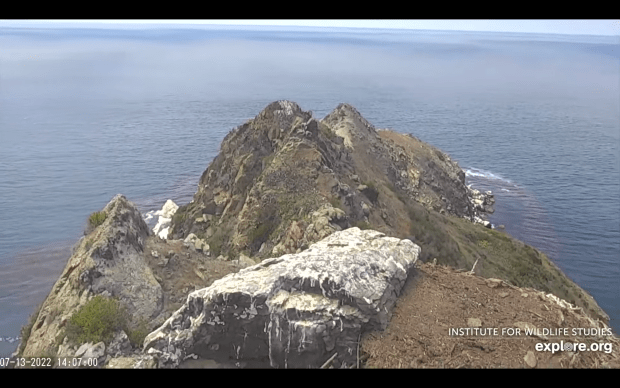
Lancer is on the rocks by the Two Harbours nest late this afternoon.
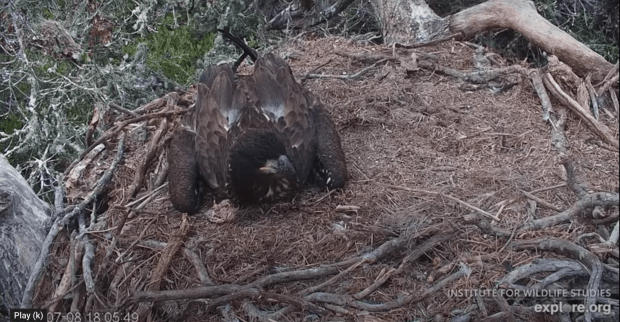
It doesn’t look like there is anyone home at the West End Bald Eagle nest of Thunder and Akecheta.
If you love California Condors, the Condor Cam is up and running and there are Condors in the trees around the site. They are often there feeding on carcasses provided for them by the Ventana Wildlife Society.
Here is the link to the camera in Big Sur:
This is a very quick look at a few nests this afternoon. I have spent the day creating a flight path for the garden birds – and there is a huge mess to clear up. I hope that everyone is well. Check in on your favourite birds. Many are about and still coming to the nests for food. Take care. See you soon!
Thank you to the following for their streaming cams and/or FB pages where I took my screen captures: Explore.org and the Institute for Wildlife Studies, Ventana Wildlife Society, and the NADC-AEF.
Most of us required some down time after the anxious moments waiting for Dr Sharpe to pick up Victor. Once he was there with Allie from the Nature Conservancy, Victor was located, held up so all could see him, and placed in a large black duffle bag. He was on his way. As Victor’s adventure is beginning, his sister Lillibet has been on the perch for most of the day. Yes, she is surely missing her brother.
I heard from ‘B’ that Lillibet had spent 5 hours on the branch after this moment. She really misses Victor. That is the sad part of all of this. What I did not realize was that Andor is a first time dad at 5 years old. Thanks, ‘B’ for letting me know that – so both Andor and Akecheta first time dads, young males – who did a fantastic job with the Mums this year raising these 5 great eagle fledglings.
Andor will bring a fish in and Lillibet will go to the nest to eat.
This is the update from Dr Sharpe:
That is fabulous that Victor made his way to the creek and was getting water there. That sure helped to keep him going til the rescue came.
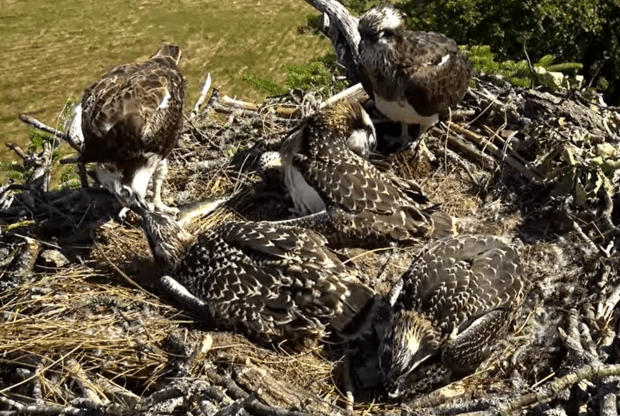
There are quite a few nests that need a quick ‘hello’. Just stopping in at the Boathouse, it is easy to appreciate how quickly the osprey nestlings grow. Look at the plumage – Dory and Skiff’s trio are moving into the Reptilian Phase. Soon we will have little black oily heads and they will be long and lanky.
‘H’ writes that we should never worry about Sloop, the third hatch. She notes that he gets at least 2 private feedings a meal and instead of being a little one sail boat he might turn out to be a small warship – the other meaning for Sloop. Oh, I needed that laugh this morning. Sloop reminds me of L4 at Big Red and Arthur’s nest. We worried ourselves sick but L4 would climb over the big siblings to get to the food and he was one of the first two to catch his own live prey to officially become a juvenile. — Dory and Skiff are doing an amazing job as first time parents.
There could be a fledge at the Mispillion Harbour Osprey nest at any moment! The chicks are flapping their wings. This was 0515. Adults have been bringing in nesting material but where has the yellow matt gone that Mum loved so much?
Breakfast at Osoyoos Osprey Platform. Looks pleasant. Hoping lots of fish come to this nest. I am told that it could be quite hot in this region for a few days. Gosh, the size difference between these two, hatch 1 and 3.
Beautiful mum with her two osplets at the Fortis Exshaw platform in Canmore, Alberta. The blood feathers are coming in on the wings. It is not a great image but you can see the shafts the feathers are growing out of on the chick on the right, their left wing.
Beautiful Mum.
There is still Only Bob and the egg on the nest of Tom and Audrey on Chesapeake Bay. Will the other egg hatch? There is still time but maybe it won’t. Tom has been alarming on and off this morning.
Doing a run through some of the Finnish nests…gorgeous chicks on nest #4. Looking really healthy. Mum has been working on the nest and they have been self-feeding. Lovely. Look at the size of those wings! Both full. No problems here.
At least one of these big chicks – and I am thinking both – are big females with lovely necklaces.
Oh, I love it when the crests are up. Gorgeous Nuppu with the ‘Only Teenager’ at nest #3 in the Satakunta region in Western Finland.
Nuppu is screaming so Ahti will hear her. We need more fish!!!!!!!!
The male at the Janakkdan nest brought in a huge fish for the two osplets at 17:04:16. I have not seen the female who was injured or sick. It is possible that she will not return to the nest. The two chicks are left with the fish to eat for themselves. Thankfully the father is still bringing in fish.
Let us watch and wait to see how these two do with this self-feeding. If the female is injured, dead, and/or left the area, the lives of these two chicks will depend on their ability to rip that fish up and eat it themselves.
Before I close we are on pip/hatch watch for Lady and Dad at the Sydney Sea Eagles nest in the Sydney Olympic Forest which is part of the Birdlife Australia Discovery Centre.
There has also been an update on WBSE27 – this was a fantastic and much necessary intervention. 27 is doing fabulous and this is the kind of news we want to hear about Little Bit ND17 – that he was kept in care until he can fly free like 27, catching his own prey and flourishing. (Note: The first time 27 went to rehab it was too short. She could not hunt and was found emaciated on a sidewalk being attacked by smaller birds).
There will be at least one more update from the Ojai Raptor Centre today. With no broken bones, it will be interesting to see what it is that was causing Victor to lose his balance and not be able to stand. He is in good hands, eating well…our thoughts go out to Andor, Mama Cruz, and Lillibet who only know that he is gone from their territory.
Thank you for joining me for this quick check up this morning. There is a tiny lull as we wait for fledges to start happening and keep a close eye on a couple of nests for progress and pip/hatch. I have not seen any new updates on Little Bit ND17 as of this moment. They could post one anytime on the Humane Indian Wildlife FB page. Take care everyone. See you soon.
Thank you to the following for their streaming cams and/or FB pages where I took my screen captures: Explore.org, Institute for Wildlife Studies, Channel Islands Eagle Lovers, Audubon Explore.org, Mispillion Harbour Ospreys and the DDNR, Osoyoos Ospreys, Fortis Exshaw, Chesapeake Conservancy, the Finnish Osprey Foundation, and Sydney Sea Eagles@Birdlife Australia Discovery Centre.
You need to know about the presentation and we have all been waiting for an update on Little Bit 17. Of course, we do not need any more bad news in Bird World.
First. I have just been notified that Alan Poole’s excellent discussion about North American Ospreys will be taken off YouTube in 8 days. This is extremely informative – if you want to learn about Ospreys, please have a listen. Lots to learn! The original programme aired last year. You can start and stop…
Humane Indiana Wildlife posted this announcement today. You will see mention of Little Bit 17 at the bottom. — I am going to assume that Little Bit’s fan club have tried to see him. Please don’t. Every wildlife clinic is underfunded and overwhelmed especially in the middle of summer. We do not want the staff to get to the point that they cannot get Little Bit out the door quick enough. He needs to stay there as long as he can learning how to fly and being taught to hunt. If you know people who say they are going,, please have a gentle talk with them. It is in Little Bit’s best interest.
At the Fraser’s Point Eagle nest, Victor and Lillibet fledged on 30 June. Here is a short video – notice that Victor tried to land on a bush but it would not support him so he fell to the ground. Lillibet had a good flight.
Victor returned to the nest this morning around 1030. He cannot stand. Mama Cruz doesn’t understand what is wrong with him. She has tried to feed him. This is tragic.
The Fraser Point nest is part of Dr Sharpe’s research area – the Channel Islands eaglets. You can be sure that he is aware of the problem and will determine whether or not it is safe to intervene and extract Victor so that it can be determined what happened and what is the best help for this recent fledgling.
This is the link to the Fraser Point streaming cam:
Send all the positive wishes that you can to this wonderful Fraser Point nest! Rest assured that if anything can be done, Dr Sharpe will do it. It is one of his great missions – to give these eagles a chance at life.
Thank you for joining me for this very quick post. Take care. See you soon.
Thank you to Humane Wildlife Indiana for their FB post, and to Explore.org and The Institute for Wildlife Studies for their streaming cam where I took my screen captures.
Do you remember holding your breath whenever the Highly Pathogenic Avian Flu H5N1 was mentioned? I recall looking at the falcons on The Campanile and the eaglets in the Channel Islands and just hoping that it would not land on those islands and wipe them out. Very very sad news is is coming out of the UK. H5N1 is in the north of Scotland and Shetland but today Coquet Island said that every chick on each of the 1964 Sandwich Tern nests has been killed by Avian Flu. Tragically, they believe that it will also wipe out every Roseate Tern as well.
Coquet Island is off the east coast of the UK just a little north of Newcastle-upon-Tyne in Northumberland.
Suzanne Arnold Horning – thankfully – has her camera with her just when she needs it. She caught the 3 Ls on a fence at Cornell today.
Can you tell who is who?
Lancer has been playing with sticks on the nest…often the Red-tail hawks will play with pinecones to help with their eye-talon coordination. This is a very cute video of Lancer having some fun. It reminds me of the Finnish Osprey couple pulling on their fish!
As well as being asked if the females ever go fishing for the osplets, I am often asked if the males ever feed their chicks. Many do! This is Aran at the Glaslyn nest today feeding his triplets.
Awwww. They finally lined up.
The beautiful Glaslyn Valley – home to Aran and Mrs G.
It is that golden glow of evening on the Dyfi Nest. Idris has brought in a nice fish for the end of the day and Telyn is busy feeding those three growing bigger girls. The weather is nice just like it is at Glaslyn.
Oh, Dorcha is feeding her big girl and boy their last meal at Loch Arkaig. It looks like she had a nice weather day – well, deserved.
The cam operator caught two of Dylan and Seren’s chicks close up. Oh, they are gorgeous. There is a third – it hasn’t gone anywhere! Just sleeping between the two. We do not need any more excitement in Osprey Land this week. Seren has also been fishing – bringing in some nice fish from the reservoir when she thinks Dylan hasn’t provided enough. Go Seren!
At the Boathouse on Hog Island, Skiff brought in a fish. It looks like Little Bob – Peanut to some – is getting another private feeding. ‘H’ mentioned to me the nautical names given to the trio – schooner, Skipjack, and Sloop. So Little Bob or Peanut is really Sloop. Did they intend for him to be a small anti-submarine warship from WWII or a sailboat with a single mast?
Big ones are full enough and Sloop gets some nice fish all by himself. I continue to praise these first time parents. They are doing fantastic.
If you have been watching the Cornell Kestrels in Wisconsin, there was a fledging frenzy today. Here it is if you missed it. All four took flight.
A few days ago ‘L’ asked about Malena and Klepetan, the White Storks who had their nest on the roof of Stjepan Vokic’s house in Croatia. Malena had been shot by a poacher and left to die. Vokic rescued her and Malena lived with him for 28 years. For 19 of those years, her mate Klepetan flew from South Africa to Croatia. The couple raised 66 White Storks to fledge with the help of Vokic.
Surprise! I found a book, Malena and Klepetan. A Love Story on Wings by Jillian Marie Shea.
The author puts several quotes in the front. One says, “You must write for children the same way you write for adults, only better.” That is the nacre of this book!
The book is rightfully dedicated to Stjepan Vokic – who would win my vote for Gold-level Interventionist. “Never doubt that a small group of thoughtful, committed citizens can change the world. Indeed, it is the only thing that ever has.” A good reminder that we have the capacity to give our feathered friends a second chance– if we will only reach out and do it – because, like Malena, so many of their tragedies are due to us.
It’s a feel good book – for all of us!
Thank you so much for joining me today. Take care. See you soon.
Thank you to the following for their streaming cams where I took my screen captures: Cornell Bird Lab, Explore.org and Audubon, CarnyXWild, Friends of Loch of the Lowes and the Wildlife Trust, Friends of Loch Arkaig and the Woodland Trust, Dyfi Osprey Project, Bywyd Gwyllt Glaslyn, and Suzanne Arnold Horning.
Good Morning Everyone. I hope that your day is bright with sunshine. A decade or kore ago, the summer temperatures in Winnipeg averaged 17-19 degrees C. Then for 4 or 5 years – perhaps a little more – they crept up to the high 20s with some days being 38 degrees. Today it is 19 C. A fantastic day for a walk and a check on the goslings later.
Yesterday I reported on one of the fledglings at the West End nest being in a dust up with another. I could not see any bands but made the assumption that it was one of the other siblings – forgetting that the 2-3 year old juveniles are returning to the Channel Islands. Lady Hawk cleared that up with a video noting it was an intruder that attacked Sky. A shout out to ‘B’ for letting me know!
Here is Lady Hawk’s video of that event:
I wondered how long it would be before more names were added to ‘the list’. That news arrived late last evening when ‘A’ wrote to me about the sadness at the Finnish Osprey nest of Miina and Marko. The feathers were found under the nest and it is believed that the nest was attacked, as others have been, by a henhawk. So sad. This nest site with its close proximity to the forest seems to be an unlucky one. Thank you, ‘A’ for letting me know.
Here is the information from Looduskalender:
"The nest equipped with a webcam in the Võrumaa osprey (Kalakotkas 1), where female Miina and male Marko nested with two eaglets, was soon taken down due to damage caused by lightning.

Today the nest was empty, the nest tree was all broken, the osprey, the young bird, was killed. The burglary could have happened a few days ago."
Happily, the osplets on the nest in Finland are healthy and safe – so far no attacks that I am aware. This is a natural Osprey nest – not a human made platform – 160 miles south of the Arctic Circle. It is in the area known as Lapland and they have sunshine almost 24/7 this time of year.
Here is the link to this nest if you do not know it:
The osplets at nest #4 are simply gorgeous and it will not be long until they are ready to fledge. Oh, let us hope that the hawks do not come around!
If you would like to watch all of the Osprey nests in Finland at one time, here is that link: saaksilive.fi/live/kaikkikamerat
Dory is busy shading the three osplets at the Boathouse Osprey nest on Hog Island today. Gosh, isn’t she just a great first time Mum?!
We will never know if the hour long fireworks did any damage to the Bald Eagles hearing at the National Arboretum. Takoda, however, continues to be fed by Mr President on the nest – and this is a good thing because we get to see this gorgeous fledgling. Takoda was eating breakfast at 0628.
All around the world people continue to celebrate the little Red-tail Hawk, Malala, that survived from being the Bald Eagle’s dinner on Gabriola Island. It was always difficult to see Malala clearly on the streaming cam. Sharon Palmer-Hunt posted two photographs of Malala on the GROWLS FB page and, in case you didn’t see it, here she is:
Adorable. Like the fledgling Blue Jays, the Red-tail hawks have light blue or light blue-gray-green eyes. As they age, the eyes will turn a deep espresso brown.
Check out the tail below. How many dark bands does Malala have? Laura Culley suggests that they need at least 5 but better 6 to fledge. Malala has been flying for a little over a week (?) and she now has 8 or 9.
Our other favourite Red-tail hawk fledglings were caught hunting and playing around the Cornell Campus last evening by Suzanne Arnold Horning. Oh, they are adorable. She got all three! Thank you, ‘S’. All of us appreciate your efforts chasing these quick hawks around the campus so we can see them.
As the North American birds fledge, we will be moving our attention to Australia. One of the most adorable Peregrine Falcon couples is Xavier and Diamond at the scrape on the grounds of Charles Sturt University in Orange. They are not a young couple – considered middle age at 9 years old.
Xavier gets prey and stashes it in the corner of the scrape for Diamond. Diamond is very particular. She does not like European Starling!!!!!! It looks a nice pigeon for lunch today.
If you do not know this couple, here is the link to their camera. We will be expecting eggs in late August/early September.
Beautiful Diamond.
If you do not know this couple, here is the link to their streaming cam:
There is wonderful news coming from Estonia. We knew from the photograph that the trail camera took that Kaia had found the fish basket Urmas has provided this family so that it can feed the foster chick, Bonus. Now Urmas has posted a photograph showing Karl II finding the fish basket! The adults will require so much more food as the storklets grow bigger and bigger.
The wonderful experiment to save as many of Jan and Janika’s Black Stork fish appears to be working with the dedication of Urmas and his team. I want to find the donation button and post it again as the cost of the fish for the two – Karl II and Eedie families – is high. If you wanted to help and haven’t yet, there is still plenty of time.
I often have disagreements over intervention with some of my raptor associates. In the case of the Black Storks, they are extremely rare. It is possible that all of the fledglings from last year in Latvia and Estonia did not survive. (We await word on Udu). It is not, however, just the Black Storks. So many of the first year birds are lost in their first year. To put accurate data on the % is very difficult as the following academic article explains. Depending on the species it can be as much as 60% in the first year.
That is why the intervention that we are seeing when adults die or birds in the nest get injured or knocked off is so important.
I was particularly moved by a statement ‘A’ made: “Now when I see an adult bird of any species, I am amazed that it made it to adulthood safely.”
‘H’ reports that there are now two chicks fledged from the Osprey nest in Carthage, Tennessee. Congratulations!
Thank you so much for joining me this morning. Have a wonderful day – or evening – wherever you are. Take care of yourselves. See you soon!
Thank you to the following for their streaming cams, personal images, and/or FB pages where I took my screen captures: Explore.org and the Institute for Wildlife Studies, Finnish Osprey Foundation, NADC-AEF, GROWLS, Charles Sturt University Falcon Cam, Looduskalender, Suzanne Arnold Horning, and Explore.org and Audubon.
Good Morning Everyone. It is such a blessing to have a beautiful day – almost mosquito free!
There are many times in our lives when we just need a good laugh..one of those rolling on the floor, letting it all out kind of hysterical moments. Just sit back and watch this Osprey couple solve a problem while the little one looks on. It took a day but they did it! Thanks to ‘T’ for the first volume and to ‘R’ for finding the finale – . Enjoy.
Just a note: This is the nest of Ossie and Alma. With the tragedy last year with the goshawk, the nest was abandoned. This is a new couple Eura (male) and Eine (female). May the wings of the goshawk never grace their territory.
You might remember that two osprey chicks were pulled off of the nest when the Mum got her talon caught in monofilament line. One died and the other was transported from the Pitkin Osprey nest to the wildlife rehabber. Thank you to everyone who got to that nest in a hurry and helped that baby. Here is the story and an update on the chick’s status:
Every once in awhile I get the question. This is a popular one at the moment: Do the female Ospreys fish? Yes, absolutely they do. Most will wait til their chicks are older than 35 days. At that age they are less likey to be predated. Some Osprey mothers have to fish to supply the food for the family earlier. Blue NC0 has been fishing for about a week and a bit at Loch of the Lowes. Rosie is a good fisher too and she brought in two very rare and protected fish to the nest today. Don’t tell anyone! The females will be entirely responsible for their food once they begin migration until they return to their nest during breeding season the following spring.
Another extraordinary effort to get a juvenile eagle – like our Little Bit 17 – to a rehabber so that it has a chance on living and flying. I will put a map of BC underneath so you can see where Powell River is!
Oh, wow. Another ringing and this time it is the historic moment that Ospreys return to Poole Harbour.
Do you love the Dahlgren Osprey nest of Jack and Harriet? ‘H’ caught them on the nest today! How wonderful to see all three together. That nest has been empty for days. Thanks ‘H’ – this is a great screen capture.
It is the time of year when people are out fishing in Canada (and elsewhere). Yesterday at the Nature Centre there were dozens of youngsters with poles. Here is another reminder of what can happen to our birds. Let’s all make an effort to help our birds by spreading the word about the dangers of fishing equipment. This is a pickerel rig – line, hooks, lead sinkers – it is all there! I can only imagine what could happen to this beautiful Osprey.
So help spread the word to fishers – not only clean up after yourself but also anywhere you see fishing tackle, old line, make an effort to clear the shores and trees of it. Of course, there are fish that will break the line and take the hook and line with them and these also wind up on the nests of our Ospreys and Eagles. Herons get tangled. Pelicans have hooks in their pouches. It is endless.
I have no idea who took this imagine. I wish I did! It is a good one to share if you hope to make the point about the dangers that fishing tackle can have on wildlife.
Poor Dorcha. After Aila not returning in 2021, Louis did not take his new mate to the nest that he shared with Aila. Instead, Louis chose the alternative nest. The weather is much worse at the new one. It has pitched rain all season – and the winds have been gale force. It was like that last night at Loch Arkaig. Dorcha is still wet and keeping the two big kids protected as much as she can.
Later in the day, everything began to dry.
In contrast, Blue NC0 and Laddie LM12 have had nice weather at the Loch of the Lowes. I am told that Loch Arkaig has its own kind of micro-climate different from the rest of Scotland.
Notice how large the chicks are compared to Mum. Once they fledge, Blue NC0 is going to begin building up her strength and eating so that she is fit for migration. Laddie will remain at the nest and leave last – staying to feed the chicks til they leave. Then he will begin his journey.
Blue NC0 fish calling later in the day.
It is always good to know where places are in relation to one another. Here is a map showing the distance from Loch Arkaig and Loch of the Lowes. I want to draw your attention to Aviemore, too. There are some incredible ospreys that live in that area on private estates. If you ever plan to go to Scotland or the Lake District, print up a map and locate all of the Osprey nests with wildlife centres and hides so you can go and see them. Many are very close together. The same goes for Wales.
The Osoyoos chicks are both on the nest —- thankfully and Mum is feeding them their breakfast. It looks like it could be a morning without rain! The nest and the chicks need to dry out. Love the crop on the big one. Hope that baby gets enough!
The Ospreys in Canmore, Alberta are going to have a nice day! Beautiful sunrise this morning. The high will be 21 C or 69.8 F. Perfect. Last year the chicks were literally jumping off the nests in British Columbia and Alberta due to the heat. (Not at this one). Twenty-three were rescued in lower British Columbia and taken into care so that they would not perish. That was just remarkable. So glad that the weather pattern is different this year for them.
Oh, beautiful Boathouse Osplets on Hog Island in Maine. They are all Reptiles!!!!!!!!! That wonderful charcoal coloured thermal down is in and you can see the wee little dandelions of natal down that will come off. Their heads have lost the ‘soft’ look and appear as if they have been smeared with oil. The coppery red feathers are on the back of the head area, the nape. Little Bit is right in there between the two older siblings.
Aran is preparing a fish for Mrs G and the kids for their tea time meal.
Mrs G is anxiously waiting! Looks like a lovely afternoon at Glaslyn.
It looks like everything is fine with the Osprey nests this morning. If you are watching Carthage, TN, ‘H’ reports that the first fledge happened early this morning. Congratulations! And ‘T’ says that the two Imperial Eaglets in Russia were ringed yesterday. Fantastic. So cute.
Thank you so much for joining me this morning. All nests seem to be doing just fine. Take care. See you soon.
Thanks to the following for the streaming cams and/or FB pages where I took my screen captures: Bywyd Gwyllt Glaslyn, Boathouse Ospreys and Audubon, Fortis Exshaw, Osoyoos Ospreys, Friends of Loch of the Lowes and Scottish Wildlife Trust, Friends of Loch Arkaig and the Woodland Trust, Dahlgren Ospreys, Bald Eagles Live Nest cam and News, and Pitkin Outside.
I hope that you have had a really lovely weekend. Thank you for taking the time to join me this evening.
There are two important moments in a young Red-tail Hawks life. Their first flight marks them as a fledglings. They need to fly out and return to the nest for the proper definition to apply. They become juveniles only after they catch their first live prey item by themselves. So everyone give a big shout out and congratulations to Big Red and Arthur’s L4 (that little cracker) and L 2 who officially became juveniles today. Wow. Didn’t I say that L4 is amazing. No fear. I will never forget him climbing right over those big siblings to get at the front of the food line. No worries about siblicide on Big Red and Arthur’s watch.
Across the pond, Osprey parents are working hard to get their chicks in perfect condition for migrating. While Osprey chicks will fledge and fly and return to the nest for a feeding from Dad, they normally do not catch their own fish until after they have begun their migration. The parents do not teach them. Fishing is hard-wired into 60 million years of Osprey DNA and memory.
Blue NC0 flew out and brought in a whopper to her two – a big girl and a boy.
Idris is trying to beat every Welsh record that there is for fishing! This is an unbelievable catch! Three big girls and Seren to feed plus himself! Idris is up to the challenge!
Dylan took the approach that more deliveries are the best so he recorded 8 fish deliveries for Seren and the kids before 1700. Wow. It looks like a perch this time.
It was very sad news to learn of Pikne’s demise on the 6th of June on a hydro pole in Turkey. Searchers for her body and the transmitter could find nothing so she has been taken by humans or larger animals. My immediate concern after hearing this is where is Udu, the only surviving juvenile of Karl II and Kaia of 2021. Finally some indication of his transmitter on 16 June but questions lately. He was in the Central African Republic at the time. But this was April 2nd…with battery power at 0%. Since Urdu’s tracker tries to send data but the location is the same as April 2nd. Perhaps someone will be able to establish what is happening. My fear is that Udu’s transmitter is in the hands of a human playing with it and Urdu is no longer with us. Please let me be wrong.
I continue to watch the experiment of Urmas and Dr Madis V with the Black storklet chicks of Jan and Janika with much interest. Bonus was been placed in the nest of Karl II and Kaia and this morning Bonus was not defensive when Karl II brought food. It would appear that Bonus has now accepted he is part of Karl’s family. Amazing news. Bonus has been in the nest for 4 days.
As you know I believe in intervention when it is more likely to benefit the bird. This is the first time that anyone has tried to raise Black Storklets in a clinical setting and then foster them with other Black Stork families. Urmas and Dr Madis V went to great lengths to try and ensure the success including decoy parents, the feeding Toto and making certain that sounds of the forest was present. Urmas also distributed fish baskets to try and take the burden of feeding an extra storklet off the parents. We celebrate today that Eedie has found the fishing basket provided by Urmas. Jan and Janika’s storklet, Janus, is in Eedie’s nest. There is a picture of Eedie going to the fish basket to get food for the family. Thank you ‘T’ for sending us this confirming image. Tears! So many are learning about the behaviour of the Black Storks in these circumstances — this will prove important in the future should another nest lose a parent during the breeding season.
When there were statements about the Bald Eagles feeding ND17 it was important to have ‘proof’ in some form. There wasn’t any. In fact, ND17 was either fed little or nothing due to his condition when the rehabbers picked him up. To demonstrate that the intervention is working and what aspects are helpful to the storks, photos are being taken. This photo proves that Eedie found the fish and now will return to the nest to feed the four storklets.
At the nest of Karl II and Kaia, there were 5 feedings today – 3 by Karl and 2 by Kaia. Bonus has now been part of their family for 4 days. Is he eating enough? Yesterday his ‘ps’ was thin but today there is an image of a healthy ps by Bonus proving that he is eating well.
At 12:12:55 Akecheta flies to the nest with a fish. He looks around wondering which one of the fledglings was going to fly down and grab it.
It was Sky!!!!!!
That is a great mantling job!!!!!!
At 16:02 it is Ahote’s turn to get the fish drop! Oh, I so admire these parents who continually risk their legs and talons to feed their fledglings. It is amazing.
If you see an empty nest at Two Harbours, do not despair. Lancet has been seen eating on the overlook cam.
This is a very short report. It was warm on the prairies today with a beautiful blue sky and lots of happy people. I was out counting American White Pelicans and Double-Crested Cormorants. I will not bore you with the panorama of photos that I took to ensure the count was accurate but..they are such beautiful birds. It is an honour to see them fishing and raising their little ones in the summer. There are places where sport fishing is popular where the pelicans are not appreciated. Authorities can, even with the Migratory Bird Treaty, give permission for people to shoot them! Pelicans were fishing out of the rivers long before people were sport fishing. If people needed to fish for their survival that is one thing (and some do) but…I will let you finish the sentence. You know me well and what I would say.
If you are ever sent to help out with a bird count, it is much easier if you take various shots of the stationary birds and then try, as best you can, to count those flying about.
Take care everyone. Thank you for being with me this evening. See you soon.
Thank you so much to the following for their streaming cams and/or FB or forum pages: Looduskalender, ‘my friend T’, Explore.org and The Institute for Wildlife Services, Dyfi Osprey Project, CarnyXWild, Eagle Club of Estonia, Scottish Wildlife Trust, and Ferris Akel Tours.
Oh, what a day it has been. Pretty exciting stuff happening on the nests. I was just told by my friend ‘G’ that a hatch is happening at Cape May Osprey nest. If you follow that nest, check it out!
First news first. Ahote returned to the natal nest of the West End Eagles, Thunder and Akecheta at 06:54:08 this morning. Whew! He spent 4 days over on Transmission Hill. It is sure nice to see the Three Amigos back together.
Thunder and Akecheta have not delivered food. One of the eaglets has flown off the main nest. It is not clear which male it was. Kana’kini is on the branch on the ocean side. It is thought to be Ahote but no confirmation.
Ahote is back on the nest. So controlled. Oh, I hope those parents get some food on this nest. He needs a big reward for all that effort.
As many of you are aware, Urmas Sellis undertook the rescue of Jan and Janika’s storklets. He originally placed a fish basket for Janika in the hopes that she would find it and be able to feed herself and the four storklets. He also put a pail of small fishes on the nest. Janika did not find the fish table. Two days later, Urmas returned to take the storklets after cold nights without warmth, etc. Sadly, the fourth one died right before the rescue. The three surviving chicks are in incubators. There is a fundraiser. Here is the information if you feel so inclined to contribute.
Fledges are going to overlap one another once they start. At the Red-tail Hawk nest of Big Red and Arthur, the average age to fledge is 46.5 days. Today L1 is 46 days, L2 is 43, L3 is 42 and L4 is 39 days old. It is believed that to fly well, the hawklets need to have at least 5 dark bands showing. L1 has her 6th band peeking out. L2 has the 5th band peeking out while L3 has 4 dark bands and L4 has 3.
Big Red brought in some unidentified prey and some wanted to eat while others wanted to run and flap. It was rather chaotic!!!!!
The hawklets are pretty sedentary on the nest – even with all the flapping. After fledging, during the first 3 weeks, their activity level is believed to double. After 6-7 weeks, they will begin to catch small vertebrae. The parents will continue to feed them (more at first) and teach them hunting tricks until they leave the territory.
To my knowledge, Little Bit 17 at the ND-LEEF has not had prey yet today.
At the UFlorida-Gainesville nest, Middle almost fledged today. He would have if a storm had not quickly rolled in with high winds, rain, and some hail. Have a look at a couple of clips of Middle’s hovering. He is impressive!
At least twice today, Middle got the fish and Big did not! His confidence level is growing and growing.
Even soaking wet, Middle just doesn’t want to give up. Expect a fledge anytime!!!!!!! Nothing is going to stop him.
Middle is full of vinegar. Is this osplet going to fledge soaking wet?
How lovely it is going to be when Middle flies off with confidence. There was a time when it was not clear if we would get to this day. Middle has grown into a fantastic, getting more confident, healthy bird. Am I saying it twice? how nice the feathers are on these two? Mum and Dad can be proud. We lost Little Bit but will have two super fledglings when Middle takes off. I hope he finds his way back to the nest as easily as Big. OGK and YRK have been a bonded pair since 2006 – 16 years.
If you watch the Royal Albatross cam, today marks the 21st day that OGK has been away. Let us hope he returns to QT chick soon. Mum YRK is doing double duty at the nest and the NZ DOC rangers on Taiaroa Head are providing supplementary feedings for several chicks.
D
Take care everyone. Thank you for joining me. See you soon.
Thank you to the following for their streaming cams where I took my screen captures and video clips: Institute for Wildlife Studies and Explore.org, the Eagle Club of Estonia, Cornell Bird Lab RTH, Cornell Bird Lab and NZ DOC, and UFlorida-Gainesville Ospreys.
I would have moved on to a different topic but several of my readers have written to me sad and frustrated that nothing was done to treat the ill peregrine falcon nestling in Melbourne. Others are very concerned that if the little male’s corpse is not removed, other, larger birds of prey might consume it and get ill. Each raises some interesting moral and ethical issues as well as practical and legal ones.
As in all cases, it is good for readers to know where the writer stands on matters so to be clear – I encourage banding of birds and the use of sat-paks for tracking information in research. I do not believe we have too many birds and I take the position of Rosalie Edge that we must know the numbers we have to be able to determine if they are dwindling. I promote safe fishing practices to protect all seabirds. I also believe that humans have had a catastrophic impact on our planet and that the fine line of when to intervene or not is blurred. I believe that animals and birds have a positive impact on human life. I know, from all the letters I receive from each of you daily, that the streaming cams of the birds has added a level of joy to your lives that many did not think possible. Many have written to me who were dying of cancer saying that the streaming cams of the birds took their mind off themselves. How wonderful. As a former university faculty member with numerous research projects, I know that permissions, specific protocols, and agreements are made and it is not always easy to tweak these. In other words, some researchers hands are simply bound and they can do nothing even if they wanted.
There is a treatment protocol for Trichomoniasis in peregrine falcons. (There is also treatments for song birds and I thank ‘L’ for reminding me of this). I am posting the first page of an article in the Journal of Avian Medicine and Surgery. The abstract at the top gives a very good synopsis of the paper. (I have yet to find a free PDF so I can post the article in its entirety).
It is unclear how practical it would be to treat wild birds such as the male on the ledge. Indeed, there could be legal issues for the researchers that do not allow for any intervention. That is something that has to be realized.
This brings me to the second concern of my readers – the corpse of the young male left on the scrape box. Peregrine Falcons are very particular about what they eat. I am not concerned about the other chicks and I do not know what other birds in the area might venture up to that high of a level for carrion. In a rural area where there could be vultures, I would be very concerned. And in my own urban area, I note that gulls will eat anything. So, yes, I am also concerned and hope that the body is removed and disposed of properly.
This was an unusual year watching this pair of Peregrine Falcons raise their chicks. At the onset, I stated that the majority of the prey items would be pigeons. As you will have noticed, there have been a variety of birds including what appears to be one of the released Peace Doves in yesterday’s Remembrance Day celebrations yesterday. So was this caused by there not being as many pigeons as normal? And is this because there has been bouts of Trichomoniasis within the species in Melbourne that has killed off numbers of the birds?
Where is the male falcon that fledged? We have seen the two large sibling sisters with their little brother. Is it possible that that little male also ingested enough of the diseased bird to be impacted?
There could be answers for the question around the disease killing off large populations of Melbourne’s pigeons. I will try and find out. I doubt if we will ever know the answer to the question about the other male unless it is found and identified and a post-mortem conducted. I truly hope that I am wrong and it just doesn’t want to fly that high yet!
I really want to thank all of you that reached out over the past week and those today. You show a genuine concern for the wildlife and birds which is refreshing and hopeful. I will, most likely, put this little one to rest now. Your letters are always welcome. Your concerns are never trivial. Thank you for caring!