There has been a lot of noise in the Winnipeg birding community about a Green Heron at a park south of our City. People love to watch the herons fish and the sheer gracefulness of their movements.
There was no heron. We had missed it by half an hour but, it was a beautiful place to walk. The only thing you could hear was the chattering of a Red Squirrel.
Groups of Canada Geese were in the fields where the farmers had harvested the grain.
As we continued down the gravel road, overhead two skein of geese in the typical ‘V’ formation flew in front of us. Did you know that by flying in the ‘V’ formation, the geese not only conserve some of their energy by it is thought that their hearing and sight are enhanced. We decided to try and locate where the geese were going.
There were geese everywhere. They cannot read the sign!
Besides geese, there were Double-Crested Cormorants, Ring Billed Gulls, and a few Mallards.
Oh, this one was a beauty. He has been in the water and was drying his wings. Those feathers are not waterproof. To help them underwater, they have sealed nostrils, great underwater vision, and look at that tail – it functions as a rudder.
I thought he was a rather attractive bird.
The plumage of the Double Crested Cormorants below is lighter than the one above which is a breeding adult. I believe these two are immature.
There is always one very cute little female Mallard.
The Ring Billed Gull had a few friends in the water. I had a very hard time determining the colour of this one’s bill. If it is yellow with the black tip, it is an adult. If it is pink with a black tip, it is a juvenile. Are its legs and feet also pale pink? If so, it is a juvenile.
The birds continue to travel through our City as fall migration continues. All of the birding organizations in my province are gearing up for fall workshops. If you live in Manitoba, you might want to check these two out. If you live elsewhere – as I know most of you do – check your local birding associations.
Near me have been fields of Sandhill Cranes, many of them dancing. Someone spotted three Moose together on a farmer’s field, too. Because of the fires and the drought, all of the animals and birds are hungry.
There has been no word from Sharyn Broni, the Ranger at Taiaroa Head about Tiaki. Her GPS indicates that she has fledged but she is on land!
Here is the link to check on both Tiaki and her dad, Lime Green Black (LGK):
Chicks have been rescued if they got off to a rocky start on their fledge. I want to wait and hear what the rangers say about Tiaki.
Thank you for joining me. I hope that wherever you live you can get outside and enjoy some beautiful fall weather with the birds. Take care. See you soon!
It is 9 September in Australia. My computer tells me that it is 17:34 on the Canadian Prairies on the 8th of September. In three hours, around 20:00. CDT, the NZ DOC rangers will fit Tiaki with the tracker. She is 228 days old and could fledge any time.
Here is the link so that you can watch. Both LGL and LGK were fitted with trackers. LGK’s is still working providing valuable information on where the adults forage for food for their chicks.
In other nest news, it has been confirmed that Z2 (Aeron) and his family have now all departed for migration. Aeron’s nest is the Pont Cresor in Glaslyn. At the same time, Aran is still at the Glaslyn nest. Many worry about his late spring wing injury but, he most often doesn’t leave until mid-September.
Wales issued a statement that due to the cold spring weather and misfortunes, their six nests produced only six chicks to fledge.
9 October is one of Cornell’s big bird submission dates. This year they are even calling it October Big Day. They want everyone to do a bird count around the world. Mark it on your calendar. I will give you more details closer to the day.
eBird submissions are very helpful. Some recent discoveries, sadly, include bird and plane collision information.
A photo of an adult Osprey yesterday leads everyone in Missoula to think that Iris is still in Montana. The image was taken from the Owl Pole Camera.
Let’s chick on where the Black Storks are today.
Pikne is in Moldova.
Udu is in Southwest Poland.
Udu’s area is full of lakes!
There was no data update for Karl II.
Julge, the only surviving chick of Jan and Janika, has made its way through Germany and looks like he is flying into France. This stork picked the Western Route! Julge is the purple line going into Belgium. It is nice to know he is safe.
The last time that Big Red and Arthur’s K1 and K3 were spotted was 3 September. If they are truly gone and starting their own lives, we wish them and those that are migrating good winds, food, and safe landings.
My original computer issue was fixed but now it seems that some of the keys are sticking. It isn’t fun to keyboard. I will leave you with a couple of images of ducks and geese from my excursion to the park today. It was quiet. Everyone was off tracking down a Green Heron that had flown into town!
A juvenile male Wood Duck.Juvenile Female Wood DuckAdult male Wood Duck,moultCanada Geese
Thank you so much for joining me today. Don’t forget to drop in and see Tiaki get her tracker! My hope is that it is equipped with a 7 year battery. Take care everyone. See you soon.
Thank you to the following for their streaming cams or FB pages where I took my screen shots: Montana Osprey Project, Eagle Club of Estonia, Cornell Bird Lab and NZ DOC, and BirdMap.
It has been several weeks since I travelled to check on the two osprey chicks in their nest at Grand Beach Provincial Park. A friend sent me word on Tuesday that the two chicks were still at the nest with mom. Circumstances kept me away until today. It was a bright sunny day with no chance of rain – seemed like the perfect chance to go and have a last visit with the osprey family if they were still home.
Manitoba is a summer breeding ground for Ospreys. They arrive in April and are usually gone by mid-September. Due to public outcries because many of the birds were electrocuted on hydro poles, our public utility, Manitoba Hydro, began erecting platforms for the birds in the hope that they would build their nests on them and not on the high voltage lines. The place that I visited is Grand Beach Provincial Park. Close to the West Beach is one platform that is occupied. There is another platform near Grand Marais, only a few moments away. It is unoccupied and was not in good condition. The water around it seems to have dried up eons ago and it is very close to the highway.
The nest that I visited is located on the shores of Lake Winnipeg. Locate Winnipeg and then move your eye 45 degrees north-northeast til you see the green type indicating Grand Beach.
Lake Winnipeg is the world’s 10th largest fresh water lake. It is very shallow by most standards. On average it is only 3.6 metres or 12 feet deep although there are a few places where it is 10.9 metres or 36 feet deep. The lake measures 436 kilometres or 270 miles in length and 111 km wide or 68 ft at the widest point. It has more than a 1609 kilometres or 1000 miles of shoreline – many areas with beautiful white sand beaches.
This young lady was the only one home while we were there. She was food calling most of the time despite the crop she had. It reminded me so much of Tiny Little. You could hear her half an American football field away quite clearly! She was not letting up.
What was especially funny was the large chunk of fish she was holding in one of her talons. Did she want mom to come to the nest and feed her?
Along with the food calling this juvenile certainly did a lot of wing flapping but, she never left the nest while we were watching.
The sun played havoc with the lighting casting everything almost in silhouette.
Look at those big beautiful wings. She has no idea what is in store for her but she has imprinted on her brain the fresh water marsh and the lake where she hatched. If she survives, she will visit this nest or a place near to it in the future.
For an area that tends to have lots of water birds, it was relatively quiet. There were only a couple of Canada Geese, a Crow, a duck, and some small birds.
There was a crow who came to see what all the commotion was about with the Osprey and to make sure that I didn’t cross the barrier to get closer to the nest.
There was also this lonely little duck all by itself. My Manitoba birding book suggests that this is a female Common Goldeneye. She is so far away this is the best I could do in terms of an image.
This seems like a perfect place for this little diving duck that is 41-51 cm long. She could be looking for tubers, frogs, insect larvae, or even small fish.
In North America, the Labour Day long weekend marks the end of summer and all of its activities. Everyone will be back in school in a few days. The beaches will be empty and the leaves will continue to turn yellow, orange, and gorgeous shades of red. Meanwhile, the birds who are still here will ready themselves for their long migration south. The seasons are changing. It is in the air and the smell of the leaves when you walk on them. There is no more need for air conditioning but, rather, a light jacket. I love this time of year.
Before I leave, I want to show you the map of the Black Stork’s migration today. I am so proud of little Pikne, the last one to leave Karl II’s nest. She has headed straight and is doing so well. She is in Moldova. Indeed, all of the birds are progressing at a good pace it seems.
You can also see that Julge – the Black Stork that got on the boat heading the wrong direction – is now in Germany. Udu is crossing Poland. Both of them appear to be going the Western route but Udu might correct his course. We wait. Karl II is relaxing on the shores of the Black Sea.
Thank you for joining me on my short visit to check on our Ospreys and the Black Storks. I wish them good winds, lots of fish, safe travels, and a long life. Stay safe everyone!
I want to thank the individuals in charge of the tracking of the birds and their posting of the current maps on the Estonia Eagle Club Forum pages.
It was another beautiful day on the Canadian prairies yesterday. Tomorrow many of the migration events as birds move through out province from north to south. The Sandhill Cranes have covered the farmer’s fields in the south already and a friend noted that the nuthatches and chickadees were all over her feeders yesterday.
There are birds coming and going at one of the local parks but the Wood Ducks remain, waiting for the juveniles to be ready. The Canada Geese were there, too, and a few people were feeding the ducks and geese grain and corn. I will say it again – all the signs put up to say no bread or salted popcorn, etc. have worked. The pond is much cleaner and while the birds might be acting like they are starving they are healthier for the effort.
Female Wood Duck. 31 August 2021
This little female Wood Duck was such a sweetie.
I am a big softie for our Canada Geese. There were about 200 of them around the pond and several hundred more on the playing fields eating grass.
These male Wood Ducks are in various phases of molt. Some, like this one, are almost finished while others remain in the eclipse phase, halfway finished. By the time they fly the males will be there colourful selves!
Those red eyes are a certain way to know it is a male Wood Duck.
Did you know that Wood Ducks are a type of perching duck. They like to stand in trees and will, if there is a box available, make their nests high off the ground.
Some of the wood Ducks joined the Mallards and the Northern Shovelers for some wild birdseed a couple were tossing on the ground.
There were about 50 of the little female Wood Ducks out and about trying to get seed.
Ah, they are so sweet. The white teardrop around the eye lets you know this is a Wood Duck.
Isn’t she gorgeous? She looks like she has white goggles on. But that beautiful grey and rusty mottled chest is stunning.
My bird book says this is a female Northern Shoveler. They will dabble on the surface of the water for food but we watched them use their wings and feet to stir up the water to get food from the bottom to rise. This one has decided to try out the wild bird seed the couple are spreading on the ground.
This cute little female Mallard kept looking at me. I wonder if she thought she should charge to have her picture taken? Perhaps a handful of seed?
Mallards are dabbling ducks. They tip themselves so they can feed feed, rooting through shallow water and mud in search of plants and insects. She will also nibble along the surface and yes, she loves it when you feed her seed on land.
This juvenile male Wood Duck was having a great time with an acorn. At first I thought he was going to choke but no, he was playing a game.
He would pick up the acorn and then he would let it roll chasing it down the embankment and then picking it up again.
This little Mallard started imitating the Wood Duck. It was quite hilarious.
There were about 50 ducks coming up to find seed. Can you spot the female Wood Ducks? and the female Mallards?
It was lovely in the park. It was so good to see people feeding the ducks the right food. Those signs really worked. One man came over to talk to me – everyone is always curious when you are out with a camera and a long lens. He thought I had found something super special! He entertained me with Knock-Knock jokes. Then he offered me some advice, ‘You can get bags of wild bird seed at the Dollar Store. I bring two bags every evening.’ What a great guy. ‘Be sure not to throw the seed in the water!’ as he walked to his car. He is absolutely right. Only toss the seed up on the ground away from the shore.
In other bird news: Maya and Blue 33 have migrated from Rutland. Maya on the 30th and Blue 33 on the 31st according to Rutland’s announcement. Everyone has now left the Dyfi Nest with Idris the last to fly out on the 30th. Aran remains at the Glaslyn Nest waiting til the last either because of his wing injury or he is still protecting the nest or both. I have not heard if Z2 (Aeron) at the Pont Croesar nest has left or not. The WBSE continue to do well so everything is alright with them. They are stretching their long necks to see what they will do. There is no news about Iris having left the Hellgate Canyon area of Missoula for her migration. Someone believed they took a snap of her on her favourite tree down on the river this morning. There was still one egg on the Orange Peregrine Falcon nest but there could be another later today.
Take care everyone. I hope to find some pelicans today – are they hiding? And if not, I will go back and feed the ducks at the local park. Thank you for joining me this morning. Stay safe!
If you are looking to take ‘decent’ photos of Canada geese, if it is a hot day in the afternoon, don’t bother. They are all taking siestas! Best time is in the morning and early evening. The Cooper’s hawks were not about either.
We had a lovely walk through the park anyway. It was just a beautiful end of the summer day i. The flowers are still blooming in the English Garden and there were more than eight people with their cameras cuddled up by the Bee Balm trying to see if they could catch a glimpse of a hummer. They were probably sleeping like the ducks.
Most of the time this pond is full of Canada geese. Not a one. A couple of lonely ducks out on the water.
This is the tower at the Duck Pond at Assiniboine Park in Winnipeg, Manitoba, Canada.
All of the water features and the move from full sun to shade gardens made the stroll delightful. There were a few people wishing they could put their feet in the lotus pond.
So we drove to a different, small park. That is actually where we found the geese sleeping and alerted me to why we could not see them in the big park. Only a few were foraging in the grass.
The juvenile wood ducks are getting bigger! They have tripled in size in a couple of weeks.
The Mallards were so busy digging in the dirt under the bark they hardly noticed me.
What is she looking for?
They are sifting through the mud and bark near the pond searching for bugs, maggots, and anything else that they can feed on including little plants. The behaviour is perfectly normal!
This gentleman got back in the water and cleaned himself off later.
There were a few geese not sleeping. These were hot and stood at the edge of the pond drinking for about five minutes.
Then they decided to do a lot of preening.
Mr Crow was simply upset at everyone today. There were people having picnics not too far away. I wonder if he was looking for some treats? It was actually good to see that no one was feeding the ducks cakes and bread. The signs are working!
Gosh, isn’t this male Wood Duck lovely? What stunning colours and that big red eye.
Another one of the juvenile Wood Ducks.
This little male decided to swim right up so I could get a good shot of him. They have the most gorgeous patterning. The swept back crest and those iridescent feathers are just stunning. He had to be the most handsome male at the pond today.
He swam away.
And then he turned around again.
Male ducks are called ‘drakes’.
This is a male Wood Duck undergoing eclipse during the summer. During this time he will lose his beautiful male plumage but he will get it back in the fall. Some ducks are unable to fly when they molt. The females also molt too.
Oh, isn’t this female Mallard gorgeous?
She might not be as colourful as the male Wood Duck but she is always a beauty. Did you know that female ducks are called ‘hens’?
The Mallards were simply going crazy splashing up and down in the water today. It was like they were trying to shake the plants up from the bottom of the pond so they could eat them.
What a beauty. Just before she flew off.
All of the ducks will hatch their eggs, take care of their babies, molt, regrow their feathers, and everyone will hope to eat well before they migrate.
The ducks in the nature centres and parks are not ringed so that they can be counted if they are shot! We enjoy learning about their life cycles and watching their babies grow. Oh, I would not be popular in places where hunting is popular!
Just a some notes about what is happening in the rest of Bird World. The people running the Sydney Sea Eagle cam have turned it back on. They believe that the danger for WBSE 28 has passed. Both of the little sea eagles have been eating well and prey has been regular. This is fantastic news.
The last of the Black Storklings that was fed on the nest in Jegova County took an unusual flight path when it left for migration. And then,Julge decided not to fly but to get on a boat and it is now heading for Primorsk, Russia. It should be there on 31 August. Julge is the purple line showing in the middle of the sea on the Birdmap tracking. I hope that Julge is OK and corrects his flight path. It would be very cold in that northern part of Russia in the winter.
Diamond even accepted a Starling from Xavier today for her lunch. There has been lots of mating – sounds heard on the camera – but no egg yet.
This morning Idris was on the Dyfi nest defending it. What expressions came on this Osprey! His son, Dysynni has not been seen since Saturday the 28th at 10:57.
I know that lots of people like to plan trips – when we can travel again – to see the Osprey. It seems that those down in Poole Harbour, England have hit the jackpot. All of the migrating birds are stopping there to feed and rest. So think end of August – Poole Harbour!
Thanks for joining me today. Tiny Tot and Tiny Little are out somewhere making their way in the world. We want them to stay safe – all the birds – and all of you. Take care.
Thanks to the following for their screen cams where I took my screen shots:Dyfi Osprey Project, The Falcon Cam at Charles Sturt University, Orange, and Cilla Kinross, the Sea Eagle Cam, Birdlife Australia, and The Discovery Centre and the folks running the BirdMap.
Diamond laid her first egg of the 2020 season at 04:16:09 on 27 August! She looked uncomfortable during the day with her rear all puffed up. How grand! Here is the video of that magical moment last year. If you have never seen a bird lay an egg, have a good look. They go into labour just like human females. The egg inside is very soft. You have probably noticed that the female birds do not immediately begin incubating the egg once they have laid it. This is so the air can harden the shell. In fact, Diamond is not going to start serious hard incubation til all of the eggs are laid. This is so the eyases will be born closer together, be a similar size, and not have the issues that eagles and ospreys have with the tiny third hatch.
There are now two Peregrine Falcon nests in Australia on streaming cam. If you miss Annie and Grinnell then please check out either of these. This is the link to Diamond and Xavier’s camera. There is a chat and excellent moderators. There is also a FB page.
We continue to wait for the 2021 egg!
The other Peregrine Falcon nest is on Collins Street in Melbourne and that happy couple are already incubating three eggs. Last year they raised triplet girls. I just love this couple.
And before everyone gets nervous, don’t. There is more of a ledge in front of this scrape box than in Diamond and Xavier’s.
Falcons are amazing to watch raise their clutches. You do not get the sibling rivalry like you do in WBSE, Eagles, or Ospreys. That again is because the eggs are not hard incubated until all of them are laid. So sit back, relax and watch the fun!
Here is the link to their camera. There is no chat.
Tiny ‘Not so Little’ is still around! She was eating a nice fish after 20:00 last night. Some are beginning to wonder if she will be too heavy to fly for migration! LOL. She certainly will be well prepared. Tiny Not so Little is a very clever girl. Let those others go first. Let dad work and stay a little later, too.
Tiny Little, there are so many people who admire you and cannot wait for you to return in 2023. Meanwhile I keep thinking that you might be like the Sharp-shinned Hawk that frequents my garden in the winter. He is an anomaly. Are you?
Migration is really in full swing here in Manitoba. There will be a number of celebrations beginning in a week as the various species make their way south to get away from the harsh winters of northern Canada. I headed off to one of the biggest environmental projects in our City – Fort Whyte. More about that later. Surely there would be ducks and geese and other species. Well, not so many. A very cranky male Canada goose did not like me within 13 metres or about 40 feet of his two juveniles and the female. He kept a good close eye on what I was doing.
It was early afternoon and the geese were obviously very thirsty. Their goal before the male noticed me was to get to the pond and have a big drink.
Some of them did this sort of gargling motion!
This beautiful little female mallard didn’t seem to mind my presence across the boardwalk. She watched me for awhile and then began preening.
And if you ever wondered, mallards are dabbling ducks. Much of the time this afternoon they were busy searching for food.
Often nature centres have special events surrounding migration. Our first is on 2 September but the one that I really look forward to is later in September or early October. It is the Goose Flight dinners at this very nature reserve I visited today. Enjoy a great meal with local ‘everything’ and then enjoy the thousands of Canada geese that fly in at dusk. It is unforgettable.
We are now putting out extra suet cylinders and topping up the feeders during the day plus all the water bowls. Just like Tiny Little needs a nice layer of fat reserves, all of the migrating birds need to eat well to help them be successful.
Brush up on the difference between the terms environmentalism and conservation. We are going to play a game in my blog on Saturday!
Take care everyone. Thank you for joining me today. Stay safe.
Thank you to the following for their streaming cams where I took my screen shots: Cilla Kinross and The Falcon Cam at Charles Sturt University in Orange, 367 Collins Street by Mirvac, The Cumbrian Wildlife Trust and the Foulshaw Moss Osprey Cam.
I don’t know a person watching a nest on a streaming cam that doesn’t get anxious if food is not brought to the nestlings and fledglings on a regular basis. Most of us start doing a bit of nail biting. Today, for example, Malin had 4 feedings. It isn’t as good as five but it is better than nothing! And last Sunday Malin had nothing. We are all hopeful for tomorrow. The weather is cooling off – Malin we are wishing for six fish tomorrow!
Malin 13 August 2021Malin 13 August 2021 after a feeding
Jake Koebernik of the Wisconsin DNR did a great job answering a lot of questions that some of us have had about Malin’s nest. One was ‘why are the fish that are delivered are so small?’ and the other was ‘why do fish deliveries drop at the weekend?’ This is his answer, “As for the nest at the Collins Marsh NC, the streams and marshes around that territory probably only offer smaller species such as bullhead, bluegills, small bass and northern pike. There aren’t large lakes or real productive rivers in that part of the state, so they are going after what is abundant and available.” Jake’s answers cleared up a lot of the mysteries. —— And tomorrow, when Malin wakes up, Malin will have its official name! Fingers and toes crossed for it to be Malin!!!!!!!
My friend ‘S’ sent a screen shot of a delivery that Telyn made to the Dyfi nest this afternoon. We both agreed that Malin’s eyes would pop out if he saw a fish this big land on the nest at Collins Marsh. That fish is bigger than Blue 491! Wow.
And if you did not hear, Idris had been missing since Wednesday and he was on the nest today, albeit with a completely sunken crop. He brought a nice fish to one of the chicks. Hoping he gets his own fill of fish. Where in the world could he have been? It is worrisome.
Telyn delivered a whopper for 491, Ystwyth who is 82 days old on 14 August
Oh, if only places that have ponds could stock them for the birds. The Pritchett Family in Fort Myers has a stocked pond for Bald Eagles Harriet and M15 and their kids and the water also allows them to cool off and clean their feathers.
We are told by the IPCC that we can expect the droughts and extreme heat to be with us. Since these changes to our climate are known to be directly caused by human activity, maybe it is time to figure out ways to help the wildlife. Providing water and food is a start.
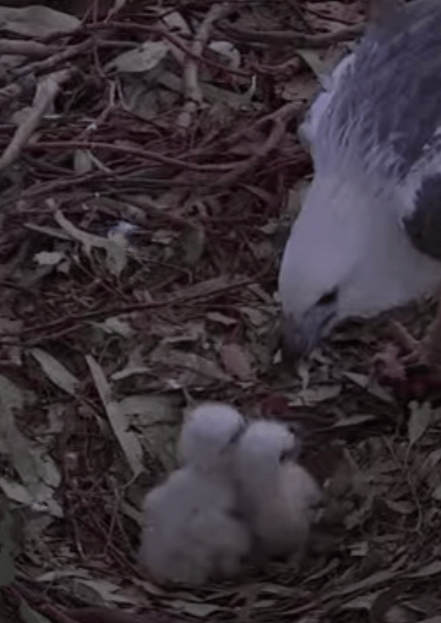
These two little sea eaglets are just adorable and a little spunky, too. They are growing like the sunflowers in my garden that the birds planted.
Both had nice crops after this feeding.
Judy Harrington, the researcher observing the WBSE Nest in the Sydney Olympic Park forest, just released her report on what these two have been eating during the last fortnight (14 days). In fact, it is the first two weeks of their life. Harrington also records the amount of time spent feeding by both the male and the female has been recorded. Lady took on 109 feedings for a total of 21 hours and 20 minutes. Dad did 8 feedings for a total of 42 minutes. Dad has been providing most of the food – he brought in 25 items and Lady brought in 5. These consisted of the following in total: 16 Bream, 4 catfish, 2 fish, 1 Mullet, 2 Whiting, 1 Yellowtail, 1 Ibis chick, 1 nestling, 1 pigeon, and 1 bird. They have now morphed into sea eagles, the second largest bird in Australia.
Sadly, it appears that Lady was hit during the night by Boo, the BooBook Owl that lives nearby in the forest. Despite its very small size the BooBook Owl has caused injuries to the large sea eagles in the past.
It is thought that Boo, as the little owl is so fondly called, has a nest near to the Sea Eagles. To my knowledge, the WBSE have never bothered their nest but, – hey. Every parent is afraid of a larger predator and wants them to leave the area.
Legacy on the Fortis Red Deer Nest has fledged. She has been on and off the nest a few times today. One was to get some fish! Here she is with Mum. After all the nestling deaths during the heat wave, this is just one of the happiest moments from that nest. Look how big Legacy is next to mom. Congratulations.
It is almost impossible to see what is happening on the Fortis Alberta Exshaw nest up at Canmore. Both chicks appear to be on the nest and calling for food. It is unclear to me if one or both have fledged.
The love story of the two Canada Geese has gone viral. It warms our hearts to see these two devoted birds – Amelia finding and waiting for Arnold during his surgery and recovery and now their reuniting. My friend, ‘R’ found two more stories on them and I want to share with you what she sent to me. You could read about these two all day – and you will always walk away with a smile.
The story of Arnold and Amelia has taught us all something. If you find an injured Canada Goose and are taking it into care, please take the time to find its mate! The outcome might be much more positive. If you live in an area where there are Canada Geese – let your local wildlife rehabber know about the story of Arnold and Amelia. They will understand why it is important to keep bonded mates together (and their goslings if necessary).
And news about Kona. It is nearing 100 F or 38 C on the nest in Montana. The foster mother, Scout, has been shading Kona. Everything is going well with this foster. How grand.
@ Montana Osprey Porject
Leaving you with a gorgeous image of Loch of the Lowes. It just looks so still and peaceful in the early morning hours of 14 August.
And a last peaceful image of Diamond on the ledge of her scrape box on the water tower at Charles Sturt University in Orange, Australia. We will be looking for eggs before the end of the month. Izzi was last in the scrape box of Xavier and Diamond 6 August. He was photographed on 10 August and someone thought they heard him this morning.
Thanks for joining me today. I am off to try and find some hawks tomorrow so this is coming out early. I will bring you some late Saturday news in the evening. Take care. Stay safe! If you hear of interesting bird stories – and in particular, raptors – let me know.
Thank you to the following for their streaming cams where I took my screen shots: Collins Marsh Nature Centre, Sea Eagle Cam, Birdlife Australia andthe Sydney Discovery Centre, Dyfi Osprey Project, Scottish Wildlife Trust and Friends of Loch of the Lowes, Falcon Cam Project at C Sturt University, Fortis Alberta Exshaw and Fortis Alberta Red Deer. Thank you to ‘R’ for sending methe links on the coverage of Arnold and Amelia and to ‘S’ for the information on Telyn and her whopper of a fish delivery. It is much appreciated!Thank you to the Montana Osprey Project FB page for the image of Scout and Kona.
White YW delivered the tea time fish – a nice large one – to the Foulshaw Moss Osprey nest in Cumbria. Blue 462 nabbed it first and then guess who pinches it off big sibling! Tiny Little!
Big Sibling 464 on the left and 462 on the right – all waiting for Tiny Little to make a wrong move with that nice fish. Go away both of you!!!!!
Then 462 got it back!
The first round both 462 and 463 struggled with the mouth and eye area. Wonder who is going to get that fish when it is nicely opened.
Ah, White YW cannot stand to hear one of his fledglings call for food. He promptly went out and got another one. Blue 464 got that one. It was such a nice fish that 464 was eating on it an hour later. Tiny Little flew off the nest probably chasing Dad. No one should be worried thought. Tiny Little had a nice crop prior to snagging that fish off 462. None of these chicks are hungry!
Blue 464 is enjoying his nice big fish – alone! No one is around sniffing for some pieces.
Good Night Foulshaw Moss Ospreys!
In Wisconsin, Malin is busy self-feeding on a piece of a fish that Dad delivered. What captivates me today are the wing feathers. They are looking so good. There is a condensation mark but if you look to the right that one dangling feather from earlier in the month is now ‘crossing over’ the way that it should. The other wing feather scallops are lined up perfectly. Oh, Malin, you are growing up!
The nests are so big and every streaming cam distorts the images (or so it seems). It is difficult to try and determine how big Malin actually is.
There is no time code on the Collins Marsh camera. I believe that there was another delivery by Collins to Malin – this time another piece of a fish. That is really helpful for Malin to work on its self-feeding and not get caught up with the bony mouths and eyes. Eventually Malin will need to do that. Right now one of the wonderful things is Malin’s anticipation of the food drop and his excitement and mantling on its arrival.
In the imager below, Malin sees Collins flying into the nest. Look at his eyes. He has also dropped his wings in anticipation of mantling that fish.
Malin pivots. Wings stretched down and out for mantling with beak forward to grab the fish from Collins’s talons.
Get out of the way Collins! Malin has secured the food.
Ah. Over. I notice also that Collins’s crop is nicely full. He has eaten the head and perhaps part of the fish before the delivery.
These two food drops for Malin to self-feed come after the aggressive manner that Malin approached the fish yesterday with Marsha. We are moving on to the next phase: no more feedings by mom? Let’s watch and see.
Is this the tail of a little Bullhead?
It is a beautiful day on the Canadian Prairies. For the first time in ever so long we can see blue sky, not sky filled with smoke. It is 21 degrees C. That is 69.8 F. Just lovely for a trip to the one of our local parks.
It was a delight to walk up to the duck pond and discover that our Parks Department has put up signs to educate people on why they should not feed the ducks bread. Last year the local birding group had a big campaign to get this practice stopped. Today, the signs are up. They are large and prominently placed at strategic entrances and exits. No one was feeding the ducks, they were just enjoying them! Well done Parks Department!!!!!!
Thanks to the recent rains many of the geese were out on the fields where people play soccer or cricket eating green grass.
A male juvenile Mallard enjoying the water fountain at the rocks.
There was real discussion on the identification of the duck above and the one below. The discussion ended when the little duck below showed us her feeding behaviour. She is a dabbler so she is a female Mallard – not a female Blue Winged-teal.
Mallards come to Manitoba to breed. They arrive in the spring and leave in the fall. Here the little female is mottled brown with a whitish tail, and orange feet.
When feeding, she tips up and dabbles in the shallow waters of the duck pond for pondweeds and aquatic invertebrates. They also feed on larval amphibians and fish eggs.
The female Wood Duck and her ducklings. You can tell the Wood Duck by its white tear-eyed eye patch. Her breast is a mottled brown and white.
Wood Ducks are migratory birds in Manitoba. They arrive in the spring, normally April, and will head south in October. They are cavity nesters. They will lay their eggs in a tree cavity or specially built enclosed wood boxes. The ducklings are ready to bounce from the nest when they are 24 hours old. Precocial animals and birds hatch/born with all their feathers, skin, etc. and are able to see, hear, and move about.
The little Wood Duck and her ducklings mingled with the Canada Geese. Only once did I see a goose get aggressive towards one of the little ones.
Malin’s initial feather issues have caused me to spend more time looking at the back and wings of birds than I ever would have thought possible. Each individual feather is simply beautiful – taken together they are like a wonderful musical symphony – each performing their own task to help this Canada goose swim, walk, and fly.
The tail and wing feathers of a non-breeding male Mallard.
As we were leaving, a Juvenile Bald Eagle was soaring above us.
Then the Northern Goshawk beats its large wings. The Northern Goshawk lives in Manitoba all year round except for the southern part where they can be seen only in the summer or in the winter if food supplies in the North fall.
It was a good day! The skies are turning grey and the wind is picking up a little and maybe, just maybe, we will have some more rain. Wishing and hoping.
Thank you for joining me today. Take care everyone. See you soon.
Thanks to the following for their streaming cams where I grab my screen shots: the Cumbrian Wildlife Trust and the Foulshaw Moss Osprey Nest and the Collins Marsh Osprey Nest.
By 18:30, the smoke and the temperatures were cooperating and it seemed like a good time to go and check on the Cooper’s Hawk family in Assiniboine Park. When I arrived at the Park, there were several cricket games going on, families were meeting and sharing a pot luck outside – many for the first time since spring 2020, there were birthday parties and children running around.
When I found the spot and knew where the hawks had their nest and were hunting for bugs and chipmunks the other day, there were children running around. I could see the hawks in the sky circling. They never went to the nest tree or came to the ground. It is the life of a birder. It would be wonderful to see them a few more times before migration. The Canada Geese do not usually begin leaving until the middle of September through to the end of October. I have seen some miss the group and wind up walking about on an early snow. Weather is such a significant factor in the challenges our birds face.
For those who are not sure what migration actually is. Our feathered friends Move from one area for breeding during the spring and summer to another area for winter. They have adapted to the pattern of coming and going in order to survive. It is based on food supplies.
Different species travel different routes to their winter homes. These are long journeys. For example, the Ospreys in the United Kingdom will travel some 8,000 kilometres or 5,000 miles to places in Africa. The birds will fly over land, sea, and desert to reach their destinations. People wonder why the birds just don’t live in Africa all the time. The answer is rather simplistic: there would not be enough nesting sites or food for all of them plus their chicks. There are also a lot of very hungry predators ready to take those lovely fluffy little ones. So they disperse from Africa to sites in the United Kingdom and Europe.
The birds decide when it is time for them to migrate. The hormones in their body begin to change. Unlike spring when this hormone change leads to breeding, the autumn sees the birds restless until they know that it is time to depart. These hormones trigger a lot of eating. Fat begins to gather under their skin. They gain weight. It is that fat that will see them through their migration. Still, they stop and feed along the way. Normally they hunt for food in the early mornings and late afternoons. High pressure systems are good for flying but low pressure systems bring winds and rain. When the birds get into a low pressure system, they will normally stop flying, if they can, and wait til another high pressure system comes through. Migration times vary because of the winds and the weather. Birds that soar and ride the thermals can travel as much as 465 km or 300 miles in a stretch. Some gather in flocks like the storks in Latvia and Estonia. Sometimes birds pair up to migrate. For the Ospreys, the female leaves and the male stays behind until there are no fledglings crying for food.
Not all birds migrate. Even I have a sedentary Sharp-shinned Hawk that defies all logic to stay on the Canadian prairies for the winter. The Osprey in Australia do not migrate. The birds in the Amazon Rainforest do not migrate. There is plenty of food and nesting sites for them year round. This past spring and early summer there was much discussion over the migration of birds from Florida. In Jacksonville, Samson, the father of Legacy, stays in the area of the nest year round. Gabrielle, on the other hand, migrates north – yes north – to cooler summer climates. This year she might have discovered it is hotter up north! Even some of the Ospreys in Florida do not migrate; they stay year round. There are plenty of fish for them as well as nests.
Birds take different routes. The White Storks from Latvia either taken a western route or an eastern route. Dr Erick Greene and his team in Montana study the migratory movements of the Ospreys from the Clark Fork River area with satellite transmitters. In the United States, some fly over Hawk Mountain where there is an annual count. In fact, you can go to this site to see the number of birds traveling over this marvellous area with its thermals. Here is the link for you for their autumn migration count that will being in about a week!
Migration is extremely challenging and we hope that all of the adults will return to their nests the following spring and that we will see the juveniles who take their first flight to Africa in a couple of years.
And now for some birding and nest news
Poole Harbour: Blue 022 and CJ7 who were so visible until a few weeks ago sky dancing, mating, and working on the nest with the streaming cam are now working on another nest in the area. There is no camera. They are still doing everything together and everyone is looking forward to the first hatches in Poole Harbour for 200 years.
Dahlgren: A large part of the nest in King George, Virginia, collapsed today. It will be fixed in the fall well after Jack and Harriet’s migration.
Kielder Forest: All 16 of the 2021 juveniles have fledged successfully. Everyone is elated. This is 6 more fledglings than their previous best year. Congratulations everyone!
Mlade Buky: Bucachek and his new love spent the night on the nest in Mlade Buky, Czechoslovakia. Oh, how sweet! Just as the dawn is beginning to appear, they are both preening.
Balloons, something that impacts all birds: Virginia, Maine, Maryland, and Delaware have or are going to pass shortly the release of balloons. Hawaii has already passed a law on helium balloons.
Port Lincoln Ospreys, Australia: Dad and Mom have been taking turns incubating the eggs. Here is dad on the nest. A little earlier he had been pestering Mom. He kept pulling on that turquoise rope wanting his turn. It was too funny. The Port Lincoln Ospreys are an example of sedentary birds. They do not migrate. There is no need.
Loch Arkaig: The two juveniles of Louis and Dorcha have now fledged. I have not heard anything about the chosen names yet.
Collins Marsh: Malin was a little wet off and on during Saturday. S/he is sleeping on the nest alone tonight. There is no perch – let us hope that the parent or both parents are in a nearby tree in case there are any owls about. It seems like a pattern. Does mom always spend Saturday night off the nest?
WBSE, Sydney Olympic Forest: 27 and 28 continue to eat until their crops almost burst and sleep. Meanwhile there has been an intruder today and Lady and Dad were honking in alert.
And last but very special, A Place Called Hope. Along with other wildlife centres, they are receiving quite a number of starving Great Blue Herons and other herons. Why would they be starving? It has been raining in the Connecticut area and all the herbicides and pesticides that people put on their lawns and gardens makes its way into the environment, into the water table, into the ponds. It is poison. If your gardening centre or lawn care person tells you that the chemicals they use are ‘Green’ – well, think again. Whatever they are using kills. So sad. It is OK if your lawn doesn’t look emerald green.
Thank you so much for joining me today. Have a lovely Sunday. Take care of yourselves. I look forward to seeing you soon.
Thank you to the following for their streaming cams and their FB pages where I grab my screen shots: A Place Called Hope, Mlade Buky White Stork Cam, Collins Marsh Osprey Nest, Port Lincoln Osprey Project, and Sea Eagles, Birdlife Australia and the Discovery Centre.
The featured image is Dad at the Port Lincoln Osprey Barge taking his turn incubating his two eggs.
Maybe it is better not to make plans! We have so hoped for rain and this morning the forecast said – ‘70% chance of rain’. My heart skipped a beat. If it would just pour. As I write this I can hear thunder.
One of my readers wrote to ask about the fires we are experiencing. First, just so everyone knows the area where are talking about you need to know where Manitoba is. Our province is on the Canadian prairies between Saskatchewan and Ontario. We are directly north of Dallas, Texas. If you drove without stopping, it would take you 24 hours to reach Manitoba if you started in Dallas.
There are two very large lakes, Lake Winnipeg on the east and Lake Manitoba in the West. Both are north of Winnipeg; it is about a 90 minute n drive to the southern tip of each. Many of the migrating shore birds and large raptors, Ospreys and Bald Eagles, have their summer breeding areas around these lakes.
Our provincial Department of Conservation and Climate reports that there are currently 159 wildfires in our province today. 17 of those started in the last 48 hours. They also reported that the yearly total of acres lost to wildfires is 904,111. That impacts wildlife. There can be no question. Here is the current fire map:
The purple areas are fires that are being monitored; the red areas are fires that are out of control; the green areas are fires under control while the yellow ones are fires being held. We are fortunate that fire crews from other provinces have come to help. The smoke from the fires impacts everyone but the city of Winnipeg is not under any threat. My concern is the area around the Osprey nests and that is in a monitored area.
That is the state of our wildfires. Of course, our thoughts are also with those people in California where the Dixie Fire is raging and has already scorched 275,000 acres.
With the promise of rain, we head to one of the most beautiful areas in our City: Assiniboine Park. It is named after one of the two rivers that meet here; the other is the Red River. The park has our zoo, an area known as the English Gardens and the Leo Mol Sculpture Garden (Mol is a noted local sculptor who worked in bronze) as well as the Duck Pond.
Turns out this was a great decision. We managed to get lost and when we asked directions, a wonderful woman offered to show us the way. Then she stopped. “You know we have a family of Cooper’s Hawks right in that tree”. If it was not for pandemic restrictions, I would have thrown my arms around her in thanks. As it was, I quietly stood jumping up and down in my mind. It was simply magical.
The couple have three fledglings this year. They are all about the grounds catching bugs. The tripod proves cumbersome. Remember I have only practiced with this lens at home. This is the test to see if I can manage it.
A squirrel has the attention of the hawk in the back.This hawk is looking up at a chipmunk.
Cooper’s hawks are about the size of crows. The Cooper’s are constantly confused with the Sharp-shinned Hawk. In flight, the Sharp-shinned has a squared-off tail and the Cooper’s is rounded. The prey for both are small birds, chipmunks, small squirrels and the books say small hares but Sharpie, who visits my garden) has never bothered the garden rabbit, Hedwig. The Cooper’s were busy eating bugs but also keeping their hawk eyes on a squirrel and a chipmunk! The eating of ‘bugs’ is not mentioned in any of the bird books. These hawks are adorable. It was fun to stop photographing and sit and watch the adults teaching the fledglings to hunt. They were having so much fun!
Next stop – Canada Geese! They are not Canada’s national bird. That is the Canada Jay – a grey version of a Blue-Jay (OK that is simplistic but it is a good description). The Canada Geese were in the pond but also seemed to be everywhere eating grass. Sadly, it looks rather dead in places from the lack of rain. Speaking of rain, we did get some. Probably not enough to even measure but it might help the grass!
And we have an update on your favourite goose – Arnold! The veterinary team at the Cape Wildlife Centre decided to remove Arnold’s bandage and boot today. Their assessment is that Arnold is doing great. He will not need any more bandages and will get to spend some time in the outdoor enclosure with a pool. Amelia comes every day and they get to spend time together having meals in the playpen. It will not be long until Arnold will be able to be in the wild with Amelia again. Isn’t that positive news?! What a great team.
@ Cape Wildlife Centre
Before I close, here is a reminder of a great fundraiser going on right now. I do not normally mention fundraisers unless I know that the funds really go to help the project – so I am delighted to mention this one again. I realize it is only August and everyone who has children or is a student is thinking about getting ready for ‘back to school’. I would like for you to think about birthdays and holiday gifts, too! If you are looking for something unique associated with the matriarch of Ospreys, Iris, whose nest is in Missoula, Montana – well, this is for you!
Dr Erick Greene of the University of Montana and the Montana Osprey Project gathers up the twigs that have dropped from Iris’s nest. These are twigs that Iris has broken off of trees and bushes in the area. The type of wood varies. Dr Greene then sends off a box of twigs to South Carolina to the workshop of master wood workers, Richard and Sharon Leigh Miles. They turn those twigs into beautiful pens. The patterns and colour depend on the type of wood. Iris goes out and gets Black Cottonwood, Douglas Fir and, sometimes, Choke cherry. Everything is sustainable and no one interferes with Iris when she is on the nest. Those sticks get knocked off and Iris will not go down on the ground and pick them up just like she won’t pick up fish that falls off the nest. This is such a unique fundraising even for the Ospreys but the number of pens are very limited.
I think they are gorgeous and can’t wait for mine to arrive. It is on its way. The cost is $45 USD. That includes postage within the United States and maybe parts of Canada.
@ Montana Osprey Project
This time I want to include the directions for you. Sometimes it is hard to find things on FB. 1) Send an email to montanaospreyproject@gmail.com 2) If your mailing address is in the US, on the subject line of your email, type your full name followed by Pen Order For example To: montanaospreyproject@gmail.com Subject: Your Name – Pen Order 3) If your mailing address is outside the US, on the subject line of your email, type your full name followed by International Pen Order For example To: montanaospreyproject@gmail.com Subject: Your Name – International Pen Order If yours is an international order we will get back to you with a few additional instructions. 4) The email’s body should include the following information: a) Your name b) Your email c) Number of pens you would like to order. d) Total amount ($45.00 per pen). Shipping is included in this price. e) Your mailing address just as it should be on the envelope. f) Send the email to MontanaOspreyProject@gmail.com 5) For those of you who live in the United States, make out a check out to: Montana Osprey Project – Erick Greene (We are not set up to take credit card or Pay Pal orders. Sorry – has to be a personal check or money order) 6) Mail your check to: Dr. Erick Greene – Montana Osprey Project Division of Biological Sciences 32 Campus Drive University of Montana Missoula, Montana USA 59812 7) For those of you who live outside of the US, send us the email with all of your information, but hold off on sending a check. We will get back to you with a few more instructions.
Thank you so much for joining me today. It is always great to hear from everyone. I have received a few letters this morning and there is some excellent information in those that I will share with everyone tomorrow! For those wondering about Malin, her feathers seem to be improving. We hope that her fish deliveries do the same. Take care. Stay Safe.
Thank you to the Montana Osprey Project FB page and the Cape Wildlife Clinic FB where I took my screen shots of the Iris pens and Arnold.