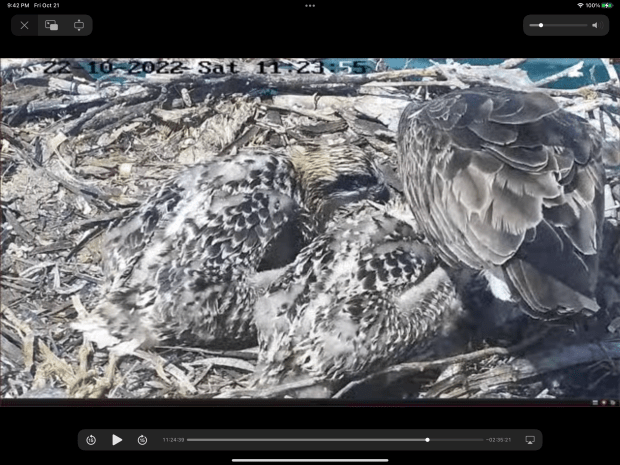
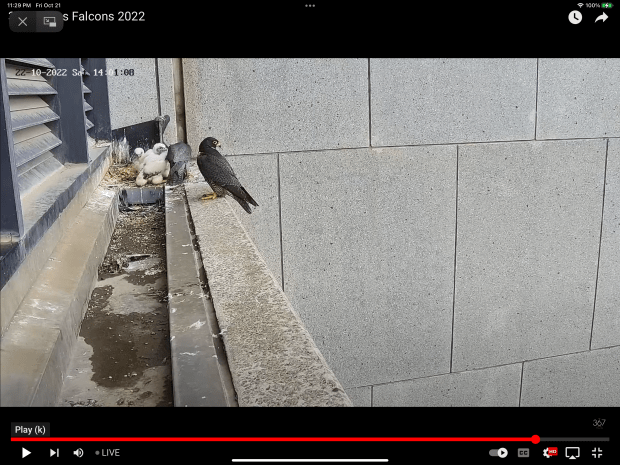
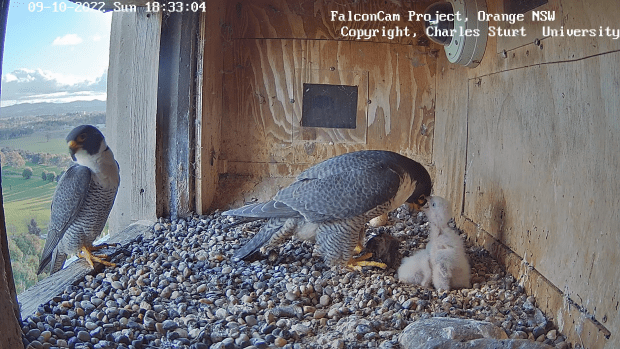
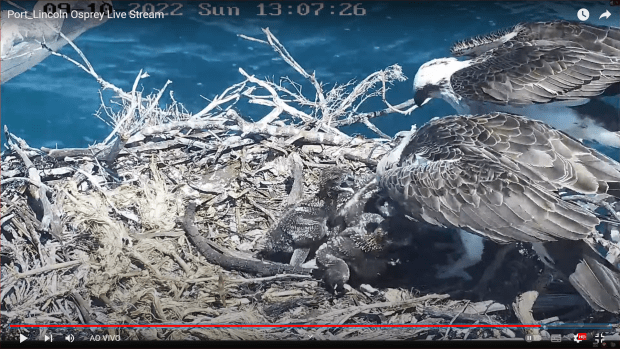
I am playing catch up with what has happened on the three other nests in Australia late this evening. After watching the step-dad care for the four eyases at 367 Collins Street (feed and shade), I turned my attention to Port Lincoln. What a surprise! Dad brought four fish in already and it is only early afternoon!
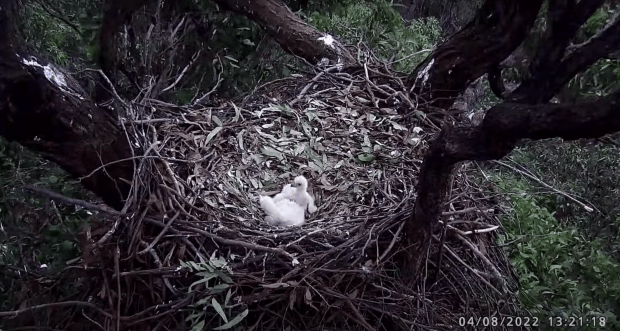
The first fish arrived at 07:23:40. It was a really nice size fish. The feeding ended at 07:44. All three Bobs had crops.
The second fish arrived at 08:16:13. No one was expecting another fish so soon. This time it was a whole fish that was very much alive. Big Bob got the first bites. By the time the fish was finished – and it is almost like the three of them vacuum up that fish – at 08:34:23, the crops of the three Bobs were bursting.
No one was really hungry when the third fish arrives at 10:31:26. The chicks were fed until the last flake was eaten at 10:49.
Just look at that crop on Little Bob!
The fourth fish arrives at 12:48:22. I cannot imagine that anyone had room for any more fish but, the one good thing about all of these deliveries is that Mum got to eat! I would like to have said that there was no beaking but Little Bob made the mistake of looking Big Bob directly in the eyes and he got a couple of beaks from Big for doing that. If there is discord, never look the other osplet in the eye. Never.
If Dad does not deliver another fish today, the osplets are quite full and have had plenty to eat. I have been reading about Hen Harriers and in the books, it states categorically that a Hen Harrier can live on two voles a day. That is good enough. Wow. I did not know that. Voles are small mouse like creatures that live in burrows.
So we can all relax. Port Lincoln is good. Sweet.
Thank you for joining me for this update on our osplets. Continue to send good wishes for good fishing for Dad. I will try and catch up with Orange and Sydney before midnight. Tomorrow, Tuesday, I have an appointment and my report will not be coming in until early evening. I just wanted you to know.
Update on Collins Street: Mum has returned to the ledge with a partial pigeon at 14:30:33. Incredible. What is this female doing???
Thank you to Port Lincoln Ospreys for their streaming cam where I took my screen captures.
It looks like it is going to be another beautiful day on the Canadian Prairies. Nippy as it is only 7 degrees C at noon but, beautiful blue skies, a wee breeze, and no rain in sight. I hope that all of you have had a joyful weekend, have had some time to watch our beloved bird families as they face challenges of feeding two eyases at Orange or delayed food deliveries at Port Lincoln.
Making News:
The RSPB is urging everyone to let the wild grow. While they are focused on the UK, other agencies are doing this throughout the world as the number of insects decreases dramatically.
Did you know?
While Peregrine Falcon chicks are almost born blind, as juveniles they will be able to see a Starling a mile away (or .6 km). That is the reason that some at Cal Falcons Berkeley believe that Annie might have seen her precious Grinnell killed. With the difference in size of the two eyases at Orange and with the eyesight getting more focused daily by the little one, here is a brief article to help us understand how falcons actually see so well.
I thought I would also include Kate St John’s article on Peregrine Falcon Development week by week. It is an excellent reference to what is happening as you watch the eyases at Melbourne and Orange grow and develop.
I know that you will be delighted to see that the adults at the Notre Dame Bald Eagle nest, home of Little Bit ND17, are beginning to rebuild their nest on the cam tree. Smile.
The names for the eyases of Diamond and Xavier at the Orange, Australian scrape are Indigo for the oldest and Rubus for the youngest. How lovely!
I haven’t been counting the bites that Rubus has gotten at each meal; I only do that with third hatch ospreys who are being badly beaked by older siblings or when watching a nest that could become unstable, such as Port Lincoln right now. I have, however, looked for a wee crop on the little one at Orange and haven’t seen one until yesterday. ‘A’ assures me that Diamond is getting better at feeding it and certainly the second feeding appeared to be better than the first with a wee crop on Rubus. Indigo is a great big sibling; she is just bigger and well her neck is longer. She will be getting pin feathers when, today, Rubus is really getting its eyes opened.
There were 5 feedings yesterday with the little one getting a bit more than the day prior. Those feedings were a Starling at 6:39:48; a pigeon at 8:42:33; 10:25:42; leftover pigeon at 12:58:11; another Starling feeding at 15:19:05 and 18: 31:26.
Here are some images of those feedings yesterday. Enjoy! Please note that the top image is the late feeding of the day.
I had actually hoped that Xavier would get a chance to feed the wee ones.
The first fish of the day did not come in until after 1300 at Port Lincoln. There had been some beaking as the three became hungrier and hungrier. It was also the first feeding where I have witnessed beaking. There was a reason. The lineup was Middle, Little, and Big at the farthest point from Mum’s beak. Middle and Little got quite a few big mouthfuls with Little Bob eating a piece of an organ that fell on the nest at 13:10:52. (Thanks, ‘A’). All of the chicks were ever so happy to see a fish that it looked like they were frantically gobbling the food. Big wasn’t getting any, though. He beaked the siblings and had them both afraid of being fed. S/he ate and then when s/he had their fill, the others ate some more. At the end of the feeding all had eaten well except for Mum who must have been ravished herself. Fighting continued at various times throughout the day with a few feeds. Big’s target was, for the most part Middle. Those two do not like each other at all and Big has always been trying to establish its dominance since they were 8 days old.
The chicks were absolutely ravenous when that 1307 fish arrived. I wonder what is keeping Dad from getting the fish to the nest early in the morning? The late deliveries are causing the nest to become unstable. Still, until yesterday, the feedings had not been impacted by food competition. Yesterday was a particularly brutal day of attacks by Big.
Little Bob eats the dropped piece of fish organ all by himself. It was a great horking just like Big did with the fish tail the day prior.
Despite the discord on the nest, all of the chicks managed to get their crops nicely filled at the feedings. Let us all hope that Dad will be able to overcome whatever it is that is stopping him from delivering fish early in the morning.
The four eyases at Melbourne are well fed. Mum spends a long time making sure that each is fed. In the last feeding of the day, you can barely see them as Mum has her back to the camera. There are a couple of glimpses. The eyases are beginning to look like raptors and you can clearly see their crops and the shiny skin on their chest where the feathers are worn off. Great work by Mum and Dad at Melbourne.
The Sydney Sea Eagle camera has been offline sometimes. SE30 spent the night on the nest with a parent above on the parent branch. No sign of SE29 yesterday although it could easily be on the nest tree out of view of the camera. That said, in days prior, SE29 was happy to jump down on the nest with the family so it does make me wonder.
The Bald Eagles in the US continue to visit their nests making a few nestorations or rebuilding an entire nest. They can do it! Let us all send warm wishes to Port Lincoln today for several fish early in the morning. That would go a long way to settling down Big and its fears about food supply. It would be wonderful if the cam would be operating at Sea Eagles – would love to see SE30 when it fledges or a visit from SE29. Meanwhile, we know that the Melbourne Four are going to begin to get itchy and start preening. We also know that they will have loads of prey. Dad is keeping the pantry full. I am especially looking forward to seeing Rubus with its eyes more focused today.
Thank you for joining me. Take care. Enjoy the rest of the weekend!
Thank you to the following for their postings and stream cams that made up my screen captures today: RSPB, Notre Dame Eagles FB, Port Lincoln Ospreys, 367 Collins Street by Mirvac, Charles Sturt Falcon Cam and Cilla Kinross, and Sea Eagles@Birdlife Australia Discovery Centre Sydney Olympic Park.
Good Morning Everyone! I hope that you had a fabulous beginning of the week. Here we are at the middle. My calendar tells me that thing are going to begin happening in Bird World soon. First up will be the Port Lincoln Ospreys who should have a hatch in 4 days. Then it should be the Melbourne Peregrine Falcons on the 27th quickly followed by Xavier and Diamond. By the time those nests have feathered osplets and eyases, we will be fledge watching for SE29 and 30. It is going to be wonderful!
Tuesday was a big ‘T’ day but that doesn’t stand for Tundra Swan but, ’tiler’. It was fantastic to see the floor tiles in the sunroom being grouted today with the news that tomorrow I can move back in and watch my beloved garden birds. Oh, how I have missed seeing them from that perspective. A new book arrived in the post, too. Having purchased Crosley’s Guide to Waterfowl – well, logically, it seemed to me that the volume would cover Shore birds but, no. Definitely not. The new book is The Shorebird Guide by O’Brien, Crossley, and Karlson and it is wonderful. Most appreciated are the excellent images of the plumage during the seasons. It still is missing the inclusion of the females in great numbers just like all of the other bird guides who continue to focus on the more colourful plumage of the males. Yes, I am growling. LOL. Quiet and monochromatic can be viewed as ‘classic’ beauty. It certainly is with many of the female Sparrows.
Just like the ducks, my mind has been taken over by the Greater and Lesser Yellow Legs and Willets at one of our local ponds. If I close my eyes I am transported to the marsh where the shore birds are tapping away at the mud with those long long bills. Incredible. If you stay quiet and don’t move, they will completely ignore you, going on with their deep quick probing for food. They are really quite lovely. Learning to identify them is going to take some time.
The Greater Yellow Legs from the other day.
The plumage on the Mallard is really lovely.
It is overcast and cold at 13 degrees C this morning. The Crows have been for their morning hotdogs, the sparrows are wanting a bath, the Blue Jay has been flitting in and out (only one), and the cat has already been chased once. Meanwhile Little Red has been running back and forth on top of the new fence which now meets up with that of the neighbour so he never has to get on the ground to get to his new home. Yes! Little Red has found a place to live since his penthouse was torn down. So thankful. The torrential rains this year and saturated ground meant that all of the trees literally tripled in size. He found a hole in the big tree and if I look carefully, I can see him going in and out. So relieved after feeling so quilty about the shed. With my chair back in the sunroom this morning, I can watch over them and hopefully get some good images of Dyson who is looking ever so healthy and fluffy these days. Gosh, that squirrel is quick. I wonder if the Crows frighten her?
In the Mailbox:
‘A’ writes that I have awakened a love of ducks for her. That is fantastic. They are often very unappreciated, like the geese, in my City but, there is nothing so peaceful as sitting on a clean bit of lawn or blanket and watching them go about their daily paddling and preening. This is wonderful news. Thank you for letting me know! In honour of this, I have used one of our favourite ducks for ‘From the Archive’ today.
Making News:
There is growing disillusion within the environmental and raptor groups in British Columbia, Canada at the decision by the Department of Forests and the University of British Columbia to cone a long standing Bald Eagle nest on the campus of the University. Their are ongoing campaigns to stop the coning which is due to take place today, the 14th of September.
Also in British Columbia, this time in Surrey, the David Hancock Wildlife Foundation is attempting to stop the cutting down of a Bald Eagle nest on the property of a Costo in that city–or get the owner to agree put up a platform nest for the eagles.
British Columbia is home to more Bald Eagles than any other area in North America. Because of this their conservation status and threat is very low – often cited as an excuse to cone the trees or cut down the nests — some 140 Bald Eagle nests were destroyed at the Site C Dam project by the province this year. Of course, what is the real count? With Avian flu still with us and in Manitoba nests and eggs destroyed by flooding with few goslings, perhaps we should be re-thinking our approach to preserve. Declines can begin to happen and spiral.
If you are in Southern Manitoba, Wildlife Haven is having its annual Open House on 23-24 September. Tickets can be pre-purchased and space is limited. It was gorgeous weather last year and the event was sold out. I can’t think of a better way to spend a few hours on a fall afternoon than getting to meet the ambassadors, tour the new flight training buildings, and check out the great vet facilities. These are the people giving our wildlife a second chance.
Do you live in New York? do you love Bald Eagles? Here is a fundraiser event you might not want to miss.
Would you like to be an Albatross detective and help get a true worldwide count of these sea birds? Here is the information.
The Bald Eagles have been returning. Yesterday it was Gabby returning to the Northeast Florida nest to Samson.
NEFlorida Eagle Nest
Samson and Gabby love to ‘kiss’ just like Alden and Annie.
Anna and Louis are back at the Kisatchie National Forest and now Mr President and Lotus are at the National Arboretum Nest in Washington, DC.
National Arboretum Nest
They are really coming home. If you see a return, send me a note!
Thunder and Akecheta were caught sitting together on the cliffs of the Channel Islands yesterday. Oh, goodness. What an incredible year we had with Ahota, Star, and Kana’kini.
Thunder flew into the West End nest with a super fish yesterday, too… Ah, it would have been grand if one of the kids swept in and took it! Everyone misses those three amigos.
Andor was at the Fraser Point nest. I haven’t seen any new updates on Victor. We can all presume that he is doing lots of flying and strengthening those wings!
The nest that our dear Little Bit ND17 grew up on had dwindled down to only a bit of mud and straw at the joint of the branches. Everyone has been concerned that the adult eagles would not return and rebuild – knowing that if they didn’t St Patrick’s County Park in South Bend, Indiana, would not be moving the camera. Well, guess what? Dad has been caught returning to the nest! This should be a ray of sunshine for everyone. It will take work but each of us has marvelled at how quickly the raptors can whip a nest into shape. No, it will not be huge like a decade old nest but it will be a new beginning.
In the image below you can see what little is left.
It appears that Idris is finally alone to enjoy his fish and that Padarn has left the territory for her migration.
At Glaslyn, however, Aran is still bringing fish for Blue 497. It won’t be long, Aran!
497 is an incredibly beautiful osprey.
To my knowledge, Blue 497 is the only fledgling left on an Osprey streaming cam in the UK to migrate.
Did I mention mantling (when a raptor spreads its wings over its prey to conceal and protect) was one of the development stages coming quickly for the Sea Eaglets in Sydney? Well, guess which of the two was the first to demonstrate this stage of growth?
If you said SE30 you would be absolutely correct! Both eaglets held the prey down with their talons and pulled. Eventually they were fed but this is very good training. So proud of 30! Go baby. Don’t you just love the look on 29’s face? (squint)
The sea eaglets have been well fed and have been sporting crops on and off for a few days now.
Watching incubation and expecting a hatch in less than a week can be nerve wrecking.
The beautiful Mum at Port Lincoln. It is the 15th. Oh, so soon we will be having little osplets –. Cannot wait.
For Melbourne, mark your calendars for the 27th of September.
Xavier and Diamond will follow after Melbourne!
Migration News:
Into Hawks? Aren’t we all? Here is a new tool to follow the counts.
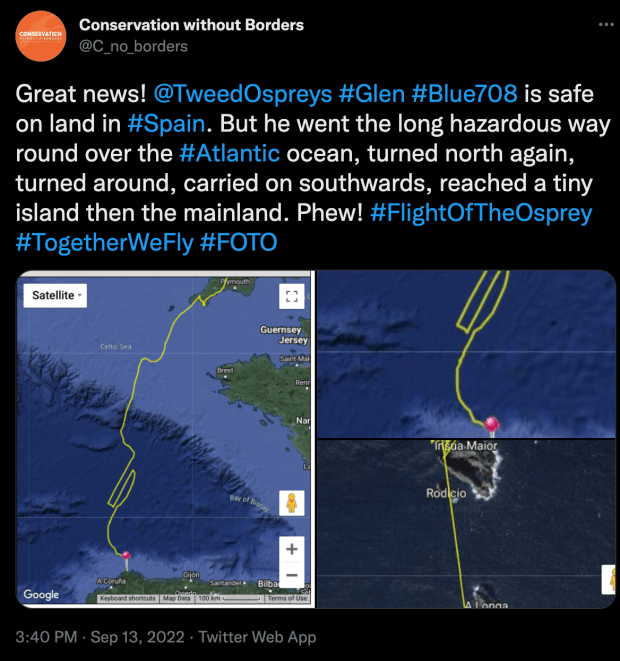
Some good news on one of the Tweed Osprey fledglings, Glen. (Sadly it appears that Kirk who had gone West and was in Ireland continued west over the Atlantic and is probably lost).
From Karl II’s family, the Estonian Black Storks from the Karula National Forest nest.
Bonus is really flying and remains in the same area he has been for several days now-the Prypjat River. He is safe. Relief as always.
Waba is at the Hrabarka River in Ukraine.
I see no transmission for Kaia or Karl II.
Audubon scientists are using data from hawk Mountain to monitor the places that raptors migrate.
I am not a cartoon character but, for many raptor watchers in Australia (and elsewhere), I am the most famous duck in the world. Do you remember me? What is my name? What kind of a duck am I? Whose nest did I lease? And do you remember what happened?
Thank you so much for joining me today and for your lovely notes. It is actually relatively quiet in Bird World but soon…so soon, there will be action in Australia – at Port Lincoln and Melbourne. Meanwhile, we can all enjoy the antics of the little Sea Eagles who are jumping, flapping, and learning to mantle and eat their own prey. Take care of yourselves. I look forward to seeing you again soon.
Thank you to the following for their tweets, their posts, videos, and streaming cams where I took my screen captures: Wildlife Haven, Bald Eagles of Centreport, Albatross Space, Channel Islands Eagle Lovers, Notre Dame Eagles, NEFL-AEF, NADC-AEF, Dyfi Ospreys, Bywyd Gwyllt Glaslyn, Sea Eagles@Birdlife Australia Discovery Centre Sydney Olympic Park, Port Lincoln Ospreys, 367 Collins Street by Mirvac, Charles Sturt Falcon Cam, Conservation Without Borders, and Looduskalender.
From the Archive: Daisy is a Pacific Black Duck. She first appeared on the nest of the Sydney Sea Eagles in December of 2020. She attempted three clutches of eggs – all predated by the Crows, sadly. The last clutch in 2021 almost made it to hatch. We were all cheering! Daisy stole our hearts and taught us many lessons about the challenges the female ducks face in being both incubator and security guard. The couple came this year to check on the nest. Oh, it was delightful to see Daisy and her mate but, equally, there was relief that she decided to lay her eggs elsewhere in the forest. Did you know that less than 15% of all duck eggs laid make it to hatch?
Sunday afternoon really was a beautiful day. The temperature on the Canadian Prairies was in the low 20s with a light breeze and a bright blue sky. It was the perfect day to wind down summer. For many, Monday is a holiday and then everyone is back at school. The Ospreys are flying south from the Cape in the US and the geese are landing in the newly cut farm fields in Manitoba.
These geese just landed on one of the ponds at Oak Hammock Marsh.
Today I walked the perimeter helping to pull invasive weeds that are threatening the marsh and was more than miffed when my watch told me that I had walked precisely .7km. Looking at the map now, it was 18.7 km. The muscles in my legs know even if the watch doesn’t!
Hiding in some of the reeds in the middle of the afternoon were some Northern Pintail ducks. Aren’t they lovely? Please do not mistake them for a Mallard – look at the beautiful colour of that bill, a soft blue grey. This is a little female with her mottled plumage of tan and light brown. They are also dabbling ducks with their little bottoms stuck high in the air while they search for pondweeds.
It is so quiet and peaceful in the country.
The minute I parked my car at home, I could hear them – the Crows. But it was much more than Mr Crow and his family. There at the corner house where a lovely lady also feeds birds were more than 50 crows – in the trees, on the fence, on her roof, on the grass, on her garage roof. What in the world was up with them? Well, it was ‘THE cat’. Yesterday, this same cat tried to get little Hedwig and the three garden crows saw this. There they were – yelling and flapping at it in this lady’s garden. No doubt it was there to try and get a song bird. Don’t get me wrong. I love cats. From the time I could crawl until last July (2022), I always had cats. In my City cats are to be kept inside. It has substantially cut down on the feral cat population and it is safer for our pets. But one neighbour insists on letting their well fed cats out every evening at 5pm. Need I say more?
It was quite unbelievable. Then the cat ran out of the yard —–the Crows dispersed and everything was back to normal. Goodness.
In the Mailbox:
After posting about the Cape May Hawk Count, ‘H’ writes to ask me if I know about some other migration counting sites. I did not! So here from ‘H’ – thank you so much – is https://www.hawkcount.org/ You can find your local nests or others you are interested in. Counts are streaming across the bottom, too! What a glorious find. So, please check this useful tool. It is at the top of my list – and it is so easy to use.
Making News:
The staff of the DOC NZ at Taiaroa Head have decided that the newly fledged Royal Cam chick shall keep her code name as her name – QT.
Keeping with QT, Mum YRK returned to Taiaroa Head to feed her daughter on Monday (Australia time) and found the nest empty. She didn’t not stay very long and did not look about for the chick. She bowed her head a couple of times and flew off into the distance. YRK did a fantastic job taking care of her chick without OGK. My heart sank for her. Her and OGK often met at the nest of their chick and loved spending time together. So sad.
A clip from the Discovery Channel’s The Savage Edge – the Peregrine Falcon, a Living Missle.
Nest News:
Port Lincoln Osprey and all those in South Australia who have worked tirelessly for our beautiful fish hawks are celebrating. The first egg has been laid at the new platform on Turnby Island. Here is the announcement:
On Sunday, both Louis and Idris are still feeding chicks. Idris has been lucky and hasn’t gotten caught up with his daughter but Louis landed on Sarafina delivering her tea time fish and their wings got all tangled. It looked terrible but…all was well in the end. I think both of these dads will be looking for these girls to take off soon!
Xavier got to spend some quality time incubating the eggs today. Diamond seemed anxious to have a break when he arrived at 13:31. I love how Xavier always talks to the eggs when he rolls them and gets settled in!
Dad arrives at the Melbourne scrap in the CBD for a turn incubating the eggs in that bright sunshine.
Cody has the new canopy cam installed at the Kisatchie National Forest Bald Eagle nest in Louisiana. It is a lovely clear view and there were eagles and chortles seen and heard this morning! I really like how Cody has the date and time at the top, white on black on the main screen.
Anna and Louis have now made three trips to the nest tree. I have a short video of one leaving and chortles from this morning.
Here is the link to the E1 camera for Anna and Louis:
Short video clip of one of the eagles at the E1 nest leaving this morning.
Here is the link to the E3 camera, the nest across the lake of the other eagle couple. It has a real crackling on the sound whereas the E1 cam is perfect.
Jak and Audacity were at the Sauces nest on the Channel Islands yesterday.
Lady and Dad are trying to encourage some self-feeding at the Sydney Olympic Forest nest. The eagles have dark brown feathers almost over their entire body. They will be hopping and flapping their wings more. We should see them figuring out how to hold the prey down with their talons while tearing bits off. You will see mantling – the spreading of the wings over the prey item to claim it. They will also stand on their feet for longer periods of time. It is hard to believe but we are about 4-5 weeks away from fledging. You will begin to bet anxious if one eaglet seems to get more food than the other. It normally works out!
At the Port Lincoln Osprey barge, Dad got some incubation time from 2339-23:54 and then Mum sent him to his cave. Dad acted like he would have incubated all night. What a sweetie!
You may recall that a raccoon climbed up the tree and took one of the two eaglets at Fort St Vrain in Colorado last breeding season. A raccoon guard has now been installed at the bottom of the tree.
It is now Monday and both Idris and Louis are still fishing for their ever ravenous daughters, Padarn and Sarafina. Top image is Padarn fish calling at Idris and the bottom is Sarafina with her fish from Louis. These girls should be leaving at any time but I wonder if anyone told them!??? LOL.
I cannot believe how dark Sarafina is – just like her Mum, Dorcha!
Migration News:
Tracking the latest news on the migration of Karl II’s family of Black Storks. Waba is in Ukraine.
Bonus remains in Belarus along the Prypjat Wetlands where he has stayed for several days now.
Kaia is in Ukraine near the River Desna which is close to Vovchok.
There is some concern for Kaia’s transmitter while she is in the war zone.
There has been no transmission from Karl II on Sunday.
But today on Monday the tracker indicates that Karl II flew over 600 km in a day and is now headed to Cherson in Ukraine which appears to be his second favourite stop enroute to Africa.
Karl II is such a strong flier and took such good care of his family. Now we need him to have some luck.
As our beautiful storks make their way to Africa, send them your best wishes for a safe trip and lots of food.
Thank you so much for joining me today. It is another gorgeous day on the Canadian Prairies. The sparrows and wrens are all over the millet seed in the garden and the Crow family has already had their “sandwiches”. Take care today wherever you are. Stay safe. See you soon!
Thank you to the following for their streaming cams, posts, videos, and articles which make up my screen captures: DOC NZ, Discovery Channel, Friends of Osprey, Friends of Loch Arkaig and the Woodland Trust, Charles Sturt Falcon Cam at Orange, 367 Collins Street by Mirvac, KNF, Explore.org and IWS, Sea Eagles@Birldlife Australia Discovery Centre Sydney Olympic Park, Port Lincoln Ospreys, Fort St Vrain Eagle Cam, Dyfi Osprey Project, and Looduskalender.
Oh, Good Morning Everyone. I hope this newsletter finds you well and happy.
It is a beautiful holiday Monday on the Canadian prairies. The sun is shining bright but the temperature is not going above 24 C today – a great day to go out and continue checking on the ducks and geese. Autumn is one of my most favourite times of year despite the fact that it leads us directly into winter and is often too short!
Yesterday the Cormorants and American White Pelicans were enjoying time in the shade near the dam at Lockport, Manitoba. The image below is one tiny section. There were more than 60 pelicans and 45 Double-crested Cormorants swimming and drying off in the sun.
If you live in or around Winnipeg, Fort Whyte will begin staying open Wed-Sunday beginning 21 September so that you can watch the Canada Geese arrive in the thousands at dusk. It is an amazing sight. There will be food trucks or you can bring your own picnic. The cafe might be holding its Goose Flight dinners but this is uncertain due to the same staffing shortages that are hitting the hospitality industry worldwide.
From the Mailbox:
‘H’ writes to ask me if I am familiar with moon_rabbit_rising on Instagram? Oh, yes, I am and if you love the Cal Falcons then you need to head over and see Bridgette Ahern’s incredible – and I do mean incredible – images of Annie and Grinnell and their family and now Annie and Alden and their family.
‘D’ wrote as did several others following my UK Osprey postings and information about the female departures: “Are the Dads usually the last to leave the nest?” Yes, the males are normally the last ones that leave the nest. The females usually depart about two weeks prior to the fledglings leaving and then the male stays, eats well getting his strength back, and then departs. There are always exceptions to the rule! I just had a couple of notes from ‘N’ who comments that the nests she normally watches generally have the males leaving first! It is a very poignant moment when the male arrives with a fish and waits – and waits some more – and no one comes to collect it. By now, Louis is wishing that Sarafina would fly in the same way that Idris would like to see Padarn off the nest.
Making News:
There are many times that I am proud to be a Canadian and today, it is so reassuring to see that the people in Callander, Ontario care about their Bald Eagle and its nest!
If you missed the video that Ojai Raptor Centre posted of Victor flying – here it is. It is also worth a second or third viewing. Victor is doing so well.
Another juvenile eagle – this time caught up in fishing line is saved!
The citizens living in the NE of England are demanding answers from the government on why hundreds of thousands of lobsters, crabs, and sea birds wound up on the shore dead.
Raptor Persecution UK is calling out Natural England as being compromised in the handling of the killing of Asta, the Hen Harrier. This is their description of the crime:
“The level of depraved brutality involved in this crime is quite shocking, even to those of us who have become hardened to the relentless illegal killing of birds of prey in the UK. It’s virtually impossible not to look at these images of Asta and imagine the horror she faced at the hands of her killer.
The calculated deviousness of whoever committed this crime deserves the full attention of the statutory regulator, Natural England, and widespread publicity about the lengths these criminals will go to hide their ongoing, appalling violence towards this species and other birds of prey.” After 18 months nothing has been done and birds of prey continue to be killed over the grouse moor hunting estates. It is not just the brutality of the killing of this single Hen Harrier but also the other 72 that have been killed and the lack of accountability that is worrisome.
Along this same theme, the Countryside Alliance is waging an all out campaign to get Chris Packham removed from the BBC because of his views about ending grouse hunting and thus, the illegal killing of raptors. If you live in the UK and have a view on this matter, please make it known.
The raptors are moving and Cape May, New Jersey likes to call itself the ‘raptor capital of North America’. See what is happening and why people are getting excited.
It is the 10th anniversary of the Bald Eagle nest at Berry College. Who didn’t love Ma Berry? and who of us did not lose their heart to B15 this season? The Bald Eagle experts take you on a trip down memory lane with the Berry Eagles but, you have to go to the Berry College FB page. They will – despite saying I can embed the link – well, it doesn’t happen! Regrets.
Suzanne Arnold Horning posted some great images of our lovely Red-tail Hawks on the Cornell Campus over this past season on the FB banner! I have not seen a new update on L3 or L4 and in this case, no news is good news.
This is one of the last shots Suzanne took of L2 before his/her migration. L2 has not been seen in a week and so she/he is off to find their own spot in the world. L2 was the first to fledge and the second to catch her own prey. Often noted as being a ‘mini’ Big Red. Beautiful hawk. Soar high and always have a full crop!
Following Karl II’s family on their migration:
Waba is in Ukraine where he has been exploring the banks of rivers for food.
Kaia remains in Ukraine in des Desna near Vovchok. She only flew 47 km – around the area feeding.
Bonus is still in Belarus in the Prypjat wetlands near Makarichi.
There is no current tracking news for Karl II.
Thunder visited the West End Bald Eagle nest in the Channel Islands at 10:38 Saturday morning. Listen to her calls. You will notice another bird flying around – you can just see the silhouette.
The Sydney Sea Eagles did not have to wait until afternoon for their breakfast today. I caught several feedings for these fast growing eaglets. Notice how well behaved they are!
It had rained and Lady is offering some comfortable out of the rain for SE29 and SE30’s heads. Poor things. They are too big to fit under her.
Dad brings in a nice fish. Lady jumps down from her parent branch to feed the wet youngsters.
Dad comes in with another prey item. It looked like a small bird but I am not entirely sure.
Ranger Sharyn posted the following information for viewers of the Royal Albatross streaming cam on Taiaroa Head, NZ after the fledgling of the Royal Cam chick QT yesterday.
It should be relative quiet while birds are incubating eggs but yesterday, there was an intruder at the scrape on the Charles Sturt campus in Orange. Cilla Kinross caught it in slow-motion:
Xavier has spent some time on the ledge protecting Diamond and their eggs.
At Port Lincoln, all is well. Mum is sleeping and incubating the eggs and Dad is down in his shed, a place he spent having some good old’ chats with Ervie. It is the 5th of September with hatch expected in a fortnight (2 weeks).
It is quiet in Melbourne at the 367 Collins Street scrape. Where is Dad you ask? He will be perched nearby – sometimes on the camera.
The amount of detail that people keep on the UK Osprey nests is truly impressive. If every nest in the world had a dedicated group keeping every single detail for each season what an impressive amount of information we would have on the breeding and behaviour of Ospreys. Llyn Clywedog just posted the number and type of fish and what this means in comparison to average deliveries elsewhere. Well done, Dylan!
Peace and Love, the two fledgling Bald Eagles of Liberty and Freedom at the Glacier Gardens nest, were on the natal nest this morning watching the traffic along the road. How lovely to see them.
Thank you so much for joining me today. Please take care. Looking forward to seeing you soon.
Thank you to the following for their streaming cams and their posts that made up my screen captures today: moon_rabbit_rising, CBC, Ojai Raptor Centre, Cape May Hawkwatch, Cornell Hawk Chatters and Suzanne Arnold Horning, Looduskalender, Explore.org and IWS, Sea Eagles@Birdlife Australia Discovery Centre Sydney Olympic Park, NZ DOC, Charles Sturt Falcon Cam, Cilla Kinross, 367 Collins Street by Mirvac, Port Lincoln Ospreys, Llyn Clywedog Ospreys, and Glacier Gardens.
Featured image is L2 taken by Suzanne Arnold Horning.
The temperature in Winnipeg rose to 32 degrees C Wednesday evening. It was unbelievably hot and the birds were making full use of the layers and layers of vines and the thick lilac bushes to keep cool. They would occasionally come out for a drink and a bath.
I saw a photograph of a converted wading pool. It was covered with a coated mesh pulled taut – small enough so that the birds could not get their feet caught and they could not drown in the water. A pump with a sprinkler system was positioned in the centre…it was full of little birds having a party. What a great idea. I have just the place for one of those for next summer so the garden visitors can cool down even more. I wonder if the Crows will try it out? or Dyson?
Making News:
Vet team in Canada performs rare spinal surgery on Bald Eagle, Buddy.
BirdCast has all the information on migration. You can go and find out how many birds flew over your region at any time in the United States. I checked on Minnesota because it is close to Manitoba – gosh I wish this map worked for the entire planet! They also tell you the birds that are migrating.
For your own information, go to birdcast.info
The Stellar’s Sea Eagle was first seen in Newfoundland/Labrador Canada some time ago. It made its way down the eastern coast of the US causing a stir in Maine. It is back up in Canada now! Some images were posted by Wade Jones. It will surely be making the news here again. Everyone was excited — and yet, there are more and more birds ‘far from home’. I often wonder if they are scouts for the species testing out new locations for living.
James Lovelock died on the 26th of July. Trained as a scientist and known as an early environmentalist and futurist, Lovelock suggested in 2007 that “we might actually choose to contaminate land to keep people out and make it safe for wild animals and birds” (quoted in Marren 274). Marren notes that there has been no mass movement to take up Lovelocks suggestion but that areas around Chernobyl and Fukishima Exclusion Zones are showing promise in this regard.
Jean-Marie duPart counted 54 ospreys fishing at the Langue de Barbarie Park. He will travel to the other areas in Senegal shortly. He says the 54 is the same count as he had in June. Thank you Jean-Marie!
Nest News:
So thrilled that the intruding male did not bring any harm to this beautiful Peregrine Falcon family. Annie and Alden continue to bond…and their little delicate kisses are just lovely.
Llyn Brenig says goodbye for the season. It is an empty nest!
The entire Glaslyn clan is still at home! Mrs G, Aran, and the three kids.
Aran hasn’t lost any talons yet.
Mrs G had her own fish over at the Oak Tree perch. Eating in quiet is important. Mrs G is the oldest osprey in the UK and she has had a busy year with those three fledglings. She needs her strength for her own migration.
Louis is still feeding Sarafina at the Loch Arkaig Nest.
Is Iris still with us? These are the departure dates for past years at the Hellgate Canyon nest in Missoula, Montana. Based on her past history, even thought she has not been seen, it is believed she is still around. Keep checking the nest!
Xavier and Diamond are so cute. Xavier cannot wait for the eggs to turn into chicks. He even brought prey to try and feed them this morning! What a darling. Then he stashed it for Diamond in the corner and she enjoyed it after a full mating ritual on top of the water tower.
Golden sun over the scrape as morning breaks in Orange, Australia.
Diamond flies off for a break.
Xavier arrives with some prey.
Would you like some pigeon?
Decides the eggs aren’t hungry so he will enjoy a few bites before stashing the snack in the corner for Diamond.
Diamond finds Xavier’s treasure.
Xavier loves to incubate the eggies and often, you will have noticed, Diamond does not give him a lot of time. Was it on purpose then that he brought the unprepared Black-faced Cuckoo Shrike in for Diamond’s tea? Imagine the time it will take her to prepare the bird and consume it? Meanwhile Xavier is in Daddyland Bliss.
So what is a Black-faced Cuckoo Shrike? These large grey birds with their distinctive black masks are a protected species in Australia. They belong to the passerine family, eat mostly insects, and are found just about everywhere in Australia.
It is after 1200 noon and I still have not seen any prey items brought to the nest. An adult has landed twice with nothing in the talons? Are there intruders? are the prey deliveries arriving later in the day? what particular reason?
Only one fish was delivered yesterday. Dad brought it in at 1508. Both eaglets were fed, according to my source, but 29 got more than 30. It was thought that Lady might start fishing but she didn’t and the spotters on the ground saw Dad at the River Roost. He flew to the nest and the kids started telling him they needed food. It has happened in the past – “feast or famine” ‘P’ calls it. They had eaten lots but 30 had cast a pellet and its crop was completely empty so the little one was really hungry. It is like their life in the wild but sometimes, worrisome to us watching.
The Sea Eagle chicks are now in week 6 and entering week 7. They continue to develop quite well despite my worries about prey deliveries. I hope this worry is for naught. I have written to my contact. One of the adults is in the tree looking out and I think it is Lady. I hope to find out if there are worries also in Sydney. If you do see a prey delivery from Dad, please do let me know.
During this time you might still see a few of the fluffy feathers. The eagles are doing a lot of preening, wing flapping and sitting and spreading themselves. They are standing slightly more steady and they continue to move the twigs in the nest about. By the end of week 8 – coming soon- they should have all of their juvenile feathers even covering their head, chest, and tail. They will be mantling and attempts at self-feeding will continue.
Dad is on the nest on the Port Lincoln barge while Mum has a much needed break and some fish. We can start counting down now…18 more days!
Ervie is out and about doing what Ervie does! Just look at his travels. Oh, just imagine. You will be one year old soon, Ervie. No balloons but we will make you a fish cake.
Hi there handsome, Ervie.
Your talon is slowly, ever so slowly growing back in but look at that green band. Soon you might be two silvers!
Little Dad watched over his new mate and the four precious eggs at the 367 Collins Street scrape in Melbourne.
In California, the Condor chick in Tom’s Canyon is doing fantastic! I don’t often write about the condors and that is a ‘shame on me’. Just look at how big and healthy this chick is.
Karl II remains in Estonia at the nest getting his strength and having some rest from feeding the four fledglings. Bonus remains at the Priyapat River in Belarus. Here is his tracker and an image of the area.
I am worried beyond belief for Kaia who entered The Ukraine near Chernobyl on the 30th. No updated tracking information for the past two days. Data due at 19:45. Will see if anything comes in. as of September 1, then no word on Kaia after landing, for the second time, in The Ukraine. Waba has sent in no data tracking. Karl II remains in the Karula National Forest in Estonia. Bonus was last in Belarus. Send them your warm wishes on their travels.
Thank you so much for joining me this morning. It is going to be another 32 C day here in Winnipeg which means it could go a little higher. The tropical plants on the deck are doing marvellous. So strange. Take care of yourselves. See you soon!
Thank you to the following for their streaming cams, videos, and posts where I took my screen captures: CBC, BirdCast, Wade Jones, Cal Falcons, North Wales Wildlife Trust, Bywyd Gwyllt Glaslyn, Friends of Loch Arkaig and the Woodland Trust, Montana Ospreys, Charles Sturt Orange Falcon Cam, Sea Eagles@Birdlife Australia Discovery Centre Sydney Olympic Park, Port Lincoln Ospreys, 367 Collins Street by Mirvac, Ventana Wildlife, and Looduskalender.
The challenges that our wildlife face in their annual migrations is daunting. War causes untold human suffering but, at the same time, the invisible or silent victims of war are often the birds and mammals. In seeking out challenges from my readers, the very first response I received was about the war in the Ukraine and the closing of Belarus’s largest wildlife NGO. Many of my readers live in countries impacted by this particular human conflict – Latvia, Estonia, Belarus, Romania, Poland, and, of course, The Ukraine and Russia. When they think of migration challenges both in the spring and now the autumn – global human conflicts were the first on their list. Other challenges to migration include habitat destruction, hunting for pleasure, climate change which I am now going to call global heating and climate breakdown thanks to Bill McGuire’s informative and straight to the point book, Hothouse Earth. Global heating has a huge impact on our raptors as we have seen from the heat domes that have killed chicks in the Pacific Northwest. Global heating also causes the ocean, river, and lake waters to warm killing the fish that our beloved ospreys and eagles rely on for food. Water pollution by microplastics and plastics is causing great harm to migrating birds along with the tonnes of human waste dumped into the oceans. Elements of the modern world – glass and electric lighting kill billions of birds while human apathy and meanness takes a toll. If you take all of the threats together the most significant single cause has its roots in our lives – human lives.
The war in Ukraine that began on 24 February 2022 is having devastating effects on wildlife, including farm animals and migrating birds. This includes many challenges such as all out destruction of protected sites, wildfires that have destroyed forests killing the wildlife and their homes, chemical pollutions caused by the shelling, soil and water pollution including oil spillages harm marine biocenosis forming, air pollution, waste water flows directly into the Dnipro River, and the sheer loss of biodiversity that once enjoyed the conservation areas of the region. The industrial, atomic energy, and nuclear waste dumps are cause for real concern. An expert on how wars impact our environment, Thor Hansen, says, “If we are concerned about biodiversity and conservation in the world, we need to be worried also about conflict and patterns of conflict.”
The Ukraine is home to 35% of Europe’s biodiversity which includes 70,000 plant and animal species. Many are rare. At its onset, fires started by military attacks had damaged 100,000 hectares of natural ecosystems, according to the European Forest Fire Information systems. 900 protected areas have been degraded with some completely destroyed by shelling, bombing, oil pollutants, and military maneuvers. This area is known as the Emerald Network, conservation areas created to preserve habitats and species. There are 14 wetland (or Ramsar) sites that are internationally recognized that are under the threat of complete destruction. “These include the large shallow lagoons and the largest island of the Black Sea in Karkinitska and Dzharylgatska bays; the Dnipro river delta, a refuge for nature in a region known for its huge agricultural fields; and the bogs, meanders, and natural meadows of the Desna river floodplains in the Sumy region.” These provide shelter, food, and nesting sites for birds of prey. What was once a biodiversity hotspot is now nothing more than a target of the war.
The wetlands around the Dnipro River are destroyed or threatened.
In the map below you can see the river that runs through Kyiv, then Cherkasya down to Dnipro flowing to Odessa and the Black Sea.
The Black Sea near Odessa known as the Black sea Biosphere Reserve is a haven for the migrating birds including Karl II who traditionally stops and spends several days here, if not weeks. It is the site for 120,000 birds who also spend their entire winter here including the White-tailed Eagle, the Red-breasted Merganser to name a couple of the raptors and shore birds.
‘B’ sent an article discussing the symbolic importance of the storks to the people of The Ukraine with horrific images of destruction and recovery. It is an excellent read!
‘A Silent Victim’ provides us with insights into how every aspect of nature is lost when human conflicts take place.
The ongoing destruction of habitat was right up there with human conflicts globally – war also destroys habitat as does the ever increasing human population’s need for bigger houses and land. Hunting and climate change are also included in this really interesting article that ‘CE’ sent to us. The research comes out of East Anglia University.
Here is an article on hunting pressures on birds as well as lighting.
Chris Packham accuses the Maltese for the slaughtering of migrating birds who fly over the island. It is not just the turtle doves which sadly can be shot legally but, many other birds including Ospreys that are killed illegally. Everyone seems to turn a blind eye when it comes to enforcement. — It is not just the Maltese. Lebanon is known for the shooting of storks so much so that a letter was sent from Stjepan Vokic to Lebanon’s President to please appeal to his citizens to stop killing the migrating birds for sport.
The National Audubon Society is urging everyone around the planet to turn those lights off. Is night time lighting one of the biggest direct threats to our raptors who are flying south in the autumn? It certainly appears that it could be!!!!!! The following article from the Audubon Society is extremely informative and it also gives sample letters that can be used by those who have the authority to turn out the lights in public buildings.
So is the biggest killer of migrating birds night time lighting? Take the lead from the Audubon Society and work towards darkening the skylines everywhere! It could save billions and billions of birds.
Ordinary citizens can help save the lives of billions of birds according to the Wake Audubon Society in North Carolina where Raleigh goes ‘lights out’ for our birds. Each of us should turn off all of lights -including outdoor ones- from 2300-0600 beginning the 15th of August until the end of migration. Spread the news to your neighbours and friends!
‘L’ reminds us that migrating sea birds continue to be endangered by the long line fishing boats as well as plastics floating in the ocean. It is not unusual to see varied species of Albatross and Petrels dying because they are full of plastic and not fish! This article states that the pollution of ocean waters is killing more albatross than was first thought.
Our heating planet with the changes in weather patterns and the intensity of floods, droughts, hurricanes, and wildfires add challenges around the world to the birds that migrate as well as those that don’t. Rivers and wetlands dry up, droughts cause a lack of food during migration, hurricanes are nothing short of devastating.
The fires and the drought brought on to southwestern France is unprecedented in the country’s history.
The Loire Valley in France has not been this dry in 2000 years.
Conservation Without Borders posted this today – speaking directly about the harm happening to the Ospreys this moment as they fly through France to get to their winter quarters from the wildfires and the drought.
Wildfires in the United States and Europe have caused migrating birds to fall out of the skies – dead. We can help halt some of the wildfires. Did you know that portable disposable barbecues are causing immense destruction by fire?
In her new book, Cold Canyon Fire Journals. Green Shoots and Silver Linings in the Ashes, author Robin Lee Carlson gives us insight into her 5 year study of the aftermath of the Wragg Nature Reserve fire. She includes not only the horrific results of the wildfire but a glimpse into how the land and the wildlife recovered.
In my own province, continuous torrential rain caused flooding that impacted the spring nesting of all the birds that migrate through and to Manitoba. It caused the Bald Eagle nests to be swept away at Hecla Island and the duck and geese eggs to be covered with water at many local ponds. The result was fewer and fewer hatchlings this year. The muddy waters made it difficult for many raptors who live on fish to see their prey.
This morning The Guardian has a discussion of wind turbines. All I am going to say is that it is an easy fix to paint one of the blade a different colour to save the birds because governments and utilities seem intent on placing them in migratory paths. It is incorrect to compare the number of birds killed by wind turbines with that of domestic cats as many of the utility company charts will show to convince us they are safe as they are. They can wipe out entire species such as the Marbled Murrelets over the projects lifetime. The threat posed by wind turbines grows with each facility constructed in a high-risk area for birds.
Pesticides are lethal poisons. They can kill migratory birds directly or they can kill them indirectly by destroying their food sources. There is positively no ‘Eco Green’ solution to keeping a lawn pristine and green.
Pesticides also cause migratory birds to lose their way and can cause considerable weight loss. Neonicotinoids harm songbirds in addition to the pollinators. They are neuro-active poisons that are related to nicotine. In Canada these are marketed as : Imidacloprid, Clothianidin, and Thiamethoxam.
‘L’ thought outside the box for many of her suggestions to the threats and challenges that harm migrating birds. They include exhaustion -flying through bad weather or being forced off course and having to fly hundreds of miles extra; starvation when large flocks of birds descend on a single area and there is not enough food for all; predation for the song birds from domestic cats; disease such as Bird Flu that passes quickly through large flocks of birds; natural disasters; and juvenile inexperience.
Many of those living near the two major oil disasters in the last twenty years were eager to share the harm that millions of barrels of oil being dumped into pristine conditions can do to wildlife. I have only to close my eyes and I can see the water fowl covered with oil in Louisiana and the volunteers rushing to wash them with Dawn dishwashing liquid. That was the Deep Water Horizon oil spill of 2010. In his book, The Tarball Chronicles. A Journey Beyond the Oiled Pelican and into the Heart of the Gulf Oil Spill, David Gessner tries to show the connectedness of life and how emergencies such as the Deep Water Horizon and the Exxon Valdez spills are threats from the bottom of the food chain to the top. He also gives us a glib look at the reporting of these huge life changing moments and how the press runs from one disaster to another – while nothing changes.
The presence of active wildlife rehabilitation centres is not just for local injuries. The migrating birds are on the move. What happens if they get injured or sick? who cares for them? What if the current or future economic crises make it impossible for donations to come in to keep the centres open? what if volunteers do not have the funds for petrol to drive for hours to pick up and deliver birds to care? The result is that there is no place to care for any wildlife – no short term care and certainly no long term facility to help them recover.
Our beloved feathered friends have no choice. Their food sources dry up in the places where they breed during the spring and summer as winter returns. They are hard wired to fly south to their winter homes and north in the spring to their breeding grounds. They seek out routes that offer easy flying and good food sources. They seek out mountain ranges that offer thermals to help them not use so much energy in flight. Many fly up and down the coasts where there is plenty of food. Those Ospreys on the east coast of the United States may winter in Florida or along the Gulf. Many will, however, travel during hurricane season over Cuba and down to Venezula and Brazil to their wintering spots. As ‘L’ reminds us, the inexperienced juveniles may have trouble. The kilometres that the birds undertake is hard to imagine and yet they will make this trip twice a year – some traveling more than 10,000 km. It is up to us to help in any way that we can. We owe it to them.
Thank you to everyone who wrote in and for those of you reading my blog this morning. What a joy it was to open the mail and see your thoughts. I must be the most fortunate blogger on the planet to have such empathetic readers who care deeply for our feathered friends. Urge everyone to help make their journey an easier one.
Good Morning Everyone! I was not going to write my newsletter until the end of the day but some of you might wish to know about the banding of the Royal Cam chick. There is a bit of other news as well. Both chicks at the Loch Garten Osprey platform fledged today – so every osprey chick in the UK has now fledged. Fantastic. I am getting notices that the cameras at the SWFlorida Bald Eagle nest of Harriet and M15 and the NEFlorida Bald Eagle nest of Gabby and Samson will go live in two weeks. Wow. Time is speeding by. Those cameras will turn on just about the time we have Osprey and falcon eggs in Australia.
The little fledgling Blue Jay has decided that it is time that I get some more peanuts outside for the three of them! Too funny. These wee ones can be quite loud when they want to be. They are getting their beautiful blue crests. I believe this is the smaller of the three – a little female -. She has that developing crest raised up high because she is excited! They are so cute and so animated.
The NZ DOC rangers will be banding the chicks on Taiaroa Head today. Here is the announcement by Ranger Sharyn Broni posted by Sharon Dunne on the Royal Cam FB page. There is no mention of the time. There will be an archived video of the banding of QT if you miss it!
I know many of you are anxious to also find out about the naming of QT. They may mention how this will be done this year. On line voting took place during the pandemic but this might change now.
Here is the link to the camera:
An Osprey rescue in Scotland that warms our hearts. You might have to keyboard the URL if it doesn’t give you an automatic link. It is the story of the collapse of the Balgavies Osprey nest mentioned a few weeks ago in my blog – this one has pictures!
scottishwildlifetrust.org.uk
The youngest chick on the Janakkalan Nest has yet to fledge. Titi often remains on the nest now that Boris is flying about for longer periods of time. With intruders and goshawks in the area, it is dangerous for Titi not to be flying.
Boris arrives in the bottom image to protect the nest. Hopefully s/he will take care of its sibling.
This brings me back to the mystery of why a normally wonderful Mum on a Finnish Osprey nest would attack her children. Nuppu on nest #4 attacked her youngest who had not fledged and the eldest who had fledged (much less) last week. Humans wondered how this loving mother could turn on her children. One of my readers ‘L’ suggested that it might have been to get the youngest to fly. Nuppu, knowing that a goshawk was in the area, wanted both of her chicks off the nest and flying free to lessen the threat of predation. I spent some time asking several osprey experts if this could be the case and they said, ‘absolutely’. The youngest did not fly and was predated when the intruder came to the nest. The eldest flew. So, there we are – the mystery of the physical attacks was to get the second chick off the nest and flying. Nuppu wanted to save her chicks, not harm them.
The only surviving fledgling on nest #4.
I do not understand why Titi on the Janakkalan nest has not flown yet. S/he has been doing some exercising of the wings. Hopefully soon!!!!! This is the nest without a female so Boris has taken on the job of security when Dad is not around.
The Sydney Sea Eaglets are doing fantastic. The tips of the wing feathers are beginning to show. You can see them coming in on both chicks – look carefully at the wings.
You will notice that the time between feedings is a little longer. That is because the eaglets can eat much more at a sitting than when they had just hatched and needed a few morsels of fish every 45-60 minutes from dawn to dusk.
SE30 even did a little beaking of 29 yesterday. Nothing major but it was cute when it sat up and gave it a bop.
Both had nice crops! Fish will not be stacked on the nest so much now because it could cause predators to become interested in the nest and the eaglets. They are not big enough yet to be out of danger. They need to be 28-30 days old.
It is raining in Orange and Diamond arrives at the scrape box on the water tower soaking wet! But with a full crop. Looking for eggs in a couple of weeks.
The high temperature for the day will be 23 C at the Osoyoos nest. What a change! A nice fish arrived early on the nest and Soo fed both of the chicks. They made it! Olsen and Soo you should receive a reward – you did fantastic in your strategies to protect the two osplets. Just look at them.
Right now the camera is fairly clear at the Fortis Exshaw Osprey nest in Canmore, Alberta. We can get a good look at those three good looking osplets! We are on fledge watch for this nest. At least two are flapping and starting to hover. It will not be long.
Karl II delivered a number of fishes just a few minutes ago to the four Black storklets in the Karula National Forest in Estonia. So far all is well. The storklets are hovering and jumping and practising their perching to prepare for fledge.
A portrait of the three females at the Loch Arkaig nest this year. From left to right: Willow, Sarafina, and Mum Dorcha (unringed). When we talk about the females having beautiful necklaces have a look at these three! Gorgeous.
I am not sure I have ever seen three females with such elaborate necklaces. Dorcha is really influencing the genetics at this nest. Bravo!
A blast from the past. The four Peregrine Falcon eyases being fed at the CBD-367 Collins Street scrape in Melbourne. Time is ticking away. The camera will be up and running in September. Just in case you forgot how incredibly cute little falcons are!!!!
Thank you for joining me this morning. Things look pretty good in Bird World. Take care. See you soon!!!!!!!!!
Thank you to the following for their posts and their streaming cams where I took my screen captures: Friends of Loch Arkaig and the Woodland Trust, Eagle Club of Estonia, Fortis Exshaw, Sea Eagles@Birdlife Australia Discovery Centre Sydney Olympic Park, Osoyoos Ospreys, Charles Sturt Falcon Cam, Finnish Osprey Foundation, CBD-367 Collins Street Falcon Cam, and Royal Cam Albatross NZ.
It is a very early good morning to everyone- just past midnight. I am posting this newsletter early so that everyone will get to read the great news that is coming in – in case you do not already know. In the case of Victor and Little Bit, continued thanks to the wildlife rehabilitation staff that intervened and gave them a second chance on life.
My goodness, it is such a wonderful feeling as if you are floating on a cotton candy cloud when there is great news in Bird World. If you get emotional, I suggest you get the tissues out before reading further.
I want to thank ‘B’ and ‘L’ for alerting me to the special news about Victor in my inbox.
The Ojai Raptor Centre posted this announcement about Victor. When all of us were worrying he might not get well or he might not be able to feed himself ——– well, he is self-feeding and doing a grand job of it, too. He is in an outside enclosure not inside the clinic. Oh,, Victor, you have worked so hard to get well and all the staff at ORC have just being doing the best for you. Tears of joy, tears of joy.
Video of Victor self-feeding:
Video of Victor’s outdoor enclosure:
The other good news is, of course, Little Bit ND17. Images were taken and studied by several who go to the park on a daily basis to watch and photograph the Notre-Dame eagle family – Mum, Dad, ND15, ND16, and ND17 Little Bit. They have longed to get a good clear picture of 17 but wanted to be sure it was him. Here is the announcement in the Notre-Dame FB postings for today:
I was so skeptical when Little Bit was returned to the park without the ability to hunt his own prey. I am joyful to have been proven wrong! Notice the top right image. See how the hair kind of goes around in a partial donut shape. It reminds me of my late father-in-law who was bald but that circular band. It appears that some of the top is flat like strands of longer feathers covering up the places where feathers are missing. At the onset, I did not think he had a crop but, yes, that top right image appears to show that he has recently eaten. What a wonderful relief to see him looking and doing well. Thanks to everyone who worked hard to ensure Little Bit got a second chance on life and those birders on the ground who tried desperately to get images to reassure all of us. Thank you.
The Sea Eaglets are doing just fine, too. The crops of both of them are simply about to pop!!!!!!!
An hour later, Lady is urging them to have ‘just one more bite’! They are growing and will have a rapid growth spurt. Full crops will be the order of the day. Look at how the wings are forming and each has a cute little tail.
The two osplets on the Osoyoos Nest are looking good this evening. The forecast was correct and it has cooled down some – of course, it is still hot, just not as blistery. The chat for the streaming cams appears to be down. Not sure why unless it is all the spam.
Soo had a big crop at 10:46.
Another delivery.
Looks like one of the chicks got the last delivery and is self-feeding.
One crop fuller than the other chick who is fish crying.
I cannot give you a fish count but it appears that both chicks ate today and so did Soo. Fantastic.
Ervie is out flying about and finding nice fish for dinner. He must miss hanging out with Dad on the barge and going to the nest to eat his fish. I wonder if he will try to return to the barge after this breeding season?
It is good to know he is safe – GPS trackers certainly help with that.
In the case of each of these nests or particular fledglings, it is so good to know that they are either improving in care or are doing splendidly on their own. There has been no word on L3 or L4. We wait.
I want to mention a book called Beauty and the Beak. How Science, Technology, and a 3D-printed Beak rescued a Bald Eagle. It is by a pair of talented women – writer Deborah Rose and wildlife rehabilitator, Jane Veltkamp. I first heard of the efforts to save this particular Bald Eagle when I was looking for information about the McEuen Park eagles in Idaho. The intended audience would be children ages 8-12 (I think) but I also enjoyed the gorgeous photos and learning about how science and new technology saved Beauty’s life. It is another fantastic book about positive interventions. If you teach science or know someone who does, I would highly recommend this book. (Cost in Canada is $11.46 for the glossy paperback).
It is a beautiful story of compassion and the commitment of Jane Veltkamp to help Beauty the Bald Eagle.
My regular newsletter that normally appears around noon CDT during the month of August will appear in the early evening on 4 August.
Thank you so much for joining me with all these good news stories. Take care everyone. See you soon.
Thank you to the following for their postings and/or streaming cams where I took my screen captures: Notre Dame Eagles, Ojai Raptor Centre, Port Lincoln Ospreys and Sea Eagles@Birdlife Australia Discovery Centre Sydney Olympic Park.
I was not going to do another posting today but, in case you did not see the update on Victor or the posting of Ervie, I wanted to share them with you.
First, yesterday Dad had a terrible day. It is not clear what happened to him on the nest but he flipped over, his eyes looked terrified, and Mum thought it best to beak him to get him to come out of it. I was worried. Dad, we need you! Dad was later caught fishing with Ervie and he looks good.
Christine Georgiou took these great shots of the pair of them and posted them on the Port Lincoln FB. Ervie on top and Dad below sans transmitter. Look at that nice fish Ervie has! I do not know if anyone has realized what a treat it is to watch Ervie mature and how lucky ‘we’ were that he lost his talon and stayed home. He has had a good start on life…Dad certainly taught him where to fish and served as a great example.
If you look closely I believe you can see Ervie’s missing talon on ‘the right foot’. Ervie has learned to carry the fish with only three talons and the fish is backwards!
If you did not see the most up to date posting about Victor, here it is again. The good news he is getting better. Notice that he is standing quite well. Victor is such a young eaglet – where in the world would he have gotten so much zinc?
Several have written to ask about Little Bit NC17. The biggest question is: has anyone seen him eat? Little Bit was released at St Patrick’s Park near the nest and treed area by the nest on 20 July. That was ten days ago. This image was 25 July and it is the three fledglings from the Notre-Dame nest flying together over the nest and the trees. There are lots of people who love Little Bit and who are making a point to go and check on the eagle family. Little Bit has pulled that tenacious resourcefulness out and he has had to have eaten ——–he could not live for ten days without food! Little Bit ate everything that came to the nest. Fledglings normally exist on carrion – dead animals – their first year. We know he can eat fur pelts!!!!! The fledglings have been seen down by the river with the adults. I am extremely hopeful that he is doing well.
Send good wishes to Victor as he continues to go through all the therapies. Let us hope that just has he has been able to stand he will be able to eat by himself soon. Send good wishes for Little Bit to have a nice fish supper – and for Ervie and Dad to be safe.
Take care everyone. Enjoy your Saturday evening. Thank you for being with me this evening.
Thanks to the Ojai Raptor Centre, the Notre-Dame Eagles FB and Port Lincoln Osprey Project FB where I took my screen captures.