Hatch at Duke Farms, GHO owlet with family, E22 is the fastest prey grabber…Tuesday in Bird World

28 February 2022

Good Morning Everyone,

Lewis and Missy hope you have had a wonderful start to the week. They are enjoying a new ‘dog bed’. It is so soft, and with their own blankets, they both decided that it was ‘OK’. They are way too big to share the small basket, and neither one will be alone!

They had to do everything together from the moment they came to their forever home. It is like synchronised living. Sleep, eat, drink water, poop, look out the window, play – it is always in tandem.

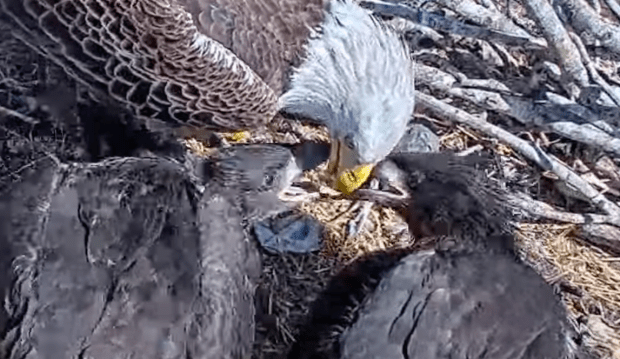
My goodness. Most of the time we think of a pip and then a wait to see how long it will be until hatch. Well, the first eaglet of the year has blasted out of the egg at Duke Farms. This is one strong eaglet. Want to bet she is a fierce formidable female?

Dad was on the nest checking on the progress.

The reveal came around 14:06.

Well, hello! Aren’t you amazing? Such a strong eaglet! Dad sees his chick for the very first time.

One strong eaglet! A nice fresh fish on the nest for Tuesday morning breakfast!

The first breakfast for Monday came in at 10:28:45 at the SW Florida nest of M15 and the Es. It was very difficult to see what that prey item was, actually. E22 mantled it and got a huge chunk. M15 found some small bits and kept 21 busy feeding him.

Another delivery came at 13:47:05. This time it was a small fish, not tiny but not huge. E21 was up at Dad’s beak first but 22 did his usual work around and got up to the beak to get some of that fish. E22 exhibited no fear as he touched beaks with 21 trying to get some fish. Meanwhile, the female is down in one of the trees not bothering what is going on at the nest. It appears that 21 and 22 play around trying to eat the skin and some bits and bobs.

E22 is the fastest eaglet on this nest and the best at self-feeding. He learned those traits early on when we all thought he might not survive. What a great eagle you will be 22.

M15 came in with another prey item at 14:54:14. It was difficult to tell which eaglet was which, but both got something to eat. I think it was 22 at the end who also had the bone and was chewing on it. Perhaps you held your breath seeing the adult above the nest, but thankfully, it was M15 just getting off the nest at 15:01:36.

I believe it is 21 on the left and 22 on the right by the tail feathers but, I could be so wrong.
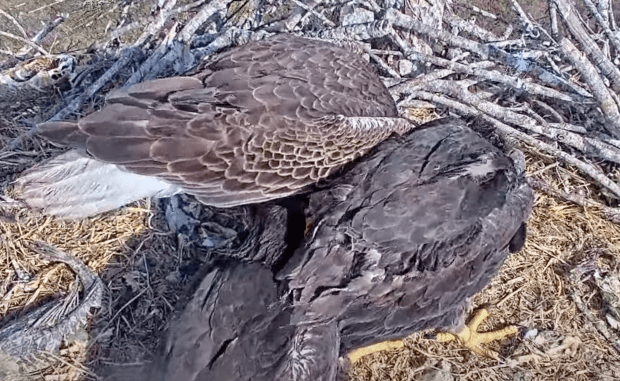
M15 came in with another fish for the eaglets at 16:23:21. E21 got some first bites but E22 was quick to get itself into a position to snatch and grab from the right to the left!

E21 is on the left and E22 is on the right.

He just grabbed a big piece of fish!

22 pushes 21 back while keeping his beak up to get the fish.

The fish went back and forth, but E22 got it and finished it off quickly. Dad was back up to the branch at 16:28:38.

That might be the last feeding of the day. It has gone well. Thank you, M15.
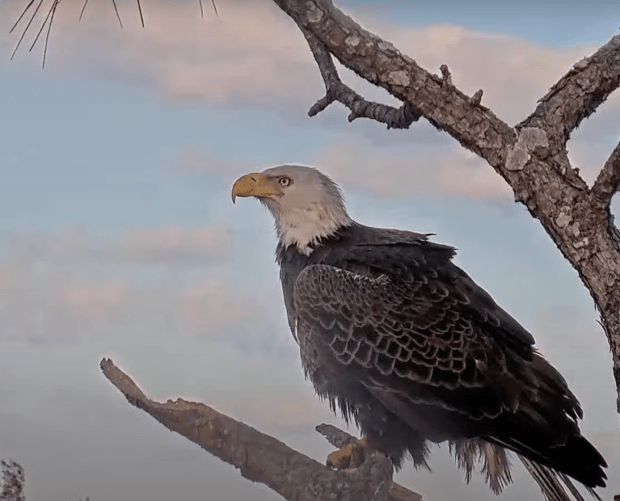
They both look a little tattered. Harriet was M15’s first mate. She was a fierce eagle as we know and no one would mess with her chicks, her nest, or her territory. We wait to see how this goes.

I am warming up to her. Injuries, stress, hunger. They all trigger behaviours that might not otherwise take place. Yes, she has pecked and winged but, she has not injured E21 or E22. As we know she did, voluntarily or feeling forced, feed 21. She has protected the territory. M15 will need a ferocious mate to take on this popular territory together.

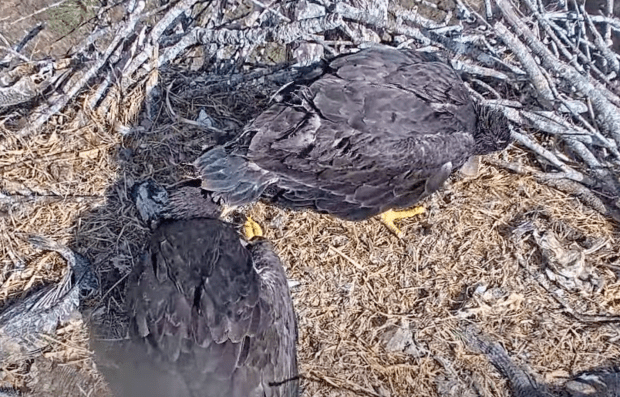
M15 brought a squirrel into the nest at 093215 for 21 and 22. He did some feeding but, in the end, it seems that 21 took some of it to self-feed. That is 22 getting fed by Dad below.

There appears to be, sadly, a territorial dispute going on at the Redding Bald Eagle nest of Liberty and Guardian. Guardian returned to the nest where Liberty is incubating their single egg for the season injured on Sunday. Injuries appear to be the left eye, the top of the head, and some frayed tail feathers.
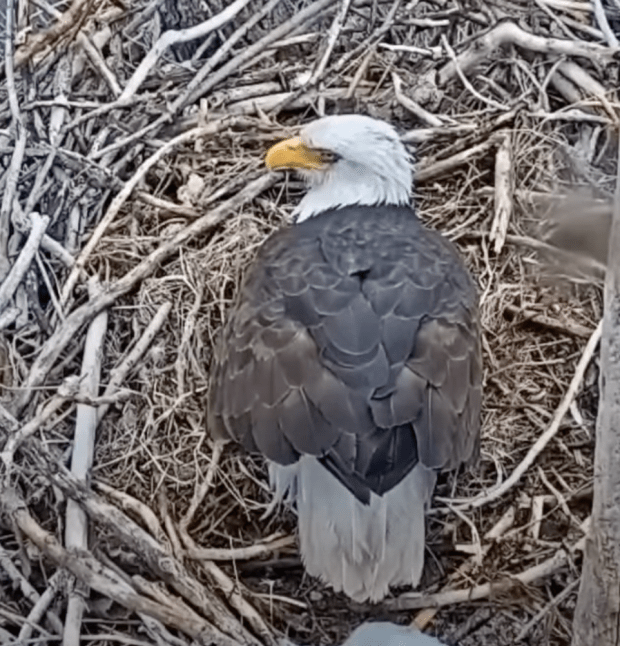
A short time in Ron and Rose’s nest, a shift change. I love the chortling.

Everyone is counting down the time to eggs and I am thinking that it is two weeks. Around 13 March for Big Red and Arthur. So happy they are back at the nest on the Fernow Light Stand so that we can watch them raise their eyases.

Meanwhile, L4 is still with the young hawk and still on Mum and Dad’s territory as far as I am aware.

The heavy snowfall promised to hit the northeastern US is now falling on Big Red and Arthur’s nest in Ithaca, New York.

Indigo is still home! And he is loud. Missy and Lewis always want the volume off. For some reason, Indigos’ screeching scares them.

If you want to glimpse the four owlets at the Corona Owl Nest, you need to watch during the night or do a good rewind. There are four of them, and voting will begin on naming the four on March 6. Check out the chat with the live stream: Corona Owls on YouTube.

At Taiaroa Head, home to the Royal Albatross Colony, Sweet Pea does her very first sky call. Lady Hawk caught it for us!

Jackie and Shadow made the news in Greece. I keep saying if love could fill that nest with little eaglets, that nest would be spilling over. Fingers crossed for a successful second clutch and hatch in the future. If you are wondering, yes, it is possible. When Harriet and M15 lost Sassy Pants, M15 wanted another clutch of eggs. Those two eaglets hatched and were named Miracle and Grace.

Making News:

I brought you the news from CROW about a GHO owlet that had fallen out of a tree and was placed in a laundry basket hoping the parents would feet it. The story gets quite amazing. A wellness check was done, the original nest located, a sibling and lots of food in the nest – and even more special, the adults welcomed the ‘lost’ baby back into the family! Thank you, CROW.

They stopped the fireworks in the UK not to disturb this amazing walrus named Thor. Today, he was discovered in Iceland!

Please don’t tell any gamekeepers on those moors!

‘EJ’ sent an article to me explaining it isn’t the type they usually send. It is hard to believe that some individuals take shotguns and are called ‘removers’. They are culling one owl species for another. Honestly, I think humans should leave nature to nature. Do we actually understand what we are doing to wildlife and the planet? — Sorry, I am ‘getting started’. Nothing has convinced me that we are proper conservators of our home and theirs or that we have insights that make us superior. I wish it were different.

https://www.salon.com/2023/02/26/professional-owl-terrorists-scare-off-barred-owls-with-shotguns-in-the-name-of-conservation/

The author says: “Remover” was an accurate term for what Hunt did. But it was a euphemism. Hunt is one of the best in the business at shooting barred owls out of trees with a shotgun. The twenty-eight-year-old, slightly-built wildlife management specialist from Belmont, New York, had spent five winters tracking barred owls and systematically blasting them from the canopy with a twelve-gauge. The goal was to reduce the barred owl population enough to relieve the pressure on spotted owls. It was a divisive study generating high emotions on all sides. But Hunt loved the work. “I’m kinda sad the removal part is over,” she said.”

This is wonderful news. I am certain that when Rita was injured, we wished this might have been the outcome. It was not to be but, for this couple, it was the perfect ending. Congratulations to all!

Here is the whole story:

Some bird humour compliments of the Webster Texas Eagles FB page.

The season’s first egg is at one of the Peregrine Falcon’s nests in Japan. Congratulations! For those who would like to watch this scrape, I have messaged the site to get a link. The scrape fledged four little eyases in 2022.

A former student ‘CD’, now teaching her university-level science classes, posted this today. Do you know about these women who saved the birds?

Thank you so much for being with us today! Take care, everyone. See you soon!

Thank you to the following for their tweets, notes, posts, videos, and streaming cams that help make up my blog: ‘CD’, ‘EJ’, Duke Farms, SW Florida Eagle Cam and D Pritchett, Gary and FORE, @Cornell Hawks, Valerie Valicento and Cornell Hawk Cam Chatters, Elain and Charles Sturt Falcon Cam and Cilla Kinross, Corona Owls, Lady Hawk and NZ DOC, Maria Grigoriadou and FOBBV, Heidi Mc and WRDC, CROW, BBC, Google Maps, Yorkshire Post, Salon.com, Sydney Wells and Bald Eagles Live Nest Cam and Nests, Webster Texas Eagle Watchers, Ashai Falcon Kirara, Women Who Saved Birds.

Will the Es be fed, balloons banned, Avian Flu in Japan…Friday in Bird World

24 February 2022

Good Morning Everyone,

There is some good news, and there is worrisome news this morning. This 2023 breeding season has really started off like a wild roller-coaster ride.

First…a big shout-out to Laguna Beach, California. They have banned balloons to save the ocean and wildlife. Let’s see who will stand up for the planet and its living inhabitants next.

https://www.theguardian.com/environment/2023/feb/23/california-laguna-beach-bans-balloons-ocean?CMP=share_btn_link

Spring is coming to the UK. I wait for the Ospreys to tell me but, some are watching the Blue Tits starting their nesting.

https://www.theguardian.com/environment/2023/feb/21/country-diary-its-started-the-blue-tits-are-house-hunting?CMP=share_btn_link

Thursday has been a very tense day in Bird World. The female with the black talon attacked M15 when he brought a fish to the eaglets for breakfast on Thursday morning. She chased him around the pasture and then flapped him off the nest. It is mid-afternoon, and M15 has not fed the eaglets. The female with the black talon is on the branch below M15, above the nest.

M15 at the very end of the tree doing security. Or is he waiting for her to leave? We should never underestimate this female. She is larger and heavier than M15, and she is determined. Her talons demonstrate that she is not afraid to engage, and we know from footage around the nest site that she has protected the area. It is extremely difficult to anticipate what she will do next but, it seems that any food M15 brings could be grabbed by her and not get to the mouths of the eaglets.

Females injured feet and talons.

SW Florida video of the interaction.

Getting older.

Beautiful hot, and hungry babies. They are 7 weeks old.

It is 17:15 on the SW Florida Nest. No food has arrived. It is now after 1800, and M15 is not at the nest tree. The Es are searching for any old scraps that they can find. We wait.

I worried M15 might not return, but he did. He is on the branch of the nest tree with the black-talon female. We wait in the hope that the eaglets will be fed on Friday. M15 is caught in a terrible dilemma. If he brings food to the eaglets, the female will swoop and eat it. Then he has to quickly get more for the eaglets, ensuring the female does not injure him. He did this successfully the other day. Will he be able to do it again?

M15 has walked a fine line since Harriet disappeared, trying to do everything single-handedly. This female may not allow him to continue to feed the eaglets as he did so valiantly. If that is the case, I hope that CROW has the permit to remove them so that they can eat, learn to fly, and fledge safely. If that should happen, I do not think anyone will forget the good fight that M15 undertook to raise his eaglets under the most difficult of circumstances.

SW Florida Eagle Cam reminds us:

It is Friday morning 11:00, and the eaglets are yet to be fed. Did I say that I am extremely worried about them? Another person has been caught leaving food! Did I say that the eaglets’ ps are getting thin? If M15 doesn’t feed them because of injury to himself, them, or both, will CROW remove the eaglets and care for them til they fly free?

Maybe if I send this quick he will fly in with a big meal for them but, alas, I fear that the fight in the nest and the fact she took two meals in a row and chased him might have changed this. Stay strong babies!

So where does someone go if they want to see stability and tranquillity? Well, there are many choices. The first up for me would be Gabby and V3. No eaglets to worry about. No intruders at the nest. Just nice and quiet. Both have eaten well and have crops. They are in good physical shape, and V3 has ensured that the revolving door of suitors is closed. Gabby saw his great potential and accepted him. While we may have gone after looks, it seems she went after a good security guard that also was quite handsome. Hopefully, they will have eaglets next year. Like everything else in Bird World, we wait.

Of the nests that have eaglets, Captiva is a good choice, but there are intruders sometimes. The KNF-E1 and E-3 nests of Anna and Louis or Alex and Andria have plenty of food and are doing well. It is difficult to tell precisely what is happening at Superbeaks, but at least one of the eaglets has fledged, and both have branched. This has been a great nest to observe. The Royal Cam nest is always sedate and beautiful until the parents begin leaving the chick. This has just started happening, and now there is anxiety because of the number of juveniles or non-bonded individuals cavorting around SP.

Meanwhile, winter storms are troubling some nests. Jackie is going to begin to get very hungry. Do her and Shadow have a food stash? They must!

Jackie and Shadow are valiantly dealing with a big winter storm in the Big Bear Valley area. This is Shadow in the nest Thursday. More than 14,000 people are watching and wishing. If our love could give them a viable egg, they would have a full nest!

Shadow brought in a ‘black’ bird for dinner at 15:53. The couple switched incubation duties while it was plucked and eaten. All I can think of is — if it is hard to hunt prey today, is it now the pesky Ravens that are being served up?

Nancy and Beau are dealing with a winter storm at their nest in Minnesota, too.

Nancy’s new mate, Beau, is good at bringing in fish for Mum and taking over incubation duties.

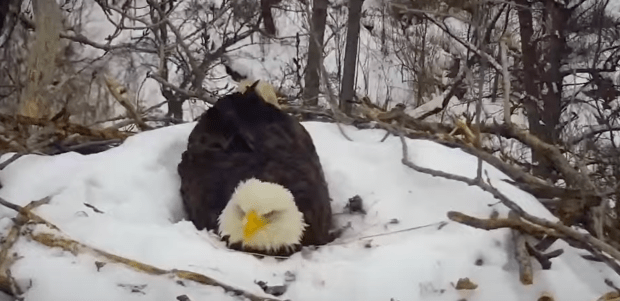
There is snow in Iowa at both the Decorah North nest (top three images) and Decorah (bottom). We tend to worry more about the eagles when they are buried under snow than when it is hot. We look at them and think that they will freeze. In reality, the snow and cold are better than the heat. Eagles are also so intelligent – as we all know. According to my grandmother, they are much better weather predictors than any meteorologist. If you had watched, they would have prepared the nest with more materials. We saw this in Iowa and Minnesota recently. They might also stash prey items. The eggs will be nestled cosy, deep in the nest, safe and warm.

At the nest of KNF-E1 Anna and Louis, Trey was doing some winging when Dudley blew up! That is one way to get rid of an egg on a nest. It was obviously non-viable!

The Mum at ND-LEEF, Little Bit ND17’s mother, has been missing now for 19 days. There is a new younger female at the nest but the relationship between Dad and her is anything but cordial. The South Bend news carries the story of our beloved missing mother from the nest in St Joseph’s Park in South Bend, Indiana.

‘H’ sent me a lovely note and images about the Captiva Osprey this morning. Angus and Florence mated four times (looks successful) and had a lovely spa bath together during the day. Things are looking up for a change—some nice news on a Friday morning.

Last year we were entranced with Thunder and Akecheta raising three eaglets. This year they have moved their nest. Oh, how we will miss this amazing family! It is nice to see them even at a distance, though.

Happy Hatch day for two more Kakapo. What a brilliant year 2022 was for the Kakapo Recovery. 55 chicks. 55!

Sweet Pea or South Plateau Chick is now in the post-guard stage. It spent the day panning the horizon for intruders and worked on gardening around the nest.

Bird Flu impacts almost every country in the world. I want to thank one of our readers from Japan for alerting me to this situation. Thank you ‘A’.

Over 10 million birds have been culled in Japan because of Avian Influenza. On the northernmost island of Hokkaido, the first Tanbaku Crane was discovered to have the flu when it died in late October. Since then, there have been—–

Oriental White Storks are Special National Treasures in Japan.

They are smaller than the most famous of the Cranes, the Red-Crowned. They average 110-150 cm in height, or 43 inches to 59 inches tall and weigh anywhere from 6-13 lbs or 2.8-5.9 kg. Their wingspan is quite large at 7.3 feet or 2.2 metres. They have a black beak, red around the eyes and bright white irises. This is the best way to tell them from the Red-Crowned cranes.

The storks live on insects, small fish and reptiles, as well as small mammals. They are a top Apex wetland predator and like Ospreys and Bald Eagles in North America, their presence is a good indicator of a healthy environment. These beautiful wading birds originally lived and searched for their prey in the ride paddies. The industrialisation of agriculture, which included the use of pesticides and chemicals, killed off their natural food sources. The change from having natural waterways connected to rivers to concrete drainage and irrigation was also detrimental. Humans could flood the rice paddies quickly, which meant that many amphibians, such as tadpoles, that the storks relied on for food did not mature. So we now have also a loss of habitat with the logging of pine forests. Many succumbed to mercury poisoning from these pesticides and chemicals and could not breed. This is, of course, very similar to the issues of DDT use in North America. The very last wild storks were seen in 1971, again, a similar time table to the decline of the Apex raptors in the US.

These gorgeous birds are featured in many works of art and on buildings throughout Japan. The risk of extinction caused them to be designed as a special national treasure in 1956 when there were 20 wild storks left. Plans to breed the storks in captivity began to be discussed. It was not until 1985, when Russia translocated six young storks to Japan, that there was hope. Four years later, one pair raised their first chick in the wild! Meanwhile, 300 storks have been bred in captivity and released. Their new threat is Avian Flu.

The female stork hatched in April 2022 and was banded. Her name was Niji, and she was discovered dead at a pond in Muragame on 15 November. Tests indicated that it was the highly pathogenic H5 strain of avian flu. This will have a devastating impact on all the water birds of Japan.

東方白鸛 Oriental White Stork” by Hiyashi Haka is licensed under CC BY-NC-SA 2.0.

Hyogo prefectural homeland for the Oriental white stork, Japan” by pelican is licensed under CC BY-SA 2.0.

The image above is Storks by Ohara Boson.

When you think it is too much at some of the nests, just read this. The raptors do not mess around when it comes to territory. They protect it – often to the death.

I can assure you that all of the eaglets on the nests – save for 21 and 22 – are being well-fed. Eggs are being incubated. There are intruders and sub-adults, even following Jackie at Big Bear today. Mating occurs in the hope of eggs and spring at other nests.

Thank you so much for being with me. Please take care! See you soon.

Thank you to the following for their notes, videos, announcements, and streaming cams, where I took my screen, captures for the newsletter today: ‘A’, ‘B’, The Guardian, SW Florida Eagle Cam and D Pritchett, SW Florida Eagle Cam, NEFL-AEF, FOBBV, MN-DNR, Raptor Resource Project and Explore.org, KNF-E1, South Bend Tribune, ‘H’ and Window to Wildlife, Gracie Shepherd and Raptors of the World, Kakapo Recovery, Cornell Bird Lab and NZ DOC, OpenVerse, and Ciryon Hoop and Raptors of the World FB.

Port Lincoln’s Middle Bob is getting some confidence…and other tales in Bird World

22 October 2022

Oh, good morning to everyone,

I hope that you are already having a wonderful weekend by the time you read this update on our feathered friends. Things are really beginning to look up at Port Lincoln. I am cautiously optimistic that Big is moving out of her aggressive stage.

My friend “S’ and I were talking about books – holding books, feeling the paper, turning the pages – a few weeks ago. She is encouraging her graduate students at university to read real books, to go to the library, to feel the pages. Of course, she was talking to a ‘member of the choir’, so to speak, when we had our chat. I love books, good quality books with beautiful images. Today, it wasn’t a book that arrived in the post but Cornell Lab of Ornithology’s Living Bird magazine that arrived. The cover featured a beautiful goshawk. Inside was a treasure trove of information for every species lover. There was a lot of information on migration, loss of biodiversity and what this means alongside reports on projects aimed at mitigating loss. The core of every article is how each of us can help mitigate the issues- sparking action to bend the curve.

As researchers and citizen scientists discovered with the great bird counts, the number of songbirds increased dramatically when ordinary people, just like you and me, began putting out bird feeders. Today, one of the most pressing issues is biodiversity. It is the word of the moment. One of the articles in this edition of Living Bird, ‘The Most Distinct Birds are at Greatest Risk of Going Extinct’ goes straight to the heart of the loss of entire species. On that list of Red Species, to my surprise, was the House Sparrow and the European Starling. The lead researcher, Emma Hughes from the University of Sheffield, said that birds with unusually long or short beaks, long or short legs were more likely to go extinct than others. Climate change and habitat loss is at the heart of the loss of these others such as the Red-headed Vulture, Giant Ibis, Seychelles Scops-Owl, the White-headed Duck, the Bee Hummingbird to name only a few on her list. They are going extinct because of their weirdness and the particular ecosystems that support them are being lost. For Hughes, the only way to stop the extinction is to increase efforts at biodiversity (21). This is precisely what they are trying to do with two species that depend on one another for survival – the White-barked Pine and the Clark’s Nutcracker. As the author of the article in Living Bird states, ‘Some pairings are so iconic that one is not complete without the other: Macaroni and cheese, Abbott and Costello. Peanut Butter and Jelly. In the northern Rockies and Sierra Nevadas, that duo is the white bark pine and Clark’s Nutcracker.’ (28)

To read the latest addition of Living Bird magazine, go to this URL: https://www.allaboutbirds.org/news/living-bird-latest-issue

There is a lovely video of the work being done on the Clark’s Nutcracker in this latest edition. Be sure to check it out.

I used the term ‘Red List’. Do you know what this means? It is the full name is the International Union for Conservation of Nature’s Red List of Threatened Species. It just so happens that there are two wonderful and exquisitely produced books on these threatened birds. They are Red Sixty Seven and the most recent edition, Into the Red, by Kit Jewitt. Both editions are collaborations between authors and artists whose goals are to call attention to at-risk-birds as well as to raise funds to support conservation work to halt their extinction. The books were published by the British Trust for Ornithology. Go to bto.org for more information, to view some pages and read about the artists, and to purchase. The purchase will go directly to helping. I urge against buying through on line book sellers as the prices on their sites are way too high or they say not in stock.

———————————————————————————————————————————

It is nearly 2300 on the Canadian prairies. There are no stars out tonight but there is one brave little Osprey in Port Lincoln, Australia who needs a round of applause. That ospreys name is Middle.

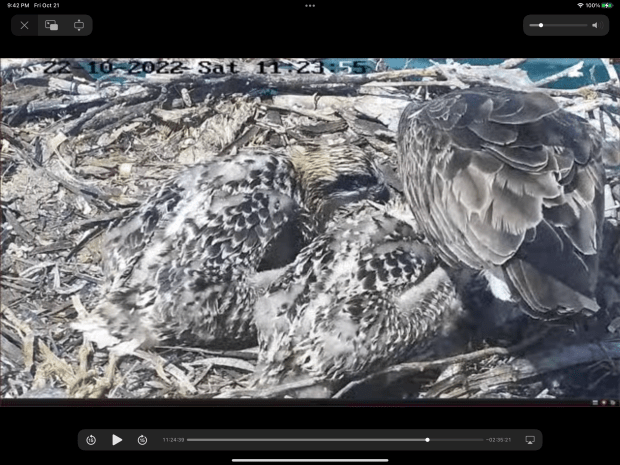
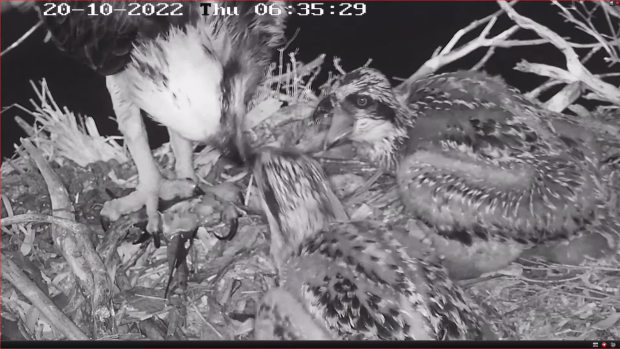
At 111232 a whole large live fish landed on the nest. Middle is being overly cautious not trying to grab any bites. Letting Big get those precious first bites and get her crop a little full. Meanwhile, Middle is pecking away at the tail of the fish. This is very interesting. You have probably seen, as I have, siblings eating from the tail while the breaking sibling is fed up at Mum’s beak. It is a good strategy once Middle figures out how to unzip that tail. By 112218 Middle is up by Big and is doing the snatch and grab. Sometimes Middle pulls back – he is very cautious. Mum gets to eat some fish. In fact, she is feeding the ospreys a little slower than usual. Big moves away from the fish feeding a couple of times. The first is at 112506. Big has been eating for 13 minutes and is getting full. Mum begins to feed Middle. At 112951 Big moves away. Middle remains cautious and then, at 114139, Middle pecks Big before he moves up to begin getting fish. So to summarize, even thought Middle is afraid and displays this as we watch, he is hungry and he is getting braver in order to get fed. Eating is essential to his survival. Middle is doing well. He will end the feeding with a nice crop.

I also noticed that Big is not as grumpy as yesterday despite there being 5 hours between fish deliveries. Perhaps she is slowing down, hitting that plateau. That would really bring peace to this nest.

By the time the 1637 Zebra fish arrives on the barge, Middle is feeling much better, more confident, and Big is being nicer. That feeding went well and even at 1817 when Mum and the two ospreys saw Dad and were feverishly calling for another fish, Middle (and Big) had enormous crops from the day’s takings. I have spent much time watching this nest as opposed to the two falcon scrapes because the fate of Middle was not quite clear. I will have said it twice today, at least, but, it appears that Port Lincoln has turned a corner.

Look carefully at the bottom image. That is Middle, full to the brim. Just sit and smile. Cry. Life appears to be good at Port Lincoln. Still, send all your best and warmest wishes to this family for continued supplies of fish.

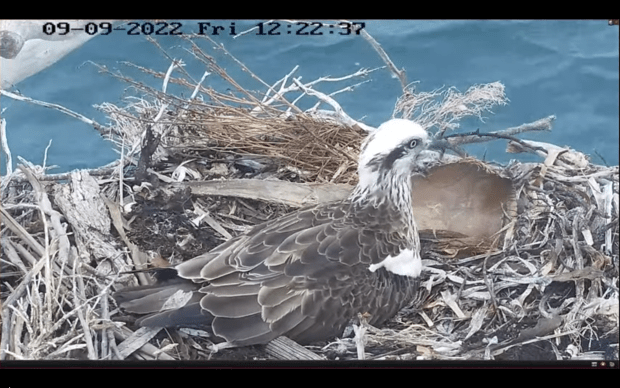
It is getting more difficult to tell the female Peregrine Falcons from the males. You must look closely. Diamond just about fooled me yesterday. They lose weight. All of the females lose approximately 30% of their body mass during incubation and raising their chicks. Diamond now has the look of a male with his tight little striped pants.

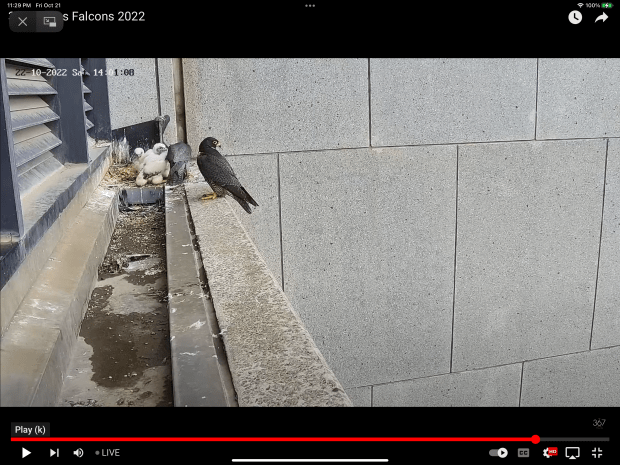
The same is true for Melbourne where the camera is now positioned so we can see the happenings at the far end. Mum seems to be enjoying it. She has a nice perch above the chicks so that she can watch them but not have any one or all of the Melbourne Four rumbling around underneath her all night. Like human parents, she can get some sleep now!!!!! Thank you to ‘H’ who watched and clocked the feedings at 367 Collins Street yesterday. Much appreciated. There were 5 of them. At 0650 a large unprepared prey arrived on the ledge. The erases were fed for 22 minutes. Leftovers came at 1153 and that was an extremely short feeding of 4 minutes. At 1358 D arrives with a big prey item and feeds the eyases and then Mum arrives and takes over. That lasted 16 minutes. The final two feedings at 1657 and 1836, were large prey items fed for 24 and 18 minutes, respectively. Four active growing eyases can eat a large unprepared bird in such a short time!

This is just a short catch up. Everything is absolutely fine at the two scrapes in Australia – at the 367 Collins Street location and at Orange. I am cautiously delighted about the happenings at Port Lincoln and extremely proud of Middle Bob who is getting ever so clever. Middle Bob is a ‘survivor’.

Thank you so much for joining me. I hope that you are all well. I am back to normal. it was the flu shot that caused me to feel like I had been hit by a big truck. It is cloudy this morning but it appears to be a reasonable day to go and check on ducks. Take care everyone. See you soon!

Thank you to the following for their streaming cams where I took my screen captures: Port Lincoln Ospreys, Charles Stuart Falcon scrape, and ‘H’ and ‘A’ and 367 Collins Street by Mirvac.

It’s not all about Raptors…

19 October 2020

Hello Everyone,

The first feeding at Port Lincoln was a good one, save for Mum. She has two big osplets that could sit and eat fish all day. It went well. Smiling. And it is warming up on the Canadian Prairies. It is 11 degrees. Tomorrow is going to be beautiful. It will be a good day to get outside!

In the Mailbox:

‘D’ writes:  You often mention some of the visitors to your garden. Today the squirrels were included again. I’m interested to read that you have greys & reds visiting. As you know, the greys in the UK are a threat to the reds, I wondered are yours a different species?

A Eurasian Red Squirrel in the Scottish Cairngorms. Photo by Dani Connor Wild.

I did not know the answer to ‘D’s question right away although I knew that Little Red looked different than the Red Squirrels in Sweden and the UK that Danni Connor photographs. First, the Grey Squirrel is native to North America. It was introduced by the aristocrats of Victorian England as an ornamental species. It is very invasive and there are currently issues with it and the native Red Squirrel in the UK. In my garden, Dyson is the matriarch of all the grey squirrels. She has been visiting for several days now along with her babies from the summer. One of the young ones prefers the shelled peanuts and will spend hours eating on the deck in the warm sunshine. Dyson will eat anything – as all of you know – but she much prefers the solid seed cylinders with the nuts and cranberries.

There are 3 species of Red Squirrel: the North America species is the one that lives in my garden in Canada. It has no ear tufts and has a single cache of winter food. Previously, Little Red used the garden shed but now he stores his nuts in the wood box. Eurasian Red Squirrels live in the UK, Europe, and parts of Asia. They have tufted ears and spread their cache to multiple sites. Gosh, I loved that question. It made me look closer at my own garden animals and it reminded me of Dani Connor Wild. I wonder what she has been up to?

Well, Dani has made a trip to Scotland to see rewilding and reintroduction measures. Wow. So today, it isn’t all about raptors…but imagine, in these Scottish Highlands, in the spring, the call of the Osprey!

Making News:

Arthur was caught on camera this morning at the Cornell Red Tail Hawk nest on the Fernow Light Tower. He delivered a single stick at 083726. It sounds like Big Red has chosen which nest to use for the 2023 breeding season. Arthur looks good!

Here he comes!

I am so fascinated at how they fly so fast, talons first and pull back their wings so they are not ripped off as they go through the metal bars.

Well, hello Arthur. It is really nice to see you!

The streaming cam at the nest of Southwest Florida Eagles Harriet and M15 is now operational again after Hurricane Ian. You can watch the nest building progress.

Australian Nests:

It is sometimes not easy watching raptor nests. We love the little gaffers and take them to our hearts. Most of the time all is well but, there are times when it isn’t and we lose one. Many of us still want to honour Little Bob in some way. We are discovering more and more about the legislation and who is responsible for permissions. When ways to help ask for intervention permissions are discovered, I will certainly let everyone know.

This was the day that the beaking began – 26 September. Little Bob was so tiny next to Big.

This is a video put together by Bart who is one of the moderators on the PLO chat that is beside the streaming cam. Difficult but best to watch to the very end.

I had so hoped that Big would settle and let peace reign on the Port Lincoln Osprey nest. That happened until it didn’t. Let’s hope that today is different.

The first fish of the day, a whole fish, arrived on the nest at 063037. This is early and very promising. So far Middle has been able to have bites without being beaked…although he is visibly cautious of Big. Middle is the furthest away from the screen.

Oh, it’s a nice big fish. Middle is so hungry and he is getting so good at the old snatch and grab. Every once in awhile, if you watch it live, you will see Middle jerk over to the right with its head and shoulders – trying to get his head out of the way if Big goes for him. But so far, so good. Big has ‘leaned over’ to try and remind Middle she’s the boss but Middle is so hungry he is doing a great job at snatch and grab. Hopefully Big will be friendly all day long but she tends to get grumpy…let’s just blow the grump out of her!

Now Mum needs some fish. That was a great feeding. Back and forth between the two. Middle finished with a really nice crop. So happy. The feeding was over at 064511. Fifteen minutes to vacuum down a big fish with its head. Gracious.

Pigeons are arriving early in Melbourne. Mum waddled down the ledge with the breakfast offering before the lights in the CBD had come on. It was 05:42:33. That pigeon was finished and Mum flew off with a couple of bones at 06:06:22. Gosh, just stare at the eyases with their thick white down and the feathers beginning to appear. Many are beginning to look like that cartoon hero The Hulk or maybe a member of the Australian Rugby team as they try to stand and use their wings for balance.

Just look. One trying desperately to stand and the other all fluffy with a nice tail. They are changing before our eyes. The thermal down will be beneath their feathers when they finish getting their plumage before fledge.

Everyone looked like they were full.

At Orange, the kids are awake. Diamond has been restless and Rubus is starving! No surprise there. It is shocking how much prey that little one can hold. And here I must admit something. I think that Rubus is one of the cutest eyases I have ever seen. He is such a character. They are waiting for breakfast to arrive.

Xavier flew to the ledge with a freshly caught unplucked Starling at 055658. The kids got a lesson in plucking. Rubus was so excited to see prey that the little gaffer was happy to have a mouth full of feathers.

Xavier was visually delighted that Diamond was not in the scrape and he got a chance to feed Rubus and Indigo.

It is 1536 on the Canadian Prairies. The sky is cloudy but it is warming up. The Juncos are busy eating Millet off the red garden carpet, their favourite. What a nice way to close the blog with the garden birds happy and all the chicks in the Australian nests fed. It is such a relief that Middle got a good feed this morning first thing.

Thank you so much for being with me. Please take care. See you soon.

Thank you to the following for their posts and streaming cams that made up my screen captures: Dani Connor Wild, SWFlorida Eagle Nest and D Pritchett Family, Cornell Bird Lab, 367 Collins Street by Mirvac, Charles Sturt Falcon Cam and Cilla Kinross, and Port Lincoln Ospreys.

An update on Big Red and Arthur’s L3

7 October 2022

The Cornell Bird Lab has issued an update on Big Red and Arthur’s third hatch of the 2022 breeding season. I thought you would like to know how she is doing (yes, this hatch, like L4, is a she).

A new supporter for the Albatross? has Mrs G left for migration…early Friday in Bird World

9 September 2022

Thursday was truly a bit of an uneventful day mostly spent waiting on a parcel delivery that came much, much later than anticipated! It was a good time to just watch the garden to see what was happening. For Dyson fans, she is back to her normal self since having the babies. She was flying off branches today, landing on the deck, grabbing peanuts and running so fast I could not catch her on camera! Two of the Crows alerted me to the presence of the cat under the bird feeders. My goodness, they are quite remarkable and were given ‘extra treats’ – cheesy sausages – for their good work in protecting the rabbit and the songbirds. It has also been quite in Bird World, pretty much. These images have been shot quickly through a screen!

The Crows on the line cawing very loudly and looking at the cat below the feeders.
The culprit – a well fed pet!

In the Mailbox:

A couple of days ago, ‘B’ asked which gender migrated earlier – males or females? I have spent time asking Osprey experts and have uncovered some preliminary data using the Dyfi charts. It seems that gender is always discussed with regard to fledging but is only a footnote when it comes to migration. With a very small sample, males are 75% more likely to migrate first than females 90 days and under.

The chart below is of the Dyfi chicks. So those who fledged at 90 days, 75% more males than females. As you can see the older the chicks get, there are more females that take longer in the nest to migrate after fledging. I cannot assume that this is the same for other nests but, for now, this is the clearest data chart I have found for us to interpret. I will be looking for others in the days to come.

‘L’ wrote to me about the new climate bill in the US. The Audubon Society had posted an article on the 12 ways that it will help birds – and other wildlife. Thanks for sending me that article, ‘L’. I am certain others will find it of interest, too.

Making News:

The Osprey lost at sea that hitched a ride on a boat is making news in Scotland.

https://www.scottishdailyexpress.co.uk/news/uk-news/boaty-mcboatface-rescue-osprey-lost-27938175

Mississippi Power is putting up some Osprey Poles. How wonderful! Maybe they will place some more nests and other utility companies will follow suit. Sitting on the Canadian Prairies it is easy to imagine the number of Ospreys that might choose to winter along the Gulf or in the Gulf States.

The Royal Albatross and the campaign to change the long line fish trawling practices may have a new champion in King Charles III.

Nest News:

Based on their size and weight, the wildlife rehabber believes that Big Red and Arthur’s L3 and L4 are both female! Nice. That explains a lot about L4’s behaviour in the nest — not afraid of anything, just barreling over the others to get to the beak. Is it possible they were all females?

L4

At the Osprey nest of Aran and Mrs G in the Glaslyn Valley in Wales, all three of this years fledglings have joined the 100 Club. This means that they have been on the nest for over 100 days and counting before migrating. Today they are 106, 105, and 102 days old! Aran might be wondering if everyone has decided to over winter.

This was early Thursday morning. Mrs G is in the second photo. It was the last seen of her. The time was 08:58. If she isn’t hiding down in the Oaks or trying to fool us, Mrs G has now left for her migration. She took a piece of fish off one of the fledglings just to top up her tank! If you have left Mrs G, safe travels, lots of fish, and return again next spring – you remain the oldest osprey in the UK and what a lovely group of offspring this year!

Idris continues to deliver fish to Padarn. It looks like some are very happy to stay in Wales!

Padarn this morning. She is still in Wales!

Louis still has Sarafina fish calling!

The Melbourne scrape seems to be getting a lot of attention lately. First up, the building number is 367 Collins Street. There are now 36.7 members of the FB group. That is an incredible number of supporters. Here is the announcement:

There has been much concern over the incubation time and whether or not there was another male falcon present at the building. Victor Hurley, the chief researcher of the nest for the Victorian Peregrine Falcon Research group posted this today on FB:

The images that I have taken today appear to me to be the same male that has been at this nest since I began watching some years ago. Dad is relieving Mum so she can have a break this morning.

Later the couple were having a conversation.

In Orange, there is heavy rain falling. Diamond watches it from inside the scrape. Xavier has been in and out helping with incubation duties. I hope he is somewhere trying to stay dry.

At the Sea Eagles nest, it was chilly and the two eaglets wanted nothing more than to be able to shrink so all of them would fit under Mum.

Dad brought a little fish in for their breakfast so that Lady could feed the two.

Both SE29 and SE30 are really getting much more steady on their feet and they are spending more time walking on top of this twig nest. That surely cannot be easy!

At the Port Lincoln Osprey barge, Mum has been hungry. Dad has been known to bring in a fish, eat a large portion of it before bringing her a piece. Today he brought her a really nice sized larger fish for her tea. How wonderful. Thank you, Dad! Mum was really excited for that lovely dinner.

Looks like Alden’s funny quirks have rubbed off on Annie who was caught ‘loafing’ on the ledge of The Campanile on Thursday.

Oh, how I love Samson. He was at the NE Florida Bald Eagle nest today waiting for his mate, Gabby, to arrive from her migration. Like Richmond, the SF Bay Osprey, Samson stays in the area of the nest and does not migrate. Both Rosie (Richmond’s mate) and Gabby, do. Gabby is usually home by the 12th of September.

Migration News:

There is information from Bonus, Jan and Janika’s Black Storklet that was fostered by Kaia and Karl II. Bonus remains in Belarus near the Pripyat River where he has been feeding for some time.

Kaia remains in the general vicinity she has been in Ukraine.

Karl II is still believed to be in the area of Kherzov. We now know that the telecommunications in the area is down. Storks should, unless shelled by accident, wish to stay away form the people and there are the many nature reserves in this area where Karl II stayed for long periods in previous years. I am trying to remain positive for him!

Waba has had trouble with the tracker so there is no conclusive report.

From the archive:

Do you know which nest this was? The year is 2020. The older sibling supported the younger. The Magpie helped ‘this eaglet’ when the Pied Curra were attacking? The third image is the last one at the nest.

Thank you so much for being with me on this very quiet Friday in Bird World. Take care everyone. See you soon.

Thank you to the following for their posts, videos, tweets, and streaming cams that make up my screen captures: Dfyi Ospreys, Cornell Bird Lab, The Scottish Daily Express, Mississippi Power, Royal Cam Albatross Group NZ, Bywyd Gwyllt Glaslyn, Friends of Loch Arkaig and the Woodland Trust, 367 Collins Street by Mirvac, Charles Sturt falcon Cam, Sea Eagles@Birdlife Australia Discovery Centre Sydney Olympic Park, Port Lincoln Ospreys, Cal Falcons, NEFL-AEF, and Looduskalender.

From the Archive Answer: That is SE25 supporting SE26 after its little leg was broken. Lady is feeding both of them. SE26 struggled in the forest after fledging. After 6 days returned to the nest massively hungry and exhausted. Lady and Dad fed SE26. When 26 had recuperated, she flew to the camera branch where she was attacked by the Pied Currawong. A Magpie came to help 26. That is the last picture we have of SE26 in the forest. She flew out, chased by Curra, during the time of a storm and landed on the balcony of a 22nd floor condo some 1.5 km away in Horn Bush. SE26 was taken into care and euthanized, sadly. It was believed the damage to her leg would cause extensive pain and could not be repaired properly. It was a very, very sad day. SE26 was inspirational to all you watched her struggles to ‘be an eagle’…she flew. That is one consolation. What we learned was that the Pied Currawong are unrelenting in chasing the Sea Eagles out of the forest. This has caused extensive difficulties which have been noted in recent years with SE27 going in and out of care and requiring training to fly and hunt prey.

Is it really Little Bit 17? and other Sadness and Gladness in Bird World

3 August 2022

Good Morning Everyone,

I was out almost all day yesterday and returned to find some sad news. We will get this over and move on to all the good news!

The situation at the #4 Osprey nest in Finland turned darker. An intruder appeared and the chicks ‘fell or flew’ off the nest. The youngest who had not as yet flown was predated. This is also the chick that was so vigorously attacked by Mum the other day. So sad. Thank you ‘N’ for letting me know. This is 81 lost so far in the past 13 months on streaming cams.

The Mum and the surviving fledgling on the #4 nest. Keep them in your warmest thoughts.

Ervie. Bazza Hockaday was doing some photography for a client and found Ervie, too. Can you spot Ervie on top of the pine tree? This park is across from the barge – so Ervie is staying close. (Magnifying glass almost required!)

Meanwhile Mum and Dad are making sure that Mum is quite comfortable on those eggs – they are lining the nest with a Silver Gull, one of the favourite foods of the Sea Eagles.

Everyone wondered if anyone would be keeping an eye for Little Bit ND17. It seems that lots of people who loved the eagle that fought so hard to live continues to have a loyal fan club. This evening on the Notre-Dame FB page, the following was posted. It looks as if our Little Bit has been very resourceful and is doing fantastic. Tears, joyful tears!

SF Ospreys have not received the DNA results from Brooks and Molate. Brooks continues to enjoy herself at the other nest and the visitor seems right at home. He is certainly a lovely Osprey – and talented.

The ‘visitor’ at the nest of Richmond and Rosie has done something very special – it caught a Spiny Dogfish (Shark) that lives in the Bay. (Reminds me of those brought to the nest at Mispillion Harbour in Delaware – bet it is just a slight difference in name from one region to the other but the same fish). The juvenile very proudly brought it to the nest. SF Ospreys say this is highly unusual. They have only seen a juvenile do this once. Round of applause!

Here is the video clip:

At the Black Stork nest of Karl II and Kaia, Karl was busy flying back and forth to the fish basket. He delivered 3 big meals to the storklets. Kaia delivered 1 on the 2nd of August. There was some concern that Karl II’s GPS was not working but it seems to be fine now. Thank goodness. I do worry about them all the time for some reason – storklets not yet fledged and requiring much food before migration.

Bonus has been standing on the curved perch with 1 leg. Great balance. Bonus is the oldest of the four. He is 72 days old on 2 August.

The four storklets of Betty and Bukacek are doing fantastic. The female- Fifinka- often spends time on the nest of the adults and then flies to the natal nest when food arrives. Sometimes she holds back from the bigger males but she wastes no time getting there if she is hungry. In the image below she is at the top flying in.

There is no reason for it other than sheer dominance at the Sydney Sea Eagles nest. Lady feeds SE29 and 30 at least every hour if not sooner. Things were going relatively well until 0911 when 29 decided to not be nice and attack 30.

Three minutes later 29 is going into a food coma and 30 is being fed (0917 below).

SE30 keeps its head down to protect it.

Notice how 30 is slinking around the back ready to move forward and eat when 29 calms herself. Very clever tactic.

SE 30 is still being fed four minutes later. All is right with the world.

Mom and Dad on the nest of the Port Lincoln Barge early on 3 August.

Did you fall in love with Louis and Anna at the Kisatchie National Park Bald Eagle cam? couldn’t believe your eyes the day 18 fish were on the nest? did you melt and worry when Kisatchie fledged? when Kincaid hatched this year? Well, Cody and Steve have more fun for everyone. You will be able to watch 2 Bald Eagle nests from the Louisiana! Here is the announcement:

Humans and wildlife rehabbers helping another juvenile eaglet so that it has a second chance at life. These stories are always welcome!

The fish have been arriving in various sizes to the Osoyoos nest. ‘H’ sent me a note this morning saying the tally was at least 13 yesterday. Olsen is keeping up the numbers and some of them had to be good a good size. Sometimes the chicks are full and sometimes they aren’t. The last fish for 2 August was delivered at 20:01. Dad brought it in and Big Chick (BC) grabbed the tasty little twiddler. Dad rooted around and found an old piece of fish and fed Little Chick (LC). The family is nourished and hydrated. They have a break in the weather for a few days. This is all good news.

Here comes Olsen! BC rushes over to get the little prize.

Fortunately for LC, Dad found a piece of fish and is feeding him while BC works on the twiddler. It is all good.

The fish started arriving at the Osoyoos nest around 0523. The first was a small one but it seems to have changed possession at least 6 or 7 times. BC has been grabbing and self-feeding. Soo got into the action so that her and LC had some breakfast too. It is starting off to be another great day at this nest with 7 fish before 00700. Thanks Olsen!

Beautiful Iris. She continues to work on her nest. Precious are these moments – every year we wait til she leaves and wonder if she will return in the spring after migration. 29 years?

There are no updates on L4. It is now presumed that it was another window strike on the Cornell Campus. That would mean that of the four eyases – three struck windows at Cornell whose Bird Lab is one of the world leaders. Of those three, two are in care and one died. It is time Cornell made its windows bird strike proof like all of us try to do. I have not see at this time 1052 CDT an image of the head of the juvenile believed to be ND17. Elsewhere things seem to be steady but that could change as I hit the word ‘publish’.

Thank you so much for joining me today. Take care everyone. See you soon.

Thank you to the following for their streaming cams, postings, videos, etc: Osoyoos Ospreys, Notre Dame Eagles FB, Sea Eagles@Birdlife Australia Discovery Centre Sydney Olympic Park, Mlade Buky, The Eagle Club of Estonia and Looduskalender, Center for Wildlife, US Forest Service at the Kistachie NF, Port Lincoln Ospreys, and SF Bay Ospreys. They have been turned into my screen captures.

Early Tuesday in Bird World!

2 August 2022

Good Morning Everyone! It looks like rain here on the Canadian Prairies – and when finally believe it is coming, the sun pops out. I am heading up north to check on the Ospreys along Lake Winnipeg. Fingers crossed! I may only make it as far as the nature centre.

Just some housekeeping. The NCTC streaming cam on Bella and Smitty’s nest has been hit by lightning. It will be replaced in time but not when the eagles are about. Phillipe Josse posted on the Notre Dame Eagles FB that all of the eaglets were seen flying about on 1 August. Great news. Victor Hurley reminds everyone that the CBD (Central Business District) 367 Collins Street Falcons generally lay their eggs around the end of August. The camera at the Boathouse Osprey nest in Maine is on the blink. I just about had a heart attack when I did not see 3 chicks in the nest yesterday when I went to their stream. Thankfully I finally figured out it was ‘Highlights’. Check in the left bottom corner if you go so the same thing does not happen to you. The word ‘Highlights’ will appear. The situation at the #4 nest in Finland where the mother attacked the youngest on the nest and the fledgling when it returned has calmed. No clear understanding of the reason behind the attacks but the youngest seemed to get the blunt of the wrath. No updates on L4 taken into care. Good news. The one surviving osprey from the Pitkin County Trail Platform (they were pulled off the nest by female caught in nesting material) remains in care at a wildlife rehab centre. The chick is now eating on its own and its feathers are growing in. Great news! That incident happened on 22 June.

Olsen delivered a very large fish on the Osoyoos nest at 1137 on 1 August (Monday). It was the 13th fish of the morning. Large and with its head. Soo fed the chicks til they were so full they could not eat another bite and then she took the fish to the perch where she enjoyed it.

Soo and BC and LC know Olsen is arriving.

Look at that nice fish! Olsen must have found a super spot to fish today even with the heat.

Everyone ate and ate.

After taking the fish up to the perch to eat her portion, Soo returned a nice piece to the nest.

There were more than 13 fish arriving at the nest of Soo and Olsen Monday. Another one came in at 18:58.

The chicks have eaten well and have spent much of the day with one or the other hanging their heads over the rim of the nest scaring the wits out of viewers. All is well!

Soo and Olsen got a bit of a break in the weather. It dropped to 33 today but….sadly another heat dome is coming in a week. Olsen has already delivered ​fish small fish at these times: 0521:46, 0533:10, 0541:22, 0620:46, 0625:11. A larger fish with head came at 0656:53 with the 7th fish at 0715:06 which was smaller and headless. If you count that is 7 fish by 0715 Tuesday. Olsen, you are amazing.

The good news at The Campanile is that the bonding rituals between Annie and Alden are increasing…and often they are sans Lindsay and Grinnell Jr. How lovely. Stay safe Annie and Alden!

If you did not see my earlier announcement, L4 was taken into care. He was found on the ground unable to fly during the evening of 31 July. Thank you to those who rescued him and took him to the Swanson Wildlife Clinic at Cornell. No updates so far.

Suzanne Arnold Horning caught Big Red, Arthur, and L2 on the campus Monday evening.

Big Red is moulting.
Arthur on the stacks.
L2 yelling for food.

It is fledge watch at the Black Stork nest of Karl II and Kaia. Yesterday it was raining which halted any thoughts of flying but, this morning the storklets are jumping around and flapping. Bonus is the oldest at 72 days with the other three at 66, 66, and 63 days.

The camera was off for awhile and it is unknown if they had a feeding or not. Yesterday Kaia brought in 1 feeding, Karl II travelled to the fish basket but it was empty because he went further to try and find fish. His transmitter stopped at 10:01 on 1 August. It is not know what the problem is and everyone is waiting not so patiently to see if data is uploaded today or if he appears at the nest with food. Fingers crossed. These are the only four Black Storklets that I am aware of in Estonia this year to survive.

Bonus is 77 days old and is the only surviving storklet of Jan and Janika of the original six.

Andor delivered a fish and Lilibet sure enjoyed it. The top image is the 30th of July.

Lilibet on 30 July 2022.

Then he delivered a fish and no one showed up.

Everyone began to question if Lilibet had left the territory. Lilibet has gone no where! She is around the nest a few minutes ago being quite loud – with what appears to be a nice crop.

Lancer is still calling Two Harbours home and Chase & Cholyn are busy delivering fish. Lancer has earned the name ‘Miss Sassy Pants’ by the Bald Eagle community. She practically tore Chase’s leg off with the delivery. — I am sure Mum and Dad do not mind. She will really be able to stand up for herself when she leaves the safety of the nest area.

The Sydney Sea Eaglets are ‘darling’. Just cute little fluff balls eating and growing. Start watching for the slightest hint of little black dots which are feathers coming in.

It is August and we have another month, perhaps, with Iris at the Hellgate nest in Missoula, Montana. For those unfamiliar, Iris is the oldest unbanded Osprey in the world believed to be 29ish. It is remarkable. Mrs G in the UK is their oldest at 22 years.

Iris spent much time at the nest earlier working and bringing in sticks and she has, on occasion, lately graced us with her beauty. She was there this morning when an intruder arrived. Louis went swiftly over to remove the visitor.

Each of us needs a good rescue story! It gives us faith in ‘humans’.

Dad at the Port Lincoln Osprey Barge seems fine. Bonding taking place!

That is a hop, skip, and a jump around the nests this morning. So far everything seems calm. It is a strange time of year. The US Ospreys are eating and preparing for migration at the end of August or beginning of September. We have eaglets in Sydney and we await the arrival of the eggs for Mum and Dad at the barge and the peregrine falcons at CBD and Orange. I do not know about you but I really need a ‘fix’ of little ospreys. Simply cannot wait.

Thank you for joining me today. Please take care everyone. See you soon.

Thank you to the following for their streaming cam where I took my screen captures: Montana Osprey Project, Cornell Bird Lab, Osoyoos Ospreys, Sea Eagles@Birdlife Australia Discovery Centre Sydney Olympic Park, Audubon Explore.org, Port Lincoln Osprey Project, Eagle Club of Estonia and Looduskalender, and Suzanne Arnold Horning for her lovely pictures of Big Red and family.

Sarafina flies, Too many fish at Osoyoos, and other good news in Bird World

31 August 2022

Good Morning! I hope this finds all of you well. For those of you waiting to see Sarafina fledge, she did it at 0655 Sunday morning, 31 July. Congratulations to Louis and Dorcha and to all at Loch Arkaig!

I am so glad that Saturday is over! This means that if the forecast is correct, the nests in the Pacific Northwest that are broiling will begin to get some relief from the heat in two days. Gosh, that seems like such a long time but they have weathered extreme heat for nearly a week and all are still with us.

Olsen and Soo have really done an amazing job keeping the two osplets in the shade on Saturday and, well, anyone who has ever fished know that the fish go down deep to get into cooler water. Ospreys are only able to dive 1m or 3 feet below the surface of the water – so they need those fish swimming around near the top not going deep to get cooler. By 0930 Olsen had delivered quite a number of fish, apparently some better sized than others. I did not count them. There was one delivery around around 19:30ish. It appeared that the two chicks were super full and Soo got some nice fish, too. — They look good at the end of today. Such a relief.

‘H’ sent this image of the ‘unwanted’ fish.

At 08:55 Sunday morning, One chick is sleeping on a fish piece, the unwanted is still there, and Soo has a super nice crop. I sure hope Olsen got some good fish, too. This family is depending on him! And Olsen, you get the gold star for the week. You and Soo are doing amazing.

On Saturday, Ferris Akel ended his tour, as always, with a stop at the Cornell Campus home to Big Red and Arthur. He found L4 prey calling to Mum and Dad. Big Red was also located.

Oh, my goodness, what a handsome fledgling. L4 has lovely light grey-blue eyes that will get darker and darker turning into an exquisite espresso colour in adulthood. He will also get his red tail when he is a year old.

L4
L4
L4
Big Red

The White-Bellied Sea Eagle nest in the Sydney Olympic Forest is becoming much calmer. There is plenty of prey. Lady feeds SE29 and 30 still about every hour. I noticed that the feedings are getting a little longer and that both chicks have nice crops at the end. It will not be long until there are fewer feedings with the chicks consuming much more prey.

What to expect as we end week 2 and prepare for week 3? The chicks will have doubled their size. You might also notice that their shape is changing – they are getting longer and so is their beak! We will begin to see them climb out of the nest or egg cup exploring their surroundings and pecking at leaves. By week 4, some pin feathers on the wings will begin to show.

The last feeding before night fall in the forest. If you look carefully you can see how the down is ‘looking different’. There will be little ‘black dots’ soon.

If you love White-tail Eagles then you will be excited to know that the oldest WTE couple on Mull Island just fledged their 25th chick! Skye is 28 and Frisa is 30. Look at that beautiful baby!

https://www.birdguides.com/news/uks-oldest-known-white-tailed-eagle-pair-fledge-25th-chick/?fbclid=IwAR2VaicG4ZgKYXqWASf-x4qjwOstyti3NUx0uEiQnEJ51PY8waezLbHO-ig

Another article about our dear Victor’s recovery.

Please note that Victor is not standing on a towel but has moved to a low perch. Lovely.

https://www.ojaivalleynews.com/news/sick-bald-eagle-recovering-at-orc/article_c4540a4a-0f08-11ed-91fc-4ba35f94378b.html?fbclid=IwAR1dT0-m8dw_Q5mF4p4ZyPyaGIuZ6Wo_9uuVq1-WpQ4PLlLe3CI0LF-Fs3Q

I am certain that everyone will agree that you can see the improvements in Victor. The top image is a couple of days ago- the lower one is when Victor began his physio.

I saw no images but on thee Notre Dame chat, Little Bit ND17 was seen by someone at the park. That is good news.

Our other lad, Ervie, really flew about Port Lincoln yesterday!

You may recall that the Port Lincoln Osprey Project carried in parts of a new tower platform nest for the couple at Turnby Island. Previously their eggs had been predated by foxes on the island. The new tower was to stop that predation with a plan in place to rid the island of its invasive fox population. The time for egg laying is near – and look what is causing the ospreys to alert.

Port Lincoln says this foxes’ days are numbered. He cannot, however, get to the eggs which were previously laid on the ground. Thank you Port Lincoln!

The two Ospreys at the Janakkalan nest are safe from the Goshawk again. They eat and sleep, sleep and eat…

Eating..

Dad with another delivery.

Last but he could never be least – one of our ‘saviours’ of the year – Alden. Alden who insured that Annie’s eggs and the last of Grinnell’s chicks would hatch – with maybe a contribution of his own! (No word on that yet). Alden finally found a little time to ‘loaf’.

Thank you so much for joining me today. It is a little wet on the Canadian Prairies – again. My garden is like a jungle. The three fledgling Blue Jays and the three fledgling Crows continue to visit. Images to follow tomorrow. I hope that all of you are well and enjoying some time in nature today. See you soon!

Thank you to the following for their streaming cams, FB postings, etc which have become my screen captures: Friends of Loch Arkaig and the Woodland Trust, Osoyoos Ospreys and ‘H’, Sydney Sea Eagles @Birdlife Australia Sydney Olympic Forest, BirdGuides, Ojai Raptor Centre, Finnish Osprey Foundation, Port Lincoln Ospreys, and Cal Falcons.

Norway osprey numbers grow plus Brooks kicked off nest by intruder…plus other brief news in Bird World

26 July 2022

It has been a beautiful day on the Canadian Prairies. The temperature is just right after our midnight thunderstorm. The forecast shows we could be in for another unsettled night. There are intruders everywhere in Bird World. Some are harmless – others not so much.

There is wonderful news coming out of Norway. Efforts to lure Ospreys to better locations after they have been impacted by extreme weather and deforestation are working. The number of Osprey chicks in 2022 is up 50%! In 2021 there were 54 chicks and this year there are 70. Fantastic.

Sadly, the news out of the SF Bay Osprey nest of Richmond and Rosie is not good but, worrisome. On 25 July Brooks was sent off the nest by an intruder. in a rather violent attack.

At present, 1118 PST, neither Brooks or Richmond have returned to the nest. Rosie is there somewhere with the intruder who has returned and is eating a big fish on the nest.

Since the intruder arrived, Richmond and Rosie have provided six fish. The intruder has not let Brooks return to the nest. The location of both Richmond and Brooks is unknown the last time I checked.

Thanks to ‘A-M and Burky 4’ for the time stamps at the Osoyoos Osprey nest. They are sooooo appreciated. We know from the weather report that it is going to be a scorcher. According to our avid hawk eyed chatters, there have been at least 6 fish deliveries, some of good size, to Soo and the chicks. The last one was at 11:03. The chicks were full from the previous deliveries at 0554, 0616, 0944, 1955, and 1103. There was some indication that the 0554 delivery was either the 2nd or 3rd of the morning. This is great. They need all the hydration they can get as the temperatures rise during the afternoon. Thank you, Olsen!

A lovely tribute article to Big Red and her two mates, Arthur and Ezra, and the chicks on the Cornell Campus.

Many of you have written letters and e-mails to BC Hydro. I still get the most welcome letters asking “What else can I do?” Tomorrow Christian Sasse will hold a discussion on that very topic. It is on YouTube and it is free. The time below – 3pm – is, as far as I know MY time which is CDT. The Pacific time would be 1pm or 1300. Go on line and check to be sure. YouTube should give the time locally at the event! Let’s try and have a good turn out. BC Hydro needs to know that we care!!!!!!!! And that we are not giving up. It will help everyone in other regions and countries when they go to demand their hydro poles protect our much loved raptors and storks.

Good to know.

At least three large fish have landed on the Jannakalan Osprey nest in Finland. Dad is taking very good care of his youngsters who are 51 days old today.

At 1904 both are working on fish.

Not quite 2 hours later, Dad arrives with another! I wish we could courier one of these to Osoyoos.

The little Sea eaglets could share some of the five fish on the nest in the Sydney Olympic Park. The cute little fluff balls finally got interested in breakfast. Sometimes there is just too much fish!

In fact, too much fish is what ‘H’ is report about the two fledglings at Mispillion Harbour. It appears that they are eating both on and off the nest. So much fish! That is another one of the Dog Fish Sharks landing on the nest in Delaware. Thanks, ‘H’.

Rescues of our beautiful raptors caught up in fishing line are always inspiring. Two surfers and a fisherman came to the rescue of an exhausted Osprey. Stories like these reach large audiences and help those who fish at least become aware of the problem and, hopefully, if they love wildlife they will become part of the solution. Thank you ‘B’ for calling my attention to the good news!

https://www.theguardian.com/environment/2022/jul/24/surfers-and-angler-combine-to-rescue-osprey-caught-in-fishing-line-off-north-stradbroke-island

Oh, please keep Richmond, Rosie, and Brooks as well as Olsen, Soo, and the two kids at Osoyoos in your positive wishes. Those two chicks at Osoyoos are big and walking around. So far Olsen is doing good going out early. That might pull them through this week if he can keep it up———— . Thank you so much for being with me today. Take care of yourself. Remember Christian Sasse’s discussion tomorrow!

Thank you to the following for their streaming cam and/or FB postings where I took my screen captures: SF Bay Ospreys and Golden Gate Audubon, Finnish Osprey Foundation, Osoyoos Ospreys, GROWLS, and Cornell Bird Lab.