Fishy Dreams and Fish Tails

Today, the Collins Marsh Osprey chick, Malin, had six fish deliveries. SIX! Feel free to correct me but I don’t ever remember this much fish on this Osprey nest. Ever.

In fact, there was so much fish with deliveries coming in on top of one another that Malin simply could not eat all the fish. There is a bullhead left – it is on the left below the light. Malin is sleeping on half of a bigger fish. What a grand pillow for an Osprey. He can have fishy dreams all night! And, Malin can wake up in the morning and not have to wait for a fish delivery.

Fish. It makes all the difference in the health and well-being of our Ospreys and Storks.

In the image below, the setting sun puts a soft glow over our little one. Please note that the big feathers are now beginning to cross. Malin is also standing and walking more and is flapping his wings much more often to get them strong for flying.

A month ago there was concern that Malin would not develop his plumage and would be unable to fly successfully off the nest. Now just look! Food – the right kind of food and the amount of it – makes all the difference in the world in Malin’s development.

Malin is miracle #3 for 2021.

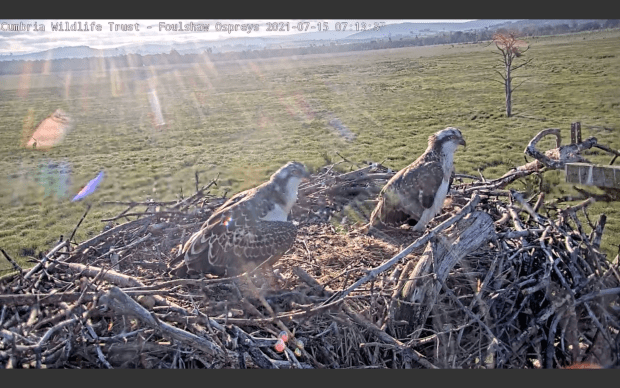
Here on the Foulshaw Moss nest, Blue 463 or Tiny Little Bob, is eating the fish her dad delivered. White YW would have heard her several miles away screaming for fish. Blue 462 had gotten the earlier fish and Tiny Little wasn’t liking it. Dad came to the rescue! Indeed, White YW and Blue 35 should get a round of applause. They pulled off a nest of three fledglings this year. They did not lose a hatch.

The crows are hoping that Tiny Little will leave some bites for them! I don’t know. She is a bit like a nest vacuum when it comes to food falling between the twigs!

Tiny Little is miracle #2 and, of course, miracle #1 is Tiny Tot from the Achieva Osprey nest in St Petersburg, Florida. I am certain that there are others that will come to mind when I publish this newsletter. For now, however, these three were enough to cause lots of anxiety.

I did a Sunday hop-skip-and-jump through some of the UK Osprey Nests to see if anyone was home. This is the Dyfi nest in Wales of Idris and Telyn. On the nest is Ystwyth, their daughter. Telyn is on the nest perch and Idris is on the far perch.

Idris and Telyn together. How beautiful.

Does he need an introduction? The chick on the Llyn Clywedog Osprey Nest, Only Bob? Only Bob was so big when he was ringed that everyone believed him to be a large female. Nope. It is just all that fish that Dylen and Seren fed him. My goodness did Blue 496 grow.

He has spotted Dylan flying in with a fish. We are so lucky to see this. Indeed, to see so many of the UK fledglings on the nests today is fantastic.

That is a gorgeous fish for dinner. Only Bob looks pretty excited.

Watch out for your toes Dylan.

Only Bob learned well despite the fact that he was the only chick on the nest. He is excellent at mantling. But, stop, and take a look at that tail and the size of those wings. I would be ever so grateful if Malin’s was half that size when he fledges.

Oh, let’s just move this beauty over here so I can eat it!

At least one of the chicks on the Loch of the Lowes has a huge crop. It is so big, it looks like it could pop. The other is hoping for a fish delivery. Of course, neither is showing us their pretty blue bands.

NC0 and Laddie have done an amazing job raising these two. NC0 has really moved up to be one of the females that I want to watch. She is becoming super mom. She can fly and haul fish to the nest just like Iris – and she isn’t afraid to do it!

Grafs was able to find enough fish for two deliveries today. The first was a bunch of small fish at 15:29 and the second came at 19:41 with some bigger fish. The storklings are starving. They are already beginning to show the signs of malnutrition.

Grafs makes sure he moves around so that each one gets a little something.

It was mentioned that not only the sunken bodies but also the fact that the bills are turning a bright colour indicates starvation.

Once the people watching these nests realized what was happening, they became very vocal in their demands that the birds be fed. Everyone knows about the fish table that the two engineers set up for the White Storks in the village of Mlade Buky, Czechoslovakia. The people demanded that their storks be fed and the wildlife staff heard them. After seeing only one feeding by 15:00, Janis Kuze wrote the following on 15 August 2021: “It may be necessary to support the operation of the feeder – to bring live fish there regularly (once a day or two). I will write about it in the coming days.”

Liz01, the moderator of the looduskalender.ee/forum (English forum for the Latvian Fund for Nature and this Black Stork Nest) posted this notice:

“Due to the fact that the female has not been seen in the stork nest for several days, she has probably started migrating, opportunities are being sought to artificially feed this nest. Currently, the only feeder is the male, whose capacity is too small for the young birds to be successfully.
One way of trying to help the inhabitants of this nest is to set up an artificial feeder. There is one ditch near the nest where it can actually be done. Ornithologist Jānis Ķuze is ready to take over the management of this event, but he needs the help of the society. Therefore, we are looking for:
1) people on the Sigulda side who would help to set up a feeder,
2) human or fish feeders on the Sigulda side, which would be willing to donate and / or catch small fish (they must be still alive), with the possibility, to put these fish into the feeder, thus regularly
replenishing fish stocks in the feeder a third person or another link in the chain).
If anyone has the opportunity to help with this event, please send a message to Jānis Ķuze by e-mail: janis.kuze@ldf.lv.
This is currently the only real way you can still try to help the young birds in this nest survive and fly successfully! It is not known whether it will work, but we think it would be better to try not to do anything and just watch.”

Immediately, there were too many offers to help the Black Storklings and Grafs. Tears. People are so generous. All we have to do is ask.

If you wish to follow the discussion about what is happening at this particular nest in English, please go here:

When I have news of what is happening at the Estonian Black Stork nest, I will let you know.

You can watch the Black Stork Nest in the forest near Sigulda, Latvia here:

We all send our prayers and warm wishes to these beautiful birds and the people helping them. We need a miracle like that at Mlade Buky.

Thank you so much for joining me. It is wonderful to bring you such good news. Please send all your positive energy to Latvia and Estonia so that the efforts to save the Black Storklings from starving to death will be successful. It is heart warming to see so many people answer calls for help.

Thank you to the following for their streaming cams: The Latvian Fund for Nature, the Collins Marsh Nature Centre, Dyfi Osprey Project, Cumbrian Trust and the Foulshaw Moss Osprey Nest, Scottish Wildlife Trust and Friends of Loch of the Lowes, Llyn Clywedog Osprey Nest and CarnyX Wild, and Bywyd Gwyllt Glaslyn.

Just a note. My newsletter will be posted late on Monday 16 August. Thank you!

What’s happening in Bird World?

I don’t know a person watching a nest on a streaming cam that doesn’t get anxious if food is not brought to the nestlings and fledglings on a regular basis. Most of us start doing a bit of nail biting. Today, for example, Malin had 4 feedings. It isn’t as good as five but it is better than nothing! And last Sunday Malin had nothing. We are all hopeful for tomorrow. The weather is cooling off – Malin we are wishing for six fish tomorrow!

Malin 13 August 2021
Malin 13 August 2021 after a feeding

Jake Koebernik of the Wisconsin DNR did a great job answering a lot of questions that some of us have had about Malin’s nest. One was ‘why are the fish that are delivered are so small?’ and the other was ‘why do fish deliveries drop at the weekend?’ This is his answer, “As for the nest at the Collins Marsh NC, the streams and marshes around that territory probably only offer smaller species such as bullhead, bluegills, small bass and northern pike. There aren’t large lakes or real productive rivers in that part of the state, so they are going after what is abundant and available.” Jake’s answers cleared up a lot of the mysteries. —— And tomorrow, when Malin wakes up, Malin will have its official name! Fingers and toes crossed for it to be Malin!!!!!!!

My friend ‘S’ sent a screen shot of a delivery that Telyn made to the Dyfi nest this afternoon. We both agreed that Malin’s eyes would pop out if he saw a fish this big land on the nest at Collins Marsh. That fish is bigger than Blue 491! Wow.

And if you did not hear, Idris had been missing since Wednesday and he was on the nest today, albeit with a completely sunken crop. He brought a nice fish to one of the chicks. Hoping he gets his own fill of fish. Where in the world could he have been? It is worrisome.

Telyn delivered a whopper for 491, Ystwyth who is 82 days old on 14 August

Oh, if only places that have ponds could stock them for the birds. The Pritchett Family in Fort Myers has a stocked pond for Bald Eagles Harriet and M15 and their kids and the water also allows them to cool off and clean their feathers.

We are told by the IPCC that we can expect the droughts and extreme heat to be with us. Since these changes to our climate are known to be directly caused by human activity, maybe it is time to figure out ways to help the wildlife. Providing water and food is a start.

These two little sea eaglets are just adorable and a little spunky, too. They are growing like the sunflowers in my garden that the birds planted.

Both had nice crops after this feeding.

Judy Harrington, the researcher observing the WBSE Nest in the Sydney Olympic Park forest, just released her report on what these two have been eating during the last fortnight (14 days). In fact, it is the first two weeks of their life. Harrington also records the amount of time spent feeding by both the male and the female has been recorded. Lady took on 109 feedings for a total of 21 hours and 20 minutes. Dad did 8 feedings for a total of 42 minutes. Dad has been providing most of the food – he brought in 25 items and Lady brought in 5. These consisted of the following in total: 16 Bream, 4 catfish, 2 fish, 1 Mullet, 2 Whiting, 1 Yellowtail, 1 Ibis chick, 1 nestling, 1 pigeon, and 1 bird. They have now morphed into sea eagles, the second largest bird in Australia.

Sadly, it appears that Lady was hit during the night by Boo, the BooBook Owl that lives nearby in the forest. Despite its very small size the BooBook Owl has caused injuries to the large sea eagles in the past.

It is thought that Boo, as the little owl is so fondly called, has a nest near to the Sea Eagles. To my knowledge, the WBSE have never bothered their nest but, – hey. Every parent is afraid of a larger predator and wants them to leave the area.

“Boobook owl” by jeans_Photos is licensed under CC BY 2.0

Legacy on the Fortis Red Deer Nest has fledged. She has been on and off the nest a few times today. One was to get some fish! Here she is with Mum. After all the nestling deaths during the heat wave, this is just one of the happiest moments from that nest. Look how big Legacy is next to mom. Congratulations.

It is almost impossible to see what is happening on the Fortis Alberta Exshaw nest up at Canmore. Both chicks appear to be on the nest and calling for food. It is unclear to me if one or both have fledged.

The love story of the two Canada Geese has gone viral. It warms our hearts to see these two devoted birds – Amelia finding and waiting for Arnold during his surgery and recovery and now their reuniting. My friend, ‘R’ found two more stories on them and I want to share with you what she sent to me. You could read about these two all day – and you will always walk away with a smile.


https://boston.cbslocal.com/2021/07/15/goose-surgery-visit-mate-new-england-wildlife-center-cape-cod-branch/
Female reporter admits to being teary eyed! 

https://whdh.com/news/goose-who-underwent-emergency-surgery-released-back-into-the-wild-to-be-with-his-devoted-mate-on-cape-cod/Shirts for sale: “Honk If you Love Arnold!”

The story of Arnold and Amelia has taught us all something. If you find an injured Canada Goose and are taking it into care, please take the time to find its mate! The outcome might be much more positive. If you live in an area where there are Canada Geese – let your local wildlife rehabber know about the story of Arnold and Amelia. They will understand why it is important to keep bonded mates together (and their goslings if necessary).

And news about Kona. It is nearing 100 F or 38 C on the nest in Montana. The foster mother, Scout, has been shading Kona. Everything is going well with this foster. How grand.

@ Montana Osprey Porject

Leaving you with a gorgeous image of Loch of the Lowes. It just looks so still and peaceful in the early morning hours of 14 August.

And a last peaceful image of Diamond on the ledge of her scrape box on the water tower at Charles Sturt University in Orange, Australia. We will be looking for eggs before the end of the month. Izzi was last in the scrape box of Xavier and Diamond 6 August. He was photographed on 10 August and someone thought they heard him this morning.

Thanks for joining me today. I am off to try and find some hawks tomorrow so this is coming out early. I will bring you some late Saturday news in the evening. Take care. Stay safe! If you hear of interesting bird stories – and in particular, raptors – let me know.

Thank you to the following for their streaming cams where I took my screen shots: Collins Marsh Nature Centre, Sea Eagle Cam, Birdlife Australia and the Sydney Discovery Centre, Dyfi Osprey Project, Scottish Wildlife Trust and Friends of Loch of the Lowes, Falcon Cam Project at C Sturt University, Fortis Alberta Exshaw and Fortis Alberta Red Deer. Thank you to ‘R’ for sending me the links on the coverage of Arnold and Amelia and to ‘S’ for the information on Telyn and her whopper of a fish delivery. It is much appreciated! Thank you to the Montana Osprey Project FB page for the image of Scout and Kona.

Tiny Little lands 3 fish for the day!

At one time there was fear that Tiny Little Bob, the itsy bitsy third hatch on the Foulshaw Moss Osprey nest would perish.

The top image is from 12 June. You can see how large 462 and 464 are at the time. There is our Tiny Little Bob sitting up looking over them.

This image is from 30 June. Tiny Little Bob has grow but is still shy and waits to eat. At this time, the banders cannot tell if 463 is a male or a female because of the lack of food and growth.

Today is 13 August. It might be hard for some to believe but Tiny Little now controls the nest. She is a big bird – the dominant bird – on the Foulshaw Moss Osprey Nest. Tiny Little has take three fish today. The first one at 6:08 am, the first fish to land on the nest today. Then she gets the fish at 16:16. And then, she snags the fish and is eating at 19:48. This is quite a change in status for a bird that people thought would die because the others were so large and cruel.

Long time readers know of my interest in the third hatch (or a tiny second that battled with a large first when there was no third). This year alone we have seen Tiny Tot (Tumbles) rise from the near dead several times on the Achieva Osprey Nest to grow into an aggressive survivor. Other researchers have sent me stories about other third hatches who came back strong. If you know of any, please do not write to me.

This is the best news of the day. Thanks for joining me for this very short newsletter. The voting closes at Collins Marsh today for the name of their Osprey. A very kind Wisconsin DNR Biologist has sent me their 2020 report on Bald Eagles and Ospreys. I will report on that tomorrow. And there is one other piece of good news. Idris had been missing on the Dyfi Nest since Wednesday the 11th at 13:16. This morning he showed up with a big fish for one of his fledglings. He had an extremely empty crop. Wonder what happened? This is great news as Telyn would have to delay her migration if he did not show up. A few Osprey adults have gone missing for a couple of days. Are they getting caught in something line line or netting?

Take care everyone!

Thanks to the Cumbrian Wildlife Trust and the Foulshaw Moss Osprey Nest and the Dyfi Osprey Project for their streaming cam where I took my screen shots.

Early Monday in Bird World, 2 August 2021

Many who read my newsletter have a love for all birds and a particular fondness for one or two species and a number of nests. My personal journey began with an encounter in my own garden – literally, getting up close and personal with a female Sharp-shinned hawk in the dead of winter who, I believed at the time, was eating the garden rabbit, Hedwig. She wasn’t. Our eyes locked to one another’s, ‘something’ happened. I cannot describe it but those minutes changed my life. I know that many of you have had a similar experience as well as others who have gone on to write books about their journeys.

Philip Brown’s, The Scottish Ospreys from extinction to survival, written in 1979, is just such a book. My used copy arrived in the post a couple of days ago from the UK. The only time that I have had to read has been late at night. The book is so well written that I was often hesitant to stop reading. His enthusiasm and love for these fish-eating birds animates the drive in Scotland to reintroduce the Osprey after years of extinction. Brown gives a good solid history but it is his personal stories of spending time with others at the eyries of Loch Garten guarding the nests that draws the reader into sympathy with the birds. Brown worries about the trees that are partially dead but have nests, about the poachers that are killing the birds, and how to halt the illegal practice of egg collecting. Those are woven in with the growing understanding of osprey behaviour and the efforts to grow public interest in the birds. If Ospreys tug at your heart then this is a book that you should read. When I was looking for a copy I discovered that the book could be ordered from the UK with standard post for a very reasonable price. It is a hardback book and used copies are available for less than 5 GBP.

I want to re-mention another book, available only in paperback. Lady of the Loch. The Incredible Story of Britain’s Oldest Osprey is by Helen Armitage. There are a couple of ways it is different than the Brown volume. It is newer, written in 2011. The book covers the reintroduction of the Osprey to Scotland also but does it by focusing on a single bird, Lady, at the Loch of the Lowes. Lady raised 48 chicks migrating to Africa and back 20 times. That is simply astounding. Armitage’s book is different in another way. The lens is female, a welcome change when the majority of books on Osprey are written by men. She includes details not found in other volumes including one that I found particularly interesting. In trying to protect the Osprey, “In September 1899, Queen Victoria confirmed that certain regiments would stop wearing osprey plumes…” She also notes that it was women who continued the fight to stop the use of bird plumes including the Duchess of Portland who became the head of the Society for the Protection of Birds. It is time to think of fall reading and these are two really excellent books to curl up with.

In nest news, it appears that Bukacek or Father Stork is the only member of his family sleeping on the nest at Mlade Buky.

It is possible that both Pankrac, the female, and Servac, the male are with other fledglings preparing for their migration?

The normal practice with raptors is the female leaves for migration first. The male remains feeding the fledglings and bulking up himself. Once the fledglings depart, the male begin his long journey. Is this also the same ritual for storks?

I had a beautiful letter from a reader, ‘S’. She confirms the special status of storks in her country, Latvia. The people of Latvia have a special name for the White Storks, svētelis. She says the term speaks to the “embodiment of something holy and brings peace and protection from bad things.” This belief explains so much about the great love the people of Latvia have for their storks and that same understanding of storks being special must extend to surrounding countries where people go to great lengths to care for these amazing birds.

In regards to the migration of the storks, ‘S’ says that every year the storks gather on the trees, the roofs of all the houses and buildings, as well as on the electricity poles close to where she lives. When they are all ready to leave they begin clacking their bill together similar to what they do when the storklings are wanting food. Close your eyes and try to imagine how wonderful it would be to see this enormous gather of storks, each being called by the winds to begin their journey. The only equivalent we have in Manitoba are the Canada Geese. Every year they gather on the large ponds near to our nature centre, Fort Whyte. They arrive as the sun is setting calling one another. It is extremely moving. I can only imagine if it were storks!

There are several videos on YouTube about Klepetan and Malena, the famous Croatian white storks and the man, Sljepan Vokic, who has cared for Malena for more than 22 years. Sometimes, it is nice to see one of those videos just to remind ourselves that the world is full of kind caring people.

Skipping down to Australia, the two little sea eaglets, 27 and 28, are doing really well. It is mystifying watching Lady feed them the tiniest morsels of fish from her large beak.

Just look at the size of fish flake Lady is feeding to 28. She is so gentle.

There is plenty of fish in the nest and, so far, I have not seen any signs of food competition. Both of the little ones have nice tiny crops after their feedings. So far, so good. Fingers crossed it keeps up. Indeed, the only cheekiness I have seen is 28 trying to take a bite of 27’s head!

I love the look in Lady’s face as she stares at those two precious little fluffy bobbles. In many ways Lady reminds me of NC0 on the Loch of the Lowes nest in that she has grown into being an excellent – and loving – mother.

There is a gentleness about her movements with the two chicks this year that is striking. These moments of both of them tenderly tucked under mom will pass so quickly – they grow so fast!

A quick early Monday morning check on the UK Osprey nests reveals that Aran and Mrs G have been on the nest together since approximately 4 am.

Amidst the bleating of the sheep and the cows mooing, Aran brought in a fish for Mrs G and did a survey of their nest.

It is reported that Aran’s wing is much improved. He is flying more and fishing for himself as well as delivering fish to Mrs G. This is all good news since it was unknown at the time of his wing injury in late May whether or not he would be healed in time for migration.

One of Laddie and NC0’s chicks is on the Loch of the Lowes nest hoping for a food drop. Of course, that band is in hiding so it is anyone’s guess which chick is calling for fish!

The scene at the Dyfi Nest of Idris and Telyn and their two fledglings is simply pastoral. That said, no one is home!

The nest of Tiny Little is equally beautiful. I love the gentle yellows of the sun kissing the Dyfi Nest as it moves above the horizon and the gentle golden pink colouring the landscape of the Foulshaw Moss nest below.

A little later the Foulshaw Moss is magical. No Tiny Little though.

I cannot think of a better way to start a Monday morning than collapsing into the serenity of one of these landscapes. You can feel the stillness while, at the same time, soaking in the freshness of the smell of dew on grass.

Thank you for joining me. I will get the synopsis of what is happening with the Gough Island Recovery project this week. Once I started reading Brown’s book on Ospreys many other things went to the wayside. I hope that you have a great start to the week. Take care all.

Thank you to the following for their streaming cams where I took my screen shots: The Scottish Wildlife Trust and Friends of the Loch of the Lowes, Dyfi Osprey Project, Sea Eagle Cam, Birdlife Australia and the Discovery Centre, Mlade Buky White Stork Cam, Bywyd Gwyllt Glaslyn, and The Cumbrian Wildlife Trust and the Foulshaw Moss Osprey Nest.

Adventures in Ospreyland and other bird tales 16 July 2021

Imagine that you have one child. Everyone is happy – it is easy to provide for the one. Then imagine one day you blink and think you are seeing double. But you aren’t. There are two children. Now imagine that you are away from home and return to find three. Osprey families have the same difficulties in providing for multiple children just like humans. The adults at the Patuxent River Park in Upper Marlboro, Maryland, Osprey nest number 2 now have that challenge! The pair had only one chick of their own and are now fostering two chicks about the same age as theirs.

Cathy Cohen of the Jug Bay Natural Area posted the following image on the park’s FB page today of the mom and the three chicks. The first foster chick was placed on the nest on 30 June. Nest 2 was chosen because the foster chicks are about the same age as the one hatched on the nest. There they are. It is incredible. They look like a perfect match. How wonderful to give those two lucky ones another chance. Intervention can be a good thing.

The foster Mom was said to have welcomed the chick who had fallen from a barn silo with open wings yesterday! Here she is looking over the babies while they are sleeping (or supposed to be sleeping).

And here they are this morning. It is getting warm and the new babies are getting shade.

Most of the time if I say the name ‘Iris’ everyone knows who I am talking about. If you don’t, here is a mini-bio. Iris is an Osprey. She is 26-28 years old. This makes her the oldest Osprey in the world. Iris has her nest at Hellgate in Missoula, Montana. The platform was put up for her and her mate, Stanley, to save them from getting electrocuted on the hydro lines. When Stanley did not return from migration, Iris bonded with Louis. They have only had one chick survive. That was a female, Le Le, in 2018. The reason for this is that Louis has another mate and another nest at the ballpark. For years, people have watched Iris perfect the renovations on her nest, catch magnificent fish, mate with Louis, lay her eggs and then either have the ravens steal and eat the eggs or have the chicks die because the female cannot protect them and fish at the same time. Individuals are very vocal in their support of Iris. They want her to have another mate and to be able to raise chicks. I have always thought maybe she could retire with dignity and just take care of herself during her summers in Montana. At the same time you know just seeing her work on the nest and the fish she brings in that she would be an amazing parent. The issue is one of territory. Iris’s nest is in Louis’s territory – according to Louis. Louis has protected Iris on a couple of occasions this summer from intruders. Iris has also managed on her own to thwart them. She is strongly independent.

When someone posted an image of Iris sitting on a branch with another Osprey on Twitter 15 July 2021, people got excited.

The notion that Ospreys mate for life is not consistently true. When Blue 5F, Seren, got tired of laying a nest full of eggs only to be abandoned by Aran because he also had a nest with Mrs G at Glaslyn, she left Aran’s territory and found another mate, Dylan, at Clywedog. According to Google Maps, Seren moved a distance of 67.4 miles. Seren and Dylan are the proud parents, this season, of fledgling Blue 396 otherwise known as Only Bob.

It will be very curious to see how things develop over the end of the summer.

We all worry about Tiny Little. It is easy to forget looking at Blue 463 that at one time his older siblings kept him from eating and were quite aggressive. Because of that Tiny Little is hesitant to engage with the older siblings and, in particular, Blue 462. So there are worries that he will not get enough to eat. Today White YW brought in a fish and within about 15 minutes he brought in another fish. Blue 35 took that one and fed Tiny Little while the other two were eating fish pieces. What a beautiful image of Mum and her three chicks on the Foulshaw Moss nest having a nice meal of fish.

People have been asking if Tiny Little has been flapping. OH, yes, he flaps those wings all the time.

If you want to join in the fun watching Tiny Little prepare to fledge, this is the link to the Cumbrian Wildlife Osprey Cam:

https://www.cumbriawildlifetrust.org.uk/wildlife/cams/osprey-cam

Erick Green with the Montana Osprey Project posted some images of chicks who were entangled with baling twine. They saved three chicks a week ago but sadly one had died. Another chick had twine cutting into his right leg to the bone. Dr Green reported today that the chick is doing fabulous today. In his posting I learned something interesting. He says, “One thing that seems to work in their favor is that ospreys (and all birds) have very high body temperatures – about 105 degrees Fahrenheit. These high body temperatures help birds fight off many bacterial infections.”

Only Bob, Blue 396, has gotten really good at flying and zooms in when Dad Dylan does a food drop. Poor Seren might have to discuss Dylan bringing in an extra fish for her. Only Bob can finish them off pretty good! Look at how big this fledgling is. Wow. Dylan delivered the fish around 13:09.

At the Dyfi Nest, Idris and Telyn are waiting for Ystwyth to fledge! So is her brother Dysynni. He is sitting there urging her to come on and join in the fun while the parents are up on the camera perches watching. Ystwyth was getting some really good height to her hovering and she will go soon if not today. She is 53 days old.

Here is Ystwyth hovering. Isn’t she great?

Other nest news:

There is sad news coming out of Taiaroa Head, NZ. One of 33 Northern Albatross chicks died yesterday. The chick was not gaining weight and the NZ DOC rangers gave it a supplementary feeding. When the chick died following this it was discovered during the necroscopy that it had a piece of charcoal stuck in its trachea. As Sharon Dunne notes, charcoal floats on the surface of the ocean and it can easily be taken in by the parents when they are out fishing for food for their chick. I never imagined charcoal! Everyone is distraught. The rangers do such an excellent job taking care of these parents and chicks. Condolences go out to all of them including the albatross parents.

Our little Golden Eagle, Zenit, has had a prey delivery – a bird – and is beginning to stand really tall and strong on its legs – adult style. All good news! The Golden Eagles eat the bones – absolutely every part of their prey so Zenit will have something later. Still, having lots of meat is what this young eaglet needs right now. Excellent news.

Ferris Akel has posted a nicely edited version of his tour on Wildlife Drive on the 14th. The editing is well done and there are discreet bird names in case you do not recognize what you are looking at. There are some really nice shots of a Black Tern. Here is that short clip.

My friend, ‘T’ tells me that there is a stork with an injured food that is getting a prosthesis. Will try and find out all the news on this incredible intervention.

And speaking of storks, there are still three White Storklings on the Mlade Buky nest in Czechoslovakia:

That’s a short morning round up of happenings late Thursday night and early Friday morning at some nests. Remember that Ferris Akel does his tours on Saturday. He begins at noon NY time and ends up at the Cornell Campus. It is a great opportunity to see the Red tail fledglings in action. They have now moved from flying near to the nest to other buildings farther away. Big Red and Arthur do this with prey drops gradually to expand their territory. It will not be too long til they are down by the barns at Cornell. Always fun. You can search Ferris Akel Livestream on YT. Thank you so much for joining me. Take care everyone.

Thank you to the following for their streaming cams where I get my screen shots or add their videos: Ferris Akel Live Tour, Patuxent River Park Ospreys, Montana Osprey Project FB Page, Cumbrian Wildlife Trust and Foulshaw Moss Osprey Cam, Dyfi Osprey Project, CarnyX Wild and Llyn Clydewog Osprey Cam, Capi Hnizdo- Mlade Buky, and Asociatia Wild Bucinova.

Thursday in Bird World

There are a number of Ospreys named Louis but the one that I am writing about today is the Louis of the Loch Arkaig Osprey Nest. His mate, Aila, did not return from migration this year and there is a new Mrs Louis. Her name is Dorcha. Louis chose not to make their nest on the one that he had shared with Aila. As a result, news of Louis and Dorcha comes from those who have access to see the nest. Today’s news is from the person who ringed the chicks. They report there are two healthy 4-5 week old nestlings. How grand. Louis is a fabulous dad – he even went fishing at night for Aila and the three chicks last year.

I am doing a bit of nest hopping. For whatever reason I am unable to access the Foulshaw Moss Osprey Nest. Others are having difficulties too but some seem to have some success. It is, of course, slightly frustrating because this is the nest of Tiny Little!

The eaglet on the Bucovina, Romanian Golden Eagle nest is hungry. Yesterday he only had a small bird and a bone. There seem to be days of bounty and then not much of anything on this nest. Is there enough prey? how far to the parents have to travel? are both parents still delivering food for the baby? For many this is the haunting memory of Spilve and Klints last year. The young Golden Eaglet cannot live on a little bird. Zenit is a beautiful bird and it will not be long til fledge. Let us all hope that Zenit gets a large prey drop today.

Zenit saw his reflection in the camera for the first time yesterday. It is so cute when they do this – the reactions to seeing another bird like them! Lady Hawk caught this precious interaction.

Wishes come true! I checked on Zenit just a minute ago and Zenit has an enormous crop! Looks like he swallowed a softball.

Scrolling back, Zenit’s mother came in to feed him. This was at 14:12. It also appears that a bird delivery was made around 17:00. It is not clear what the mother brought but as you can see above, Zenit has a very large crop and this is a good thing. It remains unclear to me how much prey there is in the area. Let us all hope it is good!

When the Royal Albatross chick was weighed on Tuesday (NZ time), she had dropped from 8.2 kg to 8.0. The rangers were monitoring Taiki’s weight and were considering whether or not she needed a supplementary feeding. Perhaps that won’t be necessary after today because her mother Lime-Green-Lime flew in for two feedings and her dad, Lime-Green-Black was there for one. Three feedings in a single day at 9:58 (LGL), 13:57 (LGK), and LGL arrives twenty minutes after LGK departed at 14:17. These were quick in and outs but it looked like Taiki got a lot of food.

LGL is so happy to see her daughter. Taiki would like her mum to dispense with all the formalities – the sky calls, the welcome – but LGL will insist. Her daughter needs to learn all of these and imprint them in her mind. Taiki will fledge in mid-September. She will not return to land for 4-6 years. At that time she will do a skycall just like Mum is doing now. Can you imagine being at sea and never stepping foot on land for that long?

Taiki is so excited to have a parent come in for breakfast.

LGK saunters in after Taiki has had her breakfast and is ready to feed her lunch at 13:57. It always looks like the adults have difficulty walking – and maybe they do if the chicks are digging holes and building play nests everywhere. Here comes dad!

It is so interesting that these little Albies stay put on their nest without moving about so much (at least at this stage). LGK does several sky calls but Taiki just wants food!

Taiki settles down to work on her play nest after LGK leaves and gets dirt all over her beak. It sure doesn’t matter. Look at how beautiful she is.

This is LGL’s second visit to feed her daughter. Taiki is so excited to see her again. I wonder if she told mum that she just missed dad? LGL does several skycalls when she greets her daughter.

The baby down is falling off and revealing a beautiful pattern on the back of Taiki.

LGL always looks like she is smiling.

Taiki must be about to pop after three big feedings! LGL must be fishing near to Taiaroa Head as she is returning so often. Taiki is lucky.

It was a golden morning on the Loch of the Lowes. No one was on the nest- they were all out flying and learning to fish. There are some trees around the nest that are apparently good perches for the birds. What a beautiful place. It looks so tranquil —- and safe for Ospreys.

It was just as beautiful at Mlady Buky in Czechoslovakia this morning. There is a mist, low lying clouds, or a fog hugging the mountains. The three storklings are on the nest. Everything is so quiet – you can almost hear the stillness.

Father Stork arrives at 6:19 with breakfast for the three almost fledging storklings.

The three continue to find small morsels on the nest after the frenzy when dad arrives.

The feeding gives them energy. The sun is up and they are warm and two are flapping madly on the nest.

The female is really covering the nest and moving her wings. She was getting some lift this morning as well. Father Stork and the people of Mlady Buky have done well. After the loss of the female, it has been simply a miracle to watch these three thrive. In a way, the people of the community stepped in and took over when supplementary feeding was necessary – just like the New Zealand Department of Conservation rangers.

Sadly, there is no one stepping in for Zenit if it is needed. I wonder if the people who operate the camera would consider setting up a food table if it were needed?

My goodness. Blue 022, the two year old who returned from his migration and stopped off at the Poole Harbour nest of CJ7, is so enthusiastic. He has been helping fix up the nest and has even provided fish for CJ7. He has also been seen ‘sky dancing’ on several occasions. This morning was no exception!

They make such a lovely couple. Oh, goodness. Everyone is already crossing their fingers and toes that these two return from their migration safely. The months will not pass quickly enough. Imagine – no chicks born in this area of England in 200 years! Incredible. There will be lots of celebrating!

Dylan and Seren are both on the nest at 7am watching and waiting for Only Bob to come and have some breakfast. He loves to go and fly often landing on the camera stand. It is so different when they fledge – at first babies always on the nest and hungry and then parents having to wait with food as they fly about.

Kindness is getting her legs stronger every day. She is standing straight and walking some on the nest. She is certainly growing fast – an advantage to being the only chick on the nest.

Kindness loves to do kissey-kissey with Mom. It is so funny watching these two.

At the Osprey nest on the Port Lincoln barge, Mom is on the nest and Dad was over on the ropes. Eggs arriving soon.

Oh, it is a bit like a bad joke. The camera at the Foulshaw Moss Osprey nest just started working. Both 462 and Tiny Little are on the nest. It is around 7am and they are watching for a parent to arrive with breakfast. Look at that nice necklace that Tiny Little has. Interesting. (TL is on the right) They are being kissed by diamond rain from the sun.

And when he wasn’t watching for a delivery, Tiny Little was flapping his wings dreaming of flying.

The more flapping he does the more the last tidbits of baby down disappear. It won’t be long Tiny but you were four days younger than everyone and you were behind in growth. You will get there just like Tiny Tot!

Hopefully that fish arrives! These two are both hungry. And it did. Tiny Little went over and ate some of the remaining fish and Blue 35 comes in and removes what is left (piece at the front) and will fly off with it.

The camera was still on the blink. I just checked and Tiny is fine. It is tea time and both Tiny and big sib are waiting for a delivery. It is so interesting that the big siblings know when to show up for food.

And last but never least, a lovely picture of Aran and Mrs G on the Glaslyn Nest together. This is a beautiful sight. There has been some bonding over the last few days. I was concerned that Aran was not in top form and Z2, Aeron, of the PC nest might want to take over this one. They are being kissed by golden raindrops, too! Mrs G doesn’t look like she is 21 years old, the oldest osprey in the United Kingdom. She is in really good shape. So sad that they lost their three chicks this year. That can cause issues but they seem to be a solid couple.

Thanks for joining me everyone. It is lovely to see the Golden Eaglet doing well today. That nest is a constant worry. And speaking of worry. The comments section on my blog seems to not be working all the time. It is like Tiny Little’s camera. Please feel free to send me an e-mail: maryannsteggles@icloud.com. I know that some of you had concerns and I regret that technology has caused you any worry. For the next while, til things step up in Australia, there may be only one blog per day. I hope to get more local Osprey news for you this coming week.

Thank you to the following for their streaming cams. This is where I grabbed my screen shots: Bucovina Golden Eagle Nest Cam, Cumbria Wildlife Trust and the Foulshaw Moss Osprey Nest, Cornell Bird Lab and NZ DOC, Mlady Buky, Port Lincoln Osprey Cam, Glacier Gardens Eagle Cam, Dyfi Osprey Project, Clywedog Opsrey Cam and Carnyx Wild, Byrwd Gwyllt Glaslyn, Poole Harbour Ospreys, and Scottish Wildlife Trust and Friends of Loch of the Lowes.

Tiny Little, Blue 35 and the fish – and other tales from Ospreyland 13 July 2021

I wanted to yell as loud as I could, ‘Go Tiny Little!’. There was a fish drop at the Foulshaw Moss Nest. Blue 462 had it in its talons.

Oh, what I forgot to tell you was that Tiny Little kept trying to steal that fish from Blue 462. Look at Blue 35 (mum) watching what is going on.

Tiny Tot finds the tail of the fish between Blue 462’s legs and trys to eat the fish from there! My friend ‘L’ says that Tiny Little is a ‘hoot’ – he is!

Tiny Little bothered his big sister so much that she moved the fish to the other side of the nest! But Tiny Little did not give up. He was more determined to try and distract Big Sister and grab that fish. Look how mum is watching everything that is going on. Tiny almost gets that fish a few times but he is not fully confident nor aggressive yet.

It must have been uncomfortable for Blue 462 to have Tiny right up there by his face. That is probably the point. At one point it looked like Tiny Little tried to grab the fish out of 462’s beak as he was pulling it off the bone.

Tiny Little pleads with mum to do something about that fish because he wants some of it and Blue 462 won’t share! Now Tiny Little didn’t do this just once, he went to speak to mum several times. There was, of course, no mention of Tiny Little finding that entire fish and not sharing it with anyone earlier!!!!!!

Blue 35 watched everything. What a smart mum she is! She waited and checked and then waited and when Blue 35 felt that Big Sis had enough fish, she walked over, took it, and flew away with it.

Here she is moving in to take it from Blue 462’s talons.

She pulls it over and once she has that fish secured she flies off the nest.

Why did she take my fish? says Blue 462. Tiny Tot is bewildered. He figures that is it for his bedtime dinner. Even Big Sis can’t figure it out. They stand there staring into space wondering what just happened.

Ah, Blue 35 wanted Big Sister off the nest. She took the fish and when the older sibling had left she returned to feed Tiny Little.

Ah, what a good mum Blue 35 is. She makes sure every one of her three babies has some fish.

When Tiny was full and off cleaning his beak, Blue 35 enjoyed a few bites of fish herself before Blue 462 flies in to try and get the precious fish tail! Mom starts feeding 462 again.

Wonder where 464 was? Did White YW give him a fish off camera?

Looks like Tiny Little won’t be sleeping alone tonight. Blue 462 is tired from all that flying! Both of these big babies have full tummies. Time to go to sleep.

As the sun was setting in Wales at the Dyfi Nest, Idris was out on his perch, Telyn was on the nest perch, and both Dysynnis and Ystwyth were on the nest ready for night-night as the train speeds by.

Over in the Clywedog Nest, Seren 5F was feeding Only Bob, Blue 496, his late night snack. He earned it today – he made a proper fledge this morning and he must be awfully tired. Gosh, this kiddo is big. Look at those legs!

As the pink of the sunset was coming over Loch of the Lowes, NC0 was on the nest watching her children, LM 1 and LM 2 as they flew around the loch.

Hopping to North America, Wattsworth and Electra were on the Cowlitz PUD Osprey Nest in Longview making a few nestorations. They lost both their chicks this year. The first to siblicide and the second to heat stroke during the 28 June extreme heat wave that hit the Pacific Northwest.

What will the Ospreys do as our planet heats up?

I don’t know if there are any repercussions on the Ospreys in Alberta from the smoke and fires to the west of them in British Columbia. Let us hope not. Legacy is growing and growing at the Red Deer Nest. It was hard to get a good image of her today but she had just finished a nice breakfast when I took this one.

And the two on the Fortis Exshaw Osprey Nest are progressing nicely as well. They are also growing really well now that the extreme heat is gone.

Kindness is 89 days old. She is on the Glacier Gardens Bald Eagle Nest up in Juneau, Alaska. She has been practicing her standing and is getting really good at it. Kindness is a ‘Northern’ Bald Eagle – not a specific species but because she is higher north in the Northern Hemisphere, she will be heavier and bigger than birds in the southern US. This is called the Bergman Allen Rule. Northern animals are typically heavier and larger than the southerly ones. This is related to the climate and physiological differences and their needs. The female Bald Eagles in the north, like Alaska, weight 4.5-6.35 kg or 10-14 lbs while in Florida the top weight for a female Bald Eagle would be 6.35 kg or 10 lbs. The males in Alaska are 3.62 -4.9 kg or 8-11 lbs while in Florida they are about 2.7 kg or 6 lbs. The average day for fledging at this nest is 89 days. (The average age for Bald Eagle nestlings in the rest of Alaska to fledge is 80 days). So we have some time yet with Kindness! Terrific.

Thank you so much for joining me. It was great fun with Tiny Little today. If you watch that nest check out Tiny Little’s rather ‘fat’ legs. Tiny Little is growing so much now that there is this notion that Tiny Little is a girl. Maybe we will find out one day. Take care everyone.

Thank you to the following for their streaming cams where I took my screen shots: Glacier Gardens Bald Eagle Cam, Cumbrian Wildlife Trust, Scottish Wildlife and Friends of Loch of the Lowes, Dyfi Osprey Project, CarnyX Wild, Fortis Alberta ExShaw Osprey Nest, Fortis Alberta Red Deer Osprey Nest, and Cowlitz PUD,

Tiny Little finds a whole fish, Only Bob does a proper fledge and other tales in Bird World

Whenever there are sad moments in Ospreyland, I find it is always comforting to head down and spend some time with Taiki, the Royal Cam Albatross in New Zealand. Taiki was 170 days old today and she weighed 8 kg. She was at 8.2 kg. Around this stage in their lives the weight of the chicks stabilizes – meaning they will not gain vast amounts of weight as they will be focusing on getting their wings strong for flight. If, however, the chick’s weight drops too much, the rangers will provide supplementary feedings. Taiki is right at that point where they are watching her.

Lady Hawk posted a video of Lime-Green-Lime, the mom, coming in to give Taiki a feeding. If you haven’t seen the adults feed their chicks, please have a look. Taiki will be making food callings and her bill will be clacking at the parent’s. That is to stimulate the feeding. Taiki was taught this when she was just a day old. How precious. LGL does beautiful sky calls.

Tiny Little spent his first night alone in that big Osprey nest at Foulshaw Moss in Cumbria. When asked if Tiny Little would be lonesome for his older siblings now that they have fledged, one person on FB said, ‘Not the way they treated him’. Yes, Tiny Little might not have survived but he did! And we are all so happy. Tiny Little was flapping his wings hard wanting to fly but it will be a few days more. Hopefully he won’t get too restless.

Both White YW and Blue 35 have been alarming and flying on and off the nest. This happened around 6:10 am.

Tiny Little did what he had been taught. Stay as still as you can and don’t move – keep your head down!

By 6: 19 the disturbance seemed to be over and Tiny was looking around hoping for a fish delivery.

There are advantages of being on the nest alone. Tiny Tot at Achieva was a pro at finding fish scraps. Look what Tiny Little finds around lunch time! You got it – an entire fish hidden in the nest!!!!

He looks around to check and see if anyone else is around and then he tucks in. He is still eating when Blue 462 lands in the nest two hours later.

Tiny Little is not showing 462 what he is mantling. Meanwhile 462 is pecking around the nest to see if there are any fish scraps left. Smart one Tiny Little!

What an absolutely tranquil scene at the Dyfi Osprey Nest in Wales. The cows are out in the fields and Dysynni was in the nest with his sister, Ystwyth, waiting for a breakfast delivery from dad, Idris.

It is a beautiful day up in Scotland at Loch of the Lowes and both fledglings, LR1 and LR2 are in the nest waiting for breakfast, too.

Those two are just beautiful. Well done Laddie LM12 and Blue NC0. Looks like they decided to pose and look at the camera instead of turning away. Thank you! You are both gorgeous fledglings!

The Rutland Manton Bay nest is growing grass after the Two Bobs fledged. Little birds have been around but seldom do we see any of the Ospreys —–until there is a fish drop and then everyone seems to show up.

Blue 33 shows up with a nice Bream and both 095 and 096 land simultaneously. 095 gets the fish in its talons.

You can see Blue 33 flying off leaving the two kids to sort the fish.

Blue 33 returns less than a minute later. Is he looking for Maya to feed the chicks? He leaves as quickly as he arrives.

Blue 095 is starting to eat the fish. No worries there will be plenty for 096.

Have a look back in time. Here are 095 ad 096 exactly two months ago tucking into a Bream. Just imagine. They are so tiny and now they are preparing themselves to migrate in about six weeks. Gosh they were cute!

It is now around noon in the UK. Only Bob, Blue 496 decided to take a flying spin around the Llyn Clywedog Nest straight to the trees where Dylan goes around 11:47. Yesterday, Only Bob flew to the camera post but today they are counting this as his official fledge! It was a great one, too. Mom, Seren 5F was on the nest with him watching her baby take those next steps.

Seren leaves and Only Bob moves over to the rim of the nest looking at his target. Those trees that he sees dad come out of.

And he’s off. If you look at the right side of the image you will see his two legs flying and heading for the trees! Gosh that must feel fantastic.

A couple of hours later, Seren has a nice fish on that nest trying to lure Only Bob over to have some lunch. It was really interesting watching Seren look at or for Only Bob. At times it sounded like she was talking to him – has slipped trying to land on the rim and is on a lower branch of the tree. Only Bob is 50 days old today.

What a great day in UK Ospreyland. Things are going really well. Aran was seen flying high over at Glaslyn today which is a good sign of an improvement. Hopefully he is not having to contend with intruders. Z2 actually landed on the Glaslyn nest the other day – his nest and chick are at the Pont Cresor nest which many consider to be close to Glaslyn. Sadly, one of the chicks on the Charlo Montana Osprey nest died because of bailing twine. If you don’t know, it is what farmers use to tie up large hay bails. So sad. Montana seems to be having a rather bad year with this twine winding up in the nests.

That is it for me today. Thank you for joining me to check in on all the babes. Take care. Enjoy your Tuesday wherever you are.

Thank you to the following for their streaming cams where I grabbed my screen shots and to Lady Hawk for her videos: Cumbria Wildlife Trust and the Foulshaw Moss Osprey Nest, Dyfi Osprey Project, Scottish Wildlife Trust and the Friends of the Loch of the Lowes, LRWT and the Rutland Manton Bay Osprey Nest, and Carnyx Wild and the Clywedog Osprey Nest.

Sunday in Bird World

Today it not just about Ospreys. There have been some nests that have been overlooked lately so I am going to try and catch up on some of those for all of us.

I love how the wildlife rehabbers go to great lengths to make certain that the babies they rescue do not imprint on humans. Have a look at an eaglet that came into care and how it is being fed:

https://fb.watch/v/1NOZVD1I5/

The female White Storkling at the nest in Mlady Buky, Czechoslovakia is ready to fledge! Look how beautiful she is with her wings spread. She looks like a dancer bowing to her audience. She was making all the right moves this morning. She began flapping her wings as the sun was rising and got very enthusiastic around 6am. She is restless and continues flapping and looking out to the world beyond the nest.

Father Stork comes in to feed the three youngsters. This generous community continues to provide supplementary food for Father Stork so that he and his three babies can survive. You can see, in the background, Father Stork eating from the fish table that is provided to him and his family. Sadly, their mother was killed on one of the electrical lines and these three are alive today because of this community. It is heart warming to see that the storklings are ready to fledge. Everyone can be so proud of their efforts!

The Bucovina Golden Eaglet, Zenit, grabbed the prey delivery from Mom and completely self-fed today for the first time. Zenit mantled and flapped all the while telling Mum to go away he could do this himself. Wow. Another milestone to independence. Lady Hawk caught this magical moment in a video:

There has been a lot of discussion about goshawks lately because they have raided and killed many Osprey both in Latvia and an eagle in Spain. There is a Crested Goshawk nest in a park in Taipei. The adults failed at their first breeding attempt and had one hatch on their second. The eaglet is three weeks old. So cute.

Crested goshawks live in Asia. Their territory is from the Indian subcontinent to Taiwan. In terms of its range and numbers it is of ‘least concern’. It is, however, a protected species in Hong Kong because of the encroachment on its forest environment. The hawks are now adapting to urban living. The Crested Goshawk is 30-46 cm in length or 12-16 inches. Like other raptors, there is reverse sex size diamorphism – the female is larger than the male. They feed on insects, birds, and mammals. The nest is normally made of sticks in a tree and most often the female will lay between two and three eggs.

The image below shows a Crested Goshawk Female. Look at that gorgeous plumage.

“鳳頭蒼鷹 – 雌鳥 Crested Goshawk (Female)” by alexwhite21 is licensed under CC BY-NC-SA 2.0

In size comparison, the Northern Goshawk that has caused issues related to the death of the Osprey chicks in Latvia and Spain is approximately twice the size of the Crested Goshawk. Each species has a long tail and shorter broad wings to help them speed around the forest area where they hunt. They are more adapt at living in the forest and often lure their prey into that environment.

Here is the mom in her nest with her eaglet.

The eaglet has been ringed with two official bands.

The eaglet will fledge in 2-3 weeks. You can watch this little one grow up here:

Now let’s check on some of those Ospreys!

Foulshaw Moss. Tiny Little is still moving in to get fed. I have seen some people worrying about him but, honestly, this little one is going to be grand. At tea time on Sunday, 464 was self-feeding. Self-feeding is hard work and the chicks spend a lot of time and energy fighting with the bones in the head. They get tired. So when 464 finished eating, Blue 35 took over and fed Tiny Little and Middle Bob.

In the image below, 464 is self-feeding. Mom, Blue 35, is waiting and it is Tiny Little stretching his wing. As we will all be saying, Tiny Little isn’t so Tiny anymore. And that is a good thing!

Blue 35 has taken over the feeding and, of course, Tiny Little is right there for the bites! Tiny Little and Middle Bob have always done well together. It is really good that 464, the big female, fledged first. It is hard to imagine but a couple of days ago Tiny Little looked like an extremely young chick. Now, unless the bands are visible and you follow the chicks it is hard to tell them apart. Now that is magnificent and it shows precisely what getting a good feeding means to these chicks.

Dyfi. Right now it is pitching down rain. Earlier it looked like Dysynni was hovering so high that he was going to fledge – but, he didn’t. Ystwyth is in awe! Dysynni is 52 days old today and Ystwyth is 48 days.

I imagine that Sir Richard Branson whose Virgin Galactic’s Unity Spaceplane took off from Spaceport America this morning successfully returning to Earth from space would really like to fly like a bird. Laura Culley, falconer and great mind, told me once that humans have the DNA for feathers and flight we just haven’t turned them on. Any geneticists out there to confirm that?

And then the rains came and Idris delivered a really nice fish that Telyn is feeding the nestlings. No more thoughts of fledging today!

Poole Harbour. Both CJ7 and Blue 022 were at the nest at Poole Harbour today. They continue bonding. There is at least a month or six weeks til they head off on their migration. Let us all hope that this lovely new couple return in late March or early April – both of them – and entertain us with their antics while raising chicks.

Clywedog. Oh, it is wet and miserable at this nest in Wales today. Only Bob looks pretty miserable.

Never fear. Dylan went out and got a nice perch for Only Bob’s (Blue 496) tea time treat. Seren is happily feeding her little one. Soon Only Bob is going to be thinking about fledging too.

Look at Dylan’s strong thin legs. The other day he flew 13 km to get a trout for his family’s dinner. Thanks John Williams for confirming that distance!

Loch of the Lowes. It is raining in Scotland, too. NC0 is on the nest feeding her nestling and her fledgling their tea time meal. NC0 has been flying with Fledgling Bob over the loch. It will be wonderful to see her spend time flying with both her babies once Second Bob has fledged. NC0 has become a very good mother. She struggled at the beginning with the feeding and many thought that Second Bob would not survive and perish like little third Bob. But, look at these two now. Fantastic. NC0 really came into her own. Laddie has done his part, too!

Are you interested in France’s plan for their Osprey and White Tailed Eagles? If so, Stephanie Scofield posted the French government’s document on the Ospreys (Pandion haliaetus) FB page. If you cannot read French, have a look anyway. The graphics are very helpful. Here is that report:

Thank you so much to the person who forwarded me an image of Z1, Tegid. I do not know who to credit for the image so thank you to that individual. I hope you do not mind my posting it today!

I am so grateful to my friend ‘T’ for telling me about this brave little osprey. As many of you know, I am setting about on a ten year plan to follow the osprey hatches that were beaten and battered and deprived of food but, who made it despite all the odds against them to fledge! I want to see how their lives unfold. Sadly, many like Tiny Tot on the Achieva Osprey nest are not ringed and most are not seen on camera. So my list is short. It includes Z1 Tegid, JJ7 Captain, Tiny Little Bob Blue 463, and Tiny Tot. If you know of others please alert me. You can leave me a comment or send the information through e-mail (maryannsteggles@icloud.com). It is much appreciated.

Here is Tegid. He has a nest with chicks for the second year in Snowdonia in Wales! Look at those strong little legs, too.

It is a soaring hot day on the Canadian prairies. The birds are really enjoying the water dishes and baths – they are keeping us busy filling them. I am taking a break from cleaning my tiny home office. It got stuffed with all manner of everything during the pandemic and now it is time to get that sorted. It is so nice, like now, to stop and check in on our friends with feathers!

Thank you so much for joining me and thank you for all the letters, comments, and pictures. I love hearing from you.

Thank you to the following for their streaming cams where I take my screen shots: Scottish Wildlife Trust and Friends of Loch of the Lowes, CarnyX Wildlife and Clywedog Ospreys, Dyfi Osprey Project, Poole Harbour Osprey Project, Cumbria Wildlife Trust and the Foulshaw Moss Osprey Nest, Crested Goshawk Nest Cam in Taipei, and the Mlady Buky White Stork Nest Cam.

Oh, Tiny Little….and friends

I thought I would check on the Foulshaw Moss Osprey Nest in Cumbria. That streaming cam does not have a rewind and so it is hit or miss as to what the chicks are doing. All three were on the nest and Blue 35 was feeding them. And bless his heart, Tiny Little was right there getting many bites – lots. It was magnificent. He was pecking for bites at Blue 35’s beak before she was ready!

Blue 35 is finished feeding in the image below. Honestly, if you can’t see the bands it is getting difficult to tell which chick is chick. Can you believe it? Tiny Little looked like a mere babe two days ago!

Blue 35 gave 464, who waited patiently without being a nuisance, the skin and the fish tail. Tiny is not taking his eyes off of that tail! 462 has moved up to the front where she is moving a branch. All Tiny Little wants is that fish tail!

Then 462 gets rather exciting and starts doing wing exercises. Tiny Little is still staring at the fish tail.

Tiny Little ducks when 462 starts flapping but his eyes are locked in on that fish tail, still. 464 seems to be having trouble eating. Tiny Little is probably saying, “Let me have a try!”

462 got some good lift. I thought she was going to fledge but she didn’t. I don’t think Tiny is next. To me his tail is not long enough! Tiny Little isn’t so Tiny anymore – almost overnight this third hatch changes. He is going to bed with a nice crop. Well done, Tiny ‘Not so’ Little.

Fledgling 464 left the nest and Blue 35 returned. She moved over and found the fish tail and some fish and just guess who was right there beak to beak wanting some more dinner!!!!!!!!!!!!!! This is why Tiny Little is not so Tiny anymore.

It is very interesting. There were individuals who thought that Tiny Tot on the Achieva Nest would to be doomed once the older siblings started self feeding. You know – we need to give these Osprey mothers some credit. They try and make sure everyone is fed. Tiny Tot blossomed before our eyes at Achieva once the other sibling 1 and then sibling 2 were flying – and it looks like having one off the nest (sometimes) at Foulshaw is helping as well.

I reported that one of Monty and Glesni’s chicks, Merin, was breeding in the Lake District. Emry Evans posted some images of Merin and his beautiful daughters in his blog. You can have a read and see the lovely images, too. If the link does not open automatically, do the old cut and paste method. You should also be able to sign up for Emyr’s blogs at the bottom if you wish to do so. Emyr includes a very helpful family tree on his blog today.

http://www.dyfiospreyproject.com/blog/emyr-mwt/2021/07/07/merin-breeding-england?fbclid=IwAR1X6b1Qy5bYFNfXyFVgib_ah941eRBYXjaumRJsAZxMexV5xIGLknUz9wg

Janet Sampson is working on a very nice chart of the Rutland relatives in Wales. She has not polished it off completely but she said we can share as long as we give her credit. So thank you Janet Sampson! This is really brilliant.

Someone sent me a note and asked me if I had a favourite Osprey. Oh, my goodness. That is a difficult question to answer. So let me tell you a story first and then I will try and answer this for you.

I have always wondered what makes a ‘great’ Osprey. I have, in fact, praised the two nestlings daughters of Merin’s as being the most beautiful osprey chicks I have ever seen. Their picture is in Emry’s blog. That led me to wonder if it is performance or appearance or both. So, in that wonderful chat the other evening with Tiger Mozone, I asked him what makes a ‘great osprey’. {Tiger has an encyclopedic mind on Osprey history and Ospreys}Tiger answered with a question: “What do you know about horses?” “Well, some”. At one time I lived on an acreage and there were five horses. Had I heard of Northern Dancer was Tiger’s second question. I ask you, is there anyone who hasn’t heard of Northern Dancer? So there was my answer. Performance. Then one day my friend ‘T’ and I were chatting. If we came back in another life as an Osprey female who would we want our mate to be? Now there is the heart of the answer to my original question. I knew that ‘T’ would say Monty. I am actually quite fond of Blue 33 (11). Today I realized for me it would be a toss up between Blue 33 (11) and Idris if I were ever to return as a female Osprey….of the choices currently available. They perform for their families. These are the guys – Monty, Blue 33, and yes, Idris will prove himself – that get the fish out of the water and on the nest. There are lots of fish. Someone said today they thought that Idris could feed a four chick nest. I think he could, too and I think Blue and Monty could as well. Take good care of the females and the chicks, fledge those babies, and then have them return to breed successfully. That is a ‘great’ Osprey. I think Tiger might agree. Of course, every great male needs an equally great female. Nora, Glesni, Telyn, and Maya are doing fantastic. So think about your favourite Osprey.

There is Telyn feeding Dysynnis and Ystwyth late today. But this appears to be a first —— Telyn caught the flounder and brought it to the nest for the chicks! Yippeeeee.

Ferris had a great tour today. These are a few shots from the beginning to end.

There were two Green Herons along the drive.

When Ferris got to the Cornell Campus, he spotted K3 right away on top of the Rice Building.

Looking for K1, there was a lovely Mourning Dove family in the trees around the Fernow Building.

Big Red was up on Bradfield. Word came to the group that she had delivered prey to both K1 and K3 just a little earlier so they are both full and not food begging.

Isn’t she beautiful? She is already beginning to moult. In a week or so we will call her Big Blonde!

There she is again, same place.

Ferris looked in the pines. He could hear Robins vocalizing and thought K1 might be around. What he found was a lovely very young Robin. Oh, I wish this little one would hide! Those hawks would like you for breakfast – maybe. Robin is not their favourite treat for sure.

K1 was discovered on one of the light towers.

And then something happened and K3 came to join K1. K1 is on the top left and you can just see the little duckling, K3 laying flat out.

Arthur has joined Big Red. All four hawks are accounted for and they are fine. Good night Big Red, Arthur, K1 and K3. Have lovely hawk dreams.

That is it for a late Saturday evening. It is once again in the 33-34 C range on the Canadian prairies. The birds are draining the water bowls every couple of hours.

Thank you so much for joining me. Take care everyone and oh, tomorrow my blog will appear in the late afternoon or early evening. I have promised myself to clean out my office for several months —— it is now time! Stay safe.

Thank you to the following for their streaming cams where I get my screen shots: Ferris Akel Live, Cumbria Wildlife Trust and the Foulshaw Moss Osprey Nest, and Bywyd Gwyllt Glaslyn.