Black Stork news – the good and the sad

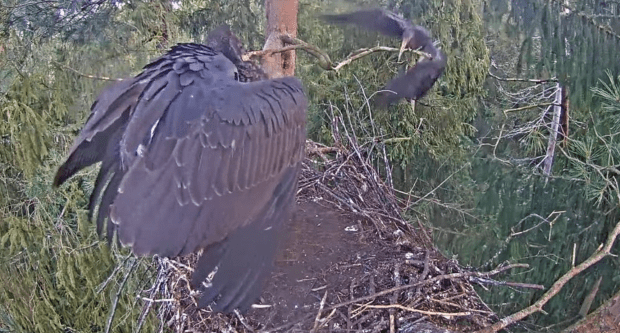
All of the storklings from the Estonian nests of Karl II and Kaia and Jan and Janika’s have fledged. In Latvia, the three nestlings of Grafs and Grafiene’s nest in Latvia have also fledged! This is simply fabulous news. Some are finding their own food and others return to the nest at different times to be fed by dad. They could also be self-feeding off the camera – no one can see and be sure.

In Jan and Janika’s nest, there was one unfledged storkling on the nest yesterday. That chick had two meals from Jan – eating alone, how grand. Gosh, they must have been overwhelmed. One sibling fledged and was gone from the nest since 22 August at 17:35. The other fledged yesterday at 09:15. There was some concerns for a storkling yesterday before 11:00. There were growling sounds and stork bill clattering below the new. It is believed that there was an encounter between a storkling and an animal but it appears to have ended well. Today, 24 August, the yet-unfledged storkling had breakfast from Jans at 9.34 am. After spending the first part of the day in the nest, the last, 3rd hatchling fledged today at 13.57 pm. My source tells me that “It sounded like an awkward fledge, probably got entangled in some branches, but we did not see it, since it was out of the camera view. However, judging by the wing flapping afterwards and not seeing the storkling anywhere when the camera zoomed out and did a 360 degree view, he/she managed to fly off unharmed. Based on the transmitter data of the storkling who fledged yesterday, everything is well with him/her.” The adult male, Jan, returned to the nest in Jergova County at 15:56 with a full crop. “He waited an hour for any of the kids to show up, but none did. However, everyone enjoyed seeing Jan in the nest for such a long time, since he seemed to enjoy his rest preening himself and tidying the nest. Until now, for a long time his visits have been super-short and did not allow us to admire this majestic bird in the way that he deserves.
As I am writing this, Jan came to nest again at 6.09 pm, the second fledgling (fledged yesterday, 23/08) followed and in a short while got a meal from Jan. Now we know that the second fledgling is still alright. Great news! Two of Jan’s children have gotten fed today. No such luck for our storklings in Latvia which makes me a bit sad, of course.”

I am so grateful to ‘S’ in Latvia for her great descriptions of the latest events on the Black Stork nests in Latvia and Estonia.

Here are some images of the nest of Grafs and Grafiene both empty and with the one fledgling.

This is a reason for having satellite transmitters – to do checks on their migration progress and to provide attention if a problem is noticed. ‘S’ reports about the migration of Karl II and his three storklings since they also have transmitters along with Karl. She says, “Karl II and his storklings have started the migration. According to the today’s data, Karl II was in Belarus, the oldest storkling Udu (meaning “fog” in Estonian) was in Poland, but the middle storkling and last fledgling Pikne (meaning “god of lightning” in Estonian) – in Ukraine. Sadly, it seems that we have lost the youngest storkling Tuul (meaning “wind” in Estonian). Yesterday’s data showed him only 400 m away from the previous location of 17th August. No one is speculating about what may have happened, but it is clear that there are 3 options: 1) Tuul is alive, but for some reason stuck somewhere; 2) Tuul has perished; 3) something wrong with the transmitter. Urmas will probably go look for him soon and report as soon as he knows something.”

This is a map posted of the Karl, Udu, and Pikne locations this morning:

You can read about Karl family’s migration here: https://www.looduskalender.ee/forum/viewtopic.php?f=65&t=945&start=11420

Every bird that is lost leave us with a hole in our hearts. There are as many people attached to Tuul who loved Malin. We know the depth of that sadness. I hope that his transmitter is broken. As soon as something concrete is available, I will update you.

That is it for me on a Tuesday. My mind and body are exhausted over the events surrounding Malin’s death. That energy will return – no fear. I am determined that Malin’s death will not go unnoticed. There are things that must change and there are several, working behind the scenes, to ensure that can happen.

I can’t leave you without giving you a smile. Tiny Little was on the Foulshaw Moss Osprey Nest this morning screaming at White YW for a fish. Everyone thought she would die – just shows them who truly is the fittest.

Thank you for joining me. It is always a pleasure to hear from you and once again – thank you for the hundreds of outpourings for Malin. He was a very special bird who fought to live and was loved by many. Take care all.

Thank you to the following for their streaming cams where I took my screen images and video clips: The Estonian Eagle Club, The Cumbrian Wildlife Trust and the Foulshaw Moss Osprey Nest, and The Latvian Fund for Nature. I would also like to thank ‘S’ in Latvia who gave me the up-to-date information on the Black Storks that I shared with you. I could not have done it without her!

Iris and Louis defend nest

In my last post, Tiny Little Bob or Blue 463 from the Foulshaw Moss Osprey Nest was screaming at White YW (aka dad) for a fish. He could have flown to Wales and he would have still heard her.

What is that about the squeaky wheel always gets the oil first? Perhaps screaming daughters do, too. It is the last fish of the evening probably and Tiny Little is eating it. Blue 462, the other female on the nest, would like Tiny Little to share. Somehow I don’t think so ——- it was, after all, Blue 462 who was such a meanie to Tiny Little when she hatched. Birds have good memories.

These are the areas adjacent to Iris’s nest in Hellgate, Missoula, Montana. It is very beautiful. We always see the nest in the parking lot but just on the other side are trees, grass, and water.

Iris is the oldest living Osprey in the world. Her nest is at Hellgate in Missoula, Montana. After her mate Stanley died, she bonded with Louis. They had one chick survive, Lele, in 2018. Louis has another nest at the baseball park with Starr. They fledged two chicks this summer. When Stanley died, Louis also took over the territory that includes the two nests. Every year Iris returns, goes through the rituals of breeding, lays her eggs, and everything falls apart. People get upset. They think very little of Louis. I am of a divided mind. Right now I prefer Iris taking care of herself, eating well, and bulking up for migration than running around with a nest full of juvenile fledglings. She has done her bit for the DNA of the species. But that is just my opinion. Everyone is entitled to theirs, for sure. But the one solid thing that binds all of us together is our love for this most amazing of Ospreys.

Iris tends to spend more time at her nest before she leaves on migration. Last year she departed on 8 September. Everyone gets a little teary eyed right about now because there is no promise that Iris will return but, we live in hope that this strongest of female Ospreys graces the screens next spring. Along with that hope is that the rains come and there is plenty of food for all.

There have been a number of intruders, both male and female, this summer. Do they want to usurp Louis? take Iris for a mate? Certainly when Dunrovin’s Congo came on the scene everyone was hopeful! or are they just curious and checking out what nests are available? Perhaps all of those things. Today, Louis flew to the nest alarming and Iris flew in and joined him – showing off her big crop!

Erick Greene and his team in Montana are considering many ways in which to commemorate Iris. Stay tuned or check out the Montana Osprey FB page. If you wanted to order an Iris pen and forgot, if you will send me a note I will send you the details. They are gorgeous and made from those sticks she brought to the nest.

In the image below, Rosie, the female adult on the San Francisco Bay Osprey cam at the Richmond Yards, is bringing Poppy, one of two female hatches, a beautiful trout. Poppy is 110 days old today.

The average age for Richmond and Rosie’s female chicks to stop feeding at the nest is 105 days. The longest a female stayed was in 2018 and that was Kiskasit who was 124 days old. Lupine was last seen on Monday. She was 103 days old. Sage, the only male, was last seen on 28 July at the age of 86 days. The average for the males to stop feeding on this nest is 93 days so Sage left a little early. There is no reason to believe that Sage and Lupine have begun any type of migration. Richmond stays in the SF Bay area year round. Mom Rosie will migrate and the female adults normally leave before the fledglings. And whose to say they will migrate! If there is plenty of food and the weather is fine – well, it certainly agrees with Richmond – may be they will stay!

And, of course, just thinking about fledglings returning to the nest to be fed until they are 90-100 days old just makes me think about Malin. Susan, the wildlife rehabber that is over the area where Collins Marsh is located, was to get in touch me later today. She wrote me a long note yesterday and she is also firm in her knowledge that Malin was a forced fledge. As we have learned, normal fledges do not require our attention. The chicks return to the nest, take short flights, and are fed by the parents. Malin was not ready despite his age. He had suffered a lack of food. His forced fledge meant that he was in jeopardy and boots on the ground were needed immediately. This did not happen. As noted earlier, she found two chicks – one dead, one alive. I am hoping that ‘no news is good news’.

Suzanne Arnold Horning was on the Cornell Campus and she found the two Ks. No sightings of Big Red and Arthur but, guess what? Getting to see K1 and K3 on the 22nd of August is a bonus. Here they are hunting. That is K1 on the top. She looks so much like Big Red and has turned out to be such a fantastic hunter. Suzanne said they were not food calling – just being quiet and hunting. These two seem so much more independent this year.

Ah, the little cutie, K3 looking down and hoping to find a chippie.

What a nice treat to get to see the Ks. And, of course, theirs could be a migration dilemma. Big Red and Arthur stay in the area year round. Perhaps with the changes in weather so will the Ks. If someone could put the average date that birds leave for migration this year against last and create a global directory (surely someone does this already), tracking of changes related to climate could be measured. We have seen Poppy stay longer as are many others and now perhaps the Ks.

Thank you for joining me today. I will let you know as soon as I hear about Malin – it is heartwarming to hear from so many around the world who came to love that little nestling. If you are in line with any of the storms hitting the coast of the US, going over Hawaii, or elsewhere, take care of yourselves. Stay safe.

UPDATE: Aug 23 at 17:35:35 No2 (7182) fledged at the Estonian nest of Jan and Janika. Slept as an adult off nest.

Thank you to the following for their streaming cam where I took my screen shots and video clips: Montana Osprey Project, Cumbrian Wildlife Trust and the Foulshaw Moss Osprey Nest, SF Bay Ospreys and Golden Gate Audubon. I would also like to thank Suzanne Arnold Horning who allows me to download her images to share with you.

Sadly, no word about Malin

I want to thank everyone that took the time to write to me and tell me how much Malin meant to them. My inbox was overflowing with letters expressing love and concern for Malin. Everyone wanted to know if there had been any word. Mom and Dad have both been on the nest with fish and today Marsha (mum) was there around 13:00. She did not have any fish that visit. During her morning visit she called out for Malin. So far there has been no sighting of Malin.

After going through the FB postings of the Nature Center, we were able to determine that Malin was the middle hatch. The youngest just disappeared from the nest and the eldest died in the middle of June leaving Malin, the chick that hatched on 18 June, alive. Malin was then the middle hatch of 18 June. Malin then was 63 days old at fledge. The average age for ospreys to fledge in Wisconsin appears to be 55 days. That would make Malin’s timing within range. Most ospreys spend at least 2 weeks flying and letting their parents feed them. Many stay much longer. Two examples that I give are Tiny Tot and Tiny Little because they were both hatches that suffered from lack of food. Tiny Tot stayed on the nest for a total of four months or 120 days. That is more than twice as long as Malin. Tiny Little remains on the nest in Cumbria. She will probably fledge before Tiny Tot’s 120 days – but she could be on the nest for 90 days.

There is disagreement over whether Malin simply flew or whether or not Malin was frightened off the nest by an intruder. Experts on both sides see that exit differently. It is unfortunate. The result is the same – Malin has not returned to the nest. The reactions to looking for Malin are different depending on which you believe. If Malin just flew because he wanted to then no one would go and really look for him. If one believed that Malin was frightened off the nest, they might worry that he was injured and look harder. Something that has to be kept in mind is that Osprey feed their fledglings on the nest – it is preferable. They do sometimes feed on a branch but I haven’t found an Osprey expert that has ever seen an Osprey parent feed their fledgling on the ground. In fact, if a fish falls off a nest they will not go and retrieve it. Have you ever seen an Osprey eat or feed its chick on the ground?

The research continues to stress that the more food and the longer fledglings stay on the nest the higher the success rate. That is the reality. This nest is really empty. Malin defied the odds – he survived and thrived. We hope that the name we gave him carries him on into his life and that he is somewhere safe eating a fish.

Collins is looking down like he might be seeing Malin.

One of the last times the entire family was together on the nest. It was a real privilege to watch little Malin survive and then – thrive. Let us all continue to send this family positive energy.

19 August 2021. Malin, Marsha, and Collins.

It is about 7am in Latvia and Estonia as I write this. The Black Storklings are waking up and like all birds are a little more energetic than they are at mid-day.

The two images below are from Grafs and Grafiene’s nest near Sigulda, Latvia. At least one of the storklets has fledged. Perhaps today they will all fledge and find the feeder area with the beautiful Grafiene decoy.

It is now just after 9am in Latvia and there is only one storkling on Graf’s nest near Sigulda. This means two have fledged just like my source had indicated. The second fledge is the oldest at 7:43 am. He is 70 days old today. The youngest fledged at day 66 after hatch.

This was not the smooth flight of the youngest. The oldest hit the branch on the other side of the tree. There is concern about the condition of that wing. I will update you as soon as there is any information. Send your strong and positive wishes. I hope it looks worse than it was. How terrifying for this young bird to have that happen.

Even so, I hope that both of the storklings are at the feeder filling themselves with fish – just like we hope Malin is doing the same.

There is now only the middle hatch. Perhaps it will go today. They are 68 days old.

When I checked on Jan and Janika’s storklings in Estonia’s Jogeva County, no more fish have been delivered to the nest. It looks to me like every scrap of the old fish has been eaten – I thought that yesterday. Perhaps one really packed down in the nest is there, the one the storkling on the left is pecking at. All of the birds need food.

Hopefully all of them will fledge and find the feeder set up for them, too.

They are so beautiful with the sunlight filtering through the trees. The storks are 67 and 68 days old today. The average for fledging is 68-72 days. I wonder if Urmas will deliver some more fish?????

Do you watch the peregrine falcons, Xavier and Diamond? If you do, then you will know that part of the pair bonding ritual is Xavier presenting a prey item to Diamond. Diamond is not that particular but, she does not like Starlings. She cannot stand them. She has turned Xavier away when he had a Starling for her. They must taste terrible!

Well, today, Xavier hit the jackpot. Diamond was completely excited about her lunch – although some of you might not be. Xavier had a Superb Parrot for his beautiful Diamond. Make sure your sound is turned up.

Superb Parrots are also known as Green Leek Parrots or the Barraband’s Parakeet. These little beauties are native to southeast Australia living in the dry woodlands of New South Wales and Victoria. They were once considered vulnerable in terms of conservation and have been listed as Least Concern since 2012. Loss of habitation due to timber logging might well see this bird back as being vulnerable.

They are medium sized, growing up to a little over 15 cm or 16 inches in length. The bird in the image below is a juvenile. How do I know that? It has brown eyes while the adults have yellow-orange eyes. The adult male has a bright yellow face and throat while the female looks like the plumage that the juvenile has below. They eat fruits, berries, insects, as well as grains and nuts.

Awww. What a sweet face.

WBSE 27 and 28 continue to charm the socks off of everyone. That beautiful fluffy white down is in transition. They look a little like old terry cloth towels sleeping in their nest this morning in Sydney.

Look closely along the edge of the wing of WBSE 28 on the left. You will see the little pin feathers coming.

The pantaloons are growing too.

Just look at that sweet baby, WBSE 28, looking up at its parent. How adorable.

They are so young and yet, both of them know to pancake when there is an intruder near the nest. They hear their parents alarming and down they go. Look at the concern shown in the eye of WBSE 27 on the left. You can also see the black pin feathers coming in on both in this image better than the other one. But look – their cute little tails are growing!

You cam almost see them growing right before your very eyes.

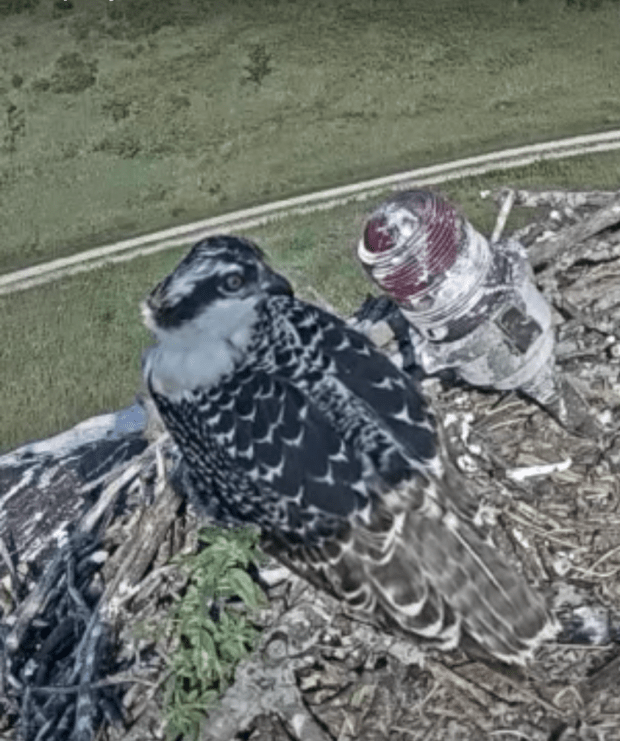
Tiny Little still makes my heart skip a beat. Oh, what a wonderful bird you have turned out to be. You were so very tiny with that big older siblings but just look at you waiting for your breakfast to arrive.

Oh, you have that ferocious look like Mrs G. I have said that a couple of times but you do, Tiny Little. I hope you live as long as Mrs G and have lots of successful hatches. You really are quite amazing, Tiny Little.

Tomorrow is Saturday but there is no Ferris Akel tour this week. I was hoping to catch up with what is happening with Big Red and her family. It was raining yesterday but the Hornings were able to spot all four of them so we know that K1 and K3 are still with us – how grand, the 21st of August.

I am researching ‘Climate Driven Evolutionary Change’. If you know of bird arrivals or departures that are earlier than normal or later than what has been the norm, please let me know. It is much appreciated.

It is so nice to have you here with me. The rain is still falling – and that is a good thing. Please continue to send your positive wishes to Malin and all the bird families. Take care of yourselves. See you soon.

Thank you to the following for their streaming cams where I took my screen shots and video clip: The Falconcam Project at Charles Sturt University and Cilla Kinross. Collins Marsh Osprey Nest, Cumbrian Wildlife Trust and the Foulshaw Moss Osprey Cam, The Eagle Club of Estonia, The Latvian Fund for Nature, and the Sea Eagles Cam, Birdlife Australia, and The Discovery Centre.

Send love and positive energy to Latvia and Estonia

I want to begin with the Black Stork nests today. For those just learning about the situation of the Black Storklings in both Latvia and Estonia, here is a very brief summary. The storklings at the nest of Grafs and Grafiene in Latvia and that of Jan and Janika in Estonia are late hatchlings. There was concern from the beginning that both parents might leave for their migration before the storklets fledged. Currently, the mothers have left and the fathers, Jan and Grafs, are the sole providers. Neither male can provide enough food for three storklings to thrive. There is also a question of the supply of the fish. In both Latvia and Estonia, feeder situations have been established with decoy female Black Storks. To date, neither male has found these feeders.

‘S’ in Latvia reports, “The good news is that it seemed that yesterday Grafs had encountered a generous feeding place on the way, not so far away. We were already a bit sad thinking that the storklets will have to spend another day with just one small noon feeding, what a celebrated surprise it was when he came back less than 4 hours later with plenty of food. Many of us bursted into happy tears:) It is good to know that he can still manage to get food elsewhere even if it is not from the feeder. And the most important thing is that he is still here caring for his young.”

aGrafs and Grafiene’s Storklings, Sigulda, Latvia 19 August 2021

At the very beginning, M. Strazds, a Latvian Black Stork specialist, warned that he felt that there was only 0.1% chance that Grafs would find the feeder because birds do not normally search for new feeding spots at the end of the nesting season. Still, as I understand it, the storklings, once they fledge, will find the feeder and it will be very good for them.

In Estonia, Jan has made only one delivery that I am aware of. The storklings have supplemented that with the fish that Urmas delivered last night. I was made aware that the storklings were playing with the fish but, it appears now that they have been eating them as the pile of fish is almost gone as I write this. I am aware that there are controversies about the effect of humans getting close to the nest because of the stress that it causes on the birds. But starving is also a major stressor. I believe that Urmas and his team know what they are doing and I hope they continue to feed these birds.

Jan and Janika’s Storklings, Jegova County, Estonia

There is one other nest with a fledgling, Pikne, the female, still being fed by a parent and that is the nest of Karl and Kaia in the Karula National Forest in Estonia. ‘S’ reports, “The feeder approach has been very successful with Karl’s nest in Karula for the sole reason that he has a transmitter and it is possible to track his usual feeding places.”

Pilkne, the last remaining storkling being fed by Karl II at the nest in the Karula National Forest in Estonia. The other two have fledged.

It has been a very difficult year for those who care for the birds and who watch the streaming cams. Osprey chicks died due to weather related issues and Cooper’s Hawk eyases got so hot on the nests in Canada, they lept off the nests to avoid literally being roasted. Many are dying as they undertake their migrations which are challenging enough without having fires and smoke enroute.

At the same time, there have been some remarkable situations. Around the world, humans have stepped in to save birds of every variety. In the interior of British Columbia, the wildlife rehabbers climbed the Osprey nests and removed the chicks taking them into care because of the extreme heat and fires. At various places around the world, Osprey chicks have been fostered and received a second lease on their life. A Canada Goose named Arnold had his digits fixed so that he could live a full life with his mate, Amelia. A very old Bald Eagle full of lead was given treatments and is now thriving and waiting for A Place for Hope to get its permit so he can be their ‘forever’ bird. Every day I read about a group of people and trying to help fix what many believe is unfixable. I hope that this is just the beginning of a change in intervention and our understanding of what works and what doesn’t. The key is not to give up.

There are, however, three miracles. I am thinking of the three Ospreys that should have died but did not – they have thrived – two of them to become dominant on their nests! Those were Tiny Tot aka Tumbles at the Achieva Osprey Nest in Florida and Tiny Little Bob aka Blue 463 on the Foulshaw Moss Nest in Cumbria. To me these are simply nothing short of a miracle.

Tiny Little Bob aka Blue 463, Foulshaw Moss Nest, 19 August 2021

The third has yet to fledge but has shown remarkable growth. I am aware that many on the chat rooms in Latvia and Estonia are concerned about feather growth. This was also a big concern for Malin on the Collins Marsh Nest in Wisconsin. Malin is our third miracle.

Malin, Collins Marsh Osprey Nest, 19 August 2021

I cannot tell you what happened to make the food deliveries on this nest turn around. All I can say is that they did and there are no more missing feathers, the tail now has 7 dark bands when 3 weeks ago there were 2 with the hint of a 3rd. It has been a remarkable recovery. At one time, there was concern that Malin might survive but not be able to fly. Those concerns have now vanished. Today, Malin has had 3 fish deliveries before 1pm and one of those was a whopper. Malin actually walked away from being fed by mom, Marsha, he was so full.

One of the major concerns for the Collins Marsh Osprey Nest is that the parents would also leave Malin on the nest and begin their migration. So far everything is going smoothly so I will just ‘knock on wood’ that it continues to be that way.

One other good news story is that the fires in Turkey are dying down or are out.

And there is more. Aran, the mate of Mrs G on the Glaslyn Valley Osprey Nest, was injured and was missing a couple of primary wing feathers,. There was a huge concern that he would not be able to fly — and consequently that he would not be able to fish or be able to migrate. Well, look at Aran’s feathers today! Yahoo. He is good to go. Tears. This is an amazing couple who lost their three chicks due to starvation when Aran was injured. The Glaslyn community kept the birds alive with a fish table until Aran was able to fly and fish.

Indeed, I do not want people to think that feeder areas or fish tables do not work. It depends on the circumstance and in the case of Aran and Mrs G as well as the Mlade Buky White Storklings, those fish tables saved the lives of those two families.

Aran at the top sitting on edge of nest! 19 August 2021.

We have a lot to be thankful for – and there is a lot of work to do to figure out how to help our precious birds – all of the wildlife. Humans stepping up to take responsibility and to “try” even if they are met with low odds and negativity should be the norm not the exception.

What can you do today to help the birds and all of the wildlife?

I want to close today with a bit of a giggle. If you watch Ospreys you understand how difficult it is for both the male and female to raise three. Actually that is true of eagles as well. Well, what about five? Now consider the fact that those five are all female. The poor dad would need a set of sound cancelling headphones!!!!!!!!!! You can hear females clear across a lake. Oh, my. The parents of these Westport, MA fledglings will certainly deserve their winter break.

Thank you for joining me on this quick update on what is happening in Latvia and Estonia. Send them all of your positive energy – and take care.

Thank you to the following for their streaming cams where I took my screen shots: Collins Marsh Nature Centre, Cumbrian Wildlife Trust and the Foulshaw Moss Osprey Nest, the Eagle Club of Estonia, the Latvian Fund for Nature, Brywd Gwyllt Glaslyn and the anonymous reader of my blog that sent me the image of these five beautiful female Ospreys. Thank you.

Things are happening in Bird World

Oh, just look who showed up on the NorthEast Florida Eagle’s nest in Jacksonville today – none other than the resident male, Samson! It was 7:23. So very nice to see you, Samson.

Samson is the son of Romeo and Juliet. Samson hatched on this very nest on 23 December 2013. Samson fledged and left the area on 22 April 2014. He was 120 days old.

At the end of the summer in 2019, in August, Samson arrived at the very nest he hatched from and began bringing in sticks. His mate, Gabrielle arrived on the nest on 12 September. In May of 2020, their two chicks, Jules and Romey, named after Samson’s parents, Romeo and Juliett, fledged. In 2021, they fledged their only hatch, Legacy.

The picture below is of Mama Gabby and baby Legacy in February 2021.

Samson has been seen at the nest earlier this month when the technicians came to do the maintenance on the streaming cam. Samson remains in the area of the nest year round while Gabby migrates to a cooler place – although, as I have often said, I don’t know where that would be this year! She will return about the middle of third week in September. It will be wonderful to see her back. Can’t wait.

Samson may be working on a nest but the Peregrine Falcon couple, Diamond and Xavier, are expecting eggs in the nest week or a week and a little bit. Their scrape box is high on a water tower, 170 steps up, on the campus of Charles Sturt University in Orange Australia.

This is Diamond on the ledge of the scrape box today.

Diamond and Xavier’s 2021 fledgling, Izzi, was the joy of everyone. As the only little falcon he was loved and spoiled by his parents. There was some concern he would not leave the scrape box before this year’s eggs are laid. This is the latest message from Cilla Kinross, the head researcher on the Falconcam Project:

“Izzi has not been in the box now for 12 days, but we think he is still around from calls. Parental behaviour continues as normal, with up to three prey a day being delivered to Diamond and preparation of the scrape. Eggs are expected soon (within a week or two). Generally, Diamond starts to spend more and more time in the scrape and her backside looks large and fluffy.”

You can watch Diamond and Xavier here:

Peregrine falcons are nothing short of amazing. Bald Eagles are big but Peregrine falcons are fast.

“Peregrine Falcon” by Jon David Nelson is licensed under CC BY-NC-SA 2.0

The cere is the yellow part above the beak. Now look at the nostrils in the cere. There are small keratinous tubercules – they look like small little bumps inside the nostril. Can you see the one on the right nostril of the falcon above? Those are what help the Peregrine Falcon fly so fast. They serve as a baffle against the wind driven in so forcefully into the lungs of the falcon as they do their high speed dives. Otherwise, their lungs would burst.

“Faucon pèlerin / Peregrine Falcon / Falco peregrinus” by FRITSCHI PHOTOGRAPHY is licensed under CC BY 2.0

Most Peregrine Falcons that you will see on a streaming cam lay their eggs in a scrape box like the one of Diamond’s, above. Some make their nests on the side of cliffs like this one in Japan on the island of Hokkaido.

“Peregrine Falcon Nest” by Ken-ichi is licensed under CC BY-NC 2.0

Peregrine Falcons do not make their nest out of twigs. It is believed that this helps to stop the spread of disease from twig nests pests like flies and parasites.

Here is a short 8 minute video to introduce you to the speed and hunting methods of the Peregrine Falcon:

It’s a great day for Malin! We do not know Malin’s exact hatch date. There were three chicks and the youngest hatched on 18 June. Two chicks perished in the heat. So Malin is either celebrating his two month hatch today or his two month hatch and a couple of days, more or less. His first delivery came around 9am and the second was at around 10:14. Malin is really growing.

Here is Malin next to mum, Marsha, this morning. You can see that Malin’s feathers are growing in nicely. Look at the crossing of those wing feathers. Yippeeeeeee. This chick has really grown with the increase in feedings.

And look at all of the bands on those tail feathers – looks like a clean 7 – while, at the same time, there are no spaces in the wing feathers.

Oh, Malin, aren’t you beautiful?

Malin has gotten very good at self-feeding.

Malin is off to a great start on Wednesday. Terrific.

It is raining heavy in Latvia at the nest of Grafs and Grafiene. There are some concerns on the amount of energy used to keep warm by the nestlings.

This is the nearby ditch. It is 200 m long. A portion of the ditch has been closed off and fish have been placed in there along with the decoy of Grafiene. The decoy of Grafiene was painted by an active chat participant and installed by Janis Kuze, the ornithologist.

I hope you don’t mind if I correct just minor details. The beautiful decoy was painted by the active chat participant B.K. and installed by the ornithologist Jānis Ķuze.

These are the size of fish being put into the feeder for Grafs. So much effort. Now we need Grafs to find this spot for his three storklings. It is a very, very difficult time for everyone especially with the rain. If you would like to check on the Latvian Forum for progress, please go to this link:

The situation of the Black Storklings in the nest in Jegova County, Estonia appears to be better than in Latvia. Jan has come to the nest to feed the storklings 3 times today. The storklings have not almost completely depleted the fish that was brought on the 13th when they received their transmitters and bands. They appear to be healthy and doing well. It is not raining on this nest today.

The three storklings are 63 and 64 days old today. The average for fledging appears to be 71 days but then the young storklings are dependent on their parents for another two to three weeks before leaving the nest area. That only puts us at the end of the first week of September for these three to be totally independent of Jan — but, of course, those numbers are only averages. It appears there is time! We all must hope for these birds. They are very rare and very special and there has not been a lot of studies done on them.

The Forum with ongoing information on the Estonian Black Stork nest is here:

Karl II has been in to feed the one fledgling on the Black Stork Nest in the Karula National Park in Estonia. Oh, that fledgling was so happy. That was at 18:33. It is Urmas, the only chick still being fed by a parent. Kaia has left for her migration and the other two siblings appear to have left the nest area and might be travelling as well.

I know that there is much sadness and anxiety in the region for the two Black Stork nests that had late hatches. But, we must also celebrate the happiness of this nest in Estonia, that of Karl II and Kaia. Three fledglings, all healthy! We need to send the most positive wishes for Kaia and the other two siblings as they make their way through Europe trying to get to Africa. And, then, of course, for Karl II and this storklet when they begin.

I have tried to catch the number to confirm this storkling but it is nearly impossible.

The smudge is right in the way!

For those of you watching the North American migration, it kicked off Sunday, the 15th of August at Hawk Mountain in Pennsylvania. The first over the ridge that day was a Broad-winged hawk. There was a strong wind that day and the count was 4 Bald Eagles, 2 Cooper’s Haws, 25 Broad-winged Hawks, and 3 American Kestrel. If you would like to check on the migration in North American on the route over the mountains with all their thermals, here is the place to go for a day to day check in:

https://www.hawkmountain.org/conservation-science/hawk-count

It’s 17:16 in Cumbria in the UK and our second great Osprey chick survivor this year – Tiny Little Bob on the Foulshaw Moss nest – is waiting for dad, White YW, to bring her the teatime fish! Every day is a blessing to see you on the nest, Tiny Little (Blue 463).

Thank you so much for joining me today. Please send all your positive energy to our friends in Latvia and to Grafs for him to find the feeder and for the safe migration of all of the birds. Take care everyone. See you soon.

Thank you to the following streaming cams and forums where I grabbed my screen shots: The Forum for the Latvian Fund for Nature and the Sigulda Black Stork Nest, The Eagle Club of Estonia and the Black Stork Nest at Jergova County, The Eagle Club of Estonia and the Black Stork nest in the Karula National Park, Collins Marsh Nature Centre, Northeast Florida Bald Eagle Cam and the AEF, Cumbria Wildlife Trust and the Foulshaw Moss Osprey Nest, and Cilla Kinross and the Falconcam Project at Charles Sturt University in Australia.

Worries…and Hope for the Black Storklings of Latvia and Estonia

Sometimes the good news in our Bird World gets suppressed by horrific news or concerns – and in that moment, we begin to lose hope that anything is being done to protect our feathered friends. Today, we are going to start off with the worrying news and end with some really positive happenings.

The real worry centres around one word: migration. Normal migration brings enough troubles to the birds – winds, lack of prey, predators but this year underneath that big umbrella of migration are two other concerns: the wildfires that are impacting birds already in the midst of their migration and those who will be starting their journeys to Africa from Europe and the UK and the late hatches. For those of you that do not know, the fires around the Mediterranean are causing birds to fall dead from the sky or to go into care for smoke inhalation. It is heating up in France and Spain with record temperatures. High atmospheric pressure is fanning the heat. It is extremely dangerous for the birds to fly through the fires to reach their winter homes. The second worry are the birds that were born late – some three to four weeks after the others. Will their parents stay and feed them? or will they die on the nest? will the father who remains while the mother has already left be able to find enough food for these large birds nearly ready to be on their own?

The latter issue is pressing down on stork nests in both Latvia and Estonia. We have had the pleasure of watching Grafs and Grafiene feed their three Black storklings on the nest in the forest near Sigulda.

Grafiene last came to the nest to feed her babies on 13 August. The Storklets were normally getting 10 feedings a day. On the 13th of August they had four feedings but, on the 14th, the next day, there were only two. It is, as we all know, extremely difficult for one parent to maintain the level of feeding when they are also preparing for migration. There is fear in the Latvian community for these beautiful birds.

My friend ‘S’ in Latvia advises me that through the efforts of the community – the calls for help for these birds – the ornithologists in charge of the area have set up a food table for the father near to the nest. This is very similar to the help given to Bukacek in Mlade Buky when the female was electrocuted. Let us hope that Grafs will accept the food and feed his nestlings. They will not be ready for fledging for at least another two weeks. Please send your warm wishes for these beautiful birds that they survive.

You can follow what is happening at the nest of Grafs and Grafiene here:

At the Black Stork Nest in Jegova county in Estonia, the storklings were fitted with satellite transmitters late on 13 August. This is the nest of Jans and Janika. The banders left a pile of frozen fish on the nest that they hoped would last a few days. Janika was last seen feeding the storklings on 6 August. The father has managed to bring some big fish to the nest but ‘S’ tells me that these fish have been difficult for the nestlings to eat because of their size.

Two things you will notice in the image below taken on the 15th. You can see the transmitters on the legs of the three storklings but you will not see a pile of frozen fish – the storklings ate all of the fish provided! This is wonderful news and gives one hope that the efforts of everyone in both Estonia and Latvia will prevail and the six rare Black storklings will fledge and survive to return to their home countries.

Here is the link to this nest:

The pandemic which began in 2019 and continues to take lives around the world also contributed to some projects that have brought much hope in regard to the natural world and our bird friends. James Aldred, an award-winning documentary filmmaker was given an assignment to document a family of goshawks living in the New Forest. The New Forest is in Hampshire in southern England. It is the largest area of forest and pastures in England consisting of 71,474 acres.

The natural landscape of the New Forest consists of areas of open fields and heavily treed forest areas.

“New Forest Landscape” by davidgsteadman is marked with CC PDM 1.0
“New Forest – River At Mill lane Brockenhurst 2” by Chalkie_CC is licensed under CC BY-NC 2.0

Aldred was there to study the Goshaws who are medium large raptors that live in the forest. They are larger than the Sharp-shinned hawk that comes to my garden and the Cooper’s hawks that I see at the park but they are significantly smaller than eagles. They are known to be fiercer in temperament than the Sharpies or the Coopers. Because they live in the forest very secretively – not liking to be around humans – they are often hard to find. Stealth hunters they are known for their excellent flying skills seeking out both bird and mammal.

The females are, like other raptors, larger than the males. The couple build a very large nest in trees using twigs where the female will lay between 2-4 eggs that are incubated for a period of 28-38 days. Fledging normally takes place after 35 days.

So what was our documentary filmmaker doing with the goshawk family in the New Forest? Aldred spent 15 hours a day in a tent recording the comings and goings of the goshawk family. He created lots of notebooks about the intricacies of their lives often unseen by humans. Aldred said it was like going back in time a thousand years. There was silence in the New Forest which is normally underneath the flight paths of thousands of airplanes every day. He said what gives him hope is that “Very soon after humans deserted the forest last spring, wild animals started reclaiming it.” In addition to the goshawk family, deer, badgers, and fox cubs came out to play.

“Stag at Bolderwood, New Forest National Park” by Chalkie_CC is licensed under CC BY-NC 2.0

“The sheer emptiness of the place…It felt weird, being out there in that paradise on my own.” What he saw and experienced is now in the book, Goshawk Summer: A New Forest Season Unlike Any Other.

The brilliant take away from all of this is that once pandemic restrictions were eased people flooded the area with what Aldred calls their ‘pandemic puppies’ killing and scaring away the birds whose nests were on the ground. The arrival of so many humans scared all of the animals back into hiding and leading their lives in a very different way than during the period when no persons were allowed into the forest. The Forestry Commission listened to Aldred about managing visitor numbers and the woodland paths so that the animals would not be harmed by humans who visit the area.

Each of these stories brings us hope and encouragement. I am delighted to hear that the ornithologists -after hearing from so many people – are providing food to the storklings. It is hoped that those in Estonia will return and place more fish on the nest or nearby for Jans. That nest is wide enough. The Latvian nest is problematic because it is too narrow and might collapse if someone tried to place fish directly on it. Let us hope that the feeding continues and that it is successful.

We also have a late hatch – little Malin at the Collins Marsh nest in Wisconsin. So far, Malin has had only one fish and that was delivered by Collins around 8am. I really hope that he is going to get enough food today. This is another nest that needs someone to supply fish for the family because of the drought and heat that has happened.

Malin is getting some air beneath his wings in the image below and those feathers look good. Oh, he is so tiny!

Over in Cumbria, big sibling 462 got the fish and there is Tiny Little hollering for White YW to bring her one! And, of course, she is giving her big sibling ‘that look’.

It is another hot day on the Canadian prairies. My resident Blue Jay has learned where to sit to tell me that more water is needed in the bowls or that the ‘buggy’ suet is all gone. Him and his mate plus another Jay have been coming to the garden for several years. They live in a tree just across the back lane. It is always lovely to see them playing in the bird bath!

Thank you so much for joining me. Send all of your best wishes to the birds who are in the process of migrating. It could be catastrophic if all of them perish in the fires trying to get to Africa. At the same time, take a cue from what has happened in Latvia and Estonia – support those that want food tables set up to help the birds survive. Donate fish if you have them to give. One other thing is to thank those who helped and are continuing to help. Take care everyone.

Thank you to the following for their streaming cams where I took my screen shots: Collins Marsh Nature Centre, Cumbrian Wildlife Trust and the Foulshaw Moss Osprey Cam, the Latvian Fund for Nature and the Eagle Club of Estonia. Thank you to the banders in Estonia and the persons supplying fish to Grafs in Latvia. We appreciate your stepping in to show how much you care at this critical time for the birds. Thank you ‘S’ for sending me all of the news. It is much appreciated.

Estonian Black Storks fledge…and other news from Bird World

All you have to do is watch a songbird catching insects for her wee nestlings, coming and going all day, to clearly see the great effort this is on behalf of the adult. As the nestlings grow ever larger, those same parents have tremendous pressure to increase the amount of food and the number of deliveries. Just finding food has been a serious challenge for all the birds this year whether they are in Montana, Florida, or Latvia. The tremendous heat waves, droughts, and urban development have impacted hunting areas as well as the quantity of fish or prey available.

I recorded an evening food delivery to Grafs and Grafiene’s storklings in Latvia. This is about a minute long. I could have recorded them for much longer but I can only upload so many MBs. It is absolutely fascinating. The parent arrives, regurgitates the fish, and quickly gets out of the way! Those three are so excited– and hungry!

There have been some concerns over the availability of food. Latvia has experienced, like other countries, excessive summer heat. ‘S’ tells me that they have also been experiencing land amelioration that has caused drainage issues in the surrounding area. If you have ever watched Ferris Akel’s Live Tours of birding areas in upstate New York, you will be aware of how the drainage of land impacts the birds. One day the water and food are there and two or three days later – gone! Poof. The summer heat has exacerbated these issues. Still, this trio of Black Stork nestlings seem to be developing quite well.

If you missed it, Karl II and Kaia’s nestlings were ringed on 9 July at the nest in the Karula National Park in southern Estonia. They also had Kotkaklubi transmitters put on their legs so the researchers can follow them as they migrate. They are Pikne 716P, Tuul 716 T and Udu is 716U. Tuul is the youngest and is seen here in this short video clip flapping and jumping. That nest seems so small!

All that flapping was leading up to something — Udu 716U fledged at 6:19 and then another fledged 716T, Tuul. This leaves Pikne, 716 P to fly. The fledgling Udu has flown and returned to the nest and flown again. It is so wonderful to see them in the early morning enjoying the little bit of wind under their wings. Always exciting and bittersweet.

I promised you an update on Big Red, Arthur, and the Ks. Everyone is doing well. K1 and K3 are very strong fliers and have really extended their range within the territory of their parents on the Cornell University campus. K1 is a very successful hunter. It is unclear to me whether or not K3 has caught his own food yet but, if he hasn’t, he will soon. Big Red and Arthur seem to take turns watching the fledglings progress from a distance.

Here is K3 on top of Roberts Hall.

K1 has been hunting. Wonder what she has in those talons?

A small bird.

K1 finished her snack and is ready to find some more prey!

I love this image. You can clearly see the ‘eyebrows’ that keep the glare out of the hawk’s eyes. Then there is that amazing red streaked belly band – enough to rival that of her mother, Big Red. K1 is such a gorgeous hawk. In this image she is completely focused on the task at hand – finding another prey item.

There is proud papa, Arthur, watching his kids closely but not interffering with their learning.

K1 seemed to be all over the campus hunting. I am not so familiar with the buildings but doesn’t she look gorgeous on this one with the red clay roof tiles? Just a beauty.

The Ks are doing well. We are moving into August. They should be hunting in the fields by highway 366 shortly, if they are not already. The days will pass quickly. The pair will begin soaring and then it won’t be long til Big Red and Arthur will be empty nesters.

Thank you so much for joining me. I hope to get some images of our local water fowl to share with you tomorrow. Take care everyone. See you soon.

Thank you to the following for their streaming cams where I take my screen shots and video clips: The Latvian Fund for Nature and the Eagle Club of Estonia. Thanks go to Suzanne Arnold Horning again for sharing her great images of the Red tail haws with us.

Happenings in Bird World 2 August 2021

It is a gorgeous day on the Canadian Prairies. The extreme heat of the past has dissipated and the sun is shining. There is no wind, every leaf is still. The only thing moving in the garden are the little songbirds waiting for the feeders to be filled. No wind means there is no smoke from the wildfires farther north. It is a nice change. We are all hoping for big downpours and, if the weather report is correct, that will come at the weekend.

A serious lump came in my throat this morning when I went to check on Tiny Little at the Foulshaw Moss Osprey Nest. No one was there this morning (nest time) and now the crows are picking at the nest. Normally, at this time of day, Tiny Little would be on the nest waiting for a fish drop. There appear to be no birds in the parent tree in the background. The Crows are a reminder that the days of seeing our Ospreys are precious ones.

I returned to the Foulshaw Moss nest several times. The last visit revealed Blue 464 – the first of White YW and Blue 35’s chicks to fledge – on the nest food calling. You could see the shadow of another bird on the camera at times.

There are some ‘late’ nests and some just starting in case you are having empty nest syndrome.

One of those nests is at the Collins Marsh Nature Centre in Wisconsin. So as not to confuse everyone, the constant watchers got together. Each felt the chick needed a name, even if it was just for us. ‘S’ from Hawaii suggested Malin which means ‘strong little warrior.’ It fit perfectly for this small chick. Voted for unanimously amongst our small but caring group! So from now on I will refer to him or her as Malin, just so you know.

The female was not on the Collins Marsh nest when I checked. She is absent for long periods of time. I want to think she is fishing and will be back to feed Malin or she is just resting. The male has made a fish delivery. This time it is headless. Malin is confused because Dad will not ever do any feeding. Malin is standing and walking much better than last week but he still wants to be fed by the adult.

Malin continues to try and get the male to feed him the fish but it is not happening!

Once Malin realized that he was being left to fiend for himself, he started self-feeding on the fish. Because this one is headless, Malin is making much better progress. This little one is trying very hard.

There is a concern about the feather growth of Malin. Unfortunately, the camera is not clear. Yesterday, ‘S’ took some screen shots that indicated some wing feathers near the tips could be missing. If you look carefully at the image below, you can see the green grass through both wings clearly. This could be a serious concern for this young bird.

Thinking about Malin’s development, a search through the FB pages of the nature centre indicates that three chicks hatched on this nest on 16, 18, and 20 of June. Historically, the smallest – the third – has died on this nest with the exception of one year. This year Malin is the only one to survive leaving us to believe that he was either the first or second hatch. That would mean that he is either 46 or 44 days old. From Osprey development charts, it appears that Malin is about two weeks behind the average in growth. This is most likely due to the low food deliveries.

Maris Strazds, from the Institute of Biology at the University of Latvia states that the availability of food determines the dates of fledging and also that the survival rate of chicks is better if they spend more time on the nest after fledging. Strazds is speaking specifically about storks but this is also known to be true in hawks and falcons and I would like to think that it also extends to Ospreys and Bald Eagles.

While the feather growth is being monitored by the Wisconsin DNR Biologist and a concerned Wildlife Rehabber of the area, access to the nest is a problem. The nest is situated on top of a wildlife tower that was moved to this site so that people could climb the stairs and view the countryside. Here is a close up view. It appears that a metal roof with a peak was fabricated to fit on top of the flat roofed water tower.

In this image the nest looks quite deep. This image was taken several years ago and it seems that the nest has been reduced in size – perhaps by strong winds. Photographic comparison of the nest cup now with the chick and a couple of years ago also indicates a loss of nesting material, perhaps substantial amounts, missing.

It is difficult to determine if there is a wooden support under the twigs. If you look at the images of the nest with Malik (above) it appears that there is something ‘square’ underneath a couple of layers of twigs.

My concern is that if the feather development on Malin is problematic, there is no emergency access to the nest from the observation box. In other newsletters I have indicated that there should be a means to access the nest without compromising the safety of the individuals trying to help the birds.

There is only one operational White-Bellied Sea Eagle cam in the world. It is at the WBSE nest in the Sydney Olympic Park and the excitement there is just beginning. These two little ones, 27 and 28, appear to be getting along without food competition. Of course that can change but there has been plenty of Catfish Eels (or is it Eel Catfish?) on the nest.

Right now the sea eagles are sleeping. One little babe can be seen sleeping on Lady’s leg.

You can access this streaming cam here:

Tomorrow I will give you some information on other nests in Australia including two Peregrine Falcon streaming cams.

If it is Bald Eagles you love then the Glacier Gardens Bald Eagle Nest in Juneau, Alaska is not to be missed. Kindness is such a little sweetheart. Liberty and Freedom are helping her by trying to get her self-feeding skills honed. The eagles fledge later in Alaska because they are bigger in size than the ones hatching in the Southern US who are already off the nest. At Glacier Gardens, the average fledge is 89 days after hatch while the rest of Alaska is 80 days on average.

‘L’ also sent me the link to an Osprey nest that she has just discovered. The chick hatched on 23 June. It is a real little sweetheart ——- and the camera definition is excellent!

It is the Minnesota Landscape Arboretum Osprey Nest. There is only one surviving chick. The other perished on 26 June; the cause is not clear. This chick looks extremely healthy. The nest is on top of a platform at the University of Minnesota. Enjoy!

Because so many of you love storks, I want to mention two that my friend, ‘S’ in Latvia says are very special. One nest is in Latvia and the other is in Estonia.

The Black Stork nest in Latvia is very special. The birds are listed as critically endangered and it is rare to see them in Latvia even though the White Stork population is healthy. The male is Grafs. ‘S’ explains to me that the nest is late because Grafs was a bachelor and waited a very long time for his mate, Grafiene, to arrive. The three storklings hatched on 12, 14, and 15 of June. There are many challenges for this couple and their trio. The first is the late hatching date and the worry about whether or not the parents will remain with the storklings until they are developed and strong enough for migration. The storklings will be ready for fledging in 20 or more days. That puts it at the third week of August. As we know, storks are already gathering for their migration so watchers can only wait and hope and take the beauty of this nest a day at a time – as we always do with other nests. The second concern has been the dangerous heat that has hit nests all around the world causing a drop in prey delivery. The third is the nest itself. It appears to be unsafe despite the fact that other stork couples have fledged chicks in previous years.

I want to add that the chicks are very healthy – they are doing so well so I want all of us to be optimistic. This year I have seen miracles happen on nests – I only have to look at Tiny Tot on the Achieva Osprey Nest and Tiny Little on Foulshaw Moss to know that positive things can happen if we all send warm wishes. Even the turning of the deadly storm cells away from the nest at Collins Marsh was another of those miracles or the safe return of the male at the Barnegat Light Osprey Nest in NJ after being missing for a day due to that same weather system. So, we wait, watch, and hope.

You can watch this beautiful nest here:

It is raining today on the nest. Oh, how I wish the beautiful storklings could send some of that moisture to Canada!

There is also a forum in English for this nest where you can go back and see the long history and discuss the nest. You can access it at

The second Black Stork nest is actually in Estonia. As in Latvia, Black Storks are loved in Estonia and are rare.

It is also raining at this nest today, too.

The parents are Jan and Janika. The nest is very stable so there are no worries with the structure. But because of the horrific heat that has impacted all nests, food deliveries have sometimes been problematic. Janika, like the mother on the Collins Marsh Osprey nest also disappears for long periods. These storklings will also have a challenge to be flight ready for when the migration begins. Again, we can watch with wonder at these extraordinary birds but we must be aware of some of the challenges that birds encounter. Life is not easy.

There is also a forum for this nest. It is here:

I really want to thank ‘S’ for bringing these two Black Stork nests to my attention plus sending me all of the information about them. They are such beautiful and rare birds and it is a real privilege to see them hatch, grow and learn, and then begin their journeys. In addition, I want to thank ‘L’ for sending the information on the Minnesota Landscape Arboretum Ospreys and ‘S’ for finding all the images of the tower at Collins Marsh and the Nest and the great name for the Collins Marsh chick – Malin.

And I want to thank you for joining me today. It is always a pleasure to have you here with all the other bird lovers around the world. Stay safe everyone. See you soon.

Thank you to the following for their streaming cams where I took my screen shots: Eagle Club of Estonia, Latvian Fund for Nature, Collins Marsh Nature Center, Cumbrian Wildlife Trust and the Foulshaw Moss Osprey Nest, Sea Eagle Cam, Birdlife Australia, and the Discovery Centre, Glacier Gardens Bald Eagle Nest, and the Minnesota Landscape Arboretum Osprey Cam.

Sunday news in Bird World

The sun is bright but not too hot, the Hibiscus continues to bloom, and Tiny Little is on the Foulshaw Moss nest eating a large fish. That is a great beginning to the day.

This is actually ‘the tea time’ fish for our favourite little fledgling on the Foulshaw Moss nest. It is about 16:00 in Cumbria.

Tiny Little is so smart. She doesn’t waste her time and energy fighting with the mouth and eyes of the fish, she rips a part of the belly open and begins to eat the side and the bottom of the fish. She is ever mindful that there are also two hungry siblings lurking about.

Tiny Little ate off that fish for more than an hour. She got a lot of really nice fish Great work, Tiny Little!

After what appears to be an hour and a half, big sibling 464 arrives. I missed the hand off. Was Tiny Little finished or did 464 come in and take the fish? We will never know. 464 has been fighting with the front of that fish for over an hour now. Sibling 462 is waiting their turn! Tiny Little has flown off.

In the White-Bellied Sea Eagle Nest in the Sydney Olympic Park, Lady has been busy feeding 27 and 28. Oh, they are so cute! I love this stage. Lady is so gentle feeding them with her big beak. They look like two little snow people with arms.

The Only Bob or Bobette in the Collins Marsh Osprey Nest in Wisconsin has had a couple of feedings this morning and perhaps more by now; it is now 13:33 on that nest. The fish that are being brought to the nest by both parents are quite small. I wonder if all the fish are that small? or are the bigger fish lurking around in deeper water?

The chick is being watched for feather development. It is hoped that the ‘blood’ feathers will grow fully and, at the time of fledging, the chick will have a full set of juvenile plumage.

In the image below, you might want to look at what some people call the quills on the left wing. As the feathers grow, those quills break open and eventually fall off. This is what we are watching.

Yesterday I reported that Bonifac, one of the male storklings cared for by the people of Mlade Buky had been electrocuted just like its mother. The other male, Servac had not been to the nest but was seen flying with other storks. Pantrac has been to the nest to be fed. There were no storks on the nest so far today. This is not unusual! The storks are beginning to gather for their migration to Africa. Yesterday might well have been the last day for them in Mlade Buky.

Before the age of Immarsat M and GPS, the only way to study the migration of the storks was if they were ringed. In 1933, a short entry in Nature Magazine (30 September, p 509) says that ‘Storks nesting east of the River Elbe have been found to use the Asia Minor route when migrating, and those nesting west of the Elbe are stated to take the route through Spain.’ Today those similar routes are simply called the Easter and the Western. The western is through Spain and the Straits of Gibraltar while the eastern has the birds flying through Egypt following the Nile. With Satellite tracking, the birds are now known to winter in Ethiopia, the Central African Republic, Senegal, Nigeria and the Niger River Basin.

The observations of the success of the migration and the concerns in 1933 are similar to those in 2021. It is a two month journey for the Danish storks – anything can happen between the time the storks leave and arrive. Even with laws protecting migrating birds, these lovely creatures have been known to have been shot down in France, Malta, and in parts of Egypt. There are many other things that impact this hazardous journey – changing climates, lack of food and water can all contribute to the loss of the birds.

Because we are talking about European laws, it is essential that the countries that make up the European Union – and many who do not- work together to ensure that the killing of migrating birds in European states is halted. There also need to be uniform protections in the territories where the birds migrate. As the world changes, following the SARS Covid-19 pandemic, countries in African that have been devastated by wars, famine, droughts, and epidemics need to understand that ‘birding’ can be an economic success story. People will begin to travel. Bird Tourism can bring vital monies into these struggling economies.

There is, however, another very troubling trend. As the climates change some of the storks are not migrating. Traditionally, they travelled to Africa where food supplies were plentiful during the winter when they were not in Europe. One troubling occurrence is that many of the European storks who take the western route are now stopping and living in garbage dumps in Spain and Portugal during the winter. There are groups that are not happy with the storks being there year round. One of them is called ‘Stop Storks’. A discussion of the issues is in an article, “European Storks become Couch Potatoes and Junk Food Junkies” in Environment.

https://www.dw.com/en/european-storks-become-couch-potatoes-and-junk-food-junkies/a-19172154

Speaking of storks, one of the nests that I have, embarrassingly not mentioned for some time, is that of the Black Storks in the Karula National Park in Estonia. The camera was broken during a severe storm on 25 June and was not operational again until 15 July. Oh, those wee babies sure have grown. Their parents are Karl II and Kaia.

The trio was ringed on 9 July. You can see the bands. Those bands contain Kotkaklibi transmitters. To my knowledge this is the first instance this type of satellite tracker has been used on the Black Storks. The band numbers are as follows 716U for the oldest chick, 716P for the middle, and 716T for the youngest. Names are pending.

In the image below you can see both the banding ring and the transmitters on the legs a little better. Hopefully reports will come back on a regular basis so that we can follow these three as they undertake their first migration.

Here is the link to the streaming cam of the Black Storks in the Karula National Park in Estonia:

Thank you so much for joining me today. Please go and see those lovely Black Storks. We are now at 1 August and they will not be with us for much longer. I hope everyone is well. Take care. Enjoy.

Thank you to the following for their streaming cams where I took my screen shots: Cumbrian Wildlife Trust and the Foulshaw Moss Osprey Cam, the Sea Eagle Cam, Birdlife Australia, and the Discovery Centre, the Collins Marsh Nature Centre and Osprey Cam, the Mlade Buky White Stork Cam, and the the Eagle Club of Estonia.

Please Note. I have very strong opinions and will always advocate hard for ways in which to protect birds. My son sent me an article with some videos on a troubling conspiracy theory in the United States. It is the ‘Birds are Not Real’ group. They believe that birds are equipped with transmitters and are actually drones that are for surveillance. Those beliefs would cause the killing of innocents. If you know of someone who believes this, please have a gentle conversation with them. If you want to check out their beliefs and what is happening, please Google: Birds are Not Real.