Friday in Bird World

24 June 2022

Stormy weather with hail and strong winds in the south of our province meant that I am home earlier than planned. How nice! I get to check on some of our favourite birds and that is always a wonderful thing (unless something awful is happening).

This was a super cell caught at noon posted by Manitoba Storm Chasers.

Remember that I said that Blue NC0 was a good fisher? I have watched her go out fishing for three years. She left this morning and came back quickly with a meal for her and the chicks – they are older now and there is less of a threat of predation.

Now why did Blue NC0 go fishing? Her mate, Laddie LM12, spent the morning keeping 5 different intruders away form the nest. There is that word that is becoming haunting – ‘intruders’.

This morning both Lindsay and Grinnell Jr returned to The Campanile. It is a rare event and one that is to be celebrated – all chicks being together at the same time. Cal Falcons posted a lovely video of that visit. Those babies are doing so well ——- rabbit_moon_rising and others have posted fantastic photographs of aerial prey drops between Alden and the kids. Check out the Cal Falcons FB and Twitter pages.

The adults at the ND-LEEF nest continue to do great in feeding Little Bit 17 and 15. I have seen no word on 16. Sadly, the nest is continuing to break away. Will it hold out until Little Bit can fledge safely – not a forced fledge but on his own? He is 80 days old today. We really need about another 7-8 days. Positive wishes, please!

More of the left side breaking and on the right where the rim was it is all ready to collapse at any moment. Will the weight take the rest of it tumbling? Oh, I hope people are close by to help!

Little Bit and 15 are such good mates. Eating the fish together.

The remains of a very large sucker.

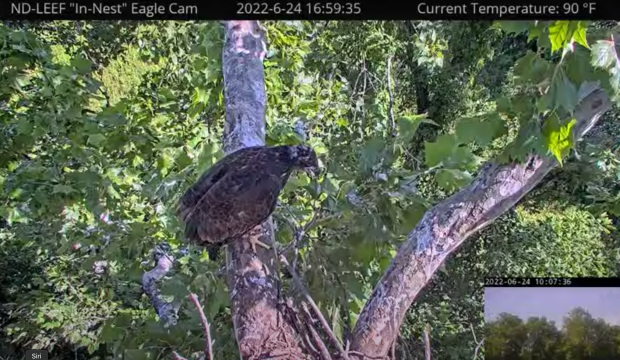
Several hours later, and Little Bit 17 is up on a very safe branch! 17 has officially branched already but this is so good because of that nest moving away. If you look at the image above, it will not take much for the right side to fall away completely. I hope that Little Bit is imprinting his exit route if that nest collapses. After spending time on this branch, he jumps back to the nest. So if he hears the nest giving way surely he will jump up to the branch. Oh, surely.

Oh, Little Bit. Stay safe!!!!!!!!
I seem to have not mentioned the Kakapo lately. Every time I put on their cute t-shirt and go out in the garden, I think of them and how much is done to try and protect their numbers and the cost of it. Helping wildlife is a good thing to do, whenever and however you can.

Kakapo are parrots that do not fly – sort of. They live on only a couple of islands and wear transmitters that need changed each year. I believe there are now 194. Last year it was 208. Staff change their transmitters annually and do wellness checks year round. Those who need care are flown to Dunedin, near Taiaroa Head, for help.

They are cute! Here is a link that was posted to help raise awareness of these flightless birds and their funding needs.

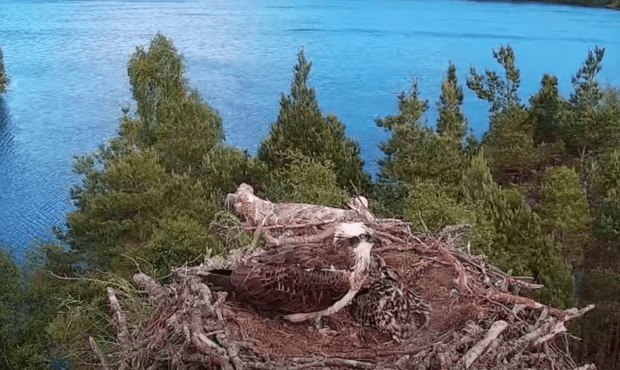
Gosh. I blinked. They were wee babies and I was worried about their feedings and now Big Bob at the Llyn Brenig Osprey nest is standing up on its feet!!!!!!! Not yet steady but wow. So happy. They lost one chick and the weather was not grand but wow. Nice.

Oh, the weather can turn so nasty so quickly. I don’t think I would ever visit Wales in June because of all the rain and cold blowing winds. (Oh, that also sounds like Manitoba!). Poor Mum!

The winds are up at the Dyfi nest of Idris and Telyn. Telyn is out on the perch with the chicks in the nest. I wonder if she will join them? That perch is really bouncing around.

Oh, my goodness. The wind is tearing through the Glaslyn Valley with great force. Mrs G is really hunkered down with the trio tonight. Just look at her determined face. Poor Mum. Those babies are too big to be brooded. Send positive thoughts to all these nests.

The weather is not that bad at the Rutland Water’s Manton Bay nest of Maya and Blue 33. The wind is up a little bit. You can see it from the windblown look of Maya’s nape of her neck.

It’s 22:12 at the Loch Arkaig nest of Louis and Dorcha and all is well. They are just that further north that the day camera is still on.

It looks like it was an alright day on the Mispillion Osprey Nest on Delaware Bay. The chicks are flapping their wings and getting those muscles strong. Hard to see if Mum has done any more decorating. I don’t think so today.

Oh, and what a beautiful sight – three little Bobs enjoying their fish at the Boathouse Osprey nest on Hog Island, Maine. It looks like Dory has figured out the feeding!

I just love this phase of Osprey development. Being good, eating well for Mum, no beaking. Adorable. Just look at Little Bob…precious.

Only Bob at the Patuxent River Park nest 1 has a charmed life. He doesn’t have to share any of the fish with anyone but Mum and Dad.

I have a love-hate relationship with Goshawks. They have been known to lure Osprey parents off the nest into the forest where they kill them. (They do the same to other birds as well, mainly Corvids). Then they return for the chicks. In fact, Llyn Clywedog was just bothered today by a Goshawk intruder.

The trio of little hawklets at the RSPB nest in Abernathy, Scotland are certainly growing and getting stronger on their legs.

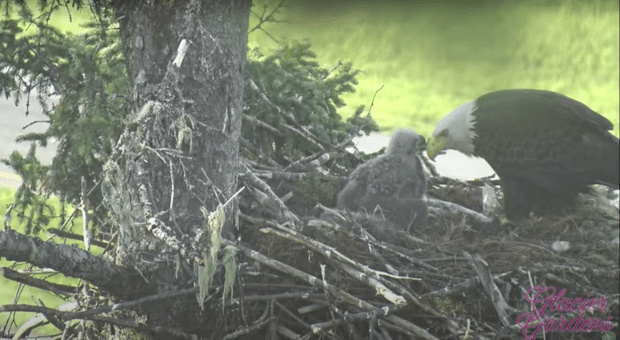
Liberty and Freedom have growing eaglets up in Alaska. Lots of food brought to the nest – no one is hungry!
It has been a couple of days since the Summer Solstice but, I don’t know about you but I am having some ‘Spirit Withdrawal’. Sure miss seeing this beauty on the nest all the time. Cali Condor caught her visit!

If you are having Red-tail Hawk withdrawal – and it is easy to do – Ferris Akel posted the highlights of his tour the other evening when he got all of them on camera. Much appreciated, Ferris!

It was nice to catch up with our feathered friends. Thank you so much for joining me. Take care. Stay safe. See you soon.

Thank you to the following for their streaming cams and/or FB pages and videos: Ferris Akel Tours, Cal Falcons, ND-LEEF, Friends of Loch of the Lowes and Wildlife Trust, MB Storm Chasers, Llyn Brenig Ospreys, Dyfi Osprey Project, Bwywd Gwyllt Glaslyn, LRWT, Friends of Loch Arkaig, People’s Post Code Lottery, and the Woodland Trust, Mispillion Ospreys, Explore.org and Audubon, RSPB, Glacier Gardens, and Friends of Big Bear Valley.

World Albatross Day and other news in Bird World

18 June 2022

Everyone reading my blog loves birds —-that is what we have in common. We love great big raptors and tiny little hummingbirds. Some favour Ospreys because they eat fish over Eagles but, in the end, I do not think any of us would harm our feathered friends deliberately. Indeed, many of you care for birds, volunteer or work at wildlife rehabilitation centres, make donations, feed the birds in your garden, etc. Whatever you can to make their lives better. So, when you read the following article, you are going to get mad. I found myself remembering the two men who took the juvenile osprey chicks off the light stand (somewhere – it has gone out of my mind) and killed them rather than waiting til they fledged to change the bulbs. After you read this, take a deep breath. Then, if you live in the US, write to your local officials. I do often wonder if the people doing these terrible deeds – how would they feel if they were treated this way? Birds and animals are sentient beings.

https://www.theguardian.com/environment/2022/jun/06/us-bird-flu-outbreak-millions-of-birds-culled-in-most-inhumane-way-available

Every June we have a problem in our City with tree cutters! While the City of Winnipeg is priding itself on planting 1 million trees, it has probably hired cutters to cut down some very old Maple trees that are not diseased or damaged. Do they check for nests? No. Last year, it was a battle with our public utility Manitoba Hydro and a Cooper’s Hawk nest. After lobbying by hundreds of us, Manitoba Hydro backed off and agreed not to trim the trees around their lines until nesting season was over.

Tree cutting should be limited to times when birds are not nesting. Simple. Write – scream – get your friends – if you see trimming going on and you know that there is a nest there!

There is still some anxiety at the Loch of the Lowes nest. Laddie LM12 did not deliver a fish to Blue NC0 until 10am. Big was unkind to Middle. What in the world is going on at this nest? 12 days ago Laddie brought in 9 fish. Oh, I wonder if he is not injured in some way and we cannot see it.

In contrast, Louis – despite the gale force wind and rain – has brought in at least 4 if not 5 large fish for Dorcha and the chicks today.

It really seems that there is something amiss at Loch of the Lowes. Again, is Laddie in some way injured that we cannot obviously tell?

Little QT chick is flapping her wings in the strong winds blowing over her nest at Taiaroa Head. Soon all of the fluffy baby down will be off those wings and our beautiful little fluff ball will look more and more like her parents, OGK and YRK.

The 19th of June is World Albatross Day. Of course, it is today in New Zealand and all other countries in different time zones. Many of you – and I – watch the Royal Cam Albatross Family on Taiaroa Head, New Zealand – YRK, OGK, and little QT. Did you know that OGK and YRK have been together since 2006? They are so lovely. OGK has melted my heart since the time he used to come and sit next to Pippa Atawhai.

I am forever grateful for the NZ DOC for intervening in the care of the chicks with their supplemental feedings, provisions against fly strike, and aid to them if injured. QT has had many supplemental feedings this season. While the cause is unknown, it could be warming waters and also large trawlers emptying the sea of the fish.

The Albatross Task Force posted 3 ways that 99% of the Albatross deaths could be mitigated. Here they are:

So how can you help? You can begin by purchasing fish that is not harvested using gill nets. Here is some information for those in the UK from the Task Force:

It is summer and there are parties and weddings. If you are going to use confetti – read this posting that showed up on my FB feed and think about using leaves for confetti. How brilliant and how sustainable.

Lindsay fledged early this morning at the Cal Falcons scrape on the grounds of the University of California at Berkeley. Here is younger brother, Grinnell Jr, looking out of the stonework wondering what it is like out there.

The hawklet being cared for by the Eagle family on Gabriola Island branched this morning. It is a beautiful scene when the Big Bald Eagle female feeds her ‘little baby’.

The hawklet has been given the name Malala meaning survivor. You might recall Malala Yousafzai, the young Afghan girl, who was almost killed by the Taliban because she wanted to go to school. Happily she graduated from Oxford after surviving. We all hope that the hawklet will live a long and prosperous life!

GROWLS is accepting donations for a new and much better camera. Christian Sasse said they they were sold an interior product -I sure hope they raise the funds. I wonder if this would ever happen again? It is rare – or it is thought that it is rare – eaglets adopting a bird as their own that has been brought in as a prey item.

Ferris Akel’s tour today ended up at the Cornell campus. He caught all of the family. Well done, Ferris. L4 has not fledged and people should not worry. There are eagles who have not fledged even though their siblings have for weeks. There is nothing wrong with L4. He is going to fly in his own time.

One of the Ls on Bruckner Hall. She will later fly to the top of the Rice building calling for prey.

Another L on the brick wall between the Soccer and Track fields.

The third fledgling on another building. I have always relied on the belly band to differentiate between them but it is impossible now unless I see them together. Gosh they are such gorgeous Red-tail Hawk chicks.

L4 was on the railing of the natal nest light stand.

The intruder couple at the Cape Henlopen Osprey platform in Lewes, Delaware were on and off the structure during the day.

Little Bit 17 had a good day. He is at the top of my list for checking followed by Loch of the Lowes. He had lots of raccoon and an entire fish to himself (minus a few bites going to 16), scrapes off the nest, and a little bit of Bluegill that Mum delivered at 15:57. So far four fish deliveries- 2 Blue gills, 1 salmon, and 1 small mouth bass (list by Jim one of the chatters – thank you). Those eagle-eye chatters also observed two PSs – fantastic.

At 19:39:48 Little Bit was eating the leftover bones with some meat on them by the rim of the nest. He was watching and when the older sibling finished, 17 made his move to get some of that. You can see the remains of the Raccoon being moved about on the nest.

Mum is in and all three were up at the table being fed. Oh, what a lovely image. I just wish she had a pantry full of fish and filled each of them up to the crown of their head.

Isn’t this just a beautiful image? Mom feeding her three eaglets – and knowing that each of them will fledge. One or two very soon.

Mum was still feeding them the remainder of that Raccoon when I last checked. Little Bit was loving it. He has eaten well today. Everyone is just elated.

Last thing today. Each one of us was horrified when the Bald Eagle cam and took Electra’s osprey chicks right off the nest. One of our readers ‘B’ lives very close to Lake Sacajawea in Cowlitz County, Washington. I asked her what might have changed to cause the eagles to go after the osprey nest. She gave the following information, “The rivers here are running high and probably muddy so fishing might be difficult. This has been one of the coldest, wettest springs on record in the northwest. Another day of rain today, temperature only 58° F.” Certainly Bald Eagles are opportunistic feeders – fish, road kill, etc. but the weather might have played a big part in this catastrophic event.

Poor Electra continues to come to the nest. She is still broody and probably in shock. Send her special wishes. This is so difficult seeing her there on that nest with three chicks doing well this year.

Thank you so much for joining me. It is a very windy evening but the sun is out. I managed to get a long walk in today (for me) and it is now time to go and check on all those weeds that grew over night. I will also be marvelling at all of the sunflowers that are growing in the garden thanks to the birds. I am leaving them and hoping that they grow high and then the birds can eat them in the fall. Take care all. See you soon.

Thank you to the following for their streaming cams and/or FB pages where I took my screen captures: Cowlitz PUD, Ferris Akel Tours, Friends of Loch of the Lowes and Scottish Wildlife Trust. Friends of Loch Arkaig, People’s Post Code Lottery and the Woodland Trust, Cornell Bird Lab and NZ DOC, Albatross Task Force, Keeper of the Cheerios Blog, Cal falcons, GROWLS, Cape Henlopen State Park, and ND-LEEF.

Henlopen Osplets die of starvation and other late Saturday and Sunday news in Bird World

11 June 2022

UPDATE: THE DEATHS OF THE THREE OSPLETS AT THE CAPE HENLOPEN STATE PARK NEST IN DELAWARE WAS CAUSED BY INTRUDERS TAKING OVER THE NEST. THE FEMALE WAS LAST SEEN ON THE NEST ON THE 10TH. ALL CHICKS WERE FINE. BOTH PARENTS ARE MISSING AND THE BIRD ON THE PLATFORM NEST IS NOT EITHER PARENT.

Oh, Saturday was just such a beautiful day. We all must treasure them and get outside and listen to the birds singing and smell the freshly mowed grass and the flowers. Our summers are so short in Canada that it is such a pleasure just sitting and listening, sometimes. Today the wee rabbit found itself underneath the square feeder by the lilacs. It was certainly enjoying those Black oil seeds and millet that had fallen to the ground. Mr and Mrs Grackle have fledglings and they are very noisy if you go anywhere near the lilac bushes – and then there is Mr Crow who arrives demanding bread, cheese, and sausages. It was quite the afternoon. I will try and take my phone out and get some photos another day for all of you. My big camera doesn’t quite understand that when it is set to CQ mode it is supposed to be ‘quiet’ and instead the noise frightens everyone within ear shot.

Saturday was not, however, a great day for Little Bit 17 at the ND-LEEF Bald Eagle nest. But it was not all bad, either. In fact, there was so little food brought to the nest that for Little Bit to have a crop was a blessing. He spent various times through day working on a raccoon that had been brought into the nest. He started working on it once at 14:39 and was still eating on it at 14:58. It looks like he ate the entire head which would have had lots of meat and fat. There were two other times that he worked on it. A fish was brought in but the older siblings seem to have been fed all of it. At one time, 16 tried to hurt Little Bit 17. It is over and Little Bit is fine. Let us all hope that there is more prey tomorrow. The nest is really relying on road kill it seems. Perhaps the river is still too high with all of the rains and too murky for the eagles to fish. Last Sunday saw a lot of fish brought to the nest – will the same thing happen tomorrow?

16 (I think it was 16 because of their actions towards Little Bit) came up wanting some of the remaining raccoon.

Mum flew in and fed the two older siblings. Little Bit stood by the side rails hoping there would be a little left but, alas, no.

All spread out and sleeping with the turtle shells. Someone said that there are at least 50 of them somewhere in the nest. You can see Little Bit’s primaries growing and his tail. I wish his head feathers would grow back. Poor thing. Any sore spots seem to have healed, thankfully.

Wish for fish everyone!

And the fish came Sunday morning. Mom brought in a Walleye at 08:28:21. At 08:40:11 Little bit 17 steals that walleye from one of the older siblings! He takes it to the porch to eat it.

You can see Little Bit pulling that fish to the porch. There is no head and he is going to heat for several minutes (7 or 8) and then 16 is going to steal it back.

At 09:59:47 Dad brought in a Blue Gill. Little Bit 17 stole the whole fish. He took it to the porch and ate the entire thing!!!!!!!!!! All by himself. Can you believe this kid? Bravo Little Bit.

Little Bit ate all of the fish and returned to look out at the world while the older siblings are up on the branches. He flapped his wings – they are growing – and stopped. You can only get a sense of how big his crop is over by the edge but he is one happy full little eaglet this morning and I have tears rolling down my eyes. He has been super brave pulling that last fish right out from under the older sibling!!!!!!

Both fledglings at the UFlorida-Gainesville have been on and off the nest eating or hoping for a delivery. At one point it started raining (or was it hail?). Middle was trying to hover off the nest and was having difficulty – of course Middle you can’t fly in pouring down rain!!!!!!! Just look at those beautiful, beautiful wings! These osplets are simply gorgeous. The feathers are absolutely perfect. Oh, I wish Little Bit was as healthy as the two fledgling ospreys.

It is rainy and windy in Gainesville Sunday morning and Middle is on the nest thinking it is a good day to stay home.

Ferris Akel has wonderful Saturday bird tours around Montezuma, Sapsucker Woods and Ithaca. At the end of the tour today, everyone lucked out as the Ls and Big Red were quickly located. I cannot tell you which chick is which from these images – so just enjoy a basket of cute little hawks.

Big Red was over on the other light stand. An adult is always around close watching the hawklets. Arthur was not spotted. He was probably off hunting!

All of the storklets still remain on the nest of Bukacek and Betty in Mlade Buky. They are growing and growing. While there is a significant difference in the size between the oldest (front right) with the youngest (back left), each is holding their own and as I have mentioned several times, there appears to be no effort to do any brood reduction by the adults. Fish must be plentiful – wonderful news!!!!!

It was a feeding fest Sunday morning in Mlade Buky. Watch how the two little ones get in there to get those fish.

Karl II and Kaia’s storklets are also growing and are being very well fed. There appears to be plenty of fish at their source in the Karula National Park in Estonia.

Kaia has fish and is getting ready to regurgitate them on the moss so the storklets can eat.

They are grabbing them with their little beaks.

Just look at the little fish in their bills. So sweet. The moss nest keeps these babies so nice and white compared to the red iron soil of Mlade Buky. The eaglets are always looking a little dirty there.

Bywyd Bwyllt Glaslyn posted some information on the osplets of Aran and Mrs G today on their FB feed. Little Bob is certainly smaller than Big Bob at the front!

There is much sadness at the Henlopen State Park Osprey Nest. One of the osplets appears to have died. I did not see it move at all today. The other osplets are weak and very hungry. Mum came in with a tiny fish. I thought she would feed the other two and they did too but, she didn’t. I fear that all will die.

It is a tiny fish. In raptors, it seems that their first priority is the protection of their territory, then to keep themselves fed and alive, and lastly the offspring. Mum has to be strong enough to fish. I do not know what if any was delivered after the 8th in terms of fish til this morning. It was not enough to keep the osplets alive and the two surviving have very concave chests.

On Sunday all three of the osplets have died. What a tragedy. The poor Mum – she lost her mate and all her lovely once healthy chicks in a few days. Incredibly sad.

There appears to be no attempt by anyone to provide a fish table for this family. Just sayin’. Most of the issues related to getting fish or other prey to the nest including those at the ND-LEEF nest can be attributed to human interference in some way or another. Changing weather patterns causing torrential rains, floods, and mudslides is impacting the rivers so that the Bald Eagles and Ospreys cannot ‘see’ to fish. Most of you are very much aware of the impact that we have had whether it is habitat destruction, rising sea temperatures due to a heating planet, etc. There isn’t much that we haven’t caused so I will not accept the answer that it is ‘just nature’ not to help out these lovely raptors.

In contrast, we have the surviving three Black Storklets in Estonia. They are being well fed and taken care of and every aspect of their future well being has been considered. Please note that they do not see ‘human animals’ very often – just the decoy mother, the step-father who feeds, and themselves. This is so they will not imprint on others.

The smallest chick even had a private feeding to ensure that it gets enough to eat with the two much larger siblings. Just like at the size of its crop when it is returned!

Everyone has been talking about the Bald Eagles raising the hawklet in their nest on Gabriola Island. Here is a delightful discussion of another Bald Eagle adopting a Red-tail hawklet a couple of years ago. Here is the complete story from beginning to successful end. Please listen. This is such an informative discussion with live footage in the nest showing the eagles and the hawklet.

The Dyfi Osprey Project posted an excellent bit of information on their FB site this morning about Osprey growth.

These are the osplets that Dyfi is referring to – the three of Idris and Telyn. We should know their names soon! Over 200 suggestions – wow.

I often wonder if the change of the plumage and the itching makes the osplets crankier during the Reptile phase that then causes them to start pecking one another????

It has been very windy up in Alaska at the nest of Liberty and Freedom. The two little eaglets don’t seem to even notice! They are having a nice meal.

The winds are raging at Loch of the Lowes too. The wee chicks are calling for food as Blue NC0 waits to see if Laddie will have some luck fishing Sunday afternoon.

Dylan brought in a perch at 16:04 at Llyn Clywedog and Seren is happily feeding all of the Bobs. The weather does not look as windy – thank goodness. This nest in the Cambrian area of Wales has been wet for several days now.

The third hatch, Little Bob, at Glaslyn is really starting to catch up. Aran is bringing in lots of fish. No one is hungry. There is even a fish sitting on the nest waiting for the next feeding. That is Little Bob by the side of Mrs G.

Poor Dorcha. The Loch Arkaig nest seems to be getting all of the bad weather. It is rainy and windy. Louis, thankfully, prevails in getting fish on this nest in the most dire of times. He is literally amazing.

I want to leave you with something beautiful. Andris has come to the nest and he is feeding the small eaglet! Mostly the males do not do this so it is very special. Oh, such a sweet little fluff ball. Andris and Anna have their Lesser Spotted Eagle’s nest in Zemgale, Latvia.

Anna is feeding the wee eaglet later. Oh, how precious.

Grinnell Jr and Lindsay are sure keeping Annie and Alden busy at the UCalifornia-Berkeley scrape. They are running all over the place chasing any adult food begging – even if they are full – and are beginning to self feed. Adorable. Being the pests they are meant to be!

Grinnell Jr has a blue band and Lindsay has a gold one.

Last but the falcons are never least, the wee little peregrine at the Manchester New Hampshire nest, Colby, woke up watching everyone fly around. At 06:52:49, Colby fludged just like Clem. I am certain the volunteers will be out to make sure he is OK and perhaps he will be returned to the nest with Clem tomorrow!

The weather certainly changed on the Canadian Prairies. We had thunderstorms all during the night and much more rain. My garden is beginning to look like a thick forest – which is what I have wanted for years – a forest in the city! The sadness at Henlopen weighs heavy today.

Take care everyone. Thank you for joining me today. See you tomorrow!

Thank you to the following for their streaming cams, FB posts and video clips: ND-LEEF, UFlorida-Gainesville Ospreys, Ferris Akel Tours, Mlade Buky, Eagle Club of Estonia, Bywyd Gwyllt Glaslyn, Henlopen State Park Ospreys, Christian Sasse, Dyfi Osprey Projects, Glacier Gardens Bald Eagles, Loch of the Lowes and the Woodland Trust, CarnyXWild, Friends of Loch Arkaig, People’s Post Code Lottery and Scottish Wildlife Trust, Cal Falcons, Peregrine Network, and the Latvian Fund for Nature.

Late Saturday in Bird World

05 March 2022

There is snow falling on Big Bear Valley. While Shadow and Jackie have over 7000 feathers in various layers to keep them warm and dry, our little chick doesn’t. It has only its soft natal down. Jackie and Shadow will both have a brood patch. It is an area between the breast bones. When egg laying is imminent, the feathers begin to fall off leaving an area of skin. That skin will keep the chick warm as the body temperature of an eagle is 105 degrees F. Eagles do well in cold snowy weather, possibly better than in the heat of summer – except for the wee ones.

The chick has already been fed at 07:45 by Shadow and by Jackie at 09:57. This feeding appears to be the third and began roughly at 12:50.

beautiful image of the parent looking down on the wee babe.

I often have trouble figuring out who is on the nest unless they are standing beside one another. Jackie is so much bigger but Shadow is inclined to have to move the sticks around. Is this Shadow on the nest?

Having moved the stick to the edge of the nest bowl – to keep the chick from running out? It is actually a good idea. Last year, the chick ran out from under Missy at the Berry College Eagle nest and perished in the cold. Smart to put that there!

You will see that the snow is falling and gets worse towards the end of this this short feeding.

The little one is alert and the adult is working hard to make sure that every bite counts. It doesn’t always with the newly hatched.

This baby is adorable balancing itself with the tip of its wings. I cannot see any indication that anything is happening with the second egg. In some ways it would be better to have only one in this weather. As they get bigger it is always easier to fit one six-week old chick under the adult than two. They have to be kept warm and dry.

The snow is really starting to come down. The chick must be chilled. Look at its tiny pink feet. It has managed to get some nourishment and there appears to be a tiny little crop.

Here is a look at Shadow delivering that large fish with its head entirely in tact. Looks like Shadow and Samson both like to wear skinny black jeans.

Safely tucked under its parent it will dry quickly from the little snow flakes that stuck to its down and will be toasty warm.

This is the forecast for the Jackie and Shadow’s nest:

There is a huge piece of fish that you can see in the image below. Lots of food for this week one and some for the adults, too.

The preliminary test results have been released on the Hilton Head Island eaglets that fell out of their nest. Their deaths were caused by the highly pathogenic Avian Flu that is spreading, sadly, to other parts of the east coast and Florida. It is believed that a duck brought to the nest was the carrier. The parents may not get ill as they are larger than the wee babes. This is very sad news.

Far away in Australia, OGK flew in last evening to find that his Quarry Track chick had been left alone by the Mum, YRK, the previous night. It is the beginning of what is known as the post-guard stage. The chick is left alone and both parents are out foraging to be able to meet all of its food requirements as well as theirs. No doubt QT chick slept much better with Dad guarding it the following evening.

Here is an extremely short video clip of the trio at the Dale Hollow Bald Eagle nest on the border of Tennessee and Kentucky. The adults are River and Obey. It is cute – shows how those little ones can really move around the nest when they want to!

Dale Hollow also posted a 5-minute video of on of the feedings. These three are so cute. It is so nice to watch them move about the nest and, just think, in about a week and a bit, this will be happening at Big Bear!

At the end of Ferris Akel’s tours, he always goes through the Cornell Campus looking for Big Red and Arthur. He has found Arthur hunting along the 366 highway.

Ferris looked and looked for Big Red and he found both her and Arthur on top of their favourite building, Bradfield. Big Red is doing a lot of preening. This is getting so eggciting. There is already a lottery on the Cornell Red Tail Hawk FB group for when the first egg will be laid.

Andy has brought a late Saturday fish onto the nest at Captiva. It was 16:47.

Lena is feeding her three chicks, each more ravenous than they have been as they are in super growth stage. Little Bob has pushed himself right up there so he will get some. No worries about anyone being hungry tonight.

It is the end of a good day. All of the nests that I regularly keep track of are doing well. Port Lincoln is, of course, a lonely site of a nest. It would be good to see Ervie. But, enjoy the birds. We cannot take anything for granted. In a blink something can happen. So enjoy the moment.

It is -4 and grey on the Canadian Prairies. Sharpie has been in and around the garden looking for lunch several times today. I am always glad to see him. Little Woodpecker – both Mr and Mrs – have been eating suet and there are lots of European Starlings and House Sparrows. I have not seen the three Grey Squirrels today but Little Red has been in and out.

Take care everyone. Thank you for joining me. See you soon.

Thank you to the following for their streaming cams where I took my screen captures: Captiva Osprey Cam and Window on Wildlife, Friends of Big Bear Valley, Ferris Akel Tours, Dale Hollow Bald Eagles, and Cornell Bird Labs and NZ DOC.

25 November in Bird World

I hope that anyone celebrating Thanksgiving today had a wonderful meal with friends and family. All of us have so much to be grateful for – including our beloved birds – every day.

So, let’s start with the not so great news and move into the good, shall we?

Everyone has been waiting for Grinnell to step up to the plate and stay in the scrape box on The Campanile or on the ledge waiting for Annie. So far that has simply not happened. Today, however, it was the ‘new male’ that was there. Grinnell may still lack the confidence to engage with the intruder that injured him. Here is that video:

Port Lincoln has posted that the official autopsy on Solly, the 2020 fledgling of the Port Lincoln Osprey Barge and the first Osprey in Australia to have a tracker, was, indeed and very sadly and unnecessarily (my words) the victim of electrocution.

Oh, just look at her. What a beauty. Her necklace would have been the envy of everyone. She reminds me, so much, of Iris. Stunning.

Port Lincoln also posted the following information on their FB page. I am delighted to see that they are going to use the information gathered by Solly’s tracking to understand where to put protectors on the hydro poles.

Thank you to all my readers who wrote to the South Australian Minister of the Environment and Water, David Speirs. You may remember that Speirs travelled to Port Lincoln to help band the chicks there and at Thistle Island. Ervie is named after the town in Scotland where Speirs was born. Every letter and every phone call does help. It is a tragedy and one that did not need to happen!

Blackland Prairie Raptor Rescue posted the following image of a hawk caught up in fishing line. Look closely at the outward damage that line caused and imagine the pain and suffering. This was in Lucas, Texas but it could be anywhere people fish and do not care to clean up after themselves. Please spread the word to anyone you know who fishes. And if you want to do something to help, put bags in your car and pickers (those tools people use to pick up litter) along with gloves. Go for a walk along a shore and clean it up. Take the family. The birds will thank you. They really will!

And now for some really good news.

Port Lincoln has a couple of items. The first is a posting about Port Lincoln fledgling from 2019, Calypso. It seems that she has been spotted a few times with a male. Could this be pair bonding?

And lastly out of Port Lincoln, Ervie is doing more flying and getting stronger. He even flew over houses! The trio – Ervie, Bazza, and Falky – are doing great. All are flying and eating and life is good on the barge.

Ferris Akel’s tour meant a lot to lovers of Big Red today. About a week or ten days ago I posed the question on the Cornell Chatter’s FB page: Has anyone seen Big Red since 16 October? No one had. News came on the Cornell Twitter Page that Karel and Bogette had seen Big Red on 21 November at Beebee Lake. There was a lot of worry.

Everyone on Ferris’s tour were overjoyed to see her back sitting on the building where her ‘throne’ is located.

Oh, she is a beauty and is so dear to everyone. Such joy she has brought to people from around the world. Indeed, at one time, she was said to be ‘the most famous’ Red Tail Hawk. I am certain she still is! Ferris also spotted Arthur so everything is right with the world in Ithaca.

Soon the NZ DOC will select the Royal Cam family for the 2021-22 season. I wonder who they will choose?

And remember to mark your calendars. #1031 Iniko will be released back into the territory where she hatched in Big Sur on 4 December. It will be so exciting to seeRedwood Queen and Kingpin’s daughter return to the wild after surviving the Dolan Fire in 2020. This is one of those events that will warm your heart. No one believed Iniko could survive that fire. Her father, Kingpin, is believed to have perished but the wee one lived. Jubilant is the word I am looking for – everyone associated with the rescue and the release will be jubilant for a long, long time.

Take care everyone. I am thankful for each and everyone of you because you love and care for the environment where our beloved birds live and hunt and raise their families. See you soon!

Thank you to the following for their streaming cams or their FB Pages where I took my screen shots: Port Lincoln Osprey Project, Ferris Akel Tours, Blackland Prairie Raptor Rescue, and Cal Falcons.

An evening with Big Red, Arthur and the Ks

If you hear the name Ferris Akel, you might recognize the individual that gives a regular Saturday afternoon virtual birding tour of the area around Montezuma National Park, Wildlife Drive, Sapsucker Lake, and the Cornell Campus at Ithaca. Ferris also surprises us with ‘pop up’ tours of the Cornell Campus at other times so that he can see what is going on with Big Red and her family and share it with us. Tonight, we got a special tour and were able to see all four members of the Big Red family.

For those of you unaware, Big Red is a Red-tail Hawk. Red tail hawks are easily identified by their bright orange-red tail feathers once they are adults. The females are larger by approximately 30% than the males. This is called reverse sex size diamorphism. Red tail hawks have amazing eye sight. They will scan for food while they are soaring or are know to sit quietly on a perch for long periods of time watching for their prey. They will immediately fly to get it. Unlike the Peregrine Falcons who take their prey in the air, Red tail hawks normally fly down and get their prey on the ground. They do not normally eat carrion (dead animals) unless they are really starving. Their wing span is 1.2-1.5 metres for both males and females or 3.9 feet to 4.9 feet.

Big Red is a huge celebrity within the birding community. Big Red is now 18+ years old. She was banded near Ithaca, at Brooktondale, on 20 October 2003. Her current mate, Arthur, hatched in a territory next to the Cornell Campus in 2016. He has been Big Red’s mate since her mate, Ezra, died in March 2017. Arthur was first spotted visiting the nest in April of 2017. Big Red and Arthur were an ‘item’ by the fall. Their nest is on one of the light boxes across Tower Road from the Fernow Building. This year they hatched three chicks, the Ks. Two of the three fledged – this is the only time that Big Red did not have all of her chicks that hatched fledge. K2 sustained an injury to her right cheek and beak in the nest and had to be euthanized. She would never have been able to live in the wild nor would she have been able to have any quality of life in captivity. The two surviving chicks, K1 and K3, have already proven themselves to be excellent flyers and it looks like K1 has already had some successful hunts.

K3 on the nest. 21 June 2021. She was taken into care the following day.

Big Red was named after the territory she dominates, the Cornell Campus. She is also a large Red-tail Hawk with a lot of the beautiful rusty brown colour and bring orange-red tail feathers. In the image below she is beginning to become ‘Big Blond’ as she is moulting.

She is the matriarch. It is estimated that she has probably hatched chicks for fifteen years. Ezra was probably her first mate. If she hatched three chicks per year, that means that she has fledged 44. That is an incredible record! Sadly none of the chicks were banded so there is no knowledge of their whereabouts or status. A small number are known to have died after fledging. One was injured and is an ambassador bird for Cornell, E3.

Big Red is noted for her very dark plumage and that amazing red feathered apron.

Ferris first spotted one of the Ks on a light tower.

Big Red was spotted on the Water Cooling Plant.

You can see that her feathers look a little ruffled, untidy. This is the moulting.

Those piercing dark eyes just make you melt.

Can you spot the hawk? Seriously I believe that Ferris Akel has ‘hawk eyes’!

Oh, look it is Arthur! He is Big Red’s mate and is one of the most amazing hunters I have ever seen. He is also moulting!

This is K1 looking out. She is a really good flier and is also believed to have already made a couple of ‘prey kills’. Yesterday she had a little chipmunk and was doing a war cry when K3 came around hoping to get some of it. Normally if the bird is war crying they are the ones that caught the prey and will not share! Even if it is their cute little brother.

At first Ferris and the gang were not sure but once we saw the stripes on the tail, we knew it was K1. K3 has a muddy tail almost verging on red – a first for all of Big Red’s chicks.

K1 is gorgeous and very dark. These images are soft not because Ferris could not focus but because of the heat shimmer off the buildings.

And here is cutie pie, K3. All those little third hatches just soften my heart.

Oh, you wanted your sister to share her chippie and she told you to go and catch your own! Poor little thing.

And that was a wrap. Ferris persisted in finding all of the Ks and trying to get some good images of them despite the heat shimmer and the fact that it was getting dark.

Good night Big Red, good night Arthur, good night K1 and K3.

Big Red and Arthur are moving the Ks around the buildings on the Cornell Campus. They can now be found around the Water cooling buildings, Bartels, and across the ravine. It will not be long til they have them out by the buildings with the cows and the open fields. It is part of their training – enlarging their territory bit by bit. How do they do thus? Food is a great motivator and the adults will carry prey to different areas of the campus and the Ks will follow! It is that easy.

If you see the hawks coughing and shaking their heads and necks and something gets ‘thrown’ out of their mouth, this is called a ‘cast’. It is the bits and bobs of the prey that cannot be digested that is sort of compressed into a small pellet. The raptors cannot digest this and so they throw it up. This is properly called ‘casting a pellet’. This is with the exception of the owls that have a gizzard for digesting these parts of the prey.

It is now getting towards the last week of July. The Ks will be with us for a bit longer. I remember last year. Once J2 and J3 had been catching their own prey around the barns they began soaring. It was not long after that that J3 went poof and was gone with the winds to be followed by J2 the following day.

The last bit of news this morning is that Tiny Little and siblings were fed by White YW (dad) this morning. 462 was first followed by Tiny Little.

It is now around tea time, late afternoon, and Tiny Little has been like a ducking food crying in the nest for a bit.

Thanks so much for joining me. It was a great evening with Big Red and the Ks. They are progressing so well towards their own independence. Sadly, they do not get bands and we will not know where they go or what they do. Lucky for us Tiny Little is Blue 463! Take care all.

Thank you to the following for their streaming cams where I took my screen shots: Ferris Akel’s Livestream and Cumbrian Wildlife Trust and the Foulshaw Moss Osprey Nest.

Saturday 17 July in Bird World

I promised some updates on Big Red, Arthur, and the Ks. Right up front I want to thank Suzanne Arnold Horning for allowing me to share her images of Cornell’s birds with all of you. She lives in Ithaca and once or twice a day she heads out with her family looking for the Ks. Thank you Suzanne!

This first series is from 16 July. Both of the Ks are on the corner of this unidentified building. K1 is on the left and K3 is on the right at the corner of the building.

Isn’ she gorgeous? This is K1, the mini-Big Red.

On the 15th, the Ks were hanging out on Weill.

K1 is doing the hawk walk! So cute.

She stops and looks for her brother, K3, who has just flown away.

K3 flew over to the middle of the hockey rink roof and landed! Good gracious.

Later, K3 rejoins his sister on Weill.

Meanwhile, where are Big Red and Arthur?

Big Red is on top of the Cornell Clock Tower.

Here’s a much closer look at Big Red.

And here is an image showing the position of Arthur and the Ks. The green arrow is where Arthur is on the light stands and the purple arrows points to the corner of the Weill Building where the two Ks are located.

Thanks Suzanne for the arrows and the images. It is reassuring to know that everyone is safe and sound.

There is some other news today. K1 caught her own prey. I know it happened but I do not have an image I can show you. Of course, no one knows if this is the first time or not but this is incredible. She is certainly related to Arthur who is like the stealth bomber of hunting! And Big Red is really good herself.

The Ks will be leaving their parents territory in August. They need to be able to fly well and hunt. As you can see Big Red and Arthur have now moved them around Weill and other areas farther from the nest. Soon they will have them hunting in the fields out by the Holey Cow Barns. Why holey and not holy you ask? The cows have clear tubes inserted in their sides so that the students in the Vet School can see what is happening inside the cow’s body. I have to admit the first time I heard this I was quite happy not to be there seeing it. But then wow – how would these students learn otherwise?

Suzanne Arnold Horning also went out to the Cornell Osprey nests and took some images. She believes that the nestlings are about to fledge!

There is only one Osprey nest on the Cornell Campus. It is located on the university athletic fields on a light tower at the soccer field. The adults there fish in Cayuga Lake, Beebee Lake, and Six Mile Creek. Those are within a few miles of the nest. The adults are Olin and Olive.

Off the Cornell Campus there were 38 Osprey nests around the Cayuga Lake Basin. While it isn’t a steadfast rule, most male Ospreys do return to the area of their natal nest. I am assuming then that when Olin showed up as a bachelor and began building a nest that he had hatched from one of the nests around Cayuga Lake several years earlier.

Olin would fly around the soccer field and people began to wonder if he was going to build a nest on one of the light towers. He made several attempts with sticks at the Game Farm Road soccer field. Olin did attract a female – Olive.

The nest you see in Suzanne Arnold Hornings’s images is the new nest that was built for Olive and Olin.

There are three little ospreys ready to fly in that nest this year.

Don’t you just hold your breath when they are hovering? I do! Wings everywhere. Looks like Olive needs to duck.

The Hornings and the Sedlaceks wrote a lovely article about the first year with Olin and Olive. There are some good images. I will attach it below this. Olin and Olive originally had a nest on a light and it was precarious. This is a wonderful nest that was constructed for this Osprey couple. Just look at it. They figured out the height, the measurements the nest should be and made sure that it was storm proof. Amazing.

Here is the link to the article. Please read it, it is lovely.

https://sites.google.com/site/cornellssurpriseospreys/

On the earlier part of the Ferris Akel Live Tour, there was a lovely juvenile Cooper’s Hawk. I think I have a couple of reasonable good screen shots to show you. What a lovely bird. We have Cooper’s Hawks that come to breed on the Canadian Prairies in the summer. They are protected under the Manitoba Wildlife Act of 1994.

Indeed, when I first encountered the hawk that comes to my garden, it was not clear if it was an adult Cooper’s or a Sharp-shinned. Turned out to be a Sharpie Adult, Northern. Like the Sharp-shinned, the Coopers are a medium sized Accipiter. These are the green-blue-grey (or celadon if you want to describe them like a pottery glaze) of a juvenile. The eyes of the adult male are red and they have a white breast/belly with ochre streaking, blue-grey hood and wings. You can see those red eyes in the image directly below.

“Cooper’s Hawk” by airboy123 is licensed under CC BY-NC-SA 2.0

This juvenile might look like a Red-tail Hawk if you only saw its back. Like my Sharpie and the Red-tails, the length of the wings attributes to the silent stealth manner in which they hunt. They live in forests and even in urban back gardens and they need to be able to turn quickly which they can also do with their wings and their medium size. You can see those celadon eyes of this juvenile in the image below.

Look at the image below. Do not peek at their blue Darvic rings! Which one of those birds is Tiny Little?

It might be a surprise to you. Tiny Little is the bigger chick at the back!

I watched Tiny Little for several hours. He is absolutely hilarious. For awhile I wondered if he had forgotten how to fly. He hovered, he flapped his wings and he really wanted to go but he couldn’t get it in forward gear. But never mind. White YW brought a fish on to the nest and thoughts of flying went right out the window. Tiny Little was up to his old tricks. What you are seeing in the image below is the second sibling that Tiny Little has tormented over the evening fish. BTW. Tiny Little had a huge breakfast! His MOD is to stare at the fish, then do some flapping, go back and stare and make the sibling nervous til they walk away and leave the fish. And guess what? He is really good at it.

Blue 464 gave up the fish! Because of his behaviour you will know which one is Tiny Little below but please look at the size and look at the other bird. This is the female, that big female that tormented Tiny Little, Blue 464. Unfortunately I took about 300 images of this nest today (maybe more). I have one of Tiny Little standing next to Blue 462, the male. 462 has the thinner longer legs of White YW. Tiny Little’s legs are stout like a female and she is a big bird.

Just like she wanted. Tiny Little gets a nice feeding by Blue 35. Indeed, I think the two of them shared almost half a fish after 464 and then 462 tried to self-feed.

Here is an earlier image of the Foulshaw Moss family minus Blue 464. White YW is on the front left. Then Blue 35 is next at the rim of the nest. Then don’t peek, which one is Tiny Little? If you said the one on the far right, you are correct. Now necklaces in themselves do not indicate a female but with those stout legs and her size. Well..

‘Silo’ chick on the Patuxent River Osprey Nest 2, the one who fell out of the nest into the water last evening, was up and moving about in the afternoon so everything seems alright there. Fabulous.

Thank you everyone for stopping in today to find out about the birds. It is great to have you with us.

Thank you to the following for their streaming cams where I took my screen shots or who gave me permission to use their images: Suzanne Arnold Horning for the images of Cornell’s Red tail Hawk family and the Osprey Nest of Olin and Olive, Ferris Akel Live Tour, Cumbrian Wildlife Trust and Foulshaw Moss Osprey Cam, and Patuxent River Osprey Cam 2.

Adventures in Ospreyland and other bird tales 16 July 2021

Imagine that you have one child. Everyone is happy – it is easy to provide for the one. Then imagine one day you blink and think you are seeing double. But you aren’t. There are two children. Now imagine that you are away from home and return to find three. Osprey families have the same difficulties in providing for multiple children just like humans. The adults at the Patuxent River Park in Upper Marlboro, Maryland, Osprey nest number 2 now have that challenge! The pair had only one chick of their own and are now fostering two chicks about the same age as theirs.

Cathy Cohen of the Jug Bay Natural Area posted the following image on the park’s FB page today of the mom and the three chicks. The first foster chick was placed on the nest on 30 June. Nest 2 was chosen because the foster chicks are about the same age as the one hatched on the nest. There they are. It is incredible. They look like a perfect match. How wonderful to give those two lucky ones another chance. Intervention can be a good thing.

The foster Mom was said to have welcomed the chick who had fallen from a barn silo with open wings yesterday! Here she is looking over the babies while they are sleeping (or supposed to be sleeping).

And here they are this morning. It is getting warm and the new babies are getting shade.

Most of the time if I say the name ‘Iris’ everyone knows who I am talking about. If you don’t, here is a mini-bio. Iris is an Osprey. She is 26-28 years old. This makes her the oldest Osprey in the world. Iris has her nest at Hellgate in Missoula, Montana. The platform was put up for her and her mate, Stanley, to save them from getting electrocuted on the hydro lines. When Stanley did not return from migration, Iris bonded with Louis. They have only had one chick survive. That was a female, Le Le, in 2018. The reason for this is that Louis has another mate and another nest at the ballpark. For years, people have watched Iris perfect the renovations on her nest, catch magnificent fish, mate with Louis, lay her eggs and then either have the ravens steal and eat the eggs or have the chicks die because the female cannot protect them and fish at the same time. Individuals are very vocal in their support of Iris. They want her to have another mate and to be able to raise chicks. I have always thought maybe she could retire with dignity and just take care of herself during her summers in Montana. At the same time you know just seeing her work on the nest and the fish she brings in that she would be an amazing parent. The issue is one of territory. Iris’s nest is in Louis’s territory – according to Louis. Louis has protected Iris on a couple of occasions this summer from intruders. Iris has also managed on her own to thwart them. She is strongly independent.

When someone posted an image of Iris sitting on a branch with another Osprey on Twitter 15 July 2021, people got excited.

The notion that Ospreys mate for life is not consistently true. When Blue 5F, Seren, got tired of laying a nest full of eggs only to be abandoned by Aran because he also had a nest with Mrs G at Glaslyn, she left Aran’s territory and found another mate, Dylan, at Clywedog. According to Google Maps, Seren moved a distance of 67.4 miles. Seren and Dylan are the proud parents, this season, of fledgling Blue 396 otherwise known as Only Bob.

It will be very curious to see how things develop over the end of the summer.

We all worry about Tiny Little. It is easy to forget looking at Blue 463 that at one time his older siblings kept him from eating and were quite aggressive. Because of that Tiny Little is hesitant to engage with the older siblings and, in particular, Blue 462. So there are worries that he will not get enough to eat. Today White YW brought in a fish and within about 15 minutes he brought in another fish. Blue 35 took that one and fed Tiny Little while the other two were eating fish pieces. What a beautiful image of Mum and her three chicks on the Foulshaw Moss nest having a nice meal of fish.

People have been asking if Tiny Little has been flapping. OH, yes, he flaps those wings all the time.

If you want to join in the fun watching Tiny Little prepare to fledge, this is the link to the Cumbrian Wildlife Osprey Cam:

https://www.cumbriawildlifetrust.org.uk/wildlife/cams/osprey-cam

Erick Green with the Montana Osprey Project posted some images of chicks who were entangled with baling twine. They saved three chicks a week ago but sadly one had died. Another chick had twine cutting into his right leg to the bone. Dr Green reported today that the chick is doing fabulous today. In his posting I learned something interesting. He says, “One thing that seems to work in their favor is that ospreys (and all birds) have very high body temperatures – about 105 degrees Fahrenheit. These high body temperatures help birds fight off many bacterial infections.”

Only Bob, Blue 396, has gotten really good at flying and zooms in when Dad Dylan does a food drop. Poor Seren might have to discuss Dylan bringing in an extra fish for her. Only Bob can finish them off pretty good! Look at how big this fledgling is. Wow. Dylan delivered the fish around 13:09.

At the Dyfi Nest, Idris and Telyn are waiting for Ystwyth to fledge! So is her brother Dysynni. He is sitting there urging her to come on and join in the fun while the parents are up on the camera perches watching. Ystwyth was getting some really good height to her hovering and she will go soon if not today. She is 53 days old.

Here is Ystwyth hovering. Isn’t she great?

Other nest news:

There is sad news coming out of Taiaroa Head, NZ. One of 33 Northern Albatross chicks died yesterday. The chick was not gaining weight and the NZ DOC rangers gave it a supplementary feeding. When the chick died following this it was discovered during the necroscopy that it had a piece of charcoal stuck in its trachea. As Sharon Dunne notes, charcoal floats on the surface of the ocean and it can easily be taken in by the parents when they are out fishing for food for their chick. I never imagined charcoal! Everyone is distraught. The rangers do such an excellent job taking care of these parents and chicks. Condolences go out to all of them including the albatross parents.

Our little Golden Eagle, Zenit, has had a prey delivery – a bird – and is beginning to stand really tall and strong on its legs – adult style. All good news! The Golden Eagles eat the bones – absolutely every part of their prey so Zenit will have something later. Still, having lots of meat is what this young eaglet needs right now. Excellent news.

Ferris Akel has posted a nicely edited version of his tour on Wildlife Drive on the 14th. The editing is well done and there are discreet bird names in case you do not recognize what you are looking at. There are some really nice shots of a Black Tern. Here is that short clip.

My friend, ‘T’ tells me that there is a stork with an injured food that is getting a prosthesis. Will try and find out all the news on this incredible intervention.

And speaking of storks, there are still three White Storklings on the Mlade Buky nest in Czechoslovakia:

That’s a short morning round up of happenings late Thursday night and early Friday morning at some nests. Remember that Ferris Akel does his tours on Saturday. He begins at noon NY time and ends up at the Cornell Campus. It is a great opportunity to see the Red tail fledglings in action. They have now moved from flying near to the nest to other buildings farther away. Big Red and Arthur do this with prey drops gradually to expand their territory. It will not be too long til they are down by the barns at Cornell. Always fun. You can search Ferris Akel Livestream on YT. Thank you so much for joining me. Take care everyone.

Thank you to the following for their streaming cams where I get my screen shots or add their videos: Ferris Akel Live Tour, Patuxent River Park Ospreys, Montana Osprey Project FB Page, Cumbrian Wildlife Trust and Foulshaw Moss Osprey Cam, Dyfi Osprey Project, CarnyX Wild and Llyn Clydewog Osprey Cam, Capi Hnizdo- Mlade Buky, and Asociatia Wild Bucinova.