Time with Tiaki

It is 6 September in Australia and the Royal Cam chick, Tiaki, is 225 days old. She is the daughter of LGL (Lime Green Lime) and LGK (Lime Green Black). They have been together as a couple since 2017. Their very first chick was also a Royal cam chick. Karere hatched in 2019 and successfully fledged. They laid their egg this season on 4 November 2020 and Tiaki hatched on 24 January. It looks like they will also have a successful fledge this year! Congratulations LGL and LGK!

It is early morning. Tiaki is not at her nest. She is looking out at what is happening around her. It is going to be a gorgeous day with lots of wind.

Tiaki has been really exercising her wings and has hovered quite high on several occasions.

Lady Hawk caught Tiaki’s first hovering – 3 weeks ago – in a short video.

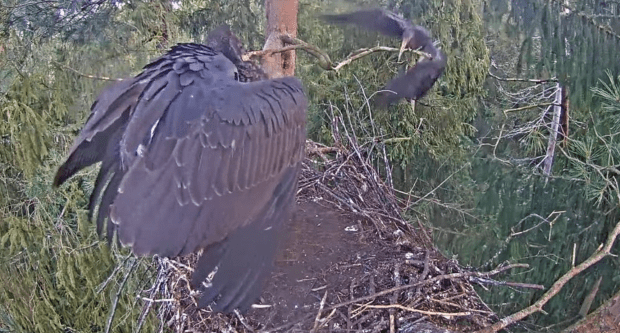
Here she is today spreading those magnificent wings. There are only little pieces of the baby down left.

Her ultimate destination – the sea.

If the average age at fledge is 232 days then it is possible that in a week, Tiaki will begin her big adventure. She will remain on the open seas only returning to Taiaro Head in 5-6 years. It will be wonderful to welcome back and to watch her do all those amazing courtship dances with the other juveniles. For those of you that adore this lovely little albatross, stay tuned to the screen. This gal really wants to fly.

It is 15:32 and Tiaki is away from her nest. It is so windy. I wonder if a parent will arrive to feed her?

Dad, LGK – Lime Green Black- had been at sea for quite some time. He has now returned on 3 and 5 September to feed his squealing daughter. I love this video that Lady Hawk posted of LGK’s visit and the feeding. Note the sky calls! And also keep on the lookout for the neighbouring chick, SSTrig. This little corner is quite the soap opera!

I just went to check on Tiaki again and look – someone is flying in. Is it LGK or LGL, the mom?

It’s Dad.

Here comes Tiaki calling to Dad so he won’t leave without giving her that wonderful squid shake. She is moving as fast as she can.

Tiaki acts like she has eaten in weeks. She is so excited and you could hear her whee, whee for quite a distance.

Tiaki gets a nice short feeding – and she always wants more and more. Dad tries to oblige her.

Tiaki doesn’t want Dad to go. Since 3 September, LGK has been in three times to feed his daughter. That is a good record.

I wonder if he knows that his time with her is growing shorter and shorter. Perhaps he will fish close to the nest and maybe fly in when mom is there, too. Wouldn’t it be grand to have a family reunion one more time? Absolutely.

Dad has stopped for a rest a little ways from Tiaki. Tiaki is in the middle of the photo and LGK is the head to the right of Tiaki. It is almost impossible to just sit with Tiaki now. She gets excited and wants more and more food. Sometimes LGK returns to do a second feeding after he has rested but, since he was just here yesterday maybe he has fed Tiaki all the squid he has.

Perhaps he will wait awhile and see if the strong winds bring Mom in?

Several times, LGK, Dad, flapped his wings at the edge of the cliff as if to show Taiki that it was a good place to fledge.

A few times I thought he had left but Tiaki would still be doing some clacking. Then dad’s wing would appear. It was hard to know precisely when he took off there were so many birds flying around.

Oh, my. Look what is happening. Is this the other parent flying in? I was not able to confirm the leg band but the camera followed the bird and we could see a chick being fed. I sure thought it was Tiaki. Hopefully someone else will be able to confirm all of this. If it was LGL then her and LGK missed one another by minutes.

The parents will not know when Tiaki fledges – unless of course they are there. I wonder if this has ever happened? They will return a few times to feed their chick and then when they cannot find her, they will take off. The couple will spend the next 14 months on the open sea building up their energy and feeding themselves. They will both meet here on Taiaroa Head in November of 2022 to begin another season in the hope of having a third chick that survives to fledge.

It is near the end of the season on Taiaroa Head. To date there have been no fledges but they will begin soon. You can still join the action, here’s the link:

I know that so many of you love the Albatross. Did you know that 15 of the 22 species of Albatross are facing extinction? It is because of the long haul fishing trawlers. Albatrosses feed on the surface of the ocean. You can see them flying about the fishing vessels who put out fish head and guts as the process the fish on board. This attracts the Osprey who get caught by the cables and are dragged under the boat and drown. The Albatross also get caught on the baited hooks of the boats. It is horrible and it doesn’t have to happen. Please check out the information on the Albatross Task Forde to fead all of the information and the solutions. There are things you can do to help!

https://www.rspb.org.uk/our-work/policy-insight/marine-and-coastal/saving-seabirds-globally/the-albatross-task-force/#:~:text=The%20Albatross%20Task%20Force%20%E2%80%93%20an,the%20deadliest%20fisheries%20for%20albatrosses.

Thank you so much for joining me today. Stay well, see you soon.

Thank you also to the Cornell Bird Lab and the New Zealand Department of Conservation for their streaming cam where I took my screen shots.

Sadly, no word about Malin

I want to thank everyone that took the time to write to me and tell me how much Malin meant to them. My inbox was overflowing with letters expressing love and concern for Malin. Everyone wanted to know if there had been any word. Mom and Dad have both been on the nest with fish and today Marsha (mum) was there around 13:00. She did not have any fish that visit. During her morning visit she called out for Malin. So far there has been no sighting of Malin.

After going through the FB postings of the Nature Center, we were able to determine that Malin was the middle hatch. The youngest just disappeared from the nest and the eldest died in the middle of June leaving Malin, the chick that hatched on 18 June, alive. Malin was then the middle hatch of 18 June. Malin then was 63 days old at fledge. The average age for ospreys to fledge in Wisconsin appears to be 55 days. That would make Malin’s timing within range. Most ospreys spend at least 2 weeks flying and letting their parents feed them. Many stay much longer. Two examples that I give are Tiny Tot and Tiny Little because they were both hatches that suffered from lack of food. Tiny Tot stayed on the nest for a total of four months or 120 days. That is more than twice as long as Malin. Tiny Little remains on the nest in Cumbria. She will probably fledge before Tiny Tot’s 120 days – but she could be on the nest for 90 days.

There is disagreement over whether Malin simply flew or whether or not Malin was frightened off the nest by an intruder. Experts on both sides see that exit differently. It is unfortunate. The result is the same – Malin has not returned to the nest. The reactions to looking for Malin are different depending on which you believe. If Malin just flew because he wanted to then no one would go and really look for him. If one believed that Malin was frightened off the nest, they might worry that he was injured and look harder. Something that has to be kept in mind is that Osprey feed their fledglings on the nest – it is preferable. They do sometimes feed on a branch but I haven’t found an Osprey expert that has ever seen an Osprey parent feed their fledgling on the ground. In fact, if a fish falls off a nest they will not go and retrieve it. Have you ever seen an Osprey eat or feed its chick on the ground?

The research continues to stress that the more food and the longer fledglings stay on the nest the higher the success rate. That is the reality. This nest is really empty. Malin defied the odds – he survived and thrived. We hope that the name we gave him carries him on into his life and that he is somewhere safe eating a fish.

Collins is looking down like he might be seeing Malin.

One of the last times the entire family was together on the nest. It was a real privilege to watch little Malin survive and then – thrive. Let us all continue to send this family positive energy.

19 August 2021. Malin, Marsha, and Collins.

It is about 7am in Latvia and Estonia as I write this. The Black Storklings are waking up and like all birds are a little more energetic than they are at mid-day.

The two images below are from Grafs and Grafiene’s nest near Sigulda, Latvia. At least one of the storklets has fledged. Perhaps today they will all fledge and find the feeder area with the beautiful Grafiene decoy.

It is now just after 9am in Latvia and there is only one storkling on Graf’s nest near Sigulda. This means two have fledged just like my source had indicated. The second fledge is the oldest at 7:43 am. He is 70 days old today. The youngest fledged at day 66 after hatch.

This was not the smooth flight of the youngest. The oldest hit the branch on the other side of the tree. There is concern about the condition of that wing. I will update you as soon as there is any information. Send your strong and positive wishes. I hope it looks worse than it was. How terrifying for this young bird to have that happen.

Even so, I hope that both of the storklings are at the feeder filling themselves with fish – just like we hope Malin is doing the same.

There is now only the middle hatch. Perhaps it will go today. They are 68 days old.

When I checked on Jan and Janika’s storklings in Estonia’s Jogeva County, no more fish have been delivered to the nest. It looks to me like every scrap of the old fish has been eaten – I thought that yesterday. Perhaps one really packed down in the nest is there, the one the storkling on the left is pecking at. All of the birds need food.

Hopefully all of them will fledge and find the feeder set up for them, too.

They are so beautiful with the sunlight filtering through the trees. The storks are 67 and 68 days old today. The average for fledging is 68-72 days. I wonder if Urmas will deliver some more fish?????

Do you watch the peregrine falcons, Xavier and Diamond? If you do, then you will know that part of the pair bonding ritual is Xavier presenting a prey item to Diamond. Diamond is not that particular but, she does not like Starlings. She cannot stand them. She has turned Xavier away when he had a Starling for her. They must taste terrible!

Well, today, Xavier hit the jackpot. Diamond was completely excited about her lunch – although some of you might not be. Xavier had a Superb Parrot for his beautiful Diamond. Make sure your sound is turned up.

Superb Parrots are also known as Green Leek Parrots or the Barraband’s Parakeet. These little beauties are native to southeast Australia living in the dry woodlands of New South Wales and Victoria. They were once considered vulnerable in terms of conservation and have been listed as Least Concern since 2012. Loss of habitation due to timber logging might well see this bird back as being vulnerable.

They are medium sized, growing up to a little over 15 cm or 16 inches in length. The bird in the image below is a juvenile. How do I know that? It has brown eyes while the adults have yellow-orange eyes. The adult male has a bright yellow face and throat while the female looks like the plumage that the juvenile has below. They eat fruits, berries, insects, as well as grains and nuts.

Awww. What a sweet face.

WBSE 27 and 28 continue to charm the socks off of everyone. That beautiful fluffy white down is in transition. They look a little like old terry cloth towels sleeping in their nest this morning in Sydney.

Look closely along the edge of the wing of WBSE 28 on the left. You will see the little pin feathers coming.

The pantaloons are growing too.

Just look at that sweet baby, WBSE 28, looking up at its parent. How adorable.

They are so young and yet, both of them know to pancake when there is an intruder near the nest. They hear their parents alarming and down they go. Look at the concern shown in the eye of WBSE 27 on the left. You can also see the black pin feathers coming in on both in this image better than the other one. But look – their cute little tails are growing!

You cam almost see them growing right before your very eyes.

Tiny Little still makes my heart skip a beat. Oh, what a wonderful bird you have turned out to be. You were so very tiny with that big older siblings but just look at you waiting for your breakfast to arrive.

Oh, you have that ferocious look like Mrs G. I have said that a couple of times but you do, Tiny Little. I hope you live as long as Mrs G and have lots of successful hatches. You really are quite amazing, Tiny Little.

Tomorrow is Saturday but there is no Ferris Akel tour this week. I was hoping to catch up with what is happening with Big Red and her family. It was raining yesterday but the Hornings were able to spot all four of them so we know that K1 and K3 are still with us – how grand, the 21st of August.

I am researching ‘Climate Driven Evolutionary Change’. If you know of bird arrivals or departures that are earlier than normal or later than what has been the norm, please let me know. It is much appreciated.

It is so nice to have you here with me. The rain is still falling – and that is a good thing. Please continue to send your positive wishes to Malin and all the bird families. Take care of yourselves. See you soon.

Thank you to the following for their streaming cams where I took my screen shots and video clip: The Falconcam Project at Charles Sturt University and Cilla Kinross. Collins Marsh Osprey Nest, Cumbrian Wildlife Trust and the Foulshaw Moss Osprey Cam, The Eagle Club of Estonia, The Latvian Fund for Nature, and the Sea Eagles Cam, Birdlife Australia, and The Discovery Centre.

A surprise visit to see the Ks

I was not expecting to see a notification that Ferris Akel was on the Cornell University Campus in Ithaca this evening. What a wonderful surprise! The reason that everyone wants to see Big Red and her family is not to see spectacular things but, really, it is just to know that each and every one of them is safe and well. After the worry of Hurricane Elsa and the nests along the southwest coast of Florida, this was simply a joyful treat.

Ferris found K1 on a window ledge. How she got there is anyone’s guess. My goodness she is so cute. Whoever said that she is a mini-Big Red is so right. Her plumage is such a deep brick red and she has a full red-feathered belly band, too, with lots of peach on her chest.

Look at the image below. Notice the feathered area that extends above K1’s eyelid. It starts at the beak and goes to the back of the head. It is called the supercilium. The supercilium helps keep the glare out of K1’s eyes! It is often simply called a bird’s eyebrow.

Hawks can turn their heads 270 degrees. Sometimes it looks like they can do the complete 360 but they can’t.

You can see in the image below, despite it being blurry (rain at started), the peach on the chest and the low very dark feathers of the belly band.

The cere is the area around the nostrils above the beak. You can easily see it in the image of K1 above and below. It is light yellow. Notice that the eyes are a green-gray. When K1 is an adult they will be brown getting a deeper brown the older she gets.

Last year, Big Red and Arthur’s fledgling, J3, was born with deep brown eyes.

Ferris did some close ups of K1’s back so that we could see the scapular ‘V’. When both wings are held tight to the body it is the ‘V’ on the upper back. Examine K1’s scapular V. It has its own pattern. Some people use this along with the tail and the belly band to try and identify hawks that are not banded.

You can think of the scapular V as being the way the hawk’s back looks when the wings are closed.

K1 has a white terminal band on her tail feathers. In fact, it is rather wide. Notice the dark bands. When hawks fledge, we want them to have five, preferably six dark bands, so that they get lift and control and will be successful. K1 now has at least eight dark bands. We know that she is also an excellent flier.

The tail feathers help the hawk to do controlled manoeuvres. This is why it is so much better if they are longer at the time of fledge. The wing feathers – you can see the tips of them in the image below- are the most useful for flying. Did you know that the wing and tail feathers of the fledglings are actually longer than those of the adults? This is to assist them when they are learning to fly. After their first moult, they will grow in the standard length of an adult hawk (return to a normal length). Another interesting fact is that at the time of fledging, the feathers actually weigh more than the bird itself!

At the beginning of their second year, when they moult, the fledglings will get their red tails. When Big Red and Arthur bonded, Arthur did not yet have his red tail! Lots of people questioned Big Red’s intentions. She had many suitors but I think we can all agree that Big Red knew best. She has a wonderful mate in Arthur.

Ferris found K3 in one of the pine trees near to Rice Hall’s parking lot. What gave K3 away? Robins vocalizing!

K3 is looking at something intently.

K3 was doing a lot of preening. The preen or the oil glands are at the base of the tail. These oils reinforce or condition the surface of the feathers. Just like the oil you put in your car, the preen oil changes composition during the year. This oil, once it is exposed to sunlight, has been found to contain vitamin D.

Big Red was over on the ledge at Bradfield. I almost did not recognize her. In the summer when Big Red begins to moult, she starts becoming Big Blond. It looks to me like this process is starting.

But why do hawks moult? Feathers are made out of keratin, just like human fingernails. But unlike our fingernails, feathers do not continually grow. Once they are fully formed, they stop growing. Over time the feathers get damaged. This damage comes from normal wear and tear, the sunlight, parasites, and from injuries. These feathers have to be renewed. Hawks do not moult or change their feathers all at once. They would be unable to fly or function and would die. Moult is a gradual process. Big Red does not begin her moult during breeding season. It is too hard on her. The birds deplete their calcium producing eggs and Red tail hawks can lose approximately 20-30% of their body weight by the time the chicks fledge. Big Red will spend the summer and fall getting back into condition and replacing her feathers.

Feathers help the birds fly, they offer camouflage, and they also keep the birds dry.

Arthur was on ‘the throne’ on Bradfield. Neither Big Red nor Arthur moved from their locations during Ferris’s visit. Both Ks appeared to have a crop and neither were food begging. The crop is the first stage of digestion. It is like a pouch under the beak and the mouth. The crop expands with the food. The undigestables are rolled around in the crop to form a casting which the hawk throws up or ‘casts’. The rest of the food that can be digested enters the digestive system proper. The only raptor that does not have a crop is the owl. Owls have gizzards. If you watch Ospreys you will have looked to see if the chicks have crops. That way you can tell if they have had food recently.

It was an absolutely wonderful surprise. There is nothing nicer than spending the end of the day with Big Red and her family. I hope you enjoyed seeing them, too.

This is a great shout out to Ferris Akel. Thank you Ferris for taking your time to go and check on ‘the family’. It is wonderful to know that they are all fine and well.

Feathers and Preening

You have probably never thought much about feathers unless you raise chickens and wind up plucking them yourself. Or your duvet is full of down and feathers and you find them all over the place if there is a small hole. But, maybe, like many of us, you wish you had wings and could fly – like Icarus – but not with the same consequences. I wish I had feathers and wings because then I would soar into the sky as high as I could go!

Before I begin, this posting is not the definitive answer to everything about feathers or preening. But I hope to give you a glimpse into the importance of both to Red-tail hawks. Sort of a nutshell version. If you are really interested in feathers and believe me, there is a lot to learn, I have included the name of a good book later in this blog.

Red-tail hawk chicks begin to jump and flap in the nest, according to my observations, approximately 2-3 weeks after they hatch. They are building the muscles in their wings when they flap and flap. Flight feathers not only help birds fly and soar but they are contoured and offer protection from the weather. In the first photo below, there is a snow and ice storm in Ithaca on May 8. Big Red’s feathers are keeping her dry and also protecting the chicks. Look carefully at the one under her beautiful red tail feathers.

Feathers keep birds warm and dry – in ice, rain, and snow. The chicks have not yet developed feathers to do this so Big Red covers them.

Several times this spring, the rain has just been torrential in Ithaca. Again, the feathers kept Big Red, no matter how drenched she looked, dry and in turn, she spreads her wings to keep the chicks dry and warm.

For us newbies, we were worried about Big Red in all the rainy weather. Here she is covering the chicks. They get so warm that they often stick their heads out just to get cool. And just a note. Both Big Red and Arthur have brood patches where their feathers have worn down from incubating the eggs and then protecting the chicks.

When it is really hot and humid as it is in both Ithaca and Syracuse the last few days, rain can be very welcome to hot hawks. Below is an image from the Syracuse University Hawk cam showing two of their newly fledged red-tails dancing in the rain to cool off. It reminds me of being in India in the late 1980s and 1990s. You would beg for the rains to come to cool off and would run out into the rain ever so thankful!

So remember. Flight feathers are not just for flying but they are also for protection from the weather. The water resistance from the feathers comes from hydrostatic pressure. Hydrostatic pressure is the tension between the structure of the feather versus the pressure of the water. Water droplets bead on the feathers.

Arthur leaving to get prey for the chicks with Big Red giving him directions. Notice his legs tucked up and the slight curve of his wings at the end and, of course, that beautiful red tail.

Wing feathers are the longest and the most useful for flying. Below is a closeup of one of the chicks with their wing feathers starting to grow. Also notice the tail feathers that are beginning on the chick and the recognizable “red tail” of the Red Tail Hawk on Big Red. The chicks will not get their beautiful red tails until they are in their second year. Tail feathers are like the rudder on a boat. They help the birds manoeuvre. About a month after they have fledged, the chicks should be able to soar into the sky.

Approximately 18% of the weight of a Red-tail Hawk comes from feathers. By the time the chicks are 29-31 days old, their dorsal wings should be 90% feathered. Their legs will begin to feather and they will get the characteristic “pantaloons”. The ear openings should be covered and the upper tail coverts should be well developed. By the time they are 35 days old (about a week from a possible fledging or first flight off the nest), the head will be at least 50% feathered, the dorsal body will be 95% feathered, and the breast should be 90% feathered. Their tail feathers should be five to six bands long, preferably. The more bands the more successful the first flight will be.

This chick is J3, the youngest. He is 31 days old. Note the distinctive “peach” on the breast, the lovely dark feathers marking the “apron” below the crop. The downy head is beginning to gets its feathers and the feathers covering the legs are there.

At the time these chicks fledge, their wing and tail feathers will be longer than their parents. With their first molt, they will return to normal. Molting is the falling out and gradual replacement of the feathers.

There is a really good book on feathers. It is Feathers: the evolution of a modern miracle by Thor Hansen. There is so much to learn including every part and its function! Apparently humans have the DNA to grow feathers but we don’t have the “switch” to turn it on and off. Feathers are much more efficient than their hair. Hawks also use their feathers like a sharpening tool to keep their beaks in perfect condition.

The simple definition of preening is that it is cleaning and maintaining the feathers. Preening reinforces and conditions the surface of the feathers with gland oils. These gland oils contain vitamin D. When the feathers are exposed to sunlight after preening, the oil works as a protective conditioner. The oil in the glands change composition during the year just like you will, if you live in a cold climate in the winter, change the weight of your oil in your car. Red-tail hawks spend approximately 77% of their time preening.

This is an example of a warble. This is when the head of the bird is folded all the way back and down and they are preening their wings
The chicks learn quickly how to balance themselves on branches or metal railings and preen at the same time!

One of the things that I found most interesting about the feathers is that because they are hollow, some researchers understand that birds can feel the changes in barometric pressure and will know what weather conditions are approaching. They are more likely to know the precise weather approaching than the local weather station. They have to. They live outside in the trees, roost on the ledges of buildings, and depend on millions of years of evolution to give them clues to nature’s mysteries so they can survive.

Everything is fine in the world of the Js

Little J3 spent the night of June 14 on Rice, apparently alone. He flew back to the nest hoping to have breakfast at 7:46 am on June 15. Arthur quickly awarded him with a squirrel which he mantled with both feet. The little guy was really hungry and no one was there to steal his food! Great hawk reflexes though. A couple of hours later Arthur returned with a chippie. Full to the brim J3 spent the day lounging on the grating or the natal nest, sometimes sleeping on his favourite leaves. At sunset, he flew back to the Rice building where he spent the night. He was just waking up this morning, stretching, and sleepy.

J3 on the nest tower thinking about flying over to the Rice building to spend the night.
J3 getting into the line backer position to take off. He is really getting his flying skills down.
J3 getting in position to fly off of Rice to head back to the nest where he will spend his day eating the food drops from Arthur. He will fly out and over to Rice to spend his second night there.
J3 is figuring out how to tuck up his landing gear!
Arthur delivering breakfast to J3 over on the nest tower. A nice reward for all the effort of his fledging the previous day.
This is an excellent example of mantling prey – protecting it so no one else can get it.
The rear view of J3, now relaxing with no sibs about, eating his lunch chippie.

J1 also spent a bit of time on the nest rearranging the oak leaves that Big Red had brought in but most of her day was spent on top of Rice where her and J2 received prey drops from Big Red.

Around 5pm she made her way to the trees in front of the Fernow Building. At one point it looked like she wanted to get to the nest and she began breaking branches to aid her flight. Very intelligent. She then changed her mind. When I left her last night at 7pm she was in the Oak tree preening and this morning she was with a squirrel in one of the Oak trees in front of Fernow.

J2 is harder to keep up with as he is our “stealth bullet baby”. J2 has amazing flying abilities. It is like he skipped the learning stage and went to advanced intermediate. Yesterday he was aggravating a bunch of robins near the old coop buildings on the Cornell campus.

It is now the morning of June 16 and all is well with the J family. They are fed by the extraordinary hunting skills of their father, Arthur, aged 4. Their mother, Big Red, aged 17, keeps a close eye on the chicks. I wish I was on the ground chasing them about in Ithaca but, sadly, not. Postings about their development and happenings will appear daily albeit they could be short.

In the meantime preparations are ongoing, around the world, for the very first World Albatross Day on June 19. Stay tuned for information on that event as well as the challenges that both the Red Tail Hawks and Albatross face living with humans and machines.

June 14. Double Fledge. J3 goes first at 8:46, 46 days old. J1 goes two hours later, 50 days old.

Wow. What a busy morning. The oak leaf and thorn plus withholding food certainly motivated the last two chicks out of the nest. J2 came over for a visit expecting to get some food but Big Red and Arthur must have had a confab last evening and decided it was thorns and oak leaves, no food. It is incredible how food can be used to motivate behaviour.

At 8:46 nest time, the hungry and light Little J3 decided it was time to go. After bouncing around on the nest, he slipped over to the front railing where everyone has expected him to fledge. In fact, Little J3 has spent most of the past several weeks looking out to the world from that very spot. He could often be seeing jumping around on the nest cup like it was his own personal trampoline but always stopping to look out to the world through the railing.

J3 after running across the nest and flapping stops to watch J1 flapping.

Over the course of the last few months, from the time of incubation, hatching, and changing, preparing to fledge, J3 won the hearts of many. For one thing, he is so tiny compared to J1 and J2. Speculation has always been that “he” is a “he” because of his size. Only a couple of us think that “he” is actually a very small female hawk. That is because “it” has very large feet in proportion to its size. Additionally, J2 always picked on J3 including sleeping on prey to keep it from him. As the chicks matured, Little J3 or Little Bit as he was often called was protected and cared for by his/her big sister, J1. Even this morning before J1 fledged, she was taking care of the nest bowl completely oblivious to the rest of the world. But because of her attachment to J3, it is believed she finally took the step and just joined her sibs (see later in post).

J2 was sitting on the railing and J1 was pleasantly resting in the nest cup as J3 made his way over to his favourite spot.

Look carefully above the road. J3 is winging it across the street. BOGs on the ground said it sounded like a little helicopter motor as opposed to when J2 (sitting on rail) fledged yesterday which was like a stealth rocket, totally silent.
J3 has his white pantaloon legs down from the previous shot and you can see that if this were video, he would be flapping his wings. When he gets more experienced he will tuck those legs up tight so there is no drag when he flies. Imagine if you will the problems that airplanes have if their landing gear gets stuck in the down position. It is the same for hawks.

The BOGs (Birders on the Ground) thought that J3 had landed a great distance from the nest because he was so light and going at such a clip. There was even speculation that he had flown all the way to a nearby lake. Even Big Red was circling around to find her chick.

In the end, J3 landed in one of the trees in front of the Fernow Building close to where J1 had fledged yesterday. After looking for some time, the BOGs found him. His descent was not as smooth as his take off. What a little guy! His great long life journey, we hope, begins.

J3 landing, rather awkwardly, on a tree near the Fernow Building. As he gains confidence and experience, these awkward moments will stop. J3 is, I am told by those who have trained and watched hawks for years, a typical fledgling, struggling to figure it out. But because of J2’s stellar performance the day before, us first timers thought his fledge would be like J2s.

While J3 was settling in the tree away from the eyes of the BOGs hunting him, J2 is on top of the Brueckner Building. J1 is on the nest cup rearranging the oak leaves that Big Red brought in the night before. At 10:36, after much back and forth, J3 gives up and reluctantly fledges between the rails at the front of the nest facing her siblings (J2 is on Bruckner and J3 is in the tree in front of her across the street).

J1 hems and haws for several minutes before taking flight. J1 will be a fantastic mom one day – she had a great teacher, Big Red.
And J1 is off!
J1 has spread her wings and she has cleared the light box. A well intended, albeit reluctant, fledge. Not a fludge.
Last night Big Red brought in oak leaves and thorn branches to the nest. Laura Culley, a falconer and owner of Mariah, a red tail hawk aged 28, speculates that the chicks will use the visual clues to find the oak trees across the road when they fledge.

J1 had a slow flight across the street but remembering those oak leaves, she landed beautifully in the oak trees just as Big Red suggested! Isn’t she gorgeous? Like J2, she has beautiful blue eyes which will get darker in time. Ironically, her little brother (sister?), J3, already has dark eyes. It was a good way to tell them apart even if he was smaller because sometimes it got confusing.

Big Red tries to lure the trio with food at noon. She stands on top of a wooden pole with a chipmunk and is tempting them but no takers so far.

Arthur brought a chipmunk to the patio and it was picked up by Big Red. She took it to a tall post where the chicks could see her. She waited to see if any of them would come to the post for their food. None did.

When none of the chicks came to the post to retrieve their lunch, Big Red eats some of the chipmunk taking the rest to J2 on top of the Bruckner Building. It was the first prey drop of the season to the chicks. J2 was delighted. He even carried the chippie around for awhile and mantled it when Big Red arrived with an oak branch. Some think that is a clue for him to spend the night on top of the Bruckner Building where it is safe.

J2 suns himself on top of the Bruckner Building after he eats his lunch. Big Red often can be seen on the Bradfield Ledge in this same position.

As J2 suns himself after his lunch, J1 flies to the top of the Rice Building, a site that would have been very familiar from the nest. Meanwhile, J3 has decided to come down from the tree and get itself in some mischief around the road. Thanks to the BOGs on the groud and especially Karel and BOGette, he did not get run over by a truck and eventually made his way to the roof of one of the buildings. From here he can work his way to a point where he should be able to see and fly to his sister, J1. He first has to manage his way up onto a slate roof and then over to the metal corners before flying over to the Rice Building. It is definitely not easy walking on slate with talons!

J3 discovers it is difficult to hawk walk up roofing slates. He eventually gets to the metal corner and makes his way to the ridge where he sees his beloved sister, J1, and flies over to join her hoping to get some supper from Arthur or Big Red.
J3 joins J1 on the top of the Rice buildings air conditioning unit.
J1 is waiting alone for his prey drop from Big Red or Arthur.

Wow. What a day. And it easily came with tears at the end of it. We leave J3 on top of the air conditioning unit waiting for food from mom or dad. It is the first day for all three of the chicks to be out of the nest.

But for Big Red and Arthur it is a day to be proud. Big Red has successfully fledged all of her babies since the time the cameras were installed in 2012. They know that she also had at least two broods pre-camera and probably more before. In all she has fledged 24 chicks on camera and at least another six off camera, 30 in all.

In the coming weeks Big Red and Arthur will help the chicks to hone their flying skills and will teach them how to hunt for their future survival. I will bring all of you updates as they become available.

The Js have grown up.

It has been nearly a month since I wrote my last blog. On May 6, I made the argument that a Red tail hawk named Big Red should be ‘Mother of the Year 2020.’ I am still entranced with the antics of Big Red, her mate Arthur, and their three eyasses (baby hawks) living on top of an 80 foot light tower at the University of Ithaca. Those fuzzy little nestlings, all cute and bonking one another, are now approaching the ‘fledge’ window.

The Js during their first week all lined up to be fed by Big Red. Hawks need a variety of food for their health and the territory of Big Red and Arthur is rich in prey. 77% of their diet is chipmunk with pigeons, squirrels, snakes, and other birds making up the remainder.
The hawklet at the back is J3 self feeding on a chipmunk. J3 was born four days after J1 and J2 and is the smallest of the three. Due to its small size, many believe that this bird is a male. The only way to know gender for certain is through DNA testing or seeing an egg laid.

Fledging is the term used for when the eyasses fly off the natal nest and begin their journey towards being independent of their parents. The average age is approximately forty-two days after hatching for this nest. The eyasses need their flight feathers to have grown in with approximately five but better six dark stripes, not including the white terminal band at the end, in their tail feathers.

The hawklet on the left is the youngest, J3. Notice that he has 2 clear black stripes with a hint of a third while the one on the right clearly has four.

They should be able to sleep standing up, and must be able to self-feed. At the time of fledging, the eyasses’ wing span will actually be larger than their parents. The length of the wings will return to a normal size for juvenile hawks during their first molt. The larger wingspan and tail feathers really helps them to achieve success during fledging. They will not get their beautiful red tails until the second year. The ‘fledge window’ for 2020 is between June 4-13. Sometimes a eyass fludges. Fludging is when a chick accidentally flies off the nest. There will be hundreds of eyes on the Cornell Hawk cam as the Js hop, jump, and flap their way to independence.

One of the Js jumping on the nest (above and below). Eventually they will run and jump on the metal grating of the light stand.

During the first three to six weeks after fledging, the parents continue to provide food for the young ones while they learn to capture prey on their own, going for ground forays from their perch. They are learning how to control their flight before they can catch things that run away. Their parents will continue to give aerial and soaring demonstrations and help the hawklets well into the end of summer. By the time that Big Red and Arthur are decided which nest of theirs to use for raising their next batch of chicks, the Js will be out finding their own territory. They will not get their beautiful red tail feathers until they are a year old. And, most of the time, they will be two or three before breeding. Arthur seems to be an exception as he was one when he became big Red’s mate.

Big Red has been doing aerial displays for the Js for the past several days. You can tell she is soaring as the Js twist and turn to get a good look at her. Yesterday she flew right up to the nest and pulled up disappearing into the sky as seen in the photograph below. Oh, the little ones so want to fly and soar. It won’t be long!