Big Red and Arthur’s fourth hatch of the 2022 breeding season was found on the ground unable to fly last evening. He has been taken into care. Here is the announcement:
Of the four juveniles L1 was killed by window strike on the Cornell Campus, l3 is in care due to an injury, and now L4. The only fledgling that is flying free at the moment is L2.
Oh, one half of the sky is blue with cottonball-like clouds. The other side is a solid mass of heavy grey clouds. It is 22 C and more rain forecast for 1700. The Crows are already in the bird bath eating their ‘sandwiches’ and peanuts. Given a chance tens of sparrows gather in there after they have left. The squirrels are running about and the birds are flitting in and out. Dyson came to drink out of the bird bath yesterday and all the rabbits have been here. The weather is hot for here and having water out for the animals is, hopefully, helping them to cool down. It is so reassuring – just like when we check on the streaming cams and everyone is home!
The three young Crows are constantly with one another. Their flying is improving. The bird bath water is in constant change for one reason – everything is washed by the Covids. I wonder if it was to soften the shell of the peanut??
One of the fledgling Blue Jays waited its turn until the Crow departed.
This Blue Jay is yelling at Dyson! The squirrels do not wait in line – they just go and grab the peanuts. It is too funny. The juveniles are just getting their crests.
Poor Junior. He is moulting. If you see a Cardinal or Blue Jay looking scarce on top, they are not ill, just replacing their feathers.
Hello Dyson. Thank goodness the new bird bath is heavy enough that Dyson doesn’t go flying when he jumps up for a drink.
Adorable Hedwig. He spent about an hour eating the spilt seeds under the feeder. Hedwig was discovered under the Peony bush. He was such a wee rabbit. He never left the garden but ate the seeds as the birds flitted around him. He is never frightened by them. His burrow is somewhere else now but you can always count on his arrival around 1730 rain or shine, winter or summer. He’s an Eastern Cottontail.
Olsen really seems to have outdone himself on Sunday. As I begin to write this, there are two partial fish sitting on the nest. The chatters have been keeping close tabs and ‘H’ provided detailed time stamps. These are invaluable for viewers coming on line. Much appreciated. By 0900, Olsen had delivered 8 fish of varying sizes. Everyone was chock full of fish. It appears that there was some nibbling on the old fish (gosh they must be like dried fish now!) with another fish delivery at 18:33.
Soo has done a fabulous job keeping the chicks shaded. It is currently 37 C but rose to 40. Or 98.6 F to 104 F.
The nest still has horrific temperatures tomorrow. They seem to just keep adding on an additional day of heat. When did I ever believe I would say that 34 C was a welcome drop in temperature? The night will be welcome cooling off periods. The Osprey parents are doing the best they can and thank goodness those two chicks are feathered nicely this year.
Send positive thoughts, please. Soo and Olsen deserve success. In 2020 they lost a chick and one fell out of the nest and in 2021 the three died in the heat dome that stayed over the area. This year we have had one fall over the nest so let us keep fingers crossed. I think Soo and Olsen will succeed this year.
It is now Monday morning and Olsen has already brought at least five fish according to the chatters and here he is at 0656 feeding his babies fish number six!
I do not know if you have read the history of this nest but it is one of those great cooperative measures. FortisBC worked with the Town of Osoyoos put up a separate de-commissioned hydro pole for the Osprey and also donated the funds for the camera – the nest and streaming cam you are watching. They were proactive – indeed, it is in their best interests not to have the local power knocked out but, grateful, so grateful.
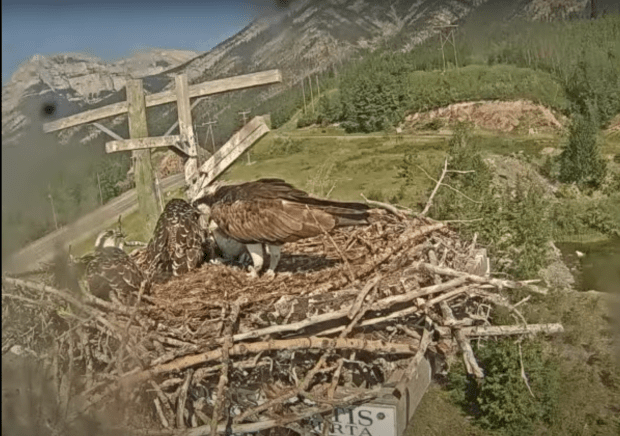
It is cooler at the Fortis Exshaw Nest in Canmore, Alberta. Mum and the trio are doing very well it seems.
Because it is in the same heat warning area, I have been checking on and off at the McEuen Park Osprey platform in Coeur d’ Alene, Idaho.
There were two of the fledglings on the nest when I popped in.
With all the heat warnings, it is nice to have something to laugh at and it is provided by Bukacek and the adult only nest. You might well remember that Bukacek had built a second nest for him and Betty. Having four large White storklets on the natal nest gets a little crowded. Now that the storklets are flying – they have taken over the new nest! Bukacek will have to build another!!!!!! Betty meanwhile lures them back to their own nest with food. Perfect. Ooops….they ate and left. Oh, goodness.
Beautiful Betty.
There has been some concern about a blood spot near the wing of SE30 on the Sydney Sea Eagles nest. What was the cause? Often the eaglets get fish blood or bird parts on their body but this does not seem to be that. It looks instead as if some feathers have clumped together either with fish juice or ps and they were, perhaps, pulling and it annoyed the eaglet who pulled them out and left a small bloody spot. The eaglet appears to be fine.
You can clearly see the spot on the right wing- and that enormous crop of SE29’s. 30 is eating well. No worries. Lady sometimes feeds it so much that 29 gets itself in a little knot. With the amount of prey coming on the nest there is no need for food competition – and even with feedings spreading a bit, everything should be fine. The eaglets are getting older. Getting ready to get some really itchy pin feathers soon. As long as food continues and Lady keeps up her remarkable feeding schedule..these two are going to grow and fledge.
There will not be any ringing or DNA tests unless one or both wind up in rehab after fledge. But I might be already inclined to guess that we have a really big sister in 29 and a little brother in 30.
We can always use good news in our lives. Here is another story of an eagle rescue that will warm your hearts! Thanks, ‘L’, much appreciated.
Our beautiful Victor. I love this photo of him standing on a low perch. You are progressing, Victor. Keep up the good work!
Since the rescue of Victor, some of us have been more than perplexed about where the zinc came from that poisoned his body. I have rattled my brain with several of you – flakes coming off of anything galvanized, warnings on garden hoses about zinc, the shale in the area contains zinc, etc. I really do not think our dear Victor sat and ate pennies knowingly. ‘C’ sent me the findings of a study by a Brazilian researcher. It has been translated by Google from the Portugese. If you are interested in how Victor might have gotten the zinc and how our contamination of the planet spreads to birds 10,000 miles away even…have a read.
Thank you, ‘C’. Much appreciated.
Title: “Not even the “end of the world” is free from human-caused pollution”
Animals that live in the waters of the Kerguelen archipelago, 3,000 km from the nearest inhabited region, are contaminated by metals such as cadmium and mercury.
Not even the “end of the world” is free from the pollution generated by humanity. Located in the south of the Indian Ocean, 3,300 km from Madagascar, the nearest inhabited region, the Kerguelen archipelago, formed by about 300 islands and islets, is contaminated by metals such as cadmium and mercury, copper and zinc. The observation is made by Brazilian researcher Caio Vinicius Cipro, a postdoctoral fellow at the Oceanographic Institute of the University of São Paulo (IO-USP), in two studies he carried out at the University of La Rochelle, in France, in partnership with scientists there.
Of volcanic origin, Kerguelen is 4 thousand kilometers south of India and 2 thousand kilometers north of Antarctica. The archipelago belongs to that country and is administratively part of the French Southern and Antarctic Lands (TAAF). There is currently a scientific station and structures associated with it. “There is also fishing activity due to France’s exclusive economic exploitation zone”, says Cipro. “Biologically, there are countless species of birds and marine mammals that have established colonies on the island and many others, in addition to significant amounts of fish and invertebrates thanks to the high primary productivity of local food. There are also several species introduced by humans, such as mice and reindeer, and some plants.”
He says that the idea for the study came during a period when he worked as a guest researcher at the University of La Rochelle. “My supervisor at the time, Professor Paco Bustamante, had told me about a dataset he had obtained years before, which he began working on during his own doctorate, and whose publication he never had time to pursue,” he says. “I volunteered to carry out the task and write the publication.”
Cipro then went on to study the occurrence of four chemical elements (cadmium, copper, mercury, zinc and selenium) in more than 30 species of invertebrates and fish, most of them at a lower trophic level (of the food chain). The objective was to understand how the concentrations of these inorganic pollutants behave at these lower levels that will influence organisms above them in the food chain.
Cipro’s first study was carried out in 2014, shortly after he arrived in France, on samples that had been collected by Bustamante’s team in the southern summers of 1997 and 1998. The Brazilian scientist analyzed metal contamination in a species of bird, the black shearwater petrel (Procellaria aequinoctialis). “We found contamination by cadmium, copper, mercury, selenium and zinc”, he says. “An article about the work was published in 2016 in the scientific journal Polar Biology.”
The second research was carried out in 2018 and yielded another article, published in the same journal. “In this case, we analyzed the levels of contamination of the same metals, with the exception of selenium – there were no conditions at the time to do this with this element in the laboratory at the University of La Rochelle – in 18 species of fish and 11 of invertebrates”, explains Cipro . The result of the work also pointed to the contamination of animals by metals.
According to Cipro, what can be concluded from the results of his research is that in this specific case of Kerguelen, cadmium values varied much more than mercury values (four orders of magnitude against one) and depended more on specificity in food ecology. and in the habitat than at the level of the food chain plain and simple.
In other words, the results of the studies showed that, contrary to what happens in most cases, the concentrations of pollutants found in animals depended little on their position in the food chain, but more on specific mechanisms of physiology and exposure, in such a way that predators from lower trophic levels could be more subject to some contaminants than others from higher positions.
This means, according to Cipro, that work with species of higher trophic level or sentinels needs more in-depth food ecology studies before reaching certain conclusions and that the food chain by itself does not mean much in this environment. “Furthermore, my research provides solid foundations on the exposure to which predators are subject, as in most cases this discussion remained on hypothetical terrain due to lack of field data,” he explains.
The work also showed a possible influence of a local secondary source of contaminants, probably the bird colonies themselves, a hypothesis confirmed in the Antarctic environment during his current research project. Going into more detail, Cipro explains that the analyzed metals have natural sources, but human activity certainly plays a bigger role than them in general. For mercury, for example, current emissions are estimated to be three to five times higher than before the industrial age. This element can reach the Kerguelen archipelago from dumps made by factories located 10,000 kilometers away.
Nevertheless, locally, in addition to bird colonies, some other natural sources may be significant, such as certain rocks and fossil fuels. “In the case of bird colonies, some studies that I proposed suggested and later confirmed their role as a local and relevant source of some elements and also of organic pollutants”, says Cipro. “In Kerguelen, we raised this hypothesis, comparing mussels from inside and outside the Gulf of Morbihan, and it seemed to be confirmed by the results obtained.”
The Dad at the Janakkalan Nest, Red CCL, continues to deliver the fish. The chatters have nicknamed the pair. Boris is the oldest and Titi is the youngest. The fish are so big that they take turns with no need to squabble. Titi is on the left. He has not figured out – yet – to hold the fish down with its talons.
Dad arrives with another fish at 1805. Titi is in the back with the huge crop from eating the fish in the image above. Boris is going to claim this one and Titi is absolutely too full to care! Lovely. Thanks, Dad.
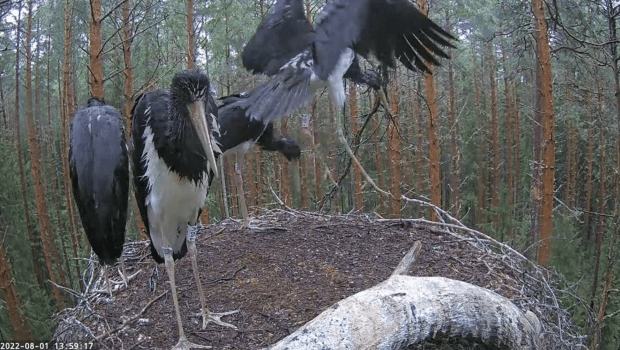
The four Black Storklets on the nest of Karl II and Kaia are really wanting a food delivery. While they wait it is raining – they shake off their feathers, flap about, and jump on and off the perch. Kaia arrives with food at 16:58, the last image.
Just look at this beautiful juvenile Red-tail Hawk, L4. Stunning. L2 and L4 will probably be soaring in the thermals soon and leaving the Campus. Every moment with them is special as it is with Big Red and Arthur.
The latest update on L3 from the Cornell Lab:
L3 is gorgeous. Looking forward to her release when she is all healed.
Thank you so much for joining me today. It is wonderful to have such good news in Bird World. To my knowledge, all of the UK Ospreys have fledged. They will be eating and gaining weight as will their mothers for migration. Soon these flights will be charted. In the meantime continue to enjoy them. The same with the storks! Take care everyone. See you soon!
Thank you to the following for their streaming cams, websites, and postings where I took my screen captures: Osoyoos Ospreys, McEuen Park, Coeur d’Elene, Idaho, Sydney Sea Eagles@Birdlife Australia Discovery Centre, Sydney Olympic Park, Cornell Bird Lab, Finnish Osprey Foundation, Mlade Buky Storks, Eagle Club of Estonia and Looduskalender, Ojai Raptor Centre, and Fortis Exshaw.
A Correction. Ah, I got caught ‘off guard’. The Spirit at the Avon Lake School was not ‘our’ Spirit! Thank you, ‘B’. I hope that our Spirit is flying free and chasing Jackie and Shadow around Big Bear while the other Spirit, in Ohio, stays out of trouble!!!!! Sorry for the confusion…
Good news coming out of Osoyoos. Olsen has been working around the clock to bring fish to Soo and the two chicks on the Osoyoos Osprey platform. Even in the heat, he really broke through and found lots of fish — some twiddlers and some nice sized ones. There were no less than seven deliveries (according to the list on chat by ‘H’) with the first at 0502 and the last at 18:42. There could be another before night falls.
A short time ago I wrote about the male Osprey in Montana being shot. (I will not get started on how crazy this makes me!) The news is that the female has been able to carry on delivering fish to the nest where there is at least one chick. Send good wishes to her and to the female at Kielder 1A nest as well. Normally, the females leave the nest before the fledglings and the male. I wonder what we will learn from these two nests in that regard? Will the female feed the chicks til they depart the territory and start their migration to the southern parts of Texas, Mexico, or Central America? or will she wait til they have left and spend 2 weeks getting into condition so that she will have a successful flight to her winter home? We wait to find the answer.
Ferris Akel caught the four Red-tail Hawks on the grounds of Cornell University during his tour today. He had some incredible images of L2 and L4. Here is a number of them. It will also not be long until they depart to find their way in the world so, every minute is precious. They were both hunting. Such wonderful images – love the close ups. Thank you, Ferris!
L2 you are a beauty.
L4 decided that being in one of the pines after a squirrel was the most fun. Good luck!
Many of you watch the Southern Royal Albatross at Taiaroa Head in New Zealand. We have all marvelled at the care and attention the albatross chicks get especially if their parents cannot supply them with enough food. It has been an anxious year with a number of chicks requiring supplementary feeding including the Royal Cam Chick, QT. Her mother YRK has been doing the best job she can with the male, OGK, missing for over two months now.
YRK visits Taiaroa Head on 24 July and gives Quarry Track (QT) chick a feeding.
Additional chicks like the one in the posting below are missing both parents and have to be fed by the rangers. Without the supplementary feedings, the chicks would have perished —including QT. This is the first time that I have seen a request for donations to purchase fish for the chicks come from the Rangers.
Disappearing Gun Chick
‘H’ sent a really cute photo of the two fledglings at Mispillion Harbour Osprey platform. Remember this Mum loves yellow! She has kept this yellow mat on the nest. Once it flew off and Mum retrieved it and put it back. Then it got hidden under other nest material. Today, one of the fledglings pulled it up to the top when it got stuck on its talon. Thankfully, it came off. Mum will be so happy! Thank you ‘H’ for this great capture with the two fledglings on the nest at the same time!
Ah, this is just a quick check in to correct the issue of ‘Spirit’. Thank you so much for joining me. Take care. See you soon.
Thank you to the following for their streaming cams and/or FB pages where I took my screen shots: Osoyoos Ospreys, Mispillion Harbour Ospreys and the DDNR, The Albatross Centre, Ferris Akel Tours, and Montana Ospreys at Hellgate.
The following announcement was made by Cornell University:
Sad News, Young Hawk “L1” Found Dead
July 14, 2022
Red-tailed Hawk fledgling “L1.” Photo by Cynthia Sedlacek
We are saddened to report to the hawk community that one of the fledglings from the 2022 Cornell Hawks cam has died. On the morning of July 14, a juvenile hawk was found dead on the roof of Cornell University’s Stocking Hall, where it was retrieved and delivered to the Janet L. Swanson Wildlife Hospital by a Cornell employee. Based on plumage characteristics and confirmed observations of fledglings L2 and L4 later that morning by local birders on the ground, the deceased hawk was identified as likely L1. Fledgling L3 is continuing treatment for an injury sustained on June 23.
Initial diagnostics suggest that L1 suffered a fatal collision near Stocking Hall. A necropsy will be conducted to determine the cause of death, and we will share more information if it becomes available.
Fledgling birds must overcome many challenges as they navigate the world outside the nest, and most don’t survive their first year. The news of L1’s passing is also a sobering reminder of the risks that birds face while living in an urban environment like Cornell University’s campus. Window collisions are estimated to kill up to 1 billion birds per year in the United States alone.
Despite the efforts made by the Cornell Lab, campus staff, and members of the hawk cam community to keep the areas around the hawks’ territory as safe as possible, it remains a hazardous place for young birds. We will continue working with stakeholders on campus to identify and remediate areas of risk to make them safer for our local birds and wildlife.
During this difficult time, we’d like to thank the Janet L. Swanson Wildlife Hospital, our birders on the ground, and the Cornell Hawk cam community for their support.
The two remaining chicks in the wild are L2, the first to fledge, and L4. These two were the first to catch their own prey and officially become juveniles.
Condolences go out to Big Red and Arthur who do as much as they can to create beautiful free-flying Red-tail Hawks. The rest is up to us to try and protect them as best we can – with windows that have anti-strike coatings in public buildings, blocking off roads from cars during breeding season, putting anti-strike coatings on any enclosure that a bird could hit, etc. While we do not know what has happened to L1 for sure, we lost J1 to a window on the Cornell Campus. There are lovely people, boots on the ground, who work tirelessly to make sure that they do what they can to help the hawks at Cornell. Thank you to all of you!
Good Morning Everyone. I hope that your day is bright with sunshine. A decade or kore ago, the summer temperatures in Winnipeg averaged 17-19 degrees C. Then for 4 or 5 years – perhaps a little more – they crept up to the high 20s with some days being 38 degrees. Today it is 19 C. A fantastic day for a walk and a check on the goslings later.
Yesterday I reported on one of the fledglings at the West End nest being in a dust up with another. I could not see any bands but made the assumption that it was one of the other siblings – forgetting that the 2-3 year old juveniles are returning to the Channel Islands. Lady Hawk cleared that up with a video noting it was an intruder that attacked Sky. A shout out to ‘B’ for letting me know!
Here is Lady Hawk’s video of that event:
I wondered how long it would be before more names were added to ‘the list’. That news arrived late last evening when ‘A’ wrote to me about the sadness at the Finnish Osprey nest of Miina and Marko. The feathers were found under the nest and it is believed that the nest was attacked, as others have been, by a henhawk. So sad. This nest site with its close proximity to the forest seems to be an unlucky one. Thank you, ‘A’ for letting me know.
Here is the information from Looduskalender:
"The nest equipped with a webcam in the Võrumaa osprey (Kalakotkas 1), where female Miina and male Marko nested with two eaglets, was soon taken down due to damage caused by lightning.

Today the nest was empty, the nest tree was all broken, the osprey, the young bird, was killed. The burglary could have happened a few days ago."
Happily, the osplets on the nest in Finland are healthy and safe – so far no attacks that I am aware. This is a natural Osprey nest – not a human made platform – 160 miles south of the Arctic Circle. It is in the area known as Lapland and they have sunshine almost 24/7 this time of year.
Here is the link to this nest if you do not know it:
The osplets at nest #4 are simply gorgeous and it will not be long until they are ready to fledge. Oh, let us hope that the hawks do not come around!
If you would like to watch all of the Osprey nests in Finland at one time, here is that link: saaksilive.fi/live/kaikkikamerat
Dory is busy shading the three osplets at the Boathouse Osprey nest on Hog Island today. Gosh, isn’t she just a great first time Mum?!
We will never know if the hour long fireworks did any damage to the Bald Eagles hearing at the National Arboretum. Takoda, however, continues to be fed by Mr President on the nest – and this is a good thing because we get to see this gorgeous fledgling. Takoda was eating breakfast at 0628.
All around the world people continue to celebrate the little Red-tail Hawk, Malala, that survived from being the Bald Eagle’s dinner on Gabriola Island. It was always difficult to see Malala clearly on the streaming cam. Sharon Palmer-Hunt posted two photographs of Malala on the GROWLS FB page and, in case you didn’t see it, here she is:
Adorable. Like the fledgling Blue Jays, the Red-tail hawks have light blue or light blue-gray-green eyes. As they age, the eyes will turn a deep espresso brown.
Check out the tail below. How many dark bands does Malala have? Laura Culley suggests that they need at least 5 but better 6 to fledge. Malala has been flying for a little over a week (?) and she now has 8 or 9.
Our other favourite Red-tail hawk fledglings were caught hunting and playing around the Cornell Campus last evening by Suzanne Arnold Horning. Oh, they are adorable. She got all three! Thank you, ‘S’. All of us appreciate your efforts chasing these quick hawks around the campus so we can see them.
As the North American birds fledge, we will be moving our attention to Australia. One of the most adorable Peregrine Falcon couples is Xavier and Diamond at the scrape on the grounds of Charles Sturt University in Orange. They are not a young couple – considered middle age at 9 years old.
Xavier gets prey and stashes it in the corner of the scrape for Diamond. Diamond is very particular. She does not like European Starling!!!!!! It looks a nice pigeon for lunch today.
If you do not know this couple, here is the link to their camera. We will be expecting eggs in late August/early September.
Beautiful Diamond.
If you do not know this couple, here is the link to their streaming cam:
There is wonderful news coming from Estonia. We knew from the photograph that the trail camera took that Kaia had found the fish basket Urmas has provided this family so that it can feed the foster chick, Bonus. Now Urmas has posted a photograph showing Karl II finding the fish basket! The adults will require so much more food as the storklets grow bigger and bigger.
The wonderful experiment to save as many of Jan and Janika’s Black Stork fish appears to be working with the dedication of Urmas and his team. I want to find the donation button and post it again as the cost of the fish for the two – Karl II and Eedie families – is high. If you wanted to help and haven’t yet, there is still plenty of time.
I often have disagreements over intervention with some of my raptor associates. In the case of the Black Storks, they are extremely rare. It is possible that all of the fledglings from last year in Latvia and Estonia did not survive. (We await word on Udu). It is not, however, just the Black Storks. So many of the first year birds are lost in their first year. To put accurate data on the % is very difficult as the following academic article explains. Depending on the species it can be as much as 60% in the first year.
That is why the intervention that we are seeing when adults die or birds in the nest get injured or knocked off is so important.
I was particularly moved by a statement ‘A’ made: “Now when I see an adult bird of any species, I am amazed that it made it to adulthood safely.”
‘H’ reports that there are now two chicks fledged from the Osprey nest in Carthage, Tennessee. Congratulations!
Thank you so much for joining me this morning. Have a wonderful day – or evening – wherever you are. Take care of yourselves. See you soon!
Thank you to the following for their streaming cams, personal images, and/or FB pages where I took my screen captures: Explore.org and the Institute for Wildlife Studies, Finnish Osprey Foundation, NADC-AEF, GROWLS, Charles Sturt University Falcon Cam, Looduskalender, Suzanne Arnold Horning, and Explore.org and Audubon.
Hello everyone. Oh, it is wet and soggy on the Canadian Prairies. I could put the rain on repeat and probably be 90% accurate for the nest 10 days. I really do not know where this water is going to go. Everything is saturated. And after 4-5 years of drought I am not going to complain.
‘R’ asked about Dyson. Dear Dyson. There is one bird feeder that has, for the past week, been empty way too soon for the birds to have eaten all the seed. With all the foliage I had not been outside at the right time to catch the culprit. I should have known but, of course, it is supposed to be a squirrel proof feeder. So much for that guarantee. Dyson is an acrobat. Somehow he managed to grip the feeder and lean it so the seed would pour out. Then he scurries to the ground to eat it all up. He is very quick! The name is perfect! I will try and get a photo if I can catch him again.
A lovely article on the ringing of the Poole Harbour osprey chicks has been posted with pictures of the lovely birds. I want to bring your attention to the last bit of information. Normally osprey chicks are brought from nests in northern Scotland to Poole Harbour to be translocated. It was felt that because of the high level of Avian Flu in Scotland and the Shetland Islands that it would be irresponsible to move birds from an infected area to one with zero transmission of H5N1. Well done! The chicks are so cute…and they got some nice trout for their effort.
Those two beautiful osprey chicks are the first chicks hatched in Poole Harbour for a little over 200 years. Magnificent. Gorgeous plumage, too!
And since it is the 4th of July in the US, it is a great time to bring you a story about Challenger, the 33 year old retired Bald Eagle. I remember Challenger as the side kick to Al Cerere, the founder of the American Eagle Foundation (now retired like Challenger) and his flights in the football stadiums. Challenger is set to fly to Branson, Missouri to receive the Patriot Award – the first raptor to do so.
Your laugh today comes from ‘H’ and the Osoyoos Osprey Nest in British Columbia – lunch was a fish followed by a Reese’s Peanut Butter Cup for dessert. Thanks, ‘H’.
It is just pitching down rain in Osoyoos – they are having a very wet year like we are. Send positive wishes off to those little ones today.
I cannot see anything new decorations on the Osprey nest at Mispillion Harbour in Delaware. It looks like Mum and the chicks are having some fun looking around at the big world outside. It won’t be long til these two are flying over the harbour and back to the nest. That will be awesome. Gosh, if you live in that area you just might want to take a trip down to the harbour and watch the ospreys fly around.
These two are starting to work those wings. I would sure love to have them weighed and measured. Nice birds.
Ah, Takoda – the pride and joy of Lotus and Mr President heads to the nest to get a fish from Dad or does he on the 4th of July? BTW Isn’t Takoda one beautiful fledgling?
Is it just me or does everyone have trouble seeing the rings on the legs of the West End fledglings of Thunder and Akecheta? What a gorgeous area to fly. It seems that the 2-4 year olds are returning and causing a bit of turmoil trying to intrude in established nest areas. Thunder has been busy chasing them away.
I honestly cannot tell which of the eaglets is which without seeing them together or observing those bands.
Suzanne Arnold Horning has taken some great images of Big Red and Arthur and their family today. I am so grateful that she always allows me to share them with you. Once the fledglings have left the nest it is hard to capture them on the Cornell camera.
Gosh these Red-tail hawk babies are beautiful. As far as I know, L4 and L2 are the only two official juveniles having caught their own live prey items yesterday.
Proud parents Big Red (left) and Arthur (right) keep watch over the Ls and their territory.
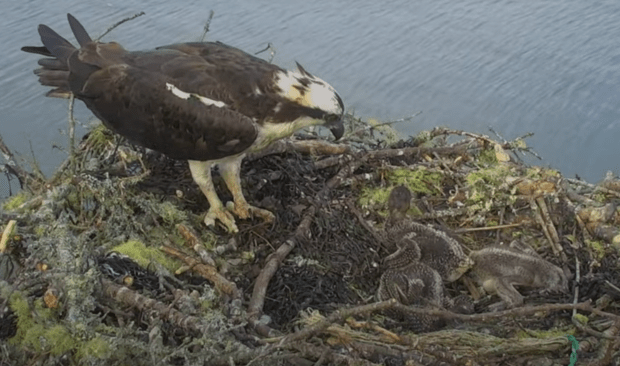
I will close this evening with a whopping salmon – complete with head – brought to the nest for Dorcha and the two kids by Louis. Wow. That is one super fish! And a very grateful Osprey family. Louis is an amazing provider and if he isn’t getting fish to the nest there is a reason — intruders.
It is lovely to have you with me and the birds today. So grateful Little Bit 17 is in care today and doing well. Thank you for being here and take care. See you soon!
Thank you to the following for their streaming cams and/or FB pages where I took my screen captures: Friends of Loch Arkaig and the Woodland Trust, Suzanne Arnold Horning and the Cornell Hawk Chatters, Explore.org and the Institute for Wildlife Studies, NADC-AEF, Mispillion Harbour Ospreys, Osoyoos Osprey Cam, and the Birds of Poole Harbour.
How many of you have tried to watch the streaming bird cams or Ferris Akel’s Tour (or both at the same time) and tried to cook dinner and bake a cake? Well, that is what I am trying to do without much success with any of them! OK. I shouldn’t say that. ‘The Cake’ is going to be delicious but it has to sit for 24 hours.
For those of you from Japan or living in Japan, it is a Yokohama Orange Cake. I am trying to replicate the one made by Hamasuzu in that city. They make some brandy cakes and cookies that are quite famous but their orange cake makes you remember it years later and well, your mouth starts to water. I will take a photo when I cut it and let you know if it is good – it took 20 oranges for the rind and the juice. Yum….I wish I could send everyone a piece.
Ferris Akel has the Ls on his streaming cam tour at the moment. He has found Big Red and Arthur and all three of the Ls. They are so cute.
The Ls continue to fly low across Tower Road. There are signs about the Osprey fledglings but I wish – as do many others I am sure – that Cornell would close tower road from fledging to the end of July.
L4 is a real cutie pie. He has a full crop and is going to sleep well tonight!
There is some very good information on Ospreys in this short article. I was looking for something else and found it.
It is fledge watch for the two Osplets at Mispillion Harbour Osprey platform next week. ‘H’ was able to locate a list of the hatch dates, sort of. The information by the Du Pont Centre is not detailed enough. There were originally five eggs. We are going to assume that the two chicks on the nest hatched on 19 May. That makes them 44 days old. Pandion Carolinis Ospreys fledge from 50-55 days normally.
Mom really loves anything that is a kind of yellow colour. The Vodka bottle flew out of the nest but the yellow mat is still there somewhere. Now there is another bag!
In his studies of the four different species of Osprey, Alan Poole notes that the North American Ospreys, the Carolinensis often like to bring items to the nest! As opposed to the other three species.
I sure hope this blows off the nest. There have been way too many accidents of chicks – even large ones close to fledging – being throw off the nests and dying when all this ‘junk’ ‘garbage’ is brought onto the nest.
According to Ervie’s tracking, he has been swinging by the barge but he has not been stopping by. It didn’t take long for Mum to get the message out? 2 or 3 times??
Oh, wouldn’t you just love to see Ervie??
Aran has really been piling the fish on the nest for Mrs G and the kids. She spent 2 entire hours feeding them a huge flounder. Just when she was done, Aran landed with a very large Sewin. Those kids are going to pop.
There is the flounder.
The Osprey nests in the UK have consistently seen large prey except up at the Loch of the Lowes when Laddie was bringing in some twiddlers.
I don’t know why but I am still a little concerned about the third hatch at the Boathouse on Hog Island. I hope I am just being a worrisome auntie. Fingers crossed for this young family.
There are still two on the Osoyoos Osprey Platform and they still make me nervous! Why do they all love to hang over the edge?!
Not an Osprey but the female at the Glacier Gardens Bald Eagle Nest, Liberty, really does like to bring plastic bags to the nest!
Look closely. Little feathers are starting to poke through on the wing tips.
There is lots of activity at the West End nest of Thunder and Akecheta. In the first image look carefully near the centre top. All three fledglings were chasing Akecheta for the fish.
Kana’kini might have it between her talons at 12:38 but…
KK sees one of her siblings coming.
She mantles.
Then she leaves the fish and goes behind the nest.
She goes back and really mantles the fish.
Here comes Sky entering from the left.
It was quite the dust up with Sky getting the prize fish at 12:41:11 – or so it appears. I cannot see the leg band to be sure and they were fighting around the end of the nest.
When the fledgling flies off the nest with the fish you still cannot see the leg band! Frustrating.
That is just a very quick look at the nests. I will continue to check on a few that could have problems although we seem to have had enough for a decade this season. I hope everyone had a really beautiful Saturday. Take care. See you soon.
Thank you to the following for their streaming cams or FB postings where I took my screen captures: Explore.org and The Institute for Wildlife Studies, Ferris Akel Tours, Bywyd Gwyllt Glaslyn, Mispillion Harbour Ospreys, Glacier Gardens, Osoyoos Ospreys, Explore.org and Audubon, and Port Lincoln Ospreys.
The walk in the forest and seeing some beautiful songbirds and several woodpeckers yesterday afternoon was lovely. “Forest Bathing” or shinrin-yoku. I have mentioned this word and the concept many times before but I highly recommend going for a walk outside with the trees if you are able. You can just sit, too. It is highly relaxing and really does remove stress. To my delight, there were a few – three- goslings. There should be some slightly older goslings about somewhere but I could not find them. There are lots and lots of fish in the water even in areas with lots of algae cover. I hope the Bald Eagle couple are taking the fish and not the goslings!
This little gosling was skipping along between its parents. Only one for them it appears.This Canada Goose couple have two goslings. In former years I would have seen hundreds of goslings. The little red squirrel was enjoying the seeds being dropped on the ground at the feeding station. Little female Downy woodpecker was working really hard to get the peanuts. There were lots of American Goldfinches at the feeding station today. This very dominant male did not want to share!
Still, the worry for Little Bit 17 and the disappointment that nothing has been done to secure an assessment on his condition is becoming more bewildering.
This is the status of the nest Wednesday morning. There is no possible way that the three birds – 15, 16, and 17 could last on this fast deteriorating nest very long.
This is precisely the situation that little Yurruga was in at the Orange Australian scrape. His feathers were not fully developed but he did fledge and fly only to have torrential rain and die. Little Bit now requires food. Is he catching mice and things? Maybe. But does anyone know that for sure? and has he moved a significant amount to show that he is actually mobile? And why not call in the experts to assess him?
I needed a laugh and ‘R’ sent me the shortest video from the NADC-AEF nest that did just that. Perhaps you need a giggle, too.
I wonder how many times a hawklet is taken to a Bald Eagle nest as a prey item and winds up being raised by the Bald Eagles? It happened in 2017 in Sydney, BC with Spunky and currently Malala is part of an eagle family on Gabriola Island. There is another nest in Ohio with a Red tail Hawklet being raised by the eagles!
Malala is still doing so well at the Bald Eagle nest. Lady Hawk just released a video showing her mantling two prey deliveries on Tuesday. How grand! When she was forced fledged and found her way up to the nest, everyone was so happy. Hopefully she will continue to thrive on the nest until she is really ready to do a lot of flying about.
So how many trout did Aran bring for Mrs G and the three Bobs before the rains began? On two consecutive days, he brought in 8 trout and the following day it was 13. Wow. Mrs G was more than delighted – .
Richmond has been busy bring in the fish to Rosie and the Two Bobs, too.
The two fledglings at the UFlorida-Gainesville Osprey nest wish that their Dad would bring in a lot of fish for them, too! Dad might be thinking they need to go to the local lakes and give fishing a try! I understand that the camera will be turned off at the end of the month so check out these two. They are beauties.
The little Lesser Spotted Eaglet at the Zemgale, Latvian nest of Uldis and Laila is called Hugo. Uldis has been bringing in rats, mice, and small birds to the nest. Hugo is doing well and growing so fast.
It is another wet day in Wales at the Dyfi nest of Idris and Telyn. Perhaps today is ringing day. Last year there were two chicks. Dysynni was the heaviest male chick in history. Many still think that perhaps Dysynni is a female. Measurements can be taken but to know 100% DNA tests need to be done. They are expensive for the nature centres and most often not undertaken.
It dried out for the Dyfi nest and the three chicks were ringed. The Darvic numbers are Bob 1 = 7B0 Bob 2 = 7B1 and Bob 3 = 7B2. None of them are Bobs – they are three girls! Telyn’s mother, Maya, also had three girls at the Manton Bay nest at Rutland this year. The Manton Bay chicks are getting ready to fledge.
There is currently a vote going on at the Dyfi Osprey project chat with the streaming cam. Question. Should the names of the three girls start with the same letter? or not?
It looks like it is another miserable wet day for Mrs G and Aran and the kids at Glaslyn. I wonder if Ospreys get sick of the rain like human animals do?
The Glaslyn nest dried off in the afternoon, too. Thankfully! Aran has been out chasing an intruder. Not good.
Blue NC0 is waiting for the morning breakfast fish to be brought to the Loch of the Lowes nest. As I was looking at her nest it occurred to me that it is a rare thing to see human garbage on these UK nests. Yes, the occasional carrier bag but even that is rare compared to nests in North America.
The females on the Manton Bay nest at Rutland of Maya and Blue 33 are wet on Wednesday morning – and they are waiting for Dad to bring in the breakfast fish!
By the afternoon, everyone is dry and the three girls have been doing some hovering. Aren’t they gorgeous?
I love California Condors. There is a little chick in the cliff nest at Tom’s Canyon. Cornell has set up a camera in collaboration with the USFWS. They posted a really nice video showing a feeding caught on the camera. Notice how the little one flaps its wings in anticipation of the arrival of the adult and some much wanted food.
When I went to check on Richmond and Rosie again, I was tired, too, and felt just like Rosie. If you look for an osprey nest to add to your list for next year, Richmond and Rosie are highly recommended! SF Ospreys.
The Dad at the Mispillion Harbour Osprey nest brought in a really super fish before dawn this morning. In the process Mum’s foot hit that vodka bottle and it went flying off the nest. ‘H’ caught the action and sent me a clip saying ‘Mispillion cannot be considered the party nest any longer!’. Absolutely. Thank you, ‘H’.
Lindsay made an early appearance on The Campanile ledge this morning. Gosh, those two fledgling falcons are looking so good and so strong in their flying. Yeah for Annie and Alden teaching them to survive in the wild!
Have you ever noticed that it is when one osprey looks directly into the eye of another that they often have a bit o a dust up?
The two Bobs at the Loch Arkaig nest of Louis and Dorcha did just that. Dorcha has been having to deal with an intruder thought to be a non-breeding female.
The two eaglets of Liberty and Freedom at the Glacier Gardens nest are getting their thermal down. Oh, goodness have they grown. Mum still, sadly, likes to bring in plastic bags!
Suzanne Arnold Horning posted some fantastic images of Big Red and Arthur’s fledglings of 2022, the Ls. Thank you Suzanne for allowing me to share! Gosh those Ls are cute – and doing so well. The three like to spend time together, too! How interesting. Just like Lindsay and Grinnell Jr do – playing and enjoying life.
Big Red and Arthur are delivering prey. Prey drops are often on top of buildings where it is safe for the Ls to eat. They are also expanding the area on campus where the fledglings go to hunt. This also strengthens their flying. Fantastic family. Highly recommended for your list of nests to watch next year.
There is no update on ND17 or on the Pitkin osplet that is in care. That chick might have passed – no one likes to give bad news. Fingers crossedd for Little Bit getting some assistance if he is not more mobile and has not been seen eating. There is no way that he can make it up to a crumbling nest 60 feet high – if he does, I will make a big donation to our local wildlife rehabber! Which reminds me. Tomorrow I will be spending the day at the wildlife clinic with the raptors if the weather is good. Hope to get some good images for all of you of our local ambassadors.
Thank you so much for joining me. Take care everyone. See you soon.
Thank you to the following for their streaming cams where I took my screen captures, their images or their videos: ND-LEEF, NADC-AEF, GROWLS and Lady Hawk, Bywyd Gwyllt Glaslyn, SF Ospreys and Golden Gate Audubon, UFlorida-Gainesville Ospreys, Latvian Fund for Nature, Dyfi Osprey Project, Friends of Loch of the Lowes and the Scottish Wildlife Trust, LRWT, Cornell Condor Cam, Mispillion Harbour Ospreys, the DDNR, and ‘H’, Cal Falcons, Friends of Loch Arkaig, People’s Post Code Lottery, and the Woodland Trust, Glacier Gardens, and Suzanne Arnold Horning.
As you know, I have been working on a list of all the feathered friends we have lost so far. I had hoped to have it tidied up last week but, the continuing loss of nestlings has, as I mentioned one day, gutted me. The one word that continues to haunt me is INTRUDERS. At the Cowlitz PUD, we lost 3 healthy osplets to a Bald Eagle predation. At the Cape Henlopen Nest, we lost 3 osplets to starvation because intruders had (most likely) killed the male and injured the female. Two Osplets drowned when their nest platform collapsed at the Patuxent River Park. Two died at Kielder 5A – one caught in the nest and the other from being unwell. One was starved and killed at Loch of the Lowes because Louis had to keep intruders away and could not fish. One died at Llyn Brenig from not being able to get to the fish while another got its leg caught in the nest and die at Loch Arkaig. That was within 7-10 days and those are just the ones I can remember in that period – all Ospreys. (My list includes other species but this count is just ospreys). Thirteen wee osplets lost.
Now there are another two. A freakish accident. It was very hot in the Roaring Fork Valley in Colorado today. The female had covered her two healthy osplets who were really getting their juvenile feathers. There was an intruder. The nesting material got caught in the mother’s talons when she flew after the intruder. As a result she knocked her two babies off the nest. They were more than half way to fledging. A search party has gone out to see if they survived. I am not hopeful. It is a long fall. If they do not survive, then there are now 15 osplets lost in just about a week.
The female at the Pitkin County Osprey nest protects her two osplets from the hot sun while also protecting them and keeping her eyes on the intruder.
Just look at how beautiful and big those two are. They are quite healthy and their juvenile feathers are coming in all over.
Mum is panting and is very hot. She keeps an eye out for the intruder that is flying about the nest.
Mum flies off the nest taking the nesting material and her two chicks with her. They fall to the ground.
Mum returns and is looking. Where are my chicks?
This is the announcement re Pitkin County. The fishing line was not visible—how sad. We could have lost Mama, too. This is perhaps a reason that all Osprey platforms should be carefully cleaned and inspected during non-breeding time. I do not know if it would have saved the one chick – and we will see the status of the injured one later – but fishing line and any human debris in a nest should be removed!
Three of Big Red and Arthur’s fledglings are on top of the Rice Building waiting for a prey drop from Mum and Dad. Meanwhile, one of their siblings – believed to be L3 – is in the rehab clinic. There was a report of a downed Red-tail and Suzanne Horning and Woody responded immediately. — Big shout out to this couple that love the hawks and work at Cornell for their help. No blood and the wings folded nicely so nothing broken. No sign of a collision. I will include any updates this evening. Send positive wishes.
Richmond and Rosie’s osplets are about the same age as the two at the Pitkin County nest. This is a look at week 5 of their lives. These videos captured and edited by SF Ospreys are a super introduction or a reminder of the various stages of the osplets lives.
Early morning at the Mispillion Harbour Osprey nest and everyone at Delaware Bay seems to be alright. This is a nest that needs to be cleaned after the season – and monitored re harmful items like monofilament line. It is a good thing that Mum realized that the pretty yellow metal grid could be dangerous and she removed it before it could harm her chicks. There should be an understanding that all human items are removed by qualified wildlife rehabbers from the nests until a certain age of chicks when it might harm them more if they bolted from the nest. I don’t know if it would have saved those babies at the Pitkin Nest. Did anyone know there was fishing line there?
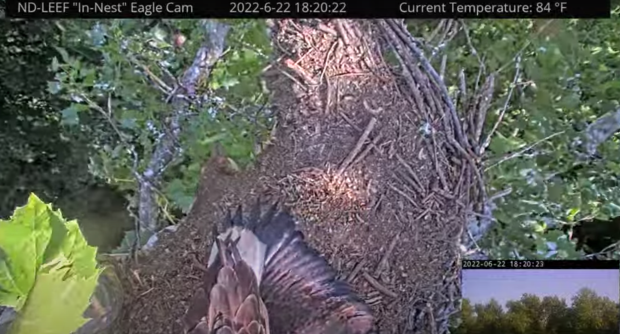
At the ND-LEEF Bald Eagle nest, Little Bit is really enjoying having a lot of the deliveries to himself now that both 15 and 16 have fledged. At 18:20 Mum flew in with a really nice fish. She goes about feeding Little Bit 17.
Mum has landed and Little Bit – the only eaglet on the nest – is mantling it.
Little Bit ate every bite of that fish!
Dad brought a second fish on the nest at 19:13:57. It was a big sucker. The parents were trying to lure 15 into the nest to eat – and it worked like a charm.
ND15, Little Bit’s buddy on the nest, has been eating and eating. He was really hungry. Flying does use up a lot of energy! Little Bit is just taking it all in.
15 could not eat all of its fish. Little Bit 17 must be full to the bald patches on his head because he is not interested in that lovely fish tail at all. Maybe he will want a snack later?
That fish tail is still there – not quite two hours later. My goodness Little Bit. It looks like Little Bit will sleep alone on the nest. 15 has already gone to his perch on the high branches and while we don’t know where 16 is – the parents surely do and have probably taken a prey drop to her.
It looks like ND17 Little Bit finished up the remaining fish and its tail from last evening show above. He came out of the porch in the early morning, around 06:08 with a very nice crop. I cannot see that any further prey items have been brought yet – it is 09:50 nest time now.
The earlier issues with intruders and lack of prey delivery to the Loch of the Lowes nest seem to have dissolved – thankfully. All is well there today.
A quick check on the Dyfi nest of Idris and Telyn. Idris brought in another huge fish today along with all the others. I am thinking he has entered some Welsh Osprey Fishing Derby! Three chicks will be ringed next week. If you haven’t gone to the Dyfi streaming cam and put in a guess for the gender of the chicks, please do. Have some fun and give Ken Gregory that is running the contest a shock with so many entries! You simply chose B for boy and G for girl. There are three of them from the oldest to youngest.
It is expected that the chicks of Mrs G and Aran at the Glaslyn nest in Wales will be ringed at the end of next week. Everything is fine on that nest – how grand.
There are three tiny osplets on the Boathouse on Hog Island, Maine. Dory is a first time Mum and Skiff is the male. The three chicks are Schooner, Slipjack, and Sloop.
Please be advised that the three chicks are so wee and Dory is figuring out how to feed them. We have to be patient and we will see if the third hatch survives. Fingers crossed. It looks like a fantastic spot for a nest! Here is the link to their camera:
Thank you so much for joining me this morning. I will be out of pocket for most of the day today – and again tomorrow – but I will send a late report on the nests we are watching. Take care everyone. Stay safe out there!
Thank you to the following for their streaming cams and/or FB pages, videos, etc where I got my screen captures: Pitkin County Ospreys, Cornell Bird Lab RTH, SF Ospreys, Mispillion Ospreys and the DDNR, ND-LEEF, Friends of Loch of the Lowes and the Woodland Trust, Dyfi Osprey Project, Bywyd Gwyllt Glaslyn, Hog Island Ospreys with Audubon and Explore.org
Within less than a week, we have seen two nest collapses – and I am thinking a third is coming at the Exshaw Osprey Nest in Alberta. The first was catastrophic with nest 2 at Patuxent River Park plummeting into the water. All three gorgeous older osplets were lost. Thankfully, the partial collapse at the ND-LEEF nest today at 15:43:25 did not cause that horrific sadness. ND15 had a forced fledge but he was ready to fly, thankfully, and landed in a neighbouring tree. ND16 went up the branch. ND17 stayed on the nest for some time looking down before officially branching. Both parents came with food – Mum with a raccoon (do they have a stash of these?) and Dad flew in with a salmon shortly after. Little Bit 17 claimed both but 16 took the fish and 17 polished off the entire raccoon. All is well. What was brilliant was the immediate response by staff to get to that nest. Hats off to Lindsay Grossman! and team. They are keeping a close watch on the nest.
Little Bit finished his racoon. He must be stuffed.
ND16 has come down to join Little Bit on the nest. Little Bit 17 flaps his wings. Maybe he will go up on the branch. His friend was ND15 – I hope he returns to the nest.
A couple of years ago when an on screen incident happened at a nest, it became readily apparent that there must be an emergency contact number under these streaming cams if there is NOT a 24/7 chat with a moderator that has that number. Things happen.
This morning the female at Mispillion Harbour Osprey nest brought in a matching decorating item for the nest. She obviously loves a particular shade of yellow and she must have read that monochromatic furnishings are in style! All kidding aside, the yellow mesh wire is dangerous for the two osplets – as well as the parents. They can get their feet caught. ‘H’ contacted the Centre with a number I provided and they know about the mesh but do not want to interfere. This, sadly, is the type of interference that is needed – it is like having fishing line in a nest. It is human caused. We need to hope that it all works out.
If you watch particular nests all the time, I urge you to find out the emergency number for the nest. USFWS offices will not help. If you cannot find a number below the information but there is a name of an organization, find their phone number. Also get out Google Maps and find the number of the nearest Wildlife Rehabber.
Last year when the chick went over the nest at Patuxent, people called the office of the park but they had closed. We left messages. We talked to Maryland’s USFWS – that is when I found out they will not necessarily do a thing. So find an alternative. Ask on line. Get clever. They don’t want all of us phoning them when a chick sneezes and this is why numbers aren’t posted. But the birds need immediate help -. Be a detective! And incidents most often happen after hours or on holidays. Seriously.
This nest should put a smile on everyone’s face. Telyn sees Idris – that fish is large enough to feed the family for a week. People in the centre saw Idris circling with it. What a guy. Great provider.
Been watching the nest but not put a guess on the chat about the gender of the three. You have a few more days. Dyfi is thrilled with the interest – it is a bit of fun. Here is the link to the nest!
Ferris Akel had a tour of the Cornell Campus this evening just to check on where the Ls were and see Big Red and Arthur. Ferris does a great job in finding the fledglings and I am terribly grateful that he is spending some of his evenings on the Cornell Campus so that we can see the babies. Here are some images for this evening’s tour. Enjoy. If you want to subscribe to Ferris’s tours, go to You Tube and search Ferris Akel’s tours and subscribe. If you have trouble, let me know.
Ferris found all of the fledglings and we got to say good night to Big Red and Arthur who are finished hunting and are going to rest for the night. Big Red was doing a lot of preening. She moults during the summer and in a week or so will be Big Blond – not Big Red! Enjoy the images.
Thank you for joining me this evening. Lots of nests did not get covered. So occupied with ND17 Little Bit. He is fine. He will get up on the branch if he needs to get off the nest. Take care. See you soon.
Thank you to the following for their streaming cams where I took my screen captures: ND-LEEF, Dyfi Osprey Project, Mispillion Habour Osprey Cam and the DDNR, and Ferris Akel Tours.