For the love of Ospreys

14 April 2022

The first time I watched an Osprey nest I swore I would never watch another one. Here I am years later. My book shelves are full of information on Ospreys, I dream about Ospreys, I do research on third hatches. My mind is filled with ‘Osprey’. These birds can take you to the lowest depths and send you to the highest heights of joy. Together many of us cheered on Ervie – the third hatch at Port Lincoln, Australia in 2021 – who was clever and survived winning our hearts and the sat-pak over Bazza and Falky. Since then he has had at least one talon pulled out – it is growing ever so slowly. As a result, Ervie has stayed around Port Lincoln. Ervie has entertained us by returning to the nest barge over and over with his puffers. It is the best! We get to enjoy him longer.

The camera at the Achieva Osprey Cam in St Petersburg, Florida is now on line. It looks terrific. While the camera was out of order, Diane laid three more eggs – a second clutch. The first fell in a hole in the nest (or so it was believed). Normally, the eggs would be hatching at the end of February or beginning of March. The hot Florida weather may pose a problem. I found it very endearing when I discovered, this morning, that David Hancock is adding a shade canopy to all of the Bald Eagle nests he is building in British Columbia. That is something that may become very necessary at the Florida nests!

Jack and Diane fledged three last year. It was not an easy nest to watch as Tiny Tot Tumbles struggled. More than three times we thought TTT would die but she was clever and persistent. She learned to eat old dried fish and she lived to become the most dominant – and beautiful. In the end, Diane went and caught cat fish to supplement what Jack brought to the nest. This is what turned the corner for Tiny Tot.

After fledging, Tiny Tot remained at the nest for some time. She even defended it against adult intruders on her own and with Jack. Oh, how I wish she was banded!

But, I will warn you. With the late hatch and the heat, there is no telling what will happen at this nest.

I have no idea how the three will be doing in a week at the U of Florida Gainesville nest. It is hot! The chicks are enjoying the shade under Mum.

These are also three of the most active little ones I have ever seen!!!!!!

At least two are up out of the egg cup. If Little Bit isn’t yet, he will be out of there soon clamouring around on the Spanish Moss.

Lena and Andy were one month ahead of the normal egg laying time in Florida. Their two osplets are just about ready to fledge. They are beginning to get a little air under their wings and it won’t be long til they are hovering about. Andy and Lena did a great job this year.

By laying the eggs a month early at Captiva, Andy and Lena might have saved their chicks from the Crows and other predators that predated their nest for two years.

The two are yelling at Andy to get the breakfast fish on the nest pronto! Lena can sit back and let them take care of it – if she chooses. They can be pretty loud.

You can still watch this nest and enjoy seeing these two beautiful birds fledge! Here is the link:

Idris has brought a large Mullet onto the Dfyi nest in Wales today but Telyn wants more fish and she is really telling him!

I am not sure what is happening in Loch Arkaig. Louis and Dorcha seem to be playing musical nests. Yesterday it felt certain that Louis and his new mate of last year would go back to the old nest but, today, Dorcha has been on the one that they used as a couple last year. It doesn’t matter for watchers – cam 1 or in this case, cam 2 – we can see them at either one!

Mrs G and Aran on the Glaslyn nest – now that everything is sorted and the females are where they should be – everyone can settle. Aran brought in five fish so far today – 3 yellow-bellied trout, 1 sea trout, and 1 flounder. He is an incredible fisher.

Mrs G, the oldest UK Osprey.

Aran! And he is very handsome.

While we wait for Mrs G to lay her first egg, Blue NC0 at the Loch of the Lowes nest laid her first a day ago and we will be watching for egg 2 shortly.

Seren and Dylan have their first egg yesterday at the Llyn Clywedog Nest in Cumbria.

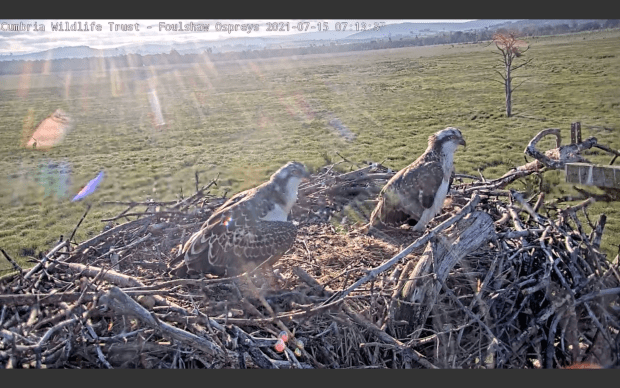
One of my favourite nests is the Foulshaw Moss nest of White YW and Blue 35 in Cumbria. This nest fledged three last year. It was the home of a third osplet that no one thought would survive – the others were monstrous when the third hatched. It was to the keen parenting and the tenaciousness of Tiny Little Bob. She fledged as Blue 463 and she was queen of this nest! It was incredible to watch her figure out how to get around the big ones.

They are not on YouTube and there is no rewind on the two cameras. You can access them here:

https://www.cumbriawildlifetrust.org.uk/wildlife/cams/osprey-cam

That is a very quick run through some of the nests. I wanted you to know about Achieva in case it was a nest that you watch. Take care everyone. Thank you for joining me today!

Thank you to the following for their streaming cams where I took my screen captures: UFlorida Ospreys at Gainesville, Captiva Osprey and Window on Wildlife, Achieva Credit Union, Woodland Trust and Friends of Loch Arkaig, Dyfi Ospreys, Brywd Gwyllt Glaslyn, Cumbrian Wildlife Trust, and CarnyxWild.

Monday in Bird World

11 April 2022

The tributes continue to come in for Grinnell! It is more than heart-warming to know that this little falcon touched the hearts and lives of so many in such a positive way.

https://www.theguardian.com/environment/2022/apr/11/peregrine-falcons-grinnell-annie-captivated-audience

I have not seen the list of names chosen by Cal Falcons in the naming contest. Will keep you posted.

A soap opera saga is playing out in the Glaslyn Valley in Wales. The four players are Mrs G, the oldest UK Osprey; her mate, Aran, Monty’s son Aeron Z2 at Pont Cresor, and Blue 014. With the late arrival of Aran and Blue 014, Aeron Z2 and Mrs G got a little too comfortable over at Aeron’s Pont Cresor nest. When both Aran and Blue 014 returned yesterday things got a little sticky. It looks like the guys are going to leave the girls to fight it out. I am just not clear which Aran or Aeron Mrs G wants!!!!!!!!

Aran is really handsome and looks in tip top shape. It is interesting, in terms of bird behaviour, what happens to a couple after there has been a loss of chicks on a nest and, to add to that, an injury to the male. That is precisely what happened at Glaslyn last year. We will wait to see how this sorts itself out.

Handsome Aran. 10 April 2022

Aran is enjoying his fish and keeping watch over his nest while the ladies fight it out.

While the drama continues to unfold in Glaslyn, the folks down in Poole Harbour are rejoicing at the reuniting of CJ7 and Blue 022. These two are totally committed to one another. What is at stake? The first Osprey to hatch in Poole Harbour in over 200 years! It is really exciting. CJ7 waited a couple of years for a mate and Blue 022, a youngster, showed up last year very keen – very keen, indeed.

The list of Ospreys left to return to the UK is growing shorter by the hour. Both Louis and Dorcha returned to the Loch Arkaig Nest safe and sound. So happy!

Some of you will remember the 2020 Osprey season at Loch Arkaig with Louis and his mate, Aila. They raised three amazing fledglings. Sadly, Aila did not return last year. Louis moved to a different nest and bonded with the female that is now called Dorcha.

I adore Louis. He is a great provider and a fabulous father. Here he is bringing Dorcha a fish. Louis knows how to take good care of his family.

It is very windy at Loch Arkaig today. It is hard to get a good image of Louis and Dorcha. Louis is on the left and Dorcha is on the right. Notice Louis’s beautiful necklace. I saw someone on one of the chats the other day comment that they thought only females have necklaces. That is not correct; there are quite a few male Ospreys with exquisite necklaces – the envy of many females!

Here is a link to camera 2 at Loch Arkaig:

I started the other day, with my friend ‘S’s list of favourite Osprey nests. So I want to go back to that list because Chesapeake Bay is on that list of great Osprey nests to live stream. The nest is on Kent Island just off the coast of Maryland. It is on the property of ‘The Crazy Osprey Family’. This family has been sponsoring a streaming cam for the Ospreys since 2012.

The Chesapeake Conservancy Osprey nest is the home to Tom and Audrey. Last year, after a couple of eggs broke in the nest, the couple fledged one chick, CJ.

Some viewers have been concerned about what appears to be a cut on Audrey’s chest. I say ‘cut’ because it does not appear to be blood from bringing in a fish. It is amazing how quickly wildlife heal and the water around the nest is 50% salt which is excellent to help cuts heal (Thanks ‘L’ for checking on that amount of salt here). Audrey should be fine.

The couple who returned to the nest from their winter migration to South America – Audrey on the 18th of March and Tom on the 25th – have been caught on camera mating today. If mating is successful, it takes three days to produce an egg. Keep watching!

Here is the link to Tom and Audrey’s camera:

The Osprey family on the light stand at the University of Florida at Gainesville survived the ball game yesterday. All three chicks were wide awake and ready for fish this morning! It is too early to tell how this nest is going to turn out. Middle and Little Bob still do not control their head as well as Big Bob who is right up front for food.

Here is a link to this cam:

https://wec.ifas.ufl.edu/extension/ospreycam/

Richmond and Rosie, the bonded pair of Ospreys whose nest is on a World War II crane at the Richmond Shipping Yards in SF Bay are hilarious. I highly recommend this nest – yes, absolutely. Solid Ospreys.

However, Richmond got a little carried away and decided to bring a small tree to the nest. In the process, he almost broke all the eggs! Richmond!!!!!

Then later Richmond decided he wanted to incubate the two eggs and was tired of waiting so he sat on Rosie! Richmond, maybe Rosie is thinking of laying a third egg??? What do you think?

Doing a quick check on Middle Little at Dale Hollow shows both eaglets ate well, both parents on the nest and a couple of nice hunks of fish. No sign of any monofilament line. All is well.

Middle Little is growing really well and eating good! Look at that big hunk of fish.

Sitting on the Canadian Prairies you would not know that a super storm is set to hit the area tomorrow. Most people are being extremely cautious. Our rivers are full to overflowing and they are predicting ‘the storm of the century’. Is it weatherman hype? In this case I hope they are entirely wrong! Thousands of Dark-eyed Juncos have just descended on our City, the Geese are nesting, the Snowy Owls are migrating north, and more song birds are moving in by the day.

This was Sunday in a rural area. The water is now up over the banks there.

There are tens of thousands of Canada Geese in Manitoba and more arriving daily.

Normally the geese leave you alone unless you get too close to their nest. Then watch out!

This little red squirrel had a stash of corn kernels at the base of the tree in the park.

He was such a cutie.

Oh, he looks like my Dyson with part of the fur on his tail missing. Poor thing.

Speaking of Dyson, I need to go and make sure that there are plenty of solid seed cylinders placed in various locations so that the squirrels can get to them during the storm. It should not be arriving until tomorrow evening – plenty of time to restock wood for the Jotul stove in case the electricity goes out, find candles, and generally get ready to sit back and read for several days. Can’t wait!

I hope that all of you are well. Thank you so much for joining me today. It is a pleasure to have you with us.

Thank you to the following for their streaming cams where I took my screen captures: Cal Falcons, Woodland Trust and Friends of Loch Arkaig, Explore.org, SF Ospreys and Golden Gate Audubon, UFL Ospreys at Gainesville, DHEC, Bywyd Gwyllt Glaslyn Wildlife, and Poole Harbour Ospreys.

Is it really JJ7?

I woke up to wonderful news from Jean-Marie Dupart from the Saloum Delta in Senegal. The Saloum Delta is home to Mangrove forests and wetlands, perfect for an Osprey.

“Saloum Delta 031” by Crane in Prague is licensed under CC BY-NC-SA 2.0

Dupart has already counted 1018 Ospreys this month. He has another week to go before his final monthly tally. This is fabulous news in terms of numbers. But – that is not why I am excited this morning although, it is reason enough.

This is Loch Arkaig in Scotland. In 2020, it was home to Louis and Aila and their three hatchlings: Doddie (male), Vera (female), and Captain (male).

A Scottish ringed bird from Loch Arkaig is at the Saloum Delta. Dupart could not tell if it is JJ2 or JJ7. Scottish observers note that it does not have the dark necklace of JJ2, a female. To me, the number appears to be JJ7.

copyright Jean-Marie Dupart

So why is JJ7 so special? There are several reasons. For some, JJ7 or Captain is the last ever hatch of Louis and Aila, the much loved Scottish Osprey couple at Loch Arkaig in 2020. Aila did not return from migration in 2021.

For me, JJ7 is a third hatch survivor. JJ7 is one among the list including others such as Tiny Tot Tumbles (2021, Achieva Credit Union, St Petersburg, FL), Tiny Little Bob or Blue 463 (2021, Foulshaw Moss, Cumbria), and Ervie (2021, Port Lincoln, Australia). My 12 year research project focuses on third hatch survivors. I want to know if the creativity and persistence that kept these little ones alive on the nest also gives them a higher success rate in the wild. Unless the birds are ringed or have a sat-pak – or a very distinctive head like Tiny Tot Tumbles- then there is no way to know about their survival rates. That is why this sighting is so important. Is this JJ7? And if so, is JJ7 the only chick to survive from the clutch of three?

There is little Captain at the back of the food line. Doddie is on the right and Vera is on Captain’s left. You can clearly see the difference in size between Doddie, the oldest sibling, also a male, and Captain.

Little Captain is on the far right.

Despite lots of fish on the nest and the exceptional parenting of Louis and Aila, there was some intense sibling rivalry.

Louis and Aila worked together to try and ensure that all three chicks thrived. Louis fished at night and also assisted Aila in feeding. JJ7 was sometimes fed separately from the larger siblings in order to make sure he had enough to eat.

The chicks enjoyed some fish after being ringed.

JJ7 Captain fledges on the 24th of July 2020.

Captain thinking about leaving the natal nest for the last time.

And he’s off!

JJ7 flies off the nest to begin his migration on 23 August 2020. Will he return this year to find a mate? Gosh, I hope so and since no one has claimed his natal nest, I hope that Captain gets there before anyone else. He can say hello to Dad, Louis, at the loch.

Along with hundreds of others I cannot stop smiling today! This is incredibly good news.

In other Bird World News, NE27 hatched at 02:24 on the 25th of January. NE26 hatched at 04:06 on the 23rd – making them approximately 46.5 hours apart in age.

Thank you so much for joining me today. I didn’t think anything could take away from the excitement of NE27 hatching but having a sighting of JJ7 sure did! Take care. See you soon.

Thank you to the following for their streaming cam or FB pages where I took my screen shot: The Woodland Trust and People’s Post Code Lottery, Loch Arkaig FB Page, NEFlorida Bald Eagle Cam, and Jean-Marie Dupart.

Osprey Migration

Dr Tim Mackrill, the Osprey specialist that worked with Glaslyn on how to set up the fish table for Aran and Mrs G this past late spring and early summer when Aran injured his wing, gave a wonderful Webinar on Osprey migration. He has taped the entire talk and you can watch it on YouTube. It is free – and worth every minute. You can, of course, start and stop the presentation as needed. Here is that link to everything you wanted to learn about Osprey migration and more!

The wait continues for the female adult at Port Lincoln’s first hatch. Any time! It’s 12 August in Australia and that was the day I guessed on the FB page. Come on hatch!!!!!!

The nest at Port Lincoln is known for its siblicide. There will be no intervention of any kind – other than putting on the Darvic rings and maybe another satellite tracker this year (if they choose to do this). If you take the number of days different from the day egg 1 was laid and egg 3 and then add the number of days between when they hatched, you will get a real number that tells you the difference in age between 1 and 3 – sometimes ten days. Some of these little ones survive. Tiny Little Bob at the Foulshaw Moss had extraordinary parents. Tiny Tot at the Achieva Nest was simply an extraordinary bird. Many aren’t. So please keep this in mind. Here is the link to the streaming cam.

There is news coming out of Loch Arkaig. Louis might still be at the lake along with one of the juveniles. Louis is very devoted to his chicks and he will wait til one of them leaves – for certain – before he does. Stay tuned. People will be checking this to make sure.

There has been no confirmation about Iris, the grand dame of all Ospreys, having left for her migration. The last certain sighting was by Sharon Leigh Miles on 6 September.

Put a bookmark on the Osprey migration video if you can’t watch it soon. On one of those rainy days when you are wanting something to watch, it is a great resource.

Thank you for joining me this morning. Take care everyone. Stay safe.

The featured image is Iris. Iris is believed to be the oldest Osprey in the world. She summers in Montana but no one knows where she stays for the winter.

Thank you to the following for their streaming cams where I took my screen shots: Port Lincoln Osprey Project and Montana Osprey Project and the Cornell Bird Lab.

As the Nest Turns 10 August

Ranger Sharyn Broni of the NZ DOC confirms there had to be adjustments made to the data coming in about Tiaki. She is on the headland -probably down the hill – and has not left!

Tiaki is 230 days old today. She is definitely in the range for fledging. Let us all hope she comes back up the hill so that we can see her take off on this amazing adventure – her life.

The Juvenile Green Heron was still south of my city on a small river fishing this morning. I am hoping that he might still be there this evening. While Blue Herons are common in my province, a Green Heron is a very rare bird. It has created much excitement in the birding community here. A friend sent me an image from early this morning. Isn’t this a lovely bird?

Ever wondered about those beautiful lochs in Scotland where the Osprey live? My bucket list includes a trip to Loch Arkaig – the home of Louis and Aila and now Louis and Dorcha. Louis and Aila sealed my love for Ospreys when they took such good care of little JJ7, The Captain, last year. Someone posted a link to a video and it is grand. I want to share it with you. It is a quick trip around Loch Arkaig — the scenery is beautiful.

Today has been the day of sharing. My friend ‘N’ sent me the link to an article about parrots. I wish I knew more about these lovely birds other than seeing them as food for our raptors in Australia! Have a read! (I do hope you can open it!).

In other bird news. The wait is on for the first hatch at the Port Lincoln Osprey barge. This will be followed by the Orange and Melbourne peregrine falcons towards the end of the month. The sea eagles are doing well. Jean-Marie Dupart who works at Nature et Oiseaux Senegal posted the images of the first two Ospreys to reach the shores of Senegal this year. If you want to have a look at some stunning avian images, check out Jean-Marie’s FB page! You do not have to be a friend to enjoy the variety of wildlife in Senegal. It appears that Aran has finally departed the Glaslyn Valley and started his migration. There has been no positive sighting of Iris and we await confirmation that she is still in Missoula or has left for her winter home.

We are being blessed with beautiful weather. In years past, there was always a frost in Manitoba in August but not this year. All of the flowers are still blooming. Indeed, my Hibiscus which has out performed any of the others has lots of new buds. One of them opened this morning. So happy to wake up and see that beauty in the middle of September.

Take care everyone. Have a great Friday. See you soon.

Thank you to the following for their streaming cam where I took my screen shot: Cornell Bird Lab and the NZ DOC. Thank you to ‘N’ and ‘B’ who sent me the article and the photo. I really appreciate these.

Hawks definitely do not like children

By 18:30, the smoke and the temperatures were cooperating and it seemed like a good time to go and check on the Cooper’s Hawk family in Assiniboine Park. When I arrived at the Park, there were several cricket games going on, families were meeting and sharing a pot luck outside – many for the first time since spring 2020, there were birthday parties and children running around.

When I found the spot and knew where the hawks had their nest and were hunting for bugs and chipmunks the other day, there were children running around. I could see the hawks in the sky circling. They never went to the nest tree or came to the ground. It is the life of a birder. It would be wonderful to see them a few more times before migration. The Canada Geese do not usually begin leaving until the middle of September through to the end of October. I have seen some miss the group and wind up walking about on an early snow. Weather is such a significant factor in the challenges our birds face.

For those who are not sure what migration actually is. Our feathered friends Move from one area for breeding during the spring and summer to another area for winter. They have adapted to the pattern of coming and going in order to survive. It is based on food supplies.

Different species travel different routes to their winter homes. These are long journeys. For example, the Ospreys in the United Kingdom will travel some 8,000 kilometres or 5,000 miles to places in Africa. The birds will fly over land, sea, and desert to reach their destinations. People wonder why the birds just don’t live in Africa all the time. The answer is rather simplistic: there would not be enough nesting sites or food for all of them plus their chicks. There are also a lot of very hungry predators ready to take those lovely fluffy little ones. So they disperse from Africa to sites in the United Kingdom and Europe.

The birds decide when it is time for them to migrate. The hormones in their body begin to change. Unlike spring when this hormone change leads to breeding, the autumn sees the birds restless until they know that it is time to depart. These hormones trigger a lot of eating. Fat begins to gather under their skin. They gain weight. It is that fat that will see them through their migration. Still, they stop and feed along the way. Normally they hunt for food in the early mornings and late afternoons. High pressure systems are good for flying but low pressure systems bring winds and rain. When the birds get into a low pressure system, they will normally stop flying, if they can, and wait til another high pressure system comes through. Migration times vary because of the winds and the weather. Birds that soar and ride the thermals can travel as much as 465 km or 300 miles in a stretch. Some gather in flocks like the storks in Latvia and Estonia. Sometimes birds pair up to migrate. For the Ospreys, the female leaves and the male stays behind until there are no fledglings crying for food.

Not all birds migrate. Even I have a sedentary Sharp-shinned Hawk that defies all logic to stay on the Canadian prairies for the winter. The Osprey in Australia do not migrate. The birds in the Amazon Rainforest do not migrate. There is plenty of food and nesting sites for them year round. This past spring and early summer there was much discussion over the migration of birds from Florida. In Jacksonville, Samson, the father of Legacy, stays in the area of the nest year round. Gabrielle, on the other hand, migrates north – yes north – to cooler summer climates. This year she might have discovered it is hotter up north! Even some of the Ospreys in Florida do not migrate; they stay year round. There are plenty of fish for them as well as nests.

Birds take different routes. The White Storks from Latvia either taken a western route or an eastern route. Dr Erick Greene and his team in Montana study the migratory movements of the Ospreys from the Clark Fork River area with satellite transmitters. In the United States, some fly over Hawk Mountain where there is an annual count. In fact, you can go to this site to see the number of birds traveling over this marvellous area with its thermals. Here is the link for you for their autumn migration count that will being in about a week!

https://www.hawkmountain.org/conservation-science/hawk-count

Migration is extremely challenging and we hope that all of the adults will return to their nests the following spring and that we will see the juveniles who take their first flight to Africa in a couple of years.

And now for some birding and nest news

Poole Harbour: Blue 022 and CJ7 who were so visible until a few weeks ago sky dancing, mating, and working on the nest with the streaming cam are now working on another nest in the area. There is no camera. They are still doing everything together and everyone is looking forward to the first hatches in Poole Harbour for 200 years.

Dahlgren: A large part of the nest in King George, Virginia, collapsed today. It will be fixed in the fall well after Jack and Harriet’s migration.

Kielder Forest: All 16 of the 2021 juveniles have fledged successfully. Everyone is elated. This is 6 more fledglings than their previous best year. Congratulations everyone!

Mlade Buky: Bucachek and his new love spent the night on the nest in Mlade Buky, Czechoslovakia. Oh, how sweet! Just as the dawn is beginning to appear, they are both preening.

Balloons, something that impacts all birds: Virginia, Maine, Maryland, and Delaware have or are going to pass shortly the release of balloons. Hawaii has already passed a law on helium balloons.

Port Lincoln Ospreys, Australia: Dad and Mom have been taking turns incubating the eggs. Here is dad on the nest. A little earlier he had been pestering Mom. He kept pulling on that turquoise rope wanting his turn. It was too funny. The Port Lincoln Ospreys are an example of sedentary birds. They do not migrate. There is no need.

Loch Arkaig: The two juveniles of Louis and Dorcha have now fledged. I have not heard anything about the chosen names yet.

Collins Marsh: Malin was a little wet off and on during Saturday. S/he is sleeping on the nest alone tonight. There is no perch – let us hope that the parent or both parents are in a nearby tree in case there are any owls about. It seems like a pattern. Does mom always spend Saturday night off the nest?

WBSE, Sydney Olympic Forest: 27 and 28 continue to eat until their crops almost burst and sleep. Meanwhile there has been an intruder today and Lady and Dad were honking in alert.

And last but very special, A Place Called Hope. Along with other wildlife centres, they are receiving quite a number of starving Great Blue Herons and other herons. Why would they be starving? It has been raining in the Connecticut area and all the herbicides and pesticides that people put on their lawns and gardens makes its way into the environment, into the water table, into the ponds. It is poison. If your gardening centre or lawn care person tells you that the chemicals they use are ‘Green’ – well, think again. Whatever they are using kills. So sad. It is OK if your lawn doesn’t look emerald green.

Thank you so much for joining me today. Have a lovely Sunday. Take care of yourselves. I look forward to seeing you soon.

Thank you to the following for their streaming cams and their FB pages where I grab my screen shots: A Place Called Hope, Mlade Buky White Stork Cam, Collins Marsh Osprey Nest, Port Lincoln Osprey Project, and Sea Eagles, Birdlife Australia and the Discovery Centre.

The featured image is Dad at the Port Lincoln Osprey Barge taking his turn incubating his two eggs.

Late Thursday and early Friday nest news

It was a rare treat to check on the Black Storks and find that Karl II was at the nest feeding the three fledglings. It was around 18:00I had been missing this. The ritual of the feeding and the eating is entrancing. This nest is in the Karula National Park in Estonia. As in Latvia, the Black Stork is very rare and much loved. Karl II and Kaia raised three healthy hatchlings this season. Congratulations!

In my last newsletter, everyone was waiting for the second egg at the Port Lincoln Osprey nest to arrive. If you missed it, it was around 3:27 am nest time on 6 August.

Last year’s PLO fledgling, Solly, is 320 days today. Wow. It is about time to get out the party hats and celebrate her one year hatch day. This just gives you hope. Today, Solly is going in and out and in and out at Eba Anchorage. She apparently has a favourite dead tree in the area that she likes to roost in.

Oh, it seems nestlings are just like human children. Let mom or dad get out of sight and they start picking on one another. This was the case with 27 and 28 at the White-Bellied Sea Eagle nest in Sydney, Australia. If this is all these two get up to – let them have a little fun. They are so close in size that neither has an advantage. Have a peek.

Dad and Mom are continuing to bring in fish about 5 fish a day to the Collins Marsh Nest. This is a big improvement over a few weeks ago. Malin’s tail now reveals three rows of dark bands and the beautiful scalloped juvenile feathers.

Oh, Malin is becoming such a gorgeous bird. The stepped up deliveries and the drop in heat seem to be suiting this Osprey family in Wisconsin, USA.

Such a little sweetie. Malin really loves this part of the nest. You can catch her sleeping there during the day (like in the image above) or at night. All tucked in with Mom watching over her. If we could only slip a little pillow under that wee head.

Suzanne Arnold Horning was on the Cornell Campus this evening and found K3. Oh, this is such a cute Red-Tail Hawk fledgling! She did not find the other three and commented that K3 must have missed the memo on where to meet tonight. He was apparently flying around food calling!

I didn’t think another Red-tail Hawk fledgling could ever win my heart like J3 did but look at that sweet face on K3. I am melting.

K3 is over on one of the light towers. What a gorgeous image of this third hatch against that clear blue sky. He has really grown into an amazing fledgling. These two, K1 and K3, are simply great fliers and K1 has turned into a fantastic hunter just like her parents, Big Red and Arthur.

Other Nest News:

Congratulations to Rutland Water. It is their 25th anniversary and today, the 200th chick, Blue 360, fledged! Wow. What a fantastic record for the translocation project. The announcement and photo of that lucky chick is on their FB page: https://www.facebook.com/324266140960825/posts/4294404503946949/

Louis and Dorcha at Loch Arkaig (nest not on camera) have their first fledge this morning. Voting has ended to name their chicks. Hopefully we will know tomorrow! What fun. That Loch Arkaig nest was so empty this year without Aila. Hopefully another couple will claim it for the 2022 season or maybe Louis and Dorcha will move from the nest off camera to the one where we can watch their every move.

Between now and the beginning of the third week in August, the females of the UK nests will begin their migration to as far away as Spain/Portugal or West Africa. The males will remain as long as there are chicks calling for food. This is normally 2-3 weeks.

This is what fish calling sounds like thanks to one of the fledglings up at the Loch of the Lowes. This chick could be heard all the way to Glasgow! They are so loud. You can easily imagine that the male will know if there is a chick on the nest who is hungry.

Things seem to be going really well on the nests today. That is always worth a big smile!

Thank you so much for joining me. I will be back late Friday evening with a nest update. Take care everyone. Stay safe.

Thank you to the following for their streaming cams where I took my video clips and screen shots: Eagle Club of Estonia, Collins Marsh Osprey Cam, Scottish Wildlife Trust and Friends of the Loch of the Lowes, Port Lincoln Osprey Project and the Port Lincoln Osprey Project FB Page, and Suzanne Arnold Horning for letting me share the beautiful images of K3.

The featured image is K3 on the light stand taken by Suzanne Arnold Horning.

Thursday in Bird World

There are a number of Ospreys named Louis but the one that I am writing about today is the Louis of the Loch Arkaig Osprey Nest. His mate, Aila, did not return from migration this year and there is a new Mrs Louis. Her name is Dorcha. Louis chose not to make their nest on the one that he had shared with Aila. As a result, news of Louis and Dorcha comes from those who have access to see the nest. Today’s news is from the person who ringed the chicks. They report there are two healthy 4-5 week old nestlings. How grand. Louis is a fabulous dad – he even went fishing at night for Aila and the three chicks last year.

I am doing a bit of nest hopping. For whatever reason I am unable to access the Foulshaw Moss Osprey Nest. Others are having difficulties too but some seem to have some success. It is, of course, slightly frustrating because this is the nest of Tiny Little!

The eaglet on the Bucovina, Romanian Golden Eagle nest is hungry. Yesterday he only had a small bird and a bone. There seem to be days of bounty and then not much of anything on this nest. Is there enough prey? how far to the parents have to travel? are both parents still delivering food for the baby? For many this is the haunting memory of Spilve and Klints last year. The young Golden Eaglet cannot live on a little bird. Zenit is a beautiful bird and it will not be long til fledge. Let us all hope that Zenit gets a large prey drop today.

Zenit saw his reflection in the camera for the first time yesterday. It is so cute when they do this – the reactions to seeing another bird like them! Lady Hawk caught this precious interaction.

Wishes come true! I checked on Zenit just a minute ago and Zenit has an enormous crop! Looks like he swallowed a softball.

Scrolling back, Zenit’s mother came in to feed him. This was at 14:12. It also appears that a bird delivery was made around 17:00. It is not clear what the mother brought but as you can see above, Zenit has a very large crop and this is a good thing. It remains unclear to me how much prey there is in the area. Let us all hope it is good!

When the Royal Albatross chick was weighed on Tuesday (NZ time), she had dropped from 8.2 kg to 8.0. The rangers were monitoring Taiki’s weight and were considering whether or not she needed a supplementary feeding. Perhaps that won’t be necessary after today because her mother Lime-Green-Lime flew in for two feedings and her dad, Lime-Green-Black was there for one. Three feedings in a single day at 9:58 (LGL), 13:57 (LGK), and LGL arrives twenty minutes after LGK departed at 14:17. These were quick in and outs but it looked like Taiki got a lot of food.

LGL is so happy to see her daughter. Taiki would like her mum to dispense with all the formalities – the sky calls, the welcome – but LGL will insist. Her daughter needs to learn all of these and imprint them in her mind. Taiki will fledge in mid-September. She will not return to land for 4-6 years. At that time she will do a skycall just like Mum is doing now. Can you imagine being at sea and never stepping foot on land for that long?

Taiki is so excited to have a parent come in for breakfast.

LGK saunters in after Taiki has had her breakfast and is ready to feed her lunch at 13:57. It always looks like the adults have difficulty walking – and maybe they do if the chicks are digging holes and building play nests everywhere. Here comes dad!

It is so interesting that these little Albies stay put on their nest without moving about so much (at least at this stage). LGK does several sky calls but Taiki just wants food!

Taiki settles down to work on her play nest after LGK leaves and gets dirt all over her beak. It sure doesn’t matter. Look at how beautiful she is.

This is LGL’s second visit to feed her daughter. Taiki is so excited to see her again. I wonder if she told mum that she just missed dad? LGL does several skycalls when she greets her daughter.

The baby down is falling off and revealing a beautiful pattern on the back of Taiki.

LGL always looks like she is smiling.

Taiki must be about to pop after three big feedings! LGL must be fishing near to Taiaroa Head as she is returning so often. Taiki is lucky.

It was a golden morning on the Loch of the Lowes. No one was on the nest- they were all out flying and learning to fish. There are some trees around the nest that are apparently good perches for the birds. What a beautiful place. It looks so tranquil —- and safe for Ospreys.

It was just as beautiful at Mlady Buky in Czechoslovakia this morning. There is a mist, low lying clouds, or a fog hugging the mountains. The three storklings are on the nest. Everything is so quiet – you can almost hear the stillness.

Father Stork arrives at 6:19 with breakfast for the three almost fledging storklings.

The three continue to find small morsels on the nest after the frenzy when dad arrives.

The feeding gives them energy. The sun is up and they are warm and two are flapping madly on the nest.

The female is really covering the nest and moving her wings. She was getting some lift this morning as well. Father Stork and the people of Mlady Buky have done well. After the loss of the female, it has been simply a miracle to watch these three thrive. In a way, the people of the community stepped in and took over when supplementary feeding was necessary – just like the New Zealand Department of Conservation rangers.

Sadly, there is no one stepping in for Zenit if it is needed. I wonder if the people who operate the camera would consider setting up a food table if it were needed?

My goodness. Blue 022, the two year old who returned from his migration and stopped off at the Poole Harbour nest of CJ7, is so enthusiastic. He has been helping fix up the nest and has even provided fish for CJ7. He has also been seen ‘sky dancing’ on several occasions. This morning was no exception!

They make such a lovely couple. Oh, goodness. Everyone is already crossing their fingers and toes that these two return from their migration safely. The months will not pass quickly enough. Imagine – no chicks born in this area of England in 200 years! Incredible. There will be lots of celebrating!

Dylan and Seren are both on the nest at 7am watching and waiting for Only Bob to come and have some breakfast. He loves to go and fly often landing on the camera stand. It is so different when they fledge – at first babies always on the nest and hungry and then parents having to wait with food as they fly about.

Kindness is getting her legs stronger every day. She is standing straight and walking some on the nest. She is certainly growing fast – an advantage to being the only chick on the nest.

Kindness loves to do kissey-kissey with Mom. It is so funny watching these two.

At the Osprey nest on the Port Lincoln barge, Mom is on the nest and Dad was over on the ropes. Eggs arriving soon.

Oh, it is a bit like a bad joke. The camera at the Foulshaw Moss Osprey nest just started working. Both 462 and Tiny Little are on the nest. It is around 7am and they are watching for a parent to arrive with breakfast. Look at that nice necklace that Tiny Little has. Interesting. (TL is on the right) They are being kissed by diamond rain from the sun.

And when he wasn’t watching for a delivery, Tiny Little was flapping his wings dreaming of flying.

The more flapping he does the more the last tidbits of baby down disappear. It won’t be long Tiny but you were four days younger than everyone and you were behind in growth. You will get there just like Tiny Tot!

Hopefully that fish arrives! These two are both hungry. And it did. Tiny Little went over and ate some of the remaining fish and Blue 35 comes in and removes what is left (piece at the front) and will fly off with it.

The camera was still on the blink. I just checked and Tiny is fine. It is tea time and both Tiny and big sib are waiting for a delivery. It is so interesting that the big siblings know when to show up for food.

And last but never least, a lovely picture of Aran and Mrs G on the Glaslyn Nest together. This is a beautiful sight. There has been some bonding over the last few days. I was concerned that Aran was not in top form and Z2, Aeron, of the PC nest might want to take over this one. They are being kissed by golden raindrops, too! Mrs G doesn’t look like she is 21 years old, the oldest osprey in the United Kingdom. She is in really good shape. So sad that they lost their three chicks this year. That can cause issues but they seem to be a solid couple.

Thanks for joining me everyone. It is lovely to see the Golden Eaglet doing well today. That nest is a constant worry. And speaking of worry. The comments section on my blog seems to not be working all the time. It is like Tiny Little’s camera. Please feel free to send me an e-mail: maryannsteggles@icloud.com. I know that some of you had concerns and I regret that technology has caused you any worry. For the next while, til things step up in Australia, there may be only one blog per day. I hope to get more local Osprey news for you this coming week.

Thank you to the following for their streaming cams. This is where I grabbed my screen shots: Bucovina Golden Eagle Nest Cam, Cumbria Wildlife Trust and the Foulshaw Moss Osprey Nest, Cornell Bird Lab and NZ DOC, Mlady Buky, Port Lincoln Osprey Cam, Glacier Gardens Eagle Cam, Dyfi Osprey Project, Clywedog Opsrey Cam and Carnyx Wild, Byrwd Gwyllt Glaslyn, Poole Harbour Ospreys, and Scottish Wildlife Trust and Friends of Loch of the Lowes.