Fledge at Mlade Buky and other news in Bird World

We have a fledge at the White Stork nest in Mlade Buky!

Oh, this is just so wonderful. The people of this community can be so proud as these three beautiful birds leave their nest. It was their help that made it possible for these three to be alive today. Bravo.
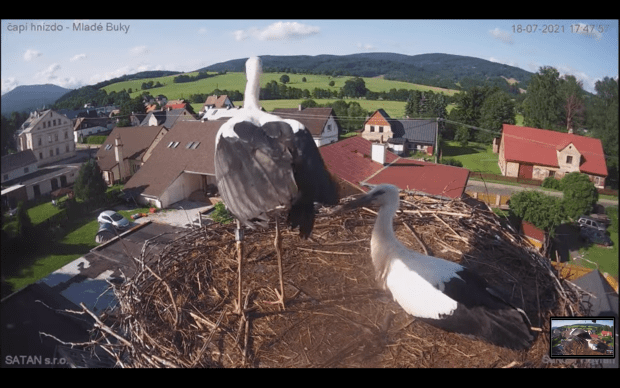
Here is the video so you can watch it.

The heat wave has taken more tolls on birds in the Pacific Northwest not just the Osprey chicks that literally roasted in the nests. Cooper’s Hawks have been jumping off the edge of the nests so they do not get cooked by the hot sun. This is a real tragedy in the making. Even the number of birds at my feeders is down. They spend the day in the myriad of vines in the shade of the house and the lilac bushes only coming out to drink and return to shade. The outside temperature near the water bowls reads 34 C. That is hotter than it is in the West Indies! So please put out water for the birds! Find old dishes and provide them with something. Thank you!

I hope that you are able to open this. If not you could Google ‘hawks jumping out of nests to avoid heat’. This is just so sad.

The streaming cams for many of the nests are being turned off as the season ends. Glaslyn will turn off the feed to Aran and Mrs G’s nest shortly as will Rutland Water on the Manton Bay Nest of Blue 33 and Maya. We will look forward to another season with them in the future. Blue 33 and Maya are a super Osprey couple – celebrities if you will allow me to call them that. They have been together since 2015 and have fledged 17 chicks. They raised a nest of four in 2019. That is almost unheard of and really takes a strong male to feed that many. I am impressed. I told someone if I came back as an Osprey in another life I wanted Blue 33 for my mate. He is incredible. They will return to the Rutland Manton nest in late March – usually within an hour of one another.

I expect many others will follow as it is costly to run the cameras. If you go to the camera and it is not functioning check the nest’s FB page. They have probably turned off the camera til the next season. But please remember that the breeding season is only beginning in Australia with the Peregrine Falcons, Port Lincoln Ospreys, and the WBSE.

NC0 up at the Loch of the Lowes nest is out fishing for her chicks. She is incredible. She spots the fish from the nest and dives down and gets it. Here is a very rough cut of a video of the two Loch of the Lowes chicks enjoying themselves.

I never thought I would say that a Golden Eagle nestling was cute but Zenit certainly is.

Zenit is really working on his wing flaps and from his crop it appears that he has had a feeding. That is good. I am just thinking how lucky Zenit is to be in a tree nest with shade.

Kindness is one of the cutest Bald Eagle nestlings I have ever seen! Here she is again trying to nibble around mom.

Oh, how beautiful. Kindness sitting next to Mom. Everyone thinks Kindness is a female because her Dad loves to feed her!

You are getting to be a big girl, Kindness. You are 52 days old today! More than halfway to fledge which will be around 89 days – the average for the Glacier Gardens nest. (The average in Alaska is 80 days).

Tiny Little has been in the nest every time I checked on her. A fish came in and 462 ate and ate. Then 464 came and couldn’t get the fish tail down. Tiny Little was playing with it when White YW brought in another fish. Tiny Little ignored it and dad left with the fish! Silly Tiny! Some dads will feed their chicks but White YW doesn’t seem to do this very often preferring that Blue 35 take on those duties almost exclusively. Tiny Little has yet to get confident in opening up a fish with a head.

White YW returned to the nest at 17:39 and Blue 35 flew in to feed Tiny Little. Tiny did not ignore that fish this time!!!!!!!

Oh, she just loves being fed by mum. Tiny Little eats for about forty minutes.

This kiddo should be stuffed.

At 21:00, Tiny Little and big sib 462 were cuddled up duckling style read to sleep.

It is not clear to me if Tiny Little ever did a second flight today. She was flapping those wings really hard and walking around the nest looking down for a long, long time. Often I had to leave only to return to find Tiny on the nest. Maybe someone saw her fly again?

Tiny tried everything but getting over on the middle left side of the nest and just going for it like she did when she fledged was something she did not do. There were a few good hovers. Fingers crossed for tomorrow. Need to get those wings strong and self-feeding down for migration.

The couple who saved the little osprey chick that fell into the river at the Putuxent Osprey Nest 2 were surprised that so many people from around the world watch their birds! I mentioned to them the need for an emergency number on the streaming cam. Fingers crossed! Thank you to everyone that sent them a thank you note. The chick is doing well.

Thank you for joining me for a quick look at a few nests on a Sunday evening. Take care. It is very hot in so many places or there are torrential rains and flooding. So where ever you are be careful.

Thank you to the following for their streaming cams where I took my screen shots: Glacier Gardens Park, Cumbrian Wildlife Trust and the Foulshaw Moss Osprey Nest, Mlade Buky White Stork Cam, Patuxent Park Osprey Cam 2, and Asociatia Wild Bucovino.

Late Saturday and early Sunday 17-18 July in Bird World

If you have watched Kindness, the Bald Eagle nestling at Glacier Gardens, then you might have caught her nipping at her mum’s beak. It looks like she is trying to kiss mum. A couple of days ago a video was made showing Kindness interacting with her mum. My goodness, Kindness, you are lucky your mum is so patient! Have a look.

At the Port Lincoln Osprey barge, it looks like the final touches have gone on the nest renovations. The egg cup is now lined with very soft pieces of bark. Mom decides to try it out!

Dad flies in with something else on his mind! No eggs yet but mating is taking place. Season will begin soon!

As we approach fledging at all of the Northern Hemisphere Osprey nests and migration in a month to six weeks, if you fear Osprey withdrawal, here is the link to this nest. Just a warning. This nest has had instances of siblicide in the past.

The Port Lincoln’s eldest chick from the 2020 season, a female named Solly, was fitted with a satellite tracker. Solly is 301 days old and she is still hanging out at Eba Anchorage and Kiffin Island. It sure seems that Solly has found her forever home at Eba Anchorage. For those of you unfamiliar, the movements of Solly changed what everyone understood about Ospreys in Australia. It was believed that ospreys stayed near to where their natal nest was located. Solly travelled over 200 km to Eba Anchorage and Perlubie giving the researchers fresh insights to the behaviour of these ospreys.

To my knowledge there has been no sighting of DEW, her younger brother. He did not receive a tracker but he did get a metal ring and a Darvic colour band.

Suzanne Arnold Horning was on the Cornell Campus again this evening. How lucky she was to get some great images of Big Red with a squirrel down on the ground – and it wasn’t raining. (Send the rain to the Canadian Prairies when you get tired of it, Suzanne!).

It was wonderful to see Big Red with prey that she was going to eat herself. She needs to build up her strength after laying eggs, incubating those eggs, and feeding and caring for the three Ks until fledge. Even now she is doing some prey drops and is busy training the Ks to hunt.

Big Red with Squirrel. @ Suzanne Arnold Horning

The Robins were giving Big Red a lot of grief. Could it be because Arthur has been up at their nest eating their babies? Or the fact that K1 caught a bird today and it was rumoured to be a young Robin?

Robins being rather assertive around Big Red. @ Suzanne Arnold Horning

Big Red and her squirrel also attracted another visitor – a Turkey Vulture!

Would you mind sharing asks the Turkey Vulture. @ Suzanne Arnold Horning

The pair also attracted a human who was said to have tried to interfere with the situation. Both of the birds were fine. Big Red was eating and the Turkey Vulture appeared to be waiting to see if she left anything.

One of the things that I have learned is that hunting is difficult and prey is not abundant always. Raptors can wait for hours, half a day, or even a day to catch prey to eat. It is estimated that only 1 out of 3 juveniles live to the age of two years – mostly due to starvation. Humans should not interfere when a raptor is eating. As a result of the human intrusion, Big Red chose to fly away from the human who was interfering. This also caused her to leave part of her meal. The vulture did eat the rest – so in the end everyone ate- but it was a situation that should never have happened. Remember if you see a hawk hunting or eating, please leave them alone. Finding their meal is not that easy.

Turkey Vulture at Cornell. @Suzanne Arnold Horning

The scientific name for the Turkey Vulture – Carthartes Aura – means ‘cleansing breeze’. They are scavengers, eating mainly carrion. They have dark espresso coloured feathers, red legs and head, with a white beak. Like the condor, there are no feathers on their head. This is a great evolutionary trait so that pieces of the dead do not stick to them causing disease or parasites. The Turkey Vulture’s sense of smell is so great that they can find a fresh killed animal a mile away! The only raptors larger than the Turkey Vultures are the Eagles and the Condors. What I find interesting is that they are the only raptor that cannot kill their own prey. They simply do not have the right talons to do this – their feet are more like that of a chicken. That said they can tear through really tough hides with their beak. In other words, the Turkey Vulture was never a threat to Big Red.

As I prepare to settle in for the night, Tiny Little is waking up. The early morning fog over the marsh is just starting to clear. You can see the parents, or siblings, or both back on the parent tree. Tiny Little is still sleeping like a duckling on the nest. Good Morning Tiny Little! Let’s get that gear box into forward today.

Tiny Little is also checking the nest for any little tidbits of leftover fish. And just like Tiny Tot he has found some lurking under those sticks.

Tiny Little was doing some prey calling and looking up in the sky. The morning fog doesn’t seem to be clearing. What a beautiful colour it is – that sort of golden pink gradually fading into the grey-blue-green. Lovely.

Update: Tiny Little had a huge breakfast. It is now mid-afternoon and Blue 462 is working on a fish that arrived. 464 is standing next to that fish and Tiny Little, 463, is ignoring it right now. She is probably still full enough from the morning not to bother. Unclear if Tiny Little has taken a second flight today. I stayed up waiting! But had to give in to being tired.

This is the image of the afternoon line up for a fish! 462 is eating, 464 is pretending to be Tiny Little and bugging his big sibling. Tiny Little is over at the side duckling style. Tiny Little is full from breakfast and knows that Mum will come to the rescue later if she gets hungry.

There is a beautiful peachy almost coral sky as the morning begins at the Poole Harbour Osprey nest. CJ7 and Blue 022 are roosting elsewhere.

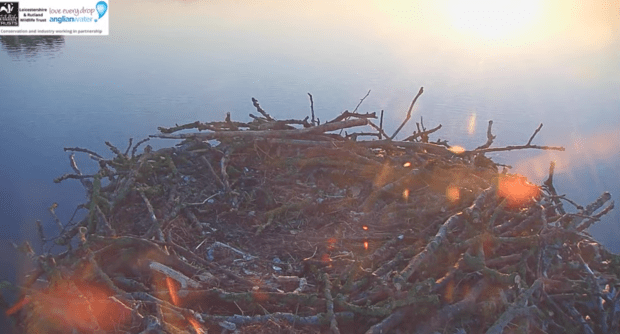
Golden diamonds are falling on the nest of Blue 33 and Maya at Rutland Manton Bay. No one is home. They are all perched elsewhere. Blue 33 does make food drops at the nest for the two Bobs.

A little later, Blue 095 flies into the nest and settles down and then flies out again.

Blue 095

Oh, wow. Just look at that sun coming up over the Dyfi nest of Idris and Telyn in Wales. It is so bright you cannot see the perch!

A very short video of Ystwyth fledging at 7:59 am on 17 July is here:

It is serene up at The Loch of the Lowes. No one is home but it sounds like there is a fledgling on the camera perch.

What you don’t see here is that later, NC0 is on the nest, spots a fish, goes out and gets it, and gives it to LM2.

Early Morning at Loch of the Lowes. 18 July 2021

The only thing you can hear at Glaslyn are either bees or wasps on the microphone! Oh, it is so beautiful and green. It has been hot at this nest, 26-29 degrees C – and the birds are staying cool in the shade of the trees. Even with the heat the landscape looks so lush. What a gorgeous way to begin the day.

Early morning at Glaslyn. 18 July 2021

Thank you so much for joining me today. I so enjoy hearing from all of you. Stay safe! See you soon.

Thank you to the following for their streaming cams where I took my screen shots: Byrwd Gwyllt Glaslyn, Dyfi Osprey Project, Scottish Wildlife Trust and Friends of the Loch of the Lowes, Cumbrian Wildlife Trust and the Foulshaw Moss Osprey Nest, Poole Harbour Osprey Project, LRWT and the Manton Bay Ospreys. I would also like to thank the Port Lincoln Osprey Research Project and the PLO FB page where I took a screen shot of Solly’s recent tracking. And last but never least, I would like to say a huge thank you to Suzanne Arnold Horning for allowing me to use her images on my blog. She holds the copyright on them so please do not use elsewhere. Thank you.

Bird Tales

Wow. I just want to sit and watch this short video over and over again. If you know someone who tells you that Ospreys are not intelligent and cannot problem solve, please show them this video of an Osprey nest in Vaasa, Finland:

https://fb.watch/6Da1-VNcEo/

I am going to recommend a lovely little book. It is called Hawk Mother. The Story of a Red-tailed Hawk Who Hatched Chickens by Kara Hagedorn.

The book has won outstanding awards for science for youngsters; I would say ages eight to twelve, elementary to the lowest level of middle school. My copy arrived in the post this morning. It is the true story of a Red-tail Hawk that was shot, would never fly, and was adopted by a zoologist that worked with the Cornell Lab. You can read more about their journey together on the website for Sunshine – that is the name of the Red tail hawk. That address is http://www.sunshinehawk.com Have a look.

You can purchase the book directly from Kara Hagedorn, the author and carer of Sunshine. It is also available through other on line outlets. It would be great for teachers or family who want to get children interested in birds. The images are photographs that Kara Hagedorn took of Sunshine. It is inspirational. Have a look and if you like the book and feel so inclined, recommend it to your local library. Hagedorn uses the proceeds to pay for the care of Sunshine.

Speaking of the adoption of Red-tail Hawks, I will mention again a book for adults, A Wing in the Door. Life with a Red-tailed Hawk. It is by Canadian Peri Phillips McQuay who took on the care of and rewilding of a hawk. Well written with great anecdotal stories. Find a used copy – your pocketbook will thank you. I ordered mine from amazon but went to the options so that I could get a used copy. I have no idea why the new price is so astronomical – avoid it at all costs!

And, of course, the best way to save money and space is to order through your local library. Ours will bring in books if they do not normally have them in stock.

When you finish reading the book, you will want to find out what happened to Merak. Go to Peri Phillips McQuay website and she will tell you!

I promised that I would post Ferris Akel’s Tour from Saturday, 3 July, once it was processed by YouTube and here it is. This is a full day tour that has been edited down to approximately 3 hours and 25 minutes. The Red-tail hawks on the Cornell Campus start 1:38:35 if you want to skip ahead. It starts with Big Red on the lights. There are some incredibly cute clips of the Ks preening and kissing one another!

There is not a lot going on in Bird World today. And that is a good thing. There was way too much drama when we had the storms and the extreme heat last weekend.

They continue to band ospreys in the UK – working flat out before they get too old and near fledge. Indeed, fledge watch is on for the Dyfi Nest of Idris and Telyn. Dysynnis, the male, is 49 days old today. Ystwyth is 45 days old. The chart for fledge times was also posted for that nest. Here is that information:

I love data. Just look at all that wonderful information! How many of us have been frustrated to go to a nest and not even have a history! Personally, if there is to be a streaming cam someone should take the responsibility of keeping accurate records and post them in the information section below so subscribers can see it. It would also help to have knowledgable moderators. Moderators are volunteers – they are not paid. They give up their time – a lot of it -to help us learn more about the birds. Histories and moderators would help citizen birders gain knowledge.

Nestlings such as the Two Bobs on Loch of the Lowes are just itching to fly so we are going to see some more fledging this week. They still love to have NC0 feeding them, though. Two big babies – look at the size of them – at the Loch of the Lowes! Laddie and NC0 did a fantastic job raising these two this year.

Others, such as the Two Bobs on the Manton Bay Nest, have fledged and are honing those wings while returning to the nest to eat. Blue 096, the female, has returned for a nice piece of fish this evening.

My goodness. Both of the parents at the Glacier Garden’s Bald Eagle Nest in Juneau, Alaska love to feed Kindness. I counted nothing short of six feedings yesterday!

When Kindness is finished eating, she looks like she is going to try out for The Hulk role in a new movie. It is a good things crops stretch! She is just now learning to stand and making attempts at walking. It is so sweet to watch her.

That is it for today. Thank you so much for joining me. Take care and let’s all hope that the nests just remain calm.

Thank you to the following for their streaming cams where I grabbed my screen shots: Scottish Wildlife Trust and Friends of Loch of the Lowes, Glacier Gardens Bald Eagle Cam, LRWT and the Manton Bay Osprey Nest.

The weather continues to claim the lives of our beloved Ospreys

The heat wave that hit the Pacific Northwest on the 28th of June continues to claim the lives of Ospreys. It is impossible to know the full extent of the impact because the vast majority of nests are not monitored. We now know for sure that two chicks at Clark PUD in Washington, 1 chick at Cowlitz PUD, 3 chicks at Osyoos, Exshaw lost 1 of 3 chicks, and all three at the Red Deer Nest in Alberta are unwell as I write and are not expected to survive. They are not eating. The little ones survived the heat to be hit with a torrential storm. Sadly I am not holding out much hope. The only raptor rescue in the interior of British Columbia has saved 26 raptors from perishing in a 24 hour period.

In a recent article, “The record-setting day when global heating surpassed COVID-19 as the existential crisis” in The Narwhal, Arno Kopecky came to the conclusion that the record breaking heat was not ready to take a downward curve because there are serious repercussions. The biggest one of those is wildfires. The town of Lytton hit a Canadian record for 47.5 degrees C. Then we watched that town burn to the ground.

There will be more wildfires – fires that rage and kill humans and animals and burn the trees that help cool the planet. Creeks and wells will continue to dry up. No water, no fish.

Kopecky mourns the lack of seriousness and understanding and says that it took this “extreme heat wave to galvanize public concern over climate change”. He believes that it is NOW – not in three months – but NOW when the heat is still killing that we, the people, must talk to our leaders and friends “about what a heat wave like this means, and what we’re willing to do about it.”

It is understood that the heating of the oceans will cause more hurricanes and storms. Right now sitting off the coast of Cuba is Elsa. That storm has its heart set on battering the west coast of Florida where there are many sea birds including our beloved, Tiny Tot.

This is the latest map showing the path that they believe Elsa will take. What happens around Cuba could change this trajectory.

For those of us worrying about Tiny Tot, the good news comes out of Wales at the beginning of June. How many of you watch the UK Osprey Nests? If you don’t, you should!

Wales was hit by a Force 11 wind storm that brought heavy rain. The wind was blowing at 75-78 mph. Mrs G, the oldest Osprey in the United States, was on the nest with her and Aran’s 2021 brood. Chicks were hatching as this storm raged. The chicks died but not because of the storm. Mrs G was soaked but she stayed on that nest! In an earlier storm that hit Wales, Monty, one of the most beloved Osprey males in Welsh history, went fishing during Storm Hector for his family.

So what I am saying is that many birds and nests will weather such a storm just fine. We are fortunate that there are no chicks on the Achieva Nest. Chicks have perished in such storms as evidenced by several weather systems that hit Martha’s Vineyard and region years ago. Imagine if this were the 10th of March?! The nest tower that the Achieva Credit Union built should have been designed to withstand a hurricane. Tiny Tot and Jack will hunker down. They may eat a lot more before the storm arrives to sustain themselves.

And now for some brief news from other nests. Electra has been on and off the nest at Cowlitz PUD. This morning around 6:30 ish, her and Wattsworth were both on the nest.

Mom and Dad both slept on the ropes last night at the Port Lincoln Osprey Nest in Australia. This is giving hope that the 2021 season is about to begin for these rare birds in Australia.

I was also very happy to see the official report on the ringing of the three ospreys on the Foulshaw Moss nest in Cumbria. There is some information to be corrected. The first hatch is a female and she is now Blue 462. Middle Bob is the one that they could not determine the sex. That bird is Blue 463. Tiny Little Bob – oh, bless you – is a male and is Blue 464. He weighed 1.6. I always believed that Tiny Little was a tiny little boy and that Big Bad Bob was a female. Thankfully it turned out that way! Someone had written, incorrectly and I picked up on it, that because Tiny Little was growing so fast it had been decided he was a female. Oh, dear.

Tiny Little is definitely growing! He still prefers not to lean on Big Bad Sister – and she is a big girl. There they are looking at something coming – White YW with a fish perhaps.

The two Rutland chicks, 095 and 096, of Maya and Blue 33 continue to practice their flying skills. They are doing great.

Flying certainly makes the little ones tired. It takes a lot of energy especially when they are learning. Both have had some good power naps.

Blue 33 makes sure that they are all fed. 095 and 096 take turns eating. Neither is out witting the other with the fish and the self-feeding. That is truly refreshing. Maya and Blue 33 rank up there as one of the power couples of UK Ospreys in terms of rearing chicks. There is never a shortage of food and Maya keeps good organization on the nest.

It is raining around the UK Osprey Nests right now. Earlier the two Bobs on the Loch of the Lowes Nest were enjoying a lovely dinner right in the middle of the drops. It is a bit too soggy to think about fledging right now but that day is coming. We will all need our worry beads!

Did you follow Louis and Aila on the Loch Arkaig Osprey Nest? If you did, I know that you are amongst tens of thousands sad because Aila did not return from her migration this year. Louis finally took another mate. They now have chicks on another nest, off camera. One devoted Osprey fan visited the area of the nest and was able to take photographs. I am sorry I cannot share them with you but what I can say is that Louis and Mrs Louis (that is what someone is calling her) have at least two healthy chicks on that nest! They are soooooo cute. There could be three. Mrs Louis would not move from her perch on the railing of the nest for the visitor to see further into the nest. I am so happy for this very devoted Osprey Dad.

Thank you for joining me and thank you to all that send me a note or make a comment. Let us all wish that Elsa gets slowed down before she gets to Florida. Take care everyone.

Thank you to the following for their streaming cams where I grab my screen shots: Achieva Credit Union, Scottish Wildlife Trust and Friends of Loch of the Lowes, Cumbria Wildlife Trust and Foulshaw Moss Osprey Nest, LRWT and Rutland Water Manton Bay Ospreys, and Port Lincoln Osprey.