Sadly, no word about Malin

I want to thank everyone that took the time to write to me and tell me how much Malin meant to them. My inbox was overflowing with letters expressing love and concern for Malin. Everyone wanted to know if there had been any word. Mom and Dad have both been on the nest with fish and today Marsha (mum) was there around 13:00. She did not have any fish that visit. During her morning visit she called out for Malin. So far there has been no sighting of Malin.

After going through the FB postings of the Nature Center, we were able to determine that Malin was the middle hatch. The youngest just disappeared from the nest and the eldest died in the middle of June leaving Malin, the chick that hatched on 18 June, alive. Malin was then the middle hatch of 18 June. Malin then was 63 days old at fledge. The average age for ospreys to fledge in Wisconsin appears to be 55 days. That would make Malin’s timing within range. Most ospreys spend at least 2 weeks flying and letting their parents feed them. Many stay much longer. Two examples that I give are Tiny Tot and Tiny Little because they were both hatches that suffered from lack of food. Tiny Tot stayed on the nest for a total of four months or 120 days. That is more than twice as long as Malin. Tiny Little remains on the nest in Cumbria. She will probably fledge before Tiny Tot’s 120 days – but she could be on the nest for 90 days.

There is disagreement over whether Malin simply flew or whether or not Malin was frightened off the nest by an intruder. Experts on both sides see that exit differently. It is unfortunate. The result is the same – Malin has not returned to the nest. The reactions to looking for Malin are different depending on which you believe. If Malin just flew because he wanted to then no one would go and really look for him. If one believed that Malin was frightened off the nest, they might worry that he was injured and look harder. Something that has to be kept in mind is that Osprey feed their fledglings on the nest – it is preferable. They do sometimes feed on a branch but I haven’t found an Osprey expert that has ever seen an Osprey parent feed their fledgling on the ground. In fact, if a fish falls off a nest they will not go and retrieve it. Have you ever seen an Osprey eat or feed its chick on the ground?

The research continues to stress that the more food and the longer fledglings stay on the nest the higher the success rate. That is the reality. This nest is really empty. Malin defied the odds – he survived and thrived. We hope that the name we gave him carries him on into his life and that he is somewhere safe eating a fish.

Collins is looking down like he might be seeing Malin.

One of the last times the entire family was together on the nest. It was a real privilege to watch little Malin survive and then – thrive. Let us all continue to send this family positive energy.

19 August 2021. Malin, Marsha, and Collins.

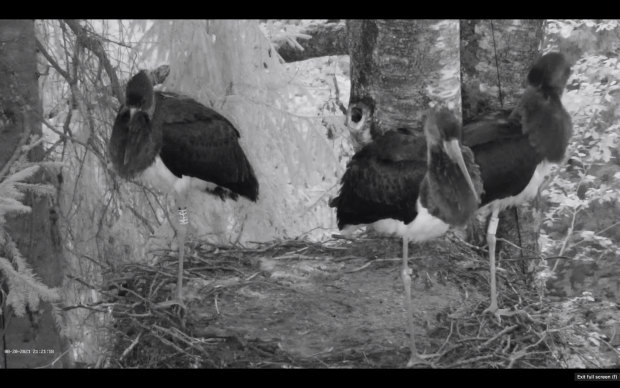
It is about 7am in Latvia and Estonia as I write this. The Black Storklings are waking up and like all birds are a little more energetic than they are at mid-day.

The two images below are from Grafs and Grafiene’s nest near Sigulda, Latvia. At least one of the storklets has fledged. Perhaps today they will all fledge and find the feeder area with the beautiful Grafiene decoy.

It is now just after 9am in Latvia and there is only one storkling on Graf’s nest near Sigulda. This means two have fledged just like my source had indicated. The second fledge is the oldest at 7:43 am. He is 70 days old today. The youngest fledged at day 66 after hatch.

This was not the smooth flight of the youngest. The oldest hit the branch on the other side of the tree. There is concern about the condition of that wing. I will update you as soon as there is any information. Send your strong and positive wishes. I hope it looks worse than it was. How terrifying for this young bird to have that happen.

Even so, I hope that both of the storklings are at the feeder filling themselves with fish – just like we hope Malin is doing the same.
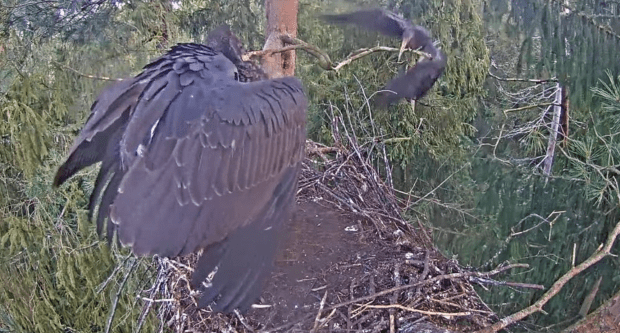
There is now only the middle hatch. Perhaps it will go today. They are 68 days old.

When I checked on Jan and Janika’s storklings in Estonia’s Jogeva County, no more fish have been delivered to the nest. It looks to me like every scrap of the old fish has been eaten – I thought that yesterday. Perhaps one really packed down in the nest is there, the one the storkling on the left is pecking at. All of the birds need food.

Hopefully all of them will fledge and find the feeder set up for them, too.

They are so beautiful with the sunlight filtering through the trees. The storks are 67 and 68 days old today. The average for fledging is 68-72 days. I wonder if Urmas will deliver some more fish?????

Do you watch the peregrine falcons, Xavier and Diamond? If you do, then you will know that part of the pair bonding ritual is Xavier presenting a prey item to Diamond. Diamond is not that particular but, she does not like Starlings. She cannot stand them. She has turned Xavier away when he had a Starling for her. They must taste terrible!

Well, today, Xavier hit the jackpot. Diamond was completely excited about her lunch – although some of you might not be. Xavier had a Superb Parrot for his beautiful Diamond. Make sure your sound is turned up.

Superb Parrots are also known as Green Leek Parrots or the Barraband’s Parakeet. These little beauties are native to southeast Australia living in the dry woodlands of New South Wales and Victoria. They were once considered vulnerable in terms of conservation and have been listed as Least Concern since 2012. Loss of habitation due to timber logging might well see this bird back as being vulnerable.

They are medium sized, growing up to a little over 15 cm or 16 inches in length. The bird in the image below is a juvenile. How do I know that? It has brown eyes while the adults have yellow-orange eyes. The adult male has a bright yellow face and throat while the female looks like the plumage that the juvenile has below. They eat fruits, berries, insects, as well as grains and nuts.

Awww. What a sweet face.

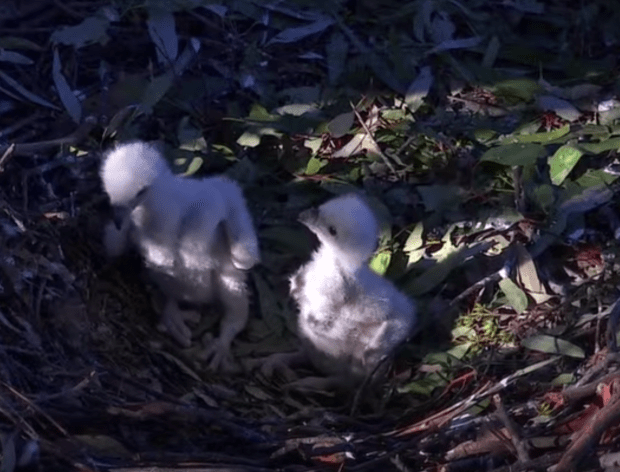
WBSE 27 and 28 continue to charm the socks off of everyone. That beautiful fluffy white down is in transition. They look a little like old terry cloth towels sleeping in their nest this morning in Sydney.

Look closely along the edge of the wing of WBSE 28 on the left. You will see the little pin feathers coming.

The pantaloons are growing too.

Just look at that sweet baby, WBSE 28, looking up at its parent. How adorable.

They are so young and yet, both of them know to pancake when there is an intruder near the nest. They hear their parents alarming and down they go. Look at the concern shown in the eye of WBSE 27 on the left. You can also see the black pin feathers coming in on both in this image better than the other one. But look – their cute little tails are growing!

You cam almost see them growing right before your very eyes.

Tiny Little still makes my heart skip a beat. Oh, what a wonderful bird you have turned out to be. You were so very tiny with that big older siblings but just look at you waiting for your breakfast to arrive.

Oh, you have that ferocious look like Mrs G. I have said that a couple of times but you do, Tiny Little. I hope you live as long as Mrs G and have lots of successful hatches. You really are quite amazing, Tiny Little.

Tomorrow is Saturday but there is no Ferris Akel tour this week. I was hoping to catch up with what is happening with Big Red and her family. It was raining yesterday but the Hornings were able to spot all four of them so we know that K1 and K3 are still with us – how grand, the 21st of August.

I am researching ‘Climate Driven Evolutionary Change’. If you know of bird arrivals or departures that are earlier than normal or later than what has been the norm, please let me know. It is much appreciated.

It is so nice to have you here with me. The rain is still falling – and that is a good thing. Please continue to send your positive wishes to Malin and all the bird families. Take care of yourselves. See you soon.

Thank you to the following for their streaming cams where I took my screen shots and video clip: The Falconcam Project at Charles Sturt University and Cilla Kinross. Collins Marsh Osprey Nest, Cumbrian Wildlife Trust and the Foulshaw Moss Osprey Cam, The Eagle Club of Estonia, The Latvian Fund for Nature, and the Sea Eagles Cam, Birdlife Australia, and The Discovery Centre.

Friday in Bird World – the happy and the sad

There were a few people who did not sleep well last night – concerned as we were over the safety of Malin. At the same time, there are great people going out to check on our little warrior. I want to give a shout out to Susan Theys, the wildlife rehabber for the area. Susan searched last night for Malin to make sure that he was OK and is returning sometime today, when she gets a chance, to search again. In addition, I want to thank Jake Koebernik, the Osprey and Eagle DNR staff for area 3, Steve Easterly, the DNR Biologist, and Patricia Fisher, Wildlife Rehabber. Malin had been flapping its wings vigorously yesterday and for a few days. Still, the video footage shows a chick that left because there was an intruder.

Two other really good things happened. The rain has been pouring down for hours on the Canadian Prairies. The ditches are full and it is marvellous. I hope that it rains for a week – putting out all the fires and filling up the water reserves. Instead of being grumpy, people are so happy. This rain might also be falling in Missoula, Montana – in the Clark Fork River tomorrow. Fingers crossed!

The second miracle happened in Latvia on the Black Stork nest of Grafs and Grafiene near Sigulda. For those who do not know, the male, Grafs was having a difficult time feeding the storklings by himself since Grafiene left for her migration. A feeder area was fixed in the ditch and stocked with fish along with a decoy of Grafiene. Grafs had not found this and the concerns grew. Fish could not be delivered directly to the nest because of the condition of it. On 20 August, Grafs made one fish delivery. BUT the miracle happened at 8:39:34. The youngest storkling, at 66 days, fledged. My source tells me that two fledged but I need to confirm the second. Now the storkling/s can find the feeder and supplement any food from Grafs. What a relief! I hope that all of them leave the nest. The oldest is 69 days and the middle is 67 days old. This is the best solution.

Here is the flight sequence of the youngest:

Wheeeee.

In Estonia, in Jan and Janika’s Black Stork nest in Jegova County, the trio have eaten every bit of the fish that Urmas has brought to the nest – for the banding and then the pail of fish the other night. You can see that they are gone in the image below.

Jan fed the storklings at least once today. These birds, like those of Grafs, are almost ready to fledge. They will, hopefully, find the feeder area set up for them too!

It is essential that we all stay hopeful – for the six storklings and for Malin. Send strong positive thoughts to all these birds.

I took this at the tea time meal. Tiny Little did not have the fish, Big Brother 464 did but, she is waiting and hoping and so far White YW has been a great ‘Door Dash’ delivery.

Oh, this bird has brought us such joy. She is tenacious. I adore her.

Dad wouldn’t leave Tiny Little hungry and screaming her head off! It is three hours later, the last fish of the day probably, and here is Tiny Little filling her crop in the image. Oh, you are going to sleep well Tiny Little!

There have been rumours that some of the female Osprey in the UK – the ones on the streaking cams – have fledged. Today, Telyn, who was believed to have left since she had not been seen since Wednesday, turned up with a fish on the Dyfi Nest. So Telyn is still with us!

Mrs G is still on the Glasyn Valley nest. Oh, she is so stern looking! You can almost tell an Osprey female from the intensity of their gaze.

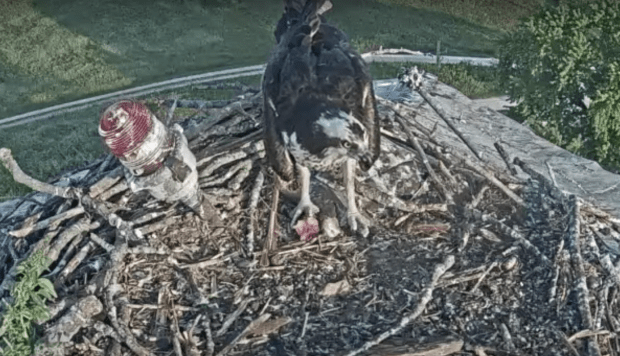
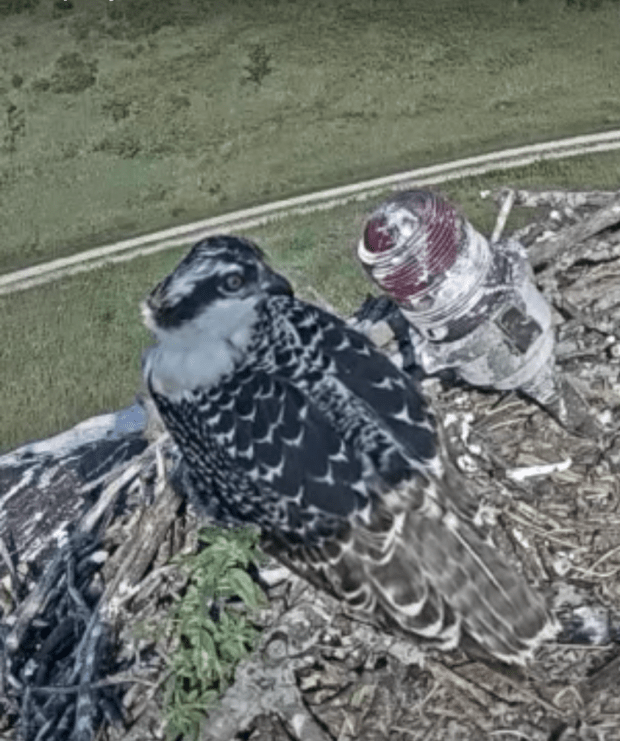
Disturbing news coming out of Maryland in the US today concerns two workers who needed to replace a light in a Southern Maryland Park. Actually it is outrageous. To do that, they removed two Osprey chicks from their nest and euthanized them. I know how to spell both words ‘disturbed’ and ‘angry’. The incident occurred at Cove Point Park. “County officials said they had a “cooperative services agreement” with the U.S. Agriculture Department’s Animal and Plant Health Inspection Service (APHIS) to have the ospreys and their nest removed. The commissioners said they were “not consulted or informed as to why or how the decision was made to euthanize the juveniles in the nest rather than relocate.” That last word is very significant – relocate. Relocate is not euthanize.

The Washington Post article is here. I hope you can open it. If not, Google the subject. There will be other news agencies picking up this story.

https://www.washingtonpost.com/dc-md-va/2021/08/20/two-young-osprey-were-removed-their-nest-euthanized-so-workers-could-replace-light-southern-maryland-park/?fbclid=IwAR2FK-kl_ATvumaLbvuTcOXd27F7GIywXTafm6Hh2MKm4FwaadqqW_O83PE

When the laws and agreements do not work, who advocates for the birds? The Audubon Society acted as advocates for Pale Male’s nest on Fifth Avenue. Maybe Audubon will go to work for these two?

If you find this as disturbing as I do, take a few minutes and fill out the form telling the Commissioners of Calvert County, Maryland what you think. Here is the link to the form:

https://www.calvertcountymd.gov/FormCenter/Contact-Us-Main-Homepage-8/Contact-Us-49

Always good for a smile or three are the two sea eaglets, WBSE 27 and 28. My goodness these two are so close in size and the bonking was at a minimal this year. They are well fed and healthy….and those pin feathers are coming in and they are both preening up a storm!

I have not been able to spend as much time with this family in the Sydney Olympic forest but I hope that might change. These two are growing slightly ahead of schedule it seems – their big clown feet match those crops. Just stop and look at those crops. They are so full they sag. Crazy. Dad and Lady are doing a fantastic job. So pleased.

The day is just beginning in the forest. Just look how big that sea eaglet is next to Lady! Wow.

I know that many have not watched this nest because of past things that have happened. I encourage you to check in this year. Lady is a more experienced mom and both of the eagles are healthy. There is no one getting the advantage over another. They are delightful.

That is what I want to leave you with this magnificent rainy day – a smile. Those sea eagles are adorable. Why not stop in and check on them? Here is the link:

Thank you to everyone for joining me. Please continue to send your positive energy to the Black Storks in Latvia and Estonia, to those storks and Ospreys migrating, and to little Malin. Malin really needs it. To my knowledge he has not returned and it is worrisome because the parents have been on the nest with fish today trying to lure Malin back. Malin is approximately 2 months and 2 days old.

Thank you to the following for their streaming cams where I took my screen shots: Collins Marsh Nature Centre, Byrwd Gwyllt Glaslyn, Dyfi Osprey Project, The Latvian Fund for Nature, The Eagle Club of Estonia, Sea Eagle Cam, Birdlife Australia, and The Discovery Centre, and The Cumbrian Wildlife Trust and the Foulshaw Moss Osprey Cam.

Malin, the Strong Little Warrior

I reported earlier today that Malin, the Osprey chick on the Collins Marsh Nature Centre’s nest, had fledged. Malin flew off the nest at 3:42 pm.

We use the term ‘fludge’ when a bird accidentally falls out of the nest and flies. But what do you call it when a nestling is scared off their nest and flies?

For several minutes before Malin flew, his mother, Marsha, had been on the nest. She was watching and alerting. There was an intruder. Marsha even ducked on occasion. When Mom flew off the nest something happened to spook Malin. He had been pancaked. Malin had done this before. But this time, the intruder must have come near enough to the nest that it spooked Malin. Without thinking and scared out of his wits, Malin flew.

Here is a video clip. You can see the shadow of a bird flying at 10 o’clock – it is impossible to know who it was – at the end.

Malin was not prepared to leave the nest. He had been exercising his wings but he had never hovered. He really needed another couple of weeks to work his wings. His feathers were continuing to grow and he was catching up for his age but he was still behind. Today, Malin was 2 months old and a day – we think. He is the only one of three hatches to survive and it is not clear which hatch he was.

Mom immediately returned to the nest looking for Malin.

Collins, the dad, came in later with a nice piece of fish hoping to entice his son to the top of the tower. Collins did look over in the area of the trees and I am hoping he knew that Malin was there.

The nest is 120 feet up and I am told that flying up is much more difficult for a bird than down. Malin is not a sophisticated flier – could he make it to the top of the tower? Collins seems to think so. I hope he is right. Indeed, I hope that Malin is unharmed and makes his way home so that he can benefit from more food and more wing exercises.

This situation has heightened my call for all streaming cams to have emergency contact numbers immediately after the name of the site and before any historical or current information about the nest. That is so the numbers can be found quickly and easily. The minute this situation happened, the office at the Nature Centre was called. The message went to voice mail. At that instant a flurry of e-mails went out from the US and Canada to try and find someone who could go and look for Malin on the ground. FB Messages were sent. Luckily ‘S’ found the wildlife rehabber for the area, living 25 minutes away. By this time more than thirty minutes had passed, possibly 45. This individual listened to what had happened and got in their car and went to check on Malin. By the time they arrived it was getting dark. They reported that it was quiet around the marsh. Tomorrow this person will return and is hoping that Malin will be close by or food crying. Of course, it would be even better if Malin were sitting up on the nest or sleeping duckling style from all the activity. The three of us that named Malin are hoping that he lives up to the name he was given, ‘Mighty Little Warrior.’ Tonight we are anxious and fearful – all we can do is hope and wait. It will be a very long night.

For the past year I have been requesting that individuals responsible for streaming cams ensure that there is emergency information so that the community of birders watching these nests can contact someone – a responsible person who will provide assistance to the bird or animal – immediately. I realize that individuals do not wish to give out their private phone numbers. The park or nature centre with the streaming cam could have two dedicated cell phones only for emergency calls. Those could be provided to those in charge. Then they would not have to have their own numbers or phones used. The person at the end of that phone line would have their own list of specialists to contact for the specific emergency. It really is that simple.

The alternative is to have a 24/7 chat room with moderators who have emergency numbers. Moderators are volunteers. They do it because they love the birds. That is actually the simplest and cheapest way to handle emergencies.

The vast majority of individuals who watch the nests are bird lovers. If they see a tiny leg tangled in fishing line they want that bird to get help. If they hear a chick fall off a nest into water, they want to help. If they notice nestlings behaving strange, having tremors, refusing to eat, they want to fine someone who will listen and help. This year all of these things have happened, some many times, and it was thanks to the community birders that help came. Sometimes people did not listen to the alarms set off by fifty or more persons watching two eaglets on a nest in Florida. They were behaving poorly. One died. Then the second. The person who set off the first alarm said ‘rodenticide’ – and they were correct. Community birders are not quacks. Many have watched nests for more than a decade. They are informed and they want to help. They do not want to waste anyone’s time.

Thank you for sending your prayers and your warm wishes to Malin and to the boots on the ground who are trying to find him and care for him. Thank you for listening to my call for a solution so that help can come to the birds immediately when something happens. If you are in charge of a streaming cam or know someone who is, please talk to them about having emergency numbers or 24/7 moderators on the chat who can get in touch with the right person if something comes up. It is really important. Thank you!

Thank you to the Collins Marsh Nature Centre and the Cumbrian Wildlife Trust and the Foulshaw Moss Osprey Nest for their streaming cams where I took my screen shots and my video clip.

I plan to bring an updated report on the Black Storks in Latvia and Estonia later tomorrow. There is still someone who can pull at my heart strings even when I am so worried about Malin and that is Tiny Little! It is 6:30 on her nest in Cumbria and there she is having her breakfast fish compliments of White YW. Thank you, dad. Thank you, Tiny Little. You give me hope for Malin tonight.

Send love and positive energy to Latvia and Estonia

I want to begin with the Black Stork nests today. For those just learning about the situation of the Black Storklings in both Latvia and Estonia, here is a very brief summary. The storklings at the nest of Grafs and Grafiene in Latvia and that of Jan and Janika in Estonia are late hatchlings. There was concern from the beginning that both parents might leave for their migration before the storklets fledged. Currently, the mothers have left and the fathers, Jan and Grafs, are the sole providers. Neither male can provide enough food for three storklings to thrive. There is also a question of the supply of the fish. In both Latvia and Estonia, feeder situations have been established with decoy female Black Storks. To date, neither male has found these feeders.

‘S’ in Latvia reports, “The good news is that it seemed that yesterday Grafs had encountered a generous feeding place on the way, not so far away. We were already a bit sad thinking that the storklets will have to spend another day with just one small noon feeding, what a celebrated surprise it was when he came back less than 4 hours later with plenty of food. Many of us bursted into happy tears:) It is good to know that he can still manage to get food elsewhere even if it is not from the feeder. And the most important thing is that he is still here caring for his young.”

aGrafs and Grafiene’s Storklings, Sigulda, Latvia 19 August 2021

At the very beginning, M. Strazds, a Latvian Black Stork specialist, warned that he felt that there was only 0.1% chance that Grafs would find the feeder because birds do not normally search for new feeding spots at the end of the nesting season. Still, as I understand it, the storklings, once they fledge, will find the feeder and it will be very good for them.

In Estonia, Jan has made only one delivery that I am aware of. The storklings have supplemented that with the fish that Urmas delivered last night. I was made aware that the storklings were playing with the fish but, it appears now that they have been eating them as the pile of fish is almost gone as I write this. I am aware that there are controversies about the effect of humans getting close to the nest because of the stress that it causes on the birds. But starving is also a major stressor. I believe that Urmas and his team know what they are doing and I hope they continue to feed these birds.

Jan and Janika’s Storklings, Jegova County, Estonia

There is one other nest with a fledgling, Pikne, the female, still being fed by a parent and that is the nest of Karl and Kaia in the Karula National Forest in Estonia. ‘S’ reports, “The feeder approach has been very successful with Karl’s nest in Karula for the sole reason that he has a transmitter and it is possible to track his usual feeding places.”

Pilkne, the last remaining storkling being fed by Karl II at the nest in the Karula National Forest in Estonia. The other two have fledged.

It has been a very difficult year for those who care for the birds and who watch the streaming cams. Osprey chicks died due to weather related issues and Cooper’s Hawk eyases got so hot on the nests in Canada, they lept off the nests to avoid literally being roasted. Many are dying as they undertake their migrations which are challenging enough without having fires and smoke enroute.

At the same time, there have been some remarkable situations. Around the world, humans have stepped in to save birds of every variety. In the interior of British Columbia, the wildlife rehabbers climbed the Osprey nests and removed the chicks taking them into care because of the extreme heat and fires. At various places around the world, Osprey chicks have been fostered and received a second lease on their life. A Canada Goose named Arnold had his digits fixed so that he could live a full life with his mate, Amelia. A very old Bald Eagle full of lead was given treatments and is now thriving and waiting for A Place for Hope to get its permit so he can be their ‘forever’ bird. Every day I read about a group of people and trying to help fix what many believe is unfixable. I hope that this is just the beginning of a change in intervention and our understanding of what works and what doesn’t. The key is not to give up.

There are, however, three miracles. I am thinking of the three Ospreys that should have died but did not – they have thrived – two of them to become dominant on their nests! Those were Tiny Tot aka Tumbles at the Achieva Osprey Nest in Florida and Tiny Little Bob aka Blue 463 on the Foulshaw Moss Nest in Cumbria. To me these are simply nothing short of a miracle.

Tiny Little Bob aka Blue 463, Foulshaw Moss Nest, 19 August 2021

The third has yet to fledge but has shown remarkable growth. I am aware that many on the chat rooms in Latvia and Estonia are concerned about feather growth. This was also a big concern for Malin on the Collins Marsh Nest in Wisconsin. Malin is our third miracle.

Malin, Collins Marsh Osprey Nest, 19 August 2021

I cannot tell you what happened to make the food deliveries on this nest turn around. All I can say is that they did and there are no more missing feathers, the tail now has 7 dark bands when 3 weeks ago there were 2 with the hint of a 3rd. It has been a remarkable recovery. At one time, there was concern that Malin might survive but not be able to fly. Those concerns have now vanished. Today, Malin has had 3 fish deliveries before 1pm and one of those was a whopper. Malin actually walked away from being fed by mom, Marsha, he was so full.

One of the major concerns for the Collins Marsh Osprey Nest is that the parents would also leave Malin on the nest and begin their migration. So far everything is going smoothly so I will just ‘knock on wood’ that it continues to be that way.

One other good news story is that the fires in Turkey are dying down or are out.

And there is more. Aran, the mate of Mrs G on the Glaslyn Valley Osprey Nest, was injured and was missing a couple of primary wing feathers,. There was a huge concern that he would not be able to fly — and consequently that he would not be able to fish or be able to migrate. Well, look at Aran’s feathers today! Yahoo. He is good to go. Tears. This is an amazing couple who lost their three chicks due to starvation when Aran was injured. The Glaslyn community kept the birds alive with a fish table until Aran was able to fly and fish.

Indeed, I do not want people to think that feeder areas or fish tables do not work. It depends on the circumstance and in the case of Aran and Mrs G as well as the Mlade Buky White Storklings, those fish tables saved the lives of those two families.

Aran at the top sitting on edge of nest! 19 August 2021.

We have a lot to be thankful for – and there is a lot of work to do to figure out how to help our precious birds – all of the wildlife. Humans stepping up to take responsibility and to “try” even if they are met with low odds and negativity should be the norm not the exception.

What can you do today to help the birds and all of the wildlife?

I want to close today with a bit of a giggle. If you watch Ospreys you understand how difficult it is for both the male and female to raise three. Actually that is true of eagles as well. Well, what about five? Now consider the fact that those five are all female. The poor dad would need a set of sound cancelling headphones!!!!!!!!!! You can hear females clear across a lake. Oh, my. The parents of these Westport, MA fledglings will certainly deserve their winter break.

Thank you for joining me on this quick update on what is happening in Latvia and Estonia. Send them all of your positive energy – and take care.

Thank you to the following for their streaming cams where I took my screen shots: Collins Marsh Nature Centre, Cumbrian Wildlife Trust and the Foulshaw Moss Osprey Nest, the Eagle Club of Estonia, the Latvian Fund for Nature, Brywd Gwyllt Glaslyn and the anonymous reader of my blog that sent me the image of these five beautiful female Ospreys. Thank you.

What is better than a Peregrine Falcon Kiss?

Lots of people keep track of hurricanes and tropical storms. Most watch because they or their loved ones, or both, live in the line of the storm. Bird watchers also track weather systems. There are currently two systems that might impact our beloved Big Red and family as well as the birds that are migrating over Hawk Mountain, PA.

Henri is going to give some heavy rain and wind. Ithaca is west of the darkest green band but could get some rain.

Tropical Disturbance Fred will also give some heavy rain in the same area. There were flash flood warnings for Ithaca last night. It is 1:03 am Thursday morning in Ithaca and there are rain drops dripping off the metal supports of the light stand that Big Red and Arthur’s nest is on. The rain does not look heavy at the moment. There is also a peculiar corn plant growing out of the centre of the nest!

Heavy rain will impact the hawks ability to hunt. They would have felt the pressure system coming and hopefully caught more food yesterday.

This isn’t the beginning of the season. Hurricane season runs until 30 November.

Baby Kindness (I wonder if she would mind if I call her that?) is not worried about hurricanes. Today, she is 83 days old. Kindness branched yesterday and all she has on her mind is ___________________. If you said flying you are 100% correct. She has really been putting on a show for the people watching the live stream today.

Oh, she really gets some nice air under those wings going back and forth from the branch to the nest.

Wow. Look at those wings. Magnificent.

Kindness has spent a lot of time considering what is below that branch she is sitting on. Sometimes she gets the branch to bouncing a bit and that seems to unnerve her slightly and she flies back to the nest.

For several days, I have been talking about the migration of Ospreys in Wisconsin, like Malin, or those living in the United Kingdom or in Northeastern Europe. The Bald Eagles in Alaska do not migrate south of Alaska unless there is no food. In 1972, the State Legislature established a long stretch of the In Chilkat River as critical bald eagle habitat. The goal was to protect the birds, some 4000 of them, that move from the interior to the Chilikat River Valley where they feed on the Chum Salmon run during the late fall and winter. The juveniles normally eat spawned and dead salmon or the carcasses left behind by bears.

The Glacier Gardens Rainforest Adventure is located in the Tongass National Forest just fifteen minutes away from Juneau. This is where Liberty and Freedom have their nest and where Kindness will fledge. There are meadows, forests, and glaciers. What a spectacular place to be a Bald Eagle!

“Tongass National Forest” by markcbrennan is licensed under CC BY-SA 2.0

One of the features of the park is the Mendenhall Glacier.

“Mendenhall Glacier – Tongass National Forest” by jcsullivan24 is licensed under CC BY-NC 2.0

Liberty, Freedom, and Kindness are not far from the Chilikat River Valley and the Alaska Chilikat Bald Eagle Reserve.

In the spring, many of the Bald Eagles will head to areas rich with Herring and Eulachon. These include the Stikine River, Copper River Delta, Silka Sound and Kenai Bend. You can see some of those on the map below. The Copper River flows from Prince William Sound while Silka Sound is closer to Juneau on the far right bottom.

Kindness is fortunate to live in such a beautiful state with what we all hope are abundant resources for her and all the wildlife forever.

There are so many worries in the world. The birds bring so much joy to each of us filled with nail-biting anxiety and that bittersweet moment when our friends fledge to begin their lives off the nest.

Malin is beginning to feel the wind beneath his wings. For so long I did not believe that Malin’s feathers would develop and he would fly – but here he is preparing just for that. Joy.

Like other birds, Malin is doing much more wing strengthening flapping as fledge approaches. The energy from the fish he is eating gives rise to lots of exercising after a feed.

For tonight though, Malin is sleeping like a duckling dreaming of fish.

While Kindness and Malin are dreaming of fish and flying, Xavier and Diamond are constantly pair bonding while preparing for their 2021 eggs and hatches. After doing their courtship dance in the scrape box today, they sealed the deal with a kiss – peregrine falcon style.

Can you think of a better way to end this newsletter? I can’t!

Want to catch the adventures of Xavier and Diamond, here is the link:

Well, what could be better than a Peregrine Falcon kiss? Three Black storklings eating the fish that Urmas brought them. That is actually cause for a big celebration!

When the storklings woke up at dawn and found the fish gift from Urmas, they began to eat.

The feeding of the storklings is a success! Congratulations.

Thank you for joining me this morning. Have a wonderful Thursday. Take care all.

Thank you to the following for their streaming cams where I took my screen shots: Cilla Kinross and the Falconcam Project Charles Sturt University, Collins Marsh Nature Centre, Glacier Gardens Rainforest Adventure, Google Maps, Cornell Bird Labs Red Tail Hawk Streaming Cam, and the National Hurricane Centre.

Things are happening in Bird World

Oh, just look who showed up on the NorthEast Florida Eagle’s nest in Jacksonville today – none other than the resident male, Samson! It was 7:23. So very nice to see you, Samson.

Samson is the son of Romeo and Juliet. Samson hatched on this very nest on 23 December 2013. Samson fledged and left the area on 22 April 2014. He was 120 days old.

At the end of the summer in 2019, in August, Samson arrived at the very nest he hatched from and began bringing in sticks. His mate, Gabrielle arrived on the nest on 12 September. In May of 2020, their two chicks, Jules and Romey, named after Samson’s parents, Romeo and Juliett, fledged. In 2021, they fledged their only hatch, Legacy.

The picture below is of Mama Gabby and baby Legacy in February 2021.

Samson has been seen at the nest earlier this month when the technicians came to do the maintenance on the streaming cam. Samson remains in the area of the nest year round while Gabby migrates to a cooler place – although, as I have often said, I don’t know where that would be this year! She will return about the middle of third week in September. It will be wonderful to see her back. Can’t wait.

Samson may be working on a nest but the Peregrine Falcon couple, Diamond and Xavier, are expecting eggs in the nest week or a week and a little bit. Their scrape box is high on a water tower, 170 steps up, on the campus of Charles Sturt University in Orange Australia.

This is Diamond on the ledge of the scrape box today.

Diamond and Xavier’s 2021 fledgling, Izzi, was the joy of everyone. As the only little falcon he was loved and spoiled by his parents. There was some concern he would not leave the scrape box before this year’s eggs are laid. This is the latest message from Cilla Kinross, the head researcher on the Falconcam Project:

“Izzi has not been in the box now for 12 days, but we think he is still around from calls. Parental behaviour continues as normal, with up to three prey a day being delivered to Diamond and preparation of the scrape. Eggs are expected soon (within a week or two). Generally, Diamond starts to spend more and more time in the scrape and her backside looks large and fluffy.”

You can watch Diamond and Xavier here:

Peregrine falcons are nothing short of amazing. Bald Eagles are big but Peregrine falcons are fast.

“Peregrine Falcon” by Jon David Nelson is licensed under CC BY-NC-SA 2.0

The cere is the yellow part above the beak. Now look at the nostrils in the cere. There are small keratinous tubercules – they look like small little bumps inside the nostril. Can you see the one on the right nostril of the falcon above? Those are what help the Peregrine Falcon fly so fast. They serve as a baffle against the wind driven in so forcefully into the lungs of the falcon as they do their high speed dives. Otherwise, their lungs would burst.

“Faucon pèlerin / Peregrine Falcon / Falco peregrinus” by FRITSCHI PHOTOGRAPHY is licensed under CC BY 2.0

Most Peregrine Falcons that you will see on a streaming cam lay their eggs in a scrape box like the one of Diamond’s, above. Some make their nests on the side of cliffs like this one in Japan on the island of Hokkaido.

“Peregrine Falcon Nest” by Ken-ichi is licensed under CC BY-NC 2.0

Peregrine Falcons do not make their nest out of twigs. It is believed that this helps to stop the spread of disease from twig nests pests like flies and parasites.

Here is a short 8 minute video to introduce you to the speed and hunting methods of the Peregrine Falcon:

It’s a great day for Malin! We do not know Malin’s exact hatch date. There were three chicks and the youngest hatched on 18 June. Two chicks perished in the heat. So Malin is either celebrating his two month hatch today or his two month hatch and a couple of days, more or less. His first delivery came around 9am and the second was at around 10:14. Malin is really growing.

Here is Malin next to mum, Marsha, this morning. You can see that Malin’s feathers are growing in nicely. Look at the crossing of those wing feathers. Yippeeeeeee. This chick has really grown with the increase in feedings.

And look at all of the bands on those tail feathers – looks like a clean 7 – while, at the same time, there are no spaces in the wing feathers.

Oh, Malin, aren’t you beautiful?

Malin has gotten very good at self-feeding.

Malin is off to a great start on Wednesday. Terrific.

It is raining heavy in Latvia at the nest of Grafs and Grafiene. There are some concerns on the amount of energy used to keep warm by the nestlings.

This is the nearby ditch. It is 200 m long. A portion of the ditch has been closed off and fish have been placed in there along with the decoy of Grafiene. The decoy of Grafiene was painted by an active chat participant and installed by Janis Kuze, the ornithologist.

I hope you don’t mind if I correct just minor details. The beautiful decoy was painted by the active chat participant B.K. and installed by the ornithologist Jānis Ķuze.

These are the size of fish being put into the feeder for Grafs. So much effort. Now we need Grafs to find this spot for his three storklings. It is a very, very difficult time for everyone especially with the rain. If you would like to check on the Latvian Forum for progress, please go to this link:

The situation of the Black Storklings in the nest in Jegova County, Estonia appears to be better than in Latvia. Jan has come to the nest to feed the storklings 3 times today. The storklings have not almost completely depleted the fish that was brought on the 13th when they received their transmitters and bands. They appear to be healthy and doing well. It is not raining on this nest today.

The three storklings are 63 and 64 days old today. The average for fledging appears to be 71 days but then the young storklings are dependent on their parents for another two to three weeks before leaving the nest area. That only puts us at the end of the first week of September for these three to be totally independent of Jan — but, of course, those numbers are only averages. It appears there is time! We all must hope for these birds. They are very rare and very special and there has not been a lot of studies done on them.

The Forum with ongoing information on the Estonian Black Stork nest is here:

Karl II has been in to feed the one fledgling on the Black Stork Nest in the Karula National Park in Estonia. Oh, that fledgling was so happy. That was at 18:33. It is Urmas, the only chick still being fed by a parent. Kaia has left for her migration and the other two siblings appear to have left the nest area and might be travelling as well.

I know that there is much sadness and anxiety in the region for the two Black Stork nests that had late hatches. But, we must also celebrate the happiness of this nest in Estonia, that of Karl II and Kaia. Three fledglings, all healthy! We need to send the most positive wishes for Kaia and the other two siblings as they make their way through Europe trying to get to Africa. And, then, of course, for Karl II and this storklet when they begin.

I have tried to catch the number to confirm this storkling but it is nearly impossible.

The smudge is right in the way!

For those of you watching the North American migration, it kicked off Sunday, the 15th of August at Hawk Mountain in Pennsylvania. The first over the ridge that day was a Broad-winged hawk. There was a strong wind that day and the count was 4 Bald Eagles, 2 Cooper’s Haws, 25 Broad-winged Hawks, and 3 American Kestrel. If you would like to check on the migration in North American on the route over the mountains with all their thermals, here is the place to go for a day to day check in:

https://www.hawkmountain.org/conservation-science/hawk-count

It’s 17:16 in Cumbria in the UK and our second great Osprey chick survivor this year – Tiny Little Bob on the Foulshaw Moss nest – is waiting for dad, White YW, to bring her the teatime fish! Every day is a blessing to see you on the nest, Tiny Little (Blue 463).

Thank you so much for joining me today. Please send all your positive energy to our friends in Latvia and to Grafs for him to find the feeder and for the safe migration of all of the birds. Take care everyone. See you soon.

Thank you to the following streaming cams and forums where I grabbed my screen shots: The Forum for the Latvian Fund for Nature and the Sigulda Black Stork Nest, The Eagle Club of Estonia and the Black Stork Nest at Jergova County, The Eagle Club of Estonia and the Black Stork nest in the Karula National Park, Collins Marsh Nature Centre, Northeast Florida Bald Eagle Cam and the AEF, Cumbria Wildlife Trust and the Foulshaw Moss Osprey Nest, and Cilla Kinross and the Falconcam Project at Charles Sturt University in Australia.

Kindness Branched

Kindness, the daughter of Liberty and Freedom, in the Glacier Gardens Bald Eagle nest branched at 9:39 am nest time in Juneau, Alaska.

Kindness spent quite a bit of time off the nest – playing with the nest and dismantling it a bit. She was rewarded with a really big fish by Mom on her return!

Kindness is 82 days old today. The average age for fledging at the Glacier Gardens nest is 89 days. It is an average of 80 days in Alaska.

Oh, Kindness really likes the feel of the air under her wings! GG4 left the nest 14 days after branching. GG5 left the nest 8 days after branching.

Kindness is GG6. Let us hope we have a little more time to spend with her. She is so sweet!

You can still catch a lot of action as Kindness works those wings. Here is the link to the streaming cam:

Oh, I love that picture on the streaming cam. Look how little Kindness was up against Mom Liberty!

It’s 4:42 nest time in Collins Marsh. The last time I peeked at Malin he was eating another fish delivery. That was at 2:16. There will most likely be another one before dusk. Gosh, Malin is growing. He has six clear bands on his tail and before long, he is going to be hovering around that nest.

Here are some cute Malin pictures to put a smile on your face.

Here is that 2:17 delivery.

Malin ate it all and laid down on the nest duckling style.

It’s been a great day for these two – Kindness and Malin. Congratulations to Kindness, Liberty, Freedom and all the folks at Glacier Gardens.

For those looking to get an Iris pen, I checked. Dr Greene has picked up another box of twigs that have been turned into pens. There are a few left. If you don’t remember how to order, send me a comment and I will give you the instructions Dr Greene left.

Thank you for joining me. We needed a good news story today and we have two of them. That is wonderful. I am hoping to wake up tomorrow and read that Grafs has found that gorgeous Grafiene 2 and is filling his kids with fish!

Thank you to the following for their streaming cams: Glacier Gardens Park in Juneau, Alaska and Collins Marsh Nature Cam in Wisconsin.

A Cracker of a Day for Malin

Oh, it’s a cracker of a day! We know that the Sharp-shinned Hawk that comes to our garden is here often but since the extreme head we had not seen him. He flipped around on the lines bringing the Internet into the house and then in a blink was in the lilac bushes. He stayed there for about ten minutes and out he flew between the houses heading north. No chance for a photo but I tried! We feed approximately 300 urban birds a day – yes, you read that right. I never grieve over the single sparrow that Sharpie is sometimes able to catch. He has to eat, too.

Sharpie is an aberration according to Cornell Bird Labs. He should not be living on the Canadian Prairies in the winter but he does! He is a year round resident. It was his mate – in January 2017 – that changed my life. It is so good to see him.

Malin is such a sweetheart. He has the sweetest face. It has been a good day for Malin, too.

Last night, Malin slept on a piece of fish about the size of the one in front and to the right of him. There was also a small Bullhead on the nest last night. Malin woke up and ate the fish he was sleeping on. Mom arrived and shared the Bullhead with him. On top of those two, Malin had four other deliveries today. A total of 6 fish! His crop is about to pop. We have never seen this Osprey chick this full. I wonder if he will use this fish as a pillow? save it for breakfast? or finish it off a little later? He is one lucky little Osprey today.

Those pesky little sea eagles will have several good feeds today, too!

WBSE 27 is the one on the left and cutie pie WBSE 28 is on the right.

There is still a tiny bit of egg tooth left but it is disappearing quickly. If you look closely under that soft down are there little pin feathers growing?

WBSE 27 hatched on 29 July and WBSE 28 hatched on 31 July. Today, they are 17 and 15 days old. This is the end of week 2 going into week 3.

  • Week 2: The wee ones are covered all in white down. Their beak is starting to grow longer but the egg tooth (the white dot) is still visible.
  • Week 3: We should be seeing the bill and the eyes enlarged but still the white down. The chicks are now doubled in size from when they hatched. They are looking around and noticing things.
  • Week 4: Those pin feathers I wondered about are starting to show on the wings. You will see them begin to preen their feathers and they should be moving around the nest picking up sticks and leaves. They will also be resting on their tarsus assisted by their wings for balance. The tarsus is the part of the leg from the top of the foot to the knee.

Ah, so sweet when they are asleep and growing!

The day is yet to begin in Latvia and Estonia. We wish that those beautiful Black Storklings get lots of fish today.

Thank you so much for joining me for this quick update on Malin. We are so pleased that Malin has had lots of fish today. He is getting so big and no doubt the more he eats the stronger the little one will get for fledge. The featured image is our little cute Malin. Take care. See you soon.

Thanks to the following for their streaming cams where I took my screen shots: Collins Marsh Nature Centre and Sea Eagles, Birdlife Australia, and The Discovery Centre.

It’s official – the Collins Marsh osprey chick is Malin!

I want to thank ‘S’ and ‘L’ for really wanting the little osprey chick on the Collins Marsh nest to have a name. Long before the Nature Centre announced its contest to name the chick, we were calling that little one, Malin. It means mightly little warrior and he was ‘mighty little’ then. Since then the heat in that area of Wisconsin has dissipated and Malin has been getting a few more feedings. It is a marsh and the fish are smaller than what you see coming out of the lochs in Scotland. Today, Collins, the male, landed a nice one and it took Malin over half an hour to finish eating. There was even some left. Malin went to sleep with a full tummy and that is a wonderful thing.

Malin loves to sit with his face into the sun getting warm but also doing what appear to be his yoga exercises!

Recently Malin has really been exercising his wings. This will help them get strong. Indeed, the extra fish has given this one some added energy.

Malin’s parents are Collins and Marsha. This is their third or fourth year raising chicks on this nest on top of a wild fire tower that was brought to the centre so visitors can see the beautiful marshlands. The nest is on top of the observation area, 120 feet off the ground.

Malin was beginning to grow in the middle of July – slowly. Wisconsin was hit with a drought and then the rains came but also more hot. The last few days have been cooler.

Everyone worried if there would be feather issues and Malin might not be able to fly but all of the aunties and uncles have watched closely along with the local rehabber and we are delighted to report that those feathers are looking good.

Malin is a mighty little warrior. He is the only surviving chick on the nest at Collins Marsh. His two siblings died during the extreme heat wave. Malin is now exercising his wings and we hope that he will have plenty of time to hone his skills and get some fat on his body before migration begins.

Thank you to everyone who submitted a name for the contest and thank you to everyone who voted – no matter what name it was. It is wonderful to see so many people interested in this lovely little Osprey. Let us hope that we find ways for his life to be a good one. As you can see I continue to call Malin a ‘he’. I believe he is a small male and if that is the case then he will return to this area to set up his own nest and find a mate in a couple of years. By then I hope we have figured out how to make that successful on a planet that is getting warmer.

Thanks to Collins Marsh for their streaming cam where I took my screen shots and for posting the official name contest for Malin. Thank you for joining me. It is always a pleasure to be among fellow bird lovers!

Happenings in Ospreyland?

Oh, it is a gorgeous day on the Canadian prairies. The sky is blue – oh, such a beautiful blue without a cloud. Those, hopefully, will come this week and bring us some more needed rain.

White YW on the Foulshaw Moss nest certainly knows when Blue 463, Tiny Little, wants a fish. My goodness she can cry really loud. You might imagine everyone in the area of the nest could hear her. There is nothing shy about 463 anymore. If she wants something, everyone knows it. And that is the way Dad likes it. Otherwise, he will think she isn’t hungry.

Tiny Little is not subtle that she would like that fish sibling 464 nabbed. She is up to her old tricks – moving sticks, crying, flapping, and staring. Tiny Little is not starving! Yesterday, she had at least 3 of the fish Dad delivered to the nest. She is smart. Bulk up before migration.

When 464 finishes, Tiny Little also does what she is good at – cleaning up all the fish that the siblings leave behind.

The Crow would like it if Tiny Little would leave some fish for it, too.

Blue 463 is gorgeous. No doubt about it – she has grown into a stunning female! This looks like a good image to keep – to compare when she returns to us again in two years time. I am so optimistic about this one and Tiny Tot from Achieva. They are strong survivors.

A really beautiful – and short – video has been posted showing the ringing of two Osprey chicks at a nest in Finland. Have a look. The scenery is stunning!

As many of you are aware, Idris, the male on the Dyfi Osprey Nest in Wales, is super reliable. When he went missing on Wednesday and did not return until the late afternoon on Friday with a sunken crop, everyone became worried about what had happened to him. It was thrilling to see that he was alright. Indeed, he brought in 3 large fish for Telyn, Ystwyth, and Dysnni. While he was away, Telyn delivered fish to the two chicks on the nest without fail. Well done, Telyn!

Ystwyth on the Dyfi Nest eating a really nice fish. There are rumours that Dysnni has migrated but it is unclear if that is true. He has not been seen on the nest for a short period but he could also be getting fish somewhere else. Many birds, once they have fledged, eat off nest. Others like those at Loch of the Lowes always return to the nest. 463 at Foulshaw Moss certainly likes eating there.

Ystwyth eating a fish late Saturday, 14 August 2021. Unknown bird on perch – most likely Telyn.

Aran and Mrs G were seen on their nest in the Glaslyn Valley today together. They are keeping a close eye on that prime real estate!

The gorgeous and formidable Mrs G looking over her territory.

Idyllic.

The Osprey chick at Collins Marsh will get its official name this evening. Fingers and toes crossed. The last time I checked – thanks to so many of you – ‘Malin’ was leading the polling.

‘S’ caught a great shot of Malin getting its third feeding around 1pm today. Three fish before 1pm. We might get to that magical 5 or 6. Fantastic. But look – ‘S’ seems to have solved the mystery of why Collins is shy about delivering fish! Ouch.

Great screen grab, S!

NC0 is still at the Loch of the Lowes Osprey nest in Scotland. She delivered a really nice salmon to the nest Saturday evening. And isn’t that simply a gorgeous view as the golden rays of the sun kiss everything making it look like autumn?

Both of the chicks remain at Rutland Water’s Manton Bay Osprey Nest. Blue 33 is kept busy feeding these two.

Blue 096 with hers.

Often Blue 096 chases 095 off the nest but here he is below enjoying his fish! Nice one.

Nothing posted on the name but Malin has another fish drop and is doing some wingersizing! Thanks Dad, number four.

Thank you to all of you for joining me today. This was just a hop and a skip to make sure everyone on the Osprey nests were doing OK and they are. Doesn’t get any nicer than that. Take care everyone. Enjoy your weekend.

Thank you to the following for their streaming cams where I get my screen shots: Collins Marsh Nature Centre, Cumbrian Wildlife Trust and the Foulshaw Moss Osprey Nest, Bywyd Gwyllt Glaslyn, Dyfi Osprey Project, LRWT, Scottish Wildlife Trust and Friends of Loch of the Lowes.