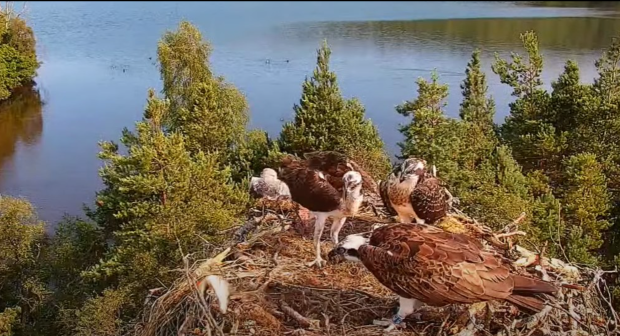
What’s happening in Bird World?

I don’t know a person watching a nest on a streaming cam that doesn’t get anxious if food is not brought to the nestlings and fledglings on a regular basis. Most of us start doing a bit of nail biting. Today, for example, Malin had 4 feedings. It isn’t as good as five but it is better than nothing! And last Sunday Malin had nothing. We are all hopeful for tomorrow. The weather is cooling off – Malin we are wishing for six fish tomorrow!

Malin 13 August 2021
Malin 13 August 2021 after a feeding

Jake Koebernik of the Wisconsin DNR did a great job answering a lot of questions that some of us have had about Malin’s nest. One was ‘why are the fish that are delivered are so small?’ and the other was ‘why do fish deliveries drop at the weekend?’ This is his answer, “As for the nest at the Collins Marsh NC, the streams and marshes around that territory probably only offer smaller species such as bullhead, bluegills, small bass and northern pike. There aren’t large lakes or real productive rivers in that part of the state, so they are going after what is abundant and available.” Jake’s answers cleared up a lot of the mysteries. —— And tomorrow, when Malin wakes up, Malin will have its official name! Fingers and toes crossed for it to be Malin!!!!!!!

My friend ‘S’ sent a screen shot of a delivery that Telyn made to the Dyfi nest this afternoon. We both agreed that Malin’s eyes would pop out if he saw a fish this big land on the nest at Collins Marsh. That fish is bigger than Blue 491! Wow.

And if you did not hear, Idris had been missing since Wednesday and he was on the nest today, albeit with a completely sunken crop. He brought a nice fish to one of the chicks. Hoping he gets his own fill of fish. Where in the world could he have been? It is worrisome.

Telyn delivered a whopper for 491, Ystwyth who is 82 days old on 14 August

Oh, if only places that have ponds could stock them for the birds. The Pritchett Family in Fort Myers has a stocked pond for Bald Eagles Harriet and M15 and their kids and the water also allows them to cool off and clean their feathers.

We are told by the IPCC that we can expect the droughts and extreme heat to be with us. Since these changes to our climate are known to be directly caused by human activity, maybe it is time to figure out ways to help the wildlife. Providing water and food is a start.

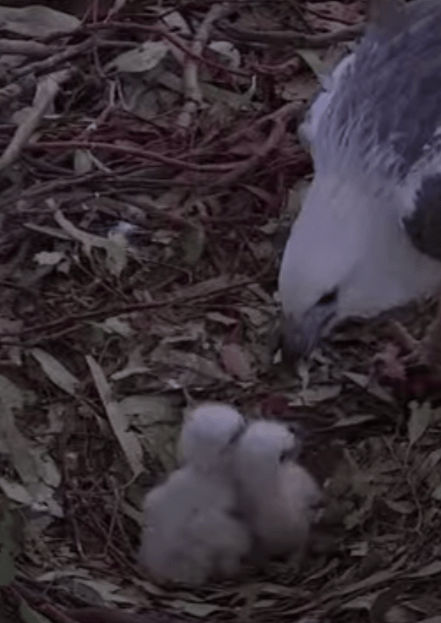
These two little sea eaglets are just adorable and a little spunky, too. They are growing like the sunflowers in my garden that the birds planted.

Both had nice crops after this feeding.

Judy Harrington, the researcher observing the WBSE Nest in the Sydney Olympic Park forest, just released her report on what these two have been eating during the last fortnight (14 days). In fact, it is the first two weeks of their life. Harrington also records the amount of time spent feeding by both the male and the female has been recorded. Lady took on 109 feedings for a total of 21 hours and 20 minutes. Dad did 8 feedings for a total of 42 minutes. Dad has been providing most of the food – he brought in 25 items and Lady brought in 5. These consisted of the following in total: 16 Bream, 4 catfish, 2 fish, 1 Mullet, 2 Whiting, 1 Yellowtail, 1 Ibis chick, 1 nestling, 1 pigeon, and 1 bird. They have now morphed into sea eagles, the second largest bird in Australia.

Sadly, it appears that Lady was hit during the night by Boo, the BooBook Owl that lives nearby in the forest. Despite its very small size the BooBook Owl has caused injuries to the large sea eagles in the past.

It is thought that Boo, as the little owl is so fondly called, has a nest near to the Sea Eagles. To my knowledge, the WBSE have never bothered their nest but, – hey. Every parent is afraid of a larger predator and wants them to leave the area.

“Boobook owl” by jeans_Photos is licensed under CC BY 2.0

Legacy on the Fortis Red Deer Nest has fledged. She has been on and off the nest a few times today. One was to get some fish! Here she is with Mum. After all the nestling deaths during the heat wave, this is just one of the happiest moments from that nest. Look how big Legacy is next to mom. Congratulations.

It is almost impossible to see what is happening on the Fortis Alberta Exshaw nest up at Canmore. Both chicks appear to be on the nest and calling for food. It is unclear to me if one or both have fledged.

The love story of the two Canada Geese has gone viral. It warms our hearts to see these two devoted birds – Amelia finding and waiting for Arnold during his surgery and recovery and now their reuniting. My friend, ‘R’ found two more stories on them and I want to share with you what she sent to me. You could read about these two all day – and you will always walk away with a smile.


https://boston.cbslocal.com/2021/07/15/goose-surgery-visit-mate-new-england-wildlife-center-cape-cod-branch/
Female reporter admits to being teary eyed! 

https://whdh.com/news/goose-who-underwent-emergency-surgery-released-back-into-the-wild-to-be-with-his-devoted-mate-on-cape-cod/Shirts for sale: “Honk If you Love Arnold!”

The story of Arnold and Amelia has taught us all something. If you find an injured Canada Goose and are taking it into care, please take the time to find its mate! The outcome might be much more positive. If you live in an area where there are Canada Geese – let your local wildlife rehabber know about the story of Arnold and Amelia. They will understand why it is important to keep bonded mates together (and their goslings if necessary).

And news about Kona. It is nearing 100 F or 38 C on the nest in Montana. The foster mother, Scout, has been shading Kona. Everything is going well with this foster. How grand.

@ Montana Osprey Porject

Leaving you with a gorgeous image of Loch of the Lowes. It just looks so still and peaceful in the early morning hours of 14 August.

And a last peaceful image of Diamond on the ledge of her scrape box on the water tower at Charles Sturt University in Orange, Australia. We will be looking for eggs before the end of the month. Izzi was last in the scrape box of Xavier and Diamond 6 August. He was photographed on 10 August and someone thought they heard him this morning.

Thanks for joining me today. I am off to try and find some hawks tomorrow so this is coming out early. I will bring you some late Saturday news in the evening. Take care. Stay safe! If you hear of interesting bird stories – and in particular, raptors – let me know.

Thank you to the following for their streaming cams where I took my screen shots: Collins Marsh Nature Centre, Sea Eagle Cam, Birdlife Australia and the Sydney Discovery Centre, Dyfi Osprey Project, Scottish Wildlife Trust and Friends of Loch of the Lowes, Falcon Cam Project at C Sturt University, Fortis Alberta Exshaw and Fortis Alberta Red Deer. Thank you to ‘R’ for sending me the links on the coverage of Arnold and Amelia and to ‘S’ for the information on Telyn and her whopper of a fish delivery. It is much appreciated! Thank you to the Montana Osprey Project FB page for the image of Scout and Kona.

A Hop, Skip, and a Jump through Ospreyland

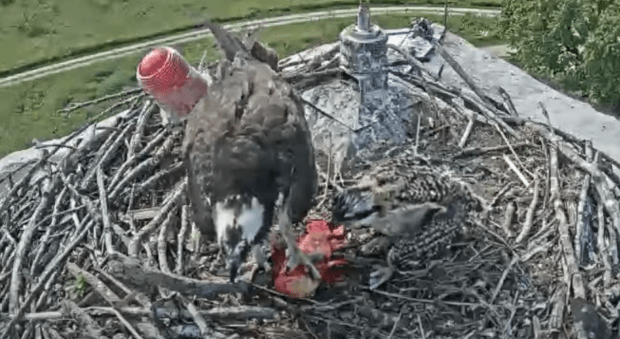
Several people have written and asked about the third or last chick placed on the Patuxent River Park Osprey Nest 2. Many call that little one the ‘Silo Chick’ since it fell out of a silo and was fostered on this nest at the River til fledging. This little one seemed to have a short run, hopefully, of bad luck as it also fell out of the Patuxent nest as well and was rescued by Katherine Dami and her boyfriend. That little Osprey was so lucky! The flurry of activity around that rescue made me realize that every streaming cam needs to have an active 24/7 emergency number to the local wildlife rehabber or the person who would instigate emergency rescue at the nest. Ah, but back to the topic at hand. Silo chick fledged and has not been seen at the nest. Katherine, when asked, wrote to ‘S’ and said that they had not observed Silo Chick at the nest. Katherine did say that a large number of fledglings have gathered together and were honing their flying skills on another spot in the Patuxent River. So let us all hope that Silo Chick is there! If I hear anything more I will let you know. That nest looks very empty right now. Some fledglings like to be fed on the nest. A good example of that is LM1 and LM2 up at the Loch of the Lowes but maybe these three are being fed off camera.

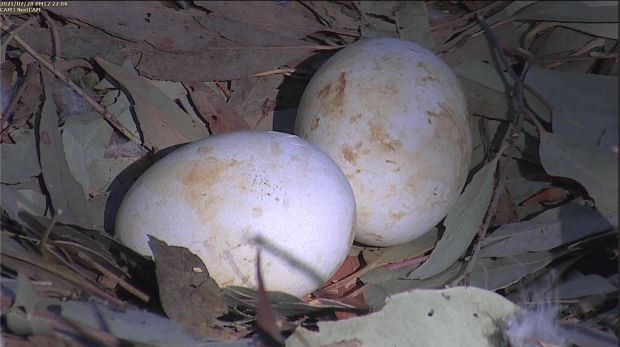
So far there are only two eggs on the Port Lincoln Osprey Nest in Australia. I am quietly cheering that it remains only two. There are nests, such as that of Blue 33 and Maya at Manton Bay Rutland, that can feed and manage four chicks but, Mom and Dad at PLO will do better if there are only two. It could stop the rate of siblicide on this nest.

Tiny Little our ‘Big Girl’ at the Foulshaw Moss nest snagged herself a nice fish this morning from dad, White YW. After losing one to a bigger sibling last evening it is grand to see her eating away. Indeed, it is always nice to see Tiny Little!

Aran and Mrs G have been staying around the nest at Glaslyn. There was even sky dancing observed. The Ospreys want to seal their bond before migration. I am so happy to see the two of them around the nest. There was a time when Aran was injured and not flying much or fishing that I was concerned that Z2, Aeron, from the Pont Croesor Nest nearby or his siblings including Z1, Tegid, who has a nest in Snowdonia, might be eyeing the Glaslyn nest.

Mrs. G on the nest:

Aran up on his perch.

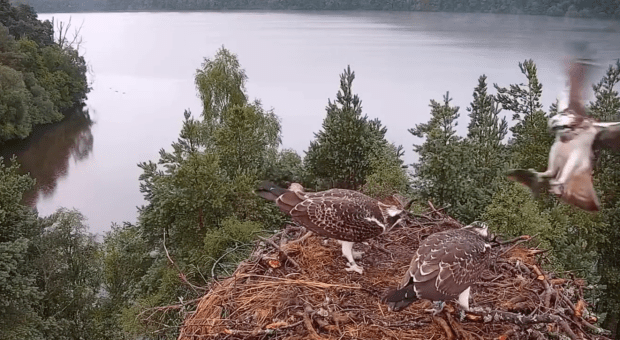
There has been a lot of discussion about when NC0 will leave the Loch of the Lowes Osprey nest in Scotland for her migration. She is still here and she is fishing – hauling in some nice ones for her two babies who prefer to eat on the nest. This was Sunday late afternoon.

The anticipation and seeing mom arriving with a fish:

NC0 lands it.

LM2 got the fish and ate really fast with older sibling hanging around.

Maya is also still at Rutland Manton Bay – there had also been questions about whether she was still around. Seen on nest with chick around 18:00 Sunday. Blue 33 had just brought in a fish for Blue 095.

The Friends of Loch Arkaig have just announced that the names of Louis and Dorcha’s two male chicks for 2021 on the alternative Loch Arkaig nest will be Aspen and Alder. The names are derived from the two popular trees in the area. They took 45.5% of the votes. Well done!

People have been wondering where Iris is. The cam operator spotted her early this morning, around 9am, on her favourite perching spot on Mt Sentinel. Iris is fine and is enjoying her summer. Worries, of course, continue for the Montana Ospreys as the Clark Fork River water levels are at all time lows. The trout are dying. The New York Times carried an article on this urgent matter. If you don’t have a subscription you might not be able to open the article and I apologize but do try. Just look at the level of the water in the image and the dead trout. So terrifying.

Speaking of Iris, I promised the Montana Osprey Project that I would mention their fundraiser – The Iris Pens – this weekend as a reminder to everyone. Dr Erick Greene has collected a few more twigs and sent them off to the workshop of Richard and Sharon Leigh Miles in South Carolina. The pens are $45 US and that includes postage.

This is Dr Greene with the box of Iris twigs.

This is Richard and Sharon Leigh Miles opening up the box of twigs they received from Dr Greene.

Richard begins by cutting the sticks in their workshop.

Pens get their beautiful shape on the lathe.

This is what the finished ‘Iris Pens’ look like – the colour and patterns will depend on the wood that the pen is made from. Iris spreads her love to various trees and shrubs!

The pens have been made and sold out for the past few years. This year as in other years we wish for Iris’s safe return to us from her migration next spring. If you want an Iris Pen, do so quickly. The original 35 are gone and, as mentioned, Dr Greene has sent some more twigs the birds knocked out of the nest to Richard and Sharon. Follow these directions supplied by the Montana Osprey Project.

1) Send an email to montanaospreyproject@gmail.com2) If your mailing address is in the US, on the subject line of your email, type your full name followed by Pen OrderFor example To: montanaospreyproject@gmail.comSubject: Your Name – Pen Order3) If your mailing address is outside the US, on the subject line of your email, type your full name followed by International Pen OrderFor example To: montanaospreyproject@gmail.comSubject: Your Name – International Pen OrderIf yours is an international order we will get back to you with a few additional instructions.4) The email’s body should include the following information:a) Your name b) Your email c) Number of pens you would like to order.d) Total amount ($45.00 per pen). Shipping is included in this price.e) Your mailing address just as it should be on the envelope. f) Send the email to MontanaOspreyProject@gmail.com5) For those of you who live in the United States, make out a check out to: Montana Osprey Project – Erick Greene(We are not set up to take credit card or Pay Pal orders. Sorry – has to be a personal check or money order)6) Mail your check to:Dr. Erick Greene – Montana Osprey ProjectDivision of Biological Sciences 32 Campus Drive University of MontanaMissoula, Montana USA 598127) For those of you who live outside of the US, send us the email with all of your information, but hold off on sending a check. We will get back to you with a few more instructions.

I can’t wait for mine to arrive.

Thank you so much for joining me today. I am off in search of hawks and ducks this afternoon. It is sunny and warm but we are going to venture out in the heat anyway! Take care all. See you soon.

Thank you to the following for their streaming cams where I grab my screen shots: Collins Marsh Nature Centre, Manton Bay Osprey Nest and Rutland Water, LRWT, Scottish Wildlife Trust and Friends of Loch of the Lowes, Port Lincoln Osprey Project, Patuxent River Park Osprey Cam 2, Cumbrian Wildlife Trust and the Foulshaw Moss Osprey Cam, Brywd Gwyllt Glaslyn, and the Port Lincoln Osprey Project. I would also like to thank Richard and Sharon Leigh Miles for allowing me to use the information and the images for the Iris Pens and for their dedication to the Montana Osprey Project. A big shout out to Dr Greene for his devotion to the Montana Ospreys. Thank you!

Featured Image are the two 2021 chicks of Laddie, LM12, and Blue NC0 waiting for NC0 to get the fish to the nest. Their numbers are LR1 and LR2.

Hawks definitely do not like children

By 18:30, the smoke and the temperatures were cooperating and it seemed like a good time to go and check on the Cooper’s Hawk family in Assiniboine Park. When I arrived at the Park, there were several cricket games going on, families were meeting and sharing a pot luck outside – many for the first time since spring 2020, there were birthday parties and children running around.

When I found the spot and knew where the hawks had their nest and were hunting for bugs and chipmunks the other day, there were children running around. I could see the hawks in the sky circling. They never went to the nest tree or came to the ground. It is the life of a birder. It would be wonderful to see them a few more times before migration. The Canada Geese do not usually begin leaving until the middle of September through to the end of October. I have seen some miss the group and wind up walking about on an early snow. Weather is such a significant factor in the challenges our birds face.

For those who are not sure what migration actually is. Our feathered friends Move from one area for breeding during the spring and summer to another area for winter. They have adapted to the pattern of coming and going in order to survive. It is based on food supplies.

Different species travel different routes to their winter homes. These are long journeys. For example, the Ospreys in the United Kingdom will travel some 8,000 kilometres or 5,000 miles to places in Africa. The birds will fly over land, sea, and desert to reach their destinations. People wonder why the birds just don’t live in Africa all the time. The answer is rather simplistic: there would not be enough nesting sites or food for all of them plus their chicks. There are also a lot of very hungry predators ready to take those lovely fluffy little ones. So they disperse from Africa to sites in the United Kingdom and Europe.

The birds decide when it is time for them to migrate. The hormones in their body begin to change. Unlike spring when this hormone change leads to breeding, the autumn sees the birds restless until they know that it is time to depart. These hormones trigger a lot of eating. Fat begins to gather under their skin. They gain weight. It is that fat that will see them through their migration. Still, they stop and feed along the way. Normally they hunt for food in the early mornings and late afternoons. High pressure systems are good for flying but low pressure systems bring winds and rain. When the birds get into a low pressure system, they will normally stop flying, if they can, and wait til another high pressure system comes through. Migration times vary because of the winds and the weather. Birds that soar and ride the thermals can travel as much as 465 km or 300 miles in a stretch. Some gather in flocks like the storks in Latvia and Estonia. Sometimes birds pair up to migrate. For the Ospreys, the female leaves and the male stays behind until there are no fledglings crying for food.

Not all birds migrate. Even I have a sedentary Sharp-shinned Hawk that defies all logic to stay on the Canadian prairies for the winter. The Osprey in Australia do not migrate. The birds in the Amazon Rainforest do not migrate. There is plenty of food and nesting sites for them year round. This past spring and early summer there was much discussion over the migration of birds from Florida. In Jacksonville, Samson, the father of Legacy, stays in the area of the nest year round. Gabrielle, on the other hand, migrates north – yes north – to cooler summer climates. This year she might have discovered it is hotter up north! Even some of the Ospreys in Florida do not migrate; they stay year round. There are plenty of fish for them as well as nests.

Birds take different routes. The White Storks from Latvia either taken a western route or an eastern route. Dr Erick Greene and his team in Montana study the migratory movements of the Ospreys from the Clark Fork River area with satellite transmitters. In the United States, some fly over Hawk Mountain where there is an annual count. In fact, you can go to this site to see the number of birds traveling over this marvellous area with its thermals. Here is the link for you for their autumn migration count that will being in about a week!

https://www.hawkmountain.org/conservation-science/hawk-count

Migration is extremely challenging and we hope that all of the adults will return to their nests the following spring and that we will see the juveniles who take their first flight to Africa in a couple of years.

And now for some birding and nest news

Poole Harbour: Blue 022 and CJ7 who were so visible until a few weeks ago sky dancing, mating, and working on the nest with the streaming cam are now working on another nest in the area. There is no camera. They are still doing everything together and everyone is looking forward to the first hatches in Poole Harbour for 200 years.

Dahlgren: A large part of the nest in King George, Virginia, collapsed today. It will be fixed in the fall well after Jack and Harriet’s migration.

Kielder Forest: All 16 of the 2021 juveniles have fledged successfully. Everyone is elated. This is 6 more fledglings than their previous best year. Congratulations everyone!

Mlade Buky: Bucachek and his new love spent the night on the nest in Mlade Buky, Czechoslovakia. Oh, how sweet! Just as the dawn is beginning to appear, they are both preening.

Balloons, something that impacts all birds: Virginia, Maine, Maryland, and Delaware have or are going to pass shortly the release of balloons. Hawaii has already passed a law on helium balloons.

Port Lincoln Ospreys, Australia: Dad and Mom have been taking turns incubating the eggs. Here is dad on the nest. A little earlier he had been pestering Mom. He kept pulling on that turquoise rope wanting his turn. It was too funny. The Port Lincoln Ospreys are an example of sedentary birds. They do not migrate. There is no need.

Loch Arkaig: The two juveniles of Louis and Dorcha have now fledged. I have not heard anything about the chosen names yet.

Collins Marsh: Malin was a little wet off and on during Saturday. S/he is sleeping on the nest alone tonight. There is no perch – let us hope that the parent or both parents are in a nearby tree in case there are any owls about. It seems like a pattern. Does mom always spend Saturday night off the nest?

WBSE, Sydney Olympic Forest: 27 and 28 continue to eat until their crops almost burst and sleep. Meanwhile there has been an intruder today and Lady and Dad were honking in alert.

And last but very special, A Place Called Hope. Along with other wildlife centres, they are receiving quite a number of starving Great Blue Herons and other herons. Why would they be starving? It has been raining in the Connecticut area and all the herbicides and pesticides that people put on their lawns and gardens makes its way into the environment, into the water table, into the ponds. It is poison. If your gardening centre or lawn care person tells you that the chemicals they use are ‘Green’ – well, think again. Whatever they are using kills. So sad. It is OK if your lawn doesn’t look emerald green.

Thank you so much for joining me today. Have a lovely Sunday. Take care of yourselves. I look forward to seeing you soon.

Thank you to the following for their streaming cams and their FB pages where I grab my screen shots: A Place Called Hope, Mlade Buky White Stork Cam, Collins Marsh Osprey Nest, Port Lincoln Osprey Project, and Sea Eagles, Birdlife Australia and the Discovery Centre.

The featured image is Dad at the Port Lincoln Osprey Barge taking his turn incubating his two eggs.

Tiny Little, it is good to see you!

Friday morning started off fantastic with Tiny Little on the nest alone food calling. She was later joined by older sibling, 462.

What you need to know is that Tiny Little had an entire fish to herself a little earlier for breakfast! Just look at her enjoying that fish!

7:45 nest time. Nice fish delivered by White YW to his girl.

Tiny Little returned later and was joined by 462. Yes, I said that already! They waited and waited. All that waiting and food calling paid off! Both Tiny Little (or Bobbie to some) and older sibling got a fish – older sib gets the flounder, Tiny Little has something else (?). Dad, you are fantastic. This is the way to keep the kids happy and quiet.

Tiny Little is the fledgling on the right. She is a ‘big’ girl! I am just so delighted to be able to see her. She is growing and growing. Tiny simply doesn’t fit anymore!!!!!!

This is the link to the Osprey Nest at Foulshaw Moss managed by Cumbrian Wildlife Trust:

https://www.cumbriawildlifetrust.org.uk/wildlife/cams/osprey-cam

But there was more happiness. To top it off, the little Osprey nestling at Collins Marsh Nature Centre had two feedings before 9:30 this morning. If this pace keeps up Malin is really going to have a big growth spurt this week. Already the tail and back feathers are remarkably changed from last week.

And another feeding here. So happy to see these parents stepping up the food. Malin is really starting to present as a juvenile Osprey now. I keep looking at those little feet – wonder if we have a little boy here? Male or female it doesn’t matter. Malin is really a gorgeous/handsome.

The link to the Osprey nest at Collins Marsh is here:

https://www.cumbriawildlifetrust.org.uk/wildlife/cams/osprey-cam

One of my readers was asking about the nest for the Black Storks in Latvia. I was able to find some information and a couple of images so that you can see the beautiful forests in the area.

The nest is in a forest in the Sigulda region of Latvia. It is 53 km southeast of the capital, Riga. It is the orange area on the map below.

The area is home to Sigulda New Castle and the remains of a medieval castle built in 1207.

The image below is the New Castle.

“Siguldas jaunā pils (Sigulda Castle)” by twiga_swala is licensed under CC BY-SA 2.0

Through the forest you can see the New Castle.

These are the remains of the medieval castle. It is a major tourist site and because of this, Latvia has stabilized some of the walls so it can be fully appreciated.

The nest in the forest is on a pine branch that extends about 1.8 metres from the trunk of the tree. So, in plain English, the nest is on a branch that is sticking out —- just a big branch! I know. Take a deep breath. It could make you nervous. The nest is 18 metres from the ground. Imagine these storks on such a branch! I kept thinking they could slide off the edge.

The youngest storkling is 53 days old today. It is flapping its wings and gets really excited. The eldest is 56 days old and the middle one is 54 days.

The adults, Grafs and Grafiene, have to be very careful when they come to feed their little ones now so they do not slide off the nest. It is getting a little crowded as the nestlings grow!

One of the moderators for the nest forum created a video of Grafiene coming to feed the storklings about one month ago. It is very short but shows us just how much these nestlings have grown in that time. Just look how tiny they were.

All of the storks meet to begin their migration. ‘S’ tells me that they land on the tops of all the houses, the hydro poles, and the trees. And then they begin clacking and this is the beginning of their long journey as far as South Africa. Everyone is a little sad when they leave.

The link to the Latvian Black Storks is here:

Don’t all babies look sweet when they are sleeping? The little sea eaglets are no exception. You would never know that they are so tired from all the mischief they cause when their parents aren’t watching.

They look like little angels.

Dad is making sure that there is lots of food on the nest.

Here is the link to the White-Bellied Sea Eagle nest in Sydney’s Olympic Park. It is the only WBSE nest in the world that is streaming live. One of the really neat things is just listening to the forest sounds when the streaming cam is on. You will hear many Australian birds. There are lots of YouTube videos of the birds and the sounds they make. Just do a search of ‘Australian Bird Sounds’.

There has been a lot of chatter about when the female ospreys in the UK will be leaving the nests and heading off on their migration. Blue NC0 is still up at the Loch of the Lowes working hard, along with Laddie, to feed LM 1 and LM 2. She is known to catch big fish and this morning she brought in a whopper. The sad part was NC0 worked so hard to get this fish out of the water and on to the nest and one of the kids let it fly off the nest. It happens but we all must appreciate the real effort these parents put into feeding these juveniles especially when they must be eating themselves, fattening up, to make their journeys.

NC0 has turned into one wonderful mom over the season. It has been such a joy to watch her develop from when the little ones hatched and we had no idea if she was going to figure out how to feed them!

The fledglings still associate the nest with food so you might still get in some good action. This has to be one of the most beautiful nest locations in the world. When I went to check, I could see the Ospreys flying around and food calling on the branches at the top left of the image below. So turn up your sound and look there when you check on this nest.

Here is the link to their camera:

I checked to see if the names had been announced for Louis and Dorcha’s chicks on the ‘other’ Lock Arkaig nest. There seems to be no mention or I have missed it. So hold on. Will let you know as soon as I hear anything! I am also waiting for the Collins Street Peregrine Falcon cam to come on live. You are going to be in for a real treat with that falcon nest! I promise.

Thank you for joining me today. I hope everyone is well. Tomorrow I am heading out to find the local hawk. Expect news to come in the late afternoon for all the nests. Enjoy your weekend. Stay safe.

Thank you to the following for their streaming cameras where I took my screen shots: The Latvian Fund for Nature and the Sigulda Black Stork Nest, the Collins Marsh Nature Centre and Osprey Cam, the Sea Eagles, Birdlife Australia, and Discovery Centre, the Scottish Wildlife Trust and the Friends of the Loch of the Lowes.

Late Thursday and early Friday nest news

It was a rare treat to check on the Black Storks and find that Karl II was at the nest feeding the three fledglings. It was around 18:00I had been missing this. The ritual of the feeding and the eating is entrancing. This nest is in the Karula National Park in Estonia. As in Latvia, the Black Stork is very rare and much loved. Karl II and Kaia raised three healthy hatchlings this season. Congratulations!

In my last newsletter, everyone was waiting for the second egg at the Port Lincoln Osprey nest to arrive. If you missed it, it was around 3:27 am nest time on 6 August.

Last year’s PLO fledgling, Solly, is 320 days today. Wow. It is about time to get out the party hats and celebrate her one year hatch day. This just gives you hope. Today, Solly is going in and out and in and out at Eba Anchorage. She apparently has a favourite dead tree in the area that she likes to roost in.

Oh, it seems nestlings are just like human children. Let mom or dad get out of sight and they start picking on one another. This was the case with 27 and 28 at the White-Bellied Sea Eagle nest in Sydney, Australia. If this is all these two get up to – let them have a little fun. They are so close in size that neither has an advantage. Have a peek.

Dad and Mom are continuing to bring in fish about 5 fish a day to the Collins Marsh Nest. This is a big improvement over a few weeks ago. Malin’s tail now reveals three rows of dark bands and the beautiful scalloped juvenile feathers.

Oh, Malin is becoming such a gorgeous bird. The stepped up deliveries and the drop in heat seem to be suiting this Osprey family in Wisconsin, USA.

Such a little sweetie. Malin really loves this part of the nest. You can catch her sleeping there during the day (like in the image above) or at night. All tucked in with Mom watching over her. If we could only slip a little pillow under that wee head.

Suzanne Arnold Horning was on the Cornell Campus this evening and found K3. Oh, this is such a cute Red-Tail Hawk fledgling! She did not find the other three and commented that K3 must have missed the memo on where to meet tonight. He was apparently flying around food calling!

I didn’t think another Red-tail Hawk fledgling could ever win my heart like J3 did but look at that sweet face on K3. I am melting.

K3 is over on one of the light towers. What a gorgeous image of this third hatch against that clear blue sky. He has really grown into an amazing fledgling. These two, K1 and K3, are simply great fliers and K1 has turned into a fantastic hunter just like her parents, Big Red and Arthur.

Other Nest News:

Congratulations to Rutland Water. It is their 25th anniversary and today, the 200th chick, Blue 360, fledged! Wow. What a fantastic record for the translocation project. The announcement and photo of that lucky chick is on their FB page: https://www.facebook.com/324266140960825/posts/4294404503946949/

Louis and Dorcha at Loch Arkaig (nest not on camera) have their first fledge this morning. Voting has ended to name their chicks. Hopefully we will know tomorrow! What fun. That Loch Arkaig nest was so empty this year without Aila. Hopefully another couple will claim it for the 2022 season or maybe Louis and Dorcha will move from the nest off camera to the one where we can watch their every move.

Between now and the beginning of the third week in August, the females of the UK nests will begin their migration to as far away as Spain/Portugal or West Africa. The males will remain as long as there are chicks calling for food. This is normally 2-3 weeks.

This is what fish calling sounds like thanks to one of the fledglings up at the Loch of the Lowes. This chick could be heard all the way to Glasgow! They are so loud. You can easily imagine that the male will know if there is a chick on the nest who is hungry.

Things seem to be going really well on the nests today. That is always worth a big smile!

Thank you so much for joining me. I will be back late Friday evening with a nest update. Take care everyone. Stay safe.

Thank you to the following for their streaming cams where I took my video clips and screen shots: Eagle Club of Estonia, Collins Marsh Osprey Cam, Scottish Wildlife Trust and Friends of the Loch of the Lowes, Port Lincoln Osprey Project and the Port Lincoln Osprey Project FB Page, and Suzanne Arnold Horning for letting me share the beautiful images of K3.

The featured image is K3 on the light stand taken by Suzanne Arnold Horning.

An Osprey blew off a nest! and other Bird World News

We were so concerned about the big storm that went through Wisconsin and the Collins Marsh Osprey Nest that nothing else mattered in the wee hours of the night the other day. In our mind’s eye, we could see that wee chick flying off that 120 ft retired fire watchtower.

Well, over in New Jersey, the mother on the Barnegat Light Osprey Nest did get blow off! The Conserve Wildlife Foundation wrote:

“On the evening of July 29, 2021 a line of severe storms moved across New Jersey. Many of these storms held the potential to produce damaging winds, hail and possible tornados. One such storm went straight for Barnegat Light, where our osprey cam is located. Watch as the wind shifts from east to west and the adult female was blown from the nest. Luckily she and her nestlings all survived unharmed, but there are many osprey who were right in the path of what looked to be a tornado, which hit High Bar Bar — just to the north of the osprey cam nest. Hopefully that the damage is not too severe to both people and ospreys.”

Here is that video of Daisy, the mother on the perch, and her two chicks on the nest.

The male, Duke, went missing in the storm. He showed up around 4pm today delivering a fish on that nest. Yippee.

Daisy and the chicks are sleeping well tonight. The family is back together again!

Fledge is over but the chicks are still actively coming to the nest for fish drops. Here is the link to that camera.

I will add a note. There were originally three chicks on this nest. The vast age and size difference meant that the third hatch became a victim of siblicide.

The Montana Osprey Project is having a fundraiser and it is really neat. Dr Ericke Green collects the twigs that fall off Iris’s nest at Hellgate, Montana. I know that almost everyone knows who ‘Iris’ is but, in case you do not, she is the oldest Osprey in the world. She has her nest in Missoula, Montana. She has spent the days since arrival and until recently adding twigs. Well, some of the twigs she adds fall off. Those that Dr Green picks up are sent to Richard and Sharon Leigh Miles in South Carolina who turn those twigs that Iris touched into pens. They cost $45 and that includes postage. I understand they sell out quickly if you are interested please go to the Montana Osprey Project FB Page. Scroll through their threads and you will find the information.

I was so excited to find this fundraiser. Can’t wait til my pen arrives!

WBSE 28 is working steady to get out of that shell! This was the progress around 10 am Saturday nest time. This sweet babe should be joining its ‘snowman’ looking sibling 27 late Saturday in the Sydney Olympic Ironbark Nest.

My first introduction to the White-Bellied Sea Eagle was last year. I am a ‘hawk and falcon’ person – smaller raptors – more than the eagles. I came across the WBSE streaming cam purely by accident. I have learned a lot about eagle behaviour over the past year.

This cute little bundle of fur is destined to be one of the largest eagles in the world. Look at its cute little wings. One of the worst things about eagle nests is the sibling rivalry – although I can say that this also happens on Osprey nests and to a much lesser extend the smaller raptors. Last year the sibling rivalry only lasted a few days. It seemed that WBSE 25 sensed that ’26’ was injured and I have said many times helped the little sibling. That said, one of the old timers told me that the second egg is the ‘insurance’ egg – there only if the first chick does not survive. When I heard that I shook my head. There can be siblicide on this nest. It is the only White-Bellied Sea Eagle Nest with a live stream that I am aware of.

I am including the link to the camera. If you are concerned about what appears to siblicide happening on this nest, this year, I urge you to stop watching especially if you have younger children. I will provide simple updates on the nest without graphic content. Hopefully there will be plenty of fish brought in at all the right times so that nothing triggers food insecurity behaviour. That said, siblicide has occurred on nests where food is plentiful.

Here is the link to Cam 4 for the Sydney Sea Eagles:

Ferris made it to the Cornell Campus tonight. He was able to spot Arthur fairly quickly but the Ks and Big Red were in hiding. He will probably return to the campus tomorrow on his regular Saturday tour. I know he will be stopping to see about the Roseate Spoonbill. Like all of us, it is a joy to see a bird outside of its territory but it is also a worry and as Ferris said, he would like this bird to get back to where it belongs.

Here is Arthur on the ‘throne’:

The chick on the Collins Marsh Osprey Nest in Wisconsin was left alone as dark was coming. It had been fed reasonably well today with fish caught by Mom and brought in and at least one delivery by Dad.

I went back and checked again and Mom was on the nest with the babe. Whew!

The last check in for today is at the Loch of the Lowes where NC0, the female, landed a whopper and brought it to the nest. That fish was so large it would feed both fledglings and mom. There might have been some leftover for Laddie! NC0 is really turning into a super mom. She doesn’t sit around and wait for Laddie. Once the chicks were old enough, she joined in the fishing for the family!

It’s late Friday evening on the Canadian Prairies. My blog on Saturday will be in the late afternoon or early evening. I want to do a lot of nest checks.

Thank you so much for joining me. It is nice to hear from you – always – and it is so wonderful to know that there are so many people who care for our birds. Take care. Stay safe.

Thanks to the following for their streaming cams where I take my screen shots: Scottish Wildlife Trust and the Friends of the Loch of the Lowes, Barnegat Osprey Light Cam and the Conserve Wildlife Foundation of New Jersey, Collins Marsh Nature Centre Osprey Cam, the Ferris Akel Live Stream and the Sea Eagle, Birdlife Australia, and Discovery Centre Sydney for the WBSE captures.

Hatch is imminent at WBSE nest…red fish, Polish storks, and Tiny Little gets a fish

My virtual friend ‘S’ and I probably never thought we would be pouring over fish ID charts trying to identify partially eaten fish. OK. I can’t fully speak for her but even growing up with a dad who lived to fish, a son that travels the world to fish and feels more at home in a boat than on land, and a grandson that fishes in all his spare time – I never thought for a second I would spend more than a few minutes looking at the type of fish the Ospreys are eating. Surprise. The fish that comes to the Collins Marsh Osprey nest is making some of us very curious as to what it is and where mum is catching it.

The DNR of Wisconsin is great. They have games you can plan, fish ID charts by name or identifying marks. It was not until I found their posters today that I even believed there was hope of figuring out this fish. It looks like my late mother’s Siamese Fighting Fish but for its colour and size.

Thanks ‘S for this great screen capture.

Seriously I thought that the Mum at the Collins Marsh Osprey Nest had found someone’s ornamental fish pond to raids. This is at least the second fish of this species brought to the nest in a 24 hour period.

These are some of the top game fish in Wisconsin but nope. Nothing on this poster resembles that fish.

It isn’t a Roach but it could be a Rudd. But the Rudd hasn’t got red scales! There are suckers that look like a closer match.

This is beginning to drive me a little nuts. And don’t be shy. If you recognize that fish the mum is feeding her chick – tell me. I will be smiling for a week. Tomorrow I am going to ask the Naturalist at Collins Marsh. To be continued.

Dad was only seen on the Collins Marsh nest once today. Mum was busy bringing in these smaller fish for her and the chick. It is a good thing that she isn’t afraid to get wet – because if she were her baby would not be alive.

The chick will eat this species but it is certainly not its favourite and Mom, on the other hand, seems to like it or is so hungry she leaves hardly any scraps.

Speaking of eating, the female at the Bucovina Golden Eagle Nest brought in an Eurasian Hare for Zenit. Zenit wasn’t close to the nest tree when mum arrived and called but he quickly comes in mantling like crazy. When you see this eaglet or any of the fledgling Osprey aggressively going after prey, the term is hyperphagia. Every bird that migrates needs to eat as much as they can – compulsive overeating – in order to store fat for their migratory journey.

Lady Hawk caught all of the action and Zenit’s enormous crop in a video:

Some of the biggest news of the day is that 8:54 am on 28 July a pip was first noticed in one of the two eggs of Lady and Dad, White Bellied Sea Eagles, whose nest is in an Ironbark Tree in the Sydney Olympic Forest.

This was Lady checking, listening, and gently rolling the eggs about forty minutes later.

There is now a hole in that egg. So hatch is close.

I adore the little sea eaglets but this nest really broke my heart last year with WBSE 26 striving to live, to fly, to be a bird and then to have it end with her being euthanized.

I have seen prosthetic legs made for birds, 3D printed beaks for eagles, sophisticated operations on the webbed feet of Canada geese, and more. I have witnessed pain management programmes for animals in care and wildlife rehabbers like those at A Place Called Hope in Connecticut that not the extra mile – they go ten extra miles. All we have to do is remember the state that The Old Warrior was in when he arrived at their clinic. His lead levels were 48, he had multiple fractures in his leg, and his beak was so damaged that he could hardly eat. That old eagle wanted to live and he was treated accordingly. His lead levels are around 10, he is eating well, his feather condition is improving all the time. He is happy! Today he remains with the clinic as they await a permit for him to be their ‘forever Warrior’. I had hoped, like so many others, that something would be done to help 26.

There are several ways to access the cam for the sea eagles. There is even one with a chat room. I will try and locate those other links for you.

Here is cam 4. The definition is good.

I want to thank a follower from Poland who sent me a note suggesting I look at the beautiful stork nest in Ostroleka, Poland. So I did! There were five storks sleeping on this nest in the northeast of Poland.

What a picturesque village. The farmer’s fields are so lovely. Tranquil is the word I want to use as the sun rises on a new day.

I need to find out more about this nest which I will do in the coming days. I am trying to imagine the challenges for the parents to feed five – or is it four chicks and the parent is off the nest? Here is the link to the camera for this nest:

Tiny Little is not sleeping on the Foulshaw Moss Nest tonight. It is not clear to me whether he had a fish drop later last night or not. But after waiting for big sibling to get their fill of a large fish, Tiny Little is now eating for sure. It is 17:01 on the Foulshaw Moss Osprey Nest.

Of course, big older sister is sitting there waiting in line! Poor things. They always get caught up spending so much time around the cheek and mouth, the bony bits. Hopefully Tiny Little will get full before it gets tired.

I love it when the mother’s get out there fishing. We see that in the mom at the Collins Marsh Nest and here comes NC0 at the Loch of the Lowes.

That fledgling just about tore her leg off! I am looking at those strong thin legs of NC0. She has been diving and bringing in fish to this nest for at least a month. Soon she is going to have to begin bulking up for her flight to Africa. It’s that word: hyperphagia.

It has been a pretty exciting day. So nice to see some of the fledglings on the nests! It is comforting to know that they are surviving.

Thank you so much for joining me. I hope that everyone has a great day. Take care. See you soon.

Thank you to the following for their streaming cams where I took my screen shots: Collins Marsh Osprey Nest and the Neustadlter Nature Center, Cumbria Wildlife Trust and the Foulshaw Moss Osprey Nest, Sea Eagles, Birdlife, and Sydney Discovery Center, Ostrolekas White Stork Nest, and Scottish Wildlife Trust and Friends of Loch of the Lowes. I would also like to thank the Wisconsin DNR for the fish poster files and ‘S’ for sending me that great shot of that ‘gold’ fish.

Bird World Happenings. 27 July 2021

Oh, so many of us are having Empty Nest Syndrome. It is that time of year. You go and check to see if there are any Osprey fledglings on the nest – and no. Poof. Gone. It suddenly sets in that those precious little fluff balls have grown up. They have fledged and are gaining their flying skills for migration. Osprey breeding season is almost over. There are a chicks few trailing behind – Collins Marsh and Chesapeake Bay to name a couple in North America. There are still chicks on the nest in Manitoba but there are no streaming cameras. The Port Lincoln couple on the barge are only ‘thinking’ about eggs. Those will come mid-August most likely. So what does one do?

One of the first things is to treasure the moments we got to spend with these bird families. It is a privilege to see them living their daily lives. There is a saying in Japanese – Ichigo ichie. It was coined by the great tea master, Sen-no Rikyu. His meaning focused on the sharing of the tea ceremony and the realization that you can repeat the ritual but you can never re-create that moment with the same person ever again. You must live it to the fullest with the deepest respect. In terms of our birds, I would like to think that we must treasure every moment that we can share with them and give them our attention. It truly is a once in a life time encounter. Tiny Little will never again receive a huge fish and fend off its sibling with that same sibling later getting a little tiddler from dad. Those were two precious moments that will never again be repeated. Indeed, I wonder if we will ever see Tiny Little again before her migration. That nest has been awfully empty today.

Some of us began to focus on the few nests that do have chicks. My attention has been on the Collins Marsh Osprey Nest in Wisconsin. It is easy to notice the very odd behaviour of the bonded pair at the Collins Marsh Osprey Nest. It truly is strange. The female disappears for 21 hours! That was when ‘S’ and I began to find other strange tidbits about this nest. The female returns on Sunday morning and Dad spends the day bringing in several fish deliveries. Then on Monday the male brings in the first fish and we don’t see him anymore. It is the female catching the fish and bringing them to the nest. So is there a pattern here? or are we just losing our minds? The female brought in two fish today in the afternoon. One was cream coloured with gold scales but the last one was pink inside and out with gold scales. Any help on IDing these would be much appreciated.

In the image below, it looks like a salmon-red colour. Needless to say the chick went to bed quite full. Every time it started chirping mum was offering fish. She has been very devoted since she returned.

Thanks S for this great screen capture.

A couple of hours earlier Mum brought in this fish. I could not readily identify it either. Regardless of the species, the chick is delighted with the arrival! The faces this chick makes are incredible. Very animated.

This is the approach to the nature centre that is near the Collins Marsh Reservoir and the Mud River in Wisconsin. Look at the left and you will see the ‘retired’ fire tower which is now home to the Osprey nest on the very top of the glass enclosed space that appears above the ‘red’ in the image. Snowy Owls inhabit the nest in the winter. The tower is 33.5 metres or 110 feet tall. The staff of the Osprey centre access the camera within the glass enclosed area. At one time it was thought that there was a portal from the glassed area to the nesting platform but it turns out that is not correct. There is no ‘easy’ access to the Osprey nest. Getting to the nest physically to do a wellness check on the chick, right now, would mean finding a person with particular skills and then being certain that it was safe for them.

courtesy of Wikimedia Commons

You can see that the nest is slightly off centre and is situated on a sort of cone hat with the camera on the pole at the corner.

Looking at this got me to thinking about access. It is quite true that there are raptor nests that can never be accessed. Eagles and Ospreys love to make their nests in extremely high places away from us! That said I have known or witnessed ‘tree climbers’ in Germany whose skill set is such that no tree defies them unless the tree itself is unsafe. This is an interesting situation at Collins Marsh. The Wisconsin DNR Biologist and the Wildlife Rehabilitator continue to monitor the chick in terms of feather growth, etc. That is great news. The question then arises: if the chick displays in another week or ten days problematic feather growth, what can be done? With the access so difficult, it would seem nothing. So let’s keep our fingers and toes crossed that nothing is wrong with the feathers! It would, however, seem prudent to explore the possibility of a portal access to the nest once the Ospreys have migrated and before the Snowy Owls take over. I hope that it is never needed but, if it were, it would be a win-win for everyone. All of that said, it would require the services of a structural engineer to figure out the best way to do this. Maybe there is someone who is qualified and loves the raptors that might, at least, consider if this was possible and do it as a donation of time to the centre. That would be grand.

Tuesday morning at Collins Marsh Osprey Nest: The day began with rain and then wind.

Mum left later and returned with a small fish/ a twiddler.

Mum leaves the nest three times after this. Very different behaviour than Monday. Dad does come to the nest and delivers a piece of fish. The chick winds up with a bit of a crop.

At the moment, the chick is on the nest alone. It is windy and the temperature is currently 24 degrees C going up to a scorching 30 degrees.

Mum returns and the chick joins her in fish calling to Dad. Oh, I hope the fish arrives and mum stays to shade the baby today.

The Cornell University Red tail hawks are still putting smiles on everyone’s faces. Suzanne Horning was out yesterday evening checking on them. I remain ever so grateful that she lets me share her images with you.

K3 and those beautiful celadon eyes just strikes right at my heart. This little one has, according to the boots on the ground, turned into a magnificent flyer.

K3 sees Arthur and immediately starts calling for food. You will notice that when the chicks do not see an adult they generally do not food call but when they do see someone who might bring ‘a food delivery’ you can hear them crying several blocks away!

K1 had a nice spot on top of one of the light stands. These stands have been, in past years, great places for the chicks to eat their prey. They are nice and flat on top.

If you cannot see their tails it takes a few moments to sit and figure out which K you are looking at. In this instance, the belly band has more red than the chick in the image above.

This is such a beautiful close up of K1. Look carefully at that beak – that very sharp point for tearing the food – and then look at how clean it is. You will see the chicks cleaning their beaks on all manner of things – sticks, tree bark, grass. At the same time they are also sharpening them. Like their feathers they need this ‘tool’ of theirs clean and sharp.

Here is a great little article that goes into more depth on the reason you see birds rubbing their beaks. It is short and very informative!

https://www.audubon.org/news/heres-why-birds-rub-their-beaks-stuff

Big Red is doing a kind of hawk walk while she is looking for prey. She is our gorgeous matriarch and every second seeing her reminds us how precious she is.

The Hornings did see Arthur but I don’t have an image for him. Both adults are moulting now and look a little scruffy.

Some of you have been asking about Arnold. Well, look at that picture of Arnold with his mate, Amelia. His wounds have healed enough that he now has a waterproof bootie and can spend some outdoor time with Amelia. If Arnold continues to improve – and why wouldn’t he with Amelia there cheering him on? – he could be released in a couple of weeks. That is wonderful!

@ Cape Wildlife Center

A few nest checks for the UK Ospreys and wow, lucky was with me.

There is one very loud food crying fledgling on the Loch of the Lowes nest. Looks like it is LR2. He wants his breakfast ‘now’!

Telyn is on the perch of the Dyfi Nest in Wales and Ystywth is eating her breakfast. How lucky she is. LR2 is so unhappy. I wonder if his big sister, LR1, took the first fish?

Ystwyth eating a fish on the Dyfi Osprey Nest in Wales. Telyn is o the perch.

One of the reasons for the big smile on my face is that when I checked the Glaslyn Nest of Aran and Mrs G someone was on the perch! And it is Mrs G. The timing could not have been better.

There she sits – the oldest Osprey in all of the United Kingdom – looking out over the territory that she shares with Aran.

Mrs G on the perch at Glaslyn.

Perhaps if I took one more peek at the Foulshaw Moss nest someone might be there having breakfast. Let’s see!

Well, not only is there no one on the nest but there is not an Osprey to be seen on the parent’s tree in the distance. I wonder if White YW and Blue 35 have taken everyone to the reservoir to try some fishing?

It is now 17:00 on the Foulshaw Moss nest and there are two fledglings hunkered down because of an intruder. “Hello, Tiny Little!”

Ah, maybe there isn’t much of an intruder. Wonder what Blue 464 is hiding? It is a big fish! No wonder Tiny Little is there. I will try and check back later to see if he gets some of it. The fish looks large enough for both as long as 464 doesn’t fly away with it. You can see its tail extending out to the left of the log. Hopefully 462 won’t come around!

Oh, Tiny Little is wanting that fish! She is up to her old tricks. It is a huge fish. Blue 464 will get tired of working at the mouth and walk away if Tiny Little can be patient.

Tiny Little has stepped back. She caused Blue 464 to move the fish a bit and she might be remembering that he did fly away with part of a fish the other day. Just wait, Tiny Little. There will be fish left!

But life throws birds wrenches and today, Blue 464 flew away with that huge fish! Tiny Little is yelling at White YW to go and get another one. Poor Tiny Little!

This is a good overview of what is going on at the nests today. So happy to catch Tiny Little. These moments are very precious.

Thank you so much for joining me today. It is so nice to be with fellow bird lovers. Just a reminder. If you live in a place where it is hot please, if you can, leave out bowls of water for the birds. Old ceramic serving bowls work great. The clay does not get as hot as metal containers. If you leave water for the hummers, make your own. It is 4 cups of water to 1 cup of sugar. Make sure the sugar is dissolved. You can heat it and allow it to cool before putting in the container. Do not use the red commercial hummer food. It actually kills the birds! How sad is that? A company allowed to make a product that actually kills the thing it is supposed to help! OK. It happens with humans, too. Terrible.

Thank you to Suzanne Arnold Horning for allowing me to use her images of Big Red and her family in my blog. Thank you to the following for their streaming cams where I get my screen captures: Cumbrian Wildlife Trust and the Foulshaw Moss Osprey nest, Scottish Wildlife Trust and Friends of the Loch of the Lowes, Bywyd Gwyllt Glaslyn, Carnyx Wild and Llyn Clywedog Osprey Nest, and Collins Marsh Nature Centre. A big shout out to the Cape Wildlife Centre who is caring for Arnold. You are fantastic!

Sunday snippets in Ospreyland

Well, it looked like Sunday in Ospreyland might have been off to a tricky start but so far, so good.

Tiny Little (Blue 463) of the Foulshaw Moss nest in Cumbria continues to get those street smarts. White YW flew in with a really large and fat fish at 17:11 and Tiny Little claimed it. Sibling 464 arrived too late. Tiny Little mantled that dinner and took it to the other side of the nest. I am so impressed with how this little one is doing. One of the FB chatters caught it and made a video so you can see the action. It is fantastic!

Tiny Little spent an hour eating and then 464 came in to eat the rest.

At the Collins Marsh Nest the mother showed up, after being away for nearly 21 hours, around 9:37 this morning. The chick was ‘starving’ – the little bit that it was able to self-feed just kept it hydrated. The mum seemed a bit strange but she began feeding the baby and has continued to do so. I asked the Wildlife Rehabber and bander, Patricia Fisher, if she had ever experienced a female Osprey being away this long and leaving their chick unattended overnight and she said, ‘no’. I continue to wonder if the mother is ill, was caught in something and couldn’t get away, etc. It is very unusual behaviour.

The male has brought in another fish. It is mid-afternoon in Wisconsin. The mother fed the chick for about eleven minutes before alerting. The chick flattened. It appears there is an intruder in the surrounding area.

Dad has made several deliveries today. This is good as it is hot in Wisconsin.

Mom and chick were both enjoying that nice fresh fish. Mom had fed the chick and herself every scrap on the nest. It makes me believe that something happened to her yesterday so she could not return to the nest and not eat. I wonder if she was tangled in something? While we will never know unless someone comes forward, it is good to have her on the nest and being attentive to the chick.

The chick has a nice crop. Shortly after the chick was down flat and mom was alerting. Stay safe!

Another Osprey caught in baling twine and another one released that had been caught in baling twine. Baling twine and hydro lines are showing up as two prominent dangers for juvenile Ospreys as this week begins.

https://fb.watch/6ZtdB7IayL/

It is a serene evening in Wales at the Glaslyn Nest of Aran and Mrs G. There continue to be sightings of the two of them on their favourite perches and Aran is improving in his flying and fishing all the time. He should be in tiptop shape for migration. That is good news.

Oh, what a treat to catch the two fledglings on the Loch of the Lowe Nest. One has the fish from the delivery and the other is food begging. There is still time for Laddie or NC0 to deliver another meal. NC0 is very good at fishing!

I can’t read the band numbers well enough to tell who has that fish but my goodness the one who is emptied taloned is awfully loud. You could hear it on the other side of the loch.

Looks like they all have the same tricks up their sleeve to try and get the fish from the sibling. This could have been Tiny Little a few days ago.

The sibling with the fish is finding the prey crying annoying. And now we can see the band. It is LR1 who has that fish. He is going to try and finish it.

What a beautiful setting for a nest. No baling twine. No monofilament fishing line. No boaters. The Scottish Wildlife Associations are making great headway in trying to protect their wildlife and their natural environment. It is refreshing to hear the efforts at restoring the Cairngorms National Park.

Around 1 August many of the streaming cameras on the Osprey nests in the UK will shut down for the season. Most of the activity is off camera. That is why it was such a wonderful surprise to find the two fledges of Laddie and NC0 on the Loch of the Lowes nest this evening. Look how big and healthy they are. Amazing.

I have had and seen questions about when the Osprey parents will teach their chicks to fish. The answer to that question is – Osprey parents do not teach their chicks to fish. Fishing is an instinct that has been developing in the Osprey for millions of years and it is programmed directly into their genetic makeup or their DNA. If they were to see a fish swimming in a lake or a stream, their ‘instinct’ would kick in and they would immediately respond. However, fishing takes practice and they will also learn by doing. Most of the chicks will not have caught a fish before their migration. There are always exceptions, however!

Thank you so much for joining me. Keep sending warm wishes to the Collins Marsh Nest. Hopefully whatever was wrong with the mum is now behind the family. I am very grateful to Patricia Fisher for answering all my questions and for her willingness to take this chick into rehab if it is necessary. I am also grateful to James Downey of the Collins Marsh Centre for his quick response to the concerns of many.

Thank you to the following for their streaming cams where I took my screen shots: Collins Marsh Nature Park, Bywyd Gwyllt Glaslyn, and the Scottish Wildlife Trust and Friends of Loch of the Lowes.

Late Monday 19 July in Bird World

When every fledgling is hungry and Mum brings in a fish:

This is currently the state at the Foulshaw Moss Osprey nest where the three fledglings are waiting on the nest for a fish drop and each one of them is food begging. Tiny Little has lost out today so let us hope that Blue 35 shows up and feeds him. The birds do not need to eat every day – a lesson that they will have to learn.

I have watched and watched but was away for a couple of hours. It is unclear if Tiny Little had any fish today. At 22:00 one of the big siblings was on the nest eating. At first Tiny Little food called to Mum but then he laid down like his cute duckling self and didn’t continue. The big sibling ate the entire fish, flew off, and then Blue 35 left also.

Nite Nite Tiny Little. Have some sweet fishy dreams – and if you are hungry tomorrow, let everyone know it.

The film, Brave New Wilderness, is only showing in New Zealand on Vimeo right now. It is about the recovery efforts going on for the Kakapo and the Takahe. Watch for when it will be released worldwide on Vimeo. Here is that trailer:

There are now only 202 Kakapo in the world. Kakapo parrots that cannot fly. They are loners. They rarely interact with one another. The only time that they come out of their ‘own space’ is during the summer and fall breeding season or you might find 2 to 4 gathered at a food dispenser on the island. Kakapo will only breed if there is lots of food and that food must be Rimu fruit. It is sometimes called Bush Tucker and is a group of Indigenous foods that grow wild.

“Ripe rimu fruit” by Department of Conservation is licensed under CC BY 2.0

This is Sinbad and he has been fitted with a very special transmitter by the Kakapo Recovery. This transmitter will not only will give Sinbad’s GPS but will also tell the researchers and staff of the recovery if Sinbad has mated.

Because of their solitary nature the Kakapo have to be fitted with transmitters so that they can get their health checks. It has made a huge difference in the population as any ill birds can be sent out for wildlife veterinary assistance.

Some people thought it was funny but right now it is such an effort to feed four people that Laddie, LM 12, losing a fish over the side of the nest on a delivery at 17:05 feels rather tragic. I know that Tiny Little would have liked to have been under that nest to catch that fish!

The storkling that fledged is back up on the nest with her other siblings. So everything is fine in Mlade Buky with the White Storks. Good news. So happy when the fledglings don’t get themselves into a spot of mischief.

It’s 5:54 at the Patuxent Osprey Nest 2 and Mom has a fish and there are three hungry chicks. The chick that fell into the water is doing fine. What a relief to have that little one back on the nest! One of the rescuers told my reader ‘L’ that they were fortunate because it was still low tide when they went to find the baby. Everyone is still so grateful!

I have to admit to almost having a mini-meltdown. One of the chicks was so well hidden behind mum that it looked like this nest had lost another one overboard. Thank goodness it was just the angle of the camera!

That is a short round up today. All of the UK Osprey nests are doing great. The fledglings are all flying and getting stronger save for our little one, Tiny Little. Her confidence is growing and no doubt by this time next week we will be wishing she was back being a duckling on the nest.

Thank you so much for joining me. So happy that you enjoy the birds! It is lovely to have you with us.

Thank you to the following for their streaming cams where I get my screen shots: Mlade Buky White Stork Cam, Scottish Wildlife Trust and Friends of Loch of the Lowes, Cumbria Wildlife Trust and Foulshaw Moss Osprey Nest, and the Patuxent Park Osprey Nest 2 as well as the Kakapo Recovery FB Page and SF Bay Ospreys and Golden Gate Audubon for their video.