Feedings and fires…Storks fall from the sky over Athens

Today is a gorgeous day on the Canadian prairies. The rains helped to contain or put out many of the wild fires in our province and this morning, for a second day, we woke up to blue skies and white clouds! All of the plants are a vibrant green and the birds continue to sing. There was not enough to fill the dry creeks but the downpours we did get are a reminder of how much all life depends on water. The nestlings and fledglings would add ‘food’ to that list!

There is a constant worry that some of the late hatches are seeing dwindling food deliveries and that the parents might leave for their migration with young still on the nest. My friend, ‘S’ is concerned, as are many others, for the nestlings on two Black Stork nests – one in Latvia and the other in Estonia. Some others worry about the little osprey on the Collins Marsh Nature Centre nest that we have been calling ‘Malin’. (The official contest is underway for the official name).

Malin self-feeds from small Bullhead. 11 August 2021

Malin was receiving 5 feedings on occasion. Those were good days. The chick has not been fed well by the standards of other nests. This past Sunday, 8 August, Malin had no food. Yesterday, 10 August, he had two feedings. Today, there have already been 2 – one at 9:35 and the other around 11:42. Always these are small whole fish or pieces of fish. I have not seen a whopper on this nest.

Malin is hungry and several of us are trying to ascertain if the fish are ‘fished out’ or if the Dad has another nest – it really is unclear. A report by the Wisconsin DNR on the number of Bald Eagle and Osprey nests in the state indicate a drop of Ospreys in area 3, where the Collins Marsh nest is located, by -25.2%. While every other area saw an increase in Ospreys, Collins Marsh was only one of two that showed a decline. Does all of this reflect a growth in Bald Eagle Nests in the area? If you would like to read the report from 2019 (I have not found one for 2020), I am attaching a copy. A big shout out to ‘S’ who found this and sent it to me. Thank you.

The feedings for the nestlings of Grafs and Grafiene at the Sigulda Nest show a similar up and down pattern to that at Collins Marsh. However, there has not been a day without food to my knowledge at Sigulda.

‘S’ reports that on 9 August, the storklings had four feedings – which is considered low – but yesterday, they had only two. Today, there have been 2 deliveries by the female, Grafiene, and one by the male, Grafs. Grafiene is also like the female at the Collins Marsh nest, Marsha, who leaves for periods up to 24 hours at a time. The behaviour of these two females is very curious.

It is hoped that there is time for both the Black Storklings and the Osprey to fledge. ‘S’ advises that the minimum is ten days for the storklings. The Ospreys tend to migrate at the end of August or beginning of September in Wisconsin.

Malin is not ready to fledge. It is very worrisome for many reasons. I look at the development and growth of the Osprey fledglings in the UK and then compare this with Malin. Those in the UK have fully developed feathering and have really perfected their flying skills. They are self-feed with ease. Most have been fledged for a month. Will Malin have a month to further develop his body and skills? Will the storklings? The nest that is on the branch of the pine tree in the forest near Sigulda is so very narrow and has collapsed in the past. Will the hopping and flapping cause the little ones to fall?

The storklings are so excited when a parent arrives with fish that it does make you wonder if the could make the branch nest collapse. Grafiene covered the nest with little fish around 17:20. There was lots of food for each of the nestlings.

The storklings were eating and eating and had large crops. I wonder if a parent will bring another delivery before night?

I am including the link to the Black Stork Nest in Sigulda County, Latvia. If you wish to find the chat room or forum (with lots of information) please check the information under the streaming cam.

In Alaska, Kindness is not short of food. She has gone some days with few deliveries and other days, Dad not only leaves her food for self-feeding but today, he fed his baby girl. Dad just can’t help himself. He has an enormous soft spot for Kindness. The image below of Dad feeding Kindness is right after he had delivered prey 20 minutes earlier! Oh, Kindness, how lucky you are.

Did you know that Bald Eagles have a polarizing lens that helps them see fish in muddy waters? (Just like those who fish often wear Polarizing sunglasses.) That said Bald Eagles normally only feed in the top 15 cm or 6 inches. Their bare legs are designed to only go into the water 15 cm or 6 inches. Like the Ospreys and Sea Eagles, if they had feathered legs, they would get water logged.
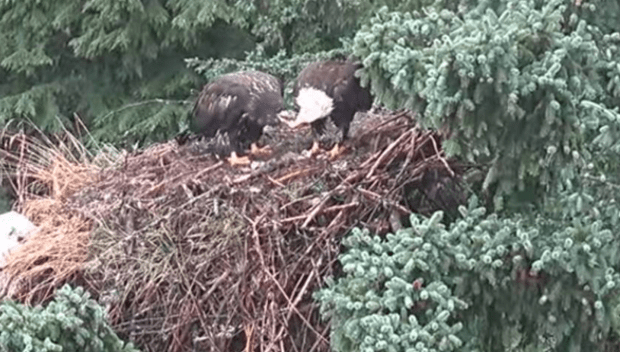
You can watch Kindness here. The moderator on the camera chat is reminding everyone today that Kindness is 76 days old today. She is already flapping and jumping. The average act for fledge on this nest – not the whole of Alaska – is 89 days. (The whole of Alaska is 80 days). If she behaves like the other eaglets on this nest, you should be able to watch her until mid-September. Here is the link to that camera:

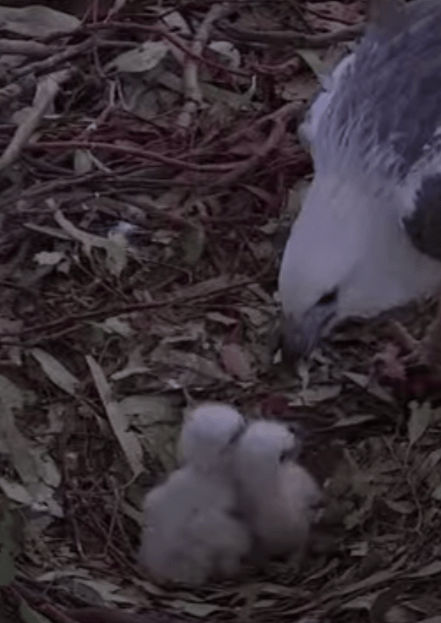
The White-Bellied Sea Eagle, Lady is feeding 27 and 28. Those little ones continue to look like white fluff balls but if you look carefully, their necks and wings are getting longer and there is a hint of ‘dark plumage’ underneath that natal down. The WBSE nest had a fright a few days ago. Dad showed up on the nest with a laceration on his leg and a cut near his throat that was bleeding. That seems to have subsided and Dad is busy catching fish for the family. (I am wondering about the small amount of salt water in the Parramatta River and its healing effects on Dad’s foot.)

27 and 28 do bonk but not much anymore. Some of the time it is instigated by the ‘little one’! They really are a good match for one another and unlike past years, viewers are remarking that they are really enjoying seeing the nest this year.

The egg tooth is disappearing as their beaks grow longer.

If you wish to watch then, here is the link to the cam:

There is some troubling news coming out in Bird World. ‘S’ informs me that the storks crossing over Greece where the wildfires are raging are being injured in large numbers as they migrate to Africa on the eastern routing. Various news agencies are reporting that people in Athens have been picking up dead storks off their lawns. This is more than sad. Here is a short news report by Reuters. I hope you can open it.

Here is a news article on the plight of these poor birds.

https://www.aljazeera.com/news/2021/8/9/disoriented-by-wildfires-migrating-storks-die-crossing-greece

A second is the number of raptors going into care. In the United States, there is an all out assault on plant life. Various levels of government are asking for and receiving permission to undertake ‘aquatic treatments’ using either Tribune or Harpoon. These are chemical herbicides and they poison birds!!!! At the moment, A Place Called Hope, has raptors in its care because of these treatments.

In Jacksonville, crews have been up doing maintenance on the NE Florida Bald Eagle cam. The presence of humans on ‘his’ nest brought Samson out from the trees and onto the nest yesterday. Wow. What a wonderful treat. Samson remains in the area and does not migrate while Gabby leaves early to travel north to cooler weather. Ironically – and sadly – this year it has been as hot in Ithaca, New York as it has been in Florida.

All three of the fledglings at the Foulshaw Moss Osprey nest were present yesterday. Poor White YW. Tiny Little Bob almost ripped his leg off trying to get at a fish delivery. Tiny Little! To steady himself, White YW had to put his talon on Tiny Little’s head. Gracious. It ended OK – no bird was injured.

For some reason all of the fledglings have been coming to the nest for fish. One will get the fish from dad, one will stalk that sibling, then they will get it and then White YW will arrive with another fish and confuse the entire situation. It is really quite hilarious. The fledglings are as big (or bigger) than Dad! You can watch them here:

https://www.cumbriawildlifetrust.org.uk/wildlife/cams/osprey-cam

Oh, wow. Tiny Little just snagged a fish from sibling 462. Fantastic.

Tiny Little is a ‘scrapper’ just like Tiny Tot. They both learned ‘street smarts’ to survive. Well done, Tiny Little! It was not that long ago that Tiny Little was shy. Her aggression will help keep her alive in the future.

News Flash. The female companion of Bucacek on the Mlade Buky White Stork nest in Czechoslovakia has been named Marketa.

Everyone reading my newsletter loves birds and animals or you wouldn’t be here. I was sent a delightful story – a view of rewilding through the eyes of a deer. Since we have so many deer in our city that have been displaced for ever more condominiums and roads, it really struck home to me. Perhaps you would enjoy reading it, too. Here is the link to ‘Rewilding is a Two Way Street. A letter from your neighborhood deer’.

https://www.hcn.org/articles/essay-wildlife-rewilding-is-a-two-way-street/print_view

Whew. That was a long newsletter. Sorry. Thank you so much for joining me. Send warm wishes to all the birds – for food and for the storks to survive as they travel from northern Europe to Africa. Take care everyone.

Thank you to the following for their streaming cams where I took my screen shots: Collins Marsh Nature Reserve, Glacier Gardens Park in Juneau, Latvian Fund for Nature, WBSE Sea Eagle Nest, Birdlife Australia, and the Discovery Centre, Cumbrian Wildlife Trust and the Foulshaw Moss Osprey Nest.

Hawks definitely do not like children

By 18:30, the smoke and the temperatures were cooperating and it seemed like a good time to go and check on the Cooper’s Hawk family in Assiniboine Park. When I arrived at the Park, there were several cricket games going on, families were meeting and sharing a pot luck outside – many for the first time since spring 2020, there were birthday parties and children running around.

When I found the spot and knew where the hawks had their nest and were hunting for bugs and chipmunks the other day, there were children running around. I could see the hawks in the sky circling. They never went to the nest tree or came to the ground. It is the life of a birder. It would be wonderful to see them a few more times before migration. The Canada Geese do not usually begin leaving until the middle of September through to the end of October. I have seen some miss the group and wind up walking about on an early snow. Weather is such a significant factor in the challenges our birds face.

For those who are not sure what migration actually is. Our feathered friends Move from one area for breeding during the spring and summer to another area for winter. They have adapted to the pattern of coming and going in order to survive. It is based on food supplies.

Different species travel different routes to their winter homes. These are long journeys. For example, the Ospreys in the United Kingdom will travel some 8,000 kilometres or 5,000 miles to places in Africa. The birds will fly over land, sea, and desert to reach their destinations. People wonder why the birds just don’t live in Africa all the time. The answer is rather simplistic: there would not be enough nesting sites or food for all of them plus their chicks. There are also a lot of very hungry predators ready to take those lovely fluffy little ones. So they disperse from Africa to sites in the United Kingdom and Europe.

The birds decide when it is time for them to migrate. The hormones in their body begin to change. Unlike spring when this hormone change leads to breeding, the autumn sees the birds restless until they know that it is time to depart. These hormones trigger a lot of eating. Fat begins to gather under their skin. They gain weight. It is that fat that will see them through their migration. Still, they stop and feed along the way. Normally they hunt for food in the early mornings and late afternoons. High pressure systems are good for flying but low pressure systems bring winds and rain. When the birds get into a low pressure system, they will normally stop flying, if they can, and wait til another high pressure system comes through. Migration times vary because of the winds and the weather. Birds that soar and ride the thermals can travel as much as 465 km or 300 miles in a stretch. Some gather in flocks like the storks in Latvia and Estonia. Sometimes birds pair up to migrate. For the Ospreys, the female leaves and the male stays behind until there are no fledglings crying for food.

Not all birds migrate. Even I have a sedentary Sharp-shinned Hawk that defies all logic to stay on the Canadian prairies for the winter. The Osprey in Australia do not migrate. The birds in the Amazon Rainforest do not migrate. There is plenty of food and nesting sites for them year round. This past spring and early summer there was much discussion over the migration of birds from Florida. In Jacksonville, Samson, the father of Legacy, stays in the area of the nest year round. Gabrielle, on the other hand, migrates north – yes north – to cooler summer climates. This year she might have discovered it is hotter up north! Even some of the Ospreys in Florida do not migrate; they stay year round. There are plenty of fish for them as well as nests.

Birds take different routes. The White Storks from Latvia either taken a western route or an eastern route. Dr Erick Greene and his team in Montana study the migratory movements of the Ospreys from the Clark Fork River area with satellite transmitters. In the United States, some fly over Hawk Mountain where there is an annual count. In fact, you can go to this site to see the number of birds traveling over this marvellous area with its thermals. Here is the link for you for their autumn migration count that will being in about a week!

https://www.hawkmountain.org/conservation-science/hawk-count

Migration is extremely challenging and we hope that all of the adults will return to their nests the following spring and that we will see the juveniles who take their first flight to Africa in a couple of years.

And now for some birding and nest news

Poole Harbour: Blue 022 and CJ7 who were so visible until a few weeks ago sky dancing, mating, and working on the nest with the streaming cam are now working on another nest in the area. There is no camera. They are still doing everything together and everyone is looking forward to the first hatches in Poole Harbour for 200 years.

Dahlgren: A large part of the nest in King George, Virginia, collapsed today. It will be fixed in the fall well after Jack and Harriet’s migration.

Kielder Forest: All 16 of the 2021 juveniles have fledged successfully. Everyone is elated. This is 6 more fledglings than their previous best year. Congratulations everyone!

Mlade Buky: Bucachek and his new love spent the night on the nest in Mlade Buky, Czechoslovakia. Oh, how sweet! Just as the dawn is beginning to appear, they are both preening.

Balloons, something that impacts all birds: Virginia, Maine, Maryland, and Delaware have or are going to pass shortly the release of balloons. Hawaii has already passed a law on helium balloons.

Port Lincoln Ospreys, Australia: Dad and Mom have been taking turns incubating the eggs. Here is dad on the nest. A little earlier he had been pestering Mom. He kept pulling on that turquoise rope wanting his turn. It was too funny. The Port Lincoln Ospreys are an example of sedentary birds. They do not migrate. There is no need.

Loch Arkaig: The two juveniles of Louis and Dorcha have now fledged. I have not heard anything about the chosen names yet.

Collins Marsh: Malin was a little wet off and on during Saturday. S/he is sleeping on the nest alone tonight. There is no perch – let us hope that the parent or both parents are in a nearby tree in case there are any owls about. It seems like a pattern. Does mom always spend Saturday night off the nest?

WBSE, Sydney Olympic Forest: 27 and 28 continue to eat until their crops almost burst and sleep. Meanwhile there has been an intruder today and Lady and Dad were honking in alert.

And last but very special, A Place Called Hope. Along with other wildlife centres, they are receiving quite a number of starving Great Blue Herons and other herons. Why would they be starving? It has been raining in the Connecticut area and all the herbicides and pesticides that people put on their lawns and gardens makes its way into the environment, into the water table, into the ponds. It is poison. If your gardening centre or lawn care person tells you that the chemicals they use are ‘Green’ – well, think again. Whatever they are using kills. So sad. It is OK if your lawn doesn’t look emerald green.

Thank you so much for joining me today. Have a lovely Sunday. Take care of yourselves. I look forward to seeing you soon.

Thank you to the following for their streaming cams and their FB pages where I grab my screen shots: A Place Called Hope, Mlade Buky White Stork Cam, Collins Marsh Osprey Nest, Port Lincoln Osprey Project, and Sea Eagles, Birdlife Australia and the Discovery Centre.

The featured image is Dad at the Port Lincoln Osprey Barge taking his turn incubating his two eggs.

Late Thursday and early Friday nest news

It was a rare treat to check on the Black Storks and find that Karl II was at the nest feeding the three fledglings. It was around 18:00I had been missing this. The ritual of the feeding and the eating is entrancing. This nest is in the Karula National Park in Estonia. As in Latvia, the Black Stork is very rare and much loved. Karl II and Kaia raised three healthy hatchlings this season. Congratulations!

In my last newsletter, everyone was waiting for the second egg at the Port Lincoln Osprey nest to arrive. If you missed it, it was around 3:27 am nest time on 6 August.

Last year’s PLO fledgling, Solly, is 320 days today. Wow. It is about time to get out the party hats and celebrate her one year hatch day. This just gives you hope. Today, Solly is going in and out and in and out at Eba Anchorage. She apparently has a favourite dead tree in the area that she likes to roost in.

Oh, it seems nestlings are just like human children. Let mom or dad get out of sight and they start picking on one another. This was the case with 27 and 28 at the White-Bellied Sea Eagle nest in Sydney, Australia. If this is all these two get up to – let them have a little fun. They are so close in size that neither has an advantage. Have a peek.

Dad and Mom are continuing to bring in fish about 5 fish a day to the Collins Marsh Nest. This is a big improvement over a few weeks ago. Malin’s tail now reveals three rows of dark bands and the beautiful scalloped juvenile feathers.

Oh, Malin is becoming such a gorgeous bird. The stepped up deliveries and the drop in heat seem to be suiting this Osprey family in Wisconsin, USA.

Such a little sweetie. Malin really loves this part of the nest. You can catch her sleeping there during the day (like in the image above) or at night. All tucked in with Mom watching over her. If we could only slip a little pillow under that wee head.

Suzanne Arnold Horning was on the Cornell Campus this evening and found K3. Oh, this is such a cute Red-Tail Hawk fledgling! She did not find the other three and commented that K3 must have missed the memo on where to meet tonight. He was apparently flying around food calling!

I didn’t think another Red-tail Hawk fledgling could ever win my heart like J3 did but look at that sweet face on K3. I am melting.

K3 is over on one of the light towers. What a gorgeous image of this third hatch against that clear blue sky. He has really grown into an amazing fledgling. These two, K1 and K3, are simply great fliers and K1 has turned into a fantastic hunter just like her parents, Big Red and Arthur.

Other Nest News:

Congratulations to Rutland Water. It is their 25th anniversary and today, the 200th chick, Blue 360, fledged! Wow. What a fantastic record for the translocation project. The announcement and photo of that lucky chick is on their FB page: https://www.facebook.com/324266140960825/posts/4294404503946949/

Louis and Dorcha at Loch Arkaig (nest not on camera) have their first fledge this morning. Voting has ended to name their chicks. Hopefully we will know tomorrow! What fun. That Loch Arkaig nest was so empty this year without Aila. Hopefully another couple will claim it for the 2022 season or maybe Louis and Dorcha will move from the nest off camera to the one where we can watch their every move.

Between now and the beginning of the third week in August, the females of the UK nests will begin their migration to as far away as Spain/Portugal or West Africa. The males will remain as long as there are chicks calling for food. This is normally 2-3 weeks.

This is what fish calling sounds like thanks to one of the fledglings up at the Loch of the Lowes. This chick could be heard all the way to Glasgow! They are so loud. You can easily imagine that the male will know if there is a chick on the nest who is hungry.

Things seem to be going really well on the nests today. That is always worth a big smile!

Thank you so much for joining me. I will be back late Friday evening with a nest update. Take care everyone. Stay safe.

Thank you to the following for their streaming cams where I took my video clips and screen shots: Eagle Club of Estonia, Collins Marsh Osprey Cam, Scottish Wildlife Trust and Friends of the Loch of the Lowes, Port Lincoln Osprey Project and the Port Lincoln Osprey Project FB Page, and Suzanne Arnold Horning for letting me share the beautiful images of K3.

The featured image is K3 on the light stand taken by Suzanne Arnold Horning.

Late Wednesday and early Thursday nest check in

Kindness, the Bald Eagle nestling in the Glacier Gardens Bald Eagle Nest in Juneau, Alaska is 70 days old today (5 August). Bald Eagles are considered fully grown at 12 weeks. The average age of fledging on the Glacier Gardens nest is 89 days while the rest of Alaska is 80 days. Kindness had a quiet Thursday. It was misting rain. Mid-afternoon Dad brought Kindness a small live fish. She ate it all!

Kindness is very good at mantling.

Kindness was fascinated by the flopping of the tail of the live fish.

She is growing into such a beautiful juvenile.

Kindness is such a sweet little Eaglet.

You can watch her here:

The little osprey nestling, Malin, on the Collins Marsh Nature Cam, had at least five feedings on Wednesday. A big shout out to ‘S’ in Hawaii for counting those feedings! Malin’s tail and wing features are looking so much better.

It was nice to see Malin with a bit of a crop early Wednesday afternoon. Those feathers are really developing and that girl loves to use her eye liner. Can’t wait to see what Malin looks like when she has all of her juvenile plumage.

Malin’s crop got bigger. So happy to see this. When Tiny Tot on the Achieva Nest needed food to really grow and begin to catch up, it arrived. Everyone’s warm wishes must be working for Malin! I do hope she grows feathers back over that shiny crop. I don’t think I have ever seen that in an Osprey chick, have you?

Malin is becoming quite the character. She is so happy when mom is on the nest. I wish I could sit in that yoga position like Malin does!

The Collins Marsh Osprey Cam is here:

At the White Bellied Sea Eagle nest in Sydney, it is all about the feedings. Unlike Kindness who eats more and requires less feedings, these little nestlings require lots of feedings with fewer bites. Lady and Dad have both been taking turns feeding and brooding. Lady does do all of the night time brooding. 27 and 28 can melt your heart. I have been told the bonking is minimal.

27 is 7 days old and 28 is 5 days old. These two are really sweet.

Lady just adores these little ones. She is so happy to be a mom again.

You can catch all of the action at the WBSE Nest in the Sydney Olympic Park here:

Hob Osterlund reports that Amazonia, the last of the Laysan Albatross Colony to hatch, fledged sometime between Monday and Tuesday off Kauai. For me, there are always a few tears when the birds fledge but no more so than for the Albatross who spend 4-6 years at sea before ever returning to land. What a leap of faith that first flight brings and how astounding it must be to fly. Take care H958. We hope to see you in Kauai in a few years with your sea legs on.

@ Hob Osterlund

There is troubling brewing down in Orange, Australia. Xavier and Diamond have been preparing the scrape box for the 2021 season. Izzi was officially 10 months old yesterday. There was a confrontation in the scrape box with Xavier. Neither bird was injured but it was Xavier that left the box. Most people feel that Xavier and Diamond will now have to treat Izzi like any other intruder – unless, of course, he wants to join in raising his siblings. It has happened – actually worked well – in the UK. We wait and watch.

Cilla Kinross posted a very short video of the unfortunate encounter:

It is a new day in the scrape box. Xavier arrives with a male Red-rumped Parrot as a food gift for Diamond around 11:20. He calls Diamond and she quickly arrives accepting the gift and fleeing the scrape box. Xavier waits and leaves after. This is good. I did not see anything of Izzi!

Diamond must have been so happy that Xavier brought a parrot than a Starling!

She grabs it quickly and goes out to enjoy her meal.

Here is the link to the camera for the Falcon Cam at Charles Sturt University:

The female at the Port Lincoln Osprey Barge laid her first egg of the 2021 season two days ago. Today should be egg#2. It wasn’t there at 12:32 on August 5 (nest time) but Mum looked restless and uncomfortable.

Still only one egg. Old timers tell me that there can be 4 days between eggs.

The 2018 hatch, Calypso, has been seen hunting just north of the barge. She was the first Osprey banded for a long, long time in Australia. She stays within 10 km of the barge – a real difference from Solly who remains up near Eba Anchorage, more than 200 km away.

Those beautiful Black Stork nestlings are doing very well. Everyone worries because these lovely nestlings hatched so very late. It is hoped their parents will stay with them and not leave for migrate before they can fly.

My friend in Latvia, ‘S’, also included a video that was made showing how the nest looked after last year’s season was ending. Wow, that nest is really narrow at the base. Have a peek!

The light in the forest changes throughout the day. There has been lovely misty rain in the early mornings with the sun bursting through later in the day. I must rewind the streaming cam today to find the parents returning to this nest to feed this trio.

There is still plenty of time before these beauties fledge. You can watch this rare Black Stork nest in Latvia of Grafs And Grafiene here:

Thank you so much for checking in with our birds today. It looks like everyone is doing fine except for Xavier and Izzi. We hope that is sorted and Izzi, the little cutie pie that no one wants to leave, is on his way to start his journey and find a mate! Take care all. See you soon.

Thank you to the following for their streaming cam where I took my screen shots: The Latvian Fund for Nature, the Glacier Gardens Bald Eagle Cam, Collins Marsh Nature Centre, Sea Eagles, Birdlife Australia and the Sydney Discovery Centre, Port Lincoln Osprey Project, Falcon Cam Project at Charles Sturt University in Orange, and to Hob Osterlund for the photo of Amazonia on her FB page.

Birding Action has started in Australia

Wow. At 00:52:40, Mom goes into labour. She is the female Osprey on the Port Lincoln Osprey Barge in Australia. Dad is sitting right at nest side in support. It was magical. The minute the egg was, Dad was off. My time said 00:57:58. And with that single significant event, the Port Lincoln Osprey season for 2021 is underway!

Mom looks very content in the early morning Australian sun.

I was very glad to see Dad there. Last year Dad just about ended my love of Ospreys. The death of Tapps, the third hatch in 2020, practically cemented that. The Achieva Osprey nest brought back the pain but the triumph of Tiny Tot gave me faith. It also has made me question the entire notion of ‘survival of the fittest’. So this year I am wishing for consistent fish drops when the eggs hatch – Dad, that means enough fish for everyone every day with no breaks.

The Northern Hemisphere fledglings are preparing to migrate (if they hatched in an area where the birds travel to warmer climates during the winter) so for all Osprey lovers this is a chance to start at the very beginning again — in Australia.

The adults spent a lot of time bringing in new twigs and lining the nest cup with bark. It is quite beautiful. This nest looks like someone cares!

Of the chicks that have fledged from this nest, Calypso (2019) fishes and is seen regularly in the Port Lincoln area. Solly (2020) was fitted with a satellite tracker as well as a leg band. It is reassuring to know that she is well. There have been no reported sightings of her brother, DEW, that I am aware of.

Solly is 317 days old and she is at her favourite place, Eba Anchorage.

The two eggs have hatched at the White-Bellied Sea Eagle cam in the forest of the Sydney Olympic Park. They are WBSE 27 and 28. Both are doing fantastic. Dad has been bringing in Bream, Pigeon, several other types of birds, and Eel-tailed Catfish. The chicks are not wanting for food or variety!

The link to the Sea Eagle Cam is here:

Are you a Peregrine Falcon lover? There are two excellent nests in Australia on streaming cam. One is on all year round and has covered the antics of Xavier, his mate Diamond, and their son, Izzi. The scrape box is on the water tower on the grounds of Charles Sturt University in Orange, NSW. This family is part of a research project of Professor Cilla Kinross.

I should tell you that this nest is hilarious. Xavier is such a sweetie and he is courting Diamond now even though they have been a bonded pair for a number of years. He brings her gifts of prey to the scrape box and they do a courtship dance. Sometimes Xavier forgets and brings Diamond a Starling. Diamond hates Starlings and refuses to accept the gift from Xavier! And then there is Izzi. Izzi is like the cutest almost one year old falcon. He should not be at the nest but he is. You see, Izzi fledged three times. The first was accidental so he was taken back up the 170 stairs to the scrape box on the water tower. The second was a good fledge but he ran into a window. He was in care for several days and returned to the scrape box. The third time was the charm. The problem? Well, Izzi should have left his parent’s territory before the beginning of 2021. Yes, it is now August. That is the problem.

I mean seriously – could you tell this cutie pie to leave home?

Both Diamond and Xavier have been ‘scraping’ in the scrape box. The indentation they are creating is where Diamond will lay the 2021 season eggs. The couple have already been mating on the top of the water tower.

This is Xavier. The yellow around the eyes, the cere (part above the beak), and the legs and feet are a deep yellow when falcons are adults. Look at the beautiful plumage patterning.

This is Xavier scraping in the scrape box.

This is Diamond scraping in the scrape box. Notice the colour of the stones. In his book, The Peregrine, J.A. Baker states that “Peregrines bathe every day…The bed of the stream must be stony and firm…They favour those places where the colour of the stream-bed resembles the colour of their own plumage.” Absolutely. Camouflage. But why do they take so many baths? Baker believed that it was so they would not transfer any lice or other parasites from their prey onto them that could cause illness or disease. The same is true of the scrape box. Peregrine falcons lay their eggs in gravel and not on a twig nest to avoid illness or disease.

Here is a very short but loud pair bonding in the scrape box. Have a look at the dance that Xavier and Diamond do together. Xavier is the smaller of the couple. Falcons, like other raptors, have reverse sex size diamorphism – meaning the female is larger.

Here is the link to the box camera. There are in fact two cameras: one looks at the inside of the box as above and the other is positioned to look forward from the back taking in the ledge and a bit of the outside world. That is cute little Izzi looking out to that big world beyond.

The chat feature has moderators, often Professor Kinross, as well as a FB Page where you can get great information.

The second is the Collins Street Falcons better known as the CBD Falcons in Melbourne. The camera is not operational yet. There are many videos from last year if you search for Collins Street Falcons on YouTube. In 2020, the couple had triplet girls. Triplets? Three eggs hatch within a period of 24 hours. These girls grew like crazy. They grew bigger than their dad.

I am including one video of the male delivering a pigeon to feed them. I just love this tiny little male. He melts my heart every time I look at him.

The diet of the two falcon families is different. The Melbourne falcons are urban. Their diet is almost exclusively pigeon. In contrast, the falcons in Orange are rather rural with a more varied diet including Starlings (remember Diamond dislikes those), Galah, sometimes a Supreme Parrot, other parrots, and birds. One thing that eyases love are cicadas. They hold them in their foot and eat them like a popsicle. It is crazy. In one day last year, Izzi ate 17 cicadas in a row. There had to be a swarm of them! It was incredible.

As night comes to the Canadian prairies the sun is rising on a new day in Europe for all of the birds. The rain falling in the Latvian forest where the three Black storklings nest sounds wonderful.

It was reported today that my city had only 1/10 the average amount of rain in July. It has been 150 years since this small amount of rain was last recorded. We long for a day just to listen to the sound of rain falling like it is here on the Black Storklings in Latvia:

Thank you so much for joining me today. It is wonderful to have you with me. Take care everyone!

Thank you to the following for their streaming cams where I took my screen shots: The Latvian Fund for Nature, Sea Eagle Cam, Birdlife Australia and the Discovery Centre, Charles Sturt University and the Falcon Cam Project, Port Lincoln Osprey Project and PLO FB Page for Solly’s transmitter data.

Note: The next newsletter will appear late Tuesday.

Happenings in Bird World 2 August 2021

It is a gorgeous day on the Canadian Prairies. The extreme heat of the past has dissipated and the sun is shining. There is no wind, every leaf is still. The only thing moving in the garden are the little songbirds waiting for the feeders to be filled. No wind means there is no smoke from the wildfires farther north. It is a nice change. We are all hoping for big downpours and, if the weather report is correct, that will come at the weekend.

A serious lump came in my throat this morning when I went to check on Tiny Little at the Foulshaw Moss Osprey Nest. No one was there this morning (nest time) and now the crows are picking at the nest. Normally, at this time of day, Tiny Little would be on the nest waiting for a fish drop. There appear to be no birds in the parent tree in the background. The Crows are a reminder that the days of seeing our Ospreys are precious ones.

I returned to the Foulshaw Moss nest several times. The last visit revealed Blue 464 – the first of White YW and Blue 35’s chicks to fledge – on the nest food calling. You could see the shadow of another bird on the camera at times.

There are some ‘late’ nests and some just starting in case you are having empty nest syndrome.

One of those nests is at the Collins Marsh Nature Centre in Wisconsin. So as not to confuse everyone, the constant watchers got together. Each felt the chick needed a name, even if it was just for us. ‘S’ from Hawaii suggested Malin which means ‘strong little warrior.’ It fit perfectly for this small chick. Voted for unanimously amongst our small but caring group! So from now on I will refer to him or her as Malin, just so you know.

The female was not on the Collins Marsh nest when I checked. She is absent for long periods of time. I want to think she is fishing and will be back to feed Malin or she is just resting. The male has made a fish delivery. This time it is headless. Malin is confused because Dad will not ever do any feeding. Malin is standing and walking much better than last week but he still wants to be fed by the adult.

Malin continues to try and get the male to feed him the fish but it is not happening!

Once Malin realized that he was being left to fiend for himself, he started self-feeding on the fish. Because this one is headless, Malin is making much better progress. This little one is trying very hard.

There is a concern about the feather growth of Malin. Unfortunately, the camera is not clear. Yesterday, ‘S’ took some screen shots that indicated some wing feathers near the tips could be missing. If you look carefully at the image below, you can see the green grass through both wings clearly. This could be a serious concern for this young bird.

Thinking about Malin’s development, a search through the FB pages of the nature centre indicates that three chicks hatched on this nest on 16, 18, and 20 of June. Historically, the smallest – the third – has died on this nest with the exception of one year. This year Malin is the only one to survive leaving us to believe that he was either the first or second hatch. That would mean that he is either 46 or 44 days old. From Osprey development charts, it appears that Malin is about two weeks behind the average in growth. This is most likely due to the low food deliveries.

Maris Strazds, from the Institute of Biology at the University of Latvia states that the availability of food determines the dates of fledging and also that the survival rate of chicks is better if they spend more time on the nest after fledging. Strazds is speaking specifically about storks but this is also known to be true in hawks and falcons and I would like to think that it also extends to Ospreys and Bald Eagles.

While the feather growth is being monitored by the Wisconsin DNR Biologist and a concerned Wildlife Rehabber of the area, access to the nest is a problem. The nest is situated on top of a wildlife tower that was moved to this site so that people could climb the stairs and view the countryside. Here is a close up view. It appears that a metal roof with a peak was fabricated to fit on top of the flat roofed water tower.

In this image the nest looks quite deep. This image was taken several years ago and it seems that the nest has been reduced in size – perhaps by strong winds. Photographic comparison of the nest cup now with the chick and a couple of years ago also indicates a loss of nesting material, perhaps substantial amounts, missing.

It is difficult to determine if there is a wooden support under the twigs. If you look at the images of the nest with Malik (above) it appears that there is something ‘square’ underneath a couple of layers of twigs.

My concern is that if the feather development on Malin is problematic, there is no emergency access to the nest from the observation box. In other newsletters I have indicated that there should be a means to access the nest without compromising the safety of the individuals trying to help the birds.

There is only one operational White-Bellied Sea Eagle cam in the world. It is at the WBSE nest in the Sydney Olympic Park and the excitement there is just beginning. These two little ones, 27 and 28, appear to be getting along without food competition. Of course that can change but there has been plenty of Catfish Eels (or is it Eel Catfish?) on the nest.

Right now the sea eagles are sleeping. One little babe can be seen sleeping on Lady’s leg.

You can access this streaming cam here:

Tomorrow I will give you some information on other nests in Australia including two Peregrine Falcon streaming cams.

If it is Bald Eagles you love then the Glacier Gardens Bald Eagle Nest in Juneau, Alaska is not to be missed. Kindness is such a little sweetheart. Liberty and Freedom are helping her by trying to get her self-feeding skills honed. The eagles fledge later in Alaska because they are bigger in size than the ones hatching in the Southern US who are already off the nest. At Glacier Gardens, the average fledge is 89 days after hatch while the rest of Alaska is 80 days on average.

‘L’ also sent me the link to an Osprey nest that she has just discovered. The chick hatched on 23 June. It is a real little sweetheart ——- and the camera definition is excellent!

It is the Minnesota Landscape Arboretum Osprey Nest. There is only one surviving chick. The other perished on 26 June; the cause is not clear. This chick looks extremely healthy. The nest is on top of a platform at the University of Minnesota. Enjoy!

Because so many of you love storks, I want to mention two that my friend, ‘S’ in Latvia says are very special. One nest is in Latvia and the other is in Estonia.

The Black Stork nest in Latvia is very special. The birds are listed as critically endangered and it is rare to see them in Latvia even though the White Stork population is healthy. The male is Grafs. ‘S’ explains to me that the nest is late because Grafs was a bachelor and waited a very long time for his mate, Grafiene, to arrive. The three storklings hatched on 12, 14, and 15 of June. There are many challenges for this couple and their trio. The first is the late hatching date and the worry about whether or not the parents will remain with the storklings until they are developed and strong enough for migration. The storklings will be ready for fledging in 20 or more days. That puts it at the third week of August. As we know, storks are already gathering for their migration so watchers can only wait and hope and take the beauty of this nest a day at a time – as we always do with other nests. The second concern has been the dangerous heat that has hit nests all around the world causing a drop in prey delivery. The third is the nest itself. It appears to be unsafe despite the fact that other stork couples have fledged chicks in previous years.

I want to add that the chicks are very healthy – they are doing so well so I want all of us to be optimistic. This year I have seen miracles happen on nests – I only have to look at Tiny Tot on the Achieva Osprey Nest and Tiny Little on Foulshaw Moss to know that positive things can happen if we all send warm wishes. Even the turning of the deadly storm cells away from the nest at Collins Marsh was another of those miracles or the safe return of the male at the Barnegat Light Osprey Nest in NJ after being missing for a day due to that same weather system. So, we wait, watch, and hope.

You can watch this beautiful nest here:

It is raining today on the nest. Oh, how I wish the beautiful storklings could send some of that moisture to Canada!

There is also a forum in English for this nest where you can go back and see the long history and discuss the nest. You can access it at

The second Black Stork nest is actually in Estonia. As in Latvia, Black Storks are loved in Estonia and are rare.

It is also raining at this nest today, too.

The parents are Jan and Janika. The nest is very stable so there are no worries with the structure. But because of the horrific heat that has impacted all nests, food deliveries have sometimes been problematic. Janika, like the mother on the Collins Marsh Osprey nest also disappears for long periods. These storklings will also have a challenge to be flight ready for when the migration begins. Again, we can watch with wonder at these extraordinary birds but we must be aware of some of the challenges that birds encounter. Life is not easy.

There is also a forum for this nest. It is here:

I really want to thank ‘S’ for bringing these two Black Stork nests to my attention plus sending me all of the information about them. They are such beautiful and rare birds and it is a real privilege to see them hatch, grow and learn, and then begin their journeys. In addition, I want to thank ‘L’ for sending the information on the Minnesota Landscape Arboretum Ospreys and ‘S’ for finding all the images of the tower at Collins Marsh and the Nest and the great name for the Collins Marsh chick – Malin.

And I want to thank you for joining me today. It is always a pleasure to have you here with all the other bird lovers around the world. Stay safe everyone. See you soon.

Thank you to the following for their streaming cams where I took my screen shots: Eagle Club of Estonia, Latvian Fund for Nature, Collins Marsh Nature Center, Cumbrian Wildlife Trust and the Foulshaw Moss Osprey Nest, Sea Eagle Cam, Birdlife Australia, and the Discovery Centre, Glacier Gardens Bald Eagle Nest, and the Minnesota Landscape Arboretum Osprey Cam.

Early Monday in Bird World, 2 August 2021

Many who read my newsletter have a love for all birds and a particular fondness for one or two species and a number of nests. My personal journey began with an encounter in my own garden – literally, getting up close and personal with a female Sharp-shinned hawk in the dead of winter who, I believed at the time, was eating the garden rabbit, Hedwig. She wasn’t. Our eyes locked to one another’s, ‘something’ happened. I cannot describe it but those minutes changed my life. I know that many of you have had a similar experience as well as others who have gone on to write books about their journeys.

Philip Brown’s, The Scottish Ospreys from extinction to survival, written in 1979, is just such a book. My used copy arrived in the post a couple of days ago from the UK. The only time that I have had to read has been late at night. The book is so well written that I was often hesitant to stop reading. His enthusiasm and love for these fish-eating birds animates the drive in Scotland to reintroduce the Osprey after years of extinction. Brown gives a good solid history but it is his personal stories of spending time with others at the eyries of Loch Garten guarding the nests that draws the reader into sympathy with the birds. Brown worries about the trees that are partially dead but have nests, about the poachers that are killing the birds, and how to halt the illegal practice of egg collecting. Those are woven in with the growing understanding of osprey behaviour and the efforts to grow public interest in the birds. If Ospreys tug at your heart then this is a book that you should read. When I was looking for a copy I discovered that the book could be ordered from the UK with standard post for a very reasonable price. It is a hardback book and used copies are available for less than 5 GBP.

I want to re-mention another book, available only in paperback. Lady of the Loch. The Incredible Story of Britain’s Oldest Osprey is by Helen Armitage. There are a couple of ways it is different than the Brown volume. It is newer, written in 2011. The book covers the reintroduction of the Osprey to Scotland also but does it by focusing on a single bird, Lady, at the Loch of the Lowes. Lady raised 48 chicks migrating to Africa and back 20 times. That is simply astounding. Armitage’s book is different in another way. The lens is female, a welcome change when the majority of books on Osprey are written by men. She includes details not found in other volumes including one that I found particularly interesting. In trying to protect the Osprey, “In September 1899, Queen Victoria confirmed that certain regiments would stop wearing osprey plumes…” She also notes that it was women who continued the fight to stop the use of bird plumes including the Duchess of Portland who became the head of the Society for the Protection of Birds. It is time to think of fall reading and these are two really excellent books to curl up with.

In nest news, it appears that Bukacek or Father Stork is the only member of his family sleeping on the nest at Mlade Buky.

It is possible that both Pankrac, the female, and Servac, the male are with other fledglings preparing for their migration?

The normal practice with raptors is the female leaves for migration first. The male remains feeding the fledglings and bulking up himself. Once the fledglings depart, the male begin his long journey. Is this also the same ritual for storks?

I had a beautiful letter from a reader, ‘S’. She confirms the special status of storks in her country, Latvia. The people of Latvia have a special name for the White Storks, svētelis. She says the term speaks to the “embodiment of something holy and brings peace and protection from bad things.” This belief explains so much about the great love the people of Latvia have for their storks and that same understanding of storks being special must extend to surrounding countries where people go to great lengths to care for these amazing birds.

In regards to the migration of the storks, ‘S’ says that every year the storks gather on the trees, the roofs of all the houses and buildings, as well as on the electricity poles close to where she lives. When they are all ready to leave they begin clacking their bill together similar to what they do when the storklings are wanting food. Close your eyes and try to imagine how wonderful it would be to see this enormous gather of storks, each being called by the winds to begin their journey. The only equivalent we have in Manitoba are the Canada Geese. Every year they gather on the large ponds near to our nature centre, Fort Whyte. They arrive as the sun is setting calling one another. It is extremely moving. I can only imagine if it were storks!

There are several videos on YouTube about Klepetan and Malena, the famous Croatian white storks and the man, Sljepan Vokic, who has cared for Malena for more than 22 years. Sometimes, it is nice to see one of those videos just to remind ourselves that the world is full of kind caring people.

Skipping down to Australia, the two little sea eaglets, 27 and 28, are doing really well. It is mystifying watching Lady feed them the tiniest morsels of fish from her large beak.

Just look at the size of fish flake Lady is feeding to 28. She is so gentle.

There is plenty of fish in the nest and, so far, I have not seen any signs of food competition. Both of the little ones have nice tiny crops after their feedings. So far, so good. Fingers crossed it keeps up. Indeed, the only cheekiness I have seen is 28 trying to take a bite of 27’s head!

I love the look in Lady’s face as she stares at those two precious little fluffy bobbles. In many ways Lady reminds me of NC0 on the Loch of the Lowes nest in that she has grown into being an excellent – and loving – mother.

There is a gentleness about her movements with the two chicks this year that is striking. These moments of both of them tenderly tucked under mom will pass so quickly – they grow so fast!

A quick early Monday morning check on the UK Osprey nests reveals that Aran and Mrs G have been on the nest together since approximately 4 am.

Amidst the bleating of the sheep and the cows mooing, Aran brought in a fish for Mrs G and did a survey of their nest.

It is reported that Aran’s wing is much improved. He is flying more and fishing for himself as well as delivering fish to Mrs G. This is all good news since it was unknown at the time of his wing injury in late May whether or not he would be healed in time for migration.

One of Laddie and NC0’s chicks is on the Loch of the Lowes nest hoping for a food drop. Of course, that band is in hiding so it is anyone’s guess which chick is calling for fish!

The scene at the Dyfi Nest of Idris and Telyn and their two fledglings is simply pastoral. That said, no one is home!

The nest of Tiny Little is equally beautiful. I love the gentle yellows of the sun kissing the Dyfi Nest as it moves above the horizon and the gentle golden pink colouring the landscape of the Foulshaw Moss nest below.

A little later the Foulshaw Moss is magical. No Tiny Little though.

I cannot think of a better way to start a Monday morning than collapsing into the serenity of one of these landscapes. You can feel the stillness while, at the same time, soaking in the freshness of the smell of dew on grass.

Thank you for joining me. I will get the synopsis of what is happening with the Gough Island Recovery project this week. Once I started reading Brown’s book on Ospreys many other things went to the wayside. I hope that you have a great start to the week. Take care all.

Thank you to the following for their streaming cams where I took my screen shots: The Scottish Wildlife Trust and Friends of the Loch of the Lowes, Dyfi Osprey Project, Sea Eagle Cam, Birdlife Australia and the Discovery Centre, Mlade Buky White Stork Cam, Bywyd Gwyllt Glaslyn, and The Cumbrian Wildlife Trust and the Foulshaw Moss Osprey Nest.

Sunday news in Bird World

The sun is bright but not too hot, the Hibiscus continues to bloom, and Tiny Little is on the Foulshaw Moss nest eating a large fish. That is a great beginning to the day.

This is actually ‘the tea time’ fish for our favourite little fledgling on the Foulshaw Moss nest. It is about 16:00 in Cumbria.

Tiny Little is so smart. She doesn’t waste her time and energy fighting with the mouth and eyes of the fish, she rips a part of the belly open and begins to eat the side and the bottom of the fish. She is ever mindful that there are also two hungry siblings lurking about.

Tiny Little ate off that fish for more than an hour. She got a lot of really nice fish Great work, Tiny Little!

After what appears to be an hour and a half, big sibling 464 arrives. I missed the hand off. Was Tiny Little finished or did 464 come in and take the fish? We will never know. 464 has been fighting with the front of that fish for over an hour now. Sibling 462 is waiting their turn! Tiny Little has flown off.

In the White-Bellied Sea Eagle Nest in the Sydney Olympic Park, Lady has been busy feeding 27 and 28. Oh, they are so cute! I love this stage. Lady is so gentle feeding them with her big beak. They look like two little snow people with arms.

The Only Bob or Bobette in the Collins Marsh Osprey Nest in Wisconsin has had a couple of feedings this morning and perhaps more by now; it is now 13:33 on that nest. The fish that are being brought to the nest by both parents are quite small. I wonder if all the fish are that small? or are the bigger fish lurking around in deeper water?

The chick is being watched for feather development. It is hoped that the ‘blood’ feathers will grow fully and, at the time of fledging, the chick will have a full set of juvenile plumage.

In the image below, you might want to look at what some people call the quills on the left wing. As the feathers grow, those quills break open and eventually fall off. This is what we are watching.

Yesterday I reported that Bonifac, one of the male storklings cared for by the people of Mlade Buky had been electrocuted just like its mother. The other male, Servac had not been to the nest but was seen flying with other storks. Pantrac has been to the nest to be fed. There were no storks on the nest so far today. This is not unusual! The storks are beginning to gather for their migration to Africa. Yesterday might well have been the last day for them in Mlade Buky.

Before the age of Immarsat M and GPS, the only way to study the migration of the storks was if they were ringed. In 1933, a short entry in Nature Magazine (30 September, p 509) says that ‘Storks nesting east of the River Elbe have been found to use the Asia Minor route when migrating, and those nesting west of the Elbe are stated to take the route through Spain.’ Today those similar routes are simply called the Easter and the Western. The western is through Spain and the Straits of Gibraltar while the eastern has the birds flying through Egypt following the Nile. With Satellite tracking, the birds are now known to winter in Ethiopia, the Central African Republic, Senegal, Nigeria and the Niger River Basin.

The observations of the success of the migration and the concerns in 1933 are similar to those in 2021. It is a two month journey for the Danish storks – anything can happen between the time the storks leave and arrive. Even with laws protecting migrating birds, these lovely creatures have been known to have been shot down in France, Malta, and in parts of Egypt. There are many other things that impact this hazardous journey – changing climates, lack of food and water can all contribute to the loss of the birds.

Because we are talking about European laws, it is essential that the countries that make up the European Union – and many who do not- work together to ensure that the killing of migrating birds in European states is halted. There also need to be uniform protections in the territories where the birds migrate. As the world changes, following the SARS Covid-19 pandemic, countries in African that have been devastated by wars, famine, droughts, and epidemics need to understand that ‘birding’ can be an economic success story. People will begin to travel. Bird Tourism can bring vital monies into these struggling economies.

There is, however, another very troubling trend. As the climates change some of the storks are not migrating. Traditionally, they travelled to Africa where food supplies were plentiful during the winter when they were not in Europe. One troubling occurrence is that many of the European storks who take the western route are now stopping and living in garbage dumps in Spain and Portugal during the winter. There are groups that are not happy with the storks being there year round. One of them is called ‘Stop Storks’. A discussion of the issues is in an article, “European Storks become Couch Potatoes and Junk Food Junkies” in Environment.

https://www.dw.com/en/european-storks-become-couch-potatoes-and-junk-food-junkies/a-19172154

Speaking of storks, one of the nests that I have, embarrassingly not mentioned for some time, is that of the Black Storks in the Karula National Park in Estonia. The camera was broken during a severe storm on 25 June and was not operational again until 15 July. Oh, those wee babies sure have grown. Their parents are Karl II and Kaia.

The trio was ringed on 9 July. You can see the bands. Those bands contain Kotkaklibi transmitters. To my knowledge this is the first instance this type of satellite tracker has been used on the Black Storks. The band numbers are as follows 716U for the oldest chick, 716P for the middle, and 716T for the youngest. Names are pending.

In the image below you can see both the banding ring and the transmitters on the legs a little better. Hopefully reports will come back on a regular basis so that we can follow these three as they undertake their first migration.

Here is the link to the streaming cam of the Black Storks in the Karula National Park in Estonia:

Thank you so much for joining me today. Please go and see those lovely Black Storks. We are now at 1 August and they will not be with us for much longer. I hope everyone is well. Take care. Enjoy.

Thank you to the following for their streaming cams where I took my screen shots: Cumbrian Wildlife Trust and the Foulshaw Moss Osprey Cam, the Sea Eagle Cam, Birdlife Australia, and the Discovery Centre, the Collins Marsh Nature Centre and Osprey Cam, the Mlade Buky White Stork Cam, and the the Eagle Club of Estonia.

Please Note. I have very strong opinions and will always advocate hard for ways in which to protect birds. My son sent me an article with some videos on a troubling conspiracy theory in the United States. It is the ‘Birds are Not Real’ group. They believe that birds are equipped with transmitters and are actually drones that are for surveillance. Those beliefs would cause the killing of innocents. If you know of someone who believes this, please have a gentle conversation with them. If you want to check out their beliefs and what is happening, please Google: Birds are Not Real.

For the love of storks

Do people who love storks like to send me private notes? Most often, no one will mention in a comment that their favourite bird is actually ‘the stork’. It is curious. My interest in storks is their behaviour, and sometimes their actions can be alarming. This is especially true when the adults decide there is not enough food available for seven storks, only three or four. Of course, the question lingers: why do some storks lay so many eggs that hatch when there is not nearly enough food for even half? The only answer that I have is that they are ‘insurance eggs’ like the second egg in an eagle nest.

For those people who love storks, here is something special. This video clip is of the White Stork nest in Mlade Burky, Czech Republic, this afternoon when two are on the nest in the hope of getting a meal from Father Stork. You might think that this is a ‘contemporary’ stork dance! They are incredibly graceful.

Pantrac with Father Stork. 31 July 2021

This video clip shows Pantrac, the female, on the nest. She has just flown in. She sees Father Stork arriving in the distance and is food begging.

This is the link to the streaming cam for the White Storks in Mlade Buky:

The storks were given lovely names. Pankrac (CE887) is the female seen in the video clip above with the dad, Bukacek. Servac (CE886) and Bonifac (CE885) were the two males. Sadly, I received a message today that Bonifac has been electrocuted in the same manner as his mother. He was killed on 29 July at approximately 14:08. It was not the same pole.

Is there a silver lining? My reader ‘S’ believes so. There are two healthy storks alive thanks to Sandor Havran and Jin Zeman, who organized feeding the little ones and then feeding Bukacek separately to not frighten the growing storks. Bukacek often fed his little ones ten times a day. That is incredible. The issue of electrocutions is not limited to Czechoslovakia. It has happened in my province also.

My reader, ‘S’, informs me that a law was passed to place protections for the birds on the electric transmission lines in 2009. That law was 458/2009 Coll. According to ‘S’, “it imposes a duty to secure all high voltage lines against bird injury by 2024.” The work is scheduled to begin in August of this year. I am not surprised that the company is waiting until the very last minute to put these protections for the birds. Ironically, it might have been much more cost-effective if they had begun the project in 2009 instead of eleven years later. It is only through the public’s caring that our Manitoba Hydro follows the laws in my province. Just a few months ago, they were caught clear-cutting around hydro poles in an area with active nests. Phone calls to the company, our provincial premier, and the newspapers and television stations paused until the birds left the area. Sadly, in the Czech Republic, it is too late for Bonifac and his mother, Barunka and hundreds of other birds of all species who die annually.

I see only Pantrac sleeping on the nest tonight. The father, Bukacek, came to the nest to feed the two fledglings before night. He called Servac, but he did not come, so Servac is not close to the nest. Only Pankrac got to eat. Here is she sleeping so beautifully on one leg! Servac was seen flying with other storks during the afternoon.

I found another little video on YouTube. It is only about a minute long and was shot by someone ‘shocked’ by all the stork nests! The community in a village in Poland love their storks. In fact, more storks live in the village than people who share their rooftops with these amazing birds.

In other bird news, the cuteness factor certainly exists on the White Bellied Sea Eagle nest in the Sydney Olympic Park Forest. Here is Lady feeding the two little ones, 27 and 28, a couple of hours ago.

The Collins Marsh chick has had a few feedings today. This one was about 4pm nest time.

If you have been wondering about the Black-Browned Albatross that is at Bempton Cliffs in the UK and not in the Southern Ocean, here is an excellent article:

I found only an empty nest every time I checked on Tiny Little today. So, let us assume that with wonderful parents like she has, she had some fish sometime today!

I would like to introduce you to some of the ‘wildlife’ that live in my urban garden that has ‘gone to the birds’.

This is ‘Little Woodpecker’. He shares the large suet cylinder with insects with the Blue Jays, three grey squirrels, and Little Red. It was not so long ago that Little Woodpecker brought the fledgling to find the feeder.

This is Little Red. He has decided to come and have a drink while the bowls were lined up to be cleaned. Little Red – and all the Little Reds after – have a lifetime lease on our large shed. The City believes it is a garage, and they have no sense of humour when I tell them my car won’t fit in there, and it is a squirrel that lives there! He takes all the seeds from the Maple Trees and builds very warm baskets throughout the space.

This is Hedwig. Hedwig’s mother brought him and left him under the bird feeders when he was about a month old. Here he is at one year with his short little ears. To this day, Hedwig sits under the bird feeders and loves it when they are full of birds tossing seeds everywhere!

Thank you so much for joining me today. I am so sorry to bring you the sad news about Bonifac. Send warm wishes out to all our bird friends for plenty of food and a safe environment. We owe it to them! Take care, everyone. See you soon.

Thank you to ‘S’ for writing to inform me about Bonifac and the laws regarding protections. It is much appreciated. Thank you to the following for their streaming cams where I took my screenshots and video clip: Mlade Buky White Stork Cam, Collins Marsh Nature Centre and Osprey Cam, and the Sea Eagles, Birdlife Australia, and the Discovery Centre.

Saturday morning in Bird World

Lady and Dad at the White-Bellied Sea Eagle Nest in the Sydney Olympic Park Forest welcomed WBSE 28 at 5:41 pm on 31 July.

The egg began to split open at 17:08. You can see the egg tooth of the chick that is banging away at the shell. Once it is all cracked like it is now, the chick will wiggle and push to get out. Lady often helps by pulling off the bottom of the shell. She removed the shell of 27 so that it would not adhere to 28’s shell and cause difficulties. The females often eat the shells to help them regain their calcium that has been partially depleted making the eggs.

By 17:41 WBSE 28 was completely out of the shell and for some crazy reason the streaming cam decided to switch to IR mode! Let us all hope that 27 is a gentle and caring older sibling til these two get big enough and out of the bobble head stage!

Congratulations to everyone down in Sydney!

It was wonderful luck to wake up in Canada and see Tiny Little on the Foulshaw Moss nest in Cumbria. It was 14:15 and she was busy eating a nice big fish all alone. Wow.

Tiny Little kept looking about while devouring her afternoon meal. With two big siblings and no where to hide I am certain that she is hoping they don’t show up.

Tiny Little has grown into a beautiful fledgling. At the time of banding they believed that Tiny Little (or Little Bob, LB) was a female but could not say for certain as her growth was so much behind the other two but, she has caught up. Look at those strong stout legs. She is a gorgeous female.

Thinking maybe I might get lucky, I decided to check on the Collins Marsh chick just in case there was an early morning fish delivery. At first, it did not look hopeful and then the chick and Mum began food calling. Dad must have been in sight of the nest.

Ah, what a relief to see this little one getting fed early in the day. Let us hope that the deliveries continue in rapid succession. This chick needs a lot of fish to grow as big as Tiny Little before it needs to migrate.

It seems everyone is eating! Zenit, on the Bucovina Golden Eagle Nest in Romania, has received a delivery, too. Here is Mom arriving with the prey at 11:01:09. She calls out to Zenit.

It is not even a second before Zenit arrives, very excited, on the nest.

Mom moves off that nest quickly as Zenit mantles his lunch.

In Romania, as in other cultures, the Golden Eagle is a symbol of noblility and power. Images of double-headed eagles can be found on the buildings and coins of ancient civilizations in the Middle East such as Sumer and Babylon. The Romans, the Holy Roman Empire, and the Byzantines each used the symbol of the Golden Eagle for their empires. The Aquila (eagle) appears on the standards (the top of the spears of the Romans while the Byzantines were fond of the double-headed eagle which symbolized the dual role of the emperor as both secular and religious head.

An illustration of the vexilloid of the Roman Empire with the Golden Eagle standard:

This is the flag of the Holy Roman Empire:

Wikimedia Commons

Today the Golden Eagle continues to appear as an emblem of the government for various countries and rulers of Europe including that of the President of the Russian Federation. So even in contemporary times the beautiful eagle adorns the coins, buildings, flags, and uniforms representing their power and authority.

Historically, the Golden Eagle was widespread throughout Romania. There was a steep decline in the numbers of breeding pairs in the 20th century due to the use of pesticides both for agriculture and the control of mosquitoes. Hunting and the lack of sufficient food also caused a decline in the numbers. In 2002, it is estimated that there were only 30-40 nesting pairs in the country. This figure doubled in 2012 to 50-60 pairs. There are approximately 300 breeding pairs in Romania today. Current threats to the Golden Eagles continue to be a lack of prey, illegal logging, loss of habitat, poaching, and poisoning. The Golden Eagle is, thus, very rare in Romania.

“Golden eagle (2)” by jack_spellingbacon is licensed under CC BY 2.0

When Zenit is an adult, his wings will be up to 2.1 metres or 7 feet and he will weigh from 3.2 to 6.6 kilograms or 7 to 14.5 lbs. Females are one quarter to one half larger than the males. Juveniles have been known to travel up to 1000 km or 621 miles after they leave their natal nest. Zenit will reach maturity when he is around 5 years old. Golden Eagles have been known to live up to 32 years but the average is 15-20 years.

At the time he is an adult, Zenit will be an ‘Avian Apex Predator’. That means that healthy adult birds are not prey to any other raptor or mammal. They are at the top of the food chain. Zenit’s eyesight is 8 times that of a human – much better than mine! He will hunt rabbits, young deer, goats, and ibex but he will also eat carrion, birds, and squirrels.

It has been a great learning experience watching Zenit grow from being a chick into this beautiful juvenile.

It is a dark and gloomy Saturday. It is difficult to tell if the strange look in the sky is from the fires, perhaps an impending rainy day, or both. It might be a great day to sip hot tea and read. A copy of The Scottish Ospreys from extinction to survival arrived from a used book store in the UK yesterday. It looks like it is a perfect day to dig into it.

Thank you so much for joining me. I hope that you have a wonderful Saturday.

Thank you to the following for their streaming cams where I obtained my screen shots: Sydney Sea Eagles, Birdlife Australia and The Discovery Center, Collins Marsh Nature Reserve Osprey Cam, Asociata Wild Bucovina, Cumbrian Wildlife Trust and the Foulshaw Moss Osprey Nest.