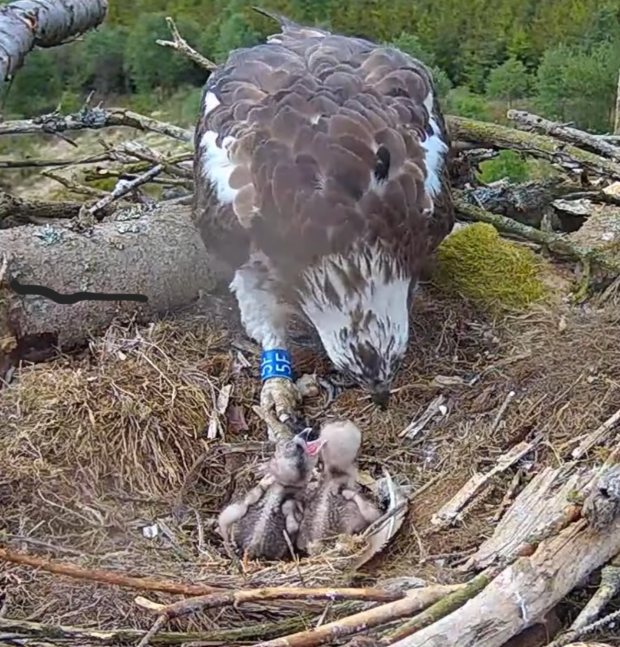
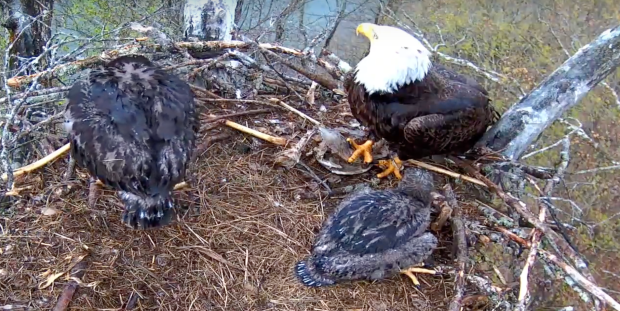
Late Tuesday and early Wednesday in Bird World

31 May – 1 June 2022

Oh, it is absolutely perfect at the Big Valley nest of Jackie and Shadow. Spirit fledged early Tuesday morning and she is back home being fed by Shadow at 16:46 the same day. You could hear Spirit squeeeeeeeeing on the nest cam. Dad flew in with a big fish and ate a bit and in flies Spirit. This is excellent. She will return to the nest – she knows where it is – and the parents will continue to feed her for a period of time until she is catching her own fish. She will perfect her flying and she will be a success.

Shadow arrives on the nest with a nice big fish.

Spirit arrives not long after. Oh, it is so sweet that Spirit wants to be fed ——-and fantastic of Shadow to want to feed his Spirit!

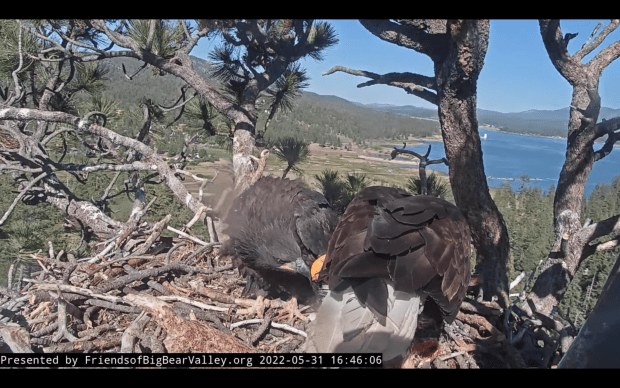
When dinner was over, Dad and his little girl sat and looked out at their world together.

Spirit remains at the nest. I hope she stays all night. It is so wonderful seeing her back on the nest, eating, and in good shape. She knows where ‘home’ is!

Spirit spent the night on the nest branch. This is just fantastic. Hopefully she will fly and get her wings strong and come home to eat and spend the night in the nest tree so we can see she is alright!

Gosh, it is hard waiting for parents to bring in food to a nest that really needs it. The lull at the ND-LEEF nest gave me an opportunity to ‘look at’ Little Bit 17 a little closer.

The Middle sibling ND16 has been the one ‘plucking’ Little Bit’s feathers from his head. When she gets aggressive about the food or lack of food, she goes for the head. It appears to me that she has pulled out more feathers today than on Sunday or Saturday. It looks like a red spot on the back but no big infected areas. To my knowledge, the eldest sibling 15 has not attacked Little Bit 17, only 16. So she is getting agitated when food is not coming on the nest.

Besides the missing head feathers, you will notice that Little Bit’s flight feathers are growing and showing.

This is a horrific viscous attack by an older sibling.

The image below was taken two days ago on the 29th. It offers some comparison with the loss of feathers on the head.

This is May 28 – three days ago. From this image I have to conclude that 16 is getting more and more aggressive towards Little Bit 17.

So is this a big problem? Yes and yes and no. The feathers on the head do not impact Little Bit 17’s ability to fly. That is the good point. Are they going to grow back quickly? No. It looks like the older sibling has pulled out the hair follicle completely. When bird’s molt (typically once a year), the loss of that feather stimulates the growth of the new feather. If Little Bit 17 found itself in a rehab centre they would probably be applying antiseptic ointment to its head. The other issue is that growing feathers is known as being ‘nutritionally intensive’. It takes a lot of calories along with vitamins and minerals to get feather regrowth. Some of you may have birds and know this. You can purchase products from your vet to help with regrowth. Some nervous birds can pluck out their own feathers. Sadly, we cannot get a vet up to the nest with these supplements nor can we fly in fish — and believe me, I wish I could put three big beauties on that nest!

Some people on the chat thought that Little Bit 17 had a bit of a crop.

It looks like it from this image below. Did he go into his stash on the porch and find some food? It is unknown.

At 20:31:21 an adult landed on the nest with a prey item. It was taken immediately by an older sibling.

Little Bit 17 stayed out of the way.

It is unclear what happened on the morning of 1 June on the ND-LEEF nest. I cannot see any prey delivered before a squirrel arrives around noon. 16 got it, then 15 stole it, and 17 is lurking hoping that 15 will leave it something. All are, of course, hungry.

17 is getting closer to 15. I am certain 17 would eat the tail if that was all that was left.

Hard to tell what will happen. 16 has moved over between 17 and 15 and is more concerned about 17 than anything. I really hope he does not pluck any more of 17’s head feathers. That is just crazy.


There is still squirrel left. You can see it when 15 pulls hard. He almost goes backwards out of the nest with that squirrel. Oh, I hope 17 gets a chance and 16 is not going to grab the prey.

16 wants to steal it. 17 is staying out of the way of 16. We need a huge fish to arrive right now. Leave 16 with the squirrel and 15 and 17 get fed by Mum!

Well, the San Francisco nest of Richmond and Rosie could offer to send some of their spare fish to ND! Today Rosie went fishing and brought in a nice whopper for the two osplets. Shortly after Richmond arrives with an equally large fish! And the kids already had big crops. Of course, there seem to be always intruders about wanting to steal the fish Richmond and/or Rosie bring to the nest on the Whirley Crane. Location, location, location! Some nests have great territory and prey and others don’t. Richmond and Rosie have a gold one – along with Arthur and Big Red at Cornell.

What lucky little osplets these two are – hatched at this nest with these two incredibly hard working parents. You will notice that Rosie is fishing, too, and delivering food. Her babies are just entering the Reptilian Phase. Some of the females pull more than their weight to ensure the success of their brood.

No one is going to be hungry today!

It is 0440 Wednesday morning at the Dyfi nest of Telyn and Idris and the three Bobs. They are having a nice breakfast of last night’s Mullet. Super chicks.

Little Bob got a nice piece of fish. Most of the time everything is fine at Dyfi. Big Bob does like to be a bit of a bully but that will pass. There is regular food on this nest.

The Three Bobs had breakfast at Loch of the Lowes, too. Laddie had a great fish and everyone is eating. Bites all around. The trio are growing and starting to get their dark wooly plumage. Reptiles next!

Louis and Dorcha have been feeding their first hatch regularly. Louis has kept the nest nicely supplied — like he always does! They are going to zoom the camera in so that we can see the chicks better. This will be left for about a week. Thank you Woodland Trust!

History was made again today in Poole Harbour when the first osprey chick hatched! Congratulations CJ7 and Blue 022!!!!!!!!!! The nest and camera are positioned so that we can only see CJ7 bring up the egg shell, removing it from the nest cup. How thrilling. There will be parties in the south of England and in the homes of all who were a part of this great relocation project. It is a success.

There are three at the Glaslyn nest of Aran and Mrs G now. All their hatching is now finished. Lots of fish – and some of it is flounder. Mrs G doesn’t like it but hey ——we know a lot of eagles and ospreys that wouldn’t care what species of fish it was! The third chick hatched on 30 May.

I continue to watch and forget to report on the Golden Eagles in Estonia. The parents are Kalju (Dad) and Helju (Mum) and their chick Margit. So cute. There nest is in the Sooma National Park in the southwestern part of Estonia.

Golden Eagles often hunt as a couple. They are known to dive down to their prey (called quarry) at speeds of 150 mph. They have great maneuverability and they can see clearly and in colour for a very long distance. One eagle might dive and drive the prey out for the other. They also hunt alone catching rabbits, squirrels, Pine Martens, foxes, and even deer. They will also eat carrion if fresh prey is low. Unlike the Black Stork, Golden Eagles are fairly common in Estonia.

Margit is a little cutie.

Here is the link to their camera:

Karl II and Kaia’s three Black Storklets in the Karula National Forest in Estonia are also doing very well. There is one egg remaining in the nest which was laid on 1 May. If it is to hatch it will be soon.

Karl II has the transmitter on his leg and he is on the nest now. Both parents are active in fishing and bringing food to the nest for the chicks who have incredible appetites.

The five storklets of Jan and Janika, also in Estonia, are doing really well. The parents have not done any sorting out of the smaller ones. This is incredible. There must be lots of food for everyone this year.

While we wait for the official names of the two chicks, Alden continues to bring in prey items for the eyases who are growing and getting interested in the world outside the scrape. What a quick hand over! Off for more!!!!!!!

Alden is also doing a fantastic job of feeding the two eyases.

The Great Spirit Bluff eyases continue to grow and are changing their plumage just like the chicks at Cal Falcon’s scrape.

There was bad weather in South Australia on the 29th of May. That is the last log in and report on Ervie. Port Lincoln says he managed to stay out of the wind and rain by staying close to the silos. Here is his map of that day. Sure miss seeing him at the barge!

And to put a smile on everyone’s face, a Dove has decided to make her nest on a palm frond at my son’s house in the West Indies. The couple will incubate their eggs for 12-14 days. The chicks will be born with their eyes closed and will be covered with a soft grey down. They will remain in the nest being fed by their parents for about 11 days before fledging.

It looks like a Common Ground Dove. They are very common across the Eastern Caribbean and can grow to 15-18 cm or 6 to 7 inches or about the same size as a large House Sparrow. They lay 1-3 eggs. They eat seeds and insects.

It is sunny today and no rain. I am heading out to enjoy this beautiful day and hopefully see some American White Pelicans and some ducks. Hopefully a few other Waterfowl surprises. Take care everyone. Thank you for being here with me in Bird World. Wish for fish to land on the ND-LEEF nest! Nasty 16 is busy eating the rest of the squirrel so hopefully 17 can have some lunch if something comes in! See you soon.

Thank you to the following for their streaming cams where I took my screen captures: fOBBV, ND-LEEF, SF Ospreys and Golden Gate Audubon, Dyfi Osprey Project, Friends of Loch of the Lowes and the Wildlife Trust, Brywd Gwyllt Glaslyn, Poole Harbour Ospreys, Friends of Loch Arkaig, the Woodland Trust and the People’s Post Code Lottery, Eagle Club of Estonia, Cal Falcons, Port Lincoln Osprey Project FB page, and Explore.org

Late Saturday and early Sunday in Bird World

28-29 May 2022

Saturday was an incredible day for a long walk at the nature centre. Thankfully individuals have donated benches in their loved one’s names and they are scattered about the trails. Much of Ft Whyte has been covered with water and there are areas that are more wetlands than anything else. Those are the interesting places. The Red-winged Blackbirds and the Yellow-rumped Warblers seemed to love eating the seeds? of the bull rushes. It was a fascinating day. Way across the lake were two adult Double-breasted Cormorants and nine juveniles. The Cormorants make their nests on islands or in the tops of trees or platforms. Normally there are 5-7 eggs that are incubated for 25-59 days. This couple seems to have hatched 9!

They were at a great distance and the sky was getting very dark. Not touched up but a lovely scene.

The usuals were around – beautiful Yellow Warblers, American Goldfinches, the Yellow-rumped Warblers, and a Downy and a Hairy Woodpecker.

What a striking difference between the male Red-winged Blackbird and their female mates, below. She is having a wonderful time gleaning for insects and seeds on the ground.

This female American Redstart flitted around the Cattail branches. She was very difficult to photograph! She was hovering around the pools of water foraging for insects.

The Canada Geese are still incubating. No one seems to know when the eggs are due to hatch at Ft Whyte! (or not anyone that I could find).

You often see evidence of the woodpeckers presence but, most times, you do not actually see them. So to see both a Hairy and a Downy over by the songbird feeding station was quite a treat.

A female Hairy Woodpecker.

The female Downy Woodpecker.

In fact, today was a fun day because so many of the female birds were out feeding. What a joy!

I had hoped to head out today, Sunday, but right now it is raining. The birds in the garden are not happy! Hopefully the sun will come out later for them and they can dry off and I can go for my walk.

Sadly, Saturday was not a good day on the ND-LEEF nest. The lack of prey coming to this nest is becoming highly problematic. The two older siblings have figured out how to self-feed. Little Middle 17 had an advantage when they didn’t know how to do this! There was someone on chat that made a comment that Little Bit 17 had some food from Dad last evening – a heron?? I did not see it. Perhaps some of you did. My notes indicate 48 hours without substantial food. Let us hope that the fish get on the nest tomorrow and are plentiful. In fact, one of the older siblings – I do think it is the Middle one 16 – attacked Little Bit today and Mum flew down from the branch and intervened. We need fish on this nest quickly. Send all positive thoughts to Little Bit 17.

Two fish have so far come to the ND-LEEF nest on Sunday morning. The second one right before 10:58 when Mum flies down and feeds 17. Originally the fish was left on the nest but no takers and Little Bit seemed reluctant to eat it. He is staying back in the part beyond the camera. After a few minutes Mum comes down and takes the fish. Little Bit eats. Then in a few minutes 16 steals the fish. How much did Little Bit get? It isn’t clear but when 16 stole the fish, there was only about half of it left. I know Little Bit can eat fast – he has had to. Let us hope he got enough and that another fish comes and then another. We need to get out of this bad loop on this nest. 16 continues to attack Little Bit. 16 is one nasty bird.

If you are at all sensitive, I would not watch this nest for a few days. Let it sort itself out. I am very concerned about the level of hunger and the attacks by 16 on Little Bit.

The eyases on the Red-tail Hawk nest of Big Red and Arthur are changing by the day. Those juvenile feathers continue to grow and grow. Watch their tails. It is best if they have 5 or more dark tail bands for fledging.

That is little L4 showing off his beautiful wings. Big sister is in front. It is awhile til fledge from the look of the tails!

At the UFlorida-Gainesville Osprey nest, Middle was busy eating a really nice fish. And guess what? He did not share!

This nest is so civilized now. If you just tuned in you could never imagine that the third hatch died from siblicide or that the Middle chick had been beaked and stopped from eating. It is a lovely nest to watch.

Middle was making some headway 9 minutes later. It is hard for the osplets to figure out how to hold the fish down and unzip it at the same time. They need to watch Mum carefully when she digs her beak into the skin and pulls hard!

Both of the osplets have been eating on the UFlorida-Gainesville nest Sunday morning. Each has had a turn at a fish and there are fish on the nest if you look closely – well, pieces of them. These two are healthy and doing so well.

As the sun went down on a beautiful Saturday at the Loch of the Lowes, Blue NC0 was feeding the three nestlings. I am cautiously hopeful for this third hatch. It is a nice strong little one.

It was so windy earlier in the day that Blue NC0 was literally blown off the nest.

It is Sunday morning and Blue NC0 and the trio of Bobs are waiting for Laddie to deliver a fish!

Laddie came through – of course, he did! They have all eaten well and Little Bob felt like he wanted to start a fight. He is a little toughie. LOL. You can see the plumage changing on Big Bob.

Telyn had gone for a break at 0503 and Idris flew in with the breakfast fish two minutes later. He thought he was going to get to feed the Three Bobs but, no. Telyn had a different idea. Gosh, they are so cute…I wish they would stay this soft grey downy chick for awhile longer before becoming a Reptile-Dinosaur showing their DNA chick.

It is quite amazing how quickly they get stronger. Adorable. Nice dark bands around those eyes.

The Dyfi Osprey Project created a video log of the hatching.

Aran and Mrs G now have two Bobs at the Glaslyn Valley Osprey nest. One more egg to go!

These two look like they will be a hand full.

CJ7 and Blue 022 have already made history by laying the first osprey eggs in a nest at Poole Harbour in more than 200 years. The eggs were laid on 23, 26, and 29th of April. That means that the first egg is 36 days old now. I am thinking pip watch in a couple of days?? This morning CJ7 ate her fish off the nest so no hatch yet! Gosh this is going to be a difficult nest to see those historical hatches!

Oh, those three Bobs on the Manton Bay nest of Blue 22 and Maya are getting huge. It seems it was only yesterday that we were worrying that the flapping Perch had killed one or both of the nestlings. It was 13 days ago!

This is such a good nest. A fish is right there when Maya gets the chicks up in the morning. It must surely help to have a stocked lake that is free from leisure vehicles and people.

You can almost hear Maya saying, “Oh, please, just have one more bite.”

Maya looks like she is in shock as Blue 33 arrives with a fish.

And what a fish that was!!!!!!!!!! Oh, gosh, is it going to land on the chicks?

All lined up like the Osprey lads at Port Lincoln last season. No need to fight over food on this nest – everyone is fed regularly til they are full. Would love to send this fish to Little Bit 17.

Blue 33 also brought in some nesting materials this morning and dropped them over the chicks. The look on Maya’s face was priceless!

After Blue flies off, Maya turns and looks at the camera. My goodness she is a beauty.

I haven’t mentioned them for awhile – shame on me. There are three osplets in the Osprey platform at Cape Henlopen State Park in Lewes, Delaware. They are doing fine and from their heads you can see they are now moving into the Reptilian phase.

Bukachek and Betty have five White Storks this morning in their nest in Mlade Buky, The Czech Republic. Everyone is so excited. There is one more egg to hatch.

Here is an adorable video of the six storklets at the nest of Jan and Janika!

There are wee ones on the nest of Karl II and Kaia, too. With all the nesting material it is hard to see how many.

It is rainy and blowing at the MN-DNR nest. Nancy has gotten food on the nest and E1, Harriet, continues to do very well. Hopefully Nancy will have a new mate next year. So many of us still miss Harry. What a real shame to lose him – he was only 5 years old. Just starting his life really as an adult. And what a wonderful mate he was while he was with Nancy!

There are way too many nests! And too many things happening. There is Annie looking up at us at 05:53 this morning in San Francisco. She is asking you to pick ‘nice’ names for the two chicks that her and Alden have raised. Suggestions stop and then there will be a vote…it seems that there will not need to be a run off for the name of the male. Grinnell is running away with the numbers! How could it not be Grinnell, seriously?

To suggest a name go to https://calfalcons.berkeley.edu and click on the Facebook tag. Scroll down a few entries and put in your desire names. Suggestions end on the 30th with voting starting immediately for the finalists once they are listed. They are giving us a short time so do not delay choosing your favourites of the short listed. I will try and remind everyone, too.

Take care everyone. Have an absolutely fabulous Sunday. Thank you for joining me today. See you soon.

Thank you to the following for their streaming cams where I took my screen captures: Cal Falcons, MN-DNR, Eagle Club of Estonia, Mlade Buky White Storks, Osprey Webcam for Cape Henlopen State Park, LRWT, Poole Harbour Ospreys, Brwyd Gwyllt Glaslyn, Dyfi Osprey Project, Friends of Loch of the Lowes and the Scottish Wildlife Trust, UFlorida-Gainesville Ospreys, Cornell Bird Lab RTH cam, and ND-LEEF.

Early Wednesday in Bird World

25 May 2022

There is so much news that it is difficult to know where to start sometimes. But today it is going to be in Port Lincoln, Australia on the Osprey barge. Mum and Dad were sitting next to one another on the ropes. Mum then went to the nest and was looking around. She was not happy. One of the long time watchers of the barge of this Osprey family, ‘M’ suggested on the chat that Ervie had been trying to land to eat a puffer, like he has done now for nearly 5 months. The camera did not pull back so that we could have a clear view. Something was definitely making Mum quite upset and ‘A’ writes this morning and confirms that at 0952 Ervie was trying to land.

This is, indeed a sad day for all of us that loved Ervie and wished beyond anything that the parents might let him come to the barge. Maybe he will go to the old barge with his puffers – the alternative for Mum and Dad. (Is it still there?)

Mum was still preening at 11:10 on the nest.

The feeding of five little storks! They have grown so much in a week!

While those White Storks have been growing, Betty and Bukachek at the Mlade Buky nest in The Czech Republic are welcoming their newly hatched storklets. Congratulations!

At the black stork nest of Jan and Jannika in Estonia, frogs and fish were brought in to feed all of the storklets. If you have never seen storklets fed, this is a great way to start watching. The parents regurgitate the fish for the little ones.

There is a very confusing situation at the Latvian Black stork nest of Grafs and Grafiene. The ‘real’ Grafiene returned late and now there are three on the nest with mating and fighting.

The second eaglet on the Fort St Vrain Bald Eagle nest in Colorado, US is sleeping quietly. The eaglet is 6 weeks old and I am so hoping that there is a parent near by. Last night a raccoon climbed and pulled an eaglet off the nest to feed it and possibly its babies. I hope this eaglet stays safe!

Before night, Little Bit 17 was flapping its wings on the ND-LEEF nest. They are getting bigger and he is getting stronger with every bite of fish that he eats.

A fish arrived on the ND-LEEF nest at 0820. Little Bit 17 began moving up to eat and was at Mum’s beat at 08:21:37 where he got fed. Yes! That is a very good way to start a Wednesday morning.

It got a bit wet on the nest this morning and Mum is there with the eaglets.

Lady and Dad are busy working on the nest first thing in the morning. Dad has been bringing fish to the nest every day for Lady. Lovely.

‘S’ was kind enough to forward a statement from the Scottish Wildlife Trust on the issue relating to Laddie, LM12’s eye. They said, “

Our breeding pair, LM12 and NC0 have made an incredible effort to provide for their growing offspring since the first chick hatched on 19 May.

If you’ve been watching the webcam you might well have noticed that resident male LM12 has an injury on his right eye – this may have been caused by an abrasion sustained when his protective, translucent, third eyelid, also known as a nictitating membrane, was open.

Fortunately this injury seems to minor and it doesn’t seem to have affected his ability to fish. LM12 brought two perch to his hungry family at 20:05 and 21:20 this evening.”

Laddie’s eye appears to be perfect. He has brought in a big fish for Blue NC0 to feed the babies!

The two osplets of Dylan and Seren at Llyn Clywedog are almost the same size. They are terribly cute. It is pitching down rain there today and the third Bob has hatched. Congratulations Dylan and Seren.

Both eggs have hatched at the nest of White YW and Blue 35 at Foulshaw Moss in Cumbria. Congratulations!

Congratulations to Idris and Telyn on the hatch of their first chick of the 2022 season at 1628 on the 25th of May! It is Tiffin Cake all around in Wales today I am told.

Both of the osprey chicks on the UFlorida-Gainesville nest were fed by Mum this morning. They were both full with Mum betting a chance to eat the tail at 1105. Later images show them with a nice crop each.

Look at the size of Middle’s beautiful wings!

The only surviving osplet on the Dahlgren Nest in Virginia US used to be the size of the Bobs at the Loch of the Lowes and Llyn Clywedog. Just look at how big that chick is today!

It was heart warming to learn that the Friends of Big Bear had so many letters of support to stop the development in Big Bear Valley. Jackie and Shadow are much loved. In terms of social media stars, they have the highest number of visitors to their streaming cam than any other Bald Eagle nest. This is fantastic news.

The day that Spirit flies off the nest is coming. It could even be today. She has been on the branch flapping her big beautiful wings and standing on one leg this morning.

Was Spirit getting some advice for the future?

DC9 has been sitting on the rim of the nest looking out at the world from the National Arboretum nest in Washington DC. Mr President is doing a great job taking care of his only eaglet this year. Mum Lotus has not been seen for several days now.

The triplets at Pittsburgh-Hayes are starting to get out on the branches!

The oldest US Steel Eaglet is 50 days old today while the youngest is 47 days.

Liberty and Guardian have been making regular prey deliveries to Star and Sentry throughout the day. Some viewers have worried. There is a chat associated with the nest and the moderator will list the times of prey deliveries and visits from parents. The two eaglets are so large they take up the entire nest!

The eyases at the Manchester New Hampshire scrape continue to loose more of their fluffy down revealing their beautiful feathers.

The San Jose City Hall falcons are so cute. They are starting to lose their fluff revealing some nice feathers, too. Such cuties sitting there like little Buddhas. They are 20 days old today.

Here is a short video of Pedro meeting those chicks. Look at how much they have grown.

Talk about losing baby down! The two Red-tail Hawks at the Presidio Trust nest in San Francisco sure look a lot different this morning. I have not checked on them for awhile and they are big hawks!!!!!

It is a crazy time in Bird World. So many nests and everything happening from mating to fledging – with lots of intruders! Let us hope that all of our feathered friends have uneventful days. One of our readers asked about the Berry College eaglet. B15 fledged – if my memory holds true – on the 28th of April. She was still visiting the nest to everyone’s delight at 110 days old. Good solid eaglet. Pa and Missy continued to provide food for her.

Gorgeous picture that someone sent me of Pa Berry and Missy. (Do not know who to credit). They are a beautiful couple and did a fantastic job this year with B15.

This has been a long blog today. Please pardon any crazy typos or wording – I tried to cover too many nests! I will do a short check in on some of the nests with recent hatches later today. Take care everyone. Thank you for joining me.

Thank you to the following for their streaming cams where I took my screen captures: Berry College Eagles, Presidio Trust, San Jose City Hall, Peregrine Networks, Redding Eagles, Pix Cams, NADC-AEF, FOBBV, Dahlgren Ospreys, UFlorida-Gainesville Ospreys, Dyfi Ospreys, Cumbrian Wildlife Trust, CarynXWild, Loch of the Lowes and Scottish Wildlife Trust, Sea Eagles@Birdlife Australia Discovery Centre, ND-LEEF, XCel Energy, Mlade Buky Storks, and Port Lincoln Osprey Project.

Late Wednesday in Bird World

13 April 2022

The snow on the Canadian Prairies arrived later than expected – around 07:45 in my garden this morning. The wind roared and the snow blew and then, around 15:30 it calmed. We have been told that there will be several calm periods with rain and snow arriving again later tonight. The 27 European Starlings came. The woodpecker arrived for suet. Tens of dozens of Sparrows and seriously, I am not exaggerating, 350 Dark eyed-Juncos. We continued to clear paths on the deck and pour a line of millet and sunflower seeds – about 30 feet long – several times today. Everyone ate there or at the seed and suet cylinders and feeders. It felt good to help them. Many are arriving or returning to eat now that the snow has stopped. We received about 55 cm of snow. Thankfully the old snow had all melted. The whole of western Canada can use the moisture. We have had droughts for 4-5 summers. I hope that this lessens the wildfires during the summer.

The UFlorida Gainesville Osprey Nest was on ‘S’s list of top ten osprey nests to watch. I must find out more about this family from her. My interest is, of course, the fact that there are three little ones and how well this wee osplet can manage against the older siblings.

Little Bob at the UFlorida Gainesville campus Osprey nest is doing fine. He is growing. They all scramble about in the nest bowl and I really dislike the camera they are using but…all that matters is that he is doing well.

There is Little Bob on the far left.

The chicks at the Captiva Osprey nest are almost ready to fledge. They love to self-feed but, Lena being the great Mum that she is prefers to do it so that both get fish. Keeping it fair. I love it. Here are some images from today.

Chicks watching, totally focused. Such beautiful birds.

Lots of flapping. Look at those long legs! This osplet wants to compete with Idris at the Dyfi Nest for the nickname, ‘Daddy Longlegs’.

Those legs of Middle sure look a lot longer than Mum’s! Little continues to love looking out over the side of the nest rim.

Another nest on ‘S’s list is the osprey nest on the Narrow (Pettaquamscutt) River. Here is a view of the nest. No occupants yet! And a link to their camera in case you want to check later.

The Ferris State University Ospreys are also on ‘S’s list and there is an osprey on the nest but no eggs yet! The couple have been working on getting the nest in good shape.

Here is another view of the nest at Ferris State University in Michigan.

This is the link to their camera: https://osprey.ferris.edu/

In the UK, Louis has decided that he likes the nest that he shared with Aila better than the nest he had with Dorcha last year. As a result, Louis has convinced Dorcha to change nests. This is very interesting behaviour. It is such a gorgeous nest. Louis seems, by the move, to have accepted that Aila will not be returning. This will be her second season not to return from migration. Louis and Aila were an incredible pair. I am looking forward to watching Louis with his new mate this season.

The couple are settling in doing what Ospreys do when breeding season hits!

Dorcha is very dark and quite stunning. She reminds me of Mrs G at the Glaslyn nest.

Beautiful Iris has been on the perch and sitting in the nest today. It is a good place to get out of the wind. Gosh, she is gorgeous. Louis has, of course. been around doing what Louis does.

There always seems to be a train going through Missoula, Montana behind Iris!

Iris has a fantastic nest. In her time with Stanley she was a magnificent mother. No doubt, as I often say, she has earned the right to let Louis do his thing, lay the eggs, let the Crows get them, and then relax for the rest of the summer.

They are not friends to the Ospreys but, Northern Goshawks are incredibly beautiful medium to large-sized hawks. There are rare in my province. Those that live or breed head to the dense northern forests in the north. The adults have red eyes with a dark crown (the eye colour changes as they age). Their plumage is a gorgeous blue-grey slate colour with streaks on their pale breast and belly. They are known for grabbing chickens in farmer’s enclosures, rabbits, squirrels of all varieties, grouse, and Rock Doves. They have been known to lure Ospreys into the forest to kill them and to take their chicks- a sadddness which happened at the nest in Finland last year.

The numbers of nesting pairs has dropped considerably when there were 1000 couples to today when there are only between 400-600 pairs.

The images below are from a nest near Riga in Estonia.

This is some very interesting information about this nest and the hawk couple from Looduskalender:

“The nest of goshawks in this location in Riga has been known since 2016 – it is believed that the breeding couple moved here from another nest about 600 metres away. In the immediate vicinity of the nest there are both industrial objects, the sounds of which can often be heard, and private houses. The tree of the nest is located in a small wet area overgrown with weeds and shrubs. The nest is built in a black alder, which grows on the edge of a ditch. The goshawk has built his dwelling on the remains of a crow’s nest. The metal wires twisted in the nest still evidence that the crow was a supporter of durable building materials.

The nest was controlled during this time and the nestlings were ringed in it. This couple, and especially the female, is known among the ornithologists for their special character – she tends to behave particularly aggressively and attack people when they are just approaching the nest. On the other hand, birds are accustomed to people and equipment operating behind the fence in the nearby industrial facility and do not pay attention to them. Interestingly, at the time the female laid her first egg, very close, about 50 m from the nest, a crow couple were building their own nest. Crows are a common food item for Goshawks, but it happens that hawks do not touch other nesting birds near their nest, and they make use of this safety zone.”

This is the link to this Goshawk nest:

Mum is on the ropes at the Port Lincoln Osprey barge this morning in Australia. I wonder if Ervie will come and visit again today making it three days in a row? It is always reassuring and such joy when he visits.

Please help select the name for Annie’s new mate. He deserves a super name and Cal Falcons have narrowed the field down for you to select the finalist. (Go to the link for the names and their associations with UC-Berkeley)

This is just a quick glance at some new nests and a check in on the UFlorida triplets. Both of the eaglets, Jasper and Rocket, have now branched at the NEFlorida Bald Eagle nest. Avian flu continues to be a concern in many areas in the US and Canada.

Take care everyone. Thank you so much for joining me today.

Thank you to the following for their streaming cams and/or FB pages where I took my screen captures: Cal Falcons, UFlorida Ospreys, Captiva Ospreys an Window on Wildlife, Angel, Twitch, Woodland Trust, Montana Osprey Project, RMC, Narrow River Ospreys, Ferris State University, and Port Lincoln Osprey Project.

Tuesday in Bird World

12 April 2022

The ‘historic’ storm is set to hit us sometime during the late evening or night. It will snow and blow then calm and start up again on Thursday. Apparently people are hoarding food and turkeys are said to now cost $80 each. Of course, they will be useless if the electricity has an outage. It is the reason that we have a back up wood stove in the City. Eons ago and I do mean eons, I remember a storm that hit leaving several feet on the roads and downing the power lines. The cables had thick ice – first sagging and then snapping under the weight. The house in the country had a hand pump to the cistern if the power was lost and a large wood stove. We ate, had hot baths and meals – one day it was so warm the children were wearing their summer clothes. The snow was so deep. It took 13 days before we were a priority with the municipality – being the only house on a road for several miles. We were fine. Sometimes old school is best. All of the garden critters have been fed so much especially Dyson and Scraggles as well as Little Red. They can hoard it all away and munch and stay warm inside their nests and the penthouse til the storm is over. No worries for them!

Dyson really does enjoy those nice nuts. He even seems to be putting on some weight since he discovered he prefers the ‘luxury’ bird seed. Too funny. He feels his cheeks and runs away returning quickly!

The soap opera in the Glaslyn Valley is officially over for the 2022 season. Mrs G is back with Aran on the Glaslyn nest and Blue 014 has Aeron Z2 all to herself at Pont Cresor. Aran has delivered half a fish to Mrs G. He might be waiting to deliver a whole one until he is sure she is staying!

Mrs G, the oldest Osprey in the UK, is as gorgeous as ever with her dark plumage.

Aran on his perch and Mrs G in the nest.

Mrs G enjoying the fish that Aran provided.

As the sun begins to set, Aran is in the nest working on the walls that were installed by the Glaslyn staff in an effort to ease the nesting season for Mrs G and her mate.

It is raining at the Dale Hollow nest. Little Middle and Big are soaked.

At 11:10:31 Obey brings a fish to the nest for Big and Little Middle.

Everyone is soaking. Little Middle was first up at the feeding once River decided it was a good time to start – around 12:13.

Even when Big moves up, Little Middle stays in place and continues to eat. It is all good.

Little Middle is happy River came to the nest. He loves cuddling with Mum.

The little eaglet at the National Arboretum nest of Mr President and Lotus is thriving.

While this wee one begins to get its thermal down, there is branching happening at the NEFlorida Bald eagle nest of Samson and Gabby. Yesterday Jasper branched at 10:10:53 as Rocket looked on.

No worries, beautiful Rocket. You will be up there soon enough! Too soon for us!!!!!

Just look above and have a quick peek at this short video – a reminder of how quickly the eagles grow! I recall the days that we were all worried that Rocket would survive but, he did. He was self-feeding first and became ever so clever.

The bonking has started at the UFL Osprey nest. I am cautiously hopeful that the beaking will subside but let’s see if Dad can get more fish on this nest pronto.

Richmond and Rosie at the SF Bay Osprey nest have their third egg. You have heard me say it many times. They are good and solid and capable of dealing with three! Eggs were laid on April 5, 8, and 11. Just perfect.

Everything is fine at the Black Stork nest of Karl II in the Karula Forest in Estonia. Kaia has returned!!!!!!!

I am so happy to report that the male is back on the Black Stork nest in Latvia! This nest is in the Sigulda region of Latvia.

Oh, and I am so excited. I love Black Kites and Grey and Golda are working on their nest in Latvia. This is exciting. Some of you might remember the Black Kite nest in a cemetery in Taipei. I continue to look for that streaming cam to start operating. But now we can watch in Latvia!

Black kites are medium sized raptors. They generally live in the forests where they generally occupy the lower canopy. This is where they hunt small mammals, frogs, salamanders, and even grasshoppers as well as other insects. They will lay between 2 and 5 eggs.

Last year there were three hatchlings. They were seriously cute.

The second White-tailed eaglet hatched at the Danish nest yesterday. Both hatches are doing well. Just watching for the third to arrive tomorrow.

White YW and Blue 35 have been working on their nest at Foulshaw Moss in Cumbria. The camera does not have a rewind capacity so you have to watch often and long to catch the ospreys on the nest. This is the nest of Tiny Little’s parents. S/he was ringed Blue 463 and as the third hatch, with the help of Mum and Dad, s/he thrived. I am very much looking forward to this season with these fabulous parents. Where do the parents roost? On the tree in the distance.

Here is the link to the streaming cam. There are two views when you click on the page.

https://www.cumbriawildlifetrust.org.uk/wildlife/cams/osprey-cam

Everything is fine at the Dyfi Osprey nest of Idris and Telyn! They are a super couple. Again, great nest to watch. Link to camera is below. You can count on Idris bringing in some whoppers!

This is a new couple. CJ7 who has hoped for a mate for so long and the more than eager to oblige dashingly handsome Blue 022. They are at Poole Harbour and as I always mention – any chicks that hatch on this nest will be the first in over 200 years. You can well imagine that the local community is pretty excited.

Here is the link to their camera as you begin to get your UK Osprey nests to watch consolidated.

There is a soft rain at the Loch of the Lowes. You can hear the songbirds in the distance. Laddie and Blue NC0 have a beautiful nest and it is impossible to see if there is an egg yet. I don’t think so.

Blue NC0 has been on and off the nest. Did I tell you she is a fantastic fisher? It is not clear whether or not Laddie caught this fish and handed it off to her after he had eaten the head but, that is probably what happened. Blue NC0 would be pleased. She turned out to be a fantastic Mum last year to the surprise of some. Once the chicks were old enough she was out fishing. She really kept the fish flowing on the nest for the two healthy chicks last year.

Here is the link to the camera at the Loch of the Lowes.

Tomorrow, Cal Falcons is due to post the list of names so that the community can vote. It will be so nice for the New Guy to get a proper name. Everything is going fine for this new couple as we continue to mourn the loss of Grinnell.

All of the Peregrine Falcon nests are doing just fine as is Big Red and Arthur’s Red-tail Hawk nest at Cornell. The action will be starting in a few weeks!

Thank you so much for joining me today as we skipped around some of the nests. The weather that is approaching Manitoba will also impact the MN-DNR nest I am pretty sure. I will try and keep an eye on Harry and Nancy and the two eaglets. Take care all. See you soon!

Thank you to the following for their streaming cams and/or FB pages where I took my screen captures: Brywd Gwyllt Glaslyn, DHEC, Birdlife Denmark, NADC-AEF, NEFlorida-AEF, UFL Osprey, CFN, SF Ospreys and Goldden Gate Audubon, Latvian Fund for Nature, Cumbrian Wildlife Trust, Scottish Wildlife Trust and Friends of Loch of the Lowes, Dyfi, and Cal Falcons.

Late Friday in Bird World

08 April 2022

Just when I introduce you to Teo and Vita, a new cute female shows up on the nest the minute Teo arrives with a fish! This is the only Osprey nest in Latvia but it looks like there are floaters looking for mates. Maybe another nest is in the making???

I have not seen an image Of Karl II at the nest in the Karula National Forest but, Looduskalender says that Karl II is now in Estonia and could be arriving anytime. I hope the camera gets to working!

If you have not suggested a name for Annie’s ‘New Guy’, Cal Falcons is accepting suggestions on their FB page. On Monday, they will select the finalists from that list for voting. Give the ‘New Guy’ a great name associated with UC-Berkeley. I hope he continues to be a loving, kind, and supportive mate for our Annie.

Annie in the scrape 08 April 2022. 11:47. Incubating three eggs – 2 Grinnell’s and 1 of New Guys.

Speaking of Peregrine Falcons, did I mention that the couple in Manchester, New Hampshire have five —— yes, 5 – eggs?! They were laid on March 21, 23, 25, 28, and 30th. How in the world do they fit them underneath? So grateful that the scrape box is covered! Don’t want to see anyone cold and sick. This is going to be a great nest to watch!

Here is the link to that streaming camera:

After posting that WBSE 27 was released from rehab in Sydney, Australia, ‘B’ wrote and asked if there had been any sightings of Daisy the Duck and ducklings. I checked with my source and they said no sightings of Daisy. Boy did that little duck win over our hearts. Won’t ever forget her! If I ever do hear anything, I will be sure to let you know. This is precisely why my friend there has not sent us any images. We do hope that Daisy hatched some eggs and that her and the ducklings are safe and sound.

Staying in the Sydney Olympic Forest and Discovery Centre area. My source believes that the WBSE eaglet juvenile that landed on the WBSE a few weeks ago could possibly be WBSE 27’s younger sibling, WBSE28. 28 fludged and has not been seen after being chased out of the forest by the Curra. Oh, I loved the spunk of that eaglet. Well, that would simply be wonderful if this is 28. Of course the bird looks quite skinny and hungry to me – which makes me ultra sad. I hope it gets some fish and is safe and well. Life is so difficult for the first year birds. 28 was a sweetheart. Of course, this is just conjecture and wishful thinking on the part of my source and me. We know it wasn’t 27 because she was in care and 26 was euthanized. The plumage and the attitude make my source believe that this beautiful bird is 28.

I really appreciate it when you write and ask questions, send links to nests, or news worthy articles. There are so many and it is hard to keep up. As we all know, the Bald Eagle and Osprey populations – the Apex Predators at the top of the food chain – were almost completely wiped out due to DDT use. The numbers have been climbing back up and populations are healthy but, the regular counts are starting to see a drop in the number of eagles. As you know, I want to see positive change in hunting and fishing equipment including the ban of all lead. ‘S’ sent me this great article on the impact that lead ammunition is having on population declines and I wanted to share it with you. Each person that ceases to use lead when they hunt and fish ultimately help. One person at a time can make a huge difference! Believe it.

It is unclear how long the YouTube station will be broadcasting the nest of Eastern Imperial Eagles, Altyn and Altynai. This is only the second year that the Imperial Eagle cam has been streaming.

Last year, the couple laid their eggs on 13 April and 16 April. The first eaglet, a male, named Aydar hatched on 24 May. He was found dead under a power line on 6 September after fledging. The second eaglet, a female, named Aygul, hatched on the 26th of May. She fledged on 12 August. She is ringed and her numbers are black on silver АВ-0423-2Е on the right leg and a silver and green ring В-423 on the left leg.

Eastern Imperial Eagles were persecuted for years by humans and are one of Europe’s most endangered species. There are approximately 10,000 breeding pairs left in the world. They breed in northern European forests – from Central and Eastern Europe all the way to Asia. They live all over southern Europe and southern Russia. Some winter in Africa, India, and southeastern PRC. They do not like to live around humans and are vulnerable to deaths by unprotected power lines and, of course, habitation loss. Their plumage is a dark brown with a rufous tinge on their shoulders. The head and neck are often lighter in colour often casting a golden glow. They are extremely beautiful birds. The eagles lay 1-4 eggs and live on small mammals, reptiles, snakes, and carrion (found dead animals). They are large predators measuring from 72-84 cm or 28.3-33.1 inches weighing an average of 5.5 lbs for the male or 2.65 kilos and females being larger weigh from 8.1 lbs or 4 kilos.

You can see that beautiful plumage that differentiates these eagles from others such as the Bald Eagle. Gorgeous!

Eastern Imperial Eagle” by Koshyk is marked with CC BY 2.0.

It wouldn’t be Friday without stopping in and checking on Thunder and Akecheta and the triplets. Seriously, how could you not smile every time you see this wonderful eagle family in the Channel Islands. Two years without eaglets and then triplets – no fighting, just great civilized kids and wonderful parenting!

This is a great nest. The land is owned by the US Navy. The Institute for Wildlife Studies and Explore.org have a permit to run the camera. That permit specifies when they can go and do maintenance, etc. The US Navy could, based on the agreement, stop the camera from operating. They are the controlling authority. — Do not worry. Dr Sharpe and his crew are fine. I am using this nest as an example of who ultimately has control over what happens at this nest – the landowner, the US Navy. If it were on my property, like Lori Coverts at the Captiva Osprey nest, then she has control. Lori withdrew her agreement with the AEF and gave Windows on Wildlife an opportunity to run a camera and chat. Lori called in CROW when Big died of unknown causes. — Sometimes it is good to know the hierarchy at the nests.

The other nests seem to be doing fine. Both eaglets are eating at US Steel – fantastic. Still waiting for Aran to get to the Glaslyn Osprey nest in Wales and for the camera to up and running at the Karula National Forest for Karl II and mate, Kaia.

Thank you for joining me. I hope you have a lovely evening. Take care everyone. See you soon!

Thank you to the following for their streaming cams or their FB pages where I took my screen captures: The Institute of Wildlife Studies and Explore.org, Sydney Sea Eagle at Birdlife Discovery Centre Sydney Olympic Park Peregrine Falcons Live, and Cal Falcons.

Late Wednesday in Bird World

06 April 2022

Everyone watching the Black Stork Karl II breathed a sigh of relief when he crossed the border into Belarus on his way home to Estonia for the spring and summer breeding season. It is a long way from the Sudan and Karl II is almost at the nest. He is spending his time today in the forest in Belarus near this site – image posted by Looduskalender. Thanks Anne7!

River brought in a fish head to the Dale Hollow nest at 16:25:48. She leans over to give Little Middle some bites and Big decides she is eating first! Little Middle moves to the rim and waits. At 16:48:54 Big moves over. The parent flies off. Little Middle moves up and feeds itself. Go Little Middle! It even looks like Big is watching and taking some self-feeding lessons from Little Middle.

Little Middle watches and waits. Once Big moves over he goes up but the adult flies away.

If there is any fish flesh left on that head, Little Middle is going to find it!

You might have been frightened if you had seen Little Middle with that fish bone choking but he finally got rid of it. Great work Little Middle.

Little Middle is a survivor.

The chicks are wet and both of them are hungry. They had a good feed this morning. Maybe a parent will come in before dark with some more fish, maybe not. Little Middle is determined to get every last piece off that fish head!

Richmond and Rosie finished their nest on the Whirley Crane just in time. There is no rewind on the camera but Rosie just rolled their first egg. She laid it on the 5th of April.

That dirty little Ragmuffin’ of OGK and YRK at the Taiaroa Head Royal Albatross Colony in New Zealand is a girl.

This is why I really like Blue 33 (11). He is right there with Maya after she lays her third egg of the 2022 season! These two are the darlings of Manton Bay at Rutland.

Over at the West End Bald Eagles, Thunder flew in with a fish at 15:33. Didn’t take the triplets long to line up and get ready for their afternoon snack. The oldest eaglet will be 30 days old tomorrow.

Just down the way at Two Harbours, the only chick that hatched earlier today for Chase and Cholyn had some fish juice and saliva. Cutie Pie.

The cold wind is howling through Iowa. Mother Goose is paying no mind to a Bald Eagle that has come around for a visit while she incubates her 6 or 7 eggs at Decorah, Iowa.

At the Decorah North Bald Eagle nest, Mr North and Mrs DNF have two fluffy 10 and 11 day old eaglets to keep fed. They are both looking good! Mr North is taking a turn feeding them. Oh, so cute when they are still fuzzy wuzzies.

My goodness. Those wee ones and then Jasper and Rocket at the NEFlorida nest of Samson and Gabby who are branching and thinking about flying. All we have to do is blink and they leave the nestling stage and get ready for the adventures that their lives will be. Jasper and Rocket have certainly been entertaining. You might recall that like Little Middle, Rocket taught itself to self-feed long before Jasper.

This year has been a wonderful season for Jackie and Shadow. Spirit is 33 days old. Hatched on the 3rd of March do you remember how you watched and hoped beyond hope that Jackie and Shadow would have a successful hatch this year? I know many of you shed tears of joy when this beautiful bird hatched.

In Redding, Liberty and Guardian are on the nest with the two eaglets alerting. Something has caught their attention.

At the Pittsburgh Hayes nest each eaglet is fed. No one is left out. They are doing fabulous. A fresh fish has just arrived on the nest.

At the USS Steel Bald Eagle nest, the first chick hatched on 4 April and they are on pip watch for egg #2.

If you ever go to the National Arboretum Nest and do not see an eagle on the nest, be assured that they are close by.

It is a wonder that the wee one ever gets some sleep. It feels like Mr President and Lotus are always feeding the baby.

Just the other day this little white bundle of fluff was more like a round teddy bear. Look at how much those wings have grown and its neck!

All of the nests and scrapes are doing well. Many continue to mourn the loss of little MO, the 4th eaglet at the PA Farm nest. It appears that little MO was not under Mum and when the rain and cold came last night, he died of hypothermia. Of course, without a necroscopy this will not be known for sure. We hope that the other three on the nest continue to thrive and are grateful for the joy that little MO brought to our lives. It is always difficult to losing a wee one.

It is a cold nasty day on the Canadian Prairies. Soaking wet with snowy rain continuing to fall.

Thank you for joining me today. It is always wonderful to have you with us. Looking forward to seeing you again soon.

Thank you to the following for their streaming cam where I took my screen captures: Golden Gate Audubon and SF Ospreys, Looduskalender, Pix Cams, Explore.org, Redding Eagles, Dale Hollow Eagle Cam, NADC-AEF, Redding Eagles, Friends of Big Bear Valley, LRWT Manton Bay, Cornell Bird Lab and NZ DOC, Friends of Big Bear Valley, NEFlorida Bald Eagles and the AEF.

Wednesday Morning in Bird World

06 April 2022

First up. The children at the school in Big Bear Valley have picked the name for Jackie and Shadow’s eaglet. It is ‘Spirit’. What a wonderful name! Fly high, Spirit!

NBC – along with dozens of other news outlets – carried the announcement.

I get really excited about the return of the Ospreys to the UK in the spring. There are many reasons for this but the one that stands out the most is the respect and care given to these beautiful fish hawks. Did you know that most of the lochs are off limits to human use of any kind during the breeding season from 1 April to September? Most of the wildlife centres operate on grants and donations and have specially constructed ‘hides’ and monitors inside the buildings so that you can see the birds. Rutland Water and Poole Harbour have ‘osprey tours’ that are guided.

There are currently Ospreys on the following nests:

  • Rutland Water Manton Bay: Blue 33 (11) and Maya currently have 1 egg waiting for the 2nd any moment.
  • Loch of the Lowes: LM12 Laddie and Blue NC0. No eggs yet. Some intruders about.
  • Llyn Clywedog: Dylan is now home with Blue 5F Seren as of yesterday. This couple raised the largest male Osprey chick ever recorded last year.
  • Dyfi: Idris returned to Telyn yesterday and has been Sky Dancing and mating.
  • Foulshaw Moss: White YW and Blue 35 both at home working on the nest.
  • Poole Harbour: CJ7 the resident female hoping for a mate circled the town and has just arrived not long ago.

We are anxiously waiting for the arrival of Mrs G’s partner, Aran. Aran was injured and left late in September for migration. I do hope he returns safe and sound! If not, Mrs G will have lots of suitors. Perhaps even Monty’s boys have some idea that they would like to have nests close to one another. Tegid Z1 (love the guy) and Aeron (Z2) over at Pont Cresor. In the US, all eyes are on the nest in the parking lot in Missoula, Montana that belongs to Iris, the oldest Osprey in the world. Return safe, Iris!

PA Farms has announced that the 4th eaglet on the nest died during the night probably from hypothermia. What a little scraper he was climbing over those big siblings to get to the food.

The weather has been miserable in many areas this spring. It can cause all manner of diseases – the wet damp nests – for our birds.

Some are wondering if Big at the Dale Hollow nest is actually suffering from something. I had an inbox full of notes saying Big is being ‘too nice’ to Little Middle for the second day. Indeed, Little Middle got up first with no intimidation and ate the fish that came in at 08:54. Nice fish andd still scraps on the nest. Little Middle is ready for breakfast!

Little Middle gets up and does a stretch. It is so nice to see chubby legs. Big does nothing.

Little Middle is truly enjoying that fish!

Big moves up later.

Big is ahead in getting its feathers despite the fact that the two hatched on the same day. Notice the tail feathers on Big. You can see them growing out of the calamus or the quill. Some people refer to these structures as the shaft. They are properly known as ‘blood’ feathers. In baby birds, these are the feathers that are growing (not molting). They have a large supply of blood inside them while they grow. This will regress when the eaglet is older. Some of you might well remember that the Captiva Eaglets last year, Hope and Peace, were fed a rat that had died because of rodenticide. In the case of the last eaglet to die, it actually broke off a blood feather and bled to death because the rodenticide caused the blood not to coagulate.

Feathers are so important. They keep our feathered friends warm and dry while giving them the ability to fly as well as their distinct plumage of each species.

Little Middle proudly shows off his large crop at 09:26.

It is official. The chick has hatched at Two Harbours this morning for Chase an Cholyn! Congratulations!

Want to catch the action at Two Harbours? Here is the link:

If you move around the Channel Islands to check on Thunder and Akecheta at the West End, get out your worry beads! Those eaglets are right up to the edge with curiousity!

At the Utica Peregrine Falcon nest, Astrid just laid her 4th egg! Congratulations!

Yesterday I posted the name of the FB group for this streaming cam incorrectly. The correct name if you are searching is Falcon Watch Utica. Thanks ‘MR’ for catching that and letting me know!

Interested in Peregrine Falcons? Cal Falcons just posted information for a free virtual falcon conference for 19 May. There is always something wonderful to learn. Here is that posting:

The ‘New Guy’ continues to impress me. More bedtime snacks for Annie last night who, in her excitement, pulled the NG off the ledge with the prey!!!!!

I have news from many readers of nests opening up. I hope to report on those tomorrow including that of the Imperial Eagles. Karl II, the Black Stork from Estonia, has transmitted from Belarus. Hopefully he will be in his nest in the Karula National Forest in Estonia shortly!

Thank you for joining me this morning. There are so many nests! Will continue to monitor to see if Iris gets home to Missoula Montana and if Aran appears at Glaslyn. Take care all. See you soon.

Thank you to the following for their streaming cams or their FB pages where I took my screen captures: Friends of Big Bear Valley, Explore.org, and Dale Hollow Eagle Cam.

White-tailed Eagles in Poland

3 April 2022

One of my favourite White-tailed eagle females is Milda. I have mentioned her before in my blog. Her nest is in Durbe County in Estonia. It has been a rough year for Milda since her long-term mate was missing and presumed dead in late March of 2021. Milda heroically tried to incubate the eggs without food for 8 straight days to the point of starvation. Several males offered hope and then didn’t. As if with a miracle the two chicks hatched and we all celebrated only for them to perish because of one of the males taking the food off the nest and then not covering them. But, that was last year, and there was hope for this one but again, disappointment when the eggs laid were broken by an interloper.

The females on the nests need a good strong partner who is working with them cooperatively!

The White-tail Eagle is so rare in Eastern Europe. Latvia, Estonia, and Poland are doing what they can to encourage breeding sites.

The White tail eagles are Haliaeetus Albicilla. They are the largest raptors in Europe and are located from Greenland to Asia. The Eagle Directory describes the plumage like this, “White-Tailed Eagles are almost entirely brown. They have a yellow-gray head, neck, breast, and lesser wing coverts, and the belly, thighs, and rump are dark brown. The flight feathers are close to black and their wedge-shaped tail, as their name would indicate, is white. The tibia are feathered, though the tarsi are not, and the legs and feet are yellow. The eyes, beak, and cere are yellow.”

As you can seen from the images of the White-tailed Eagles below, the plumage can vary and of course, we have to take into account the lighting and settings on these streaming cams. These eagles grow to be from 74-92 cm long with a wingspan of 193-244 cm. The females are larger than the males as in most raptor species and weight between 3.7 and 6.9 kg. The males come in at 3.1 to 5.4 kilos. Their life expectancy can be up to 36 years. They eat mainly fish but also hunt mammals such as rabbits and birds. I have seen them also be opportunistic and bring some carrion to the nest. Indeed, it was a crane brought to the White-tailed eagle nest last year that killed two wee chicks because that crane brought with it the highly pathogenic Avian Flu, H5N1. While the birds are listed as not being under threat in some areas, they are very rare in Eastern Europe and the UK is trying to reintroduce them. While they may lay 1-3 eggs, it is most typically 2 eggs that will be incubated by both parents (as you see below) and hatch within 34-46 days. Fledging typically takes place between 77-90 days after which the fledglings are depending on the parents for 4-6 weeks while they learn to fly and hunt.

In older White-tailed eagles, the head and neck can be almost white.

The adults in the images are in a nest in the Woziwoda Forest District. It is a special project of the Eagle Conservation Committee, the Woziwoda Forest District and Polish Radio promotion both old forests and the White-tailed Eagles. The nest is highly protected. There can be no activity within a radius of 200 m. Setting up the camera were problematic and the workers who installed it had to do this cautiously when the eagles were away.

The nest you are looking at is on a 140 year old pine tree at a height of 25 metres. This nest has been occupied for four years. It is known that there was one fledge in 2021.

For transparency, I do not know any of the history of this nest so I do not know whether to give you caution or not. I am attempting to find out. The setting is simply beautiful and if some of you have been watching this nest in the past, please let me know. The chat is in Polish and I understand eggs are being incubated but it is not clear how many or when they were laid by the information provided.

Here is the link:

Just an update on 2 other nests: The adults at Dale Hollow have brought in a teaser 2 bite fish and a small sucker early in the morning. Big ate both of them. No other food has been provided to the eaglets up to 18:30 this evening. I sure wish they would bring a whopper on the nest tonight for both. That said, Little Middle ate well yesterday and is OK. Sadly, Little Middle continues to pull that monofilament line. Thank you to ‘CA’ from Belgium who sent me this 15 second video clip. I could not see him dragging the nesting material, my mistake.

https://youtube.com/clip/Ugkxv7V8o6oR9Gyt8aIgJyQ8dTxjUZI3Copk

Annie and the new male continue to bond in the scrape box. I have caught him incubating a few times today. I sure hope he is a good guy to our Annie! I don’t think any male will ever fill Grinnell’s shoes – he was a huge character in every aspect of a raptor’s life but any bird who will care for Annie, Grinnell’s eggs and now on of his own is gold in my books!

Karl II has spent his 4th night in the Ukraine not far from Kyiv. Anne7 posted this image of where he was hunting for food this afternoon. I am so grateful for the Looduskalender Forum and their English pages and to the tirelessness of Anne7 to inform all of us of Karl’s whereabouts. I wish him to replenish his energy and get to Estonia! Fast.

You may find yourselves spending too much time looking at the Dale Hollow nest hoping for a miracle. I had to begin to pull back today. It is mentally exhausting. We cannot make the adults bring in more food and legions of you have contacted enough people to get help. ‘L’ has had a promising conversation with Al Cerere who asked the important questions. If help can come, he is the guy to make it happen. We simply have to wait and hope. My heart breaks for both of these eaglets but, of course, most especially Little Middle.

Our weather is set to soar to a high of 8 degrees Celsius. We will all be outside in our summer clothes! Well, not quite but it will feel like that. It was a damp day, cold to the bones British type weather today. Birds are arriving and I really hope to get out to see some of them in the morning tomorrow. My post will likely arrive late in the afternoon.

Thank you so much for joining me this evening. Please take care. See you soon!

Thank you to the following for their streaming cam where I took my screen captures: Cal Falcons and Bieluki On line Bory Tucholskie.

Late Friday in Bird World

1 April 2022

I want to thank everyone who sent notes and who contacted folks in Tennessee around the Dale Hollow area. When I came home from my appointment, it was late but I realized that the issue is knowing who to call. Many of us live in various parts of the world. We know who helps there. But not in Tennessee. As I sat and pondered the dilemma, I remembered that Ron Magill of the Miami Zoo had recently rescued R2, the youngest fledgling of Rita and Ron at the Zoo, because of monofilament line. It is a long shot but, perhaps, he knows someone in Tennessee who believes in action not apathy! So I e-mailed him. Each of us can say that we have tried to help Little Middle in our way. Sometime we succeed and sometimes we don’t. I continue to hope for this little one who has been through so much and now this.

The good news is rather perplexing but, it is good news. Yesterday the male Peregrine Falcon, Grinnell, who had been with his bonded mate Annie for five successful seasons breeding on The Campanile – and they had two eggs laid for their sixth season – was killed. Annie was due to lay her third egg yesterday. She did not lay in in the scrape box at The Campanile. This raises an interesting question. If Annie did lay a third egg – dispose of it somewhere – was she aware that Grinnell had been killed? did she think she could only care for two chicks herself? The researchers at Cal Falcons believe this could be the case. Who knew what when??? As everyone watched Annie thinking there would be a third egg last evening and upset because we believed she did not know about Grinnell, Annie was kerchuffing to another falcon. I believed that it was possibly one of the female juveniles hanging about. But was it the male? This morning Annie and the male had two bonding sessions in the scrape box. I understand from the Cal Falcons FB page that Annie and the male were seen mating. This is certainly not normal and Annie’s behaviour has taken many by surprise. This afternoon the male incubated the two eggs for a short time. Is this the same male Annie was with when Grinnell was in the wildlife rehab clinic at the end of October? Who is he? Will he help Annie with the eggs? will he bring her prey? will he bring prey to the hatchings. I live in hope for Annie as well as Little Middle.

It is curious.

Annie and the male bonding in the scrape for the first time today.

Second bonding.

Male incubates eggs.

It is 17:30 in California and Annie is incubating the eggs.

There were several large fish on the Dale Hollow Nest when I left the house this afternoon. I was away for approximately 5 hours. The fish are either covered up or were eaten. Rewinding the camera did not help me. Little Middle still has the monofilament line around his legs and talons but he was eating, had a crop, and could move about. Continue to send your best wishes to this wee babe.

‘L’ sent me a note and said that another juvenile fledgling has a hook and line attached to it. This is E20 from the SWFlorida Nest of Harriet and M15. And, I mentioned Ron Magill, because he rescued R2, the youngest of Ron and Rita’s chicks the other day because of fishing line. SWFlorida will have CROW involved if there is a way to lure E19 to the nest. It is difficult once they fly. Here in a week, three known instances of fishing line and/or hooks. It is a growing and tragic problem for wildlife. People need to clean up after themselves, scour the shoreline when they are, get out in boats and get this stuff off the trees and their roots in the water. Please spread the word.

Sharon Dunne posted this image on the SWFL website. I know she will not mind if I share it with you.

There it is. If anyone can help, CROW can and E20s nest is in their region!

One of the most frustrating things that I have written about over the past few years is the need for emergency phone numbers should someone watching a streaming cam see something happening that needs attention. How we get the cams to do this is beyond me. We had some success last year but knowing who to contact is essential.

I have not been able to check on all the nests I had hoped to for this posting. I did look at Akecheta and Thunder because they give me a smile and all is well.

Akecheta trying to keep his babies cool.

Everything is fine at the Captiva Osprey nest of Andy and Lena.

There is BTW an osplet in the care of CROW from Captiva but it is from a different nest.

These two have really grown and thrived. Middle has the darkest plumage in the front. Little loves to look over the edge and the feathering is slightly lighter.

DC9 is the cutest, fluffiest little baby – the recent hatch of Mr President and Lotus at the National Arboretum Bald Eagle nest in DC. Just imagine a piece of fishing line here! I bet someone would be up there to make things right in a matter of hours.

Just look at those precious wings, that little fat bottom, and tail. So cuddly.

The two recently hatched babies at the nest at Decorah North, Iowa, are doing alright as well. It is so odd. Some eaglets hatch and appear to be wearing ‘goggles’.

It often takes two if you have triplets! Mum and Dad at Pittsburgh-Hayes may be used to fledging three but it is always a challenge.

Harry continues to fill the pantry with ever more prey for the two eaglets he shares with Nancy at the Minnesota DNR nest.

I hope these two are good to one another. There is lots of food!

The wee one at Dulles-Greenaway seems just fine. Martin and Rosa really make sure it is fed. What a beautiful place for a nest.

I wanted also to continue to check on Karl II’s progress to Estonia and can do so because of Anne7’s good reporting on Looduskalender Forum. I had so hoped that he would veer to the West. But he flew north and then returned to Moldova. But today the GPS coverage is erratic I am told and he is not in a good place. He is at Berdichev, Ukraine. There are issues with cell coverage and this is an area of attacks in this horrible war. I hope Karl II is safe. We need some good news – lots of it. Take care Karl II. We need you home!

This is the distance. Very close to major military activity and if flying north going through Belarus.

This is just a quick peek. I would love to wake up in the morning and find that someone had removed the monofilament from both DH15 and E20 who also has a hook. I want to hear that all is well with Annie and that the 4th eaglet on the PA Farm nest is eating well. No more monofilament. If we see three instances in a week on monitored nests wonder what it is like in the wild? It appears that leisure activities that humans undertake like fishing and hunting are life threatening to wildlife. So sad.

Please excuse my grammar and typos. It has been a long day and I didn’t get a chance to proof read this blog.

Thank you for joining me. Please take good care. See you soon.

Thank you to the following for their streaming cams where I took my screen captures: Dale Hollow Bald Eagles, West End Bald Eagles and the Institute of Wildlife Studies, Sharon Dunne and her posting on the SWFlorida FB page, Dulles-Greenaway Eagles, Captiva Ospreys and Window on Wildlife, MN DNR, Pittsburg Hayes and Pix Cams, Explore.org, Looduskalender Forum, Cal Falcons, and the NADC-AEF.