Port Lincoln’s Middle Bob is getting some confidence…and other tales in Bird World

22 October 2022

Oh, good morning to everyone,

I hope that you are already having a wonderful weekend by the time you read this update on our feathered friends. Things are really beginning to look up at Port Lincoln. I am cautiously optimistic that Big is moving out of her aggressive stage.

My friend “S’ and I were talking about books – holding books, feeling the paper, turning the pages – a few weeks ago. She is encouraging her graduate students at university to read real books, to go to the library, to feel the pages. Of course, she was talking to a ‘member of the choir’, so to speak, when we had our chat. I love books, good quality books with beautiful images. Today, it wasn’t a book that arrived in the post but Cornell Lab of Ornithology’s Living Bird magazine that arrived. The cover featured a beautiful goshawk. Inside was a treasure trove of information for every species lover. There was a lot of information on migration, loss of biodiversity and what this means alongside reports on projects aimed at mitigating loss. The core of every article is how each of us can help mitigate the issues- sparking action to bend the curve.

As researchers and citizen scientists discovered with the great bird counts, the number of songbirds increased dramatically when ordinary people, just like you and me, began putting out bird feeders. Today, one of the most pressing issues is biodiversity. It is the word of the moment. One of the articles in this edition of Living Bird, ‘The Most Distinct Birds are at Greatest Risk of Going Extinct’ goes straight to the heart of the loss of entire species. On that list of Red Species, to my surprise, was the House Sparrow and the European Starling. The lead researcher, Emma Hughes from the University of Sheffield, said that birds with unusually long or short beaks, long or short legs were more likely to go extinct than others. Climate change and habitat loss is at the heart of the loss of these others such as the Red-headed Vulture, Giant Ibis, Seychelles Scops-Owl, the White-headed Duck, the Bee Hummingbird to name only a few on her list. They are going extinct because of their weirdness and the particular ecosystems that support them are being lost. For Hughes, the only way to stop the extinction is to increase efforts at biodiversity (21). This is precisely what they are trying to do with two species that depend on one another for survival – the White-barked Pine and the Clark’s Nutcracker. As the author of the article in Living Bird states, ‘Some pairings are so iconic that one is not complete without the other: Macaroni and cheese, Abbott and Costello. Peanut Butter and Jelly. In the northern Rockies and Sierra Nevadas, that duo is the white bark pine and Clark’s Nutcracker.’ (28)

To read the latest addition of Living Bird magazine, go to this URL: https://www.allaboutbirds.org/news/living-bird-latest-issue

There is a lovely video of the work being done on the Clark’s Nutcracker in this latest edition. Be sure to check it out.

I used the term ‘Red List’. Do you know what this means? It is the full name is the International Union for Conservation of Nature’s Red List of Threatened Species. It just so happens that there are two wonderful and exquisitely produced books on these threatened birds. They are Red Sixty Seven and the most recent edition, Into the Red, by Kit Jewitt. Both editions are collaborations between authors and artists whose goals are to call attention to at-risk-birds as well as to raise funds to support conservation work to halt their extinction. The books were published by the British Trust for Ornithology. Go to bto.org for more information, to view some pages and read about the artists, and to purchase. The purchase will go directly to helping. I urge against buying through on line book sellers as the prices on their sites are way too high or they say not in stock.

———————————————————————————————————————————

It is nearly 2300 on the Canadian prairies. There are no stars out tonight but there is one brave little Osprey in Port Lincoln, Australia who needs a round of applause. That ospreys name is Middle.

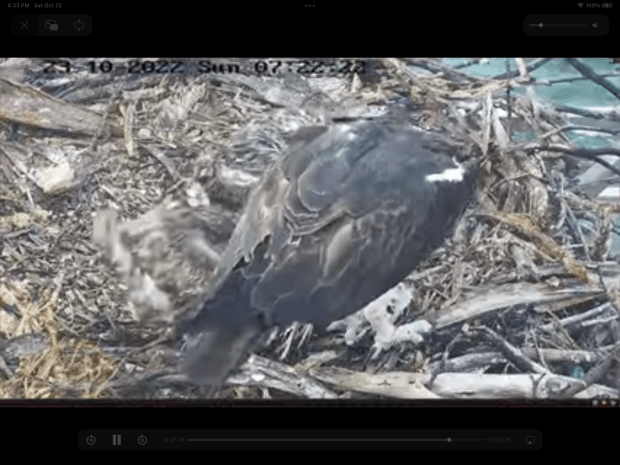
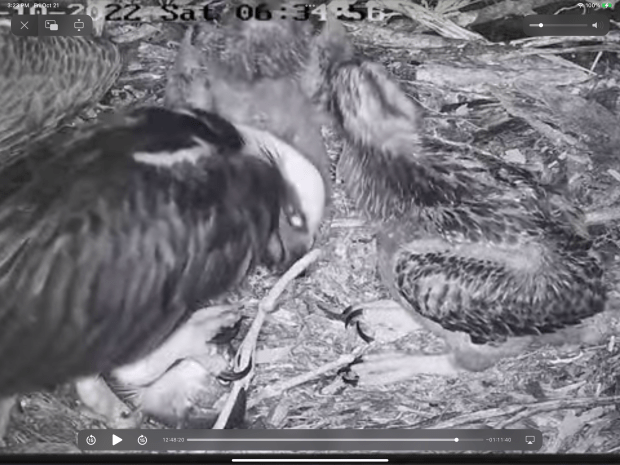
At 111232 a whole large live fish landed on the nest. Middle is being overly cautious not trying to grab any bites. Letting Big get those precious first bites and get her crop a little full. Meanwhile, Middle is pecking away at the tail of the fish. This is very interesting. You have probably seen, as I have, siblings eating from the tail while the breaking sibling is fed up at Mum’s beak. It is a good strategy once Middle figures out how to unzip that tail. By 112218 Middle is up by Big and is doing the snatch and grab. Sometimes Middle pulls back – he is very cautious. Mum gets to eat some fish. In fact, she is feeding the ospreys a little slower than usual. Big moves away from the fish feeding a couple of times. The first is at 112506. Big has been eating for 13 minutes and is getting full. Mum begins to feed Middle. At 112951 Big moves away. Middle remains cautious and then, at 114139, Middle pecks Big before he moves up to begin getting fish. So to summarize, even thought Middle is afraid and displays this as we watch, he is hungry and he is getting braver in order to get fed. Eating is essential to his survival. Middle is doing well. He will end the feeding with a nice crop.

I also noticed that Big is not as grumpy as yesterday despite there being 5 hours between fish deliveries. Perhaps she is slowing down, hitting that plateau. That would really bring peace to this nest.

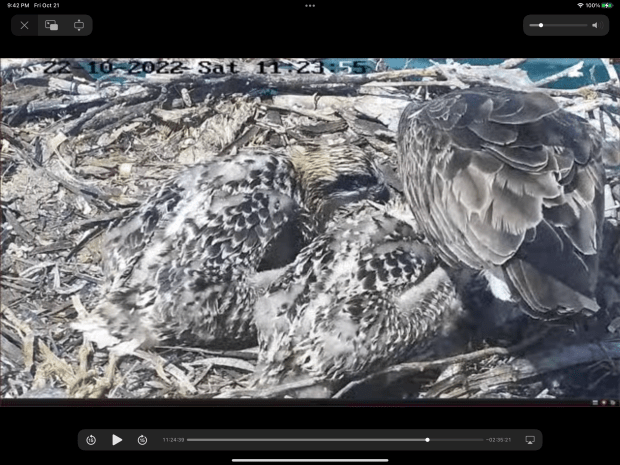
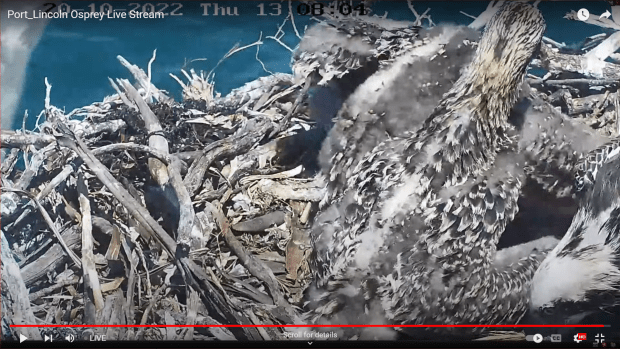
By the time the 1637 Zebra fish arrives on the barge, Middle is feeling much better, more confident, and Big is being nicer. That feeding went well and even at 1817 when Mum and the two ospreys saw Dad and were feverishly calling for another fish, Middle (and Big) had enormous crops from the day’s takings. I have spent much time watching this nest as opposed to the two falcon scrapes because the fate of Middle was not quite clear. I will have said it twice today, at least, but, it appears that Port Lincoln has turned a corner.

Look carefully at the bottom image. That is Middle, full to the brim. Just sit and smile. Cry. Life appears to be good at Port Lincoln. Still, send all your best and warmest wishes to this family for continued supplies of fish.

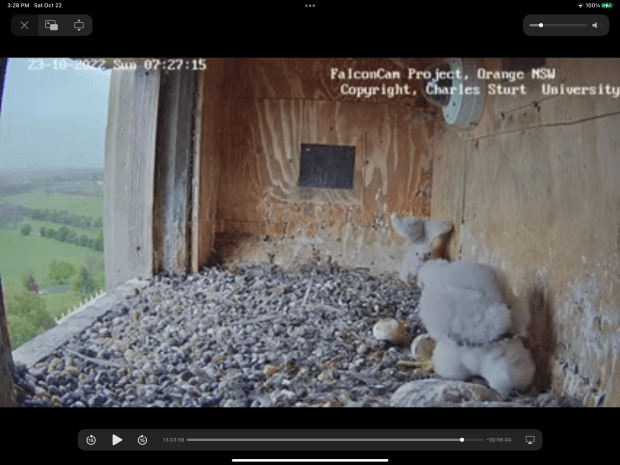
It is getting more difficult to tell the female Peregrine Falcons from the males. You must look closely. Diamond just about fooled me yesterday. They lose weight. All of the females lose approximately 30% of their body mass during incubation and raising their chicks. Diamond now has the look of a male with his tight little striped pants.

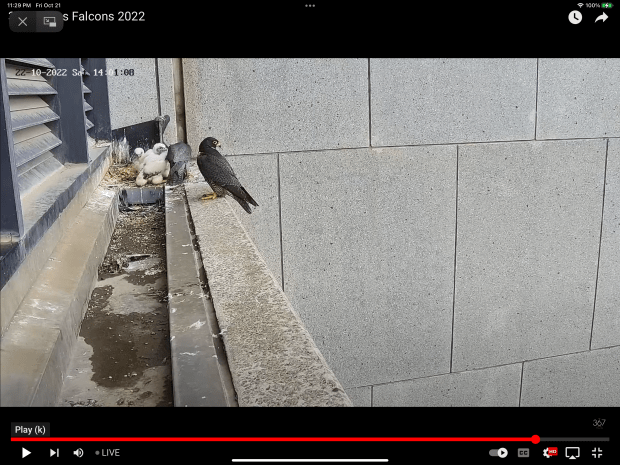
The same is true for Melbourne where the camera is now positioned so we can see the happenings at the far end. Mum seems to be enjoying it. She has a nice perch above the chicks so that she can watch them but not have any one or all of the Melbourne Four rumbling around underneath her all night. Like human parents, she can get some sleep now!!!!! Thank you to ‘H’ who watched and clocked the feedings at 367 Collins Street yesterday. Much appreciated. There were 5 of them. At 0650 a large unprepared prey arrived on the ledge. The erases were fed for 22 minutes. Leftovers came at 1153 and that was an extremely short feeding of 4 minutes. At 1358 D arrives with a big prey item and feeds the eyases and then Mum arrives and takes over. That lasted 16 minutes. The final two feedings at 1657 and 1836, were large prey items fed for 24 and 18 minutes, respectively. Four active growing eyases can eat a large unprepared bird in such a short time!

This is just a short catch up. Everything is absolutely fine at the two scrapes in Australia – at the 367 Collins Street location and at Orange. I am cautiously delighted about the happenings at Port Lincoln and extremely proud of Middle Bob who is getting ever so clever. Middle Bob is a ‘survivor’.

Thank you so much for joining me. I hope that you are all well. I am back to normal. it was the flu shot that caused me to feel like I had been hit by a big truck. It is cloudy this morning but it appears to be a reasonable day to go and check on ducks. Take care everyone. See you soon!

Thank you to the following for their streaming cams where I took my screen captures: Port Lincoln Ospreys, Charles Stuart Falcon scrape, and ‘H’ and ‘A’ and 367 Collins Street by Mirvac.

Late Friday in Bird World

21 October 2022

The day turned out to be a lovely 14 degrees C. I am not feeling 100% but I do not have Covid. I am thankful but, I did call off the small celebration for my BFF’s birthday just in case. I know that some of you have symptoms of long Covid and my heart goes out to you every single day. My problem seems to be a response to the flu vaccine. Nothing serious and it will go away. Please do not worry. The chair I am sitting on is perfect and there is nothing more healing that watching the birds flit from one feeder to another and the squirrels run along the top of the fence. As a friend -who is healing from surgery reminded me this morning – watching the birds outside in the feeders is joyful and healing.

Awhile ago I posted some recent research that found that hospital rooms that had windows looking out to trees had patients who were happier, required less pain medication, and went home sooner!!!!! So look outside and smile!!!!

Making News:

The news on SE30 is coming in slowly. This is the latest from our friends down in Sydney.

Last year was tragic for Nancy and Harry at the MN-DNR Bald Eagle nest. First, the dashing young Harry went missing leaving Nancy to have to not only provide security, at a time when intruders were about, but, also provide food for the two eaglets on the nest, E1 and E2. The weather was miserable. Nancy was unable to provide food for both and E1 threw E2 off the nest. E2 was euthanized. E1 went on to fledge. Nancy was, however, left alone with a beautiful nest but no mate. Well, that seems to be over.

I was thrilled to read that Bonnie Johnson consulted with Pat Burke for the name of the new male. Pat Burke has an encyclopedic memory of the Sydney Sea Eagles as well as many of the Bald Eagle nests. As a wealth of knowledge, she has graciously answered any and all eagle questions that I threw at her. She is a treasure.

Honestly I cannot think of anything scarier climbing up an Osprey nest. Can you?

The Mispillion Harbour Osprey nest on the coast of Delaware is one of the busiest nests off season. ‘H’ has made videos of the Bald Eagles coming and going, occasionally taking sticks. Today, the nest was visited by what appears to be a immature Norther Harrier. As a reminder, don’t think your favourite nest is idle, check it often!

It is often the fringe that gives the Harrier’s ID away. Their face actually looks like an owl at times and the fringe gives them the same ability to hear that an Owl has. Gorgeous birds.

It is time how to turn our attention to the Australian nests to see how they are doing for breakfast.

Dad arrived on the very wet ledge of the 367 Collins Street scrape with a pigeon at 065144. Mum flew in immediately after he landed to feed the Melbourne Four. So, despite the rain, prey is being brought up in good time – either freshly caught or from the pantry. It doesn’t matter as long as the erases get fed, right?!

Mum perched near the Melbourne Four during the night. The erases are too large to brood now and they will remain dry in the rain that Melbourne is experiencing at this end of the ledge.

I suspect something similar is happening at the scrape box of Diamond and Xavier. Dad will fly in with the breakfast and Mum will come and feed Indigo and Rubus. What do you think?

You can see some blue sky and some clouds. It appears as if it will also be a rainy day in Orange. Xavier should be bringing in prey shortly. We all worry about them when the bad weather and heavy rains come. Take care Xavier.

Every time I think of Port Lincoln, I hold my breath before I start looking at the streaming cam. Big has been in such an attack mode lately that – well, since the loss of Little, it can make one overly anxious for Middle. There is, however, no reason to believe that Middle will not fledge. If Middle is a male he might to decide to get off that nest much faster than the lads last year so that he can get away from Big!

A fish arrived early. That could be a good omen but, not always. It does get the nest off to a good start. The times was 063456. It was a nice big fish. Of course, Big had to eat first. Middle was very nervous but by 065018, Middle was trying to figure out a way to get some breakfast. In the end, he decided to just move up next to Big and eat. Middle has become very good at snatch and grab and as long as Big doesn’t tear into him – and she does sometimes when she thinks Middle is getting more food than her – Middle should’ve be able to have a reasonable feed. There is fish left.

Middle is going to be fine. Big has moved away and Mum is finding all the scrap pieces of fish she can for Middle. Now…Mum needs food! Middle has a nice crop. Smiling.

If Big could just turn her attention more to nesting, Middle might be able to enjoy a carefree life til fledge. Remember the chicks will get names and will be banded on 12-14 November.

Everyone has had food but Orange. I am certain that Xavier will come into the scrape, possibly drenched, with prey before long. Indigo is really exploring the boundaries of the scrape and looking out to the world. Rubus has now moved to exploring the corner and sleeping there – Little Brother copying Big Sister!

Thank you for being with me today. Wish for fish and prey. Take care of yourselves. See you soon!

Thank you to the following for their posts and streaming cams where I took my screen captures: Port Lincoln Ospreys, 367 Collins Street by Mirvac, Charles Stuart Falcon Cam and Cilla Kinross, ‘H’ and Mispillion Harbour Osprey Cam, Friends of the Non-Game MN-DNR Bald Eagle Nest, Cornell Bird Lab, Nature Heaven Group, and Sea Eagle Cam.

SE30 is in care, Middle and the two fish…and other news in Bird World

21 October 2022

It is 14 degrees C in Winnipeg. That is really hard to believe and it is almost 2200. I am again starting my newsletter for tomorrow early. With the improved weather I hope to get some photographs of the birds foraging and building their strength to migrate tomorrow. I wonder if that little fuzzy duckling that was getting its back feathers is still around? Tomorrow will be a lovely day to be outside and this morning newsletter might be my only one for the day with a little brief account late about the breakfast feedings.

Oh, how things change overnight. My super powerful flu shot seems to have given me the flu! I am behind in answering e-mails as a result but I wanted to get the bird news off to you. I plan is to feel better. You hear a lot about my grandmother. She was a great believer in honey ginger tea and sweating out the sickness. We will see if she was right. Have a wonderful day. Thank you!

Making News:

SE30 has been taken into care. The birders on the ground in the vicinity of the Discovery Centre near the Sydney Olympic Forest have been keeping an eye on her. No details are given on what caused her to go into care. It was, however, believed that she had not been fed by the parents. It is very challenging for the WBSE fledglings once they leave their natal nest in the forest. The Magpies and the Currawongs continually chase and harass them. It has been happening for years, never slows down, and always seems to wind up in tragedy for our eaglets that we treasure.

This was the announcement:

There are two main spotters of European Ospreys in their winter homes in Senegal and The Gambia. Jean-marie Dupart reports from Senegal and Chris Wilson reports from The Gambia. The images give you an idea of their winter homes along the coasts of Africa and the inland waters. These are the latest sighting reports by duPart:

Jean-marie Dupart travels to various sites in Senegal reporting throughout the season. You can find his page on FB. Just do a search using his name.

Australian Nest News:

For those that missed it, the second camera at 367 Collins Street has been activated and you can now watch the comings and goings of the Melbourne Four. So grateful to Mirvac for acting so quickly. We were all in a panic.

The heat from the sun was such a worry especially with this first time falcon mother leaving her eyases for extended periods of time. When she was with them in the heat of the day, Mum made a magnificent umbrella. ‘A’ and I were counting the days until the eyases could run down the gutter to the other end and get in the shade. This area is also protected from the rain. Perhaps the four will persuade Mum to choose that end next year to lay her eggs!

Rubus and Indigo could have their own comedy programme on cable television. What a pair they are.

Rubus and Indigo have had 3 feedings so far today. They were leftovers at 070557, a parrot at 074247, and what looks like to be another parrot or rosella at 105333.

Be sure to notice Rubus’s little wing flaps. Seriously. What an adorable eyas. I could watch his antics all day!

Indigo had been flapping her wings and Rubus had been watching. Just look at him give it a go!!!!!!!

There was high hope in Port Lincoln that the arrival of that huge fish at 0649 was a good omen and that many fish would be brought to the nest in quick succession. You can see from Big’s enormous crop that it had a fantastic breakfast. Middle had some beaking from Big but, wound up with a nice crop, too.

The pattern has been that Big is not so ‘grumpy’ at breakfast but gets more anxious as the day progresses. This translates into the beaking of Middle. It is now after noon and a second fish is yet to arrive.

The cam operator did give us some wonderful close ups. You can see the feather development on Big.

Please note that Port Lincoln have set the 12-14th of November as ringing day on the barge. The chicks will get their names and their measurements should give us an indication as to their gender. What do you think?

The amber eyes of the youngsters will change to yellow when they are adults. The only exception to this that I know is Monty at the Dyfi nest in Wales. He kept his amber eyes – something that was very striking in an adult bird.

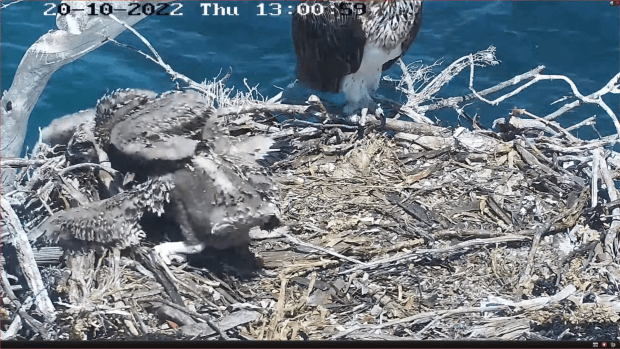
At 1300 Dad brought in a flat fish – at times it looked like one of the Zebra fish. It looked a little stiff. Middle immediately took the fish doing a superb mantling job. Big was not going to let Middle have a whole fish to himself and a brutal attack occurred. Big took the flat fish while Middle was curled up in submission. Big managed to open the fish and eat.

Yeah for Middle!

Middle defends himself and the fish.

Big uses her brute strength and size to push Middle over. Look at her enormous legs and feet.

Big also has quite the bottom – a sign of a chick that has not gone without.

Having whipped Middle into submission, Big moves over to the rim of the nest. She has completely forgotten about what she was fighting for.

Then she remembers.

Big was able to find a place and tear off the skin and eat.

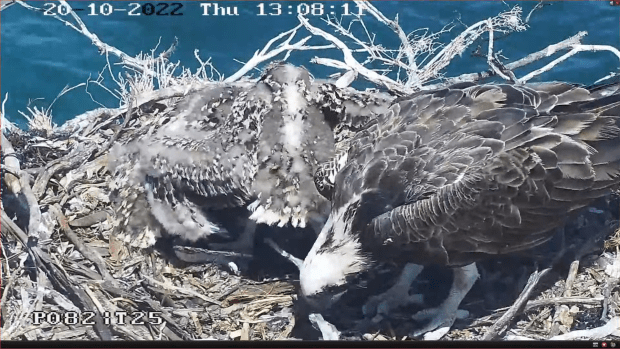
At 1312 Mum flies in with a whole big fish. She caught it. You can see the white feathers of her fluffy behind are wet. Big immediately drops the fish Dad brought and moves up to Mum to be fed. Middle stays in submission. At 132939 Middle moves over and Mum begins to feed her second chick. Six minutes later, Big decides he wants more fish! He eats, moves, then Mum feeds Middle again.

Once Big leaves, Middle moves over slowly to get some food. Remember. Big ate the majority of the breakfast fish and still had a big crop at 1300. Middle has only had ‘some fish’ – hard to tell how much but, clearly Middle needs to eat much more, just like Mum does.

Big gets a hankering for more fish.

Topped up, Big goes to watch the water while Mum finishes up the big fish she caught. I bet she thought she might get to eat something, too. Big reminds me so much of the second hatch at Achieva Ospreys in 2021. That osplet would eat and eat just to spite everyone else.

At 1346 Mum takes the flat fish and begins to feed Middle. She will move this fish and eat some herself. She is ‘very’ hungry. These two leave little fish for her.

Middle has a crop. Mum must eat to replenish her energy.

Mum ate some but could not ignore Middle’s calls for fish. She turned around and fed Middle and, at the end, treated herself to the fish tail. I want you to look at the size of Middle’s crop. There are no worries for Middle. If he gets no more food today, he will be fine. If he does, it will be a bonus.

Note the time. Mum has really been feeding these chicks! She should get a reward for looking out for Middle. She has certainly done that in very subtle ways the last two days.

Middle’s crop is just about to pop!

Migration News:

There are no new transmissions for Karl II who was in Egypt and Kaia who was in Chad. They could be in areas with very little service. Everyone was quite worried because no transmission had come in for Bonus. It is well known by the data kept in Estonia, that only 20% of Black Stork fledglings survive their first migration. This caused much anxiety and then…Bonus’s data came in. He is still in Romania near Latinu.

Waba had his breakfast at a lake formed by the Koca Stream (?) then he flew 284 km and was at Baklankuyucak, Turkey.

Send all your warm wishes for their continued safe travels.

Thank you so much for joining me. Take good care of yourselves. See you soon!

Thank you to the following for their posts, their videos and streaming cams that make up my screen captures: Sea Eagles Cam FB, Jean-marie Dupart FB, Charles Sturt Falcon Cam and Cilla Kinross, 367 Collins Street by Mirvac, Port Lincoln Ospreys, and Looduskalender Forum.

The loneliest scrape…and other tales from Bird World on a late Thursday

20 October 2022

It is 16 degrees C. The sky on the Canadian Prairies is mostly cloudy. While the Blue Jays and Crows remain and the squirrels continue their feverish collection of nuts for their winter cache, it appears that most of the Dark-Eyed Juncos have departed. Oh, I will miss them flitting about with that touch of white on their tails as they move. There are still some Canada Geese in the City feeding on the grass and, tomorrow, I hope to get out to count geese and ducks. It didn’t work for today but, tomorrow should prove to be another light-jacket day. How grand!

In the Mailbox:

‘H’ asks: Do falcons hunt at night?

The answer is yes! This may be particularly true for urban falcons. Most observers of falcon streaming cams were first introduced to the night hunting with Alden, the new mate of Annie at the U-California Berkeley Campanile scrape box. It was thought that Alden used the light of the city to help him hunt for prey. It was also noted that the smaller birds that the falcons feed on are active in the dark and it would make it easier for Alden with the challenge of one of his legs. Sean Peterson also believes that it is safer for Alden to hunt at night, away from the eyes of other large predators (save for owls). This breeding season we have seen M22 bring prey in before dawn at the 367 Collins Street scrape.

From the Bookshelf:

I took Helen Armitage’s Lady of the Loch with me to several appointments this morning to read while I was waiting. I am going to go back and put a highly recommended star by this small packed volume. If you want to learn about nesting behaviour, this is an excellent read. If you want to learn about some of the myths about Ospreys that were debunked by Lady, it is a good read. At the time, scientists believed that Osprey females could only lay a total of 20 eggs! Lady laid more than 58!!!!!!!!!!!!!

Making Waves:

The floofs from the 367 Collins Street scrape have moved!!!!!!!!!!!!!! With the smallest one capable of stomping (‘A’s word and a sound she loves to hear) up and down the gutter, the Melbourne Four have packed up their bags and headed to the scrape at the other end of the ledge. This scrape is protected from rain and from the sun. They will no longer wonder if they are being roasted. Of course, we will have to rely on sounds and it would seem from yesterday that feedings also took place at that end of the building’s ledge. In the past there was great reluctance to move the camera during the breeding season. This is why, I believe, that Mirvac will be installing a second camera so that we can enjoy the eyases wherever they are until they fledge.

Of course, that does not help us observe them now but the policy has been very clear. The falcons will not be disturbed in order to change the camera for public viewing. That would go against all of the State wildlife laws.

So, at present, let us hope that those little fluff balls run back and forth to get their legs strong!

At 0606 you could hear kew-kew-kew coming from the ledge. The eyases were obviously enjoying their breakfast.

Nest News:

Deb Steyck made a video of Harriet and M15 working on their nest yesterday. Enjoy!

‘H’ caught the pair of Bald Eagles on the Mispillion Harbour Osprey nest again! This time they are removing a nice big stick. Replenishing their own nest for breeding season? I had no idea until ‘H’ told me that some of the Bald Eagles stay in Delaware, on the coast, for the winter. I know that we have one couple in our City and a single male downtown that stay year round. It has to do with food availability not necessarily weather.

Thanks ‘H’.

It was good to see that Middle had some of the late fish. I was extremely impressed when Big moved away from eating and Mum waited, watched, and then physically moved the fish over to Middle and fed him. This meant that Middle did not have to walk up to the fish and have Big turn around and beak him again. Middle had already been subjected to many attacks yesterday. I wonder what today will hold for our osprey nest on a barge in the marina at Port Lincoln?

Yesterday, it was very interesting watching Rubus and Indigo at the scrape in the water tower at Orange. I don’t know if it is just me or if it is the timing of the Starling deliveries, but these two eyases seem to much prefer Crimson Rosella’s, Rainbow Lorikeets, and ducklings compared to Starlings — like their mother, Diamond.

Diamond was up and out of the scrape at 060657. The day is waking up at Orange. Rise and Shine Rubus! Serenade us with your very loud voice.

Rubus and Indiigo had a leftover breakfast at 070557. Then…

Xavier arrives with a King Parrot at 074247. Rubus and Indigo are delighted!

Look at Rubus. Isn’t Dad going to feed us this morning? Xavier is a wonderful feeder. Maybe later, little Rubus.

Big is known to usually wake up in a good mood at Port Lincoln. That mood seems to change later. I am hoping that the whooper of a fish that came in at 064931 will just keep Big happy. Maybe Dad will find another one. he ate the head – Dad has to be as hungry as Mum at times. Keep them coming!

It is almost impossible to see who is eating until around 0717 when you can see Middle gets bites. I cannot tell you who got the most of that fish with confidence. I hope that Mum was able to feed them rather equally with some for herself.

Mum is beautiful and so are the two osplets. Just look. Little angels. Oh, I hope it stays that way from now on. Middle is closest to us. The black line on the top of its head is smaller. What a beautiful beard, Middle.

Middle looks like it has a crop forming. You can certainly see Big’s crop! Oh, I hope this nest has a good day today.

Oh, wish for fish for Port Lincoln!

Thanks for joining me today. Take care everyone. See you soon!

Thank you to the following for their videos, their posts and their streaming cams where I took my screen captures: Deb Steyck and SWFlorida Eagles, ‘H’ and Mispillion Harbour Osprey Cam, 367 Collins Street by Mirvac, Port Lincoln Ospreys, and Charles Sturt Falcon Cam and Cilla Kinross.

What a Mum…and other news Early Thursday in Bird World

20 October 2022

Hello Everyone,

I am starting tomorrow’s blog at 2130 Wednesday evening. I have appointments early tomorrow morning and I wanted to give you an idea of how the day progressed at the three nests we are watching in Australia. When it is Thursday in Canada, it is Friday in Australia. The day names and dates can be confusing!

I have started with Port Lincoln. The two falcon scrapes are stable although anything could happen at any moment to change that. The worry remains with the barge nest. It is Thursday in Port Lincoln. Big should have calmed herself by now but, she hasn’t. The nest is very volatile. Warning that the images below are graphic. They show an intense attack on Middle. The feeding after 1500 is very interesting. Notice that Big does keep Middle from eating but, Big is full and leaves. Mum moves the fish and feeds Middle. Don’t ever think she doesn’t know what is going on!

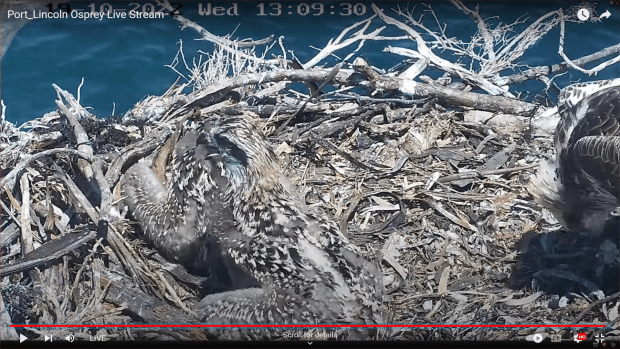
At the Port Lincoln Osprey barge, the water was calm and such a beautiful blue compared to the choppy waves of day’s past. At 063037 a whole fish arrived. It was so early that everyone hoped that this early start meant it would be a day full of lots of fish. So far, that has not been the case. As I write this, it is after 1300 and Big is attacking Middle. I was actually fearful that Big would push Middle off the nest.

I really had to hold my breath. It was clear that Big could have pushed Middle right out of the nest.

Middle stayed in the tight ball of submission and then, a few minutes later, wanted to move away from being by Big. Big started attacking Middle again.

Mum used a stick as a diversion. Would this get Big to turn away from attacking Middle?

Well, it did for a minute.

Mum flew off. Middle slowly slithered to the other side of the nest. Even if Mum brings in a fish right now, it is doubtful that Middle will get any. Big is in key form to block her younger sibling in any way that she can. The attack was ruthless. It was meant to instill fear and to let Middle know that Big is the boss. The food is for Big. Middle might get some, maybe, but only if Big is full to the tip of its beak.

I don’t think we will see any attempt by Middle to snatch and grab ————– I want to be wrong.

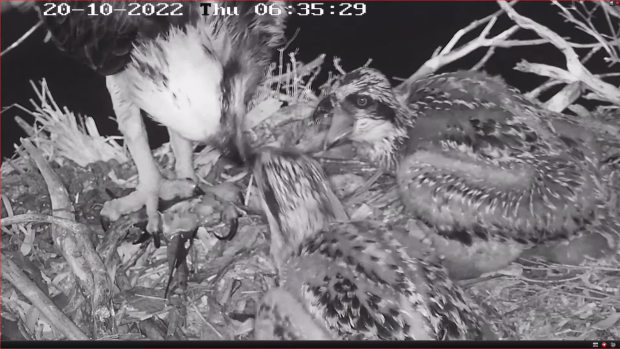
Another fish came in at 1504. It was a zebra fish. Big ate and ate and ate and starts on Middle at 1551. But Mum still has some fish left. And look! She physically moves the fish over to Middle so that it can have some food. I am so impressed.

Middle is hungry and hoping that a fish will arrive. Look at the crop on Big.

The last fish of the day arrives at 1838. It was almost impossible to see how the feeding went. The camera was zoomed out and then to close but Middle ate.

Big has a crop but did Middle eat??? Yes, he moved carefully around big to get to Mum’s beak.

Middle keeps its head down and waits for big to move out of the way.

Now Middle has its head up and is facing Mum. You can see its crop. Middle will not go to bed hungry.

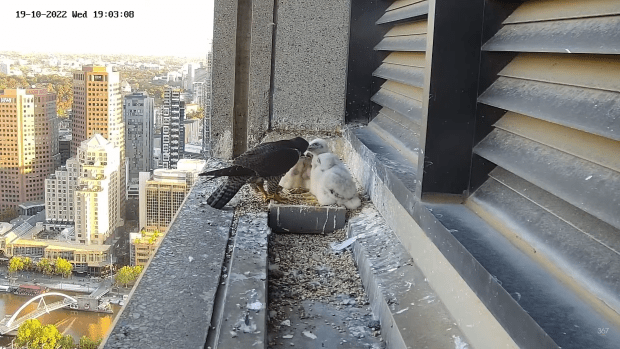
The only problem at the 367 Collins Street scrape is the heat and that is slowly becoming not a problem as the eyases – at least three of them – can easily run dwn the gutter to the other end of the ledge to get in the shade.

The parent is afraid that the fourth hatch is wandering too close to the ledge. Notice the attempt to pull back by the scruff of the neck. It is interesting that both parents use that method to get the chicks to stop doing what worries them – or to get them out of trouble -.

Mum leaves and the 4th hatch gets down into the gutter into the shade. I couldn’t help myself. What a cutie pie this one is. Love the nice big crop. All of the Melbourne Four are being well fed. Food is not a problem. My concern until now was the absences of Mum, the heat, and lack of shade. The four have solved that themselves by growing big and strong. They can get in the shade and simply wait for Daddy Door-Dash.

A little Buddha.

It is now very difficult to gauge the feedings at Collins Street because of the heat from the sun on the scrape. The eyases are down at the other end, in the other scrape where there is no camera, and we can hear the calling and feeding but we cannot see it now.

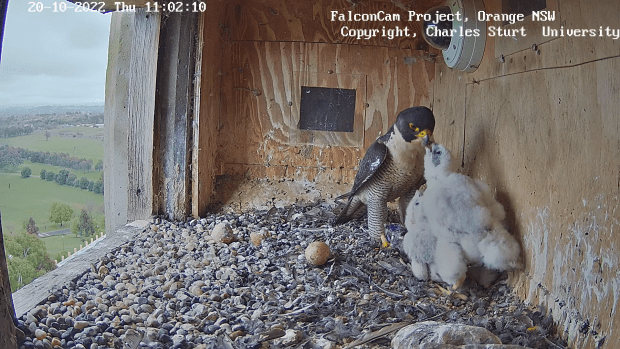
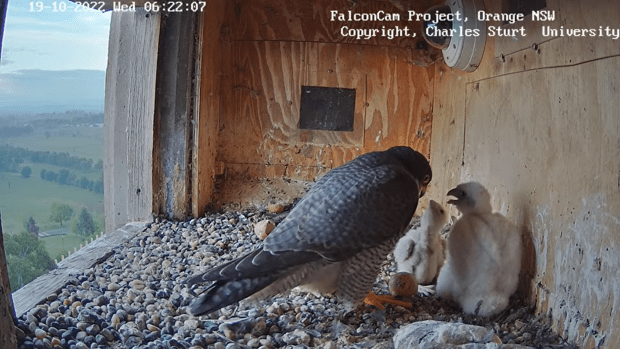
Rubus and Indigo have had a Starling breakfast, a feeding started by Xavier and finished by Diamond. Four and a half hours later, at 11:01:10, Darling feeds her two babies a Crimson Rosella. Oh, they loved it.

Oh, just look at how fluffy Indigo is and Rubus is getting fluffy, too. That white down will fly off their wings, their bodies, their heads revealing beautiful juvenile feathers. Underneath those feathers will be an insulating layer of grey.

More feedings arrive. The last one is a Starling at 1829 and neither Rubus or Indigo are hungry. They have crops from the earlier feedings! There are some gorgeous pictures of Diamond with Rubus before the arrival of that prey item.

Indigo would rather play on Cilla’s rocks and be in the corner wandering around that eat any more food. These two are absolutely adorable.

Peregrine Falcon scrapes are peaceful and fun to watch. The eyases are always cute in every stage of their development. in the Charles Sturt Falcon scrape, the way it is set up there is no fear for too much sun and rain on the chicks. They are protected. This close proximity to their lives allows us to begin to see the individual characteristics of each of the eyases. What a joy this can be.

Thank you for being with me for this brief look at the state of the Australian raptor nests. Take care everyone. See you soon!

Thank you to the following for their streaming cams: Port Lincoln Ospreys, 367 Collins Street by Mirvac, and Charles Sturt Falcon Cam and Cilla Kinross.

It’s not all about Raptors…

19 October 2020

Hello Everyone,

The first feeding at Port Lincoln was a good one, save for Mum. She has two big osplets that could sit and eat fish all day. It went well. Smiling. And it is warming up on the Canadian Prairies. It is 11 degrees. Tomorrow is going to be beautiful. It will be a good day to get outside!

In the Mailbox:

‘D’ writes:  You often mention some of the visitors to your garden. Today the squirrels were included again. I’m interested to read that you have greys & reds visiting. As you know, the greys in the UK are a threat to the reds, I wondered are yours a different species?

A Eurasian Red Squirrel in the Scottish Cairngorms. Photo by Dani Connor Wild.

I did not know the answer to ‘D’s question right away although I knew that Little Red looked different than the Red Squirrels in Sweden and the UK that Danni Connor photographs. First, the Grey Squirrel is native to North America. It was introduced by the aristocrats of Victorian England as an ornamental species. It is very invasive and there are currently issues with it and the native Red Squirrel in the UK. In my garden, Dyson is the matriarch of all the grey squirrels. She has been visiting for several days now along with her babies from the summer. One of the young ones prefers the shelled peanuts and will spend hours eating on the deck in the warm sunshine. Dyson will eat anything – as all of you know – but she much prefers the solid seed cylinders with the nuts and cranberries.

There are 3 species of Red Squirrel: the North America species is the one that lives in my garden in Canada. It has no ear tufts and has a single cache of winter food. Previously, Little Red used the garden shed but now he stores his nuts in the wood box. Eurasian Red Squirrels live in the UK, Europe, and parts of Asia. They have tufted ears and spread their cache to multiple sites. Gosh, I loved that question. It made me look closer at my own garden animals and it reminded me of Dani Connor Wild. I wonder what she has been up to?

Well, Dani has made a trip to Scotland to see rewilding and reintroduction measures. Wow. So today, it isn’t all about raptors…but imagine, in these Scottish Highlands, in the spring, the call of the Osprey!

Making News:

Arthur was caught on camera this morning at the Cornell Red Tail Hawk nest on the Fernow Light Tower. He delivered a single stick at 083726. It sounds like Big Red has chosen which nest to use for the 2023 breeding season. Arthur looks good!

Here he comes!

I am so fascinated at how they fly so fast, talons first and pull back their wings so they are not ripped off as they go through the metal bars.

Well, hello Arthur. It is really nice to see you!

The streaming cam at the nest of Southwest Florida Eagles Harriet and M15 is now operational again after Hurricane Ian. You can watch the nest building progress.

Australian Nests:

It is sometimes not easy watching raptor nests. We love the little gaffers and take them to our hearts. Most of the time all is well but, there are times when it isn’t and we lose one. Many of us still want to honour Little Bob in some way. We are discovering more and more about the legislation and who is responsible for permissions. When ways to help ask for intervention permissions are discovered, I will certainly let everyone know.

This was the day that the beaking began – 26 September. Little Bob was so tiny next to Big.

This is a video put together by Bart who is one of the moderators on the PLO chat that is beside the streaming cam. Difficult but best to watch to the very end.

I had so hoped that Big would settle and let peace reign on the Port Lincoln Osprey nest. That happened until it didn’t. Let’s hope that today is different.

The first fish of the day, a whole fish, arrived on the nest at 063037. This is early and very promising. So far Middle has been able to have bites without being beaked…although he is visibly cautious of Big. Middle is the furthest away from the screen.

Oh, it’s a nice big fish. Middle is so hungry and he is getting so good at the old snatch and grab. Every once in awhile, if you watch it live, you will see Middle jerk over to the right with its head and shoulders – trying to get his head out of the way if Big goes for him. But so far, so good. Big has ‘leaned over’ to try and remind Middle she’s the boss but Middle is so hungry he is doing a great job at snatch and grab. Hopefully Big will be friendly all day long but she tends to get grumpy…let’s just blow the grump out of her!

Now Mum needs some fish. That was a great feeding. Back and forth between the two. Middle finished with a really nice crop. So happy. The feeding was over at 064511. Fifteen minutes to vacuum down a big fish with its head. Gracious.

Pigeons are arriving early in Melbourne. Mum waddled down the ledge with the breakfast offering before the lights in the CBD had come on. It was 05:42:33. That pigeon was finished and Mum flew off with a couple of bones at 06:06:22. Gosh, just stare at the eyases with their thick white down and the feathers beginning to appear. Many are beginning to look like that cartoon hero The Hulk or maybe a member of the Australian Rugby team as they try to stand and use their wings for balance.

Just look. One trying desperately to stand and the other all fluffy with a nice tail. They are changing before our eyes. The thermal down will be beneath their feathers when they finish getting their plumage before fledge.

Everyone looked like they were full.

At Orange, the kids are awake. Diamond has been restless and Rubus is starving! No surprise there. It is shocking how much prey that little one can hold. And here I must admit something. I think that Rubus is one of the cutest eyases I have ever seen. He is such a character. They are waiting for breakfast to arrive.

Xavier flew to the ledge with a freshly caught unplucked Starling at 055658. The kids got a lesson in plucking. Rubus was so excited to see prey that the little gaffer was happy to have a mouth full of feathers.

Xavier was visually delighted that Diamond was not in the scrape and he got a chance to feed Rubus and Indigo.

It is 1536 on the Canadian Prairies. The sky is cloudy but it is warming up. The Juncos are busy eating Millet off the red garden carpet, their favourite. What a nice way to close the blog with the garden birds happy and all the chicks in the Australian nests fed. It is such a relief that Middle got a good feed this morning first thing.

Thank you so much for being with me. Please take care. See you soon.

Thank you to the following for their posts and streaming cams that made up my screen captures: Dani Connor Wild, SWFlorida Eagle Nest and D Pritchett Family, Cornell Bird Lab, 367 Collins Street by Mirvac, Charles Sturt Falcon Cam and Cilla Kinross, and Port Lincoln Ospreys.

Big shuts Middle out of fish…and other breakfast news from Australia

20 October 2022

Yesterday was a good day. All four of the Blue Jays were seen along with all four of the Crow family. The two Chickadees came flitting through. Four grey squirrels and one red one. Loads of Sparrows and Dark-eyed Juncos. I know I have mentioned all of them recently but there is something so reassuring to see them – alive. Urban environments present particular challenges for our feathered friends and, it is like knowing that your whole family is fed, warm, and tucked in for the night. It feels good just like watching the little falcons eat. Something very rewarding.

Making News:

SE 30 was seen in a residential area around the Discovery Centre. What a beautiful sea eagle.

Jackie and Shadow have been working on the nest in the Big Bear Valley. Shadow has a new hair style to show off for this breeding season!

It is that time of year that lead begins to make news – and never in a good way. Read the post by one of my favourite Wildlife Rehab Clinics in the US, A Place Called Hope. It takes one lead pellet or one lead sinker to damage or kill an eagle. When there are alternatives, this is unacceptable. If lead paint is outlawed because it can harm humans, then lead hunting and fishing equipment that causes death to our raptors needs to be outlawed as well.

I wish that I could tell you that all is well at Port Lincoln. A whole fish arrived at 090824. Middle did get some bites but Big ate the majority of that fish making Middle have to do the snatch and grab. At 124709 another fish arrived on the nest. Big is going to eat all of it. She has beaked Middle so that he is afraid to come up to the table. Middle was tucked in tight. Listening and watching. At 13:10:58 Middle slithers up to Mum. Is there any fish left? No. Mum just ate the fish tail.

There will, of course, be other fish. But there is still a problem. We had high hopes that Big would calm down and everything would be civil on the Port Lincoln Nest on Monday. Big did get most of the fish but she was not chasing Middle away from the table.

Both eating on Monday.

By Wednesday everything had changed significantly. If Big continues to eat the way she is, Mum is not getting enough food and Middle will continue to be intimidated and afraid to go and eat.

Big will stop eating to intimidate Middle.

Middle really needs to have a good meal.

There were other fish but beyond the 0909, Big did not allow Middle much. Those fish came in at 1247, 1651, 1931, and 1952.

If Middle moves a speck, Big raises its head. This is not a good situation. Middle neeeds to eat today, Thursday in Australia.

At Melbourne, the problem was the heat. The eyases were very hot. Some made it to the other end of the ledge to enjoy the shade. Mum and Dad had turns acting as umbrellas to block the sun.

Both parents dug in their talons and tried to help the Melbourne Four.

Thankfully the shade came! What a difference a couple of hours makes.

Lots of prey came for the Melbourne Four. It looks like Mum took charge of all the 5 feedings. Thanks to ‘H’ and ‘A’ for the time stamps and information. At the 0552 feeding, the eyases ate for 9 minutes; at 0749 it was 21 minutes, at 1627 for 32-33 minutes, at 1734 for 12 minutes, and a bedtime snack came in at 1859 and the kids ate for 5 minutes.

Indigo and Rubus had five feeds yesterday, too. Those came at 072721, 100848, 105425, 144754, and the last one before light’s out was at 181056. The prey thought to be a Red Waddle bird at 100848 was positively identified as a Noisy Miner later.

Have a close look at little Rubus. He is starting to get pin feathers.

Diamond is making sure that Indigo uses her neck muscles, too!

Diamond is fascinated by the camera!

Migration News:

The news coming for Karl II and his family of Black Storks from the Estonian Karula National Forest appears to be all good. Little Waba flew 298 km and is now in Turkey. S/he did that in one day!

This is an image from where Waba’s tracker indicated s/he is feeding. Just lovely.

There was no new transmission from Kaia. She continues to be in Chad in a dry area it is believed.

Bonus is still in Romania feeding in the ditches east of Latinu.

Karl II really got to flying. he covered 373 km in one day and is now feeding along on the eastern side of the Nile River near Asswan.

Great News.

Two things I try to avoid when bringing you news about our feathered family are politics and religion. Sometimes, politics cannot be avoided because our wildlife are wrapped up in particular views and policies that belong to the different parties in the various governments around the world.

There is a quiet movement behind the scenes to see what can be done to change the intervention laws in South Australia in the memory of Little Bob. What we have learned is that David Speirs -often seen with the ospreys, Janet Forster (Port Lincoln Osprey founder), and who is now President of Friends of Ospreys- was the Minister of the Environment for the State of South Australia and, as you can tell, extremely supportive of the Ospreys. The Liberals lost the last election and the Labour Party is in power. David Speirs (Ervie is named after the village in Scotland where Speirs was born) is now the leader of the Opposition.

Every day something new is discovered. Current regulations and policies are being examined to see how to move forward. The last thing anyone wants to do is to damage the fine work that Port Lincoln and Friends of Osprey have already done. It takes time for change but, no one is forgetting Little Bob least of all Port Lincoln who support intervention but cannot within the current policies and guidelines or they would lose their licenses and everything they have gained in terms of being able to provide for the Ospreys. All of this is good. Little Bob is not forgotten.

Thank you so much for being with me today. Please take care. See you later today with the breakfast news. Send positive wishes to Port Lincoln, please.

Thank you to the following for their posts, videos, and their streaming cams where I took my screen captures: Sydney Sea Eagle Cam FB, Friends of Big Bear Valley, A Place Called Hope, Port Lincoln Ospreys, 367 Collins Street by Mirvac, Charles Sturt University Falcon Cam and Cilla Kinross, and Looduskalender.

Will Indigo hit the bullseye again and other news…Late Tuesday in Bird World

18 October 2022

Hello Everyone!

It is entirely possible that the most entertaining and educational streaming raptor cam of the year will be the Falcon Cam on the water tower at Charles Sturt University in Orange. It is the home of Xavier and Diamond, seasoned parents, and this year’s eyases, Indigo and Rubus.

How do you spell adorable? Indigo and Rubus! When Indigo was walking today, Rubus was very concentrated in watching his big sister.

Today, Indigo continued her quest to walk while, at the same time, she is practicing hitting the camera with her ps every day. The last one resulted in Dr Cilla Kinross, the lead researcher on the Peregrine Falcon Project, having to climb 170 steps inside the old water tower to clean the camera.

Watch Diamond’s reaction and then, don’t stop. Listen to how little Rubus is. Then, watch as Cilla finishes going down the ladder, Indigo has a near hit again!

Of all the streaming cams, this one with its three cameras gives you a view of the tower so you can see the peregrine falcons arrive and leave, and two views of the scrape. The closeness lets us catch the details that can be missed elsewhere including the incredible facial expressions and eye popping moments.

Indigo and Rubus have already had two feedings today. At 055209, Xavier arrives with the breakfast pigeon. That breakfast is over at 060314. At 074959, a bird with long red legs arrives. What is special about this feeding is that little Rubus is in front and gets some of the best and biggest mouthfuls yet. How splendid. He did not have to stretch his neck all the way to Sydney to eat! Cilla Kinross thinks it could have been a Red waddle bird.

Proud mama Diamond.

Indigo wants to walk and flap at the same time. She is just not quite coordinated yet!

This morning Indigo played, ‘Ring around the Rubus’.

That second prey item was very popular!

Look at that neck on Rubus!

The Melbourne Four had an even earlier breakfast. Dad arrives with the pigeon before Melbourne is even waking up. It was 055209. At 060314 Mum flies off, breakie is over. At 074959 there is another pigeon feeding! These parents are working hard to take care of the pigeon population in the CBD.

Port Lincoln was still waiting as the golden glow of the sun spread down on the nest with beautiful Mum and Big and Middle. It is the first time we will see Big stand.

Dad brought in a late fish last night but the osplets and Mum are starting to get a little peckish as 0800 gets closer. Big has pecked Middle a couple of times – late yesterday – but, in general the nest has entirely settled down. Middle is a beautiful bird. Look at the images of her/him next to Mum at the end.

We all miss Little. It is impossible not to grief that we have loved. What we need to learn is the ‘why’. But, now it is time to turn our attention to wishing well for Mum and Dad, for the nest to have a lot of fish, for these to fledge, and have productive lives building up the population of Ospreys in South Australia.

At the same time, take care of your garden birds, the birds at the park, and do whatever you can, how little or small, to make the world a better place for our feathered friends. A place where there is so much fish that all of the birds and animals depend on the oceans, the seas, the lakes, and rivers can thrive. We will talk about how you can do that later this week but, if you have good ideas or know projects, send them to me. I would be very grateful.

Middle is very smart. He tries not to make eye contact with Big yet. Instead, he moves over by Mum to look out over the water waiting for Dad’s arrival.

As Port Lincoln waits for breakfast, I will sign off. It is a sunny blue skied day in Manitoba. The temperature is 4 degrees C with the promise of a much warmer day coming on Thursday.

Thank you for being with me on our breakfast check up in Australia. Take care everyone. See you soon!

Thank you to 367 Collins Street by Mirvac, Port Lincoln Ospreys and Charles Sturt Falcon Cam for their streaming cams where I took my screen captures.

Update on SE30 and other news in Bird World

18 October 2022

Good Morning Everyone,

The sky is a beautiful royal blue, not a cloud in sight and it is -7 on the Canadian prairies. On Thursday, we will warm up by 21 degrees C to a balmy +14. I cannot wait! I can hear the Crows but, I cannot see them. The Blue Jays are already finding corn and the Dark-eyed Juncos are still in Canada. Meanwhile, despite the break in the weather which will be wonderful for checking duck numbers in the city, it is time to get all the winter closed organized, put up the garden hose, and store the summer deck furniture.

Making News:

The birders on the ground, the bogs, near the Discovery Centre really need a great pat on the back. Thanks to them we have been able to keep up with SE 30 since s/he fledged. It is fantastic. Just look at this beautiful juvenile. SE 30 looks to be doing very well, indeed. Here is the latest announcement:

I really hope that SE30 is getting their own prey and we do not see them hungry in a couple of weeks on the sidewalk. Send this wonderful fledgling all the good wishes that you can!

Floods in the State of Victoria, Australia are causing havoc for wildlife.

Native wildlife flee flood waters across northern Victoria – video | Environment | The Guardian

From the Bookshelf:

I realized that I should create a link to a book list for everyone who is searching for books on different species. I promise to do that over the winter. The latest questions have been about books on Ospreys – questions about general knowledge books and others more specific. ‘H’ gave me a poke and reminded me about one on migration that she had just read. So here goes a few good books on Ospreys to get you started.

I have two books by Alan Poole on Ospreys. They are excellent reference books. The first is Ospreys. A Natural and Unnatural History published by the University of Cambridge in 1989. There are no beautiful colour photos – it is all black and white. The second is Ospreys. The Revival of a Global Raptor published in 2019 by John Hopkins University Press. The second book is much more up to date in terms and has made use of technological advances in studying raptors to bring our understanding up to date on their lives.

One of favourite books on Ospreys is by Roy Dennis who has spent the last 60 years re-introducing raptors to England (and various sites in Europe such as Spain). His book, A Life of Ospreys, of 2009, is very good.

The book that ‘H’ wants me to mention to you is Belle’s Journey. An Osprey Takes Flight by Rob Bierregaard. As ‘H’ points out it is not just for children and the reviews say it is loved by those from 9 to 90. The book follows a fledgling osprey with a satellite tracker to her winter home so it is about migration and its challenges. Extremely well written and easy to understand.

A book by David Gessner, Soaring with Fidel, is written on the back of Belle’s Journey and offers us even more insight into the migration of the Ospreys from the NE US who winter in Brazil and Columbia. It was this book that has prompted me to want to take that journey to Cuba to sit on top of a mountain with thousands of Ospreys flying overhead. Gessner is a charismatic writer and it is not boring science which one can easily get tired of reading. Like Bierregaard, Gessner weaves the science in like a parent sneaking cough syrup to a child and they didn’t know it.

Gessner wrote a second book, Return of the Osprey. A Season of Flight and Wonder. Equally well-written but this one focuses on the breeding season, not migration.

I know that many of you are fans of the Chesapeake Bay nest. Inside An Osprey’s Nest. A Photographic Journey through Nesting Season takes you up close and personal with a newly mated pair of Ospreys. Their eggs fail. Will they accept foster chicks? It is a moving narrative with incredible pictures.

If you can get your hands on a copy, The Scottish Ospreys from extinction to survival by Philip Brown is excellent. It was published in 1979 and, like the first Poole edition, has mostly black and white illustrations. It is an excellent historical account of the demise of the Osprey in the UK and the reintroduction efforts that have been underway by individuals such as Roy Dennis.

Lady of the Loch. The Incredible Story of Britain’s Oldest Osprey by Helen Armitage tells the story of Lady who lived to have 20 breeding seasons in Scotland. It gives special insights into the challenges of the birds, banding, etc. I thoroughly enjoyed it but, it is a book about a special Osprey in a special area of Scotland. If you are looking for general knowledge, get the second book by Poole first.

There are many others some written to celebrate a notable male bird such as Monty or the history of Rutland Water and its Ospreys. I will include that in the long list for everyone.

Nest News:

The Melbourne Four are really keeping the two first time parents busy. All of them are capable of getting up and down out of the gutter and today, when I checked, there were only three near the scrape. I did, literally, hold my breath til that little head appeared. ‘A’ loves the sound of the eyases ‘stomping’ down that metal piece of the ledge because it means that they can now get into the shade. ‘A’ might be happy but the parents appeared particularly bewildered at times today.

Poor Dad got down in the gutter with them. Just think. These two didn’t have one eyas to deal with in their first season as parents. Oh, no. They got four…lively, healthy, fat little bottomed chicks. It is perfect.

The parents must have decided that they need to bring in more pigeons. The kids had pigeon at 0646. When next I checked, Mum had come in with a pigeon and was feeding them at 1014. They had just settled down and Dad comes in with ‘something’. The time was 1031. I hope someone identifies this prey. It was big. It is so odd watching the falcons attach the prey to one taloned foot and hobble down to the scrape. It was not clear if the eyases would get up to eat but, they did. They are literally just ‘eating machines’ right now growing bigger and bigger every day.

At Orange, a Starling showed up at 0624. It was the parrot that came in at 0941 that caused the most excitement. We are going to start calling Rubus ‘Rubber Neck’. My goodness Xavier makes Rubus work for his dinner. He jumps and stretches and squeals. Meanwhile, Indigo just sits there occasionally raising her neck and sometimes taking food out of Rubus’s beak. She is unphased by his antics. What a live wire Rubus is. ‘Full of vinegar’ my grandmother would say rolling her eyes thinking of all the mischief he will be getting into.

At Port Lincoln, the day was rather calm. A large fish came in early – at 0748. It was followed by a much smaller fish at 0954.

At Port Lincoln, Dad brought in a total of six fish for the day. That is a lot of fish! Just look that the crop on Big.

Middle also has a crop. Yippee. I hope that Mum was able to get enough fish for herself. It is so hard to determine that when she is so busy feeding these two growing osplets.

Rubus and Indigo ate well. The Melbourne Four could have had more prey but, the osplets were stuffed. In all it was a good day in Australia yesterday. The Melbourne Four can now easily move up and down the gutter to the scrape so they can get into the shaded area if Mum is not about.

Thank you so much for joining me today. Take care everyone. See you soon!

Thank you to the following for their posts and/or streaming cams where I took my screen captures: Amazon, Sydney Sea Eagle Cam FB, Port Lincoln Ospreys, 367 by Mirvac, and Charles Sturt Falcon Cam.

Grieving? Surviving? A look at Bird World early Monday

17 October 2022

Good Morning Everyone,

The mailbox has been full. So many of you want to help Port Lincoln get permission to intervene should siblicide be apparent in the future, others want to know if raptors grieve, many are concerned about the hot sun on the eyases at Collins Street. What a caring community you are! It warms my heart. The outpouring of love for a small little Osplet still brings tears to my eyes. It is so very difficult to lose one. It takes days to get over it.

It was cold this morning. -5 C. We are being told that there will be a warming period with temperatures up to 13 the end of this week. I hope to go and check on the ducks that day and see how many remain in our City. The past two evenings there have been no Canada Geese flying overhead. It will be interesting to see how many are still at the nature centre.

Today, however, I have appointments this afternoon and I expect that my breakfast updates will be arriving late.

In the Mailbox:

My mailbox has been full of individuals wanting to help Port Lincoln get permission to intervene in the future should the fish deliveries run low. I would love to help Port Lincoln secure those permissions. There have also been other questions – ‘Is Big really a survivor’. My answer is below in Nest News’.

One question that is very important comes from ‘F’ who writes: ‘Will the mother know that the youngest has died because of the eldest?’

The answer to that question is ‘yes’. At times Mum even ‘sat’ on the three when they were younger to stop the beaking. Other osprey and eagle parents have tandem fed so that the youngest gets food. There are many examples of tandem feeding but Harriet and M15 come to mind immediately. I always refer back to the falconer, Laura Culley, who insists that raptors have a higher level of communication than humans – that we have lost that ability. She would answer this question with this answer, ‘And why wouldn’t the Mum know what happened?’

Animals and raptors grieve. A few good examples are when the sweet Moli chick, Ka ha Ki’i died unexpectedly in April 2021. His Mum, Laysan Alobatross, Kauai often visited his grave. When Hope and Peace died on the Captiva Bald Eagle nest due to a rat brought to the nest by their dad, Joe. The rat had eaten rodenticide poisoning. Both parents stood over the body of the second dead eaglet and mourned before it was removed for testing. Humans only believe that we are the only ones with feelings and emotions. This is not true. One of the best books on the subject of the emotional lives of animals which includes grieving is Marc Bekoff’s The Emotional Lives of Animals.

It also needs to be understood that most parents do not get the opportunity to grieve because they have other chicks to care for. In many instances, when the male has felt responsible for the deaths of the babies, such as the case with Joe at Captiva, he is mourning, leaves the area, and never returns. Connie, his mate, has taken several mates since him but has had no eaglets to fledge.

Making News:

The attacks on Chris Packham and calls for his BBC presence to end by Nature’s Alliance are not being supported by the public. Indeed, the mood of the UK population is to support nature, not harm it. Packham has been lobbying to end grouse hunting on the hunting estates. He has had his gate and car burned and has threats on his life.

Public support for Chris Packham overwhelms Countryside Alliance’s latest vindictive attack – Raptor Persecution UK

If you ever travel to Port Lincoln, they have indicated that Ervie often perches in front of the hotel on the Morton Bay Fig Tree.

Nest News:

‘A’ wrote to me about Indigo and the Starlings head wondering if anyone would mention it. Yes, it comes in the form of a video! It was one of those great moments in streaming cam history.

If Academy awards could be given out in Bird World surely the ‘Starling Head Scene’ at the Orange scrape would rate right up there with the shower scene in Alfred Hitchcock’s Psycho.

Here is the video of that interaction with the Starling head.

If you are trying to watch Orange today, you will not be able to see the chicks from the side camera (the one I use) very well. Indigo made a perfect bull’s eye with a big ps. I wonder if Cilla will climb up the 170 steps to get to the scrape to clean it? I am betting she does.

Victor Hurley has announced that Mirvac is going to install a second camera at the 367 Collins Street scrape in Melbourne next year. He also indicated that the camera will be panned out to show part way down the gutter now that the eyases are becoming more mobile. There are a few of us that are hoping they might put a shade cover and rain protector – like they have at the other end of the ledge on the other scrape box – on this one if the F22 is going to continue leaving her eyases alone in the heat of the day.

‘H’ takes very detailed notes of the Collins nest. She counted 5 feedings yesterday: At 1640 for 15 Minutes; at 0852 for 11 Minutes; at 1343 for 19 Minutes; at 1657 for 27 Minutes; and the last feeding at 1920 for 21 minutes. I was astounded at how fast the Melbourne Four could eat a large pigeon yesterday. Thanks, ‘H’.

At Port Lincoln, Big decided a few times that Middle was getting too much of the fish. The beaking was not awful and you can see Middle has a crop in the image below but, the intimidation remains. I continue to hope that her angst slows. Today Big will be 30 days old.

Let us all be clear about ‘Big Bob’. Big Bob did not have to survive anything. Big Bob ate all the fish including times when Mum needed some nourishment, intimidated its siblings, even killing one of them by starvation and possible injury. Right now Middle is having to survive Big and Middle is ‘clever’. She went under mum’s bottom and between her legs to eat. Middle has -so far – survived Big. Sadly, Little did not. Big has had no hardships to face. As ‘H’ puts it, ‘How would Big do if it went up against some bird bigger than it?’ ‘H’ is right. We would then see if Big was a survivor. The use of the word is misleading – you must survive ‘something’ to be a survivor.

The weather was not good yesterday with choppy water and strong winds. Dad managed to bring in several fish – one whole and the others partially eaten. The fish he brings in must feed four. If he is to provide, he has to eat. So does Mum. Dad has no control over the wind, the waves, and the gulls that attack the Ospreys wanting their fish. We hope that he has much better fishing luck today. The nest could use some large fish to fill everyone up — and I am speaking mostly of Mum since you will notice that both Big and Middle had crops at several feedings.

With the first eggs due to laid in November for the Bald Eagles in the US, ElfRuler has posted links to all of the streaming cams for eagles. Here is the link to their blog to find those cams.

LINKS TO STREAMING CAMS | Bald Eagles (elfruler.com)

Thank you so much for being with me this morning. I hope not to be too late with the breakfast news today. Take care all. See you soon!

Thank you to all those who wrote in with questions or comments, to ‘A’ and ‘H’ who are my eyes in the middle of the night, and to the following for their posts and streaming cams that make up my screen captures: Raptor Persecution UK, ElfRuler Blog, 367 Collins Falcon Watchers, Port Lincoln Ospreys, 367 Collins Street by Mirvac, and Charles Sturt Falcon Cam.